My Husband Found a Cat Sealed in a Plastic Box—But What He Did When a Hand Touched Him Broke Me
PART3:
A rasp.
Not a meow.
Not really.
More like a body asking whether air was still available.
Daniel’s voice dropped.
“Who does this?”
I had no answer.
No good one.
“Get him help,” I said. “Call me after.”
“I’m taking him now.”
“What about the route?”
“I don’t care about the route.”
That was when I knew how bad it was.
Daniel cared about work. Not because he loved garbage collection, but because he was responsible. He finished what he started. He hated leaving a job for someone else. If he said he didn’t care about the route, then whatever was in that bin had reached a place inside him I rarely saw.
He drove the cat himself.
The nearest veterinary clinic was twenty miles away, tucked beside a feed store and a tire shop. It was small, the kind of place that handled farm dogs, barn cats, goats, chickens, and the occasional injured wild animal someone found on the road.
Dr. Evelyn Hart was the veterinarian on duty.
She told me later that when Daniel walked in carrying the plastic bin, she could smell it from the front desk.
The cat was barely conscious.
His temperature was 107.4 degrees Fahrenheit—41.9 Celsius. Dr. Hart said normal for a cat is around 101 to 102.5. Past 105, organs start failing. Past 106, you are racing death. His kidneys were already in crisis. His liver enzymes were so high she ran the test twice because she thought the machine had made a mistake.
His gums were white.
His heart rhythm was irregular.
His skin, when gently lifted, stayed tented for six full seconds before flattening again.
He was critically dehydrated.
Starved.
Burned.
Poisoned by his own waste.
And yet he was alive.
Dr. Hart and her tech, Jenna, moved fast. Cooling. Fluids. Oxygen. Bloodwork. Eye rinse. Pain medication as carefully as his organs could tolerate. Wound assessment. Warm water cleaning in stages because his body could not handle too much shock at once.
Daniel sat in the waiting room with the empty plastic bin beside him.
A receptionist asked if he wanted to throw it away.
He said no.
When he told me that part later, I asked why.
He said, “Because if he dies, I want someone to see what he survived long enough to be found in.”
The clinic staff began calling him “the bin cat” at first because no one knew what else to call him.
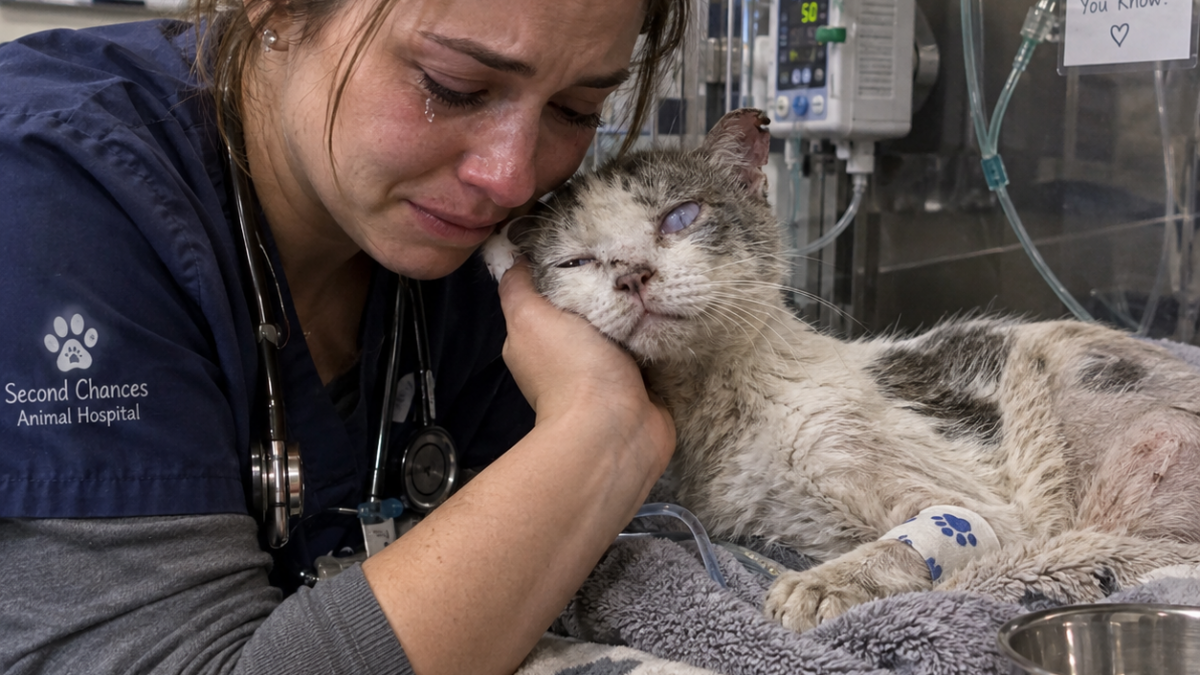
Then Jenna reached into the oxygen cage to adjust his IV.
That was when everything changed.
He was lying on a towel, too weak to lift his head for more than a second. His left side was less damaged than his right, though only slightly. On the right, his whiskers were mostly gone, burned or destroyed by the ammonia trapped inside the bin. His left whiskers still trembled when air moved.
Jenna slid her hand inside the oxygen cage.
The cat opened his one usable eye.
Jenna froze, expecting panic.
Most animals in his condition would flinch.
Some would bite.
Some would retreat as far as their bodies allowed.
This cat did none of that.
He dragged his face toward her hand.
Slowly.
Painfully.
Then pressed the intact side of his face into her palm.
Jenna did not move.
His eye closed.
Then she felt it before she heard it.
A vibration against her fingers.
He was purring.
His body was failing. His eyes were burned. His paws were split. His ears were necrotic. He had been sealed in a box with no air, no water, and no hope for five days.
And the moment a human hand touched him without hurting him, he leaned into it.
Jenna had to leave the room.
Dr. Hart found her crying in the hallway.
That was the first time I heard the sentence that would later become the center of his story.
“He’s not stupid,” Jenna said. “He knows what hands did to him. He just still wants to believe this one is different.”
Daniel came home that night with red eyes and no appetite.
The children were already asleep.
I had kept dinner warm, but he only sat at the table and stared at his hands.
I poured him coffee even though it was late.
“Is he alive?”
“For now.”
“What did the vet say?”
Daniel rubbed his face.
“That he shouldn’t be.”
I sat across from him.
He told me everything then. Not dramatically. Daniel is not a dramatic man. He speaks in plain sentences, and that made it worse.
Plastic box.
No air holes.
Duct tape.
Five-day-old newspaper.
Heat inside likely over 120 degrees.
Eyes chemically burned.
Ears cooked.
Paws damaged by urine.
Hip sores because he couldn’t move.
Organs failing.
Still purring.
When he got to that part, his voice cracked.
I reached across the table and took his hand.
He looked down at our joined fingers.
“He pushed his face into Jenna’s hand,” he said. “Just like that.”
I tried to imagine it.
I couldn’t.
Not really.
It is one thing to feel sorry for suffering.
It is another to be confronted with trust surviving where trust had no logical reason to remain.
“What happens now?” I asked.
“They’ll keep him overnight. Maybe several nights. Dr. Hart said the next forty-eight hours are critical.”
“And after?”
Daniel looked at me.
“I don’t know.”
I did not like the way he said it.
“Daniel.”
“I’m not saying anything.”
“You have that look.”
“What look?”
“The look you had when you brought home the broken rocking chair from the dump because you said it ‘still had structure.’”
He almost smiled.
Not quite.
“This is not a chair.”
“I know that.”
“He may not survive.”
“I know that too.”
But he did survive the first night.
Then the second.
His heart rhythm stayed irregular for forty-eight hours. His kidneys were watched obsessively. His liver numbers were terrifying, then slowly less terrifying. His eyes required medication several times a day. The burns inside his ears crusted and sloughed. His paws had to be wrapped, then unwrapped, then cleaned, then wrapped again. Dead tissue on two rear paw pads had to be removed surgically.
The upper third of his left ear could not be saved.
His right ear healed curled inward, scarred into a shape that never fully opened again.
A pressure sore on his left hip became necrotic and had to be debrided. Because his organs were too fragile for full anesthesia, Dr. Hart and Jenna worked with local numbing, pain control, and careful restraint. They expected him to cry. They expected him to struggle.
He purred.
Through IV changes.
Through wound care.
Through eye cleaning.
Through bandage changes.
Through the first time they placed him on a soft bed.
He kneaded that bed with damaged paws, slowly and painfully, as if testing whether softness was real.
Jenna sent Daniel updates.
Daniel showed them to me even when I told him I was not getting attached.
“I’m just telling you,” he said.
“No, you’re preparing me.”
“For what?”
“For the sentence you already want to say.”
He slid his phone across the table.
There was a photo of the cat lying on a fleece blanket, one eye cloudy, one ear bandaged, face turned toward a human hand resting near him. His paw was on that hand.
I looked away first.
“He needs somewhere to go,” Daniel said quietly.
“There are rescues.”
“Yes.”
“People who know cats.”
“Yes.”
“We have never had a cat.”
“I know.”
“Owen is loud. Lily is three.”
“I know.”
“We don’t even own a litter box.”
“We can buy one.”
I stared at him.
He looked exhausted.
Not just from work.
From carrying the image of that box.
I sighed.
“Temporary.”
He nodded too fast.
“Temporary.”
“I mean it, Daniel.”
“I know.”
“I’m not keeping a cat.”
“I know.”
“I don’t know how to care for one with this many medical problems.”
“We’ll learn.”
That word should have warned me.
We.
Kept came to our house twelve days after Daniel found him.
He did not have that name yet.
Dr. Hart had started calling him “Buddy,” which every veterinary clinic seems to call every animal in crisis when no one knows what else to say. Jenna called him “sweet boy.” Daniel called him “the little guy.” I called him “the cat,” because I believed distance could be maintained through language.
He arrived in a carrier lined with washable pads, medications labeled in careful marker, printed care instructions, eye ointment, paw balm, antibiotics, liver support, kidney follow-up schedule, and more warnings than I felt ready for.
He weighed four pounds.
His ideal weight, Dr. Hart said, should have been closer to ten.
He looked smaller than the space around him.
His left eye was permanently cloudy, covered with a bluish-white veil. His right eye tracked movement but watered constantly. His left ear was clipped and bandaged from surgery. His right curled inward like a dry leaf. His hip had a shaved, raw-looking patch with stitches. His paws were wrapped in tiny bandages that made each step awkward.
When I opened the carrier in our spare bathroom, he stepped out slowly.
Then stopped.
The room was quiet. We had laid towels on the floor, set out water, food, a low-sided litter box, and a soft bed Dr. Hart said he loved at the clinic. Daniel stood behind me, holding his breath.
The cat looked around with his one working eye.
Then walked straight to my hand.
I had not reached for him.
My hand was resting on the floor beside me.
He crossed the towel, lowered his head, and pressed the left side of his face into my palm.
I froze.
Daniel whispered, “He does that.”
The cat closed his eye.
Then he purred.
Not a small purr.
Not a polite sound.
A deep, broken, rumbling purr that seemed too large for his damaged body.
I had planned to be practical.
Medication schedule. Feeding. Follow-up. Temporary care.
Instead, I sat on the bathroom floor with this half-blind, burned, scarred little cat pressing his face into my hand like he had been waiting for me.
“Oh,” I said.
That was the beginning of the end of temporary.
The first night, I checked on him at midnight, two, and four, though no one told me to. At six, I found him awake, sitting on the towel beside the door. He looked up when I entered, and his damaged tail moved once.
I sat down.
He climbed into my lap.
Slowly.
Carefully.
As if every movement still cost him.
Then he pressed his face into my open hand and stayed there.
Thirty minutes.
That was how long I sat on the bathroom floor while my coffee went cold downstairs and the children argued over cereal and Daniel looked in once, saw us, and wisely said nothing.
At breakfast, Owen asked, “Is the cat staying?”
“No,” I said.
Daniel coughed into his mug.
Lily, who had oatmeal on her sleeve, asked, “Why not?”
“Because we’re just helping him get better.”
“What’s his name?”
“He doesn’t have one.”
“He needs one.”
“No, he doesn’t.”
Owen frowned.
“Everything needs a name.”
I hated when children were right.
For three days, I refused to name him.
On the fourth morning, he climbed into my lap at the kitchen table. His paws had healed enough for him to move more comfortably, though he still stepped carefully. He pressed his face into my hand as always, closed his good eye, and purred so loudly that Lily started giggling.
“He sounds like Daddy’s truck.”
Daniel smiled.
I looked down at the cat.
Someone had taped him in a box and left him with garbage.
Someone had meant for him to disappear.
Someone had decided he was disposable.
And yet here he was, in my kitchen, choosing to trust the hands of a woman who had not even wanted him.
“Kept,” I said.
Daniel looked up.
“What?”
“His name is Kept.”
The room went quiet.
Owen repeated it softly.
“Kept.”
Lily clapped.
“Keppy.”
Daniel’s eyes filled, though he turned toward the sink before anyone could see.
That was his name from then on.
Kept.
Because someone threw him away.
And someone else decided he was not trash.
Caring for him was not romantic.
People like to turn rescue into soft music and before-and-after photos, but the middle part is work.
Medication alarms.
Eye ointment he hated but tolerated.
Paw soaks.
Bandage checks.
Accidents outside the litter box because the low entry still hurt his feet at first.
Vet visits.
Bills.
Special food.
Humidifier.
Balm for his paw pads because healed tissue cracked when the air was dry.
Warm compresses for the eye that never stopped watering.
Monitoring his hip scar.
Checking his ears.
Learning which meow meant pain and which meant dinner and which meant someone had shut a door he preferred open.
There were nights I cried from exhaustion.
There were mornings I found blood spots from cracked pads and panicked.
There were days when Lily wanted to pet him too hard and Owen forgot to wash his hands before touching the ointment tube and Daniel came home late and the house smelled faintly of medicine and cat food and damp towels.
And through all of it, Kept trusted us.
Not blindly.
I came to hate when people said that.
“He’s so trusting, like he doesn’t know what happened.”
No.
He knew.
His body knew.
He flinched at the sound of duct tape tearing. The first time Daniel opened a plastic storage bin in the garage, Kept vanished under the couch and did not come out for two hours. If a door clicked shut too loudly, his ears flattened. If the air in a room grew too hot, he paced until we opened a window.
His body remembered.
But he had made a decision I still do not understand.
He had decided hands were not the enemy.
Or maybe he had decided that even if some hands were, not all hands had to be.
There is a difference.
He never hissed.
Never scratched.
Never bit.
Not at Dr. Hart. Not at Jenna. Not at Daniel. Not at me. Not even at the children.
One afternoon, Lily climbed onto the couch beside him with the unsteady enthusiasm of a three-year-old who loved too loudly. I was folding laundry nearby. Before I could stop her, she wrapped both arms around him and accidentally pressed one small hand against his damaged ear.
Kept’s body tensed.
My heart stopped.
“Lily, let go.”
She froze.
Kept turned his head slowly.
He did not snap.
Did not run.
Did not raise a paw.
He touched his nose to her fingers.
Then lay back down.
Lily whispered, “Sorry, Keppy.”
I picked her up and carried her into the kitchen, where I explained for the fourth time that gentle meant gentle, especially with his ears.
Then I went into the bathroom, closed the door, and cried.
Not because of his scars.
Not because of his blindness.
Because everyone before us had tried to teach him that hands meant pain, confinement, abandonment, tape, heat, fear, and the closing of a lid.
And he had refused to finish that lesson.
What kind of creature does that?
What word is there for a heart that survives cruelty and still reaches for warmth?
I still don’t have one.
Kept grew stronger.
Slowly.
His weight climbed from four pounds to five, then six, then almost eight. He never reached the full size Dr. Hart thought he might have been before starvation, but he became sturdy in his own way. His fur grew back soft except over the hip scar, where a small hairless patch remained permanently sunken. His right whiskers partly returned, but three never did. The left side of his face stayed more expressive, more alive somehow, because that was the side he offered to every hand.
His left eye remained blind and cloudy.
His right eye watered constantly.
His hearing was never normal again, partly from the damaged ears. He startled if approached from the wrong side, so we learned to tap the floor or let him see us first.
The children learned too.
Owen became his serious protector, teaching visitors the rules.
“Don’t touch his left hip hard.”
“Don’t grab his ears.”
“Let him smell you.”
“He likes open hands.”
Lily announced to everyone, “Keppy was trash but now he’s not,” which horrified me until Dr. Hart heard it and said, “Honestly, that’s accurate.”
Six months after he came home, Daniel finally threw away the plastic bin.
Not in our trash.
He drove it to the county evidence disposal after the investigation closed without charges. No cameras. No witnesses. No fingerprints useful enough. No one claimed responsibility. Whoever sealed him inside disappeared back into the world with clean hands, at least on the outside.
Daniel asked if I wanted to see the bin before he got rid of it.
I said no.
Then changed my mind.
It was in the garage, sealed in a thick evidence bag.
Clear plastic sides.
Blue lid.
Tape residue still visible around the rim.
No holes.
That was the detail that made me furious all over again.
No holes.
Not even one.
No last-minute mercy.
No hesitation.
No tiny opening where guilt had pushed through.
Just a sealed box.
I stood looking at it for a long time.
Daniel stood beside me.
“I hate it,” I said.
“I know.”
“He was in that.”
“Yes.”
“For five days.”
“Yes.”
“I want to break it.”
Daniel handed me a hammer.
That is marriage too.
I smashed the lid first.
Then one side.
Then the other.
I hit it until pieces of plastic scattered across the garage floor and my arms shook.
Daniel did not stop me.
When I was done, he swept up the pieces and took them away.
That night, Kept climbed into my lap and pressed his face against my sore hand.
As if he knew.
As if he forgave something I had not even done.
Over time, Kept’s story spread because Jenna posted about him with our permission. She wrote carefully, leaving out some of the worst details, though the photos said enough. His curled ear. His cloudy eye. His scarred paws kneading a blanket. His face pressed against her palm.
People cried.
People donated toward his medical bills.
People asked to adopt him.
By then, he was not available.
He had never been, not really.
One comment under the post stayed with me.
How does a cat forgive humans after that?
I stared at it for a long time.
Then I wrote a reply I almost deleted.
I don’t know if forgiveness is the word. Maybe he just refuses to let the worst human be the only human who gets to define us.
Jenna printed that comment and taped it inside the staff room at the clinic.
I felt embarrassed when I saw it.
But I still believed it.
Kept did not erase what happened.
He did not forget.
He did not become untouched by trauma.
He simply kept making new evidence.
Every hand that fed him.
Every hand that warmed his bed.
Every hand that cleaned his eye.
Every hand that touched gently and stopped when he leaned away.
Every child’s hand learning softness.
Evidence that the first hands were not the whole story.
That is what healing became in our house.
Evidence repeated.
Again and again.
Every morning, Kept climbed onto my lap at the kitchen table.
It became our ritual.
Daniel left early for work. The children came down noisy and hungry. The coffee maker hissed. Toast burned sometimes. Shoes went missing. Permission slips appeared at the last second. Life stayed chaotic.
And in the middle of it, Kept would appear.
He would jump first onto the chair beside me, then step carefully into my lap. He always turned the same way, offering the left side of his face, the side with the intact whiskers. I would open my hand.
He would press into it.
Then his good eye would close.
And he would purr.
Loud enough to hear from the next room.
Some mornings, I had a thousand things to do.
Pack lunches.
Sign forms.
Find socks.
Answer work emails.
Start laundry before mildew claimed the towels.
But Kept did not care.
He had waited five days in a sealed box.
Thirty minutes of my morning seemed like a small thing.
So I gave it to him.
That ritual changed me.
I had spent years moving through mornings like a machine. Efficient. Irritated. Always behind. Always measuring love in completed tasks.
Kept did not need efficiency.
He needed presence.
An open hand.
A still lap.
Someone willing to stop.
I began waking fifteen minutes earlier, then thirty, just so I would not resent the time he asked for.
Imagine that.
A cat who had been thrown away taught me to stop treating tenderness like an interruption.
Kept is about five now.
That is Dr. Hart’s best guess.
He is blind in one eye, partially deaf, missing part of one ear, and shaped by scars in ways strangers notice before they notice anything else. His right eye still waters. His curled ear never fully opens. His paw pads crack in dry weather, so we keep balm in three rooms. His hip scar remains a smooth hairless oval. Three whiskers on his right side never grew back.
He is not beautiful in the easy way.
He is beautiful in the way old quilts are beautiful. In the way repaired pottery is beautiful. In the way a hand with scars can be beautiful when it is holding something gently.
Our daughter Lily is eight now. Owen is eleven. They barely remember the house before him. To them, Kept has always been part of the morning, part of the furniture, part of the family grammar.
“Don’t move, Kept’s on Mom.”
“Watch his paw.”
“Who used the last of Kept’s eye wipes?”
“Kept stole my blanket.”
“Kept’s purring again.”
When new people come over, he approaches slowly, sniffs their shoes, then—if they pass whatever test cats understand and humans don’t—presses his face into their hand.
Every time, I hold my breath.
Every time, I feel the same ache.
Not fear.
Awe.
He still chooses this.
After everything, he still chooses this.
One afternoon, Daniel came home from work and found me sitting on the kitchen floor with Kept asleep against my leg. I had been crying, though quietly.
He crouched beside me.
“What happened?”
“Nothing.”
“That usually means something.”
I wiped my face.
“A woman at the library was talking about an article. Some animal abuse case. She said she couldn’t understand why people get so emotional about animals when they’re just animals.”
Daniel looked at Kept.
“What did you say?”
“Nothing.”
“That was probably wise.”
“I wanted to.”
“I know.”
I stroked the fur between Kept’s shoulders.
“Just animals,” I repeated.
Kept sighed in his sleep.
Daniel sat beside me on the floor.
For a while, neither of us spoke.
Then he said, “He changed our whole house.”
“Yes.”
“Changed my route.”
“Yes.”
“Changed the kids.”
“Yes.”
“Changed you.”
I looked at him.
Daniel smiled faintly.
“Changed me too.”
Kept opened his good eye, saw both of us sitting there, and began to purr without moving.
Just animals.
No.
Not just.
Never just.
A living creature is never just anything.
Five years after Daniel found him, Dr. Hart asked if we would bring Kept to a fundraiser for the clinic’s emergency care fund. I said yes before thinking it through. Then panicked for two weeks because Kept hated noise, strangers, carriers, temperature changes, and anything that interfered with his nap schedule.
But he surprised me.
He often did.
The fundraiser was held in a community hall, quiet and small, with tables of donated baskets and photos of animals the clinic had saved. Kept’s picture was on one display board: the early clinic photo, the one with his burned face against Jenna’s hand, and a newer one of him in my lap at the kitchen table.
People recognized him.
They approached gently because the sign asked them to.
Some cried.
Some whispered, “Hi, Kept.”
Some simply stood there, unable to speak.
A little boy with glasses asked if he could pet him.
I knelt.
“Open hand,” I said. “Let him choose.”
The boy held out his palm.
Kept leaned forward, sniffed, then pressed his face into it.
The boy’s eyes went wide.
“He likes me.”
“Yes,” I said.
“How does he know I’m nice?”
I looked at Kept.
“I think he gives people a chance to be.”
The boy considered that.
“That’s brave.”
“Yes,” I said. “It is.”
Later that evening, Dr. Hart asked me to say a few words.
I almost refused.
I am not a speaker. I shelve books. I pack lunches. I refill prescriptions and argue with children about screen time. I do not stand in front of rooms and talk about miracles.
But Daniel squeezed my hand.
Kept sat in his carrier with the door open, watching me through his good eye.
So I stood.
I told them I had not wanted a cat.
That got a laugh.
I told them my husband found him sealed in a plastic box beside the trash with no air holes, no food, no water, and no reason to trust anyone again.
The room went silent.
I told them about the heat, the burns, the cloudy eye, the missing ear, the cracked paws, the five-day-old newspaper.
Then I told them about Jenna’s hand.
About how he leaned into it.
About the purr.
My voice broke there.
I let it.
“People ask me how he forgave,” I said. “I don’t know that he did. Forgiveness is a human word, and sometimes we use it too quickly because we want pain to become tidy. Kept is not tidy. What happened to him was not tidy. His scars are not tidy.”
Kept shifted in the carrier.
I continued.
“But every day, he chooses not to let the worst thing that happened to him become the only truth he believes. Every morning, he climbs into my lap, presses his face into my hand, and purrs like the world is still worth trusting. I don’t know what to call that. I just know I’ve never seen anything stronger.”
People stood after.
I wished they hadn’t because applause startled him, but Kept only blinked and tucked his head against the blanket.
On the drive home, Daniel said, “You did good.”
I looked at Kept asleep in the carrier.
“He did good.”
“He always does.”
That night, after the children were asleep, Kept climbed into my lap on the couch. Not the kitchen chair this time. The couch, under the old yellow lamp, while rain tapped against the windows.
I opened my hand.
He pressed his face into it.
His purr filled the room.
Daniel sat beside me, one arm around my shoulders.
“He’s not what they did to him,” I said quietly.
Daniel looked at me.
“He’s what he became after.”
Kept’s good eye closed.
His curled ear twitched once.
Outside, rain washed the windows clean.
Inside, a cat who had been thrown away slept against the hands of people who had decided to keep him.
That is the story, really.
Not the box.
Not the tape.
Not the heat.
Not even the scars.
The story is what happened after someone opened the lid.
A waste worker stopped.
A veterinarian fought.
A technician offered her hand.
A family learned.
Children became gentle.
A house made room.
And a cat named Kept kept choosing warmth.
I still think about the person who sealed that box.
Not every day anymore, but sometimes.
I wonder if they ever remember.
If they know he lived.
If they would care.
If they have convinced themselves it was not as bad as it was, that he was probably found quickly, that animals don’t understand, that life moved on.
Life did move on.
But not the way they intended.
He did not disappear.
He was not crushed in the back of a truck.
He did not become one more sealed container in a landfill.
He lived.
He was treated.
He was named.
He was held.
He is loved by children who know exactly how to touch his damaged ears.
He has a bed in every room because Daniel claims he “just happened” to buy them on sale.
He has a stocking at Christmas.
He has medication reminders in my phone.
He has a veterinarian who still calls him “sweet boy.”
He has Jenna’s handprint in his history and mine in his mornings.
He has a place.
That is why we named him Kept.
Because keeping is an action.
Not a feeling.
Not a word on a tag.
It is medicine given on schedule.
It is paw balm in winter.
It is telling a child, “Gentle,” for the hundredth time.
It is waking earlier so a scarred cat can have thirty quiet minutes in your lap.
It is throwing away the idea that broken things are burdens.
It is choosing, every day, to be the opposite of whoever closed the lid.
Kept is not whole in the way he might have been.
Neither are most of us.
But every morning, when he climbs into my lap and presses the unburned side of his face into my hand, I feel the same truth vibrate through his purr.
He is here.
He is safe.
He is not what they threw away.
He is what we refused to lose.
And if you stand in my kitchen early enough, before the children come downstairs, before the coffee finishes brewing, before the day asks for anything else, you can hear him from the next room.
A scarred little cat with one good eye, half an ear, cracked paws, missing whiskers, and a heart no sealed box could ruin.
Purring like thunder.
Purring like proof.
Purring like he is still choosing to believe that the next hand might be kind.








