My Husband Abandoned Me in Labor for His Mother’s Birthday—Then Came Home to a Billionaire Holding Our Son
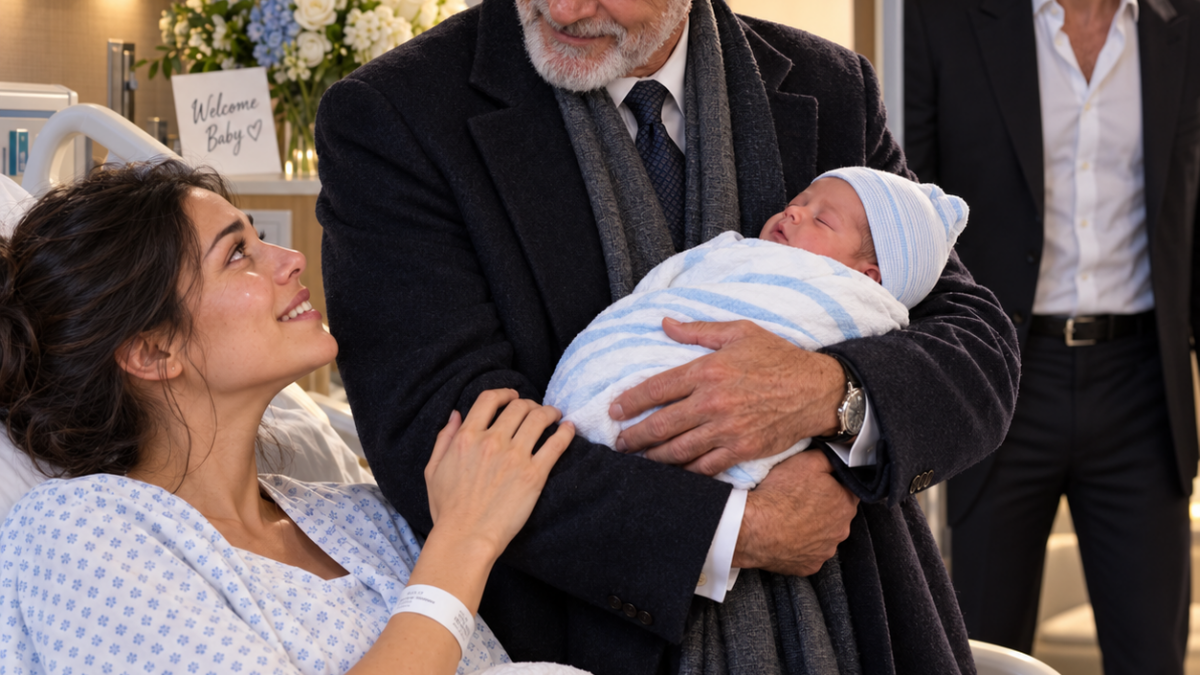
My Husband Abandoned Me in Labor for His Mother’s Birthday—Then Came Home to a Billionaire Holding Our Son
My husband chose his mother’s birthday dinner over the birth of our son, then told me to handle labor by myself.
Three days later, he came home expecting a tired wife he could silence and found a billionaire holding our newborn in his arms.
What he did not know was that the man was my father, and while Rowan was gone, I had traced the money trail leading straight to his mother.
My name is Phoebe Bennett, and at thirty-eight weeks pregnant, I learned that abandonment does not always happen when someone walks out of your life.
Sometimes it happens over the phone, while you are standing outside a hospital entrance with your dress soaked, your belly tightening every four minutes, and your husband laughing in the background because his mother’s birthday dinner has a better seating arrangement than the birth of his first child.
The night my son was born, the sky above Charlotte was the color of wet concrete. Rain had been falling since morning, not hard enough to flood the streets, just steady enough to turn every sidewalk slick and every headlight into a blurred ribbon of gold. I remember the smell of it when I stepped out of the rideshare at the maternity entrance. Rain on asphalt. Hospital disinfectant drifting through automatic doors. My own fear, metallic and hot in my throat.
My water had broken twenty-three minutes earlier.
I knew because I had looked at the clock on the microwave when it happened.
7:41 p.m.
One moment I was standing in our kitchen trying to convince myself the lower back pain was just pregnancy misery. The next, warmth rushed down my legs, and the entire world narrowed into one thought.
Leo is coming.
That was our son’s name.
I had chosen it after my mother, Leonora, who died when I was twenty-four and left behind three things that mattered more than any money ever could: her name, her stubbornness, and a private investment account she told me never to discuss with a man who loved my bank balance before he loved my voice.
I should have listened earlier.
But love makes even accountants bad at math.
I called Rowan first.
Of course I did.
Even after everything, even after months of his mother’s little comments and his growing impatience and the way he had started checking his phone whenever I talked about the baby, I still called my husband first.
Because some part of me believed birth would make him remember who he was supposed to be.
The call connected on the third ring.
Music hit my ear immediately. Laughter. Clinking glasses. Someone cheering in the background. A woman’s voice, bright and loud, calling for champagne.
“Rowan,” I said, gripping the kitchen counter through another contraction. “I’m at home. My water broke.”
“What?”
For one second, I heard surprise.
Then irritation moved in fast behind it.
“Now?”
I stared at the wall.
Now.
As if my body had failed to consult his calendar.
“Yes, now. Contractions are close. I’m calling a car.”
“Phoebe, Mom’s dinner has been planned for months.”
“So was our son.”
Silence.
Then Selina’s voice in the background, sharp enough to cut through the music.
“Is that Phoebe? Tell her women have been giving birth without husbands forever.”
A few people laughed.
Not loudly.
Enough.
My grip tightened on the counter until my knuckles went white.
“Rowan,” I said, “I need you.”
He sighed.
It is strange what a sigh can do.
A shout gives you something to fight.
A sigh makes you feel like a chore.
“Phoebe, don’t start. I’m across town. Mom just sat down. This is important to her.”
“I am in labor.”
“And you’re at the hospital, right?”
“I’m going now.”
“Then nurses will handle it.”
Another contraction seized me. I bent forward, pressing one hand to my belly, breathing the way the class instructor had taught us while Rowan scrolled through emails and said the videos would cover anything he missed.
“Please come,” I whispered.
Maybe that was the moment I will always hate most.
Not his refusal.
My please.
The way I begged for something that should never have required pleading.
In the background, Selina said, “If he leaves now, the whole night is ruined.”
Rowan laughed once, low and embarrassed, like I had put him in an awkward position.
Then he said, “Handle it yourself. Stop being so dramatic.”
The line went dead.
For a moment, I stood in my kitchen with the phone still against my ear.
Rain ticked against the window.
The refrigerator hummed.
My son shifted low and heavy inside me, as if reminding me that the night did not care whether my heart had just broken.
Another contraction came.
Four minutes apart.
Maybe less.
I grabbed my hospital bag from beside the pantry. I had packed it three weeks earlier, folding tiny blue pajamas with shaking hands while Rowan stood in the doorway and said, “Don’t overpack. It’s not a vacation.”
I called the rideshare with fingers that barely worked.
PART2:
Then I called the one person I had avoided needing for almost two years.
My father.
Gideon Sterling answered on the first ring.
He always did when I called, which was part of why I called so rarely. Immediate love can feel like pressure when you are determined to prove you do not need it.
“Phoebe?”
I tried to speak.
Nothing came out.
The contraction released and left me trembling.
“Dad.”
His voice changed instantly.
“Where are you?”
Not what happened.
Not are you okay.
Not why are you calling after months of short birthday texts and careful distance.
Where are you?
Because my father understood crisis.
“At the house. Going to Mercy General. The baby’s coming.”
“Is Rowan with you?”
I closed my eyes.
“No.”
A pause.
Not long.
Long enough for fury to enter the room and be locked away because I needed action first.
“I’m leaving now,” he said. “Do not hang up until the car arrives.”
“Dad—”
“Phoebe.”
That one word steadied me.
The way it had when I was six and afraid of thunderstorms, when I was sixteen and crashed my mother’s car into a mailbox, when I was twenty-four and stood beside my mother’s grave feeling like the earth had swallowed the only person who knew how to translate me.
“I’m here,” he said.
I slid down the kitchen cabinet and sat on the tile.
The phone stayed pressed to my ear.
“I’m scared,” I whispered.
“I know. Breathe with me.”
So I did.
Through the next contraction.
Through the arrival of the car.
PART3:
Through the humiliating moment when the driver saw my soaked dress and panicked until my father, through speakerphone, calmly instructed him to drive to Mercy General and ignore any upholstery concerns because he would personally cover the cost.
Twenty-five minutes later, Gideon Sterling walked into the maternity ward wearing an old gray coat and looking nothing like the billionaire investor whose face appeared in financial magazines whenever people wanted to discuss markets, mergers, or men who made impossible decisions before breakfast.
To the world, my father was intimidating.
To me, that night, he was just Dad.
His silver hair was damp from rain. His tie was crooked. His expression held the kind of controlled terror only a parent can wear while trying not to frighten his child further.
He reached my triage room as a nurse was adjusting the monitor across my belly.
“Phoebe.”
I turned my head.
The second I saw him, I started crying.
Not elegant tears.
Not cinematic.
The ugly, exhausted kind that come when the person you have been trying not to need arrives anyway.
He crossed the room and took my hand.
“I’m here.”
The nurse looked between us.
“And you are?”
“My father,” I said.
The words felt strange in that room.
Not because they were untrue.
Because I had spent so long keeping them separate from the life I built with Rowan.
When Rowan and I met, I was using my mother’s last name, Bennett. Legally, I had kept it after she died. Professionally, it was simpler. Personally, it protected me.
Phoebe Bennett could meet someone at a friend’s barbecue and be judged for her laugh, her opinions, her overuse of spreadsheets, her terrible bowling, her habit of reading restaurant menus online before arriving.
Phoebe Sterling was a headline waiting to happen.
Gideon Sterling’s daughter.
Trust fund girl.
Heiress.
Someone men suddenly treated like a ladder.
I had watched it happen in college. I had watched men who did not know my favorite color become fascinated by my “future.” I had watched women decide I could not understand real work while asking me to donate to their causes. I had watched people confuse access with affection.
So when Rowan asked my name that summer evening five years ago, I said, “Phoebe Bennett.”
And I never corrected the story.
Not when he mocked wealthy heirs as “spoiled oxygen thieves.”
Not when Selina asked what my father did and I said, “Investments,” and she laughed, “So some retired salesman type?”
Not when Rowan said, “At least you’re not one of those rich girls who thinks life is a charity gala.”
I told myself I wanted to be loved for myself.
That was true.
But truth can still hide cowardice.
I also did not want to test him.
Because a test can reveal failure before you are ready to walk away.
Dad stayed through all fourteen hours of labor.
He stayed when I vomited into a plastic basin and apologized, and he said, “You once threw up on a yacht in front of the Dutch finance minister. This is not our worst moment.”
He stayed when the epidural took longer than expected.
He stayed when I gripped his hand so hard the nurse winced on his behalf.
He stayed when I whispered, “Rowan should be here,” and he did not insult my husband, though I could feel the words trying to claw out of him.
Instead, he brushed damp hair from my forehead and said, “Yes. He should.”
That was all.
No excuse.
No comfort pretending abandonment was anything else.
Yes. He should.
At 4:17 a.m., Leo Bennett Miller was born.
Seven pounds, one ounce.
A furious little cry.
Dark hair plastered to his head.
Tiny fists clenched like he had arrived ready to challenge the world for inconveniencing him.
The nurse placed him on my chest, and everything stopped.
Pain.
Humiliation.
Rain.
Rowan.
Selina.
The world became warm skin, trembling breath, and the impossible weight of a person who had been inside me and was suddenly here, real and outraged and alive.
“Hi,” I whispered.
Leo cried harder.
My father stood beside the bed with one hand over his mouth.
I had seen Gideon Sterling face hostile boards, federal investigations, market crashes, betrayal, grief, and my mother’s death without breaking in public.
But when he looked at my son, tears ran down his face.
“Mom would have loved him,” I said.
His eyes closed.
“Yes,” he whispered. “She would have tried to steal him immediately.”
I laughed through tears.
Hours later, after nurses cleaned Leo and checked him and wrapped him in a blanket with blue and pink stripes, Dad held him for the first time.
He sat in the chair near my hospital bed like a man entrusted with national secrets. His large hands looked almost ridiculous around such a small body. Leo slept against his chest, mouth open, one tiny fist pressed under his chin.
Dad stared at him as if the entire financial world could collapse outside and he would not look away.
“Hello, Leo,” he said softly. “I’m your grandfather. I already admire your timing.”
I should have been happy.
I was happy.
I was also hollowed by absence.
Rowan never came.
Not during labor.
Not after delivery.
Not when I sent one photo at 5:06 a.m. with the simple message:
He’s here.
Rowan did not reply for two hours.
Then my phone buzzed while Leo was nursing and Dad was arguing quietly with a nurse because he wanted to know whether the hospital coffee had been “designed as punishment.”
Mom loved the watch. Coming home Monday. Don’t start another fight.
I stared at the message.
Mom loved the watch.
Our son was less than three hours old, and my husband’s first real update was about Selina’s birthday present.
I took a screenshot.
Not because I knew exactly what I would do with it.
Because I am a forensic accountant, and somewhere deep beneath the exhaustion, betrayal, blood loss, and hormones, the professional part of my brain reached for documentation like a life raft.
Evidence calms me.
It always has.
People lie.
Numbers forget less.
During the final weeks of pregnancy, I had already noticed several transfers from our joint account that Rowan had not explained properly. Small enough at first to seem like timing mistakes. Then larger. Then structured strangely, routed through a consulting company I did not recognize.
When I asked, he brushed me off.
“Family stuff.”
“What family stuff?”
“Can we not do an audit every time I move money?”
“I’m asking because it’s our joint account.”
“And I’m asking you to trust me.”
Trust.
The favorite word of people who do not want transparency.
I had been too tired to push then. Too swollen. Too focused on nursery drawers, medical appointments, and the strange loneliness of late pregnancy inside a marriage that felt increasingly crowded by Selina’s voice.
But while Rowan was away for three days after our son’s birth, something in me sharpened.
Maybe it was motherhood.
Maybe rage.
Maybe the ghost of my mother saying, Baby, check the ledger.
On Sunday morning, Leo asleep in the clear hospital bassinet and Dad reading quarterly reports in the corner like a man incapable of leisure, I opened my laptop.
Dad looked up.
“You should be resting.”
“I’m an accountant. This is resting.”
“No. That is a trauma response with Wi-Fi.”
“Probably.”
He closed his folder.
“What are you looking at?”
“Our joint accounts.”
His expression changed.
Not intrusive.
Alert.
“Do you want help?”
“No.”
He nodded.
That was one of the reasons I loved him.
Gideon Sterling could buy entire companies before lunch, but when I said no, he heard it.
I logged into our bank portal.
At first, exhaustion blurred the numbers. I blinked hard, drank water, and zoomed in. Three transfers stood out immediately because they had been categorized manually, not automatically.
$12,400.
$16,900.
$17,500.
All within four months.
All labeled consulting.
All routed through a company called SLM Advisory.
SLM.
Selina Louise Miller.
My mother-in-law loved monograms. They were on her towels, her luggage, her phone case, even the ridiculous silk robe she wore during Christmas mornings as if hosting a morning show.
I searched the company registry.
SLM Advisory LLC.
Registered manager: Selina L. Miller.
Business address: a mailbox suite fifteen minutes from her condo.
My entire body went cold.
Dad said my name.
I did not look up.
I opened our savings account.
The one Rowan and I had created for medical bills, parental leave, and Leo’s first year.
More transfers.
$8,000.
$9,500.
$13,200.
Family reimbursement.
I had approved none of them.
I downloaded statements.
Screenshots.
CSV exports.
PDF confirmations.
Timestamps.
Recipient details.
Memo fields.
The familiar process steadied me. Gather. Preserve. Duplicate. Store offsite. Never rely on a single copy when someone has already shown comfort with deception.
By the time the discharge nurse came in, I had built a folder titled Household Review.
Dad saw the name and muttered, “Your mother used titles like that before destroying people in estate meetings.”
“Good.”
He almost smiled.
“Very good.”
We left the hospital Sunday afternoon.
Not because Rowan came.
Because Dad hired a private nurse for the first night home after I refused his offer to move me into his penthouse, his lake house, or “somewhere with better security and soup.”
“I’m going home,” I said.
“That house contains Rowan.”
“That house contains my nursery.”
His jaw tightened.
“Phoebe.”
“I need to know what he thinks he’s coming back to.”
Dad studied me.
Then nodded once.
“Then I’ll be there.”
He carried Leo inside.
The nursery smelled like fresh paint, baby detergent, and the lavender sachets Selina said were “too feminine for a boy” until I ignored her. The crib stood by the window. A rocking chair waited in the corner. A framed print of a lion cub hung above the dresser.
Leo slept through his first tour of the house with impressive disrespect.
Dad placed him in the bassinet in the living room while I lowered myself carefully onto the couch, sore in places I did not know could be sore.
“Do you want tea?” Dad asked.
“I want my husband to be a different man.”
His face softened.
“I know.”
“Tea is fine.”
Rowan still did not come home.
Sunday night, he texted a photo of Selina smiling beside a silver watch.
Mom cried. Big success.
I looked at Leo sleeping on my chest and felt something final settle inside me.
Not divorce yet.
Not forgiveness either.
A door closing in a long hallway.
Monday came with gray light and pain.
The private nurse, Marisol, helped me shower while Dad sat in the living room with Leo and took a business call in a whisper so fierce I heard him tell someone, “Unless the bond market is actively giving birth, handle it without me.”
At noon, Rowan texted:
Leaving after lunch.
At two:
Traffic.
At four:
Almost there.
He arrived at 5:13 p.m.
Three days after telling me to handle childbirth myself.
The front door opened.
He walked in carrying an overnight bag and wearing the navy sweater I had bought him last Christmas. His hair was neat. His watch gleamed. He looked tired, but not in the new-parent way. In the stayed-up-too-late-drinking-expensive-wine way.
“Phoebe?” he called.
I was sitting in the armchair with my laptop open on the side table, printed documents stacked beside it.
Dad sat on the sofa holding Leo.
My son slept against his chest, one tiny hand curled near the lapel of his old gray coat.
Rowan entered the living room and stopped so abruptly his overnight bag slipped from his hand.
His face went white.
Not pale.
White.
“Phoebe,” he said slowly. “Why is Gideon Sterling holding my son?”
Dad lifted his eyes.
The room temperature seemed to drop.
“You abandoned my daughter for dinner.”
Rowan stared at him.
Then at me.
“Your daughter?”
“Yes,” Dad said.
One word.
A whole marriage cracked inside it.
Rowan turned toward me.
“Phoebe?”
I closed the laptop halfway.
“Hello, Rowan.”
His mouth opened.
Closed.
He looked at Dad again as if maybe the universe would correct itself.
“Gideon Sterling is your father?”
“You never cared enough to ask.”
“That’s not fair.”
I laughed once.
The sound surprised even me.
“Not fair?”
He flinched.
Dad shifted Leo slightly, protective without seeming to move.
Rowan’s eyes dropped to the papers beside my laptop.
His expression changed again.
Fear replacing shock.
Because whatever he had expected when he came home, it was not me rested enough to be dangerous.
He had expected tears.
Maybe anger.
Maybe a fight about his absence that he could turn into my hormones, my dramatics, my habit of making everything “bigger than it needed to be.”
He had not expected statements.
He had not expected Gideon Sterling holding his son like judgment in a gray coat.
He had not expected his mother’s name on the table.
Rowan sat down slowly in the chair across from me.
“You never told me,” he said again.
“No.”
“Why?”
“Because when we met, I wanted one relationship where my father’s money wasn’t in the room.”
“You lied to me.”
“I used my legal name. I told you my father worked in investments. You decided that meant he was unimportant enough to mock.”
His face flushed.
“I didn’t mock him.”
“You called him a retired salesman.”
“That was Mom.”
“And you laughed.”
He looked away.
I leaned forward carefully, every movement tugging at the stitches and soreness birth had left behind.
“Do not look away from me today.”
His eyes came back.
Good.
I pushed the first statement across the coffee table.
“Over four months, $46,800 left our joint account and went through a company called SLM Advisory. Registered manager: Selina Louise Miller. Your mother.”
His jaw tightened.
“She needed help.”
“With what?”
Silence.
Dad stood from the sofa, still holding Leo.
Rowan snapped, “This is between my wife and me.”
Dad’s expression did not change.
“Then answer your wife.”
The words landed with quiet force.
Rowan looked at the papers again.
“She had expenses.”
“What expenses?”
“Personal.”
“You used our joint money.”
“It was temporary.”
“Without telling me.”
“I was going to replace it.”
“When?”
He rubbed his forehead.
“Phoebe, you just had a baby. This is not the time.”
I almost smiled.
He had chosen the wrong sentence.
“While I was having the baby was apparently a wonderful time for you to celebrate your mother’s birthday for three days. So yes, Rowan, this is the time.”
His face tightened.
I pushed the second page forward.
“More than $30,000 moved from the savings account we created for medical bills and Leo’s first year. You labeled the transfers family reimbursement. I approved none of them.”
“That account had extra.”
“That account had a purpose.”
“We’re married.”
“Yes. And marriage is not blanket consent to drain medical savings for your mother.”
His eyes flashed.
“You don’t understand family obligation.”
Dad’s head turned slightly.
I lifted one hand before he could speak.
“No,” I said. “Let him finish.”
Rowan’s nostrils flared.
“My mom sacrificed everything for me.”
“She lives in a paid-off condo you helped refinance twice.”
“She had business opportunities.”
“With my medical savings?”
“With our money.”
“Our money,” I repeated. “The money you took while I was pregnant, while I was preparing for hospital bills, while you told me not to overbuy diapers because we needed to be practical.”
He looked down.
“Rowan.”
His eyes lifted.
“There’s more.”
I placed the final document on the table.
It was a lender inquiry.
Two weeks before Leo was born, Rowan had contacted our mortgage lender asking whether our home could be refinanced if his wife became “temporarily medically unavailable.”
The phrase glowed in my mind like a warning flare.
Temporarily medically unavailable.
I looked directly at him.
“Were you planning to use childbirth as my medical unavailability?”
He went completely silent.
Dad’s face changed then.
Until that moment, he had been angry.
Now he became still.
People think rage is the most dangerous version of a powerful man.
They are wrong.
Stillness is.
Rowan swallowed.
“That was just a question.”
“Why ask it?”
“I was exploring options.”
“Options for what?”
“Cash flow.”
“For Selina?”
He said nothing.
I opened another folder.
“But that isn’t the worst part.”
His eyes moved to the page in my hand.
I watched his face carefully.
The document attached to the lender file referenced a private investment account inherited from my mother. It did not list everything, but it listed enough. Too much. A value estimate almost exact to the quarterly report I had never shared with Rowan.
Never.
Not once.
That account was separate property. Protected. Managed through my father’s office. Known only to me, my father, our attorney, and the private client team that handled legacy assets from my mother’s estate.
One person outside my father’s office had recently asked questions about “Phoebe’s family account.”
Selina.
I placed the email on the table.
It had been forwarded to me by my father’s chief legal officer after I asked him, quietly, whether anyone had contacted the firm about my inherited assets.
From: Selina Miller.
To: Sterling Capital Private Client Services general inquiry box.
Subject: Family planning question.
The email was dressed in politeness.
It claimed Selina was “assisting my daughter-in-law with financial organization before childbirth.” It asked whether a spouse could help access or restructure inherited accounts if the account holder became “medically unavailable during delivery or recovery.” It included my married name, my date of birth, and a value estimate close enough to make my skin crawl.
Rowan read it.
Every trace of anger disappeared from his face.
Because suddenly he knew I had found something he and his mother never expected me to see.
Dad laid Leo gently in the bassinet.
Then he came to stand beside me.
“Explain,” he said.
Rowan looked up at him.
“I didn’t send that.”
“I asked you to explain. Not deny the wrong part.”
Rowan’s throat worked.
“Mom was worried Phoebe wouldn’t be able to manage things after the baby.”
I stared at him.
“You mean after giving birth to your son alone?”
He winced.
“I didn’t know you’d go into labor that night.”
“You knew I was thirty-eight weeks pregnant.”
“Lots of first babies come late.”
“Lots of husbands still answer the phone.”
Dad’s jaw tightened.
Rowan looked at him, then back at me.
“Mom asked about the account because she thought we should have a plan.”
“How did she know the value?”
Silence.
“Rowan,” I said, “how did your mother know the approximate value of my inherited account?”
He wiped his palms on his jeans.
“I may have seen something once.”
“What?”
“Your laptop.”
My chest went cold.
“When?”
“I don’t remember.”
“Try.”
“I saw a statement open months ago.”
“No, you didn’t. I don’t open those statements on my personal laptop. They go through a secure portal on my work tablet or Dad’s office.”
His face changed.
A flicker.
Small.
Enough.
Dad saw it too.
“Rowan,” he said, voice low, “answer carefully.”
Rowan stood abruptly.
“I’m not being interrogated in my own house.”
I looked around the living room.
The bassinet.
The folded baby blankets.
The flowers Dad had bought because Rowan had not.
The documents he never thought I would gather.
“Our own house,” I said. “The one you were exploring refinancing while I was days from childbirth.”
His face reddened.
“I made mistakes.”
“Plural is doing heavy lifting.”
“Phoebe, please.”
There it was.
The turn.
Anger had failed.
Denial had failed.
Now came pleading.
He moved toward me.
Dad stepped slightly between us.
Rowan froze.
I said, “Don’t.”
His eyes filled with tears.
“I panicked.”
“About what?”
“Money.”
“We had savings.”
“Not enough.”
“For what?”
He pressed both hands over his face.
“Mom’s investment.”
The room went silent except for Leo’s tiny sleeping breaths.
“What investment?” I asked.
Rowan dropped his hands.
“She had a chance to get in early on a luxury wellness development. Senior living, medical spa, high-end residences. She said the return would be huge. She needed bridge money.”
“How much?”
He did not answer fast enough.
“How much, Rowan?”
“Eighty.”
My stomach turned.
“Eighty thousand?”
He looked down.
I stood too fast, and pain tore through my body.
Dad caught my elbow.
I pulled away gently.
“Eighty thousand dollars?”
“It was supposed to come back in six weeks.”
“From where?”
“The project.”
“What project?”
“Selina had documents.”
“Did you verify them?”
“She knew the developer.”
“Did you verify them?”
His voice cracked.
“No.”
I laughed.
It sounded nothing like humor.
“You drained our joint account, stole from our baby fund, contacted a lender about using my childbirth as an opportunity to refinance our home, and helped your mother inquire about my inheritance because Selina had documents?”
“She said we’d make enough to pay everything back before you noticed.”
There it was.
Before you noticed.
Not before it hurt us.
Not before it harmed our son.
Before I noticed.
I sat down slowly because my legs had begun to shake.
Dad’s hand rested on the back of my chair.
“Get out,” he said.
Rowan looked at him.
“You can’t throw me out of my house.”
“No,” Dad said. “But she can.”
Rowan turned to me.
“Phoebe, don’t do this.”
I looked at the man who had missed our son’s birth for his mother’s dinner and returned three days later to ask me not to ruin his life by noticing what he had done.
“Leave,” I said.
His face crumpled.
“For tonight?”
“Start with tonight.”
“What about Leo?”
“You should have asked that Friday.”
The words hit.
His eyes filled.
“I’m his father.”
“You are the man who told his mother that her dinner mattered more than his birth.”
“I was wrong.”
“Yes.”
“I can fix this.”
“No,” I said. “You can cooperate with the consequences.”
Dad pulled out his phone.
“My driver is outside. He can take you wherever you need to go.”
Rowan’s pride snapped back.
“I’m not taking your car.”
“Then walk.”
For one second, I thought Rowan might shout.
Instead, Leo stirred in the bassinet and made a tiny sound.
All three of us turned.
My son stretched his hands, face scrunching, unaware that his first homecoming had become a financial crime scene.
I went to him.
Slowly.
Carefully.
I lifted him against my chest.
He settled almost immediately.
Rowan watched.
Something like grief crossed his face.
But grief after harm is complicated. Sometimes people grieve the wound. Sometimes they grieve getting caught holding the knife.
“I want to hold him,” he whispered.
“No.”
“Phoebe.”
“Not tonight.”
“He’s my son.”
“He is a newborn, not a symbol you get to hold so you feel less guilty.”
Rowan flinched.
Dad moved to the front door and opened it.
The rain had stopped, but the night air was cold.
Rowan picked up his overnight bag.
At the doorway, he turned.
“You should have told me who your father was.”
I held Leo closer.
“You should have been someone I could trust with that truth.”
He left.
The door closed.
For several seconds, I stood in the living room listening to Leo breathe.
Then my knees weakened.
Dad crossed the room and took us both into his arms.
I did not cry at the hospital when Rowan failed to come.
I did not cry when I found SLM Advisory.
I did not cry when he admitted he planned to replace the money before I noticed.
But standing there with my newborn son against my chest and my father’s arms around me, I finally broke.
“I loved him,” I sobbed.
Dad held me carefully, mindful of the baby, mindful of the body that had just given birth.
“I know.”
“I really loved him.”
“I know, sweetheart.”
“How could he do this?”
Dad was quiet for a long moment.
Then he said, “Because he confused your forgiveness with permission.”
The next morning began the part of betrayal nobody makes dramatic enough.
Phone calls.
Lawyers.
Bank freezes.
Pediatric appointments.
Postpartum bleeding.
A baby who needed to eat every two hours.
An aching body.
A mind that wanted to collapse but kept being summoned by paperwork.
Dad wanted to bring in his entire legal team immediately. I told him no. Then yes. Then no again. Then I fell asleep sitting upright while holding a burp cloth, and he called them anyway but instructed them not to contact anyone without my approval.
That was his version of restraint.
My attorney, Maren Holt, arrived at noon with a sleek leather folder, sharp eyes, and the calm of a woman who had seen marriages end for reasons stranger than birthday dinners and cleaner than financial betrayal.
She listened while I explained.
She asked precise questions.
Dates.
Account types.
Authorization.
Property ownership.
Prenuptial agreement.
Separate assets.
Lender contact.
Selina’s email.
Rowan’s admission.
Whether I had recorded the conversation.
I had not.
I had been holding a baby, not running an interrogation.
Maren did not scold me.
“We have documents. We have timestamps. We have transfers. We have the email. We have your screenshot from his labor response. We have your father as witness to the confrontation. We move carefully.”
“Divorce?” I asked.
The word sat in the room like something alive.
Maren looked at me.
“That is your decision. Today, we protect you and Leo. We can discuss the marriage when your blood pressure is not being held together by spite and caffeine.”
Dad, from the kitchen, said, “Spite is underrated.”
Maren ignored him.
I liked her instantly.
We froze what we could freeze.
Changed passwords.
Separated direct deposits.
Flagged the lender.
Sent preservation letters.
Notified the bank of disputed transfers.
Documented that no authority existed for Rowan or Selina to access my inherited account.
By evening, Rowan had called thirty-one times.
I did not answer.
Selina called fourteen.
I blocked her after the fifth voicemail.
Unfortunately, before blocking, I listened to one.
Her voice poured through the speaker like syrup over poison.
“Phoebe, sweetheart, I know emotions are high after birth, but you must be very careful not to destroy your family over misunderstandings. Rowan was under tremendous pressure. Men process childbirth differently. As for the money, marriage means sharing. I hope your father isn’t encouraging you to be selfish. We all know wealthy people can be very possessive.”
I stared at the phone.
Dad, holding Leo near the window, said, “Do not throw it. You’ll need the evidence.”
“I hate that you’re right.”
“I often am. It’s very hard on those around me.”
I saved the voicemail.
By Wednesday, Selina changed tactics.
She appeared at my front door wearing black sunglasses, a cream coat, and the expression of a grieving queen forced among peasants.
Dad answered before I could stand.
I watched from the couch through the reflection in the hallway mirror.
Selina removed her sunglasses.
For once, she looked genuinely startled.
“Mr. Sterling.”
“Mrs. Miller.”
“I came to see my grandson.”
“No.”
Her mouth opened.
Closed.
“I beg your pardon?”
“No,” Dad repeated.
“This is my son’s home.”
“It is my daughter’s recovery space.”
Her eyes flashed.
“I see. So Phoebe runs to Daddy when marriage gets hard.”
Dad smiled slightly.
It was not a friendly smile.
“No. Phoebe called me when she was in labor and her husband told her to handle it herself because you wanted him at dinner.”
Selina’s face tightened.
“That has been exaggerated.”
“I heard enough.”
“You heard my daughter after your son abandoned her. Be careful which exaggeration you accuse.”
Her mask slipped.
“You Sterlings think money makes you untouchable.”
“No,” Dad said calmly. “Lawyers do.”
I would have laughed if I had not been so sore.
Selina tried to look past him.
“Phoebe! I know you can hear me. This is cruel. A grandmother has rights.”
I stood slowly, Leo asleep in my arms.
Dad turned immediately.
“You don’t have to—”
“I want to.”
He stepped aside enough for Selina to see me but not enter.
Her eyes dropped to Leo.
For one second, softness crossed her face.
Then calculation followed it.
“My grandson,” she whispered.
“No,” I said. “My son.”
Her gaze snapped to mine.
“Don’t be petty.”
“I’m being precise.”
“Rowan is devastated.”
“Good.”
She recoiled.
“He made one mistake.”
I almost laughed.
“One?”
“He panicked.”
“He stayed away for three days.”
“He didn’t know how serious—”
“I said the baby was coming.”
“First-time mothers exaggerate.”
Dad’s hand tightened on the door.
I shifted Leo higher.
“You told him women have been giving birth without husbands forever.”
She lifted her chin.
“And they have.”
“Yes,” I said. “And now I know I can.”
That landed.
Her lips pressed tight.
“You are going to regret making enemies of family.”
I looked at her carefully.
For months, I had endured Selina’s comments because I thought they were annoying, not dangerous. She criticized my nursery colors, my body, my work, the way I planned maternity leave, the fact that I did not want her in the delivery room. She told Rowan I was “overly private.” She told me Rowan needed “a woman who understood his family came first.”
What she meant was herself.
And for too long, I mistook her hunger for closeness as unpleasant but manageable.
Now I saw it clearly.
Selina did not want family.
She wanted access.
To Rowan.
To Leo.
To our money.
To my inheritance.
To any room where she could decide who mattered most.
“You are not family to me right now,” I said.
Her eyes widened.
“You don’t mean that.”
“I do.”
“You can’t cut me off from my son.”
“No. But I can cut you off from mine.”
Her face hardened.
“You little—”
Dad stepped forward.
“Finish that sentence carefully.”
Selina looked at him.
For the first time, fear moved across her face.
Not because he was loud.
Because he was not.
She put her sunglasses back on with shaking hands.
“This isn’t over.”
“No,” I said. “It isn’t.”
Dad closed the door.
Outside, Selina stood on the porch for another full minute.
Then left.
That night, Rowan sent a long email.
Not a text.
An email, because apparently betrayal becomes professional once lawyers breathe nearby.
Phoebe,
I know things look bad. I know I hurt you by not being there. I will regret missing Leo’s birth for the rest of my life. Mom was emotional about turning sixty, and I felt trapped trying to keep everyone happy. That is not an excuse, but it is context.
Regarding the money, I should have told you. Mom presented the transfers as temporary. I believed her. I was trying to build something for us. The refinance question was only exploratory in case we needed emergency liquidity. I never intended to harm you or Leo.
Your father’s involvement is making this bigger than it needs to be. I would like to come home so we can discuss this as husband and wife.
I love you.
Rowan
I read it twice while Leo slept against my shoulder.
Then I forwarded it to Maren.
Then, against legal advice I had not yet received but could already imagine, I replied.
Rowan,
You missed our son’s birth after telling me to handle it myself. You stayed away for three days. You moved money from our joint and baby-related savings accounts without my knowledge. You helped create or support a plan to access cash using my childbirth as a condition. Your mother contacted my father’s firm about my inherited assets using private information she should not have had.
This is not being made bigger by my father.
It became this big when you made those choices.
Do not come to the house without written agreement through counsel.
Phoebe
I did not write I love you.
Because I did.
And because I refused to use it as a bandage over rot.
The truth about Selina’s investment came out in pieces.
There was no luxury wellness development.
Not really.
There had been a proposal, a website, a pitch deck full of stock photos and phrases like holistic aging ecosystem, but the land had not been secured, the permits had not been filed, and the developer was a man named Victor Hale who had been sued twice for securities-related misrepresentations and once by a golf club for unpaid dues.
Selina had not been a helpless victim.
That was the part Rowan resisted longest.
“She was deceived,” he said during our first supervised meeting at Maren’s office.
“Maybe,” I said. “At first.”
Maren slid a document across the table.
“Mrs. Miller received referral fees for bringing in additional investors.”
Rowan stared.
“What?”
“Your mother was paid $7,500 after introducing two members of her church investment club.”
His face drained.
“No.”
Maren placed another page down.
“She also represented herself in emails as having access to substantial family capital that could be leveraged soon.”
Rowan looked at me.
I held his gaze.
“Family capital,” I said. “My mother’s account.”
He shook his head.
“She wouldn’t.”
“She did.”
His mouth trembled.
“You don’t understand. My mom isn’t sophisticated with finance. She probably didn’t know what she was saying.”
Maren, who had remained professionally calm through everything, looked over her glasses.
“Mr. Miller, your mother formed an LLC, opened a business bank account, routed transfers through it, solicited investors, requested information about your wife’s inherited separate property, and discussed refinancing your marital home during your wife’s late pregnancy. Whether she understood securities law is separate from whether she acted deliberately.”
Rowan leaned back like the chair had disappeared beneath him.
That was the moment I saw him begin to lose the mother he thought he had.
I wish I could say I enjoyed it.
Part of me did.
A smaller, uglier part I will not pretend away.
But mostly, watching Rowan realize Selina had used him too brought no pleasure.
Because being manipulated does not erase the harm you cause while carrying someone else’s blade.
He still chose not to come to the hospital.
He still laughed when Selina mocked me.
He still took money.
He still treated my trust like a resource he could borrow against.
After the meeting, he asked to see Leo.
Maren looked at me.
The choice was mine.
I agreed to thirty minutes in the conference room with me present.
When Marisol brought Leo in from the waiting area, Rowan stood so fast his chair nearly tipped.
He looked at our son like a starving man looking through glass.
“Hi,” he whispered.
Leo, unimpressed, yawned.
I sat first.
Then nodded.
Rowan washed his hands twice, dried them badly, and took Leo when Marisol passed him over.
The second Leo settled against him, Rowan started crying.
Not quiet tears.
Full, broken sobs he tried to swallow because men like Rowan believe crying is acceptable only when it can be framed as noble.
“I’m sorry,” he whispered to Leo. “I’m so sorry.”
Leo slept.
Newborns are merciful because they do not understand.
I watched them and felt my heart tear in two directions.
There was the man I married, holding our son with trembling hands.
And there was the man who missed his birth.
Both existed.
That was the cruelty of it.
If Rowan had been only monster, leaving would have been simpler. But betrayal often comes from people with enough goodness to make you grieve what they destroyed.
He looked up at me.
“I want to be his father.”
“Then learn the difference between wanting and being.”
He nodded.
No defense.
Good.
But not enough.
Weeks passed.
Leo grew.
That is what babies do while adults drown in consequences. They stretch. Root. Cry. Sleep badly. Make tiny expressions that reorganize your entire nervous system. His hair lightened slightly. His fingers wrapped around mine. His whole body relaxed when I sang my mother’s favorite lullaby, though my voice cracked nearly every time.
Dad stayed in Charlotte.
He claimed he had business.
He did not.
Or maybe he did, and simply made the business orbit his grandson.
He bought a townhouse twelve minutes away “temporarily,” hired a night nurse I could call when exhaustion turned dangerous, and learned how to change diapers with the grim determination of a man negotiating with a hostile asset class.
The first time Leo peed on his shirt, Dad looked down and said, “Your opening position is noted.”
I laughed so hard I cried.
Those early weeks were strange and sacred.
I was devastated.
I was also happy.
That feels impossible until you live it. My marriage was collapsing, financial betrayal sat in organized folders, my mother-in-law was under investigation by people with calmer voices than mine, and yet my son would open his eyes at 3 a.m. and look at me like I was the whole sky.
Joy does not wait for the courtroom to clear.
It arrives rude and bright and hungry.
Rowan attended supervised visits.
At first, he tried to talk about us every time.
“I miss you.”
“I want to come home.”
“I made mistakes, but we can rebuild.”
I finally stopped him.
“Your visit is with Leo.”
His face tightened.
“I’m trying to fix our family.”
“No. You’re trying to reach me through him. Don’t.”
That landed.
After that, he behaved better.
Not perfectly.
Better.
He learned Leo’s feeding cues. Learned how to support his head properly. Learned that babies do not care if your mother is crying on the phone. Learned that thirty minutes of holding a child is not fatherhood, just one brick in a wall he had barely begun to build.
Selina tried to break the boundaries repeatedly.
She sent gifts.
I returned them.
She mailed a silver rattle engraved with L.M.M. and a note that said, Grandmother loves you even if others are bitter.
Maren kept it for documentation.
She showed up at Rowan’s supervised visit once, claiming she had a right to meet Leo.
Security escorted her out.
She called my father’s office asking to speak to “Phoebe’s financial guardian.”
Dad’s chief legal officer apparently replied, “Ms. Bennett is an adult woman with counsel. Do not call again.”
I sent flowers to that woman.
By the time Leo was two months old, the bank had confirmed unauthorized transfers from accounts requiring joint consent. Rowan had initiated them electronically using credentials I had trusted him with for household management. Selina’s LLC had received funds and immediately dispersed portions to the fraudulent investment, personal credit cards, and one luxury travel deposit listed as “client retreat.”
Client retreat.
In Sarasota.
At a spa.
While I was comparing diaper prices.
When Maren showed Rowan the report, he looked physically ill.
“I didn’t know she used it for that.”
I said nothing.
He covered his face.
“I swear I thought it was going into the development.”
“That is not the defense you think it is.”
“I know.”
“Do you?”
He lowered his hands.
His eyes were red.
“I’m starting to.”
Starting.
The honest word.
Too late to save what he wanted.
Maybe early enough to save something for Leo.
I filed for legal separation first.
Not divorce.
Not immediately.
People judged that.
Some quietly. Some not.
Carla, my college friend, said, “I support you, but also, I could drive over him in a rental.”
My father said, “I will support any decision except pretending nothing happened.”
Maren said, “Legal separation gives you protection while preserving options.”
That was the language I could live with.
Protection.
Options.
Not forgiveness.
Not revenge.
Space.
When Rowan received the papers, he came to Maren’s office alone. No lawyer yet, which was unwise but very Rowan when guilt made him want to seem sincere.
“I won’t fight financial protections,” he said.
Maren blinked, perhaps disappointed not to battle immediately.
He looked at me.
“I’ll sign temporary custody terms. Supervised visits if that’s what you need. Account repayment plan. Full disclosure. Whatever.”
I studied him.
“Why?”
He laughed once, broken.
“Because for once I’m trying not to make you prove what I already know.”
My throat tightened despite myself.
He continued.
“I talked to Mom yesterday.”
I stiffened.
“She asked me to say you manipulated me. She said if I loved her, I would protect her from your father’s lawyers. She said you used Leo as leverage.”
His hands shook.
“And I heard myself in her.”
Silence.
“That night at dinner,” he said. “At the birthday. When you called. She said you were dramatic, and I repeated it. She said women give birth without husbands, and I let that become permission. She said family comes first, but what she meant was she comes first.”
His voice cracked.
“I chose her because I was trained to. But I still chose.”
That was the first sentence that sounded like accountability instead of collapse.
I did not comfort him.
I did not punish him either.
I just nodded once.
“That matters,” I said.
He closed his eyes.
Relief moved across his face.
I added, “It does not fix it.”
His eyes opened.
“I know.”
Maybe he did.
Selina’s world unraveled publicly in May.
The church investment club filed complaints. Victor Hale vanished for three weeks and then resurfaced through an attorney claiming all investors had been informed of risk. Selina insisted she was also a victim until documents showed she had received referral fees and used family funds while telling others she had access to “Sterling-backed liquidity.”
Sterling-backed.
My father read that phrase at breakfast and became so still Leo stopped waving his spoon.
“I dislike that woman,” Dad said.
Leo slammed mashed banana on the high-chair tray.
“Correct,” Dad told him.
Selina eventually entered a civil settlement with several investors and faced inquiries from state regulators. Whether she faced criminal charges became a slow, ugly process full of words like intent, material representation, and cooperation.
I stopped following every detail after a while.
Not because it did not matter.
Because my life had a baby in it, and I refused to let Selina occupy more space than Leo’s first laugh.
That happened on a Tuesday.
Dad made a ridiculous sneeze noise.
Leo laughed.
A full, bubbling sound that burst out of him like sunlight through blinds.
I cried immediately.
Dad looked offended.
“I’m funny.”
“You are accidentally funny.”
“Still counts.”
I sent the video to Rowan.
I hesitated before pressing send.
Then did.
He replied two minutes later.
Thank you. I’ve watched it six times. I’m sorry I missed the first version of so many things. I won’t waste what you do share.
No request.
No pressure.
I let myself breathe.
By summer, Rowan’s visits expanded.
Not because I trusted him fully.
Because he showed up.
Every time.
On time.
Phone off.
Diaper bag stocked.
Questions asked without defensiveness.
He completed a financial transparency agreement, began repaying funds through payroll deduction and asset liquidation, and sold the watch he had bought Selina for her sixtieth birthday.
That part was symbolic, but I appreciated it.
Selina called him cruel.
He did not engage.
He sent one message:
I used Phoebe and Leo’s money to buy that watch. Selling it is not cruelty. Keeping it was.
Then he blocked her for ninety days.
When he told me, I said, “How do you feel?”
He looked surprised.
Then answered honestly.
“Like I’m detoxing.”
That made sense.
Selina had not raised him to love her.
She had raised him to regulate her.
There is a difference.
One leaves a child secure.
The other leaves an adult man abandoning his laboring wife because his mother might be embarrassed at dinner.
I did eventually tell Rowan the full story of why I hid my father’s identity.
Not as an apology.
As context.
We were sitting in a park while Leo slept in his stroller, sunlight moving through oak leaves above us. Rowan had been approved for unsupervised daytime visits, but we still did some together because rebuilding co-parenting required new habits.
“I thought money ruined everything,” I said.
He looked at me.
“When men found out who Dad was, they changed. Some got ambitious. Some got resentful. Some acted like loving me was a political position. I wanted to meet someone as Phoebe Bennett.”
Rowan stared at the grass.
“I liked feeling like I had something rich people didn’t.”
“What?”
“Moral superiority.”
The honesty surprised a laugh out of me.
He smiled sadly.
“I made fun of wealthy heirs because it made me feel grounded. Then the second I had access to money, I acted worse than anyone I judged.”
I watched Leo’s blanket rise and fall with his breathing.
“You didn’t have access,” I said. “You took it.”
He nodded.
“I know.”
“I need you to understand that hiding my father was not the same kind of betrayal as what you did.”
“I do.”
“Do you?”
He looked at me.
“Yes. You protected yourself from being used. I used you.”
That sentence sat between us.
Clean.
Painful.
Necessary.
I looked away first.
Not because I disagreed.
Because part of me still loved him enough that his honesty hurt too.
Our separation lasted eleven months.
During that time, I learned motherhood outside a functioning marriage, financial recovery, legal patience, and the strange grief of watching someone become better after the damage has already been done.
That may be one of the hardest parts.
If Rowan had remained defensive, cruel, or loyal to Selina’s lies, my path would have been clear. Painful, but clear.
Instead, he changed.
Consistently.
Not performatively.
He did the work when nobody praised him. Therapy. Parenting classes he found himself. Financial ethics counseling, which I had not known existed and which sounded like something my father might have invented to scare executives. He submitted full bank access for review. He wrote apology letters to me, to Leo for the birth he missed, and to my father for disrespecting him before knowing him and fearing him after.
Dad read his letter with a face of stone.
Then said, “Adequate start.”
From Gideon Sterling, that was practically a hug.
Selina hated the new Rowan.
That told me the change was real.
She tried to reach him through relatives, through old family friends, through guilt, illness scares, birthday messages, and one dramatic voicemail saying, “You have chosen that woman’s money over your mother.”
Rowan forwarded it to his therapist and did not answer.
Progress can look very boring from the outside.
It is not boring when you have lived the alternative.
On Leo’s first birthday, we held a small party in my father’s garden.
Not the mansion lawn the magazines loved to photograph.
The smaller back garden behind his Charlotte house, where my mother had planted white roses and insisted wealth was useless if it could not grow tomatoes.
Leo wore a blue romper and smashed cake into his hair.
Dad gave a toast that lasted thirty seconds because I threatened him beforehand.
“To Leo,” he said, lifting a glass of sparkling water. “Who arrived in chaos, improved everyone’s priorities, and remains the only person here allowed to throw food at investors.”
Everyone laughed.
Rowan stood near the edge of the patio, watching Leo with a softness that still hurt sometimes.
After the cake, he approached me.
“I have something for you.”
I tensed.
He saw it.
“It’s not dramatic.”
He handed me an envelope.
Inside was a cashier’s check.
The final repayment.
Every dollar taken from the medical and baby savings accounts. Every transfer through SLM Advisory. Plus interest calculated at a rate my father later called “surprisingly fair.”
I looked at the check.
Then at Rowan.
“I sold the car,” he said. “And the watch. And cashed out the rest of what I could.”
“You didn’t have to do it all at once.”
“Yes,” he said. “I did.”
My throat tightened.
“Thank you.”
His eyes glistened.
“I know it doesn’t buy trust.”
“No.”
“But it closes the theft.”
I looked at him for a long moment.
“Yes,” I said. “It does.”
He nodded.
That night, after everyone left and Leo slept upstairs in the nursery, Dad found me standing in the garden by my mother’s roses.
“He’s changed,” Dad said.
I did not pretend not to know who he meant.
“Yes.”
“Is it enough?”
I touched one white rose petal.
“I don’t know.”
Dad stood beside me.
“Your mother once told me that forgiveness is not a door you open for someone else. It is a house you decide whether you can live in.”
I smiled sadly.
“That sounds like Mom.”
“She was usually right, which was deeply inconvenient.”
I looked toward the lit windows.
“I can forgive him someday. Maybe I already have in places. But staying married is another question.”
“Yes.”
“I don’t want Leo raised inside punishment.”
“Good.”
“I also don’t want him raised inside a story where betrayal disappears if the betrayer improves.”
Dad nodded.
“Better.”
I looked at him.
“What would you do?”
He sighed.
“I would want to buy an island, move you and Leo there, and ban everyone named Miller.”
“Dad.”
“You asked what I would do. Not what was wise.”
I laughed.
He softened.
“What I hope you do is choose the life where you trust yourself most. Not Rowan. Not me. Yourself.”
That was the advice I needed.
In the end, Rowan and I did not move back in together after the first year.
We chose a longer road.
Co-parenting.
Continued therapy.
Separate homes.
No divorce filing yet, but no return to marriage by momentum. I refused to let the question become, Has he suffered enough? That was not the question.
The question was whether a new marriage could exist where the old one had broken.
Maybe.
Maybe not.
But Leo would not be used as glue.
Neither would my forgiveness.
When I told Rowan, he cried quietly.
Then said, “Okay.”
No begging.
No guilt.
No weaponized love.
Just grief.
And respect.
That was the man I wished had answered the phone when I was in labor.
Maybe that man did not exist then.
Maybe he does now.
I am still deciding what that means.
Selina has met Leo twice.
Both times supervised.
Both times brief.
The first time, she cried so hard he stared at her in alarm. When she reached for him without asking, Rowan said, “No. Ask Phoebe.”
She looked at him like he had betrayed their bloodline.
Good.
She asked.
I said no that day.
The second time, months later, I allowed her to hold him for five minutes while Rowan sat beside her and I remained in the room. She whispered, “Grandma loves you,” and then, because she cannot resist turning love into ownership, added, “Even if people keep us apart.”
Rowan took Leo from her immediately.
Visit over.
She was furious.
I was proud.
Not because it punished her.
Because Leo will grow up learning that love does not excuse manipulation just because it comes in a grandmother’s voice.
He is eighteen months old now.
He has Rowan’s eyes, my mother’s stubborn chin, and my father’s alarming habit of staring silently at people as if evaluating their quarterly performance. He calls my father “Gid” because Dad made the mistake of introducing himself as Gideon one day and toddlers are agents of chaos.
Dad pretends to hate it.
He does not.
Rowan is a good father now.
I say that carefully because people think good now erases absent then.
It does not.
He missed the birth.
That will always be true.
He also shows up now.
That is also true.
I have learned to let two truths stand without forcing one to kill the other.
As for me, I no longer hide who I am.
Not completely.
I still use Bennett professionally because it is my name and my mother’s name, and I love the sound of it. But when people ask about my family, I tell the truth without apology.
My father is Gideon Sterling.
My mother was Leonora Bennett.
I am not responsible for managing what people do with that information.
That has been freedom.
I spent years thinking secrecy protected me from being used.
Sometimes it did.
But secrecy also protected people from revealing themselves too early.
Rowan might have failed the test if I had told him on our third date.
Maybe that would have saved me.
Or maybe he would have performed humility better and failed later in a different way.
I cannot rebuild the past with cleaner variables.
Believe me, I have tried.
Accountants love a revised model.
Life refuses one.
What I can say is this: the night Leo was born, I stopped begging to be chosen by people who benefited from making me wait.
I called my father.
I opened the accounts.
I kept the screenshots.
I asked the questions.
I made the consequences real.
I protected my son’s future before I knew what my marriage would become.
That matters more than any perfect ending.
People always ask about the moment Rowan came home and saw Gideon Sterling holding Leo.
They want the drama.
The pale face.
The shock.
The billionaire’s calm voice.
You abandoned my daughter for dinner.
They want to imagine the powerful father arriving like justice in a gray coat.
And yes, it was satisfying in a way I will not pretend it wasn’t.
But the real turning point was earlier.
It was me standing outside the maternity entrance, phone in hand, after Rowan hung up.
It was the second I stopped calling him back.
The second I stopped thinking, If I explain it better, he’ll come.
The second I understood that a man who has to be convinced childbirth matters has already answered the question.
Then I called someone who did not need convincing.
That is what I want Leo to know someday.
Not that his father failed.
Though he did.
Not that his grandfather is rich.
Though he is.
Not that his grandmother on one side tried to turn money and guilt into a family business.
Though she did.
I want him to know that when someone abandons you in your most vulnerable moment, you do not have to build a home around their excuse.
You can call someone safe.
You can gather the truth.
You can let love be complicated without letting harm be confusing.
You can protect your peace even while your heart is broken.
Last week, Rowan came to pick Leo up for their Saturday visit. He arrived ten minutes early, waited on the porch instead of letting himself in, and held up Leo’s little jacket.
“Cold enough for this?”
I checked.
“Yes.”
He nodded.
Leo ran to him shouting, “Dada!”
Rowan’s whole face changed.
Some wounds a person carries forever.
Some become part of the way they hold joy.
He lifted our son and kissed his cheek.
Then he looked at me.
“Thank you.”
“For what?”
“For still letting me become better near him.”
I studied him.
“That is for Leo,” I said.
“I know.”
“Not for you.”
“I know that too.”
Good.
After they left, Dad came out of the kitchen holding coffee.
He had arrived uninvited, as usual, claiming he was “in the neighborhood,” which was absurd because billionaires are never accidentally in neighborhoods.
“He seems steadier,” Dad said.
“He is.”
“Are you?”
I took the coffee.
“Most days.”
Dad nodded.
“Most days is respectable.”
We stood in the doorway watching Rowan buckle Leo into the car seat. He checked the straps twice. Then a third time. Leo babbled at him impatiently.
Dad said, “Your mother would be proud of you.”
I used to hate that sentence because it felt like being handed a gift from a person who could not really give it.
That day, I let myself receive it.
“I know,” I said.
And I did.
When the car pulled away, I touched my belly without thinking. Not because Leo was there anymore. Because that was where the story had split open. Where fear became labor. Where abandonment became evidence. Where I became a mother before I was ready and stronger before I had a choice.
Rowan missed our son’s birth.
Selina tried to use my marriage like a bank account.
My father held Leo before his father did.
Those are facts.
But they are not the whole story.
The whole story is that I survived the night I was told to handle alone.
I did handle it.
Not by pretending it did not hurt.
Not by forgiving quickly.
Not by letting a famous last name rescue me from decisions only I could make.
I handled it by choosing the people who showed up, questioning the money that disappeared, naming the betrayal without dressing it up as stress, and refusing to let my son’s first lesson in family be that women must beg men to care.
Leo will grow up loved.
That is my promise.
He will know his father as a man who failed badly and then worked, if Rowan keeps working, to become worthy of the name.
He will know his grandfather as the man who came in the rain without asking for explanations.
He will know his grandmother Leonora through songs, roses, and the account she protected so I would never be trapped.
He will know Selina only as much as her behavior earns.
And he will know me.
Not as the woman who was abandoned in labor.
As the woman who stopped begging from a hospital doorway, made one call, opened her laptop, and changed the locks on every place betrayal thought it could enter unnoticed.
The night Rowan came home, he thought the worst thing waiting for him was Gideon Sterling holding his son.
He was wrong.
The worst thing waiting for him was me with the truth printed neatly on the table.
Sore.
Exhausted.
Heartbroken.
Bleeding.
A newborn mother with receipts.
And finally, no intention of making myself smaller so a guilty man and his mother could feel less exposed.








