My Elderly Neighbor Died, and the Little Yellow-and-White Cat She Left Behind Came to Me Still Waiting by the Door for a Love That Was Never Coming Home
PART3:
Something in the way she said it made me stop near the doorway.
“Yes?”
“If anything ever happened to me…” She paused.
I waited.
Her eyes moved to Sunny.
Then she smiled too quickly.
“Never mind. Listen to me being dramatic.”
“You’re allowed to be dramatic.”
“At my age, drama is just indigestion with better lighting.”
I laughed because she wanted me to.
Then Sunny lifted her head and looked at me.
I can still see that moment clearly: Mrs. Whitaker in her blue cardigan, Sunny’s white paw against her wrist, rain streaking the window behind them, the apartment warm and dim and full of all the things I did not yet know were about to become evidence of a life interrupted.
“If anything happened,” I said gently, “what?”
Mrs. Whitaker looked down at Sunny.
“She doesn’t do well with change.”
“No cat does.”
“No,” she said softly. “But Sunny already lost one home before me.”
I had never heard that.
“She did?”
Mrs. Whitaker nodded.
“My son brought her to me when she was a kitten. Not as a gift, exactly. More like a problem he wanted solved.”
Her voice changed when she mentioned her son. It tightened, like a hand closing.
“His little girl wanted a kitten. Then the kitten scratched the furniture, and his wife said either the cat went or the new sofa did. So Sunny came here in a cardboard box with a towel and a bag of food.”
I looked at the cat, curled so trustingly beside her.
“She was their cat first?”
“For three weeks.” Mrs. Whitaker’s mouth trembled. “Three weeks was enough to teach her people leave.”
I did not know what to say.
Mrs. Whitaker stroked Sunny’s head.
“She sat by the door for a month after he dropped her off. Every time the elevator opened, she ran to listen. She thought they were coming back.”
“Did they visit?”
A strange little smile crossed Mrs. Whitaker’s face, but there was no happiness in it.
“My son is very busy.”
That was all she said.
I should have asked more.
Instead, I said, “Sunny has you now.”
Mrs. Whitaker looked at me, and her eyes were wet.
“Yes,” she whispered. “She has me.”
Two days later, Mrs. Whitaker died.
It happened in the early morning.
I did not hear the ambulance because I had slept with earplugs after a late work shift. By the time I opened my door, there were two paramedics in the hall, our building manager, Mr. Larkin, standing with his keys in his hand, and Sunny’s voice coming from inside 3B.
Not a meow.
A cry.
A raw, confused, broken sound that made the skin on my arms rise.
“What happened?” I asked.
Mr. Larkin turned. He was a narrow man in his late fifties with slicked-back gray hair and the permanent irritation of someone who believed other people’s emergencies were scheduling problems.
“Mrs. Whitaker passed,” he said, as if telling me the elevator was out of service.
I gripped the doorframe.
“What?”
“Her church friend couldn’t reach her. Called for a welfare check.”
The paramedics wheeled something covered in a white sheet toward the elevator.
I stepped back so fast I hit the wall.
Sunny cried again from inside the apartment.
“Is the cat in there?” I asked.
Mr. Larkin sighed.
“Yes. Animal control can come if family doesn’t handle it.”
“Family?”
“Son’s been notified.”
“Is he coming?”
Mr. Larkin shrugged.
“Said he’d send someone.”
Sunny’s crying continued behind the door.
“Can I go in?” I asked.
“No.”
“She knows me.”
“This is a secured unit now.”
“She’s scared.”
Mr. Larkin looked at me as if I were making his morning difficult on purpose.
“It’s a cat.”
I stared at him.
Maybe grief needs a target because without one it spreads everywhere.
At that moment, I hated him.
“It’s her cat,” I said.
His face did not change.
“Go back inside, Ms. Miller.”
The elevator doors opened. The paramedics disappeared with Mrs. Whitaker’s body. And behind the locked door of 3B, Sunny kept crying.
I stood in the hallway long after everyone left.
I could hear her moving inside. Pawsteps. A jump. A thud. Then scratching near the door.
I knelt on the carpet.
“Sunny,” I whispered.
The scratching stopped.
“I’m here.”
A small sound came from the other side.
I placed my hand flat against the door.
“I’m so sorry.”
Of course she could not understand.
Or maybe she understood everything that mattered.
The rest of that day felt unreal.
I called the church because I knew Mrs. Whitaker attended St. Andrew’s on Maple. A woman named Ruth answered, already crying, and told me Mrs. Whitaker had missed a phone check-in. Ruth was the one who called for help.
“She didn’t want to be a burden,” Ruth said. “She always said that.”
“Do you know about Sunny?”
“Oh, that poor baby.” Ruth’s voice broke. “I told Mr. Larkin she needed food and water. He said family would deal with it.”
“Who is the family?”
“Her son. Paul. He lives in Cincinnati, I think. Or maybe Indianapolis now. Eleanor didn’t like to talk about it.”
Neither did anyone else, apparently.
That evening, I left a note on Mr. Larkin’s office door asking him to contact me if Sunny needed temporary care. I added my phone number twice.
He did not call.
All night, I thought about that cat alone in Apartment 3B, waiting for a woman whose scent still lived in every chair, every blanket, every sleeve of every cardigan in the closet.
The next morning, I knocked on Mr. Larkin’s office before work.
He opened the door with coffee breath and irritation.
“Is Sunny still in there?”
He blinked at me.
“Good morning to you too.”
“Is she?”
“She has food.”
“Who fed her?”
“I went in.”
“Did she come to you?”
“No. She’s under the bed.”
“Can I see her?”
“No.”
“Why?”
“Because Mrs. Whitaker’s son requested no one enter until the estate is handled.”
“The cat isn’t an estate item.”
“Legally, pets are property.”
I felt something inside me recoil.
“Do not say that like it makes sense.”
His mouth tightened.
“Ms. Miller, I have a building to run.”
“And she had a life here.”
“And her family has rights.”
“Her family left that cat locked in an apartment with a dead woman’s belongings.”
He stepped back.
“That is enough.”
No, I thought.
It was not nearly enough.
But I went to work because bills do not pause for grief, and for eight hours I stared at insurance codes and denial letters while seeing Sunny’s face at the window.
When I came home, two neighbors were waiting outside my door.
One was Ruth from the church, whom I recognized from Mrs. Whitaker’s holiday cards. She was a soft-bodied woman with short white hair and a purple raincoat. The other was Mr. Alvarez from 3F, a retired postal worker who walked with a cane and knew everyone’s mail habits but pretended not to.
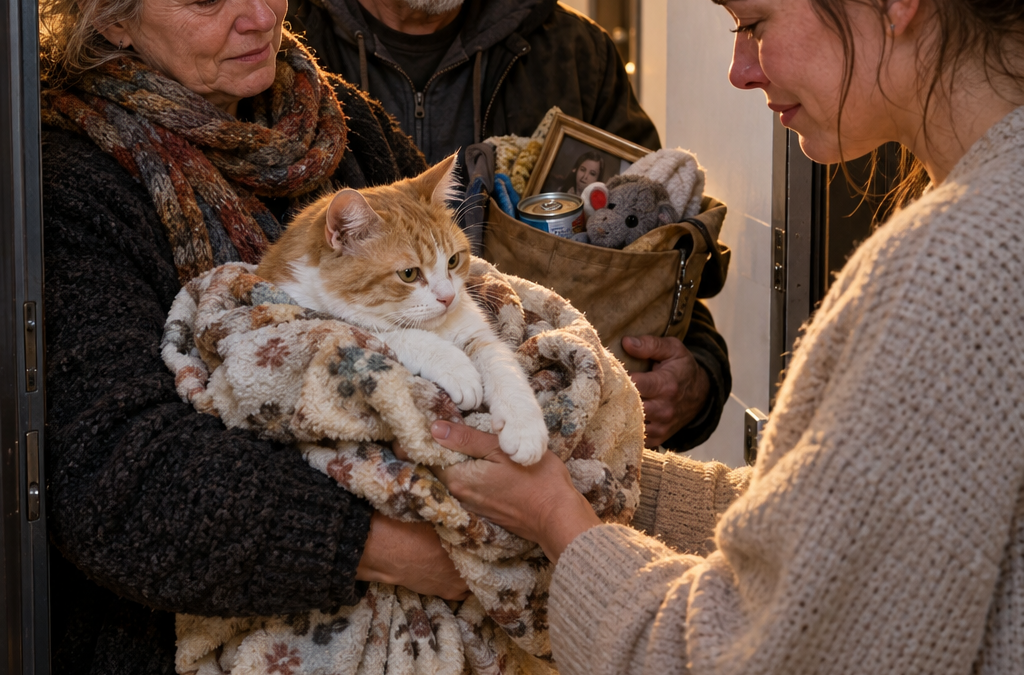
Ruth held Sunny wrapped in a yellow blanket.
Mr. Alvarez carried a small brown paper bag.
Sunny was completely silent.
No struggling.
No crying.
No fear.
Only those sad amber eyes looking down the hallway toward Apartment 3B, as if she believed the door would open at any second and Mrs. Whitaker would call, “There’s my sunshine.”
Ruth’s face was blotchy from crying.
“Mr. Larkin said the son won’t take her,” she said quietly. “Animal control is coming tomorrow if no one can keep her tonight.”
I looked at the cat.
She looked smaller outside the window, smaller without Mrs. Whitaker beside her, smaller wrapped in a blanket that still smelled like a life she understood.
“She can come here,” I said.
Ruth closed her eyes in relief.
“Just for tonight if you need,” Mr. Alvarez added quickly. “We can ask around.”
“No,” I said. “She can come here.”
I stepped aside.
Sunny did not move when Ruth carried her in.
My apartment was not ready for a cat. I had no litter box, no dishes, no toys, no bed. Ruth handed me the paper bag. Inside were a small bag of food, a few cans, a brush, two toys, a packet of medication, and a folded paper with Sunny’s feeding schedule written in Mrs. Whitaker’s careful handwriting.
At the bottom, in smaller letters, it said:
She likes her water fresh. Please tell her when you leave. She worries.
I had to turn away.
Ruth touched my arm.
“Eleanor loved that cat more than anything.”
“I know.”
“No,” Ruth said softly. “More than you know.”
Mr. Alvarez cleared his throat.
“I’ll bring a litter box. My daughter keeps foster supplies.”
“I can go buy one.”
“No.” He lifted his cane slightly. “Let an old man be useful.”
They left me with Sunny, the blanket, and the kind of silence that belongs to a creature whose world has ended but whose body has not yet understood it must keep living.
I placed her on the couch.
She stayed exactly where Ruth had set her.
I sat on the floor across from her.
“Hi, Sunny,” I whispered.
Her eyes moved to my face.
“I’m Clara. You know me a little.”
She did not blink.
“I’m so sorry.”
The words were useless.
I said them anyway.
After a while, she stood.
Slowly, carefully, as if every movement had to be considered. Her white paws were nearly soundless on the floor. She stepped down from the couch and began moving through the apartment.
She stopped at the kitchen doorway.
Looked in.
Turned back toward the front door.
She walked down the short hallway to my bedroom.
Paused.
Looked behind the door.
Returned to the living room.
Every few steps, she looked back toward the entrance.
Waiting.
Listening.
I understood then that she was not exploring.
She was searching.
The grief of animals is unbearable because it has no story to protect itself with. Sunny could not tell herself Mrs. Whitaker had passed peacefully or that she was no longer in pain or that death was part of life. She only knew the person who had always come back had not come back.
When she found the blanket, everything changed.
Ruth had placed it on the armchair.
Sunny saw it, froze, then hurried to it with the first real urgency she had shown. She climbed onto the chair, buried her face in the fabric, and sniffed for a long time.
Then she made one small sound.
It was not a meow.
It was a question.
She curled her yellow-and-white body tightly around the blanket, almost as if she could hold on to the last piece of the life she knew.
And then she fell asleep.
Really asleep.
Her body softened. Her head sank. One white paw stretched across the edge of the blanket.
I sat beside her until Mr. Alvarez returned with supplies. I sat beside her after he left. I sat beside her until the light outside turned blue and the hallway grew quiet.
At midnight, I went to bed.
Sunny followed me.
Not all the way at first. She stood in the bedroom doorway, watching.
“It’s okay,” I said. “You can come in.”
She looked behind her toward the front door.
Then back at me.
“I’ll be here in the morning.”
I do not know why I said it that way.
Maybe because Mrs. Whitaker had written, Please tell her when you leave.
Maybe because Sunny needed promises more than comfort.
“I’ll be here,” I said again.
She stepped into the room.
That first night, she slept on the floor beside my bed, curled on Mrs. Whitaker’s blanket. Twice I woke to find her sitting upright, staring at the bedroom door.
Each time, I whispered, “I’m still here.”
Each time, she lay down again.
The next morning, I called in sick.
Then I called the vet listed on Sunny’s medication packet.
“Sunny Whitaker,” the receptionist said when I gave the cat’s name. “Oh, Eleanor’s girl.”
Her voice softened.
“I’m sorry,” I said. “Mrs. Whitaker passed away. Sunny is with me now.”
The line went quiet.
“Oh,” the woman said. “Oh no.”
I heard papers rustling.
“Are you family?”
“No. A neighbor.”
Another pause.
“Do you plan to keep her?”
I looked at Sunny, who was sitting at the end of the hallway watching me as if phone calls were suspicious.
“Yes,” I said.
The word surprised me.
But it was true before I had fully understood it.
“Yes. If I’m allowed.”
The receptionist lowered her voice.
“You may want to come in. There are notes on file.”
“What kind of notes?”
“I think Dr. Patel should explain.”
My stomach tightened.
“Is Sunny sick?”
“She has mild kidney disease and arthritis, but she’s stable. It’s not that.”
“Then what?”
Another pause.
“Mrs. Whitaker was worried about what would happen to her.”
I looked at the folded feeding schedule on my counter.
Please tell her when you leave. She worries.
“I’ll come today,” I said.
Dr. Patel was a small woman with silver-streaked black hair, warm eyes, and the calm seriousness of someone who had held many beloved animals at the end of their lives. She came into the exam room and looked at Sunny in the carrier.
Sunny was pressed against the back, wrapped in the yellow blanket.
“Oh, sweetheart,” Dr. Patel whispered. “Where is your person?”
I started crying before I could stop myself.
“I’m sorry.”
Dr. Patel handed me a tissue without making a fuss.
“She was loved here,” she said. “Everyone knew her.”
“Sunny or Mrs. Whitaker?”
“Both.”
Sunny allowed the exam with quiet resignation. Dr. Patel checked her weight, heart, teeth, joints, hydration, and blood pressure. She was thirteen years old, older than I had realized, but in decent health considering the stress.
“She’ll need routine care,” Dr. Patel said. “Renal diet if you can manage it. Medication for arthritis. Bloodwork every six months. Mostly, she’ll need stability.”
“I can do that.”
Dr. Patel studied me.
“Mrs. Whitaker hoped someone would.”
Then she opened Sunny’s file.
“There’s a letter here.”
My heart stuttered.
“A letter?”
“She gave it to us three months ago. She said if she became unable to care for Sunny, we were to provide it to whoever took responsibility for her.”
“Why didn’t she give it to family?”
Dr. Patel’s face changed.
Professional, but sad.
“I think you should read it.”
She handed me an envelope.
On the front, in Mrs. Whitaker’s handwriting, were the words:
For the person kind enough to love Sunny after me.
I held the envelope with both hands.
“I don’t know if I can.”
“You don’t have to read it here.”
But I did.
Because some truths ask to be faced before fear makes them heavier.
Inside was a single page.
Dear friend,
If you are reading this, then I am no longer able to care for my Sunny. Thank you for giving her shelter. She has already known abandonment once, and my greatest fear is that she will know it again. She may seem quiet, but she feels deeply. Please be patient if she waits by the door. She waited a long time before she believed I would always come back.
Her food, medication, and vet details are listed separately. I have set aside a small amount for her care, though I do not know whether my son will honor my wishes. If he does not, please do not fight him for money. Fight only for her safety.
Sunny likes fresh water, soft voices, and the yellow blanket from my chair. She dislikes loud men, plastic bags, and being picked up quickly. She will follow you once she trusts you. Tell her when you leave. Tell her when you return. It may sound foolish, but she understands love best through routine.
If Clara from 3A is the one reading this, please know I wanted to ask you directly, but I was ashamed. It is a terrible thing to reach the end of your life and realize the person you trust most with your heart is not blood, but a neighbor you met because your smoke detector needed batteries.
With gratitude,
Eleanor Whitaker
By the time I reached the end, I could not see the page clearly.
Dr. Patel waited.
Sunny had turned in the carrier and was looking at me through the mesh.
“She named me,” I whispered.
“Yes.”
“She wanted to ask me.”
“Yes.”
“But she didn’t.”
Dr. Patel’s voice was gentle.
“Many older people fear being a burden more than they fear being alone.”
That sentence hurt because I knew it was true.
I folded the letter carefully.
“There’s money for Sunny?”
“Mrs. Whitaker mentioned it. But I don’t know the legal details.”
Neither did I.
Not yet.
That afternoon, when I returned to my building, a man in an expensive navy coat was standing outside Mrs. Whitaker’s door arguing with Mr. Larkin.
He was in his late fifties, broad-shouldered, with dark hair going silver at the temples and the polished impatience of someone used to service workers moving faster when he frowned.
Several cardboard boxes sat in the hallway.
I recognized his face from the photographs in Mrs. Whitaker’s apartment.
Her son.
Paul.
He turned when the elevator opened. His eyes went immediately to the carrier in my hand.
“Is that my mother’s cat?” he asked.
Sunny shrank backward.
I felt it like a physical thing.
“Yes,” I said. “She’s with me.”
His mouth tightened.
“I didn’t authorize that.”
Mr. Larkin cleared his throat.
“Mr. Whitaker, this is Ms. Miller. She’s the neighbor who took the cat temporarily.”
“Temporarily,” Paul repeated.
I held the carrier closer.
“Animal control was coming. I agreed to keep her.”
Paul looked at me with cold assessment.
“That cat is part of my mother’s property.”
“She’s a living animal.”
“She is legally part of the estate.”
“Then the estate should have fed her.”
Mr. Larkin looked away.
Paul’s expression sharpened.
“I don’t appreciate your tone.”
“I don’t appreciate yours.”
For a second, surprise flickered across his face. Men like Paul Whitaker are always surprised when a woman they consider ordinary does not soften herself for their convenience.
“My mother was elderly,” he said. “She grew sentimental. I’m sure she said many things to many people.”
“She wrote a letter.”
His eyes changed.
“What letter?”
I should not have said it.
I knew that instantly.
But grief had made me tired, and anger had made me careless.
“A letter about Sunny.”
His gaze dropped to my purse.
“May I see it?”
“No.”
“I am her son.”
“And I am the person she trusted with her cat.”
Paul stepped closer.
Sunny trembled inside the carrier.
“Listen carefully, Ms. Miller. My mother’s apartment and everything in it will be inventoried. If you removed documents, belongings, cash, or property—”
“Are you accusing me of stealing from a dead woman?”
His voice lowered.
“I am saying grief makes lonely people do strange things.”
The hallway went silent.
Mr. Larkin suddenly became fascinated by his clipboard.
I felt my face burn.
Lonely people.
It was not just an insult.
It was a strategy.
He had looked at me, unmarried, childless, living alone across from his dead mother, holding a cat wrapped in an old woman’s blanket, and decided exactly where to press.
I wanted to shout.
Instead, I lifted my chin.
“Your mother died two days ago,” I said. “Her cat spent a day locked in that apartment waiting for her. If your first concern is inventory, that tells me everything I need to know.”
Paul’s face hardened.
“You have no idea what my relationship with my mother was.”
“No,” I said. “But Sunny does.”
He looked at the carrier then.
For one strange second, something like shame crossed his face.
Then it disappeared.
“You’ll be hearing from my attorney.”
“Good,” I said. “Tell him to ask Dr. Patel about the letter.”
I walked into my apartment before he could answer.
Inside, I set Sunny’s carrier down and opened the door.
She did not come out.
I sat on the floor beside her.
My hands were shaking.
“I’m sorry,” I whispered. “I shouldn’t have let him scare you.”
Sunny stared at the doorway.
“He won’t take you,” I said.
I did not know if I could promise that.
But I did.
Sometimes love begins before certainty.
The next week became a blur of tension.
Paul had Mrs. Whitaker’s apartment cleared with brutal speed. Movers came on Saturday morning and carried out boxes of books, framed photographs, lamps, dishes, bedding, and furniture. I heard the scrape of her chair across the floor, the chair where she had held Sunny and written notes in the margins of library books. I heard one mover laugh at something. I heard Paul say, “Anything stained or cat-related can go in trash.”
I opened my door.
In the hallway, a young mover held Sunny’s window bench.
The yellow blanket was not on it. It was with Sunny in my apartment.
But the bench itself, the place she had waited every day, was being carried toward the elevator.
“Where is that going?” I asked.
The mover looked nervous.
“Donation pile, I think.”
“I’ll take it.”
Paul appeared behind him.
“No, you won’t.”
“It belonged to the cat.”
“It belonged to my mother.”
“Your mother would want Sunny to have it.”
“My mother wanted many unrealistic things.”
I stepped into the hallway.
“Like a son who visited?”
The mover’s eyes widened.
Paul went very still.
Mr. Larkin, who had been hovering near the open door, muttered, “Ms. Miller…”
Paul smiled then.
It was not a kind smile.
“You know, my mother always had a weakness for wounded things. Stray cats. Charity cases. People with empty apartments and too much interest in other people’s lives.”
The words landed in front of the movers, Mr. Larkin, and two neighbors who had paused near the stairwell.
Public humiliation does not always happen in front of a crowd.
Sometimes five witnesses are enough.
I felt heat crawl up my neck, but I kept my voice calm.
“I’ll pay you for the bench.”
“I don’t need your money.”
“No,” I said. “You just need control.”
His smile vanished.
“You’re overstepping.”
“And you’re throwing away the only home Sunny has left.”
He looked past me toward my open apartment door.
Inside, Sunny stood in the shadow of the hallway, watching.
Paul saw her.
For a moment, the mask slipped again.
He looked not sad, exactly, but disturbed. As if the cat’s presence had carried his childhood into a room where he could no longer keep it sealed.
Then he turned away.
“Give it to her,” he snapped at the mover. “And get the rest done.”
The mover handed me the bench.
I carried it inside, closed the door, and leaned against it.
Sunny approached slowly.
When she saw the bench, she froze.
Then she climbed onto it.
She sniffed every inch.
She turned in a circle.
She sat facing the door.
Waiting.
I knelt beside her and cried silently because I could not explain to her that the apartment across the hall was empty now, that the person she loved was not behind that door or any door, that the smell of home would fade from the bench and blanket no matter how desperately she pressed her face into them.
Sunny turned and placed one white paw on my wrist.
Just once.
Then she looked back at the door.
Grief has no schedule.
For the first month, Sunny lived between two worlds.
By day, she followed me gently everywhere. When I walked into the kitchen, she came too. When I sat at my desk, she settled beside the chair. When I left the room, she lifted her head immediately, eyes wide, needing to know I was not disappearing as well.
But every afternoon, at the exact hour Mrs. Whitaker used to return from errands, Sunny went to the front door.
She sat there facing it.
Sometimes for twenty minutes.
Sometimes for an hour.
At first, I tried to distract her.
Treats. Toys. Soft words.
Nothing worked.
So I began sitting with her.
At four-thirty each afternoon, I sat on the floor beside the door while Sunny waited for a ghost.
“I’m here,” I would say.
She would not look at me.
“I know it’s not the same.”
Her tail would curl around her paws.
“I wish she could come back too.”
Eventually, she would stand, walk to the yellow blanket, and lie down with her back to me.
That was our routine.
A heartbreak repeated daily, because love cannot be convinced by logic to stop looking.
Meanwhile, Paul’s attorney sent a letter demanding return of “all property removed from the decedent’s residence, including but not limited to the domestic animal known as Sunny, veterinary records, blankets, furniture, documents, and miscellaneous items.”
I read it three times at my kitchen table.
Then I called Dr. Patel.
She gave me the name of an attorney who volunteered with a senior advocacy group.
That was how I met Miriam Voss.
Miriam was seventy-one, sharp-eyed, and wore red lipstick like battle armor. Her office was above a bakery and smelled faintly of paper, coffee, and cinnamon rolls. She read Paul’s letter, Mrs. Whitaker’s letter, Sunny’s vet notes, and the feeding schedule without interrupting.
When she finished, she looked at me over her glasses.
“Paul Whitaker is either very greedy or very frightened.”
“Of what?”
“That depends on what his mother left behind.”
“I don’t care about money.”
“No,” Miriam said. “That’s why people with money often underestimate people like you.”
She tapped Mrs. Whitaker’s letter.
“This is not a formal will. But it helps establish intent. The vet’s file helps. Witnesses help. Did anyone else hear Mrs. Whitaker talk about Sunny’s care?”
“Ruth from church. Maybe Mr. Alvarez. Maybe Dr. Patel.”
“Good.”
“Can Paul take her?”
Miriam paused just long enough to make my stomach drop.
“He can try.”
I gripped the arms of the chair.
“But?”
“But courts do not enjoy being used to rip elderly cats from stable homes when the deceased owner’s wishes are documented. Especially if we can show abandonment or neglect after Mrs. Whitaker’s death.”
“She was left alone in the apartment.”
“For how long?”
“At least a day. Maybe more.”
Miriam made a note.
“And Paul refused to take her?”
“Yes.”
“Witnesses?”
“Ruth and Mr. Alvarez.”
Another note.
Miriam leaned back.
“Then we do not panic.”
“I’m already panicking.”
“Fine. Panic privately. Publicly, we document.”
I almost laughed.
Miriam became my second unexpected guardian that month.
She sent a response letter so cold and precise it could have chilled soup. She requested proof of Paul’s legal authority, demanded records of Sunny’s care during the estate transition, cited Mrs. Whitaker’s documented wishes, and stated that any attempt to remove Sunny from her current caregiver would be contested as contrary to the animal’s welfare.
Paul did not reply immediately.
Instead, he complained to Mr. Larkin.
Then Mr. Larkin complained to me.
“You’re creating drama,” he said one evening when I was checking the mail.
I turned slowly.
“Excuse me?”
“Mr. Whitaker is trying to settle his mother’s affairs.”
“By threatening her cat?”
“By requesting property be returned.”
“If you call Sunny property one more time, I’m going to become very difficult to manage.”
He stared at me.
“You think because you took in a cat, you’re some kind of hero?”
“No,” I said. “I think because you locked a grieving animal inside a dead woman’s apartment and waited for someone else to solve it, you’re not.”
His face flushed.
“You don’t know what my job is like.”
“I know what decency looks like.”
Other tenants had gone quiet around the mailboxes.
Mr. Larkin stepped closer.
“Be careful, Ms. Miller.”
Miriam’s voice appeared behind me.
“She is.”
I turned.
Miriam Voss stood in the lobby wearing a long black coat and carrying a leather briefcase.
I had never been so happy to see an elderly woman with red lipstick in my life.
Mr. Larkin stiffened.
“And you are?”
“Her attorney.”
His mouth opened.
Miriam smiled.
“Do continue. I love witnesses.”
He left.
Miriam looked at me.
“You’re terrible at panicking privately.”
“I’m learning.”
“Learn faster.”
But her eyes were warm.
The real secret appeared because of Sunny.
It happened on a cold evening six weeks after Mrs. Whitaker’s death. Rain tapped the windows, and I was working late at my desk. Sunny had been sleeping on her yellow blanket, but suddenly she got up and walked to the front door.
I checked the time.
Four-thirty had passed hours ago.
“Sunny?”
She pressed her nose to the bottom of the door and sniffed.
Then she pawed at it.
Not scratching to leave.
Searching.
I opened the door carefully.
The hallway was empty.
Mrs. Whitaker’s apartment had been cleared and locked. The door across the hall looked bare without her little wreath of fabric flowers.
Sunny stepped into the hallway.
“Sunny, no.”
She did not run. She walked slowly to Apartment 3B and sat in front of it.
Then she looked back at me.
“No,” I whispered. “We can’t go in.”
She placed one paw against the door.
The sound was tiny.
Tap.
Tap.
Tap.
My throat tightened.
“I know.”
She looked down.
Sniffed the crack beneath the door.
Then she moved to the side, toward a narrow strip of baseboard between Mrs. Whitaker’s door and the wall. She sniffed intensely, pawed once, and looked at me again.
I crouched.
“What is it?”
There was something wedged behind the loose baseboard.
At first, I thought it was dust or trash.
Then I saw the corner of a small cloth pouch.
My pulse quickened.
I glanced down the hall.
No one.
The baseboard was already loose. When I touched it, it shifted outward half an inch. I pulled gently and the cloth pouch slid free, covered in dust.
Sunny leaned forward and sniffed it.
It smelled faintly of lavender.
Inside the pouch was a key and a folded note.
My hands shook as I opened it.
Clara,
If I lose my nerve and do not ask you, I hope Sunny remembers where I hid this. She watched me place it here. The key is for the cedar box in my closet, beneath the winter quilts. If Paul has not found it, please give it to Miriam Voss. I should have done this properly sooner. I was foolish and ashamed.
E.W.
For a moment, the hallway seemed to tilt.
Sunny sat beside me, calm now, as if she had completed a task she had carried without understanding.
The cedar box.
But the apartment had been cleared.
The closet emptied.
The winter quilts were gone.
I called Miriam before I stood up.
She answered on the third ring.
“What happened?”
“How did you know something happened?”
“You never call after eight unless you’re about to panic.”
I read her the note.
Silence.
Then Miriam said, “Do not tell Mr. Larkin.”
“I wasn’t planning to.”
“Do not tell Paul.”
“Definitely not.”
“Take a photo of everything exactly where you found it.”
“I already moved it.”
“Of course you did.”
“Sorry.”
“Photograph it anyway. Then bring it to my office first thing tomorrow.”
“What about the cedar box?”
Miriam’s voice sharpened.
“We find out whether it was removed, donated, trashed, or stolen.”
“Stolen?”
“Clara, frightened greedy people do not threaten lawsuits over elderly cats unless something else is missing.”
The cedar box became the center of everything.
Through Ruth, we learned Mrs. Whitaker had mentioned “putting things in order” at church a few months before she died. Through Mr. Alvarez, we learned he had seen Paul leaving Mrs. Whitaker’s apartment two weeks before her death carrying a banker’s box, though Paul had claimed he had not visited in months. Through building security footage Miriam requested before it could be deleted, we saw Paul entering 3B the evening after Mrs. Whitaker’s death, before Ruth and Mr. Alvarez brought Sunny to me.
He had stayed forty-three minutes.
He had left with a blue storage bin.
Mr. Larkin had let him in.
When Miriam confronted him in writing, Paul claimed the bin contained “personal family photographs.”
Then Nora, the owner of a local thrift shop two neighborhoods over, contacted Ruth. A cedar box with carved flowers had been donated along with several quilts, books, and household items from an estate clean-out. Nora had bought it for five dollars because it reminded her of her grandmother.
The box was empty.
Or it appeared empty until Miriam inspected the lining.
Under the false bottom, wrapped in tissue paper, were three things.
A formal signed document naming me as Sunny’s preferred caregiver and setting aside a small pet trust for her care.
A handwritten letter to Paul.
And a stack of bank statements showing withdrawals from Mrs. Whitaker’s account over the last year of her life, all signed by Paul under power of attorney.
Not illegal by itself, Miriam explained.
But suspicious.
Very suspicious.
Especially because Mrs. Whitaker’s own letters showed she had been worried about money disappearing.
The letter to Paul was the hardest to read.
Miriam warned me not to.
I did anyway, with her permission, because Sunny was asleep on my lap in the office and somehow that made me feel responsible for understanding.
My dear Paul,
I have rewritten this letter more times than I can count. You are my son, and there is no pain quite like admitting that someone you carried as a child can grow into a stranger who visits only when papers need signing.
I know you are angry with me for asking questions about the withdrawals. I know you believe I owe you because life has disappointed you. Perhaps I failed you in ways I do not fully understand. If I did, I am sorry. But I will not let guilt become permission for cruelty.
Sunny is not to be taken by you or placed in a shelter. You gave her away once because she inconvenienced your household. I forgave you because I wanted to keep loving you. But I did not forget. She deserves better than to be unwanted twice.
I have asked that Clara Miller be trusted if she is willing. She has shown me more kindness in hallway conversations than you have shown in years of hurried phone calls. That sentence breaks my heart to write, but it is true.
There is still time to become a better man, Paul. But you must begin by telling the truth.
Your mother,
Eleanor
Miriam took the letter gently from my hands when I finished.
Sunny slept on, her head tucked against my stomach, unaware that the woman she had loved had fought for her in the only way she could.
“What happens now?” I asked.
Miriam looked at the papers.
“Now Paul has a problem.”
The confrontation happened at a probate meeting two weeks later.
I did not want to go.
Miriam said I should.
“Not because you need to fight,” she said. “Because Eleanor deserves someone in the room who loved what she loved.”
So I went.
The meeting was held in a small conference room with beige walls, a long table, and the stale smell of institutional coffee. Paul sat on one side with his attorney, a tired-looking man who kept rubbing his forehead. Miriam and I sat across from them.
Paul did not look at me.
Miriam placed copies of the documents on the table.
“We have located Mrs. Whitaker’s written instructions regarding Sunny,” she said. “We have also located the pet trust documentation.”
Paul’s attorney looked at the papers and visibly deflated.
Paul’s jaw clenched.
“My mother was not competent.”
Miriam’s voice stayed calm.
“Her physician and veterinarian both noted she was competent. Her church witness and notary agree.”
“She was manipulated.”
I laughed before I could stop myself.
Everyone looked at me.
Paul’s eyes flashed.
“You think this is funny?”
“No,” I said. “I think it’s amazing how quickly people call an elderly woman confused when she finally says something they don’t like.”
Miriam’s mouth twitched, but she said nothing.
Paul leaned forward.
“You knew her for what? A few years? I knew her my entire life.”
“Then you had more time to be kind.”
The words left my mouth quietly.
That made them worse.
Paul’s face reddened.
“You have no idea what she was like as a mother.”
“You’re right,” I said. “I don’t. But I know what you were like as a son at the end.”
His attorney placed a hand on his arm.
“Paul.”
But Paul pulled away.
“She always made me feel like I wasn’t enough,” he snapped. “Always with the disappointed eyes, the quiet sighs, the little notes. Even that damn cat got more tenderness from her than I did.”
There it was.
Not grief.
Not love.
Resentment.
Old, festering, and finally careless enough to speak.
Miriam leaned forward.
“So you threatened the cat?”
“I wanted what was mine.”
“Sunny?”
“The apartment. The money. The decisions. My mother had no right giving a stranger control over anything.”
“Sunny is not a bank account,” I said.
Paul looked at me then.
“No. She’s a reminder.”
For one second, I saw him not as a villain, but as something sadder: a boy who had grown into a man without ever forgiving his mother for loving imperfectly, and without ever taking responsibility for the ways he had chosen to wound her back.
But understanding is not the same as excuse.
Miriam slid another document across the table.
“This is the security record showing you entered the apartment before the authorized inventory.”
Paul went pale.
“This is the donation receipt showing items removed from the apartment were sent to a thrift shop before probate review.”
His attorney closed his eyes.
“This is a copy of your mother’s bank statement. We will be requesting a full accounting of all withdrawals made under power of attorney.”
Paul said nothing.
Miriam’s voice became softer, which somehow made it more dangerous.
“And if you continue pursuing Sunny, we will ask the court why you are so determined to recover an elderly cat you previously refused to house, especially when the deceased left documented instructions to the contrary.”
Paul stared at the table.
The fight went out of him slowly.
Like air leaving a punctured tire.
At the end, his attorney requested a recess.
By the following week, Paul withdrew his claim to Sunny, agreed to honor the pet trust, and submitted to a financial review of his handling of Mrs. Whitaker’s accounts. Some money had to be returned to the estate. Some belongings were recovered. Some were gone forever.
Paul did not apologize to me.
I did not need him to.
But three months later, a card arrived with no return address.
Inside was a copy of a photograph.
A young Paul, maybe six years old, sitting on a porch with a yellow kitten in his lap. Beside him, much younger Mrs. Whitaker smiled at the camera, her hand resting lightly on his shoulder.
On the back, someone had written:
I forgot she used to look at me that way too.
There was no signature.
I sat with that card for a long time.
Then I put it in the cedar box Miriam gave me after the estate settled.
Not for Paul.
For Mrs. Whitaker.
Because love stories are rarely clean. People fail each other. Parents wound children. Children abandon parents. Grief curdles into greed. Regret arrives late and poorly dressed.
But truth still matters.
And so does the one left waiting by the door.
Sunny changed after the case ended.
Not all at once.
Animals do not follow human legal timelines.
But slowly, she began to believe my apartment was not temporary.
She stopped sleeping only on the yellow blanket and began trying the couch, the rug beneath my desk, the sunny corner near the balcony door. She discovered the warm top of the dryer and claimed it with religious devotion. She began eating better. Her coat grew softer. Her eyes lost that constant faraway searching.
She still went to the door at four-thirty.
But she no longer stayed for an hour.
Sometimes she sat for five minutes.
Sometimes she only looked.
Then she would come find me.
The first time she climbed into my lap on her own, I did not move for forty-two minutes because I was afraid breathing too boldly might ruin it.
She stepped onto my knees, turned in a slow circle, tucked her paws beneath her, and rested her chin on my wrist.
I cried silently over her head.
She opened one eye, annoyed by the moisture, then closed it again.
That was Sunny’s way.
Tenderness with standards.
I learned her language.
Fresh water in the morning, not from the bowl that had been sitting overnight.
Medication hidden in soft food but not too deeply, because she did not appreciate dishonesty.
Two taps on the door before leaving.
A clear sentence every time.
“I’m going to work, Sunny. I’ll come back.”
At first, I felt foolish saying it.
Then I remembered Mrs. Whitaker’s note.
She understands love best through routine.
So I built routines like little bridges.
“I’m taking out the trash. I’ll come back.”
“I’m going downstairs for mail. I’ll come back.”
“I’m going to the grocery store. I’ll come back.”
And every time I returned, I said the other half.
“I came back.”
Sunny would look at me from her window bench, amber eyes steady, as if keeping a record.
Maybe she was.
On the first anniversary of Mrs. Whitaker’s death, I took the yellow blanket to 3B.
The apartment had a new tenant by then, a young nurse named Maya, who knew only pieces of the story. She let me stand in the hallway for a moment with Sunny in her carrier.
“I don’t want to upset her,” I said.
Maya smiled gently.
“Take your time.”
I opened the carrier door.
Sunny stepped out cautiously.
She sniffed the hallway.
The door of 3B was painted the same color, but the wreath was gone. The smell was different. The life behind it belonged to someone else.
Sunny sat in front of the door.
Not waiting this time.
Just remembering.
I sat beside her on the carpet.
“I miss her too,” I whispered.
Sunny leaned against my leg.
After a few minutes, she stood and walked back into the carrier.
That was all.
Grief does not always need a ceremony.
Sometimes it needs permission to leave the hallway.
That evening, Ruth, Mr. Alvarez, Dr. Patel, Miriam, and I gathered in my apartment. We drank tea from Mrs. Whitaker’s old cups, the ones Paul had not thrown away because Miriam recovered them from a donation box. Ruth brought lemon cake from the church kitchen. Mr. Alvarez brought flowers. Dr. Patel brought a toy Sunny ignored. Miriam brought a stack of paperwork and pretended that counted as affection.
We told stories about Mrs. Whitaker.
Ruth told us she had once corrected the pastor’s grammar in the church bulletin with a red pen.
Mr. Alvarez said she always knew when his arthritis was bad because she would leave the elevator door open longer without mentioning it.
Dr. Patel said Mrs. Whitaker used to bring Sunny’s medication schedule written more neatly than most medical charts.
I told them about the smoke detector, the marmalade, the mystery novel with the ridiculous ending.
Sunny sat on the window bench through most of it, watching us with solemn approval.
Near the end of the evening, Ruth lifted her teacup.
“To Eleanor.”
“To Eleanor,” we said.
Sunny blinked slowly.
And for the first time, I felt not only the sadness of Mrs. Whitaker’s absence, but the shape of what she had left behind.
Not money.
Not furniture.
Not legal documents.
A cat who still knew how to trust, even after being abandoned twice.
A neighbor who had learned that family can begin with a knock on the door.
A small circle of people who would not let a quiet life disappear unnoticed.
Years from now, people in the building may not remember Mrs. Whitaker’s name.
They may not know she was a librarian, or that she made marmalade, or that she once kept a yellow kitten because her son could not be bothered to keep a promise to his child.
But I will remember.
Sunny will remember in the way cats do: through places, routines, blankets, light, and the certainty that love should return.
And because of Mrs. Whitaker, I have changed too.
I notice the elderly man in 2C who carries groceries one bag at a time because he is too proud to ask for help.
I notice the woman downstairs who leaves early every morning in scrubs and comes home with her shoulders bent from exhaustion.
I notice the little dog in the first-floor window who barks until his owner’s car turns into the lot.
Waiting is everywhere once you know how to see it.
So is loneliness.
So is love.
Sunny is beside me now as I write this, curled on the yellow blanket at the end of my couch. Her golden patches glow in the afternoon light, just as they did in Mrs. Whitaker’s window. Her white paws are tucked beneath her chest. One ear stands perfectly straight; the other tilts outward as though listening for secrets.
At four-thirty, she still lifts her head.
Some habits are made of love too deep to vanish.
But now, when the old waiting rises in her body, she looks at the door, then looks at me.
And I say, “I’m here.”
She believes me more quickly these days.
Sometimes she comes to sit beside my chair.
Sometimes she presses one white paw against my wrist.
Sometimes, if the light is just right and the apartment is quiet, I imagine Mrs. Whitaker smiling at the sight of her sunshine safe in another patch of sun.
I cannot bring back the woman Sunny lost.
I cannot undo the hours she spent alone in that apartment, listening for a key that would never turn.
I cannot make Paul become the son his mother needed, or give Mrs. Whitaker the courage to ask sooner, or return every object that was tossed away by people who did not understand that ordinary things can hold a whole human life.
But I can keep the promise that was handed to me in a yellow blanket.
I can give Sunny fresh water.
I can give her medicine hidden badly enough that she forgives me.
I can give her the window bench, the soft voices, the routine, the words before leaving and after returning.
I can give her a home where no one calls her property.
I can give her a door that always opens again.
Last night, for the first time, Sunny did not sleep on Mrs. Whitaker’s blanket.
She carried her ragged mouse into my bedroom, jumped onto the bed with surprising effort for an old lady with arthritis, and curled against my side.
I stayed awake, barely breathing, feeling the warmth of her small body through the quilt.
After a while, she stretched one white paw and rested it on my hand.
Just like she used to do with Mrs. Whitaker.
I cried then, quietly, not from sadness exactly, but from the overwhelming tenderness of being trusted by a heart that had every reason to close.
Sunny slept through it.
Outside, the hallway was dark.
The door was locked.
The world was still full of people who forgot the old, discarded the inconvenient, and measured life by what could be claimed, sold, or controlled.
But inside my apartment, a little yellow-and-white cat dreamed safely beside me.
She had arrived grieving.
She had arrived carrying the scent of the woman who loved her first and best.
She had arrived with sad eyes fixed on a door that would never open the way she wanted.
But she was not alone anymore.
And maybe that is the most any of us can do when grief leaves someone waiting.
We cannot always bring back what was lost.
We cannot always explain why love disappears from the doorway.
But we can sit beside the one still waiting.
We can speak softly.
We can stay.
We can become, for a frightened heart, the person who comes back.
And sometimes, after enough patience, enough routine, enough small faithful mercies, the one who was left behind will finally close their eyes, place a paw on your hand, and believe that home has found them again.








