My Deaf Grandfather Hadn’t Had a Real Conversation in Ten Years—Then a Golden Retriever Tapped the Floor and Answered Him
PART3:
I wish I could tell you I was heroic about it.
I was not.
I was consistent, which is different.
Every Sunday, after church if I had gone, after grading papers if I had not, after the grocery store or laundry or whatever errands life used to make itself feel urgent, I drove from Albany to Schenectady and sat with him by the window.
I am a high school music teacher.
I spend my weekdays surrounded by sound—clarinets squeaking, trumpets overblowing, teenagers singing half a beat late and then laughing, piano keys, metronomes, the thud of chairs being dragged across rehearsal rooms, the sudden impossible beauty of thirty young voices finding the same chord at the same time.
Then on Sundays, I entered my grandfather’s silence.
I wrote with the black marker.
Hi Grandpa. It’s Caroline.
He always gave me the same look when I wrote that, as if to say he knew perfectly well who I was and did not need subtitles for his own granddaughter.
Then he would write back in blue.
You are late.
Even when I was not.
Especially when I was not.
Our conversations averaged twelve minutes.
I know because one day, ashamed of myself, I started timing them.
Twelve minutes before my wrist cramped.
Twelve minutes before his fingers stiffened.
Twelve minutes before the pauses between sentences grew too long and we both pretended the birds outside had become fascinating.
How are classes?
Loud.
Good. Children should be loud.
One trombone player got his slide stuck in a music stand.
Good. Trombone players require humility.
I would laugh.
He could not hear it.
That was one of the first griefs I never learned how to explain.
Laughing in front of someone who used to love your laugh.
After about twelve minutes, we usually stopped writing.
I would hold his hand.
He would look out the window.
We would sit in the quiet that had been his country for ten years.
My mother had done better.
She was a kindergarten teacher for forty years and had the patience of a saint, though she would have rejected the phrase because she said saints probably never had to line up twenty-one five-year-olds after recess.
She could write to him for thirty minutes at a time.
Sometimes longer.
She drew little pictures. She printed jokes. She wrote questions slowly and waited without rushing him.
Then she died in 2021.
Cancer.
Quick at the end.
After that, I became the last person in his life who wrote to him consistently for any meaningful length of time.
Twelve minutes a week.
That was the entire spoken life of an eighty-six-year-old man.
Until Maple.
The therapy dog program came to Pinegrove in March.
I was there the first afternoon by accident. It was not my usual time, but a snowstorm had closed school early, and I decided to visit Grandpa on a Thursday because the roads were still passable and I had no excuse not to.
Memory care had a different feeling on weekday afternoons.
Sundays were polished for family.
Weekdays told the truth.
A television murmured in the common room to residents who were not watching. A woman in a pink sweater folded the same napkin again and again. A man near the window asked every three minutes whether the train had come. Staff moved gently but quickly, carrying trays, laundry, medication cups, clipboards, patience.
I was writing to Grandpa about my students’ spring concert when a soft commotion moved down the hall.
Not noise exactly.
Energy.
A few residents lifted their heads.
A nurse said, “Maple’s here.”
A Golden Retriever appeared in the doorway.
She was not dramatic.
That was the first thing I noticed.
Some dogs enter rooms like they have been announced by trumpets. Maple entered like warm light.
She was seven, maybe eight, with a pale golden coat, a sugar-white muzzle, and the calm brown eyes of a creature who had discovered long ago that most humans are carrying more than they say. She wore a blue therapy vest. Her handler, Denise, stood beside her holding a loose leash.
“Would August like a visit?” Denise asked.
I looked at Grandpa.
He had seen the dog.
His eyes had sharpened.
Animals still reached him faster than people did.
I wrote on the board.
A therapy dog is here. Her name is Maple. Do you want to meet her?
He read it.
Then looked at Maple.
Then wrote:
Dog.
“Yes,” I said out loud, uselessly. “Dog.”
He lifted one hand slightly.
Denise brought Maple closer.
“She’s gentle,” she said. “She visits twice a week. Mostly just pets and company.”
Maple approached Grandpa’s chair and placed her head carefully on his knee.
Not his lap.
His knee.
As if asking permission to become weight.
Grandpa’s hand trembled when he touched her head.
He had not owned a dog since before I was born, but I had seen photographs: a black-and-tan mutt named Otto, sitting beside Grandpa in the 1960s with one torn ear and an expression of deep suspicion toward the camera.
Grandpa stroked Maple’s head once.
Then again.
His face changed.
Not happiness.
Something more fragile.
Recognition without demand.
Maple stood quietly for several minutes.
Then Denise said they needed to continue down the hall.
Maple lifted her head.
Grandpa’s hand followed her for half an inch before dropping back to his lap.
I wrote:
She visits twice a week.
He read it.
Then wrote:
Good dog.
That was all.
I thought it was sweet.
I did not know I had just watched the first sentence of a language being born.
The next time Maple visited, I was not there.
I heard about it from Yolanda, one of the nurses who understood my grandfather better than most because she had learned to write slowly and in large letters.
When I arrived Sunday, Yolanda met me in the hall.
“Your grandfather has a girlfriend,” she said.
I blinked.
“Excuse me?”
She grinned.
“Golden Retriever. Maple. He lit up like Christmas.”
That made me smile.
Then she lowered her voice.
“Actually, he did something strange. Not bad strange. Interesting strange.”
“What?”
“She tapped her paw on his floor. He tapped back.”
I looked toward his room.
“What do you mean, tapped back?”
“On the chair. With his heel.”
I did not yet understand why that mattered.
When I entered, Grandpa was waiting with the board.
Already uncapped.
That meant he had something to say.
I kissed his cheek and sat.
He wrote:
Dog came.
I smiled and wrote:
Maple?
He nodded.
Then wrote:
She knocked.
I frowned.
On door?
He shook his head, impatient.
Then he tapped his blue marker twice against the whiteboard frame.
Tap. Tap.
Wrote:
Floor.
I looked at the words.
She knocked floor?
He nodded.
Then pointed down.
I leaned forward.
Grandpa lifted his right foot and tapped his heel once against the metal footrest of his wheelchair.
A tiny vibration traveled through the frame.
Then he looked at me, eyes bright in a way I had not seen in years, and wrote:
I answered.
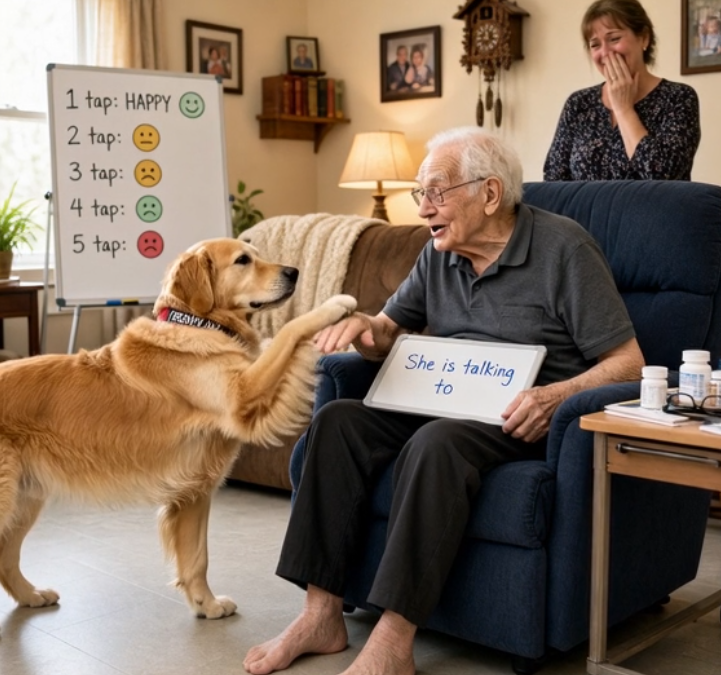
Six days later, Maple and my grandfather had eleven signals.
Not tricks.
Not random gestures.
Signals.
A working system.
A language of rhythm and pressure that used neither sound nor sight as its primary channel.
It began with the floor.
Maple had been trained to offer a paw gently when residents seemed withdrawn. Denise said it was part of her therapy repertoire. Paw on knee. Paw on bed. Sometimes paw on floor if she was lying down.
But with Grandpa, Maple discovered something.
When she tapped the linoleum near his wheelchair, he felt it.
Not through hearing.
Through vibration.
A small, physical pulse traveled through the floor, into the wheels, into the frame, into his footrest, into the bones of his legs.
He noticed.
So he tapped back.
One tap became hello.
Two taps became again.
Three taps became yes.
A long paw press became stay.
A paw scrape became come closer.
A soft chin pressure against his knee meant tired.
A paw placed on his shoe meant walk.
A nose press against his palm meant hand.
Two slow taps followed by chin pressure meant sad.
Three fast taps followed by a paw scrape meant water.
One tap, pause, one tap became Maple’s way of asking, Are you there?
Grandpa answered with his heel.
One tap, pause, one tap.
I am here.
The eleventh signal was the one that broke me.
Maple invented it on the sixth day.
She placed her paw gently on the top of Grandpa’s foot and did not move.
Not a tap.
Not a scrape.
Weight.
Grandpa looked down, then placed his hand over her paw.
Denise thought it meant pet me.
Grandpa knew better.
He wrote later:
She says quiet together.
That was the eleventh signal.
Quiet together.
When Yolanda told me this, I wanted to believe it and did not want to be foolish.
Those two feelings often arrive together when hope has been scarce.
I am a music teacher. Rhythm is my profession. Pattern is not mystical to me. Humans make meaning from repeated structure. So do animals, more often than we give them credit for. But language is a big word.
I did not use it at first.
I said system.
I said routine.
I said signals.
Then I watched them.
Maple came into his room on a Thursday afternoon while I was visiting.
Grandpa was in his wheelchair by the window, whiteboard across his lap.
Denise paused at the doorway.
“Maple, gentle.”
Maple walked in, tail low and slow, and stopped three feet from Grandpa.
She tapped the floor once.
Grandpa’s face changed immediately.
He tapped his heel once against the footrest.
Maple stepped closer.
She tapped twice.
Grandpa tapped twice.
Maple gave a full-body sigh, crossed the remaining distance, and placed her head on his knee.
He put his hand on her head and closed his eyes.
No one had written a word.
No one had spoken a word he could hear.
But something had been said.
I felt it in the room.
Denise whispered, “That’s their greeting.”
I could not answer.
Because I was watching my grandfather have a conversation faster than any conversation I had managed with him in six years.
Maple lifted her head and pawed lightly at the floor.
Tap. Tap. Tap.
Grandpa tapped three times with his heel.
She turned in a circle once, then settled beside his chair.
“Yes,” Denise said softly. “That one means yes.”
I looked at her.
“How do you know?”
“Because when he doesn’t want her to do something, he doesn’t answer three. He answers one and then pushes the board toward her.”
“That means no?”
“No,” Denise said. “It means ask Caroline.”
Despite myself, I laughed.
Grandpa looked at my face.
He could not hear my laugh, but he saw the shape of it.
For once, that was enough.
I began documenting the signals.
Not because I doubted them anymore.
Because I was afraid the world would.
I wrote them in a notebook and numbered them. I recorded times. Context. Responses. Whether Maple initiated or Grandpa did. Whether the meaning stayed consistent across settings.
It did.
The signals held.
On linoleum, through the wheelchair.
On the wooden floor of the activity room.
Through the frame of his bed when Maple tapped beside it.
Even through the metal leg of the small table near his window when Grandpa tapped the tabletop with his knuckles and Maple answered by pawing the floor underneath.
They were not using sound.
They were barely using sight.
Some days Grandpa’s eyes were tired or unfocused, and Maple still reached him through pressure. Through vibration. Through contact.
She had found a door under the silence.
And my grandfather, after ten years of people giving up after two sentences, opened it.
The change in him was not dramatic in the way movies prefer.
He did not suddenly become young.
He did not stop forgetting names.
He did not regain hearing through the miracle of dog love.
He was still eighty-six.
Still deaf.
Still in memory care.
Still sometimes confused about the year.
Still sometimes asking for my grandmother as if she might be down the hall.
But something in him returned.
Not all at once.
In increments.
He began wearing his cardigan buttoned correctly again.
He asked for his comb.
He started eating more at lunch on Maple days.
He wrote more.
Not just to me.
To staff.
To Denise.
Once, to Maple, which made practical sense to no one and emotional sense to everyone.
He wrote on the board and held it down for her as if she could read.
GOOD DOG.
Maple sniffed the board, then tapped once.
Grandpa nodded solemnly.
I did not correct either of them.
Why would I?
On the third week, Grandpa wrote something that made me leave the room and cry in the hallway.
I had written:
Maple comes tomorrow.
He read it.
Then slowly wrote:
Tomorrow has someone in it now.
For ten years, days had been flat to him.
Meals.
Medication.
Sleep.
My visits.
The same window.
The same birds.
The same silence.
Now tomorrow had someone in it.
A Golden Retriever had placed a future back on his calendar.
The first time Maple missed a visit, we learned how real the language had become.
It was a Tuesday, and Denise had called Pinegrove that morning to say Maple had a minor stomach upset. Nothing serious. She would skip the visit and come Thursday.
No one told Grandpa until after lunch.
That was a mistake.
He had been waiting since ten.
Yolanda found him in his room with his shoes on, cardigan buttoned, whiteboard ready, both markers lined up perfectly.
She wrote:
Maple is sick. She will come Thursday.
He read it.
His face emptied.
Then he tapped once on the footrest.
Pause.
Once again.
The question.
Are you there?
No answer came.
Yolanda told me later that he repeated the signal for nearly twenty minutes.
One tap.
Pause.
One tap.
Not loudly.
Not dramatically.
Just asking the floor for someone who was not there.
When I arrived that evening after she called me, he would not write.
I sat beside him.
The board lay blank.
Finally, I placed my hand on his footrest and tapped.
One.
Pause.
One.
His head turned.
I tapped again.
One.
Pause.
One.
I am here, I thought.
I am not Maple.
But I am here.
For a long time, he did nothing.
Then his heel lifted.
One tap.
Pause.
One tap.
I cried without sound because sound had no place there.
After that, Denise and I made a schedule card with Maple’s picture on it. We attached it to Grandpa’s wall with Velcro. Maple days. Non-Maple days. If Maple was sick, Denise sent a photo and a note.
Maple rests today. She will come Thursday.
Grandpa accepted that.
Mostly.
The language began spreading in small ways.
Not to everyone.
It was not a trick staff could perform on command. Maple did not respond to random tapping from people she did not know. Grandpa did not like when curious visitors treated it like entertainment.
But Yolanda learned three signals.
I learned six.
Denise knew all eleven.
Dr. Feld, the facility physician, knew one: the pain signal.
That one was not in the original eleven.
Or maybe it was hidden inside them, waiting.
It happened in April.
Grandpa had been more confused for two days. Not dramatically. Just enough that staff noted it. He did not finish breakfast. He wrote less. He slept through an activity he normally watched from the doorway.
Memory care can make decline look ordinary.
That is one of its dangers.
When people expect confusion, they can miss illness.
On Thursday afternoon, Maple came.
She entered the room, tapped once.
Grandpa did not answer.
She tapped again.
Nothing.
She walked to his wheelchair and placed her paw on his foot.
Quiet together.
Still nothing.
Then she did something she had never done before.
She scraped the floor three times, hard enough that her nails made Denise look down.
Then she pressed her nose into Grandpa’s right hand and backed away.
Then scraped again.
Three hard scrapes.
Nose press.
Back away.
Denise frowned.
“August?”
Grandpa’s eyes were half open, but unfocused.
Maple moved to the door and tapped rapidly.
Not one of the signals.
Then returned to his hand.
Nose press.
Back away.
Scrape.
Denise called Yolanda.
Yolanda came in, checked him, and said his temperature was slightly elevated. Blood pressure low. He seemed dehydrated. They called Dr. Feld.
By the time I arrived, Grandpa was on his way to the hospital.
A urinary tract infection had become systemic faster than anyone expected.
In older adults, especially those with cognitive issues, infection can look like sudden confusion, weakness, silence.
Silence.
As if he needed more of that.
He spent four days in the hospital.
Maple was not allowed beyond certain areas, but Denise brought her to the courtyard outside his window on the second day. Grandpa was too weak to sit up. Too tired to write.
But I took his hand and tapped against his palm.
One.
Pause.
One.
His fingers moved.
Barely.
One.
Pause.
One.
I am here.
On the fourth day, he wrote for the first time.
Maple knew.
No one argued.
When he returned to Pinegrove, Maple greeted him in the lobby.
She was supposed to remain calm.
She did, technically.
But her whole body trembled.
She tapped once.
He tapped once from the wheelchair footrest.
She tapped twice.
He tapped twice.
Then she placed her paw on his shoe and kept it there.
Quiet together.
He put his hand over her paw.
The lobby staff pretended to be busy.
Every single one of them was crying.
The story reached the local paper because someone’s niece worked there and heard about “the deaf man and the therapy dog with a secret code.” I was wary at first. I did not want Grandpa turned into a novelty. I did not want Maple turned into a miracle with fur. Real stories become cheap when people sand off the inconvenient parts.
But the reporter who came was kind.
She sat with me first. Then Denise. Then Yolanda. She watched Grandpa and Maple without interrupting.
When she asked me what the language was called, I said we had not named it.
Grandpa overheard in the sense that he saw us discussing something.
He held out the board.
I wrote:
Reporter asks what your language with Maple is called.
He read it.
Then, without hesitation, wrote:
Floor talk.
So that was what the article called it.
Floor Talk.
A Deaf Man and a Therapy Dog Invent a Language of Vibration.
People loved that phrase.
I did too, though I knew it was only partly accurate.
It was not just the floor.
It was the chair frame.
The bed rail.
The palm.
The shoe.
The knee.
The weight of a paw.
The pause between taps.
The agreement to wait long enough for meaning to arrive.
That was the real language.
Patience.
Given physical form.
After the article, emails came.
From families of deaf parents.
From occupational therapists.
From dog handlers.
From a woman in Ohio whose husband had stopped speaking after a stroke but still tapped his fingers to music.
From a man who said his father in memory care had not had a visitor in six months, and after reading about August, he went and stayed an hour.
A professor from a university in Albany asked to observe. I said no at first. Then yes, after Denise and I discussed it, with strict rules: no testing Grandpa like a lab subject, no pressuring Maple, no cameras without consent.
The professor’s name was Dr. Leona Price. She specialized in communication disorders and augmentative communication. She spent three visits watching from a chair near the door.
After the third visit, she said, “It’s not language in the formal linguistic sense.”
I felt defensive immediately.
Then she continued.
“But it is absolutely communication. Consistent, symbolic, mutually understood, emotionally meaningful communication. That matters more than what we call it.”
Grandpa watched us.
I wrote a simplified version on his board.
Doctor says Floor Talk is real.
He read it.
Then looked at Maple.
Then wrote:
Of course.
As if the rest of us had been slow catching up.
In May, Pinegrove held a small event in the activity room for therapy dog volunteers. They asked if Grandpa and Maple could demonstrate Floor Talk.
I nearly said no.
Then I asked Grandpa.
He wrote:
Maple decides.
So we let Maple decide.
On the day of the event, fifteen residents gathered, along with staff, volunteers, and a few family members. Denise brought Maple in without fanfare. Grandpa sat at the front in his wheelchair, whiteboard on his lap but unused.
Maple stopped in the center of the room.
The floor was different there—wood laminate over concrete, less responsive than the linoleum in his room.
Denise looked worried.
Maple sniffed once, then walked to Grandpa and tapped his shoe instead.
One tap.
Grandpa tapped the footrest.
One tap.
A murmur moved through the room.
Maple tapped twice.
Grandpa tapped twice.
She placed her paw gently on his foot.
Quiet together.
Grandpa placed his hand over her paw.
For thirty seconds, nothing happened.
And that was the whole point.
No performance.
No trick.
No applause.
Just an old man and a dog sitting in a silence that no longer meant alone.
One of the residents, a woman named Mrs. Alvarez who rarely spoke, began crying.
Her daughter whispered, “Mom?”
Mrs. Alvarez said, very clearly, “I had a dog.”
Those were the first words she had spoken in three weeks.
After that, Pinegrove changed its therapy dog policy.
Not officially at first.
Human places are slow to put tenderness into policy.
But staff began watching differently.
Not every dog became Maple.
Not every resident needed Floor Talk.
But the question changed.
Instead of asking, Does this resident respond normally?
They began asking, What counts as response for this person?
A man who never spoke began turning his wedding ring when Maple entered.
A woman who refused group activities would hum when the smaller therapy spaniel sat beside her.
A retired mechanic who had lost most speech after a stroke tapped engine rhythms on his tray, and one young aide started tapping back.
The building became a little less certain that silence meant absence.
That was Maple’s gift.
Not that she fixed anyone.
That she made people look again.
In June, Grandpa had a bad memory week.
Those came sometimes.
He called me Elise twice, which hurt less than I expected and more than I wanted. He asked whether his mother had packed his lunch. He wrote in German once, something I had to photograph and send to an old friend to translate.
Wo ist der Bahnhof?
Where is the train station?
Memory is not a straight line.
It loops.
It folds.
It opens trapdoors.
That Sunday, he did not know my name for the first ten minutes.
I wrote:
I am Caroline. Your granddaughter.
He read it politely, like someone accepting information from a stranger.
Then Maple arrived.
Denise had added an extra visit because Yolanda called and said he was having a difficult day.
Maple entered and tapped once.
Grandpa looked down.
His face did not brighten.
Not at first.
Maple waited.
Then tapped again.
One.
Grandpa’s heel moved slowly.
One.
Maple tapped twice.
He tapped twice.
She pressed her paw onto his foot.
Quiet together.
His hand lowered onto her paw.
Then he looked at me.
Really looked.
His eyes cleared by one painful degree.
He picked up the blue marker.
Your mother had your hands.
I covered my mouth.
He had not written about my mother in months.
I wrote:
I miss her.
He read it.
Then wrote:
Me too.
Two words.
Eight letters.
The first real shared grief we had managed in years.
Maple rested her head on his knee while we cried.
That is how the deepest conversations with him began to happen.
Not through questions like How are you feeling?
That was too large.
Too vague.
Too exhausting.
They began after Maple opened the room.
After the taps.
After the greeting.
After his nervous system remembered there was someone patient enough to wait.
Then he could write.
Not much.
But enough.
He wrote about my grandmother.
She sang badly but with confidence.
He wrote about Germany.
Snow was different there when I was a boy.
He wrote about America.
I learned English from electricians. This is why I know many bad words.
He wrote about deafness.
People think silence is peaceful. They are wrong. Silence is work.
He wrote about Maple.
She does not hurry my words.
That sentence should be printed and hung in every hospital, school, church, nursing home, and family kitchen in the world.
She does not hurry my words.
I had hurried his words.
I had not meant to.
But I had.
Every time I checked my phone during a pause.
Every time I shortened a question because writing felt tedious.
Every time I accepted twelve minutes as if twelve minutes were enough.
Maple had no watch.
No errands.
No papers to grade.
No discomfort with silence.
She waited.
And in that waiting, my grandfather became more than a man receiving care.
He became someone with something to say.
In August, Pinegrove asked if I would speak at their family education night about communicating with deaf residents. I said I was not an expert. They said I was family, which in memory care is its own kind of expertise.
I stood in a room of folding chairs and told them the truth.
That I loved my grandfather and still failed him.
That patience is easy to admire and hard to practice.
That writing one sentence is not the same as having a conversation.
That deafness plus memory loss does not erase personhood.
That communication is not only speech, and listening is not only hearing.
Then I taught them the first signal.
One tap.
I am here.
I had everyone tap it against their own palm.
One.
Pause.
One.
The room became quiet.
Not empty quiet.
Full quiet.
The kind where people understand something at the same time.
Afterward, a man approached me. He was maybe fifty, wearing a work shirt with his name stitched over the pocket. His father lived in another unit.
“I don’t know what to say to him anymore,” he said.
I recognized the shame in his voice.
It sounded like mine.
“Start there,” I said.
“With what?”
I tapped once against my palm.
Pause.
Then again.
“Tell him you’re there.”
In September, Maple turned eight.
Pinegrove threw her a birthday party in the common room with a dog-safe cake, party hats nobody made the residents wear, and a banner that said HAPPY BIRTHDAY MAPLE in letters cut out by the activities director.
Grandpa wore a tie.
No one asked him to.
He simply decided the occasion required it.
Maple tolerated a yellow bandana around her neck with saintly resignation. Residents petted her. Staff took photos. Denise cried twice and blamed allergies.
At the end, Grandpa held out his board.
He had written something before the party.
Denise read it aloud for the room, though Grandpa could not hear her.
Maple is not special because she understands me.
Denise stopped, swallowed, then continued.
She is special because she asks me to answer.
The room went very still.
Maple, unaware of philosophy, licked frosting from her paw.
Grandpa looked pleased.
That winter, his health declined.
Not suddenly.
Age rarely drops all its weight at once.
It places one stone at a time.
He slept more. Ate less. Lost interest in the birds for days at a stretch. His handwriting became smaller and shakier. Some Sundays, our board conversations returned to five minutes, then three.
But Floor Talk stayed longer than writing.
Even when his hand could not form letters well, his heel could tap.
Even when he forgot the day, he remembered one tap.
Even when he did not know whether I was Caroline or Elise or some kind woman visiting from church, Maple could ask, Are you there?
And he could answer.
I am here.
In January, he stopped getting out of bed regularly.
Maple adjusted.
She began tapping the bed frame instead of the floor.
The vibration traveled through the rail into the mattress.
One tap.
His fingers answered against the blanket.
One tap.
Two taps.
Again.
Three taps.
Yes.
Paw on bed.
Quiet together.
In February, he wrote his last full sentence.
It took him almost six minutes.
I sat beside him, resisting the urge to help, while Maple lay with her head near his hip and Denise stood at the foot of the bed.
His blue marker moved slowly.
Painfully.
Letter by letter.
When he finished, he pushed the board toward me.
Do not stop talking to people who are slow.
I read it once.
Then again.
Then I put my head down on the edge of his bed and wept like a child.
His hand moved into my hair.
Maple placed one paw on my shoe.
Quiet together.
The last week came in March.
Almost exactly ten years after my grandmother died.
I do not know what to make of that.
Maybe nothing.
Maybe everything.
He was placed on hospice care in his room at Pinegrove, by the window where we had spent six years of Sundays. The staff moved softly. They brought a better blanket. Yolanda placed a small vase of carnations on the windowsill because she remembered.
Maple came every day.
Not as a therapy dog on schedule.
As family.
Denise did not ask permission after the first day. No one would have denied it anyway.
On the last afternoon, snow fell lightly outside.
The kind of March snow that does not mean winter has returned, only that it has not quite finished saying goodbye.
I sat on one side of the bed.
Denise on the other.
Maple lay on a thick blanket on the floor, close enough that her paw touched the bed frame.
Grandpa had not opened his eyes in hours.
His breathing had changed.
Anyone who has sat vigil knows that change.
The body beginning to turn toward a door no one else can see.
I held his hand and tapped against his palm.
One.
Pause.
One.
Are you there?
Nothing.
I tried again.
One.
Pause.
One.
His fingers did not move.
Maple lifted her head.
Slowly, with effort, she rose.
Her muzzle was grayer now than it had been in spring. She stepped close to the bed frame and tapped once against the metal rail.
The vibration traveled through the bed.
Nothing.
She waited.
Tapped once.
Pause.
Tapped once.
Are you there?
For a long moment, the room held still.
Then my grandfather’s fingers moved.
Barely.
So faint I thought I had imagined it.
One tap against my palm.
Pause.
Another.
I am here.
Denise covered her mouth.
Maple placed her paw on the bed frame and held it there.
Quiet together.
Grandpa exhaled.
Not sharply.
Not with fear.
Just a long breath leaving a place where it had worked hard for a very long time.
His hand softened in mine.
The room became silent.
But for the first time in ten years, I did not think of silence as the thing that had taken him.
Because someone had entered it.
A Golden Retriever with a white muzzle and a patient heart had entered the country of his silence and found him there.
After the funeral, I kept his whiteboard.
It sits on my piano at home.
The blue marker is dry now. I have not replaced it.
Sometimes, before school, before the day fills with sound, I touch the frame and think about all the words that passed across it too slowly for the world’s liking.
I think about how often we mistake speed for connection.
How often we decide someone is gone because reaching them takes too long.
How often we ask people to respond in the language easiest for us, then call them unreachable when they cannot.
Maple still visits Pinegrove twice a week.
She is older now and takes longer to rise. Denise says she may retire soon. When she enters the memory care unit, residents still lift their heads. Yolanda still keeps treats in her pocket even though she denies it.
There is a new man in Grandpa’s old room.
His name is Mr. Alvarez. He had a stroke and speaks very little. The first time Maple visited him, she stood beside his chair and tapped the floor once.
Denise told me he looked down.
Then he tapped one finger against the armrest.
Once.
Not a miracle.
Not a cure.
A beginning.
That is enough.
I visit Maple sometimes.
Not every Sunday.
I am learning not to turn love into penance.
But often.
When I see her, she presses her head against my leg, and I tap lightly on the floor with my shoe.
One.
Pause.
One.
She always answers.
People ask me whether I really believe my grandfather and Maple had a language.
I tell them yes.
Not because it had grammar.
Not because it could be diagrammed on a board by linguists.
Not because it would impress scholars, though it did impress at least one.
I believe it because it did what language is supposed to do.
It carried meaning from one living being to another.
It made loneliness answerable.
It gave my grandfather a way to say I am here after the world had stopped asking.
And it taught the rest of us that communication is not a gift we give only to the quick, the easy, the verbal, the convenient.
It is a door.
Sometimes it is made of speech.
Sometimes of ink.
Sometimes of music.
Sometimes of a paw against linoleum.
My grandfather spent ten years in a silence almost no one had the patience to enter.
Then Maple tapped the floor.
He felt it.
He tapped back.
And from that small vibration came eleven signals, dozens of conversations, one saved life, one final goodbye, and a lesson I will carry until I am old myself:
If you love someone trapped behind silence, do not stand outside the door shouting.
Kneel down.
Put your hand on the floor.
And learn how to knock.








