My Daughter Pulled Nine Hairs From a Terrifying Biker’s Beard—Then He Opened Her Dead Father’s Letter
PART3:
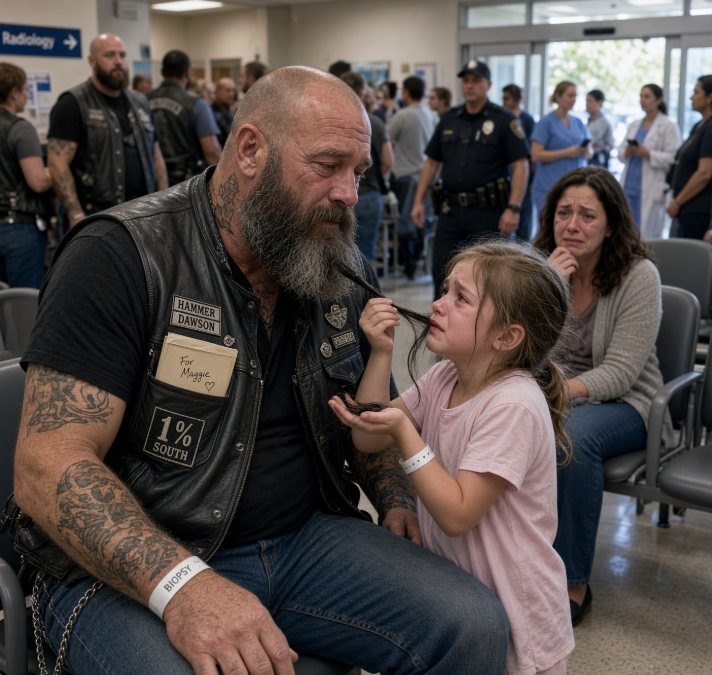
Ray counted each one in the same low, gravelly cadence Aaron had used beside her bed during thunderstorms.
“One for what you hear.”
“Two for what you touch.”
“Three for where your feet are.”
“Four because the door is open.”
The hospital security officer reached for Maggie’s shoulder.
Ray lifted one hand.
“Don’t.”
“Sir, we need to separate you from the child.”
“No.”
“She is pulling out your hair.”
“I noticed.”
“You cannot restrain her here.”
“I’m not touching her.”
The officer moved closer.
Ray’s brothers shifted.
For one dangerous second, the waiting room divided into frightened patients, uniformed security, and large men in leather who looked ready to defend one of their own.
Then their club president spoke.
“Everybody breathe.”
Her name was June Alvarez, though the club called her Sprocket. She was in her early sixties, with silver hair tied in a low ponytail and the steady expression of someone accustomed to stopping large men from making small situations worse.
Ray never looked away from Maggie.
“Five,” he said.
She pulled harder.
His eyes watered, but he stayed still.
“Five for one slow breath.”
Maggie inhaled.
“Six.”
“Six for what you see.”
“Your beard,” Maggie whispered.
“That counts.”
“Seven.”
“Seven for somebody safe.”
“Mom.”
Ray glanced toward me.
I nodded because I finally understood.
“Eight,” he said.
Maggie held the collected hairs beneath her nose.
They smelled of rain, leather, motor oil, and the bitter road coffee Aaron used to drink.
“Eight for what you remember.”
“Daddy.”
Before the ninth, Ray removed a sealed envelope from inside his vest.
It had been addressed to him in Aaron’s handwriting.
Raymond Dawson.
Personal.
The envelope was wrinkled and soft along the edges, as though Ray had carried it through heat, rain, and thousands of miles.
Maggie touched it.
“Daddy wrote that.”
Ray nodded.
“Why didn’t you open it?”
His jaw tightened.
“Wasn’t ready.”
Then Maggie noticed the plastic wristband around his arm.
Beneath his name was one word.
BIOPSY.
“You’re scared too,” she said.
Ray did not answer.
His right hand trembled harder.
Maggie pulled the ninth hair.
“Nine,” she whispered for him.
The biggest biker in the room finally released the breath he had been holding.
Maggie placed all nine hairs inside the envelope, closed Ray’s shaking hand around it, and repeated the final sentence of her father’s game.
“Now we stay.”
That was when I realized my daughter was not the only person being pulled back from panic.
The security officer lowered his hand.
Ray looked at Maggie for a long time.
Then he placed the envelope against his chest.
“I’m staying.”
The MRI technician appeared near the radiology doors.
“Margaret Harper?”
Maggie’s shoulders tightened.
Ray saw it.
“You made me stay,” he said. “Seems fair I return the favor.”
The technician looked at me.
“Only one adult can accompany her.”
“I’m not family,” Ray said. “I’ll wait right here.”
Maggie reached for his vest.
“You’ll be here?”
“Same ugly chair.”
“Promise?”
Ray hesitated.
Sprocket spoke from behind him.
“Careful, Hammer. She knows what that word means.”
He looked at Maggie.
“I promise.”
Maggie took my hand.
We walked toward the radiology doors.
Halfway there, she turned around.
Ray remained in the chair beside the exit, one enormous hand wrapped around Aaron’s unopened letter.
The MRI took forty-three minutes.
Maggie cried during the first sequence, but she did not ask to leave. I stayed beside the machine with my hand resting against her ankle.
Whenever the magnets began their loud mechanical pounding, I spoke through the intercom.
“One for what you hear.”
She answered through the headphones.
“The machine.”
“Two for what you touch.”
“The blanket.”
“Three for where your feet are.”
“In the straps.”
We made it to nine each time.
When the scan ended, Maggie emerged exhausted and proud.
Ray was still there.
So were his three club members.
A nurse had called his name twice for pre-procedure testing, but he had refused to leave until Maggie returned.
She walked directly to him.
“I stayed.”
“So did I.”
“Now you have to do your biopsy.”
Ray looked toward the corridor.
“Don’t get bossy.”
“My dad said I’m naturally gifted.”
For the first time, Ray smiled.
It transformed his face.
The frightening biker disappeared, leaving behind a tired man who had been carrying fear alone for far too long.
A nurse approached with a wheelchair.
Ray stared at it.
“I can walk.”
“Hospital policy after the sedative.”
“I haven’t had the sedative.”
“You will.”
“I can walk until then.”
The nurse sighed.
Sprocket leaned toward Maggie.
“He’s terrified of wheelchairs.”
“I’m not terrified,” Ray said.
“What are you, then?”
“Opposed.”
“Your hands are shaking.”
“Your face is annoying.”
Maggie stepped in front of him.
“Nine.”
Ray looked down at her.
“You can count in the procedure room,” she said. “You already have the hairs.”
The nurse tried not to smile.
Ray opened his fist.
The envelope remained sealed, with nine strands of beard trapped beneath the flap.
He turned to me.
“You’re Aaron’s wife.”
“Yes.”
“I’m sorry.”
The words sounded painfully inadequate, but I saw the weight behind them.
“You knew him?”
“Better than he knew.”
“What does that mean?”
Ray looked at the envelope.
“Means I should have opened this a long time ago.”
“Why didn’t you?”
He rubbed his thumb across my husband’s handwriting.
“Because he mailed it three days before he died.”
My stomach tightened.
“You’ve had it for fourteen months?”
He nodded.
“What is in it?”
“I don’t know.”
Anger arrived so quickly that it startled me.
“You carried my dead husband’s letter for fourteen months without opening it?”
Ray accepted the accusation without flinching.
“Yes.”
“Why?”
“Because Aaron left me a voicemail the same day he mailed it. He asked me to call him. I didn’t.”
“Why not?”
“I was angry.”
“At Aaron?”
“At everybody.”
“That isn’t an answer.”
“It’s the only one I have.”
A nurse appeared beside Ray.
“Mr. Dawson, if we don’t begin soon, your biopsy will need to be rescheduled.”
Ray looked toward the exit.
Maggie grabbed one finger.
“Now we stay.”
He closed his eyes.
Then he followed the nurse.
The MRI showed no tumor, bleeding, or structural abnormality in Maggie’s brain.
That should have ended the fear.
Instead, her pediatrician recommended additional heart monitoring and neurological testing because the fainting remained unexplained.
“We’ve ruled out several frightening possibilities,” she told me. “That doesn’t mean we stop looking.”
Maggie accepted the portable heart monitor with more courage than I did.
She called it her robot sticker.
While a technician attached it to her chest, my attention kept returning to Ray.
Why had Aaron written to him?
Why had he called three days before dying?
And why had a man who claimed to care about my husband ignored both?
Ray’s biopsy lasted less than an hour.
The doctors had found a mass near the upper lobe of his right lung during an examination for a fractured rib. They did not know whether it was cancer.
When he returned to recovery, he looked pale beneath his tattoos.
Sprocket sat on one side of his bed. Brick stood on the other.
Maggie climbed onto a chair near his feet.
Ray looked at the unopened envelope resting on his folded vest.
“Hand it to me.”
Sprocket picked it up.
“You sure?”
“No.”
She placed it in his hand anyway.
I stood near the door.
He looked at me.
“You should hear this.”
I wanted to tell him the letter was private.
Then I saw my name written beneath his on the back.
If I cannot explain this myself, find Laura.
Ray broke the seal.
The nine beard hairs slipped onto the blanket.
Maggie gathered them carefully while Ray unfolded four handwritten pages and a smaller yellow note.
He began reading silently.
Halfway down the first page, his face changed.
“What?” I asked.
He did not answer.
“Ray.”
He passed me the letter.
Hammer,
You once told me fear and instinct feel the same until you decide whether you are running from danger or responsibility.
I have spent six months trying to decide which one is following me.
Red Mesa Ambulance is falsifying maintenance records.
Unit 12 failed its brake inspection twice. The rear tires are retreads and should have been removed in October. Unit 8 has an oxygen leak. Unit 16’s steering linkage is beyond tolerance.
I reported all three.
Malcolm Vane ordered me to sign corrected inspection sheets.
I refused.
He suspended me last week, but they are telling everyone I requested personal leave.
Aaron had told me he was taking time off because he was exhausted.
He had lied to protect me.
I continued reading.
I copied the maintenance records, dispatch logs, and emails. The copies are in locker 214 at North Valley Storage. The key is taped beneath the emergency card in this envelope.
If anything happens, take them to somebody outside Coconino County.
Vane owns too many favors here.
I stopped.
Ray watched me.
“What is it?” Maggie asked.
“Grown-up information.”
“That means bad.”
“Yes.”
I found the yellow note.
It contained two names and a storage-unit number.
Beneath them, Aaron had written:
Ray, open this before you find another excuse.
My anger shifted toward the man in the hospital bed.
“You had the key.”
Ray looked at the blanket.
“You had evidence that Aaron’s employer was operating unsafe ambulances.”
“I didn’t know.”
“You knew he needed help.”
“I knew he wanted to talk.”
“You ignored him.”
Brick stepped forward.
Sprocket raised one hand.
Ray did not defend himself.
“I ignored him,” he said.
“Why?”
His voice became rough.
“Because two nights before he called, he found me drunk at Lily’s grave.”
I did not know who Lily was.
Sprocket did.
Her eyes lowered.
Ray continued.
“He took my keys. I swung at him.”
“You hit my husband?”
“He moved faster.”
Despite everything, that sounded like Aaron.
“He told me he wouldn’t watch me kill myself,” Ray said. “I told him to mind his own family. He said that was what he was doing.”
His eyes moved toward Maggie.
“I didn’t understand.”
“What happened after that?”
“He called. I saw his name. I let it ring.”
My hands shook around the letter.
“Three days later, he died.”
“I know.”
“You could have helped him.”
“I know.”
“You could have opened this after the accident.”
“I know.”
“Stop saying that.”
Ray looked at me.
“What do you want me to say?”
“That there was a reason.”
“There wasn’t a good one.”
The honesty made it harder to hate him cleanly.
He looked toward Maggie.
“After Aaron died, I found the letter in my mailbox. I knew if I opened it, I might find out his last call was asking for help.”
“And it was.”
“Yes.”
“You carried it for fourteen months because you were afraid of feeling guilty?”
“No,” he said. “I carried it because guilt was the only part of him I thought I deserved.”
The recovery room fell silent.
Maggie reached across the blanket and pushed one beard hair toward him.
“Dad didn’t like people wasting time being sorry.”
Ray’s mouth tightened.
“No, he didn’t.”
“He made you stay.”
“He tried.”
“No. He did. You’re still here.”
Ray looked at the letter.
Then at the biopsy dressing on his chest.
“Locker 214,” he said.
North Valley Storage sat four miles outside Flagstaff beside an auto-parts yard and a row of abandoned warehouses.
We went the next morning.
Ray was under instructions to rest, but he rode in Sprocket’s truck because nobody trusted him on a motorcycle after sedation.
Maggie stayed with my sister.
Detective Sarah Mills from the Arizona Department of Public Safety met us there. I had called her because Aaron’s letter specifically warned against taking the evidence to anyone tied to the county.
Mills was cautious.
“A letter does not prove the crash involved defective equipment.”
“The company’s ambulance was there,” I said.
“Several ambulances were there.”
“Unit 12?”
She checked her copy of the crash report.
“Red Mesa Unit 12 arrived eight minutes after the first emergency call.”
Aaron’s letter said its brakes and tires were unsafe.
The storage manager unlocked the outer gate.
Locker 214 was at the back of the property.
Its padlock had been cut.
The door stood open by less than an inch.
Ray stepped in front of me.
“Stay back.”
Detective Mills drew her weapon and lifted the door.
The unit had been searched.
Boxes lay open across the floor. Aaron’s old uniforms had been thrown into the dust. A filing cabinet stood empty, its drawers bent.
Someone had arrived before us.
I picked up one of Aaron’s paramedic jackets.
His name remained stitched above the pocket.
For fourteen months, I had believed I owned everything he had left behind.
Now I understood he had hidden an entire part of his life from me.
“What were we supposed to find?” Mills asked.
“Maintenance records, emails, dispatch logs,” Ray said.
“They’re gone.”
Ray examined the walls.
“No.”
“How do you know?”
“Aaron knew engines, but he didn’t trust computers. If he thought somebody might search this place, he would have hidden the real copies somewhere ordinary.”
I looked around.
Nothing seemed ordinary anymore.
Ray crouched beside a red medical bag in the corner.
The main compartment was empty.
He opened the side pocket and removed a blood-pressure cuff. Then he pressed the stiff base.
A thin plastic panel lifted.
Beneath it were three flash drives, a stack of copied inspection reports, and a small digital recorder.
Detective Mills put on gloves.
“We need to document everything before removing it.”
Ray sat back against the wall.
“He really did it.”
“What?” I asked.
“Stayed.”
Mills reviewed the paper records at the scene.
Unit 12 appeared repeatedly.
Brake warning light inoperative.
Rear tires below minimum tread depth.
Anti-lock braking system disabled.
Vehicle restricted from service pending repair.
Three days later, another sheet returned the ambulance to duty.
The mechanic’s signature had been copied.
At the bottom was the authorization of Malcolm Vane, president of Red Mesa Emergency Services and a trustee of St. Anne’s Medical Center.
The digital recorder contained a conversation between Aaron and Vane.
Aaron’s voice emerged through static.
“You cannot put Unit 12 back on winter roads.”
Vane replied, “You are a paramedic, not a fleet manager.”
“I signed the rejection.”
“And I overruled it.”
“The rear tires are condemned.”
“We have a storm system coming and two units in repair. We need twelve.”
“If those brakes lock, somebody dies.”
There was a pause.
Then Vane said, “People die every day while waiting for ambulances perfectionists refused to drive.”
“That isn’t what this is.”
“It is exactly what this is. Sign the corrected sheet.”
“No.”
“Then you are suspended.”
“I’ll report it.”
“To whom? The county contract officer who plays golf with me or the hospital board that depends on my company?”
The recording ended.
Detective Mills looked at me.
“This is enough to reopen the maintenance investigation.”
“What about Aaron’s death?”
“We need to establish whether Unit 12 contributed to the collision.”
“The official report said a cargo van struck him.”
“Yes.”
“Was there a cargo van?”
“A witness reported one.”
“Did police find it?”
“No.”
Ray had gone completely still.
“What?” I asked.
He pointed toward the original dispatch log.
Unit 12’s arrival time had been changed.
The handwritten entry placed it at the scene at 6:42 p.m.
The computerized record placed it there at 6:31.
Aaron had been struck at 6:34.
The ambulance was present before his injury.
Somebody altered the report to make it appear later.
Detective Mills took every document into evidence.
Before we left, Ray noticed fresh tire tracks in the dust outside the locker.
Someone had searched it recently.
Someone knew the letter had been opened.
That afternoon, Malcolm Vane came to my house.
He wore a charcoal suit and carried flowers.
Fourteen months earlier, he had spoken at Aaron’s funeral.
He called my husband courageous, selfless, and devoted to service. Then Red Mesa denied me survivor benefits because Aaron had been off duty when he stopped at the crash.
Vane had explained the decision personally.
“Our hearts are with you,” he had said, “but policy language is very specific.”
Now he stood on my porch with white lilies in his hands.
I did not invite him inside.
“I heard investigators contacted North Valley Storage,” he said.
“How?”
“News travels quickly.”
“That wasn’t news.”
His expression did not change.
“Aaron was troubled during his final weeks.”
“He was documenting unsafe ambulances.”
“He had become fixated on routine maintenance disagreements.”
“Routine?”
“Large emergency fleets receive defect reports daily. Most do not affect safe operation.”
“Unit 12 failed its brake inspection.”
“It received repairs.”
“The mechanic’s signature was forged.”
“That is a serious accusation.”
“It’s on a recording.”
For the first time, uncertainty entered his eyes.
He looked past me into the house.
“Is your daughter home?”
“Do not ask about Maggie.”
“I’m concerned about the strain this could place on her.”
“You denied her father’s death benefits.”
“Because state law required it.”
“You blamed Aaron for stepping into traffic.”
“The crash report did.”
“The crash report was changed.”
Vane lowered his voice.
“Laura, grief can make hidden explanations feel comforting. It is difficult to accept that a good man died because of weather and timing.”
“My husband died because he stopped to save people.”
“Yes. And that is how he should be remembered.”
“Not as the man who caught you sending defective ambulances onto the road?”
His face hardened.
“You have begun spending time with Ray Dawson.”
“What does that have to do with anything?”
“He has a criminal history.”
“So do half the men your company transports.”
“He is unstable.”
“He was stable enough for Aaron to trust.”
“Aaron tried to help him. That was his nature.”
Vane placed the flowers on the porch rail.
“Red Mesa could reconsider the insurance settlement. There may be discretionary benefits available to Maggie.”
“What do I have to do?”
“Nothing improper. Simply avoid making public allegations before experts review the documents.”
“And return Aaron’s evidence?”
“The materials belong to the company.”
“They belong to the state police now.”
Vane’s composure cracked.
“You had no right.”
There it was.
Not grief.
Not concern.
Ownership.
“You should leave,” I said.
“Think carefully. Your daughter has medical tests ahead. Bills accumulate quickly.”
It was not a threat spoken loudly enough for a neighbor to hear.
It was worse.
It was a calculation.
I took the flowers from the rail and dropped them at his feet.
“Do not come back.”
He stared at the lilies scattered across the porch.
Then he smiled.
“Ray Dawson will eventually frighten you too.”
I closed the door.
Two hours later, a local television station released footage from the hospital waiting room.
The video began when the security officer approached Ray.
It showed Maggie standing between Ray’s knees while three bikers rose behind him. It did not show her first panic attack, the grounding exercise, or Aaron’s letter.
The headline read:
MOTORCYCLE CLUB CONFRONTS SECURITY OVER EIGHT-YEAR-OLD GIRL.
Vane appeared as a hospital trustee.
“Our staff acted to protect a vulnerable child from an intimidating adult,” he said. “St. Anne’s is reviewing why known gang affiliates were permitted to remain near pediatric patients.”
Ray became the villain before dinner.
Commenters accused him of grooming Maggie, restraining her, and using a grieving family to create sympathy before his biopsy.
The Iron Saints’ clubhouse received threats.
Someone posted Ray’s decades-old assault conviction.
Another person found a photograph of him being arrested after a bar fight and placed it beside an image of Maggie touching his beard.
The caption said:
THIS IS WHO LAURA HARPER TRUSTS WITH HER CHILD.
My sister called.
“Tell me that man is not staying near Maggie.”
“He saved her from a panic attack.”
“He is a convicted felon.”
“He never touched her.”
“He has gang tattoos.”
“Aaron knew him.”
“Aaron knew lots of damaged people. That doesn’t mean he wanted one raising his daughter.”
The words hurt because they touched the fear Vane wanted me to feel.
Was grief making me reckless?
Was I trusting Ray because he carried a piece of Aaron?
That night, Maggie found me sitting at the kitchen table with Aaron’s letter.
“Are people mad at Hammer?”
“Yes.”
“Because I pulled his beard?”
“Because they didn’t understand what they saw.”
“I can tell them.”
“You don’t have to.”
“But they’re lying.”
“You are eight years old. This is not your job.”
She considered that.
“Was it Dad’s job?”
“What?”
“To stop the bad ambulance.”
“He believed it was.”
“And nobody listened.”
I looked at her.
Maggie touched the heart monitor beneath her shirt.
“Maybe being little doesn’t mean I can’t tell the truth.”
The following morning, St. Anne’s canceled Ray’s follow-up appointment.
The official explanation was a scheduling conflict.
His doctor called privately and told him the hospital administration had classified him as a security risk.
Ray’s biopsy results were waiting.
He could not receive them without entering the building.
“I’ll go somewhere else,” he said.
The nearest hospital equipped to handle the potential surgery was more than two hours away.
Sprocket argued with him.
Brick threatened to park forty motorcycles outside St. Anne’s.
Ray refused.
“No intimidation.”
“They humiliated you on television,” Brick said.
“They showed a video.”
“They lied about it.”
“Then we answer with the truth.”
The truth came from an unexpected person.
The security officer who had approached Maggie was named Daniel Cho. He had spent twelve years in hospital security and had never spoken publicly about an incident.
That afternoon, he resigned.
Then he gave a statement to the press.
“The biker known as Ray Dawson did not threaten Margaret Harper,” he said. “He kept his hands visible, followed instructions, and prevented our intervention from worsening a child’s panic attack.”
Daniel had requested release of the complete hospital video.
The administration refused.
So a family in the waiting room provided their own recording.
It showed everything.
Maggie crawling from beneath the chairs.
Ray recognizing her.
The counting.
His shaking hand.
The biopsy band.
Maggie saying, “You’re scared too.”
And finally, her placing the hairs inside Aaron’s letter before telling him, “Now we stay.”
The full video spread farther than the edited one.
Millions of people watched a tattooed biker sit motionless while an eight-year-old girl used his beard to find her way out of terror.
Parents of children with panic disorders recognized the grounding exercise.
Veterans recognized Ray’s hypervigilance.
Grieving families recognized the terrible intimacy of one frightened person helping another remain in the room.
Public pressure forced St. Anne’s to reinstate Ray’s appointment.
The hospital president issued an apology.
Malcolm Vane did not appear beside him.
Ray received his results with Maggie and me sitting in the consultation room.
Dr. Priya Shah entered holding a folder.
Ray stared at her face.
“Don’t soften it.”
“I wasn’t planning to.”
“Cancer?”
“Yes.”
His fingers closed around the arms of the chair.
Maggie reached toward his beard, then stopped.
“You can use the hairs,” Ray told her.
She shook her head.
“You know the count now.”
Dr. Shah explained that the tumor was non-small-cell lung cancer, apparently limited to one upper lobe. The scans showed no obvious spread.
Surgery offered a strong chance of cure.
Ray heard only one word.
Surgery.
His breathing changed.
Maggie placed Aaron’s envelope in his hands.
“Nine.”
Ray looked toward the door.
“One for what you hear,” she said.
“Your voice.”
“Two for what you touch.”
“The chair.”
“Three for where your feet are.”
“On the floor.”
By nine, his hands were steady.
“When?” he asked the doctor.
“As soon as we complete staging.”
“I’ll do it.”
Sprocket began crying before Ray did.
While he prepared for surgery, the investigation into Route 89 widened.
State technicians recovered Unit 12’s electronic control module from a storage yard.
Red Mesa had claimed the ambulance was retired and dismantled after the pileup.
It had not been dismantled.
It had been hidden beneath a tarp.
The module showed the ambulance was traveling forty-eight miles per hour when the driver applied the brakes.
The rear wheels locked.
The vehicle spun across the icy road and struck a pickup truck. The pickup then hit Aaron while he was treating an injured driver.
There had never been a fleeing cargo van.
The ambulance driver survived and had been pressured to sign a false statement while medicated for a concussion.
His name was Caleb Price.
When investigators found him, he had left emergency medicine and moved to Nevada.
He agreed to testify.
“I told Vane the brakes failed,” Caleb said. “He said if I blamed the ambulance, I would face criminal charges for speeding. He promised the company would take care of Aaron’s family if I stayed quiet.”
“They gave us nothing,” I said.
Caleb began to cry.
“I thought they paid you.”
He had carried fourteen months of guilt built on another lie.
The altered arrival time had been entered by a Red Mesa dispatcher named Helen Ward. She admitted Vane ordered her to change it.
The county contract officer who approved the report had received consulting payments from a company owned by Vane’s brother.
Investigators searched Red Mesa’s headquarters.
They found duplicate inspection sheets, deleted emails, and records showing the company had diverted maintenance money into executive bonuses.
Aaron had not died in an unavoidable chain of bad weather and timing.
He had died because a wealthy man decided brake repairs cost too much.
Vane continued denying everything.
Then he held a press conference outside St. Anne’s.
He wore a dark coat and stood beneath the hospital emblem.
“Aaron Harper’s death was a tragedy,” he said. “But grief should not be weaponized by criminals seeking financial gain.”
A reporter asked whether he meant the Iron Saints.
“I mean individuals with violent histories who have manipulated a widow and her vulnerable child.”
I watched from inside the hospital with Ray.
He was waiting for preoperative testing.
“That’s me,” Ray said.
“He’s talking about both of us.”
“He thinks insulting me will make you afraid to stand beside me.”
“Is he right?”
Ray looked at the screen.
“People have been afraid to stand beside me most of my life. I got used to it.”
“I didn’t ask about other people.”
He turned toward me.
“No,” I said. “He isn’t right.”
The state held a public licensing hearing three weeks later.
Vane’s attorneys tried to prevent Aaron’s recordings from being admitted. They argued he had illegally copied company records.
The hearing officer allowed them.
Vane sat behind a table surrounded by lawyers.
I sat across the room with Maggie, Ray, Sprocket, and Caleb Price.
The Iron Saints filled the back rows.
They did not wear club cuts.
Ray had told them he wanted the focus on Aaron.
Vane’s attorney questioned me first.
“Mrs. Harper, you were not present when Unit 12 was inspected, correct?”
“Correct.”
“You have no mechanical training.”
“No.”
“You stand to gain financially if your husband’s death is reclassified as work-related.”
“I stand to receive benefits his employer denied our daughter.”
“So the answer is yes.”
“The answer is that my daughter should not have been punished because her father stopped to save strangers.”
The attorney displayed a photograph of Ray.
“Is this the man who provided your husband’s letter?”
“Yes.”
“You are aware of his criminal record?”
“Yes.”
“You allow him contact with your child?”
“Yes.”
A murmur moved through the room.
“Despite his history of assault?”
“Ray has never harmed Maggie.”
“Did you know him before this investigation?”
“No.”
“So a convicted biker produced a letter supposedly written by your late husband, and you accepted it without question.”
“I recognized Aaron’s handwriting.”
“Grief can affect judgment.”
“So can money.”
Vane’s attorney stiffened.
“I beg your pardon?”
“Your client saved more than eleven thousand dollars by returning Unit 12 to service without repairing it. Aaron wrote that number in his report.”
The hearing officer warned us both.
Then the attorney called Ray.
He walked to the witness table with the rigid control of a man entering a cage.
“Mr. Dawson, when did you first read Aaron Harper’s letter?”
“Fourteen months after it arrived.”
“You ignored it for more than a year?”
“Yes.”
“Why?”
“I was afraid.”
The simple answer weakened the attorney’s planned attack.
“Afraid of what?”
“That Aaron had asked me for help before he died.”
“And he had.”
“Yes.”
“So your failure to open the letter may have allowed allegedly unsafe ambulances to remain in service.”
Ray’s face tightened.
“Yes.”
The room became silent.
The attorney expected denial.
Ray gave him responsibility.
“You feel guilty?”
“Every day.”
“And exposing Mr. Vane helps you feel better?”
“No.”
“Then why are you here?”
Ray looked toward Maggie.
“Because guilt is not an excuse to keep failing the same person.”
The attorney changed direction.
“You have referred to the Iron Saints as your family.”
“Yes.”
“Several members have criminal convictions.”
“Yes.”
“Would they lie for you?”
“Some probably would.”
Sprocket closed her eyes.
The attorney smiled.
“So their testimony is unreliable.”
“You asked if they would lie for me. You didn’t ask if I would let them.”
The smile disappeared.
Ray leaned closer to the microphone.
“Aaron did something I couldn’t do. He told the truth while it was still dangerous.”
He looked directly at Vane.
“I’m here because he should not have had to die before the rest of us became brave enough to join him.”
Caleb Price testified next.
Then Helen Ward.
Then the mechanic whose signature had been forged.
Finally, the state played Aaron’s recording.
His voice filled the hearing room.
“If those brakes lock, somebody dies.”
Vane’s recorded answer came next.
“People die every day while waiting for ambulances perfectionists refused to drive.”
The hearing officer stopped the audio.
Vane stared at the table.
For the first time, he looked less like a respected executive and more like a man realizing his own voice had survived him.
The state suspended Red Mesa’s operating license immediately.
Vane was arrested before he left the building.
The charges included fraud, evidence tampering, conspiracy, reckless endangerment, and negligent homicide.
The county contract officer and two Red Mesa executives were arrested the same week.
Justice did not feel like victory.
Aaron remained dead.
Maggie still woke from nightmares.
Ray still had cancer.
Caleb still carried the memory of the ambulance spinning beyond his control.
But the truth changed the direction of our grief.
For fourteen months, I had blamed weather.
Caleb blamed himself.
Ray blamed the phone call he did not answer.
Maggie blamed hospitals because that was where her father disappeared.
Now the blame had a name, records, signatures, and consequences.
Red Mesa’s insurer paid the survivor benefits it had denied us. The company also funded independent inspections for every emergency vehicle in the county as part of a civil settlement.
I placed most of the money in a trust for Maggie.
With the rest, I created a small emergency fund for families of first responders injured while off duty.
Aaron would have hated having his name on anything grand.
So we called it Stay Nine.
The program paid for transportation, child care, counseling, and immediate expenses during the weeks when official agencies were still deciding whether a family qualified for help.
No grieving spouse had to wait for policy language before buying groceries.
Ray’s surgery took place five weeks after the hearing.
He arrived at St. Anne’s before sunrise with forty Iron Saints behind him.
Only Sprocket and Brick came inside.
The others remained in the parking lot beside their motorcycles.
Maggie carried Aaron’s envelope.
The nine beard hairs were still inside.
Ray had placed each one between two strips of clear tape so they would not be lost.
A nurse asked whether he had an advance directive.
“Yes.”
“Emergency contact?”
Ray looked toward Sprocket.
Then toward me.
“Laura Harper.”
I blinked.
“Me?”
“You answer your phone.”
It was the closest he came to making a joke that morning.
The orderly arrived with a wheelchair.
Ray stared at it.
Maggie pointed.
“Sit.”
“I can walk.”
“Hospital policy.”
Ray looked at Sprocket.
“She’s becoming unbearable.”
“She learned from Aaron.”
He sat.
Before the orderly moved him, Maggie stepped close.
“You don’t get nine new hairs.”
“Why not?”
“You need those.”
She touched his beard.
“We count without pulling.”
Ray nodded.
“One for what you hear,” she said.
“Motorcycles outside.”
“Two for what you touch.”
“The envelope.”
“Three for where your feet are.”
“On the wheelchair.”
“Four because the door is open.”
Ray looked toward the operating-room doors.
“For now.”
Maggie frowned.
“It opens both ways.”
He absorbed that.
“Five for one slow breath,” she continued.
They counted together.
When they reached eight, Maggie looked at him.
“Eight for what you remember.”
“Aaron.”
“Nine?”
Ray’s eyes filled.
“Now we stay.”
The orderly pushed him through the doors.
His surgery lasted almost six hours.
Dr. Shah removed the upper lobe of his right lung and seventeen lymph nodes. None of the nodes showed cancer.
The tumor had been found early.
Ray woke in intensive care angry about the breathing tube, the chest drain, the hospital gown, and the fact that Brick had taken a photograph of him wearing compression socks.
That anger reassured everyone.
Recovery was difficult.
Ray hated asking for help.
He tried to stand without assistance two days after surgery and nearly collapsed. He refused pain medication until Maggie told him suffering unnecessarily did not make him tough; it made him annoying.
He took the medication.
He completed breathing exercises.
He walked one slow lap around the unit, then two.
Every evening, Maggie called and counted to nine with him.
Her own tests eventually found the cause of her fainting.
She had a common rhythm disturbance that became worse with dehydration and anxiety. It was treatable. Her cardiologist prescribed medication, increased fluids and salt, and gave us a clear plan for school.
The diagnosis frightened me, but knowledge was gentler than uncertainty.
Maggie returned to counseling.
This time, Ray sometimes joined her.
He claimed he was only providing transportation.
Her counselor claimed otherwise.
Six months after the surgery, Ray’s scans showed no evidence of cancer.
He celebrated by riding his Harley to our house and complaining that doctors used too many words to say he was fine.
Maggie climbed onto the porch rail and examined his beard.
A small patch near his chin had never grown back evenly.
“I made a hole,” she said.
“You gave me character.”
“You already had too much character.”
He handed her a small wooden box.
Inside were the nine beard hairs and Aaron’s original letter.
A brass plate on the lid read:
ONE FOR WHAT YOU HEAR.
TWO FOR WHAT YOU TOUCH.
THREE FOR WHERE YOUR FEET ARE.
FOUR BECAUSE THE DOOR IS OPEN.
FIVE FOR ONE SLOW BREATH.
SIX FOR WHAT YOU SEE.
SEVEN FOR SOMEBODY SAFE.
EIGHT FOR WHAT YOU REMEMBER.
NINE—NOW WE STAY.
Maggie ran her fingers across the words.
“Why are you giving it to me?”
“Because your dad wrote the letter.”
“But he wrote it to you.”
Ray sat beside her.
“He wrote the address to me. The truth inside belonged to everyone.”
She considered this.
“Do you still feel guilty?”
“Yes.”
“Does it go away?”
“No.”
“That’s bad.”
Ray shook his head.
“Not always. Some guilt tells you where you failed. You just can’t build your house there.”
“Where do you build it?”
He looked toward me.
“Near people who make you open the door.”
The following winter, we returned to Route 89.
The state had installed a memorial marker near the place where Aaron died. It listed his name and described him as a paramedic who stopped while off duty to assist strangers during a multivehicle collision.
There was no mention of Malcolm Vane.
I was grateful.
Aaron’s life deserved more space than the man responsible for ending it.
Snow covered the shoulder.
Forty Iron Saints parked in a line along the closed turnout. Their engines fell silent one after another.
Caleb Price came with his wife.
Daniel Cho, the security officer who had resigned from St. Anne’s, came too. The hospital had rehired him as director of patient safety after an independent review.
Sprocket placed a paramedic patch beneath the memorial.
Brick left a cup of terrible gas-station coffee.
Maggie carried nine black-and-gray threads tied together with blue ribbon.
They were not Ray’s original beard hairs. Those remained safe inside the wooden box.
These were strands he had cut that morning.
She placed them beneath Aaron’s name.
“One for what you hear,” she said.
The wind moved through the pines.
“Two for what you touch.”
Her glove rested against the cold stone.
“Three for where your feet are.”
“In the snow.”
“Four because the road is open.”
A truck passed slowly behind us.
“Five for one slow breath.”
Everyone inhaled.
“Six for what you see.”
“Your dad’s name,” I said.
“Seven for somebody safe.”
Maggie reached for my hand.
Then she reached for Ray’s.
“Eight for what you remember.”
She looked toward the highway.
“My dad stopped.”
Ray’s eyes filled.
“Nine,” Maggie said.
For a moment, nobody spoke.
Then all forty bikers answered together.
“Now we stay.”
The words crossed the snow-covered turnout and disappeared into the open desert.
I had spent more than a year believing staying meant refusing to move forward.
I thought loyalty to Aaron required preserving our grief exactly as he left it.
Ray taught me something different.
Staying did not mean living forever in the worst room of your life.
It meant remaining long enough to tell the truth.
Long enough to accept help.
Long enough to hear the diagnosis, open the letter, challenge the lie, and hold somebody’s hand when every frightened part of you wanted to run.
Aaron stayed on Route 89 because strangers needed him.
Maggie stayed inside an MRI because she trusted me to count.
Ray stayed for his biopsy because a little girl recognized fear beneath his tattoos.
And I stayed beside both of them long enough to understand that courage does not always roar, fight, or break down a door.
Sometimes courage sits quietly in a hospital chair while a terrified child pulls nine silver hairs from your beard.
Sometimes it opens an envelope fourteen months too late.
And sometimes, even after everything precious has been taken from you, courage is the voice that says the door is still open.
Now we stay.








