My Daughter Died in the Crash—But Her Cat Stayed Beside My Grandbaby for Fourteen Hours
PART3:
“Stay here tonight. Go in the morning.”
“Mom, she’s alone.”
That was Emily.
If someone called scared, she went.
Ellen offered to keep Ava, but Emily said she didn’t have enough pumped milk for the night and Ava was fussy with teething. She would take the baby, stay a couple of hours, and come back before midnight.
Rust jumped into the carrier by himself when Emily opened it.
That should have made us laugh.
It did, at the time.
“See?” Emily said. “Even Rust wants to help.”
I carried Ava’s diaper bag to the car.
The night was cold and clear, the kind of cold that makes sound travel sharper. Frost had already formed on the grass. Emily buckled Ava into her rear-facing car seat, tucked her fleece suit around her legs, then placed Rust’s carrier on the back seat beside her.
I leaned into the open door.
“You call when you get there.”
“Yes, Dad.”
“And when you leave.”
“Yes, Dad.”
“And if the roads get icy—”
“I’ll turn around.”
“You always say that.”
She smiled.
“I usually mean it.”
I kissed Ava’s forehead.
She grabbed my finger.
For one second, she would not let go.
Emily laughed.
“She knows you’re dramatic.”
I looked at my daughter.
There are moments that return later with knives hidden inside them.
Ordinary moments.
A porch light.
A car door.
A baby’s hand.
Your daughter smiling at you beneath the yellow glow of a garage lamp.
I said, “Love you, kid.”
She said, “Love you too, Dad.”
Then she got in the car and drove away.
We did not know that was the last time we would hear her voice.
At 11:18, Emily texted Ellen.
Leaving now. Ava slept the whole time. Roads okay. Be home soon.
At midnight, Ellen looked at the clock.
At 12:20, she called Emily.
No answer.
At 12:28, I called.
No answer.
At 12:40, Ellen said, “Maybe she lost service.”
The road between Melissa’s town and ours cut through dense state forest for several miles. There were dead spots, sharp curves, old guardrails, and no houses close enough to see much from the road.
At 1:10, I got in my truck.
Ellen stood in the doorway wearing slippers and my coat.
“Jack.”
“I’m just going to drive the route.”
“You don’t know which road she took.”
“She always takes County 18.”
“Call the sheriff.”
“I will if I don’t see her.”
That was my mistake.
One of them.
Grief gives you a list afterward.
Things you should have done sooner.
Words you should have said differently.
Questions you should have asked.
I drove County 18 twice.
Once toward Melissa’s town.
Once back.
I saw nothing.
No broken glass.
No skid marks.
No lights in the trees.
No sign.
I called the sheriff at 2:17 a.m.
They took the report.
They told me patrol would keep an eye out.
They told me adults sometimes stopped somewhere, lost phone battery, took alternate roads.
They were not cruel.
They were calm.
Calm felt like cruelty.
By dawn, Ellen had called every hospital within eighty miles.
Nothing.
At 8:00 a.m., the sheriff’s department officially listed Emily and Ava as missing.
At 10:30, volunteers began driving routes.
At 1:50 p.m., a county road maintenance crew noticed a section of rusted guardrail bent outward on County 18.
Not shattered.
Not dramatic.
Just wrong enough to make one man stop.
His name was Dale Turner.
I know that because I later shook his hand and could not let go.
Dale told me the guardrail looked like something heavy had gone through it, but snow crust and dead brush hid the tire tracks. He and another worker climbed down the wooded slope expecting to find trash or maybe an abandoned vehicle.
They found my daughter’s car upside down against an oak tree.
Twelve yards below the road.
Hidden from passing headlights.
No camera.
No cell signal.
No witness.
Just metal, broken glass, December air, and fourteen hours of silence.
The sheriff came to our house at 2:26 p.m.
I remember the exact minute because the clock above our kitchen sink stopped working that day, and I never replaced it.
Two deputies stood on the porch.
Ellen opened the door.
I saw their faces and knew before they spoke.
There are uniforms that carry news.
One deputy asked if they could come inside.
Ellen said, “No.”
Just that.
No.
As if refusing entry could refuse reality.
The older deputy removed his hat.
“Mr. and Mrs. Morrison, there’s been an accident.”
Ellen made a sound I had never heard from her.
Not crying.
Not screaming.
Something lower.
Animal.
I reached for the wall because the room tilted.
The deputy said Emily was gone.
He said she likely died on impact.
He said he was sorry.
He said Ava was alive.
Alive.
The word did not fit with the others.
For one moment, I thought I had misunderstood.
“What?”
“Your granddaughter is alive. She’s being transported to St. Anne’s Medical Center.”
Ellen grabbed his sleeve.
“Alive?”
“Yes, ma’am.”
“How?”
The deputy swallowed.
Then he said a sentence none of us understood yet.
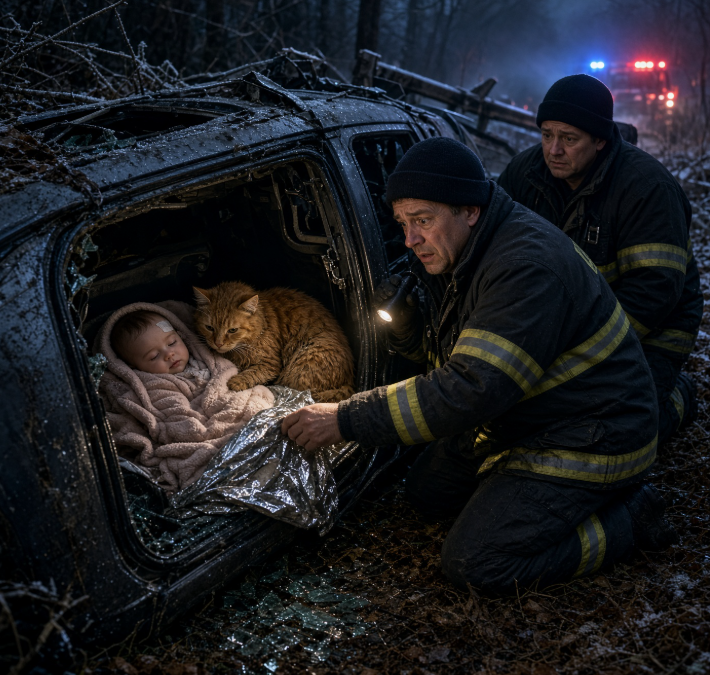
“There was a cat with her.”
The hospital smelled like antiseptic, coffee, and panic.
Ava lay in a pediatric trauma room wrapped in warming blankets, so small beneath the monitors that my knees nearly failed when I saw her.
A cut above her left eye had been stitched.
Four tiny stitches.
Her left arm was secured carefully because of a fractured clavicle.
Her cheeks looked too pale.
A bruise darkened near her temple.
But she was breathing.
My granddaughter was breathing.
Ellen reached the bedside first.
She touched Ava’s foot like she was afraid anything more would hurt her.
“Baby,” she whispered. “Oh, baby.”
A nurse told us Ava’s core temperature had been thirty-three degrees Celsius when the paramedics brought her in.
Hypothermic.
But alive.
The doctor explained things gently because pediatric doctors learn to wrap horror in softness.
Ava had been trapped in the back seat after the car rolled. The seat had held. The roof partially collapsed. She had injuries, but not the kind that explained why she survived the cold.
Then he paused.
“The responders told us the family cat was curled around her.”
I stared at him.
“Rust?”
“Orange male cat?”
“Yes.”
“He was alive too.”
Ellen began crying harder.
“Where is he?”
“At an emergency veterinary clinic. He’s badly injured, but alive.”
The doctor looked between us.
“I can’t make absolute statements, Mr. Morrison. But based on her temperature pattern and the environmental exposure, direct contact with the cat’s body heat likely made a significant difference.”
“A difference?”
He chose his next words carefully.
“It may be why she survived long enough to be found.”
I looked at Ava.
Her tiny fingers twitched beneath the blanket.
I remembered her gripping mine the night before.
Then I turned away and vomited into a trash can.
Grief and gratitude do not cancel each other out.
They collide.
They tear through the same body in opposite directions until you do not know whether you are being saved or destroyed.
My daughter was dead.
My granddaughter was alive.
A cat had done what no person had been there to do.
There is no clean place to put that.
Later, Dale told me what he saw in the car.
He did not have to.
I asked.
Maybe I should not have.
But when grief cannot save someone, it becomes desperate for details.
He said the car was upside down, passenger side crushed toward the back, windshield broken, rear glass shattered. Cold air moved through the vehicle freely. The baby seat had stayed anchored, but the impact had shifted everything. Ava was partly on her side, still strapped, unconscious.
Rust was wrapped around her.
Not lying nearby.
Not trapped by accident.
Wrapped.
His back was pressed against the twisted metal of the door.
His belly was against Ava’s torso and legs.
His head rested across her chest.
One paw was hooked over her fleece suit.
Dale said at first he thought the cat was dead.
Then Rust opened one eye.
“When we moved closer,” Dale told me, voice thick, “that cat growled.”
I almost laughed.
Of course he did.
Rust had a broken shoulder, cracked ribs, glass in his paws, a deep cut down his back, and frostbitten ears.
And he still growled at the men trying to reach Ava.
“He didn’t know we were help,” Dale said.
“No.”
“He thought he was still on duty.”
Yes.
That was exactly it.
The paramedics had to work carefully.
Rust did not attack, but he refused to move until one of them slid a warming blanket over Ava. Only then did he allow himself to be lifted aside. When they placed him in a carrier, he tried to crawl back toward the baby.
In the ambulance, Ava’s body warmed slowly.
At the veterinary clinic, Rust nearly died.
We did not see him until two days later.
Ava was still in the hospital. Emily’s body had been released to the funeral home. Our house was full of relatives speaking in low voices and casseroles nobody wanted. I moved through rooms like someone underwater.
Then the vet called.
“Rust is stable enough for a short visit.”
Ellen and I drove there in silence.
The emergency clinic was twenty minutes from the hospital, tucked beside a pharmacy and a closed pizza place. A young veterinarian named Dr. Patel met us in the lobby.
She looked exhausted in the way people look after fighting death and not knowing whether they won enough.
“He’s alive,” she said before anything else.
Ellen covered her face.
Dr. Patel led us back.
Rust lay in an oxygen cage with bandages around his torso, one shoulder immobilized, an IV line taped to his front leg, and both ears darkened at the tips from frostbite.
He looked smaller.
That was the first thing that hurt.
Rust had always seemed enormous in Emily’s house. Confident. Heavy. Indestructible.
Now he looked like what he was.
A wounded animal who had spent fourteen hours between a baby and the cold.
His eyes opened when he heard us.
I stepped closer.
“Hey, trouble.”
His tail flicked weakly.
Ellen began sobbing.
Dr. Patel explained his injuries.
A ten-centimeter laceration across his back from broken glass.
Thirty-one stitches.
Left shoulder dislocation.
Two broken ribs.
Moderate frostbite on both ear tips and the end of his tail.
Cuts in three paw pads from shattered glass.
“He was lying against the damaged door?” she asked.
“Yes.”
“That explains the rib fractures and the cold injury pattern.”
She looked through the glass at him.
“He must have stayed pressed there for hours.”
I could not speak.
Ellen placed her hand against the oxygen cage.
“Rust,” she whispered.
He lifted his head.
Not much.
Enough.
Then he made a sound.
A rough, broken meow.
Ellen nearly collapsed.
Dr. Patel said gently, “He’s been vocalizing whenever he hears baby sounds from the treatment area.”
“What baby sounds?”
“We had a puppy crying earlier. He reacted.”
I closed my eyes.
Even half-sedated, in pain, separated from the wreck and the cold, Rust was still listening for Ava.
“He needs to see her,” Ellen whispered.
“He can’t leave yet,” Dr. Patel said.
“I know. But when he can.”
The vet nodded.
“When he can.”
Ava stayed in the hospital five days.
Her clavicle would heal.
The cut above her eye would leave only a small scar.
She had mild frostbite on two fingers, but circulation returned. There was no neurological damage. No organ failure. No sign that the fourteen hours had taken her future.
Every doctor said words like lucky, remarkable, fortunate.
I hated all of them.
Luck had nothing to do with Rust choosing not to leave.
At night, Ellen stayed beside Ava’s hospital crib.
I went home and sat in Emily’s empty nursery because grief made me stupid.
The crib was still assembled in our guest room from the nights Ava stayed with us. A stuffed rabbit lay on its side near the pillow. A package of diapers sat open on the dresser. One of Emily’s sweaters hung over the rocking chair.
I picked it up.
It still smelled like her.
That was when I finally broke.
Not at the hospital.
Not in front of the deputies.
Not beside the wreck when I went later and saw where the guardrail had failed.
In that quiet room, holding my daughter’s sweater, I became a sound more than a man.
Ellen found me there an hour later.
She did not tell me to get up.
She sat on the floor beside me and leaned her head against my shoulder.
“We have to raise her,” she said.
I knew who she meant.
Ava.
Our granddaughter.
Our daughter’s baby.
“I know.”
“I don’t know how to do that again.”
“Me neither.”
“We’re old.”
“We’re not that old.”
“My knees are old.”
I laughed.
It came out wrong.
Then we both cried.
The funeral happened on a gray Saturday.
I will not describe my daughter’s funeral in detail.
Some things belong to the people who stood there, and some pain does not need to be dressed up for storytelling.
I will say this.
Ava was not there.
She was still too fragile, and Ellen said no baby should attend her mother’s burial before she can understand what the word mother means.
Rust was not there either.
He was still recovering.
But I thought about him the whole time.
When the pastor spoke of love as sacrifice, I saw orange fur pressed against cold metal.
When he spoke of protection, I saw a wounded cat refusing an open window.
When he spoke of Emily’s devotion to her daughter, I thought, Yes.
And when Emily could no longer protect Ava, Rust did it for her.
I did not say that aloud at the funeral.
Not then.
I did not trust myself to speak.
Three weeks later, Rust came home to us.
He looked different.
The tip of his tail had been amputated.
One ear had been shortened where frostbite took the tissue.
The other healed curled at the edge, giving him a permanently lopsided, battle-worn appearance.
His back was shaved around the long stitched wound.
His shoulder was still stiff.
His ribs were healing.
His paws were tender.
He walked slowly from the carrier into our living room, stopped in the middle of the rug, and looked around.
He had been to our house before.
But this was not a visit.
Emily would not come through the door after him carrying Ava’s bag.
He stood there for a long moment.
Then Ava made a sound from the playpen.
Not even a cry.
Just a small baby noise.
Rust turned.
He limped straight to her.
Ellen started to move.
I stopped her gently.
“Let him.”
Rust reached the playpen, lifted himself carefully onto his back legs despite the pain, and looked in.
Ava was sitting upright, one arm still secured, blinking at him.
For a second, neither moved.
Then Ava smiled.
A baby’s smile.
Open.
Tooth showing.
No understanding of funerals, hospitals, or the fact that the orange cat before her had nearly died keeping her alive.
Rust made a sound like a chirp.
Then he lay down beside the playpen and rested his head against the mesh.
From that day on, he slept in her room.
Every night.
At first, we placed a bed for him near her crib because he was still healing and could not jump. He ignored every other bed in the house.
When Ava transitioned from crib to toddler bed, Rust moved with her.
The first night, Ellen tried to close the bedroom door with Rust outside because we worried he might climb onto Ava while she slept.
He scratched at the door for forty minutes.
Not frantic.
Relentless.
Scratch.
Pause.
Scratch.
Pause.
A wounded old soldier asking to return to his post.
Ellen opened the door.
Rust walked past her without looking up, crossed the room, climbed carefully onto the end of Ava’s bed, circled once, and lay down.
Ellen stood in the hallway crying.
We never closed that door again.
Ava grew.
Children do that, even when grief makes adults feel time should stop out of respect.
At one, she learned to walk by holding onto furniture and sometimes Rust’s back. He tolerated this with saintly patience and occasional offended meows.
At two, she called him “Wuh.”
At three, she could say Rust clearly, though she often called him “my Rust,” as if the possessive mattered.
At night, he slept pressed against her legs.
If she had a fever, he lay closer.
If she cried, he put one paw on her blanket.
If she had nightmares, he woke before we did.
Once, when she was nearly four, Ellen found her sitting beside him in the hallway at 3:00 a.m.
Ava was whispering, “It’s okay. I’m here.”
Rust had arthritis by then and sometimes woke stiff.
Ellen asked, “Sweetheart, what are you doing?”
Ava looked up seriously.
“Rust was sad.”
Ellen sat beside them.
“How do you know?”
Ava shrugged.
“He stayed for me. I stay for him.”
That sentence still lives inside me.
We told Ava about her mother carefully.
Not all at once.
Never the full weight before she was old enough to carry pieces.
We kept photographs everywhere. Emily holding her as a newborn. Emily laughing at the kitchen table. Emily with Rust draped over her shoulder like an orange scarf. Emily in the garden. Emily asleep on our couch with baby Ava on her chest and Rust curled beside both of them.
Ava grew up knowing her mother loved her.
That mattered to us more than anything.
One day, when she was five, she asked about the scar above her eye.
We had known the question would come.
Ellen looked at me.
I sat beside Ava on the porch.
Rust lay in a sunbeam nearby, his shortened tail twitching.
“You were in a car accident when you were a baby,” I said.
“Was Mommy driving?”
“Yes.”
“Did she get hurt?”
I took a slow breath.
“Yes, sweetheart.”
“Is that how she died?”
Children can walk straight through doors adults spend years avoiding.
“Yes.”
Ava looked down at her hands.
“Did I get hurt?”
“A little.”
She touched the small scar.
“Was Rust there?”
I looked at the old orange cat.
“He was.”
“What did he do?”
“He stayed with you.”
“For how long?”
“Fourteen hours.”
Ava’s eyes widened.
“That’s a lot.”
“It is.”
“Was he scared?”
“Yes.”
“Was he hurt?”
“Yes.”
She looked at him differently then.
Not like a pet.
Like a witness.
Rust opened one eye.
Ava walked over, sat beside him, and carefully placed her small hand on his back where the scar still ran beneath fur.
“Thank you,” she whispered.
Rust purred.
Not loudly.
But enough.
The story eventually spread beyond our family.
I did not want that at first.
Neither did Ellen.
But one of the paramedics mentioned Rust at a community fundraiser for the volunteer rescue squad. A local reporter called. I said no. Then Dr. Patel asked if she could share Rust’s story anonymously to raise money for emergency veterinary care for accident animals.
That was different.
Rust’s medical bills had been expensive.
People helped us pay them.
Not because we asked.
Because once the town heard what he had done, donations appeared at the veterinary clinic. Twenty dollars. Fifty. A jar of coins from the elementary school. A check from a man whose note said only: Had a cat once. They know.
So we said yes.
Dr. Patel posted a photo of Rust after recovery, sitting beside Ava’s toddler bed with one shortened ear and a scar down his back.
The caption did not exaggerate.
It simply told the truth.
He could have left.
He stayed.
People understood.
Letters arrived.
From cat owners.
From parents.
From first responders.
From people who had lost children.
From people who had been saved by animals in ways nobody else believed.
One woman wrote, My son died three years ago. His dog still sleeps outside his bedroom door. People tell me he doesn’t understand. I think he understands more than they do.
I kept that letter.
I keep many things now.
Grief turns some people into throwers-away.
It turned me into a keeper.
Emily’s sweater.
Ava’s hospital bracelet.
Rust’s first veterinary bill.
The piece of ribbon he stole from under our couch the night before the accident.
The pastor asked me once, months after Emily died, whether I wanted to speak at a small community service honoring first responders.
I said no.
Then he asked whether I wanted to speak about Rust.
I said no again.
But that night, Ava climbed into my lap with a picture book and Rust settled at my feet, and I looked at the two of them together.
The child who lived.
The cat who stayed.
And I realized silence was beginning to feel like ingratitude.
So I spoke.
Not long.
I stood in the church basement in front of folding chairs, coffee urns, and people who had brought casseroles after the funeral.
I held my notes.
Then I put them down.
“My daughter died in that car,” I said.
The room went still.
“There is no gentle way to say that. There is no lesson that makes it okay. Nothing will repair it. Nothing will make it even.”
Ellen sat in the front row holding Ava.
Rust was not there because cats do not attend church meetings unless they choose the agenda.
I continued.
“My granddaughter lived because my daughter’s cat placed his body over her in a freezing car for fourteen hours.”
My voice shook.
“He had broken ribs. His shoulder was out. He was cut open by glass. There was a broken window less than three feet from him. He could have left.”
I saw Dale, the road worker who found them, lower his head.
“He did not leave.”
The room blurred.
“My daughter could not protect her baby anymore. So Rust did it for her.”
I had to stop.
No one moved.
Finally, I said the only thing that mattered.
“I will take care of that cat until the end of his life because he did what Emily would have done if she could. He stayed.”
Afterward, people cried with us.
Not for us.
With us.
There is a difference.
Years passed.
Rust grew old.
Older than we expected, considering what his body had endured.
His shoulder remained stiff. Cold weather bothered his ribs. His ears looked uneven forever. The end of his tail was blunt where the frostbite had taken it.
He became less adventurous.
Less likely to jump onto counters.
More likely to demand assistance onto furniture and then glare because needing help offended him.
Ava became his helper.
She placed little steps beside her bed so he could climb up without pain.
She warmed his blanket in the dryer.
She learned to put his arthritis medicine into soft food and wait until he swallowed because Rust had a gift for hiding pills under his tongue like a criminal.
At seven, she wrote a school essay titled My Cat Saved My Life.
Her teacher called us before sending it home because she cried reading it.
Ava wrote:
Rust stayed with me when I was a baby. I do not remember it, but my body does because I feel safe when he sleeps by me. Grandpa says he chose me. I think Mommy told him to.
Ellen read that sentence and left the room.
I found her in the laundry room holding one of Ava’s tiny old fleece suits from storage.
“I think Mommy told him to.”
Maybe she did.
I do not know what I believe about things like that.
Before the accident, I believed in practical matters. Weather. Bills. Work. Family. Fix what breaks. Feed what’s hungry. Love people while they are in front of you.
After the accident, I believe the world is stranger than I understood.
I do not know whether Emily told Rust to stay.
I do know he did.
Maybe that is enough.
Rust died when Ava was ten.
He was thirteen years old.
It happened in early spring, during a week when the snow finally melted from the edges of the yard and the first brave shoots pushed through the soil.
He stopped eating on a Monday.
By Tuesday, he only wanted water.
By Wednesday morning, he could not climb the steps to Ava’s bed.
She slept on the floor beside him that night.
We all did, eventually.
Ellen brought blankets.
I brought pillows.
Ava placed one hand gently on his side, rising and falling with each breath.
“Is he dying?” she asked.
I had promised myself I would not lie to her.
“Yes, sweetheart.”
She nodded, tears sliding silently into her hairline.
“Can we help him stay?”
I closed my eyes.
The cruelty of that question.
He had stayed for her.
Now she wanted to return the favor.
“We can help him not hurt,” I said.
“That’s not the same.”
“No.”
She swallowed.
“But it’s love?”
I looked at Rust.
His body was thin now, bones sharper beneath orange fur, scars hidden but still there.
“Yes,” I said. “It’s love.”
Dr. Patel came to the house.
The same veterinarian who had stitched him back together years before.
She knelt when she entered and touched Rust’s head.
“Hello, brave boy.”
Rust opened one eye.
His tail tip—what remained of it—moved once.
We carried him to Ava’s room because that was where he belonged.
Not on a steel table.
Not in a clinic.
In the room he had guarded for nearly ten years.
Ava sat on the bed.
I lifted Rust gently beside her.
He rested his head on her lap.
Ellen sat on one side.
I sat on the other.
Dr. Patel explained everything softly.
Ava listened like a child trying to be older than she should have to be.
Before the first injection, Ava bent over him.
“You can go find Mommy now,” she whispered.
Ellen made a broken sound.
Ava stroked his shortened ear.
“Tell her I’m okay.”
Rust purred.
I had not heard him purr in days.
But he purred then.
Low.
Faint.
Real.
The medication eased him into sleep.
His breathing slowed.
Ava kept her hand on him the whole time.
When the final breath left him, the room became impossibly quiet.
Ava did not scream.
She did not pull away.
She leaned down and pressed her forehead to his fur.
“Thank you for staying,” she whispered.
We buried Rust beneath the maple tree behind the house, near the place where Ava used to play in the leaves.
Dale came.
So did Dr. Patel.
So did the paramedic who carried Ava from the wreck.
The pastor said a few words, but not many.
Animals do not need long speeches.
Their lives speak plainly.
Ava placed a small stone at the grave.
She had painted it herself.
Orange, badly mixed.
On it, in careful letters, she wrote:
RUST
HE STAYED
For weeks afterward, Ava slept with Rust’s old blanket.
Sometimes I found her sitting by the grave after school.
I never rushed her.
Children grieve differently.
More honestly sometimes.
One evening, I sat beside her under the maple.
She was quiet for a long time.
Then she said, “Grandpa?”
“Yeah?”
“Do you think I only lived because he died later?”
I frowned.
“What do you mean?”
“If he had left the car, maybe he wouldn’t have been hurt so bad.”
There it was.
Survivor’s guilt.
At ten years old.
I hated that grief had found her so early.
I put my arm around her.
“Rust did not stay because you asked him to. You were a baby. He stayed because he loved you.”
“But he got hurt.”
“Yes.”
“And then he had pain.”
“Yes.”
“So it’s my fault.”
“No.”
The word came out firm enough that she looked up.
“No, Ava. Listen to me. Love that costs something is not the fault of the person being loved.”
Her eyes filled.
“Then whose fault is it?”
I thought about the road.
The guardrail.
The ice.
The night.
The accident that had taken my daughter and left us with questions no answer could satisfy.
“Sometimes terrible things happen,” I said. “And the only choice left is whether someone stays.”
She looked at the stone.
“He stayed.”
“Yes.”
“For me.”
“Yes.”
I touched her hair.
“And now we live in a way that honors that.”
“How?”
“We stay too.”
She leaned against me.
So we did.
We stayed.
We kept telling Emily stories.
We kept Rust’s blanket folded on the chair in Ava’s room.
We donated every year to the volunteer rescue squad and the emergency vet fund.
Ava grew into a young woman with a fierce love for animals and a deep impatience for people who called them “just pets.”
At sixteen, she volunteered at Dr. Patel’s clinic.
At eighteen, she gave a scholarship speech about first responders, veterinary emergency care, and the unseen bond between children and animals. She ended by telling Rust’s story.
Not dramatically.
She did not need drama.
The truth was enough.
She said, “I don’t remember the crash. I don’t remember the cold. I don’t remember the cat wrapping himself around me. But every person I love remembers for me. So I live with a borrowed memory of being protected. That changes how you see the world.”
I sat in the audience beside Ellen, crying like an old fool.
Ava continued.
“Rust taught my family that love is not always loud. Sometimes it is a body placed between someone helpless and the cold. Sometimes it is staying when leaving would be easier. Sometimes it is choosing another life over your own comfort without knowing anyone will ever call you brave.”
She looked toward us.
“My mother gave me life. Rust helped me keep it. My grandparents helped me understand both.”
That night, when we came home, Ava went straight to the maple tree.
She stood there in her graduation dress, holding her shoes in one hand because heels had never been her talent.
I watched from the porch.
Ellen stood beside me.
“She looks like Emily,” she whispered.
“She does.”
“That still hurts.”
“I know.”
“And helps.”
“I know that too.”
Ava crouched by Rust’s grave and touched the stone.
The orange paint had faded.
The words remained.
HE STAYED.
I am an old man now.
Older than I expected to become.
Ellen says I have become sentimental.
I tell her I have always been sentimental and simply disguised it poorly with complaining.
The maple tree is taller.
Ava is grown.
Emily is still gone.
That sentence remains true no matter how many years pass.
But so does this one.
Ava is alive.
She is alive because a car seat held.
Because road workers noticed a bent guardrail.
Because paramedics worked fast.
Because doctors knew what to do.
Because veterinarians fought for a wounded orange cat.
And because Rust stayed.
Fourteen hours.
Broken ribs.
Glass in his paws.
Frostbite on his ears and tail.
A window open beside him.
Cold air moving through the wreck.
A baby unconscious at his side.
He stayed.
People ask sometimes whether animals can make choices like that.
I am the wrong man to ask if they want doubt.
I know what was found in that car.
I know what the doctors said about Ava’s body temperature.
I know where Rust’s injuries were.
I know the window was open.
I know he could have left.
And I know he did not.
Maybe someone with more education can explain instinct.
Heat-seeking behavior.
Bonding.
Territorial attachment.
Stress response.
I do not reject those words.
Science is not the enemy of wonder.
But no explanation has ever changed the simple fact that when my granddaughter was alone in the cold, Rust put his body over hers and remained there until help came.
That is love, whatever else it is.
On winter nights, when the wind moves hard against the house and the temperature drops below freezing, I still wake sometimes around midnight.
I lie there listening.
For years, I would imagine the wreck.
The dark woods.
The upside-down car.
Emily beyond help.
Ava breathing faintly.
Rust curled around her, hurt and freezing, refusing to leave.
Those images used to destroy me.
Now, sometimes, they do something else.
They remind me that even in the worst night of our lives, love was still present.
Not enough to save everyone.
I will never pretend that.
But enough to save one.
Enough to keep one small body warm.
Enough to give us Ava.
The porch light stays on at our house every night now.
Ellen still leaves it burning.
I no longer complain.
Some lights are not about who is coming home.
Some are about honoring those who did not.
And some are for the ones who stayed until morning.








