My Daughter Chose the Old Cat Everyone Walked Past—Then One School Meeting Exposed the Cruel Truth About Why She Was Abandoned
PART3:
“Go ahead,” I said softly. “Pick one.”
Ellie stepped forward.
For two seconds, she looked at the kittens.
Only two.
Then her hand slipped out of mine.
She turned.
And she walked past them.
Past the kitten room.
Past the row of younger cats stretching paws through cage doors.
Past a handsome tuxedo cat who rolled onto his back like he had studied adoption marketing.
Past a little tabby with a pink nose and a paper sign that said, Loves kids!
Ellie walked all the way to the far wall, where the light was dimmer and the cages held the cats no one rushed toward.
My stomach tightened before I knew why.
“Ellie,” I called gently.
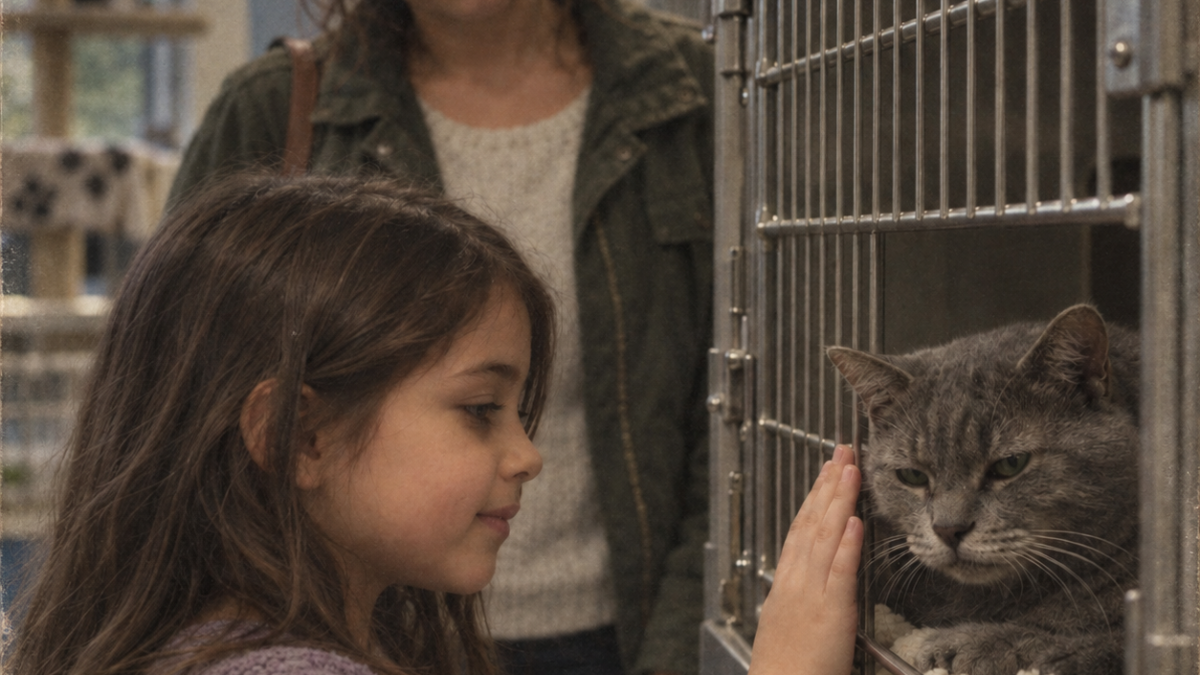
She stopped in front of the last cage.
Inside was an old gray cat.
Not old in the charming, fluffy, “wise grandma” way people like to imagine. Old in the way bodies become honest. Her fur was thin around her ears. Her spine made a ridge beneath her coat. One eye was cloudy. The other was green and tired. She was curled on a towel, not sleeping, exactly. Just existing with the stillness of a creature who had stopped trying to be chosen.
A card hung from the cage door.
Female.
Eleven years old.
Owner surrender.
Needs dental evaluation.
Quiet home preferred.
Ellie put her small hand against the metal bars.
“This one,” she said.
I laughed.
I hate that I laughed.
Not loudly. Not cruelly. Just a surprised little sound that came out before I could stop it, because the idea seemed impossible. We had walked through a room full of bright, healthy, adoptable kittens and my daughter had chosen the one cat in the building that looked like she had already lived through all the happy endings and been left behind after the credits.
“Honey,” I said, keeping my voice gentle, “no. We came for a kitten.”
Ellie did not move.
The old cat’s green eye shifted toward her.
“Sweetheart,” I tried again, crouching beside her, “an older cat might have health problems. She might need special food or medicine. A kitten would be easier for our first pet.”
Ellie stared through the bars.
“That’s why nobody wants her.”
Something in me tightened.
Maya, the shelter worker, stood a few feet behind us, silent.
I lowered my voice. “I’m just being practical.”
Ellie turned and looked at me.
Not angry.
That would have been easier.
She looked disappointed in a way only a child can look disappointed, before they learn that adults often call fear wisdom and convenience common sense.
“If we don’t take a kitten,” she said, “somebody else will.”
I swallowed.
She looked back at the gray cat.
“But if we leave her here, maybe nobody comes back.”
The shelter noise faded.
Dogs barking somewhere down the hall.
A phone ringing at the front desk.
Rain ticking against the window.
All of it moved far away.
“Ellie…”
“She looks like she knows what it feels like,” my daughter whispered.
“What?”
“To be left.”
I looked at her then.
Really looked.
At the child who still kept her father’s stuffed cat even though he had missed her last birthday party because of “a work conflict” that his Instagram later revealed involved a lake house and a woman named Brianna. At the child who said, “It’s okay,” after canceled calls because she had learned that making disappointment easy for adults was one way to keep them from leaving faster. At the child who never asked why her dad sometimes loved her loudly for two weekends and then disappeared into silence for six weeks.
My practical arguments turned to dust in my mouth.
Maya stepped closer.
“Would she like to meet her?”
I opened my mouth to say we should think about it.
Ellie said, “Yes, please.”
The old cat did not perform when Maya opened the cage.
No eager meow.
No purr.
No rubbing against the door.
Maya lifted her carefully, supporting her thin body like something breakable but not broken, and placed her on a folded blanket on the visiting bench.
Ellie sat beside her.
The gray cat stayed still.
My daughter held out one hand, palm down, the way the shelter signs instructed.
“Hi,” Ellie whispered. “I’m Ellie.”
The cat watched her.
“I know you’re scared. We’re scared sometimes too.”
That sentence nearly knocked the breath out of me.
The old cat leaned forward.
Barely.
It was almost nothing. Just the smallest press of her cheek against Ellie’s knuckles.
But Ellie’s face changed.
Not excitement.
Recognition.
Like two abandoned little parts of the world had quietly found each other in a room full of barking and bleach.
I sat down because my legs felt unreliable.
Maya smiled, but her eyes were wet.
“Her name here is Graycie,” she said. “But you can change it.”
Ellie looked at the cat.
“June,” she said.
I blinked. “June?”
“Because June sounds warm.”
Maya made a tiny sound in her throat.
I looked at the old gray cat.
She did not look warm.
She looked tired, wary, underfed, and entirely too expensive for a woman who had checked her bank balance twice in the parking lot.
But Ellie’s hand rested beside her.
The cat leaned again.
And I knew I had already lost.
I signed the papers before my fear could organize a better argument.
On the drive home, Ellie held the carrier on her lap and talked softly the whole way.
“Your name is June now,” she said. “You don’t have to answer yet. Sometimes I don’t answer when adults ask things either.”
I kept my eyes on the road.
“You can hide if you want,” Ellie continued. “We have a couch. It’s kind of ugly, but it’s safe underneath. Mom says we might get a new one someday, but someday is a big word at our house, so don’t worry.”
I gripped the steering wheel harder.
“We don’t yell much,” she told June. “Only if I spill juice near the laptop. And Mom doesn’t mean scary yelling. She means tired yelling.”
“Ellie,” I said.
“What?”
“That is very specific.”
“It’s true.”
The carrier was quiet.
At a red light, Ellie bent close to the little metal door.
“You can be scared,” she whispered. “We’ll still be here.”
I looked out at the wet road and blinked fast.
The first few hours at home were awful.
June bolted under the couch the second we opened the carrier. Not ran, exactly. Her old legs didn’t allow drama. She slipped out low and fast, a gray shadow with bones, and vanished beneath the sagging middle cushion where Ellie had once lost a peanut butter cracker for three months.
Ellie lay flat on the floor.
“Hi, June.”
Nothing.
“I’m not going to grab you.”
Nothing.
“I made you a bed.”
Nothing.
The bed was a shoebox lined with one of Ellie’s old pajama shirts. She had drawn little yellow suns on the outside and written JUNE in crooked letters.
June did not care.
By dinner, she had not eaten.
By bedtime, she had not used the litter box.
By nine o’clock, Ellie’s smile had begun to tremble at the edges.
“She hates us,” she whispered.
“She doesn’t hate us.”
“She won’t come out.”
“She’s scared.”
“What if she thinks we’re going to leave her too?”
There it was.
The real question hiding inside the cat question.
I sat beside Ellie on the living room rug and pulled her against me.
“We’re not leaving her.”
“Dad said that too.”
The room went still.
She did not say it dramatically. She did not accuse. She did not cry. She just placed the sentence between us like something heavy she had been carrying alone.
I closed my eyes.
Her father’s name was Ryan.
Once, I had loved saying it.
Ryan.
It used to mean Sunday pancakes and bad singing in the car and the way he lifted Ellie onto his shoulders at the farmer’s market. It used to mean warmth. Then slowly, almost politely, it became a name attached to missed pickups, vague explanations, new passwords, late-night phone light, and a final conversation at our kitchen table where he cried just enough to look wounded while telling me he “couldn’t keep living a life that felt like a shirt buttoned wrong.”
He did not abandon Ellie all at once.
That would have been cleaner.
He became unreliable in stages.
First late.
Then distracted.
Then apologetic.
Then busy.
Then mostly gone.
He sent gifts. He texted heart emojis. He remembered just enough to keep hope alive and failed just enough to bruise it again.
I had spent three years trying to make his absence sound less personal.
Daddy loves you.
Daddy’s schedule is complicated.
Daddy is trying.
But kids know.
They always know.
I kissed Ellie’s hair.
“June isn’t Dad,” I said.
“No,” Ellie whispered. “She came back with us.”
That one hurt in a place I had no defense for.
After Ellie went to bed, I came back to the living room and turned off every light except the small lamp beside the couch. Then I sat on the rug with my back against the wall, my knees pulled to my chest, and listened.
Nothing.
The apartment creaked.
Rain ran down the window.
A car hissed through the parking lot outside.
At 11:43, a little gray nose appeared beneath the couch.
I held perfectly still.
June stared at me with one cloudy eye and one suspicious green one.
“Hi,” I whispered.
She disappeared again.
“Fair.”
I fell asleep on the couch sometime after midnight, neck bent wrong, one hand hanging near the rug.
Just before dawn, I woke because something warm brushed my fingers.
I opened my eyes.
June stood beside the couch, thin and silent. She sniffed my hand, then moved past me toward the hallway.
I did not move.
She entered Ellie’s room.
I followed slowly, barefoot, heart pounding over something so small it felt ridiculous.
Ellie was asleep on her side, one arm hanging off the mattress.
June stood below her for a long time.
Then, with stiff, careful effort, the old cat jumped onto the bed.
She nearly missed.
I had to bite my tongue not to help.
But she made it, claws catching the blanket, back legs scrambling once, then settled beside Ellie’s stomach with a sigh so quiet it was almost imagined.
Ellie stirred.
Her hand moved in sleep.
June froze.
Then Ellie’s palm came to rest gently on her back.
The cat closed her eyes.
I stood in the doorway and covered my mouth with both hands.
Because suddenly I understood this had never only been about bringing home a pet.
It was about all the ways a home could be wounded and still be waiting for something gentle enough to enter.
The next morning, Ellie woke and found June pressed against her side.
She did not scream.
She did not jump.
She opened her eyes, saw that old gray cat curled there like she had belonged all along, and smiled the kind of smile children have before the world teaches them to ask whether joy is allowed to stay.
“She picked us,” Ellie whispered.
I leaned against the doorframe and nodded because I did not trust my voice.
For three weeks, we lived inside a fragile kind of happiness.
June learned our routines.
Breakfast at six because Ellie insisted “old ladies like early breakfast.”
A slow walk to the window.
A nap in the sun.
A judgmental stare whenever I made coffee instead of tea.
By the second week, she followed Ellie from room to room. Not closely. June was not needy in the obvious way. She kept a careful distance, as if love were a porch light she wanted to sit near but not stand under too quickly. If Ellie did homework at the kitchen table, June slept beneath her chair. If Ellie brushed her teeth, June waited outside the bathroom door. If Ellie cried because subtraction with borrowing felt like a personal attack, June climbed onto the worksheet and sat there until the crisis ended.
“She knows math is rude,” Ellie said.
“She may have a point.”
At night, June slept at the foot of Ellie’s bed. By morning, she was always beside her ribs.
I tried not to fall too in love too fast.
That sounds cold.
It was fear.
The adult part of me kept standing near the doorway of happiness with a clipboard, reminding everyone about risks. Senior cat. Unknown history. Dental issues. Rent due. Emergency fund thin. Do not get too attached to something fragile.
But every time I saw Ellie talking to June in that low, steady voice, some hard little place inside me softened.
Then, on a Tuesday morning before school, Ellie screamed.
Not a movie scream.
Worse.
A small, sharp cry that cut off halfway through.
I ran into the kitchen still holding my toothbrush.
Ellie sat on the floor beside June’s bowl, her knees pulled to her chest, tears sliding down her face.
June stood in front of her food.
Not eating.
Her head hung low. A thread of drool clung to her mouth.
“What happened?”
“She tried,” Ellie sobbed. “She tried to eat and then she stopped.”
I knelt so quickly my hip hit the tile.
June turned toward me, and I saw it then.
Pain.
Not dramatic pain. Not the kind that makes noise and announces itself clearly enough for everyone to respond. A quiet, hidden, old pain. The kind that lives behind cloudy eyes and stiff joints. The kind nobody notices until it has been patient too long.
I called the vet before I called my boss.
The clinic waiting room was too bright for the kind of fear I carried in with me.
Posters on the walls showed glossy dogs catching Frisbees and cats with perfect teeth. A television mounted in the corner played a silent loop of smiling families and wagging tails. Everything looked clean, cheerful, expensive.
Ellie sat beside me holding June’s carrier on her lap even though it was too big and awkward. She had put one of her own socks inside because she said June should smell home.
The sock was dirty.
It had strawberries on it.
I said nothing.
The receptionist handed me forms.
I filled in our information while doing math in my head.
Exam fee.
Medication.
Possible bloodwork.
Possible dental surgery.
Possible everything.
There is a particular shame that comes when you are afraid of money while a living thing is suffering. It makes you feel cheap in your own skin. You hate yourself for thinking about your debit card. You hate the system that makes care and cost stand in the same room. You hate that love has to pass through a payment terminal before anyone can call it responsible.
The vet was kind.
Not fake kind.
Not soft-voice, pity-smile kind.
Her name was Dr. Patel, and she had tired eyes, practical hands, and the calm of a woman who had learned not to waste words when an animal hurt.
She checked June’s mouth.
June growled once.
Ellie looked proud.
“Good,” she whispered. “Use your voice.”
Dr. Patel’s mouth twitched.
After the exam, she sat on a rolling stool and faced me.
“She has a significant infection around one of her teeth,” she said. “I suspect it’s been building for a while. It hurts when she tries to eat.”
Ellie’s hand flew to her mouth.
“But we can help her,” Dr. Patel added quickly.
I held on to the word help like a rail in deep water.
“She’ll need pain medication and antibiotics right away. Bloodwork would be smart because of her age. Once the infection is controlled, we should schedule a dental extraction.”
I nodded as if each sentence were not adding invisible numbers in red ink behind my eyes.
Then the estimate came.
The paper looked harmless.
White sheet.
Black print.
Ordinary lines.
But I stared at the total until the digits blurred.
I could pay it.
Technically.
If I moved the electric bill.
If I delayed the car repair.
If groceries became creative.
If nothing else went wrong.
That was the cruel joke of being almost okay. You could handle one emergency as long as life politely agreed not to send a second.
Ellie leaned over.
I tried to move the paper, but she saw enough.
“Mom,” she whispered, “are we too broke to help her?”
Nobody prepares you for the first time your child says your private shame out loud in a public room.
Dr. Patel looked away with professional mercy.
I folded the estimate in half.
Then I looked at my daughter.
“We are not too broke to love her,” I said.
Ellie waited.
Eight-year-olds can tell when adults answer only half the question.
I took a breath.
“And we will figure out the rest.”
It was a brave sentence until I reached the front desk.
Then bravery became a debit card.
June came home with medicine, soft food, and a follow-up appointment.
Ellie carried the paper bag from the clinic like it contained holy relics.
For the next ten days, our life revolved around getting an old cat to take pills.
If you have never tried to medicate a senior cat with trust issues, let me explain something: there are governments with less resistance strategy.
June could hide a pill in her cheek like a prison informant hiding evidence. She could detect medicine inside tuna, chicken, gravy, and one expensive salmon paste recommended by a woman online who clearly had never met June. She could clamp her jaw shut with the moral conviction of a Supreme Court ruling.
Ellie became her nurse.
“Come on, Ms. June,” she would say. “This is not optional.”
June glared.
“I know. The government is unfair.”
I stood nearby holding a towel and wondering when my child had become an old soul in pink socks.
Slowly, June improved.
Not magically.
Real healing is rarely cinematic at first.
It is measured in three bites of food.
One trip to the litter box.
A nap without trembling.
A tail lifting half an inch when your child walks into the room.
Ellie celebrated every tiny victory like a championship.
“She ate five bites!”
“She drank water!”
“She hissed at the vacuum!”
“That is character development,” I told her.
By the end of the month, June had gained a little weight. Her fur still looked thin around the ears, and her cloudy eye still made her face look permanently haunted, but she began to move through the apartment with ownership. She found the warm patch near the living room window. She discovered the laundry basket. She learned that if she sat on my laptop, I stopped working.
She also began waking Ellie from nightmares.
I noticed it first one Wednesday around 2 a.m.
A sound pulled me out of sleep.
Not crying.
Breathing.
Fast, frightened breathing.
I got up and stepped into the hallway.
Ellie’s bedroom door was half open. Her night-light threw a soft yellow moon across the wall. She was curled on her side, face wet, hands clenched in the blanket. June sat beside her chest, one paw resting against Ellie’s pajama top.
Not moving.
Just pressing.
Ellie’s breathing slowed.
June kept her paw there until my daughter’s hands unclenched.
I stood in the hallway and felt the past rise up like floodwater.
Ryan leaving with his suitcase.
Ellie standing by the window.
The way she asked, “Is Daddy coming back tonight?” even after we both knew the answer.
The nightmares had started the first month after he moved out. At first, she dreamed he had forgotten her at school. Then that I had disappeared too. Then she stopped telling me the details and just said, “Bad dream.”
I had tried everything.
Night-light.
White-noise machine.
Bedtime stories.
Therapy, when I could afford the copays.
Love, when nothing else worked.
And now this old cat, this unwanted gray creature with infected teeth and cloudy eyes, had found a way to reach my child inside sleep.
June looked up and saw me.
Her green eye held mine.
For one strange second, I felt like she was telling me not to interfere.
So I didn’t.
I went back to my room and cried into my pillow like a woman who had been holding her breath for three years.
The school assignment came in early October.
Bring in a photo or draw a picture of someone important in your family and write one page about why they matter.
Ellie told me about it while cutting June’s wet food into smaller pieces with the side of a fork, because apparently June preferred being served like royalty recovering from oral surgery.
“I’m writing about June,” she said.
I smiled. “Not me?”
“You already know you’re important.”
“That is… fair.”
“June might not.”
I looked at the old cat sitting by the bowl with her back straight, waiting like a retired headmistress.
“I think June knows exactly how important she is.”
Ellie drew her anyway.
She used gray pencil, green marker, and a yellow crayon halo of sunlight around her. In the drawing, June looked healthier than she did in real life, but somehow older too. Not cute. Noble.
At the top of the page, Ellie wrote:
This is June. She is old and nobody wanted her, but that does not mean she is not important.
I read the first sentence and had to sit down.
The rest was worse.
Not because it was sad.
Because it was true.
Ellie wrote that June was brave because she still let us love her even after someone had left her. She wrote that old things were not garbage. She wrote that some people pick kittens because kittens are easier, but easier is not always the same as better. She wrote that June slept beside her when she had bad dreams and that maybe animals understood leaving because people did it to them too.
Then, near the bottom, in uneven pencil, she wrote:
My mom was scared to choose her because grown-ups think love should be practical. But I think love should go where it is needed most.
I stared at that line for a long time.
Then I read it again.
My first feeling was pride.
My second was shame.
My third was fear, because children telling the truth in public have a way of making adults behave badly.
On Monday, Ellie brought the paper to school.
On Tuesday afternoon, her teacher called me.
I was at work, standing beside the copier, waiting for insurance denial forms to print. The office smelled like toner and microwaved soup. My phone buzzed with the school’s number, and every parent knows the tiny heart attack that arrives with that display.
“Is Ellie okay?”
“Yes,” Mrs. Alvarez said quickly. “Ellie is fine.”
I closed my eyes. “Thank God.”
“I’m sorry to worry you. I just wanted to talk about her family assignment.”
My stomach tightened.
Mrs. Alvarez was a good teacher. Patient. Warm. The kind of teacher children remember because she saw them as people before she saw their grades. But her voice had that careful adult tone people use when something small has become unnecessarily complicated.
“What happened?”
“Well,” she said, “the students shared their pages yesterday. Ellie’s was very thoughtful.”
I waited.
“And it brought up a lot of discussion.”
There is no phrase more dangerous in American school life than a lot of discussion.
“What kind of discussion?”
A pause.
“One parent felt the presentation made her child uncomfortable.”
I pinched the bridge of my nose.
“Because of the old cat?”
“Because of the implication that choosing a younger pet is less compassionate.”
“That was not Ellie’s implication.”
“I understand.”
“Do you?”
Mrs. Alvarez sighed softly. Not annoyed. Tired.
“I do. I thought Ellie’s paper was beautiful. But another parent said it was emotionally manipulative.”
I laughed once.
Not because it was funny.
Because if I did not laugh, something else might come out.
“An eight-year-old wrote about loving her cat.”
“I know.”
“Who complained?”
“I can’t share that.”
But I already had a guess.
Vanessa Cole.
Every school has a mother like Vanessa.
Polished blonde hair. White SUV. Stanley cup with her name in vinyl letters. Perfect seasonal porch photos. The kind of woman who said “mama bear” with a smile that made you wonder whose throat she had recently considered. Her son, Brayden, was in Ellie’s class. He was not a bad kid, just loud in the way children become loud when adults reward every opinion as leadership.
Vanessa volunteered for everything because volunteering gave her proximity to control. Field trips. Bake sales. Classroom decorations. Fundraisers. She had once sent a four-paragraph email to the class list because someone brought store-bought cupcakes to a party labeled “homemade preferred.”
I had avoided her for two years.
Ellie had not.
“Is Ellie in trouble?” I asked.
“No. Absolutely not.”
“Then what are you asking me?”
Mrs. Alvarez hesitated. “I’m not asking you to punish her. I just wanted you to be aware that the topic may come up at Thursday’s parent night. The principal wants to keep things calm.”
“Parent night is about the fall reading program.”
“It was.”
I stared at the copier as it spit out page after page of other people’s rejected claims.
“Mrs. Alvarez,” I said slowly, “are you telling me adults are going to discuss whether my daughter’s senior cat essay was offensive?”
Another pause.
“I wish I could say no.”
That night, I told Ellie.
Not everything.
Enough.
She sat at the kitchen table, putting tiny check marks on June’s medication chart with a purple marker.
“Some parents had strong opinions about your paper,” I said.
She looked up.
“Did I lie?”
“No.”
“Was I mean?”
“No.”
“Did I say kittens are bad?”
“No.”
“Then why are they mad?”
I sat across from her.
June sat in the third chair because June had decided chairs were a civil right.
“Sometimes,” I said, choosing each word carefully, “people feel judged when a true thing gets too close to them.”
Ellie thought about that.
Then she shrugged in a way that made her look older than eight.
“If they feel bad,” she said, “maybe it’s because they know.”
June sneezed.
I had no better argument.
Parent night should have been boring.
It was not.
The school cafeteria had been decorated with paper leaves and posters about reading goals. Long tables held sign-up sheets, juice boxes, grocery-store cookies, and flyers for the upcoming book fair. Children darted between adults while parents performed the exhausted friendliness of people trying to look involved after long workdays.
Ellie stayed home with our neighbor Mrs. Kline, who adored June and had promised they would watch a nature documentary together “for enrichment.” I was grateful. Whatever happened that night, my daughter did not need to watch adults weigh her heart on a cafeteria table.
I arrived ten minutes late because traffic on Maple Avenue had collapsed around a fender bender.
Vanessa was already at the front.
Of course she was.
She stood beside Principal Hargrove, one hand on a folder, wearing cream slacks and a soft blue sweater that probably cost more than my monthly grocery budget. Her expression said she had been waiting for a chance to be disappointed in public.
Mrs. Alvarez caught my eye from near the wall.
She looked apologetic.
That worried me more than Vanessa did.
Principal Hargrove cleared his throat. He was a tall man with kind eyes and the permanent fatigue of someone who had chosen education before realizing parents came with it.
“Before we discuss the reading program,” he said, “I understand there are some concerns about a recent classroom assignment.”
Vanessa stepped forward.
“I appreciate the chance to speak,” she said.
She always appreciated chances she had created herself.
“My concern is not with any child personally,” she continued, which meant my child personally. “My concern is with the messaging being encouraged in the classroom.”
I stood near the back, arms folded.
“Several students came home upset after hearing a presentation suggesting that families who adopt younger pets are selfish or morally inferior.”
Murmurs moved through the room.
Mrs. Alvarez straightened. “That is not what was said.”
Vanessa smiled without looking at her. “That may not have been the intention, but impact matters.”
I nearly laughed.
There was something dizzying about watching a woman weaponize emotional sensitivity against an eight-year-old’s compassion.
She opened her folder.
Oh, Lord.
She had printed things.
“This is part of a larger pattern,” Vanessa said. “Our children are being exposed to guilt-based messaging. They are too young to be told that practical family choices are cruel.”
A father near the cookies muttered, “Is this about the cat paper?”
Vanessa ignored him.
“My family adopted a puppy last year,” she said. “A healthy puppy. A good fit for our home. My son came home asking whether we should have adopted an old dog instead because ‘easy isn’t always better.’ He was made to feel guilty.”
Mrs. Alvarez said, “The children were discussing compassion. No one was accused of anything.”
“My son felt accused.”
“Your son also told another student her lunch smelled like dog food last week,” someone whispered behind me.
I turned.
A woman with red hair and tired eyes lifted her paper cup to hide her mouth.
I liked her immediately.
Vanessa continued. “I am asking the school to review assignments that encourage children to bring emotionally loaded family issues into class.”
Emotionally loaded family issues.
My daughter had drawn a cat.
Principal Hargrove looked like a man realizing the bridge beneath him was weaker than advertised.
Before he could answer, Vanessa added, “And I do think we need to consider whether stories about abandonment, shelters, and unwanted animals are appropriate for second graders without parental consent.”
That was when something in me clicked.
Not broke.
Aligned.
I stepped forward.
“My daughter wrote that paper,” I said.
Every head turned.
Vanessa’s eyes landed on me, and something like satisfaction flashed there. She had wanted me visible. She wanted the room to see the kind of mother attached to this problem: tired coat, work shoes, hair twisted up too quickly, purse with a cracked strap.
I walked to the front anyway.
“Claire Whitaker,” I said. “Ellie’s mom.”
Vanessa’s smile sharpened. “Claire, I’m not attacking Ellie.”
“No,” I said. “You’re just holding a folder about her feelings in front of thirty adults.”
A few people shifted.
Principal Hargrove coughed into his hand.
Vanessa’s cheeks colored. “This is exactly the emotional framing I’m concerned about.”
I looked at the room.
At the parents.
Some annoyed. Some curious. Some sympathetic. Some clearly wishing they had stayed home and ordered pizza.
“My daughter adopted an old cat,” I said. “That cat had been surrendered. She needed dental care. She was scared. Ellie wrote about why she mattered to our family. That’s it.”
“That is not it,” Vanessa said. “She wrote that people choose easy things.”
“She did.”
“That is judgmental.”
“It’s also something children are allowed to think about.”
“She made other children feel bad.”
“Maybe feeling bad for five minutes because an old animal needed love is not the worst thing that can happen to a child.”
The red-haired woman near the coffee let out a tiny “mm.”
Vanessa’s eyes narrowed.
I kept going before fear could stop me.
“My daughter did not say puppies are bad. She did not say kittens are bad. She did not say families who make different choices are bad. She said one old cat no one wanted still mattered.”
I looked straight at Vanessa.
“If that sentence feels like an attack, maybe the question is why.”
The room went still.
Vanessa’s face hardened.
“My question,” she said, voice low, “is whether your personal circumstances are being turned into a classroom lesson.”
There it was.
A colder silence.
Mrs. Alvarez said sharply, “Vanessa.”
But Vanessa had already stepped through the door pride opened.
She gave a little shrug, as if reluctant to say what she fully intended to say.
“Some of us work very hard to keep adult burdens off our children. I’m sorry, but not every family wants their second grader processing abandonment because another child’s home life includes that theme.”
My throat went tight.
Not because she had struck me.
Because she had struck Ellie.
She had taken the tenderest part of my daughter’s compassion—the part formed in the shadow of her father’s leaving—and held it up like contamination.
A few parents gasped.
The red-haired woman said, “Wow.”
Mrs. Alvarez’s face had gone pale with anger.
Principal Hargrove finally found his spine.
“That is inappropriate,” he said.
Vanessa lifted her chin. “I’m speaking honestly.”
“No,” I said.
My voice was quiet.
Quieter than I expected.
“You’re speaking cruelly and calling it honest because that sounds better.”
Vanessa blinked.
I could feel every eye in the room.
I hated public speaking. My hands had gone cold. My heart hammered so hard I could hear it.
But I thought of Ellie lying beside the couch whispering, I just don’t want you to be alone.
I thought of June leaning into her fingers because hope had become almost too heavy.
And I refused to let Vanessa make shame out of mercy.
“You’re right about one thing,” I said. “My daughter knows what abandonment feels like. Not because I turned it into a lesson. Because some adults made promises they didn’t keep.”
Vanessa looked away first.
“But she did not become bitter. She did not decide vulnerable things were too expensive to love. She walked into a shelter full of kittens and chose the old cat who might not have gotten another chance.”
My voice shook now.
I let it.
“That is not inappropriate. That is character.”
The cafeteria was silent.
Then the red-haired woman set down her coffee.
“My mom is in assisted living,” she said.
Everyone turned.
She looked embarrassed, but continued. “My son came home talking about Ellie’s paper too. Asked me if Nana felt like the old cat. I was annoyed at first. Then I realized I hadn’t visited my mother in three weeks because it was inconvenient and sad and I didn’t like how guilty I felt afterward.”
Her voice cracked.
“So maybe the problem wasn’t the paper.”
A man near the book fair table cleared his throat.
“My family adopted a puppy,” he said. “Great dog. Total disaster. My daughter also asked about senior pets after Ellie’s presentation. We talked about it. Nobody died. It was actually a good conversation.”
A few people chuckled.
Another mother spoke up. “My kid asked why animals get surrendered. I didn’t love answering. But I’m not sure every hard question is harmful.”
Vanessa looked around, realizing the room was slipping away from her.
She turned to Principal Hargrove. “So we’re just allowing children to moralize personal choices now?”
“No,” Mrs. Alvarez said, voice firm. “We’re allowing children to show empathy.”
That should have ended it.
It didn’t.
Cruel people rarely stop when they lose the room. They escalate because humiliation feels like danger, and danger makes pride stupid.
Vanessa opened her folder and pulled out a printed screenshot.
“If we’re talking about empathy,” she said, “perhaps we should also talk about responsibility.”
She held up the page.
My stomach dropped.
It was a photo from my personal Facebook.
Ellie sitting on our couch, June curled in her lap.
I had posted it two weeks earlier for family only. The caption said:
Three months with June. Still old. Still bossy. Still loved.
Vanessa looked at the room.
“This cat has ongoing health problems, correct? Dental surgery, medication, repeated vet visits?”
I felt my face go hot.
“Where did you get that?”
She ignored the question.
“I’m not judging,” she lied. “But when children are taught to make emotional decisions without regard for cost, the adults pay for it. Literally.”
The room chilled.
My private life.
My money.
My daughter’s cat.
All of it laid out under cafeteria lights by a woman who wanted to win.
Principal Hargrove stepped forward. “Mrs. Cole, that’s enough.”
But Vanessa wasn’t done.
She looked at me with soft, poisonous sympathy.
“I just worry, Claire, that Ellie is being taught to confuse love with rescue. That can become unhealthy, especially given her family history.”
Family history.
My hands curled into fists.
There are moments when you can feel yourself standing at the edge of becoming someone you do not want your child to hear about later.
I wanted to humiliate her.
I wanted to tell the room about her son’s cruelty, her marriage rumors, her performative volunteering, her need to control every classroom because maybe her own house was not as perfect as her porch photos.
The words lined up in my mouth.
Then I thought of Ellie.
And June.
And what love was supposed to teach.
So I breathed.
Once.
Twice.
Then I said, “You don’t get to use my daughter’s pain as a prop.”
Vanessa’s face flickered.
“You also don’t get to pretend this is about responsibility after stealing a private photo and turning a child’s compassion into a public trial.”
A murmur moved through the room.
I turned to Principal Hargrove.
“I want to know how she accessed that post. And I want it addressed.”
Vanessa rolled her eyes. “Someone sent it to me.”
“Who?”
“I don’t have to say.”
“Then don’t,” said a voice from the cafeteria doorway.
I froze.
Ryan stood there.
Ellie’s father.
He wore a navy jacket over a button-down shirt and the guilty, handsome expression that had once worked on me before I learned charm could be a mask for cowardice. He looked out of place in the school cafeteria, like a man who had arrived late to his own consequences.
My stomach turned.
“What are you doing here?” I asked.
He stepped inside.
“I got the parent night email.”
“You never come to parent night.”
The words came out before I could soften them.
His jaw tightened.
“I know.”
Vanessa looked between us.
Recognition flashed.
Then discomfort.
Ryan looked at her.
“I sent the screenshot,” he said.
The room went silent.
I stared at him.
“What?”
He swallowed.
“Vanessa messaged me after Brayden came home talking about the assignment. She said the class was discussing… abandonment. She asked if Ellie was okay. She made it sound like you were encouraging her to process our divorce through the cat.”
“Our divorce?” I repeated.
He flinched.
Good.
“You sent her my private post?”
“I didn’t think she’d use it like this.”
A bitter laugh escaped me.
That sentence.
The official anthem of weak men everywhere.
I didn’t think.
Vanessa snapped, “Ryan, that is not exactly—”
He turned on her. “No. Don’t. You said you were worried about Ellie. You said Claire was unstable.”
A sound moved through the room.
I felt it more than heard it.
Unstable.
The word landed on me like something dirty.
Ryan looked ashamed.
Finally.
Three years late, but there it was.
“She said,” he continued, voice rough, “that if the school knew Claire was making Ellie responsible for an old sick animal, maybe someone would step in before Ellie got hurt.”
Mrs. Alvarez’s hand flew to her mouth.
Principal Hargrove’s face hardened.
Vanessa went pale.
“That is a complete misrepresentation.”
Ryan laughed once, without humor. “You wanted dirt. I gave it to you because it was easier than admitting I hadn’t read Ellie’s assignment myself.”
He looked at me then.
Really looked.
Not with charm.
With damage.
“I’m sorry,” he said.
I could barely speak.
“You shared a picture of our child with a woman you barely know because she made you feel like the responsible parent?”
His face crumpled.
“Yes.”
The answer was so honest it hurt worse.
For a moment, the cafeteria disappeared.
It was just him and me and three years of me making his absence softer for Ellie. Three years of protecting his image because I thought that was what good mothers did. Three years of saying Daddy’s busy when the truth was Daddy chooses what is easiest and calls guilt love afterward.
Vanessa had not created the wound.
She had only pressed on it.
The whole room watched us.
I hated every second of it.
Then Principal Hargrove spoke, calm and cold.
“This meeting is over.”
Vanessa’s head snapped toward him. “Excuse me?”
“This discussion should never have happened in this manner. Mrs. Alvarez, please stay. Mrs. Whitaker, Mr. Whitaker, Mrs. Cole, I’d like to speak with you privately.”
“I have done nothing wrong,” Vanessa said.
The red-haired mother muttered, “That’s ambitious.”
Someone coughed to hide a laugh.
Principal Hargrove did not smile.
“Privately,” he repeated.
In his office, the truth came out in pieces.
Vanessa had emailed three parents claiming that Ellie’s assignment had “disturbed several children.” Only one had responded with concern. The others had either ignored it or told her she was overreacting. She had contacted Ryan through the class directory, presenting herself as a concerned parent worried that Ellie was being used to process adult issues. Ryan, who had missed both the assignment instructions and most of Ellie’s actual emotional life, responded with the screenshot and vague comments about my “tendency to take things personally.”
I looked at him when Principal Hargrove read that part from Vanessa’s printed email.
He looked like he wanted the floor to swallow him.
Good.
Vanessa tried to frame everything as concern.
Concern for children.
Concern for curriculum.
Concern for emotional boundaries.
Concern, I was learning, is one of the easiest words to hide control inside.
Mrs. Alvarez sat stiffly beside me, eyes bright with anger.
“I will not apologize for allowing a child to speak compassionately about her family pet,” she said. “Ellie’s paper was age-appropriate, thoughtful, and kind.”
Vanessa folded her hands. “The issue is not kindness. The issue is moral pressure.”
“No,” Principal Hargrove said. “The issue is that you brought another child’s family circumstances into a public meeting and used private material without consent.”
Vanessa’s mouth opened.
He continued.
“You will step down from classroom volunteer duties while we review this matter. You will not contact Ellie, Claire, or Ryan about this again. You will not discuss Ellie’s family circumstances with other parents. And you will provide a written apology.”
Vanessa’s face went rigid.
“I have given years to this school.”
“And tonight you harmed a child who was not present to defend herself.”
The room went quiet.
That sentence mattered.
Because adults love talking about children while children are absent. We dress it up as concern, policy, development, safety, values. Sometimes those conversations are necessary. Sometimes they are just power talking over innocence because innocence is not in the room to ask why everyone is being so strange.
Vanessa looked down.
For a second, I thought she might cry.
Then she stood.
“I will have to speak with my husband.”
Principal Hargrove nodded. “That is your choice.”
She left without looking at me.
The door closed.
The office felt smaller afterward.
Ryan rubbed both hands over his face.
“I’m sorry,” he said again.
I was too tired to hold anger elegantly.
“You don’t get to send me one apology and call it growth.”
He nodded.
“I know.”
“Do you?”
His eyes filled.
“I read her paper,” he said.
I looked away.
“After Vanessa called. I asked Mrs. Alvarez to send it. I read it in the parking lot before coming in.”
His voice broke.
“She wrote, ‘Some people leave because staying gets too hard, but June stayed after she knew we were safe.’”
The room went silent.
I had not seen that line.
Ellie must have added it after showing me the draft.
Ryan covered his mouth.
“I did that to her.”
I wanted to comfort him.
That old reflex rose immediately.
Tell him it wasn’t that simple.
Tell him Ellie knew he loved her.
Tell him he wasn’t a monster.
Women are trained to bandage the men who cut them if the men bleed while holding the knife.
I stayed quiet.
Ryan looked at me, waiting maybe.
I did not rescue him.
Finally he nodded as if receiving the consequence.
“I’ll do better,” he said.
I closed my eyes.
“Do not say that to me unless you have a plan.”
He swallowed. “Okay.”
“No more random gifts instead of showing up. No more promising calls you might miss. No more using work as a curtain. If you want to be in Ellie’s life, you will be consistent. If you can’t, you will stop reopening the wound every few weeks because guilt makes you lonely.”
Mrs. Alvarez looked at her lap.
Principal Hargrove pretended to read a paper.
Ryan’s face had gone pale.
“I deserve that,” he whispered.
“Yes,” I said. “You do.”
The next day, Ellie knew something had happened.
Children always know.
I picked her up from school, and she climbed into the car quietly, backpack hugged to her chest.
“Is Mrs. Cole mad at me?” she asked.
My hands tightened on the steering wheel.
“No, baby. Mrs. Cole made a mistake.”
“Because of my paper?”
“Because of choices she made after your paper.”
Ellie looked out the window.
“Brayden said his mom thinks June is a guilt cat.”
I almost drove into a mailbox.
“A what?”
“A guilt cat.”
I took a breath so deep it scraped my ribs.
“What did you say?”
“I said June is just a cat and maybe his mom should drink water.”
I pressed my lips together.
Hard.
“That was… creative.”
“Did I get in trouble?”
“No.”
“Was it rude?”
“A little.”
She nodded. “I thought so.”
We drove in silence for a few blocks.
Then she asked the question I had been dreading.
“Did Dad come to parent night?”
I looked at her in the mirror.
“Yes.”
Her face changed.
Hope is cruel when it enters a child too quickly.
“He came?”
“Yes.”
“For me?”
I hesitated.
Then chose truth.
“He came because there was a problem. But he read your paper, and I think it made him understand some things.”
Ellie looked down at her hands.
“Is he sad?”
“Yes.”
“Good.”
The word was quiet.
Not mean.
Honest.
She looked startled by herself after saying it.
“I don’t mean bad sad,” she added quickly.
“I know.”
“I mean maybe if he’s sad, he knows.”
I nodded.
“Maybe.”
She wiped one eye with her sleeve, angry at the tear.
“June knows,” she said.
“She does.”
“She doesn’t say sorry and then leave again.”
“No,” I whispered. “She doesn’t.”
That evening, Ryan called.
On time.
Ellie stared at the ringing phone like it was a snake pretending to be a birthday present.
“You don’t have to answer,” I said.
She looked at June, who was sitting beside her on the couch.
Then she answered.
The conversation was awkward.
Beautifully, painfully awkward.
Ryan did not perform. He did not open with big cheer. He did not try to charm her into comfort.
He said, “I read your paper.”
Ellie said nothing.
He said, “It was really good.”
Still nothing.
He took a shaky breath.
“And it made me realize I’ve hurt you by not showing up when I said I would.”
Ellie’s lower lip trembled.
June pressed against her leg.
Ryan continued.
“I’m sorry. Not quick sorry. Real sorry. I’m going to call every Tuesday and Friday at seven. If I can’t, I’ll tell your mom before school that day. And I’m going to visit every other Saturday. Not maybe. Not sometime. I’m putting it on my calendar.”
Ellie whispered, “Calendars don’t make people come.”
I had to turn away.
Ryan was silent for a long moment.
“You’re right,” he said. “People make people come. I have to be the person.”
Ellie cried then.
Not loud.
Just tears sliding down her face while she held the phone.
“I’m mad at you,” she said.
“I know.”
“June didn’t make me mad.”
“I know.”
“You did.”
“I know.”
“Okay,” she whispered.
It was not forgiveness.
It was a door left unlocked, not open.
That was enough for one night.
Vanessa’s apology arrived by email two days later.
It was polished.
Too polished.
I could feel her husband’s lawyerly influence in phrases like “I regret that my concerns caused distress” and “It was never my intention to single out any child.”
I read it once.
Then I wrote back:
Thank you for acknowledging the harm. For clarity, the issue was not that distress occurred. The issue was that you used my child’s private family circumstances and photo in a public argument. Please do not contact us again except through the school if necessary.
I stared at the response for five full minutes before hitting send.
Then I did something shocking.
I did not soften it.
Justice, I was learning, did not always arrive in dramatic punishments.
Sometimes it arrived as a woman refusing to make a clean landing pad for someone else’s bad behavior.
Vanessa stepped down from volunteering.
For a while, the school felt tense. People avoided eye contact in the pickup line. Then, slowly, the truth spread in that strange half-whispered way school communities digest scandal. Some people exaggerated. Some invented details. Some took sides without knowing enough to choose one.
But something else happened too.
Mrs. Alvarez asked if Ellie would be comfortable helping with a small donation drive for Green Hollow Animal Rescue.
I worried.
Ellie didn’t.
“Can it be for old pets too?” she asked.
Mrs. Alvarez smiled. “Especially old pets.”
The donation table was set up outside the library with construction-paper paws taped to the wall. Ellie helped make a sign that said:
OLD DOESN’T MEAN UNLOVABLE.
Under that, Mrs. Alvarez added:
Senior pets need soft blankets, wet food, towels, and second chances.
Kids brought cans of food.
Old towels.
Coins in plastic bags.
A fifth grader donated three dollars and a note that said, My grandpa is old and he is my best friend so I get it.
A kindergartener brought a single can of tuna from home, dented on one side.
One boy drew a picture of a dog with gray eyebrows and wrote, Still a good boy.
The table filled slowly.
Not enough to change the world.
Enough to change the temperature of one hallway.
Then Brayden came.
Vanessa’s son.
He stood in front of the table after school, backpack hanging off one shoulder. Ellie was arranging cans into a pyramid because apparently compassion required architecture.
He held out a small fleece blanket.
“My mom said not to bring this,” he said.
Ellie looked at him.
“But my grandma said my mom is not the boss of my heart.”
I coughed into my hand.
Mrs. Alvarez suddenly became very interested in a stack of flyers.
Ellie took the blanket.
“Thank you.”
Brayden looked uncomfortable.
“Is your cat still sick?”
“She’s old, not dead.”
“Oh.”
“She takes medicine.”
“That stinks.”
“Sometimes. But she purrs now.”
He nodded like this was valuable data.
Then he said, “My mom cries in the laundry room.”
Ellie froze.
So did I.
Brayden looked at the floor.
“I think she’s lonely, but she’s mean about it.”
For a moment, nobody moved.
Then Ellie, my tender, terrifying child, did not say what many adults would have said.
She did not say Vanessa deserved it.
She did not say loneliness was no excuse.
She did not say his mother had hurt us.
She simply said, “June was mean at first too.”
Brayden looked up.
“Really?”
“She hissed at Mom for giving medicine.”
“Did she scratch?”
“No. But she thought about it.”
He almost smiled.
Ellie folded the blanket and placed it on the table.
“Sometimes scared things act mean,” she said. “But they still have to stop.”
I stared at her.
Eight years old.
Saying what half the adults in my life still couldn’t hold together.
Mercy and boundaries.
Compassion and consequence.
Understanding without excuse.
Brayden nodded.
Then he walked away.
That night, I told Ellie I was proud of her.
She shrugged.
“I didn’t do anything.”
“You were kind to someone whose mother hurt you.”
She brushed June slowly.
“Brayden didn’t do it.”
“No. But you were still kind.”
Ellie thought about that.
Then she said, “Being kind doesn’t mean letting people bite you.”
June chose that moment to yawn, showing the gap where her bad tooth had been.
“No,” I said. “It really doesn’t.”
The shelter invited Ellie’s class to visit in November.
I almost said no.
The idea of returning to that building with twenty second graders, three teachers, six parents, and the emotional chaos of animals behind bars sounded like a recipe for tears and at least one child trying to smuggle a guinea pig in a hoodie.
But Ellie wanted to go.
So I signed the permission slip and took half a day off work.
Green Hollow looked the same as it had on that rainy Saturday, but I did not.
That surprised me.
The first time I walked in, I had seen risk.
Cost.
Mess.
Need.
This time, I saw lives waiting under fluorescent lights and tried not to flinch from how many there were.
Maya remembered us immediately.
“June’s family,” she said.
Ellie beamed.
“She sleeps on my head now.”
Maya laughed. “That means you’ve been promoted.”
The kids toured the facility in small groups. They learned about feeding schedules, cleaning, fostering, adoption applications, and why older animals sometimes waited longer. Mrs. Alvarez guided the discussion carefully, but children went straight to the heart of things because children do not know how to politely walk around pain.
“Why did someone leave that dog?”
“Does that cat miss her family?”
“What happens if nobody adopts him?”
“Do animals know they’re old?”
Maya answered honestly without being cruel.
Sometimes families moved.
Sometimes owners got sick.
Sometimes money ran out.
Sometimes people made bad choices.
Sometimes animals waited.
Then we reached the senior cat room.
Ellie went very still.
June’s old cage had a new occupant.
A black-and-white cat named Milton, thirteen years old, with one folded ear and a sign that said Loves laps, hates being ignored.
He sat at the front of the cage, staring at the children like he was interviewing them for character.
Ellie placed her hand against the bars.
“Hi,” she whispered.
Milton pressed his cheek against her fingers.
The room went quiet.
Not because of magic.
Because everyone remembered.
Mrs. Alvarez wiped one eye.
Maya looked away.
Even I had to swallow hard.
Then a woman behind us whispered, “That’s the one.”
I turned.
A mother stood near the doorway holding the hand of a little boy from Ellie’s class. She had dark circles under her eyes and a donation bag over her shoulder.
“My dad died last month,” she said, almost apologetically. “My mom barely gets out of bed. My son came home talking about June, and I thought maybe…”
She looked at Milton.
“Maybe older isn’t a problem. Maybe older is calmer.”
Maya stepped forward gently. “Would you like to meet him?”
The woman nodded.
Ellie looked at me.
Her face shone.
Not with pride.
With recognition.
Like love had just made another quiet turn toward where it was needed.
Milton went home three days later.
Not to us.
To the grandmother who had stopped getting out of bed.
Two weeks after that, Maya sent Mrs. Alvarez a photo with permission to share: Milton curled in the lap of an older woman in a blue recliner, both of them asleep in a square of sunlight.
Ellie taped a copy beside June’s medicine chart.
“See?” she told June. “You started a thing.”
June licked her paw like she accepted credit.
Thanksgiving came with Ryan.
That sentence alone would have sounded impossible a year earlier.
He arrived on time.
With green beans.
Not flowers.
Not a toy.
Not guilt disguised as generosity.
Green beans, because I had asked him to bring green beans.
It was the first evidence that he had learned listening could be more loving than grand gestures.
Ellie watched him carefully all afternoon.
So did June.
Ryan sat at the edge of the couch and held out one hand.
June sniffed him.
Then walked away.
“Fair,” he said.
Ellie laughed.
It was small.
But real.
Dinner was awkward and decent.
Sometimes that is the best a repaired thing can be at first.
Ryan did not overpromise. He did not try to reclaim old family warmth like he had a right to walk back into it. He washed dishes. He asked Ellie about school. He listened when she explained the senior pet drive in excruciating detail. He did not look at his phone once.
After dinner, Ellie went to her room to get a drawing, and Ryan stood beside me at the sink.
“She’s different,” he said.
“She’s growing up.”
“No.” He looked toward the living room where June had claimed the armchair. “I mean… she says things now. Things I don’t know how to answer.”
“She always did. You just weren’t here to hear them.”
He accepted it.
That mattered.
“I’m going to keep showing up,” he said.
I kept washing a plate.
“I hope you do.”
“I know you don’t trust me.”
“No.”
He nodded.
“I don’t either yet.”
That was the first sentence from him that gave me any real hope.
Not because it was beautiful.
Because it was accountable.
June eventually forgave him enough to sit near his shoe.
Ellie treated this like a royal pardon.
By Christmas, life had become fuller.
Not easier.
Fuller.
There is a difference.
June’s medicine cost money. Ryan’s consistency required emotional adjustment. Work remained work. The car needed brakes. Mr. Voss raised the rent by seventy-five dollars and called it “market pressure,” as if the market were a weather system and not people making choices behind desks.
But our home had changed.
The apartment no longer felt like a place where two people recovered from being left.
It felt like a place where three souls practiced staying.
Ellie became more confident in small ways. She raised her hand more at school. She stopped apologizing when she asked Ryan if he was still coming Saturday. She invited a friend over without first asking whether our apartment was “too small for guests.” She told Mrs. Alvarez she wanted to write stories about animals nobody picked first.
June became bossier.
Health, apparently, had restored her belief in management.
She woke us at six, inspected breakfast, judged laundry, supervised homework, and developed a deep distrust of the printer. She purred more often but only when she thought no one was making too big a deal out of it.
At night, she still slept beside Ellie.
Some nights, beside me.
The first time she chose my bed, I woke at 3 a.m. with the weight of her small body against my knee. For a moment I did not move, afraid she might leave if I acknowledged wanting her there.
Then she opened one eye.
As if irritated by my emotional complexity.
I whispered, “Thank you.”
She closed her eye again.
That was June’s version of grace.
In January, Vanessa returned to a school event.
Not as a volunteer.
As a parent.
She looked different without authority in her hands. Smaller somehow. Still polished, but less certain that polish could protect her. I saw her in the gym during the winter concert, standing beside Brayden and her husband. She noticed me across the room.
For a moment, we only looked at each other.
Then she walked over.
I braced myself.
“Claire,” she said.
“Vanessa.”
Brayden stood beside her, looking mortified to exist in a world where mothers spoke.
Vanessa held a white envelope.
“I owe you more than the email I sent.”
I said nothing.
She looked down.
“I was cruel. To you. To Ellie. I told myself I was protecting my son from guilt, but really I was angry because your daughter’s paper made him ask questions I didn’t want to answer.”
Brayden stared at his shoes.
Vanessa’s voice thinned.
“My mother lives twenty minutes from us. She’s widowed. She calls too much. That’s what I told myself. Too much. After Brayden asked if she felt like June, I realized I had made her loneliness sound like bad manners.”
The gym noise moved around us.
Children laughing.
Parents finding seats.
A microphone squealing.
Vanessa swallowed.
“I visited her.”
I watched her carefully.
“She cried when we left. Brayden cried in the car. I got mad at first. Then I realized I was mad because I had seen it.”
“The truth?” I asked.
She nodded.
“I’m sorry.”
There was no performance in it.
No folder.
No audience invited.
Just a woman holding an envelope in a noisy school gym, looking ashamed.
I took the envelope.
Inside was a handwritten apology to Ellie.
I read it later before deciding whether to show her. It said:
Dear Ellie,
I was wrong to speak about your paper as if kindness was something dangerous. I was wrong to use your cat’s story in an argument. Your love for June helped my family notice someone we were not loving well. That does not erase what I did, but I wanted you to know your heart was not the problem.
Mrs. Cole
I cried over that letter.
Then I let Ellie read it.
She sat silently at the kitchen table, June in her lap.
When she finished, she folded it carefully.
“Can we keep it?” she asked.
“Yes.”
“Good.”
“Are you okay?”
She nodded.
Then she said, “Maybe Mrs. Cole was like June.”
I blinked. “How?”
“Scared and kind of mean at first.”
I laughed despite myself.
“Maybe.”
Ellie looked at June.
“But June stopped biting.”
“She never actually bit.”
“With her eyes, she did.”
Fair.
The senior pet drive became annual.
That was Mrs. Alvarez’s idea at first, then Principal Hargrove’s, then somehow the school board’s, though by the time administrators put something on letterhead, children have usually already done the real work.
They called it the June Project.
Ellie hated the name for exactly one day because she said June would not enjoy being exploited.
Then Maya from the shelter brought June a tiny certificate that said Honorary Senior Pet Ambassador, and Ellie decided exploitation was acceptable if it came with a ribbon.
June tried to eat the ribbon.
The first June Project collected food, blankets, and enough money to cover dental care for two senior cats and a twelve-year-old beagle named Hank. The second year, three older pets were adopted within a month after the school displayed their photos and stories. The local paper ran a small article with a picture of Ellie holding June.
I worried the attention would turn ugly again.
Some of it did.
Attention always invites people who think cynicism makes them intelligent.
But this time, I was different.
When someone commented online, Not everyone can afford an old sick pet, stop shaming people, I answered:
That is true. Not everyone can. This is not about shaming people who cannot. It is about remembering that the ones who need more care still deserve to be seen.
Then I logged off.
Growth.
One afternoon, about a year and a half after we adopted June, Ellie and I returned to Green Hollow to drop off donations.
June did not come. She had reached an age and level of entitlement where car rides were considered emotional terrorism unless medically required.
The shelter looked brighter now. Or maybe I did.
Maya hugged Ellie.
“You’ve gotten tall.”
Ellie beamed.
“I’m nine and a half.”
“Very different from nine.”
“Exactly.”
We carried bags of towels to the back room. On the way, we passed the kitten room. Tiny paws. Tiny squeaks. Tiny perfect faces.
A family stood inside with a little boy choosing between two tabby kittens.
The mother looked nervous and happy.
The father held a carrier.
The boy pointed.
“That one!”
Ellie watched them.
For a moment, I wondered if she felt the old righteous ache, the fear that every kitten chosen meant someone older left behind.
But she smiled.
“That kitten is lucky,” she said.
I looked down at her.
“Yeah?”
She nodded.
“Love doesn’t have to pick the saddest one every time,” she said. “It just has to not forget them.”
I stopped walking.
Because there it was again.
Mercy with balance.
Wisdom without bitterness.
The thing I had almost failed to teach her because I had been too busy surviving.
I squeezed her shoulder.
“You know,” I said, “you are a pretty remarkable person.”
She made a face.
“Mom.”
“It’s true.”
“Please don’t be emotional in public.”
“Too late.”
She rolled her eyes.
Then we walked to the senior room.
A new old cat sat in June’s former cage.
Tortoiseshell.
Fourteen.
Missing most of her tail.
Her card said:
Name: Mabel.
Owner deceased.
Needs patient home.
Ellie placed her hand against the bars.
Mabel stared at her.
I felt an old pull in my chest.
The same one from that rainy Saturday.
Only now, it did not feel like fear.
It felt like recognition.
“No,” Ellie said gently, as if answering my thought. “We can’t take another cat right now.”
I blinked.
“We can’t?”
She shook her head. “June would sue us.”
“She would.”
“And we have to take care of the one we promised first.”
I looked at her.
She smiled at Mabel through the bars.
“But we can help find her person.”
So we did.
Ellie made a flyer.
Not dramatic.
Not sad-eyed manipulation.
Just honest.
Mabel is fourteen. She is quiet. Her owner died. She likes soft blankets and people who understand that love can start slowly.
The flyer went to the school newsletter, the shelter page, and the community board at the grocery store.
Three weeks later, Mabel was adopted by a retired librarian named Mrs. Frank who had recently lost her husband and said she wanted “someone old enough to respect silence.”
When Maya told us, Ellie whispered, “Good.”
That night, she told June, “We didn’t replace you. We networked.”
June sneezed.
Time moved.
That is the part stories often rush because time is hard to make dramatic.
But time is where love proves itself.
June had good months and difficult ones.
There were vet visits.
There were appetite scares.
There was a terrifying weekend when she hid under Ellie’s bed and would not come out, and I sat on the floor for two hours remembering the shelter day and thinking, not yet, please not yet.
There were also mornings when she galloped down the hallway like a haunted dust mop because apparently old age did not prevent sudden crime.
There were sun patches.
Holiday photos.
Medicine charts.
Soft blankets.
Ellie growing taller.
Ryan showing up.
Me learning to unclench.
One evening, two years after adoption, Ellie asked the question I knew would come eventually.
“How long do you think June has?”
We were sitting on the couch. June slept between us, one paw stretched across Ellie’s thigh. Her breathing was slow and steady. Her fur had gone lighter around the face, silver over gray, like moonlight dusting old stone.
I did not say, Don’t think about that.
That would have been for me.
“I don’t know,” I said.
Ellie’s eyes filled.
“Not forever.”
“No.”
She nodded, but tears spilled anyway.
I pulled her close.
“I hate that,” she whispered.
“Me too.”
“If loving old things means losing them sooner, why do it?”
There it was.
The question beneath every practical argument I had ever made.
Why choose what will hurt?
Why open the door when goodbye waits closer?
Why let your child love something fragile?
Why let yourself?
I looked at June.
At the old cat nobody wanted because everyone could see the ending more easily than the life before it.
Then I said, “Because shorter love is still love. And sometimes the ones who have less time need us to stop acting like time is the only thing that gives love value.”
Ellie cried harder.
So did I.
June, awakened by all this inconvenient emotion, stood, stepped over my lap, and settled directly across both of us like a warm gray bridge.
We laughed through tears.
That was her gift.
Not stopping pain.
Staying through it.
The final trouble with Ryan came the next spring.
Not dramatic like before.
Quieter.
More ordinary.
Which made it more dangerous.
He had been consistent for almost a year. Calls. Saturdays. School events. He even took Ellie to the dentist and sent me the paperwork without acting like he deserved a parade. Trust had begun to grow in cautious green shoots.
Then he got a promotion.
More travel.
More pressure.
More old patterns knocking.
He missed one Tuesday call but texted early.
Then he rescheduled a Saturday.
Then another.
Ellie said she understood.
That was how I knew she didn’t.
One Friday night, she sat on the living room floor brushing June and said, “Dad is getting busy again.”
I sat beside her.
“Yes.”
“Is busy stronger than love?”
My throat tightened.
“No.”
“Then why does it win so much?”
I had no clean answer.
So I called Ryan after she went to bed.
He sounded tired.
“Claire, I’m doing my best.”
“No,” I said. “You’re doing what feels possible without rearranging anything.”
He sighed. “That’s not fair.”
“Maybe not. But it’s close.”
Silence.
I looked at June asleep in Ellie’s doorway, guarding her like a tiny old soldier.
“You taught her promises can disappear,” I said. “Then you worked hard to teach her they could stay. Do not make her learn the first lesson twice.”
Ryan was quiet for a long time.
Then he said, “I don’t know how to balance everything.”
“Then stop pretending balance happens by accident.”
He came over the next morning.
Not for his scheduled visit.
For the hard conversation.
He sat with Ellie at the kitchen table while I made coffee and pretended not to listen from five feet away.
“I messed up,” he told her.
She stared at him.
“I started letting work take over again. That’s not your fault.”
“I know.”
The answer was quick.
Sharp.
He nodded like he deserved it.
“I’m changing the travel schedule. I talked to my boss.”
Ellie’s eyes narrowed. “Really?”
“Really.”
“Why didn’t you before?”
“Because I told myself I couldn’t.”
“Could you?”
He swallowed.
“Yes.”
Ellie looked down at her hands.
June jumped onto the chair beside her, stiffly but with determination.
Ryan watched the cat.
Then he said, “June asks for what she needs.”
Ellie snorted. “June demands what she needs.”
“Maybe I need to learn from her.”
“Good,” Ellie said.
It was not warm.
But it was open.
That was enough.
The str








