My Dad Is a Biker, He Said—The Class Laughed Until a Hells Angel Walked In
PART3:
“All right, all right,” Mrs. Gable said at last, clapping her hands. “Class, settle down.”
Leo looked at her with a kind of wild hope.
She smiled at him.
A small, soft, terrible smile.
“Leo, thank you for sharing. I’m sure your father enjoys his hobby. You can sit down now.”
The room tittered again.
Hobby.
Leo stared at her.
“It’s not a hobby,” he whispered.
But the fight had drained out of him.
He walked back to his desk, eyes on the floor, Polaroid clutched in one shaking hand.
For the rest of the day, he was a ghost.
At recess, he hid behind the portable classrooms and sat with his knees pulled to his chest. He could still hear Trent’s voice.
Unemployed hobos.
Criminals who can’t afford cars.
Hobby.
Leo loved his father.
He loved the smell of gasoline and worn leather. He loved the rumble of engines on Saturday mornings. He loved sitting on a stool in the garage while John explained carburetors and loyalty with the same seriousness, as though both were parts of a machine that failed if neglected. He loved the way his father’s huge hand could tighten a bolt, then tie Leo’s shoelace with surprising gentleness.
But in that classroom, surrounded by polished shoes and PowerPoint presentations, Leo had felt something he hated himself for feeling.
Shame.
Deep, hot, humiliating shame.
Not because of his father.
Because other people had made loving him feel foolish.
The Donovan garage was a sanctuary.
It sat behind their small house at the end of a cracked driveway, lit by humming fluorescent tubes and smelling of motor oil, exhaust, metal, leather, coffee, and the faint trace of stale tobacco from men who claimed they had quit. Tools hung in careful rows. Bike parts rested on labeled shelves. A black 1998 Dyna Super Glide sat near the open bay door like a sleeping animal waiting for permission to roar.
This was where John “Iron” Donovan spent most of his time when he was not on the road.
John was not a weekend enthusiast.
He was a fully patched member of the Hells Angels Motorcycle Club and sergeant-at-arms for his local charter. He was a giant of a man with tattooed arms, a thick beard, heavy boots, and a leather cut that made strangers change sidewalks before they had heard him say a single word.
To Leo, he was Dad.
The man who packed lunches badly but tried.
The man who checked under the bed for monsters with a flashlight and a wrench.
The man who had raised Leo alone after his mother left when Leo was too young to remember her clearly.
The man who never missed a school meeting if he could help it, even when the teachers stared at his vest like it had walked in without him.
Leo was his entire world.
That afternoon, when Leo got out of a friend’s mom’s minivan, he did not run to the garage like usual.
He kept his head down.
Walked straight through the front door.
Went to his bedroom.
Locked it.
John was dialing in the carburetor on the Dyna when he heard the front door close.
He paused.
A father learns his child’s footsteps the way a mechanic learns an engine.
Leo’s were wrong.
Too quiet.
Too fast.
No backpack dropped near the couch. No call of “Dad, I’m home.” No small body appearing in the garage doorway with a hundred questions.
John set down the wrench.
He wiped his grease-stained hands on a rag and went inside.
His boots sounded heavy against the hardwood floor, but when he reached Leo’s bedroom, his knock was gentle.
“Leo?”
No answer.
“You good, buddy?”
“I’m fine.”
The voice was muffled and thick.
John did not hesitate.
He opened the door.
Leo lay face down on the bed, shoulders trembling. His denim jacket was still on. One shoe had fallen off. The Polaroid lay on the blanket beside him, bent now from being held too hard.
John’s face changed.
The hard lines of the sergeant-at-arms disappeared, leaving only a father.
“Hey,” he said softly.
He sat on the edge of the mattress. The springs groaned beneath his weight.
A massive, calloused hand settled on Leo’s back.
“Talk to me.”
Leo shook his head into the pillow.
John’s voice stayed calm.
“Who do I need to fix?”
That made Leo turn over, face red and blotchy, tears still wet on his cheeks.
“They laughed.”
John went still.
“Who laughed?”
“Everyone.”
Leo sat up, wiping his nose with the back of his sleeve.
“It was Career Week. I told them you were a biker. I told them you were in a club. Trent Higgins said you were just a fat guy in tight pants. He said bikers are unemployed losers who can’t afford cars.”
John’s jaw tightened.
“Mrs. Gable didn’t even stop them,” Leo continued, voice breaking. “She just said it was a nice hobby.”
The room went very quiet.
John did not yell.
He did not curse.
That would have been easier.
The anger that flashed through his eyes was colder than noise. Protective. Controlled. Dangerous only because it had discipline behind it.
“They called it a hobby,” John said.
“I tried to tell them.” Leo’s tears came harder now. “I tried to show them your picture, but they wouldn’t look. They just kept laughing.”
He grabbed the Polaroid and pushed it toward his father as if the evidence had failed him.
“I was embarrassed, Dad.”
John looked at the photo.
Then at his son.
“I’m sorry,” Leo whispered. “I’m so sorry.”
John gripped Leo’s shoulders, firm enough to anchor him.
“Don’t you ever apologize for them.”
Leo blinked.
“You hear me?” John said. “You hold your head up. Ignorance speaks loudest when it doesn’t know what it’s looking at.”
“But they think you’re a joke.”
John stood slowly.
A grim smile moved under his beard.
“Well,” he said, “then I suppose Oak Haven Elementary needs a proper education.”
He walked into the kitchen and picked up his phone.
The first call was answered on the first ring.
“Dutch,” John said.
His voice changed.
Not louder.
Heavier.
The father was still there, but now the sergeant-at-arms had stepped beside him.
“We got a situation. Nothing violent. Nothing stupid. But we need to make a statement.”
He listened.
Then said, “Call Snake. Call Crowbar. Call Liam. Call the rest of the charter.”
Another pause.
John looked toward Leo’s closed bedroom door.
“Tomorrow’s the parent-teacher open house. We’re going for a ride.”
The next afternoon, Oak Haven Elementary was dressed for admiration.
The school gymnasium had been polished until the floor reflected the overhead lights. Presentation boards lined the walls. Paper cups of lukewarm punch sat beside trays of store-bought cookies. Parents mingled in designer slacks, cashmere sweaters, tailored jackets, expensive watches, and the invisible armor of people accustomed to being welcomed.
The parking lot outside was a sea of Teslas, BMWs, Range Rovers, and spotless SUVs that looked as if they had never transported anything messier than a tennis racket.
Richard Higgins stood near the bleachers holding court.
He wore a three-piece suit and laughed loudly at his own jokes. Trent stood beside him, smug and shiny-haired, feeding off his father’s confidence.
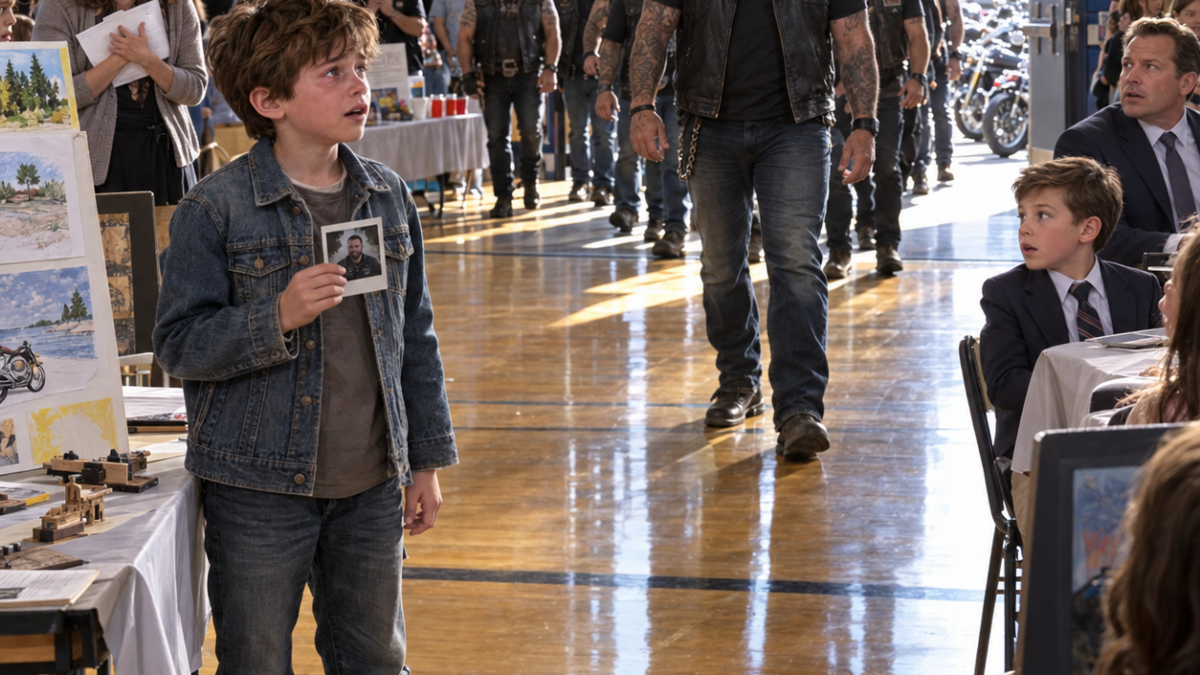
Leo stood alone near his small display board in the corner.
The Polaroid of his father was pinned at the center.
Around it, he had written three sentences in careful marker:
My dad builds motorcycles.
He helps his brothers.
He teaches me that family is who stands beside you.
Mrs. Gable had told him the board was “simple but sweet.”
Leo knew what that meant.
He kept watching the gym doors, dread twisting in his stomach.
His father had promised to come.
Part of Leo wanted him there more than anything in the world.
Another part hoped he would not come at all.
He could still hear the laughter from yesterday. He imagined Trent’s father looking at John’s vest, smirking, saying something polished and cruel. He imagined Mrs. Gable shrinking away. He imagined the whole room humiliating his father to his face.
At exactly 2:45 p.m., a sound broke the quiet suburban air.
It began low and distant.
A vibration more than a noise.
Mrs. Gable paused mid-sentence.
One mother near the refreshment table looked toward the high gym windows.
“Is there a storm coming?”
The sound grew louder.
Not thunder.
Engines.
Heavy American V-twins rolling together in a deep, synchronized roar that seemed to climb up through the pavement and into the bones of the school itself. Paper cups rattled on the refreshment table. Children moved toward the windows. Parents stopped speaking.
Outside, a convoy turned onto Oak Haven Drive.
At the front rode John “Iron” Donovan on his jet-black Dyna, chrome catching the afternoon sun.
Behind him, in tight two-by-two formation, rode twenty fully patched members of the Hells Angels Motorcycle Club.
Dutch Vanderwall, huge and scarred, rode a modified Road King.
Snake O’Connor, lean and heavily tattooed, rode a chopper with ape-hanger bars.
Liam Mercer rode with his gray beard tucked into his jacket, eyes hidden behind dark glasses.
Crowbar. Saint. Reyes. Mule. Bishop. Men with names the suburbs would not understand and histories too deep for a classroom joke.
The convoy did not speed.
They did not swerve.
They did not rev like fools.
They did not need to.
Their discipline was more intimidating than chaos could have been.
Twenty heavyweight motorcycles moved as one body, slow and controlled, stopping traffic for three blocks without anyone quite deciding to challenge them.
Inside the gym, parents drifted toward the glass doors.
Richard Higgins pushed his way to the front, annoyance already blooming purple in his face.
“What in the world is going on out there?”
Trent peeked around his father’s side.
His smirk vanished.
John signaled with his left hand.
The bikers turned into the parking lot and backed their machines into one long, perfect row in front of the school entrance, completely dwarfing the luxury sedans around them.
Engines cut out one by one.
The sudden silence rang.
Hot exhaust pipes ticked in the cool air.
John swung off his bike, kicked down the stand, and adjusted his leather cut. The sergeant-at-arms patch sat clear on his chest.
He looked back at his brothers.
Dutch gave a slow nod.
“All right, boys,” John said. “Let’s go to school.”
The heavy double doors to the gymnasium swung open.
The open house died mid-breath.
John Donovan stepped inside.
Dutch and Snake flanked him. Eighteen more Hells Angels filed in behind them, boots thudding against the polished gym floor, leather creaking, silver chains catching fluorescent light.
They brought the outside world in with them.
The smell of exhaust.
Worn leather.
Cold air.
Road dust.
And a presence this manicured suburb had no category for.
Parents in designer clothes backed away toward bleachers and folding tables. Children stared wide-eyed. Mrs. Gable went pale beside a papier-mâché volcano.
Richard Higgins stepped forward.
A man used to ruling boardrooms through volume and money did not surrender the room easily.
“Excuse me,” Richard barked, pointing at John. “You are completely out of line. This is a private school event. You and your gang need to leave before I call the police.”
John stopped.
He looked down at Richard’s pointed finger.
Then at Richard.
Behind him, Dutch folded arms the size of fence posts. Snake smiled without warmth.
“It’s a club,” John said, voice low and gravelly enough to carry to every corner of the gym. “Not a gang.”
Richard’s mouth tightened.
“And this,” John added, “is a parent-teacher open house. I’m a parent. I’m here to see my son’s project.”
“You’re frightening the children.”
Snake glanced around.
“Only one shaking is you, suit.”
“Gentlemen, please,” Mrs. Gable stammered. “Mr. Donovan, we just didn’t expect such a large group.”
“My son told me there was a misunderstanding yesterday,” John said, turning toward her. “A little confusion about what I do. What my brothers do. Since you were so interested in careers, I brought visual aids.”
Mrs. Gable swallowed.
John looked across the gym.
In the far corner, standing beside a flimsy trifold board, was Leo.
His eyes were huge.
Shock.
Fear.
And something else rising beneath both.
Pride.
John’s expression softened.
“Hey, kid.”
Leo stood frozen.
John crossed the gym floor, his heavy engineer boots echoing like drumbeats. The twenty bikers followed, parting the crowd without touching anyone.
When they reached Leo’s corner, they did not crowd him.
They fanned out behind him in a protective semicircle, a wall of leather, denim, muscle, scars, gray beards, tattoos, and quiet loyalty.
Leo looked up at his father.
John winked.
Then he turned to face the room.
“I heard some people thought my son’s project was a joke.”
No one spoke.
John’s eyes found Trent, who was now hiding halfway behind his father’s leg.
“I heard somebody said bikers are unemployed hobos who can’t afford cars.”
The silence deepened until the buzzing fluorescent lights sounded loud.
John stepped beside Leo’s display board and gently tapped the Polaroid with one grease-stained thumb.
“Yesterday, my son stood in front of this class and told you his father was a biker. He told you I belong to a motorcycle club. He held up this picture.”
His eyes swept over the crowd.
“And you laughed.”
Leo stared at the floor.
John’s voice hardened.
“You looked at his worn sneakers. You looked at his old jacket. You heard the word biker, and you decided you knew everything worth knowing. You judged him. You judged me. You turned my son’s pride into a punchline because it didn’t come wrapped in a suit and a slideshow.”
Richard cleared his throat.
“Now see here, Mr. Donovan. We are respectable people. My son merely pointed out that in the real world, success is measured by professional achievement, not by riding motorcycles and wearing—”
“Stop.”
The word cracked through the gym.
Richard stopped.
John did not raise his voice again.
He did not need to.
“Let’s talk about the real world, Mr. Higgins.”
Richard stiffened.
“Your kid stood up yesterday and bragged about how you protect corporate money. How you keep powerful companies from losing what they’ve already got. He said that made you a winner.”
Richard’s jaw worked.
John took two slow steps closer.
“Maybe it does in your world. I don’t know. But let me ask you something.”
The gym held its breath.
“If the market crashes tomorrow, how many of those clients stand beside your son when he cries? If a younger lawyer wants your office, how many of those corporations come fix your roof? If you break your back and can’t work, how many boardrooms show up with groceries, tools, and enough men to carry you through the front door?”
Richard opened his mouth.
No words came.
John turned his back on him.
Not angrily.
Worse.
Completely.
“You called us losers,” John said. “You called us criminals. So let’s do proper introductions for Career Week.”
He gestured to the massive man on his left.
“This is Dutch Vanderwall. The man your children would probably cross the hall to avoid.”
Dutch stood still, scarred face unreadable.
“Dutch served two tours as a Marine combat medic. He pulled wounded kids out of burning vehicles while people back home were arguing over lunch reservations. When he came home, he didn’t get a corner office. He got pain, bills, and a wheelchair ramp the VA took too long to approve.”
John’s voice sharpened.
“You know who built the ramp so he could get into his own kitchen? We did. His club. Because we don’t leave our brothers outside their own homes.”
Several parents looked away.
John pointed toward Liam.
“This is Liam Mercer. He owns one of the largest custom steel fabrication shops in the county. Employs over eighty local men and women. Welders. Machinists. Drivers. People who work with their hands because the world still needs things built by people who know how metal behaves under pressure.”
Liam nodded once.
John turned to Snake.
“And Snake O’Connor? He grew up in the foster system. Group home to group home. The kind of kid respectable people talk about helping as long as he stays far enough away from their dinner tables. Now he runs a nonprofit mechanic shop downtown. He teaches at-risk kids how to work on engines so they don’t end up dead, addicted, or locked in a cell before anyone bothers to learn their names.”
Snake looked at Trent.
Trent looked at the floor.
John pointed to another man near the back.
“That’s Reyes. Electrician. Keeps half this town’s businesses running when storms knock power out. That’s Bishop. Buried a daughter and still rides every Christmas with toys for children he’ll never meet. That’s Crowbar. Tows cars for single mothers for free when they break down after dark, because once, years ago, no one came for his sister.”
The room had changed.
Not softened.
Not exactly.
It had been forced to look.
That was different.
The mothers who had clutched pearls now stared at the bikers with something closer to shock than fear. The fathers who had smirked at first stood stiff and silent. Children leaned forward, trying to understand how yesterday’s joke had become something too large to laugh at.
John stepped back beside Leo.
“You people teach your kids that worth comes from money, titles, cars, zip codes, and who gets to stand at the front of the room without being mocked.”
His hand settled on Leo’s shoulder.
“I teach my son something else.”
Leo looked up.
“A hero isn’t always the man with the cleanest office,” John said. “Sometimes he’s the man who shows up when there’s nothing to gain. Sometimes he’s the man who stands beside you after the rest of the world decides you’re inconvenient. Sometimes he’s the man with grease on his hands, scars on his face, and brothers behind him who would ride through fire if one of their own called.”
He tapped the patch on his chest.
“This patch does not make me better than you.”
His eyes moved across the parents.
“But your money does not make you better than my son.”
No one moved.
Then John lowered himself onto one knee in front of Leo.
The hard coldness vanished from his eyes.
Only love remained.
Fierce.
Unashamed.
Overwhelming.
“You listen to me, kid,” John said softly.
In the silence, every word carried.
“You never hang your head for them. Not for anyone. You are Leo Donovan. You are my son. And you have an army of uncles behind you who know exactly what you’re worth.”
Leo’s face crumpled.
John gripped his shoulders.
“Don’t you ever let anyone in a cheap suit or an expensive one tell you that you aren’t the richest kid in this room.”
Tears spilled down Leo’s cheeks.
But they were not the same tears as yesterday.
Yesterday’s had burned.
These washed something clean.
Leo threw his arms around his father’s thick neck and buried his face in the leather cut.
“I love you, Dad.”
John closed his eyes for half a second and held him tight.
“I love you too, son.”
For the first time all afternoon, someone in the crowd made a sound.
Not laughter.
A sniffle.
Mrs. Gable stood near a table of student projects, pale and shaken, her hands clasped too tightly.
John stood.
He turned to her.
“Grade his project fairly, Mrs. Gable.”
She swallowed.
“Of course, Mr. Donovan.”
John held her gaze.
“I’d hate to think there was any lingering bias in this classroom.”
Her face flushed.
“No. No, absolutely not.”
John nodded once.
Then he looked at Dutch.
“Let’s roll.”
As methodically as they had entered, the twenty Hells Angels turned and walked back through the parted crowd. Their boots echoed across the gym floor. No one spoke. No one laughed. No one asked them to leave now.
Outside, engines fired one after another, a deep mechanical thunder rolling across Oak Haven’s perfect parking lot.
The convoy pulled away in formation.
Slow.
Controlled.
Unforgettable.
When the final bell rang, Leo did not slip out the back door.
He walked straight through the front entrance.
His head was up.
His scuffed sneakers squeaked proudly against the polished linoleum.
Trent Higgins stood near the buses.
When Leo passed, Trent looked down.
For once, he had nothing to say.
The next Monday, Oak Haven Elementary felt different.
Not completely.
Schools do not transform overnight, and wealthy parents do not abandon arrogance because one hard lesson embarrasses them in public. But something had shifted enough for everyone to feel it.
Leo’s display board had been moved from the corner to the front wall with the other featured projects.
Mrs. Gable had written an A in careful red ink at the top.
Under comments, she wrote:
Strong presentation about family, loyalty, skilled mechanical work, and community support.
Leo read it twice.
He did not know whether she meant every word.
But she had written them where everyone could see.
At recess, two boys asked him what kind of motorcycle his dad rode. One asked if John really built engines. Chloe wanted to know whether Snake’s nonprofit shop let kids visit. Leo answered carefully, surprised by how strange it felt to be asked honest questions instead of defending himself against insults.
Trent stayed away.
For three days.
On Thursday, he approached Leo near the water fountain.
Leo stiffened.
Trent looked smaller without an audience.
“My dad said your dad threatened him,” Trent said.
Leo looked at him.
“Did he?”
Trent’s mouth tightened.
“No.”
Leo waited.
Trent kicked lightly at the floor.
“My dad was mad because everybody saw him back up.”
Leo said nothing.
Then Trent muttered, “I shouldn’t have said that stuff.”
It was not a perfect apology.
It was not even a brave one.
But it cost Trent something.
Leo knew that.
“My dad says ignorance talks loud,” Leo said.
Trent looked confused.
Leo walked away before explaining.
That weekend, John found Leo in the garage sitting on his usual stool, Polaroid in hand.
The Dyna stood between them, partly disassembled, chrome dulled by fingerprints and honest work.
“You okay, kid?”
Leo looked up.
“Yeah.”
“You sure?”
Leo nodded.
Then, after a moment, “Did you mean it?”
“Which part?”
“That I’m the richest kid in the room.”
John set down the wrench.
He wiped his hands slowly.
“I did.”
“But we’re not rich.”
“No.”
“We don’t have a big house.”
“No.”
“And your truck makes that sound.”
“Truck has character.”
“It has smoke.”
“Character and smoke.”
Leo smiled faintly.
John crouched in front of him.
“Money matters,” John said. “Don’t let anybody tell you it doesn’t. Bills are real. Food costs. Rent costs. Tools cost. Anybody who says money doesn’t matter usually has enough of it not to be scared.”
Leo listened.
“But money is not the only kind of wealth,” John continued. “It sure isn’t the best kind.”
“What is?”
John looked around the garage.
At the tools borrowed and returned.
At the extra helmets on the shelf.
At the old couch where men had slept when they had nowhere safe to go.
At the wall of photos: rides, funerals, toy drives, hospital visits, road trips, cookouts, scars, birthdays, memorial patches, and Leo grinning from the seat of a bike too big for him.
“The people who show up,” John said. “That’s wealth.”
Leo looked at the Polaroid again.
“Dad?”
“Yeah?”
“I wasn’t ashamed of you.”
John’s expression softened.
“I know.”
“I was ashamed that they laughed.”
John’s voice went quiet.
“That’s a heavy difference for a kid to carry.”
“I hated it.”
“I would too.”
Leo leaned forward and hugged him.
John held him, grease-stained hand gentle against the back of his son’s denim jacket.
Outside, a motorcycle turned into the driveway.
Then another.
Then three more.
Dutch came in first carrying a paper bag.
“Brought lunch,” he announced.
Snake followed with a box of donated tools for the nonprofit shop, stopping to ruffle Leo’s hair.
“There he is. Professor Donovan.”
Leo rolled his eyes.
“I’m not a professor.”
“You educated a whole private school, didn’t you?”
John gave Snake a warning look.
Snake grinned.
“What? Compliment.”
By afternoon, the garage was full.
Men worked on bikes.
Someone argued about spark plugs.
Someone else burned hot dogs on the grill and called it barbecue.
Leo sat on the workbench eating chips while Dutch showed him how to identify a stripped bolt. John watched from beside the Dyna, arms crossed, heart quieter than it had been in days.
This was what the classroom had not understood.
The club was not clean.
Not simple.
Not easy to explain to people who preferred their heroes polished and framed.
But it was real.
It was men with pasts and flaws and rough edges choosing, again and again, not to leave one another behind.
It was Leo growing up with more uncles than he could count.
It was a father who looked dangerous to strangers and made pancakes badly on Sunday mornings.
It was loyalty wearing leather because nobody had ever handed it a blazer.
Weeks later, Oak Haven announced a new community career series.
Mrs. Gable sent home a note asking parents and guardians from “a broader range of professions and life experiences” to volunteer.
John laughed when he read it.
“Life experiences,” he said. “That’s one way to put it.”
Leo looked hopeful.
“Would you go back?”
John studied him.
“You want me to?”
Leo thought about it.
This time, there was no shame in the thinking.
“Yes,” he said. “But maybe just you. And maybe Dutch. And maybe no twenty motorcycles unless they deserve it.”
John smiled.
“Fair.”
So John went back.
Not with a convoy.
Not with thunder.
Just one motorcycle parked properly in the visitor lot and a toolbox in one hand.
He wore his cut because he was not going to become smaller for anyone’s comfort, but he left the hard edge at the door. He spoke to three classes about engines, safety, discipline, road awareness, mechanical work, and the difference between confidence and recklessness.
He let students hold a spark plug.
He explained how an engine breathes.
He told them that a machine tells the truth if you learn how to listen.
Even Trent raised his hand once.
John called on him.
“What happens if you ignore a small sound?” Trent asked.
John looked at Leo before answering.
“It becomes an expensive lesson.”
The class laughed.
Not cruelly this time.
Leo laughed too.
That evening, Leo pinned a new photo above his desk.
Not the old Polaroid.
A new one.
John standing beside him in the Oak Haven parking lot after the career talk, one huge hand resting on Leo’s shoulder, one motorcycle behind them, the school building in the background.
Leo studied it before bed.
Then he wrote a sentence on a sticky note and placed it beneath the frame.
My dad is a biker.
No explanation.
No apology.
No shame.
Years later, Leo would remember the laughter.
Of course he would.
Children do not forget the first time pride is punished.
But he would remember something else more clearly.
The sound at 2:45 p.m.
The low thunder rolling toward Oak Haven.
The paper cups rattling.
The gym going silent.
His father walking through the doors not to scare children, not to start a fight, not to prove he was better than anyone in that room, but to stand where his son had stood alone the day before.
That was the lesson Leo kept.
Not that power should answer insult.
Not that fear was respect.
But that love sometimes arrives loud because shame has already been too loud.
That loyalty is not a word for speeches.
It is a thing with boots on, engines cooling outside, and twenty men standing behind one trembling boy until he remembers how to lift his head.
And from that day forward, whenever someone asked Leo what his father did, he no longer lowered his voice.
He looked them straight in the eye.
“My dad builds motorcycles,” he said. “He rides with his brothers. And he taught me that family means showing up.”
Most people understood.
Some did not.
Leo stopped needing all of them to.








