My Company Forgot Me After Retirement—Then the Cat Nobody Wanted Taught Me Who Was Really Waiting
PART3:
By Wednesday, I realized I had gone two full days without speaking out loud except to say “excuse me” to a cashier at the grocery store.
By Thursday, I started leaving the television on from breakfast to bedtime.
By Friday, I sat in the driveway for forty-seven minutes after returning from the hardware store because I could not think of one reason to go inside.
That was the moment I began to scare myself.
Not dramatically.
I was not planning anything terrible. I was not drunk. I was not breaking dishes. I was not crying on the bathroom floor.
I was just fading.
Quietly.
Politely.
In a paid-off house with trimmed hedges and a garbage bin brought in by noon.
That is how a lot of men disappear in this country. Not into rivers or scandals or dramatic breakdowns. Into recliners. Into televisions. Into garages. Into silence. Into the strange shame of not knowing who you are when nobody is waiting for you to solve something.
Three weeks after retirement, on a rainy Tuesday, I drove to Green Hollow Animal Shelter.
I told myself I was killing time.
That was true.
It was also not true.
I think I needed to be somewhere life was still making noise.
The dog side was too loud for me that day. Too much barking. Too much wanting. Dogs have no dignity about hope. They throw it at you full force, paws on glass, tails beating, eyes wide open. I could not handle that much need coming at me all at once.
So I wandered to the cat room.
Cats were easier.
Or so I thought.
Most of them came right up to the glass. They rolled onto their backs, stretched little pink paws through bars, blinked slow, meowed, sold themselves with the shameless charm of creatures who understood the adoption economy better than most salesmen.
Then I saw her.
Gray and white. Small face. Yellow-green eyes. Thin body tucked on a window ledge in the back of the senior room. She was not looking at me. She was looking through the window at the parking lot.
Not casually.
Not curiously.
Waiting.
That was the word that came to me before anyone said anything.
She looked like she had been waiting so long that waiting had become part of her bones.
A volunteer stepped beside me.
She was maybe mid-thirties, ponytail messy, jeans faded at the knees, sweatshirt sleeves pushed up. She smelled faintly like laundry soap and litter dust, which is a more honest smell than most colognes.
“Her name is Willow,” she said softly.
The way she spoke told me this was not a sales pitch.
“Pretty cat,” I said, because men will say the smallest available thing when the larger truth is too close.
“She’s been here almost three years.”
I turned.
“Three years?”
The volunteer nodded. “Her owner moved out of state and left her behind with a neighbor who couldn’t keep her. She was seven then. She’s ten now.”
I looked back at the cat.
Willow did not turn.
“People don’t want older cats?” I asked.
“Some do.” She smiled, but it was tired. “Not enough.”
I understood that kind of answer.
“She just sits there?”
“Every day. Watches the lot. People come in, people go out. They choose the playful ones. The younger ones. The ones who make a better first impression.”
The volunteer paused.
“Willow stopped auditioning a long time ago.”
That sentence went through me.
Stopped auditioning.
There are phrases that do not merely describe someone else.
They expose you.
I saw myself in my bathroom mirror that morning, work shirt on, no work to go to. I saw my phone sitting silent on the kitchen counter. I saw the refrigerator door opening and closing because I kept looking for a reason inside it.
“How long can she stay?” I asked.
The volunteer looked at me carefully.
“This is a no-kill shelter, if that’s what you mean. But staying alive isn’t the same as being home.”
I had to look away.
Outside, rain blurred the parked cars.
Willow kept watching them.
“What happened to the owner?” I asked.
“From what we know? New apartment. New boyfriend. New life. Willow didn’t fit.”
New life.
Didn’t fit.
I thought about how quickly a company can celebrate you and replace you in the same week. I thought about how many things in America are loved only as long as they remain useful, young, impressive, easy, or convenient.
Then Willow turned.
Slowly.
Her yellow-green eyes met mine.
She did not look hopeful.
That was the worst part.
Hope would have been easier to resist.
She looked tired.
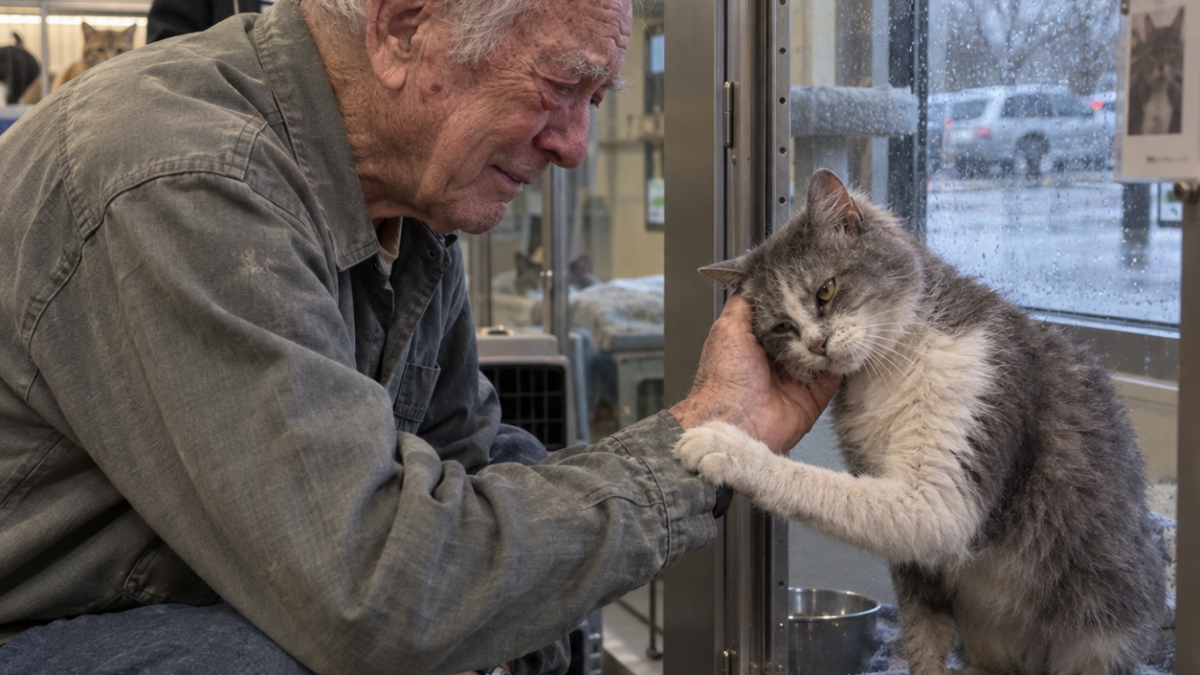
I crouched in front of the glass.
“Hey there,” I said.
My voice sounded rough.
The volunteer opened the enclosure and stepped back.
I held out my hand, expecting nothing.
Willow walked toward me slowly, each step deliberate, like she had learned not to rush toward anyone who might change their mind.
Then she put one paw on my sleeve.
Pressed her forehead into my palm.
And stayed there.
No music swelled.
No beam of sunlight broke through the clouds.
No one clapped.
It was just a quiet old cat leaning into a retired man’s hand like she was asking a question neither of us knew how to answer.
I laughed once.
My eyes filled too fast.
“Well,” I said, clearing my throat, “I guess we’re both bad at starting over.”
An hour later, Willow was in a carrier on the passenger seat of my truck.
I stopped at a red light and looked over at her.
She was silent.
I appreciated that about her.
Dogs would have barked or whined or forgiven me too quickly. Willow sat still, facing the carrier door, carrying her uncertainty with the dignity of a widow at a funeral luncheon.
The first night, she hid under the armchair for three hours.
I set food nearby.
Water.
A small bed I had bought at the shelter because the volunteer, Lena, said, “She likes soft edges.”
Willow ignored all of it.
I sat in the recliner and pretended to watch a baseball game.
Around sunset, she came out.
Slowly.
She sniffed the room. Paused near Marian’s old bookshelf. Walked past my shoes. Then jumped onto the front windowsill and sat there staring at the street.
Waiting again.
I stood in the kitchen holding a can of cat food, and something inside me broke open.
Because there she was in my house, still looking for the person who left.
And there I was in my own life, still looking for the man I had been before the office door closed behind me.
The next morning, I woke before dawn.
Out of habit.
For the first time since retirement, getting out of bed did not feel pointless.
A small living creature needed breakfast.
Willow did not greet me warmly. She sat near the kitchen doorway and stared at me as if evaluating whether I understood basic service standards.
I opened the can.
She ate three bites, then walked away.
“Good talk,” I said.
By the third day, she ate half.
By the end of the week, she slept on the arm of my recliner.
By the second week, she followed me from room to room, not in a needy way, more like a supervisor checking whether I remained a real person if she broke eye contact too long.
If I folded laundry, she watched from the bed.
If I worked in the garage, she sat by the door.
If I read the paper, she lay across the section I had not finished.
Slowly, the house changed.
Not in a movie way.
In inches.
The television stayed off more.
The blinds opened earlier.
The coffee got poured into a mug instead of forgotten on the counter.
I swept more often because gray-and-white fur began appearing in places no animal had physically visited.
I bought better cat food, then pretended the price did not offend every practical bone in my body.
I spoke out loud again.
Mostly nonsense.
“Excuse me, ma’am, that is my chair.”
“Do not look at me like that. The vet said half a can.”
“You know, Marian would have liked you. She liked creatures with standards.”
At that, Willow blinked slowly.
I chose to interpret it as approval.
A month after I adopted her, Lena called from the shelter.
“Just checking in,” she said. “How’s our girl?”
Our girl.
That phrase warmed something I had not realized was cold.
“She’s doing good,” I said. “Still sits in the window some.”
“Same way?”
I looked toward the front room.
Willow was on the sill, but her body was looser now, her tail draped over the edge. She was watching a squirrel violate several rules of decency near the maple tree.
“No,” I said. “Not the same way.”
Lena was quiet a moment.
“That matters.”
I knew it did.
I started going back to the shelter on Tuesdays.
At first, I dropped off supplies. Extra food Willow rejected because she had opinions. Towels from Marian’s linen closet I had not been able to give away until then. A carrier somebody at church had offered after hearing I had a cat.
Then I stayed.
Lena handed me a brush and pointed toward an old orange tom named Gus who drooled when happy and looked like he had seen combat in at least three alleys.
“Just sit with him,” she said.
“That’s it?”
“That’s it.”
I sat.
Gus ignored me for ten minutes, then climbed halfway into my lap like a sack of warm gravel.
I brushed him.
He drooled on my jeans.
I went home feeling oddly useful and not hollow.
That became my Tuesday.
The senior cat room. Clean water bowls. Folded blankets. Slow brushing. Quiet voices. The old cats nobody rushed toward. The shy ones. The cloudy-eyed ones. The ones with medical notes clipped to cages like warnings. The ones who did not sell themselves anymore.
I understood them.
Maybe too well.
You would be surprised how many creatures in this world do not need to be entertained, fixed, inspired, or improved.
They need someone willing to stay.
I got good at staying.
Six months passed that way.
My life became smaller.
Better too.
People do not always understand those two can happen at once.
Mornings had shape again. Not the big kind of shape that comes from deadlines and meetings and people needing answers by noon. A quieter shape. Willow’s breakfast. My coffee. The front blinds. A walk around the block if my knee allowed. Tuesday shelter hours. Yard work. Soup on the stove. A library book on the table. Willow asleep beside my leg with one paw hanging over the edge of the recliner like she owned not only the chair but the idea of rest itself.
Then my old office called.
It was a Thursday morning in June.
The phone rang at 6:47 while I sat at the kitchen table with toast on one plate, coffee in my chipped mug, and Willow in the window washing one paw like she paid the mortgage.
I looked at the screen.
Rick Dawson.
My heart did something embarrassing.
It leaped.
Not with fear.
With recognition.
Old wiring coming alive.
I answered before the third ring.
“Hello?”
Rick sounded breathless.
“Tom, thank God. You got a minute?”
There it was.
The phrase.
You got a minute?
For decades, that sentence had been the first tug on a rope I always grabbed.
“What’s going on?”
He explained fast.
A major account had gone sideways. Inventory numbers were off across two warehouses. Orders weren’t matching system counts. A shipment was stalled. Nobody could find where the breakdown started because the process had been patched so many times over the years it looked, in Rick’s words, “like somebody’s uncle built it during a tornado.”
I almost smiled.
Somebody’s uncle had built part of it.
Me.
Rick kept talking. “They changed a step after you left. Then Brenda retired early. Kyle’s out with pneumonia. Ethan is losing his mind. Honestly, Tom, you’re the only one who knows how the whole thing breathes.”
The only one.
That is dangerous music for a man who has been living in silence.
I looked across the room.
Willow had stopped washing. She watched me from the window with her green-yellow eyes half narrowed.
“I can come in for a few hours,” I said.
Rick exhaled so loudly it crackled through the phone.
“You’d be saving my life.”
No, I thought.
I would not.
But I wanted to believe it.
That was the problem.
After I hung up, I sat there with cooling toast and a pulse that felt twenty years younger.
Willow jumped down from the window and walked to her bowl.
“You ever make a mistake before breakfast?” I asked her.
She ignored me.
I ironed a blue button-down.
Not my old work shirt.
I told myself that mattered.
Then, before leaving, I opened the dresser drawer and took out my watch.
I had not worn it in months.
When the clasp clicked around my wrist, something in my chest tightened.
The office smelled exactly the same.
Cold air. Printer dust. Burned coffee. Floor cleaner losing a long war against stress. I stood in the lobby longer than I needed to while a receptionist I did not know smiled politely at me, trying to decide whether I was important.
Rick came around the corner and clapped me on the shoulder.
“Man,” he said. “You have no idea.”
He was right.
I had no idea how fast old habits could put their hands around my throat.
The first hour felt good.
I will not lie.
It felt good in the stupid, human, embarrassing way praise feels good when it touches a wound.
People came to the conference room where they had set me up with a temporary login. They leaned over my shoulder. They asked questions and waited for the answer. They wrote down what I said. They frowned when I frowned. They nodded when I pointed to the screen.
I found the first problem in twenty minutes.
Someone had removed a manual verification step between incoming vendor updates and warehouse reconciliation.
“Why was that step there?” Ethan asked.
He stood behind me with his arms folded, trying to look calm and failing. He was forty-two, maybe, with expensive shoes and the particular confidence of men who call people “resources” without hearing themselves.
“Because vendor files don’t always arrive clean,” I said. “The system flags quantity mismatches only after the reconciliation batch runs. That step caught bad data before it became bad inventory.”
Ethan frowned. “That seems inefficient.”
“It was inefficient on purpose.”
He blinked.
I turned back to the screen. “A lot of stability looks inefficient to people who never had to clean up after speed.”
Rick coughed into his fist.
By lunch, I had traced the issue.
By two, we had a workaround.
By four, I had a legal pad full of notes and three younger analysts standing behind my chair like I was translating an extinct language.
I felt ten feet tall.
That is the part nobody warns you about.
They tell you retirement can be boring. They tell you to find hobbies. They tell you not to sit around in sweatpants watching old Westerns until your brain softens. Nobody warns you how intoxicating it is when the machine that exhausted you turns around and says it still misses your hands.
I got home after five-thirty.
Not late, exactly.
But later than Willow expected.
She was in the front window.
Still.
Upright.
Focused on the driveway.
The second my truck pulled in, she stood.
That should have made me happy.
Instead, a small stone dropped into my stomach.
Inside, she met me at the door. She rubbed once against my shin, then stepped back and looked up as if confirming I had returned in the same shape.
“Sorry, girl,” I said.
I fed her.
Changed clothes.
Made dinner.
But all evening, my mind stayed at the office.
The broken step.
The fix.
Rick’s relief.
Ethan’s reluctant respect.
The younger analysts saying, “How did you know that?”
How did I know?
Because I had mattered there.
Or so I told myself.
The next morning, Rick called again.
There was another issue.
Related.
Could I come in one more day?
Just one.
I said yes.
One day became three.
Three became a week.
A week became almost a month.
The company found reasons.
I found excuses.
It was only temporary. It was only mornings. Then it was only until lunch. Then a vendor call ran long, a report failed, an audit question came up, or Ethan needed “historical context,” which is what young managers call old work when they need it but do not want to respect the person who built it.
Every afternoon, I drove home feeling charged and hollow.
That should have told me something.
Real nourishment does not leave you hollow.
Real belonging does not make you feel like you have to earn tomorrow before you have finished today.
But old addictions wear respectable clothes.
This one wore productivity.
I missed Tuesday shelter hours twice.
The first time, I texted Lena.
Busy week. Back soon.
She replied:
No pressure. Glad you’re okay.
No pressure should have felt kind.
It felt like a mirror.
At the office, pressure came dressed as importance. People needed me. People called. People waited. People said, “We hate to bother you,” while handing me another problem. People treated my time as valuable because they wanted pieces of it.
At the shelter, Lena missed my face.
Not my output.
My face.
That was harder to know what to do with.
By the third week, I put on my old work shirt.
The actual one.
Blue cotton. TOM above the pocket.
I told myself it was practical. Office air ran cold. The shirt still fit. No reason to leave it hanging in a drawer like a museum piece.
Willow watched me from the couch while I buttoned it.
“Don’t look at me like that,” I said.
She did not blink.
“Cats don’t care what shirt a person wears.”
Maybe cats don’t.
But they care when a house changes temperature in ways that have nothing to do with weather.
That evening, I came home at 6:42 and found Willow in the window again.
Not lounging.
Not bird-watching.
Waiting.
I knew that posture.
I had seen it the day I met her at the shelter.
Body still. Head up. Hope disciplined into silence.
Uncertainty trying to look dignified.
I stood in the driveway with one hand on the truck door and felt ashamed before I could explain why.
Inside, she greeted me.
She always did.
But after dinner, while I listened to a voicemail from Rick and reheated soup I did not want, I looked toward the front room.
Willow was back on the sill.
I had already come home.
She was still checking.
That did something to me no lecture could have.
The following Friday, Ethan asked me into his office.
His office had been mine once.
Not officially. I had never had the title for it. But for years, I used that little corner room because I needed space for binders, vendor records, and the kind of quiet required when everyone else was panicking. After I retired, Ethan took it, replaced the old metal filing cabinets with a sleek whiteboard wall, and put a fake plant in the corner where Marian’s picnic photo used to sit.
He gestured for me to sit.
“Tom, first I want to say how grateful we are.”
I hated the sentence immediately.
Corporate gratitude has a smell.
It smells like unpaid overtime.
“You’ve been incredibly helpful,” he continued. “The team respects you. Leadership sees the value you bring.”
Leadership.
That word meant somebody far from the mess had found a way to discuss me without saying my name.
Ethan folded his hands on the desk.
“We’d like to propose an ongoing advisory arrangement.”
I leaned back.
“What kind?”
“Flexible. Part-time. Nothing too heavy. Maybe three days a week at first while we stabilize.”
“At first?”
He smiled. “We’ll see how it evolves.”
I looked at the fake plant.
Plastic leaves. No dust yet.
“Paid?”
He blinked as if I had introduced a vulgar topic too early.
“There would be a stipend.”
“A stipend.”
“To start. We’d frame it as transitional consulting.”
“What’s the rate?”
He named a number so low I thought I had misheard him.
I laughed once.
He stiffened.
“That’s less than half my old hourly rate.”
“Well, the idea is that you’re retired. This would keep you engaged.”
Keep me engaged.
Like I was a bored child in the back seat who needed puzzle books.
Like my life at home was an empty waiting room they were generously rescuing me from.
I looked at Ethan, and for the first time, the spell cracked.
He did not see me as essential.
He saw me as available.
That is not the same thing.
“I’ll think about it,” I said.
His smile returned. “Great. We were hoping to announce something at next week’s operations meeting. It would be a nice morale moment.”
“A morale moment.”
“People love seeing legacy knowledge honored.”
Legacy knowledge.
Forty years of early mornings, late nights, missed dinners, canceled vacations, and my wife eating alone because “the system went down again,” and now I was legacy knowledge. Something to display when useful, discount when paying, and frame as a kindness when asking for more.
I drove home with his proposal folded on the passenger seat.
Willow was not in the window.
For one panicked second, I felt the bottom drop out of me.
I unlocked the front door and called her name.
Nothing.
I checked the living room.
Kitchen.
Bedroom.
Basement stairs, though she hated the basement.
Finally, I found her in the guest room closet behind a stack of towels.
Eyes open.
Body tight.
Not trapped.
Hiding.
It had been months since she hid.
I sat down on the floor outside the closet.
The proposal paper was still in my hand.
I looked at the cat in the dark and thought, Look what you did.
Not to her.
To myself.
I had adopted a creature who had spent three years waiting for someone who never returned, and in less than a month I had taught her the old lesson again.
People leave when something else calls louder.
“I’m sorry,” I whispered.
She did not move.
“I know words don’t fix it.”
That was something Marian used to say during our marriage when I apologized for being late again. She never said it cruelly. That made it worse.
Words don’t fix it, Tom. Choices do.
I sat outside that closet for nearly an hour.
I did not reach in.
Did not plead.
Did not crowd the hurt because I wanted relief from my own guilt.
Eventually, Willow came forward.
Just enough to place one paw on my knee.
That little paw broke me harder than anything dramatic could have.
Because it was not full trust.
It was a test.
The kind you get from something that still wants to believe in you but is no longer certain you deserve it.
The next day, I went to the shelter.
Lena looked up from the front desk and smiled.
“Glad to see your face.”
That sentence nearly took me out.
Not, “Glad you can clean cages.”
Not, “Glad you’re here because Gus threw up on three blankets.”
Not, “Glad you finally remembered us.”
Glad to see your face.
I stood there with my keys in my hand and had to clear my throat like a fool.
“Got any jobs for an unreliable old man?”
She studied me.
Then handed me a bag of towels.
“Start by being reliable for the next ten minutes.”
Fair enough.
I cleaned.
Refilled bowls.
Brushed Gus.
Sat with a black cat named Minerva who had kidney disease and the expression of a retired judge.
Around noon, Lena sat beside me on the bench.
“You okay?” she asked.
I said yes.
Too fast.
She waited.
That is something kind people do.
They wait after the easy answer.
So I told her.
Not all of it.
Enough.
The office calling. The way it felt good. The proposal. The low pay. The phrase keep you engaged. Willow hiding in the closet.
Lena listened without interrupting.
Then she said, “A lot of people mistake being wanted for being valued.”
I looked at her.
She shrugged.
“We see it here all the time. Someone wants a pet because it fills a hole. Then the pet gets old, sick, inconvenient, or less entertaining, and suddenly what they called love starts looking pretty conditional.”
That went straight through me.
Because she was talking about animals.
And she was not only talking about animals.
That night, I called Rick.
He answered with, “Tom, thank God. Ethan’s been looking for you.”
“I need to ask you something.”
His tone changed. “Okay.”
“Did they plan to call me back before I retired?”
Silence.
That was answer enough.
“Rick.”
He sighed. “I don’t know everything.”
“Tell me what you know.”
He was quiet so long I heard his office phone ring in the background and stop.
“Ethan thought you were a bottleneck,” he said finally. “He told leadership the department needed to move away from single-person dependency.”
“He wasn’t wrong.”
“No. But he pushed the timeline. Said keeping you longer delayed modernization. Said the team had enough documentation.”
I closed my eyes.
Documentation.
We both knew what that meant.
Almost none.
“And then?”
“Then things broke.”
“And instead of admitting they pushed me out before the transition was ready, they called me back.”
“Tom…”
“How long was the advisory plan in place?”
Rick did not answer.
“Rick.”
“There was talk,” he said. “Before the party.”
Something inside me went very still.
“Before.”
“I’m sorry.”
I looked toward Willow. She was on the recliner arm, watching me.
“They retired me publicly, called the transition complete, waited until the mess showed, and then planned to bring me back cheap as a consultant.”
Rick’s voice was low. “That’s how it looked to me.”
“Why didn’t you tell me?”
His shame came through the phone.
“Because I didn’t want to make trouble.”
There it was.
The sentence that lets half the harm in the world continue wearing clean shoes.
I did not yell.
That surprised both of us.
“I know,” I said. “I’ve said that plenty.”
Rick exhaled.
“I should’ve told you.”
“Yes.”
“I’m sorry.”
“I believe you.”
That was true.
It was not the same as excusing him.
The next Monday, I went back to the office one last time.
Not because Ethan had asked.
Because I had decided how the story would end.
I wore jeans.
A flannel shirt.
No watch.
Willow sat in the window when I left, but this time her body was loose. I had fed her, brushed her, sat with her, and told her out loud, “I’ll be home by lunch.”
Maybe that mattered.
Maybe it only mattered to me.
That was enough.
The operations meeting was held in the main conference room. Twenty people sat around the table. Ethan stood at the front beside a screen showing a slide that said TRANSITIONAL EXCELLENCE PLAN.
I nearly turned around.
Rick sat near the end, face pale.
Ethan smiled when I entered.
“Tom. Perfect timing. We were just about to discuss your advisory role.”
“No,” I said.
The room went quiet.
His smile stayed, but his eyes sharpened.
“No?”
“No advisory role.”
A few people looked down at their papers.
Ethan gave a soft laugh. “Let’s not decide that in front of everyone.”
“You were planning to announce it in front of everyone.”
His jaw tightened.
I set a folder on the table.
“I spent the weekend documenting the core processes. Inventory reconciliation, vendor update checks, exception handling, warehouse count timing, and all the old workarounds that should have been written down before I retired.”
Rick stared at the folder like it was a life raft.
“I also wrote recommendations for what needs to be rebuilt instead of patched.”
Ethan reached for it.
I kept my hand on top.
“And I included a note for leadership.”
His smile vanished.
“A note?”
“Yes.”
I looked around the room.
Some of these people had worked with me for years. Some had known me only as the retired guy called back to clean up a problem. All of them looked uncomfortable, which meant truth had entered and nobody knew where to put it.
“The note says I am happy to provide a formal consulting proposal at a fair market rate if the company needs additional support. It also says the department was not ready for the transition leadership claimed was complete, and the failure came from removing checks without understanding why they existed.”
Ethan’s face flushed.
“That is not an appropriate characterization.”
“It is an accurate one.”
“Tom.”
For almost forty years, that name in that tone would have pulled me back into line.
Not this time.
“I’m not angry that the place needs to change,” I said. “It should. I’m not angry that younger people are taking over. They should. I’m not angry that I retired. I chose that.”
I looked at Ethan.
“I’m angry that you treated my experience as an obstacle when it cost money, then as a treasure when you could get it cheap.”
The room went dead still.
Rick closed his eyes.
Ethan said, “That’s unfair.”
“Maybe. But it’s close.”
One of the younger analysts, a woman named Priya, spoke from the far side of the table.
“He’s right.”
Ethan turned. “Excuse me?”
Priya’s face went red, but she did not look away.
“We asked for documentation before Tom retired. We were told the transition plan was above our level and not to worry about it.”
Another analyst nodded. “Same.”
Rick cleared his throat.
“I raised concerns too.”
Ethan stared at him.
Rick looked scared.
Then tired.
Then, finally, honest.
“I should’ve pushed harder.”
The room shifted.
There is a particular kind of public humiliation that does not come from being insulted. It comes from having the story you controlled corrected in front of people you expected to remain quiet.
Ethan looked at me like I had betrayed him.
That almost made me laugh.
People who use you often feel betrayed when you stop cooperating.
I slid the folder across the table.
“This is my last free day,” I said. “I’ll walk the team through the documentation until noon. After that, any request goes through a contract.”
Ethan said nothing.
So I turned to the team.
“Let’s get to work.”
We did.
And because I am still me, I did the work well.
I did not sabotage. I did not grandstand. I did not withhold information to prove my value. I gave them everything useful.
That was the difference between dignity and revenge.
Revenge keeps people dependent so they suffer.
Dignity gives what is right and refuses what is wrong.
At 12:07, I packed my folder.
Rick walked me to the lobby.
For a while, neither of us spoke.
Then he said, “I’m proud of you.”
I looked at him.
He looked embarrassed by his own sentence.
“I know that sounds weird.”
“It does.”
“But I mean it.”
We stood near the glass doors where rain streaked down outside.
Rick rubbed the back of his neck.
“I don’t know how I’m going to leave this place when it’s my turn.”
That hurt because it was honest.
“You learn before it teaches you the hard way,” I said.
He nodded.
“I missed my grandson’s school play last month,” he said quietly. “He was a tree.”
“A tree?”
“Apparently a very good tree.”
I smiled.
Rick did not.
“I stayed late for a meeting that got canceled. Didn’t even tell my daughter. Just sat at my desk because I was annoyed and didn’t know what else to do.”
His eyes shone.
“I missed him being a tree, Tom.”
That sentence was so small and so devastating I had to look away.
“You can stop,” I said.
“How?”
The saddest question a man like him can ask another man like him.
I wanted to give him a system.
Men love systems.
Five steps. Ten habits. A checklist for rebuilding a life after usefulness stops being handed to you by other people’s emergencies.
But the truth I had was smaller.
Harder.
“You let something matter that nobody pays you for,” I said. “Then you keep showing up for it.”
Rick laughed once through his nose.
“So I need a cat.”
“Wouldn’t hurt.”
When I got home, Willow was at the door.
Not the window.
The door.
Like she knew the difference.
I knelt down, and she stepped onto my thigh, put both paws against my chest, and pushed her face beneath my chin.
That was all.
No fireworks.
No swelling music.
Just an old cat deciding I had come home properly this time.
I cried in the entryway.
Didn’t call it allergies.
Didn’t make a joke.
I cried because I was relieved, ashamed, grateful, and finally honest enough to understand that the creature I had rescued from waiting had spent the last month rescuing me from running back to the wrong kind of need.
I turned my phone off that evening.
Not silent.
Off.
Set it in the kitchen drawer.
Closed it.
Then I made scrambled eggs for dinner and opened Willow’s favorite food, the expensive kind she pretended not to like until I looked away.
The next Tuesday, I went back to the shelter.
Not as a man squeezing it around more important things.
As a man returning to part of his actual life.
Lena took one look at me and smiled.
“You picked your side.”
“I was that obvious?”
“Painfully.”
She handed me a brush.
“Gus missed you.”
Gus, naturally, bit the brush.
Life went on.
Not perfectly.
The office called twice.
The first time, Ethan’s assistant asked whether I could “jump on a quick call” about a warehouse exception.
I gave her my consulting rate.
She said she would circle back.
She did not.
The second time, Rick called.
Not for help.
Just to talk.
That mattered.
He adopted a lopsided beagle three months later. Sent me a photo with no caption. The dog had one ear up, one ear down, and the expression of a creature already disappointed in Rick’s furniture.
I printed the picture and stuck it on my fridge.
At the shelter, something began to happen.
Slowly.
The Tuesday senior room became a gathering place for people who did not call it that.
There was Walter, a retired mechanic whose wife had died in February and who came in twice before speaking to anyone. He eventually adopted a black cat named Milton who looked mean until you realized he was simply done auditioning.
There was June, a retired school secretary whose husband had dementia and who said she came to brush cats because “at least they know when I’m in the room.”
There was Earl, who said almost nothing for three straight weeks and then one day told Gus, “You and I have both been lied to by cheerful people,” which made Lena laugh so hard she had to sit down.
We did not form a club.
Men and women our age do not always know what to do with clubs unless there are dues and folding chairs.
We just showed up.
We cleaned bowls.
Folded towels.
Read newspapers aloud to cats who did not care about the local zoning dispute but seemed to appreciate the sound of a voice.
We complained about our knees.
We argued about coffee.
We learned which animals liked brushing and which preferred quiet company.
And slowly, people visiting the shelter began stopping longer in the senior room.
It is one thing to see an old cat in a cage and feel sad for seven seconds before moving on.
It is another to see a retired mechanic sitting with him, talking softly about weather, carburetors, and grief.
Suddenly the animal stops looking like a problem.
He starts looking like what he always was.
A life still happening.
That fall, Green Hollow held a small fundraiser.
Nothing fancy.
Folding chairs.
A donation table.
Cookies from a grocery store.
A slideshow of adoptable pets projected slightly crooked on a wall.
Lena asked me to speak.
I said no.
She asked again.
I said, “I’m not a speaker.”
She said, “Good. Speakers are usually annoying. Just tell the truth.”
So I stood in front of thirty or forty people and did.
I told them about Willow.
About the shelter window.
About my driveway.
About my old company calling.
I did not name the company. I did not need to. This was not about revenge anymore.
Then I said the sentence that made the room go still.
“I think we have a bad habit in this country of throwing away anything that stops performing on command.”
Nobody moved.
I kept going.
“I’m not just talking about cats. I’m talking about older workers. Widows. Caregivers. Retired men. Sick spouses. Parents whose children only call when they need something. Pets people adored when they were cute and gave up on when they got quiet. We say we value loyalty, but too often what we really value is convenience.”
A woman in the second row looked down.
A man near the back crossed his arms.
I went on anyway.
“I spent almost forty years believing being needed meant being valued. Then I retired, and the silence nearly swallowed me. Willow knew something about that. She had spent three years waiting for someone who only loved her until a new life made her inconvenient.”
My voice shook.
I let it.
“That cat did not need me to give her a big life. She needed me to come home. And I needed to learn that a smaller life can still be a truer one.”
When I finished, people clapped.
Not everyone.
That was fine.
Truth does not need unanimous approval.
Afterward, a younger man came up to me near the donation table. He wore a work badge clipped to his belt and looked like he had wandered in by accident.
“My dad retired last year,” he said. “I only call him when my sink backs up.”
He laughed, but his eyes were wet.
“Call him about something else,” I said.
He nodded.
Two weeks later, Lena told me donations for senior pet care had doubled.
Three older cats were adopted before Christmas.
Not because of me alone.
Life is rarely that neat.
But maybe because a few people paused at the far cages instead of walking past. Maybe because somebody looked at an animal with cloudy eyes and saw more than cost. Maybe because one retired man finally said out loud what many people had been feeling quietly.
Winter came.
Ohio winters have a way of making everything look tired before it looks beautiful. Trees give up. Lawns turn stiff. The sky flattens into one long sheet of gray. But my house stayed warm.
I kept birdseed in the garage because Willow loved watching cardinals through the window.
I baked refrigerator cookies Marian used to make, badly at first, then less badly.
I went to the shelter every Tuesday.
I met Rick for coffee once a month.
I learned to leave my phone in another room without feeling like I had abandoned a post.
And Willow stopped waiting like someone uncertain.
She still sat in the window.
Every afternoon around four-thirty, she climbed onto the sill and looked toward the driveway. But her body was different now. Soft. Trusting. The waiting had changed.
She no longer watched like someone afraid the world would leave.
She watched like someone sure the person she loved was coming back.
There is a difference.
I think that difference saved my life.
Not from death.
From a quieter tragedy.
From filling retirement with the same old noise and calling it purpose.
From going back to a company that respected my usefulness more than my humanity.
From mistaking applause for love.
From spending the rest of my years sitting by the wrong window, waiting for the wrong thing to prove I still mattered.
Willow is asleep beside me as I write this.
Her fur is whiter around the face now. Her jumps are lower. Her naps are longer. She has a little arthritis in her hips and a talent for making me feel personally responsible for winter. She snores sometimes, tiny rough sounds that would offend her deeply if she knew.
My old work shirt is gone.
I cut the name patch off and put it in a drawer. The shirt itself went into a box of shelter rags. Somewhere at Green Hollow, an old cat has probably slept on it by now.
That feels right.
Let usefulness become softness.
Let the thing that once helped me disappear help something else feel warm.
These days, when people ask what I do, I do not rush to make retirement sound impressive.
Sometimes I say, “I volunteer at the shelter.”
Sometimes I say, “I keep a small house and an old cat company.”
Some people smile politely and move on because they do not understand a life unless it sounds busy.
Others lean in.
Those are usually the ones who need permission.
So I give it when I can.
A quieter life still counts.
A smaller life can be full.
Being needed is not the same as being loved.
And you do not have to run back to every place that only misses you when something breaks.
Tonight, rain taps against the front window.
Willow opens one eye, hears my chair creak, and goes back to sleep because she knows I am not leaving.
The phone is in the kitchen.
The porch light is on.
The house smells like soup.
There is one heartbeat in this room besides mine, and it is glad I came home.
At my age, I no longer pretend that is a small thing.
It may be the biggest thing that ever happened to me.
Because I thought I rescued Willow from waiting for the wrong person.
But the truth is, she rescued me from waiting for the wrong life.
And I do not wait that way anymore.








