My Cat Vanished at a Rest Stop Three States Away—Seven Months Later, Something Scarred and Starving Scratched at My Door and Tried to Purr
PART3:
I moved closer to the glass.
The cat’s mouth opened.
A sound came out.
Not even a full meow.
Rough.
Thin.
But familiar.
“Buddy?”
The cat pushed himself upward.
His bad leg folded.
He stumbled against the door.
Then—
I heard it.
A purr.
Barely there.
A broken vibration behind the glass.
Daniel stopped breathing.
“No way.”
I turned toward him.
“It’s him.”
“Sarah—”
“It’s Buddy.”
He stared again.
“That’s impossible.”
“Look at him.”
“I am.”
“That’s him.”
“Sarah, we lost Buddy in—”
“I KNOW WHERE WE LOST HIM.”
My voice cracked so loudly the cat flinched.
I immediately dropped to my knees.
“I’m sorry. Buddy. Baby.”
I put both palms against the cold glass.
The cat pushed his forehead against the other side.
Seven months.
Seven months of missing posters.
Calls.
Messages.
Shelters.
Microchip reports.
Driving three states away twice.
Seven months of trying not to imagine roads.
Coyotes.
Cold.
Hunger.
Seven months of telling myself eventually I had to accept what every reasonable person already had.
Buddy was gone.
And now he was leaning against our front door.
Daniel knelt beside me.
His face looked completely different.
I had seen my husband cry exactly four times in twenty-one years.
When his father died.
When our daughter was born.
When our daughter left for college.
And the afternoon we drove away from the rest stop without Buddy.
Now his eyes filled immediately.
“Open it.”
I unlatched the storm door.
Buddy tried to step forward.
His front leg gave out.
He almost fell through the opening.
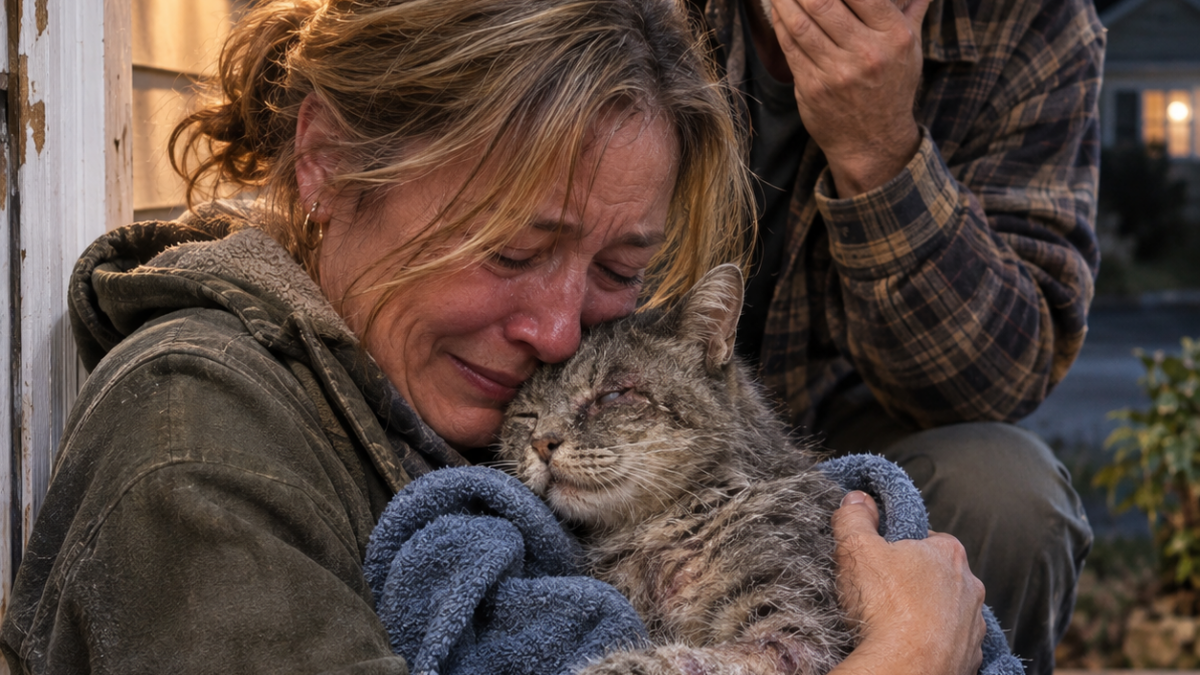
I caught him.
He weighed nothing.
That is what I remember most.
Our Buddy had once weighed thirteen and a half pounds.
Not fat.
Just broad.
Solid.
The kind of cat who landed on your stomach at four in the morning and removed the air from your lungs.
The animal in my arms felt like sticks beneath fur.
“Jesus.”
Daniel reached for him.
Buddy panicked.
His claws caught my sweatshirt.
“It’s okay. It’s okay.”
I lowered myself.
“Nobody’s taking you.”
He pressed against my chest.
The purr started again.
Rough.
Faint.
Unmistakable.
I cried so hard I couldn’t talk.
Buddy smelled terrible.
Mud.
Urine.
Old blood.
Cold air.
Something sour from his skin.
I didn’t care.
I buried my face against the top of his head.
“I’m sorry.”
His ear moved.
“I’m so sorry.”
Daniel crouched.
“Sarah, we need a vet.”
“I know.”
“Tonight.”
“I know.”
“There’s an emergency clinic in—”
“I KNOW.”
I wasn’t angry with him.
I simply couldn’t process two things at once.
Buddy was alive.
Buddy was horribly injured.
My brain kept alternating between them.
Alive.
Injured.
Alive.
Injured.
Daniel grabbed the old blue towel hanging beside the mudroom.
We had kept that towel for years.
Rainy paws.
Wet carriers.
Muddy shoes.
Buddy used to attack it whenever I dried him after he’d escaped onto the porch during storms.
I wrapped him.
He didn’t fight.
That scared me.
Buddy fought everything.
Medicine.
Nail trimming.
Carriers.
Being moved from a chair he’d decided belonged to him.
He had once bitten Daniel hard enough to draw blood because Daniel attempted to remove him from an empty pizza box.
The cat in my arms simply surrendered.
“Buddy.”
His eyes opened.
Still there.
Still him.
“Stay with me.”
Daniel drove.
I sat in the back seat because I refused to put Buddy inside a carrier.
He lay wrapped against my chest.
Every few minutes, I checked his breathing.
At one point Daniel looked at us in the mirror.
“How did he get here?”
“I don’t know.”
“Sarah.”
“I don’t know.”
“We lost him six hundred miles away.”
“I know.”
“Seven months ago.”
“I know.”
He stopped talking.
Because there was no answer.
Not yet.
The emergency veterinarian confirmed his identity before doing almost anything else.
Microchip.
Daniel had insisted we chip him as a kitten.
I had teased him at the time.
“He’s an indoor cat. Where’s he going?”
Daniel never forgot that sentence.
Neither did I.
The scanner beeped.
The technician looked at the screen.
Then at us.
“Buddy Lawson?”
My hand covered my mouth.
“Yes.”
There it was.
Proof for the part of my mind still afraid I had imagined the whole thing.
Dr. Rebecca Mills examined him.
She was maybe forty.
Calm.
Fast.
The kind of person who could deliver bad news without making it feel colder than necessary.
“He’s profoundly underweight.”
“How much?”
The technician checked.
“Seven pounds, two ounces.”
I closed my eyes.
Almost half his old body weight.
“He’s dehydrated,” Rebecca continued. “There’s an old fracture in the left foreleg. It healed incorrectly.”
“Can you fix it?”
“Possibly. But that’s not tonight’s priority.”
“What is?”
“Everything else.”
Blood tests.
X-rays.
Temperature.
Heart.
Kidneys.
Liver.
Infection.
Parasites.
His paws were cracked and scarred.
Several claws were broken.
One pad had an old cut through it.
The torn ear had healed unevenly.
There were bite scars on his neck.
His teeth showed unusual wear.
One canine had snapped.
The facial scars were old.
Not fresh.
Some injuries had happened months earlier.
Others more recently.
I stood beside the examination table while Rebecca ran her fingers carefully along his spine.
Buddy looked at me.
“Prrr.”
Rebecca stopped.
“Is he purring?”
I laughed through tears.
“He always purrs when he’s scared.”
She smiled.
“Some cats do.”
“No.”
I touched his head.
“Buddy purrs for everything. Scared. Happy. Angry. Hungry.”
Daniel said, “He once purred while attacking a veterinarian.”
“That wasn’t me, was it?” Rebecca asked.
“No.”
“Good.”
For one second, we laughed.
Then Buddy’s eyes closed.
Reality returned.
He spent the night at the hospital.
That was almost unbearable.
Seven months searching.
Seven months wanting him back.
Then within two hours of his return we were leaving him again.
“I know,” Rebecca said when I hesitated beside his cage. “But he needs IV fluids. Monitoring. We need to bring his temperature up slowly.”
“What if he thinks we’re abandoning him?”
“He won’t.”
“You don’t know that.”
She looked at me.
“No. I don’t.”
That answer made me trust her.
She crouched.
“But you’re coming back tomorrow.”
“First thing.”
“Then that’s what matters.”
I touched Buddy’s nose.
“We’ll be back.”
His eyes opened.
“I’m not leaving you again.”
That sentence stayed with me all night.
Because Buddy hadn’t chosen to leave.
We had lost him.
There is a difference.
A painful one.
We had taken that trip in May.
It was supposed to be easy.
Our daughter, Lily, had finished her first year of graduate school in North Carolina, and Daniel and I decided to drive down for a long weekend.
We didn’t like leaving Buddy with anyone because he had started developing anxiety as he got older.
He hated boarding.
Hated strangers in the house.
So we brought him.
Terrible idea.
Wonderful idea.
I still don’t know.
Buddy had traveled with us before on shorter trips.
He complained dramatically, then slept.
That morning we left Pennsylvania before sunrise.
Buddy rode in his carrier for the first couple hours.
Eventually we let him out because he wouldn’t stop crying.
He sat on the back seat.
Watched trucks.
Then slept against a suitcase.
We stopped at a highway rest area in Virginia.
I will never forget it.
Bright day.
Warm.
Crowded.
Families.
Truck drivers.
A bus full of high school students.
Daniel needed the restroom.
I wanted to reorganize a bag because a bottle had leaked.
Buddy was lying on the rear floorboard.
Or so I thought.
Daniel opened the driver’s door.
I opened the back.
Something frightened Buddy.
Maybe a truck’s air brakes.
Maybe a motorcycle.
Maybe the sudden doors.
He shot between us.
Gray blur.
Pavement.
“Buddy!”
He ran beneath an SUV.
Then a pickup.
Then across a strip of grass.
By the time Daniel reached him, Buddy disappeared into thick brush beyond the parking lot.
We searched for nine hours.
Nine.
People helped.
An older couple walked the perimeter.
A trucker brought canned tuna from his cab.
One of the high school students crawled under hedges looking.
Daniel went into thorn bushes until his forearms bled.
I walked around shaking treats.
“Buddy!”
Again.
Again.
Again.
Until my voice disappeared.
At dusk, we saw him once.
I swear it.
Two yellow-green eyes beneath brush.
I crouched.
“Buddy.”
The eyes moved.
I put food down.
He didn’t come.
A truck started somewhere behind us.
The eyes vanished.
We stayed until after midnight.
A state trooper eventually told us the rest area technically closed for maintenance overnight and we had to leave.
I hated him.
Unfairly.
But I hated him.
We slept three hours at a motel.
Went back at dawn.
No Buddy.
We printed posters.
Called shelters.
Animal control.
Veterinarians.
Posted everywhere online.
Daniel set a humane trap with food.
We delayed our trip.
Lily drove up to help.
We stayed four days.
Nothing.
Our jobs couldn’t wait forever.
Life has an ugly way of continuing when your heart wants the world to stop.
When we finally drove home, Buddy’s empty carrier sat in the back seat.
I couldn’t look at it.
Somewhere in Maryland, I told Daniel to pull over.
I got out.
Walked behind the gas station.
And threw up.
“I left him,” I said.
Daniel held my shoulders.
“We didn’t.”
“We’re driving away.”
“We have people checking traps.”
“He doesn’t know that.”
“Sarah.”
“He thinks we left him.”
That became the thought I couldn’t escape.
Not that Buddy was dead.
That was horrible.
But somehow the thought that he was alive and believed we had abandoned him was worse.
For weeks, I woke imagining him waiting at the rest area.
Watching cars.
Looking for ours.
We returned twice.
Once in June.
Again in July.
No sign.
A woman at a nearby campground said she’d seen a gray cat.
We spent two days searching.
Wrong cat.
A warehouse employee found a gray tabby ten miles away.
Not Buddy.
A rescue called about an injured male.
Not Buddy.
Every phone call sent my heart through the ceiling.
Then dropped it.
By October, people stopped asking.
By November, I took down the food bowl.
I cried while washing it.
Daniel didn’t say anything.
He simply dried it and put it in the cabinet.
We never discussed whether that meant we had given up.
Neither of us could say the words.
Now, in January, Buddy had walked through our front door.
The next morning, Rebecca called at 6:14.
I had not slept.
I answered before the first ring finished.
“Buddy’s stable.”
My body collapsed against the pillow.
“Okay.”
“His kidneys look surprisingly decent considering the dehydration.”
“Okay.”
“Liver values are elevated, but that may be nutritional.”
“Okay.”
“No evidence of internal bleeding. No obvious cancer. Heart sounds good.”
“Okay.”
She paused.
“You can breathe, Sarah.”
I started crying again.
“Sorry.”
“Don’t apologize.”
“What about his leg?”
“Old radius-ulna fracture. Probably happened several months ago. It healed with significant angulation.”
“Does it hurt?”
“Probably some.”
“Can you repair it?”
“We’ll consult orthopedics once he’s stronger.”
“His scars?”
“Some bites. Some could be from fights with other cats. Possibly wildlife.”
“Coyote?”
“Maybe. Hard to know.”
I closed my eyes.
“What happened to him?”
Rebecca was quiet.
“We may never know.”
That became the hardest sentence.
Because Buddy had returned carrying evidence.
But no explanation.
Scars don’t tell stories in order.
His body was a map without labels.
Still, pieces began emerging.
The first came from the microchip company.
When we reported Buddy found, a representative mentioned something.
“Your chip was scanned in August.”
I stopped.
“What?”
“One moment.”
The woman checked.
“August nineteenth. A veterinary clinic in West Virginia.”
My heart began pounding.
“Why didn’t anyone call us?”
“It appears your phone number was recorded incorrectly in the finder report.”
“That’s impossible. You have my number.”
“The clinic may have copied it manually.”
I felt anger rising.
“Which clinic?”
She gave me the name.
Daniel called immediately.
A receptionist checked archived records.
Yes.
A gray tabby.
Male.
Approximately eight to ten years old.
Thin.
Found near a truck stop.
A delivery driver had brought him in.
Microchip detected.
They attempted to contact the listed number.
Wrong number.
The driver declined surrender to animal control and said he would take the cat with him temporarily.
“Who was the driver?” Daniel asked.
They couldn’t give personal information without permission.
But they agreed to contact him.
Two hours later, our phone rang.
A man named Marcus Reed.
Long-haul trucker from Tennessee.
“Is this Buddy’s family?”
I sat.
“Yes.”
There was silence.
Then Marcus said, “Well, I’ll be damned.”
He had found Buddy in West Virginia in August.
Nearly three months after we lost him.
At a truck stop.
“How?”
“He was under my trailer.”
Buddy had been thin but not yet skeletal.
His front leg was already injured.
“He couldn’t put weight on it,” Marcus said.
“I took him to the vet.”
“Why didn’t you leave him there?”
“They said animal control might pick him up. I had a load. Didn’t like leaving him.”
So Marcus bought a carrier.
Food.
Water.
Kept Buddy in his truck.
“For how long?”
“About five weeks.”
Daniel and I stared at each other.
“Five weeks?”
“Yeah.”
Buddy had lived in a truck.
Marcus laughed softly.
“He hated me.”
I smiled through tears.
“That sounds right.”
“Wouldn’t let me touch him first week. Then he started sleeping behind my seat.”
Marcus had named him Smokey because he didn’t know Buddy’s name.
He stopped at clinics trying to trace the chip.
Somewhere the contact error followed.
Then in September, everything went wrong.
Marcus stopped outside Columbus, Ohio.
He opened the passenger door.
Buddy slipped out.
Again.
“What happened?”
“I chased him. Couldn’t catch him.”
Marcus’s voice changed.
“I stayed as long as I could.”
I knew that sentence.
The guilt.
The helplessness.
The way life eventually forces you to drive away.
“I’m sorry,” Marcus said.
“Don’t.”
“I lost him.”
“No.”
I was crying.
“You kept him alive.”
Buddy’s journey had shifted.
Virginia.
West Virginia.
Ohio.
Still hundreds of miles from Pennsylvania.
How did he get from Ohio to us?
The next piece arrived three days later.
Once Buddy’s story appeared in a local newspaper, social media did what social media sometimes does well.
People shared.
A woman in eastern Ohio named Claire recognized him.
She sent a photograph.
Gray tabby.
Thin.
Torn ear.
Sitting beneath her porch.
October.
My hands shook.
“That’s Buddy.”
Daniel zoomed in.
Same bent leg.
Same face.
Claire had fed him for about three weeks.
He never let her catch him.
Then disappeared.
Another person came forward.
A retired mechanic thirty miles east.
Gray cat sleeping in his garage in November.
Fed him.
Couldn’t keep him because of dogs.
Then the cat vanished.
We mapped the sightings.
Daniel spread a paper road map across the kitchen table.
Virginia.
West Virginia.
Ohio.
Western Pennsylvania.
Buddy’s path wasn’t direct.
It curved.
Jumped.
Followed roads.
Towns.
Possibly trucks.
Nobody could say he intentionally traveled every mile home.
Cats don’t have magical GPS.
Some people online insisted he had navigated entirely by instinct.
Experts we spoke to were more cautious.
Buddy may have followed food.
Shelter.
Transportation corridors.
Smells.
Terrain.
Random opportunities.
He may have ridden unknowingly in vehicles or trailers.
But one fact remained.
By December, every confirmed sighting was moving east.
Toward us.
Then a man named Paul Weaver contacted us.
He owned a small auto shop twenty-eight miles from our house.
“I had your cat.”
December 17.
Buddy appeared near the dumpster.
Paul started feeding him.
“He was rough.”
“How rough?”
“Skinny. Limping. Didn’t trust anybody.”
“Did you try to catch him?”
“Yeah.”
“How’d that go?”
“He bit me.”
Daniel laughed.
“Definitely Buddy.”
Paul put food out every night.
Around Christmas, Buddy started entering the shop.
He slept near a heater.
Paul had considered taking him to a veterinarian after New Year’s.
Then January 2, Buddy disappeared.
Our house was roughly twenty-eight miles east.
Fifteen days later—
Scratching at our door.
That last distance became the part nobody could explain.
Buddy had never lived near Paul’s shop.
Never traveled that area with us as far as we knew.
Yet he came to our exact house.
Not merely our town.
Our porch.
The same front door where he had spent years waiting when we returned from grocery shopping.
The same porch window he used to sit beside.
Rebecca warned us not to romanticize too much.
“Animals can navigate using scent, landmarks, magnetic cues—we’re still learning. But reconstructing intention is difficult.”
I understood.
Science mattered.
But so did what happened.
Buddy arrived.
Maybe luck played a role.
Probably.
Maybe people unknowingly helped.
Absolutely.
Marcus.
Claire.
Paul.
Others we’d never find.
Maybe Buddy wasn’t walking six hundred miles with our address in his head.
Still, at some point twenty-eight miles away, a battered cat kept moving.
And somehow he stopped at our door.
Recovery took months.
The first week, Buddy slept almost constantly.
We fed small meals because letting him eat everything he wanted too quickly could hurt him.
He hated this.
His personality returned before his strength did.
He screamed at the empty bowl.
Rebecca looked delighted during his checkup.
“That’s a good sign.”
“You can take him home with you.”
“No, thank you.”
“He has opinions.”
“So I’ve heard.”
His coat slowly improved.
The fleas disappeared.
Parasites treated.
Dehydration resolved.
He gained twelve ounces.
Then another pound.
The leg was harder.
Orthopedic imaging showed the fracture had healed badly enough that complete correction would require breaking the bone again.
Buddy was older now.
Weak.
Surgery carried risks.
Dr. Patel, the orthopedic specialist, showed us the images.
“We can operate.”
“Should we?” I asked.
Different question.
He nodded.
“Exactly.”
Buddy used the leg.
Poorly.
But he used it.
Pain medication helped.
There was arthritis.
We had to weigh a theoretically straighter leg against major surgery and rehabilitation.
Daniel asked, “If he were your cat?”
Dr. Patel thought.
“I’d give him time.”
So we did.
Buddy learned his new gait.
Three good legs.
One crooked front leg that swung slightly outward.
He could climb stairs.
Slowly.
He could reach the couch with a small step Daniel built.
He could still jump onto our bed by using a padded bench.
He could still knock pens from the nightstand with full accuracy.
Every ability felt like a gift.
Then came the night terror.
About six weeks after Buddy returned, I woke at 2:13 in the morning.
He was screaming.
Not meowing.
Screaming.
I ran downstairs.
Buddy was under the dining table.
Body flattened.
Eyes enormous.
Claws gripping the rug.
“Buddy.”
He hissed.
At me.
I stopped.
Daniel appeared.
“What happened?”
“I don’t know.”
Outside, somewhere far away, a truck downshifted on the highway.
Buddy shook.
We finally understood.
Certain sounds terrified him.
Air brakes.
Large engines idling.
Metal doors slamming.
Thunder.
Sometimes dogs barking.
Once, a raccoon crossed the porch and Buddy disappeared beneath the bed for seven hours.
He had come home.
His body knew he was safe.
Some part of him didn’t.
That hurt differently.
I’d imagined reunion as an ending.
It wasn’t.
Buddy carried the road home inside him.
We worked with a veterinary behaviorist.
Routine.
Safe spaces.
Never drag him from hiding.
Predictable food times.
Covered beds.
White noise.
Patience.
“Trauma isn’t disobedience,” the behaviorist told us.
“He’s not refusing to understand he’s safe. His nervous system is reacting faster than his thinking can.”
That sentence changed how I treated him.
Maybe changed how I treated people too.
When Buddy hid, I stopped coaxing.
I’d sit nearby.
Read.
Fold laundry.
Exist.
Eventually he’d come out.
The first time he voluntarily fell asleep beside me after a truck rattled past, I didn’t move for two hours.
Daniel brought me water.
“Your leg’s going numb.”
“I know.”
“You can move.”
“No.”
“Sarah.”
“I said no.”
He smiled.
“Okay.”
People became interested in Buddy’s story.
Too interested sometimes.
Local television called.
A national website wanted photographs.
A producer asked if we’d recreate the moment he came to the door.
I said no.
“Why?”
“Because Buddy isn’t an actor.”
They offered money.
Still no.
I didn’t want his suffering turned into content before I’d finished understanding it myself.
But we did agree to one local newspaper interview because Marcus asked us to.
He wanted people to know microchip information needed to be checked carefully.
The article reunited us with more people.
A woman remembered feeding Buddy behind a diner.
A teenager thought he’d seen him near a drainage culvert.
Some sightings couldn’t be confirmed.
Some probably weren’t him.
But together they painted a picture.
Buddy survived because strangers did small things.
A dish of food.
An open garage.
A truck cab.
Water.
A towel.
People who never knew his story long enough to receive credit.
That humbled me.
I’d spent seven months believing Buddy was alone.
He had been alone.
And he hadn’t.
Those can both be true.
Marcus eventually visited.
He was driving through Pennsylvania and called.
“I’d like to see Smokey.”
“Buddy.”
“He’s Smokey Monday through Friday.”
When Marcus entered our kitchen, Buddy froze.
The man didn’t move closer.
“Hey, buddy.”
Buddy’s ears turned.
Marcus sat on the floor.
“I know you remember me.”
For almost ten minutes, nothing happened.
Then Buddy walked toward him.
Slowly.
Crooked leg.
Scarred face.
He sniffed Marcus’s boots.
Then rubbed against his knee.
Marcus covered his face.
He was a huge man.
Six feet something.
Broad shoulders.
Gray beard.
He cried like a child.
“I thought you died.”
Buddy purred.
Marcus looked at me.
“I kept thinking I should’ve stayed longer.”
I knew.
I sat beside him.
“We stayed four days when we lost him.”
He nodded.
“Still didn’t feel long enough, did it?”
“No.”
“That’s the thing.”
We both looked at Buddy.
“Sometimes you can do everything you can and still have to leave.”
That sentence forgave something in both of us.
Not everything.
Enough.
Paul visited later.
Claire sent Buddy a knitted blanket.
He hated it.
Preferred the cardboard box it arrived in.
Typical.
By spring, Buddy weighed eleven pounds.
By summer, twelve.
He never regained his old thirteen and a half.
His face remained scarred.
Ear permanently torn.
Leg crooked.
He looked different.
That bothered some people.
Not me.
I learned every scar.
The one above his eye.
The small notch on his nose.
The bald patch near his shoulder that never grew back correctly.
Each was proof of something we’d never fully know.
Sometimes I wanted the complete story desperately.
Where had he slept the first night?
What broke his leg?
Who fed him first?
How many nights went hungry?
Did he call for us?
Did he recognize our voices in memory?
Was he frightened every time a car door opened?
Did he ever return to the rest stop looking?
Questions with no answers can become another kind of cage.
Eventually I stopped trying to solve every mile.
Buddy wasn’t asking me to.
He lived in the house again.
That was enough.
He reclaimed the front window.
First cautiously.
Then completely.
He slept there afternoons in sunlight.
The first time I came home from groceries and saw his round gray face behind the glass, I stopped in the driveway.
Seven months.
I had imagined that sight every day.
There he was.
I cried over grocery bags.
Again.
Buddy seemed annoyed by how emotional I had become.
Daniel said, “He probably thinks you’ve changed.”
“He’s right.”
Our daughter Lily came home during summer.
Buddy had always adored her.
When she entered, he walked toward her.
Stopped.
Sniffed.
Then made the loudest purr we’d heard since his return.
Lily sat on the floor.
“No.”
Her face collapsed.
“Buddy.”
He climbed halfway into her lap.
She cried into his fur.
“I thought I’d never see you again.”
Buddy kneaded her jeans.
“Look at you.”
She touched his scarred cheek.
“What happened?”
That was always the question.
Buddy blinked.
No answer.
Lily looked at me.
“Do you think he knew he was coming home?”
“I don’t know.”
“You really don’t?”
“No.”
She smiled.
“You used to say he wasn’t smart enough to find his food if we moved the bowl.”
“I was clearly wrong.”
That fall, we drove back to the rest area.
People thought we were strange.
Maybe we were.
We left Buddy home with Lily.
No more road trips for him.
Daniel and I drove to Virginia.
The place looked smaller than I remembered.
That’s what trauma does.
It enlarges geography.
In my memory, those woods had been endless.
The parking lot enormous.
The interstate impossibly loud.
Standing there again, it was just a rest stop.
Cars.
Vending machines.
Picnic tables.
Brush.
I walked to the place where I’d last seen Buddy’s eyes.
Vegetation had changed.
Nothing looked the same.
Daniel stood beside me.
“You okay?”
“No.”
He nodded.
We had learned that no was an acceptable answer.
“I keep thinking about him waiting here.”
“Sarah.”
“I know.”
“We don’t know.”
“I know.”
He took my hand.
“We came back.”
“Not that night.”
“We came back the next morning.”
“He didn’t know.”
“No.”
I started crying.
“I’m sorry.”
Daniel held me.
“You didn’t open the door.”
“What?”
“I did.”
“We both—”
“No.”
His voice shook.
“I’ve been letting you carry all of it because you say it was both of us.”
I looked at him.
He stared toward the brush.
“I opened the driver’s door without checking where he was.”
“Daniel.”
“I did.”
“It was an accident.”
“I know.”
“Then why are you doing this?”
“Because you apologized to Buddy every day for months.”
He looked at me.
“And I never said I was sorry.”
His eyes filled.
“I was afraid if I said it out loud, you’d finally blame me.”
My chest hurt.
“Oh, Daniel.”
“I blamed myself enough for both of us.”
We stood beside the same parking lot where our cat had disappeared.
Seven months of guilt had lived between us, disguised as grief.
I took his hands.
“I never blamed you.”
“Not once?”
“No.”
“I did.”
“I know.”
That was what Buddy’s disappearance had done to us.
We’d lost the same cat.
But privately assigned ourselves different crimes.
I believed I’d abandoned him.
Daniel believed he’d caused it.
Neither had said enough.
Maybe because saying guilt out loud makes it feel official.
We stayed until sunset.
Before leaving, I placed a small bowl of cat food near the edge of the brush.
Not for Buddy.
For whatever animal might need it.
Daniel smiled.
“You’re not supposed to feed wildlife.”
“Then don’t tell anyone.”
On the drive home, we talked more than we had during the original trip.
Not only about Buddy.
About everything.
Fear.
Age.
Lily moving further away someday.
Daniel’s retirement.
My mother getting older.
The strange fragility of routines we’d assumed would last.
Losing Buddy had frightened us because it revealed how quickly an ordinary life can fracture.
A car door.
One second.
Gone.
But his return taught something else.
Broken isn’t always gone.
Changed isn’t always lost.
Sometimes what comes home does not resemble what left.
You love it anyway.
Buddy aged rapidly after that.
Or perhaps I simply noticed age more.
At eleven, he developed kidney disease.
Mild at first.
Rebecca laughed when she saw him again.
“Our traveler.”
Buddy hated her.
“Mutual?” I asked.
“Deeply.”
At twelve, arthritis worsened in the damaged leg.
We started medication.
At thirteen, he stopped climbing stairs entirely.
Daniel built ramps.
Our house began looking like an accessibility project designed by cats.
At fourteen, Buddy lost hearing in one ear.
The torn one.
He startled if approached from that side.
We learned to touch the floor so he could feel vibrations.
At fifteen, he slept most of the day.
Still ate.
Still purred.
Still sat at the front door sometimes.
That was the behavior that affected me most.
After Buddy returned, he developed a habit.
Every evening around ten, he’d walk to the front door.
Sit.
Look at it.
Then come back.
At first I thought he wanted outside.
Absolutely not.
Not in a million years.
We had turned our home into Fort Knox.
Screens checked.
Doors double-checked.
Visitors warned.
Buddy was never leaving unsupervised again.
But he didn’t scratch.
Didn’t cry.
Just sat.
Daniel once said, “Maybe he’s checking.”
“Checking what?”
“That it’s still here.”
I laughed.
Then thought about it.
Maybe.
Or maybe we were projecting.
Humans do that.
We make animals carry metaphors because sometimes it’s easier than admitting they’re ours.
I checked doors too.
I checked whether Daniel was home.
Whether Lily had texted.
Whether Buddy was breathing when he slept too deeply.
Trauma creates rituals.
One winter evening, years after Buddy’s return, snow started falling.
Large flakes.
Quiet.
Buddy sat on the rug by the heater.
I realized the scene looked almost exactly like that first night.
Except he was warm now.
Healthy enough.
Home.
I sat beside him.
“You know, people still ask me how you did it.”
He opened one eye.
“Six hundred miles.”
No response.
“Three states.”
He licked one paw.
“You could at least pretend to be impressive.”
He continued washing.
I touched his torn ear.
“I wish you could tell me.”
Buddy stopped.
Put his paw down.
Then leaned against me.
Purr.
Old.
Rough.
Same sound.
Maybe that was the only answer I was going to get.
He survived.
People helped.
He kept moving.
Somehow he arrived.
Not every mystery needs to become a miracle to matter.
Buddy died at seventeen.
Eight years after he came scratching at our door.
Eight years we would not have had if he had given up somewhere along the road.
His final decline was slow.
Kidneys.
Weight.
Age.
The crooked leg became painful.
He stopped eating much.
Rebecca had moved to another clinic by then, but she returned to our house for him.
“I couldn’t let somebody else do this,” she said.
Buddy lay on the blue towel.
The same old blue towel.
We had kept it.
Faded almost white.
Daniel sat on one side.
I sat on the other.
Lily joined by video because she lived in California and couldn’t get a flight quickly enough.
“I’m sorry,” she kept saying.
I told her what I’d learned.
“You don’t have to apologize for distance.”
Buddy heard her voice from the phone.
His ear moved.
Lily cried.
“Tell him I love him.”
I put the phone beside him.
“She loves you.”
His chest vibrated.
Purr.
Barely audible.
Just like the night he came home.
Rebecca looked at me.
“Ready?”
No.
Of course not.
But readiness isn’t always part of love.
Sometimes love asks something before you’re ready.
I kissed Buddy’s head.
“You found us.”
My voice broke.
“You crazy little thing.”
Daniel rubbed his face.
“I don’t know how you did it.”
Buddy’s eyes were half closed.
I put my hand beneath his chin.
“And I’m sorry.”
Daniel looked at me.
I smiled through tears.
“Still.”
Then I corrected myself.
“No.”
I touched Buddy’s forehead.
“I’m done apologizing.”
Because I’d finally understood.
Buddy had not spent eight years blaming us.
That was human.
He had come home.
Accepted food.
Warmth.
Beds.
Hands.
He had slept beside us.
Purrrred.
Complained.
Lived.
He had not made our worst mistake the center of every day afterward.
Why had I?
“I love you,” I whispered.
That was enough.
Rebecca gave the medication.
Buddy relaxed.
His paw rested against my wrist.
Daniel placed his hand over mine.
The last sound Buddy made was that purr.
Then it faded.
His breathing slowed.
Stopped.
The house became quiet.
But not the same kind of quiet as when he had disappeared.
Back then, the silence had been uncertainty.
A question.
Where are you?
Are you cold?
Are you alive?
Did you think we left you?
This silence was grief.
Terrible.
But complete.
We knew.
Buddy had been here.
He had been loved.
He had gotten old.
He had reached the ending every lost animal deserves but too few receive.
Safe.
Warm.
Known.
Home.
We had him cremated.
Daniel built a small wooden box himself.
On the lid, he carved one word.
BUDDY.
No dates.
No quote.
I asked why.
“Because the important part isn’t when.”
“What’s the important part?”
“That he made it.”
I kept Buddy’s old collar.
It was the replacement collar we’d bought after he returned.
The first one had vanished somewhere during those seven months.
Sometimes I wondered where.
Virginia woods?
West Virginia truck stop?
Marcus’s cab?
Ohio?
Another mystery.
A year after Buddy died, Marcus called.
We hadn’t spoken in months.
“You still think about that cat?”
“Every day.”
“Me too.”
He’d retired from trucking.
Adopted an elderly orange cat from a shelter.
“Meanest thing alive.”
“Good.”
“Named him Diesel.”
“Of course you did.”
He went quiet.
Then said, “I’ve been thinking about that road.”
“What road?”
“All of it.”
I knew.
“You know Buddy didn’t make it by himself.”
“I know.”
“Neither do we.”
Simple sentence.
It stayed with me.
Buddy’s story became famous in our town.
People called him the six-hundred-mile cat.
I never loved that name.
It made the distance seem like the miracle.
The distance wasn’t the part I remembered.
I remembered the scratching.
A tired paw against our door.
A cat who looked almost nothing like the animal we’d lost.
A body damaged by months we would never understand.
Then the eyes.
Recognition.
And the purr.
That was home.
Not the address.
Not the house.
Recognition.
I used to think home was a fixed place.
Our porch.
Kitchen.
Bed.
The patch of carpet where Buddy slept.
But houses change.
People move.
Neighborhoods change.
Bodies age.
Families scatter.
If home depended entirely on geography, we’d all lose it eventually.
Buddy taught me something different.
Home is also memory.
Scent.
Voice.
Routine.
The person whose footsteps you know.
The hand you trust even after you’ve learned the world can hurt you.
The place where your damaged body does not have to explain why it is damaged before someone opens the door.
Years later, Daniel and I moved.
Smaller house.
Closer to Lily after she came back east.
On the final day, I stood at the old front door.
The one Buddy scratched.
If you looked carefully, there were still four tiny marks near the bottom.
Daniel had offered to sand them years earlier.
I wouldn’t let him.
The new owners were a young couple with a toddler and a black Labrador.
Before we left, the woman noticed me touching the scratches.
“Dog damage?”
I smiled.
“Cat.”
She looked confused.
I told her the short version.
Her eyes widened.
“Six hundred miles?”
“Something like that.”
“How?”
I looked at the door.
“I don’t know.”
She smiled.
“That’s incredible.”
“Yeah.”
I stepped outside.
Then stopped.
“Could I ask you something strange?”
“Sure.”
“Don’t sand those out.”
She looked down.
Then back at me.
“I won’t.”
I believed her.
In our new house, Buddy’s wooden box sits on a shelf near the front window.
Not because I think his spirit needs a view.
Just because he always liked windows.
Lily jokes that Buddy still traveled further than any of us expected.
Daniel says that’s because Buddy had poor judgment.
We’re allowed to laugh now.
That’s another thing grief eventually gives back.
Humor without guilt.
Sometimes when winter gets cold enough, I think about that January night.
What if I’d gone upstairs five minutes earlier?
What if the television had been louder?
What if Buddy had stopped at somebody else’s porch?
What if he had collapsed in our yard?
You can torture yourself with what-ifs forever.
I did that after losing him.
I refuse to do it about finding him.
He came.
I heard him.
I opened the door.
That’s enough.
I also think about the strangers.
Marcus.
Claire.
Paul.
The veterinary staff who scanned his chip.
The diner employee who may have fed him.
People we never identified.
Maybe somebody put water out on a hot day.
Maybe a child shared chicken.
Maybe a farmer let him sleep in a barn.
Maybe somebody chased a dog away.
Maybe a person who doesn’t remember Buddy at all gave him the meal that got him through one more night.
We like stories about heroic survival because they make strength look individual.
One determined cat travels hundreds of miles.
One miraculous journey.
But survival is often built from invisible mercy.
Tiny acts.
A bowl.
A box.
An open garage.
A stranger stopping.
Help doesn’t always know what story it’s joining.
That’s why it matters.
There is probably no way to reconstruct every mile Buddy traveled.
Maybe he walked some.
Rode some.
Wandered.
Backtracked.
Followed instincts.
Followed roads.
Followed luck.
Followed memories we don’t understand.
The mystery used to bother me.
Now I love it.
Because Buddy’s story does not need an explanation precise enough to fit on a map.
The truth is already remarkable enough.
We lost a cat three states away.
For seven months, his life continued beyond our sight.
He got hurt.
He got hungry.
He met strangers.
He survived heat.
Storms.
Cold.
Other animals.
Traffic.
Fear.
He was carried forward by instinct and chance and the kindness of people who didn’t know they were helping return somebody’s family.
And then one winter night, almost too weak to stand, he reached a familiar door.
He scratched.
We opened it.
He looked up.
And before we even had proof from a microchip, before the veterinarian confirmed anything, before we mapped sightings or called truck drivers or understood a single mile—
Buddy purred.
That was how I knew.
Not because he looked the same.
He didn’t.
Not because he came home unbroken.
He hadn’t.
I knew because underneath everything the road had changed, one small familiar thing remained.
The sound he made when he trusted me.
Sometimes I think that’s what love really is.
Not preserving someone exactly as they were.
Not demanding they come back untouched.
It’s recognizing them through the damage.
Opening the door anyway.
Saying:
I know you.
Come inside.
You’re home.








