My 81-Year-Old Veteran Father Was Sl@pped in a Diner—Then I Walked In With the Hells Angels
PART3:
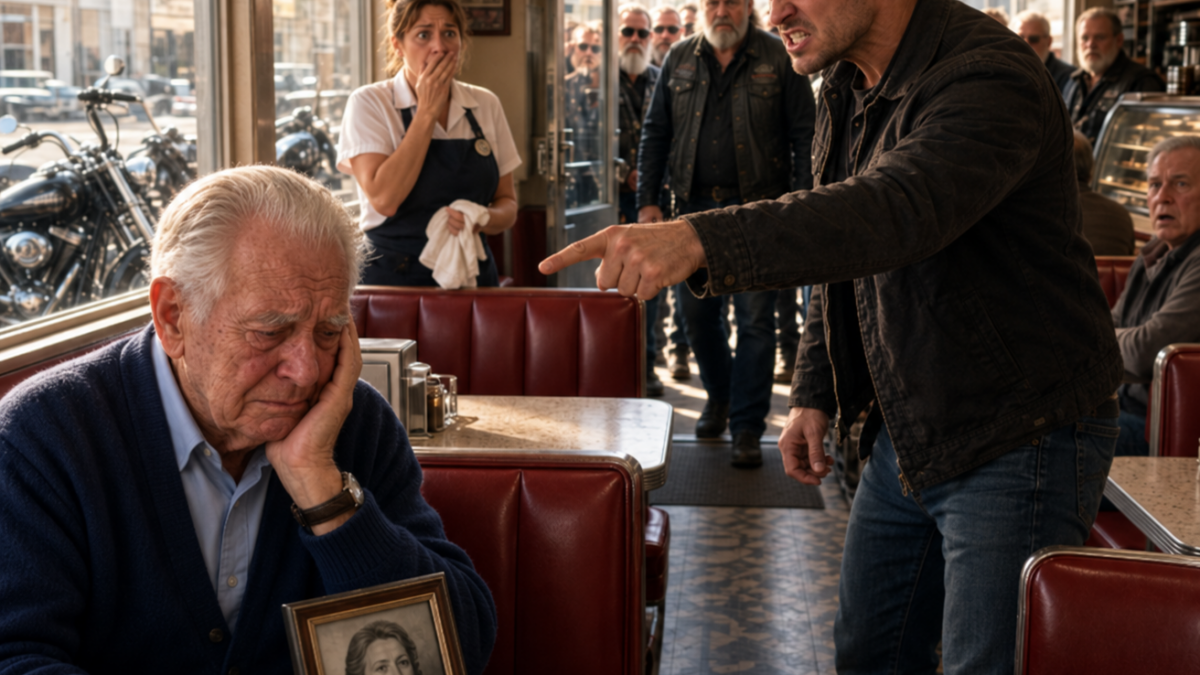
The owner, Ray Donnelly, stood near the register pretending to study receipts. He was not a bad man, but he was careful in the way small-business owners become when every broken chair costs money and every police report becomes gossip. He saw Colton. He saw Dad. He did not move yet.
Alara did.
She came around the counter with the coffee pot still in her hand.
“Everything okay here?”
Colton smiled without looking at her.
“Just asking Grandpa to share the space.”
Dad’s hand tightened around his cup.
“I have a name.”
Colton looked down at him.
“Do you?”
“Everett Hale.”
Something in Dad’s voice changed when he said his own name. Not louder. Straighter. Like he was placing it on the table beside Mom’s photograph and expecting both to be treated with care.
Colton looked at the picture.
“Who’s that? Your nurse?”
Dad’s face moved.
Barely.
Ruth set down her sandwich.
Alara’s eyes flashed.
“That’s enough,” she said.
Colton finally looked at her.
“Mind your coffee, sweetheart.”
Dad spoke before she could.
“Respect costs nothing, son.”
Colton turned back.
Dad continued, still calm.
“Everyone eventually hopes to reach old age. Best not to mock the road you’re traveling.”
Those words should have ended it.
Maybe with a laugh.
Maybe with a rude gesture.
Maybe with Colton strutting back to his friends and pretending he had chosen to let it go.
Instead, they angered him.
Cruel people hate calm because it denies them the fight they are trying to start.
Colton stepped closer.
“You think because you’re old, everybody owes you something?”
“No.”
“You think that little watch and cardigan make you important?”
“No.”
“You think anyone cares what you did fifty years ago?”
At that, Dad lowered his eyes.
Not because he was ashamed.
Because he had spent half a century trying not to make his service a weapon in ordinary rooms.
“I didn’t ask anyone to care,” he said.
Colton laughed.
Then he slapped him.
The sound cracked across the diner.
A flat, ugly sound.
Ruth said every spoon stopped moving.
Dad’s coffee cup tipped over. Black coffee spread across the table, running toward the edge in a dark sheet. Mom’s photograph slid with it, pushed by the spill, nearly falling.
Dad did not stand.
He did not strike back.
He did not even look at Colton first.
He reached for the photograph.
His old hand trembled as he lifted it from the coffee and checked the plastic sleeve for damage. He wiped it carefully on his napkin, as if the whole room had disappeared and the only thing that mattered was whether Marjorie’s smile had survived.
That tiny action changed something in the diner.
Ruth stood.
Alara rushed forward with a clean towel.
Ray came out from behind the register at last.
Colton backed away, trying to laugh like the whole thing had been smaller than it was.
“Man, he’s fine. I barely touched him.”
Dad held the photograph in both hands.
Alara crouched beside him.
“Mr. Hale, are you all right?”
He nodded.
But his eyes had gone glassy.
Not because he had been hit.
My father had been hit before, in places and ways he never described fully.
No, what hurt him was being humiliated in a room full of people after spending his whole life believing decency was still a choice people could make.
Someone called the authorities.
I later learned it was Simon Reed, a delivery driver who had been eating at the counter. He had already pulled out his phone when Colton started leaning over Dad. By the time the slap landed, Simon was telling dispatch what happened.
But before the police arrived, another sound approached.
Not a siren.
Motorcycles.
One first.
Then another.
Then several more.
A low rumble moving down the road like distant thunder.
That was us.
I had not come because someone called me about the slap.
Not yet.
That cruel timing is part of the story too.
I was already on my way to the diner.
My friend Preston Vail rode beside me with the repaired pocket watch in his saddlebag until I made him hand it over at the last stoplight because I suddenly wanted to be the one to give it to Dad. Dutch, Romero, Big Mike, and two others rode behind us. We had been at Preston’s garage that morning, collecting the watch he had spent months restoring.
It had belonged to my mother.
A small silver pocket watch engraved with M.H. on the back.
Marjorie Hale.
Dad gave it to her on their twenty-fifth anniversary because she had always teased him that soldiers were married first to time. She carried it in her purse for years. After she died, the watch disappeared. Dad thought it had been lost during the hospital move.
It had not been lost.
I found it in a shoebox in the back of her closet, wrapped in a scarf that still smelled faintly of lavender if memory was being kind. The glass was cracked. The chain broken. The mechanism dead.
Preston Vail, one of our quietest riders, restored old watches as a hobby. He looked like a man who could tear a door off its hinges and spent his evenings cleaning gears with tweezers under a magnifying lamp. I asked him to fix it for Dad.
He did.
We planned to surprise him at the diner.
That was all.
No grand entrance.
No confrontation.
No justice.
Just a son finally showing up on a Tuesday with something his father thought was gone.
Then we pulled into the lot and saw the room through the windows.
I saw Dad first.
He was sitting rigid in the corner booth, one hand near his cheek, the other wrapped around Mom’s photograph. Alara stood beside him. Coffee spread across the table. People were standing. Colton was near the aisle, shoulders high, face still cocky but uncertain now that the room had turned against him.
Something hot and primitive flashed through me.
I will not dress it up.
For one second, I wanted to become exactly what people think a Hells Angel is.
I wanted to cross that diner, put Colton through the table, and let every person who had watched my father get slapped understand what fear looked like when it finally changed direction.
Then Dad looked through the window and saw me.
That was all it took.
Not a gesture.
Not a word.
Just my father’s eyes meeting mine through glass.
Everett Hale had raised me better than the anger in my chest.
So I took my hand off the throttle, killed the engine, and breathed until I could hear him instead of myself.
The others parked beside me.
Nobody rushed.
Nobody shouted.
We removed our helmets and walked toward the diner in a line that must have looked like trouble arriving in formation.
Leather vests.
Patches.
Boots.
Gray beards.
Tattoos.
Loud engines still ticking hot behind us.
I know what we looked like.
I have known for years.
People see the patch and decide the story before any of us opens a door. Sometimes they are afraid. Sometimes they are curious. Sometimes they want us to be dangerous because it makes their own lives feel closer to something dramatic. I stopped arguing with the first impression a long time ago.
But that day, I felt the weight of it differently.
Because my father was inside.
Because he had spent his life teaching me that intimidation is not the same as strength.
Because I knew the room would expect us to do one thing, and Dad needed me to do another.
I opened the diner door.
The bell above it rang once.
Every face turned.
The room went quiet again, but this quiet was different.
The first silence had been shock.
This one was fear.
Colton looked at us and lost color around his mouth.
His two friends stepped backward so subtly they might have hoped nobody noticed.
Dad sat in the booth, still holding Mom’s photograph.
I walked straight to him.
Not to Colton.
To him.
I knelt beside the booth, ignoring the eyes on my back.
“Dad.”
His cheek was red.
The sight nearly undid me.
“Son,” he said.
His voice was calm, but thin.
I looked at Alara.
“What happened?”
She opened her mouth.
Dad touched my wrist.
“Ask me.”
So I did.
“What happened?”
He looked past me toward Colton.
“That young man struck me.”
My jaw tightened.
“Why?”
“He wanted the booth.”
Behind me, I heard Big Mike mutter something under his breath. Dutch made a low sound that stopped him. The other riders stayed by the entrance, hands visible, bodies still. They knew me well enough to know the most dangerous moment was not when we came through the door.
It was now.
Dad’s fingers tightened around my wrist.
“Mason.”
I looked at him.
“I don’t want revenge,” he said quietly. “I want him to understand he was wrong.”
That was my father.
An eighty-one-year-old man with a burning cheek and spilled coffee in front of him, still trying to leave a door open for someone else’s conscience.
I swallowed.
“All right.”
Colton laughed nervously from behind me.
“Oh, come on. He’s exaggerating. I barely—”
I stood.
The laugh died.
I did not step toward him.
I did not need to.
For several seconds, neither of us spoke.
Colton was big.
Younger than me by almost twenty years, wide in the shoulders, still full of the stupid belief that size means the room belongs to you.
I was fifty-six, gray in my beard, slower than I used to be, and wearing a vest that made men like him calculate outcomes they had not considered when mocking old people in cardigans.
But I did not want his fear.
I wanted the truth.
“My father says you hit him.”
Colton’s eyes flicked toward the riders near the door.
“I said he’s exaggerating.”
“Then say that to the officer when he gets here.”
His face shifted.
“The officer?”
Simon raised one hand from the counter.
“I called.”
Colton turned on him.
“For what?”
Ruth Calder stepped into the aisle.
“For assaulting an elderly man,” she said.
Colton looked at her like he could not believe the room was disobeying him.
Ruth did not blink.
“I saw it,” she said. “You struck him after he told you respect costs nothing.”
Simon stood too.
“I saw it. He slapped him hard enough to spill the coffee.”
Ray, the owner, finally found his spine and lifted his chin.
“And the camera caught it.”
Colton’s confidence began to drain.
Not all at once.
Men like him rarely lose arrogance cleanly. It leaks out as anger first.
“Are you serious?” he snapped. “You’re all acting like I beat him half to death.”
“No,” Dad said from the booth.
Everyone turned.
He was looking at Colton.
“You humiliated yourself more than you hurt me.”
The words landed harder than anything I could have done with my fists.
Colton’s face reddened.
The front door opened again.
Two officers entered.
One was younger, one older. The older officer’s name tag read Mercer.
Daniel Mercer.
I knew him by sight but not well. Maple Ridge was small enough that everyone had passed everyone at a gas station or funeral at least once.
Officer Mercer took in the room the same way all experienced cops do: quickly, quietly, noting exits, bodies, tension, hands.
His eyes paused on us.
Six Hells Angels near the entrance.
One beside the old man.
One furious younger man near the aisle.
A spilled coffee.
A diner full of witnesses pretending not to look eager to talk.
“All right,” Mercer said. “Everybody stay calm.”
Dutch lifted both hands slightly.
“We’re calm, officer.”
Mercer’s eyes moved to him.
“Let’s keep it that way.”
“That’s the plan.”
Mercer turned toward Ray.
“You the owner?”
“Yes.”
“Camera?”
“Yes.”
“Preserve it.”
Ray nodded fast.
Then Mercer looked at Dad.
“Sir, are you injured?”
Dad shook his head.
“My pride took the worst of it.”
“Medical attention?”
“No.”
I said, “He’s eighty-one. His cheek is swelling.”
Dad gave me a look.
“I am aware of my age, Mason.”
Officer Mercer paused.
His eyes narrowed slightly.
“Everett?”
Dad looked at him more carefully.
“Yes?”
“Everett Hale?”
“Yes.”
Something changed in the officer’s face.
Not professionalism. That stayed. But recognition moved beneath it like light under a door.
“You probably don’t remember me,” Mercer said.
Dad tilted his head.
The officer’s voice softened.
“Daniel Mercer. My mother was Carla Mercer. She ran the youth room at the old community center on Grand.”
Dad blinked.
Then his face changed too.
“Danny Mercer.”
The officer smiled despite the situation.
“Yes, sir.”
“You had the red bicycle with the bent fork.”
“That’s me.”
Dad’s eyes warmed for the first time since I walked in.
“Your mother made terrible lemonade.”
Mercer laughed once, startled.
“She did. She really did.”
The room seemed to exhale.
Then Officer Mercer looked down at Dad’s cheek, the spilled coffee, the photograph in his hands, and the warmth left his face.
When he turned to Colton, he was all law again.
“Hands where I can see them.”
Colton started talking immediately.
“I barely touched him. Everybody’s making a thing because—”
“Hands,” Mercer repeated.
The younger officer moved beside him.
Colton obeyed.
The investigation took time.
It always does.
People think justice is a dramatic moment. Usually it is paperwork with witnesses.
Ruth gave a statement.
Simon gave one.
Alara described the comments Colton made before the slap. Ray pulled the security footage. Colton’s friends tried to minimize things until Officer Mercer separated them and the video did what weak men would not.
It told the truth without adjusting its voice.
Through all of it, I stayed beside Dad.
I did not interfere.
Did not shout.
Did not threaten.
I held Mom’s photograph while Dad answered questions because his hands shook enough that he finally let me.
That small permission hurt.
My father had carried the world in silence for so long that letting me hold a photograph felt like surrender to him.
To me, it felt like being trusted with something holy.
When Officer Mercer finished speaking with Dad, he stood there a moment longer than necessary.
“I want you to know something,” he said quietly.
Dad looked up.
“You taught me to fix that bicycle.”
Dad smiled faintly.
“I mostly held tools and told you not to lose screws.”
“No,” Mercer said. “You told me being strong meant knowing when to protect someone and when to walk away.”
My father’s face went still.
“I said that?”
“Yes, sir.”
“I don’t remember.”
“I do.”
The officer swallowed.
“My mom talked about you for years. Said you helped half the kids in that place and never let anyone make a fuss over it.”
Dad looked down, embarrassed.
“That was a long time ago.”
“Not to everyone.”
That was when my father smiled.
A small, fragile smile.
It broke my heart more than the slap.
Because I realized how long it had been since someone reminded him that his life had left marks in places he no longer remembered touching.
Colton was taken outside.
He did not look so large then.
He looked like what he was: a man who had mistaken cruelty for power until witnesses, cameras, and consequences entered the room.
As the officers led him past, his eyes darted toward me.
There was fear there.
I felt no pride in it.
Dad would not have wanted me to.
After they put him in the cruiser, Officer Mercer returned to tell Dad what would happen next. Charges. Statements. Follow-up. The ordinary machinery of accountability.
Dad thanked him.
Mercer hesitated.
Then held out his hand.
Dad shook it.
For a moment, I saw the old man and the little boy with the broken red bicycle standing in the same space.
Life does that sometimes.
It folds years without asking.
When the officers finally left, the diner remained quiet.
No one knew how to return to eggs and coffee after watching an old man get slapped and then hearing he had once helped the officer taking the report learn what strength meant.
Dad looked down at his hands.
The left one trembled.
The right one rested near his watch.
I sat across from him.
The riders stayed near the entrance, speaking softly with Ray, not crowding Dad. They knew this was not their scene to own.
Alara brought fresh coffee.
“No charge,” she said.
Dad shook his head.
“I can pay.”
“I know you can.”
She set it down anyway.
Then Ruth Calder appeared with a slice of pie.
“Apple,” she said. “You look like a man who needs pie.”
Dad opened his mouth.
Ruth pointed at him.
“Do not argue with old women. We’re meaner than we look.”
Dad closed his mouth.
Simon came by next and placed a clean napkin beside the photograph.
“Sir,” he said awkwardly, “I should’ve stood up sooner.”
Dad looked at him.
“You called.”
“I waited until after.”
“You acted.”
Simon’s jaw tightened.
“Could have acted faster.”
Dad studied him.
“So could most people, most days.”
Simon nodded and stepped back.
Ray came from behind the counter holding a small frame.
It was cheap, probably from the office wall, the kind that had held a health inspection certificate or a faded coupon notice. Alara had cleaned it and slipped Mom’s photograph inside to keep it safe from another spill.
Dad stared at it.
His lips parted.
“I didn’t want it damaged,” Alara said.
He touched the edge of the frame.
“Marjorie would have liked you.”
Alara’s eyes filled.
“Well,” she said, voice rough, “she had good taste then.”
Dad laughed softly.
The sound loosened something in the room.
People began moving again.
Forks touched plates.
Coffee poured.
Chairs shifted.
The diner did not become normal.
It became kinder.
There is a difference.
After a while, Dad looked at me and said, “Walk with me outside?”
“Of course.”
I helped him stand.
He hated that I helped him.
He accepted it anyway.
Outside, sunlight remained bright. Cars still passed along the road. People still carried grocery bags and coffee cups on the sidewalk. The world looked unchanged, which seemed almost insulting after what had happened inside.
The bikes stood in the parking lot, chrome bright under the afternoon sun.
The club waited near them.
Men people crossed streets to avoid.
Men who sent nervous glances through store windows.
Men who had stood quietly in a diner entrance and done nothing violent, even when violence had been expected of them.
Dad looked at them.
Then at me.
“You brought the cavalry?”
“Not exactly.”
Preston Vail stepped forward.
He was quiet, broad, dark-skinned, with careful hands and an expression people often misread as cold because they had never watched him repair something delicate. He removed a small wooden box from inside his jacket and held it out.
“Mr. Hale,” he said. “Mason asked me to restore this.”
Dad looked at me.
I nodded.
His hands shook as he opened the box.
Inside lay Mom’s pocket watch.
The silver case gleamed softly. The cracked glass had been replaced. The chain repaired. The engraving polished but not erased.
M.H.
Dad stared at it.
For several seconds, he did not breathe in any way I could see.
Then he reached inside and lifted the watch.
His thumb moved over the engraving.
“Where did you find it?” he whispered.
“Mom’s closet. In the shoebox with her scarves.”
His mouth trembled.
“I thought it was gone.”
“I know.”
Preston said quietly, “Still keeps good time.”
Dad opened the cover.
The second hand moved.
Tick.
Tick.
Tick.
A little sound.
A living sound.
Dad closed his hand around the watch and pressed it against his chest.
No speech could have touched that moment without bruising it.
So none of us gave one.
The motorcycles attracted attention as always. People slowed in the lot. Looked. Wondered. Made stories in their heads.
But the real power that afternoon did not come from leather jackets, loud engines, or intimidating appearances.
It came from restraint.
Witnesses telling the truth.
A waitress protecting a photograph.
A cop remembering a bicycle.
A son kneeling before his father instead of charging at the man who hurt him.
An old veteran asking for understanding when revenge would have been easier to demand.
Dad and I sat on the curb beside my bike after the others gave us space.
He held Mom’s watch in both hands.
For a long while, neither of us spoke.
Then he said, “It brought back things.”
I knew what he meant.
Not the slap alone.
The helplessness.
The sudden violence.
The room freezing.
The body remembering before the mind can explain.
Dad had carried war quietly for decades. He never let it make him cruel. But quiet pain does not disappear just because it behaves well in public.
“What things?” I asked.
He looked across the parking lot.
“Being old feels a little like being underestimated by life itself.”
I swallowed.
He continued, “When I was young, men looked at me and expected strength. After the war, your mother looked at me and expected survival. When you were a boy, you looked at me and expected answers.”
“I still do sometimes.”
He smiled faintly.
“But now people look at me and see inconvenience. Slow hands. Slow steps. A booth someone else thinks I should give up.”
His fingers tightened around the watch.
“After Marjorie died, the hardest part wasn’t only losing her.”
I waited.
“It was realizing nobody needed me anymore.”
The words entered me slowly.
I wanted to reject them.
To say, That’s not true.
To say, I need you.
But my father had taught me better than to argue with a confession before understanding it.
So I listened.
“For most of my life,” he said, “I was a husband. A father. A soldier. A man someone could call when the furnace went out or a boy’s bicycle broke. Then one day I was just an old man eating breakfast alone.”
My eyes burned.
“Dad.”
He did not look at me.
“I don’t say that to accuse you.”
“It still accuses me.”
“No,” he said. “It invites you.”
That was my father too.
Even his pain opened a door instead of closing one.
I stared at the pavement.
“I told myself you wanted independence.”
“I did.”
“I thought giving you space was respect.”
“Sometimes it was.”
“And sometimes?”
He finally looked at me.
“Sometimes it was absence wearing a nicer shirt.”
That hit harder than Colton ever could have.
I nodded because denial would have been cowardice.
“I’m sorry.”
Dad looked down at the watch.
“I know you love me.”
“I do.”
“Being loved and being needed are not the same thing.”
I thought about that.
Then I said, “No. But maybe being needed isn’t the only proof that someone should show up.”
His eyes lifted.
“I’ve been visiting less because I thought needing less from me meant you were doing fine,” I said. “I was wrong.”
He watched me carefully.
“I don’t want you here out of guilt.”
“Good. Because guilt gets tired. Love can learn a schedule.”
A small laugh escaped him.
“That sounds like something your mother would say.”
“I stole most of my best material from her.”
He looked at the diner.
Then at the motorcycles.
“Next Tuesday,” he said, “we’re having breakfast together.”
“I’ll be here.”
“Not try?”
“No try.”
“Good.”
Then, after a pause, “And Mason?”
“Yes?”
“Do not bring six motorcycles every time. Alara will run out of coffee.”
I laughed.
The sound felt like something returning.
For the next few weeks, I kept my promise.
Every Tuesday at 12:30, I met Dad at the Maple Ridge Diner.
The first Tuesday after the slap, every person in the place pretended not to watch us. Alara had reserved the corner booth without making a big production of it. Ray nodded from behind the register. Ruth sat two booths over as usual, though I suspected she had come partly to make sure Dad came back.
Dad walked in with Mom’s framed photograph under one arm and her restored pocket watch in his cardigan pocket.
His cheek had faded from red to yellow.
His pride was harder to measure.
He sat slowly.
I sat across from him.
Alara brought two coffees.
“Black for Mr. Hale,” she said. “And for you?”
“Same.”
Dad looked offended.
“You hate black coffee.”
“I’m evolving.”
“You’re lying.”
“Fine. Cream.”
Alara smiled and brought cream.
For the first twenty minutes, Dad talked about nothing.
The weather.
A pothole on Cooper Road.
A neighbor’s dog.
The eggs being slightly less crisp than last time.
Then, when I stopped trying to guide the conversation toward something meaningful, meaning arrived on its own.
That is how it often works with quiet men.
He told me about a boy named Danny Mercer who used to come to the community center after school because his mother worked late. Dad had taught him to fix a red bicycle with a bent fork. The boy had been angry then, always ready to fight someone bigger because he did not yet know how else to feel strong.
“He became a good officer,” Dad said.
“You saw that in him?”
“I saw that he wanted rules to mean something. That can go wrong or right depending on who teaches the boy.”
I stirred cream into my coffee.
“You taught him?”
“Some. His mother did most.”
The next Tuesday, Dad told me about Mom.
Not the stories I already knew.
New ones.
How she had hated their first apartment but loved the window over the sink. How she once made him dance in the kitchen during a thunderstorm because she said fear hated being mocked. How she kept the pocket watch in her purse not because she needed the time, but because he had given it to her and she liked carrying proof that he had once bought something delicate without looking terrified.
The Tuesday after that, he told me about the war.
Not much.
Never enough to satisfy curiosity.
Enough to honor trust.
He told me about a field hospital smell that came back whenever diner coffee burned too long.
About a nineteen-year-old kid named Alvarez who sang old Motown songs off-key.
About fear so constant it became weather.
About coming home and realizing everyone wanted either a hero or a broken man, when mostly he was tired and wanted Marjorie to keep touching his hand under the table.
I listened.
I did not interrupt.
That became my discipline.
Not fixing.
Not steering.
Listening.
The club began joining us sometimes, one or two at a time.
Preston came first.
Dad liked Preston because Preston could sit for forty minutes saying six words and somehow still feel like company. They talked watches. Tools. How small gears require more patience than large engines. Dad gave him an old magnifying lamp from the basement. Preston accepted it like a medal.
Dutch came next and told Dad lies about me from my younger years, most of which were unfortunately true.
Romero came with his wife and brought homemade tamales because he said diner food had limits.
Big Mike came once and cried when Dad thanked him for his service, then denied crying so aggressively that Ruth handed him a napkin and said, “Your allergies are leaking.”
The diner changed too.
Not because of us.
Because people decided it should.
Ray installed a small sign near the front: Reserved seating available for seniors and disabled guests upon request.
Alara started a Tuesday tradition of leaving a fresh flower in a little glass beside Dad’s booth. The first time she did it, Dad said, “That necessary?”
She said, “No.”
He never questioned it again.
Ruth began arriving early enough to claim the booth next to ours, which she called “security.”
Simon, the delivery driver, always waved when he came in.
Officer Mercer stopped by sometimes on lunch break, sitting at the counter where he could see Dad and the door. They talked bicycles once. Then community centers. Then nothing at all, which seemed to suit both of them.
As for Colton Vance, he faced consequences.
Not as dramatic as people wanted.
Real consequences rarely are.
Charges were filed. He had to appear in court. The video made denial impossible. The judge ordered fines, probation, anger management, and community service with a senior transportation program.
That last part was Ray’s idea, passed quietly to Officer Mercer, then to the prosecutor.
I hated it at first.
I did not want Colton anywhere near older people.
Dad surprised me by approving.
“If he can’t see them, he won’t learn.”
“He hit you.”
“Yes.”
“You don’t owe him education.”
“No,” Dad said. “But the court can assign it.”
That was the difference between my father and me.
I wanted consequences to satisfy anger.
He wanted them to create a chance, even if the chance failed.
Colton’s apology came two months later.
Dad received a letter first.
Three pages.
Clumsy.
Defensive in places.
Ashamed in others.
He showed it to me at the diner.
The handwriting was rough, slanted hard to the right.
Mr. Hale,
I don’t expect forgiveness. What I did was wrong. I thought being disrespected gave me the right to disrespect someone else. That sounds stupid now. It was stupid then. I was showing off. I saw you as an old man taking space instead of a person sitting where he had a right to sit.
Dad read that line twice.
Then folded the letter.
“What do you think?” I asked.
“I think shame has entered the room. Whether it stays is up to him.”
A week later, Colton came to the diner.
Not during the lunch rush.
Not with friends.
Officer Mercer came with him but stayed near the door.
Colton looked smaller without an audience.
Dad sat in the booth.
I sat beside him, because I am only so evolved.
Colton stopped at the table.
His eyes flicked once toward me, then back to Dad.
“I’m sorry,” he said.
Dad looked at him.
“For what?”
Colton swallowed.
“For hitting you. For mocking you. For acting like your age made you less important than me wanting a seat.”
Dad waited.
Colton’s face flushed.
“And for laughing after. That was worse.”
Dad nodded slightly.
“Yes, it was.”
I watched Colton absorb that.
No softening.
No immediate forgiveness to make the young man feel clean.
Just agreement with the truth.
Dad said, “What have you learned from the transportation service?”
Colton looked startled.
“That old people talk a lot.”
I nearly stood.
Dad lifted one finger.
Colton hurried on.
“I mean—at first I thought that. But mostly they’re just glad someone’s listening. One lady, Mrs. Park, she tells me the same story every Thursday about her husband building a porch wrong in 1968. First time, I thought it was annoying. Now I ask how the porch is holding up.”
Dad’s mouth twitched.
“That’s something.”
Colton nodded.
“I’m trying.”
Dad studied him.
“Trying matters if it becomes practice.”
“Yes, sir.”
Dad did not offer his hand.
Colton did not ask for it.
That was proper.
After he left, I said, “You okay?”
Dad looked out the window.
“No.”
I appreciated the honesty.
Then he said, “But better than if he had learned nothing.”
The restored pocket watch became part of Dad’s routine after that.
He carried Mom’s photograph in its frame, but the watch went in his cardigan pocket every Tuesday. Sometimes he took it out and checked the time even though the diner clock worked perfectly.
Once, Alara asked him why.
He said, “Because it still runs.”
I understood.
We all did.
Winter came.
The motorcycles came less often because even men who claim weather is a mindset eventually meet ice. I drove Dad to the diner most Tuesdays. Sometimes he complained about my truck’s heater. Sometimes he fell asleep on the way home. Sometimes he asked me to take the long road past the community center, now converted into a daycare with bright murals on the windows.
One Tuesday in January, we passed it slowly.
Dad watched children run inside.
“I thought nobody needed me anymore,” he said.
I kept both hands on the wheel.
“I remember.”
“I was wrong.”
I glanced at him.
He looked older in winter light.
Smaller, maybe.
But not invisible.
“Officer Mercer brought his nephew by last week,” Dad said. “Bicycle chain issue.”
“You fixed it?”
“I supervised.”
“Of course.”
“Boy listened about as well as you used to.”
“So terribly.”
“Worse.”
I smiled.
Dad continued, “Alara asked if I’d look at her nephew’s scooter next.”
“You’re opening a repair shop?”
“At my age, I’m calling it consultation.”
That spring, the diner hosted a small breakfast for veterans.
Dad hated the idea until he learned Alara had organized it without speeches, banners, or anyone being asked to stand while strangers clapped. Just free breakfast, extra coffee, and a table where people could bring photographs if they wanted.
Dad brought Mom’s picture.
Not his service photo.
Mom’s.
When I asked why, he said, “She served the aftermath.”
That was the first time I had ever heard him put it that way.
The club came too.
Not all in vests.
Some did.
Some didn’t.
Preston brought the wooden box he had made for Dad’s watch, lined with soft blue cloth. Dutch brought a donation jar for the senior transportation program, muttering that Colton’s probation project might as well get properly funded. Officer Mercer came off duty with his mother, Carla, who hugged Dad so hard he looked frightened.
“You fed my boy half the time,” she told him.
Dad looked embarrassed.
“He fixed things for me.”
“He was twelve.”
“He had potential.”
Daniel Mercer stood behind her, smiling like a man watching his own childhood return a borrowed tool.
That day, Dad was not invisible.
Not to anyone.
And yet, the part of the story I cherish most happened months later, when nothing dramatic was happening at all.
It was another Tuesday.
Warm weather.
Open windows.
Fresh coffee.
Dad and I sat in the corner booth. Mom’s photograph stood between the salt and pepper shakers. Her watch ticked in his pocket. Alara moved between tables. Ruth argued with Ray about pie crust. Officer Mercer waved from the counter.
Outside, a motorcycle rolled into the parking lot.
Just one.
Preston.
He came in carrying a small paper bag and sat at the end of our booth.
“Mr. Hale,” he said, “I need advice.”
Dad looked pleased in the restrained way old men look when someone gives them the dignity of usefulness.
“What broke?”
“Pocket watch. Belonged to a customer’s grandfather. Keeps losing time.”
Dad took the watch carefully.
Turned it over.
Listened.
His hands still trembled, but Preston waited patiently.
No rushing.
No reaching to help before help was requested.
Dad held the watch near his ear.
“Balance spring, maybe.”
“That’s what I thought.”
“Then why ask me?”
Preston’s face remained serious.
“Wanted to be sure.”
Dad looked at him for a long moment.
Then smiled.
He was needed.
Not as a symbol.
Not as a victim.
Not as an old veteran people admired from a safe emotional distance.
As a man who knew something useful and still had something to give.
That is what stayed with me.
Colton’s slap had made the room stop.
But it was everything after—the statements, the coffee, the watch, the Tuesday breakfasts, the bicycle repairs, the questions—that helped my father begin moving again.
People think standing up for someone means arriving dramatically.
Sometimes it does.
Sometimes standing up means sitting down beside them every week and staying long enough for their loneliness to believe you.
Dad lived three more years after that day.
Good years, mostly.
Not easy.
Age does not reverse itself because a diner learns kindness.
There were doctor visits. Bad nights. A fall in the hallway that scared us both. Arguments about whether he should still use the basement stairs. Grief that returned on Mom’s birthday and their anniversary and sometimes for no reason except that the sky looked like a day she would have loved.
But there was also breakfast.
Every Tuesday.
Until he could not go anymore.
Then Alara brought breakfast to the house.
Ruth sent pie.
Officer Mercer fixed the porch light.
Preston came by with watches.
Dutch came by with stories Dad pretended not to enjoy.
Colton, after finishing probation, kept volunteering with the senior transportation program. He never became part of our circle exactly. Some harm does not earn closeness just because a person improves. But once, two years later, he drove Dad to a clinic appointment when I was out of town and the regular driver was sick.
He helped Dad out of the van.
Did not rush him.
Did not touch his arm without asking.
Dad told me later, “He’s learning.”
That was all.
From Dad, that was a lot.
When my father died, the Maple Ridge Diner closed for half a day.
Ray put a sign on the door:
Closed until noon in honor of Everett Hale. Coffee will be terrible without him.
Alara placed Mom’s photograph and the pocket watch in the corner booth.
The club rode escort behind the hearse, engines low, not roaring, because Dad disliked unnecessary noise. Officer Mercer stood at the cemetery in uniform. Ruth cried openly and threatened anyone who noticed. Simon brought flowers. Preston carried the wooden watch box in both hands.
Colton stood near the back.
Alone.
Respectful.
I saw him.
I nodded once.
He nodded back.
That was enough.
After the service, I found a note Dad had left in his desk drawer with my name on it.
Mason,
If you are reading this, I have gone ahead to find your mother, assuming she has not already reorganized heaven and scolded me for taking so long.
Keep the watch if you want. Or give it to someone who needs reminding that broken things can run again.
Do not confuse anger with loyalty. You nearly did once. I saw it in your face at the diner. I was proud of you for choosing better.
Come to breakfast sometimes. Not because I am there, but because other lonely people may be.
Love,
Dad
I read that letter in his chair with the watch ticking on the table beside me.
Then I cried like a son, not a biker, not a grown man with a reputation, not someone trying to look steady for anyone else.
Just a son.
The next Tuesday, I went to the diner.
Alara had kept the booth open.
I almost told her not to.
Then I heard Dad’s voice in my head saying that refusing care is sometimes just pride pretending to be strength.
So I sat.
I ordered two eggs over medium, wheat toast, hash browns crisp, coffee black.
I still hate black coffee.
I drank it anyway.
Ruth slid into the booth across from me without asking.
“Your father would say you’re drinking that wrong.”
“He would.”
“He’d be right.”
“I know.”
She poured cream into my cup from the little metal pitcher.
“Better.”
We sat there together.
No speeches.
No engines.
No confrontation.
Just an old woman and a grieving son in a booth by the window, letting routine do what my mother always said it could.
Keep a lonely heart from becoming too heavy.
I tell this story now because people remember the slap.
They remember the Hells Angels walking in.
They remember Colton’s face when he realized the old man he humiliated was not as alone as he thought.
But that is not the whole story.
The whole story is about what my father taught all of us that day.
He taught me that restraint can be harder than rage.
He taught Colton that humiliation is not strength.
He taught a diner full of silent witnesses that truth needs voices, not just sympathy.
He taught Officer Mercer that the lessons we give children can return decades later wearing a badge.
He taught my brothers in leather that loyalty does not always mean forming a wall around someone. Sometimes it means staying back because the person you love asked for peace.
And he taught me, too late but not too late to change, that being present is not a small thing.
My father did not need me to fight his battles.
He needed me to sit beside him while he faced them.
He needed me to show up on Tuesdays.
He needed me to understand that old age does not erase a man’s dignity, his history, his usefulness, or his need to be seen.
The man who slapped him expected fear.
What he found was family.
Not just by blood.
By witness.
By apology.
By pie.
By coffee.
By a repaired watch.
By motorcycles parked outside a diner and men inside choosing not to become the violence everyone expected.
That was my father’s victory.
Not that Colton was taken away.
Not that the room turned against the bully.
Not that the Hells Angels looked intimidating enough to make a cruel man tremble.
The victory was that Everett Hale kept his character when someone else lost theirs.
And because he did, the rest of us had a chance to find ours.
Every Tuesday now, when I can, I go to Maple Ridge Diner.
I sit in the corner booth.
I place Mom’s photograph on the table.
I set Dad’s watch beside my coffee and listen to it tick.
Tick.
Tick.
Tick.
Broken things can run again.
Lonely hearts can be found before they disappear completely.
And sometimes the loudest motorcycles outside are not there to start a fight.
Sometimes they are there because an old man raised his son to know the difference between revenge and loyalty.
My father was eighty-one years old when a thug slapped him in a diner.
But by the time that afternoon ended, everyone in the room understood what I should have remembered all along.
Everett Hale was never just an old man sitting alone.
He was a husband still carrying love in a photograph.
A father still teaching his son.
A veteran still choosing restraint.
A neighbor whose kindness had outlived his memory of giving it.
A man whose life mattered in more rooms than he knew.
And when I walked in with the Hells Angels behind me, I thought I was coming to protect him.
Instead, even with a red mark on his cheek and coffee spilled across the table, he protected the best part of me.








