My 8-Year-Old Walked Past Every Kitten in the Shelter—Then She Sat Down Beside the 14-Year-Old Cat Nobody Had Chosen in 437 Days
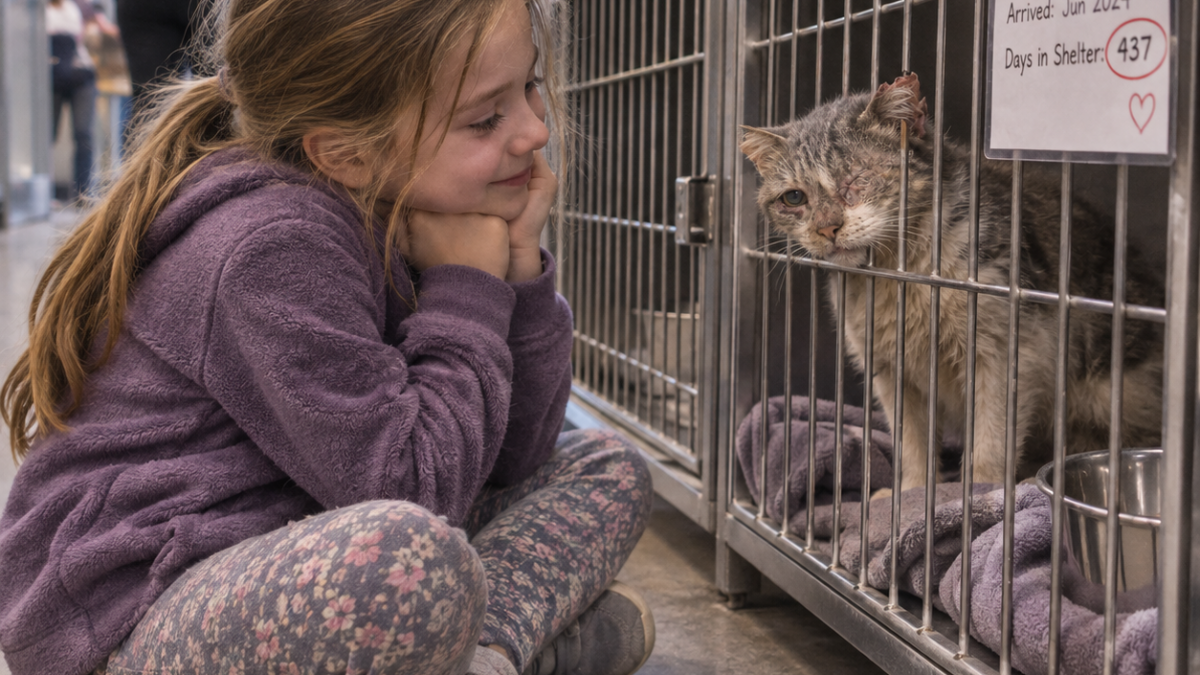
My 8-Year-Old Walked Past Every Kitten in the Shelter—Then She Sat Down Beside the 14-Year-Old Cat Nobody Had Chosen in 437 Days.
We took our eight-year-old daughter to the shelter for her birthday and told her she could choose any cat she wanted, so naturally I expected her to fall in love with the smallest, fluffiest kitten in the building.
Instead, she walked past every kitten, sat cross-legged on the concrete floor in front of a fourteen-year-old one-eyed cat who had been ignored for 437 days, and waited until he finally turned away from the wall to look at her.
Then she slipped her fingers through the bars, looked up at me, and said something so simple that every adult standing in that hallway went quiet.
My daughter’s name is Lily.
She turned eight last Saturday.
For the three months leading up to her birthday, she talked about almost nothing except getting a cat.
Not in the exhausting way children sometimes talk about wanting something.
There were no tantrums.
No daily negotiations.
No handwritten contracts promising she would clean the litter box “FOREVER AND EVER.”
She simply kept returning to the subject.
At breakfast.
In the car.
While brushing her teeth.
At bedtime.
“Dad, do cats know their names?”
“Usually.”
“Do old cats play?”
“Some do.”
“Can cats be sad?”
“I think so.”
“What if a cat doesn’t like me?”
“Then you give it time.”
“What if it never likes me?”
“Then you still take care of it.”
She would think about that.
Then ask something else.
My wife, Rachel, was the one who finally said it.
“What if we let her adopt one?”
I was standing at the kitchen sink.
“Now?”
“For her birthday.”
“We said no pets until she was older.”
“She is older.”
“She’s eight.”
“Exactly.”
“That is not what I meant.”
Rachel smiled.
We had talked about pets before.
We both grew up with animals.
PART2:
I had a dog through most of my childhood.
Rachel had cats.
Two of them.
One lived to nineteen.
But after Lily was born, life became complicated.
Work.
Childcare.
Moving twice.
A new mortgage.
My father getting sick.
Then recovering.
Then getting sick again.
We always found a reason to wait.
Lily had been asking for a cat since she was five.
By eight, she had stopped asking every week.
That was probably what finally convinced me.
She still wanted one even after the excitement had settled into something quieter.
So Rachel and I agreed.
One cat.
Shelter adoption.
Lily could choose.
We did not specify age.
Did not specify color.
Did not specify male or female.
We said:
“Any cat that the shelter says is a good fit for our family.”
Lily stared at us.
“Really?”
“Really.”
“Even a black cat?”
PART3:
“Yes.”
“A white cat?”
“Yes.”
“A cat with three legs?”
Rachel looked at me.
“Yes.”
“A kitten?”
“Yes.”
“A really fluffy one?”
“Yes.”
“A really ugly one?”
“Lily.”
“What?”
Rachel tried not to laugh.
“We don’t call animals ugly.”
“I mean one that looks weird.”
“You can choose the weird one too.”
That seemed to satisfy her.
The shelter was called Maple County Animal Rescue.
It sat just outside town beside a veterinary clinic and a county maintenance yard.
We had visited once before during a school fundraiser.
Lily remembered the kitten room.
Of course she did.
Everybody remembers the kitten room.
If you have ever walked into a shelter during kitten season, you know what I mean.
It is chaos designed specifically to defeat adult judgment.
Tiny paws.
Big eyes.
Cats climbing over one another.
One sleeping in a food dish.
Another trying to scale the cage bars.
A black kitten hanging upside down from a blanket for reasons known only to him.
A calico chasing her own tail.
Two orange kittens wrestling like miniature drunk men outside a bar.
Every child entering that room makes the same sound.
“Ohhhhhhh.”
Lily did too.
She stood in the doorway.
Eyes wide.
Hands pressed together.
Rachel looked at me.
This is going to be easy, her expression said.
I thought so too.
A shelter volunteer named Maria greeted us.
She was maybe in her thirties, wearing jeans and a green shelter T-shirt covered in cat hair.
“Birthday girl?”
Lily nodded.
“How old?”
“Eight.”
“Big day.”
“I get to pick a cat.”
Maria looked at us.
“Any restrictions?”
“Indoor only,” I said.
“No other pets at home.”
Rachel added:
“We’d like one reasonably comfortable with children.”
Maria nodded.
“We have plenty.”
Then she opened the kitten-room door.
Lily entered.
Every kitten became aware of her immediately.
One tabby shoved his face through the bars.
A white kitten started climbing.
A tiny tuxedo cat reached one paw toward Lily’s sleeve.
This should have been over in thirty seconds.
Instead, Lily walked slowly.
One cage.
Then another.
She smiled.
She laughed when an orange kitten attacked his own tail.
She let a volunteer place a tiny gray kitten in her lap.
The kitten climbed onto her shoulder.
Lily giggled.
Rachel looked at me again.
I mouthed:
That one.
She mouthed back:
Obviously.
Lily held the kitten for about a minute.
Then gave him back.
“Can I see the other cats?”
Maria looked surprised.
“The adult room?”
“Yes.”
“Of course.”
We left the kitten room.
I followed Lily into the hallway of adult cats.
The energy changed immediately.
Fewer squeaks.
Less motion.
Cats sleeping.
Cats sitting quietly.
Cats watching.
Some came to the doors.
Some did not.
The first adult cat was a huge orange male named Cheddar.
Seven years old.
Twenty pounds.
Lily laughed.
“He’s enormous.”
“He’s on a diet,” Maria said.
Cheddar looked offended.
The next was a black female named Willow.
Four years old.
She pressed against the cage door for attention.
Lily stroked her through the bars.
“Sweet girl.”
Then kept walking.
A young Siamese mix.
A three-year-old tabby.
Two bonded sisters.
A white cat with blue eyes.
A long-haired black-and-white male.
Lily stopped at each.
Not long.
Just enough to read the card.
Then she continued.
The hallway turned.
At the far end was another row.
Older cats.
Medical cases.
Cats waiting longer.
I did not know that then.
I only knew the room was quieter.
Lily slowed.
At the bottom corner cage, almost at floor level, she stopped.
There was a paper card clipped to the front.
BEAN.
MALE.
DOMESTIC SHORTHAIR.
14 YEARS.
ARRIVAL DATE: JUNE 2024.
Below that:
LONG-TERM RESIDENT.
Lily crouched.
I looked into the cage.
At first, I thought it was empty.
Then I saw him.
Bean was lying at the very back.
Facing the wall.
Gray-brown tabby.
Thin.
His left eye was missing completely.
Not injured recently.
The socket had healed closed, leaving a shallow depression beneath the fur.
His right ear was half gone.
Not neatly tipped.
Torn.
Jagged.
An old injury.
There was a scar across the bridge of his nose.
His fur around the neck was sparse.
His hips looked sharp.
I am going to say something that sounds cruel.
Bean was not beautiful.
Not in the way shelter posters use the word.
Not photogenic.
Not the cat people stopped beside because they could imagine him on a Christmas card.
He looked worn.
Like life had happened to him too many times.
Lily sat down.
Cross-legged.
Right there on the concrete floor.
Rachel and I stood behind her.
Bean did not turn around.
Lily said nothing.
Thirty seconds.
A minute.
I started to ask if she wanted to keep looking.
Rachel put one finger against her lips.
So we waited.
Bean’s ear moved.
The damaged one.
Then slowly, he turned his head.
One eye.
Yellow-green.
Cloudy around the edge.
He looked directly at Lily.
She stayed still.
Then she slid two fingers between the cage bars.
Not reaching toward him.
Just leaving them there.
Bean watched.
Nothing happened.
Another minute passed.
Maybe two.
Shelter time is strange.
You become aware of every tiny movement.
Bean shifted.
Got his front paws beneath him.
Stopped.
Then stood.
His back legs were stiff.
He took one step.
Then another.
He moved toward the door so slowly that I wondered if he might change his mind.
Lily did not move.
Bean reached the bars.
Sniffed her fingers.
Then did something I will remember for the rest of my life.
He lowered his head.
And pressed his forehead against her hand.
Not hard.
Just contact.
Lily inhaled.
Then looked up at me.
“This is him.”
I blinked.
“What?”
“This is the cat I want.”
I looked at Bean.
Then toward the hallway full of healthy younger cats.
“Sweetheart, we can keep looking.”
“No.”
“You haven’t seen all of them.”
“I don’t need to.”
Rachel crouched beside her.
“Why Bean?”
Lily looked back at the cat.
Then at us.
“Because nobody else is going to pick him.”
Nobody spoke.
Maria, who had been standing several feet away, looked down.
I thought Lily was guessing.
Children say dramatic things.
I looked at the card again.
Arrival date.
June 2024.
I pulled out my phone.
Did the math.
Four hundred thirty-seven days.
I thought I had counted wrong.
“Maria?”
She came closer.
“How long has he actually been here?”
Her face changed.
“Four hundred thirty-seven days today.”
Lily looked at her.
“That’s more than a year.”
“Yes.”
“Why?”
Maria glanced at us.
Then at Bean.
“Can I be honest?”
“Please,” Rachel said.
“He’s old.”
She crouched.
“And he looks old.”
Lily frowned.
“What does that mean?”
Maria took a breath.
“People come in wanting kittens. Or younger cats.”
She gestured toward Bean.
“And when they see his eye and ear, most don’t stop.”
“Does it hurt?”
“His eye?”
Lily nodded.
“No. It healed a long time ago.”
“His ear?”
“Also old.”
“What happened?”
“We don’t know everything.”
Bean had arrived through county animal control.
Found behind an abandoned garage.
Underweight.
Severe eye injury.
Ear infection.
Old wounds.
The left eye could not be saved.
Veterinarians removed it.
The ear was already partially torn when he arrived.
He healed.
He was friendly enough.
But cautious.
No known owner.
No microchip.
Nothing to explain the years before.
“How old was he when he came here?” Lily asked.
“About thirteen.”
“And he’s fourteen now.”
“Yes.”
“That means he had his birthday here.”
Maria swallowed.
“Yes.”
That bothered Lily.
I could tell.
“Did he get a birthday?”
Maria smiled sadly.
“We gave him tuna.”
“That’s good.”
“It was.”
Lily looked into the cage.
Bean had moved back slightly.
But he was still facing her.
Maria continued.
“People have looked at him.”
“How many?”
“I don’t know.”
“A lot?”
“Yes.”
“And nobody wanted him?”
I wanted to interrupt.
The word wanted sounded too harsh.
Maria answered carefully.
“People wanted different things.”
“Like kittens.”
“Yes.”
Lily thought about that.
Then:
“Does Bean know?”
I looked at her.
“What?”
“Does he know people don’t pick him?”
Maria’s face changed again.
“I don’t know what cats understand.”
Lily waited.
Maria added:
“But he used to come to the front whenever anyone walked by.”
“When?”
“When he first got here.”
“What happened?”
Maria glanced toward Bean.
“About six months ago, he stopped.”
My stomach tightened.
“Stopped what?”
“Coming forward.”
“He stays back there?”
“Most days.”
“Facing the wall?”
Maria nodded.
“Sometimes.”
Rachel looked away.
Lily did not.
She leaned closer to the cage.
“Bean.”
His ear moved.
“You came for me.”
Bean looked at her.
Maria stood.
“I can open the cage if you’d like to meet him properly.”
Lily nodded.
We moved into a small visitation room.
Blankets.
Two chairs.
Cat tree.
Toys.
Bean arrived in a carrier because shelter policy required staff transport.
When Maria opened it, he did not come out.
Lily sat on the floor.
Same posture.
Cross-legged.
Waiting.
Five minutes.
Bean stayed inside.
I began worrying.
Not because he was doing anything wrong.
Because suddenly I understood what adopting him meant.
Fourteen years old.
Medical history.
Probably arthritis.
One eye.
Unknown past.
Potential vet bills.
Potential kidney disease.
Dental problems.
Maybe only months.
Maybe a year.
Maybe two.
We had promised Lily any cat.
But like most adults, I had made that promise while subconsciously imagining an easy version.
A kitten.
Healthy.
Years ahead.
Something that grew up with her.
I looked at Rachel.
She was thinking the same thing.
I could tell.
Maria crouched beside us.
“Can I give you some information before you decide?”
I nodded.
Bean had mild arthritis.
Early kidney changes, though nothing requiring medication yet.
He needed senior bloodwork.
Dental cleaning might become necessary.
Because of his age, he should have regular veterinary monitoring.
He might need a quieter home.
He had lived around other cats in the shelter but preferred not to interact.
He had never shown aggression toward staff.
He disliked being picked up.
He liked his chin scratched.
He ate wet food better than dry.
He sometimes missed the litter box when stressed.
And there was no way to know how long he had.
“We understand,” Rachel said.
I was not sure I did.
Lily did not appear bothered.
“Can he sleep in my room?”
“If he wants to,” Maria said.
“Can he get on a bed?”
“He can jump some.”
“I have a little stool.”
Bean’s head appeared at the carrier opening.
Lily stopped speaking.
He stepped out.
One paw.
Then another.
He looked around.
Saw me.
Saw Rachel.
Then saw Lily.
He walked straight toward her.
No hesitation this time.
He stopped beside her knee.
Lily held out her hand.
Bean pushed his head underneath it.
Then sat.
That was all.
But it was enough.
I sat down on the chair.
“Lily.”
She looked at me.
“You understand he’s very old.”
“Yes.”
“He may get sick.”
“Yes.”
“He may need medicine.”
“I can help.”
“He might not live for many years.”
I hated saying it.
Lily looked down at Bean.
Then said:
“That doesn’t mean he shouldn’t have a home now.”
I looked at Rachel.
She looked at me.
There are moments when children reveal that most adult reasoning is simply fear wearing nicer clothes.
I was afraid Lily would love Bean and lose him.
That was true.
I was afraid we would spend money on an old cat.
Also true.
I was afraid adopting him would turn her birthday into a lesson about death too soon.
True again.
But none of those fears answered the question in front of us.
Did Bean deserve a home?
Of course.
Was Lily asking to give him one?
Yes.
Then what exactly was I protecting her from?
Love?
Loss?
Both arrive anyway.
I said:
“All right.”
Lily stared.
“Really?”
“Really.”
She threw her arms around me.
Bean startled.
Lily immediately pulled back.
“Sorry.”
That made Maria laugh.
Then Maria cried.
Not metaphorically.
Actual tears.
She turned away and wiped both cheeks.
“I’m sorry.”
Rachel touched her arm.
“You okay?”
Maria laughed through tears.
“Yes.”
Then she looked at Bean.
“I’ve watched him get passed over for fourteen months.”
Nobody said anything.
“I thought he was going to die here.”
Lily looked horrified.
Maria immediately corrected herself.
“No, sweetheart. Not because he was sick. I just mean…”
She struggled.
“He’s old. And sometimes older animals wait longer than they have.”
That was the sentence.
Older animals wait longer than they have.
I looked at Bean.
Four hundred thirty-seven days.
How many mornings had staff turned on the lights and found him still there?
How many adoption events?
How many families?
How many kittens leaving in carriers while he remained in the bottom corner?
The number stopped being abstract.
Four hundred thirty-seven breakfasts.
Four hundred thirty-seven nights.
Four hundred thirty-seven times lights turned off.
We signed the adoption papers.
There was a fee.
It had been waived for Bean because he was a long-term senior resident.
That somehow hurt too.
Nobody even had to pay.
Still nobody had taken him.
Maria brought out a paper bag.
Inside:
His medical records.
A small bag of his current food.
A blanket.
Medication from a recent arthritis flare.
Two cans of wet food.
And a toy mouse.
“Does he play with this?”
“No.”
“Then why—”
“Hope.”
Maria smiled.
“We keep trying.”
Lily took the mouse.
“He might play at home.”
Maybe.
The entire shelter seemed to know Bean was leaving.
Employees came from the front desk.
A man from animal care.
Another volunteer.
One woman said:
“Bean?”
Maria nodded.
“He’s adopted.”
The woman covered her mouth.
“You’re serious?”
Lily held the carrier.
“He’s mine.”
“Who picked who?”
Lily thought.
“He picked my fingers first.”
The woman knelt.
“Good luck, old man.”
Bean stared through the carrier door.
Another employee brought a small fleece blanket.
“His favorite.”
“Really?”
“He sleeps on it.”
Lily immediately tucked it under the carrier.
One employee took a photograph for the shelter page.
We agreed.
Lily crouched beside Bean’s carrier.
The caption later read:
AFTER 437 DAYS, BEAN HAS LEFT THE BUILDING.
I did not see it until that night.
By then, the post had hundreds of comments.
Former volunteers remembered him.
People wrote things like:
I can’t believe Bean finally got adopted.
Best news all week.
Tell that little girl she has a huge heart.
Thank you for choosing the senior.
I showed Lily.
She did not seem impressed.
“Why does everyone know Bean?”
“Because he was there a long time.”
She looked toward her bedroom.
“He’s not there anymore.”
No.
He wasn’t.
The drive home took twenty-seven minutes.
Bean did not make a sound.
Lily sat beside the carrier.
One hand resting near the door.
Every few minutes, she said:
“We’re almost home.”
I almost told her cats do not understand time estimates.
Then decided it did not matter.
At home, we prepared one room first.
Shelters recommend giving cats a small safe space.
Litter box.
Food.
Water.
Bed.
Hide places.
We chose Lily’s room because she insisted.
Bean’s carrier went on the floor.
Door open.
We left him alone.
For ten minutes, nothing.
Then Bean came out.
Sniffed.
Walked behind the dresser.
Stayed.
Lily sat on the bed.
“I won’t bother him.”
Good.
An hour.
Nothing.
Two hours.
Still behind dresser.
Lily checked from a distance.
“He’s okay.”
At three hours, I started getting concerned.
Maria had warned us.
Long-term shelter cats can take time.
Days.
Weeks.
Some hide.
Some barely eat at first.
Some pace at night.
Some do not sleep deeply for a long time.
The shelter had been Bean’s world for more than a year.
A house might feel enormous.
At three hours and twelve minutes, Bean emerged.
I happened to be standing in the hallway.
He walked past me.
Slow.
One room at a time.
Living room.
Kitchen.
Dining room.
Back hallway.
He sniffed everything.
Then turned.
Went back toward Lily’s room.
She was sitting on her bed reading.
Bean stopped at the doorway.
Lily froze.
“Hi.”
Bean entered.
He looked at the bed.
It was not particularly high.
But high enough for an arthritic fourteen-year-old cat to think about it.
Lily had already placed a small wooden step beside the frame.
She had remembered.
Bean stepped onto it.
Then onto the mattress.
Turned twice.
Lay down.
Lily looked at me.
I whispered:
“Don’t move.”
She barely breathed.
Bean stretched.
His head rested near the pillow.
Lily slowly lay beside him.
Not touching.
Five inches between them.
Bean closed his one eye.
Then the sound started.
Purring.
At first quiet.
Then louder.
I stood in the doorway.
Rachel appeared behind me.
“Is that him?”
“Yes.”
Bean purred.
And purred.
And purred.
We ate dinner downstairs.
The sound could still be heard when we checked later.
Eight o’clock.
Purring.
Nine.
Still.
Ten-thirty.
Still.
Near midnight, I went into Lily’s room.
She was asleep.
Bean lay on the pillow beside her head.
His damaged ear flattened gently against the pillowcase.
His one eye half closed.
Purr.
Purr.
Purr.
I took the photograph.
Not because I planned to post it.
Because I needed proof.
Bean’s first night.
Four hundred thirty-eight.
Except not in a cage.
At 12:17, he was still purring.
Six hours.
Maybe more.
I do not know when he stopped.
In the morning, I found him under the blanket with Lily.
She had somehow turned during the night without disturbing him.
Bean’s head stuck out near her shoulder.
Breakfast changed our understanding of him.
At the shelter, Maria had said he preferred wet food.
Preferred was an understatement.
Bean heard the can open from upstairs.
He appeared in the kitchen with the speed of an animal twenty years younger.
I stared.
“You can move like that?”
Lily laughed.
“He’s hungry.”
Bean yelled.
Not meowed.
Yelled.
A deep rusty sound.
“Apparently.”
He ate the entire bowl.
Then looked at us.
“We’re done,” I said.
Bean yelled again.
Lily said:
“He wants more.”
“He is manipulating you.”
Bean stared.
“He only has one eye, Dad.”
“That eye works perfectly.”
She gave him another spoonful.
Within two days, Bean had established rules.
Breakfast at six-thirty.
Dinner at five-thirty.
Lily’s bedroom belonged to him.
The blue chair beside the window also belonged to him.
The couch belonged to him between three and five in the afternoon.
Nobody was allowed to close the bathroom door completely.
He hated the vacuum.
He liked tuna.
He disliked chicken.
He tolerated me.
He loved Rachel.
He worshipped Lily.
If Lily left the room, Bean watched.
If she went upstairs, he eventually followed.
If she read, he sat beside her.
Homework?
On the workbook.
Drawing?
On the paper.
Sleeping?
Pillow.
Four hundred thirty-seven days facing a shelter wall.
Within a week, Bean wanted to be everywhere we were.
That first week included our first scare.
Bean missed the litter box.
Not dramatically.
He urinated beside it.
I remembered Maria’s warning.
Stress.
Old age.
Could happen.
I cleaned it.
The next day, same.
Rachel called the veterinarian.
We were told to bring him in.
Urinalysis.
Bloodwork.
Nothing acute.
Mild kidney disease.
Common in seniors.
The vet suggested a lower-entry litter box because arthritis might make climbing uncomfortable.
We bought one.
Problem solved.
That was another lesson.
Behavior often has a reason.
Not spite.
Not revenge.
Not “bad cat.”
Discomfort.
We began noticing Bean’s limitations.
He could jump.
But calculated carefully.
Stairs took time.
He had trouble seeing things approaching from his missing-eye side.
If I moved too quickly from the left, he startled.
So we learned.
Approach from the right.
Speak before touching.
Small stools beside furniture.
Rugs on slippery floors.
Lily became the expert.
“Dad, don’t come from his blind side.”
“I forgot.”
“You always forget.”
“I’m old too.”
“You have two eyes.”
Fair.
At school, Lily had to write about her birthday.
Most children wrote about gifts.
A trampoline.
Video game.
New bike.
Lily wrote about Bean.
Her teacher emailed us.
The last line said:
Everyone wanted the kittens, so I picked the cat that waited the longest.
The teacher said she cried.
Apparently Bean had become an efficient adult-crying machine.
Two weeks after adoption, Maria called.
“How’s our guy?”
“Your guy is destroying my sleep.”
“What?”
“He screams at six-fifteen.”
Maria laughed.
“That’s new.”
“He didn’t do that there?”
“No.”
“Why?”
“Shelter breakfast is predictable.”
I thought.
“So screaming is good?”
“Actually…”
Maria paused.
“It might be.”
“How?”
“He’s asking for things.”
That sentence changed the way I saw everything.
Bean asks for things.
At the shelter, he had stopped coming forward.
Stopped expecting.
At our house, he complained.
About food.
Doors.
Being moved from pillows.
He followed people.
Demanded water from the sink even though his bowl was full.
He had preferences again.
Annoyance requires expectation.
You do not complain when you believe nobody is listening.
Bean was learning that somebody was.
Lily took this as permission to spoil him.
I fought a losing battle.
“No table food.”
“He likes turkey.”
“No.”
“He’s fourteen.”
“That is not a legal defense.”
“He doesn’t have many years.”
There it was.
First time she said it.
I stopped.
Lily looked down.
“So he should have turkey.”
I gave Bean turkey.
That night, Rachel said:
“You know she’s thinking about it.”
“Death?”
“Yes.”
“I hoped she wasn’t.”
“She’s eight, not stupid.”
“I know.”
“You tried to talk her out of Bean because of it.”
“I didn’t try.”
“You suggested looking more.”
“That was responsible.”
“It was fear.”
I sighed.
“Both.”
Rachel sat beside me.
“Lily knows he’s old.”
“Knowing and understanding are different.”
“Yes.”
“She’s going to get hurt.”
“Yes.”
That answer irritated me.
“You’re not supposed to agree that quickly.”
“What should I say?”
“I don’t know.”
Rachel looked toward the hallway.
Bean was asleep near Lily’s bedroom door.
“Maybe being hurt later doesn’t mean choosing him now was wrong.”
I knew.
But parents are wired to prevent pain.
Sometimes so wired that we risk preventing the love that causes it.
A month after adoption, Bean returned to the shelter for a follow-up event.
Not because he needed to.
Lily wanted to show everyone.
We put him in a carrier with his fleece blanket.
When we entered Maple County, Maria heard his name.
She came running.
“Bean!”
He stared.
Maria crouched.
“You look fat.”
He had gained almost a pound.
Lily corrected:
“He’s healthier.”
“Sorry.”
Bean sniffed Maria’s fingers.
Then pushed his forehead against them.
She cried again.
“Do you just cry at work all day?” I asked.
“Pretty much.”
Other staff came.
Bean tolerated the attention.
Then the weirdest thing happened.
A woman entered with two children looking for a kitten.
She saw Bean.
“Is that the old cat?”
Maria smiled.
“Former old shelter cat.”
The woman looked at Lily.
“You adopted him?”
Lily nodded.
“Why?”
Adults asked that question constantly.
Lily had developed an answer.
“He needed a house more.”
The woman looked uncomfortable.
Not offended.
Just forced to think.
Her children looked toward the senior-cat hallway.
One asked:
“Do you have more old cats?”
Maria smiled.
“Yes.”
The family went to look.
I do not know what they adopted that day.
Maybe a kitten.
Maybe nothing.
The point was not that everyone had to choose the oldest animal.
The point was stopping.
Seeing.
Considering.
Bean had taught Lily that naturally.
Adults needed reminders.
Fall arrived.
Bean loved the window.
Sunlight pooled on the blue chair in Lily’s room around eleven.
He slept there every day.
His fur improved.
The sparse area around his neck filled slightly.
Not fully.
His scars remained.
His missing eye remained.
His torn ear remained.
But after months, I stopped seeing them first.
That surprised me.
At the shelter, they were Bean.
One eye.
Damaged ear.
Scar.
At home, Bean was:
The cat who yelled at cabinets.
The cat who stole Lily’s pillow.
The cat who refused expensive cat beds.
The cat who sat beside Rachel while she worked.
The cat who bit my shoelaces exactly once and then acted embarrassed.
The cat who climbed into empty laundry baskets.
The injuries became details.
Not identity.
That made me understand something about shelter photographs.
People make decisions in seconds.
A cage card.
A face.
Age.
Appearance.
You see the missing eye before you learn the cat sleeps beside children.
You see fourteen before you discover he loves turkey.
You see scars before personality has time to arrive.
Bean had lived behind those first impressions for 437 days.
At home, time gave him the chance to become more.
Christmas was ridiculous.
Lily insisted Bean needed a stocking.
We bought one.
She wrote BEAN in glitter.
Bean attacked the stocking.
Then slept beneath the Christmas tree.
We took too many photos.
The shelter had an online holiday fundraiser.
They asked former adopters for updates.
Lily dictated:
Bean likes our house. He sleeps with me every night. He yells for food. He does not like when Dad sneezes. He is very good except he steals my pillow.
We sent a photograph.
The shelter posted it beside his original intake photo.
I had never seen that photo.
Bean on arrival.
Thinner.
Eye damaged.
Ear infected.
Standing inside a stainless-steel kennel.
He looked exhausted.
Then current Bean.
On Lily’s bed.
Rounder.
Fur clean.
One eye half closed.
That crooked ear on the pillow.
A small piece of him touching Lily’s arm.
The caption said:
437 DAYS WAITING. 4 MONTHS HOME.
The post went viral locally.
Hundreds of comments.
One person wrote:
That little girl saved him.
Lily read it.
Then frowned.
“I didn’t save him.”
“What do you mean?”
“The shelter saved him.”
She pointed at the intake photograph.
“They fixed his eye.”
True.
“So what did you do?”
“I took him home.”
Simple.
Maybe rescue language sometimes makes ordinary care sound heroic.
The shelter saved Bean’s life medically.
Lily gave him somewhere to spend it.
Both mattered.
Winter was hard on his arthritis.
We noticed him hesitate before stairs.
Dr. Ames—the same veterinarian the shelter used—recommended medication.
First dose.
Bean hated it.
Foam at mouth.
Ran away.
Lily cried because she thought we hurt him.
We found a compounded version flavored like fish.
Bean accepted it.
Within a week, he moved better.
Medicine became routine.
Morning:
Food.
Pill.
Chin scratch.
Night:
Food.
Pill.
Bed.
Lily never forgot.
I forgot twice.
Both times she reminded me.
“Dad, Bean’s medicine.”
Parents talk about teaching children responsibility through pets.
Mostly Bean taught us.
Lily became observant.
She noticed when he drank more water.
When he slept longer.
When his eye looked watery.
When he ate half a meal instead of all.
Sometimes I worried she watched too closely.
“Let him just be a cat.”
“I am.”
“You don’t have to check everything.”
“I want him to be okay.”
There it was again.
Fear.
Her version.
One night she asked:
“How old do cats live?”
We were in the living room.
Bean asleep beside her.
I wanted to lie.
Not directly.
Just be vague.
“Depends.”
“Like what?”
“Health. Genetics. Luck.”
“What’s the oldest?”
“Some cats live into their twenties.”
“Will Bean?”
“I don’t know.”
She stroked his head.
“He’s fifteen soon.”
“Yes.”
“Could he die this year?”
I hated parenting.
“Yes.”
Lily stared at Bean.
Then asked:
“Could you?”
I laughed once.
“Technically.”
“Mom?”
“Yes.”
“Me?”
“Technically.”
She looked annoyed.
“That doesn’t help.”
“No.”
She was quiet.
Then:
“I just don’t want him to think he got a family and then we leave him.”
I realized she had reversed the fear.
I thought she was worried Bean would leave her.
She was worried we would leave Bean.
“We’re not going anywhere.”
“What if he gets sick?”
“We take care of him.”
“What if he gets really sick?”
“We keep him comfortable.”
“What if he dies?”
I swallowed.
“We stay with him.”
Lily nodded.
That was what she needed.
Not a promise of survival.
A promise of presence.
Bean turned fifteen in our house.
Lily insisted on a birthday party.
We estimated the date because nobody knew his real one.
She picked the anniversary of his adoption.
“His home birthday.”
Fine.
Tuna.
No candles near cat whiskers.
A little paper crown Bean refused.
One photograph.
Maria came.
Bean ignored everyone and ate tuna.
Perfect.
At dinner, Lily said:
“This is his first birthday here.”
I said:
“Technically.”
Rachel kicked me under the table.
Lily continued.
“He had his last birthday at the shelter.”
“Yes.”
“He’ll have all the next ones here.”
The room went quiet.
I looked at Rachel.
Lily noticed.
“What?”
“Nothing.”
She understood anyway.
“Until he dies.”
“Yes.”
“Still here.”
“Yes.”
That became our family rule.
Still here.
In his second year with us, Bean developed kidney disease beyond the early stage.
Nothing catastrophic.
New food.
More frequent bloodwork.
Hydration.
We bought a fountain.
He ignored it.
We bought another.
Ignored.
We put a ceramic mug beside the sink.
He drank from that.
Cats.
The vet said:
“Whatever works.”
Lily decorated the mug.
BEAN WATER ONLY.
I accidentally drank from it once.
Lily was horrified.
“You contaminated it.”
“I am a human being.”
“Exactly.”
Bean survived.
Not because of miracles.
Because kidney disease can progress slowly.
We managed.
He slept.
Ate.
Yelled.
Loved.
Sometimes slept sixteen hours.
Then eighteen.
But when Lily returned from school, his head always lifted.
At eleven, she had become taller.
Less little-girl voice.
Longer hair.
New friends.
More homework.
She still went straight to Bean.
The shelter photo remained framed in her room.
Bean behind bars.
Facing forward that day.
Beside it, first-night photo.
Pillow.
One eye.
Crooked ear.
I once asked:
“Why keep the shelter picture?”
“So I remember.”
“What?”
“That he waited.”
That answer stayed with me.
By Bean’s third year home, we had stopped counting how long he had been adopted compared with shelter time.
At first:
One month home.
Six months.
One year.
Eventually, home became larger.
The shelter became the shorter chapter.
That felt important.
His 437 days had seemed enormous when we adopted him.
Then home days accumulated.
Day 438.
1,000.
One afternoon, Lily came downstairs holding a calendar.
“Dad.”
“What?”
“Bean has been home longer than he was at the shelter.”
I stopped.
We calculated.
She was right.
She smiled.
“So now he’s mostly ours.”
I knew what she meant.
Not ownership.
Memory.
More days with us than behind bars.
That night, Bean slept on her pillow.
Same position as the first night.
Older.
Thinner again.
But purring.
Lily took another photograph.
Two images.
Years apart.
Same bed.
Same cat.
Different child.
At eight, Lily had round cheeks and missing front teeth.
Now eleven.
Growing.
Bean remained beside her.
That contrast hurt beautifully.
Senior adoption gives you a strange relationship with time.
You expect the animal to be temporary.
Then children change faster than the pet disappears.
Bean watched Lily grow.
He sat beside her when she learned multiplication.
When she practiced flute badly.
Very badly.
Bean left the room during flute.
Smart.
He sat on her papers during middle-school applications.
He slept beside her when her best friend moved away.
The first time a boy hurt her feelings, Bean was there.
I overheard her telling him:
“He’s stupid.”
Bean purred.
“Thank you.”
Supportive.
At fourteen—Lily fourteen, Bean roughly twenty? No. Bean would be older by then, but he did not make it that far.
The decline began when Bean was seventeen.
Three years after adoption.
His kidney disease worsened.
Weight loss.
Appetite changed.
He became dehydrated easily.
We learned subcutaneous fluids.
The first time, I thought Lily should leave the room.
She refused.
“I can help.”
We hung the fluid bag.
Inserted needle beneath loose skin.
Bean complained.
Lily fed him squeeze-tube treats.
We did it twice weekly.
Then three times.
He felt better afterward.
Still slept with Lily.
Still wanted breakfast.
Still purred.
Quality of life.
That phrase entered our house.
I hated it.
Necessary phrase.
Hateful phrase.
How many good things?
How many bad?
Does he still eat?
Does he seek you?
Can he move?
Is he comfortable?
Parents spend years measuring children’s growth.
Then suddenly you measure an animal’s decline.
Lily knew.
One night, she came into our bedroom.
“Bean didn’t finish dinner.”
“I know.”
“Is it happening?”
I did not pretend not to understand.
“Maybe not tonight.”
“But soon?”
“Yes.”
She cried.
I held her.
“I don’t want him to die.”
“I know.”
“He waited 437 days.”
“I know.”
“He only got three years.”
I wanted to say three years is a lot.
It was.
It was not.
Both.
“He got you.”
She cried harder.
That sounded like consolation.
I meant it differently.
Bean got mornings.
Sun.
Turkey.
A pillow.
Medicine.
A child growing beside him.
He got a home long enough to become ordinary.
That matters.
Still, grief does not care about philosophy.
Bean rallied.
For two months.
Ate better.
Sat in the window.
One afternoon, he even chased a string.
Three jumps.
Lily screamed:
“DAD!”
I ran upstairs thinking emergency.
Bean attacked string.
“You scared me.”
“He’s playing!”
We watched.
Three minutes.
Then Bean lay down like he regretted youthful behavior.
That became one of my favorite memories.
At seventeen.
One eye.
Half an ear.
Kidney disease.
Still enough cat to hunt yarn.
The final week came in March.
Bean stopped eating wet food.
Then tuna.
Then turkey.
When Bean refused turkey, we knew.
Dr. Ames examined him.
Kidney values very poor.
He was weak.
Nauseated.
We could hospitalize.
IV fluids.
Maybe a few days.
Maybe weeks.
Maybe not.
Lily sat beside him in the exam room.
Bean’s head on her leg.
Dr. Ames spoke gently.
“What matters now is what Bean would choose if he could tell us.”
Lily asked:
“Does he hurt?”
“Probably uncomfortable. We can help some.”
“Can you make him better?”
“Not better the way you mean.”
Lily looked at me.
I wanted to take the decision from her entirely.
She was eleven.
Still a child.
It was our responsibility.
Not hers.
We brought Bean home.
One more night.
Not because we wanted him to suffer.
Because the vet said medication could keep him comfortable until morning and we wanted home.
His bed.
His room.
His person.
Bean did not use his cat bed.
Of course.
He climbed Lily’s little wooden step.
Slow.
Onto the mattress.
That step was the same one we had placed three years earlier.
He reached the pillow.
Lay down.
Lily lay beside him.
I stood at the doorway like the first night.
Except no purring.
Not at first.
Lily stroked between his ears.
“Remember me?”
Bean opened his eye.
She laughed and cried.
“Of course you do.”
Then a faint purr began.
Soft.
Uneven.
Nothing like six hours.
Enough.
I left them alone.
Around midnight, Lily came downstairs.
“Dad?”
I was awake.
“Yeah?”
“Can I ask something?”
“Anything.”
“Do you think he knew I picked him?”
I sat beside her.
“What do you mean?”
“Like at the shelter.”
“Yes.”
“How?”
“I don’t know.”
“Do cats know when they’re going home?”
“I don’t know.”
She thought.
“Do you think he thought I was going to leave too?”
That hurt.
“Maybe at first.”
“He came to my hand.”
“Yes.”
“I waited.”
“You did.”
She looked upstairs.
“Maybe that’s why.”
“Why what?”
“He trusted me.”
Maybe.
Lily had done the first thing Bean needed before adoption.
Nothing.
She sat.
She did not demand affection.
Did not tap the cage.
Did not call him.
Did not force him to perform.
She offered presence.
Bean decided.
Maybe that was why.
“Dad?”
“Yeah?”
“I’m glad we didn’t get a kitten.”
“Me too.”
“Even though this hurts?”
I looked at her.
“Yes.”
She nodded.
“Me too.”
The veterinarian came to the house the next afternoon.
Maria came too.
We had asked if she wanted to.
She arrived crying before she entered.
“Sorry.”
“You’re consistent,” I said.
She laughed.
Bean lay on Lily’s bed.
Maria sat beside him.
“Hi, old man.”
Bean opened his eye.
She touched his cheek.
“You did it.”
Lily asked:
“What?”
Maria looked at her.
“He got out.”
That was all.
He got out.
Not physically.
The shelter doors.
The cage.
The waiting.
He had not died in the bottom corner facing a wall.
That had been Maria’s fear.
Now he would die on a child’s pillow after three years of being wanted.
The vet explained the process.
Lily wanted to stay.
We allowed it.
Some people will disagree.
That is okay.
We knew our daughter.
She had asked for presence.
We had promised.
Bean lay between us.
Rachel near his back.
Lily at his head.
I sat at the foot of the bed.
Maria near the door.
The vet gave sedation.
Bean relaxed.
Lily whispered:
“You don’t have to wait anymore.”
I cried.
Because I understood.
437 days.
Waiting for someone to stop.
Waiting for someone to sit.
Waiting for someone to choose him.
Now no waiting.
He had his person.
Bean’s head rested in Lily’s palm.
The vet gave the final medication.
His breathing slowed.
Stopped.
The room remained still.
Lily touched his damaged ear.
Then the closed eye socket.
Then the scar on his nose.
The features people had walked past.
“Bye, Bean.”
No dramatic sound.
No miracle.
No last-minute recovery.
Just a very old cat dying safely.
Maria cried openly.
So did Rachel.
So did I.
Lily cried the hardest.
But she did not look away.
Afterward, the veterinarian wrapped Bean in his fleece blanket.
The shelter blanket.
The one he had carried home.
Lily tucked the toy mouse beside him.
The toy he never played with.
“Hope,” Maria said softly.
Lily nodded.
“He played once.”
Maria smiled.
“Then it worked.”
Bean’s ashes came home two weeks later.
Lily chose a small wooden urn.
No elaborate inscription.
Just:
BEAN
CHOSEN
I had expected dates.
She wanted one word.
Chosen.
The shelter posted a memorial after asking permission.
They used two photographs.
Bean in his cage.
And Bean on Lily’s pillow.
The caption said:
Bean waited 437 days for a home and then spent the rest of his life exactly where he belonged.
Thousands of people responded.
Lily read some.
Then closed the phone.
She did not need strangers to tell her what Bean meant.
A month later, we returned to the shelter.
Not to adopt.
That is what I said.
Rachel laughed.
“We’re just visiting.”
“Yes.”
“Sure.”
Lily had donated part of her birthday money.
She wanted it used for senior cats.
Maria hugged her.
Then took us through the adult hallway.
Bean’s cage held another cat.
That stopped Lily.
An eleven-year-old black female named Opal.
Two cloudy eyes.
Shy.
Three months at shelter.
Lily crouched.
I saw history preparing to repeat itself.
“Lily.”
She looked at me.
“We are not adopting today.”
“I know.”
She sat anyway.
Opal remained at the back.
Lily waited.
I looked at Rachel.
She smiled.
“Don’t.”
“I said nothing.”
Ten minutes later, Opal came forward.
Sniffed Lily’s fingers.
Lily looked at me.
I held up one hand.
“No.”
She grinned.
“We can foster.”
“Lily.”
Maria laughed.
We did not adopt Opal that day.
Two weeks later, we fostered her.
Three months after that, an elderly couple adopted her.
Lily cried when Opal left.
Then smiled when photographs came.
That became another lesson.
Love does not always mean keeping.
Sometimes it means helping something reach the next home.
Lily started volunteering at Maple County when she was old enough.
At first, simple things.
Folding laundry.
Refilling toys.
Cleaning.
Sitting with shy cats.
Especially sitting.
She had a talent for it.
No pressure.
No reaching.
Just presence.
Staff began joking:
“If a cat won’t come forward, send Lily.”
Years passed.
The eight-year-old who chose Bean became a teenager.
Then a young woman.
Bean’s picture stayed in her room.
Whenever friends asked about the one-eyed cat, she told them.
Not dramatically.
“He was old and nobody wanted him.”
Then she would correct herself.
“Nobody had chosen him yet.”
That distinction mattered.
Unwanted and unchosen are not the same.
Bean had been loved by shelter staff.
Fed.
Treated.
Protected.
What he lacked was a person whose life included him.
Lily became that person.
For three years.
Sometimes people heard the story and said:
“That must have been so hard for a child.”
It was.
But I started answering:
“It was also good for her.”
Not because grief builds character in some inspirational way.
I hate when people romanticize pain.
It was good because she experienced the whole contract.
Not only adoption day.
Not only cute photos.
Care.
Medicine.
Aging.
Worry.
Loss.
Staying.
She learned that loving an old animal is not choosing sadness.
It is choosing not to make possible sadness a reason to deny present comfort.
That is different.
I had not understood that at forty.
My eight-year-old did.
Years later, Lily applied to veterinary school.
I am not saying Bean caused that.
Life is not that neat.
But her application essay mentioned him.
She let me read it.
The first sentence:
When I was eight, I chose the cat facing the wall.
I stopped.
Looked at her.
“You remember that?”
“Everything.”
She wrote about 437 days.
The missing eye.
The ear.
The first touch through bars.
The purring.
Kidney disease.
The final day.
But the essay was not about rescue.
It was about attention.
How suffering often becomes invisible when it stops asking loudly.
Bean stopped coming to the front.
Adults interpreted that as disinterest.
Maybe he had simply learned not to spend energy expecting.
Lily wrote:
The first thing I ever did for Bean was sit still long enough for him to decide I was worth approaching.
I read that line three times.
Then I cried.
Of course.
Adult-crying machine.
Still working years later.
Lily did become a veterinarian.
Eventually.
Not specializing in senior cats.
She wanted general practice.
But she always had a weakness.
Old animals.
Scarred animals.
One-eyed animals.
The ones people apologized for.
“They’re not pretty.”
“They’re difficult.”
“They’re too old.”
She never argued emotionally.
She explained.
Quality of life.
Needs.
Cost.
Commitment.
No false promises.
She also never pressured adoption.
That mattered.
Not everyone should adopt a senior.
Not every home fits.
Children, pets, schedules, finances—all matter.
Bean’s lesson was not:
Everyone must choose the oldest animal.
It was:
Do not let first impressions make the decision before you have seen who is inside.
There is a difference.
When Lily was twenty-six, Maple County remodeled.
New cat rooms.
More natural light.
Larger enclosures.
Senior section moved from the dark lower row.
Lily donated money toward a quiet room.
The shelter asked if she wanted the room named after Bean.
She said no.
That surprised me.
“Why?”
“Bean doesn’t need a room named after him.”
“What do you want?”
“A bench.”
They placed one outside the senior-cat room.
Small wooden bench.
Plaque:
SIT A WHILE.
That was all.
No Bean.
No 437.
No inspirational quote.
Just:
SIT A WHILE.
Perfect.
Families used it.
Children sat.
Adults read cage cards.
Some adopted seniors.
Some did not.
But they stopped.
I once visited alone.
I sat on the bench.
A thirteen-year-old tabby watched from a windowed enclosure.
Two eyes.
Perfect ears.
Still old.
People passed.
A couple stopped.
Read his card.
Moved on.
Another family came.
The little boy wanted kittens.
His mother pointed toward the senior room.
“Let’s look at everyone first.”
I smiled.
Maybe they heard Bean’s story.
Maybe not.
Does not matter.
One story changes what it changes.
You rarely get to measure the reach.
The original photograph of Bean’s first night still hangs in our hallway.
Lily sleeping.
Bean beside her.
One eye half closed.
Torn ear against pillow.
If you did not know the story, it is not dramatic.
Just a child and a cat.
That is why I love it.
His shelter picture looked dramatic.
Injuries.
Bars.
Loneliness.
But his life with us became ordinary.
That was the point.
Breakfast.
Pill.
Bed.
Homework.
Sunlight.
Turkey.
A family.
The most extraordinary thing we gave Bean was the right to become unremarkable.
No longer the one-eyed shelter cat.
Just Bean.
The cat on the pillow.
I still think about my first reaction that Saturday.
I wanted Lily to keep looking.
That embarrasses me.
Not because it was cruel.
Because it was reasonable.
Adults love reasonable.
He’s fourteen.
He may die soon.
The child will get hurt.
There may be medical bills.
A kitten could live fifteen years.
All true.
But reason can sometimes become a tool for avoiding vulnerability.
Lily did not calculate return on emotional investment.
She saw a cat.
She saw a card.
437 days.
And asked the only question she cared about:
Who needs me?
Not who will live longest.
Not who is cutest.
Not who will give me the easiest experience.
Who needs someone now?
She was eight.
I was forty-one.
I had more information.
She had better priorities.
That does not make children automatically wiser than adults.
They are not.
Children can be selfish.
Impulsive.
Cruel.
Wonderful.
Like humans.
But sometimes they have not yet learned our habit of measuring worth by polish, youth, convenience, or future.
Lily looked at Bean before those filters fully formed.
One eye?
Okay.
Old?
Okay.
Scarred?
Okay.
Nobody choosing him?
Then why are we still talking?
Years later, I asked her if she remembered why she chose him.
We were sitting at dinner.
She was home from college.
She smiled.
“Because nobody else was going to.”
“That’s what you said.”
“I was wrong.”
“How?”
“Someone would have.”
I looked at her.
“You think so?”
“Maybe.”
She shrugged.
“But I was there first.”
Then she said something that sounded exactly like the eight-year-old version of herself:
“He shouldn’t have had to wait for me.”
No.
He should not have.
But he did.
437 days.
And then he got three years.
People sometimes hear those numbers and focus on unfairness.
I do too.
Three years feels too short.
But Bean did not spend those three years calculating what he deserved.
Cats do not compare timelines.
He had breakfast.
Warmth.
Medicine.
Hands.
A pillow.
A girl.
And when the end came, he was not facing a wall.
That matters more than any number.
I once asked Maria what she remembered most about Bean’s adoption.
I expected:
The paperwork.
The staff crying.
Lily sitting at the cage.
She said:
“The sound.”
“What sound?”
“His purring?”
“No.”
She smiled.
“The cage latch.”
I looked at her.
“You know how many times we opened that cage to clean it?”
“Hundreds.”
“Thousands.”
“Probably.”
“But the day he went home, I heard it differently.”
She paused.
“Latch open.”
Carrier in.
Carrier out.
Cage empty.
“We had a little sign we put on empty cages.”
“What did it say?”
“Adopted.”
I had forgotten.
Maria’s voice changed.
“I clipped it to Bean’s cage after you left.”
She looked down.
“And for the first time in over a year, nobody was inside.”
That image stayed with me.
Empty cage.
Not sad.
Empty because someone left alive.
That is one of the best kinds of emptiness.
Bean’s life did not become valuable when Lily chose him.
It was already valuable.
That is important.
Adoption did not prove he deserved saving.
The shelter had already treated him because he deserved saving.
The staff had already cared because he mattered.
What Lily gave him was not value.
It was belonging.
Those are different things.
No animal should have to become beautiful, young, useful, inspiring, or chosen before its life counts.
Bean counted on day one.
He counted on day 437.
He counted on the day we signed.
He counted on the final day.
Chosen or not.
But being chosen changed what those days felt like.
That was the gift.
Today, Lily is grown.
Maple County still has that bench.
The plaque is scratched now.
SIT A WHILE.
I visit occasionally.
Not often.
Enough.
There are always kittens.
There will always be children rushing toward them.
Good.
Kittens need homes too.
There are young adults.
Bonded pairs.
Three-legged cats.
Shy cats.
Loud cats.
Black cats.
Cats with medical problems.
Cats who hide.
And old cats.
Always old cats.
Some adopted quickly.
Some wait.
Whenever I walk past one facing the back of an enclosure, I think of Bean.
Not because every withdrawn cat has the same story.
They do not.
I think of the possibility.
The animal you see in the cage is not the whole animal.
Stress changes behavior.
Noise changes behavior.
Time changes behavior.
Hope probably does too.
Bean facing the wall was not Bean forever.
That was Bean in a shelter after 437 days.
Bean at home yelled for tuna.
Bean stole pillows.
Bean purred six hours.
Bean chased string at seventeen.
Bean loved one little girl enough to sleep beside her every night.
That animal was already inside the cage.
We just had not met him yet.
Sometimes people tell me:
“You raised an amazing daughter.”
I appreciate it.
But that sentence still makes me uncomfortable.
We raised Lily.
Yes.
We taught her manners.
Responsibility.
Kindness, we hoped.
But I cannot take credit for what happened in that hallway.
I was the adult telling her she could keep looking.
She was the child who knew she was done.
So when I think about that day, I do not think:
I raised someone better than me.
Not anymore.
I think:
I was lucky enough to watch my daughter become herself before the world taught her to look away.
And Bean was lucky enough to be there when she did.
Four hundred thirty-seven days.
One eye.
Half an ear.
One little girl sitting on concrete.
That was all it took to change the rest of his life.
Not because she fixed him.
Not because love erased the years.
Not because he became younger or healthier.
She simply stopped.
Sat down.
Waited.
And when Bean finally turned away from the wall, there was still someone there.








