My 8-Year-Old Walked Past Every Kitten and Chose the Scarred 14-Year-Old Cat Nobody Wanted—Then We Learned Why He Had Waited 437 Days
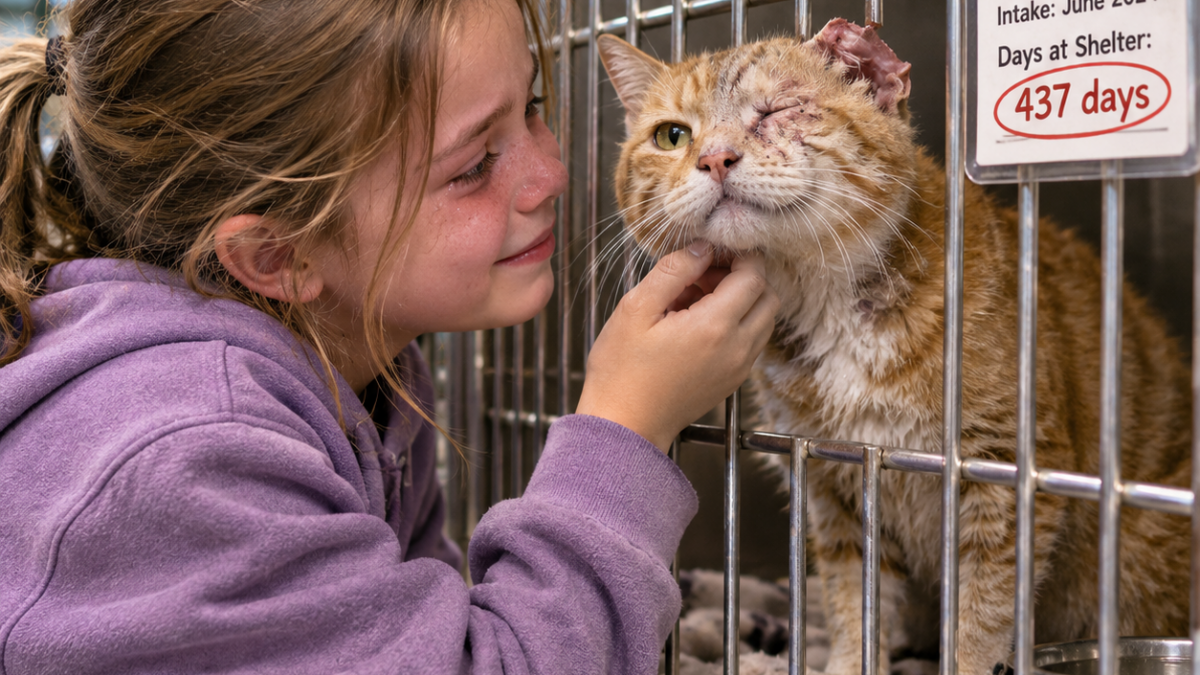
My 8-Year-Old Walked Past Every Kitten and Chose the Scarred 14-Year-Old Cat Nobody Wanted—Then We Learned Why He Had Waited 437 Days.
My daughter walked past an entire room of playful kittens on her eighth birthday and chose a fourteen-year-old cat with one eye, half an ear, and 437 days of rejection behind him because, as she quietly told me, “He’s the one because nobody else is going to pick him.”
That night, Bean climbed onto her bed and purred beside her head for hours, but three days later the shelter called to say they had uncovered something buried in his intake records that explained his scars—and why the old cat had stopped coming to the front of his cage six months earlier.
Then a woman arrived at our house demanding Bean back, carrying photographs that proved she had once known him, and my eight-year-old daughter had to watch the first animal she had ever chosen become the center of a fight between the family who had abandoned him and the child who had finally convinced him he was worth choosing.
My daughter had been talking about her eighth birthday for 114 days.
I know because she counted them.
Every morning at breakfast, Emma would announce the number as though she were reporting something of national importance.
“One hundred and fourteen days.”
“Great.”
“One hundred and thirteen.”
“Still great.”
By the time she reached twenty, my wife Rachel had started hiding behind her coffee mug whenever Emma entered the kitchen.
It was not the birthday itself Emma cared about.
It was the promise.
A cat.
We had made the mistake nine months earlier.
That was how Rachel described it.
I called it an agreement.
Emma called it a legally binding contract.
She had wanted a cat since kindergarten.
For two years, we had given her the standard parental reasons for saying no.
You’re too young.
Pets are expensive.
Your brother is allergic.
That last one stopped being useful when her older brother left for college and informed us he had apparently never been allergic to cats in the first place.
“I just didn’t want one in my room.”
Rachel stared at him over FaceTime.
“You let us buy three air purifiers.”
“I liked the air purifiers.”
After that, our defenses weakened.
Emma made a presentation.
Six slides.
She had learned PowerPoint at school.
Slide one:
WHY I AM READY FOR A CAT.
Slide two:
I CAN CLEAN A LITTER BOX.
Slide three:
CATS TEACH RESPONSIBILITY.
Slide four:
I HAVE $83.42.
Slide five:
BEN IS A LIAR ABOUT ALLERGIES.
Slide six:
PLEASE.
I had laughed so hard that Rachel kicked me under the table.
Eventually we made the deal.
PART2:
On her eighth birthday, we would take her to the county shelter.
She could choose a cat.
Within reason.
That last phrase was mine.
I should have known better.
“What does within reason mean?” Emma asked immediately.
“Healthy.”
Rachel looked at me.
“David.”
“What?”
“You cannot promise a child she can choose and then quietly create specifications.”
“I’m not creating specifications.”
“You just said healthy.”
“I mean… reasonably healthy.”
Emma narrowed her eyes.
“What if it has three legs?”
I hesitated.
Rachel smiled.
“I would like to hear this.”
“Three legs is fine.”
“What if it’s old?”
“Old is fine.”
“What if it has no tail?”
“Fine.”
“One eye?”
I laughed.
PART3:
“Emma, if you somehow find a one-eyed, three-legged, tailless cat, we’ll discuss it.”
She nodded.
“Okay.”
That conversation returned to me later.
At the time, I thought we were joking.
The Saturday after her birthday, we drove to the Franklin County Animal Shelter just after ten in the morning.
Emma wore the purple sweatshirt her grandmother had given her.
Hair in two uneven braids because she had insisted on doing them herself.
She carried a small notebook.
Rachel noticed.
“What’s that?”
“Notes.”
“On what?”
“The cats.”
I looked at Rachel.
“She made a rubric.”
Emma sighed.
“It’s not a rubric.”
“What is it?”
“A list.”
“Of criteria?”
“Yes.”
“That’s a rubric.”
“No, Dad.”
I decided not to fight an eight-year-old before we had even entered the shelter.
The building sat behind the county public works complex.
Low brick.
Faded blue sign.
The lobby smelled like disinfectant, dog hair, and something vaguely metallic.
A beagle barked somewhere behind the wall.
Then another dog answered.
Then all of them seemed to remember barking existed.
Emma’s eyes widened.
A volunteer named Nora Bennett met us at the desk.
She was maybe in her late fifties, silver streaks in dark hair, cat-shaped earrings.
“Birthday girl?”
Emma nodded.
“How old?”
“Eight.”
“Congratulations.”
Nora looked at us.
“First cat?”
Rachel answered:
“For her.”
“For us too, really.”
Nora smiled.
“Then I’ll show you the kitten room before she explodes.”
Emma did not explode.
That surprised all of us.
The kitten room was exactly what you would expect.
Tiny paws.
Huge eyes.
Chaos.
Three kittens wrestled inside one enclosure.
A gray one climbed the bars.
An orange kitten tried to bite Emma’s shoelace through the bottom gap.
A fluffy black-and-white kitten rolled onto its back the second she approached.
I looked at Rachel.
We had both assumed the decision would take approximately thirty seconds.
Emma walked slowly.
Read every card.
Name.
Age.
Sex.
Vaccinations.
Personality.
She wrote something in the notebook twice.
She held a feather toy for a calico kitten.
Laughed when it jumped.
Then moved on.
After maybe seven minutes, she walked toward the door.
Nora blinked.
“Want to meet any of them?”
Emma shook her head.
“No, thank you.”
I followed.
“None?”
“No.”
“You have looked at twelve kittens.”
“I know.”
“You understand we are here specifically for a cat.”
She gave me the expression children reserve for fathers who say things beneath response.
“Yes.”
Nora smiled.
“Want to see the adults?”
Emma nodded.
The adult-cat corridor was quieter.
Not silent.
Just different.
The kittens demanded attention.
The older cats negotiated for it.
Some came to the bars.
Some remained curled in beds.
One orange male named Waffles screamed at us continuously.
Emma loved him.
Still did not stop long.
She moved down the row.
Read every card.
At cage fourteen, she crouched.
A white cat came forward immediately.
At cage nineteen, an enormous tabby rolled onto his side.
At cage twenty-two, a seven-year-old tortoiseshell hissed at me and purred at Rachel.
“Good judgment,” Rachel said.
“Very funny.”
Emma continued.
Then we reached the last enclosure.
Bottom row.
Far corner.
I saw the information card before I saw the cat.
BEAN.
MALE.
14 YEARS.
DOMESTIC SHORTHAIR.
SPECIAL NEEDS / SENIOR.
INTAKE: JUNE 14, 2024.
DAYS IN CARE: 437.
I read that number twice.
Four hundred thirty-seven.
Bean lay at the back of the enclosure facing the wall.
Gray-brown tabby.
Thin.
His coat had the slightly rough texture old cats sometimes develop.
Half of his left ear was gone.
His right eye was closed permanently.
Not injured recently.
Gone.
A pale scar crossed his nose.
Another disappeared beneath the fur at his neck.
His one remaining eye was open, but he did not turn toward us.
Emma sat down on the floor.
I waited.
Thirty seconds.
One minute.
Rachel whispered:
“Sweetheart?”
Emma raised one hand.
Not at us.
Just a tiny wait gesture.
So we waited.
Bean’s ear moved.
The good one.
Then his head turned.
One yellow-green eye found Emma.
She did not say:
“Kitty.”
Did not click her tongue.
Did not put her face against the bars.
She simply placed three fingers through the gap.
Bean watched.
Another thirty seconds.
Then he stood.
Slowly.
His back legs seemed stiff.
He walked toward her.
Stopped.
Sniffed.
Emma did not move.
Bean pushed his forehead into her fingers.
Once.
Then harder.
Emma looked up at me.
“He’s the one.”
I looked at Bean.
Then at the card.
“Emma.”
“He’s the one.”
“You haven’t met most of the cats.”
“I met enough.”
Rachel crouched beside her.
“Why Bean?”
Emma looked confused that we needed to ask.
“Because nobody else is going to pick him.”
The sentence hit harder than it should have.
Maybe because of the number.
Maybe because Bean had already turned away from the corridor before we arrived.
Nora was standing several feet behind us.
She covered her mouth.
I noticed.
“Is something wrong?”
She shook her head.
“No.”
Then nodded.
“A little.”
“What?”
Nora crouched.
“Bean’s been here a long time.”
“I gathered that.”
Emma looked at her.
“Why?”
Nora hesitated.
“He’s fourteen.”
“So?”
Emma asked it with complete sincerity.
Nora smiled sadly.
“Most people come looking for younger cats.”
“Why?”
“More years, usually.”
Emma frowned.
She did not like that answer.
Nora continued.
“And Bean looks…”
She stopped.
Emma finished for her.
“Hurt.”
“Yes.”
“Does it hurt now?”
“Most of it doesn’t.”
“What happened to his eye?”
“We don’t know everything.”
“Ear?”
“Old injury.”
“Scars?”
“Also old.”
Emma looked at Bean.
He had moved closer and was now sitting at the front of the cage.
Nora lowered her voice.
“When Bean first arrived, he used to come to the front for everybody.”
“He loved attention.”
“He’d reach his paw through the bars.”
“Meow whenever somebody walked past.”
Emma listened.
“Then what?”
Nora glanced at us.
“Months went by.”
“People kept choosing other cats.”
“About six months ago, he stopped.”
“Stopped what?”
“Trying.”
Rachel inhaled.
Nora touched the cage door.
“He started sleeping in the back.”
“Facing the wall.”
“Some days he barely looked up during adoption hours.”
“We started moving him into the office sometimes because I hated watching people pass.”
Emma’s face changed.
Not dramatic.
Just quieter.
She looked at Bean.
“Can I hold him?”
Nora smiled.
“Let’s use the visiting room.”
I stood.
“Can we talk first?”
Emma immediately knew what that meant.
“Dad.”
“Five minutes.”
“You promised.”
“I know.”
“Any cat.”
“I know.”
“Bean is a cat.”
I closed my eyes.
Rachel turned away because she was smiling.
“I know Bean is a cat.”
“Then what?”
I looked at Nora.
“Can he be adopted normally?”
Nora’s expression shifted.
“Yes.”
“But?”
“Senior.”
“Early kidney disease.”
“Managed with diet.”
“Arthritis.”
“Medication as needed.”
“Only one eye.”
“Obviously.”
“Dental work done six months ago.”
“Any behavioral issues?”
“No.”
“Litter box?”
“Perfect.”
“Kids?”
Nora looked at Emma.
“He’s never been tested with young children outside supervised visits.”
Emma folded her arms.
“I’m not young.”
“Sorry.”
Nora corrected.
“Extremely mature eight-year-olds.”
Emma nodded.
“Better.”
I asked:
“Life expectancy?”
Rachel whispered:
“David.”
“What?”
“We need to know.”
Nora did not seem offended.
“No one can tell you.”
“He could have months.”
“Could have several years.”
“His blood work is stable.”
“He’s eating.”
“He’s not in pain we cannot manage.”
I looked through the glass.
Bean remained near the front.
Emma’s hand rested against the bars.
He kept his forehead touching one finger.
My practical brain began building objections.
Medication.
Vet bills.
Possible kidney progression.
Loss.
An eight-year-old choosing a cat who might die soon.
I had imagined a kitten.
Five, ten, fifteen years.
A childhood companion.
Not this.
Rachel saw all of it on my face.
She took my arm.
“We promised.”
“I know.”
“Did you mean it?”
“Yes.”
“Then we meet him.”
The visiting room had two chairs, one bench, a scratching post, and enough cat hair on the floor to construct another cat.
Nora carried Bean inside.
The moment she set him down, he moved underneath the chair.
Emma sat on the floor.
Again, no calling.
No reaching.
Five minutes.
Bean appeared.
Sniffed her shoe.
Walked around her.
Then climbed into her lap.
Just climbed.
Like he had known where he was going.
Emma froze.
“Can I pet him?”
Nora whispered:
“Yes.”
One finger.
Then another.
Bean closed his eye.
Purr.
Quiet at first.
Then louder.
Rachel sat beside me.
Neither of us spoke.
Emma looked down.
“Hi, Bean.”
Purr.
“We have a house.”
Purr.
“I have a bed.”
Purr.
“My dad says cats aren’t allowed on the table.”
I looked at her.
“We discussed this.”
“He says that now.”
Rachel whispered:
“She already knows you’ll lose.”
I ignored her.
Bean put one paw on Emma’s chest.
She smiled.
That was it.
We filled out the paperwork.
Nora cried.
Not politely.
Full tears.
“I’m sorry.”
She wiped her face.
“I promised myself I wouldn’t do this.”
Emma looked concerned.
“Are you sad?”
“No, sweetheart.”
Nora crouched.
“I’m very happy.”
“Then why are you crying?”
Nora laughed.
“You’ll understand when you’re older.”
Emma thought.
“My mom says that when she doesn’t have a good answer.”
Rachel looked offended.
“I do not.”
“You do.”
Nora laughed harder.
The adoption fee for seniors had been waived.
That bothered Emma.
“Why is he free?”
I almost choked.
Nora explained:
“It helps older cats get adopted.”
Emma looked at Bean.
“He shouldn’t be free.”
Nora’s face softened.
Emma opened her little birthday purse.
Pulled out a twenty-dollar bill.
The money her grandmother had given her.
“I want to pay.”
“You don’t have to.”
“I know.”
She placed it on the desk.
“For the next old cat.”
Nora cried again.
“Great.”
I looked at Rachel.
“We broke the shelter employee.”
Rachel was crying too.
“You’re next.”
“I’m fine.”
I was not.
We drove home at 2:17 p.m.
Bean did not like the carrier.
He complained for the first seven minutes.
Then became silent.
Emma sat beside him.
She read aloud from a book about space.
Bean did not care about Neptune.
But he listened to her voice.
At home, we opened the carrier in the living room.
Nora had warned us:
Do not drag him out.
Do not overwhelm him.
Give him one room first if necessary.
Bean solved the issue himself.
He remained inside for twenty-eight minutes.
Then came out.
Walked under the couch.
Stayed three hours.
Emma lay on the rug nearby.
Did homework.
Colored.
Never reached under.
At 6:42, Bean emerged.
He explored the kitchen.
Dining room.
Hallway.
Sniffed every doorway.
When he reached Emma’s room, he stopped.
She was arranging a blanket in a cardboard box beside her bed.
“That’s yours.”
Bean walked past the box.
Jumped onto her mattress.
Rachel whispered:
“So much for boundaries.”
Bean circled twice.
Curled beside Emma’s pillow.
She climbed in carefully.
Within five minutes, both were asleep.
Bean’s purr filled the room.
I stood in the doorway.
Rachel beside me.
“One night,” I whispered.
“What?”
“We’re keeping him off her pillow tomorrow.”
Rachel looked at me.
“Of course.”
We both knew I was lying.
At 11:30, I checked again.
Bean had moved closer to Emma’s head.
His damaged ear rested against the pillowcase.
One paw stretched across a strand of her hair.
Purring.
Still.
Rachel leaned against me.
“You worried?”
“Yes.”
“About?”
“Everything.”
She knew.
“He’s old.”
“Yes.”
“He’ll get sick.”
“Probably.”
“She’ll lose him.”
“Yes.”
Rachel looked toward our daughter.
“She’ll lose every animal eventually.”
“That doesn’t mean you start with fourteen.”
“No.”
She paused.
“It means she chose fourteen.”
I looked at Bean.
“Why him?”
“You heard her.”
“Everyone wants kittens.”
“She’s eight.”
“Exactly.”
Rachel smiled.
“You wanted her to learn responsibility.”
“I meant litter.”
“Apparently she skipped ahead.”
The first week was almost embarrassingly easy.
Bean used the litter box.
Ate.
Took his kidney-support supplement mixed into wet food.
Slept.
Followed Emma.
He did not scratch furniture.
Did not climb counters.
Rarely meowed.
He simply wanted proximity.
If Emma read on the couch, Bean lay against her hip.
If she brushed her teeth, Bean waited outside the bathroom.
If she did homework, Bean sat on the paper.
When she went to school, he waited near the front window.
At 3:18 every afternoon, five minutes before the bus normally arrived, Bean moved to the front door.
We noticed on day four.
Rachel texted me at work:
Your senior cat has a schedule.
I replied:
Her senior cat.
Rachel:
Sure.
Then, three days after Bean came home, Nora called.
I was at work.
Insurance office.
Exciting life.
My phone showed FRANKLIN COUNTY SHELTER.
My stomach dropped.
“Hello?”
“David?”
“Nora?”
“Yes.”
“Is Bean okay?”
“As far as I know.”
“Then why are you calling?”
Pause.
“We found something.”
Those words are rarely good.
“What?”
“We’re digitizing old intake records.”
“Bean’s original paperwork was incomplete in the system.”
“Okay.”
“There’s a microchip number.”
I sat straighter.
“What?”
“It wasn’t active when he came in.”
“The registry information had been outdated.”
“But we found the original manufacturer record.”
I waited.
Nora continued.
“Bean had another name.”
I looked around the office.
“Okay.”
“Walter.”
“Walter?”
“Yes.”
“Who named a cat Walter?”
Nora almost laughed.
“Apparently his original family.”
I asked:
“What family?”
“We’re still figuring that out.”
Bean had been brought to the shelter fourteen months earlier by a man who said he found him behind an abandoned farmhouse.
Badly injured.
Thin.
One eye already destroyed.
Ear torn.
Scars partially healed.
No collar.
The shelter’s initial microchip scan returned a number but no active owner.
They documented him as stray.
Later, during a software migration, the chip field disappeared from his main profile.
Now staff had traced the manufacturer.
The chip had been implanted thirteen years earlier at a veterinary clinic in West Virginia.
Registered to:
Caroline Mercer.
Nora said:
“We called the old clinic.”
“And?”
“It closed five years ago.”
“Records are stored with another practice.”
“They’re checking.”
“Why does this matter?”
Another pause.
“Maybe it doesn’t.”
“But if there is an owner—”
My throat tightened.
“He’s ours.”
“Legally, your adoption is valid based on the shelter’s hold and records.”
“Good.”
“But we need to understand what happened.”
“Why?”
Nora lowered her voice.
“Because whoever brought Bean in may not have been telling the truth.”
That was the first crack.
The next came two days later.
Dr. Monica Reeves from Mountain Ridge Veterinary Hospital called the shelter.
She had inherited the old clinic’s paper archives.
Bean—Walter—had been a regular patient for twelve years.
Neutered.
Vaccinated.
Indoor-outdoor.
No missing eye.
No torn ear.
No major scars.
Last visit:
Fourteen months before shelter intake.
Owner:
Caroline Mercer.
Address:
Ridgewood Farm, Millstone County.
The same abandoned farmhouse near which Bean was supposedly found.
I asked Nora:
“So he belonged there.”
“Yes.”
“What happened to Caroline?”
Nora went quiet.
“She died.”
“When?”
“Approximately three months before Bean entered the shelter.”
My anger changed shape.
“Family?”
“A daughter.”
“Name?”
“I cannot give you private information yet.”
“Did the daughter surrender him?”
“Not according to our paperwork.”
“Then who brought him?”
“A man named Randall Cole.”
“Connection?”
“We don’t know.”
The shelter director contacted county animal control.
Not because Bean had been adopted improperly.
Because his injuries and ownership timeline no longer made sense.
When he was last documented with Caroline Mercer, he was healthy.
Three months after her death, he appeared with severe injuries.
A man claimed stray status.
No one had ever connected him to the farmhouse where he already lived.
And no one had asked why.
That made Nora furious.
She told me later:
“We failed him.”
I said:
“You saved him.”
“After failing him.”
“You didn’t know.”
“We should have.”
That distinction became important.
Institutions can do good and still make mistakes.
The shelter had treated Bean.
Removed the damaged eye.
Managed infection.
Fed him.
Kept him alive for 437 days.
And yet the first question on his intake should have been:
Why was this elderly cat injured on the property where his registered owner had lived?
Nobody asked it.
Until after Emma chose him.
Three days later, a sheriff’s animal-cruelty investigator named Dana Brooks visited our house.
Emma sat on the floor with Bean.
Dana crouched.
“Is this the famous Bean?”
Emma nodded.
“He’s not famous.”
“Sorry.”
Bean sniffed Dana’s shoe.
“Can I pet him?”
“If he wants.”
Dana smiled.
“Good rule.”
Bean decided no.
He walked into Emma’s lap.
Dana sat on the couch.
She explained what they knew.
Caroline Mercer had been seventy-six.
Widow.
Lived alone at Ridgewood Farm.
Bean—Walter—had been hers since he was a kitten.
When Caroline died after a stroke, her daughter, Diane Miller, inherited the property.
Diane lived in Ohio.
She hired a local caretaker to clear the farmhouse before sale.
That caretaker was Randall Cole.
The man who later brought Bean to the shelter.
Dana said:
“We contacted Ms. Miller.”
My stomach tightened.
“What did she say?”
“She believed Bean died.”
Emma looked up.
“What?”
Dana looked at me.
I nodded.
She continued carefully.
“Your cat was called Walter then.”
Emma hugged Bean.
“He’s Bean.”
“Yes.”
“Walter is a weird name.”
“Emma.”
“What?”
Dana smiled.
“Bean is a strong improvement.”
Then she explained.
According to Diane, after her mother died she asked Randall Cole to find a home for Walter.
She did not want to take him.
Her husband disliked cats.
She lived four hours away.
Randall told her Walter escaped during the cleanup.
Two weeks later, he told her he had found what appeared to be the remains of an animal near the barn.
Diane assumed Walter was dead.
She never came to verify.
Emma looked at Dana.
“She didn’t come?”
“No.”
“Why?”
Dana did not answer quickly enough.
Emma’s expression hardened.
“She just believed him?”
“Yes.”
Bean purred against her.
Emma stroked the scar across his nose.
“What happened to him?”
Dana said:
“That is what we are trying to find out.”
Randall Cole initially refused an interview.
Then claimed Bean attacked him.
Said the cat had become “feral” after Caroline died.
He said he tried to catch him.
Bean scratched him.
Bean escaped.
Months later, Randall found an injured cat near the farm and assumed it was the same one.
He took him to the shelter.
The timeline did not work.
Bean’s injuries appeared weeks old when he arrived.
Not months.
And Randall’s original intake form said:
FOUND TODAY IN BARN AFTER PROPERTY CLEANOUT.
Not roadside.
Not months after escape.
Barn.
Dana obtained the farmhouse sale records.
The property had not been abandoned when Bean was hurt.
It was being renovated.
Contractors.
Heavy machinery.
Debris.
Then a former contractor named Michael Hayes contacted investigators after seeing a county notice.
He remembered the cat.
“Old tabby?”
“Yes.”
“One eye?”
“He had both when you saw him?”
Michael paused.
“Yeah.”
My stomach turned.
Michael had worked at Ridgewood Farm for six weeks.
Bean stayed around the property because it was his home.
Workers fed him.
Some liked him.
Randall did not.
Why?
“He got into the house.”
Michael said.
“Climbed on furniture.”
“Randall said he was ruining things.”
One afternoon, Michael saw Randall throw a piece of wood toward Bean.
Not at him, Randall claimed.
Near him.
The cat ran.
A week later, Bean appeared with an injured ear.
Then disappeared.
Then came back with his eye badly damaged.
Michael urged Randall to take him to a vet.
Randall refused.
Said the cat did not belong to anyone.
“It’s a stray.”
Michael remembered answering:
“No, it was Caroline’s.”
Randall said:
“Caroline’s dead.”
That sentence made Emma cry.
She heard it when Dana eventually explained.
Not all details.
Enough.
“Because his person died, he didn’t matter?”
“No.”
I sat beside her.
“That’s not what it means.”
“It’s what that man thought.”
Maybe.
Dana found more.
A security camera from a neighboring property had retained cloud clips because the owner never deleted them.
One clip showed Bean limping near the farmhouse.
Another showed Randall driving a utility cart.
Another, more important clip, showed Randall carrying Bean by the scruff toward an outbuilding.
The cat struggled.
Timestamp:
Six days before shelter intake.
Two hours later, Bean emerged alone.
His right eye swollen.
Blood near the ear.
The footage did not show what happened inside.
But Randall’s claim that Bean had been found already injured was dead.
Animal control obtained a search warrant for the shed after the property’s new owner cooperated.
Inside, investigators found an old wire animal trap.
Rust.
Dried biological material too degraded for perfect testing.
A broken wooden handle.
Photos from the real estate listing showed the trap had not been there before Randall’s cleanup.
The theory became ugly.
Not proven fully.
But ugly.
Randall had trapped Bean because he was entering the house.
The cat panicked.
Injured himself against the wire.
Randall may have struck or handled him roughly.
The eye injury went untreated.
Ear tissue became infected and partially necrotic.
By the time Randall finally brought him to the shelter, the eye could not be saved.
He told everyone he had found a stray.
He hid the truth because admitting Bean belonged to Caroline meant admitting he had responsibility for the animal.
Emma listened to the simplest version.
“He hurt Bean and didn’t get him help.”
“Yes.”
“Why?”
I hated that question.
Because adults like reasons.
Children think reasons should make actions sensible.
Sometimes they do not.
“He was angry.”
“At a cat?”
“Yes.”
“That’s stupid.”
“Yes.”
“He could have called the shelter.”
“Yes.”
“He could have called Diane.”
“Yes.”
“He could have called anybody.”
“Yes.”
Emma looked at Bean.
“Then he picked being mean.”
I did not correct her.
A week later, Diane Miller called me.
I almost did not answer.
Unknown Ohio number.
“Hello?”
“Is this David Lawson?”
“Yes.”
“My name is Diane Miller.”
I knew immediately.
My body tightened.
“Caroline Mercer was my mother.”
“I know.”
Pause.
“I understand you have Walter.”
“His name is Bean.”
Silence.
“Yes.”
“Bean.”
She sounded offended.
That annoyed me more than it should have.
“What do you want?”
“I want to see him.”
“No.”
I answered too quickly.
Diane paused.
“I beg your pardon?”
“He’s fourteen.”
“He has one eye because of what happened after your mother died.”
“He was in a shelter 437 days.”
“My daughter adopted him.”
“He’s finally settled.”
“I’m not having strangers show up because they suddenly feel nostalgic.”
Her voice sharpened.
“I am not a stranger.”
“To him?”
Silence.
“I knew him for twelve years.”
“How often did you visit?”
“That is none of your business.”
“Then no.”
I hung up.
Rachel was furious.
Not at Diane.
At me.
“You cannot do that.”
“I just did.”
“David.”
“She left him.”
“She lived four hours away.”
“She believed some guy who said he died.”
“You don’t know what happened in that family.”
“I know Bean spent 437 days in a cage.”
Rachel lowered her voice.
“And I know you’re making this about your anger.”
“My anger is justified.”
“Probably.”
She paused.
“That does not make every decision you make justified.”
I hated when Rachel was right.
Frequently.
Two days later, Diane came anyway.
Saturday.
11:08 a.m.
Black SUV.
Ohio plate.
Emma was coloring at the kitchen table.
Bean slept in the sun.
Doorbell.
I opened the door.
Diane Miller was sixty-two.
Carefully styled blond-gray hair.
Dark coat.
Pearl earrings.
She looked like someone who had spent the whole drive rehearsing.
“Mr. Lawson?”
“You should’ve called.”
“I did.”
“You should’ve listened.”
She inhaled.
“I’m not here to fight.”
“Then what?”
She held a folder.
“I want my mother’s cat.”
Every protective part of me activated.
“He’s not available.”
Her eyes moved past me.
Bean had stood.
He stared toward the door.
Diane saw him.
Her face collapsed.
“Walter.”
Bean froze.
Emma came around the corner.
Diane stepped forward.
“Walter.”
Bean backed up.
Emma immediately stood between them.
“He’s Bean.”
Diane looked at her.
“Oh.”
“This must be…”
“My daughter.”
“Emma.”
Emma folded her arms.
“You’re Diane.”
Rachel appeared behind her.
Clearly our child had been listening to too many adult conversations.
Diane looked at Bean.
He remained near the couch.
One eye wide.
Body low.
No recognition I could see.
Diane’s eyes filled.
“He looks terrible.”
Emma’s face changed.
That was the wrong sentence.
I knew before she spoke.
“He looked worse before.”
Diane looked at her.
Emma continued:
“Because you didn’t get him.”
“Emma.”
I stepped in.
Diane flinched anyway.
“I thought he was dead.”
“You didn’t check.”
“Sweetheart—”
“Don’t call me sweetheart.”
Rachel put a hand on Emma’s shoulder.
“That’s enough.”
Emma looked at Bean.
“He waited 437 days.”
Diane’s face hardened slightly.
“I did not put him in the shelter.”
“No.”
Emma said quietly.
“You just didn’t come get him.”
No adult in the room had an answer better than that.
Diane sat at our dining table.
We did not invite her to.
She looked exhausted.
The folder contained photographs.
Caroline holding Bean as a kitten.
Bean under a Christmas tree.
Bean asleep on Diane’s lap years earlier.
Bean with two eyes.
Whole ear.
Thick coat.
I hated seeing him that way.
Because suddenly the damaged animal in our living room had a before.
Diane touched one photograph.
“My mother loved him more than most people.”
Emma sat across from her.
“Then why didn’t you?”
Diane closed her eyes.
“I did.”
“Not enough.”
“Emma.”
Rachel’s warning.
Diane looked at our daughter.
“No.”
She said it quietly.
“Maybe not enough.”
That surprised everyone.
She continued.
“My mother and I did not have a good relationship at the end.”
I looked at Rachel.
Diane rubbed her hands.
“She became difficult.”
“Controlling.”
“Suspicious.”
“She refused assisted living.”
“Refused help.”
“I was driving from Columbus twice a month.”
“She would scream at me for touching her things.”
“She changed the locks once.”
“She accused my husband of stealing money.”
“Was he?”
I asked.
Diane looked at me.
“No.”
Fair.
She continued.
“When she died, I had spent years angry.”
“I wanted the house sold.”
“Everything gone.”
“I told Randall to clean it out.”
“Find homes for whatever animals remained.”
“Whatever animals?”
I repeated.
Diane heard how it sounded.
“Two barn cats and Walter.”
“Bean.”
“Yes.”
She swallowed.
“Bean.”
“He told me the barn cats disappeared.”
“Then said Bean escaped.”
“I was relieved.”
Emma stared.
Diane’s eyes filled.
“I know how that sounds.”
“You were relieved?” Emma whispered.
“Yes.”
“Why?”
“Because if he escaped, I didn’t have to decide what to do with him.”
The honesty was brutal.
Diane continued:
“Then Randall told me he found a dead cat by the barn.”
“I asked if it was Walter.”
“He said probably.”
“I said okay.”
Emma looked shocked.
Diane began crying.
“I said okay.”
“I did not drive out.”
“I did not ask for a picture.”
“I did not check the chip.”
“I was tired.”
“I was angry at my mother.”
“And I let that anger touch something she loved.”
The room went quiet.
Bean walked toward Emma.
Jumped into her chair.
She wrapped an arm around him.
Diane watched.
“I came here thinking I wanted him back.”
My jaw tightened.
She raised a hand.
“I know.”
“But I think…”
She looked at Bean.
“He doesn’t know me.”
“That’s not true.”
I said it automatically.
Maybe it was.
Maybe not.
Diane continued:
“I think I wanted to undo what I did.”
“That’s not the same thing as wanting what’s best for him.”
Rachel looked at her carefully.
“No.”
Diane whispered:
“It isn’t.”
She opened the folder.
Removed one photograph.
Caroline sitting on a porch.
Bean in her lap.
“Can Emma have this?”
Emma looked at me.
I nodded.
Diane slid it across the table.
Emma picked it up.
“This was his mom?”
Diane smiled through tears.
“In a way.”
Emma looked at Bean.
Then at Caroline.
“Did she call him Walter?”
“Yes.”
Emma frowned.
“Still weird.”
Diane laughed unexpectedly.
So did Rachel.
Even I did.
The tension cracked.
Diane did not demand Bean.
Not that day.
She stayed twenty-eight minutes.
Bean never approached her.
When she left, Emma walked to the door.
“Diane?”
She turned.
“You can visit.”
Diane’s face changed.
Emma continued:
“If Bean wants.”
There it was again.
Her rule.
If he wants.
Diane nodded.
“Thank you.”
After she left, I looked at Emma.
“You know you did not need to offer that.”
“I know.”
“Why did you?”
She looked at the photograph.
“Because maybe Bean remembers her smell.”
“Maybe.”
“And she said sorry.”
“That doesn’t fix it.”
“I know.”
“Then?”
Emma shrugged.
“Sorry can still be true.”
Eight years old.
I hated how often she made me feel emotionally underqualified.
The criminal case against Randall Cole moved slowly.
He was charged with animal cruelty related to failure to provide necessary care and causing injury during confinement.
The exact details inside the shed could not be proven beyond every doubt.
That bothered me.
I wanted a clean story.
Bad man hurts cat.
Evidence proves everything.
Court punishes him.
Life rarely agrees to that structure.
Randall’s attorney argued Bean injured himself trying to escape a humane trap.
Said Randall panicked.
Said he lacked money for veterinary care.
Said he eventually did the responsible thing by bringing Bean to a shelter.
Dana Brooks did not argue that bringing Bean in was wrong.
She argued the delay mattered.
The lie mattered.
The untreated eye mattered.
The fact that Randall knew the cat belonged to Caroline mattered.
A former contractor testified that he repeatedly told Randall Bean needed a veterinarian.
Text messages supported him.
One from Michael Hayes:
THE CAT’S EYE IS BAD. TAKE HIM IN.
Randall:
not paying $500 for a dead woman’s cat
Another:
call her daughter then
Randall:
she doesn’t want it either
That message ended my ability to feel neutral.
Not because Randall was entirely wrong about Diane then.
She had not wanted responsibility.
But he had used another person’s failure to excuse his own.
That became the theme of the whole case.
Everyone pointing sideways.
Diane did not want Bean.
So Randall did not have to care.
Randall said Bean escaped.
So Diane did not have to check.
The shelter saw a stray.
So no one had to investigate ownership deeply.
Potential adopters saw scars.
So they did not have to imagine the cat underneath.
Everybody had a reason to pass responsibility forward.
Until Emma.
She did not know any history.
She saw an old cat facing a wall.
And stopped.
Randall ultimately pleaded guilty to neglect and a cruelty count tied to his failure to obtain care after Bean’s eye injury.
He received probation, fines, restitution to the shelter, community service, and a ban on owning animals during probation.
I thought it was too light.
Dana asked me:
“What sentence would feel right?”
“I don’t know.”
“Exactly.”
She was not dismissing me.
She was tired.
“You can punish conduct.”
“You cannot put Bean’s eye back.”
I knew.
Still hated it.
The shelter received restitution for Bean’s surgery and treatment.
Nora called Emma.
“Guess what?”
“What?”
“Bean paid his own vet bill.”
Emma frowned.
“No.”
“Sort of.”
“The man who hurt him has to pay the shelter back.”
Emma thought.
“Good.”
Then:
“Can it pay for old cats?”
Nora laughed.
“We can put it toward senior medical care.”
“Do that.”
A small fund started.
Not officially because of Bean at first.
Then donors heard.
Someone gave fifty dollars.
Another two hundred.
Diane donated three thousand.
Anonymous.
We knew.
The shelter named it:
THE BEAN FUND — SENIOR & SPECIAL-NEEDS CAT CARE.
Emma objected.
“He doesn’t know money.”
“That’s okay.”
“He’ll think the sign is food.”
“Probably.”
The fund paid for dental surgery for a twelve-year-old orange cat.
Then thyroid treatment for a fifteen-year-old tortoiseshell.
Then diagnostics for an old Siamese surrendered after his owner died.
Emma kept a list.
She called them “Bean’s coworkers.”
Bean knew nothing about his philanthropic career.
He cared about chicken.
The months at home changed him.
At first, he startled whenever somebody walked quickly toward him.
He hated closed doors.
If Emma shut her bedroom door, he cried.
We stopped shutting it.
He flinched when I carried tools.
Especially long handles.
That one made me think about the broken wooden handle found in Randall’s shed.
I stopped carrying the broom near him.
Some habits faded.
Some did not.
But the biggest change was where he slept.
Week one:
Emma’s pillow.
Month one:
Emma’s pillow.
Month six:
Emma’s pillow.
I bought him three cat beds.
One heated.
He ignored all of them.
Rachel said:
“You spent $89 on furniture for a cat who sleeps on our child.”
“Thank you for tracking expenses.”
“You’re welcome.”
Bean’s kidney disease remained stable.
His arthritis improved with medication.
He gained two pounds.
His coat became softer.
He began grooming properly again.
The old patches on his neck remained thinner.
But they filled in.
He discovered toys.
This was unexpectedly emotional.
One evening Emma dragged a string toy across the rug.
Bean watched.
Did nothing.
She kept going.
After five minutes, one paw moved.
Then another.
Then the fourteen-year-old cat launched himself approximately six inches.
Missed.
Sat down.
Looked offended.
Emma screamed with joy.
“HE PLAYED!”
Bean ran under the couch because she frightened him.
“Great.”
I looked at her.
“You celebrated him into hiding.”
She crawled near the couch.
“Sorry, Bean.”
Ten minutes later he came back.
The second pounce was eight inches.
Progress.
Diane began visiting once a month.
At first Bean ignored her.
Then one Saturday she brought a sweater that had belonged to Caroline.
Old blue cardigan.
She asked before bringing it inside.
“Would smell matter?”
Probably.
We placed it on the couch.
Bean approached.
Sniffed.
Stopped.
His whole body went still.
Diane sat across the room.
Nobody spoke.
Bean sniffed again.
Then climbed onto the cardigan.
Kneaded twice.
Lay down.
Diane covered her mouth.
Emma sat beside him.
“Was this hers?”
“Yes.”
Bean pressed his face into the sleeve.
Diane began crying.
“I should have brought him home.”
Emma looked at her.
“You can’t change that.”
“No.”
Diane wiped her face.
“But you can come now.”
“Yes.”
That was their reconciliation.
Not Bean suddenly running into Diane’s arms.
Not Diane becoming his owner.
Something quieter.
She became part of his life again.
Eventually he accepted her hand.
Then her lap once.
She cried so hard Bean left.
Emma laughed.
“You scared him.”
“I know.”
Diane laughed too.
By the time Bean turned fifteen, the family joke was that he had more adults than Emma.
Me.
Rachel.
Nora.
Diane.
Dana occasionally asking for updates.
Even Michael Hayes, the contractor who had testified, sent Bean a Christmas toy every year.
Bean hated the first toy.
Loved the box.
Of course.
The photograph of Caroline and Bean sat on Emma’s bookshelf.
Beside it:
First-night picture.
Emma asleep.
Bean curled around her head.
The contrast was striking.
In Caroline’s photo, Bean was young.
Whole.
Two eyes.
Perfect ears.
In Emma’s, he was scarred.
Old.
Damaged.
And somehow looked just as safe.
Maybe safer.
At school, Emma wrote an essay called:
WHY OLD CATS ARE NOT USED CATS.
Her teacher called us.
Not because anything was wrong.
Because Emma had written:
People think kittens are new and old cats are used, but cats are not shoes.
Rachel laughed for an hour.
The school asked Emma to read it during an assembly about community service.
She refused.
“Why?”
I asked.
“Bean doesn’t like assemblies.”
“Bean is not attending.”
“I still don’t want to.”
Fair.
Instead she asked if her class could collect supplies for the shelter.
They did.
Her teacher invited Nora.
Nora brought photographs of senior cats.
Not Bean.
That surprised me.
I asked why.
“Because his story gets attention.”
“The others need it.”
Emma approved.
“Good.”
Three senior cats were adopted that month.
One by Emma’s teacher.
Bean’s influence widened without him leaving our couch.
Then came the first bad blood test.
Sixteen years old.
Almost two years after adoption.
Kidney values worse.
Not catastrophic.
Progression.
Nora had warned us from day one.
Our veterinarian, Dr. Claire Bennett, explained options.
Fluids.
Diet.
Medication.
Monitoring.
Emma sat beside Bean on the exam-room bench.
“What happens if his kidneys get worse?”
Claire looked at us.
I wanted to intercept.
Protect.
Rachel shook her head slightly.
Answer.
Claire said:
“Eventually, if they get much worse, Bean may feel sick even with medicine.”
“Can you fix kidneys?”
“Not old kidneys like his.”
Emma looked at Bean.
“So he will die from it?”
My heart stopped.
Claire answered gently.
“Maybe.”
“Or something else because he’s very old.”
Emma stroked him.
“How long?”
“We don’t know.”
She looked annoyed.
“Adults say that a lot.”
Claire smiled sadly.
“Because sometimes it’s the truthful answer.”
In the car, Emma was silent.
Then:
“Dad?”
“Yeah?”
“I knew he was old.”
“I know.”
“I still don’t like it.”
“I know.”
“What if he only gets two years with us?”
I pulled over.
Not because driving was unsafe.
Because this conversation deserved stillness.
“Then he got two years.”
“That’s not enough.”
“No.”
She looked at me.
I continued.
“But enough and forever are different things.”
“That doesn’t make sense.”
“Probably because I’m making it up.”
She almost smiled.
I tried again.
“You chose Bean because he needed someone.”
“Yeah.”
“You did not choose him because he could promise you ten years.”
“No.”
“You chose him knowing you might get less.”
Emma started crying.
“That was brave.”
“I don’t want brave.”
“I know.”
“I want Bean.”
I hugged her.
That was the day I finally understood the cost of her decision.
When she said:
“Everyone wants the kittens. They don’t need me.”
I had treated it like wisdom.
Sweet.
Viral, if someone had filmed it.
But wisdom has consequences.
She had chosen the cat most likely to break her heart soon.
Not because she wanted pain.
Because she believed his remaining time mattered even if it was short.
An eight-year-old understood something I had spent my adult life avoiding:
Love is not a good investment because it lasts.
It is valuable while it exists.
Bean stabilized again.
Sixteen became seventeen.
We started celebrating monthly birthdays because Emma said yearly intervals were “reckless.”
Bean did not know.
He received chicken.
Every month.
He became heavier than ideal.
Claire told us to stop.
Emma accused veterinary medicine of ruining celebrations.
Bean’s world narrowed gradually.
He stopped jumping onto Emma’s bed.
I built a ramp.
Too steep.
Rachel told me.
I rebuilt it.
Bean used the cardboard box it came in instead.
Eventually he accepted the ramp.
His hearing faded.
His eye clouded with age.
But he knew footsteps.
Emma’s especially.
She was ten by then.
Her body changed.
Voice changed slightly.
Interests changed.
Bean did not care.
At 3:18, he still waited near the door.
One afternoon the school bus was late.
Bean sat.
3:25.
3:30.
3:40.
He began pacing.
Rachel texted me:
He’s worried.
Emma arrived at 3:47 after a bus breakdown.
Bean walked toward her as quickly as his arthritis allowed.
She dropped her backpack.
Sat on the floor.
He climbed into her lap.
“You thought I left.”
That sentence hurt.
Because perhaps he did.
Or perhaps he only knew routine had broken.
Either way, Emma understood what 437 days had done to him better than we ever could.
She never wanted him waiting again.
At seventeen and a half, Bean had his first real crisis.
Vomiting.
Would not eat.
Dehydrated.
Hospitalization.
Two nights.
Emma slept in our room because her own bed without Bean felt wrong.
At 2:00 a.m., I found her awake.
“What if he dies there?”
“Doctors are helping him.”
“What if he thinks we put him back in a cage?”
I had no answer ready.
Emma cried.
“He spent 437 days in a cage.”
“He knows the difference.”
“How?”
“Because we went back.”
She looked at me.
“What?”
“The shelter wasn’t the bad thing.”
I said.
“Being forgotten was.”
“We didn’t forget him.”
“We took him to a doctor.”
“We’ll go tomorrow.”
“We always go back.”
Emma thought.
Then nodded.
Bean came home.
We went back.
The kidney disease advanced over the next year.
He received subcutaneous fluids.
Emma learned to help.
At first she hated the needle.
Then became excellent at distracting him with treats.
Bean disliked the process but forgave us quickly.
Diane visited more often.
She had retired.
Moved back to Pennsylvania.
Not because of Bean alone.
But he mattered.
One afternoon, she sat beside Emma on the porch.
Bean slept between them.
Diane said:
“I’ve been thinking about my mother.”
Emma was twelve.
Old enough now for harder stories.
“What about her?”
“I spent years remembering the worst parts.”
“The fights.”
“The accusations.”
“The way she made everything difficult.”
Emma listened.
Diane stroked Bean.
“When she died, I was so angry that I wanted every piece of that life gone.”
“House.”
“Furniture.”
“Cat.”
Her voice shook.
“I thought leaving him behind was about him.”
“It wasn’t.”
“What was it?”
“I was punishing my mother after she was dead.”
Emma looked at her.
“That doesn’t make sense.”
“No.”
Diane smiled sadly.
“Adults do many things that don’t.”
Emma thought.
“Bean didn’t know.”
“What?”
“That you were mad at Caroline.”
Diane closed her eyes.
“No.”
“He just knew nobody came.”
Diane started crying.
“Yes.”
Emma put one hand on hers.
“I’m glad you came now.”
Diane nodded.
“So am I.”
Bean slept through the entire breakthrough.
He was excellent at emotional boundaries.
At eighteen, Bean became the shelter’s longest-lived senior adoption story.
Nora asked if she could use his photograph in a campaign.
Not a sad one.
A happy one.
Emma approved one condition.
“No before picture.”
Nora asked:
“Why?”
“Because everybody already knows sad old cats look sad.”
“Show him at home.”
The campaign used a photograph of Bean asleep on Emma’s homework.
Caption:
437 DAYS WAITING.
4 YEARS HOME.
THE SECOND NUMBER MATTERS MORE.
I cried when I saw it.
Did not tell anyone.
The campaign helped twelve senior cats get adopted in six weeks.
One had diabetes.
One had three legs.
One was nineteen.
Emma found that hilarious.
“Bean got beaten.”
“By what?”
“Age.”
The nineteen-year-old cat went to a retired couple.
Bean did not care.
He was busy stealing Rachel’s chicken.
Then winter came.
Bean slowed sharply.
Not one moment.
A slope.
Food left behind.
Longer sleep.
Less grooming.
More fluids.
Weight loss.
Claire changed medication.
Blood tests.
Kidney failure progressing.
Anemia.
High blood pressure.
The map became clear.
Emma was twelve.
Old enough to understand.
Young enough that I wanted to lie.
Claire would not.
She sat on the exam-room floor with us.
Bean in Emma’s lap.
“He may have weeks.”
“Maybe a few months.”
Emma looked down.
“Can we make him better?”
“Comfortable.”
“That’s not better.”
“No.”
Claire’s honesty hurt.
I appreciated it later.
Emma asked:
“How do we know when?”
“When the hard days become more common than the good ones.”
“How do you count?”
Claire gave us a quality-of-life chart.
Eating.
Drinking.
Pain.
Mobility.
Hygiene.
Interest.
Comfort.
Emma took it seriously.
Too seriously at first.
She made a calendar.
Green day.
Yellow day.
Red day.
First week:
Green.
Green.
Yellow.
Green.
Green.
Second:
Green.
Yellow.
Yellow.
Green.
Third:
Yellow.
Red.
Green.
Yellow.
I hated that calendar.
I understood why we needed it.
Bean still had good moments.
Sunlight.
Chicken.
Emma’s lap.
Diane’s cardigan from Caroline.
Yes.
We still had it.
Bean loved that sweater his entire time with us.
On difficult nights, Emma placed it beneath him.
Maybe Caroline’s scent was long gone by then.
It did not matter.
The sweater itself had become home too.
Then, one morning, Bean stopped walking to the front door when Emma left for school.
He watched from the couch.
That was the first sign that frightened me.
Three days later, he missed the litter box.
Not because he forgot.
He could not get there quickly enough.
Emma cleaned it.
No complaint.
The next morning, Bean refused chicken.
Emma looked at me.
“Red day.”
I could not speak.
She cried.
“We promised we wouldn’t make him stay because we’re scared.”
Rachel turned away.
I sat beside Emma.
“When did you get so grown up?”
“I’m not.”
She sobbed.
“I don’t want to be.”
Neither did I.
We called Claire.
She came to the house the next afternoon.
Bean had spent the morning on Emma’s bed.
We lifted him there because he could no longer climb the ramp.
The same bed.
Different sheets.
Different child.
Four years earlier, Emma had been eight, asleep while Bean purred beside her head on his first night home.
Now she was twelve.
Longer hair.
Braces.
Tears.
Bean was eighteen.
Thin.
One eye nearly closed.
Damaged ear soft with age.
Scars hidden beneath a coat that had grown healthy years before.
Diane came.
Nora too.
We had not invited a crowd.
Just people Bean knew.
Diane brought Caroline’s blue cardigan.
Placed it beside him.
Bean moved one paw onto the sleeve.
Diane broke.
“I’m sorry.”
She had said it a hundred times in different ways.
This one was for Bean.
Not us.
“I should have come.”
Bean breathed.
“I should have looked.”
Another breath.
“I’m glad Emma did.”
Emma took Diane’s hand.
Nora sat near the door.
She whispered:
“You know, he used to face the wall.”
Emma looked at her.
“I remember.”
“No.”
Nora shook her head.
“You saw him after.”
“I mean before that.”
“He used to sit at the front every morning.”
“Every person.”
“Every family.”
“He’d stand up.”
“Sometimes put his paw through the bars.”
“He did it for months.”
Nora’s voice broke.
“Then one day he stopped.”
Emma looked at Bean.
Nora continued:
“I thought he’d stopped wanting a home.”
“I was wrong.”
“What was he doing?”
Nora smiled through tears.
“Waiting for a quieter person.”
Emma cried harder.
Bean’s breathing changed.
Claire checked him.
“We can wait.”
Emma shook her head.
“No.”
I looked at her.
“You sure?”
“No.”
That answer.
The same one from every hardest moment.
No.
But.
Do it anyway.
Emma lay beside Bean.
He had spent years sleeping against her head.
Now she placed her forehead beside his.
“Hi.”
His ear moved.
“Remember the shelter?”
Probably not.
“I picked you.”
Bean’s paw moved.
Emma swallowed.
“Everybody says I saved you.”
She cried.
“But you saved yourself for 437 days.”
Nora covered her face.
Emma continued:
“I just got there last.”
That was when I lost it.
Rachel held me.
I did not care.
Emma stroked Bean’s cheek.
“You can stop waiting now.”
Claire gave the sedative first.
Bean relaxed.
His head sank into the cardigan.
Emma whispered:
“I love you.”
Purr.
Almost inaudible.
But there.
Diane heard it.
Nora heard it.
All of us.
Claire waited.
Emma nodded.
The final medication entered slowly.
Bean breathed.
Once.
Again.
One last exhale.
Then no more.
Emma remained beside him.
Nobody rushed.
After maybe five minutes, she said:
“437 days was too long.”
Nora whispered:
“Yes.”
Emma touched his damaged ear.
“But four years was good.”
I swallowed.
“Yes.”
“Not enough.”
“No.”
“But good.”
“Yes.”
That was the truth.
We had Bean cremated.
Half the ashes stayed with Emma.
Diane asked for a small amount to bury beside Caroline.
Emma agreed immediately.
We drove to West Virginia together.
Ridgewood Farm had been sold years before, but Caroline was buried in a small cemetery on a hill near the church she attended.
Diane carried a little wooden box.
Emma carried the photograph of Caroline and young Bean.
We buried a small portion beside the grave.
Diane placed the photograph beneath a stone temporarily.
“Mom.”
She laughed through tears.
“I finally brought Walter back.”
Emma corrected her automatically.
“Bean.”
Diane looked at her.
Then laughed.
“Right.”
She touched the grave.
“I brought Bean home.”
The rest of Bean’s ashes went into a plain wooden urn in Emma’s room.
She chose the inscription.
BEAN
WAITED 437 DAYS
WAS LOVED FOR THE REST
No age.
No scars.
No “one-eyed cat.”
No tragedy.
Just waiting.
Then love.
The shelter changed because of him.
Not dramatically.
No movie ending.
But policies.
Every senior animal received a more prominent adoption card.
Long-stay animals got regular behavior reassessment.
Cats who stopped approaching visitors were moved into quieter interaction spaces instead of being written off as withdrawn.
Nora started a program called SEE ME.
Emma hated the name at first.
Then approved after Nora promised no sad music in promotional videos.
The Bean Fund grew.
Diane became its largest regular donor.
She never put her name on anything.
Randall’s restitution was tiny compared with the eventual donations, but Emma insisted it stay in the fund.
“His money should help cats.”
Fair.
Three years after Bean died, Emma was fifteen.
We visited the shelter on his adoption anniversary.
She still did every year.
Nora was retired by then but came.
At the far end of the adult corridor sat a thirteen-year-old black cat named Otis.
Diabetes.
One ear tipped.
Overlooked seven months.
Emma sat on the floor.
I felt a terrible sense of repetition.
“Absolutely not.”
She looked at me.
“What?”
“We already have two cats.”
True.
After Bean died, we waited a year.
Then adopted a bonded pair.
Both seniors.
Apparently our household had lost the ability to make normal pet decisions.
Emma smiled.
“I’m just sitting.”
Otis looked at her.
Walked forward.
I pointed.
“Do not say he’s the one.”
“I wasn’t going to.”
Otis pushed his forehead into her fingers.
Emma looked at me.
Rachel started laughing.
“No.”
I said.
Emma laughed too.
We did not adopt Otis.
A retired nurse did two days later.
Emma said that counted.
It did.
I used to think the lesson of Bean’s story was that children are kinder than adults.
That is too simple.
Adults saved Bean too.
Nora cared for him 437 days.
Veterinarians removed his destroyed eye.
Shelter workers gave him medication.
Dana investigated after the records surfaced.
Michael spoke up.
Diane admitted what she had done instead of defending herself forever.
Even institutions that failed at one moment corrected themselves later.
People are rarely divided neatly into the ones who care and the ones who do not.
More often, we divide ourselves moment by moment.
Notice.
Ignore.
Stop.
Walk.
Ask.
Assume.
Choose.
Pass.
Bean’s life was shaped by those small decisions.
Caroline chose him as a kitten.
Diane chose not to take him.
Randall chose not to seek care.
The shelter chose to treat him.
Hundreds of adopters chose other cats.
Then an eight-year-old girl sat on the floor.
That decision was small too.
She did not know she was changing anything.
She did not know Bean’s history.
She did not know about Caroline.
Randall.
The shed.
The bad eye.
The old sweater.
The investigation.
The fund.
The senior-cat program that would come later.
She only saw what was in front of her.
An old cat at the back of a cage.
Facing the wall.
She sat.
That was enough to make him turn around.
People sometimes ask me whether Emma was unusually compassionate.
I never know how to answer.
She is kind.
She is also messy.
Forgets dishes.
Gets irritated with her mother.
Once lied for three weeks about breaking a lamp.
She is a person.
Not a lesson.
At eight years old, she happened to notice something adults learn to filter out.
We are attracted to beginnings.
Puppies.
Kittens.
New things.
Possibility.
Bean looked like an ending.
Fourteen.
Scarred.
One eye.
Missing ear.
437 days.
Kidney disease.
No guarantee.
Emma did not see an ending.
She saw a cat whose turn had not happened yet.
That difference changed everything.
Years after Bean died, I found Emma’s original birthday notebook while cleaning a closet.
I had forgotten it existed.
The kitten notes were hilarious.
ORANGE ONE — BITES SHOES.
BLACK/WHITE — VERY FLUFFY.
GRAY — FAST.
Then adult cats.
WAFFLES — LOUD.
MOLLY — NICE BUT HID.
TESSA — HISS AT DAD. MAYBE SMART.
At the bottom of the last page:
BEAN.
Nothing else.
No stars.
No pros and cons.
No age.
No health notes.
Just Bean.
I showed Emma.
She was sixteen.
She looked at it for a long time.
“Why didn’t I write anything?”
“You had decided.”
She smiled.
“Probably.”
Then she asked:
“Do you still have his first-night picture?”
“Of course.”
We found it.
Eight-year-old Emma asleep.
Bean curled beside her head.
One eye half closed.
Damaged ear flat against the pillow.
The old cat had been home less than nine hours.
The shelter warned us it might take weeks before he trusted the house.
Weeks before he came out.
Months before he attached.
Bean apparently disagreed.
Maybe because he had once had a home.
Maybe because Emma smelled safe.
Maybe because after 437 days, he had finally gotten tired of waiting.
People romanticize animals when we love them.
I try not to pretend Bean understood adoption.
Or rejection.
Or pity.
I do not know what he thought while people walked past.
I do know what his behavior did.
He stopped coming forward.
He faced the wall.
Then Emma sat down.
He turned around.
That is enough.
The photo still sits on our hallway table.
Next to it is Caroline’s photograph.
Young Bean.
Old Bean.
Before.
After.
If you did not know the story, you might think the first photograph was the happier one.
Two eyes.
Whole ear.
Perfect coat.
Caroline smiling.
But happiness is not always easiest to identify in the body before it has been hurt.
In the second picture Bean had scars.
He had lost things he would never get back.
He was old.
Tired.
And sleeping beside a child who had already decided none of those things made him less worth bringing home.
I think about the phrase Emma used.
“Nobody else is going to pick him.”
At the time, it sounded sad.
Later, I realized it was not entirely true.
Nora would have kept advocating.
Someone might eventually have chosen him.
Maybe.
The point was not that Emma was the only person capable of loving Bean.
The point was that she refused to make love someone else’s responsibility.
That is rarer.
Adults say:
Someone should help.
Someone should adopt him.
Someone should report that.
Someone should stop.
Someone should care.
Emma said:
Then me.
Four hundred thirty-seven days of people walking past ended because one child did not.
And Bean did not spend the rest of his life repaying her for it.
He did not become a therapy cat.
He did not save anyone from a fire.
He did not magically cure sadness.
He slept.
Ate chicken.
Stole pillows.
Left fur on clothes.
Needed expensive blood tests.
Vomited on our rug twice.
Bit me once when I tried to put him into a carrier.
Ignored every cat bed I bought.
Woke Emma at 4:00 a.m. because he wanted breakfast.
Waited for her school bus.
Sat on her homework.
Purrrred beside her head.
That was the reward.
Ordinary life.
For a cat who had spent 437 days being overlooked, ordinary life was enormous.
And when people ask Emma now why she chose the oldest, most damaged cat in the shelter instead of one of the kittens, her answer has changed slightly.
At eight, she said:
“Everyone wants the kittens. They don’t need me.”
At sixteen, she says:
“I was wrong.”
Then she smiles.
“The kittens needed people too.”
“Bean just needed his person that day.”
I like that answer better.
Because compassion is not a contest over who is most broken.
You do not have to prove an animal is unwanted enough before caring.
The lesson Bean left our family was simpler.
Look long enough to see what everyone else has started overlooking.
Do not confuse age with worth.
Do not confuse damage with emptiness.
Do not assume that because someone has stopped asking, they have stopped needing.
Sometimes they have simply learned that asking hurts.
And sometimes the most important thing you can do is sit down quietly enough for them to risk turning around one more time.
Bean did.
Emma was there.
And after 437 days of watching families walk past his cage, the old cat finally saw someone who wasn’t going anywhere.








