My 68-Year-Old Father Collapsed Alone in His Recliner—Then Our Orange Cat Spent 45 Minutes Trying to Wake Him.
PART3:
I had been out of college for nearly fifteen years.
Mom ignored that detail.
Dad shook his head.
“No litter box.”
“I’ll clean it.”
“No cat hair.”
“I’ll vacuum.”
“No animal climbing on the counters.”
“Of course not.”
Clyde eventually climbed on every counter in the house.
Dad looked into the carrier.
The cat meowed.
Dad said, “Don’t look at me.”
That lasted approximately forty-eight hours.
By the end of the first week, Clyde knew exactly what time Dad woke in the morning.
By the end of the second, he had learned that Dad pretended not to notice when small pieces of turkey “accidentally” fell from sandwiches.
Within a month, Clyde had claimed the left arm of Dad’s recliner.
Not the seat.
Dad defended that.
The arm.
Dad would sit watching the evening news with one elbow resting beside a purring orange animal he insisted was “your mother’s cat.”
When Mom pointed out that Clyde followed him into the garage, Dad said, “He likes the smell.”
When Clyde slept on Dad’s work jacket, Dad said, “It’s warm.”
When Clyde waited outside the bathroom every morning, Dad said, “He has boundary issues.”
When Mom found Dad cutting tuna into smaller pieces because “he chokes when it’s too big,” she said nothing.
She simply smiled.
That annoyed him more.
For nine years, that was their relationship.
Clyde slept.
Ate.
Shed.
Judged.
He reached twelve pounds.
Then thirteen.
Then nearly fourteen before the veterinarian placed him on a diet and Dad declared the entire profession “obsessed with numbers.”
Clyde had never caught a mouse.
Never escaped outdoors.
Never alerted anyone to a fire.
Never done anything anyone would call heroic.
His greatest recorded achievement was knocking a ceramic mug off the counter and somehow looking offended by the noise.
Dad liked him anyway.
Not openly.
Never openly.
Then came Tuesday, March 12.
My mother, Susan, left the house at 1:46 in the afternoon.
I know the exact time because she later checked the grocery receipt, her phone records, and the security camera from the house across the street so many times that the timeline became engraved into our family.
She was going to Giant Eagle.
Milk.
Bread.
Chicken breasts.
Coffee.
Dad stayed home.
He had complained that morning about a slight headache.
Nothing severe.
He took two ibuprofen.
Mom asked if his blood pressure was high.
He said, “My blood pressure goes up every time you ask about my blood pressure.”
That was the last normal thing he said that afternoon.
At approximately 2:08, Dad carried a glass of iced tea into the living room and sat in his recliner.
The local news was on.
Clyde was asleep across the room on the couch.
Nobody knows the exact moment the stroke happened.
We reconstructed it later from stupid details.
The glass of tea was still cold when Mom returned.
The television station switched from local news to a syndicated courtroom show at 2:30.
Dad’s phone showed no activity after 2:11.
A neighbor’s doorbell camera captured Mom’s SUV leaving.
And the stroke specialist eventually estimated that the neurological event likely occurred shortly after two.
What we know is simple.
Dad was sitting upright.
Then something happened inside his brain.
A blood vessel blocked.
Blood flow stopped reaching an area that needed it.
His left side weakened.
His awareness vanished.
And Frank Mercer, a man who had repaired industrial machinery larger than some houses and once reset his own dislocated finger in a garage because he did not want to “waste six hours in urgent care,” lost control of his own body in seconds.
He slumped sideways in the recliner.
His head tipped against the cushion.
One arm fell toward the floor.
His phone remained on the small table beside him.
Less than three feet away.
He could not reach it.
Clyde slept on the couch.
At least at first.
That became one of the questions Dad later asked when memory returned.
“How long before he noticed?”
No one knew.
Maybe seconds.
Maybe minutes.
Cats do not provide testimony.
Mom returned at 2:58.
She had been gone seventy-two minutes.
The grocery bags were in both hands.
She unlocked the side door from the garage.
Her first thought was that the television was too loud.
Dad always complained when she left it above twenty-five.
It was at thirty-one.
She carried the first bags into the kitchen.
“Frank?”
No answer.
She assumed he had fallen asleep.
She went back to the garage.
Two more bags.
Frozen peas.
Coffee.
A carton of eggs.
She was putting milk into the refrigerator when she heard a strange sound from the living room.
Not a meow.
A repetitive wet rasping.
Stop.
Start.
Stop.
Start.
“Clyde?”
The sound continued.
Mom walked through the doorway.
The grocery receipt fell from her hand.
Dad was in the recliner.
Eyes closed.
Mouth slightly open.
Head turned unnaturally toward the left.
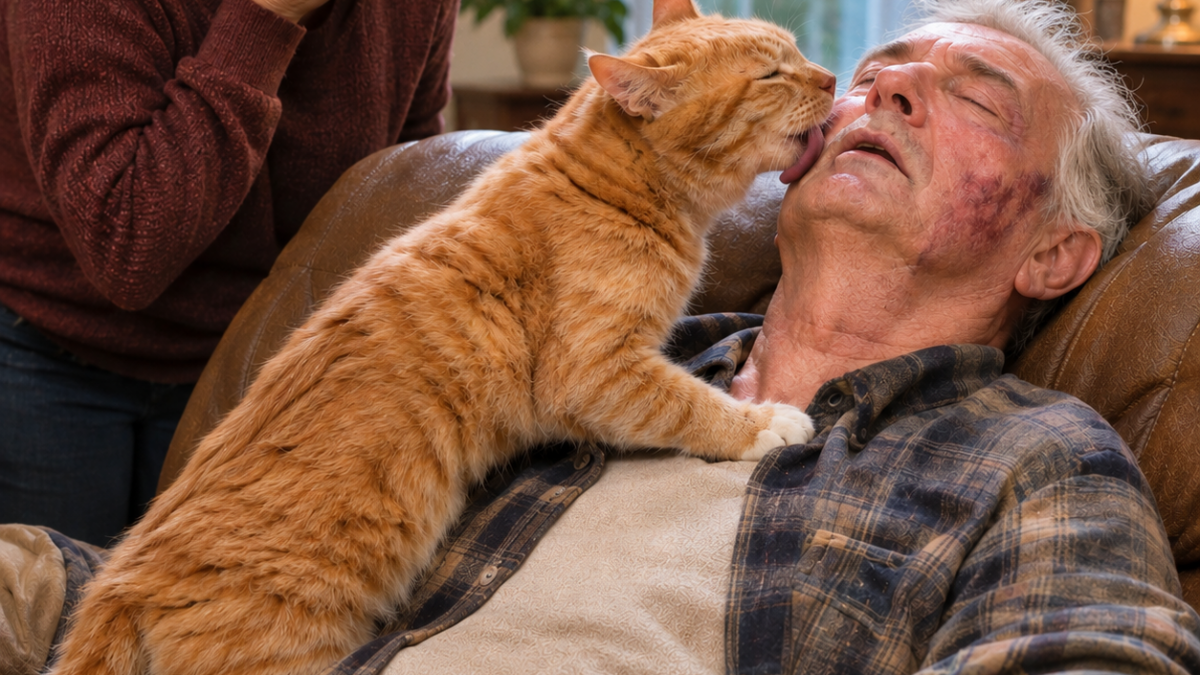
And Clyde was standing directly on his chest.
All four paws.
The cat’s back was arched.
His tail was puffed.
He was licking Dad’s face with frantic, rough movements.
Cheek.
Forehead.
Nose.
Closed eyelids.
Again.
Again.
Again.
“Frank?”
No response.
Mom dropped to her knees.
“Frank!”
Clyde barely acknowledged her.
He kept licking.
Mom touched Dad’s shoulder.
Nothing.
She slapped his cheek lightly.
“Frank!”
Clyde shifted but did not jump down.
Mom would later say that was when she knew something was terribly wrong.
Not because Dad did not answer.
Because Clyde would normally run the second anybody moved quickly near him.
Now Mom was shouting.
Crying.
Pulling at Dad.
And the cat stayed.
She grabbed the phone.
The dispatcher answered.
“My husband won’t wake up.”
The next several minutes became fragmented in Mom’s memory.
The dispatcher asking whether Dad was breathing.
Yes.
Was he blue?
No.
Could she lower him to the floor safely?
She tried.
Dad was six feet tall and nearly two hundred pounds.
At sixty-five, Mom could not move him alone.
The dispatcher told her not to risk injuring herself.
Unlock the front door.
Stay with him.
Watch breathing.
Paramedics were coming.
Clyde remained on Dad’s chest.
Mom finally lifted him away because she needed space.
He immediately jumped back onto the recliner arm.
Then onto Dad again.
“Clyde, stop.”
He did not stop.
His tongue kept moving across Dad’s face.
Mom noticed the skin on Dad’s cheek was bright red.
Raw.
The cat’s tongue had rubbed the same area over and over.
It looked almost burned.
“Frank, please.”
Nothing.
Clyde licked his eyelids.
Then his forehead.
Mom said the cat was trembling so hard she could see his shoulders shake.
At 3:07, the first ambulance arrived.
Two paramedics entered.
Daniel Ortiz and Mark Hensley.
Mom remembered Daniel because he had a calm voice.
He took one look at Dad and said, “Possible stroke.”
They moved fast.
Blood pressure.
Pulse.
Oxygen.
Pupil response.
Blood glucose.
Commands.
“Sir, can you hear me?”
Nothing.
“Frank, open your eyes.”
Nothing.
They applied stimulation.
Checked response.
Dad made a faint sound.
Clyde was now under the coffee table.
Watching.
One paramedic asked Mom:
“When did you last see him normal?”
“Before I went out.”
“What time?”
“Quarter to two.”
“When did you find him?”
“Three.”
“Any medical history?”
“High blood pressure.”
“Blood thinners?”
“No.”
“Diabetes?”
“No.”
“How long has he been unconscious?”
“I don’t know.”
Mom looked toward Clyde.
“He was doing that when I came in.”
Daniel followed her gaze.
“What?”
“The cat.”
Mom pointed.
“He was licking Frank.”
Daniel looked at Dad’s face.
The reddened cheek.
“Like grooming?”
“No.”
“Hard.”
“Constantly.”
“For how long?”
“I don’t know.”
That question would matter later.
At the hospital, doctors estimated that based on the wet fur around Clyde’s mouth, the irritation on Dad’s face, and the timeline, the cat might have been licking or pawing at him intermittently for thirty to forty-five minutes.
No one could prove the exact duration.
Mom always said forty-five.
It became the family number.
Forty-five minutes.
Daniel helped load Dad onto the stretcher.
Mom followed.
Before leaving, she saw Clyde near the front door.
His paws left tiny damp marks on the hardwood.
She almost ignored it.
Then she touched them.
Wet.
Not from water.
There was no spilled bowl.
No sink nearby.
Later, our veterinarian explained that cats have sweat glands in their paw pads and may leave damp prints when extremely stressed.
Mom remembered that detail more vividly than almost anything else.
Clyde had been sweating.
The cat who spent nine years treating most household events as beneath his attention had been terrified.
Mom called me from the ambulance bay.
I was at work.
“Rachel.”
Her voice told me immediately.
“What happened?”
“It’s Dad.”
I stood.
“What happened?”
“I don’t know. Stroke. They think stroke.”
I left without telling my manager where I was going.
He figured it out later.
The drive from my office to Cleveland Clinic normally took thirty-five minutes.
I have no memory of most of it.
I remember one red light.
A truck with a ladder.
A woman walking a golden retriever.
And thinking how offensive it was that the world looked normal.
People drove.
Dogs walked.
Somebody bought gasoline.
Meanwhile my father was somewhere ahead of me with part of his brain starved of blood.
Mom met me outside the emergency department.
She looked ten years older.
“Where is he?”
“They took him.”
“What happened?”
She told me.
The recliner.
The cat.
The licking.
“Was Dad awake at all?”
“No.”
“Did he say anything?”
“No.”
“Did he move?”
“I don’t know.”
“Mom.”
“I don’t know, Rachel.”
She began crying.
I hugged her.
She pulled away almost immediately.
“Clyde knew.”
I stared.
“What?”
“He knew.”
“Mom—”
“He was on him.”
“I know.”
“No. You don’t understand.”
Her voice rose.
“He wouldn’t stop.”
People in the waiting area looked over.
Mom lowered her voice.
“His paws were wet.”
I had no idea what she meant.
At the time, I thought it was shock talking.
The neurologist came out forty minutes later.
Dr. Aaron Blake.
He told us Dad had experienced an ischemic stroke.
The clot affected the right hemisphere.
That explained the left-sided weakness.
Treatment had begun.
Timing was critical.
They had done imaging.
Intervention was successful enough that blood flow improved.
But the next twenty-four hours mattered.
“How bad?”
I asked.
He gave the answer doctors give when they know families want numbers that medicine refuses to provide.
“It’s significant.”
“Will he wake up?”
“We expect him to.”
“Will he walk?”
“Too soon.”
“Talk?”
“Too soon.”
“Know us?”
“Too soon.”
I hated him for saying it.
Not fairly.
But I did.
Mom sat beside me.
Her hands shook.
Then Daniel, the paramedic, found us.
He was finishing paperwork and recognized Mom.
“How’s he doing?”
“Stroke,” she said.
“I figured.”
“They treated him.”
“Good.”
Mom asked the question that had been haunting her.
“Did the cat help?”
Daniel looked cautious.
“I can’t say that.”
“But you said—”
“I said stimulation matters.”
He pulled a chair closer.
“When somebody’s unconscious, we evaluate responsiveness. Pain response. Voice. Touch. Pressure. Those things tell us whether the nervous system is reacting.”
“So Clyde was keeping him awake?”
“Not exactly.”
“He wasn’t awake.”
“Right.”
Mom looked frustrated.
Daniel continued.
“I’m not saying the cat medically prevented damage. Stroke outcome depends on blood flow, clot location, time to treatment, all kinds of things.”
“But?”
Daniel paused.
Then said the sentence Mom repeated for years.
“Forty-five minutes is a long time to be unconscious with no stimulation.”
He looked toward the treatment doors.
“Another hour and we’d be having a very different conversation.”
Mom started crying again.
Daniel put one hand on her shoulder.
“Your husband got here.”
That was all he could promise.
Dad woke fully that evening.
His first word was not Mom.
Not my name.
Not Clyde.
It was:
“Cold.”
Mom laughed and cried at the same time.
The nurse brought another blanket.
Dad looked confused.
His left arm barely moved.
His speech was thick.
I walked to the bedside.
“Dad?”
His eyes found me.
“Rach?”
That one word nearly broke me.
“Yeah.”
He frowned.
“Why you here?”
Mom covered her face.
I laughed.
“You had a stroke.”
Dad looked at me.
Then at Mom.
“No.”
“Yes.”
He tried to lift his left hand.
Nothing happened.
His expression changed.
Fear.
I’ve seen my father angry.
Annoyed.
Sad once or twice.
I had never seen him afraid.
He looked at his own arm as though it belonged to someone else.
“Move.”
It didn’t.
“Dad.”
He tried again.
Nothing.
His face crumpled.
Just for a second.
Then the old Frank returned.
“Son of a bitch.”
I laughed through tears.
“That sounds more like you.”
He slept.
Woke.
Slept again.
The first twenty-four hours were a parade of tests.
Doctors.
Nurses.
Neurologists.
Speech therapy.
Physical therapy.
Questions.
“What’s your name?”
“Frank Mercer.”
“Where are you?”
“Hospital.”
“What year?”
He gave the correct one.
“Who is that?”
He looked at Mom.
“My parole officer.”
She hit his good arm.
The nurse laughed.
Dad improved faster than we expected.
By the second day he could move his left fingers.
By the third, lift the arm slightly.
His leg remained weak.
Walking required help.
His speech cleared.
The occupational therapist asked what he did before retirement.
“Fixed machines.”
“What hobbies?”
“Yelling at television.”
Mom said, “And feeding a cat too much.”
Dad looked around.
“Where’s Clyde?”
That was the first time he asked.
Mom smiled.
“Home.”
“Alone?”
“Carol’s feeding him.”
Carol was the neighbor.
Dad frowned.
“He won’t eat for her.”
“He ate.”
“You saw?”
“No.”
“Then you don’t know.”
I looked at Mom.
She looked at me.
Neither of us said anything.
Dad had just suffered a stroke.
Could barely move one side of his body.
And he was worried whether Clyde had eaten.
Mom leaned close.
“Do you remember him being on you?”
Dad frowned.
“What?”
“When you were unconscious.”
“Why would I?”
“He was licking your face.”
Dad stared at her.
“What?”
“For maybe forty-five minutes.”
“That’s disgusting.”
That was Dad.
Mom laughed.
“He rubbed your cheek raw.”
Dad touched the sore skin.
Winced.
“That explains that.”
“He was trying to wake you.”
“Or eat me.”
I said, “Dad.”
“What? I was defenseless.”
Mom shook her head.
“You should be grateful.”
“I am.”
But the words came too quickly.
Dad looked away.
That evening, I found him staring toward the window.
“What’s wrong?”
“Nothing.”
“You look weird.”
“Thanks.”
“Seriously.”
He was quiet.
Then:
“Did he really stay on me?”
“Mom says yes.”
“For how long?”
“Maybe forty-five minutes.”
He looked down at his left hand.
It moved slightly now.
“Why?”
I sat beside him.
“I don’t know.”
Dad nodded.
Animals were easier when you could dismiss everything as food.
This was harder.
“What did the paramedic say?”
I told him.
Carefully.
Not that Clyde saved him.
We could not say that.
The paramedic had not said that.
But stimulation.
Responsiveness.
Time.
Dad listened.
Then changed the subject.
Four days after the stroke, he came home.
Getting into the house took fourteen minutes.
Dad hated every second.
The front steps were only three stairs.
He had climbed them thousands of times.
Now Mom stood on one side.
I stood on the other.
A gait belt around him.
Cane.
Instructions.
“Slow.”
“I am going slow.”
“Dad, you almost fell.”
“I did not.”
“You leaned into me.”
“That is not falling.”
“You’re exhausting.”
“Then let go.”
“No.”
The front door opened.
Clyde was inside.
He had been sitting on the entry rug.
The moment he saw Dad, he stood.
He did not run forward.
That surprised all of us.
Dad stopped.
“Hey, fat man.”
Clyde’s ears moved.
Dad leaned on the cane.
The cat approached.
Slowly.
He sniffed Dad’s shoes.
Then the hospital bag.
Then Dad’s left pant leg.
Dad reached down with his good hand.
“Come here.”
Clyde backed away.
Dad froze.
His face changed.
Mom whispered, “Give him a second.”
Clyde circled behind Dad.
Sniffed.
Then sat.
Dad continued toward the living room.
Clyde followed.
When Dad finally lowered himself into the recliner, exhausted, Clyde remained on the floor.
Dad leaned back.
“Good.”
He sounded almost disappointed.
“Probably doesn’t recognize me.”
Mom began unpacking medication.
“He recognizes you.”
“I smell like a hospital.”
“Frank.”
“What?”
Clyde jumped.
Straight onto the recliner.
Dad tensed.
The cat placed two paws on his chest.
Exactly where Mom had found him.
Dad stopped breathing for a second.
Clyde sniffed his face.
Then licked his left cheek.
Once.
Dad closed his eyes.
Clyde licked again.
Dad’s mouth tightened.
“Okay.”
Mom stood in the kitchen doorway.
I was behind her.
Neither of us moved.
Dad whispered:
“That’s enough.”
Clyde settled on his chest.
Dad’s good hand came up.
Rested on the cat’s back.
For the first time in nine years, my father did not pretend the contact was accidental.
Recovery was harder than Dad expected.
Much harder.
He had spent his life believing physical limitation was something you outworked.
A machine doesn’t run?
Take it apart.
Find the faulty piece.
Replace it.
Body broken?
Exercise.
Push.
Fix it.
Strokes do not respect that worldview.
Some mornings Dad’s left hand worked better.
Then worse by afternoon.
He struggled with buttons.
Hated the shower chair.
Dropped forks.
Bumped walls.
Could walk short distances with a cane but tired quickly.
Physical therapy became his enemy.
His therapist, Kimberly, was thirty-three and five feet four inches tall.
Dad feared her more than anyone in our family.
“Again,” she’d say.
“I did it.”
“Again.”
“My insurance only pays for one.”
“Again.”
He’d glare.
Then do it.
Clyde attended therapy at home.
Not helpfully.
He sat on the exercise mat.
Dad would try to lift his leg.
“Move.”
Clyde stared.
“Kim, tell him.”
She laughed.
“Clyde, please respect the rehabilitation space.”
Nothing.
Dad muttered, “Useless animal.”
Then slid the cat away gently with his good foot.
One afternoon, while Dad practiced standing from a chair without pushing off with his hands, his left knee buckled.
Kim caught him.
Dad swore.
Clyde jumped from the couch.
He ran over.
Not walked.
Ran.
He began circling Dad’s ankles.
“Get him out of here.”
Mom moved toward Clyde.
Dad said, “No.”
Everyone stopped.
Dad looked down.
“He can stay.”
Clyde sat.
Dad tried again.
For the next three months, Clyde stayed close.
Not constantly.
He was still Clyde.
Meals remained sacred.
Sunbeams outranked emotional support.
But something had changed.
Before the stroke, Clyde slept wherever heat and softness were highest.
Afterward, he preferred Dad.
Dad’s recliner.
Dad’s bed.
The bath mat outside Dad’s shower.
When Dad practiced walking the hallway, Clyde followed several feet behind.
One evening Dad turned too quickly and nearly stepped on him.
“See?”
Dad pointed.
“This is why cats are dangerous.”
Mom laughed.
“You’re blaming the cat?”
“He’s underfoot.”
“He saved your life.”
“He licked my face.”
“For forty-five minutes.”
“Allegedly.”
That became our family argument.
Mom: “Clyde saved you.”
Dad: “Clyde was confused.”
Me: “He was trying to wake you.”
Dad: “He wanted dinner.”
Ellie—my younger sister, who lived in Cincinnati—said, “Maybe he was checking if you were edible.”
Dad liked that theory.
Mom did not.
The veterinarian, Dr. Karen Levy, was more careful.
We brought Clyde in about three weeks after Dad returned home.
Mom wanted to know about the wet paw prints.
The vet examined Clyde.
He weighed thirteen pounds.
Dad complained because the chart said overweight.
Then Mom asked:
“Can cats sweat through their feet?”
Dr. Levy nodded.
“Paw pads, yes.”
“When stressed?”
“Yes.”
“Extremely stressed?”
“Potentially.”
Mom looked at Dad.
Dad stared at the floor.
Dr. Levy continued.
“If a cat is frightened, you can sometimes see damp paw prints on hard surfaces.”
Mom said, “That’s what I saw.”
Dad crossed his arms.
Dr. Levy smiled.
“Something was upsetting him.”
Dad finally asked:
“Would he know I was sick?”
The question surprised everyone.
Dr. Levy thought carefully.
“Know stroke?”
“No.”
“Understand medically what happened?”
“No.”
“Then what?”
“He may have recognized abnormal posture, breathing, smell, lack of response.”
Dad was quiet.
“Cats notice routines very well.”
She looked at Clyde.
“If someone they live with suddenly behaves unlike themselves, many animals react.”
“How?”
“Vocalizing. Pawing. Staying nearby. Sometimes licking.”
Mom said, “He was licking hard.”
Dad rubbed his cheek automatically.
The skin had healed by then.
Dr. Levy smiled.
“Maybe Clyde’s bedside manner needs work.”
Dad laughed.
Then asked:
“Why didn’t he go get help?”
Mom stared.
“He’s a cat, Frank.”
“I know.”
“What did you want him to do? Call 911?”
Dr. Levy laughed.
Dad shrugged.
“If we’re making him a hero, he should complete the job.”
That night, I found Dad in the kitchen giving Clyde turkey.
“Diet,” I said.
Dad looked guilty.
“He had a hard month.”
“So did you.”
“I can’t eat cat treats.”
“That’s not the point.”
He gave Clyde another piece.
“Don’t tell your mother.”
By June, Dad walked without a cane inside the house.
Outside, he kept one for uneven ground.
His left hand remained weaker.
His handwriting changed.
He struggled with fine movements.
But he could drive short distances after his neurologist cleared him.
The first trip he took alone was to the hardware store.
The second was to buy cat food.
He insisted that was coincidence.
Summer brought progress.
And something else.
Fear.
Dad never admitted it.
But we saw it.
He stopped sitting alone for long periods.
If Mom went out, he asked where.
How long.
What time she’d be back.
If she was gone twenty minutes longer than expected, he called.
He kept his phone in his pocket even inside the house.
He purchased a medical-alert watch after resisting for weeks.
“I’m not eighty.”
Mom said, “You don’t need to be eighty to have another stroke.”
He glared.
Then wore it.
The recliner became complicated.
For the first month, Dad avoided it.
He sat on the couch instead.
Mom noticed.
Said nothing.
Eventually, on a rainy afternoon in July, he sat there again.
Clyde was asleep on the couch.
The news was on.
Exactly like that Tuesday.
Dad made it nine minutes.
Then stood.
Mom looked up from the kitchen table.
“What’s wrong?”
“Nothing.”
“You just sat down.”
“Back hurts.”
She knew he was lying.
Later, she told me.
I went over the following Sunday.
Dad was in the garage sharpening a mower blade.
Left hand still awkward.
“Mom says you won’t sit in the recliner.”
He kept working.
“She needs hobbies.”
“She has hobbies.”
“More.”
“Dad.”
“What?”
“You scared?”
That stopped him.
He looked at me.
“I had a stroke.”
“I know.”
“In that chair.”
“I know.”
“So maybe I don’t feel like sitting there.”
“You don’t have to.”
“I know.”
He returned to the blade.
I waited.
Then he said:
“Couldn’t move.”
His voice was different.
Lower.
“I woke up in the hospital and couldn’t move my arm.”
I leaned against the workbench.
“I know.”
“You know what’s stupid?”
“What?”
“The phone was right there.”
He pointed to an imaginary table.
“Could’ve touched it if I could move three feet.”
He stared at his left hand.
“Three feet.”
I said nothing.
“If your mother had decided to stop for gas…”
He stopped.
“She came home.”
“If traffic was bad.”
“But it wasn’t.”
“If she went to Target after groceries.”
“She hates Target.”
That made him smile.
Barely.
Then:
“If Clyde hadn’t…”
He stopped again.
I did not finish the sentence for him.
Dad looked toward the house.
“I don’t remember him.”
“I know.”
“Nothing?”
“Probably better that way.”
He nodded.
“Maybe.”
Then he went back to sharpening the blade.
That was as close as my father came to telling me he was terrified.
The recliner remained empty for another week.
Then one morning, Mom sent me a photograph.
Dad asleep in it.
Head tilted back.
Clyde stretched across his chest.
Dad’s hand on him.
Caption:
LOOK WHO FINALLY SAT DOWN.
I stared at that image for a long time.
The change continued so gradually we almost stopped noticing.
Dad began touching Clyde more.
Not dramatic petting.
A hand on the back.
Scratching beneath the chin.
Letting him sleep against his legs.
Clyde began climbing onto Dad’s chest every evening.
Not for forty-five frantic minutes.
Just five.
Ten.
Then he’d settle beside him.
Mom called it “the inspection.”
Dad called it “being smothered.”
Neither tried to stop it.
One afternoon in August, Dad had a doctor’s appointment.
The neurologist said he had regained roughly ninety percent of his previous function.
Dad hated the number.
“What happened to the other ten?”
Dr. Blake smiled.
“You tell me.”
“My grip.”
“Yes.”
“Balance.”
“A little.”
“Fatigue.”
“Common.”
“So why ninety?”
“Because I’m trying to keep you from arguing over decimals.”
Dad liked him after that.
The doctor emphasized blood pressure control.
Medication.
Exercise.
Diet.
Recognizing stroke signs.
Dad listened more carefully than he would have before.
Near the end, Dad asked:
“Can animals know?”
Dr. Blake frowned.
“Know what?”
“That somebody’s having a stroke.”
I looked at Dad.
He ignored me.
The neurologist leaned back.
“There are dogs trained to alert to certain medical conditions.”
“Cats?”
“Less research.”
“So no.”
“Not no.”
Dad waited.
“Animals can notice changes in human behavior, scent, movement, routine. Whether Clyde recognized a stroke specifically, I can’t tell you.”
Dad nodded.
“He licked my face.”
“I heard.”
“Forty-five minutes.”
Mom smiled.
Dad added quickly:
“According to my wife.”
Dr. Blake said, “That’s commitment.”
Dad looked down.
“Yeah.”
On the drive home, Dad was quiet.
I said, “You know, you don’t have to prove he medically saved you.”
“What?”
“You keep asking doctors.”
“I’m curious.”
“You want permission to believe it.”
He looked out the window.
“I want facts.”
“Sure.”
“Facts matter.”
“So does what happened.”
He said nothing.
I continued.
“You were unconscious.”
“Yes.”
“He stayed.”
“Apparently.”
“He was stressed enough to sweat through his paws.”
“Apparently.”
“He licked you until your face was raw.”
“Unfortunate.”
“You love him.”
Dad looked at me.
“Don’t be ridiculous.”
I laughed.
Three months later, another event changed how Dad talked about the stroke.
Not medically.
Emotionally.
Mom had gone to a church luncheon.
Dad was home.
Alone again.
He called me around noon.
I saw his name.
My stomach tightened immediately.
That had become my trauma.
Dad calling unexpectedly.
I answered too fast.
“What’s wrong?”
Silence.
Then:
“Nothing.”
“Why are you calling?”
“I can’t call my daughter?”
“Not at noon on Wednesday.”
“I’m offended.”
“Dad.”
He sighed.
“Clyde’s acting weird.”
My fear shifted.
“How?”
“Walking around yelling.”
“Is he hurt?”
“No.”
“Did you feed him?”
“Yes.”
“Water?”
“Yes.”
“Litter?”
“Clean.”
“Maybe he’s bored.”
“He keeps coming over to me.”
I waited.
“So?”
Dad was quiet.
“You feel okay?”
Another pause.
“That is what I was asking.”
My heart jumped.
“Dad.”
“I feel fine.”
“Smile.”
“What?”
“Smile.”
“This is stupid.”
“Dad.”
I switched to video.
His face appeared.
“Smile.”
He did.
Symmetrical.
“Raise both arms.”
“Rachel.”
“Do it.”
He raised them.
Left still slightly lower.
Normal for him.
“Say: You can’t teach an old dog new tricks.”
“That sentence is discriminatory.”
“Say it.”
He did.
Speech clear.
“Any headache?”
“No.”
“Vision?”
“No.”
“Dizzy?”
“No.”
“Chest pain?”
“No.”
“Call Mom.”
“She won’t answer.”
“She’s at church.”
“I know.”
“Call the doctor.”
“For what? The cat’s yelling?”
“Medical alert watch?”
“Fine.”
He checked.
Heart rate normal.
No obvious emergency.
Twenty minutes later, Clyde stopped.
Dad called again.
“He’s asleep.”
“Great.”
“Maybe he’s just insane.”
“Probably.”
But something about it bothered him.
Later we learned that Dad’s blood pressure had been unusually high that morning.
Not emergency-level.
No stroke.
Could Clyde detect it?
No one knew.
Maybe he wanted attention.
Maybe there was a squirrel outside.
Maybe Dad smelled different.
Maybe coincidence.
Dad stopped demanding an answer.
That was the change.
Before, uncertainty irritated him.
After the stroke, he learned some events could matter without being completely explainable.
At Christmas, our family gathered at my parents’ house.
Ellie drove up from Cincinnati.
My husband came.
Our kids, both college-age.
Mom cooked too much food.
Dad complained the turkey was dry even though it wasn’t.
Clyde spent most of dinner sitting beneath Dad’s chair because people kept sneaking him meat.
After dessert, my son Ben asked:
“Grandpa, is it true Clyde saved your life?”
Everyone went quiet.
Dad looked at Clyde.
The cat was washing one paw.
“Your grandmother likes that version.”
Mom said, “It’s the correct version.”
Dad sighed.
Ben waited.
Dad could have joked.
He almost did.
Then he said:
“I don’t know if he saved me.”
Mom opened her mouth.
Dad raised one finger.
“But he didn’t leave.”
The room went silent again.
Dad looked uncomfortable.
“So that’s worth something.”
Ben nodded.
“Yeah.”
Clyde jumped onto Dad’s lap.
Everyone laughed.
Dad said, “Don’t encourage him.”
The following March marked one year.
Mom wanted to celebrate.
Dad refused.
“You don’t celebrate strokes.”
“You celebrate survival.”
“Have cake then.”
“We are.”
She bought a cake.
Dad complained.
A small orange cat made of frosting sat in one corner.
Dad said it looked nothing like Clyde.
Mom said, “Eat it.”
We did.
At 3:17 that afternoon—the time Mom later estimated she had first been talking to the dispatcher—Dad sat in the recliner.
Clyde slept on his chest.
I was there.
Mom was in the kitchen.
Dad touched the cat’s back.
“I think he knew.”
I looked at him.
That was the first time he said it.
“Yeah?”
“Something.”
I did not tease.
Dad continued.
“He must’ve.”
“Probably.”
“He would’ve left if nothing was wrong.”
“Maybe.”
“He always leaves.”
As though insulted, Clyde lifted his head.
Dad looked down.
“You do.”
Clyde settled again.
Dad smiled.
It was tiny.
But I saw it.
Years passed.
Dad continued improving.
Not perfectly.
His left hand never returned completely to its old strength.
He stopped doing delicate repairs on small tools.
He hated asking for help.
Then slowly stopped treating help like humiliation.
He walked every morning.
Blood pressure became almost annoyingly controlled.
He reduced salt.
Sort of.
Mom hid the salt shaker.
Dad bought another and kept it in the garage.
Clyde gained weight again.
Dr. Levy put him back on a diet.
Dad said the veterinarian was “attacking an elderly gentleman.”
Clyde was now thirteen.
Then fourteen.
Orange fur lightened around his mouth.
He moved slower.
Jumped onto the recliner in stages.
Floor.
Ottoman.
Arm.
Dad started lowering the footrest for him.
Mom noticed.
Of course.
“You built him stairs.”
“I did not.”
“You put an ottoman there.”
“It belongs there.”
“It was across the room for eleven years.”
Dad glared.
Clyde climbed up.
The arrangement stayed.
When Clyde developed arthritis, Dad gave him medication hidden inside tiny pieces of chicken.
When he developed early kidney disease, Dad learned how to give subcutaneous fluids.
Watching my father do that was surreal.
The first attempt, Clyde fought him.
Dad nearly dropped the bag.
“Hold still.”
Clyde twisted.
“I’m helping you.”
Clyde attempted escape.
“I have personal experience with medical incompetence.”
Mom laughed so hard she had to sit down.
Eventually, they learned.
Dad would place Clyde beside him.
Fluid bag hanging from a coat hook.
Needle.
Treat.
Routine.
The man who once considered scooping a litter box excessive involvement now kept a notebook documenting the cat’s water intake.
No one teased him too much.
We knew why.
Then, seven years after the stroke, Dad had another health scare.
Not another stroke.
Pneumonia.
He spent three nights in the hospital.
At seventy-five, recovery was slower.
Clyde was twenty.
Ancient.
He had lost weight.
Hearing poor.
Kidneys declining.
But when Dad came home, Clyde walked from the living room to the entryway.
Slowly.
Painfully.
Dad stopped.
“Hey.”
Clyde stared.
Then pressed his head against Dad’s ankle.
Dad bent as far as he safely could.
“I’m here.”
Mom cried.
Dad pretended not to notice.
That winter, Clyde began sleeping on Dad’s chest every night before bed.
Not all night.
Ten minutes.
Sometimes twenty.
Dad would lie on top of the covers.
Clyde climbed up.
Purr.
Hand on orange back.
Then Mom transferred Clyde to the heated bed beside the dresser because Dad needed sleep.
It became ritual.
One evening, during my visit, I watched.
“Does he still lick your face?”
Dad said, “God, no.”
Clyde immediately licked his chin.
I laughed.
Dad wiped his face.
“Spiteful animal.”
“Still trying to keep you conscious.”
“I am clearly conscious.”
“Can’t be too careful.”
Dad looked at Clyde.
“Guess not.”
Clyde died the following spring.
Twenty-one years old, as best anyone could estimate.
His kidneys failed.
Slowly at first.
Then not.
Dad saw it before the rest of us.
He called Dr. Levy.
The vet came to the house.
Mom called me.
I drove over.
Dad sat in the recliner.
Of course.
Clyde lay on his chest.
Thin now.
Almost weightless.
The same place where Mom had found him standing seven years earlier.
Dad’s hand moved over his back.
Very slowly.
Dr. Levy examined him.
Then looked at Dad.
“You know.”
Dad nodded.
Mom cried quietly.
I sat on the couch.
Dad did not.
Not yet.
Clyde’s breathing was shallow.
Dad stared at him.
“I hate this.”
Dr. Levy said, “I know.”
“He’s not eating.”
“No.”
“Barely drinking.”
“No.”
“Hurts?”
“Probably uncomfortable.”
Dad closed his eyes.
“I don’t want him hurting.”
“I know.”
Clyde shifted.
His head rested against Dad’s shirt.
Dad looked down.
For a long time, nobody spoke.
Then Dad said:
“Did I ever tell you what that paramedic said?”
We all knew.
Mom answered anyway.
“Yes.”
“Forty-five minutes.”
“Yes.”
Dad touched Clyde’s ear.
“He stayed on me forty-five minutes.”
Mom sat beside him.
“Yes.”
Dad’s voice broke.
“He didn’t know what to do.”
“No.”
“So he did the only thing he could.”
Mom put her hand over Dad’s.
Dad stared at Clyde.
“I guess that’s what we’re doing now.”
No one could answer.
Dr. Levy waited until Dad nodded.
The first injection relaxed Clyde.
His body softened.
Purring slowed.
Dad leaned back.
For the first time, tears ran openly down my father’s face.
He made no effort to hide them.
“Good boy.”
That was the first time I ever heard him call Clyde that.
Good boy.
Not fat man.
Not freeloader.
Not useless animal.
Good boy.
Clyde opened his eyes once.
Dad pressed his forehead gently against the cat’s.
“You did enough.”
My throat closed.
Seven years earlier, Clyde had stood over an unconscious man and kept touching him because he would not respond.
Now Dad stayed with Clyde while his body stopped responding.
There was no panic.
No ambulance.
No bright lights.
Only home.
The recliner.
Mom beside him.
Family.
The final medication went in.
Clyde took one breath.
Another.
Then none.
Dad kept his hand on him.
Forty-five minutes.
That was how long Dad stayed in the chair after Clyde died.
I noticed the clock.
I don’t know whether he did.
Nobody asked him to move.
At forty-five minutes, Dad finally lifted Clyde gently.
“I’ll take him.”
Dr. Levy stood.
Dad shook his head.
“No.”
He carried Clyde himself.
Slowly.
Carefully.
Left arm weaker than the right.
But enough.
He buried Clyde beneath the maple tree behind the garage.
The same tree where our childhood dog had been buried decades earlier.
Dad did not want an urn.
Did not want ashes on a shelf.
“He liked outside windows.”
That was his explanation.
We placed a flat stone over the grave.
Mom asked if he wanted something engraved.
Dad said no.
Two weeks later, I visited.
A small metal plaque had appeared.
CLYDE
2010–2031
HE STAYED.
I looked at Dad.
“You did that?”
“No.”
“Mom?”
“No.”
“Dad.”
He sighed.
“Maybe.”
I sat beside him on the porch.
For a while, neither spoke.
The house was different without Clyde.
Quiet.
Dad noticed too.
He left the television on more.
That detail hurt me because I remembered Mom telling me I did the same thing years earlier when Ellie first moved away.
Loss creates strange echoes.
One evening I asked him:
“Do you miss him?”
Dad stared at the yard.
“No.”
I waited.
He added:
“Yes.”
That was enough.
Months later, Mom found something while cleaning the living room.
Tiny scratches in the leather of the recliner.
Four small sets near the center of Dad’s chest position.
Probably from the afternoon of the stroke.
Clyde’s claws gripping for balance while he licked Dad’s face.
Mom wanted to replace the recliner.
Dad refused.
“It’s still good.”
The leather was cracked.
The mechanism squeaked.
One side sagged.
“It needs replacing.”
“No.”
“Frank.”
“No.”
The chair remained.
By Dad’s eightieth birthday, walking had slowed.
His stroke was old history.
He had other problems.
Arthritis.
Hearing aids.
A pacemaker.
But cognitively, he remained sharp enough to argue with everyone.
We held the birthday party in the house.
Family photographs covered one table.
I found one from before the stroke.
Dad in the recliner.
Clyde asleep on the arm.
Both younger.
Both pretending not to be attached.
I handed it to Dad.
He smiled.
“That cat was fat.”
“You fed him.”
“Your mother did.”
“She says you did.”
“Revisionist history.”
I sat beside him.
“Do you still think he saved your life?”
Dad looked at the photograph.
For years, he had resisted the phrase.
Medically inaccurate.
Sentimental.
Impossible to prove.
At eighty, he no longer seemed interested in winning every argument.
He said:
“I think he knew I was gone.”
I frowned.
“Gone?”
“Not dead.”
He tapped his chest.
“Gone somewhere.”
He looked toward the old recliner.
“And he wanted me back.”
My eyes filled.
Dad saw.
“Oh, don’t.”
“I’m not doing anything.”
“You’re making that face.”
“What face?”
“The crying face.”
I laughed.
He looked at the photograph again.
“Saved my life?”
He shrugged.
“Maybe that’s too big.”
Then:
“He kept me company until help came.”
That sentence felt more like my father.
True.
Plain.
Enough.
After Clyde died, Dad never adopted another cat.
Mom suggested it once.
“No.”
“Why?”
“I’m too old.”
“That’s not a reason.”
“Yes it is.”
“There are senior cats.”
Dad looked at her.
“No.”
She understood.
Some relationships do not create appetite for replacement.
They simply occupy their place.
My father lived another nine years after Clyde.
He died at eighty-four.
Not from a stroke.
Heart failure.
Quietly.
At home.
Mom had gone before him by two years.
I was there.
So was Ellie.
The recliner was still in the living room.
Same scratches.
Same sagging cushion.
After the funeral, we began sorting the house.
Forty-two years of marriage.
Nine years of widowhood.
Drawers full of screws.
Old tax returns.
Tools.
Photographs.
Mom’s recipes.
Clyde’s ancient veterinary records.
I found a small envelope in Dad’s desk.
My name was on it.
Inside was one sheet of paper.
Dad was not a letter writer.
Three paragraphs.
The first dealt with practical things.
Where he wanted certain tools to go.
Which neighbor had borrowed a ladder.
A reminder that the furnace filter size written on the utility-room wall was wrong.
Classic Dad.
Then the final paragraph.
Rachel,
Your mother always said Clyde saved me. You know I don’t know if that is scientifically true. Don’t let anybody make up things just because they sound nice.
I laughed while crying.
Of course.
Then:
But I know this. I was alone, and he wasn’t. Maybe that’s what mattered.
I had to stop reading.
The next line:
If you keep anything from the house, keep the picture of him on the chair. Not the chair. That thing should have been thrown away years ago.
I laughed harder.
Then the last sentence.
Your mother was right about the cat.
That was it.
No explanation.
He knew I would understand.
I kept the photograph.
Not the chair.
Dad was correct about that.
The recliner went to the dump.
Before it left, I ran my fingers across the scratches in the leather.
Tiny marks.
Nothing dramatic.
No evidence that would convince a scientist.
No proof.
Just four paws once braced against a man’s chest while the world inside that man went dark.
People have asked our family about Clyde many times.
The story spread.
First among relatives.
Then Mom told her church friends.
Then somebody told a local reporter after Dad completed rehab.
We refused interviews at first.
Dad hated the idea.
“I am not going on television because a cat licked me.”
Eventually the story became one of those family legends that people retell at holidays.
Details shift.
Somebody says Clyde screamed.
He didn’t.
Someone claims he ran to the door when Mom returned.
No.
Someone says he was pawing Dad’s chest like CPR.
Definitely not.
We correct them.
Because the real story does not need embellishment.
A man had a stroke.
His cat noticed something was wrong.
The cat stayed.
He licked.
Pawed.
Climbed.
Trembled.
Sweated through his paw pads.
Tried repeatedly to get a response.
Then help arrived.
Could Clyde have prevented neurological damage?
We cannot know.
Did stimulation change Dad’s outcome?
Maybe.
Maybe not.
Did the paramedic’s comment reflect a medical guarantee?
No.
Dad’s survival came from rapid recognition, emergency transport, skilled physicians, modern stroke treatment, rehabilitation, and luck.
But people sometimes confuse that uncertainty with meaninglessness.
Because we cannot prove Clyde changed the neurological outcome, some people think the cat’s behavior does not matter.
I disagree.
It matters because of what it reveals.
For nine years, Clyde’s life was built around routine.
Dad woke at six.
Coffee.
News.
Breakfast.
Recliner.
Garage.
Lunch.
Evening television.
Sleep.
Clyde knew those rhythms more intimately than most humans did.
Then, one afternoon, the man at the center of half those routines stopped responding.
Clyde could not name stroke.
Could not call 911.
Could not check FAST symptoms.
Could not measure blood pressure.
He had no language for neurological emergency.
But he knew:
This is wrong.
The person who should move is not moving.
The person who should speak is silent.
The person whose hand usually pushes me away is not pushing.
So Clyde did what he could.
He climbed onto him.
Touched him.
Licked him.
Again.
Again.
Again.
For however long it took.
Maybe forty-five minutes.
Maybe less.
Maybe more.
Until someone came through the door.
That is the version I believe.
Not because it turns Clyde into a doctor.
Because it lets him remain exactly what he was.
A cat.
A lazy, overweight, irritating orange cat who knocked cups off counters and shed enough fur to build another cat.
A cat who loved one man in the uncomplicated way animals sometimes love us.
Without speeches.
Without understanding our biology.
Without needing credit.
Dad spent years pretending Clyde belonged to Mom.
Clyde spent forty-five minutes proving otherwise.
And after the stroke, something in Dad changed.
Not dramatically.
He never became the man who posted pet photos online.
Never called himself a cat dad.
Never bought Clyde clothes.
Thank God.
But he stopped pretending indifference.
He touched him.
Let him sleep on his chest.
Tracked his medication.
Built unofficial steps to the recliner.
Stayed beside him at the end.
I think Dad understood something after the stroke that he had resisted most of his life.
Being needed and being loved are not always loud.
Neither is fear.
Neither is loyalty.
Sometimes love looks like a man feeding turkey beneath the table while insisting he doesn’t care.
Sometimes it looks like a cat licking a motionless face until his own paws sweat.
Sometimes it looks like an old man sitting in a worn recliner with one hand resting on orange fur because he knows exactly what it means to wake up and find somebody still there.
My father never thanked Clyde in words.
Not really.
But he did something better.
He let the cat know the relationship had changed.
From the day Dad came home from the hospital until the day Clyde died, the recliner belonged to both of them.
There was always space.
And when Clyde’s body finally failed, Dad returned the same gift the cat had once given him.
He stayed.
That is what I remember now.
Not the stroke itself.
Not hospital corridors.
Not machines.
Not the panic in Mom’s voice.
I remember two moments.
A cat standing on a man’s chest, refusing to leave while that man is unconscious.
And seven years later, that same man holding the old cat on the same chest, refusing to put him down while the cat takes his final breath.
Neither could save the other forever.
That was never the promise.
The promise was smaller.
And perhaps more important.
When you are frightened, I will stay.
When you cannot answer, I will stay.
When your body fails, I will stay.
When help is coming but has not arrived yet, I will stay.
Forty-five minutes.
Seven years.
A lifetime.
Maybe the length was never the point.
The staying was.








