My 5-Year-Old Made Me Miss the Most Important Biker Meeting of the Year—Then I Found the 11-Second Video Her Mom Left Behind
PART3:
“Nothing.”
“It’s pointing nowhere.”
“It used to.”
Caroline studied me.
Then said:
“That might be the saddest answer I’ve ever heard from a man holding a turkey sandwich.”
I stared at her.
She laughed.
I married her eighteen months later.
Caroline did not cure me.
I hate stories where a good woman magically fixes a damaged man.
It turns the woman into medicine and the man into a project.
Caroline was not my cure.
She was my witness.
She saw exactly what I was capable of.
Good and bad.
She demanded that I take responsibility for both.
The first time I raised my voice during an argument, she did not flinch.
She pointed toward the front door.
“You are allowed to be angry.”
I went silent.
“You are not allowed to make me afraid so you can feel powerful.”
I never forgot it.
Not because I never failed again.
Because she made the rule clear.
When Ellie was born, I stood beside the hospital bassinet terrified to touch my own daughter.
Caroline looked exhausted.
Hair sticking to her forehead.
Hospital gown twisted.
Still somehow ready to make fun of me.
“Pick her up.”
“I will.”
“When?”
“Soon.”
“She’s your baby, Gabriel.”
“My hands are too big.”
Caroline stared.
I looked at my knuckles.
STAY.
HOME.
Scars.
Ink.
Hands that had put a man into surgery.
Caroline understood.
She lifted Ellie herself.
Then placed our daughter against my chest.
“She isn’t made of glass.”
“I know.”
“No.”
Caroline smiled.
“You absolutely do not.”
Ellie weighed seven pounds.
I held her like she weighed nothing and everything.
For five years, she found increasingly creative ways to humiliate me.
Pink nail polish before charity rides.
Temporary unicorn tattoos on my neck.
Stickers on my helmet.
Plastic butterfly clips in my beard.
One Saturday she put twelve of them in while I slept.
I woke, looked in the mirror and started removing them.
She cried.
So I rode to the shop with butterflies.
Saint laughed.
Once.
Only once.
Caroline laughed for twenty minutes.
That sound filled every corner of our house.
Then eight months before the spa, Caroline died.
Not after some long decline.
Not with time to prepare.
Not with a hospital room full of people saying meaningful things.
She died on our kitchen floor.
Cerebral aneurysm.
One moment she was making coffee and telling Ellie they were going to be late.
The next she dropped the mug.
I was in the garage.
I heard the ceramic break.
Then Ellie scream.
I reached the kitchen before Caroline stopped moving.
Called 911.
Started CPR.
Rook arrived before the ambulance because he happened to be three blocks away.
He took Ellie outside.
I kept pressing Caroline’s chest.
Paramedics came.
Machines came.
Commands.
Shock.
Needles.
Movement.
Then less movement.
Then none.
There are words used in medicine that sound gentle until they become the border between before and after.
Time of death.
I do not remember the exact time.
I could look it up.
I never have.
I remember the kitchen clock.
I remember coffee running beneath the refrigerator.
I remember one of Caroline’s slippers near the dishwasher.
I remember the paramedic touching my shoulder.
I remember Rook holding Ellie in the driveway.
My daughter was screaming for me.
I remember thinking:
I cannot go to her yet.
Then:
I have to.
That was the first impossible thing grief asked.
Leave Caroline’s body.
Walk toward our daughter.
I did.
For months afterward, Ellie waited for her mother to reappear in strange ways.
She checked the bedroom.
Asked whether Mommy needed her raincoat.
Wanted to know if people who died still needed toothbrushes.
Once she left half a cookie on Caroline’s side of the table.
I found it there after bedtime.
I sat in the kitchen alone for an hour staring at it.
People complimented me on how well I handled things.
That almost made me angry.
Ellie arrived at kindergarten clean.
Lunch packed.
Hair brushed badly but brushed.
Bills paid.
Shop open.
Laundry done.
Doctors scheduled.
I learned which detergent did not irritate her skin.
Learned that dinosaur chicken nuggets went on sale every third Thursday.
Learned how to braid hair from a video made by a twelve-year-old with more patience than I had.
From outside, competence looks like healing.
It is not.
Inside our house, Caroline remained everywhere.
Yellow raincoat behind the kitchen door.
Blue mug over the coffee maker.
A grocery list beneath a Memphis magnet.
Half a bottle of shampoo.
Red Softail under a cover at the shop.
I could remove an engine from a touring bike in under two hours.
I could not throw away a piece of paper that said:
Milk
Bananas
Ellie cereal
Dish soap
Tell Gabe we need batteries
Tell Gabe.
Present tense.
As if she might still tell me.
Ellie noticed everything.
Children always do.
She began closing doors softly.
Stopped dropping toys.
Asked permission to make noise.
“Daddy, can I watch cartoons?”
“Yes.”
“Loud?”
“If you want.”
“Are you sure?”
“Yes.”
One afternoon our neighbor’s golden retriever ran through a sprinkler and crashed into a lawn chair.
Ellie made a little laughing sound.
Then looked at me.
“Can I laugh?”
That question frightened me more than almost anything after Caroline’s death.
“You don’t need permission to laugh.”
She nodded.
Then did not laugh again.
Caroline had been the noise.
She sang while doing dishes.
Made songs about missing socks.
Narrated grocery shopping like an expedition.
“We have entered the dairy kingdom. Stay close. The yogurt tribes are unpredictable.”
She made silliness feel safe.
I responded to her death by becoming organized.
Schedules.
Rules.
Meals.
Bedtimes.
Locked doors.
I thought routine would protect Ellie.
Some routine did.
But I also made our home quiet enough for grief to become the loudest thing in it.
Then came the spa.
Saturday morning.
I was in the garage working on Caroline’s old bicycle.
Not the Softail.
Her cheap red bicycle with a bent rear fender.
Ellie carried Caroline’s tablet into the garage.
“Daddy.”
“Yeah?”
“I’m opening a business.”
I tightened the chain.
“What kind?”
“A spa.”
“We don’t have a spa.”
“We have a garage.”
“Garages are for motorcycles.”
“And spas.”
“No.”
“Yes.”
I looked at her.
She had Caroline’s expression.
Not appearance.
Expression.
The one that meant the debate existed only because I had not yet accepted that I was losing.
“What exactly does this spa involve?”
“I need cucumber.”
“No.”
“And yogurt.”
“Why?”
“And cocoa.”
“Absolutely not.”
“And honey.”
“You are describing breakfast.”
She held up the tablet.
A woman in a white robe was applying a homemade facial mask while a little girl painted her fingernails.
Whale music played.
“See?”
I stared.
“You want to put food on my face?”
“It’s spa.”
“Looks like lunch.”
“Daddy.”
That tone.
“Fine.”
Within an hour, the back of my garage had been transformed.
A beach towel over an old recliner.
Caroline’s portable speaker playing recorded ocean sounds with whale calls.
Every seven minutes, the video was interrupted by an advertisement about car insurance because Ellie had somehow found the worst free relaxation recording in existence.
A cereal bowl held a brown mixture of oats, yogurt, cocoa and honey.
Two cucumber slices floated in water.
A pink towel rested over the chair.
Ellie taped a sign outside.
ELLY ROYAL ROD SPA
Below:
ONE CUSTMER. VERRY IMPORTANT.
“You spelled your name wrong.”
“It’s business spelling.”
“Royal Rod?”
“For motorcycles.”
“Of course.”
She pointed at the chair.
“Sit.”
My phone vibrated.
Rook.
City Hall.
That should have mattered immediately.
The Caroline Kane Memorial Ride was six weeks away.
For seven years, it had raised money for families facing sudden medical emergencies.
Caroline started the original event after one of her students’ fathers lost both legs in a factory accident.
She convinced businesses to sponsor.
Churches to donate.
Riders who did not like one another to share routes.
After she died, the club renamed it for her.
I fought that.
Lost the vote.
This year, nearly seven hundred riders were expected.
Two neighborhoods had filed noise complaints.
A city council member described the ride as “an intimidating occupation of public roads.”
We had a permit hearing.
Mayor.
Police chief.
Council.
Rook messaged:
MEETING MOVED 12:30. NEED YOU.
It was barely ten.
Plenty of time.
I put the phone facedown.
Then sat in the spa chair.
At first, I expected fifteen minutes.
Children create businesses the way thunderstorms create puddles.
Suddenly.
Then gone.
Ellie had a schedule.
Three printer pages taped together.
Drawings.
My head with cucumbers.
My beard covered in purple lines.
Two people beside a clock.
“What are the purple lines?”
“Beard conditioner.”
“We don’t have beard conditioner.”
She held up Caroline’s apple-scented detangler.
“No.”
“It smells good.”
“No.”
“VIP customers don’t complain.”
“Who said I’m VIP?”
“You’re my only customer.”
Fair.
She wrapped the pink towel around my shoulders at 11:03.
At 11:07, she spread the first layer of mud across my forehead.
Cold.
Sticky.
“Your face is too big.”
“I have received that feedback.”
“I need more mud.”
“Maybe use less face.”
She ignored me.
Then cucumbers.
Darkness.
“Don’t move.”
“I can still breathe?”
“Yes.”
“Generous.”
She began asking questions.
Not normal spa questions.
“Do motorcycles sleep?”
“Yes.”
“Where?”
“Garages.”
“Do they dream?”
“Probably about better owners.”
“Does Mommy’s motorcycle miss her?”
Every muscle in my body tightened.
Caroline’s red Softail remained under a cover at the rear of the shop.
I had not started it since she died.
I had not sold it.
Had not moved it.
Could not.
“I think it does.”
“Do you?”
Artificial whales called through the speaker.
Somewhere outside, a car passed.
“Yes.”
Ellie dabbed mud onto my chin.
“Me too.”
Three words.
First time in eight months she had said them without changing the subject.
I swallowed.
“Yeah?”
“Sometimes a lot.”
“Me too.”
She continued brushing the mask.
That was the first clue this was not really a spa.
At 11:26, somebody knocked.
Ellie ignored it.
11:31, phone vibrated.
11:39, motorcycle came into the driveway.
I recognized Rook’s Road King by the idle.
Slightly uneven.
I have offered to fix it for fifteen years.
He refuses.
His father’s Shovelhead sounded the same.
Engine stopped.
Boots.
Garage door opened.
Silence.
I could not see them.
You learn to read silence around bikers.
This one was trying not to laugh.
“Grinder.”
Rook.
“Rook.”
“What happened to your face?”
“Premium treatment.”
Ellie corrected:
“VIP.”
“VIP treatment.”
Someone behind Rook made a strangled noise.
Saint.
Mateo Alvarez.
Our road captain.
Jo Kessler was there too.
ER nurse.
Rider.
The only club member who could tell fifty men to sit down and expect compliance.
Jo said:
“Saint, grow up.”
“I didn’t say anything.”
“You made a sound.”
Rook did not laugh.
“The mayor moved the meeting.”
“I know.”
“We leave now.”
“Can’t.”
Silence.
Rook stepped closer.
“The Caroline ride, Gabe.”
“I know what meeting this is.”
“The permit is shaky.”
“I know.”
“They changed the time because the police chief has to leave.”
“I know.”
“Then stand up.”
Behind the cucumbers, I heard Ellie’s brush stop.
A tiny sound.
Wood against cereal bowl.
Her breathing changed.
That was when I understood.
She had been expecting this.
Not Rook specifically.
The interruption.
The moment the phone mattered more.
The moment motorcycles mattered more.
The moment Daddy got up.
Ellie climbed down from her milk crate.
“I can close.”
Her voice had no anger.
That was worse.
She was prepared.
Prepared to lose.
At five years old.
She began folding the pink towel.
Something inside me cracked.
Not dramatically.
No revelation music.
I simply understood that my daughter had already learned a pattern I did not know I had taught.
Calls come.
Daddy leaves.
Club needs him.
Daddy leaves.
Customer calls.
Daddy leaves.
Someone’s bike breaks.
Daddy leaves.
The last eight months had been full of legitimate reasons.
Work.
Bills.
Charity.
Responsibilities.
But to Ellie, a reason is not presence.
I replaced the cucumber over my eye.
“No.”
She stopped.
“The spa stays open.”
Rook’s voice lowered.
“You’re choosing this?”
I knew what he meant.
He had ridden 170 miles to visit me in prison for six years.
Mortgaged his house to help start our shop.
Reached my kitchen before the ambulance the morning Caroline collapsed.
Carried Ellie outside so she would not watch the paramedics give up.
Rook had never asked me to repay anything.
Now he needed me.
“Yes.”
I kept my voice steady.
“I’m choosing this.”
Rook walked out.
No threat.
No shouting.
That somehow hurt more.
Saint hesitated.
Followed.
Jo remained.
She crouched near Ellie.
“What’s in the mask?”
“Oats.”
“Okay.”
“Yogurt.”
“Okay.”
“Cocoa.”
“Honey.”
“Water.”
“Any soap?”
“No.”
“Any shop chemicals?”
Ellie looked offended.
“Garage stuff is dirty.”
Jo nodded.
“Smart.”
Then she walked near me.
“Rook thinks you stopped caring.”
“He’s wrong.”
“Then explain.”
“If I explain in front of Ellie, she learns I need a tragic reason to stay.”
Jo said nothing.
“She opened a spa.”
I continued.
“That’s enough.”
Jo exhaled.
“Who has your presentation?”
“Blue folder. Right saddlebag.”
“You planned Rook to lead?”
“I told him Thursday.”
“He thought you were testing him.”
“I was trusting him.”
“With you two those things look the same.”
Fair.
She took the folder.
Left.
At 12:41, motorcycles started arriving.
Rumor moves faster than any bike.
Rook and I had disagreed.
Then argued.
Then, according to one version, Rook challenged my presidency.
Another said Ellie had taken me hostage with skin care products.
Twelve riders stood outside by one.
Twenty by one-thirty.
Eventually dozens.
I heard voices.
Engines.
Boots.
Nobody entered without Ellie’s permission.
One prospect lifted his phone.
I removed one cucumber.
“If that camera comes up, you clean every oil pan in this building with a toothbrush.”
Phone vanished.
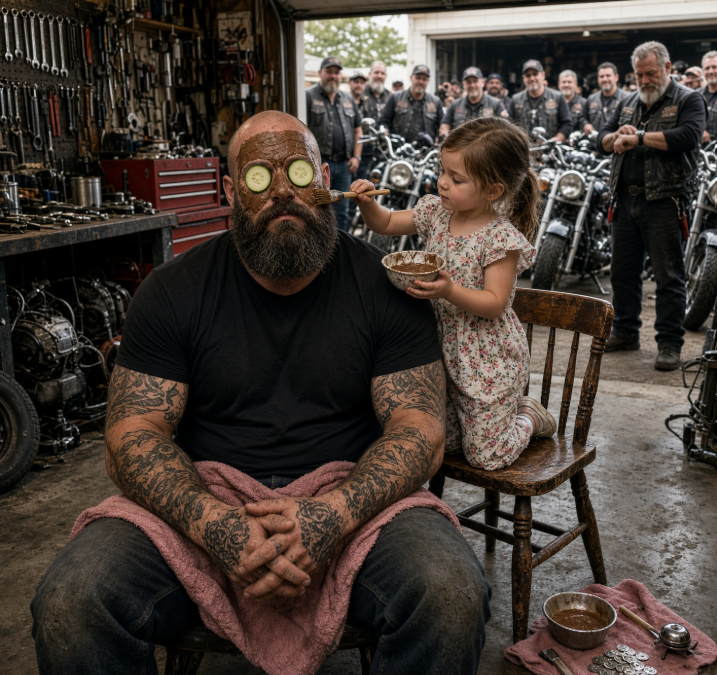
Unfortunately, my neighbor across the road had already taken a picture.
Me in the chair.
Pink towel.
Mud face.
Cucumber eyes.
Ellie standing on a milk crate with a brush.
A line of tattooed riders outside.
Caption:
I DON’T KNOW WHAT’S HAPPENING AT THE BIKER HOUSE, BUT THE TINY LADY APPEARS TO BE IN CHARGE.
By lunchtime, half of Clarksville had seen it.
I did not know.
At 1:04, beard relaxation began.
Against my explicit objections, Ellie used apple detangler.
At 1:22, I received cucumber water in Caroline’s chipped blue mug.
I felt the cup and nearly removed the cucumbers.
“That’s Mommy’s mug.”
“I know.”
“Why?”
“Spa cup.”
I drank.
The water tasted faintly of cucumber and eight months of things I had refused to move.
At 1:37, bicycle bell.
I started up.
“Not finished.”
“You rang.”
“Halfway bell.”
I checked the clock.
Two and a half hours.
“My back is dying.”
“VIP doesn’t complain.”
“I regret VIP.”
“Thirty more minutes.”
“Why is your spa three hours?”
She glanced toward the tablet.
“Because that’s how long the lady stayed.”
“The tutorial is fifteen minutes.”
“Not that lady.”
I should have asked.
I didn’t.
Rook returned at 1:49.
Alone.
Road King.
Garage quieted.
His boots stopped beside me.
“Well?”
“The permit passed.”
I removed both cucumbers.
Rook looked furious.
“You won.”
“You knew.”
“I knew you could handle it.”
“The council changed questions.”
“You had Jo.”
“Police chief went after the emergency plan.”
“You wrote the emergency plan.”
“Mayor wanted the president.”
“Vice president outranks my facial appointment.”
Rook’s jaw tightened.
“This wasn’t trust.”
“Yes.”
“No. You didn’t want to go.”
“That too.”
His eyes moved toward Ellie.
She stirred the bowl.
Pretended not to listen.
Rook said:
“Caroline built that ride.”
“I remember.”
“Act like it.”
That one hit.
I stood.
Too fast.
Pink towel fell.
Dry mud cracked from my face.
The riders in the driveway shifted.
Old instincts.
Mine.
Rook’s.
The version of myself who measured arguments by volume came up from somewhere I thought I had buried.
Then I saw Ellie back away.
Brush against her chest.
Eyes wide.
That stopped me.
Rook saw it too.
His face changed.
I sat.
“The appointment isn’t finished.”
Rook looked at Ellie.
“How long?”
“Eleven minutes.”
Rook dragged a stool across the floor.
Sat opposite me.
No apology.
No speech.
Men like us often repair the first inch through geography.
Sit closer.
Stop leaving.
At 2:00, Ellie rang the bicycle bell three times.
“SPA CLOSED!”
The riders outside applauded.
Saint revved an engine.
Jo slapped his helmet.
Then something happened.
Ellie laughed.
One sharp sound.
She stared at herself as if surprised.
Then laughed again.
Mud had cracked into my beard.
A cucumber slice was stuck to my neck.
Rook had put the pink towel over his head and said:
“Do you offer an angry old man discount?”
Ellie collapsed into laughter.
Real laughter.
Shoulders shaking.
Hands over her mouth.
Sound pouring out anyway.
I had not heard that sound since Caroline’s funeral.
Eight months.
I lowered my head.
Not because I was embarrassed.
Because if I looked at anybody, I was going to fall apart in front of fifty men.
Rook noticed.
Turned away.
Ellie brought a washcloth.
Then stopped.
“The lady says you have to watch the ending.”
“What lady?”
She picked up Caroline’s tablet.
The spa tutorial started.
Woman in white robe.
Little girl.
Mud mask.
Music.
At fourteen minutes, the tutorial ended.
Suggested videos appeared.
Ellie tapped twice.
Another file opened.
Caroline.
I forgot how to breathe.
She was sitting on the red Softail.
Our garage.
Blue scarf over her head.
Too thin.
Still smiling.
The video came from three years earlier.
Caroline had breast cancer.
Early enough.
Treatable.
Surgery.
Chemotherapy.
She beat it.
Completely.
We thought we had survived our big disaster.
Then years later an aneurysm killed her in minutes.
I still have opinions about the universe because of that.
During chemotherapy Caroline recorded messages for Ellie.
I knew about them.
We watched them after she died.
Bedtime messages.
Birthdays.
First day of school.
One for when Ellie lost her first tooth.
One telling her never to let a boy insult her shoes.
I thought I had copied every video.
This one lasted eleven seconds.
Caroline lifted two cucumber slices.
Put them over her eyes.
“If Daddy gets his storm face, open the silly spa.”
My chest stopped moving.
“He’ll say no.”
She smiled.
“Charge him extra.”
End.
Eleven seconds.
Nobody in the garage spoke.
Not Rook.
Not Jo.
Not Saint.
Not fifty men who had seen prison, war, funerals, wrecks, overdoses, storms, gunshot wounds and things they pretended not to carry.
Ellie replayed it.
“If Daddy gets his storm face, open the silly spa. He’ll say no. Charge him extra.”
Then she looked at me.
“You didn’t say no.”
“No.”
“So you don’t have to pay extra.”
“Good business policy.”
Her smile faded.
“Did it fix your storm face?”
There it was.
The question.
Not:
Did you have fun?
Not:
Do you like my spa?
Did it fix your storm face?
I could have explained grief.
Could have told her no spa could fix missing her mother.
Could have said a person can laugh and still hurt.
Could have given her a speech.
Instead I reached out.
Ellie climbed onto my lap.
Mud ruined her shirt.
Neither of us cared.
Her arms wrapped around my neck.
“It helped.”
She pressed her face against me.
“I made the spa for you.”
I closed my eyes.
Not for herself.
Me.
I had thought I was staying for her.
She had been trying to make me stay for me.
Ellie had discovered Caroline’s hidden clip weeks earlier.
She watched me after bedtime.
Saw the garage light under the door.
Saw the meals I forgot.
Saw me touch the inside of my vest before rides where Caroline’s memorial patch was sewn.
Saw the storm face.
Then she searched Caroline’s tablet until she found the tutorial that matched the message.
Built the sign.
Collected washers for money.
Created the schedule.
Three hours.
That number suddenly mattered.
During Caroline’s chemotherapy, each infusion had taken around three hours.
Ellie had only been two.
Too young to sit in the treatment room.
Caroline called it:
“Mommy’s long spa where medicine teaches my body to fight.”
After treatments, Caroline came home exhausted.
I would sit beside her.
Cold cloth over her eyes.
Three hours sometimes.
Until she slept.
Ellie remembered fragments.
Kids do that.
They build memory from pieces adults assume were too early to remain.
She had rebuilt Caroline’s long spa for me.
Not because she believed oatmeal could cure grief.
Because she had seen us stay beside Caroline.
Now she wanted someone to stay beside me.
Rook got up.
“Where are you going?”
“To get in line.”
He took off his cut.
Folded it.
Sat in my chair.
Ellie stared.
“You VIP?”
“No.”
“Why?”
“I complained.”
“That costs two dollars.”
Rook emptied pockets onto her coffee-can register.
Coins.
Bolts.
Knife.
Road King key.
Ellie took two quarters.
“Sit still.”
Twenty minutes later, the vice president of the Iron Harbor Riders had oatmeal drying in his eyebrows.
Saint wanted a turn.
Then Jo.
Then Buck.
Then half the club.
By 3:30, the driveway was full.
Ellie expanded operating hours.
Our neighbor took another photo.
Rook in the pink towel.
Me holding the bowl.
Fourteen tattooed men waiting.
Caption:
APPARENTLY THE TINY LADY HAS EXPANDED.
That photograph traveled farther.
People loved it.
Biker president at daughter’s spa.
Tough men.
Cucumber masks.
Cute.
What the photograph could not show was Caroline’s tablet on the workbench.
Could not show eleven seconds.
Could not show my daughter’s first real laugh in eight months.
Could not show Rook sitting down because our friendship had nearly cracked.
Could not show why I stayed.
Two days later, Rook closed my shop office door.
Placed the City Hall folder on my desk.
“You should have told me.”
“I did.”
“No. You said, ‘You lead Saturday.’”
“Yes.”
“I thought you meant the presentation.”
“I did.”
“You never said you wouldn’t be there.”
“I didn’t know I wouldn’t until there was a spa.”
“That isn’t the point.”
He was right.
I hate when that happens.
Rook had spent decades being my second.
That sounds honorable until you realize what being second to a stubborn man can mean.
Catch whatever he drops.
Fix whatever he overlooks.
Lead whenever he disappears into anger or grief.
I trusted Rook.
But sometimes I used trust as an excuse not to communicate.
Caroline had named that years earlier.
“You don’t ask people to lead, Gabriel.”
“What do I do?”
“You drop the weight.”
She demonstrated with both hands.
“Then watch who catches it.”
I told Rook.
He leaned against the wall.
“She said that?”
“Repeatedly.”
“Smart woman.”
“She married me.”
“Everyone makes mistakes.”
I almost smiled.
Then Rook asked:
“If the permit had failed, would staying in that chair still have been worth it?”
“Yes.”
His face hardened.
I did not change my answer.
“The ride matters.”
“You’re damn right.”
“The families matter.”
“Yes.”
“You matter.”
Rook stared.
“But Ellie watched her mother disappear in one morning.”
His anger shifted.
“Every time my phone rings, she watches me to see whether I disappear too.”
Rook looked through the office window.
Ellie’s crooked spa sign was still on the garage wall.
“I didn’t see that.”
“Neither did I.”
That was the truth.
The Iron Harbor Riders had a phrase.
Brotherhood first.
We loved it.
Brotherhood first meant show up when a rider crashes.
Brotherhood first meant hospital at 2:00 a.m.
Brotherhood first meant funeral, jail, divorce, addiction, whatever.
Good things.
But phrases become dangerous when nobody asks what they are pushing into second place.
Family often got whatever was left.
Caroline used to challenge us.
At Ellie’s second birthday, a prospect broke down forty miles outside town.
Safe.
Inside diner.
Tow truck already coming.
Twelve of us left the birthday party anyway.
Because brotherhood.
We returned two hours later.
Cake dry.
Decorations sagging.
Ellie asleep.
Caroline sat beneath paper streamers cleaning frosting from plates.
“You men love rescuing each other from inconvenience.”
Nobody answered.
“It lets you feel noble while somebody else cleans up the empty chairs.”
We remembered.
Did not change enough.
After the spa, Rook called a club meeting.
I expected him to challenge my leadership.
Instead he stood in front of the room.
“We have become experts at showing up for strangers and amateurs at staying home.”
Nobody liked that.
Good.
Saint argued:
“Families understand what this life is.”
Jo immediately asked:
“Why does understanding always travel in one direction?”
Silence.
Buck admitted his teenage son stopped inviting him to school events.
“Why?”
Buck looked down.
“Because I always miss them.”
That room got ugly.
Not violent.
Honest.
Men defending themselves.
Men blaming work.
Men crying badly.
Men angry at wives who had stopped believing promises.
Good discussions are sometimes unpleasant because lies tend to be comfortable.
We changed three rules.
Safe breakdowns no longer required half the club.
Family commitments could not be challenged unless somebody faced real danger.
Major club events needed at least two leaders fully trained to handle decisions so no single man became indispensable.
Rook called it the Ellie Rule.
Ellie heard.
“No.”
Rook frowned.
“What?”
“It’s Spa Rule.”
He nodded solemnly.
“Spa Rule.”
“And everybody pays.”
“Of course.”
The Caroline Kane Memorial Ride happened six weeks later.
Seven hundred twelve motorcycles.
Police escorts.
Controlled route.
No incidents.
We raised enough money to help nine families with medical bills, hotels, meals, travel and lost wages.
Before the ride, the mayor approached.
Clean windbreaker.
Careful politician smile.
“I saw the photo.”
“Most people did.”
“My granddaughter wants to know if the spa accepts children.”
“You ask management.”
Ellie stood behind a folding table selling bracelets.
Mayor handed her five dollars.
She gave four back.
“First visit is one dollar.”
He stared.
“Your pricing model is aggressive.”
“VIP complains, two dollars.”
Mayor gave me a look.
I shrugged.
Later his granddaughter sat beside Rook beneath a canopy while Ellie applied a harmless oatmeal mask.
Reporters loved it.
One asked me:
“Why would a man with your reputation agree to sit beneath cucumber slices for three hours?”
I hated:
A man with your reputation.
But the question was fair enough.
I answered:
“My daughter opened a spa.”
He waited.
“I was the VIP customer.”
More waiting.
“So?”
“So I lay still for three hours.”
I looked toward Ellie.
“She laughed.”
The reporter lowered his microphone slightly.
“Worth the permit meeting?”
“Every minute.”
That quote spread.
People sent stories.
Fathers.
Grandfathers.
Firefighters.
Truckers.
Soldiers.
One man in Kentucky wrote after his wife died.
His six-year-old son saw the photograph and opened a barbershop in their laundry room.
The father sat two hours while the kid sprayed water on him and charged bottle caps.
The final line:
He talked about his mother the whole time.
I taped that letter inside the garage cabinet where Caroline used to keep spare gloves.
More came.
Truck driver let his daughter braid his beard before a weeklong trip.
Firefighter spent all afternoon in a blanket fort because his son had stopped inviting him to play.
Grandfather let three grandkids paint his nails before heart surgery.
None of those men needed spa treatments.
They needed a reason to stop telling themselves presence was what remained after important work.
That distinction changed me.
Because for years, I had confused providing with being present.
Money matters.
Food matters.
Safety matters.
A roof matters.
But a child cannot hug direct deposit.
A child cannot tell a schedule about missing her mother.
Ellie’s spa became a monthly fundraiser.
Jo controlled every product.
Sealed.
Child-safe.
Nothing from the actual service bay.
Riders paid five dollars for beard combing, temporary stickers, hand massages and cucumber water.
The spa raised more money than our custom-motorcycle raffle the first month.
Rook hated it.
“Healing costs more than chrome,” Jo said.
“Chrome doesn’t put yogurt in my eyebrows.”
“You complained.”
She held out her hand.
“Two dollars.”
He paid.
The first Sunday of every month became spa day.
Noon.
Ellie opened.
She upgraded her sign.
Rook built a wooden one.
She painted it.
Appointment was spelled three different ways.
Nobody corrected her.
I stayed first customer.
Sometimes twenty minutes.
Sometimes an hour.
She brushed my beard.
Cucumbers.
Whale sounds.
Cucumber water in Caroline’s blue mug.
Mostly she talked.
Kindergarten intelligence reports.
Caleb was stealing purple crayons.
The class hamster was probably a girl regardless of what Mrs. Jenkins believed.
Clouds might be dead dinosaurs.
I took every report seriously.
The club learned to wait.
That was the real transformation.
Engines still came.
Men still argued.
Phones still rang.
But if the spa sign faced the street, people respected the hour.
Rook handled City Hall.
Saint handled breakdowns.
Jo handled emergencies because Jo handled everything better than us anyway.
The club stopped behaving as if every inconvenience required maximum brotherhood.
Caroline’s tablet stayed on a shelf above the chair.
We backed up the videos to three drives.
Rook wanted five.
“Three is enough.”
“You thought one was enough before.”
We made five.
Ellie rarely replayed the eleven-second message.
She did not need to.
One rainy Sunday, she asked:
“Why did Mommy call it storm face?”
I knew immediately.
“Because I looked angry when I was sad.”
“Why?”
I considered lying.
“Angry felt safer.”
She arranged cucumber slices.
“Is it?”
“No.”
She thought about that.
“Your face still does it.”
“I know.”
“I charge extra.”
“I know.”
She covered my eyes.
Outside, twenty-three motorcycles started.
The vibration moved through concrete into the chair.
Years earlier, that sound would have pulled me up automatically.
Somebody leaving.
Something happening.
I needed to know.
That Sunday, I remained seated.
Caroline’s Softail stayed covered for a year.
On the anniversary of her death, I rolled it into daylight.
Ellie stood beside me.
Rook came.
Nobody made it ceremonial.
I drained old fuel.
Changed fluids.
Checked lines.
Battery.
Tires.
Slow work.
Bringing the motorcycle back without pretending the rider would return.
We never sold it.
We mounted it behind the spa booth at our clubhouse.
Caroline’s blue scarf beside it.
Small plaque.
Name.
Dates.
No speech.
Every spa Sunday, some child put one cucumber slice on the Softail seat before opening.
By the end of the day it always disappeared.
Rook blamed Saint.
Saint denied everything.
Two years after the first spa day, I returned from a three-day ride and found the garage open.
Ellie was seven.
Louder now.
Taller.
Still distrustful of vegetables unless cucumbers were used professionally.
Pink towel on recliner.
Coffee-can register.
Whale sounds.
But Ellie was not running the spa.
Rook was.
He wore purple swimming goggles on his forehead.
Held the wooden brush.
“What is this?”
“Appointment.”
“With whom?”
He pointed.
Ellie sat in the recliner.
Cucumber slices.
Child blanket.
Oatmeal mask.
Rook said:
“Owner had a difficult week.”
Ellie lifted one cucumber.
“Caleb says spas are dumb.”
“The crayon thief?”
“He only steals blue now.”
“Progress.”
I hung my cut by the garage door.
“Move, Rook.”
“One brush.”
“I’ll cope.”
I sat on the floor.
Concrete hurt my knees.
Rook painted another line across Ellie’s forehead.
My daughter reached sideways.
Found my hand without looking.
Her fingers covered part of STAY.
Part of HOME.
“Daddy?”
“Yeah?”
“Do spas fix everything?”
“No.”
“What do they fix?”
I thought about Caroline.
Blue scarf.
Hospital treatment.
Eleven seconds.
Rook driving 170 miles every second Sunday for six years.
Ellie’s laugh.
A biker club learning how to stay home.
“Nothing by themselves.”
She waited.
“They give people time.”
“For what?”
“To sit beside each other.”
She accepted it.
Rook placed cucumbers over my eyes though I was sitting on concrete.
My back hurt from riding.
The garage smelled like oatmeal, apples, gasoline and old leather.
Nobody asked me to leave.
Nobody needed rescuing.
Nothing urgent happened.
For three hours, we stayed.
That should be enough.
But healing does not happen once.
People love one perfect turning point.
The day Dad chose his daughter.
The day grief changed.
The day biker learned family first.
Real life repeats the exam.
Again.
Again.
Months later, a club brother named Tommy went down on Interstate 24 during Ellie’s school play.
I was seated in the third row.
Phone vibrated.
Rook texted:
TOMMY DOWN. ALERT. AMBULANCE THERE. CONSCIOUS. I’M GOING.
Every cell in my body told me to stand.
Accident.
Brother.
Road.
Old reflex.
Ellie was backstage.
She had one line.
One.
She was playing a tree.
Not even a named tree.
I almost laughed at the absurdity of comparing the two.
Then another message:
STAY. I HAVE HIM.
Rook knew.
I remained.
My hands shook.
Curtain opened.
Children entered.
Ellie stood in cardboard bark.
She searched the audience.
Found me.
Her face changed.
Not much.
Half an inch.
I knew half inches by then.
She said her line.
“The forest is still here.”
I nearly cried.
After the play, we went to the hospital.
Tommy had a broken collarbone.
Concussion.
Road rash.
He complained:
“You missed my dramatic arrival.”
“My daughter was a tree.”
He stared.
“Important tree?”
“The most important.”
Tommy nodded.
“Fair.”
The next year, I missed one spa Sunday.
A customer’s bike had a mechanical failure hours before he was supposed to ride to his son’s wedding.
Real urgency.
Not life or death.
But meaningful.
I told Ellie before leaving.
Explained.
Asked.
“Can Rook be first customer?”
She considered.
“Do you come back?”
“Yes.”
“What time?”
“Two.”
“You promise?”
I almost said yes automatically.
Then stopped.
“I plan to. If something changes, I call.”
She studied me.
“Okay.”
I returned at 1:48.
Ellie was giving Saint a temporary butterfly tattoo.
She looked at the clock.
Then at me.
“You’re early.”
“Don’t spread that rumor.”
Trust is rebuilt through ordinary arrivals.
Not dramatic speeches.
Enough mornings.
Enough promised times kept.
Enough explanations when they are not.
That was what I had failed to understand after Caroline.
I thought Ellie needed me never to fail.
Children do not need perfection.
They need patterns strong enough to survive mistakes.
Caroline had known.
Of course.
I found another video six months later.
Not hidden deliberately.
Misfiled.
Caroline sitting at our kitchen table during chemo.
No scarf.
Bald.
Ellie asleep against her chest.
Caroline looked into the camera.
“Gabe, if you’re watching this without me, I’m going to assume you’ve turned the house into a funeral museum.”
I laughed and cried simultaneously.
She continued.
“Throw something away.”
Pause.
“Not me.”
Smile.
“You dramatic idiot.”
I watched the video four times.
Then went upstairs.
Took Caroline’s yellow raincoat from behind the door.
Held it.
Could not throw it away.
Not yet.
But I took the grocery list from beneath the Memphis magnet.
Tell Gabe we need batteries.
I photographed it.
Put the original into a memory box.
Then I used the magnet for Ellie’s school drawing.
That was enough.
Repair rarely begins where other people think it should.
One item.
One appointment.
One Sunday.
One laugh.
Sitting beneath cucumber slices did not redeem me.
That distinction matters.
The man whose jaw I broke did not heal because I became a good father.
Prison did not disappear.
Caroline’s lonely birthday parties did not become harmless because I later understood.
The days I chose club obligations when I could have stayed home remained days I missed.
The spa was not redemption.
It was one kept appointment.
Then another.
Then enough to become a different pattern.
When Ellie turned eight, she asked about my knuckles.
Finally.
“What does STAY HOME mean?”
We sat on the shop floor.
“Reminder.”
“To stay in the house?”
“No.”
“Then why home?”
I spread my hands.
STAY.
HOME.
“When I got out of prison, I was scared I’d become who I was again.”
“Mean?”
“Sometimes.”
“Did you hurt people?”
“Yes.”
She got quiet.
I did not soften it.
“One man badly.”
“Why?”
“I was angry.”
“Did he hurt you?”
“He pushed Uncle Michael.”
“So you protected him?”
“At first.”
She watched me.
“What happened after?”
I swallowed.
“I kept hurting the man after I should have stopped.”
Ellie looked at the letters again.
“So STAY means don’t go back?”
“Partly.”
“HOME means me?”
That hit.
“You and Mommy.”
She considered.
“Now Mommy isn’t home.”
“No.”
She touched the letters.
“Maybe she is a little.”
I looked toward Caroline’s Softail.
The blue scarf.
The spa sign.
“Maybe.”
Ellie smiled.
“You should add SPA.”
“No.”
“On your forehead.”
“Absolutely not.”
Rook overheard.
Supported her suggestion for months.
At ten, Ellie stopped operating regular spa Sundays.
Not suddenly.
Kids grow.
Soccer.
Friends.
School.
The sign remained.
Occasionally she opened by request.
Mostly fundraisers.
Sometimes when she noticed storm face.
She did not need a three-hour ritual anymore.
Sometimes she simply put a cucumber slice on my desk.
No explanation.
That meant:
Come home.
Once during a terrible week, the club faced a lawsuit after a rider caused a crash during an unofficial event while wearing our colors.
Insurance.
Lawyers.
Arguments.
Possible financial damage.
I spent sixteen-hour days at the shop.
Friday evening, I found one cucumber slice inside my helmet.
I stared.
Rook walked past.
“Boss called.”
“What?”
He pointed upstairs.
Ellie waited in the garage.
Thirteen then.
Too cool for almost everything.
“Seriously?”
I held up the cucumber.
“You were being weird.”
“That’s your intervention?”
“You trained me.”
“I regret everything.”
She smiled.
We ordered pizza.
No spa.
No mud.
No whales.
Just dinner.
That was enough.
Caroline’s memorial ride continued.
Eventually the city stopped resisting.
Not because everyone suddenly loved motorcycles.
Because we proved discipline.
Routes.
Noise controls.
Medical support.
Cleanup.
The ride raised more money each year.
We expanded family assistance grants.
Named nothing else after Caroline.
I resisted.
Her name did not need to become branding.
The spa booth stayed.
At fifteen, Ellie took over accounting for it.
She discovered Rook had been underpaying for years.
“Complaint surcharge.”
He objected.
“You are retroactively charging me?”
“Yes.”
“This is corruption.”
“Pay.”
He paid forty-two dollars.
Jo framed the receipt.
At sixteen, Ellie rode Caroline’s Softail for the first time.
Not on a road.
Closed lot.
Helmet.
Protective gear.
Rook and I hovering so badly she finally stopped the bike.
“If both of you don’t move back, I am going inside.”
I moved.
Rook moved half the requested amount.
She started again.
Slow circles.
Caroline had ridden that motorcycle before Ellie existed.
Seeing our daughter on it nearly tore me open.
But grief had changed.
Not falling anymore.
Carrying.
I remembered a man named Grim saying something similar years later, though that is another story.
Loss becomes shape.
At seventeen, Ellie asked why I never remarried.
“Because I’m difficult.”
“Serious answer.”
“That is serious.”
She rolled her eyes.
“I don’t know.”
“Are you waiting for Mom?”
“No.”
“Then?”
I thought.
“I liked being married to your mother.”
“That’s not an answer.”
“I don’t know if I want another marriage.”
“Okay.”
She accepted.
Then:
“You still have storm face.”
“Inflation?”
“Three dollars.”
“Extortion.”
“You raised me.”
Fair.
When Ellie graduated high school, fifty Iron Harbor riders sat in folding chairs.
Not revving.
Not making spectacle.
Rook cried openly and denied it.
Saint shouted too loud.
Jo threatened him.
I watched Ellie cross the stage.
Caroline should have been beside me.
That truth remained.
People say things like she would be proud.
Maybe.
Probably.
It helps.
It does not create a body in an empty seat.
I carried both.
Joy.
Absence.
After graduation, Ellie gave me an envelope.
Inside was a photograph.
The first spa day.
Not the viral one.
A different angle.
Me in the recliner.
Pink towel.
Mud face.
Cucumbers.
Ellie beside me.
On the back:
THANKS FOR STAYING.
I sat down.
“Why would you do this to me in public?”
She laughed.
“Storm face.”
“Illegal.”
Then she hugged me.
At college, she studied child psychology.
Of course.
She told me the spa had taught her something.
“What?”
“Kids notice adult emotions even when adults think they’re hiding them.”
“Revolutionary.”
“And play gives them a way to talk without calling it talking.”
I stared.
“You’re telling me I paid tuition for you to discover what you knew at five?”
“Basically.”
“Refund.”
“No.”
She eventually became a counselor working with children experiencing parental loss.
The first room in her practice had art supplies.
Puppets.
Sensory toys.
A tiny toy motorcycle.
And plastic cucumbers.
I found them.
“No.”
She grinned.
“Yes.”
“You use spa?”
“Sometimes.”
“Do parents know the founder is an ex-con biker?”
“Only VIP clients.”
Years passed.
Kane Custom Motorworks expanded.
Rook retired from daily work.
Then kept showing up daily.
I told him that defeated retirement.
He told me to shut up.
Iron Harbor changed leadership structures.
Eventually I stepped down as president.
That shocked people.
Old Gabriel would have died before surrendering a title.
But the club no longer needed one indispensable man.
That had been the point of the Spa Rule.
Rook was too old to take over.
Saint did.
Terrible speeches.
Good leadership.
Jo remained the real authority.
Ellie was twenty-seven when I became a grandfather.
A little girl.
Caroline Kane Bennett.
They named her Caroline.
I cried so hard at the hospital Rook later accused me of dehydration.
When they put baby Caroline in my arms, I looked at my hands.
Older now.
More scars.
STAY.
HOME.
Faded ink.
I remembered holding Ellie for the first time.
Caroline saying:
“She isn’t made of glass.”
My granddaughter opened one eye.
I whispered:
“I know.”
Ellie heard.
“Actually?”
I looked at her.
“No.”
She smiled.
“Thought so.”
Baby Caroline was three when she discovered the old spa sign in my garage.
It had been stored behind shelving.
She dragged it out.
“What’s this?”
Ellie and I looked at each other.
“No,” I said.
Ellie said:
“Absolutely yes.”
Twenty minutes later I was back in the recliner.
Different pink towel.
Same blue mug.
Caroline’s granddaughter placed cucumber slices over my eyes.
“Your face is too big.”
From somewhere beside me, Ellie began laughing.
Same sound.
Older.
Fuller.
Alive.
I laughed too.
The garage filled again.
Not with absence.
Memory.
There is a difference.
Rook was still alive then.
Eighty.
Walked with a cane.
He arrived halfway through.
Saw me.
“VIP?”
“Against my will.”
Granddaughter Caroline looked at him.
“You complain?”
Rook grinned.
“Constantly.”
She held out her hand.
“Two dollars.”
Rook stared at me.
“You’ve created a dynasty of criminals.”
I removed one cucumber.
“You taught me loyalty.”
He paid.
Before Rook died, we sat in that garage one evening.
No spa open.
Just chairs.
Caroline’s Softail behind us.
Ellie’s sign above.
Rook was sick.
Cancer.
Advanced.
He knew.
I knew.
Neither liked saying it.
“You remember that first day?” he asked.
“Spa?”
“Yeah.”
“You were an ass.”
“So were you.”
“Fair.”
He looked at his hands.
“I thought you were choosing grief over the club.”
“I thought I was choosing Ellie.”
“Were you?”
I considered.
“Yes.”
Then:
“And Caroline.”
He nodded.
“And yourself.”
I looked at him.
“Jo said that.”
“She’s smarter.”
“Yes.”
We sat.
Rook smiled faintly.
“Best permit meeting I ever ran.”
“You nearly failed.”
“We passed.”
“You sweated.”
“The police chief was hostile.”
“You cried afterward.”
“I did not.”
“You called Jo from the parking lot and said you wished Caroline were there.”
“That is not crying.”
“You were crying while saying it.”
He looked away.
After a minute:
“You trusted me.”
“Yeah.”
“I didn’t understand.”
“Neither did I.”
He tapped his cane against concrete.
“That’s the thing.”
“What?”
“Sometimes somebody trusts you before you feel ready.”
I looked at him.
“Then you become ready because they didn’t show.”
That was Rook.
Six years of prison visits.
City Hall.
Ellie’s spa chair.
Decades.
He died three months later.
At his funeral, Ellie placed two cucumber slices on his casket.
Jo laughed and cried simultaneously.
Saint said:
“He’d hate that.”
I said:
“Exactly.”
We buried Rook with the Road King key Ellie had once accepted as spa payment.
His son approved.
Brotherhood changed meaning again.
Not first.
Not above.
Beside.
That became our word.
Years after Caroline’s death, a documentary crew contacted us about the memorial ride.
They had found the old spa photograph.
Wanted to frame the story:
FEARED BIKER TRANSFORMED BY DAUGHTER.
I declined.
Producer asked why.
“Because it’s wrong.”
“How?”
“I wasn’t transformed by one afternoon.”
“But it changed you.”
“Yes.”
“Then—”
“It started practice.”
He waited.
I explained.
“People like redemption stories because they compress repair.”
One day.
One act.
One speech.
“But repair is boring.”
He looked confused.
“It’s calendars.”
“Phone calls.”
“Showing up.”
“Not leaving.”
“Apologizing.”
“Changing club rules.”
“Coming back Tuesday.”
“Coming back Sunday.”
“Keeping another appointment after nobody cares about the viral photo anymore.”
That documentary never happened.
Good.
The story belonged better in our garage.
I am older now.
Much older than the man in that photograph.
My beard is mostly white.
Knees sound like gravel.
I ride less.
Kane Custom Motorworks belongs to younger hands.
The Iron Harbor Riders still exist.
Different president.
Same patches.
Better rules.
The Caroline Kane Memorial Ride still runs every year.
The spa booth too.
Ellie no longer operates it.
Teenagers from families helped by the ride do.
Money goes into emergency grants.
The sign has been replaced several times.
One thing remains.
Under the main sign, a smaller plaque:
STAYING COUNTS.
I did not write that.
Ellie did.
Caroline’s blue mug is retired.
Cracked too much.
It sits behind glass in the clubhouse.
Ridiculous.
A coffee mug behind glass.
Saint’s idea.
The red Softail remains displayed.
My knuckle tattoos have faded.
STAY.
HOME.
Letters blurred.
I could have them redone.
I won’t.
They have done their job.
Sometimes people ask me the same question that reporter asked decades ago.
“Was it really worth risking the permit to sit in that chair?”
They usually expect a sentimental answer.
Yes, because daughters matter more than motorcycles.
That is true but incomplete.
The permit mattered.
The families mattered.
The ride mattered.
My club mattered.
Leadership mattered.
Rook deserved better communication.
All of that can be true.
Life is rarely a clean choice between good and bad.
The dangerous choices are between two good things.
Commitment to community.
Commitment to your child.
Being needed elsewhere.
Being needed at home.
I stayed because I realized something specific.
Rook could go to City Hall.
Jo could answer medical questions.
Saint could handle the route.
Fifty men could protect the ride.
Nobody else could be Ellie’s father in that garage.
That was the difference.
Not importance.
Replaceability.
The club needed leadership.
It had leaders.
Ellie needed me.
One person.
Me.
Parents forget that when work makes them feel indispensable.
I did.
Caroline knew.
That is why her message was not:
Make Gabriel quit riding.
Not:
Tell Daddy the club doesn’t matter.
It was:
If Daddy gets his storm face, open the silly spa.
Stay with him.
Make him sit.
Let joy interrupt grief.
Charge extra.
That was Caroline.
Eleven seconds.
Enough to reach decades.
People think legacy has to be grand.
Money.
Foundations.
Buildings.
Speeches.
Caroline left a cucumber joke on an old tablet.
It changed my life.
Ellie changed the rest.
The last time I sat in the original recliner, the upholstery was torn.
Springs groaned.
I should have thrown it away years earlier.
Granddaughter Caroline was eight.
She ran the spa.
My daughter Ellie sat on the floor beside us.
Three generations.
The whale soundtrack still existed somehow.
The same insurance commercial interrupted it.
I shouted:
“How is this company still advertising?”
Ellie laughed.
“You refused to pay for premium for thirty years.”
“Principle.”
“Cheapness.”
Granddaughter put cucumbers over my eyes.
I asked:
“VIP?”
She said:
“You complain too much.”
“Runs in family.”
She painted something cool across my forehead.
Probably oatmeal.
Maybe mud.
Did not matter.
Outside, motorcycles started.
Low rumble.
Once upon a time, that sound meant I needed to stand.
Needed to lead.
Needed to know what was happening.
That afternoon, I remained.
Granddaughter asked:
“Grandpa?”
“Yeah?”
“Mom says Grandma Caroline made this spa.”
“Sort of.”
“But she died before it started.”
“Yes.”
“How can somebody make something after they die?”
I thought about it.
Ellie stayed quiet.
I said:
“Sometimes people leave ideas inside you.”
“What kind?”
“Things they taught you.”
“Like school?”
“Better.”
She considered.
“Grandma left spa?”
“She left your mom courage to open it.”
“What did she leave you?”
I looked down at my hands beneath the towel.
STAY.
HOME.
Faded.
“Instructions.”
“What instructions?”
“To sit still.”
“That’s weird.”
“Very.”
She accepted that.
Kids know truth does not need dignity.
Then she asked:
“Did Mommy fix your storm face?”
I could have said yes.
Would have been easy.
But Ellie deserved the truth then.
My granddaughter too.
“No.”
Cucumber shifted as I spoke.
“She helped me learn what to do when it comes.”
“What?”
“Don’t run.”
“Anywhere?”
“Not inside myself.”
She did not understand completely.
That was fine.
She would someday.
Or not.
Some lessons belong to the person who needed them.
The bicycle bell rang.
Granddaughter announced:
“Halfway!”
I groaned.
“How long is this appointment?”
“Three hours.”
Ellie burst out laughing.
I removed one cucumber.
“No.”
Granddaughter crossed her arms.
“VIP doesn’t complain.”
I looked at Ellie.
“This is your fault.”
She smiled.
“No.”
She pointed toward Caroline’s old tablet on the shelf.
“Mom’s.”
Fair.
So I replaced the cucumber.
Stayed.
The concrete no longer shook from fifty motorcycles.
Only a few.
The club had moved most operations elsewhere years before.
The garage was quieter.
Not grief quiet.
Life quiet.
Different thing.
I listened to Ellie and her daughter argue about whether cocoa belonged in the mask.
Smelled apples from beard spray.
Heard Caroline’s voice in memory.
If Daddy gets his storm face…
I smiled beneath the mask.
The five-year-old Ellie had not known what she was doing in every adult sense.
She did not understand city permits.
Leadership structures.
Trauma patterns.
Avoidant grief.
Attachment.
Institutional redundancy.
None of those words mattered.
She knew one thing.
Her father was disappearing while remaining physically present.
So she opened a pretend business.
Made him sit.
Then kept him there long enough to hear himself.
People later asked why fifty bikers obeyed a five-year-old.
That question misses it.
They were not obeying Ellie.
Eventually, they were learning from her.
The men outside that garage knew how to stay beside wrecks.
Stay beside hospital beds.
Stay beside jail cells.
Stay beside broken motorcycles.
We prided ourselves on loyalty.
Ellie taught us to apply the same loyalty to ordinary moments.
A daughter’s game.
A school play.
A birthday.
Dinner.
A grieving spouse.
A quiet Sunday.
Things with no sirens.
No applause.
No emergency.
Things easy to postpone because tomorrow seems guaranteed.
That is where we had failed.
Caroline once told me:
“You’re addicted to emergencies because they give you permission to be tender.”
I was offended.
Mostly because she was right.
At emergencies, men like me know what to do.
Carry.
Protect.
Fix.
Stand watch.
Ordinary love requires stranger skills.
Listen.
Wait.
Play.
Sit.
Let someone else lead.
Be silly.
Do nothing productive.
That was harder for me than prison.
Harder than rebuilding engines.
Harder than standing before city councils.
Five-year-old Ellie understood before I did.
Her mother did too.
That is the deepest truth of the spa day.
I did not sacrifice something important to entertain a child.
I discovered I had been categorizing the child as the interruptible part of my life.
The club was fixed.
City Hall fixed.
Work fixed.
Ellie flexible.
Her needs could move.
Her game could close.
Her disappointment could wait.
Because children adapt.
They do.
That is the problem.
Children adapt to absence.
They stop asking.
That can look like maturity.
It is sometimes surrender.
Ellie saying:
“I can close.”
That sentence still hurts more than Rook telling me the permit might fail.
She was ready to make herself smaller so my responsibilities could remain large.
I do not know what would have happened if I stood up.
Maybe nothing dramatic.
She might have cleaned the bowl.
Watched television.
Forgotten.
Maybe the permit passed anyway.
Maybe I returned and apologized.
But something inside her would have collected one more piece of evidence.
Daddy leaves.
That day I gave her different evidence.
Daddy stayed.
Once.
Then again.
Enough times.
That is what mattered.
When Caroline died, I could not give Ellie the thing she wanted.
Her mother.
I spent months trying to compensate through control.
Routine.
Protection.
What Ellie needed was permission to grieve beside me.
The spa created it.
Cucumbers over my eyes made it easier for her to ask if I missed Mommy.
A mud mask made it easier for me to answer.
Sometimes seriousness blocks truth.
Silliness opens a side door.
Caroline knew.
That is why her message worked.
If she had recorded:
Gabriel, you need to process grief more openly with our daughter and prioritize relational presence over compulsive responsibility,
I would probably have ignored it.
Instead:
Open the silly spa.
Charge him extra.
Perfect.
She knew her customer.
I have told this story many times.
Never exactly the same.
Some details sharpen.
Some soften.
Memory changes.
But three moments never do.
Ellie saying:
“I can close.”
Ellie laughing.
Caroline appearing on the tablet.
Those are fixed.
Before.
Return.
Message.
Everything else grew from them.
I still visit Caroline’s grave.
Not on a schedule.
I used to go every Sunday.
Then realized I was treating grief like another appointment.
Now I go when I want.
Sometimes with coffee.
Sometimes Ellie.
Sometimes alone.
One year, I brought two cucumber slices.
Placed them on the stone.
Stood there feeling ridiculous.
Caroline would have loved that.
I said:
“Spa’s still open.”
Wind.
Birds.
Nothing supernatural happened.
No sign.
No voice.
I do not need one.
I stayed a while.
Then went home.
That is what I learned.
Not how to stop missing Caroline.
I still miss her.
Not how to become soft.
I am still difficult.
Ask anyone.
Not how to choose family over all responsibility.
Life is more complicated.
I learned how to ask:
Am I truly the only person who can handle what is calling me away?
Or am I leaving because leaving feels more useful than staying?
That question changed everything.
Sometimes the answer is:
Go.
Emergency.
Danger.
Commitment only I can fulfill.
I go.
Sometimes:
Rook has it.
Jo has it.
Saint has it.
Someone else can.
Then I stay.
That is adulthood too.
Not always choosing one thing.
Knowing when you are using duty to avoid intimacy.
My daughter taught me at five.
With cucumber slices.
A cereal bowl.
Seventeen washers.
A pink towel.
And the worst whale soundtrack ever recorded.
If that sounds ridiculous, good.
Most important things do when described from far enough away.
Fifty bikers outside.
President covered in mud.
City Hall waiting.
Little girl ringing a bicycle bell.
Ridiculous.
Until you know what it cost for her to laugh.
Then it becomes simple.
I stayed.
She laughed.
Her mother spoke for eleven seconds.
We listened.
That was the day the Iron Harbor Riders nearly lost a permit and gained a rule.
The day Rook learned leadership did not require me in every room.
The day I learned being present is not the time you give after everything else is finished.
Everything else is never finished.
There will always be another motorcycle.
Another call.
Another problem.
Another crisis.
Children grow anyway.
People die anyway.
Afternoons end.
If someone you love asks you to sit down, there will not always be a dramatic reason to say yes.
Sometimes the reason is only:
They asked.
I used to think that was not enough.
Now I know it may be the best reason.
The last thing Caroline ever taught me was recorded before either of us knew I would need it.
The lesson was not about spas.
It was not even about Ellie.
It was about the word across my knuckles.
STAY.
I had spent years believing it meant stay out of prison.
Stay away from violence.
Stay loyal.
Stay home.
Caroline expanded it.
Stay when there is nothing to fix.
Stay when somebody is sad.
Stay when the phone rings.
Stay when another capable person can handle the emergency.
Stay long enough for the laugh.
Stay long enough for the question behind the game.
Stay long enough to hear the eleven-second message.
Stay even when your mind insists movement is more useful.
That is what those three hours became.
Practice.
For the rest of my life.
And if you ever pass through Clarksville and hear old riders laughing about the afternoon Grinder Kane let a five-year-old smear yogurt on his face while City Hall waited, understand something.
They will tell it like a joke.
Bikers do that with memories that still hurt.
They will mention Rook’s pink towel.
Saint getting caught stealing the cucumber off Caroline’s motorcycle.
The mayor paying too much.
The complaint surcharge.
They may show you a photograph.
Big scarred men waiting in line outside a child’s garage spa.
You might laugh.
You should.
Caroline would want that.
But look a little longer.
Somewhere behind that photograph is a five-year-old girl who had spent eight months afraid to make noise.
A father who thought he was doing fine because lunches were packed.
A dead mother who knew both of them well enough to leave exactly eleven seconds of foolishness.
And fifty men learning that loyalty sometimes means not calling someone away.
That is what the camera never captured.
The reason I stayed in that chair was not because I had stopped being president.
It was because for three hours, somebody more important needed me to stop being indispensable.
My daughter needed a customer.
My wife had left instructions.
And the hardest thing I had ever learned how to do was finally written across my hands.
STAY.
HOME.
So I did.








