Little Girl Beaten Into a Coma by Her Gambling Aunt—A Hells Angel Saw and Did This
PART3:
I looked at the scrape marks on the brick, the disturbed dirt, the teddy bear, the way the woman had been facing the exit when I rode in.
“You were leaving,” I said.
Her mouth opened.
Nothing came out.
Sirens cried in the distance.
Good.
That sound was the only reason I stayed still.
The ambulance came hard into the alley, red and white lights bouncing off brick. Paramedics ran past me, and I stepped back, forcing myself to give them room. They worked fast. Neck brace. IV. Oxygen. Stretcher.
One of them looked up at me.
“You called it in?”
“Yes.”
“Did she lose consciousness?”
“She was down when I arrived. Pulse was weak.”
The woman began sobbing loudly as police arrived, putting on a show now that there were uniforms.
The first officer looked at me, then at her, then at the child.
“What happened here?”
I pointed at Brenda.
“She hurt the kid. Arrest her.”
Brenda screamed, “He’s lying!”
The officer hesitated because I knew what he saw.
A bleeding child.
A hysterical woman.
And me.
A two-hundred-fifty-pound Hells Angel with a record and a face that did not inspire trust in courthouse hallways.
But Brenda’s hands were marked. Her clothes were dirty. Her story changed twice in under a minute. And one of the paramedics quietly told the officer the girl’s injuries did not look like a simple fall.
They cuffed Brenda.
She cried all the way to the cruiser.
I did not care.
My eyes were on the ambulance.
As the doors closed, I looked down and saw the teddy bear still lying in the dirty water.
Something made me pick it up.
It was ugly in the way loved things become ugly after surviving childhood. One plastic eye. Torn ear. Stained fur. Little stitched vest.
Then I saw the patch pinned to the back.
My hand stopped moving.
A faded military patch.
101st Airborne.
Screaming Eagles.
I knew that patch.
I knew it because I had given that exact patch to my best friend, Jonathan Reynolds, ten years earlier before he deployed to Afghanistan.
Jonathan had been the closest thing I ever had to a brother.
He was cleaner than me.
Better than me.
The kind of man who could sit beside darkness without letting it stain him. He had been military. Loyal. Stubborn. Funny when he wanted to be. Serious when it mattered.
When he came home, he got married.
Had a little girl.
Then died with his wife in a car wreck on Highway 99 three years later.
I had heard about the crash too late.
By the time I tried to find his daughter, she had already been placed with a relative.
Aunt Brenda.
I stared at that bear in my hands.
The child in the ambulance was Jonathan’s daughter.
Chloe.
I had never met her.
I had never held her.
I had never heard her voice.
But I knew in that moment that the debt of blood had been called in.
I got on my Harley and followed the ambulance to Bakersfield Memorial Hospital.
The emergency room went quiet when I walked in.
People noticed men like me.
They noticed the cut.
The boots.
The tattoos.
The smell of gasoline and road dust.
They noticed the teddy bear in my hands last.
I went straight to the desk.
“A little girl just came in,” I said. “Blond hair. Seven years old. Head injury. Where is she?”
The nurse swallowed.
“Sir, are you family?”
I looked down at the bear.
“I’m her family now.”
Before she could call security, a doctor stepped out from behind the trauma doors. Older man. Gray hair. Blood on his gown. Eyes tired enough to know he did not waste words.
“You the one who called it in?” he asked.
“Yes.”
“How is she?”
He sighed.
“Critical. Severe blunt force trauma. Brain swelling. We’ve placed her in a medically induced coma to give her the best chance. If she had arrived much later, she would not have survived the night.”
The bear felt heavier in my hands.
“What’s her name?”
“Chloe Reynolds.”
Even though I already knew, hearing it hit me hard enough to make the room tilt.
The doctor studied my face.
“You know her?”
“Her father was Jonathan Reynolds,” I said. “He was my brother. Not by blood. By choice.”
The doctor’s expression changed.
Not trust.
Not yet.
But less fear.
“She’s being moved to pediatric ICU,” he said. “The next forty-eight hours are critical.”
“I’m staying.”
“That may not be—”
“I’m staying.”
He looked at me for a long moment.
Then nodded once.
“Do not get in the staff’s way.”
“I won’t.”
Word travels fast in my world.
By three in the morning, the pediatric ICU waiting area looked like a clubhouse that had been dropped into a hospital by mistake.
Fifteen fully patched members of the California charter had arrived.
Iron Mike.
Dutch.
Vander.
Stitches McGee.
Men who had seen prison yards, desert highways, knife fights, gun barrels, and nights that never made it into police reports.
That night, they stood against the walls in silence.
No loud jokes.
No posturing.
No engines.
No threats.
Just men in leather guarding a little girl none of them had met because she belonged to Jonathan.
And Jonathan had belonged to us.
Hospital security stood at the far end of the hallway, unsure what to do.
The nurses moved carefully around us at first, then realized we were not there to make trouble. We were there to make sure no more trouble reached Chloe.
I sat outside her room with Barnaby the bear in my lap.
That was the bear’s name. A nurse found it written in faded marker on the tag.
Barnaby.
I cleaned him with hospital wipes as best I could without damaging the patch.
It was a ridiculous thing, a giant biker carefully wiping a teddy bear at four in the morning.
Nobody laughed.
At eight o’clock, trouble came wearing a beige pantsuit.
Her name was Sarah Jenkins, senior caseworker for child protective services.
She stepped off the elevator with a clipboard, saw the hallway lined with Hells Angels, and immediately decided she hated all of us.
Fair enough.
A lot of people did.
She walked straight to me.
“Mr. Henderson?”
I stood.
She had to tilt her head back to look at me, but she did not back down.
“I’m with CPS. I’ve reviewed the initial police report regarding Brenda Reynolds. She is in custody. Once Chloe is medically cleared, she will be placed under state care.”
“No.”
Her eyes narrowed.
“Excuse me?”
“No.”
“Mr. Henderson, you have no legal right to this child.”
I pulled a folded paper from inside my cut.
Jonathan had given it to me years ago, back when Chloe was a baby. I had thought he was being paranoid.
He was always good at seeing storms before the sky changed.
“If anything happens to me and Laura,” he told me, “Brenda is listed first because she’s family. But if she fails Chloe, you’re named second.”
I had laughed then.
Told him no judge would ever hand a baby to me.
Jonathan had looked me dead in the eye.
“You’re dangerous to bad people. That’s not the same as being dangerous to a child.”
Now I handed Sarah the document.
“Check the records.”
She scanned it.
Her face tightened.
It was a notarized guardianship designation.
Brenda was primary.
If Brenda was deemed unfit, the secondary guardian was listed clearly.
Garrick Thomas Henderson.
Godfather.
Sarah looked up.
“This will be challenged.”
“Let them challenge it.”
“You are affiliated with an outlaw motorcycle club. You have a criminal history.”
“Yes.”
“The state will have serious concerns.”
“The state should have had serious concerns before Jonathan’s kid ended up with a gambling addict who spent her insurance money and nearly killed her.”
Her face flushed.
“That is not helpful.”
“No,” I said. “But it’s true.”
She lowered the document.
“Until a court decides otherwise, you cannot interfere with CPS procedure.”
“And until a court decides otherwise,” I said, sitting back down beside Chloe’s door, “I’m not leaving.”
The legal battle began before Chloe even opened her eyes.
But life, as usual, was not done being cruel.
Three days into Chloe’s coma, two detectives came to the hospital.
They pulled me into a consultation room.
I knew from their faces it was bad.
“Henderson,” Detective Miller said, “we have a problem.”
“Brenda?”
He nodded.
“She changed her story.”
I leaned back against the wall.
“Of course she did.”
“She’s claiming you attacked them in the alley to collect a gambling debt. She says you hurt Chloe and threatened her into silence.”
I laughed once.
Not because it was funny.
Because the lie was so ugly it almost impressed me.
“You saw the scene.”
“I know.”
“You saw her hands.”
“I know.”
“You heard what the paramedics said.”
“I know.”
“Then why are you here?”
Detective Miller exhaled.
“Because you’re a Hells Angel with an assault record, and she’s a woman claiming she was terrified of you. The DA is nervous. CPS is using her statement to push an emergency injunction against your guardianship.”
There it was.
The world I knew.
People did not trust men like me.
Most days, I did not blame them.
But that day, Chloe might pay for my past.
I walked out of the room and found Dutch standing near the vending machines.
He saw my face.
“What do you need?”
“Every camera near that alley.”
He nodded once.
“How wide?”
“Three blocks. Check businesses, ATMs, pawn shops, back windows, anything pointing near Chester Avenue. Cops canvassed, but people there don’t talk to cops.”
Dutch’s mouth hardened.
“They talk to us.”
For the next twenty-four hours, my brothers searched Bakersfield’s underbelly.
They used cash.
Pressure.
Old favors.
Street respect.
Not warrants.
Not badges.
By two in the morning on the fifth day, Dutch walked into the PICU holding a USB drive between two fingers.
He looked exhausted.
But triumphant.
“Got it.”
I stood.
“What?”
“Check-cashing place across the street. Owner had an illegal camera watching the back lot so nobody messed with his car. Caught the alley. Audio too.”
I took the drive.
For the first time in days, I could breathe.
“Give it to Detective Miller.”
“Already called him.”
The footage ended Brenda’s lies.
It showed her dragging Chloe into the alley.
Showed the attack.
Showed me arriving after Chloe was already down.
Showed me calling 911.
Showed me covering the child with my jacket.
The district attorney dropped every suspicion against me and upgraded Brenda’s charges. CPS lost the emergency argument.
But none of that mattered as much as what happened the next morning.
I was sitting beside Chloe’s bed.
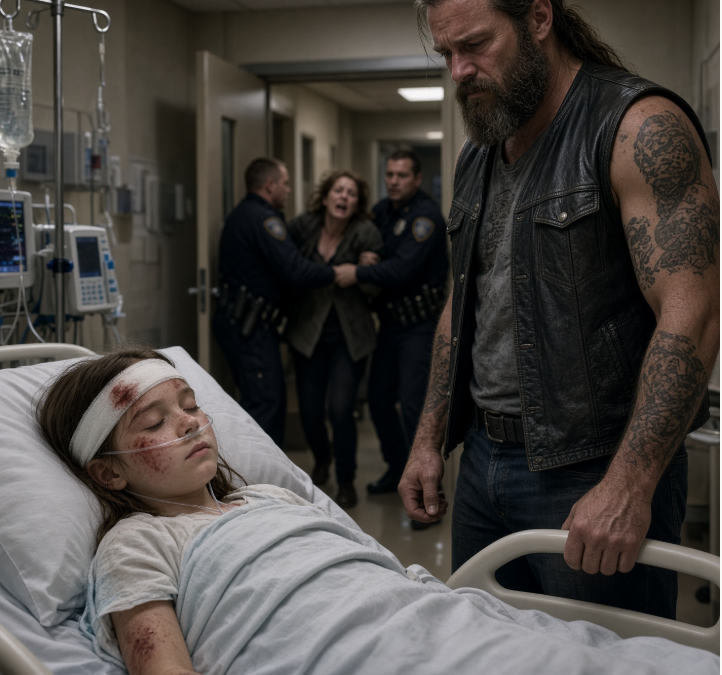
The machines beeped in steady rhythm. Tubes ran from machines to her little body. A bandage wrapped part of her head. Her face looked too pale against the hospital pillow.
Barnaby was tucked carefully under her arm.
I held her hand.
My hand swallowed hers.
I had been talking to her for hours even though the doctors said she might not hear me.
I told her about Jonathan.
I told her he used to sing badly on purpose.
I told her he once tried to teach me how to fold a fitted sheet and gave up because I “lacked domestic discipline.”
I told her he loved her.
Even if he wasn’t here.
Even if the world had failed to prove it.
Then the monitor hitched.
Only slightly.
But I saw it.
Her fingers twitched.
I stopped breathing.
“Chloe?”
Her brow furrowed.
Her eyelids fluttered.
Then slowly, painfully, her eyes opened.
They were blue.
Jonathan’s blue.
Unfocused at first.
Then blinking against the light.
She turned her head a little and winced.
The nurse rushed in.
I backed away half a step, afraid the sight of me might scare her.
Most kids would be frightened waking up to a man like me.
Leather vest.
Tattoos.
Scarred hands.
Beard.
The kind of face people warned children about.
Chloe looked at me.
Then she looked down at Barnaby.
Her weak fingers touched the patch on the bear’s vest.
“My daddy had that,” she whispered.
My chest broke.
Not cracked.
Broke.
I sat forward slowly.
“I know, kiddo.”
My voice barely worked.
“He was my best friend.”
Her eyes moved back to my face.
She saw the tears before I could hide them.
“Are you my guardian angel?”
A wet laugh came out of me.
It hurt.
“Something like that.”
I gently wrapped my fingers around her tiny hand.
“My name is Garrick. And I promise you, as long as I’ve got breath in my lungs, nobody is ever going to hurt you again.”
Chloe looked at me for a long moment.
Then her fingers curled weakly around my thumb.
“Okay, Garrick.”
That was the first time she trusted me.
It was also the moment I knew my life was no longer mine in the way it had been before.
Six months later, the legal fight ended.
Judge Harrison reviewed everything.
Jonathan’s will.
The guardianship document.
Brenda’s charges.
The video evidence.
My record.
My club affiliation.
Letters from hospital staff.
Letters from the community.
Letters from people I never expected to speak for me.
Dr. Miller wrote that I had remained calm, cooperative, and present throughout Chloe’s hospitalization.
A nurse wrote that I learned how to help with Chloe’s therapy exercises.
Sarah Jenkins, who still did not like me, admitted in court that Chloe had formed a strong bond with me and that removing her without cause would create further trauma.
Bear in mind, she did not say I was charming.
She was not a liar.
But she told the truth.
That was enough.
The judge looked at me over his glasses.
“Mr. Henderson, this court is aware of your history.”
“I am too, Your Honor.”
“You understand that caring for a child requires more than protection.”
“Yes.”
“It requires stability. Patience. Emotional responsibility. Sacrifice.”
“I know.”
“Do you?”
I looked at Chloe.
She sat beside me holding Barnaby, her hair growing back where they had shaved part of it, one small hand resting on my sleeve.
Then I looked back at the judge.
“No,” I said honestly. “Not all of it. But I’m learning. And I’ll keep learning.”
The courtroom went quiet.
The judge studied me for a long moment.
Then he granted full custody.
Chloe did not go into foster care.
She came home with me.
Not on the back of a Harley that day—that part came later, when she was stronger and wearing a helmet too big for her head.
That day, she came home in the passenger seat of my truck, Barnaby buckled beside her because she insisted he needed a seatbelt.
My house was not ready for a little girl.
I had bought a bed.
A dresser.
Books.
Clothes.
A nightlight shaped like a moon.
Too many stuffed animals because every member of the club bought one and pretended someone else had done it.
The first night, Chloe stood in the doorway of her room and stared.
“This is mine?”
“Yes.”
“All of it?”
“Yes.”
“For how long?”
I crouched carefully, still too big for the space.
“As long as you want it.”
She looked at the bed.
Then at me.
“If I’m bad?”
“Still yours.”
“If I spill something?”
“Still yours.”
“If I cry at night?”
“Still yours.”
Her eyes filled.
“Aunt Brenda said I cost too much.”
I closed my eyes for one second.
When I opened them, I kept my voice steady.
“Chloe, you are not a bill. You are not a problem. You are not bad luck. You are a child. And children are supposed to be cared for.”
She looked at Barnaby.
Then whispered, “Okay.”
Healing was not simple.
People like endings where the villain goes to prison and the child smiles again.
Real life is slower.
Chloe woke screaming for months.
She hid food in drawers.
She apologized when she used too much toothpaste.
She flinched when someone dropped a pan.
She panicked the first time I raised my voice during a phone call, even though I was not angry at her.
I learned quickly that protection was not only standing between her and danger.
Protection was lowering my voice.
Closing doors softly.
Keeping cereal where she could reach it.
Telling her every appointment before it happened.
Letting her ask the same question ten times.
“Are you coming back?”
“Yes.”
“Promise?”
“Yes.”
“You won’t forget?”
“Never.”
The club changed too.
No one knew what to do with a seven-year-old girl in a clubhouse.
So they learned.
Iron Mike learned to braid hair by watching online videos and practiced on three grown men before Chloe let him near her.
Dutch built a bookshelf shaped like a castle.
Stitches bought glitter markers and pretended they were “for tactical planning.”
Vander cried during Chloe’s school play and threatened anyone who mentioned it.
These men had been called monsters by half the state.
Some had earned pieces of that.
But when Chloe walked into the room, they became uncles.
Big, loud, terrifying uncles who dropped to one knee and asked about spelling tests.
Brenda went to prison.
Her trial was ugly.
Her lawyer tried every angle.
Addiction.
Debt.
Panic.
Grief after losing her sister.
None of it changed what she had done.
The video spoke louder than her excuses.
She was convicted and sentenced to decades behind bars.
I did not bring Chloe to court for the worst of it.
She had already seen enough.
When Chloe was older, I told her the truth in pieces, always with her therapist’s guidance. Not the brutal details. Not all at once. Just enough so the empty places in her memory did not fill with blame.
Because children often blame themselves when adults do evil.
And I would not let Brenda’s shadow live inside Chloe as guilt.
Years passed.
Chloe grew.
Her hair came back soft and bright.
The scar near the back of her head faded but never disappeared.
She struggled in school at first, then caught up. She loved drawing. Hated peas. Became obsessed with horses for six months, then dinosaurs, then astronomy.
At ten, she asked if her dad had been brave.
“Yes,” I said.
“Like you?”
I laughed.
“Better than me.”
She frowned.
“I don’t think so.”
“You didn’t know him.”
“I know you loved him.”
That shut me up.
At twelve, she asked why her mother’s family had not come for her.
I told her the truth as kindly as I could.
Some were gone.
Some were unable.
Some should have done more.
She cried that day.
I sat with her and did not try to fix the grief.
Some grief should not be interrupted.
At thirteen, she stood in front of the mirror wearing a leather jacket the club had custom-made for her—not a cut, not club colors, nothing she was too young to understand, just a jacket with a little embroidered bear on the sleeve.
Barnaby.
She turned toward me.
“Too much?”
“Definitely.”
She smiled.
“I like it.”
“Then it’s perfect.”
At fifteen, she rode on the back of my Harley for the first time.
Helmet.
Gloves.
Boots.
My rules.
She rolled her eyes at every safety lecture but listened.
We rode through the foothills as the sun dropped gold over California. She held on carefully at first, then relaxed. When we stopped at an overlook, she took off her helmet and looked at the sky.
“I think Dad would have liked this,” she said.
“He would have hated that I taught you,” I replied.
She laughed.
“Then he should’ve been here.”
The words came out light, but the grief underneath was real.
I nodded.
“Yeah, kiddo. He should have.”
We stood there together until the air cooled.
I thought about the alley.
The bear in the puddle.
The pulse under my fingers.
The promise I made beside a hospital bed.
Nobody is ever going to hurt you again.
It was a promise no human being can make perfectly.
The world hurts people.
Loss happens.
Fear returns.
Memories ambush.
But what I meant was this:
She would never face it alone.
Not while I had breath in my lungs.
Years after that night, people still told the story wrong.
They made it about revenge.
About a Hells Angel punishing a monster.
About an outlaw biker becoming a guardian angel.
They liked the dramatic version.
The blood.
The leather.
The courtroom.
The club standing guard in the hospital.
But that was not the real story.
The real story was quieter.
It was learning how to pack a school lunch.
It was Chloe sleeping with the hallway light on.
It was me sitting through parent-teacher conferences in a leather vest while nervous teachers tried not to stare.
It was therapy appointments.
Nightmares.
Birthday cakes.
Homework.
Bandages.
Hair braids.
Apologies.
Trust built one ordinary day at a time.
The real story was a child who had every reason to expect the worst from adults slowly learning that some adults stay.
One evening, long after Chloe had become taller than I ever wanted her to be, I found her sitting on the porch with Barnaby in her lap.
The bear was older now.
Restitched.
Clean.
Still missing one eye.
The patch was still on his vest.
She ran her thumb over it.
“Do you ever wish you hadn’t found me?” she asked.
The question hit me harder than any fist ever had.
I sat beside her carefully.
“No.”
“Even with all the trouble?”
“Especially with all the trouble.”
She leaned her head on my shoulder.
“I don’t remember everything from that night.”
“Good.”
“I remember your jacket.”
I looked at her.
“You were cold.”
“I remember waking up and seeing you.”
I swallowed.
“You asked if I was your guardian angel.”
She smiled faintly.
“You said something like that.”
“I didn’t know what else to say.”
She looked out toward the driveway where my Harley sat under its cover.
“You were.”
I shook my head.
“No, Chloe. I was a man who got there in time.”
“That counts.”
Maybe it did.
Maybe that was all a guardian angel ever was.
Someone flawed.
Someone unlikely.
Someone not clean enough for church windows or polite stories.
Someone who still shows up when a child needs help.
Brenda had once treated Chloe like a burden.
The system had nearly treated her like a file.
The world could have let her become another tragedy hidden behind a card room.
But Jonathan’s patch led me to her.
Barnaby carried the truth.
And Chloe survived.
That is what matters.
Not the darkness she came from.
The life she stepped into after.
A life where hard men learned gentleness.
Where a little girl with a scar grew into someone brave.
Where the loudest room in Bakersfield went silent whenever she sang at school events.
Where the men everyone feared became the men checking homework, fixing bikes, building bookshelves, and showing up for every birthday.
Chloe did not get the family anyone expected.
She got something stranger.
Rougher.
Louder.
Imperfect.
But it was hers.
And when people asked her years later what it was like being raised by Garrick “Bull” Henderson and a pack of Hells Angels, she always smiled the same way.
Then she said:
“They looked scary to everyone else. But to me, they were the first people who made the monsters afraid.”








