Koko Spent Years Locked in a Cage Until She Weighed Just 25 Pounds—Then Rescuers Opened the Door and She Collapsed.
PART3:
By the time Koko reached adulthood, she could no longer run inside it.
She could turn.
Sit.
Lie down.
Stand.
That was the entire geography of her life.
Four movements.
Turn.
Sit.
Lie down.
Stand.
Again.
Again.
Again.
Days became weeks.
Weeks became years.
The red ball disappeared from the yard.
One child went away to college.
The younger boy stopped coming outside except to take trash to the bins.
Koko still lifted her head when she heard the back door.
For a long time, she believed footsteps meant someone was coming for her.
Eventually she learned that most footsteps passed.
Sometimes a bowl appeared.
Sometimes it did not.
Water came irregularly.
During hot weather, the bowl would dry long before somebody remembered to fill it.
Koko learned to lick moisture from the metal after rain.
She learned to curl tightly during cold nights.
She learned the difference between sounds that mattered and sounds that did not.
The refrigerator door inside the house.
Not for her.
A car in the driveway.
Not for her.
Children laughing in another yard.
Not for her.
A bag of dog food being dragged across concrete.
Maybe.
Footsteps approaching the cage.
Yes.
Always yes.
Even after years, she stood whenever somebody came near.
That was the thing about Koko.
Hope did not disappear all at once.
It thinned.
Like her body.
Slowly.
Almost invisibly.
Until one day there was barely anything left.
The neighbor first noticed because of the crying.
Her name was Miriam Naidoo.
She lived two houses down and had known the family casually for years.
Not well.
A wave from the driveway.
An exchanged package when a delivery went to the wrong address.
A few conversations about weather.
Nothing intimate.
She knew they had a dog.
She did not know how the dog lived.
Then one evening she heard a strange sound while hanging laundry.
It was not barking.
It was a low, repetitive whine.
Miriam stopped.
The sound came again.
She looked over the wall.
Nothing.
“Koko?”
She remembered the name vaguely from years earlier.
Silence.
Then another whine.
Miriam pulled a plastic chair toward the wall and climbed carefully onto it.
From there she could see part of the neighboring yard.
At first she saw only the cage.
Then something moved inside.
Miriam narrowed her eyes.
The animal looked nothing like the dog she remembered.
Koko had once been tall and elegant, even as a young greyhound, all long limbs and nervous energy.
The animal behind the bars looked folded in on herself.
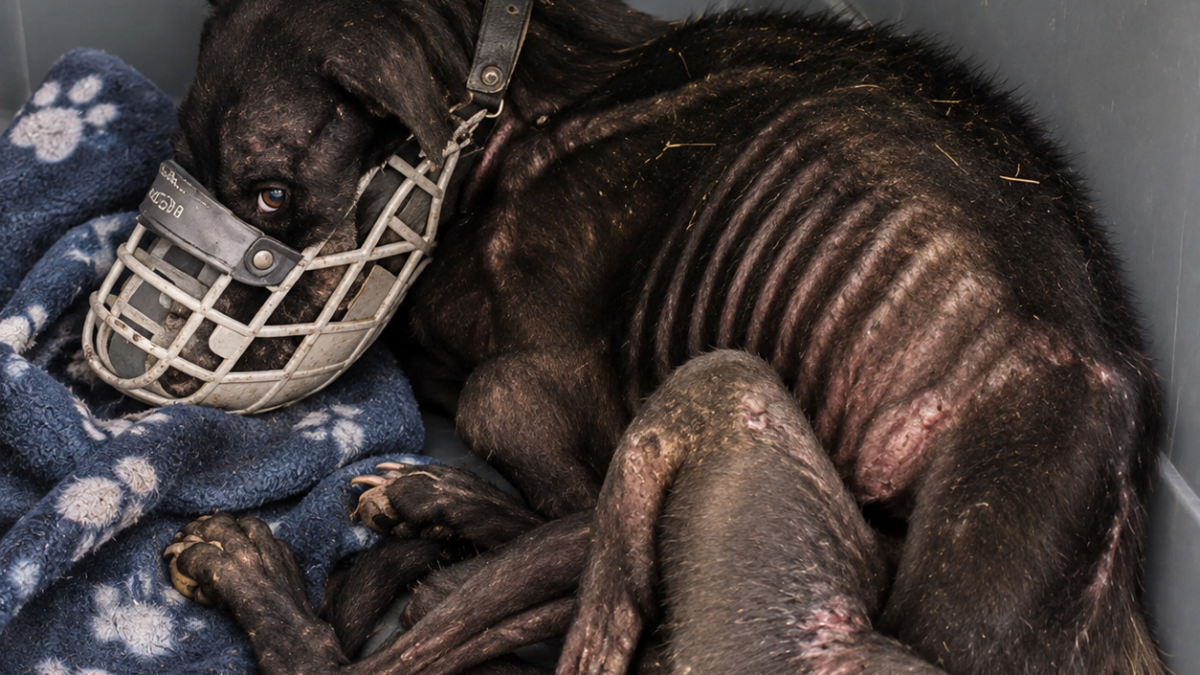
Her ribs stood out sharply.
Her hips formed hard angles beneath the skin.
Large patches of fur appeared dull and uneven.
Miriam could see dark clusters around her neck and ears.
Ticks.
Dozens from that distance.
Probably far more.
“Oh, sweetheart.”
Koko raised her head.
Their eyes met.
Miriam would later say that was the moment she knew she could not pretend she had merely seen a thin dog.
There was something in Koko’s expression that made indifference impossible.
Not accusation.
Not anger.
Expectation.
She had seen a person.
And she was waiting to find out whether that person would leave too.
Miriam climbed down.
She walked to Martin’s front gate and rang the bell.
He answered after several minutes.
“Yes?”
“I’m sorry to bother you.”
He looked impatient.
“Your dog.”
“What about her?”
“I think she’s sick.”
Martin glanced toward the side of the house.
“She gets thin.”
Miriam stared at him.
“She looks extremely thin.”
“Greyhounds are thin dogs.”
“Not like that.”
His expression changed slightly.
Not concern.
Defensiveness.
“She’s old.”
“How old?”
“I don’t know. Ten?”
Koko was not ten.
Not yet.
Miriam did not know that.
She only knew what she had seen.
“She needs a veterinarian.”
“We’ve got it under control.”
“Does she have water?”
Martin’s face hardened.
“Excuse me?”
“I couldn’t see any water.”
“You were looking into my yard?”
“I heard her crying.”
“So you climbed my wall?”
“I was worried.”
“You shouldn’t be spying on people.”
Miriam felt heat rise through her face.
“I’m not spying. I’m telling you your dog looks like she’s starving.”
The front door opened behind Martin.
Leanne appeared.
“What’s happening?”
“Neighbor thinks she knows how to look after our dog.”
Miriam looked at her.
“Please.”
Leanne’s eyes shifted away.
That tiny movement mattered.
Miriam saw shame there.
Or fear.
Or both.
“She needs help,” Miriam said.
Leanne whispered, “I’ll talk to him.”
Martin turned.
“There’s nothing to talk about.”
Miriam left.
But she did not stop.
The next morning she called a local animal welfare organization.
They referred her to rescuers experienced with neglected sighthounds.
That was how the report reached SA Greys.
The call was passed to a rescuer named Hannah Jacobs shortly after nine.
“Severely underweight greyhound,” the coordinator told her. “Possibly long-term confinement.”
“Owner surrender?”
“Not yet.”
“Emergency access?”
“Neighbor says the dog may not have water.”
Hannah stood immediately.
“I’ll go.”
She had handled cruelty cases before.
That did not make them easier.
It only changed what she noticed.
New rescuers often saw the obvious suffering first.
Hannah saw details.
The length of nails.
The wear pattern beneath a dog’s elbows.
Muscle loss.
Pressure sores.
How quickly an animal approached food.
Whether the dog flinched when hands moved overhead.
Whether a collar was embedded.
Whether the eyes tracked the door.
Every neglected animal carried a history.
Not in words.
In the body.
A volunteer named Peter drove.
Miriam met them at the property.
“Thank you for coming.”
Hannah looked toward the house.
“Have they agreed to let us in?”
“Not exactly.”
Peter exhaled.
“So we’re going to have fun.”
Hannah gave him a look.
“Be nice.”
“I am always nice.”
Miriam almost smiled.
They rang the bell.
Leanne answered this time.
She looked tired.
“Are you from the shelter?”
“SA Greys,” Hannah said. “We received a concern about Koko.”
Leanne looked behind her.
“My husband isn’t home.”
“Can we see her?”
“I don’t know if I should let—”
A sound came from the backyard.
Weak.
Thin.
A whine.
Leanne closed her eyes.
Hannah’s voice softened.
“Please.”
For several seconds, nobody moved.
Then Leanne stepped aside.
“Come in.”
They walked through the house.
Family photographs covered the hallway.
Birthday parties.
School uniforms.
Vacations.
Christmas mornings.
A family moving through years.
Hannah noticed a photograph near the kitchen.
Three children sat on the lawn with a young greyhound puppy sprawled across their laps.
Koko.
Healthy.
Bright-eyed.
Hannah stopped.
“Is that her?”
Leanne nodded.
“She was beautiful.”
Hannah looked at her.
“Was?”
Leanne flinched.
Hannah immediately regretted the sharpness.
Anger could come later.
The dog came first.
They reached the back door.
The smell reached them before the cage did.
Urine.
Feces.
Old food.
Damp bedding.
Hannah walked outside.
Then stopped.
Peter whispered, “Jesus.”
Koko tried to stand.
Her front legs shook.
Her chest lifted halfway.
Then she collapsed back onto a dirty blanket.
Hannah had seen severely underweight greyhounds.
This was different.
Koko’s ribs looked carved beneath the skin.
Her spine rose like a ridge.
The muscles over her hindquarters had nearly disappeared.
Ticks clustered along the thin skin of her ears, around her eyes, beneath her neck, between her toes.
Her water bowl was empty.
Completely dry.
Hannah’s jaw tightened.
She crouched several feet away.
“Hi, Koko.”
The dog’s ears twitched.
Her eyes followed Hannah.
“You don’t know me.”
Koko tried again to rise.
“Don’t.”
Hannah moved closer.
“You don’t need to.”
Koko’s tail moved once.
Barely.
Peter turned his face away.
Miriam stood at the door crying.
Hannah examined the cage.
It was far too small for a greyhound.
Rust marked the corners.
A section of wire had been repaired with twisted metal.
There was no proper bedding beyond an old blanket stained nearly black.
“When was she last fed?” Hannah asked.
Leanne stood behind them.
“This morning.”
“How much?”
“I don’t know.”
“Who feeds her?”
“My husband usually.”
Hannah looked at the empty bowl.
“When did she last see a veterinarian?”
Silence.
“Leanne?”
“I don’t remember.”
“A year?”
No answer.
“Two?”
Leanne covered her mouth.
Peter spoke quietly.
“We need to take her.”
Leanne began crying.
“My husband will be furious.”
Hannah stood.
“That dog may die here.”
“I know.”
“Then sign her over.”
Leanne shook her head.
“You don’t understand.”
Hannah looked toward Koko.
“No.”
Her voice hardened.
“I understand enough.”
The argument with Martin happened by phone.
He refused at first.
“She belongs to us.”
Hannah stood ten feet from the cage while Leanne held the phone on speaker.
“Then take her to an emergency veterinarian immediately,” Hannah said.
Martin’s voice came through sharp and loud.
“Who are you?”
“My name is Hannah Jacobs. I’m with SA Greys.”
“You people show up at my house when I’m at work and tell me what to do with my animal?”
“Your animal weighs approximately a third of what she should.”
“You haven’t weighed her.”
“I don’t need a scale to know this is an emergency.”
“Greyhounds are naturally skinny.”
Peter looked at Hannah.
She closed her eyes for one second.
“Sir, I work specifically with greyhounds.”
Silence.
Then Martin said, “She’s always been difficult with food.”
Koko’s empty bowl sat between them.
Hannah stared at it.
“How long has she been kept in this cage?”
“It’s a kennel.”
“How long?”
“Years.”
“Does she leave it daily?”
“She guards the property.”
Hannah looked at the high walls surrounding the yard.
“From inside a cage?”
Martin became angry.
“This conversation is over.”
“No.”
Hannah’s voice changed.
“This conversation ends one of two ways. You voluntarily surrender Koko right now, and we get her emergency medical care, or we contact animal welfare enforcement and document everything exactly as we found it.”
Leanne whispered, “Hannah—”
Martin shouted through the phone.
“You threatening me?”
“I’m explaining your options.”
Another silence.
Koko lowered her head.
Hannah watched her breathing.
Too fast.
“We don’t have time.”
Martin cursed.
Then finally said, “Take the damn dog.”
Nobody spoke.
Hannah stared at the phone.
“Say it clearly.”
“What?”
“Say you are surrendering ownership of Koko to the rescue.”
Another curse.
Then:
“I surrender the dog.”
Hannah took the paperwork from Peter.
Leanne signed.
Koko’s cage opened.
The sound of the latch seemed enormous.
Metal scraped.
The door swung outward.
For a few seconds, Koko did nothing.
She simply looked through the opening.
Hannah crouched.
“Come on, sweetheart.”
Koko stared.
The door was open.
For years, bars had been the one permanent fact in her world.
Now there was a space where bars had been.
Hannah placed a hand on the ground.
“You can come out.”
Koko’s front paw moved.
It landed beyond the cage threshold.
One paw.
Then the second.
She tried to lift herself.
Her hind legs shook violently.
Hannah reached forward.
“Koko—”
The greyhound collapsed.
Her entire body folded onto the ground.
Miriam screamed.
“Oh my God!”
Peter was already moving.
“Blanket.”
Hannah placed one hand against Koko’s chest.
“She’s breathing.”
Koko’s eyes remained open.
“Stay with me.”
Peter returned with a thick blanket.
Together they lifted her.
Koko weighed almost nothing.
That frightened Hannah more than the collapse.
A grown greyhound should have had substance.
Weight.
Muscle.
Resistance.
Koko felt like an empty coat wrapped around bone.
They carried her through the house.
As Hannah passed the family photographs, she saw the puppy picture again.
Koko racing across the lawn.
Koko with a child’s arms around her neck.
Koko alive inside a world that had once seemed to include her.
Hannah looked down at the body in her arms.
“What happened to you?”
Leanne heard.
She began crying harder.
At the clinic, the scale stopped at twenty-five pounds.
The veterinarian checked it twice.
Dr. Priya Shah stared at the number.
“She should weigh somewhere around seventy-five, depending on her frame.”
Peter whispered, “Twenty-five.”
“About a third.”
Hannah looked at Koko.
Ticks were still being removed.
One technician counted until the number became meaningless.
Koko was severely dehydrated.
Her blood pressure was low.
Her gums were pale.
Bloodwork showed what the team feared.
Her body had been consuming itself.
Fat stores were gone.
Muscle had been broken down.
Her organs were under strain.
The instinctive response would have been simple.
Feed her.
Feed her everything.
Let her eat until she was full for the first time in years.
But Koko was too fragile for that.
Dr. Shah explained it to Hannah.
“We have to be careful.”
“She needs food.”
“Yes.”
“So feed her.”
“We will.”
Priya looked at her.
“But not as much as you want me to.”
Hannah understood.
Refeeding could be dangerous after prolonged starvation.
Electrolytes could shift.
The heart could be affected.
The body could fail under the sudden abundance of something it had been denied.
Cruelty had made even kindness complicated.
Hannah hated that.
“How much?”
“Small measured meals.”
“She’ll be hungry.”
“I know.”
“She has spent years hungry.”
“I know.”
Hannah’s voice cracked.
“And we’re going to put food in front of her and take it away?”
Priya stepped closer.
“We’re going to keep her alive.”
Hannah looked down.
Koko had fallen asleep beneath a warming blanket.
“All right.”
The first night was the longest.
Koko received fluids slowly.
Medication for parasites.
Treatment for the tick burden.
Carefully calculated nutrition.
Her temperature was monitored.
Her heart was monitored.
Everything was monitored.
Hannah stayed.
At two in the morning, Koko woke.
She tried to stand.
Could not.
Hannah sat beside her.
“It’s okay.”
Koko’s eyes moved toward the food preparation area.
A technician had opened a container.
The smell carried.
Koko lifted her head.
Hannah’s chest hurt.
“I know.”
Koko tried to move.
“No.”
Hannah placed a hand beside her.
“You’ve had enough for now.”
Koko stared toward the food.
“I know that doesn’t make sense.”
The greyhound began licking the empty edge of a feeding dish.
Hannah looked away.
A minute later she felt something against her wrist.
Koko’s nose.
The dog sniffed her.
Hannah stayed still.
Koko pressed her face into Hannah’s palm.
It lasted three seconds.
Then she withdrew.
But Hannah did not sleep afterward.
She sat beside the bed until sunrise.
At six, Priya returned.
“You’re still here.”
“So are you.”
“I went home.”
“Show-off.”
Priya smiled faintly.
“How is she?”
“Hungry.”
“Good.”
“Good?”
“Hungry is better than unresponsive.”
Hannah looked at Koko.
“That’s a terrible standard.”
“For now, it’s the standard.”
The second day brought no miracle.
Neither did the third.
Koko could not stand.
Her body remained frighteningly thin.
Her eyes seemed too large for her face.
She watched everything.
Hands.
Doors.
Food.
People.
If someone moved suddenly, she flinched.
If footsteps approached, her body tensed.
When a bowl arrived, she ate with desperate speed until the caregivers began using shallow dishes and hand-feeding methods to slow her.
The first time Peter stroked her shoulder, Koko froze.
He immediately stopped.
“Sorry.”
Hannah watched from across the room.
Koko turned her head.
Peter lowered his hand.
“It’s okay.”
He did not touch her again.
Five minutes later, Koko shifted closer.
Peter’s eyes filled.
“You want me to?”
Koko remained still.
He placed two fingers gently against her neck.
This time she did not freeze.
“Good girl.”
Hannah looked away to give him privacy.
Healing, she realized, was going to happen in measurements too small for scales.
A meal tolerated.
A little more hydration.
One touch accepted.
Five seconds without fear.
On the fourth day, Miriam came to visit.
She stood outside Koko’s room and cried.
“I should’ve called earlier.”
Hannah turned.
“You called.”
“I heard her before.”
“How long?”
Miriam looked ashamed.
“I don’t know. Months.”
“You didn’t know what it meant.”
“I knew something was wrong.”
Hannah did not answer.
Miriam wiped her face.
“I kept thinking it wasn’t my business.”
“That sentence hurts a lot of animals.”
Miriam nodded.
“I know.”
There was no accusation in Hannah’s voice.
Only exhaustion.
Miriam looked through the glass.
“Can I see her?”
“Quietly.”
She entered.
Koko watched her.
Miriam sat on the floor several feet away.
“Hi.”
Her voice broke.
“I’m the nosy neighbor.”
Koko blinked.
Miriam smiled through tears.
“I should’ve been nosier sooner.”
She did not approach.
For twenty minutes she simply sat.
Before leaving, she placed a folded blanket near Koko’s bed.
“I don’t know if she needs this.”
“She has blankets.”
“I know.”
Miriam looked embarrassed.
“I just needed to bring something.”
Hannah took it.
“Then she needs it.”
The fifth day was dangerous.
Koko’s electrolyte levels shifted.
Priya adjusted her feeding.
For several hours, everyone became frighteningly quiet.
Hannah learned to fear quiet in clinics.
People talked when things were stable.
They joked.
Complained.
Asked what anybody wanted for lunch.
When a patient was failing, voices disappeared.
Koko slept while machines recorded what her body was doing.
Hannah stood outside.
“Tell me.”
Priya looked at the latest results.
“We’re managing it.”
“That isn’t an answer.”
“It is the answer.”
“Is she getting worse?”
“Some values changed.”
“Can her heart handle this?”
Priya looked directly at her.
“I believe so.”
“You believe?”
“Hannah.”
“I need more than belief.”
“No, you want more.”
Priya lowered the chart.
“But sometimes medicine only gives us the next hour.”
Hannah stared through the glass.
Koko opened her eyes.
The next hour passed.
Then another.
By evening, the numbers improved.
Koko ate.
Hannah cried in the supply room where nobody could see her.
Peter found her anyway.
“She’s okay.”
“For now.”
“For now is pretty good.”
“I hate for now.”
“Everybody does.”
On the sixth morning, Koko lifted herself onto her elbows without help.
Hannah took a photograph.
Not for social media.
For herself.
On the seventh day, they carried Koko outside.
The sun was mild.
Priya wanted only a few minutes.
Koko lay on a blanket in a patch of grass.
Her nose moved constantly.
Wind.
Soil.
Flowers.
Cars.
Other dogs.
The world seemed to arrive through smell.
Hannah sat beside her.
“Remember this?”
Koko watched a bird land near the fence.
“I bet you do.”
Peter stepped away to answer a phone call.
Priya walked toward the door.
Then Hannah felt movement.
Koko’s front legs straightened.
“Wait.”
Priya turned.
Koko pushed.
Her hind legs shook.
Hannah’s hands hovered near her without touching.
“Koko.”
The dog rose.
All four feet beneath her.
For one second.
Two.
Three.
Nobody breathed.
“She’s standing,” Peter whispered.
Koko swayed.
Hannah slid one hand beneath her stomach.
“I’ve got you.”
But Koko remained upright.
Her head lifted.
The sun touched her face.
Seven days earlier, she had collapsed while leaving the cage.
Now she stood beneath open sky.
Priya covered her mouth.
Peter began crying.
Hannah laughed and cried at the same time.
“Look at you.”
Koko took a step.
It was clumsy.
Her paw dragged slightly.
Then another.
Hannah moved with her.
Five feet.
Maybe six.
That was all.
Koko’s legs gave way.
Hannah caught her.
“No more.”
She lowered her gently onto the blanket.
“You did enough.”
Koko panted.
Her eyes were brighter.
Hannah rested her forehead against the dog’s neck.
“You stood.”
Koko licked her chin.
Peter captured that moment in a photograph.
It later became one of the images people remembered most.
Not the cage.
Not the ribs.
A woman kneeling in grass with a greyhound who had just discovered she still had legs strong enough to hold her.
By the end of the second week, Koko weighed thirty-two and a half pounds.
Seven and a half pounds.
Under ordinary circumstances, it would not have seemed dramatic.
For Koko it was evidence.
Her body was beginning to believe food would keep coming.
She learned the schedule quickly.
Morning meal.
Rest.
Medication.
Short assisted walk.
Another meal.
Rest.
Gentle grooming.
Evening meal.
More rest.
Routine.
That word meant more than anyone realized.
Neglected animals often lived inside uncertainty.
Would food come?
Would water?
Would someone shout?
Would the door open?
Would a hand hurt?
Koko began learning that the same good things could happen repeatedly.
The same person could enter and not cause pain.
The same bowl could fill again tomorrow.
The same door could open.
The walk could end with a return to safety rather than confinement.
The first time Hannah clipped a leash to her collar, Koko dropped flat to the floor.
Hannah froze.
“Okay.”
She removed it.
The next day, she placed the leash nearby.
Nothing happened.
The day after, she clipped it on and immediately removed it.
A week later, Koko followed her three steps.
No pulling.
No pressure.
Three steps.
Then five.
Then down the hallway.
Then outside.
Her eyes changed during those walks.
That was what Peter noticed.
“Look at her.”
Hannah glanced down.
Koko was staring toward the clinic gate.
Tail slightly raised.
“What?”
“Her face.”
Koko took another step.
Peter smiled.
“She wants to know what’s out there.”
Curiosity.
The same thing prolonged neglect had nearly erased.
It returned slowly.
One smell at a time.
One doorway.
One patch of grass.
Koko did not know how to play.
The first toy they gave her was a stuffed rabbit.
She looked at it.
Hannah squeaked it.
Koko flinched.
Hannah immediately stopped.
“Bad choice.”
Peter brought a soft rope.
Koko sniffed it.
Walked away.
A tennis ball rolled past her.
Nothing.
For weeks, toys were simply objects.
Then one afternoon a volunteer named Rachel dropped a fleece blanket on the floor.
One corner slid toward Koko.
The dog reached out and caught it with her teeth.
Rachel stopped.
Koko pulled.
Very gently.
Rachel held the opposite edge.
Koko pulled again.
Hannah stared from the doorway.
“Don’t move.”
Rachel whispered, “I’m not moving.”
Koko gave one tiny shake.
Rachel let the blanket move.
Koko’s tail wagged.
Hannah covered her mouth.
“Oh my God.”
Rachel smiled.
“What?”
“She played.”
Koko pulled again.
For thirty seconds, she played tug with a blanket.
Thirty seconds of puppyhood.
Years late.
Nobody cared.
They celebrated like she had won a championship.
Koko’s case became public after photographs of her condition circulated through rescue networks.
People were furious.
Some demanded immediate prosecution.
Others asked how a dog could live in such obvious neglect for years without anyone intervening.
That question became uncomfortable.
Because there was no single answer.
Some neighbors had not known.
Some had noticed the dog but assumed she was thin because she was a greyhound.
Some heard crying but thought it was normal barking.
One man admitted he had once seen Koko’s ribs from an upstairs window.
“Why didn’t you report it?” Miriam asked him.
He looked down.
“I thought somebody else would.”
That sentence spread through the neighborhood faster than anger.
Somebody else.
It became the phrase nobody wanted attached to themselves.
Animal welfare officers opened a formal investigation.
They photographed the cage.
Measured it.
Collected the empty containers.
Reviewed veterinary records.
There were almost none.
They interviewed Leanne.
Then Martin.
His version changed repeatedly.
First, Koko had always been thin.
Then she had recently stopped eating.
Then he claimed the children were responsible for feeding her.
Then he said his work schedule had become difficult.
Then he argued that nobody had told him she was seriously ill.
The investigator, Carla Mendez, sat across from him.
“She weighed twenty-five pounds.”
“I know that now.”
“She was severely dehydrated.”
“We had a water bowl.”
“An empty bowl.”
“It had water when I left.”
“Koko was covered in ticks.”
“She lived outside.”
“Outside doesn’t cause uncontrolled tick infestation.”
Martin crossed his arms.
“You people are making me sound like a monster.”
Carla studied him.
“I haven’t called you anything.”
“My wife says rescue people have been posting online.”
“I’m asking about your dog.”
“She was everybody’s dog.”
“What does that mean?”
“The kids wanted her.”
Carla paused.
“The children?”
“Yes.”
“You brought Koko into the home because your children wanted a puppy?”
“Yes.”
“And when they grew older?”
Martin looked away.
“She became a guard dog.”
“From inside a cage.”
“She barked.”
“How often did she leave the cage?”
“I don’t know.”
“Daily?”
Silence.
“Weekly?”
“I worked.”
“Monthly?”
Martin became angry.
“You’re trying to trap me.”
“No.”
Carla placed a photograph on the table.
Koko at intake.
Twenty-five pounds.
Barely conscious.
“This trapped her.”
Martin looked away.
Charges were eventually filed under local animal welfare laws.
The legal process moved slowly.
Too slowly for Hannah.
Every delay felt obscene compared with how quickly starvation could destroy a body.
But Carla reminded her that strong cases took evidence.
“You want accountability?”
“Yes.”
“Then let me build something that survives court.”
“What if he says he didn’t know?”
Carla closed a folder.
“He lived in the same house.”
“What if he blames the children?”
“That won’t help him.”
“What about Leanne?”
“She signed the surrender. She’s cooperating.”
“She also lived there.”
“Yes.”
Hannah’s anger sharpened.
“So why is cooperation supposed to erase years?”
“It doesn’t.”
Carla looked at her.
“But responsibility can be shared without being identical.”
Hannah hated that answer because it was reasonable.
She wanted cruelty to be simple.
One villain.
One victim.
One punishment.
Koko’s case was uglier.
Children had once loved her and then drifted away.
Adults became careless.
One adult became defensive.
Another became passive.
Neighbors became uncertain.
Everybody assumed time would continue without consequence.
Neglect often worked that way.
Not always through a single violent act.
Sometimes through a thousand moments when somebody could have done something and didn’t.
At the rescue center, Koko knew none of this.
Her world was becoming larger.
At forty pounds, she could walk several hundred yards.
At forty-five, her ribs still showed, but less sharply.
At fifty, muscle began returning to her hindquarters.
Her coat improved.
The ticks were gone.
Her skin healed.
Her eyes shone.
One morning, Hannah arrived late.
Koko was waiting near the gate.
When she saw Hannah, her entire body changed.
Head up.
Tail wagging.
Feet dancing.
Hannah stopped.
“Are you happy to see me?”
Koko took two excited steps.
Hannah laughed.
“You are.”
She crouched.
Koko walked directly into her arms.
Months earlier, affection had confused her.
Now she pushed her long face beneath Hannah’s chin and demanded it.
“You’re becoming needy.”
Koko leaned harder.
“Absolutely shameless.”
Peter walked past.
“She learned from you.”
“Go away.”
Koko followed Hannah everywhere.
Not fearfully.
By choice.
That distinction mattered.
She could walk away now.
She simply often chose not to.
The first time she ran happened almost by accident.
They had taken her into a secure grassy enclosure after months of rehabilitation.
Hannah unclipped the leash.
Koko stood still.
She had been off-leash in enclosed areas before, but she usually wandered slowly.
That afternoon, wind moved through the grass.
A younger greyhound named Finn raced past.
Koko watched him.
Finn circled.
Ran again.
Koko’s ears lifted.
Hannah saw it.
“Don’t.”
Peter looked at her.
“Don’t what?”
“She wants to—”
Koko launched.
Not fast.
Not yet.
But unmistakably.
She ran.
Ten yards.
Twenty.
Her gait was awkward from lost muscle and years of confinement.
Finn slowed instinctively.
Koko followed.
For several seconds, they moved together.
Then Koko stopped.
She stood breathing hard.
Hannah was already crying.
Peter laughed.
“You cry constantly now.”
“Shut up.”
Koko looked toward them.
Then ran back.
Hannah dropped to her knees.
The dog collided gently with her chest.
“You ran.”
Koko panted into her face.
“You actually ran.”
Hannah thought of the cage.
Four movements.
Turn.
Sit.
Lie down.
Stand.
Now there was another.
Run.
The court hearing happened six months after Koko’s rescue.
By then she was strong enough that photographs taken that week barely resembled the animal officers had documented.
Martin pleaded guilty to animal neglect rather than proceed to trial on more serious allegations.
The court imposed fines, community service, costs related to Koko’s veterinary treatment, and restrictions preventing him from owning animals for a significant period.
The details disappointed people who wanted prison.
Hannah was one of them.
She sat outside the courthouse furious.
“That?”
Carla joined her on a bench.
“He admitted responsibility.”
“He starved her for years.”
“Yes.”
“And he walks out.”
“He has a criminal record now.”
“He goes home.”
Carla sat beside her.
“I know.”
Hannah looked at her.
“Do you?”
“Yes.”
Carla’s voice remained quiet.
“I’ve worked cases where animals died before we got there.”
Hannah looked away.
“I’ve worked cases where charges disappeared completely.”
She paused.
“This isn’t everything you wanted.”
“No.”
“But it is a public record saying what happened to Koko was wrong.”
Hannah stared at the courthouse steps.
“Does that matter?”
“It matters the next time someone thinks a dog behind a wall is private business.”
Miriam had attended too.
She stood several feet away.
“I wish I’d reported earlier.”
Hannah turned.
Miriam repeated it.
“I keep thinking maybe she wouldn’t have gotten that bad.”
Carla looked at her.
“You can’t change when you called.”
“I know.”
“But you can change what you do next time.”
Miriam nodded.
“There won’t be a next time.”
Carla’s expression softened.
“There is always a next time.”
Miriam frowned.
“Somewhere.”
That stayed with Hannah.
Koko’s rescue did not undo neglect.
But maybe it could interrupt another case sooner.
When Hannah returned to the rescue center that afternoon, Koko met her at the gate.
No court understood justice the way a dog did.
Koko did not ask for punishment.
She asked for a walk.
Hannah clipped the leash on.
“All right.”
Koko pranced impatiently.
“Clearly the legal system has not affected your schedule.”
They walked for nearly a mile.
The dog who once collapsed after one step now pulled slightly when she saw birds.
Hannah laughed.
“Easy.”
Koko looked back.
“Don’t give me that face.”
A month later came the adoption inquiry.
It arrived from England.
Hannah almost ignored it.
International adoptions required planning.
Transport.
Paperwork.
Health certifications.
Coordination.
And Koko had become personal.
Too personal.
The applicants were a British couple named Claire and Daniel Whitmore.
They lived in a village near the coast.
They had owned greyhounds for eighteen years.
Their last dog, Jasper, had died the previous spring.
Their house had a fenced garden.
They had references.
Veterinary records.
Photographs.
Everything was annoyingly perfect.
Hannah read the application three times.
Peter leaned over her shoulder.
“You hate them already.”
“Yes.”
“Why?”
“They seem lovely.”
“Terrible people.”
“Exactly.”
He laughed.
“You know she can’t stay here forever.”
“Who says?”
“The purpose of rescue?”
“Overrated.”
Peter pulled up one of the photographs.
A wide green field behind the Whitmores’ home.
“Hannah.”
“No.”
“Look.”
“I saw it.”
“There are no cages.”
“Manipulative.”
“There’s a beach twenty minutes away.”
Hannah looked despite herself.
The photograph showed open land beneath a gray-blue sky.
She thought of Koko standing in the cage doorway, too weak to take a second step.
“No.”
Peter smiled.
“That sounded weaker.”
The video interview made things worse.
Claire appeared first.
Silver-streaked hair.
Warm face.
Nervous smile.
Daniel joined carrying a mug.
“Hello.”
Koko lay beside Hannah.
Claire saw her and immediately started crying.
“Oh, I’m sorry.”
Hannah watched carefully.
“You haven’t even met her.”
“I know.”
Claire wiped her eyes.
“We followed her recovery.”
Daniel glanced at his wife.
“She has watched the standing video about fifty times.”
“Thirty.”
“Fifty.”
Claire ignored him.
“We don’t want to rescue her from anything.”
Hannah looked up.
That was not what most adopters said.
“What do you mean?”
“Koko has already been rescued.”
Claire looked at the dog.
“She doesn’t need us to save her.”
Daniel nodded.
“We’d just like to give her a home.”
Hannah became very still.
Claire continued.
“If she wants us.”
That sentence mattered.
Not we want her.
If she wants us.
They spent an hour discussing Koko.
Her feeding habits.
Fears.
Medical history.
Need for space.
Her sensitivity around confinement.
Her tendency to freeze if somebody closed a door too quickly.
Her increasing love of soft beds.
Her habit of stealing towels.
Daniel smiled.
“We can manage towels.”
“You say that now.”
“We’ve had greyhounds.”
“Fair.”
Claire asked, “Does she like the car?”
“She’s learning.”
“Other dogs?”
“Usually.”
“Cats?”
“Unclear.”
“We don’t have one.”
“Children?”
“Gentle with them so far.”
Claire hesitated.
“What makes her happiest?”
Hannah looked down.
Koko was asleep.
“What?”
“I’ve read all the medical information.”
Claire’s voice softened.
“But what does she love?”
Nobody had asked that before.
People asked what Koko endured.
What she needed.
What frightened her.
What treatment she required.
Claire asked what she loved.
Hannah thought.
“Walks.”
Claire smiled.
“Good.”
“Grass.”
Daniel nodded.
“Plenty.”
“She likes lying in sunlight.”
“We have windows.”
“She steals blankets.”
Claire glanced at Daniel.
“He does too.”
Daniel protested.
“That’s marriage. Blankets become communal property.”
Hannah laughed despite herself.
“And?”
Claire asked.
“What else?”
Hannah looked at Koko.
“Being included.”
Her voice changed.
“If you’re doing something, she wants to be there.”
Claire nodded.
“She can be there.”
The adoption was approved.
Hannah cried after closing the laptop.
Peter pretended not to notice.
The travel day arrived several weeks later.
Koko wore a soft harness.
Her paperwork filled a folder thick enough to look like a legal case.
Hannah checked everything six times.
Peter finally took the folder.
“You’re done.”
“I want to check the vaccination certificate.”
“You did.”
“The microchip number?”
“Four times.”
“The transport contacts?”
“Saved.”
“The receiving—”
“Hannah.”
She stopped.
Koko stood beside her.
Strong.
Healthy.
Nearly seventy pounds.
Hannah crouched.
“I hate this.”
Koko licked her nose.
“You could at least pretend you’re sad.”
Koko wagged.
“Traitor.”
At the airport, Hannah stayed composed until the final handoff.
Then Koko looked back.
That destroyed her.
Hannah walked forward and put both arms around the dog’s neck.
“You listen to me.”
Koko pressed against her.
“You don’t owe anyone anything.”
Her voice broke.
“You don’t have to be brave.”
Peter looked away.
“You don’t have to be grateful.”
Hannah kissed Koko’s forehead.
“You already did enough.”
Koko rested her head against Hannah’s shoulder.
“I wish I could explain where you’re going.”
Hannah closed her eyes.
“There are no bars.”
When the transport doors finally closed, Hannah stood watching until the vehicle disappeared.
She cried in Peter’s car for twenty minutes.
He let her.
Halfway across the world, Claire and Daniel waited.
The arrival area was crowded.
Claire checked the time repeatedly.
Daniel held a new leash, though they had been told not to overwhelm Koko immediately.
“You’re shaking,” he said.
“So are you.”
“I’m British. We don’t shake.”
“You’re visibly shaking.”
“Jet wash from the ventilation.”
“Inside an airport?”
He smiled.
Then the door opened.
A transport handler appeared.
Behind him was Koko.
Claire stopped breathing.
The greyhound looked around cautiously.
New smells.
New voices.
New country.
Daniel whispered, “There she is.”
Claire did not rush forward.
Neither did Daniel.
They crouched several yards away.
Koko saw them.
She froze.
The handler loosened the lead.
Claire spoke softly.
“Hello, Koko.”
The dog’s ears moved.
“I’m Claire.”
Daniel smiled.
“And I’m the one who was told you steal blankets.”
Claire elbowed him.
Koko took one step.
Then another.
She sniffed Claire’s hand.
Claire did not touch her.
Koko moved to Daniel.
Sniffed his coat.
Then returned to Claire.
For almost a minute, nobody tried to claim her.
Finally Koko pushed her nose beneath Claire’s palm.
Claire’s face crumpled.
“Oh.”
Daniel placed a hand on her shoulder.
Claire touched Koko’s cheek.
“Hello, darling.”
Koko leaned in.
The first night in England, she refused the bed they had bought.
It cost more than Daniel wanted Claire to admit.
Koko slept on an old rug beside the back door instead.
“Excellent,” Daniel said.
Claire looked at the unused orthopedic dog bed.
“Don’t.”
“I’m not saying anything.”
“Your face is saying it.”
“My face says forty pounds.”
“Go to bed.”
At two in the morning, Claire woke and checked on Koko.
The dog was standing in the hallway.
Claire stopped.
“Need outside?”
Koko stared.
Claire opened the garden door.
Koko stepped into the night.
Cold air.
Wet grass.
Silence.
She stood there for several minutes.
Claire waited inside.
Koko returned.
Claire offered a treat.
Koko took it.
Then, without warning, walked into the bedroom.
She circled once beside the expensive bed.
Daniel opened one eye.
“Well?”
Koko stepped onto it.
Claire grinned.
Daniel closed his eye.
“Worth every penny.”
Koko’s new life was built from ordinary discoveries.
Stairs.
She hated them.
Sofas.
She loved them.
Rain.
Suspicious.
Snow.
Deeply offensive.
Squirrels.
Magnificent.
The toaster.
Untrustworthy.
The vacuum.
An enemy.
She met another greyhound named Archie who lived three houses away.
Archie bowed playfully.
Koko stared.
He ran in a circle.
Koko followed.
Within weeks, they were inseparable.
She learned that doors opened.
This took time.
At first, whenever Claire closed the garden door after a walk, Koko became anxious.
She paced.
Whined.
Watched the handle.
Claire began leaving interior doors open whenever practical.
She never forced Koko into confined spaces.
One afternoon, Daniel found her asleep inside the utility room with the door partly closed by the wind.
He did not open it wider.
He simply stood there.
Koko woke.
Looked at the door.
Then went back to sleep.
Daniel felt tears rise.
He told Claire that evening.
“She didn’t care.”
Claire smiled.
“She knows she can leave.”
That was freedom too.
Not merely open space.
Knowing the exit belonged to you.
Hannah received photographs constantly.
Koko under a blanket.
Koko in a pub garden.
Koko standing beside Archie.
Koko asleep with her head on Daniel’s lap.
Koko wearing a raincoat and looking personally betrayed.
Each photograph hurt and healed something at the same time.
Then Claire sent a message.
BEACH TOMORROW.
Hannah stared at it.
Her heart raced.
She called immediately.
“Video.”
Claire laughed.
“Obviously.”
“From the beginning.”
“Yes.”
“Don’t let her off-leash unless—”
“Hannah.”
“Secure area.”
“We know.”
“Long line first.”
“We know.”
“She may be overwhelmed by the waves.”
“We know.”
Hannah sighed.
“You’re very annoying adopters.”
“So we’ve been told.”
The next morning, the sky over the coast was pale silver.
Wind moved across the dunes.
Koko stepped from the car.
She immediately smelled something unfamiliar.
Salt.
Her head rose.
Claire held the long line loosely.
Daniel carried towels and water.
Archie had come with his owner.
They followed the path over the dunes.
Koko walked faster.
Then they reached the top.
The ocean appeared.
It filled the entire horizon.
Koko stopped.
Claire stopped with her.
Nobody spoke.
For a dog whose world had once ended three feet from her nose, there was suddenly no visible ending at all.
Water stretched beyond anything she could understand.
Waves moved toward her and away.
The wind pushed against her chest.
Gulls cried overhead.
Koko stared.
Daniel lifted his phone.
Claire whispered, “Don’t call her.”
He nodded.
Koko took a step down the dune.
Then another.
Her paws reached sand.
She sniffed.
A wave broke farther down the beach.
Koko startled.
Then leaned forward.
Claire laughed softly.
“It’s okay.”
Koko walked.
The sand shifted under her feet.
She looked confused.
Archie ran ahead.
Koko watched.
That old expression returned.
Curiosity.
The same look Hannah had seen at the clinic gate.
What’s out there?
Claire lengthened the line.
Koko moved faster.
Walk.
Trot.
Then run.
Claire shouted, laughing.
“Koko!”
Daniel ran behind them with the camera shaking wildly.
Koko’s legs stretched.
Greyhounds do not run like ordinary dogs.
They unfold.
The body becomes something made for distance and air.
For a few seconds, Koko seemed to leave the years behind physically.
Her stride lengthened.
Her back curved and released.
Sand flew beneath her paws.
Archie raced alongside.
Koko ran toward the water.
Turned.
Ran back.
Then away again.
Claire could barely keep up.
“Look at her!”
Daniel was laughing and crying.
“I am!”
Koko reached the end of the long line and turned naturally.
Claire followed.
Then Koko ran parallel to the sea.
Faster.
Faster.
The dog who had spent years unable to move more than the width of a cage now had an entire shoreline.
She ran until Claire had to slow her.
“Easy!”
Koko stopped near the edge of the surf.
A wave rolled over her paws.
She jumped backward.
Daniel laughed.
Koko stared at the water in outrage.
Then another wave approached.
She jumped toward it.
Claire doubled over laughing.
“Oh, now you’re brave?”
Koko chased the retreating water.
Then it chased her.
She ran.
Again.
Again.
A game invented in seconds.
Koko was playing with the ocean.
Thousands of miles away, Hannah watched the video.
Once.
Twice.
Then again.
By the fourth viewing, she could barely see through tears.
Peter walked into the office.
“What happened?”
Hannah turned the phone toward him.
He watched silently.
Koko running.
The sea behind her.
Wind lifting her ears.
A body once reduced to bones now built from muscle and movement.
Peter sat down.
Neither spoke until the video ended.
Then he said, “Remember the cage?”
Hannah nodded.
“I wish I didn’t.”
Peter looked at the frozen frame.
Koko mid-stride.
“But look at that.”
Hannah wiped her face.
“Yeah.”
The legal file eventually closed.
Martin completed the sentence imposed by the court.
Leanne moved away.
The children, now adults, contacted the rescue privately.
The oldest daughter wrote to Hannah.
She apologized.
Not in the vague language people used when they wanted forgiveness without responsibility.
She wrote:
I loved Koko when I was little, and then I grew up and stopped noticing what was happening right in front of me. I told myself Dad was feeding her. I told myself Mom would handle it. When I came home, I avoided the backyard because seeing her made me feel guilty. I understand now that avoiding guilt was another way of abandoning her.
Hannah read the message three times.
Then she replied.
She did not absolve her.
She did not attack her.
She wrote:
What happened to Koko cannot be changed. What you do with what you learned can.
Months later, the daughter began volunteering with an animal welfare organization in another city.
When Hannah heard, she felt something complicated.
Not satisfaction.
Not forgiveness.
Possibility.
Consequences did not always have to mean punishment.
Sometimes they meant refusing to repeat what you had once allowed.
Miriam became impossible to live near if you neglected an animal.
She reported everything.
A dog chained without shade.
A cat with an untreated wound.
A horse losing weight in a nearby field.
Her neighbors joked about her.
“Animal police.”
She accepted the title proudly.
One afternoon she called Hannah.
“You told me there would be a next time.”
“I did?”
“You said somewhere there would always be another animal.”
Hannah remembered.
“What happened?”
“Dog two streets over. Water bowl empty for three days.”
“You reported?”
“Before calling you.”
Hannah smiled.
“Good.”
“I learned.”
That mattered too.
Koko continued learning.
Her first winter in England was difficult.
The cold brought memories nobody could identify.
When temperatures dropped sharply, she sometimes became restless.
Claire bought coats.
Several.
Daniel complained.
“You have purchased this dog a more sophisticated wardrobe than mine.”
“She’s thinner than you.”
“Cruel.”
“Accurate.”
Koko owned a red fleece.
A waterproof blue coat.
A ridiculous green sweater Claire bought at Christmas.
Daniel drew the line at boots.
Then Koko cut a paw on ice.
He bought the boots himself.
Claire said nothing.
Her silence was devastating.
“Don’t.”
“I didn’t say anything.”
“You’re thinking loudly.”
Koko stood between them wearing four tiny protective boots and looking humiliated.
Claire lost control and laughed.
The dog eventually learned the rhythm of the house.
Daniel made coffee first.
Claire fed Koko.
Morning walk.
Breakfast.
Nap in the sunroom.
Afternoon walk.
Dinner.
Evening couch.
Final garden break.
Bed.
Routine again.
But this routine did not trap her.
It held her.
There was a difference.
Years passed.
Koko’s muzzle gradually lightened.
She remained thin in the healthy way greyhounds are thin.
Strong shoulders.
Muscular legs.
Bright eyes.
At veterinary visits, Claire still watched the scale closely.
The first time Koko reached a stable healthy weight, she photographed the number and sent it to Hannah.
Hannah responded:
Tell her I remember 25.
Claire wrote:
So do we.
But Koko did not.
Or if she did, she gave no indication.
Dogs carry memory differently.
A smell may remain.
A sound.
A body response.
A sudden fear with no visible explanation.
But Koko did not sit around mourning years.
She occupied the life in front of her.
Grass.
Food.
Warmth.
Walks.
Archie.
Claire.
Daniel.
The sea.
When Archie died at twelve, Koko searched for him during walks for weeks.
She stopped near his gate.
Waited.
Claire cried every time.
One afternoon, Koko finally walked past without stopping.
Claire did not know whether that meant she understood or had simply adjusted.
Either way, grief had entered Koko’s life.
But this grief was different from loneliness.
Grief meant someone had been there first.
Loss hurt because love had existed.
Claire thought about that often.
Years earlier, Koko had been alone because nobody came.
Now when she lost a friend, people sat beside her.
Even sorrow had changed shape.
When Koko turned eleven, her joints began to stiffen.
Running became shorter.
The beach remained her favorite place.
Claire and Daniel stopped taking the longest route down the dunes and found an easier path.
They brought a padded mat for rest breaks.
Koko still chased waves.
Slower.
But with the same offended surprise when water touched her feet.
One summer morning, Hannah finally visited.
She had promised for years.
Money and rescue work kept delaying the trip.
Claire met her at the station.
“You’re nervous.”
“No.”
“You are.”
“I flew ten hours. I’m exhausted.”
“You’re nervous.”
Hannah sighed.
“What if she doesn’t remember me?”
Claire smiled gently.
“Then you still saved her.”
“I know.”
“That isn’t enough?”
Hannah looked out the window.
“It should be.”
They reached the house.
Daniel opened the door.
Koko was asleep in the sunroom.
Hannah stopped in the hallway.
The dog was older.
Gray around the face.
A little stiff.
But unmistakably Koko.
Claire whispered, “Go on.”
Hannah walked slowly.
“Koko?”
The greyhound’s eyes opened.
Her head lifted.
For a second, nothing happened.
Hannah’s heart sank.
Then Koko stood.
She stared.
Her ears moved forward.
Her tail began to wag.
Once.
Twice.
Then rapidly.
Hannah dropped to her knees.
“Oh, no.”
Koko walked faster than her old joints usually allowed.
She pressed her head into Hannah’s chest.
Hannah broke.
She wrapped both arms around her.
“You remember.”
Koko leaned harder.
“You remember me.”
Claire stood in the doorway crying.
Daniel pretended to inspect something outside.
Hannah buried her face against Koko’s neck.
“You look amazing.”
Koko licked her ear.
“You’re old.”
Another lick.
“I’m allowed to say that. I’m old too.”
That afternoon they went to the beach.
Hannah had seen the videos.
She thought she was prepared.
She wasn’t.
When Koko reached the sand, something changed in her.
Age remained.
Stiffness remained.
But excitement pulled her forward.
Hannah unclipped the short leash once they reached the safe enclosed stretch and switched to the long line.
Koko trotted.
Claire smiled.
“Watch.”
A wave approached.
Koko jumped backward.
Hannah laughed.
“She still does that?”
“Every time.”
Koko chased the water.
Hannah stood crying in the wind.
Years earlier she had carried this dog out of a cage.
Now Koko walked toward an ocean so large the horizon itself seemed inadequate.
Hannah crouched and touched the sand.
Claire stood beside her.
“What is it?”
Hannah shook her head.
“I spent years thinking the best moment was when she stood.”
“Day seven?”
“Yeah.”
She watched Koko.
“I was wrong.”
Claire waited.
“The best moment is this.”
Koko stopped and looked back.
Not trapped.
Not starving.
Not waiting for permission to exist.
Just checking where her people were.
They were there.
So she continued.
That evening, Hannah sat with Claire at the kitchen table while Koko slept nearby.
Daniel had gone upstairs.
Claire poured tea.
“I have a question.”
“Okay.”
“Do you ever forgive the people who did it?”
Hannah looked at Koko.
“No.”
Claire nodded.
“I didn’t think so.”
“But I think about them less.”
“Is that the same?”
“No.”
Hannah considered.
“Forgiveness gets treated like a requirement for healing.”
Claire listened.
“I don’t think Koko cares whether I’ve forgiven anyone.”
“No.”
“She cares whether breakfast arrives.”
Claire smiled.
“She is spiritually advanced.”
“Extremely.”
Hannah leaned back.
“What I had to learn was that anger could keep me useful, or it could make those people keep occupying space in my life.”
She looked toward Koko.
“I’d rather give that space to her.”
The years moved forward.
Koko turned twelve.
Then thirteen.
Her world became smaller again.
But this time, shrinking space did not mean confinement.
It meant comfort.
Shorter walks.
A favorite room.
A soft bed near the radiator.
A garden path she knew by memory.
The world narrowed because her body aged naturally.
And every smaller circle remained filled with love.
There were no bars.
No empty bowl.
No unanswered crying.
When she could no longer climb into the car easily, Daniel built a ramp.
When she struggled on slippery floors, Claire covered the hallway with rugs.
When her appetite became fussy, they tried different foods.
Daniel cooked chicken.
Claire warmed meals.
They sat beside her.
Nobody complained that she required too much care.
Nobody said the children had lost interest.
Nobody reassigned her a role.
She was not a guard dog.
Not a rescue case.
Not a symbol.
Koko.
Their dog.
One morning she refused breakfast.
Claire noticed immediately.
Years earlier, days might have passed before anyone responded.
Now one missed meal changed the entire household.
The veterinarian found a mass.
Cancer.
Advanced.
There were options.
None promised much time.
Claire called Hannah that night.
Neither woman spoke for several seconds.
Finally Hannah said, “Is she in pain?”
“Not yet.”
“What does the vet recommend?”
“Comfort.”
Hannah closed her eyes.
“Then comfort.”
Claire cried.
“I want more time.”
“I know.”
“I feel greedy.”
“You’re allowed.”
Koko had several good weeks.
They took her to the sea twice.
The final trip happened under a clear autumn sky.
Daniel carried her down part of the path.
She protested enough that he put her down.
“Stubborn woman.”
Koko walked slowly toward the water.
Claire and Daniel stayed beside her.
The wind lifted the fur along her neck.
A wave came.
Koko stepped back.
Still suspicious.
Claire laughed through tears.
“You’ve had years to understand those.”
Koko looked at her.
Then walked forward again.
She did not run.
She could not.
But she stood at the edge of the sea.
Her paws in wet sand.
The horizon open.
Daniel took one photograph.
Not many.
Some moments did not need documentation.
They needed presence.
Koko died at home six days later.
Claire lay beside her on the floor.
Daniel held her paw.
The veterinarian sat quietly nearby.
Koko’s breathing slowed.
Claire whispered, “You’re safe.”
Daniel rubbed behind the dog’s ear.
“No cages.”
Koko exhaled.
Claire cried.
“No hunger.”
Another breath.
“No cold.”
Daniel’s voice broke.
“No being forgotten.”
Koko’s eyes rested on them.
Claire placed her forehead against hers.
“You can rest.”
Her final breath came in the same house where doors had always opened.
Hannah received the call before sunrise.
She sat on the edge of her bed.
For a long time, she said nothing.
Then she asked, “Was she afraid?”
“No.”
Claire’s answer came immediately.
“She was home.”
Hannah cried.
Later that day, Claire sent one photograph.
Not Koko at the end.
Koko at the beach years earlier.
Mid-run.
Legs stretched.
Mouth open.
Wind pushing past her.
Behind her was the sea.
Hannah printed it.
She placed it in the rescue office beside an older photograph.
Koko on day seven.
Standing for the first time.
Two images.
In the first, the dog was skeletal.
Weak.
Uncertain.
But upright.
In the second, she was running.
People who visited sometimes asked about her.
Hannah told the story.
Not all of it.
She never wanted Koko’s suffering to become entertainment.
She described enough.
The cage.
Twenty-five pounds.
Severe dehydration.
Ticks.
The collapse.
Careful feeding.
Day seven.
Thirty-two and a half pounds after two weeks.
Walks.
Trust.
Adoption.
The sea.
Then she always pointed to the running photograph.
“This is the important one.”
One visitor asked, “Why?”
Hannah looked at Koko’s body suspended in motion.
“Because people think rescue stories are about the moment you remove an animal from danger.”
She shook her head.
“That’s just the door opening.”
The visitor looked at her.
“What comes after?”
Hannah smiled.
“This.”
Space.
Food.
Medical care.
Patience.
Routine.
Choice.
A family.
Years.
A life.
Miriam kept one photograph too.
Koko standing by the sea.
She placed it near the kitchen window.
Whenever someone asked why, she told them:
“I almost decided she wasn’t my business.”
Then she would pause.
“She taught me better.”
Koko’s former owner’s name gradually disappeared from conversations.
That surprised Hannah.
For months after the rescue, everybody had talked about him.
What punishment he deserved.
What excuse he gave.
What the court would do.
Years later, almost nobody remembered.
They remembered Koko.
That felt like its own kind of justice.
The person who neglected her had once controlled everything.
When she ate.
When she drank.
Whether the cage opened.
How far she could move.
He had seemed like the most powerful figure in her life.
In the end, he became a footnote.
Koko became the story.
She had been brought home as a puppy because children wanted a companion.
When novelty faded, she was turned into something useful.
A guard.
A presence behind bars.
Then even usefulness did not guarantee care.
Food became inconsistent.
Water became uncertain.
Affection vanished.
Her body shrank.
Her muscles disappeared.
Her organs struggled.
Yet when the cage finally opened, neglect did not receive the final word.
The first step belonged to Koko.
So did the collapse.
The hospital bed.
The measured meals.
The difficult nights.
The seventh day.
The first stand.
The first short walk.
The first tail wag at someone she trusted.
The first game.
The first run.
The airplane.
The new house.
The first night on the expensive bed Daniel had complained about.
The garden.
Archie.
The coats.
The snow.
The ridiculous boots.
The children she met.
The years she grew old without being discarded.
And the ocean.
Especially the ocean.
There was something almost unbearable about the contrast.
For years, Koko had measured life in inches.
The distance from one side of a cage to another.
The distance between her nose and the bars.
The distance from an empty bowl to the place where she lay.
Then one day, after people had patiently rebuilt a body that neglect had nearly destroyed, she stood before something impossible to measure.
Water beyond sight.
Sky without walls.
Sand stretching farther than she wanted to run.
She did not know it was symbolic.
Dogs do not need symbolism.
She only knew the leash gave her room.
The wind smelled new.
Another dog was running.
Her legs were strong.
So Koko ran.
She ran badly at first.
Then better.
She ran toward the waves.
Away from them.
Along the shoreline.
Back toward Claire.
Past Daniel.
Again.
Again.
Again.
Every stride contained something she had once been denied.
Choice.
She chose where to go.
When to stop.
When to return.
Who to approach.
Whose hand to lean into.
Which bed to sleep on.
Which patch of sunlight belonged to her.
Which wave deserved to be chased.
For so long, Koko’s entire world had been a cage.
In the end, no one who loved her measured her life by the years she spent there.
They measured it by everything that came after the door opened.
The weight returning to her body.
The trust returning to her eyes.
The strength returning to her legs.
The people who learned to wait for her instead of demanding she follow.
The home where an open door no longer frightened her because she knew she was free to leave—and safe enough to stay.
And the morning an old greyhound who had once been too weak to stand reached the edge of the sea and looked out at a horizon with no metal bars anywhere in sight.
Then she lowered her head.
Stretched those long legs beneath her.
And ran.








