Is This Seat Taken?” the Disabled Girl Asked the Navy SEAL—Then His Dog Went Into Guard Mode
PART3:
Titan’s eyes locked past me.
I followed his line of attention.
Crowd.
Ticket kiosks.
Stalled line at customer service.
Two transit officers near the main doors.
A family arguing over bags.
A man sleeping under a hood.
A woman trying to calm a baby.
No immediate threat.
I checked exits.
Elevated walkway.
Restrooms.
Blind spot behind the departure board.
Glass doors bottlenecked by passengers.
Roped-off concourse to the east.
Maintenance doors beyond that.
Then I saw her.
She emerged from the crowd like she had been pushed out of the storm itself.
A young woman in a manual wheelchair.
Twenty-four, maybe twenty-five.
Chestnut hair damp and escaping from a scarf. Pale face. Dark circles beneath her eyes. Coat expensive once, now scuffed at the sleeves and wet along the shoulders. Her gloved hands gripped the push rims so tightly her knuckles looked white even through the fabric.
The crowd did not make room for her.
Crowds rarely do.
People stepped in front of her wheels, bumped her chair, dragged rolling suitcases across her path, muttered when she could not move quickly enough, and ignored her quiet apologies like they were background noise.
I watched her navigate the terminal for maybe ten seconds.
That was enough to know she was exhausted.
Not ordinary tired.
Past it.
Her shoulders were trembling from the repeated push motion. Her jaw was set against pain. There was a heavy brace visible beneath her coat, securing her lower spine. She carried a thick manila envelope against her chest like a shield.
Titan’s growl deepened.
That was wrong.
Not because the woman looked harmless.
Harmless appearances do not matter. I had learned that early.
It was wrong because Titan was not looking at her.
He was looking beyond her.
Through her.
Past her.
The woman saw the empty space beside me.
A gap between the end of the bench and a concrete pillar, wide enough for her chair if she angled in carefully. Most people had given me distance all evening. The combination of my size, the cap pulled low, and the German Shepherd at my boots had created a privacy zone without me asking.
She was too tired to care.
She pushed out of the main traffic flow and approached the alcove. Her wet tires squeaked against the old floor.
“Excuse me,” she said.
Her voice trembled slightly, from cold or fatigue or something deeper.
“Is this space taken?”
I looked at her.
She tried to smile and failed.
“I just need to stop moving for a minute.”
I was already reaching for my duffel to shift it.
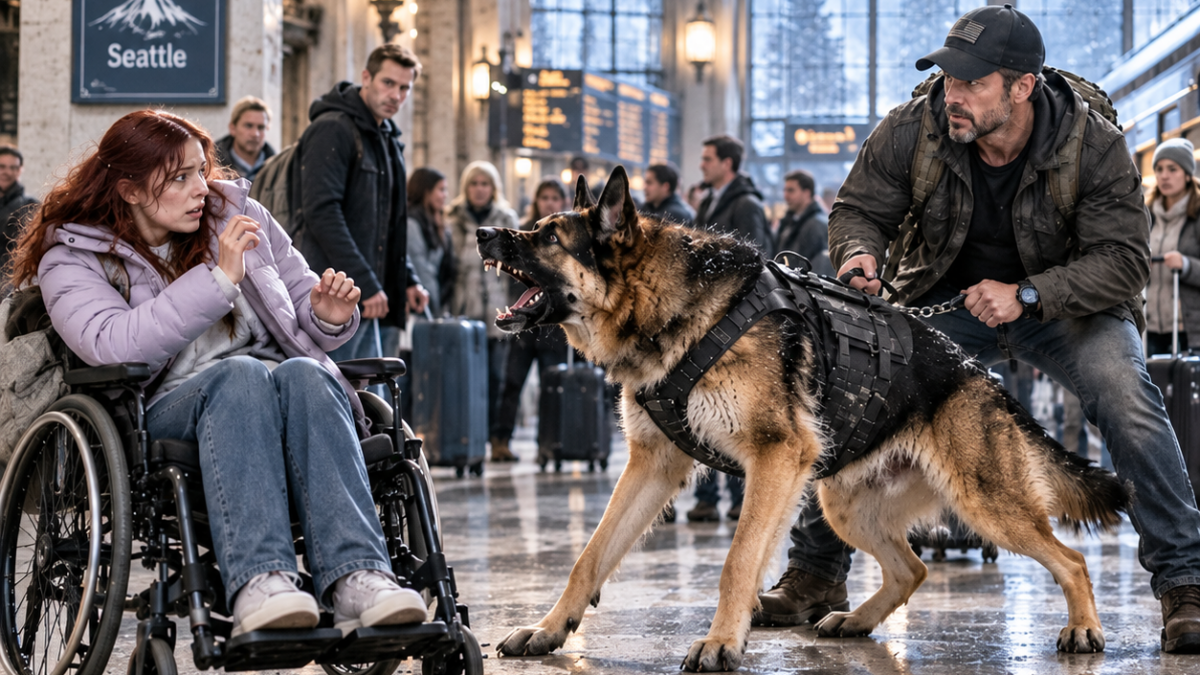
Then Titan stood.
No command.
No glance at me.
He rose abruptly, stepped around my boots, and placed himself squarely between her wheelchair and the crowd.
Then he sat.
Heavy.
Deliberate.
Facing the concourse.
Not facing her.
The fur along his spine rose.
His upper lip lifted just enough to show white teeth.
A low rumble rolled out of him, steady and sustained.
I knew that posture.
I had seen it outside compounds, in alleys, near vehicles that smelled wrong, in rooms where the air changed before the first shot.
Hostile approaching perimeter.
The woman gasped and shrank back, hands flying up toward her face.
“I’m sorry. I’ll leave. I didn’t mean to startle him.”
“Don’t move,” I said.
My voice came out low and rough.
She froze.
I was not looking at her.
I was staring at the back of my dog’s head, trying to understand why the impossible had just happened.
Titan was trained to protect me.
Me.
That was the bond.
That was the conditioning.
That was years of work reinforced in environments where hesitation killed people.
He did not randomly extend his protective perimeter to strangers.
Never.
Not once.
“Is he going to bite me?” she whispered.
“No.”
I followed Titan’s stare into the crowd.
“He’s not looking at you.”
Her breathing hitched.
“Then what is he doing?”
“He’s protecting you.”
Her eyes widened.
“From what?”
“I don’t know yet.”
That was the truth.
And I hated it.
I scanned the station again with a different lens.
When something feels wrong, do not look for the monster first. Look for the person pretending not to be one.
Someone standing still in a moving crowd.
Someone overdressed or underdressed for weather.
Someone whose eyes fix while their body acts casual.
Someone watching reactions instead of events.
The woman stared at Titan. The dog leaned backward slightly until his flank pressed against her left leg. She looked startled by the contact, then strangely steadied by it.
I recognized that too.
Deep pressure.
Grounding.
Titan did that for me during nightmares. If I woke disoriented, heart slamming, hand reaching for a weapon that was no longer there, Titan pressed his weight against my legs until my body remembered the war was not in the room.
Now he was giving that to her.
I looked at her properly.
“What’s your name?”
She swallowed.
“Harper.”
“Full name.”
Her hesitation told me more than the answer.
“Harper Lawson.”
“I’m Garrett. This is Titan.”
Titan did not react to his name. His focus stayed forward.
I leaned down, forearms on knees, making my posture look relaxed while every muscle prepared to move.
“Talk to me, Harper. Why are you in King Street Station during a blizzard with a medical brace, an envelope you’re holding like a life vest, and a dog I trust telling me someone wants you?”
Her face drained of what little color she had.
“I don’t know what you mean.”
“Harper.”
Her eyes flicked to the crowd.
Then the doors.
Then the envelope.
That was not confusion.
That was calculation.
I softened my voice.
“My dog has survived three combat deployments. He doesn’t bluff. You can lie to me if you want, but you’ll be wasting time.”
She stared at Titan’s broad back.
“Eight months ago,” she said finally, voice dropping to a whisper, “I was a junior forensic accountant for a logistics firm.”
I said nothing.
She continued.
“I found a discrepancy. At first I thought it was internal theft. Then shell companies. Then offshore accounts. Then names I recognized from federal investigations. Millions moving through freight invoices, fuel surcharges, fake storage fees. The kind of things people hide because nobody thinks accountants are dangerous.”
I looked at the envelope.
“The drive?”
She nodded.
“Original ledgers. Backups. Emails. Scans. Payment routing. Everything.”
“What happened when you reported it?”
Her mouth twisted.
“I took it to my boss. He said he would escalate quietly. Three days later, I was crossing a street outside my apartment. A black SUV ran a red light at sixty miles an hour.”
She looked down at her legs.
“They called it a hit-and-run. The driver was never found. My spine was shattered.”
A train announcement crackled overhead. Nobody listened.
“I spent months in a rehabilitation clinic under an assumed name. I moved twice. I stopped using cards. Stopped calling friends. Tomorrow morning I’m supposed to meet an assistant U.S. attorney in Portland.”
“And tonight?”
“I thought I was safe enough to travel. Then the storm hit. My train connection was delayed. My phone battery died. Every accessible seating area was full. I couldn’t keep moving.”
“How did you get here?”
Her voice dropped further.
“Three different cabs. Paid cash.”
I stared at her.
Three cabs.
Cash.
A disabled whistleblower carrying federal evidence in a public station during a weather shutdown.
That was not bad luck.
That was a tactical nightmare.
Titan’s growl deepened.
His head shifted slightly left.
Contact.
I did not move my head.
“What did you see?” Harper whispered.
“Not yet.”
The anomaly appeared near the digital departure board.
Average height.
Dark gray raincoat.
Hands in pockets.
Everyone else near the board kept looking up at delays, phones, each other.
He looked straight at the alcove.
Too still.
Balanced stance.
Weight distributed evenly.
Not a tired passenger.
Not a curious bystander.
A man waiting for a decision.
“Gray raincoat,” I said quietly. “Twelve o’clock. Forty yards. Near the monitors. Do you recognize him?”
Harper leaned forward just enough to see past Titan’s shoulder.
Her breath left her in a broken gasp.
“Oh God.”
“That the driver?”
“No.”
“Then who?”
“Derek Mitchell. Private security contractor. My firm hired him to ‘investigate’ after I reported the discrepancies.” Her voice shook. “He took my initial report. He knows exactly what I found. He knows what I look like.”
Derek Mitchell did not look away when my eyes met his.
Instead, he pulled a phone from his pocket and brought it to his ear.
“Not alone,” I said.
Harper’s hand tightened on the envelope.
“What do we do?”
“First, you breathe.”
“I can’t.”
“Yes, you can.”
Titan pressed harder against her leg.
She inhaled shakily.
“Good,” I said. “Now listen. If he wanted to shoot you in the crowd, he had chances. Too many witnesses. Too much mess. They either want the drive, or they want you removed quietly. Medical emergency, accident, panic, private extraction. Something deniable.”
“You sound like this happens all the time.”
“It happens enough.”
Titan’s head snapped right.
At the far end of the concourse near the restrooms, a second man in a dark jacket started moving against the flow of traffic, cutting a direct angle toward us.
Two vectors.
One target.
Me, Titan, one wheelchair, one envelope, and a station full of civilians.
“Harper,” I said.
“What?”
“Take the brakes off your chair.”
Her eyes widened.
“We can’t outrun them. I’m in a chair.”
“We aren’t running.”
I stood.
Titan rose with me.
The second man kept moving.
Derek Mitchell moved too.
The crowd between us still had no idea it was part of the terrain now.
“Hold on to my belt,” I said.
“What?”
“Not my arm. Not the chair. My belt. If you lose grip, yell my name.”
Her hands shook as she reached out and gripped the back of my belt.
I wrapped Titan’s leash once around my left hand.
“Titan. Stand.”
The German Shepherd stepped forward, lips peeling back fully now, fangs exposed. He let out one bark.
Sharp.
Deafening.
It cracked through the station like a shot.
People near us recoiled.
A woman screamed.
A man dropped a coffee.
The crowd opened away from the dog.
To an untrained eye, it looked like panic.
To me, it was cover.
“Move.”
I gripped the push handles of Harper’s wheelchair and pivoted hard east, away from the main doors. Outside was ice, stalled vehicles, bottlenecked exits, no advantage. Instead, I drove the chair toward the roped-off defunct concourse.
“They’re following,” Harper cried.
“Head down.”
Titan led, barking low and hard, clearing space without touching anyone. People moved because ninety pounds of military-trained German Shepherd with exposed teeth makes even angry commuters discover manners.
I pushed fast but controlled.
Wet wheels skidded once on polished floor.
Harper held the envelope to her chest with one arm and my belt with the other.
Then the second man appeared from behind ticketing kiosks.
Heavyset.
Dark bomber jacket.
Eyes on Harper.
His hand lifted.
A folded newspaper hung awkwardly from it.
Wrong.
Too stiff.
Metal glinted beneath.
Weapon.
“Contact right.”
Old reflex.
Old language.
The man’s arm rose.
Titan needed no confusion in that instant.
“Titan!”
I gave the apprehension command, clipped and sharp.
Titan launched.
He covered the distance in less than two seconds.
The man’s eyes widened.
Titan hit him center mass and drove him sideways before he could level the pistol. The weapon clattered to the floor. Titan pinned him and held the weapon arm, controlled, furious, trained.
The station exploded into screams.
I did not stop.
I pushed Harper past, scooped the fallen weapon with my foot and kicked it under a locked gate where no civilian could grab it.
“Titan, heel!”
Titan released and returned, falling into step beside Harper’s wheels as if he had never left.
We crashed through a heavy wooden door marked STATION PERSONNEL ONLY and entered a narrow maintenance corridor running parallel to the tracks.
The sudden quiet hit hard.
The corridor smelled of damp concrete, ozone, old dust. Fluorescent lights flickered overhead. Far behind us, the station roared with panic.
Harper gasped.
“Are you okay?” I asked.
“I’m fine. I’m fine. But we’re trapped. This only goes to the old freight elevators and loading dock.”
“I know.”
She stared at me.
“I’m funneling them.”
“What does that mean?”
“It means out there, they had three hundred sixty degrees of approach. In here, they come through one door.”
“That sounds terrible.”
“For them.”
I pushed her behind a rusted industrial dumpster near the freight elevator doors, placing her where thick concrete protected her back and sides.
“Stay here. Envelope under your coat.”
She shoved it inside.
I crouched in front of Titan.
His eyes were bright, focused, ready.
I ran one hand down his spine.
“Good boy. Guard.”
Titan stepped in front of Harper’s chair and planted himself there.
His eyes locked on the double doors at the far end.
I moved into the shadows behind metal storage lockers.
Then we waited.
Ten seconds.
Twenty.
Rain lashed high barred windows.
Harper’s breathing shook.
Titan did not move.
Then Derek’s voice echoed down the corridor.
“You’re making a mistake, soldier.”
He had not entered yet.
Smart enough to use acoustics.
“I ran your plates, Hayes. I know who you are. Discharged. Living off a pension in the woods. You don’t want this fight.”
I stayed silent.
“We don’t care about you or the dog,” Derek continued. “Push the girl’s chair out with the envelope, and you can walk back into the terminal. No one has to die today.”
Harper squeezed her eyes shut.
I saw her lips form a silent no.
Derek’s voice hardened.
“She’s already dead. You think that drive saves her? The people behind this own politicians, judges, cops, half the port system. She won’t make it to the U.S. attorney. She won’t make it through federal custody. Walk away.”
That was his mistake.
Not the threat.
Threats are easy.
The mistake was assuming every man can be bought with survival.
I had survived plenty.
It had not impressed me.
Titan nudged Harper’s knee with his nose.
She opened her eyes.
The dog did not look back at her.
He simply reminded her he was there.
The door creaked.
Not fully.
Just enough.
Then something rolled into the corridor.
A small silver canister spinning across concrete.
Hissing.
“Tear gas,” I barked. “Harper, cover your face.”
She yanked her scarf over her nose and mouth as gray chemical smoke began to pour outward.
Titan sneezed once.
Shook his head.
Held position.
Through the spreading smoke, two figures entered wearing respirators.
Derek and another contractor.
Weapons raised.
Professional enough to be dangerous.
They expected civilians.
They expected panic.
They expected a veteran blinded and coughing.
They did not understand what kind of places had taught me to move without clean air.
I did not rush.
Rushing gets people killed.
I shifted silently along the lockers, holding my breath, using sound and memory.
One figure left.
One right.
Flashlight beams cutting smoke.
The second contractor saw movement and turned half a second too late.
I struck his weapon arm into the locker edge, drove him into the wall, and stripped the gun before his nervous system caught up. He went down hard, stunned, breathing.
Derek fired toward the motion.
Bullets tore into metal.
Harper screamed.
Concrete spat chips.
Titan held position because I had told him to, and that obedience under pressure was worth more than most medals.
Smoke thickened.
My eyes burned.
I needed Derek’s focus broken for one second.
“Harper!”
“I can’t see!”
“Take off the brakes.”
“What?”
“The chair brakes. Off.”
She did it.
“Push the dumpster. Use the chair for leverage.”
“I can’t—”
“You can.”
For one heartbeat, nothing happened.
Then metal shrieked.
Harper leaned forward with every ounce of upper-body strength she had, wheels grinding, arms trembling, and shoved the heavy dumpster hard enough to scrape it several feet across the floor.
The sound ripped through the corridor.
Derek’s flashlight swung toward it.
That was enough.
“Titan!”
This time I gave him the takedown command.
Titan flew.
Not ran.
Flew.
A dark shape through gray smoke, launching from Harper’s side with terrifying precision.
Derek turned his weapon back, too late.
Titan hit him high, driving him off balance. The gun skittered away across concrete. Derek went down with Titan on him, the dog pinning the weapon arm and holding until I reached them.
I kicked the gun farther away and secured Derek against the floor.
“Titan, out.”
Titan released instantly and backed off, panting hard, eyes still locked on the threat.
Derek coughed, mask knocked loose, rage and shock twisting his face.
“You have no idea who you just crossed,” he spat.
I leaned close.
“Neither do you.”
Then I stood and hit the emergency ventilation button on the wall.
Industrial fans roared to life, pulling smoke toward overhead vents. The corridor cleared slowly, revealing Harper behind the dumpster, face streaked with tears and soot, scarf over her mouth, envelope still clutched under her coat.
She looked at me.
Then at Titan.
Then at the disabled brake levers on her chair.
“You told me to push a dumpster.”
“You did.”
“I pushed a dumpster.”
“You pushed the hell out of it.”
A small, incredulous laugh escaped her.
It turned into a cough.
Titan walked to her and placed his head against her knee.
This time, when she touched him, her hand did not tremble as much.
“He saved my life,” she whispered.
“We both did,” I said.
Thirty minutes later, the loading dock flashed red and blue.
Seattle police.
Transit police.
Federal agents.
Paramedics.
The second man from the station was in custody. Derek was cuffed and furious. The contractor Titan had stopped first was being treated under guard. The dropped weapons were bagged. Security footage was already being pulled.
Harper had managed to power on her phone and call the emergency number connected to the assistant U.S. attorney’s office. Once she said her name and the phrase “original ledgers,” the response accelerated fast.
A federal agent named Donovan took possession of the envelope, sealed the drive in an evidence bag, and looked at Harper with the kind of respect people reserve for someone who has been underestimated at great cost.
“Ms. Lawson,” Donovan said, “you kicked a hornet’s nest.”
Harper sat wrapped in a thermal blanket, exhausted beyond fear.
“I know.”
“We’re moving you under federal protection tonight.”
Her eyes flicked toward me.
I saw the question before she asked it.
“Garrett?”
I stood near the dock doors with Titan at my side, watching snow swirl under the lights.
She rolled toward me.
“Where are you going?”
“Out.”
“They want your statement.”
“They have what they need for now.”
“You can’t just disappear.”
“That’s debatable.”
She smiled faintly, then sobered.
“I don’t know how to thank you. You risked everything for a stranger.”
I looked at Titan.
Then back at her.
“You asked if the seat was taken. Titan decided it belonged to you.”
Her eyes filled.
“You don’t even know me.”
“No.”
“Then why?”
I looked past her to the station, to agents moving through the loading dock, to Derek Mitchell being guided into a vehicle with blood on his sleeve and hate still in his eyes.
“Because my dog was right.”
That was the simplest answer.
The truest one.
I tipped the brim of my cap.
“Keep fighting, Harper.”
She reached for Titan one last time.
He leaned into her palm.
Then I turned and walked into the Seattle snowstorm with my dog beside me.
That is where some people think the story ended.
It did not.
Stories like that do not end when the lights fade and the sirens leave. They keep going in courtrooms, safe houses, hospital rooms, nightmares, depositions, and quiet mornings when someone who survived realizes survival is not the same thing as peace.
Two days later, Agent Donovan found me at a diner forty miles south of Seattle.
I should have known better than to use my own truck.
Titan saw her first and huffed once from under the table.
I looked up as she slid into the booth across from me.
“You’re hard to find, Mr. Hayes.”
“No, I’m not. You’re federal.”
She almost smiled.
“You left before giving a complete statement.”
“I gave enough.”
“Harper asked about you.”
I said nothing.
Donovan placed a folder on the table.
“She’s alive because of you.”
“She’s alive because she was brave enough to carry the drive.”
“She says Titan knew before anyone else.”
“He usually does.”
Donovan opened the folder.
The evidence Harper carried had detonated through the investigation exactly as promised. Shell companies. Port contracts. Freight manipulation. Cartel laundering. Judges and politicians would come later, if the case survived long enough. For now, arrests had begun.
“Derek Mitchell is talking,” Donovan said.
“That was fast.”
“He wants a deal.”
“Men like him usually do once the ground disappears.”
“He confirmed Harper’s collision was attempted murder.”
I looked out the window.
Rain streaked the glass.
Not snow now.
Rain.
Seattle returning to form.
“Does she know?”
“Yes.”
“How is she?”
Donovan’s voice softened slightly.
“Angry. Scared. Exhausted. Refusing to quit.”
“Good.”
“She wants to testify.”
“Of course she does.”
“She also asked if Titan could visit before we move her again.”
I looked down.
Titan’s ears had lifted at his name.
“No.”
Donovan leaned back.
“No?”
“She needs protection, not sentimental attachments.”
“She specifically asked for the dog.”
“She’s in federal custody. You have protocols.”
“Protocols did not save her in the station.”
My jaw tightened.
Donovan noticed.
“Mr. Hayes, I’m not asking you to join witness security. I’m asking you to bring the service dog who grounded her during an active attempt on her life to visit a trauma patient who has not slept more than twenty minutes at a time since.”
I hated federal agents who made sense.
Titan placed one heavy paw on my boot.
I looked down at him.
He stared back.
“Fine,” I said.
Donovan closed the folder.
“Tomorrow morning.”
The safe location was not dramatic.
People imagine secure houses as bunkers. This was a bland medical recovery apartment attached to a federal facility, with reinforced doors, controlled access, and nurses who pretended not to be security-adjacent.
Harper sat near a window, wheelchair angled toward gray morning light.
She looked smaller without the station around her.
No coat.
No envelope.
Hair pulled back.
Bruising under one eye I had not noticed during the chaos.
A blanket covered her legs.
When Titan entered, she broke.
Not loudly.
She covered her mouth and bent forward as if trying to hold something inside her body that had become too heavy.
Titan crossed the room without waiting for my command.
I let him.
He stopped in front of her chair and rested his chin on her knee.
Harper put both hands into his fur and cried.
I stood by the door because some moments are not improved by men hovering.
After a while, she said, “I thought I imagined how warm he was.”
“You didn’t.”
“I keep hearing the shots.”
“That’ll happen.”
“I keep thinking if I had gone to another station, or left earlier, or never taken the job—”
“Don’t.”
Her eyes lifted.
“Don’t what?”
“Try to rearrange the past until you find the version where none of it happened. You’ll lose years in there.”
She looked down at Titan.
“Is that what you did?”
“Yes.”
“Did it work?”
“No.”
She gave a weak laugh.
Titan nudged her hand.
She stroked his ears.
“I pushed a dumpster,” she said.
“You did.”
“I didn’t know I could.”
“Most people don’t know what they can do until the alternative gets worse.”
Her face turned serious.
“I was terrified.”
“Good.”
“That’s not comforting.”
“Fear keeps you sharp. Panic gets you killed. You were afraid, but you listened. That matters.”
She looked at the window.
“I hate needing help.”
I understood that too well.
“Everybody needs help. Some of us just develop uglier ways of denying it.”
She glanced at me.
“Is that your professional medical opinion?”
“No. That’s what my dog has been trying to teach me for years.”
Titan sighed as if confirming this had been a difficult assignment.
The federal case grew.
Harper testified in sealed proceedings first, then publicly months later. She faced men who had tried to erase her and spoke in a voice that shook only at the beginning. The drive became the spine of a case that reached farther than even she had known.
I watched some of it from a distance.
Not every hearing.
I was not family.
Not law enforcement on record beyond witness statements.
Not part of her protection team.
But she sent updates through Donovan sometimes.
Testified today. Didn’t throw up. Calling that a win.
Or:
Your dog would have hated the defense attorney.
Or:
I used the phrase “forensic irregularity” and watched three men sweat.
Titan received those messages better than I did.
I usually read them aloud.
He usually thumped his tail.
Months later, Harper rolled into a courthouse lobby after one of the final hearings and found me waiting near a pillar.
Titan sat beside me, calm as stone.
She stopped.
“You came.”
“You said the defense attorney was annoying.”
“He is.”
“Titan wanted to judge him.”
She smiled.
It was the first smile I had seen from her that looked like it belonged to her old life and her new one at the same time.
She wore a navy coat and leather gloves. Her wheelchair had been upgraded—lighter frame, better wheels, custom fit. She looked stronger through the shoulders. Still tired, yes. Still carrying pain. But not defeated.
The verdicts came down over the following weeks.
Guilty.
Guilty.
Guilty.
Not everyone.
Never everyone.
Power protects itself too well for perfect endings.
But enough.
Enough men in suits heard cell doors close.
Enough money trails froze.
Enough officials resigned before indictment could find them publicly.
Enough victims were named.
Harper became more than the girl in the chair with the envelope.
She became the witness who survived.
The accountant who brought ledgers to war.
The woman who pushed the dumpster.
She hated that part most.
“They keep mentioning the dumpster,” she told me one afternoon outside the federal building.
“It was memorable.”
“It was not my finest accounting work.”
“No, but it was efficient.”
Titan nudged her wheel.
She looked down at him.
“You started all of this.”
He blinked, unimpressed by courtroom narratives.
A year after King Street Station, Harper invited me to a hearing where she was giving an impact statement.
I almost did not go.
Public rooms still made my shoulders tight. Ceremonial language made me irritable. Applause made me want exits.
But Titan stood by the door when I read the message.
That was his way of voting.
So we went.
Harper spoke from her wheelchair at the front of the courtroom.
She did not make herself smaller for anyone.
She talked about the crash.
The months of rehabilitation.
The fear of being watched.
The humiliation of being disbelieved.
The rage of learning that the man assigned to investigate her report had helped hunt her.
Then she paused.
Her eyes found me near the back.
Found Titan.
“I used to think courage meant not being afraid,” she said. “Then I learned courage is doing the next necessary thing while fear is still sitting in your lap.”
Titan shifted at my feet.
Harper continued.
“A year ago, I asked a stranger if a seat was taken because I was too tired to keep moving. His dog stood up before he answered. That dog saw danger, but he also saw me. Not as fragile. Not as inconvenient. Not as a wheelchair in the way. He saw me as someone worth guarding.”
Her voice broke, but she did not stop.
“That mattered before the shooting. Before the chase. Before the evidence. It mattered because for months, everyone around me had treated my survival like a liability. Titan treated it like an order.”
I looked down.
My throat tightened.
Harper finished with the evidence, the cost, the names of others harmed by the syndicate, the need for protection for whistleblowers, disabled witnesses, and patients in hiding. She was precise. Controlled. Devastating.
An accountant to the end.
Afterward, in the hallway, she rolled up to us.
“Well?” she asked.
“I hate speeches.”
“I know.”
“That was a good one.”
She smiled.
“High praise.”
Titan placed his nose in her palm.
She looked at him softly.
“And you?”
He wagged once.
“Even higher praise,” I said.
Life did not turn into a neat thing after that.
Mine didn’t.
Hers didn’t.
She still had nerve pain that flared with storms. I still had nights where sleep came apart in my hands. Titan aged, slowly but unmistakably. His muzzle silvered. His hips stiffened in cold weather. He still scanned rooms, but sometimes he needed help getting into the truck.
I bought a ramp.
He ignored it for three weeks on principle.
Harper laughed the first time she saw him use it.
“Pride surrendered?”
“Strategic adaptation,” I said.
She came to the cabin once.
Then again.
Not because we were suddenly a romance from a movie.
Life is stranger and slower than that.
At first, she came because Titan’s veterinarian had recommended hydrotherapy for his joints, and Harper knew a rehab specialist who worked with both humans and service animals. Then she came because the cabin had a ramp I built badly and she criticized until I built it properly. Then she came because Titan liked her, and Titan liking someone remained one of the strongest references a person could have.
We became friends in the way survivors sometimes do.
Not constantly.
Not easily.
But honestly.
She understood parts of fear I did not have to explain. I understood parts of vigilance she was tired of defending. We could sit for ten minutes without speaking and not mistake silence for distance.
Titan liked that best.
He often positioned himself between us, one side touching my boot, one paw resting near her wheel.
Still guarding.
Still choosing.
The anniversary of the station came during another storm.
Not as severe.
Enough to make Seattle wet and restless.
Harper asked if I would meet her at King Street.
I said no.
Then yes.
Then no again.
Then Titan stood by the truck until I accepted that I did not actually run the household.
We arrived at 6:00 p.m.
The station looked ordinary.
People with bags.
Coffee smell.
Announcements.
A child crying.
Wet footprints.
The alcove near East Gate was still there, though brighter now after renovations. The bench had been replaced. The concrete pillar remained.
Harper rolled to the same approximate space where she had first stopped.
“Is this seat taken?” she asked.
I looked at her.
Not pale and hunted now.
Still in pain sometimes.
Still careful.
But alive.
“No,” I said. “Titan saved it.”
Titan, older and slower, walked to the space between her chair and the crowd.
He sat.
Facing outward.
Harper’s eyes filled.
“He still does it.”
“Yes.”
“Does he think I’m still in danger?”
I watched my dog.
His ears were relaxed.
Hackles flat.
No growl.
“No,” I said. “I think he remembers his post.”
Harper reached down and rested her hand on his back.
“Thank you,” she whispered.
Titan leaned into her touch.
Around us, commuters moved without knowing the floor beneath their feet had once held fear, smoke, gunshots, and a woman learning she could push harder than she believed.
That was fine.
Not every battlefield needs a plaque.
Some only need the people who survived to stand there once without running.
We stayed until 6:14.
Then we left.
Years later, when people ask how I met Harper, I usually say, “She asked for a seat.”
When people ask how Titan knew, I say, “He always knows.”
Both answers are true.
Neither is complete.
The complete truth is harder.
A disabled woman carrying evidence through a storm.
A retired SEAL trying to disappear.
A combat dog who refused to ignore fear in a stranger.
A station full of people who did not see the hunters because hunters survive by looking ordinary.
A question simple enough to change all our lives.
Is this seat taken?
I think about that question more than I expected to.
A seat is a small thing.
A place to stop moving.
A place to breathe.
A place to be allowed to exist without apologizing for the space your body needs.
Harper asked for that.
Titan heard something bigger.
He heard the part she did not say.
I am tired.
I am hunted.
I cannot keep moving.
Please let there be one place I am allowed to stop.
So he made one.
With his body.
His teeth.
His training.
His loyalty.
I only followed his lead.
That is still how it works.
Titan is old now.
His muzzle is mostly white. His steps are shorter. He dreams more than he used to, paws twitching against the rug. Some mornings, he stands slowly, pride fighting arthritis until I pretend not to notice and place a hand beneath his chest.
Harper visits when she can.
She built a life after the case.
Not a perfect one.
A real one.
Consulting work. Advocacy. Court testimony when needed. Bad pain days. Good coffee. A laugh that comes easier now but still feels earned.
When she arrives, Titan still rises.
Always.
No matter how stiff his joints are.
He walks to her chair, presses his nose to her hand, then turns and places himself between her and the nearest door.
Guard mode, but softer now.
Less war.
More promise.
One evening, she looked down at him and said, “You know nobody’s chasing me today, right?”
Titan sighed.
I said, “He’s retired. Not careless.”
She smiled.
Then she looked at me.
“And you?”
“What about me?”
“Are you retired or just not careless?”
I thought about the man I had been in that station.
The one trying to disappear.
The one who thought distance was safety.
The one whose dog still believed in choosing strangers.
“I’m learning,” I said.
That was the truth.
Titan laid his head on Harper’s knee.
Outside, rain moved through the pines.
Inside, nobody ran.
Nobody hid.
Nobody asked us to explain the ways we had survived.
The seat beside me was no longer empty.
And my dog, who had once stood between Harper and a crowd full of danger, closed his eyes like his work for the moment was done.








