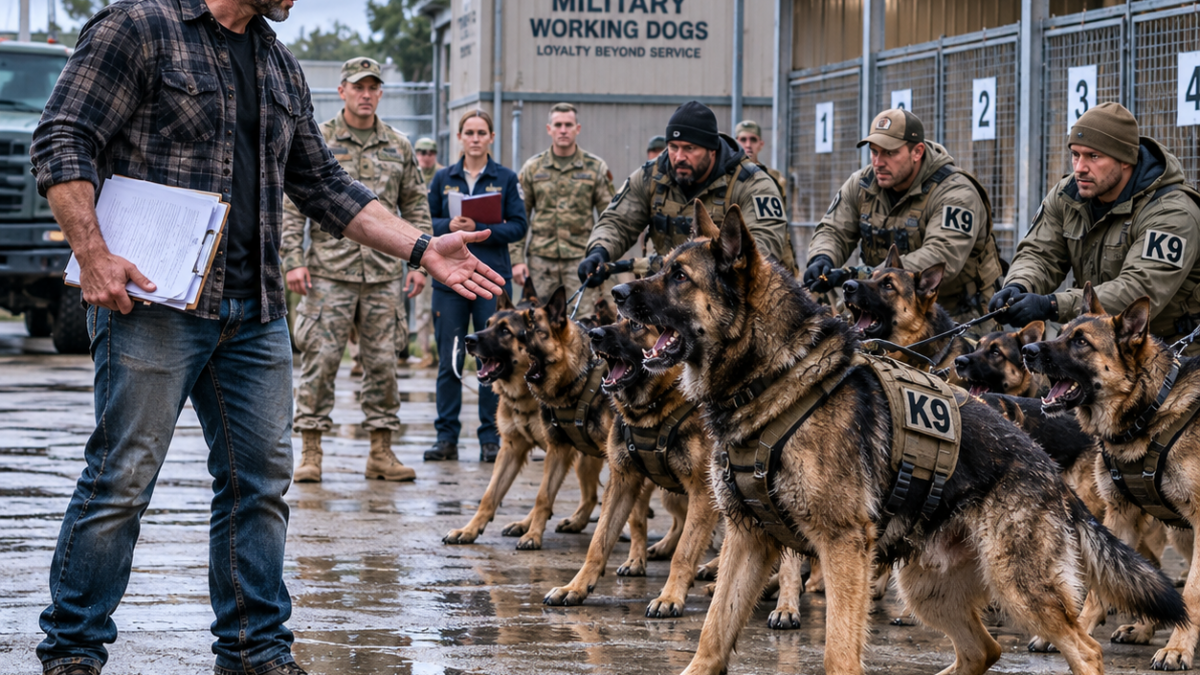
I’m Taking All Seven Dogs,” a Retired Navy SEAL Declared—Just Hours Before the Military Was Set to Euthanize Them. Everyone Warned Him These Traumatized K9s Were Too Dangerous to Save… Until One Stormy Night, the Seven German Shepherds Surrounded His Cabin and Revealed a Terrifying Secret Hidden Beneath His Home.
PART3:
The forms did not say Titan had held a perimeter around three wounded men for six hours after his handler stopped breathing.
At 9:12, Colonel Richard Hayes appeared in the doorway.
He was not cruel.
Sarah wished he were.
Cruel men were easier to hate.
Hayes was practical.
Fifty-four.
Career logistics officer.
Gray hair cut short.
Uniform always exact.
He believed systems existed because emotion failed under pressure.
In many situations, he was right.
“Fourteen hundred,” he said.
Sarah looked at him.
“I know what time.”
“Veterinary techs ready?”
“No.”
His expression tightened.
“Dr. Jenkins.”
“Colonel.”
“This review has been through three boards.”
“I know.”
“Two civilian working-dog sanctuaries declined.”
“I know.”
“Three experienced handlers withdrew applications.”
“I know.”
“Titan injured a staff handler.”
“He was awakened from a night terror by somebody grabbing his collar from behind.”
“He bit.”
“He released immediately.”
“The handler required twenty-two stitches.”
Sarah stood.
“Titan spent five years being trained that hands appearing behind him in darkness might mean he had half a second to react.”
Hayes’s face did not move.
“That does not make him safe.”
“No.”
“Then what are we arguing?”
Sarah stared at folders.
“That dangerous and disposable are not same thing.”
Hayes exhaled.
“Dakota paced until his paws bled.”
“Because you moved him away from the only two dogs he recognized.”
“Havoc attacked another dog.”
“After three transfers in nine days.”
“Brutus snapped at medical staff.”
“He has hip pain.”
“Duke destroyed a kennel gate.”
“During thunder.”
Hayes’s voice lowered.
“You can explain every behavior.”
“Yes.”
“You cannot erase it.”
Sarah stopped.
Because that was true.
Good intentions did not make an eighty-five-pound German Shepherd with combat training harmless.
Trauma did not erase risk.
Understanding behavior was not the same as pretending consequences did not matter.
Hayes continued:
“I’m not calling them evil.”
“I am saying we cannot put them into normal homes.”
“Then don’t.”
“Sanctuaries declined.”
“Build something else.”
“With what budget?”
Sarah hated that question.
Because compassion always sounded noble until somebody put a number beside it.
Hayes looked at clock.
“Fourteen hundred.”
“Have the syringes ready.”
He turned.
The office door opened hard enough to nearly strike him.
A man stood there.
Forty-two.
Six-two.
Broad shoulders.
Faded red-and-black flannel over black T-shirt.
Jeans.
Scuffed boots.
Short dark hair.
Scar running from beneath his left ear to his collarbone.
Sarah recognized him before Hayes did.
Chief Petty Officer David Henderson.
Retired three days earlier.
Twenty years Navy.
Most of them SEAL teams.
He had visited once after the seven dogs arrived.
Once.
He stood in front of Titan’s kennel for forty minutes without speaking.
Then left.
“Chief,” Hayes said.
“Your clearance expired Friday.”
David ignored him.
His eyes stayed on red folders.
“They’re today.”
Sarah said nothing.
That answered.
David stepped inside.
“I’m taking them.”
Hayes stared.
“Taking what?”
“All seven.”
Silence.
Sarah actually laughed once.
Not because funny.
Because impossible statements sometimes trigger wrong response.
David looked at her.
She stopped.
Hayes said:
“No.”
David reached into back pocket.
Removed folded documents.
Placed them on desk.
“I submitted custodial transfer request three weeks ago.”
Sarah stared.
“You knew?”
“I suspected.”
Hayes picked up paperwork.
Read.
His expression changed.
“How did you get this approved?”
“Calls.”
“This requires facility certification.”
“Done.”
“Veterinary contingency plan.”
“Done.”
“Insurance.”
“Done.”
“County dangerous-animal compliance.”
“Done.”
“Forty acres minimum for multi-dog placement.”
“Fifty.”
Hayes looked up.
“Where?”
“Bitterroot Valley.”
“Montana?”
“Yes.”
“Neighbors?”
“Nearest house three-quarters mile.”
“Fence?”
“Ten-foot containment run around cleared acre.”
“Secondary interior pens.”
“Seven individual kennels.”
“Climate shelter.”
“Backup generator.”
Sarah stared at him.
“You built this?”
“No.”
“Property already had most outer fencing.”
“I added internal containment.”
“When?”
“Last month.”
“You planned this before you retired.”
“Yes.”
Hayes put papers down.
“Why?”
David looked toward hallway where distant barking echoed.
“Because I knew what was going to happen.”
Sarah’s voice sharpened.
“These are not dogs you rescue because you feel guilty.”
David looked at her.
“I know.”
“Do you?”
“Yes.”
“Titan can hurt you.”
“Yes.”
“Havoc and Brutus cannot simply be thrown into one yard.”
“I know.”
“Ghost may stop eating under transition stress.”
“I know.”
“Dakota paces compulsively.”
“I know.”
“Duke wakes disoriented and comes up defensive.”
“I know.”
Sarah moved around desk.
“Then tell me why you think being a SEAL qualifies you to rehabilitate seven traumatized working dogs.”
David’s jaw moved.
“It doesn’t.”
That stopped her.
“What?”
“It qualifies me to understand what not sleeping for four days does to judgment.”
“To know loud sounds can put your body somewhere your mind knows you’re not.”
“To know somebody can function perfectly on deployment and fall apart in grocery-store parking lot.”
“To know being dangerous in one environment does not mean dangerous everywhere.”
Sarah stared.
David continued.
“And I know their handlers.”
Past tense.
Sarah looked down.
The Al-Hasakah incident had been classified beyond her clearance.
She knew only what behavioral records implied.
Catastrophic operation.
Multiple casualties.
Seven dogs recovered after prolonged exposure.
David looked at Hayes.
“I was overwatch.”
The colonel’s face changed.
David continued.
“I watched their handlers go down.”
“I watched those dogs stay.”
“Somebody ordered extraction delayed because airspace wasn’t secure.”
“Those dogs held shattered perimeter until nobody human was left conscious enough to tell them what to do.”
His voice remained controlled.
“That’s why they watch doors.”
“That’s why thunder sounds wrong.”
“That’s why some of them won’t sleep.”
Sarah whispered:
“You were there.”
“Yes.”
Hayes said:
“That still does not make this safe.”
David looked at him.
“No.”
“It makes it mine.”
Hayes frowned.
“Mine?”
“My risk.”
“My property.”
“My time.”
“My decision.”
Sarah said:
“And if it fails?”
David looked at folders.
“Then it fails with somebody who knew them before they became red paper.”
Hayes read authorization again.
There was nowhere left to object administratively.
He hated that.
Sarah saw it.
The man trusted paperwork.
Today paperwork betrayed him into compassion.
Hayes finally said:
“You understand the transfer becomes permanent.”
“Yes.”
“You cannot bring them back because this becomes inconvenient.”
“Yes.”
“You cannot distribute them casually.”
“Yes.”
“You accept full liability.”
“Yes.”
Hayes lowered documents.
“This is a death wish.”
David looked toward kennel wing.
“Maybe.”
Then:
“Show me my dogs.”
Sarah hated the possessive.
My dogs.
Too soon.
Too confident.
But she led him.
The high-security wing was quieter than ordinary kennels.
That was not comforting.
Noise was information.
Silence could mean animals had shut down.
First:
Dakota.
Pacing.
Six steps forward.
Turn.
Six back.
Same line.
Paw pads bandaged.
David stood sideways.
Did not approach.
Dakota glanced once.
Continued.
Ghost and Reaper shared adjacent runs with solid divider partially lifted so scent carried.
Ghost lay rear corner.
Reaper stood near divider.
Havoc watched through chain link.
Brutus remained on bed.
Duke clutched old Kong.
Then Titan.
Last kennel.
Large shepherd.
Charcoal and tan.
Half left ear missing.
Burn scar over right shoulder.
Golden eyes.
He did not bark.
Sarah whispered:
“He hasn’t slept properly in four days.”
David knelt.
Sarah immediately said:
“Don’t put fingers through.”
“I know.”
He laid palm flat against outside chain link.
Titan stared.
One minute.
Nothing.
Two.
Sarah became aware of her own breathing.
Then Titan stood.
Slow.
Approached.
Stopped.
Nose came to fence.
Pressed opposite David’s palm.
One exhale.
David closed eyes briefly.
Sarah saw something pass through his face.
Grief.
Not triumph.
David whispered:
“Hey, big man.”
Titan stayed.
David stood.
“Load them.”
The transport took two days.
Seven separate reinforced crates in climate-controlled trailer.
No dogs loose together.
Sarah insisted on sedation plan only if medically necessary.
David agreed.
She rode the first hour behind him in rescue van because she did not trust him yet.
At first fuel stop, trailer shook when semi air brakes hissed nearby.
Duke slammed crate wall.
Havoc barked.
Dakota spun.
David did not shout.
He lowered trailer lighting.
Moved truck farther from highway.
Waited.
Sarah watched him.
“You could use calming meds.”
“If needed.”
“They’re distressed.”
“I know.”
“Why wait?”
“Because first thing they learn with me shouldn’t be that fear makes somebody put hands on them.”
Sarah considered.
“You’re going to have to handle them eventually.”
“Yes.”
“Medical exams.”
“Yes.”
“Emergencies.”
“Yes.”
“Then?”
“Then we build toward that.”
Sarah looked at him.
“You’ve thought about this.”
“Three weeks.”
“Only three?”
“Three weeks full-time.”
Then dryly:
“And twenty years making plans nobody follows.”
She almost smiled.
At Amarillo she turned back for Texas.
Before leaving she made him promise daily check-ins first week.
David hated promise.
Agreed anyway.
Montana appeared under cold orange sunset.
Bitterroot Mountains.
Pines.
Open land.
Gravel driveway.
Cabin.
Old barn.
Fencing.
Property had belonged to somebody who lost it to federal seizure years earlier.
David bought through auction.
Cheap for acreage.
Real estate agent said previous owner had legal problems.
David did not care.
He wanted distance.
He wanted silence.
He wanted enough land that nobody complained if dogs barked at three in morning.
Unloading took hours.
One at a time.
Separate runs first.
Dakota paced fence.
Ghost pressed against shadow.
Reaper tracked him.
Havoc postured at Brutus through divider.
Duke carried Kong.
Titan came last.
David opened crate.
Titan stepped out.
Lifted nose.
Pine.
Snowmelt.
Other dogs.
Open sky.
He froze.
Then something unexpected happened.
Dakota stopped pacing.
Ghost stood.
Reaper stopped whining.
Havoc stared.
Titan walked to central fence line.
Havoc growled.
David held lead loose but ready.
Titan did not attack.
Did not lunge.
He looked.
One deep bark.
Havoc lowered himself.
Not terrified.
Recognizing.
David stared.
Behavior board had said pack hierarchy disrupted beyond restoration.
Maybe.
Or maybe institutional kennels had prevented the dogs from doing the one thing they once understood:
organize around each other.
David did not open gates.
Not yet.
He was not stupid.
But something shifted.
First night he slept on cot in mudroom.
Second on porch.
Third too.
He did not bring dogs inside.
Routine.
Feed individually.
Water.
Short yard exposures.
Parallel walks.
No forced contact.
No dominance games.
No shouting.
If a dog backed away, space.
If growl, information.
If freeze, time.
He called Sarah every evening.
“Dakota?”
“Pacing decreased.”
“How much?”
“Maybe thirty percent.”
“Paws?”
“Better.”
“Ghost eating?”
“Half portion.”
“Reaper?”
“Full.”
“Titan?”
“Watching me.”
“Still?”
“Constantly.”
“What happens when you sleep?”
“I don’t know.”
“That’s concerning.”
“Yes.”
“David.”
“What?”
“You need to sleep.”
“I do.”
“When?”
Silence.
Sarah sighed.
“The dogs aren’t your deployment.”
“I know.”
“Do you?”
He hung up ten minutes later.
The first time dogs shared large yard, Sarah drove up from Texas.
She said this was professionally unnecessary.
David believed that as much as she did.
They opened pairs first.
Ghost and Reaper.
No issue.
Dakota with Duke.
Cautious.
Then Brutus.
Havoc last.
Titan always present on separate long line.
David expected fight.
Instead tension rose, peaked, settled.
Titan did almost nothing.
That fascinated Sarah.
“He’s not dominating.”
David looked.
“What?”
“He’s regulating.”
“How?”
“He positions.”
She pointed.
Whenever Havoc moved too directly toward Duke, Titan stepped between at distance.
No contact.
When Dakota began frantic pacing, Titan walked across his pattern.
Dakota stopped.
Sniffed.
Changed direction.
When Ghost retreated, Titan did not follow.
“He’s working,” David said.
Sarah frowned.
“No.”
“What?”
“Be careful.”
“He’s doing something.”
“Yes.”
“But if you decide every behavior is mission behavior, you may trap him in old identity.”
David stared.
Sarah continued:
“Maybe he’s social.”
“Maybe he’s familiar.”
“Maybe he’s just a dog who understands these dogs.”
“You don’t need to turn that into duty.”
That irritated David.
Because he had already done it.
Titan, leader.
Titan, alpha.
Titan, protector.
Labels were efficient.
They also carried expectations.
“What should I call it?”
Sarah shrugged.
“Tuesday.”
“What?”
“Today is Tuesday.”
“Maybe dogs are just having Tuesday.”
David looked at her.
“That’s stupid.”
“It’s extremely therapeutic.”
The first week passed.
Dakota’s paws healed.
Ghost ate more if Reaper nearby.
Brutus allowed David to clip leash without stiffening.
Duke slept five straight hours one night.
Havoc still resource guarded toys, so toys stayed managed.
Titan never played.
Never rolled.
Never slept where David could see.
He followed exactly six feet behind in yard.
Always.
David turned.
Titan stopped.
David moved.
Titan moved.
Six feet.
Like spacing drilled into him.
“You can come closer,” David said once.
Titan stared.
David felt foolish.
Second week, David built seven open-front shelters though barn already existed.
He wanted choices.
Shelter.
Yard.
Cabin porch.
Distance.
The dogs began forming patterns.
Not perfect.
No miracles.
Duke had nightmare and snapped at empty air.
Dakota reopened paw.
Ghost refused breakfast during nearby logging noise.
Havoc charged fence at UPS driver.
Sarah reminded:
“Progress is not line.”
David replied:
“Lines are easier.”
“Yes.”
“That’s why people lie about recovery.”
On day ten David found Titan asleep.
For first time.
Under porch.
Chin on paws.
Eyes closed.
David stopped twenty feet away.
He wanted photograph.
Didn’t.
Some victories shrank when documented.
Titan slept eight minutes.
Then woke.
Still.
Eight.
Day twelve, thunder forecast.
Sarah texted:
MONITOR.
David replied:
OBVIOUS.
She sent:
THAT MEANS DON’T TURN IT INTO TEST.
He ignored.
Not the advice.
The tone.
Afternoon sky darkened.
Bitterroot peaks vanished behind clouds.
Wind rose.
Dogs restless.
David moved all seven into separated indoor runs inside reinforced barn before worst storm.
Titan refused.
He planted at gate.
Would not enter.
David did not force.
“Fine.”
He opened porch enclosure instead.
Titan chose covered side near cabin.
At midnight storm hit.
Rain hammered metal roof.
Thunder rolled.
David slept badly.
Dream.
Al-Hasakah.
Dust.
Radio static.
Someone yelling coordinates.
Then pounding.
Thump.
Thump.
Thump.
He woke.
Dark.
2:06 a.m.
Thump.
Pause.
Thump.
Not thunder.
David sat.
Reached flashlight.
Then heard barn gate.
He moved to front window.
Lightning flashed.
His entire body went still.
Dogs were out.
Not loose accidentally.
Positioned.
Ghost and Reaper near front gate.
Back-to-back.
Dakota left side cabin.
Brutus behind him.
Duke and Havoc on right.
Each facing outward.
Scanning.
No barking.
No frantic movement.
Formation.
David’s pulse dropped into operational calm.
He looked for Titan.
Not outside.
“Titan.”
No answer.
David opened front door.
Rain hit.
“Titan!”
A heavy thud behind him.
He turned.
Titan stood inside hallway.
Soaked.
How did he get in?
Mud tracks led through partially open mudroom door.
Titan’s body rigid.
Hackles raised.
But not at David.
Cellar door.
David frowned.
He had never used cellar.
Property came with stone basement accessible from kitchen and exterior bulkhead.
He stored nothing there.
Old boxes from prior owner remained because David had intended to clear later.
Titan made strange sound.
Low chattering alert.
Not ordinary growl.
David knew it.
Explosive-detection trained alert variant.
His skin went cold.
“Titan?”
Dog stared at cellar.
David stepped toward it.
Titan moved fast.
Not attack.
Hit David’s legs sideways.
Enough to knock him down.
Before David could rise, Titan grabbed flannel collar and pulled.
David swore.
“Off.”
Titan pulled harder.
Dragged him three feet.
“Titan!”
The dog did not release until David was near front door.
Then stood between David and cellar.
Lightning flashed.
David heard something.
Beep.
Beep.
Beep.
Faint.
Below floor.
He stopped.
Not necessarily explosive.
Could be sensor.
Battery device.
Anything.
But somebody had activated something inside a cellar he never used.
David turned off lights.
Called 911.
Then county sheriff.
No heroics.
No private breach.
No proving anything.
“Possible unlawful entry.”
“Unknown persons in basement.”
“Electronic device audible.”
“Seven working dogs on property.”
Dispatcher asked:
“Are dogs secured?”
David looked outside.
Formation.
“No.”
Pause.
“Sir—”
“I can secure them if I move them, but right now they’re indicating possible perimeter intrusion.”
Long pause.
“Do not enter basement.”
“I won’t.”
“Leave residence if safe.”
David looked at cellar door.
Then Titan.
“Already moving.”
He backed onto porch.
Titan came.
Other dogs held positions.
David whistled pattern he had introduced for emergency recall.
One by one.
Not instantly.
Ghost.
Reaper.
Duke.
Brutus.
Dakota.
Havoc.
Titan last.
David moved them to secondary fenced run far from cabin.
The dogs resisted leaving lines.
Titan especially.
David said:
“You did your job.”
Then stopped.
Sarah’s voice in his head.
Not every behavior needs become duty.
He corrected:
“You’re safe.”
Titan stared.
David closed gate.
Deputies arrived eighteen minutes later.
Then bomb squad due unknown electronic signal.
Then federal agents after property history surfaced.
The device turned out not to be explosive.
Motion sensor.
Cheap commercial perimeter alarm.
Placed near exterior cellar bulkhead.
Bulkhead lock had been cut.
Cellar door drilled.
Someone had entered during storm.
Whoever was inside fled through drainage access when they heard police approach.
But they left evidence.
Footprints.
Tools.
Opened section of old dirt floor.
And three vacuum-sealed bundles of cash.
Sheriff called federal contacts because property had once belonged to Arthur McMillan, a financial operator tied to regional trafficking network.
David stood under porch roof at 4:30 a.m.
Special Agent John Keller approached.
Fifty.
Rain jacket.
Tired eyes.
“You bought this place through federal auction?”
“Yes.”
“You know prior owner?”
“No.”
“You didn’t ask?”
“I wanted land.”
Keller looked toward seven dogs.
“They alerted?”
“Yes.”
“To people?”
“Something.”
“Those positions weren’t random.”
“No.”
“What were they?”
David hesitated.
“Perimeter.”
Keller stared.
“All seven?”
“Yes.”
“Without command?”
“Yes.”
Lightning far away.
Keller said:
“That’s either very good or very bad.”
David looked at Titan.
“Probably both.”
Investigators spent two days excavating cellar.
Nearly two million dollars in cash.
Ledgers.
Old drives sealed in waterproof containers.
Records connecting multiple criminal operations.
Previous owner had hidden emergency fund before arrest.
Associates apparently waited years for property to change hands and law-enforcement attention to fade.
Storm provided cover.
They did not expect retired SEAL.
They definitely did not expect seven former special-operations dogs.
The story reached local media.
Then national.
Headlines:
“UNADOPTABLE” MILITARY DOGS FOIL BREAK-IN.
RETIRED SEAL’S K9 PACK UNCOVERS $2 MILLION STASH.
SEVEN DOGS SAVED FROM EUTHANASIA SAVE OWNER.
David hated all of them.
Sarah called.
“You famous.”
“No.”
“Titan saved you.”
“No.”
“He knocked you away from door.”
“Yes.”
“That sounds fairly save-like.”
“They didn’t rescue me from money.”
“They detected disturbance.”
“Media hates nuanced verbs.”
David became quiet.
Sarah asked:
“How are they after incident?”
That was better question.
“Dakota pacing again.”
“Ghost skipped breakfast.”
“Duke slept badly.”
“Havoc aggressive at gate.”
“Titan hasn’t slept.”
Sarah exhaled.
“There it is.”
“What?”
“Everybody wants story where mission heals them.”
David looked toward yard.
“They looked perfect that night.”
“I know.”
“More focused than they’ve been since they got here.”
“I know.”
“And now they’re worse.”
“Because competence is not same as recovery.”
David sat.
Sarah continued:
“They knew exactly what to do during threat.”
“That environment matched what their nervous systems expected.”
“Peace is harder.”
He closed eyes.
That sentence landed.
Peace is harder.
David had known that personally.
In war he slept.
Stateside refrigerator clicking could wake him.
During operations decisions were clear.
At home, grocery aisles could feel pointless.
Threats simplify.
Peace asks who you are when nobody needs you.
Sarah said:
“Don’t give them another mission.”
David looked up.
“What?”
“People are going to ask.”
“Security work.”
Law enforcement.”
Contractors.”
“They’ll say look how functional.”
“No.”
“Good.”
“They need ordinary.”
David hated word.
“Ordinary.”
“Boring.”
“Grass.”
“Food.”
“Sleep.”
“Walks.”
“Being terrible at fetch.”
“Havoc is excellent at fetch.”
“Then terrible at something else.”
David smiled faintly.
Sarah continued:
“They don’t need to remember who they were.”
“They need permission to find out who they are now.”
That sentence changed everything.
Because David had said same wrong thing internally.
They just need their mission.
They just need a commander.
They just need structure.
Maybe not.
Maybe that was easier for him to understand.
He knew mission.
He knew command.
He did not know home.
Next morning he removed tactical-looking obstacle equipment he had started building.
Not all training.
Dogs needed engagement.
But no perimeter drills.
No bite work.
No replication of deployment.
Instead:
Sniff walks.
Food puzzles.
Separate spaces.
Parallel rest.
Veterinary pain management.
Behavior work.
Choice.
It looked unimpressive.
Progress became tiny.
Dakota walked perimeter three times instead of thirty.
Ghost ate during thunder.
Reaper slept in different room from Ghost for seven minutes.
Havoc released ball voluntarily.
Brutus allowed hip exam.
Duke stopped carrying Kong long enough to leave it under porch.
Titan—
Titan remained hard.
Always watching.
Six feet.
David could feel him behind.
One afternoon David stopped.
Sat in grass.
Titan stopped six feet away.
David waited.
Ten minutes.
Twenty.
No command.
At thirty-two minutes Titan lay down.
Still six feet.
David smiled.
Next day five feet.
Week later four.
Never because called.
David started therapy.
Sarah insisted.
He hated her.
Therapist in Missoula named Dr. Elena Price.
Former VA.
First session:
“Why are you here?”
“Because veterinarian threatened to report me.”
Elena smiled.
“Can veterinarians do that?”
“I didn’t ask.”
“What happened?”
David told dogs.
Not himself.
Elena listened.
At end:
“You saved seven dogs.”
“I transferred ownership.”
“You have trouble with word save?”
“Yes.”
“Why?”
“Implies outcome.”
“Explain.”
“You pull someone out today and they still have tomorrow.”
Elena nodded.
“So you don’t believe rescue ends at rescue.”
“No.”
“Good.”
He looked suspicious.
“That sounded like agreement.”
“It was.”
He returned.
Mostly because he hated being predictable.
The seven dogs became known locally.
People wanted visits.
David refused.
A school asked demonstration.
No.
Veterans organization asked therapy event.
No.
Sheriff asked whether dogs could help training.
No.
Federal agent Keller asked whether Titan could assist scent search.
“No.”
“Dog clearly still has drive.”
“No.”
“You sure?”
“Yes.”
Keller nodded.
“Fair.”
David respected him for stopping.
Six months.
Winter became spring.
Fencing grass grew.
Brutus underwent hip treatment.
Duke developed favorite sleeping spot under kitchen table.
Ghost discovered blueberries.
Reaper hated blueberries.
Havoc loved kiddie pool and looked ridiculous.
Dakota stopped pacing enough that fur grew back over worn shoulders.
Titan entered cabin voluntarily for first time on quiet Sunday.
David was making eggs.
Turned.
Titan standing doorway.
David froze.
Dog looked around.
Exited.
David said nothing.
Next day Titan entered.
Three steps.
Left.
One week later he lay on rug.
Six feet from David.
Distance again.
But inside.
Sarah visited.
Saw.
Cried.
David mocked her.
“Professional.”
“Shut up.”
She crouched twenty feet away.
Did not approach.
Titan slept.
Actual sleep.
Paws twitching.
Dreaming.
Sarah whispered:
“This is the part nobody writes headlines about.”
“What?”
“Dog sleeping.”
David looked.
Maybe she was right.
Sleep was extraordinary when body had forgotten safety.
Not long after, Colonel Hayes visited.
Unannounced.
Government sedan.
David met at gate.
“You lost?”
Hayes looked older.
“No.”
“How?”
“Dr. Jenkins invited me.”
“Traitor.”
Hayes almost smiled.
He stood outside fence.
Seven dogs visible.
No lunging.
No chaos.
Not perfect.
Dakota watched.
Havoc barked once.
Titan under porch.
Hayes looked.
“I read reports.”
“Which?”
“All.”
“Why?”
“Because I signed euthanasia order.”
David said nothing.
Hayes continued:
“I was doing my job.”
“I know.”
“That almost makes it worse.”
David studied him.
Hayes looked at Titan.
“I thought keeping them alive was sentiment.”
“Sometimes it is.”
“I thought risk was unacceptable.”
“Risk was real.”
Hayes turned.
“You’re not going to tell me I was wrong?”
David considered.
“You were incomplete.”
Hayes frowned.
David said:
“You saw what they could do in kennel.”
“You didn’t know what different environment would do.”
“Neither did I.”
“I gambled.”
Hayes looked at seven dogs.
“You won.”
“No.”
David’s answer sharp.
“Not game.”
Hayes nodded.
“Right.”
He removed something from coat.
Seven old service patches.
Each dog’s unit identifier.
“Records office was discarding decommissioned gear.”
“I asked.”
David took them.
Did not put on collars.
He framed later in barn.
History.
Not identity.
Hayes stayed for coffee.
At departure, Titan approached fence.
Hayes stiffened.
David said:
“Don’t reach.”
“I wasn’t.”
Titan sniffed air.
Sat.
Hayes whispered:
“I signed his paper.”
“He doesn’t know.”
“Lucky me.”
David looked at him.
“Maybe lucky both.”
A year passed.
The men who entered cellar were arrested after federal investigation.
No dramatic showdown at cabin.
Traffic stops.
Warrants.
Evidence.
Court.
Former property owner’s network collapsed further because records found beneath David’s home.
Keller joked dogs solved case.
David corrected him every time.
“They alerted.”
Keller finally said:
“That’s enough to solve half my cases.”
The two million went through forfeiture.
David received nothing.
Fine.
He did not need it.
A documentary producer offered money.
He refused.
Then considered when Sarah suggested directing payment to military working dog retirement care.
He agreed to one interview.
Producer asked:
“Did the seven dogs prove military was wrong?”
David said:
“No.”
Producer looked disappointed.
“No?”
“They proved assessments describe behavior in conditions where assessment occurred.”
“They were dangerous at facility.”
“Some still have risk.”
“Havoc cannot go to dog park.”
“Titan should not be approached by strangers.”
“Duke needs controlled handling when awakened.”
“Keeping them alive did not make warnings fake.”
“So what did it prove?”
David looked at dogs.
“That ‘difficult’ is not same word as ‘finished.’”
That became documentary line.
Fund raised enough to support sanctuary placements.
Not every red-folder dog could be placed.
Some stayed in specialized facilities.
Some were euthanized when suffering or risk could not be safely managed.
David hated simplistic activism that called every euthanasia murder.
Sarah taught him why.
Sometimes severe neurological damage.
Uncontrollable pain.
Unmanageable aggression with no safe environment.
Compassion sometimes meant limits.
The seven were not proof everyone could be saved.
They were proof individual assessment mattered.
That distinction made story more honest.
At eighteen months, Reaper was adopted.
First to leave.
Everyone shocked.
Retired Air Force couple with secure acreage.
No children.
Experienced working-dog handlers.
Ghost and Reaper had become less dependent enough for separation.
Sarah suggested trial.
David resisted.
“They’re bonded.”
“Bonded doesn’t mean imprisoned together.”
Another lesson.
Reaper spent weekend.
Then week.
Returned.
Second trial.
Month.
Thrived.
David signed transfer.
On departure, Reaper climbed truck willingly.
Ghost watched.
Whined.
David sat beside Ghost after.
“You okay?”
Dog looked.
Ate dinner.
Slept.
Next morning.
Life continued.
David realized love did not always mean keeping.
Brutus went next to veterinary technician with large fenced ranch.
Duke eventually placed with former handler’s widow after records connected them.
That reunion broke everyone.
Widow, Marlene, had believed Duke died overseas because communication error after unit transition.
She entered yard.
Duke stared.
Ten seconds.
Then carried old Kong to her.
Dropped at feet.
Marlene sank to knees.
David turned away.
Some moments belonged to other people.
Dakota remained.
Havoc remained.
Ghost remained.
Titan remained.
Four dogs.
Property quieter.
David missed noise.
Funny.
At two years, Ghost surprised them.
He became gentle companion to foster teenager named Eli who visited through veterans-family program.
Eli seventeen.
Father killed overseas.
Barely spoke.
Ghost chose sit near him.
No therapy designation.
No program.
Just dog.
Eli returned.
Read.
Sat.
Same pattern.
Months later Ghost transitioned to Eli’s aunt’s home under supervision.
David saw similarity to Reaper.
Room.
Choice.
No force.
Havoc became permanent.
Too much dog for most homes.
David liked him.
Havoc still stole tools.
Dakota developed degenerative condition at ten.
David kept.
Titan—
Titan became closest without ever becoming conventional pet.
He did not fetch.
Did not cuddle.
Rarely solicited touch.
But every morning he sat on porch beside David.
Not six feet eventually.
Two.
Then one.
The first time Titan leaned shoulder against David’s boot, David nearly moved from surprise.
Didn’t.
They sat.
Elena asked in therapy:
“What did you feel?”
“Dog leaned.”
“That’s event.”
“What feeling?”
“Warm.”
“Physical.”
“Yes.”
“David.”
He sighed.
“Trusted.”
“And?”
“Terrified.”
“Why?”
“Because then there’s something to lose.”
Elena nodded.
There it was.
David had spent years calling solitude peace because attachments created casualty lists.
Dogs challenged strategy.
They were temporary by definition.
Aging.
Vulnerable.
You could protect them and lose them anyway.
Titan had lost handler.
David lost teammates.
Both responded by watching doors.
Different species.
Same logic.
If you never fully sleep, maybe nobody disappears without you noticing.
It was exhausting.
One December night, David woke from nightmare.
Not cellar.
Al-Hasakah.
He sat on kitchen floor.
Breathing too fast.
Hands numb.
Titan appeared.
Stopped doorway.
David did not call.
Titan approached.
Sat.
One foot away.
David placed hand on floor.
Titan rested chin over it.
No command.
No mission.
David cried silently.
Next therapy session he admitted.
Elena said:
“Who rescued who?”
David rolled eyes.
“Don’t.”
“Too sentimental?”
“Extremely.”
“Fine.”
Then:
“Maybe nobody rescued anybody.”
David looked.
“Maybe you learned how to stay in room together.”
That he could tolerate.
At third year, Sarah left military facility.
Opened nonprofit specializing in retired working-dog transitions.
David joined board.
Only after she promised no galas.
She lied.
There was gala.
David wore suit.
Hated.
Colonel Hayes attended in retirement.
Marcus flew in.
Elena not because boundaries.
Keller donated.
On stage Sarah displayed first seven red folders.
Copies.
Not originals.
Then updated:
Reaper—adopted.
Brutus—adopted.
Duke—reunited.
Ghost—placed.
Dakota—sanctuary with David.
Havoc—sanctuary with David.
Titan—sanctuary with David.
Audience applauded.
David looked at folders.
Sarah said:
“These dogs were not mislabeled.”
Room quiet.
“The labels described real behavior.”
“They were frightened.”
“Reactive.”
“Some were dangerous.”
“The mistake was assuming the behavior told us every environment they could ever live in.”
She looked at David.
“And the second mistake was assuming rehabilitation meant turning them back into what they were before.”
David felt that personally.
Sarah continued:
“Recovery is not restoration to prior productivity.”
“It is the creation of a life worth living now.”
Standing ovation.
David hated attention.
Clapped anyway.
Dakota died that winter.
Cancer.
Fast.
David handled better than he expected.
Worse too.
Two truths.
He chose euthanasia before pain became unmanageable.
Havoc searched two days.
Titan did not visibly react.
Then stopped eating breakfast.
David sat.
“Miss him?”
Titan looked away.
Dogs did not need humans narrating everything.
David left food.
Titan ate later.
Havoc aged into ridiculous old man.
Once terrifying resource guarder.
At twelve he guarded one squeaky duck and slept with it under chin.
Sarah visited.
“You know what military report said?”
“I know.”
“Severe possession aggression.”
“He still growls if I take duck.”
“Then don’t take duck.”
“Clinical brilliance.”
Havoc died at thirteen.
Stroke.
David and Titan left.
Two.
Then one after Havoc.
Titan was fourteen.
Impossible age for dog with his history.
Arthritis.
Hearing reduced.
Scar white.
Half ear.
He slept most days.
Finally.
That itself felt victory.
One morning Titan did not come to porch.
David found him on rug.
Awake.
Unable to rise.
He knew.
Sarah drove from Missoula.
Not doctor on case anymore but came as friend.
Veterinarian from local clinic assessed.
Heart failure.
Pain.
Time.
David sat beside Titan.
Old dog watched door even then.
David moved chair so Titan could see outside.
“Perimeter’s clear.”
Sarah cried quietly.
David rested hand near Titan.
Not on.
Choice until end.
Titan moved nose.
Touched fingers.
Same as kennel first day.
Chain link absent now.
No fence.
David smiled.
“Yeah.”
He thought he would give speech.
Couldn’t.
Finally:
“You don’t have to watch anymore.”
Titan exhaled.
David continued:
“They’re all gone.”
“Safe.”
“Reaper safe.”
“Brutus safe.”
“Duke safe.”
“Ghost safe.”
“Dakota’s gone.”
“Havoc’s gone.”
“You can stand down.”
Sarah turned away.
Medication.
Titan relaxed.
David placed palm against his head only after dog leaned.
Heartbeat stopped.
The house became unbearably quiet.
David did not get another dog for a year.
Everyone expected he would.
He didn’t.
No replacement.
Loss deserved space.
The sanctuary continued under Sarah’s network.
Other dogs came temporarily to outer kennels.
David helped assessments.
But cabin remained empty.
He learned he could belong without being constantly needed.
That was the hardest lesson.
Five years after he walked into Lackland and said he was taking all seven, David returned.
Invitation.
Training seminar.
New military policy initiative.
Sarah beside him.
The corridor looked same.
Bleach.
Concrete.
Barks.
But red-folder protocol had changed.
Multi-stage placement review.
Sanctuary partnerships.
Trauma-informed environmental trials.
No guarantee.
No fantasy.
Just more possibilities before final decision.
Young veterinarian showed them one shepherd.
Ten years old.
Malinois mix.
Startle response.
Handler died.
David stood outside kennel.
Dog stared.
Young vet asked:
“What would you do?”
David almost gave answer.
Then remembered everything.
“Ask better question.”
“What?”
“What does dog do when nobody asks him to perform?”
The veterinarian looked.
David continued:
“Where does he sleep?”
“What makes him eat?”
“What makes him worse?”
“What makes him less afraid?”
“Who does he choose to be near?”
“What pain are we treating?”
“What environment are we testing?”
He looked at dog.
“Then decide.”
Not save.
Decide.
That mattered.
Before leaving, Sarah took David to old office.
Red folders gone.
She had kept one thing.
Titan’s first assessment copy.
At bottom, in old handwriting:
PROGNOSIS: POOR.
David smiled.
“Accurate.”
Sarah looked.
“What?”
“He never became normal.”
“No.”
“He never needed to.”
She smiled.
They walked out.
Years later, journalists still repeated simplified version.
Seven K9s scheduled for euthanasia.
Navy SEAL adopts all.
Dogs save him from criminals.
Happy ending.
David understood why people liked it.
Good shape.
Beginning.
Danger.
Redemption.
But real story had been slower.
Seven dogs did not heal because they found purpose.
They had already spent their lives drowning in purpose.
Mission.
Detection.
Perimeter.
Handler.
Target.
Command.
What changed them was not being needed again.
It was being allowed to exist after usefulness ended.
Titan did not need a new war.
He needed sleep.
Dakota needed enough safety to stop walking circles.
Ghost needed food without fear.
Reaper needed distance without abandonment.
Brutus needed pain treated.
Duke needed somebody who remembered him.
Havoc needed boundaries and one stupid squeaky duck nobody tried to steal.
David needed much the same things in human form.
Sleep.
Pain acknowledged.
People who stayed.
Permission not to be useful every minute.
A life after being very good at surviving.
The night beneath the Montana thunderstorm did matter.
It proved the dogs retained extraordinary training.
It probably saved David from walking blindly into a dangerous situation.
But it did not prove the military had been wrong because the dogs were secretly perfect.
They weren’t.
Neither was David.
They were injured.
Complicated.
Capable of harm.
Capable of trust.
Sometimes both in same hour.
The miracle, if anybody insisted on using the word, was not that seven broken dogs became weapons again.
It was that eventually they stopped needing to be weapons at all.
The cellar was emptied.
The criminals arrested.
The cash removed.
The storm passed.
The headlines faded.
And afterward came the part nobody filmed.
Morning.
Food bowls.
Medication.
Mud.
Veterinary appointments.
Bad dreams.
Quiet walks.
Open gates.
Old dogs sleeping in sunlight.
David learning that a watchful animal did not always need command.
Titan learning that a man standing up did not always mean deployment.
No one was coming through the tree line.
No helicopter was inbound.
No radio call waited.
No one needed perimeter held.
For the first time in their lives, silence did not mean something terrible was about to happen.
Sometimes silence was simply silence.
One spring, years after Titan died, David sat on the porch during a thunderstorm.
Rain crossed Bitterroot Valley.
Lightning touched mountains.
The old secondary fence stood open because there were no dogs inside it anymore.
He thought about closing it.
Didn’t.
The gate moved slightly in wind.
Open.
Nothing escaped.
Nothing entered.
David smiled.
For years he believed safety meant stronger walls.
Better plans.
Tighter control.
Seven German Shepherds taught him something more difficult.
A locked gate could keep danger out.
It could also make staying meaningless.
Home was different.
Home was the place you could leave—
and still chose to return to.
Titan had chosen the porch.
Ghost chose Eli.
Duke chose Marlene.
Reaper chose a new family.
Brutus chose sunlight.
Havoc chose his ridiculous duck.
Dakota chose to stop walking.
And David, after twenty years of living according to missions other people gave him, finally chose Montana.
No commander ordered it.
No teammate needed it.
No dog depended on him anymore.
He stayed because he wanted to wake up there.
That was how he finally knew the war was over.
Not because he stopped remembering it.
Not because the scars disappeared.
Not because every dangerous part of him became gentle.
The war was over because one evening thunder rolled across the mountains and David Henderson heard it—
and did not reach for a weapon.
He stayed on the porch.
Listened to rain.
And for the first time, there was nobody standing six feet behind him watching the door.
David missed Titan.
He always would.
But he smiled anyway.
Because the old dog had finally taught him the one command neither of them had ever been trained to obey.
Rest.








