I Went to the Shelter to Adopt One Old Cat—Then His Bonded Companion Reached Through the Bars and I Realized I Couldn’t Take Half a Heart Home
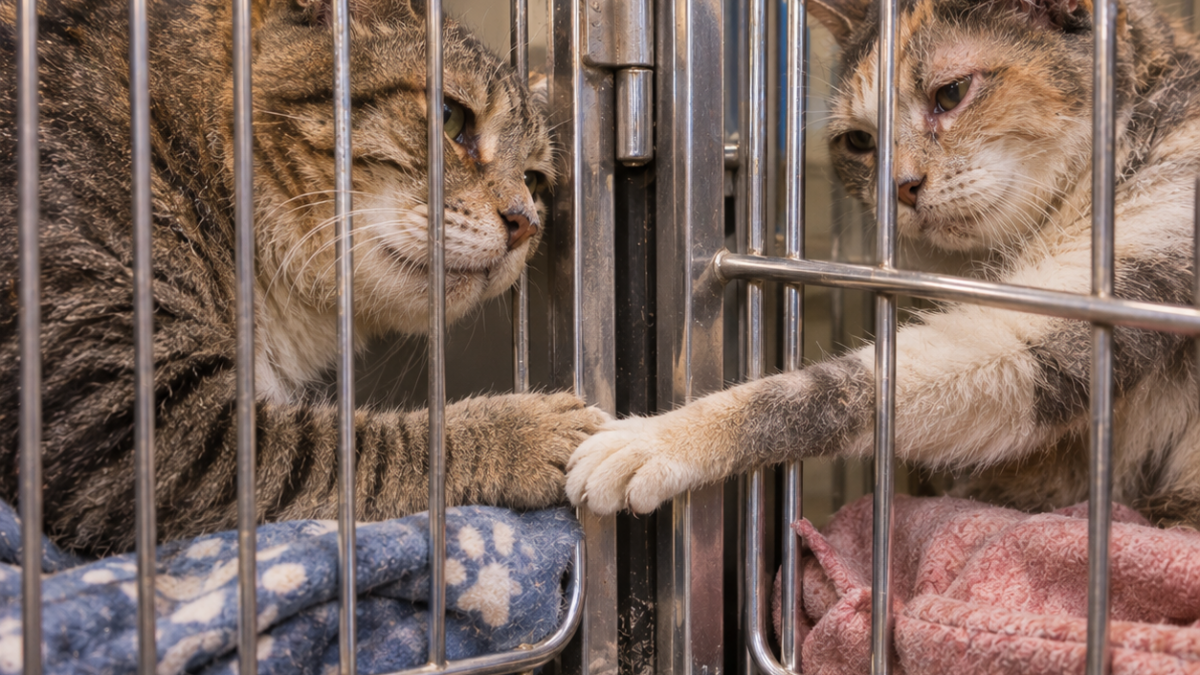
I Went to the Shelter to Adopt One Old Cat—Then His Bonded Companion Reached Through the Bars and I Realized I Couldn’t Take Half a Heart Home.
I had already signed the paperwork for Walter when an old, trembling cat across the aisle pushed one paw through the bars and reached for him like she knew this was the moment her whole world was about to disappear.
The shelter told me they had survived weeks alone beside their dead owner, and that every attempt to separate them ended the same way—Sadie tore at her own fur while Walter simply stopped eating.
I still carried Walter toward the parking lot alone, but when he turned in my arms and stared back at the building without moving, I realized I was about to become one more person who had decided their bond was inconvenient.
The first thing I remember about that afternoon is the light.
December sun has a way of making winter look kinder than it feels.
Everything outside the county shelter glittered.
Snow had fallen the night before, not much, maybe two inches, and the parking lot had already been plowed into gray ridges along the edges. What remained on the grass looked clean and almost blue beneath the low sun.
It was beautiful from inside the car.
Then I opened the door.
Cold air cut straight through my coat.
I pulled my scarf higher and hurried toward the entrance with the adoption folder tucked under my arm.
One cat.
That was the plan.
I had repeated it to myself for a week.
One older cat.
Quiet.
Independent.
Not too demanding.
A companion, not a lifestyle overhaul.
That distinction mattered to me.
My name is Daniel Brooks, and at the time I was fifty-three years old, divorced, living alone in a second-floor apartment outside Columbus, Ohio.
The apartment was not large.
Two bedrooms, although one had become an office.
One bathroom.
A narrow kitchen.
A living room with a west-facing window that caught good afternoon light.
I liked it.
More importantly, I understood it.
Everything had a place.
Coffee mugs in the cabinet above the machine.
Shoes on the rack by the door.
Mail opened immediately.
Bills paid on Fridays.
Laundry Saturday morning.
Groceries Sunday evening.
I had spent the previous six years rebuilding my life into something predictable.
Before that, very little had been predictable.
My marriage had ended slowly.
No affair.
No screaming match.
No dramatic betrayal anyone could point to.
Just two people becoming experts at living around each other.
My ex-wife, Hannah, moved to North Carolina after the divorce.
PART2:
Our daughter, Grace, was already in college by then, so there were no custody battles.
Just paperwork.
Boxes.
A silent kitchen table.
A mutual decision that somehow still felt like failure.
The first year after the divorce, I hated being alone.
The second year, I got used to it.
By the third, I defended it.
That is how these things happen.
You stop calling loneliness loneliness.
You call it independence.
You call your routines peace.
You tell yourself you like eating dinner standing over the sink because plates are unnecessary.
You tell yourself the empty side of the bed is spacious.
You tell yourself that not having anyone waiting for you means freedom instead of absence.
Then one Tuesday evening, Grace called.
“Dad, you need a cat.”
I laughed.
“I need a plumber.”
“You always need a plumber.”
“The sink drips.”
“You need both.”
“I don’t want a cat.”
“You send me cat videos every other day.”
“That is completely different.”
“You comment on them.”
“I observe.”
PART3:
“You write things like, ‘This gentleman has excellent judgment.’”
“That orange cat did have excellent judgment.”
Grace sighed.
“You’re lonely.”
“I’m not.”
“You spent Thanksgiving reorganizing your kitchen cabinets.”
“They needed it.”
“You alphabetized spices.”
“That has improved efficiency.”
“You’re lonely.”
She was twenty-six and had inherited her mother’s ability to say irritatingly accurate things with calm confidence.
“I work.”
“So do people with cats.”
“I travel.”
“You went to Cleveland twice this year.”
“That is technically travel.”
“You need something in that apartment that can ignore you professionally.”
I laughed despite myself.
Then she said, more gently, “Just look.”
So I did.
Not immediately.
I waited three weeks so she would not think she had won.
Then I went online.
I skipped kittens.
Too much energy.
Too much chaos.
I wanted older.
Steady.
A cat that already understood the world and had no interest in climbing curtains.
That was how I found Walter.
His shelter photo was terrible.
He looked like a disgruntled accountant.
Gray-brown tabby.
White chin.
Thick cheeks.
One ear slightly folded at the tip.
Eleven years old.
The profile said:
Quiet senior gentleman seeking calm home.
Enjoys warm beds, chin scratches, and observing household activity from a respectful distance.
No mention of drama.
Perfect.
I submitted an application.
The shelter called two days later.
Then I visited.
Walter was exactly what I expected.
He sat in the back of his enclosure and watched me.
No performance.
No reaching.
No dramatic meowing.
I sat on the floor outside his kennel.
“Hello.”
Walter blinked.
“I’m told you’re low maintenance.”
He blinked again.
“Excellent.”
A shelter worker named Marlene opened the enclosure.
Walter allowed me to scratch his chin.
Then he leaned forward once.
That was enough.
I applied.
A week later, the shelter called.
Approved.
I bought one litter box.
One scratching post.
One bed.
Two bowls.
A bag of food.
One carrier.
The number mattered.
One.
I even measured the corner of my bedroom where the cat bed would go.
That was the kind of man I had become.
Prepared.
Reasonable.
Protected from surprises.
So there I was on that bright December afternoon, walking into the shelter to collect Walter.
Inside, warmth fogged my glasses.
The building smelled like disinfectant, detergent, cat litter, dog fur, and something faintly sweet from the laundry room.
Marlene was at the front desk.
She wore a gray hoodie beneath a shelter vest and a knitted blue cap even though we were indoors.
“You came.”
“I said I would.”
“Some people don’t.”
Her tone was casual.
The sentence was not.
She handed me the paperwork.
“Everything looks good. We’ll go over medication, feeding, transition.”
“Medication?”
“Joint supplement. Nothing major.”
“Okay.”
“Walter’s a little stiff.”
“I’m fifty-three. So am I.”
She smiled.
“You’ll understand each other.”
I signed.
Initialed.
Signed again.
Accepted responsibility for veterinary care.
Agreed to return him to the shelter if adoption failed.
I remember my signature looking unusually dark on the page.
Daniel Brooks.
One cat.
One manageable change.
Marlene led me into the cat wing.
Sunlight came through the high windows at the end of the hallway.
Dust floated through it.
The fluorescent lights buzzed overhead.
Cats watched us pass.
Some approached their doors.
Some slept.
Walter was in enclosure 18.
He looked exactly as he had during my first visit.
Still.
Composed.
Old-man face.
I opened the carrier.
Set it near the enclosure.
Marlene unlocked the door.
“All yours.”
I crouched.
“Hey, buddy.”
Walter looked at me.
“Let’s go home.”
He did not move.
I waited.
“Come on.”
Nothing.
I reached slowly.
Walter did not flinch.
But he did not lean toward me either.
His eyes had moved.
Not to my hand.
Across the aisle.
I followed his gaze.
Enclosure 21.
A cat stood at the front.
Thin.
Brown-gray tabby.
Smaller than Walter.
Her fur was uneven along the shoulders.
One ear bent sideways.
A pale scar crossed her nose.
She looked older than her listed age probably was.
There are animals who look tired because they need sleep.
Then there are animals who look tired because they have learned the world keeps happening to them.
She was the second kind.
“What’s her name?”
I asked.
Marlene’s expression changed.
“Sadie.”
“How old?”
“About ten.”
“Why is Walter staring at her?”
Marlene did not answer immediately.
Sadie took one step forward.
Then another.
She raised her right paw.
Slowly pushed it through the bars.
I watched.
Her paw trembled.
Not violently.
Just enough.
She stretched.
Her toes spread against the metal.
The claws barely appeared.
Walter stood.
That surprised me.
He had moved slowly every other time.
Now he crossed his enclosure.
Pressed his side against the bars facing Sadie.
Her paw could not reach him.
The aisle was too wide.
But she kept it extended.
Walter made a sound.
Soft.
Cracked.
Almost a sigh.
I stopped breathing.
“What is this?”
Marlene leaned against the opposite enclosure.
“The reason I was wondering whether you’d ask.”
“Ask what?”
“About Sadie.”
I stood.
“What do you mean?”
“They came together.”
I looked at her.
“Together how?”
“Same home.”
“Why didn’t anyone tell me?”
“Your application was for Walter.”
“That doesn’t answer the question.”
Marlene nodded.
“No. It doesn’t.”
She crouched beside Walter’s kennel.
“We didn’t initially classify them as bonded.”
“Why not?”
“Because we try not to assume.”
I waited.
She continued.
“They’re older. Came from the same house. Sometimes animals tolerate each other because there’s no choice. That’s different from a bonded pair.”
“And these two?”
She looked at Sadie’s paw.
“These two are not just tolerating each other.”
Something tightened in my stomach.
“How bonded?”
Marlene stood.
“If we put them in separate rooms, Sadie panics.”
“What does panic mean?”
“Paces. Vocalizes. Overgrooms.”
“How badly?”
Marlene’s jaw tightened.
“She pulled fur from her chest last week.”
I looked at Sadie.
Her coat was thin there.
“And Walter?”
“He stops eating.”
“How long?”
“The longest separation was fourteen hours.”
“He didn’t eat?”
“Not once.”
“Water?”
“Very little.”
I looked back at my signed adoption paperwork.
One cat.
My plan suddenly felt obscene.
“How long have they been here?”
“Seven weeks.”
“Together the whole time?”
“Mostly.”
“Why separate them at all?”
“Medical exams. Cleaning. Space.”
Walter remained pressed against the bars.
Sadie’s paw was still extended.
“What happened to their owner?”
Marlene exhaled.
“His name was Thomas Vance.”
“How old?”
“Seventy-nine.”
“Died?”
She nodded.
“At home.”
I looked at the cats.
“Were they there?”
Marlene’s voice became quieter.
“Yes.”
“How long?”
“We don’t know exactly.”
Something in my chest shifted.
“Days?”
“Likely between twelve and seventeen.”
I stared.
“What?”
“No family nearby. Neighbors thought he was visiting his sister.”
“That long?”
“A delivery driver reported mail piling up.”
I looked at Walter.
Then Sadie.
“How did they survive?”
“There was an open bag of dry food.”
“That’s it?”
“Water dripping from a bathroom faucet.”
My stomach turned.
Marlene continued carefully.
“They had enough to survive.”
“Were they starving?”
“Dehydrated. Underweight. Walter had lost almost four pounds.”
“And they stayed?”
She nodded.
“Animal control found them in the bedroom.”
“With him?”
“Yes.”
The hallway seemed to change.
Same light.
Same sounds.
But somehow smaller.
Marlene looked at the floor.
“Walter was on the bed.”
“And Sadie?”
“Under it.”
I swallowed.
“They wouldn’t leave the room at first.”
I looked at Sadie’s paw.
“Why were they left alone so long?”
“Thomas was private.”
“No family?”
“A nephew in Arizona. They weren’t close.”
Marlene rubbed her palms together.
“He’d lived in the same house thirty-two years. Wife died seven years ago.”
“And the cats?”
“Walter was hers originally.”
I looked at him.
“Sadie?”
“Thomas took her in later. Stray.”
“When?”
“Four years ago.”
“So Walter lost Thomas’s wife too.”
“Yes.”
The old cat pressed harder against the bars.
Marlene said, “Walter basically grew up with that couple.”
I sat back on my heels.
The story was becoming too large for the tidy paperwork in my hand.
Thomas.
His wife.
Walter.
Then Sadie.
One house.
Years.
Then silence.
Then strangers arriving.
Body removed.
Cats removed.
Shelter.
Metal bars.
Separation.
I asked, “Why aren’t they housed together?”
“We don’t have double kennels large enough for long-term housing.”
“That’s awful.”
“It is.”
“Can’t you put them in foster?”
“We tried.”
“What happened?”
“The foster had two cats already. Sadie hid. Walter stopped eating.”
I looked at her.
“They came back?”
“After four days.”
The word survivors came back to me.
I had not heard it yet.
Marlene said it then.
“Staff started calling them the survivors.”
I almost hated the phrase.
Not because it was wrong.
Because survival is often romanticized by people standing safely outside of it.
Survival is not always strength.
Sometimes survival is simply what happens when death does not.
Walter had survived.
Sadie had survived.
That did not mean either of them had recovered.
I crouched again.
“Walter.”
He looked toward me briefly.
Then back at Sadie.
I reached inside.
He allowed me to touch him.
But his body stayed angled toward her.
I tried to convince myself.
Maybe he would adjust.
Cats adjust.
People adjust.
Everything changes.
You cannot preserve every bond forever.
That was rational.
Reasonable.
Adult.
All the words I used when I wanted feelings to behave.
“I can’t take two.”
Marlene did not respond.
“My apartment’s small.”
She nodded.
“I bought one setup.”
Another nod.
“I work.”
“I understand.”
“Two cats means twice the vet bills.”
“Sometimes.”
“Food.”
“Yes.”
“Litter.”
“Yes.”
I looked at her.
“You’re not helping.”
“I’m not trying to make the decision.”
“That is helping even less.”
She smiled sadly.
“You came here for Walter.”
“Yes.”
“He is legally yours once we finish checkout.”
I looked across the aisle.
Sadie lowered her paw.
Slowly.
Placed it on the floor.
I hated that.
Marlene said, “You don’t owe Sadie an adoption.”
The sentence should have relieved me.
It did not.
“What happens to her?”
“We keep trying.”
“By herself?”
“We’ll do our best.”
“That phrase is terrible.”
“I know.”
I stood.
“All right.”
Marlene watched me.
I hated what came next.
I put Walter in the carrier.
He resisted.
Not dramatically.
Just braced his legs.
I whispered, “Come on.”
He looked toward Sadie.
She rose.
Paw through bars again.
Walter made that small broken sound.
I nearly stopped.
Instead, I pushed through.
I told myself this was temporary pain.
Walter would adjust.
Sadie would be adopted.
The shelter would handle it.
I had made a commitment to one cat.
That was already a good thing.
You do not have to solve every sadness you see.
All true.
Walter entered the carrier.
I closed the door.
Sadie’s paw remained extended.
Walter turned inside the carrier.
Faced her.
Marlene said nothing.
That almost made me angry.
“Please say something.”
“What?”
“That I’m not doing something terrible.”
She looked at me.
“You’re adopting an older cat who needs a home.”
“That was not the question.”
“No.”
She did not save me.
I carried Walter down the hall.
Sadie did not cry.
That was worse.
No meowing.
No throwing herself against the door.
Nothing cinematic.
She simply lowered herself.
Her front leg remained through the bars for several seconds.
Then slowly slid back.
Her head lowered.
Walter watched through the carrier.
I reached the lobby.
Signed the final line.
Marlene handed me medical records.
Food sample.
Transition instructions.
“Keep him in one room at first.”
“Okay.”
“Give him time.”
“Okay.”
“If he doesn’t eat by tomorrow evening, call.”
That instruction landed differently now.
“Because of Sadie?”
“Because he’s senior.”
We both knew that was not the whole answer.
I carried Walter outside.
The cold hit.
Snow crunched beneath my boots.
My car sat three rows away.
Each step felt wrong.
That annoyed me.
I had made a choice.
Responsible adults make choices and tolerate discomfort.
I opened the passenger door.
Put the carrier on the seat.
Walter had turned around completely.
He was looking back through the windshield.
Toward the shelter.
“Walter.”
No response.
I opened the carrier door.
He did not come out.
I had brought a harness because Marlene suggested one for transport.
I clipped it.
Lifted him.
His body was heavy.
Warm.
Stiff with age.
I held him against my chest.
He turned his head.
Shelter.
Not me.
“Come on, buddy.”
Walter stared.
Snowlight reflected in his eyes.
Then he made that sound again.
Tiny.
Almost nothing.
I looked at the building.
My arguments returned.
Two cats.
Vet bills.
Small apartment.
Litter boxes.
Travel.
Routine.
Space.
Plan.
Reasonable.
I looked at Walter.
He was not struggling.
Not scratching.
Not trying to escape.
He simply refused to participate in leaving.
Like some part of him had learned that resistance did not work, so he had chosen waiting instead.
That broke me.
I remembered my divorce.
Not the paperwork.
The night Hannah left the house.
She had packed the car.
I stood in the driveway.
We had both agreed the marriage was over.
Still, when she started the engine, a primitive part of me wanted to step in front of the car.
Not because I thought we could repair things.
Because endings become real when somebody physically leaves.
Walter already knew that.
He had watched Thomas disappear.
Had been removed from the only home he knew.
Then spent seven weeks surviving metal doors and unfamiliar voices with one living connection left.
Sadie.
And I was about to take that too.
I closed my eyes.
“This is ridiculous.”
Walter looked at me.
“You understand my lease only allows two pets.”
Nothing.
“I have one litter box.”
Nothing.
“I bought one bed.”
He blinked.
“You’re not even negotiating.”
I laughed once.
It came out strangely.
“All right.”
Walter’s ears moved.
“All right.”
I carried him back.
Marlene was typing at the desk when the door opened.
She looked up.
Saw me.
Saw Walter.
Did not smile.
I appreciated that.
“I need another form.”
She nodded.
“Okay.”
“I’m taking Sadie.”
“Okay.”
“I don’t have supplies.”
“We can help.”
“I have one carrier.”
“We have extras.”
“I don’t know what I’m doing.”
“Most people don’t.”
I set Walter’s carrier down.
“I’m not taking him without her.”
Marlene’s shoulders dropped.
The tension left her face.
“Okay.”
That was all.
No applause.
No emotional speech.
She printed another form.
I signed.
Again.
Daniel Brooks.
Second cat.
I called Grace.
She answered immediately.
“Do you have him?”
“Yes.”
“Picture.”
“Problem.”
“What?”
“I adopted two cats.”
Silence.
Then screaming.
“You did what?”
“Stop yelling.”
“I told you to get one cat and you somehow overachieved?”
“They’re bonded.”
Grace went quiet.
“Oh.”
“That tone is not helping.”
“What are their names?”
“Walter and Sadie.”
“Dad.”
“What?”
“You have a Sadie now?”
“Apparently.”
“I’m going to cry.”
“Please don’t.”
“Too late.”
“Your mother never cried this much.”
“That explains the divorce.”
I laughed.
“Terrible child.”
“Send pictures.”
“Later.”
I hung up.
Marlene handed me the second paperwork.
Then led me back.
Walter became alert the moment we entered the hallway.
Sadie was still in her enclosure.
Curled tightly.
Marlene opened Walter’s carrier.
I expected hesitation.
He stepped out.
Slowly.
But immediately.
Marlene opened Sadie’s enclosure.
Sadie remained still.
“Come on, sweetheart.”
Nothing.
Then Walter made a sound.
Not a meow.
A short chirp.
Sadie’s head lifted.
She stood.
Walked forward.
Stepped out.
Her legs trembled.
Walter went to her.
No dramatic reunion.
They simply pressed together.
Shoulder to shoulder.
Sadie lowered her head beneath Walter’s chin.
Walter closed his eyes.
The trembling stopped.
I felt something move through my chest that I was not prepared for.
Marlene looked away.
Maybe giving me privacy.
Maybe giving herself some.
“We’ll put them in the larger carrier together,” she said.
“Is that safe?”
“They’ve survived worse.”
I hated the sentence.
They settled immediately.
Sadie curled into Walter.
Walter rested his chin over her shoulders.
By the time I started the car, both were lying down.
Grace called again.
“What now?”
“I forgot you only have one cat bed.”
“I know.”
“I ordered another.”
“What?”
“It’ll arrive before you get home.”
“You don’t know my door code.”
“You gave it to me when you went to Cleveland.”
“I’m changing it.”
“No, you’re not.”
I looked in the rearview mirror.
Two old cats.
Curled together.
Warm.
I sighed.
“Order a second litter box too.”
“I already did.”
“Of course you did.”
“Love you.”
“Questionable.”
“Love you too.”
The drive home took thirty-five minutes.
Snow lined the road.
The heater hummed.
Every few minutes, I checked the mirror.
Sadie slept.
Deeply.
Walter stayed awake.
Watching.
Not anxious.
Just alert.
At one stoplight, his eyes met mine in the mirror.
I said, “You knew what you were doing.”
He blinked.
I swear it looked smug.
My apartment was not ready for two cats.
That became obvious immediately.
One bed.
One litter box.
Two bowls.
One scratching post.
One carrier.
One neat little plan split completely open.
I put them in the bedroom first.
Opened the carrier.
Walter stepped out.
Sadie did not.
He walked three feet.
Stopped.
Looked back.
Sadie remained inside.
Walter returned.
Sat outside the carrier.
Waited.
Ten minutes later, Sadie emerged.
That became their pattern.
Walter first.
Sadie second.
Every room.
Every doorway.
Every new experience.
Walter checked.
Sadie followed.
She was the more frightened cat.
Walter was the anchor.
But the relationship was not one-way.
I learned that quickly.
The first night, Walter woke crying.
A low, confused sound.
Sadie immediately moved.
She pressed her body against his.
Walter stopped.
Just like that.
I lay awake listening.
They had different wounds.
They carried each other through both.
The first week was difficult.
Sadie hid beneath the bed.
Walter explored, but only within sight of the bedroom doorway.
Neither ate much the first day.
That terrified me because of what Marlene had said.
But they ate at midnight.
Together.
I know because I had fallen asleep sitting against the wall beside the food bowls.
I woke to crunching.
Walter was eating.
Sadie beside him.
I did not move.
I sat there with my back aching and watched two cats have dinner.
That was the first time my apartment felt inhabited instead of occupied.
Grace came the next morning.
She brought supplies.
Far too many.
Beds.
Bowls.
Toys.
A cat tunnel.
Two blankets.
One ridiculous cardboard house shaped like a ski lodge.
“You’re enabling chaos.”
“You adopted two cats.”
“Under emotional duress.”
“Sure.”
Sadie disappeared when Grace entered.
Walter stayed visible.
Grace crouched.
“Hi.”
Walter sniffed her finger.
Then accepted a chin scratch.
She looked at me.
“Dad.”
“No.”
“I love him.”
“You cannot have him.”
“I don’t want him. I’m recognizing quality.”
“That sounds like theft preparation.”
Grace laughed.
Sadie watched from beneath the bed.
Grace never approached her.
That mattered.
After an hour, Sadie came out.
One step.
Then another.
Walter stood.
Walked toward Grace.
Sadie followed.
Grace looked at me.
I put one finger to my lips.
Sadie sniffed her shoe.
Then retreated.
Grace cried.
Quietly.
“Why are you crying?”
“She touched my shoe.”
“You need hobbies.”
“I have hobbies.”
“None strong enough.”
Over the next month, the apartment changed.
Not just physically.
Though physically it became a disaster.
Cat beds appeared in three rooms.
Rugs covered sections of hardwood so Walter’s hips would not slip.
Sadie claimed the windowsill.
Walter claimed my armchair.
The litter boxes moved twice.
Food bowls became elevated because Walter had arthritis.
I bought a heated pad.
Sadie refused it.
Walter loved it.
I put up a camera because I worried about them while working.
That was how I discovered something strange.
Whenever I left, Walter and Sadie sat by the front door for approximately ten minutes.
Not sleeping.
Waiting.
Then Walter would walk toward the living room.
Sadie followed.
They slept.
At 5:20, before I usually came home, they returned to the door.
The first time I saw the recording, I watched it three times.
Maybe routine.
Probably.
Still.
Something about being expected changed me.
I began leaving work on time.
That may sound ordinary.
It was not.
For years, I stayed late because nobody waited.
Work expanded to fill whatever space I gave it.
Now at 5:01, I shut down my computer.
My coworker Jamie noticed.
“Date?”
“Cats.”
He laughed.
“You’ve become one of those people.”
“What people?”
“You know.”
“I don’t.”
“You have cat hair on your coat.”
I looked.
Gray fur.
“Occupational hazard.”
“You’ve shown me twelve pictures this week.”
“That is false.”
“Fourteen.”
“Some were videos.”
“That’s worse.”
I left.
Walter and Sadie waited behind the door.
Every day.
When I entered, Walter came forward first.
Sadie hung back.
By week four, she approached.
By week six, she let me touch her forehead.
Three seconds.
Then she walked away.
I did not chase.
Trust is ruined fastest by people who think receiving one inch gives them permission to take a mile.
I learned that from Sadie.
Walter was easier.
Walter liked touch.
Especially chin scratches.
He slept near my legs.
He followed me into the kitchen.
He developed the habit of supervising coffee.
Sadie observed all of this.
Then gradually copied him.
One morning, I woke and felt pressure against my calf.
Walter.
Expected.
Then another warm shape.
Sadie.
She had slept pressed against Walter.
But part of her back touched my leg.
I did not move for forty minutes.
I was late to work.
Jamie asked why.
“Traffic.”
I lied.
That winter was one of the coldest in years.
Snowstorm after snowstorm.
My apartment windows rattled.
The cats slept together on the heated blanket.
On nights when wind pushed against the glass, Sadie became restless.
She paced.
Walter followed.
Then lay beside her.
Eventually she settled.
I wondered what December had been like in Thomas’s house.
Cold rooms.
A dead furnace maybe.
Food running low.
Water dripping in the bathroom.
Two cats listening for footsteps that never returned.
I hated imagining it.
Then one night, Grace asked something I had been avoiding.
“What happened to Thomas?”
“What do you mean?”
“Exactly.”
“He died.”
“How?”
“I don’t know.”
“Did the shelter say?”
“No.”
She looked at Walter.
“Do you want to know?”
I did.
That surprised me.
Marlene had Thomas’s emergency contact information but could not share private details.
She did tell me one thing.
His nephew had recently called.
“He wants to know how the cats are.”
My first reaction was anger.
“Seven weeks later?”
Marlene’s face tightened.
“Careful.”
“Why?”
“You don’t know the situation.”
“He was family.”
“So?”
I stopped.
She continued.
“Family is not geography.”
That annoyed me because it sounded wise.
“What does he want?”
“Just an update.”
I looked at Walter.
Then Sadie.
“Tell him they were adopted together.”
Marlene smiled.
“I will.”
Two weeks later, Thomas’s nephew sent a letter through the shelter.
His name was Aaron.
He lived in Tucson.
The letter was addressed:
To Whoever Took Walter and Sadie
I almost threw it away.
Then opened it.
Aaron wrote that Thomas had been his mother’s older brother.
They had spoken every Sunday.
Thomas was stubborn.
Independent.
Refused help.
Aaron had offered to arrange grocery deliveries after Thomas’s health worsened.
Thomas refused.
He had heart disease.
Had fallen twice.
Still refused to leave his house.
Aaron wrote:
The last time I spoke to him, he told me Sadie had stolen Walter’s bed again and Walter was sleeping on a folded coat because “that woman runs the house.”
I laughed.
Sadie was sleeping in Walter’s bed as I read it.
Aaron continued.
Thomas’s wife, Elaine, had adopted Walter from a rescue when he was a kitten.
She called him Walter because, according to Thomas, “he had the face of a retired bank manager.”
That was accurate.
Elaine died of pancreatic cancer.
Walter slept on her pillow for months.
Then Thomas found Sadie beneath his porch during a thunderstorm.
She was injured.
One ear torn.
Afraid of humans.
Walter approached her first.
For weeks, Sadie refused Thomas but followed Walter everywhere.
Eventually she came inside.
Aaron wrote:
Uncle Tom used to say Walter adopted her before he did.
I looked at them.
Of course.
Walter first.
Sadie second.
Doorways.
Food.
Rooms.
People.
He had been teaching her the world was survivable for four years.
The letter continued.
Aaron explained the final weeks.
Thomas sounded normal on their last Sunday call.
On the next Sunday, he did not answer.
Aaron called neighbors.
One neighbor believed Thomas had gone to stay with his sister in Indiana.
Thomas had told them he might travel.
Aaron waited another day.
Called again.
Then another.
By the time he contacted police, almost two weeks had passed.
Aaron wrote:
I will regret that delay for the rest of my life.
I sat down.
The anger I had built toward some distant neglectful nephew dissolved.
Real life again.
Messy.
Everybody carrying incomplete information.
Aaron ended:
I can’t bring Uncle Tom back, and I can’t undo what Walter and Sadie went through. I only need to know they stayed together. If they did, please tell them, in whatever ridiculous way people talk to cats, that Tom loved them. He talked about them more than he talked about us.
I read that sentence twice.
Then I looked at Walter.
He sat in the window.
Sadie beside him.
I said, “Thomas loved you.”
Walter looked at me.
Sadie blinked.
There.
I had fulfilled the request.
Ridiculous way and all.
I wrote Aaron back.
They are together.
Walter still leads every room.
Sadie still steals his bed.
He allows it.
They sleep pressed together.
They are safe.
Aaron replied with photographs.
Thomas.
Elaine.
Walter as a kitten.
Walter sitting on Elaine’s lap.
Walter older, beside Thomas’s recliner.
Then Sadie.
Thin stray under a porch.
Another photo months later:
Sadie asleep against Walter.
Same position she used in my apartment.
Same head beneath his chin.
My chest hurt.
There was one final picture.
Thomas asleep in his chair.
Walter on one side.
Sadie on the other.
Three old souls.
Together.
I printed it.
Put it on a shelf.
Not prominently.
Just there.
History deserves a place.
That spring, Walter became ill.
Nothing dramatic.
He stopped eating breakfast.
That was enough.
I knew their routines by then.
Walter never refused breakfast.
Veterinarian.
Bloodwork.
Kidney disease.
Early stage.
Manageable.
The word terrified me anyway.
Sadie came in the carrier with him.
The clinic initially suggested leaving her home.
I refused.
“She panics without him.”
The technician looked at the chart.
“Oh.”
One carrier.
Two cats.
Walter underwent fluids.
Sadie remained beside him.
When the veterinarian took Walter to the back for imaging, Sadie began pacing.
I sat on the floor.
She did not care.
She wanted Walter.
Five minutes.
Ten.
She started licking her chest rapidly.
“No.”
I reached.
Stopped myself.
Do not grab fear.
I put Walter’s blanket beside her.
She sniffed.
Lay on it.
That helped.
When Walter returned, Sadie stood so quickly she nearly fell.
She pressed against him.
Walter licked her forehead once.
I looked away.
Some intimacy is not ours.
Walter stabilized.
Medication.
Kidney food.
More water bowls.
Life adjusted.
But the illness changed something in me.
I had adopted older cats.
I knew intellectually that time might be shorter.
Knowing is not acceptance.
I started worrying obsessively.
Did Walter drink enough?
Did Sadie lose weight?
Was sleeping sixteen hours normal?
Was Walter’s breathing different?
I checked cameras.
Counted litter clumps.
Recorded food intake.
Grace noticed.
“Dad.”
“What?”
“You’re doing it.”
“Doing what?”
“Trying to control the ending.”
I hated that.
“I’m managing their health.”
“You have a spreadsheet.”
“It’s useful.”
“You color-coded bowel movements.”
“I did not.”
“You absolutely did.”
“That is medical information.”
“You’re scared.”
I looked at her.
She softened.
“You don’t want to lose them.”
“No.”
“Obviously.”
“But you knew.”
“I knew mathematically.”
“That’s different?”
“Completely.”
Grace sat beside me.
Walter was sleeping on the couch.
Sadie against his back.
“You can’t love something and stay protected from losing it.”
“I know.”
“Do you?”
“Yes.”
She nodded toward them.
“You walked back inside.”
That sentence stopped me.
“What?”
“The shelter.”
She smiled.
“You could have taken Walter and kept everything manageable.”
I looked at Sadie.
“Instead you went back.”
“So?”
“So maybe stop pretending manageable is your goal.”
Children are intolerable when they become adults and start using your own life against you.
She was right.
My whole apartment was evidence.
Two litter boxes.
Rugs.
Pills.
Food schedules.
Cat hair.
Scratching posts.
Medical bills.
Walter asleep on my sweater.
Sadie sitting in my laundry basket.
Nothing manageable about it.
Everything alive.
Summer arrived.
Then fall.
Walter and Sadie had been with me almost a year.
On the anniversary of their adoption, Grace arrived with a cake.
“For humans,” she said.
“Thank God.”
“And chicken for them.”
Walter appeared immediately.
Sadie followed.
Grace put two candles on the cake.
“Why two?”
“One for each cat.”
“That’s not how anniversaries work.”
“It is now.”
Walter stole a piece of chicken before we finished singing anything.
Sadie waited.
Then stole his.
Justice.
Later that night, I sat by the window.
Snow had begun.
Just a dusting.
Like the day I adopted them.
Sadie sat beside Walter.
She pushed one paw against his side.
Not reaching through bars anymore.
Nothing between them.
I thought about the second set of paperwork.
The decision that had felt unreasonable.
I had spent years building a life designed to prevent unnecessary complications.
Walter and Sadie taught me something embarrassing.
Some complications are the point.
Then, fourteen months after adoption, Walter’s kidney disease worsened.
This time, it happened quickly.
Weight loss.
Nausea.
Weakness.
He still ate.
Then less.
Then only chicken.
Sadie never left him.
She groomed his ears.
Slept against his stomach.
If he moved rooms, she followed.
The veterinarian said we had options.
Fluids.
Medication.
Appetite stimulant.
Time.
We tried.
Not endlessly.
Not aggressively.
Comfort first.
Walter improved for a while.
Three good months.
During those months, he spent every afternoon in sunlight.
Sadie beside him.
I worked from home more.
Not because I thought he would die every day.
Because I had finally learned the difference between being present and waiting for disaster.
Then one Monday, Walter stopped walking to the window.
I carried him.
He rested against me.
Sadie watched.
When I set him down, she climbed beside him.
Walter put his chin over her shoulders.
Same position as the shelter.
Same as the car.
Same as every photograph.
My chest tightened.
“You two really don’t change.”
Walter closed his eyes.
Two days later, the vet came to my apartment.
I could not take him back to a clinic.
Not after everything.
Walter lay on his bed.
Sadie beside him.
The veterinarian sat on the floor.
Grace came.
Marlene came too.
That surprised me.
She had stayed loosely connected.
Christmas cards.
Occasional updates.
Photographs.
When she saw Walter, her eyes filled.
“Hey, old man.”
Walter’s ear moved.
Sadie stood between him and Marlene.
Protective.
Marlene smiled.
“Still doing your job.”
The vet explained the process.
I had heard it before.
Still did not understand anything.
My hand rested on Walter’s head.
Sadie lay against his side.
“Should we move her?”
I asked.
The veterinarian shook her head.
“If she’s calm, let her stay.”
First injection.
Walter relaxed.
His breathing changed.
Sadie sniffed his face.
Then groomed his forehead.
Slowly.
Once.
Twice.
Again.
Exactly the way animals care for each other when there are no useful words.
I cried.
Not quietly.
I had spent six years becoming good at not needing anything.
Then an old cat died in my living room and proved every defense useless.
Walter’s final breath came with Sadie’s paw resting against his shoulder.
Afterward, she continued licking him.
Then stopped.
She sat.
Waited.
The vet gave us time.
Sadie did not panic.
That surprised me.
She sniffed Walter’s face.
Walked around him once.
Then sat beside me.
For the first time since I adopted her, she leaned into my leg without Walter between us.
I put my hand on her back.
She stayed.
That nearly destroyed me.
Because Walter had spent years teaching Sadie how to trust.
Then, at the end, he left her with me.
Or maybe that is just the story humans tell themselves when grief needs meaning.
Either way, she stayed.
The first week after Walter died was the part I had feared since the shelter.
Sadie searched.
Bedroom.
Window.
Kitchen.
Front door.
She slept in his bed.
She refused breakfast the first day.
My heart stopped.
I called the veterinarian.
We monitored.
She ate that evening.
Not much.
Enough.
The second day, she waited by the hallway at the time Walter usually walked through.
The third, she cried once at midnight.
I sat on the floor.
Did not touch her.
Just sat.
She came to me.
Slowly.
Placed one paw on my knee.
The gesture took me straight back.
December sun.
Metal bars.
Her trembling paw reaching toward Walter.
Only this time, there were no bars.
I covered her paw gently with my hand.
“I’m here.”
Sadie blinked.
She had lost Walter.
But she had not lost everything.
That mattered.
So did I.
For months, we learned each other without him.
Sadie became different.
Not transformed.
Not suddenly outgoing.
But she came farther into rooms.
Slept beside me.
Waited at the door.
She began sitting on Walter’s old spot by the window.
At first, always on the left side.
Where she used to sit.
Then one afternoon, she moved into his patch of sunlight.
I noticed.
I did not cry.
That surprised me.
I smiled.
“About time.”
Sadie closed her eyes.
Two years after I walked back into the shelter for her, she let Grace pick her up.
Three seconds.
Grace nearly exploded.
“Dad.”
“I saw.”
“She let me.”
“She immediately regretted it.”
“She loves me.”
“She tolerates you.”
“Same thing.”
That conversation had happened before.
Walter had been there then.
Not now.
Still, laughter remained possible.
That was his final lesson.
Love can survive the death of the thing that taught it to you.
Sadie lived three more years.
Long enough to become old.
Really old.
Her bent ear went gray around the edges.
Her movements slowed.
She developed arthritis.
Then thyroid disease.
I learned medication again.
Appointments.
Blood tests.
Warm food.
Ramps.
All the things I once thought made life unmanageable.
When she reached fourteen, Marlene sent me the original shelter photo.
Sadie behind bars.
Walter opposite.
Paw extended.
I had never seen that picture.
A volunteer had taken it the week before adoption.
I stared for a long time.
The image showed everything.
Walter pressed against the front of his enclosure.
Sadie reaching.
Metal between them.
I framed it.
Beside it, I placed another photograph.
Sadie sleeping in sunlight years later.
Alone.
Peaceful.
Not abandoned.
Alone and safe are not the same thing.
That distinction may be the entire story.
When Sadie’s own ending came, it was gentler.
She stopped eating.
The veterinarian said kidney failure.
I knew the language by then.
More good days than bad.
Comfort.
Quality.
Choice.
I hated that knowing the vocabulary did not make the decision easier.
Grace came.
Sadie lay in Walter’s old bed.
The same bed I had almost not bought because I had planned for one cat.
I stroked her bent ear.
“You caused a lot of paperwork.”
Grace laughed through tears.
Sadie opened one eye.
“You know that?”
Her paw moved.
Barely.
I remembered the bars.
The outstretched leg.
The cold hallway.
The moment I had nearly walked away.
I whispered, “I came back.”
Grace squeezed my shoulder.
“I know.”
Sadie died with my hand beneath her paw.
Afterward, my apartment became quiet again.
But not the old quiet.
Not protected.
Not empty.
There were scratches on the furniture.
A faded patch on the rug.
Two unused food bowls.
A framed photograph of two cats reaching toward each other.
Evidence.
That is what love leaves.
Not always permanence.
Evidence.
Grace asked months later if I regretted adopting senior cats.
I looked at her.
“Which part?”
“The vet bills?”
“Yes.”
“The medication?”
“Yes.”
“The mess?”
“Frequently.”
“The heartbreak?”
I thought.
“No.”
She smiled.
“Really?”
“Ask me again on a bad day.”
She laughed.
I looked toward the window.
“Actually, no.”
“No?”
“I don’t regret it.”
“Why?”
Because the alternative had become impossible to imagine.
One cat.
Walter leaving.
Sadie remaining behind.
Walter refusing food.
Sadie tearing fur from her body.
Two animals who had survived death, abandonment, removal, and confinement only to be separated because my apartment was small and I liked tidy plans.
I could have done it.
Legally.
Reasonably.
Nobody would have blamed me.
That fact frightens me more now than it did then.
We sometimes use reason to justify cruelty that is convenient enough to look respectable.
Not always.
Boundaries matter.
Money matters.
Housing matters.
Nobody can save everything.
But sometimes the moral choice is obvious before it becomes practical.
You just have to decide whether inconvenience is a strong enough reason to ignore it.
That December afternoon, I almost decided it was.
Then Walter looked back.
That was all.
No miracle.
No sign from the universe.
An old cat looked at a building.
And I finally understood what he was asking.
Not for a bigger apartment.
Not for perfect care.
Not for certainty.
He was asking me not to make him survive another goodbye he did not understand.
So I went back.
That decision changed the next four years of my life.
It changed the way I came home.
The way I worked.
The way I thought about loneliness.
The way I thought about age.
The way I thought about grief.
It changed my relationship with Grace.
She began visiting more.
Not just for the cats.
For me.
We ate dinner.
Watched bad movies.
Argued.
Talked.
She once told me, “You’re different.”
“Older?”
“Less sealed.”
That irritated me.
Mostly because it was accurate.
Walter and Sadie had broken my routine apart.
Then built something warmer inside the pieces.
They taught me that dependence is not always weakness.
That attachment is not failure.
That loving something vulnerable does not make your own life smaller.
It often makes it larger.
Messier.
More expensive.
Less predictable.
Larger.
I still have the adoption forms.
Both.
Walter’s signed first.
Sadie’s ten minutes later.
Sometimes I look at the timestamps.
2:17 p.m.
Walter.
2:34 p.m.
Sadie.
Seventeen minutes.
That is how long it took for my carefully planned life to fall apart.
I am grateful.
Because the first form represented the life I had designed.
Controlled.
Reasonable.
One cat.
The second represented the life I actually needed.
Connected.
Complicated.
Two old animals who understood staying better than I did.
People often say I rescued them together.
I dislike that phrase now.
Walter had already rescued Sadie years before I met them.
He taught a frightened stray to enter a house.
Sadie rescued Walter after Elaine died.
She gave him another living thing to care about.
After Thomas died, they kept each other alive in the silence.
At the shelter, they survived because the other remained visible.
When Walter died, he had spent years teaching Sadie that humans could become safe again.
Then Sadie taught me how to stay after loss without turning grief into another locked door.
Nobody was the hero.
We just kept passing the reason to continue from one living thing to another.
That may be what family actually is.
Not blood.
Not paperwork.
Not ownership.
The quiet agreement that when one of us cannot carry the weight alone, someone else leans closer.
Walter leaned toward Sadie.
Sadie reached through the bars.
I walked back inside.
Years later, when my daughter asked what I remembered most about that day, she expected me to say Walter’s face.
Or Sadie’s paw.
Or the moment they reunited.
It was none of those.
What I remember most is the instant before I turned around in the parking lot.
The carrier door was open.
Walter was in my arms.
The winter sun was bright enough to hurt my eyes.
Everything I had planned was still possible.
I could have put Walter in the car.
Driven home.
Set one bowl on the kitchen floor.
One bed in the bedroom.
One litter box in the bathroom.
I could have called myself generous.
I could have lived with that story.
But Walter would not look at me.
He kept watching the shelter.
Waiting.
And for once in my carefully arranged life, I understood that being able to leave did not mean leaving was right.
So I carried him back.
That was the moment.
Not the paperwork.
Not the reunion.
The turn.
One step away from the car.
Then another.
Back toward the door.
Back toward Sadie.
Back toward the mess.
Back toward love.
I went into that shelter believing I was there to choose a cat.
I was wrong.
I was being asked to choose what kind of person I wanted to become when doing the right thing interfered with everything convenient.
Sadie never knew that.
Walter never knew.
They only knew the bars opened.
They stayed together.
The car was warm.
There was food at the other end.
There were windows.
Beds.
Hands.
Years.
And when the final separations came, they happened only because life had reached the place where even love cannot follow forever.
Not because somebody decided staying together was too much trouble.
That matters to me.
It always will.
Because sometimes love does not arrive beautifully.
Sometimes it arrives scruffy.
Old.
Terrified.
With one bent ear.
Sometimes it does not make a sound.
Sometimes it simply pushes one trembling paw through cold metal bars and reaches toward the only living thing that still feels like home.
And sometimes the entire question of who we are comes down to whether we keep walking away—
or turn around.








