I Went to the Shelter for One Easy Adult Cat—Then They Lifted One Kitten From Cage 17 and the Sound His Sister Made Stopped the Entire Room
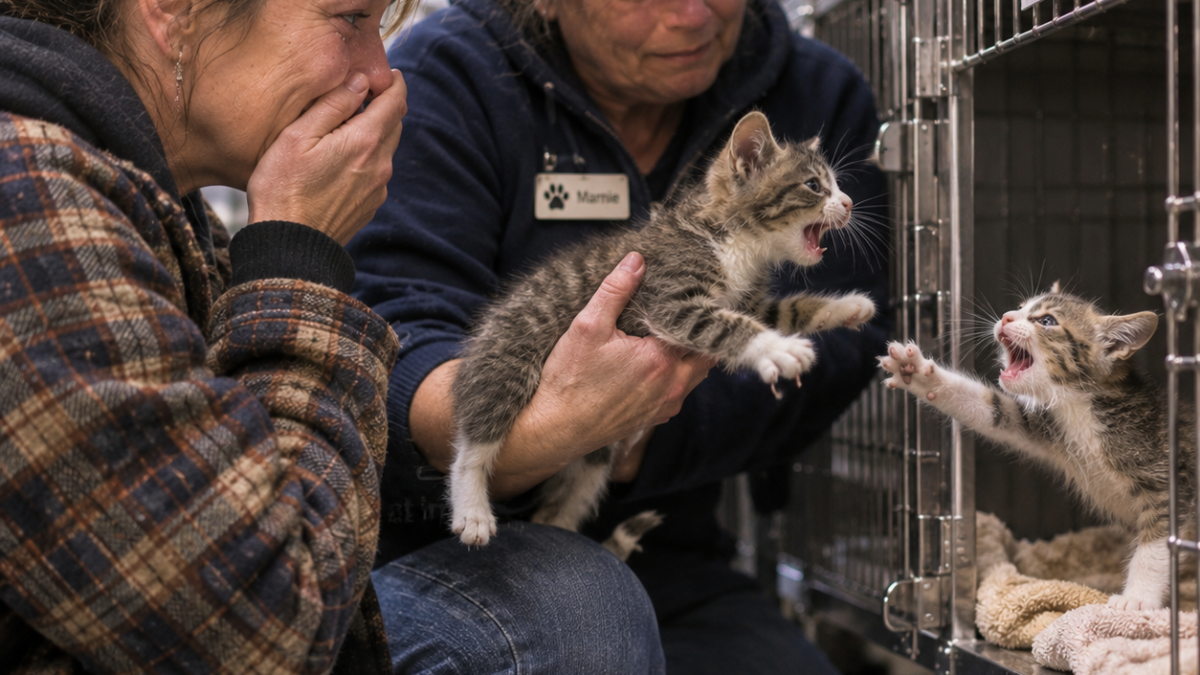
I Went to Adopt One Calm Cat—Then a Kitten Screamed When They Took His Sister Away, and Three Weeks Later Someone Asked Me to Separate Them Again
I had gone to the shelter for one quiet adult cat, but when a worker lifted a tiny male kitten out of Cage 17, the sister left behind made a sound so terrified that every conversation in the room stopped at once.
I adopted them both because I could not be the person who taught either of them that survival meant watching the one creature they trusted disappear, yet three weeks later a woman stood in my kitchen and calmly asked whether I really needed to keep both.
What none of us knew then was that Benno and Poppy were carrying a secret from the month they spent behind a shopping center—and when one of them suddenly collapsed, that secret would force a veterinarian, a shelter director, my daughter, and eventually me to understand that what looked like unhealthy dependence was actually the reason both kittens had survived long enough to reach me.
I had promised myself one cat.
I remember saying it aloud in the car before I opened the door.
“One.”
As if the universe cared about limits announced in parking lots.
One cat.
Preferably grown.
Calm.
No medical drama.
No behavioral project.
No kitten climbing curtains at three in the morning.
I was forty-seven years old and living alone for the first time in my life.
I had gone directly from my parents’ house to a college apartment with roommates, then to marriage, then motherhood.
There had always been somebody.
A husband snoring beside me.
A daughter singing badly in the shower.
Shoes by the door that weren’t mine.
A cereal bowl in the sink I could complain about.
Then life became quiet in stages.
My marriage ended six years earlier.
Not explosively.
We had simply worn one another down until being polite required more energy than being apart.
My ex-husband, David, moved two counties away.
We remained civil.
Our daughter, Hannah, stayed with me while finishing college locally.
For a while, the house still sounded like life.
Friends coming through the kitchen.
Music upstairs.
Her yelling:
“Mom, have you seen my keys?”
while holding the keys.
Then Hannah graduated.
She got a job in Portland.
Oregon.
I lived in Pennsylvania.
The week she told me, I said everything a good mother is supposed to say.
“That’s amazing.”
“I’m proud of you.”
“You have to go.”
And I meant all of it.
That was the problem.
You can be proud and devastated at the same time.
People do not say that enough.
The morning she drove away, I stood in the driveway and waved until her car disappeared.
Then I walked back into the house.
Her bedroom door was open.
Bed stripped.
Closet half empty.
Two thumbtacks still in the wall where she’d removed a poster.
I sat on the edge of her mattress and discovered that silence can have pressure.
For the first week, I kept expecting her to come downstairs.
For the second, I left the television on.
PART2:
By month three, I was sleeping with the hallway light on for no reason I could defend.
I did not need a child replacement.
I hated when people said that.
“You need a pet now that Hannah’s gone.”
No.
Hannah was not a vacancy a cat could fill.
But I did need something alive in the house.
Something that required breakfast.
Something whose presence created ordinary evidence that another heartbeat existed near mine.
So one Saturday in October, I drove to Westhaven County Animal Shelter.
One cat.
That was the plan.
The shelter occupied an old brick building at the far end of a cracked parking lot behind a tire store.
Inside smelled like bleach, litter, damp fur, and something fried from the employee break room.
A woman named Celia sat at reception.
Late fifties.
Dark hair streaked with silver.
Glasses on a cord around her neck.
She asked what I wanted.
“Adult cat.”
“Age range?”
“Anything grown.”
“Temperament?”
“Mellow.”
“Other pets?”
“No.”
“Kids?”
“Not anymore.”
That came out wrong.
Celia looked at me.
“My daughter moved.”
PART3:
She nodded as though that explained more than I wanted it to.
“Okay.”
She stood.
“Let’s meet some adults.”
We walked through the adoption room.
Cats occupied cages and glass-fronted enclosures on both walls.
Some slept.
Some performed.
One huge black cat stared at me from a blanket with the expression of a judge disappointed by the entire legal profession.
I liked him immediately.
“What about that one?”
“Walter.”
“How old?”
“Seven.”
“Friendly?”
“Depends whether Walter believes you deserve friendship.”
“Honestly, that’s fair.”
I almost stopped there.
Then we passed Cage 17.
Two kittens.
They were pressed together on a folded towel so tightly that at first I thought there was only one.
The larger kitten sat in front.
Brown-gray tabby.
White chin.
White socks.
Maybe four months old.
His chest was pushed outward as if he had appointed himself security.
Behind him, almost underneath him, was a smaller tortoiseshell female.
Black and copper fur.
One orange streak over her nose.
Huge greenish eyes.
She was trembling.
Not a cute kitten shiver.
Her entire body quivered.
The male did not tremble.
But his ears remained fixed forward.
Watching.
“You said adult,” Celia reminded me.
“I know.”
We stopped.
The male shifted slightly.
The female shifted with him.
Not after.
With.
Like two compass needles attached to one mechanism.
“They came in together,” Celia said.
“Littermates?”
“We think so.”
“You think?”
“Found behind Belden Square shopping center. No mother. No other kittens.”
“How long?”
“Twenty-eight days.”
The male stared at me.
The female looked at Celia.
Then at the hallway.
Back to her brother.
“They’re bonded?”
Celia hesitated.
“We use that word carefully with kittens.”
“Why?”
“Some kittens are very attached because they’re young and frightened. They may grow out of it.”
I nodded.
“But these two?”
“They panic when separated.”
“Both?”
“Yes.”
“What kind of panic?”
Celia gave me a look.
“You want to meet them?”
I should have said no.
Instead:
“Can I see him?”
The moment the words left my mouth, the little female lifted her head.
Celia unlocked the cage.
The male backed into his sister.
Not away from Celia.
Into her.
Then he stopped.
Celia moved slowly.
“It’s okay, buddy.”
She slid one hand under his chest.
He froze.
Did not scratch.
Did not bite.
She lifted him.
For perhaps half a second, nothing happened.
Then the female kitten screamed.
Every person in the room turned.
I have owned cats before.
I’ve heard yowling.
Fighting.
Heat calls.
The horrible noise a cat makes before vomiting directly onto something expensive.
This wasn’t any of those.
It did not sound like anger.
It sounded like terror had somehow been given lungs.
The little kitten lunged.
Her back feet slipped on the towel.
She slammed into the cage door.
Reached through the bars.
Claws open.
Celia froze.
The male began shaking in her arms.
Not struggling.
Shaking.
He stretched his neck toward his sister.
She screamed again.
Someone across the room said:
“Oh my God.”
Celia immediately returned him.
The second his paws touched the towel, the female threw herself against him.
Not playfully.
She buried her face beneath his chin.
The male wrapped one front leg over her shoulders.
The room stayed quiet.
Celia closed the cage.
“That’s what I meant.”
I stared.
The female was breathing through an open mouth.
The male licked the top of her head.
Once.
Twice.
Then sat in front of her again.
Guard position.
My throat tightened.
I thought of Hannah’s empty bedroom.
Not because my daughter leaving for a good life in Oregon was the same thing.
It wasn’t.
But bodies do not always care about intellectual distinctions.
Loss is loss before the brain explains it.
“How long have they been doing that?”
“Since intake.”
“Every time?”
“Every separation longer than a few seconds.”
“What about vet exams?”
“We try to keep them within sight.”
“Adoption?”
Celia looked toward the front desk.
“That’s the problem.”
Most people wanted one kitten.
Two meant twice the food.
Two vaccinations.
Two spay-neuter appointments.
Two carriers.
Two sets of everything.
Technically, not twice everything.
Cats happily share many resources.
But people hear two and calculate burden.
“Have people been interested?”
“Several.”
“What happened?”
“They wanted one.”
“And you said no?”
“We’ve been trying not to separate them.”
“Trying?”
Celia sighed.
“We’re municipal.”
That sentence contained an entire system.
Space.
Policy.
Intake pressure.
Budget.
The reality that good intentions occupy cages.
“If they stay too long?”
“We reassess.”
I looked at the kittens.
“How long is too long?”
“No number.”
I knew there was a number.
There is always a number.
Maybe nobody writes it down.
The female kitten had stopped panting.
Her face remained pressed to her brother.
“What are their names?”
“Intake names are Bean and Pepper.”
“No.”
Celia laughed.
“That’s your objection?”
“I don’t know why, but yes.”
“You haven’t adopted them.”
“I know.”
I walked away.
Actually walked away.
I went back to Walter.
The black cat.
The adult.
The plan.
Walter sniffed my hand.
Allowed exactly one stroke.
Then turned his back.
Perfect.
Independent.
Mellow.
Seven.
One cat.
I could imagine him sleeping on my couch.
I could imagine quiet companionship.
Simple.
Then, from Cage 17, I heard one tiny chirp.
Not terror.
Just communication.
I looked.
The female had lifted her head.
Her brother touched noses with her.
I knew I was finished.
I went back to Celia.
“If I took both…”
She did not smile.
Professional.
“It’s more responsibility.”
“I know.”
“Kitten energy.”
“I know.”
“Possible separation anxiety.”
“I know.”
“Unknown medical history.”
“I know.”
“Two adoption fees.”
I looked at her.
“That one was really going to stop me?”
She smiled then.
I said:
“Please don’t separate them.”
Celia’s eyes softened.
“I’ll take both.”
Paperwork took almost two hours.
Partly because municipal shelters are powered by forms and stubborn printers.
Partly because both kittens required updated vaccination records.
I named the male Benno.
The female Poppy.
Why?
I don’t know.
The names simply fit once I said them.
“Benno.”
He looked at me.
“Poppy.”
She hid behind Benno.
Good enough.
They went into one large carrier.
Celia insisted.
“Don’t use separate carriers for now.”
“I wasn’t planning to.”
“Good.”
At the car, I put the carrier on the passenger-side floor so it would not slide.
Both kittens huddled at the back.
Poppy underneath Benno.
Every red light, I spoke.
“We’re okay.”
Rustling.
“We’re going home.”
A small mew.
“Nobody’s taking anybody anywhere.”
That sentence came out before I understood how much I meant it.
At home, I opened the carrier beside my bed.
Old quilt on the floor.
Food and water ten feet away.
Litter box near the bathroom.
The kittens stayed inside forty minutes.
Then Benno emerged.
Slow.
One paw.
Pause.
Second paw.
He sniffed the carpet.
Poppy appeared behind him.
She did not step anywhere he had not stepped first.
Benno walked three feet.
Poppy walked three feet.
Benno stopped.
Poppy stopped.
He found the bed.
Looked underneath.
Poppy squeezed past him and disappeared.
Benno immediately followed.
For the next six hours, I technically owned two cats I could not see.
I sat on the bedroom floor and read a book.
Not aloud.
Just existed.
At 7:00 p.m., Benno emerged.
He ate.
Returned under bed.
Poppy came out.
Ate exactly where he had eaten.
Back under.
At midnight, I woke to tiny footsteps.
I did not move.
One kitten climbed onto the mattress.
Probably Benno.
Then another.
They approached my legs.
I felt them turn in circles.
Settle.
The next morning, I discovered Benno curled around Poppy between my calves.
The house felt different.
Not dramatically.
The refrigerator still hummed.
The heater clicked.
Hannah was still three thousand miles away.
But the silence no longer sounded abandoned.
It contained breathing.
That first week, Benno became brave quickly.
Poppy did not.
Benno discovered stairs.
Poppy watched.
Benno conquered the couch.
Poppy eventually climbed after him.
Benno investigated the kitchen.
Poppy stood in the doorway until he returned.
When the washing machine entered its spin cycle, Poppy shot under the bed.
Benno followed.
Not because he was frightened.
He sat beside her until she came out.
At meals, Poppy would not eat unless Benno began first.
At night, if I closed a door between them accidentally, she cried.
Immediately.
I stopped closing doors.
I called the shelter.
Celia said:
“That’s more intense than we’d hoped.”
“Is it bad?”
“Not necessarily.”
“What does that mean?”
“It means give them time.”
I did.
They rewarded patience with chaos.
By week two, Benno was knocking pens from my desk.
Poppy had learned curtains could be climbed.
I came home from the grocery store to find both kittens sitting inside the kitchen sink.
Water running.
Neither looked apologetic.
I sent Hannah the picture.
She called immediately.
“You got kittens?”
“Two.”
“You said one adult.”
“I was ambushed.”
“By kittens?”
“Emotionally.”
She laughed.
Then:
“Mom, I’m glad.”
That sentence mattered more than I admitted.
“Are you?”
“The house was too quiet.”
“You knew?”
“Mom.”
Children know their parents in inconvenient ways.
Three weeks after adoption, my older sister Diane visited.
That was when she asked the question.
Diane loved me.
I need to establish that.
She was not cruel.
She was the person who drove twelve hours when my marriage ended because she didn’t trust me to eat.
She helped Hannah move.
She remembered birthdays.
She sent Christmas cards before Thanksgiving.
She was also relentlessly practical.
If I said:
“I’m sad.”
Diane asked whether I had exercised.
If I said:
“I’m worried.”
She asked for a spreadsheet.
Grief, to Diane, was a problem whose inefficiencies could be reduced.
She came into my kitchen carrying soup.
Benno and Poppy streaked past.
One body with two sets of paws.
Poppy stopped when she saw Diane.
Benno stopped too.
Poppy backed.
Benno moved in front.
Diane watched.
“They always do that?”
“What?”
“Move together.”
“Pretty much.”
She sat.
Benno eventually approached.
Poppy remained three feet behind him.
Diane held out one finger.
Benno sniffed.
Poppy waited.
Diane looked at me.
“How much was the vet visit?”
“Why?”
“You mentioned vaccinations.”
“Not bad.”
“Two kittens adds up.”
“I know.”
“And Poppy seems…”
“What?”
She searched.
“Very dependent.”
I felt defensive immediately.
“She was scared.”
“I can see that.”
“She’ll get better.”
“Maybe.”
Then she asked it.
“Are you sure you need both?”
Kindly.
That was the worst part.
Cruelty is easier to resist when it sounds cruel.
Practicality enters wearing comfortable shoes.
I stared at her.
“What?”
“I’m not saying get rid of one.”
“You just asked if I need both.”
“I’m asking whether keeping them together is actually helping her.”
Diane nodded toward Poppy.
“She won’t even approach unless he does first.”
“They’re bonded.”
“They’re kittens.”
“So?”
“Maybe she’d become more confident without him.”
I knew she wasn’t inventing the concern.
Celia had used similar language.
Dependency.
Confidence.
Adjustment.
Still, anger rose.
“You heard what she does when they’re separated.”
“From the shelter.”
“Yes.”
“That doesn’t mean permanent separation wouldn’t eventually—”
“No.”
Diane stopped.
I had spoken sharply.
Poppy bolted.
Benno followed.
The kitchen became quiet.
Diane said:
“I’m not attacking you.”
“I know.”
“Then don’t look at me like that.”
“I heard her scream.”
“I didn’t.”
“No.”
I stood.
“You didn’t.”
Diane’s face changed.
I regretted the tone.
She said:
“I just don’t want you making decisions because Hannah moved.”
There it was.
Not kittens.
Me.
“You think I’m filling the house.”
“I think you were lonely.”
“I was.”
“And sometimes lonely people take on things because they need to be needed.”
I stared.
Diane sighed.
“I didn’t mean—”
“You did.”
“Laura.”
That is my name.
Laura Bennett.
I almost never mention it because for years I had been someone’s wife, someone’s mother, someone’s sister, and my own name seemed mostly useful on forms.
Diane continued:
“I just want to make sure you’re doing this for the right reasons.”
I looked toward the hallway.
Benno’s head appeared around the corner.
Poppy behind him.
“What are the right reasons?”
“I don’t know.”
“Exactly.”
I picked up her soup.
Put it in the refrigerator.
The visit recovered.
Mostly.
But the question remained after she left.
Are you sure you need both?
That night, Poppy woke crying at 2:13.
Not screaming.
Calling.
Benno was on the windowsill.
Five feet away.
Poppy couldn’t see him from beneath the chair.
He jumped down.
Touched noses.
She stopped.
I lay awake.
Diane’s question became another.
Was I protecting Poppy?
Or protecting myself from witnessing separation?
The next morning, I called an animal behaviorist.
Not because I intended to separate them.
Because love can become selfish when you refuse questions simply because the answers might hurt.
Dr. Elise Warren visited six days later.
She specialized in feline behavior.
She spent an hour mostly ignoring the kittens.
Benno approached.
Poppy didn’t.
Elise observed.
Then she placed a screen between them.
Not a closed door.
Just visual barrier.
Poppy froze.
Benno looked toward her.
Elise waited three seconds.
Removed it.
Poppy ran to Benno.
Elise tried distance.
Benno in hallway.
Poppy in bedroom.
Door open.
Poppy followed.
Benno did not always follow Poppy.
That distinction mattered.
Elise said:
“Benno isn’t dependent in the same way.”
“So Diane was right?”
“No.”
“What does that mean?”
“It means the relationship is asymmetrical.”
“English?”
She smiled.
“Poppy relies on him more than he relies on her.”
“Is that unhealthy?”
“Not automatically.”
“How do I make her independent?”
“Why is independence the goal?”
I stopped.
Elise continued.
“We like independent animals because they’re easier for us.”
I thought of Diane.
“Poppy needs confidence.”
“Yes.”
“But confidence doesn’t have to mean losing Benno.”
That sentence loosened something.
Elise gave me exercises.
Separate feeding stations several feet apart but visible.
Individual play.
Reward Poppy for exploring without Benno.
Short moments of distance where she could still hear him.
Never force panic.
“Think inches, not miles.”
Over two weeks, Poppy improved.
She entered the kitchen alone.
Once.
For four seconds.
I celebrated like she had graduated medical school.
She began playing with a feather wand while Benno slept.
She sat beside me without touching him.
Progress.
Then, one Thursday morning, Benno collapsed.
No warning.
One second he was chasing a bottle cap.
The next, his back legs folded.
He hit the floor.
Poppy screamed.
I ran.
“Benno?”
His eyes were open.
He tried to stand.
Couldn’t.
I scooped him up.
Poppy launched herself at my legs.
I grabbed the carrier.
Put Benno inside.
Poppy tried to follow.
For half a second, instinct said:
One sick cat.
Emergency.
Leave the other.
Then Cage 17 came back.
That scream.
I shoved a towel into the carrier and put Poppy in beside him.
We drove to Ridgeway Veterinary Emergency Hospital.
Benno lay against the carrier wall.
Poppy pressed into him.
I drove with one hand too tight on the steering wheel.
“Stay.”
I don’t know which one I meant.
At the clinic, a technician opened the carrier.
“We need him back.”
“She’s bonded.”
“We’ll keep her here.”
“No.”
The technician looked at me.
“We need to evaluate him quickly.”
“I know.”
“Then we need the patient.”
Poppy began trembling.
I said:
“Take the carrier.”
They did.
Both kittens disappeared through the treatment doors.
I sat in the waiting room.
Twenty minutes.
Thirty.
Forty-five.
Then Dr. Marcus Lee came out.
Young.
Calm.
The kind of veterinarian who removed fear from his voice before entering rooms.
“Benno’s stable.”
I breathed.
“What happened?”
“We’re not sure yet.”
Bloodwork.
X-rays.
Ultrasound.
Possible congenital issue.
Maybe toxin.
Maybe heart.
Then he said:
“Your other kitten is making this difficult.”
My stomach dropped.
“What did she do?”
“Nothing bad.”
He almost smiled.
“She won’t let anyone take her more than two feet away from him.”
“I’m sorry.”
“Don’t be.”
He sat.
“Actually, I wanted to ask about their history.”
I explained.
Shopping center.
Shelter.
Screaming.
Bonded.
Marcus frowned.
“How old when found?”
“About three months.”
“Any injuries?”
“Not that I know.”
“Did the shelter give you intake records?”
“Yes.”
“Can you send them?”
I did.
While he reviewed, I asked:
“Is Benno dying?”
Marcus looked at me.
“I don’t know.”
That sentence is unbearable when attached to a small body.
He continued.
“He has significant anemia.”
“Why?”
“We’re working on it.”
“Cancer?”
“Unlikely at his age.”
“Infection?”
“Possible.”
“Something genetic?”
“Possible.”
Poppy remained with him.
The clinic bent rules.
Not everywhere.
Not during procedures.
But whenever safe, they kept the kittens in adjacent kennels.
Marcus later showed me a photograph.
Benno inside one oxygen enclosure.
Poppy in the next.
Their bodies pressed against the transparent divider.
Same position.
Two halves of one shape.
That evening, Celia called.
The emergency clinic had contacted the shelter for more history.
She sounded strange.
“Laura?”
“Yes.”
“Do you have time?”
“I’m at the ER vet.”
“I know.”
“What happened before they came to you?”
Silence.
“I need to explain something.”
My body went cold.
“What?”
“When Benno and Poppy arrived, animal control thought they were just abandoned kittens.”
“Okay.”
“They weren’t.”
I stood.
“What does that mean?”
Celia told me about the intake officer, Raymond Ortiz.
He had been the one who trapped them behind Belden Square.
The original report said two kittens under a loading dock.
No mother visible.
But there was a supplemental note that never made it into the public adoption record.
Raymond had gone back the next morning.
Why?
Because a store employee called.
She had remembered something.
Three weeks earlier, a homeless woman had been living intermittently behind the shopping center with several cats.
Security removed her.
Animal control records showed four adult cats and three kittens taken.
But two kittens escaped during capture.
Benno and Poppy.
I stopped breathing.
“They lived behind the shopping center for three weeks?”
“At least.”
“Alone?”
“We don’t know.”
“Where was their mother?”
“One of the adult cats taken earlier was lactating.”
“Where is she?”
Celia went quiet.
“Laura…”
“Where?”
“She was transferred.”
“To where?”
“A rescue in Maryland.”
“Can you find her?”
“Maybe.”
“Is she alive?”
“I don’t know.”
The room tilted.
Benno and Poppy had not simply been stray kittens together.
They had been left behind together.
Possibly after watching their mother and littermates disappear into traps.
People.
Carriers.
Doors closing.
Then three weeks under a shopping center.
Cars.
Cold.
Dumpsters.
Noise.
Predators.
Two kittens.
Celia said:
“The officer noted that when he finally trapped Benno, Poppy followed him into the trap.”
I closed my eyes.
“What?”
“He caught Benno first. Poppy was outside.”
My skin prickled.
“He was going to reset another trap.”
“Yes.”
“But she went in?”
“She climbed into the same trap while he was moving it.”
I thought of Cage 17.
The scream when Celia lifted Benno.
It was not simply fear of being alone.
It may have been memory.
The last time something had taken her family away, Benno was the only one who remained.
Marcus returned.
I ended the call.
He had results.
Benno had severe flea-related anemia combined with hemoplasma infection—a blood-borne bacterial infection cats can acquire through fleas or bites.
Likely present before adoption.
Stress may have worsened it.
Treatable.
But serious.
“He needs a transfusion.”
“Do it.”
“He may need hospitalization.”
“Do it.”
“Forty-eight hours, maybe more.”
I nodded.
Then:
“What about Poppy?”
Marcus sighed.
“We can’t hospitalize a healthy cat in ICU indefinitely.”
My heart dropped.
“But…”
“I didn’t say we have to send her home.”
He glanced toward treatment.
“We have an unused kennel in isolation.”
“You’ll let her stay?”
“For tonight.”
“Thank you.”
“Laura.”
He waited until I looked at him.
“Her stress is affecting him too.”
“What do you mean?”
“When we moved her out of sight, his heart rate increased significantly.”
I stared.
“He reacts to her?”
“Seems to.”
“So they’re both—”
“Attached.”
He chose the word carefully.
Not dependent.
Attached.
That night I went home without either kitten.
The house felt worse than before I adopted them.
Two bowls.
Two toy mice.
No movement.
I sat on the kitchen floor.
Diane’s question returned.
Are you sure you need both?
I called her.
She answered immediately.
“What’s wrong?”
I cried before I could explain.
Diane arrived forty minutes later.
No questions.
Soup again.
My sister solves pain with soup.
I told her everything.
Benno.
Anemia.
Transfusion.
Shopping center.
Poppy.
The ICU divider.
Diane covered her mouth.
“I didn’t know.”
“Neither did I.”
“I shouldn’t have said—”
“You asked a reasonable question.”
“No.”
She shook her head.
“I asked a reasonable-sounding question.”
I looked at her.
Diane’s eyes filled.
“I saw her cling to him and assumed the clinging was the problem.”
“That’s what I wondered too.”
“But maybe he was the reason she could function at all.”
We sat.
Then Diane said something I still remember.
“People always praise letting go.”
I waited.
“Maybe sometimes holding on is what gets you far enough to learn how.”
I looked toward the empty hallway.
“That’s annoyingly good.”
“I have moments.”
The next morning, I returned to the emergency hospital at 6:30.
Poppy had not eaten.
Benno had.
Tiny amount.
Good sign.
Marcus led me back.
Poppy sat in her kennel.
Benno next door.
He looked terrible.
But alive.
When I entered, Poppy stood.
Meowed.
Then looked at Benno.
I sat between the kennels.
For two hours.
At one point, Benno reached one paw through the bars.
Poppy reached hers.
Their paws touched.
The technician stopped walking.
Then backed away.
“Don’t move.”
I whispered.
She smiled.
“Wasn’t planning to.”
Benno improved.
Slowly.
Transfusion worked.
Antibiotics.
Flea treatment.
Fluids.
Appetite.
By day three, his gums were pinker.
By day four, he stood.
Poppy ate only after he did.
Marcus discharged both the same afternoon.
The bill hurt.
I paid it.
Diane offered help.
I refused.
She sent money anyway.
I sent it back.
She sent it again labeled:
SOUP FUND.
I kept it.
At home, Benno recovered.
Poppy changed too.
Not instantly.
But something about surviving the hospitalization seemed to confirm a truth she had needed.
Benno could leave the room.
And return.
I could leave the house.
And return.
Doors did not always mean disappearance.
We continued Elise’s exercises.
Ten seconds apart.
Thirty.
One minute.
Poppy learned to sleep on the couch while Benno sat in a window.
Benno learned he could play without constantly checking her.
Months passed.
Then Celia called.
“We found the mother.”
I sat down.
“What?”
“Maybe.”
The Maryland rescue had records.
The lactating female from the shopping center had been transferred to a foster group.
Gray-brown tabby.
Approximately two years old.
They named her Flora.
Three kittens had been documented originally.
One black.
Two tabby-tortie mixes.
One kitten escaped during trapping.
Another possibly.
Records were messy.
But photographs existed.
Celia emailed one.
Flora lying in a crate.
Three kittens nursing.
One looked like Benno.
One looked like Poppy.
The third black.
I stared.
Not proof.
Very close.
“What happened to her?”
“Adopted.”
“Good.”
“She’s alive.”
I closed my eyes.
“Good.”
“Do you want the adopter’s contact?”
I thought.
What would I do?
Reunion?
Cats do not build family trees for human satisfaction.
Flora had a home.
Benno and Poppy had theirs.
Celia said:
“The adopter sent a current photo.”
Flora was sprawled across a sofa.
Fat.
Happy.
Wearing a green collar.
I laughed.
“Send it.”
I printed the photograph.
Placed it in a drawer.
Not on the wall.
It was for me.
Evidence that the story did not end badly for everyone taken that day.
By winter, Benno and Poppy were nearly a year old.
Poppy still disliked strangers.
Benno considered strangers poorly trained servants.
He greeted everyone.
Poppy observed from a distance.
Diane visited often.
One afternoon she sat in the kitchen.
Same chair.
Benno on the counter despite repeated legal challenges.
Poppy on the windowsill.
Separate.
Diane noticed.
“Look at her.”
“I know.”
“She’s by herself.”
“I know.”
Poppy jumped down.
Walked across the room.
Passed Benno.
Climbed into Diane’s lap.
Diane froze.
I froze.
Poppy sat.
Diane whispered:
“Do I move?”
“No.”
“What do I do?”
“Nothing.”
Poppy curled.
Diane’s eyes filled.
“Oh, come on.”
I laughed.
“You’re crying.”
“No.”
“You are.”
“This is allergies.”
“In February?”
“Shut up.”
Poppy slept twenty minutes.
Then left.
Diane sat completely still another minute.
“I was wrong.”
“About what?”
“You know.”
I did.
But I made her say it.
“About them needing each other.”
I shook my head.
“No.”
She frowned.
“You weren’t entirely wrong.”
“What?”
“They did need to learn they could exist separately.”
“Exactly.”
“But they could only learn because nobody forced them to prove it before they were ready.”
Diane thought about that.
“There’s your bumper sticker.”
“I hate bumper stickers.”
“Put it on a mug.”
The shelter asked if they could share Benno and Poppy’s story.
I hesitated.
Celia explained why.
Westhaven was reviewing its bonded-animal policy.
Not only kittens.
Cats.
Dogs.
Pairs.
Previously, “bonded” depended heavily on staff interpretation.
Some animals were labeled bonded because they arrived together.
Others showed extreme separation distress but had no formal designation.
Space pressures sometimes led pairs to be split.
Celia wanted better criteria.
Observation.
Feeding.
Sleeping.
Stress when separated.
Recovery time.
Medical coordination.
“Your two changed the conversation,” she said.
“They’re cats.”
“I know.”
“Please don’t make them inspirational heroes.”
“I won’t.”
“Don’t say they saved each other with magical love.”
“I promise.”
“Don’t—”
“Laura.”
“What?”
“You are difficult.”
“That is accurate.”
The shelter posted a measured story.
Two kittens.
Found after weeks outdoors.
Extreme distress during separation.
Adopted together.
Later-discovered history suggesting previous traumatic separation.
Clinical behavior support.
One kitten hospitalized.
Veterinary team maintained proximity where possible.
Both now thriving.
The shelter added:
Bonded does not mean incapable.
It means the relationship itself may be part of the animal’s stability and should be evaluated before separation.
That sentence spread farther than I expected.
Rescue groups shared it.
People told their own stories.
Bonded senior cats.
Dogs surrendered after owner deaths.
Littermates.
Mother-daughter pairs.
Not every pair needed to remain together.
That mattered.
Sometimes separating was healthy.
Sometimes necessary.
But “easier to adopt one” stopped being the only question.
A local reporter contacted me.
I declined.
Then agreed when Celia promised the article would focus on shelter policy.
The reporter came to my house.
Benno climbed into her equipment bag.
Poppy watched from the stairs.
She asked:
“Why did you adopt two when you wanted one?”
I answered:
“Because someone picked one up.”
She waited.
“That was it?”
“I heard what happened to the other.”
“Do you think you rescued them?”
“No.”
“Why not?”
I looked at Benno.
He was biting a microphone cable.
“Because they had already kept each other alive before I met them.”
The reporter smiled.
“And what did you do?”
“I stopped anyone from making them do it alone.”
That line became the headline quote.
I hated seeing my words in large type.
Hannah loved it.
She called from Oregon.
“My mother is famous.”
“Your mother was in the county paper.”
“Same thing.”
She had been gone almost a year by then.
Her life was good.
Work.
Friends.
A boyfriend named Noah I pretended not to research online.
She visited at Christmas.
When she entered the house, Poppy vanished.
Benno greeted her.
Hannah sat on the floor.
“Hi, little guy.”
Benno climbed into her lap.
Poppy watched from the hallway.
Hannah looked toward me.
“Don’t push her?”
“Exactly.”
Three hours later, Poppy approached.
Sniffed Hannah.
Retreated.
Next morning, she slept on Hannah’s suitcase.
Hannah cried.
Apparently our family had become people who cried whenever a cat sat somewhere.
On the third night, Hannah and I stayed up after midnight.
Benno and Poppy slept together on the couch.
Not clinging.
Just touching backs.
Hannah said:
“Mom?”
“Hmm?”
“Were you really that lonely after I left?”
I looked at her.
She immediately added:
“I’m not asking because I feel guilty.”
“Good.”
“I just…”
She hesitated.
“I thought you were okay.”
“I was.”
“That doesn’t answer me.”
I smiled.
“You are definitely my child.”
She waited.
“I was lonely.”
Her face changed.
“Hannah, that’s not your fault.”
“I know.”
“You were supposed to leave.”
“I know.”
“You leaving was good.”
“I know.”
“I would have been horrified if you stayed because of me.”
“I know.”
“Then stop looking like that.”
She laughed.
Then cried anyway.
I moved beside her.
“You can miss someone and still want them to go live their life.”
She looked at the kittens.
“Like them?”
“No.”
“Kind of.”
I thought.
“Maybe.”
Poppy woke.
Benno remained asleep.
She stood.
Walked to the other end of the couch.
Lay down alone.
Hannah smiled.
“Look.”
I did.
“She knows he’s still there.”
That sentence stayed with me.
Maybe that was security.
Not constant contact.
The knowledge that someone could move away without ceasing to exist.
My daughter’s life no longer felt like abandonment.
Poppy’s confidence no longer looked like distance from Benno.
Love did not require bodies pressed together at every second.
It required trust that separation had an end.
The following spring, Westhaven called again.
This time about a new pair.
Not because I was adopting.
I had become a volunteer.
That happens.
You enter a shelter once and suddenly you own a lint roller in every room.
The pair were adult cats.
Twelve-year-old brothers.
Milo and Otis.
Owner died.
Family surrendered them.
One shelter manager wanted to list separately because bonded adult pairs were harder to place.
Celia asked me to sit in on an observation.
“Why me?”
“You’ve seen panic.”
“I am not qualified.”
“Correct.”
“Comforting.”
“We need another set of eyes.”
They separated Milo and Otis briefly with a mesh barrier.
Milo cried.
Otis paced.
Five minutes.
No recovery.
Reunited.
Both calmed.
They were listed:
BONDED PAIR — ADOPT TOGETHER.
Thirty-nine days later, a retired teacher adopted both.
That evening, Celia texted:
TWO CATS. ONE HOME. EVERYONE SURVIVED.
I sent:
STOP BEING SENTIMENTAL.
She replied:
YOU STARTED IT.
Benno and Poppy turned two.
Then three.
Poppy became confident enough to sit near visitors.
Not all.
Diane had permanent approval.
Hannah.
Celia.
Elise.
Noah eventually.
Benno matured into a fifteen-pound tabby with no awareness of personal space.
Poppy stayed small.
Nine pounds.
Fast.
Watchful.
They no longer slept wrapped together every night.
Sometimes yes.
Sometimes separate rooms.
But certain things remained.
If Poppy vomited, Benno appeared.
If Benno returned from the vet smelling unfamiliar, Poppy followed him until he smelled like home again.
During thunderstorms, they slept together.
When I packed a suitcase, both sat inside it.
I stopped interpreting every behavior.
They were not symbols.
They were cats.
They fought.
Once over a cardboard box.
Benno slapped Poppy.
Poppy chased him down the hallway and bit his tail.
Bonded does not mean saintly.
It means relationship.
Real relationships contain irritation.
That realization amused me.
At forty-nine, I began dating again.
Briefly.
His name was Paul.
Not shelter Paul.
Different Paul.
Apparently middle-aged Pennsylvania contained an excess.
He was kind.
Divorced.
Owned a motorcycle he talked about too much.
On his third visit, Benno loved him.
Poppy hated him.
Not fear.
Dislike.
There is a difference.
Paul sat in my kitchen.
Poppy stared from the doorway.
“She always like that?”
“No.”
“Just me?”
“Apparently.”
He laughed.
“That’s awkward.”
We dated six months.
Ended peacefully.
Poppy watched him leave without comment.
I accused her of sabotage.
She yawned.
I did not need another relationship to prove the house was alive.
That was new.
My life became fuller in small ways.
Shelter shifts.
Book club.
Diane.
Calls with Hannah.
Travel.
Work.
Cats.
I stopped turning on the television for noise.
Sometimes I sat in silence.
Actual peaceful silence.
Benno asleep on a chair.
Poppy in the window.
Nothing wrong.
Four years after Cage 17, Hannah called.
“Mom.”
I knew from the voice.
“What?”
“Noah proposed.”
I sat.
“Oh.”
“Is that bad oh?”
“No.”
“Mom.”
I laughed.
“It’s a good oh.”
She cried.
I cried.
Of course.
Wedding planning began.
Oregon.
She asked me to stay three weeks.
I said yes.
Then looked at Benno and Poppy.
Diane stayed at my house.
The night before my flight, I packed.
Poppy sat inside the suitcase.
Benno beside it.
“You’re not coming.”
Poppy stared.
“This is exactly what therapy was for.”
Benno stepped into the suitcase too.
“Traitors.”
The morning I left, Poppy followed me to the front door.
My heart tightened.
Old fear.
What if she panics?
What if she thinks I’m gone?
Diane stood behind me.
“She’ll be okay.”
“I know.”
“You don’t sound like it.”
“I know.”
I crouched.
Touched Poppy’s head.
Benno stood beside her.
“I’m coming back.”
Ridiculous.
Necessary.
I went.
Three weeks.
The longest I had ever left them.
Diane sent daily photos.
Benno sleeping.
Poppy eating.
Poppy alone in window.
Benno downstairs.
Together.
Apart.
Fine.
When I returned, Benno ran to the door.
Poppy did not.
I panicked.
“Where is she?”
Diane pointed.
Poppy sat halfway up the stairs.
Watching.
I said:
“Hi.”
She stared.
Then walked down.
Not ran.
Walked.
Came to me.
Sniffed my shoe.
Rubbed my leg.
Then went to her food bowl.
Diane laughed.
“You wanted more?”
“No.”
I was crying.
“Apparently.”
Poppy had learned.
People leave.
Sometimes they return.
So had I.
Years passed.
Cage 17 became a story I told less often.
Not because it mattered less.
Because it no longer defined them.
Benno became nine.
Then ten.
Poppy too.
Middle-aged cats.
Not kittens.
Hannah had a daughter.
My granddaughter, June.
The first time June visited, Poppy disappeared for two days.
Children were unacceptable.
Benno adored her.
June learned to sit quietly.
By age four, Poppy allowed one finger on her head.
June whispered:
“She picked me.”
I nearly corrected her.
Then thought of the couple with the kitten climbing the man’s jeans.
Maybe sometimes it feels good to be chosen.
At eleven, Benno developed a heart murmur.
Minor.
Monitored.
At twelve, kidney values changed.
Early disease.
Nothing unusual for aging cats.
Poppy remained healthy.
Their relationship shifted.
Poppy began waiting for Benno.
He moved slower.
She walked ahead.
Then stopped.
Looked back.
If he did not follow, she returned.
One evening, I watched them climb the stairs.
Poppy reached the landing.
Benno paused halfway.
She came back down three steps.
Sat.
Waited.
I had to look away.
Not because it was tragic.
Because some patterns persist long enough to become unbearable in their tenderness.
At thirteen, Benno’s heart disease progressed.
Medication.
More tests.
Poppy hated the pill routine more than he did.
She followed every dose.
Inspected him afterward.
Elise had retired by then.
Celia too.
Westhaven moved into a renovated building.
Bright.
Quiet HVAC.
Better cat rooms.
Cage 17 no longer existed.
The shelter’s bonded-animal protocol did.
Staff still evaluated rather than assuming.
Some pairs separated successfully.
Others stayed together.
No sentimental absolutes.
Just attention.
I liked that.
Benno declined slowly.
One winter, he stopped climbing stairs.
I moved everything downstairs.
My bed too.
Diane said:
“You moved your bedroom for a cat?”
“Yes.”
“Reasonable.”
She had changed.
Or maybe we both had.
One February morning, Benno did not eat.
Poppy did.
Then stopped when she realized he had not.
My chest tightened.
We went to the vet.
Both.
Always both when possible.
Dr. Marcus Lee was now a partner at the clinic.
He remembered them.
“Cage 17.”
“Please don’t call them that.”
He smiled.
“Sorry.”
Tests.
Heart.
Kidneys.
Age.
Benno was thirteen years old.
Not ancient.
But sick.
Marcus sat with me.
“We can hospitalize.”
I looked at Poppy.
She sat against Benno’s carrier.
“Would it help?”
“Maybe.”
“Good time?”
He paused.
“Maybe not much.”
That answer.
I had heard versions of it before.
I called Hannah.
Not because she could decide.
Because sometimes daughters become the person you call when life feels too large.
She listened.
Then said:
“Mom, you always told me staying isn’t the same as holding on forever.”
I closed my eyes.
When had I told her that?
Probably during some breakup.
Children return your own sentences when you’re least prepared.
We brought Benno home.
Pain medication.
Comfort care.
Marcus made a house call two days later.
Poppy stayed beside Benno.
Not frantic.
Not screaming.
Just there.
I sat on the floor.
Same position as the shelter thirteen years earlier.
Benno lay on a blanket.
Poppy touched her nose to his.
Then lay one foot away.
Not pressed against him.
That mattered.
She knew.
Or maybe I imagined she knew.
Marcus gave the first medication.
Benno relaxed.
I placed my hand on his chest.
Poppy watched.
His breathing slowed.
Then stopped.
No scream.
I had feared that for thirteen years.
Some part of me still expected the sound from Cage 17.
Poppy stood.
Walked to him.
Sniffed his face.
Then chest.
Then paws.
She waited.
Marcus did not move.
Neither did I.
Poppy walked around Benno once.
Sat.
Looked at me.
I whispered:
“He’s gone.”
My voice broke.
Poppy remained.
Five minutes.
Ten.
Then she walked away.
That night, she slept under my bed.
Emergency place.
The first time in years.
I lay on the floor beside it.
Did not reach.
At 3:00 a.m., she came out.
Walked to Benno’s empty blanket.
Sniffed.
Then climbed into my bed.
She had never slept on my chest.
Not once.
That night she did.
For several weeks, Poppy searched.
Not desperately.
She checked rooms.
Paused at Benno’s favorite chair.
Went to the bottom of the stairs.
Waited sometimes.
She ate.
Drank.
Used the litter box.
She grieved without collapsing.
That was when I finally understood how far she had come.
Thirteen years earlier, taking Benno out of her sight had made her scream until she could barely breathe.
Now he was gone permanently.
She hurt.
She searched.
She changed.
But she remained.
The goal had never been to make her stop loving him enough to survive his absence.
The goal had been to give her enough safety that love and survival no longer had to be enemies.
I called Diane.
“She’s okay.”
Diane knew what I meant.
“You sound surprised.”
“I am.”
“I’m not.”
“Why?”
“Because she had thirteen years of learning people come back.”
I looked at Poppy.
“And one day they don’t.”
Diane was quiet.
Then:
“That’s every life.”
I hated that she was right.
Poppy lived four more years.
Seventeen.
Old tortoiseshell.
Small.
Bossy.
Confident in ways I never imagined.
She slept alone.
She greeted Diane.
Tolerated June.
Ignored most men.
Sat in the kitchen while I cooked.
Sometimes she slept on Benno’s old blanket.
Not every night.
She no longer had an emergency place beneath the bed.
Or maybe the whole house had become one.
When Poppy’s final year came, I was sixty-four.
Hannah was forty.
June was nine.
Time had moved whether I noticed or not.
Poppy developed lymphoma.
We treated what made sense.
Stopped what did not.
She died at home in sunlight.
No panic.
My hand on her back.
Hannah on video because she could not get a flight in time.
June crying beside her mother.
Before the final medication, I whispered:
“You don’t have to find him.”
I don’t know why.
Maybe because some stories become language in your body.
Poppy purred.
Then slept.
Afterward, the house became quiet again.
But not the same quiet.
That surprised me most.
I had thought losing them would return me to the woman sitting in Hannah’s empty bedroom thirteen years earlier.
It didn’t.
Silence had changed meaning.
The house had been lived in.
Scratched.
Climbed.
Vomited on.
Slept in.
Loved.
The baseboards carried tiny claw marks.
There was still a toy mouse under the refrigerator I could not reach.
One corner of the couch remained permanently damaged from Benno’s youth.
The hallway mirror still had faint marks near the bottom.
Evidence.
I left them.
People asked whether I would adopt again.
Maybe.
Not immediately.
I went back to Westhaven.
The new building smelled better.
Still like animals.
Celia had been retired five years, but her photograph hung in the volunteer room.
I walked to the bonded-cat area.
Not Cage 17.
Nothing like it.
Large rooms.
Shelves.
Windows.
A card on one enclosure read:
BONDED PAIR.
PLEASE ASK STAFF ABOUT THEIR RELATIONSHIP AND NEEDS.
I smiled.
Not:
MUST STAY TOGETHER.
Not:
SEPARATE FOR EASIER ADOPTION.
Ask.
Observe.
Understand.
Inside were two adult orange cats sleeping several feet apart.
One opened an eye.
Went back to sleep.
A young volunteer asked:
“Are you looking to adopt?”
I laughed.
“I don’t know.”
“What are you looking for?”
Thirteen years earlier, I had answered:
One adult cat.
Something mellow.
This time, I said:
“Whatever everybody else keeps walking past.”
The volunteer smiled.
That dangerous shelter smile.
She picked up a ring of keys.
I followed.
Not because Benno and Poppy had taught me that every bonded animal must stay together forever.
They taught me something harder.
Love is not measured by how little you need.
Dependence is not automatically weakness.
Independence is not automatically health.
Sometimes the creature hiding behind another creature needs that protection before it can learn the room is safe.
Sometimes the one standing in front needs permission to stop being brave all the time.
Sometimes two lives become intertwined because the world frightened them before they were ready.
The answer is not always to pull them apart and call the panic growth.
And the answer is not always to keep them pressed together so tightly neither learns there is a world beyond the other.
The answer is attention.
Patience.
Inches before miles.
A door that opens again.
A person who returns.
A home where nobody disappears simply because loving them became inconvenient.
I went to Westhaven for one cat because I thought one was all I could manage.
Benno and Poppy arrived shaking.
They came with fear.
Vet bills.
Claw marks.
Bad nights.
Two food bowls.
Two sets of medical records.
And a relationship I did not understand.
For years, people liked to tell me I had saved them by refusing to separate them.
That wasn’t quite right.
They had already saved one another behind a shopping center.
They did that before I knew their names.
What I gave them was simpler.
I gave them a place where staying together was no longer their only defense against the world.
Benno eventually learned he could walk into another room and come back.
Poppy learned she could watch him leave without screaming.
Then one day, many years later, he left in the one way nobody returns from.
And Poppy still knew she had a home.
That is the part I think about now.
Not the scream.
Not Cage 17.
Not even the moment I said, “I’ll take both.”
I remember Poppy after Benno died.
Old.
Small.
Standing beside his empty blanket.
She looked toward the hallway.
Waited.
Then turned around.
Walked toward me.
And came home all over again.








