I Went to the Shelter for One Cat—Then I Saw Two Cats Curled Against Separate Cages Like They Belonged to Each Other
PART3:
“Well, he’s subtle.”
We dried him with towels, treated the fleas, checked him for injuries, and fed him. He ate slowly, cautiously, as if he did not want to appear greedy.
“Name?” Ashley asked.
I looked at the drenched black cat now sitting on the exam table with a towel around his shoulders.
“I don’t know yet.”
“We have Brick in cage 9,” she said, glancing at the board. “Maybe this one can be Mortar.”
I looked at her.
“Brick and Mortar?”
She shrugged.
“We’re tired. Let us have this.”
I laughed.
“Fine. Mortar.”
At the time, it was just a joke.
None of us knew how true it would become.
We placed Mortar in cage 10, right beside Brick.
The bottom row again.
Two cats.
Two separate stories.
Two separate cages.
One metal divider between them.
At first, nothing happened.
Brick was used to new cats coming and going. The cat room changed constantly. One day there was a nervous calico in cage 6. The next day, a pair of kittens in cage 14. A senior Persian in cage 2. A loud Siamese in cage 11. Cats arrived with names, without names, with medical records, with fleas, with scars, with favorite toys, with no history at all.
Brick noticed Mortar the way cats notice most changes.
Briefly.
Suspiciously.
Then he returned to his blanket.
Mortar, however, noticed Brick immediately.
On his first night in cage 10, after the shelter closed and the lights dimmed, I did my final walkthrough. I checked water bowls, litter boxes, locks, medication notes, heating pads, and the thermostat. Then I reached the bottom row.
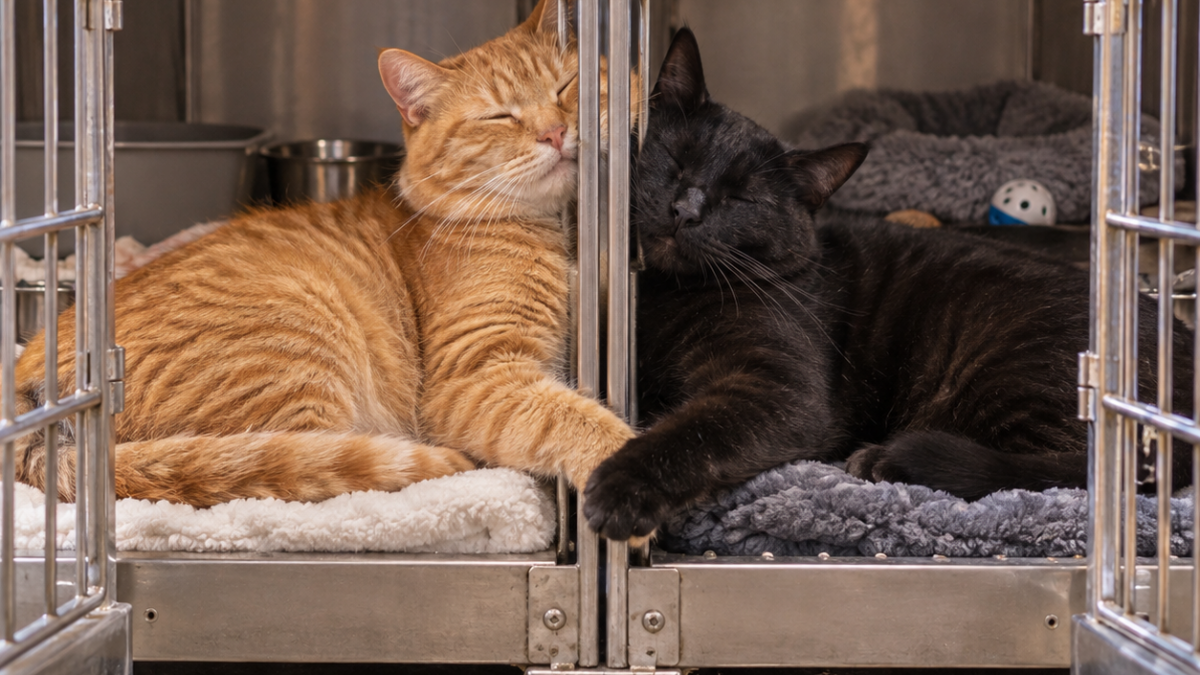
Brick was lying on his right side against the divider between cage 9 and cage 10.
Mortar was lying on his left side against the same divider.
Their bodies were aligned perfectly.
Orange fur on one side.
Black fur on the other.
Between them, the metal bars.
I smiled.
“Well, that’s new.”
Mortar’s eyes opened.
Brick’s tail twitched once.
I thought it was coincidence.
Animals in shelters often choose strange sleeping spots. Some cats sleep in litter pans at first because enclosed spaces feel safer. Some sleep on shelves. Some press against the warmest wall. The bottom row had a draft near the front, so maybe the middle divider was warmer. Maybe both cats had simply found the same comfortable place.
The next morning, they were still there.
Brick against the bars.
Mortar against the bars.
Their fur pushed slightly through the gaps in the metal.
When Brick shifted, Mortar shifted.
When Mortar stretched, Brick adjusted.
Ashley noticed during breakfast.
“Look at them.”
“I saw it last night.”
“Have they met?”
“No.”
“Not even during intake?”
“No.”
She crouched.
“Hey, boys.”
Brick looked annoyed.
Mortar blinked slowly.
Ashley tilted her head.
“That’s weirdly cute.”
“Don’t say that too loudly. The universe punishes cute here.”
But the universe, for once, let us have it.
For the next week, Brick and Mortar did the same thing every day.
They ate.
Used their litter boxes.
Accepted attention.
Then returned to the divider.
Brick always on his right side.
Mortar always on his left.
Their backs curved toward each other. Their paws sometimes slipped through the bars. More than once, I saw Mortar’s tail lying partly inside Brick’s cage, and Brick’s front paw resting over it like he was afraid it might disappear.
“They’re bonded,” Ashley said one morning.
“They met six days ago.”
“So?”
“That’s not usually how bonded pairs work.”
“Maybe they work fast.”
I wanted to dismiss it.
Not because I disliked the idea.
Because I knew what bonded meant.
Bonded meant hard to adopt.
Bonded meant conversations.
Bonded meant people looking at us with disappointment when we said, “They need to go together.”
Bonded meant one animal might wait months because the world prefers love in convenient portions.
But I had been doing rescue long enough to know better than to ignore what animals were telling me.
So we tested it.
Not cruelly.
Not casually.
Just enough to understand.
Mortar needed to be moved to the exam room for a follow-up anyway, so after his appointment, we placed him temporarily in an empty cage across the aisle while we cleaned cage 10.
The change was immediate.
Mortar froze.
Then he turned toward the place where Brick had been.
He stared at cage 9 from across the room.
Brick sat up.
For several seconds, neither cat moved.
Then Brick let out a sound I had never heard from him before.
Not a meow.
Not a cry.
Something lower.
A broken, confused call.
Mortar answered with one sharp cry.
Ashley looked at me.
“Maybe we should hurry.”
We did.
But cleaning took fifteen minutes, and in those fifteen minutes, Mortar refused the treat Ashley offered. He ignored the food bowl. He ignored the towel. He stayed pressed against the front of the temporary cage, staring across the room at Brick.
When we returned him to cage 10, he walked straight to the divider.
Brick was already there.
They pressed against the bars so hard their fur pushed through in little orange and black tufts.
Ashley whispered, “Okay.”
I nodded.
“Okay.”
Still, a week later, we tried again.
We needed to know whether this was attachment or stress behavior.
This time, we moved Mortar to a cage on the other side of the room for a longer period, planning to observe carefully.
Mortar stopped eating.
The first day, he ignored breakfast.
That was concerning but not unheard of.
The second day, he ignored dinner.
That was dangerous.
The third day, he sat facing the wall where Brick’s cage would have been if the world made sense to him.
He did not groom.
He barely moved.
When I opened his cage and offered food by hand, he turned his face away.
“Mortar,” I whispered.
Nothing.
Across the room, Brick had stopped finishing his meals too. He ate a few bites, then lay against the divider of his empty side, the side that no longer had Mortar on the other side.
On the third afternoon, I stood in front of Mortar’s temporary cage holding his untouched bowl.
Ashley came up beside me.
“We have to put him back.”
“I know.”
“We can’t prove everything scientifically.”
“I know.”
“Claire.”
“I said I know.”
We returned Mortar to cage 10.
He stepped out of the carrier, walked directly to the shared divider, and lay down.
Brick came immediately.
Their bodies met through the bars.
Less than ten minutes later, Mortar ate.
After that, I stopped pretending this was simple.
The second test happened by accident, though I blamed myself for it for weeks.
A plumbing issue forced us to temporarily move several cats from the bottom row. Brick had to go to a clean cage near the front while maintenance worked near cage 9.
I told myself he would be fine for a few hours.
He was not.
Brick stopped eating.
For three days.
He sat facing the wall.
Exactly like Mortar had.
The big orange cat who had slowly begun accepting affection curled into silence again. He ignored toys. Ignored treats. Ignored the blue blanket that had once been his comfort. Mortar, back in cage 10, pressed against the divider where Brick should have been and cried until his voice went hoarse.
On the third day, maintenance finished.
We put Brick back.
Mortar was waiting.
Brick stepped from the carrier, crossed his cage without even glancing at his food, and pressed himself against the bars.
Mortar pushed against him from the other side.
They stayed like that for almost an hour.
No one in the cat room spoke.
From that day on, the board on the wall changed.
Brick — cage 9.
Mortar — cage 10.
Bonded pair. Must be adopted together.
That should have been the solution.
It became the problem.
Brick was easy to market.
Orange tabby. Round face. Gentle personality. Former house cat. Good litter-box habits. Loved chin scratches. Photographed beautifully.
People loved Brick.
They stopped in front of cage 9 constantly.
“Oh, look at him.”
“He’s so handsome.”
“I’ve always wanted an orange cat.”
“My grandmother had one just like him.”
“Is he available?”
“Yes,” I would say. “But he’s bonded with Mortar. They need to be adopted together.”
Then the person would look at cage 10.
Mortar would usually be lying against the bars, his black fur blending into the shadows of the bottom cage.
“Oh.”
That one syllable told me everything.
Sometimes they tried to be polite.
“I really only planned on one.”
“I don’t have room for two.”
“My lease allows one cat.”
“I’m not sure about black cats.”
“My husband doesn’t like black cats.”
“My kids wanted an orange one.”
“I just feel a connection to Brick.”
I heard versions of it again and again.
By May, Brick had received nineteen adoption inquiries by himself.
Mortar had received eleven.
Together?
Zero.
By June, the numbers grew.
Twenty-seven for Brick.
Fifteen for Mortar.
Together?
Still zero.
By August, we had a running tally taped inside the staff office, though I started to hate looking at it.
Brick alone: 41.
Mortar alone: 23.
Both: 0.
Not one person had filled out an application for both cats.
Not one.
People stopped in front of cage 9 and fell in love with Brick.
People stopped in front of cage 10 and softened when Mortar reached one black paw through the bars.
But the moment we said they came as a pair, interest vanished.
It happened so often that I began anticipating the disappointment before the words even left their mouths.
One Saturday, a woman named Angela spent twenty minutes sitting in front of Brick’s cage. He rolled onto his back for her, which he almost never did for strangers.
“He likes me,” she said, smiling.
“He does.”
“I think he’s the one.”
I took a breath.
“He has a bonded companion.”
Angela looked at me.
“What does that mean?”
“It means he needs to be adopted with Mortar.”
I gestured toward cage 10.
Mortar was sitting quietly beside the divider.
Angela’s smile faltered.
“Oh.”
There it was.
“Oh.”
“He’s very sweet,” I said. “They’re deeply attached.”
“I only want one cat.”
“I understand.”
“I mean, I came for one.”
“I understand.”
She looked at Brick again.
“Wouldn’t he adjust?”
The question landed harder than she meant it.
I thought of Brick refusing food.
Facing the wall.
Waiting.
“No,” I said gently. “I don’t believe he would.”
Angela stood.
“That’s too bad.”
She left without looking at Mortar again.
Afterward, I sat on the floor in front of the cages.
Brick reached one paw through the bars toward Mortar.
Mortar pressed his cheek against it.
“I’m sorry,” I whispered.
I wasn’t sure which one I was apologizing to.
Maybe both.
Maybe myself.
Shelter work is full of impossible math.
Too many animals.
Too little space.
Too many emergencies.
Too few adopters.
Too much suffering.
Too little money.
Every decision becomes an equation you never wanted to solve.
Two bonded cats taking up two cages for eight months was not a small thing. I knew that. The shelter board knew that. Our intake list kept growing. Every week, we received calls about kittens in sheds, seniors whose owners had died, injured strays, cats left behind in apartments.
Space mattered.
And yet every time someone suggested we might need to reconsider the adoption requirement, I looked at cage 9 and cage 10.
Brick and Mortar were pressed against the divider.
Always.
Not simply near each other.
Against each other.
Their fur mingled through the metal.
Two cats who had not been surrendered together.
Two cats who were not brothers.
Two cats who had never shared a room.
Two cats who had somehow found each other through a cage wall and decided that was enough to keep going.
How could I tell them love did not fit our space limits?
In September, the board held a meeting.
I knew what was coming before I walked into the conference room.
Our shelter director, Marlene, looked exhausted. She was sixty-two, with short gray hair, reading glasses always hanging from a cord around her neck, and the kind of practical compassion that kept shelters alive. She loved animals fiercely, but she also knew love did not pay electric bills.
“We need to discuss cage 9 and 10,” she said.
No one looked at me.
That was how I knew everyone had already discussed it without me.
I folded my hands on the table.
“They stay together.”
Marlene sighed.
“Claire.”
“They don’t eat when separated.”
“We know.”
“They shut down.”
“We know.”
“They have no one else.”
Marlene removed her glasses.
“We have thirty-two cats in a building designed for twenty-four. We have six more waiting to come in. Two bonded cats occupying two cages for eight months is a problem.”
“I’m aware.”
“Then give us a solution.”
I didn’t have one.
That was the worst part.
I had passion.
I had evidence.
I had two cats pressed through bars.
I did not have a home.
“We need a better photo,” Ashley said from the end of the table.
Everyone turned.
“What?” Marlene asked.
Ashley straightened.
“We keep posting their individual photos. Brick sitting up. Mortar looking cute. People don’t understand. They hear bonded pair and think we’re being sentimental.”
“We are not being sentimental,” I said.
“I know. But they don’t know. We need to show them.”
“How?”
Ashley shrugged.
“From the floor.”
That evening, after closing, Ashley lay down in the cat-room hallway with her phone. I stood behind her holding a bag of treats, mostly unnecessary because Brick and Mortar were already in their usual position.
Cage 9.
Cage 10.
Bottom row.
The metal divider between them.
Brick on his right side.
Mortar on his left.
Their bodies pressed so tightly to the bars that orange and black fur pushed through the gaps, touching in tiny impossible places. Brick’s paw rested partly through one opening. Mortar’s cheek pressed against it. From Ashley’s angle, they looked like one animal divided by a line of metal.
She took several photos.
Then she stopped.
“Oh.”
“What?”
She turned the phone around.
I stared at the screen.
The picture was not polished.
The lighting was poor. The floor showed. The cages looked old because they were old. There was a water bowl in the corner and a scratch on the wall behind Brick.
But the photo told the truth.
Two cages.
One bond.
Eight months of love trapped inches apart.
Ashley whispered, “This one.”
I nodded.
“That one.”
Marlene wrote the caption herself.
Brick and Mortar met through cage bars.
They were not surrendered together. They are not brothers. They had never known each other before arriving here.
Brick is in cage 9. Mortar is in cage 10.
For eight months, they have slept pressed against the divider between them.
We tried moving Mortar. He stopped eating for three days.
We tried moving Brick. He stopped eating too.
Since then, we have stopped asking them to prove what they already told us.
Brick has received 41 adoption inquiries.
Mortar has received 23.
Together, they have received 0.
They have never been in the same room.
They have never curled up together without bars between them.
They have never touched except through metal.
Please, someone be willing to count to two.
We posted it at 7:12 p.m. on a Tuesday.
By 7:30, it had been shared forty times.
By 8:15, three hundred.
By morning, thousands.
The comments poured in.
I’m crying.
Someone adopt them both.
They’ve never been in the same room?
This broke me.
I wish I could.
Please update us.
Why are black cats always overlooked?
Brick and Mortar. Even their names belong together.
For the first time in months, I felt hope.
Then the messages began.
Do you transport to Oregon?
Can they live with six dogs?
Can I adopt Brick and let my neighbor adopt Mortar?
Will you separate if I pay a higher fee?
Can I take Brick now and maybe Mortar later?
Can you hold them for three months?
Are they declawed?
Is the black one friendly or just attached to the orange one?
I closed my laptop.
Hope, in rescue, often arrives wrapped in frustration.
Still, among the chaos, real applications began to appear.
Not many.
But some.
The first family had three young children and two large dogs with no cat experience. Not a fit.
The second lived in a studio apartment with a strict one-pet lease and hoped the landlord “wouldn’t notice.” Not a fit.
The third wanted them as barn cats.
Absolutely not.
The fourth seemed perfect on paper until the woman admitted she wanted Brick for herself and Mortar “for company in the basement.”
No.
Then came application number five.
Applicant name: Ruth Whitaker.
Age: 74.
Residence: Small house, fenced yard, screened sunroom.
Current pets: None.
Previous pets: Two cats, both deceased within the last three years. Adopted as seniors. Both indoor only.
Reason for interest: “I know what it means to need someone beside you.”
That sentence made me pause.
I read the rest carefully.
Ruth lived thirty minutes away in a quiet neighborhood near the river. Her veterinarian reference was excellent. Her previous cats, Louise and Fern, had lived to nineteen and twenty-one. Her home had no dogs, no small children, no chaos. She was retired, widowed, and home most of the day.
When Marlene called her, Ruth answered on the second ring.
“I was hoping you’d call,” she said.
“You understand they must be adopted together?”
“Yes.”
“They may need time to adjust.”
“So do most of us.”
“They have never been loose in the same room together.”
“I read that.”
“We don’t know exactly how they’ll behave once the bars are gone.”
“I suppose they don’t either.”
Marlene looked across the office at me.
I tried not to smile too soon.
Ruth came the next afternoon.
She was small, with silver hair pinned at the back of her head, a blue cardigan despite the warm weather, and hands that looked delicate until she shook mine. Her grip was firm.
“I’m Claire,” I said.
“Ruth.”
She looked toward the cat room.
“Are they still here?”
“Yes.”
“Good.”
She said it like she had been afraid someone else might have gotten there first.
We walked to the bottom row.
Brick and Mortar were in their usual place.
Ruth stopped several feet away.
For a long moment, she said nothing.
Then she lowered herself slowly onto the floor.
Not in front of Brick.
Not in front of Mortar.
In front of the divider.
Exactly between them.
That was the first thing I noticed.
Most people chose one cat to look at first.
Ruth looked at both.
“Well,” she said softly. “There you are.”
Brick opened his eyes.
Mortar lifted his head.
Ruth did not reach toward them.
She simply sat.
Minutes passed.
Brick stood first. He stretched, walked to the front of cage 9, and sniffed the air near her fingers.
Mortar followed.
Ruth smiled.
“I see.”
“What?” I asked.
“They’re not two halves,” she said.
I looked at her.
“They’re two whole cats who chose each other.”
My throat tightened.
“Yes.”
Ruth stayed for almost an hour.
She talked to them about her sunroom. About the birds that came to the feeder. About the old quilt on her guest bed where her previous cats used to nap. About her husband, Walter, who had died four years earlier and always claimed he was “not a cat person” while cutting turkey into tiny pieces for Louise.
Brick eventually pressed his face against the cage door.
Mortar blinked slowly at her.
Before leaving, Ruth looked at me.
“What happens next?”
“Home visit. Vet reference confirmation. Adoption approval. Then we plan a slow transition.”
She nodded.
“Good.”
Most applicants ask how quickly they can take an animal home.
Ruth asked what the cats needed first.
That mattered.
The home visit happened two days later.
Ashley and I drove out together.
Ruth’s house sat on a quiet street lined with maple trees. There were wind chimes on the porch, two rocking chairs, and a ceramic birdbath in the yard. Inside, the house smelled faintly of lemon polish and old books.
The sunroom was perfect.
Large windows.
Soft rugs.
Two cat trees.
A wide bench with cushions.
Food and water stations set up on opposite sides, just in case.
Two litter boxes.
Two beds.
And in the middle of the room, one large shared blanket.
Ashley looked at me.
I looked away.
Ruth noticed.
“I wasn’t sure whether they’d want separate beds or one.”
“Probably both,” I managed.
“That’s what I thought.”
On the wall near the window were framed photos of two elderly cats.
Louise and Fern.
Below them sat a photograph of a man in a fishing hat smiling at the camera.
“My husband,” Ruth said.
“Walter?”
“Yes.”
She touched the frame lightly.
“He died in this house. Hospice bed right over there, where the bookshelf is now.”
I didn’t know what to say.
Ruth smiled gently.
“It’s all right. It was sad, but it was not terrible. There’s a difference. He was loved. He knew it.”
She looked toward the sunroom.
“After he died, Louise stopped sleeping in our bedroom. She slept outside the door instead. Fern stayed with her. I used to think they were waiting for him together.”
Ashley wiped at her eye.
Ruth pretended not to notice.
“When I saw Brick and Mortar,” Ruth continued, “I thought, well, I know something about waiting with someone.”
The adoption was approved unanimously.
For Brick and Mortar, however, approval was only the beginning.
We had to decide how to introduce two cats who were bonded but had never shared space. It sounded absurd, but it mattered. Through bars, they could smell each other, touch slightly, and lie together. But open space was different. Cats are territorial. Stress changes behavior. Love through a divider did not guarantee immediate harmony without one.
Dr. Singh, our shelter veterinarian, advised a controlled introduction in the shelter before transport.
“We should let them meet in the visiting room,” she said. “Supervised. Short session first.”
I was nervous.
More nervous than I admitted.
What if they fought?
What if the bars had created an attachment that didn’t survive freedom?
What if we had built an entire story around something we misunderstood?
The visiting room was small but quiet, with a rug, a bench, a cat tree, and no hiding places we couldn’t access. We cleaned it thoroughly, placed two bowls of treats on opposite sides, and brought Brick in first.
He stepped out of the carrier cautiously.
Sniffed.
Walked the perimeter.
Then looked at the door.
Mortar’s carrier arrived next.
He was silent inside it, but his green eyes were wide.
Ruth stood beside me.
She had come because we wanted her to be part of the process if all went well.
“Ready?” Ashley whispered.
“No,” I said.
She opened the carrier door.
Mortar stepped out.
For three seconds, nothing happened.
Brick froze.
Mortar froze.
They stared at each other.
No bars.
No divider.
No metal between them.
Just space.
Then Brick made that same low sound I had heard when Mortar was moved across the room months earlier.
Mortar answered.
Brick walked forward.
Mortar met him halfway.
They touched noses.
Then Mortar pressed his entire face against Brick’s cheek.
Brick leaned into him so hard both cats nearly tipped sideways.
Ruth covered her mouth.
Ashley started crying openly.
I didn’t even pretend.
They circled each other, sniffing, bumping shoulders, pressing side to side. Brick licked the top of Mortar’s head. Mortar tucked himself under Brick’s chin. Then, as if eight months of waiting had exhausted them, they walked together to the rug, turned in a clumsy little circle, and curled into one shape.
Orange around black.
Black against orange.
No bars.
No gap.
No metal.
For the first time, Brick and Mortar slept in the same room.
Actually touching.
Ruth whispered, “Oh, boys.”
We let them stay there for two hours.
No one wanted to move them.
Eventually, practical life returned because practical life always does. Carriers had to be prepared. Papers had to be signed. Instructions had to be reviewed. Adoption fees had to be processed, though Ruth had already written a check and added an extra donation “for the cats who are still waiting.”
When it was time to transport them, we placed both cats in one large carrier lined with Brick’s blue blanket and a towel Mortar had slept on.
Brick entered first.
Mortar followed.
They settled together.
Ruth watched.
“I thought I was ready,” she said softly.
“For what?”
“To love something again.”
I looked at the carrier.
“Maybe no one is ever ready.”
She smiled.
“Maybe we do it anyway.”
At Ruth’s house, we set them up in the sunroom.
We opened the carrier door and stepped back.
Brick emerged first, low to the ground, cautious but curious. Mortar followed so closely his nose nearly touched Brick’s tail. They explored together. When Brick paused near the window, Mortar paused too. When Mortar sniffed the cat tree, Brick bumped his side as if reminding him he was there.
Ruth sat in the rocking chair with her hands folded in her lap.
No reaching.
No rushing.
No demands.
Just presence.
By evening, Brick and Mortar had found the shared blanket.
Of course they had.
They lay on it together, no longer separated by bars.
Ruth sent us a photo that night.
Brick was on his right side.
Mortar on his left.
Just like before.
Only now, there was no metal between them.
The caption read:
They finally fit.
The shelter staff gathered around my phone like it held proof of a miracle.
Marlene cried first.
Then Ashley.
Then me.
Even Dr. Singh, who was usually composed enough to remove stitches while eating crackers, wiped her eyes and said, “Well, that was worth eight months.”
The post announcing their adoption went up the next morning.
Brick and Mortar went home together.
They met through cage bars.
They waited eight months.
Today, they slept side by side without anything between them.
Thank you, Ruth, for counting to two.
The internet did what the internet does.
It cried.
It shared.
It asked for updates.
But inside the shelter, something quieter happened.
People began asking about bonded pairs.
Not hundreds.
Not even dozens.
But some.
A woman who had previously wanted one kitten asked about adopting two littermates together. A retired man asked whether we had any seniors who “came as a set.” A young couple adopted two shy sisters who had been overlooked for months because they hid whenever anyone entered the room.
Brick and Mortar left space behind.
But somehow, they also opened space.
That is one of the strange things about rescue.
A happy ending does not solve everything.
But it gives people the courage to try again.
Ruth sent updates constantly.
Brick discovered the windowsill and appointed himself supervisor of all backyard birds. Mortar became obsessed with the laundry basket. Brick loved Ruth’s slippers. Mortar loved Ruth’s knitting bag. Brick slept beside Ruth’s hip at night. Mortar slept against Brick.
Within two weeks, they had taken over the sunroom.
Within a month, they had taken over the house.
Ruth claimed she was still in charge.
The photographs suggested otherwise.
One showed Brick sitting inside a casserole dish.
Another showed Mortar asleep in Ruth’s sink.
Another showed both cats on the guest bed, lying on Walter’s old quilt.
That one made me pause.
I called Ruth after she sent it.
“Are you okay?” I asked.
She knew what I meant.
“Yes.”
“You sure?”
She was quiet for a moment.
“That quilt was the last one Walter used. I kept it folded in the closet for years because I couldn’t bear to wash it and couldn’t bear to see it.”
“And now?”
“Now it has cat hair on it.”
I laughed softly.
“So much cat hair,” she said.
Her voice trembled.
“I think that’s better.”
The months passed.
Brick gained weight.
Mortar’s coat became glossy.
Brick became more outgoing, greeting visitors with the confidence of a cat who believed every person had come specifically to admire him. Mortar remained quieter, but Ruth said he followed her everywhere.
“If I go to the kitchen, Mortar comes. If I go to the bathroom, Mortar comes. If I open a closet, Mortar supervises.”
“He was a stray,” I said. “Maybe he likes knowing where his person is.”
Ruth paused.
“Maybe we both do.”
In December, Ruth invited the shelter staff to visit.
Marlene, Ashley, Dr. Singh, and I went together, carrying a small basket of toys and treats. Ruth opened the door wearing a red sweater with embroidered cats on it.
“I promised myself I would never become this kind of woman,” she said.
Ashley grinned.
“It happens slowly.”
“No, it happened immediately.”
Brick appeared first, tail high, orange fur shining. Mortar followed from the hallway, black coat sleek, green eyes bright.
For one strange second, I saw them as they had been.
Bottom row.
Cage 9.
Cage 10.
Pressed through bars.
Waiting.
Then Brick trotted toward us and Mortar bumped his shoulder, and the memory loosened.
They were not waiting anymore.
Ruth had set up tea in the sunroom. Outside, a thin layer of snow covered the backyard. Birds hopped around the feeder. Inside, the room was warm.
Brick climbed into Marlene’s lap like he had always belonged there.
Mortar sat beside Ruth.
I watched them for a while.
Ruth noticed.
“What are you thinking?”
“That I was afraid we’d never find you.”
She smiled.
“I was afraid I was done being needed.”
Mortar stretched one paw across her knee.
Ruth placed her hand gently over it.
“I suppose we were all wrong.”
Near the window, Brick rolled onto his back, completely shameless.
Ashley took at least twenty photos.
Before we left, Ruth handed me a small envelope.
“What’s this?”
“Open it later.”
I did, in my car.
Inside was a check for the shelter.
And a note.
For the ones still waiting.
Thank you for not deciding their love was inconvenient.
I sat behind the steering wheel for several minutes before starting the engine.
Shelter work teaches you many things.
It teaches you that people can be careless.
It teaches you that people can be cruel.
It teaches you that love is not always enough to keep an animal safe, because people can love badly, selfishly, or only when life is easy.
But it also teaches you that the right person can arrive late and still arrive in time.
Ruth arrived after eight months.
After sixty-four people wanted only one.
After two failed separations.
After two cats had spent more than half a year pressing fur through metal.
She arrived in time.
One year after the adoption, Ruth asked if she could bring Brick and Mortar back to the shelter for a visit.
We normally discouraged that. Returning to the building could stress animals who had finally settled elsewhere.
But Ruth wanted to make a donation in person, and the cats were unusually confident by then. Dr. Singh said a short visit might be fine if we watched them carefully.
So on a bright Saturday morning, Ruth walked through the shelter doors carrying a large soft-sided carrier.
Brick’s orange face was visible through one side.
Mortar’s green eyes through the other.
The staff gathered like relatives at an airport.
Ruth laughed.
“You’d think I brought celebrities.”
Marlene said, “You did.”
We took them into the visiting room, not the cat room at first. Brick stepped out, sniffed, and immediately began investigating. Mortar followed and then looked at Brick as if checking whether this adventure had been approved.
Then, after a few minutes, Brick walked to the door.
He knew.
I felt it.
Ruth looked at me.
“Should we?”
I hesitated.
Then nodded.
“Just for a minute.”
We carried them into the cat room.
The bottom row had changed. Cage 9 held a shy gray cat named Pepper. Cage 10 held a pair of kittens who were asleep in a pile.
Brick stood in the aisle.
Mortar stood beside him.
For a long moment, both cats looked at the cages.
I don’t know what cats remember.
I don’t know whether they recognized the room as the place where they had spent eight months waiting for someone capable of seeing both of them.
But Mortar moved closer to Brick.
Brick leaned back.
Their sides touched.
No bars.
No divider.
No metal.
Ashley whispered, “I can’t.”
Ruth bent and stroked both their backs.
“You’re not staying, boys,” she said. “Just visiting.”
Brick flicked his tail as if insulted by the suggestion.
Mortar looked toward the exit.
That was enough.
We returned to the visiting room, gave them treats, and let them settle. Before leaving, Ruth asked to see the current bonded pairs.
Marlene showed her two senior cats surrendered after their owner entered assisted living. They were curled in one bed, both gray, both thirteen years old.
Ruth looked at me.
“Are they available?”
“Not yet. Dental work next week.”
“Call me when they are.”
I stared at her.
“Ruth.”
“What?”
“You already have Brick and Mortar.”
“I’m aware.”
“That would be four cats.”
“I can count that high.”
Marlene covered her mouth to hide a smile.
I said, “Let’s get through the dental first.”
Ruth did not adopt the senior pair.
Her neighbor did.
Because Ruth shared their story at church.
That became her habit.
She became, in her own quiet way, an advocate for the animals nobody wanted in convenient numbers.
Bonded pairs.
Senior cats.
Black cats.
Cats who needed medication.
Cats who hid during meet-and-greets.
She started bringing handmade blankets to the shelter every month. Each had a small tag sewn into the corner.
You are worth taking home.
The first time I saw one, I had to step into the supply closet and cry for a minute.
Brick and Mortar grew older.
Not old, exactly.
Just settled.
Time softened them.
Brick became rounder. Mortar became braver. Ruth became busier than any seventy-four-year-old widow had a right to be.
She hosted “cat tea” on Sundays, where neighborhood children could sit in her sunroom and read aloud to Brick and Mortar. Brick loved the attention. Mortar preferred sitting behind Ruth’s chair, listening from safety. Sometimes, though, he would approach a quiet child and rest beside them.
“Mortar chooses the lonely ones,” Ruth told me.
“How can you tell?”
She looked at him across the room.
“Because I was one.”
Three years after the adoption, Ruth called me late one evening.
My heart immediately tightened.
That is what rescue does to you.
Late calls become emergency-shaped.
But Ruth’s voice was calm.
“Claire, I need to ask you something.”
“What’s wrong?”
“Nothing urgent.”
“You say that like someone who knows it is urgent.”
She sighed.
“I had a doctor’s appointment.”
I closed my eyes.
“What did they say?”
“Nothing that gives anyone permission to panic. But I’m seventy-seven. I need to be practical.”
“Ruth…”
“No. Listen.”
I did.
“I’ve made arrangements. If anything happens to me, Brick and Mortar go to my niece, Caroline. She has already agreed. She lives fifteen minutes away. They know her. She visits every week.”
My throat tightened.
“Okay.”
“I also put it in writing.”
“Good.”
“And I put the shelter as backup, just in case.”
“Ruth.”
“I know. But I need you to promise me something.”
“What?”
“If I go first, they stay together.”
I looked at the wall in my kitchen.
There were moments in rescue when the past returned so suddenly it took your breath away.
Cage 9.
Cage 10.
Fur through metal.
“They stay together,” I said.
“Promise?”
“I promise.”
She exhaled.
“Thank you.”
Ruth did not go first.
Brick did.
It happened two years later, on a rainy morning in April.
He was ten by then, maybe older. He had been healthy until he wasn’t, the way cats sometimes are. Ruth noticed he didn’t finish breakfast. That was unusual enough to call Dr. Singh immediately.
The diagnosis came fast.
A hidden tumor.
Internal bleeding.
The kind of thing that turns ordinary mornings into endings.
Ruth called me from the clinic.
“Claire.”
I knew.
I drove there without asking.
Brick was lying on a blanket in a quiet room, Mortar pressed against him. Ruth sat beside them with one hand on Brick’s back and the other on Mortar.
Dr. Singh’s eyes were red.
“There isn’t a surgical option that would be fair to him,” she said gently.
Ruth nodded.
“I know.”
Brick lifted his head when I came in.
Barely.
“Hey, handsome,” I whispered.
His amber eyes blinked slowly.
Mortar did not move away from him.
That was what broke me.
Through cage bars, through adoption, through years of sunroom windows and quilts and slippers and children reading aloud, Mortar had stayed pressed against Brick.
Now he stayed again.
Dr. Singh gave Brick medication to ease his pain. Ruth leaned close and whispered things only Brick needed to hear. I stood beside her, one hand on her shoulder.
Mortar placed his paw over Brick’s.
No one in that room would ever forget it.
Brick died with his face turned toward Mortar.
For a while afterward, none of us spoke.
Then Ruth said, “He got everything after.”
It was not my phrase.
I had heard something like it before from other adopters, other stories, other griefs.
But that day, it became Brick’s.
He got everything after.
Not a perfect life.
Not a life without loss.
But a life after the cage.
A life after waiting.
A life after being unwanted as part of a pair.
Mortar grieved.
Of course he did.
For the first week, he searched the house.
He slept on Brick’s side of the blanket.
He stopped eating normally, and for one terrifying day I thought we were back at the beginning, back to three days without food, back to a wall where someone should have been.
But Ruth knew him now.
She did not panic.
She sat with him.
Hand-fed him.
Talked softly.
Opened the sunroom windows so he could hear birds.
Caroline came every afternoon.
I visited too.
On the fourth day, Mortar ate half a bowl of chicken.
On the sixth, he slept beside Ruth’s hip.
On the tenth, he carried one of Brick’s old toy mice into the sunroom and placed it on the shared blanket.
Ruth called me crying.
“I think he’s trying.”
“He is.”
“So am I.”
“I know.”
Mortar lived three more years.
He became quieter after Brick, but not empty. Never empty. Ruth said he had changed shape around the loss, the way water changes around a stone.
He still enjoyed children reading. He still followed Ruth from room to room. He still slept on the shared blanket, though now he stretched across the middle as if occupying enough space for both of them.
When Mortar died at sixteen, he was old, loved, and warm.
Ruth called me afterward.
“He went in his sleep,” she said.
I sat down.
“I’m sorry.”
“He was on the blanket.”
Of course he was.
“I think Brick came for him,” she said.
I am not someone who says things I don’t believe just to soften grief.
But I said, “Maybe he did.”
Ruth buried Brick and Mortar’s ashes together beneath the maple tree behind her sunroom. She placed a small stone there.
It read:
BRICK & MORTAR
THEY FOUND EACH OTHER THROUGH BARS
AND BUILT A HOME
When I visited, Ruth stood beside me with her hands folded.
“I used to think I saved them,” she said.
“You did.”
She shook her head.
“No. They saved part of me I thought had closed.”
I looked through the sunroom windows. The shared blanket was still there, folded neatly on the bench.
“I think rescue works that way,” I said.
“Does it?”
“Most of the time, nobody knows who saved who.”
Ruth smiled.
“That sounds right.”
Years have passed since Brick and Mortar left cage 9 and cage 10.
The bottom row has changed many times.
Hundreds of cats have come through.
Some stayed days.
Some stayed months.
Some broke our hearts.
Some healed them.
But I still think of those two whenever I see animals pressed together in fear or love or both. I think of the way people looked at one and not the other. I think of the number zero beside their names. I think of Ruth sitting on the shelter floor, looking not at cage 9, not at cage 10, but at the space between them.
The place where their love had been forced to live.
That was what everyone else had missed.
They saw two cats.
Ruth saw a promise.
Brick and Mortar were not brothers.
They were not surrendered together.
They did not come from the same home.
They met through bars.
And somehow, in a place built from loss, they chose each other.
For eight months, they slept with metal between them.
For eight months, they pressed their fur through the gaps just to feel a fraction of warmth.
For eight months, people asked for one and walked away when told love came with another name attached.
Then one person counted to two.
That was all.
One person.
One home.
One yes big enough for both of them.
People often ask why shelters insist on keeping bonded animals together.
I tell them about Brick and Mortar.
I tell them about the three days Mortar didn’t eat.
The three days Brick faced a wall.
The photograph from the floor.
The first time they met without bars.
The way they touched noses and collapsed into sleep as if they had been holding their breath for eight months.
Then I tell them the truth shelter work teaches you over and over again.
Love is not always convenient.
Sometimes it takes two carriers.
Two food bowls.
Two vet appointments.
Two names on one adoption form.
Sometimes it costs more.
Sometimes it asks you to rearrange the life you thought you were looking for.
But sometimes, if you are willing to make room for the whole story instead of the easy part, you get to witness something extraordinary.
You get to watch two animals who were once separated by metal spend the rest of their lives choosing the same blanket.
Brick was orange.
Mortar was black.
One arrived in January.
The other in March.
They should have been strangers.
Instead, they became home.
And in the end, the bars were not the most important part of their story.
The most important part was that someone finally opened them.








