I Went to the Shelter for One Calm Cat—Then a Kitten Screamed When They Lifted Her Brother Out of Cage 17, and I Knew I Couldn’t Separate Them
PART3:
Then I hung up and made dinner for one.
Sometimes I didn’t even do that.
Sometimes I ate cereal standing at the counter or crackers over the sink because cooking one full meal felt like an announcement that nobody else was coming.
That was how I ended up in the shelter parking lot on a gray Saturday morning, gripping the steering wheel and telling myself I was not making an emotional decision.
Just one cat.
One food bowl.
One litter box.
One warm body in the house.
One thing to care for without admitting I needed care too.
The shelter sat at the end of a cracked parking lot in a tired old brick building.
Inside, it smelled like bleach, litter, wet fur, and nervous hope.
A woman at the front desk asked what I was looking for.
“An adult cat,” I said. “Something mellow.”
She gave me the kind of smile people give when they already know life is about to hand you something else.
“Let’s take a walk,” she said.
Her name was Denise.
She wore purple sneakers, a sweatshirt with paw prints on it, and the tired, kind face of a woman who had learned how often love arrived too late.
She walked me down a row of cages.
Some cats slept through our footsteps.
Some pressed against the bars.
One old black cat watched me like he had already judged my personality, credit score, and cooking skills and found all three disappointing.
I almost picked him.
He would have been perfect.
Quiet.
Grown.
Judgmental enough to make the house feel occupied but not energetic enough to rearrange it.
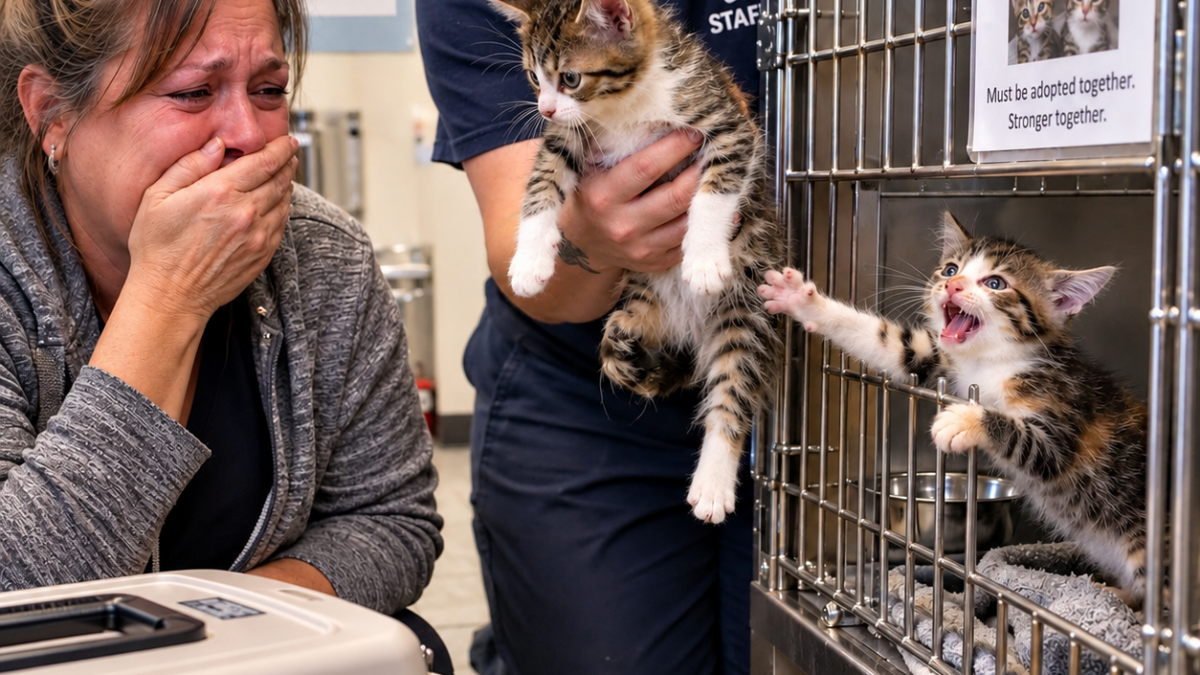
Then we stopped in front of Cage 17.
Two kittens were inside on one folded towel.
They were pressed so tightly together they looked like one small frightened creature with too many paws.
The one in front sat upright when I stepped closer.
Tiny chest out.
Ears up.
Trying so hard to look brave that the effort itself nearly broke my heart.
The other had her face buried into his side like she wanted to disappear inside him.
Neither made a sound.
Denise lowered her voice.
“They came in together.”
I looked at the card.
No names yet.
Just numbers, estimated age, intake date, and the words found behind shopping center.
“Are they littermates?”
“We think so. Brother and sister, probably. About twelve weeks old.”
The little male blinked slowly at me.
The smaller female trembled so hard I could see it along her spine.
“They’re bonded,” Denise said. “Very bonded.”
I kept staring.
“People say that a lot now,” I said, because I had read enough online comments to know strangers loved accusing everyone of exaggerating attachment.
Denise did not get defensive.
She only nodded.
“They do. But these two panic when separated. We learned that fast.”
The smaller kitten lifted her head just enough to look at me.
Her eyes were too big for her face.
The male shifted in front of her like a shield.
“That makes it harder,” Denise added.
Harder.
I knew what she meant.
Harder to place.
Harder to explain.
Harder to ask somebody to say yes to two when most people came in planning for one.
Harder to fit into someone’s neat idea of rescue.
I should have nodded and kept walking.
Instead I asked, “Can I see him?”
The second I said it, the smaller kitten lifted her head fully.
Denise opened the cage slowly and reached in.
The little male froze, but he let her pick him up.
And that was when it happened.
The kitten left in the cage made a sound so sharp and broken that every person in the room turned.
It was not a meow.
It was not even crying.
It sounded like terror had been given a heartbeat.
She lunged forward so fast she slipped on the towel, caught herself, and kept reaching through the air toward him like she could pull him back by force.
The kitten in Denise’s arms started shaking too.
Not fussing.
Not wriggling.
Shaking.
He stretched every inch of his tiny body toward the cage, toward her, toward the only thing in that place that still made sense.
My throat closed.
Denise immediately put him back.
The two kittens collided.
The female shoved herself beneath his chin, and he wrapped himself around her with such frantic urgency that I had to look away.
Maybe because I knew that sound.
Not exactly.
But close enough.
I knew what it was to lose the one thing that made a strange place survivable.
I knew what it was to stare at a door after someone left and feel your body reject the idea that they were not coming back through it.
Denise stood beside me quietly.
“They calm down when they’re together.”
I looked at the carrier I had brought.
One carrier.
For one cat.
That was the plan.
One bowl.
One vet bill.
One small warm creature in a house that had become too hollow.
Behind the bars, the little female had gone silent again, but only because she had run out of breath.
Her mouth was open.
Her eyes stayed fixed on him like blinking might make him vanish.
“How long have they been here?” I asked.
“Almost a month.”
A month.
A month of people pausing.
A month of people asking, “Do they have to go together?”
A month of people deciding easier.
A month of two tiny lives surviving only because neither had been left behind yet.
I heard myself before I fully decided.
“Please don’t separate them.”
Denise looked at me.
“I’ll take both.”
She closed her eyes for half a second like she had been carrying that hope all morning and was afraid to set it down too quickly.
“You’re sure?”
No.
Of course I was not sure.
Only foolish people are sure before love rearranges everything.
But I said, “Yes.”
The ride home was all rustling and tiny frightened movement inside the carrier.
At every red light, I talked to them like they understood every word.
“You’re okay.”
“We’re almost there.”
“Nobody is taking anybody away.”
I said that last one more than once.
Maybe for them.
Maybe for me.
At home, I spread an old quilt on the floor beside my bed.
The bigger one stepped out first.
Slow.
Careful.
Still trying to be brave.
The smaller one followed immediately and pressed herself against his side so tightly it looked like she needed to prove he was real.
I named him Benno.
I named her Poppy.
Neither name mattered much that first night.
Fear was still bigger than names.
I sat on the floor in my socks and waited.
After a while, Benno curled around Poppy.
A little later, Poppy unclenched.
Then the room changed.
Not all at once.
Not like a movie.
Just enough.
Enough for the air to feel warmer.
Enough for the silence to stop sounding empty.
Enough for me to realize I had not gone there to save two kittens.
I had gone because something in me was tired of coming home to a house that felt unlived in.
That night, listening to their tiny breathing from the quilt beside my bed, I understood something I wish more people said out loud.
Sometimes love does not arrive in a neat shape.
Sometimes it comes shaking.
Sometimes it comes with another life already attached to it.
And sometimes the kindest thing you can do is stop asking what is easiest to carry and take home what refuses to survive alone.
The first weeks were not cute in the way rescue stories usually pretend.
There were cute moments, yes.
Benno discovered his own tail and acted personally betrayed.
Poppy sneezed herself backward once and then looked at me as if I had done it.
They fell asleep with their paws tangled together.
They fit inside one shoebox and seemed offended when I laughed.
But the middle of love is rarely photogenic.
The middle is litter dust.
The middle is diarrhea on the bath mat at 5:40 in the morning when you are already late for work.
The middle is reading the back of medicine bottles in panic because one kitten has decided chicken flavor tastes like old pennies and the other will only eat if you sit on the floor pretending not to watch.
The middle is finding out that every online article about “giving cats privacy” was written by someone who had never met Benno and Poppy.
They did not want privacy.
They wanted visibility.
If Benno could not see Poppy, he cried.
If Poppy could not hear Benno moving somewhere nearby, she flattened herself to the floor and went still in a way that made my stomach hurt.
The first time I shut the bathroom door without realizing she was inside, I heard that sound again.
Thin at first.
Threadbare.
Panic trying not to take up too much space.
Then Benno launched himself at the door.
Again.
Again.
Again.
When I opened it, Poppy ran out low to the ground, slammed straight into his chest, and stayed there.
Both kittens looked at me like I had betrayed a treaty.
I sat on the hallway floor and cried.
Not dramatic crying.
The tired kind.
The kind that comes when you realize love is going to ask more of you than you budgeted.
At the end of week two, I took them to the vet.
One carrier.
Together.
I knew better by then.
Benno stayed alert the whole drive, sitting upright like a very small security guard.
Poppy buried her face into his shoulder.
At a red light, I looked through the little metal grate and saw his paw resting over her neck like a seatbelt.
That almost finished me.
The clinic was full of ordinary noises.
A dog panting.
A phone ringing.
Somebody turning magazine pages too slowly to be reading.
A child asking whether a lizard could get braces.
The technician looked into the carrier and smiled.
“Oh,” she said. “A matched set.”
“That is one way to put it.”
The exam itself was not terrible.
Ear mites.
Low weight on Poppy.
Stress-related stomach upset.
Vaccines.
Dewormer.
A bag of sensitive food.
A bottle of medicine flavored like chicken if you believed the label and like betrayal if you believed Benno.
Then the woman at the desk handed me the total.
I did not say anything.
I did not make a face.
I did what adults do when numbers hit harder than expected.
I got very still.
It was not a ruinous amount.
That is not the point.
The point is that there is the life you plan on paper, and then there is the life that swipes your card and asks if you want a receipt.
I drove home with the carrier buckled into the passenger seat, the clinic bag beside it, and an ugly little thought flickering in my chest.
Not regret.
Close enough to scare me.
At the kitchen table later, I opened my checkbook, grocery list, and a coupon flyer I had not planned to use.
Benno and Poppy sat under the table at my feet.
Every time I shifted, Poppy pressed closer to Benno.
I looked down at them and thought something I hated myself for thinking.
One would have been easier.
There it was.
Small.
True.
Embarrassing.
One would have been easier.
One bowl.
One set of shots.
One little body to feed.
One future to pay for.
One life to hold when I was already relearning how to hold my own.
That is the thing people do not say out loud because it sounds heartless.
Sometimes the wrong thought is also an honest one.
Honesty is not cruelty.
It only becomes cruelty when you build a life around the wrong thought and call it wisdom.
The next afternoon, Leah called.
We talked once or twice a week.
A little more if one of us was pretending not to need the other.
She wanted to see the kittens.
So I propped my phone against the sugar jar and carried Benno toward the screen while he made it clear he had not consented to this level of celebrity.
Leah laughed.
A real laugh.
The kind I had missed hearing in my kitchen.
Then Poppy crept into frame behind him, wide-eyed and uncertain.
“Oh no,” Leah said.
I smiled.
“What?”
She put a hand to her chest.
“That little one knows things.”
“She knows fear,” I said.
Leah went quiet.
Then she asked, “How are you doing?”
It should not have bothered me.
It was a loving question.
It still bothered me.
Because sometimes “How are you doing?” does not sound like curiosity.
It sounds like someone has noticed you are barely keeping your hands around your own life.
“We’re okay,” I said.
Leah looked at the kittens.
Then at me.
“You look tired.”
“I am tired.”
“You didn’t have to make your life harder, you know.”
There was no judgment in it.
That somehow made me bristle more.
“I know.”
She nodded.
Then smiled and asked me to send more pictures.
After we hung up, I stood in the kitchen too long with the dark phone screen in my hand.
Benno batted at my pant leg.
Poppy watched my face.
There are some sentences that would sound harmless to anybody else.
You didn’t have to make your life harder.
Perfectly reasonable.
Loving, even.
But if you are a certain age, and your child has left, and your house has learned your footsteps too well, it can land another way.
You could have chosen easier.
You could have chosen quieter.
You could have chosen not to need so much.
A few days later, my neighbor came by with banana bread and the kind of curiosity people pretend they are not carrying.
Her name was Marlene.
She had lived next door for eight years and knew everything about everyone because she gardened aggressively in her front yard.
By “heard I had kittens,” she meant Benno had launched himself into the front window the day before after spotting a leaf, and half the street had probably heard the crash.
I invited her in.
Benno hid under the armchair.
Poppy vanished completely.
Marlene sat at my kitchen table and looked around at the toys, bowls, folded blankets, and the cardboard scratcher already shedding little brown crumbs onto my rug.
“This is sweet,” she said.
Then Benno came out.
A few minutes later, Poppy slid from behind the bookshelf and went straight to him.
Marlene watched them circle each other once and settle.
Her face changed.
Not cold.
More calculating.
“My sister has been thinking about getting a kitten,” she said.
I knew before she finished.
“She only wants one, though.”
My hand tightened around my coffee mug.
“So?”
“She’d take the little gray one in a heartbeat.”
Poppy was not gray.
She was that washed-out brown some tabbies get when the light hits them wrong.
But I knew which one she meant.
The smaller one.
The softer-looking one.
The one who looked like pity in fur form.
“She’s adorable,” Marlene said. “And honestly? It might be good for them to learn some independence.”
There it was again.
Kindness wearing the clothes of common sense.
I looked at Poppy.
Then at Benno.
Then back at the woman in my kitchen.
“They are not furniture.”
Marlene’s smile tightened.
“No, of course not. I just mean kittens adjust. They’re young.”
I nodded because I was raised not to put my whole truth down on someone’s table when they came carrying banana bread.
After she left, I wrapped the loaf and put it in the freezer without cutting a slice.
That night, I barely slept.
Not because I was tempted exactly.
Because Marlene’s words had landed on the same bruise as the clinic bill and Leah’s question and every quiet adult thought that begins with be realistic.
I lay in bed listening to Benno and Poppy shift on the quilt at my feet.
One rustle.
A tiny thump.
Two bodies checking that the other one was still there.
Against my will, my mind started doing arithmetic.
Not money.
Life arithmetic.
One kitten would still be company.
One kitten would still make the house feel alive.
One kitten would still curl near my ankle in the morning.
One kitten would still be more than the empty rooms had been.
I hated how convincing I sounded to myself.
The next day, I was carrying laundry down the hall when Benno darted between my feet and Poppy startled the opposite way.
I did not notice she had slipped into Leah’s old room.
I shut the door and kept walking.
Five seconds later, Benno made a sound I had never heard from him before.
It was not a kitten sound.
It was too raw for that.
He threw himself at the spare-room door so hard it rattled in the frame.
Again.
Again.
Again.
From the other side came Poppy’s crying.
Not loud at first.
Then louder.
Then broken.
I dropped the laundry basket so fast towels spilled everywhere.
When I opened the door, Poppy ran straight into Benno’s chest hard enough to rock him backward.
He licked the top of her head frantically.
She tucked herself under him like she was trying to crawl back into the shape of safety.
I sank to the floor.
Benno turned and looked at me.
Not accusing.
Not forgiving either.
Just direct.
As if the message was very simple.
Didn’t you say nobody was taking anybody away?
I wish I could tell you that was the moment all doubt disappeared.
It was not.
Love would be easier if one dramatic scene solved everything.
Mostly, it just makes the argument inside you louder.
Because once you know what separation does, you can no longer pretend you do not know.
But knowing does not pay a bill.
Knowing does not make you less tired.
Knowing does not stop the voice saying, Other people manage with less. Other people make smarter choices. Other people do not choose complications when life has already given them enough.
That weekend, I made another mistake.
I posted a picture.
Just Benno and Poppy on the windowsill.
Benno upright like a tiny, overqualified guard.
Poppy asleep with her cheek against his side.
Sunlight across both of them.
The caption was simple.
I went in for one cat and came home with a bonded pair. Turns out some hearts come pre-attached.
I did not expect anything from it.
A few friends liked it.
Leah sent a heart.
An old coworker commented that they looked like trouble.
Then the local neighborhood page picked it up because somebody knew somebody who volunteered at the shelter.
That was when strangers arrived.
Some were lovely.
They shared stories about bonded animals.
Two old dogs who refused to eat unless their bowls touched.
A pair of cats who slept paw-in-paw until one died and the other stopped going upstairs afterward.
A foster mother who said some animals break a little every time people insist they are young enough to get over it.
Then came the other comments.
The practical ones.
The efficient ones.
Bonded is overused.
Kittens adapt fast.
Two cats for one woman living alone? Hope she likes vet debt.
Sometimes rescue people guilt folks into taking more than they can handle.
Everything has to be dramatic now.
I should have closed the app.
Instead, I read every word.
That is another thing adults do even when we know better.
We put our softest decisions in front of strangers and then act surprised when somebody touches them with dirty hands.
I did not reply.
I burned onions at dinner.
Poppy stole a pea from the floor and stared at it like it had personally offended her.
Benno stole a shred of chicken and ran under the table.
Ordinary things.
Tiny things.
And through them all, I could hear those comments.
Not because the strangers were right.
Because some part of me was afraid they might be.
A week later, Leah came home for the first time since I had adopted the kittens.
She was in town for work.
Just one weekend.
A small suitcase.
A tired face.
The same quick hug at the door she always gave when she was trying to fit tenderness into limited time.
Benno approached first.
Curious.
Poppy watched from behind my chair.
Leah crouched and held out her hand.
“Hi, babies.”
Benno sniffed once and decided she was acceptable.
Poppy did not move.
That first evening, we kept things easy.
Takeout.
A movie neither of us followed.
Conversation that stayed safely on the surface.
How work was.
Whether Portland rain was actually romantic or just wet.
Whether her apartment pipes still made that concerning noise.
At some point, Benno climbed into the curve of her legs on the couch.
Leah looked startled.
Then pleased.
“He likes me,” she whispered.
“Everyone likes you.”
It came out lighter than it felt.
Poppy stayed near me.
Not on me.
Near.
That was her version of trust.
Late that night, after Leah had gone to brush her teeth, I found one of her old hoodies in the linen closet.
It must have been left behind months earlier.
I had washed it once and could not bring myself to donate it.
I do not know why I took it out.
Instinct, maybe.
I laid it on the armchair in the corner.
The next morning, Poppy was asleep on it.
Not curled.
Collapsed.
Like she had finally found something that smelled enough like missing to rest.
When Leah saw her there, she laughed softly.
“Well,” she said. “That’s rude.”
I smiled.
Then she looked at me differently.
A little too carefully.
We made coffee.
Benno knocked a spoon off the counter and acted shocked by gravity.
For a few minutes, everything felt almost normal.
Then Leah said, “How bad are the bills, really?”
I looked up.
“What?”
“The kittens. The clinic. Food. Everything.”
“We’re fine.”
“That’s not what I asked.”
Something in me tightened.
“We’re managing.”
Leah nodded slowly.
“Mom, you don’t always have to prove you can carry the whole thing.”
I laughed once.
Not kindly.
“Funny timing, coming from the person three states away.”
The room went still.
Benno jumped off the counter and vanished.
Leah set her spoon down.
“I didn’t mean it like that.”
“I know exactly how you meant it.”
“No,” she said quietly. “You don’t.”
Poppy had frozen in the doorway.
That is the awful thing about tension in a house.
Animals feel it before people admit it.
Leah leaned against the sink.
“I’m just saying maybe you did this because the house got too quiet.”
I stared at her.
Then she said the sentence that cut me open.
“Maybe you didn’t rescue them. Maybe you just couldn’t stand being left.”
It was not shouted.
It did not need to be.
There are truths people throw when they are scared that still hit like stones.
I put my mug down too hard.
“You think I don’t know that?”
She blinked.
I kept going.
“You think I didn’t stand in that shelter and hear those kittens crying and feel every empty room in this house at once?”
“Mom—”
“No. Let me finish.”
My voice shook.
Not loud.
Shaking.
“I know I was lonely. I know exactly how lonely I was. I know maybe part of why I said yes was because I recognized something broken and attached and terrified of being left behind.”
Leah’s eyes filled.
Mine did too.
“And I am so tired,” I said, “of people saying that like it disqualifies the love.”
Neither of us moved.
The refrigerator hummed.
A car door slammed outside.
Poppy disappeared down the hallway.
Leah wiped under one eye.
“I didn’t say it disqualified anything.”
“You implied it.”
She swallowed.
Then said, “I think I was trying to ask if you’re okay, and it came out ugly.”
I looked at her.
Really looked.
She looked tired in a way that had nothing to do with work.
Young still.
But worn around the edges.
As if adulthood had taken a bite and kept chewing.
“I’m not okay all the time,” I said.
Her mouth trembled.
“Me neither.”
That should have been where we softened.
It was not.
Hurt rarely leaves on schedule.
Leah grabbed her coat and said she was going for a walk.
I let her go.
For the next hour, the house felt wrong.
Not empty.
Worse.
Occupied by what had been said.
Benno came out eventually and circled the living room.
Poppy did not.
I checked under the bed.
Under the couch.
Behind the washer.
Nothing.
Then I heard Benno make a tiny questioning chirp near Leah’s old bedroom.
He stood by the partly open closet door, tail low.
Inside, on the floor behind a storage bin, Poppy had buried herself in a nest of old clothes and one faded college sweatshirt Leah had not taken.
She was tucked so tightly into the fabric that only one eye showed.
I sat down on the closet floor.
Benno came in after me.
Very slowly, he lay down against the pile.
Not touching her at first.
Just close enough.
Poppy stretched one paw until it rested on his back.
That was all.
One paw.
Permission.
Presence.
I sat there in my daughter’s old closet with those two small creatures and felt something in me rearrange.
Maybe Leah had been right in a way she had not meant kindly.
Maybe I had said yes in that shelter because I knew that kind of fear.
Maybe I had taken home two kittens because I did not know what else to do with my own leaving and being left.
But what I understood in that closet was this:
Love does not become fake just because it meets you where you are wounded.
Sometimes that is the only place it can reach you.
When Leah came back, her eyes were pink.
Mine probably were too.
We did not do speeches.
We are not that kind of family.
She stood in the bedroom doorway and looked at me on the closet floor.
Then at Benno and Poppy.
Then at the old sweatshirt under Poppy’s face.
Her expression changed.
Softened.
Broke, maybe.
“I’m sorry,” she said.
I nodded.
After a moment, I shifted over, and she sat down beside me.
Not gracefully.
Not neatly.
Just real.
We stayed there longer than either of us would admit we needed.
Finally she said, “When I left, I kept picturing you in this house.”
I did not say anything.
“I knew you were proud of me,” she said. “That almost made it worse.”
“Why?”
“Because if you’d been angry, I could blame that.”
I turned to look at her.
She stared into the closet.
“But you were good. You helped me load boxes. You bought snacks for the drive. You hugged me like you were happy for me.”
“I was happy for you.”
“I know.”
She laughed once, bitter and small.
“That’s what hurt. I got to Portland, sat on my apartment floor, and thought, I just blew a hole through the middle of my mother’s life.”
My throat closed.
“I never wanted you to feel that.”
“I know.”
She pressed her lips together.
“I think when I saw the kittens, I thought maybe you had filled that hole with something that needed you so much it couldn’t leave.”
There it was.
Not accusation.
Fear.
Her guilt disguised as concern.
I leaned back against the wall.
“Maybe I did.”
She looked at me.
“And maybe that’s okay.”
That weekend was not magically healed after that.
Real life does not work that way.
We still had awkward moments.
She still worked from my dining table Saturday afternoon while Benno tried to sit on her laptop.
Poppy still refused to come within arm’s reach of Leah unless I was nearby.
We still stepped carefully around the bruise of the kitchen conversation.
But something shifted.
By Sunday morning, Leah was lying on the living room rug in sweatpants, one arm stretched out, while Benno chewed her shoelace and Poppy watched from the edge of the couch.
“Do you think she hates me?” Leah asked.
“No. I think she’s suspicious of change.”
Leah snorted.
“Same.”
When she left that afternoon, she knelt and said goodbye to both kittens.
Benno accepted the attention like a minor public figure.
Poppy stayed back.
Then, just before the suitcase rolled out the door, Poppy took three small steps forward and sniffed Leah’s fingers.
That was it.
No dramatic cuddle.
No swelling music.
Just three steps.
But Leah looked at me like she had been handed absolution.
After she drove away, the house was quiet again.
But it was a different quiet.
Not empty.
Layered.
The refrigerator hummed.
The hall clock ticked.
Benno attacked a cardboard scratcher with personal conviction.
Poppy drank water in careful little pauses.
Underneath all of it was proof.
Proof that leaving was no longer the only thing my home knew how to hold.
Months passed the way small-animal months do.
Fast and completely.
Benno grew into his paws before the rest of him caught up.
Poppy stayed smaller, finer-boned, but her fear changed shape.
It did not vanish.
I do not think that kind of fear ever fully goes away.
But it stopped running the house.
She started sleeping in the chair instead of under the bed.
Then on the couch when she thought I was not looking.
Then one rainy Tuesday, while I was reading, she jumped up beside me for exactly eleven seconds before panicking and fleeing like intimacy had violated a contract.
I counted the seconds because that is the kind of person I had become.
Benno was easier.
Not easy.
Just easier.
He greeted guests.
He chased dust motes.
He announced every bathroom trip I took like a regional weather alert.
He also developed a habit of stealing dish towels and dragging them down the hallway while Poppy followed like an anxious accomplice.
They were, together, the opposite of one calm adult cat.
They were noise.
Mess.
Bills.
Work.
Routine.
Attachment.
And somewhere in there, without me noticing exactly when, they became family.
I think that is different from being loved.
Lots of things can be loved.
A song.
A houseplant.
A sweater too old to wear outside.
Family is different.
Family interrupts your plans and expects dinner.
Family rearranges furniture, priorities, sleep, and future assumptions.
Family knows where you keep the breakable parts and steps on them by accident.
Then curls in your lap and dares you to stay mad.
In early autumn, I took them back to the clinic for their spay and neuter appointments.
I had dreaded it for weeks.
Not the procedures themselves.
The separation.
Even temporary.
Even necessary.
The staff remembered them.
“The pair,” one technician said when she saw the carrier.
I nodded.
“The pair.”
At intake, the woman explained they would take them back one at a time.
My body tensed before my mind caught up.
“Can they stay together until the last possible minute?”
She gave me a sympathetic look.
“We’ll do what we can.”
Benno went first.
He was trying to be brave.
I could see it.
That tiny ridiculous bravery again.
He leaned forward when the carrier opened, not because he wanted to leave, but because maybe if he went first, he could make sense of the room for Poppy.
The second he was lifted out, Poppy screamed.
There is no prettier word.
She screamed.
The waiting room stopped.
The same way the shelter room had stopped.
That same terrible tearing note.
Benno twisted in the technician’s hands trying to reach back.
Not fighting her.
Reaching.
The woman froze.
Then another staff member came over and said, very softly, “Okay. Let’s do this differently.”
They brought in a towel.
They wrapped Benno loosely so he could still see.
They opened the side of the carrier instead of the front.
Poppy shoved her face toward him until her nose hit the mesh.
He pressed his head against hers through it.
It was not enough.
But it was something.
A man sitting across the room with a bulldog gave a little laugh and said, “They’re kittens. They’ll get over it.”
I turned and looked at him.
Not rudely.
Just long enough for him to hear the silence I chose instead of words.
Maybe he was right in the narrowest biological sense.
Maybe many young animals adapt.
Maybe lots of young things survive what they should not have had to.
That is not the same as saying it does not matter.
They’ll get over it.
That sentence has become one of my least favorite sentences in the English language.
Children hear it.
Adults hear it.
Animals hear it without words.
Parents hear it.
Anyone grieving something inconvenient hears it sooner or later.
As if the goal of love is not to leave a mark.
As if the ideal life is one where nothing ever attaches deeply enough to hurt.
As if functioning afterward means untouched.
I left them there because I had to.
Then I sat in my car in the clinic parking lot and cried harder than the situation probably justified to anyone watching from another vehicle.
But if you have ever left something small and scared in the hands of strangers, even good strangers, you know there is no rational measurement for that drive home.
The house felt wrong without them.
Too neat.
Too still.
I had once wanted that stillness.
Now it sounded like failure.
When the clinic called later and said they were waking up well, I thanked the woman so many times she laughed.
I picked them up before they had fully shaken off the anesthesia.
Benno wore the expression of a man who had seen the underworld and found it bureaucratic.
Poppy was limp with medicine and trust.
The minute I set the carrier down in my bedroom and opened it, she crawled straight to him.
Not to me.
To him.
Her cone bumped his cone.
He licked the edge of it like he was trying to groom the whole ordeal off her.
That night they slept pressed together in a shape I can only describe as relief.
I sat on the floor beside them until midnight.
At work the next week, someone asked how my “weekend errands” had gone.
I said, “Fine,” because that is what adults say when the true answer would require a moral framework, three old wounds, and a slideshow of cone-shaped humiliation.
But inside, I kept thinking about that man in the clinic.
They’ll get over it.
Maybe some of our ugliest choices survive because we have made peace with that sentence.
Maybe too many people confuse recoverable with acceptable.
Maybe that is how we separate what should stay together.
Animals.
Families.
Old people from familiar homes.
Children from routines that make them feel safe.
Maybe we do it because we can.
Maybe we do it because manageable has become our favorite virtue.
I know how that sounds.
Too big for a story about two cats.
Maybe.
But I do not think it is just about cats.
I think a lot of us live in a culture that worships convenience so hard that attachment starts looking suspicious before we even learn its name.
We want easy pets.
Easy friendships.
Easy marriages.
Easy aging.
Easy grief.
We want children who leave cleanly, call often, and never make us ache in ways that interrupt productivity.
We want parents who adjust quietly to smaller tables and holiday absences.
We want love without rearrangement.
Loyalty without mess.
Living things that fit around our lifestyle the way throw pillows do.
And when they do not, we ask the same question Marlene asked in my kitchen.
Are you sure you need both?
I know what she meant.
Are you sure you want the harder version?
Are you sure you want the extra bowl, the extra vet bill, the double trouble, the doubled future?
Are you sure you want something that will ask more of you than you intended?
What she did not understand was that sometimes the harder version is also the truer one.
Late in October, I made another mistake.
I tried to train them to sleep outside my bedroom.
Not forever.
Just one night.
I had been exhausted for weeks.
Benno had discovered that 3:12 a.m. was the perfect time to gallop across my ribs.
Poppy had learned that if she sat by the bed and tapped the wooden frame exactly four times with one claw, I would wake up with the sensation that my ancestors were calling.
So I shut the bedroom door.
I told myself it was healthy.
Boundaries.
Routine.
Independence.
All the good adult words.
At first, there was silence.
Then one soft scratch.
Then two.
Then Benno gave a confused chirp.
Then Poppy started crying.
Not the shelter scream.
Something lower.
Sadder.
Benno answered immediately.
Within seconds both of them were at the door.
Not raging.
Asking.
Over and over.
I lasted eleven minutes.
Yes, I checked the clock.
When I opened the door, they did not run in wildly as I expected.
They walked past me with the solemn dignity of people who had learned not to trust management.
Benno jumped onto the bed.
Poppy climbed onto the quilt at my feet.
Neither looked at me for a full minute.
Then eventually Poppy crept closer until one paw rested against my ankle through the blanket.
There are boundaries, and then there are punishments we disguise as growth.
I did not try that again.
In November, the closest call came.
Leah visited for two nights before Thanksgiving.
We had gotten better by then.
Not perfect.
Better.
She and Poppy had reached a cautious truce involving treat bribes and very slow blinks.
Benno had promoted her to trusted shoelace provider.
That afternoon, a delivery driver knocked.
Leah answered too quickly.
Poppy slipped through the narrow opening like fear had suddenly remembered its legs.
For one second, nobody understood what had happened.
Then Benno made a sound that hit the back of my teeth.
Leah shouted, “Mom!”
I was already moving.
Outside, the air was sharp and cold.
The sky had that early-dark look November gets before dinner.
Poppy was nowhere.
Front steps.
Shrubs.
Under the porch.
Nothing.
Leah’s face went white.
“I didn’t see her.”
“I know.”
We searched with flashlights.
We called softly.
Then desperately.
Inside, Benno sat in the front window losing his mind.
I have no better phrase.
He raced from one side of the sill to the other, crying so hard his voice went hoarse.
Every time I passed the window, he threw his body toward the glass as if he could break through it and find her himself.
An hour went by.
Maybe less.
Maybe more.
Time gets stupid when panic is involved.
Leah’s hands shook.
Mine did too.
“I’m so sorry,” she kept saying.
I wanted to comfort her.
I could not yet.
Not because I blamed her.
Because every available part of me was listening for one tiny sound.
Then Benno stopped.
Not completely.
Enough.
He froze at the window and stared toward the side yard.
Then he cried once.
Different.
Short.
Sharp.
Directional.
I ran.
Past the trash bins.
Along the fence.
Toward the crawl-space opening beneath the back deck.
At first, I saw nothing.
Then two eyes.
Low.
Reflective.
Terrified.
“Poppy,” I whispered.
She did not come.
Of course she did not.
Leah came up behind me, breathing hard.
I held one hand out without taking my eyes from the dark.
“Stay back one second.”
Inside, Benno cried again from the window.
The minute Poppy heard him, her body changed.
She inched forward.
One step.
Then another.
I kept talking.
Softly.
Stupidly.
Anything.
All the while, Benno kept calling from the house like a lighthouse with fur.
Finally, she came close enough.
I reached.
When I tucked her against my chest, she was ice cold and shaking so hard my coat trembled with her.
Leah started crying before we even got inside.
At the door, Benno was waiting.
The second I set Poppy down, he rushed to her so fast he nearly fell over himself.
He sniffed her face, ears, sides, tail, paws, like he was counting pieces.
Poppy pushed against him and stayed there.
Leah slid down the wall and cried with both hands over her mouth.
I sat on the floor too.
For a long time, nobody said much.
When Leah finally spoke, her voice was wrecked.
“I thought I lost her.”
I looked at her.
“So did I.”
She nodded, tears still falling.
Then she whispered, “Is this what it felt like?”
I knew what she meant.
When she left.
When the taillights disappeared.
When her room stopped being a room and became a memory container.
Not the same.
But near enough to touch.
“Yes,” I said.
She pressed her lips together and looked at Benno and Poppy curled together by the heater.
Then she said, “I’m sorry for every time I acted like you should have adjusted faster.”
I did not answer right away.
Some apologies you accept with words.
Some you accept by making room on the floor beside you.
I patted the rug.
She sat next to me.
Benno eventually climbed into her lap.
Poppy did not.
But she stayed close enough to count as mercy.
Thanksgiving that year looked nothing like the ones from when Leah was little.
No crowded table.
No noisy relatives.
No overcooked casseroles competing for attention.
Just the two of us.
Two cats.
And a grocery-store pie because neither of us had the energy to prove love with pastry.
It was, unexpectedly, one of the best holidays I had had in years.
Not because it was impressive.
Because it was honest.
That night, after dishes were done and Leah had gone to bed, I sat alone in the living room.
Benno and Poppy were asleep together in the chair.
Their breathing rose and fell in the tiny shared rhythm they had carried all the way from Cage 17 to my house.
I looked around the room.
The blanket over the couch arm because Poppy liked the texture.
The cardboard scratcher ruining any hope of elegance near the fireplace.
The hoodie still on the chair because both cats had claimed it and I had stopped pretending I would wash it.
The second food bowl.
The second carrier.
The second life.
And I thought about how many people had asked some version of the same question.
At the shelter.
At the clinic.
Online.
In my family.
Inside my own head.
Are you sure you need both?
I know some people would still say I made the irresponsible choice.
Maybe they are not entirely wrong.
Maybe I did choose with my ache before I chose with my spreadsheet.
Maybe I did say yes because some part of me could not bear the sight of one small creature reaching for another and not being allowed to keep it.
Maybe I brought home more need than I planned for.
More cost.
More noise.
More fear.
More mess.
More love.
I no longer believe those things cancel each other out.
I think that is what love often is.
Not a clean addition.
A rearrangement.
A sacrifice with fur on it.
A decision that looks impractical from six feet away and inevitable once you kneel close enough to hear what is actually being asked.
People love to say, “Do what’s best for you.”
Sometimes that is wise.
Sometimes it is just a nicer way of saying, “Choose the version that disturbs your life the least.”
But some of the best things that ever happened to me disturbed my life completely.
My daughter.
Motherhood.
Grief, if I am honest.
Because grief taught me what mattered by showing me what still hurt after the noise died down.
And Benno and Poppy?
They taught me something I wish more people understood before they call attachment weakness.
Needing is not the same as failing.
Being deeply tied to another life is not a design flaw.
Panic at separation is not always pathology.
Sometimes it is memory.
Sometimes it is survival.
Sometimes it is what remains after the world has already taken too much too early.
We are so quick now to shame anything that cannot function beautifully under pressure.
The child who cries too hard.
The adult who does not bounce back on schedule.
The old dog who cannot be rehomed without unraveling.
The widow who still talks to a photograph.
The cat who cannot sleep unless another heartbeat is close enough to hear.
We call all of it too much.
Too needy.
Too sensitive.
Too inconvenient.
Then we wonder why everything feels so lonely.
I am not saying every bond must be preserved at any cost.
Life is more complicated than slogans.
Safety matters.
Circumstances matter.
Sometimes hard choices are real choices and not moral failures.
I know that.
But I also know convenience has talked a lot of people into calling love unreasonable.
And I think that has cost us more than we admit.
So here is the truth I came to in my ordinary little house, with two once-feral kittens sleeping in a chair that used to hold unfolded laundry:
I did not need both in the practical sense.
I could have survived with one.
The litter would have lasted longer.
The clinic visits would have been simpler.
The windowsill would have held fewer paws.
I could have managed.
That was never really the question.
The real question was whether I was willing to make my life smaller just because smaller was easier to explain.
And I was tired of making my life smaller.
Tired of pretending loneliness was maturity.
Tired of acting like deep attachment was embarrassing.
Tired of applauding detachment just because it looked efficient.
Benno stirred in his sleep.
Poppy tucked her face deeper into his side.
And in that quiet room, I understood something that felt bigger than cats, bigger than parenting, bigger than one woman learning how to live in a changed house.
Sometimes the bravest thing you can do is refuse to separate what clearly belongs together.
Even when people roll their eyes.
Even when it costs more.
Even when it complicates your nice clean plan.
Even when it exposes the part of you that was lonely enough to recognize another lonely thing on sight.
Especially then.
Because maybe love is not always about rescuing something else.
Maybe sometimes it is about finally telling the truth about what in you still needs company to survive.
And maybe that is not pathetic.
Maybe that is the most honest thing in the world.
I went to that shelter for one cat.
I came home with two.
But that is not the whole truth.
The whole truth is this:
I came home with proof that some broken things heal best side by side.
I came home with a daily reminder that being easy is not the same as being whole.
I came home with two small lives that refused to survive alone, and in learning how to keep them together, I stopped pretending I was meant to do the same.
Months later, Leah called me from Portland on a rainy evening.
I had the phone on speaker while washing dishes.
Benno was on the counter supervising despite several local laws I had invented against it.
Poppy sat on the windowsill watching rain slide down the glass.
Leah said, “I’ve been thinking about them.”
“Who?”
“The chaos twins.”
I smiled.
“They accept your tribute.”
“I think I was jealous,” she said.
The plate in my hand went still.
“Of the cats?”
“I know that sounds ridiculous.”
“It does, but continue.”
She laughed softly.
Then sighed.
“When I saw them needing you so much, part of me was relieved. Part of me was scared. And part of me thought, Oh, she found something that can stay.”
I dried my hands.
“Leah.”
“I know. I know that wasn’t fair.”
She paused.
“But maybe I also wanted to believe you didn’t need me so much anymore.”
That hurt.
Not badly.
Honestly.
“I’ll always need you.”
“I know.”
“But not in a way that should keep you from living your life.”
Her voice shook.
“See, that’s the part that always makes me cry.”
I looked at Poppy.
She was watching me now.
“I can miss you and still want you free,” I said.
Leah cried quietly on the other end.
I did too.
Benno knocked a spoon into the sink, which ruined the emotional dignity of the moment but improved its accuracy.
That winter, I bought a bigger cat tree.
A ridiculous one.
Too expensive.
Too tall.
Too difficult to assemble.
The instructions looked like they had been translated from another language by someone angry at furniture.
Leah watched through video call while I struggled.
“You need help?”
“No.”
“You sure?”
“I am a grown woman.”
“You have the top platform upside down.”
“I am a grown woman having a private journey.”
She laughed so hard she had to set the phone down.
Benno climbed into the unfinished base before I had attached the second post.
Poppy waited until it was done.
Then waited another day.
Then another.
Finally, on a bright morning in January, she followed Benno up one level, then another, then all the way to the top perch.
They sat there together, shoulder to shoulder, looking out at the street.
Two cats in a tower I had never planned to buy.
Two lives I had almost convinced myself were too much.
My phone buzzed.
Leah had sent a message.
Picture?
I took one.
Benno looked like a prince surveying a kingdom.
Poppy leaned against him, eyes half closed in the winter sun.
I sent it.
Leah replied:
Some hearts really do come pre-attached.
I sat down on the couch and looked around my living room.
The scratcher.
The toys.
The stray clump of fur under the table.
The second water bowl.
The blanket on the chair.
The hoodie I still had not washed.
The house was not quiet anymore.
Not the old way.
It had sounds now.
Small thuds.
Tiny chirps.
The jingle of collars.
The thunder of eight kitten feet at impossible hours.
The voice of my daughter through the phone asking for updates.
My own laugh, returning when I least expected it.
I had thought adopting one calm adult cat would make the house bearable.
Instead, two frightened kittens made it alive.
They complicated everything.
Thank God.
If that sounds messy, good.
Most real love is.
If that sounds inconvenient, even better.
That probably means it is alive.
And if somebody asks me now, in that careful practical voice, whether I really needed both, I know exactly what I will say.
No.
I did not need both.
I needed to become the kind of person who stopped measuring love by how little it asked of me.
And that, it turns out, took two.








