I Went to the Shelter for a Kitten With No Baggage—Then the Cat in Box 43 Pushed His Battered Teddy Bear Toward Me Like It Was All He Had Left
PART3:
Not a meaningful life lesson.
A kitten.
Tiny.
Funny.
Fresh.
Something that hadn’t already learned disappointment.
Something that would run across the floor after a string and sleep in the laundry basket and make the house feel less like a waiting room.
No baggage.
I actually used those words in my head.
I cringe now.
At the time, they felt reasonable.
I finished what was left of my coffee.
Checked my phone.
Three work emails.
One message from Mom asking if I’d picked up her prescription.
I had.
One text from my brother saying:
Can you handle Mom tomorrow? Crazy week.
Of course.
I locked the screen.
“Kitten,” I told myself.
“One thing at a time.”
The shelter was warmer than the parking lot.
The first thing I noticed was the smell.
Disinfectant.
Laundry detergent.
Old blankets.
Cat litter.
Dog fur.
Something medicinal.
Not unpleasant.
Just specific.
The building had probably been a county office years ago.
Low ceilings.
Fluorescent lights.
Brown tile.
A bulletin board near the entrance was covered with adoption photos.
People holding animals.
Dogs wearing bandanas.
Cats curled in beds.
One picture had a handwritten note underneath.
SIX YEARS IN A CAGE. HOME NOW.
I looked away from that too.
The woman behind the desk smiled at me.
Late fifties maybe.
Gray streak through dark hair.
Purple sweatshirt.
A name tag that said MARA.
“Hi.”
“Hi.”
“Looking for somebody?”
“A cat.”
Mara’s smile widened.
“First time?”
“Is it obvious?”
“You’ve got the face.”
“What face?”
“The one that says you’ve already made rules.”
I laughed.
Despite myself.
“What rules?”
She folded her hands on the desk.
“You tell me.”
I shrugged.
“Kitten.”
“There it is.”
“I’ve thought it through.”
“I’m sure.”
“Apartment—well, house. Indoor only. I work from home three days a week. No other animals.”
“Sounds good.”
“I’d like young. Social. Not too… complicated.”
The last word came out softer.
Mara didn’t react.
Not visibly.
“Kittens are through there.”
She pointed toward a hallway.
“Adults are down this row.”
“I’m thinking kitten.”
She nodded.
“I heard you.”
No sales pitch.
No guilt.
I appreciated that.
I followed the KITTENS sign.
The room did exactly what I’d hoped.
Tiny chaos.
A black kitten climbed the front of a cage like a little burglar.
Two orange siblings wrestled over a cloth mouse.
A calico pressed both paws against the glass.
One gray kitten was sleeping in a food dish.
I smiled.
Actually smiled.
There.
That’s why I came.
No metaphors.
No heartbreak.
Just ridiculous small animals.
A volunteer opened one enclosure and handed me a black-and-white kitten named Pixel.
He weighed almost nothing.
He immediately climbed my jacket.
“Oh.”
The volunteer laughed.
“He’s confident.”
Pixel put one paw on my chin.
Cute.
Extremely cute.
This was the plan.
I could already picture him in the house.
Running through the hallway.
Sleeping on my desk.
Attacking my laptop charger.
I held him for maybe three minutes.
Then something hit the floor behind me.
Thump.
Soft.
Not loud.
I looked over my shoulder.
Nothing.
Pixel chewed my zipper.
The volunteer said, “He’d do well as an only cat if you keep him busy.”
“Okay.”
I was about to say it.
I’ll take him.
Then—
Thump.
Again.
Behind me.
More deliberate this time.
I turned.
Across the hallway was the adult-cat section.
Quieter.
Much quieter.
Glass-fronted enclosures.
Older cats.
Bigger bodies.
No bouncing pile of limbs.
Some were sleeping.
Some watched.
Some turned away.
At the third enclosure from the end was a sign.
BOX 43.
And behind the glass sat a golden cat.
Not orange exactly.
Warmer.
Almost yellow in the shelter light.
Big.
Solid.
Adult.
One ear tipped slightly sideways as if it had healed badly from an old tear.
His whiskers bent in different directions.
There was nothing obviously dramatic about him.
No missing leg.
No huge scar.
No sad, theatrical expression.
He just sat.
And watched me.
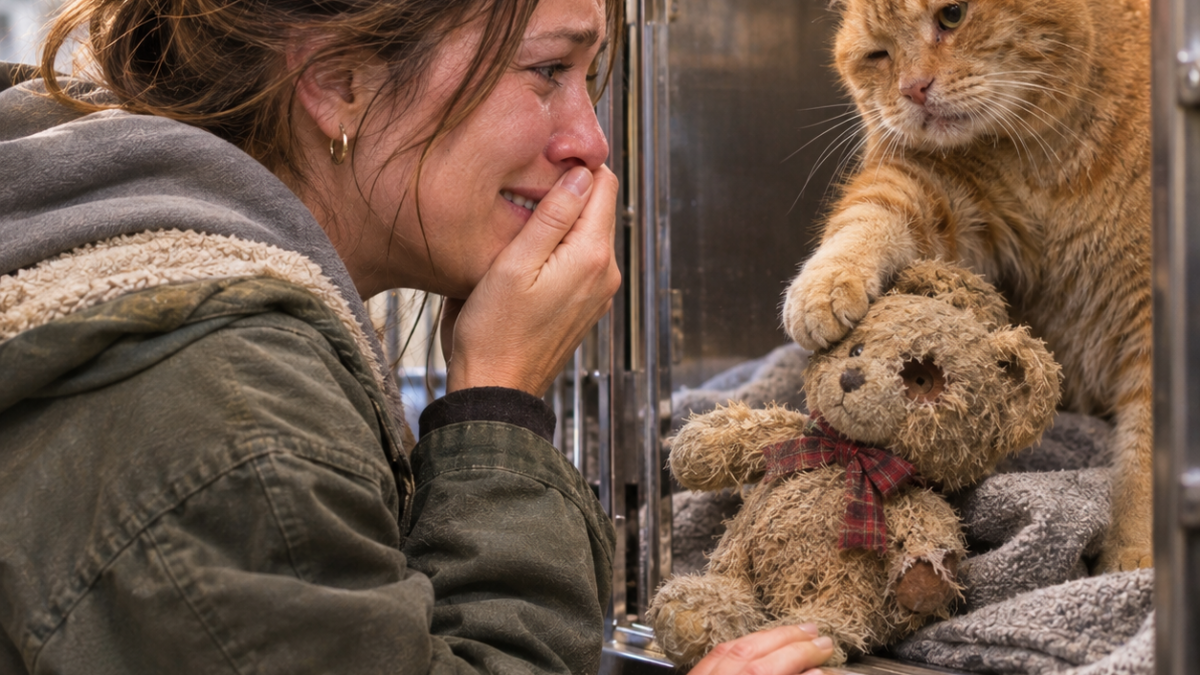
At his paws lay a teddy bear.
It looked terrible.
Brown once, probably.
Now beige-gray from years of wear.
One plastic eye missing.
The remaining eye cloudy and cracked.
A seam across the belly had been stitched with thread that didn’t match.
One ear barely attached.
The fur on its face had been rubbed almost flat.
The cat lowered his head.
Put his nose against the bear.
Pushed.
Thump.
The bear hit the glass.
I stared.
“What is he doing?”
The volunteer holding Pixel followed my gaze.
“Oh.”
She smiled.
“Pear.”
“Pear?”
“His name.”
“Why?”
“No idea. Came with it.”
I handed Pixel back slowly.
The volunteer put him into his enclosure.
Mara appeared beside me as if she’d been waiting.
“That’s Box 43.”
“You number them?”
“Enclosures. Not cats.”
“He’s Pear.”
“Yes.”
Pear kept watching.
I stepped closer.
He nudged the teddy bear again.
Thump.
“What is that?”
“His bear.”
“He pushes it at people?”
Mara’s expression shifted.
Just slightly.
“Sometimes.”
The younger volunteer said, “Every time.”
Mara glanced at her.
The young woman shrugged.
“He does.”
I looked from them to Pear.
“Why?”
Mara hesitated.
“That’s what he came in with.”
“Like a toy?”
“The only thing.”
Pear put one paw on the teddy bear.
Pulled it back.
Then pushed it forward.
I crouched.
His eyes followed me.
Green.
Not bright kitten eyes.
Steady.
Measuring.
“How old?”
“About six.”
“That’s not old.”
“No.”
“Why is he here?”
Mara didn’t immediately answer.
I noticed.
“Was he surrendered?”
“Yes.”
“Behavior?”
“No.”
“Medical?”
“Healthy now.”
“Now?”
She sighed softly.
“Would you like to meet him?”
I almost said no.
I should have.
I had a plan.
“I was looking at kittens.”
“I know.”
There was no judgment in it.
That made saying no harder.
Pear pushed the bear once more.
Thump.
I pointed.
“Why does he do that?”
The younger volunteer answered before Mara could.
“We think he thinks people want something.”
Mara gave her another look.
“What does that mean?”
The girl bit her lip.
“I don’t know. It’s just… when somebody stops, he brings it over. Then when they walk away, he pulls it back.”
Something moved in my chest.
I didn’t like it.
Mara said, “Cats don’t necessarily attach human meanings to objects the way we do.”
“Right.”
“But Pear is very attached to that bear.”
“Did his old family leave it?”
“Yes.”
That sentence changed the room.
“Why did they give him up?”
Mara looked toward Pear.
“Financial problems.”
I almost laughed, but there was nothing funny.
“That’s all?”
“There’s more.”
Of course there was.
There is always more.
I stood.
“I really only came for a kitten.”
“Then look at kittens.”
She smiled.
“Nobody’s going to trick you into taking Pear.”
I felt ridiculous.
“Good.”
I turned.
A family entered the adult room.
Mother.
Father.
Boy maybe nine.
The boy saw Pear.
“Look at the yellow one.”
The father approached.
Pear stood.
His body changed.
Not excited exactly.
Alert.
He picked up the teddy bear by its worn arm.
Carried it forward.
Dropped it.
Thump.
The boy laughed.
“He gave me his toy.”
Pear sat.
The mother read the card.
“Six?”
“Too old,” the father said.
Six.
Too old.
“We wanted younger.”
They moved to the next enclosure.
Pear stayed facing them.
His ears forward.
The boy glanced back.
The parents didn’t.
Pear waited.
Then slowly reached one paw toward the bear.
Hooked it.
Pulled it back against his chest.
The movement was so controlled it hurt more than if he’d cried.
Then another couple entered.
They looked.
“He’s huge.”
Pear pushed the bear.
“Pretty.”
“Long hair, though.”
“He’ll shed.”
They left.
Pear pulled the bear back.
I stood there longer than I should have.
Mara didn’t speak.
“How long?”
“What?”
“How long has he been doing this?”
“Most of the time he’s been here.”
“How long has he been here?”
“One hundred and seventeen days.”
I looked at her.
“You know that exactly?”
“We know everybody’s numbers.”
“Why hasn’t someone taken him?”
“Somebody almost did.”
“What happened?”
Her face tightened.
“They brought him back.”
There it was.
The baggage.
The word I’d been avoiding.
“What did he do?”
“Nothing.”
“People don’t return animals for nothing.”
“People return animals for lots of reasons that have very little to do with the animal.”
“What was the reason?”
Mara looked at me.
“Their daughter was allergic.”
“That’s it?”
“That’s enough if it’s severe.”
“How long did they have him?”
“Nine days.”
I looked at Pear.
His paw rested on the bear.
“Was that his first family?”
“No.”
“So three homes?”
“Technically.”
“What happened with the first?”
Mara exhaled.
“We don’t normally tell somebody’s whole surrender history unless they’re seriously considering adoption.”
“I’m not.”
“Then go pick your kitten.”
She wasn’t being rude.
She was giving me a way out.
I didn’t take it.
“Can I meet him?”
Mara studied me.
“Sure.”
The meeting room had a vinyl floor, two plastic chairs, one cat tree, and a window that looked over the parking lot.
Mara brought Pear in.
The teddy bear came too.
“Does it have to?”
“Yes.”
She closed the door.
Pear stayed beside the wall.
No running toward me.
No rubbing ankles.
I sat.
“Hey.”
He stared.
Great start.
I looked at Mara.
“Friendly?”
“Very.”
“He seems thrilled.”
“Give him a minute.”
She put the bear on the floor.
Pear walked to it.
Sat beside it.
I held out my hand.
Nothing.
“He’s not coming.”
“No.”
“Is that bad?”
“No.”
“You’re not very reassuring.”
Mara smiled.
“You’re used to animals auditioning.”
That annoyed me because it was true.
“What does that mean?”
“People come into shelters expecting to feel chosen in thirty seconds.”
“I didn’t say that.”
“No.”
She nodded toward Pear.
“But he’s not going to perform.”
I looked at him.
He looked at me.
Then, after almost two minutes, Pear stood.
Picked up the bear.
Walked halfway across the room.
Dropped it.
Not at my feet.
Halfway.
He sat.
Mara went very still.
“What?”
“Nothing.”
“Don’t do that.”
“Do what?”
“Make a face like something happened.”
“He usually takes longer.”
“To do what?”
“That.”
Pear pushed the teddy bear with one paw.
Toward me.
Maybe three inches.
I laughed awkwardly.
“What does he want?”
“Maybe you.”
“That’s sentimental.”
“It is.”
“You’re a shelter employee. You’re supposed to be objective.”
“Volunteer coordinator.”
“Worse.”
Pear moved closer.
Bear too.
He stopped within arm’s reach.
I put my hand out.
He sniffed me.
Then sat.
No touching.
No purr.
Just inspection.
“Hi, Pear.”
One ear turned.
“That’s a terrible name.”
Mara laughed.
Pear blinked.
I touched the teddy bear.
His entire body tightened.
I pulled my hand away.
“Sorry.”
He put one paw on it.
“It’s okay.”
I didn’t know why I was reassuring a cat about a stuffed animal.
Mara sat in the other chair.
“You asked about the first family.”
I looked at her.
“You’re telling me?”
“You asked to meet him.”
“That’s not the same.”
“No.”
She folded her arms.
“Pear belonged to an older woman named Eleanor.”
“How old?”
“Seventy-eight.”
“She surrendered him?”
“Her family did.”
I felt something sink.
“Why?”
“She developed dementia.”
Pear had begun washing one paw.
“Her daughter moved her into memory care.”
“And the cat?”
“The daughter kept him temporarily.”
“What happened?”
“Her lease didn’t allow pets.”
“Couldn’t someone else take him?”
“They tried.”
Mara spoke carefully.
“Pear had lived with Eleanor since he was a kitten.”
I looked at the bear.
“That was hers?”
“No.”
“His?”
“Apparently Eleanor’s grandson gave it to him when he was little.”
“Why does it look fifty years old?”
“He carried it everywhere.”
Mara smiled faintly.
“She repaired it a lot.”
The unmatched stitches.
“That’s why the belly’s sewn.”
“Yes.”
“What happened after Eleanor left?”
“Pear stopped eating.”
I looked at him.
“He’d sit at the apartment door.”
“Waiting?”
“We assume.”
“Then?”
“Family moved him into the daughter’s apartment. He hid. Cried at night. She risked eviction for six weeks before bringing him here.”
“So she did try.”
“Yes.”
Something in me loosened.
I had been preparing to hate someone.
That was easier.
Cruel person abandons devoted cat.
Simple.
But real life is usually more exhausting than evil.
Mara continued.
“Eleanor’s daughter cried through the entire surrender.”
Pear looked toward the window.
“She brought the bear.”
“Yes.”
“Did Eleanor know?”
“Know what?”
“That he was here.”
Mara paused.
“We don’t know.”
There it was.
A different kind of grief.
No villain.
Just people losing each other in pieces.
“Why Pear?”
“His name?”
“Yeah.”
“Supposedly Eleanor had a pear tree in her backyard when she was a child. She said he had the same color as ripe pears.”
I smiled.
“That doesn’t make sense.”
“Nope.”
“He’s orange.”
“Don’t tell him.”
Pear finally stepped toward me.
Rubbed one cheek against my knee.
One pass.
Then returned to the bear.
My throat tightened.
I ignored it.
“So the second family?”
“Adoption after about three months here.”
“Nine days.”
“Yes.”
“Then back.”
“Yes.”
“How long since?”
“Twenty-two days.”
“And he’s doing the teddy bear thing more?”
Mara looked surprised.
“You noticed.”
“Am I wrong?”
“No.”
Something cold moved under my ribs.
“He thinks he has to bring something.”
“Sarah—”
“How do you know my name?”
“Intake form.”
“Oh.”
She smiled.
I looked at Pear.
“I don’t want to invent feelings he may not have.”
“Good.”
“But that is what it looks like.”
“Yes.”
“What?”
“Like he’s making a trade.”
Mara was quiet.
Then she said, “Yes.”
Pear lifted the bear.
Carried it closer.
This time he put it against my shoe.
I stared down.
He stepped back.
Sat.
I could have laughed.
Instead, tears hit my eyes so quickly I got angry.
“Oh, come on.”
Mara pretended not to notice.
“I didn’t come here for this.”
“I know.”
“I wanted easy.”
“I know.”
“I wanted a kitten.”
“You can still adopt a kitten.”
I looked at Pear.
“You’re not helping.”
“I am.”
“No, you’re being calm and reasonable. It’s manipulative.”
That made her laugh.
Pear rubbed against my ankle.
I closed my eyes.
There are moments when you recognize yourself in something that has nothing to do with you.
It is deeply inconvenient.
I’d spent six months telling people I was fine.
Work was busy.
Mom needed me.
The house needed fixing.
Jason and I were “better apart.”
That’s the phrase I used.
Better apart.
Clean.
Adult.
No bitterness.
Meanwhile, I had stopped sleeping properly.
Started eating cereal for dinner.
Worked until ten because the silence afterward was worse.
Deleted photographs I wanted to keep because keeping them felt weak.
Kept his coffee mug in the cupboard because getting rid of it felt weaker.
I was doing the same thing I’d accused Pear of doing.
Offering the acceptable parts.
Competence.
Humor.
Work.
Help.
Look.
I can still be useful.
Will that be enough to make me worth staying for?
Pear nudged the bear against my shoe.
I bent down.
“You’re making this very difficult.”
He blinked.
I touched his head.
He leaned.
Just slightly.
Then more.
My palm filled with warm fur.
A purr began.
Deep.
Not kitten-loud.
Low.
Steady.
I looked at Mara.
“If I take him—”
She didn’t react.
“Yes?”
“Does the bear come?”
Now she smiled.
Not big.
Not triumphant.
Just kind.
“He’d want it.”
I looked down.
“That’s not what I asked.”
Mara laughed.
“Yes. The bear comes.”
Pear’s purr got louder.
I said, “Okay.”
The word scared me.
“Okay what?”
“You know what.”
“I’d like to hear you say it.”
“You’re terrible.”
“I’ve been told.”
I took a breath.
“I’m adopting Pear.”
The paperwork was insultingly simple.
That bothered me.
A decision that large should involve ceremony.
Witnesses.
Maybe a judge.
Instead, I signed three forms with a pen that barely worked.
Emergency contact.
Veterinary history.
Indoor-only agreement.
Microchip transfer.
Mara went through food information.
Adjustment period.
Safe room.
Litter.
Stress.
Hiding.
I heard maybe half.
Pear sat in the carrier with the teddy bear beneath one paw.
When Mara opened Box 43 to bring him out, something happened that I still think about.
She placed the empty carrier beside the enclosure.
Pear didn’t resist.
Didn’t flatten.
Didn’t run.
He looked at the open carrier.
Then at Mara.
Then at me.
He turned around.
Picked up the bear in his mouth.
Walked to the front.
Dropped it outside.
At my feet.
I stared.
Mara didn’t speak.
“Why did he do that?”
“I don’t know.”
Pear stepped into the carrier.
The bear remained beside my shoe.
I picked it up.
It was lighter than I’d expected.
The worn fabric smelled faintly like shelter detergent and something older underneath.
Home, maybe.
I put it into the carrier.
Pear immediately put one paw over it.
That was when I understood.
Or decided I understood.
Maybe there’s no difference in moments like that.
Pear wasn’t offering to leave his past behind.
He was asking whether I could take it too.
I drove home slowly.
Every pothole felt personal.
Pear made no sound.
At traffic lights, I glanced back.
Green eyes.
Teddy bear.
No panic.
That worried me more than crying might have.
The house felt enormous when I brought him inside.
Jason had helped choose that house.
Three bedrooms.
Basement.
Little fenced yard.
We’d planned to fill it.
Not necessarily with children.
We’d never decided.
But with people.
Friends.
Noise.
Dogs maybe.
Dinner parties.
Something.
After he left, the unused space became accusation.
I carried Pear into the guest room.
Door closed.
Food.
Water.
Litter box.
Cardboard scratcher.
Small bed.
Everything the shelter suggested.
I opened the carrier.
Pear didn’t come out.
“Fine.”
I sat on the floor.
“You’ve had a day.”
Nothing.
“I have too.”
Five minutes.
Ten.
Then his head appeared.
He smelled the air.
One paw.
Second paw.
He stepped out.
Crouched.
Looked around.
The bear remained in the carrier.
Pear took four slow steps.
Stopped.
Returned.
Picked up the bear.
Then explored.
Bear in his mouth.
That nearly undid me.
He walked perimeter first.
Walls.
Bed.
Closet.
Desk.
Window.
He set the bear down each time he investigated something closely.
Then picked it up again before moving on.
Eventually, he approached me.
Dropped the bear.
Sat.
I stared.
“Again?”
Pear blinked.
I touched the bear’s worn ear.
“It’s staying.”
His head tilted.
“I mean it.”
I felt ridiculous.
“It’s not payment.”
Pear stepped closer.
“It’s yours.”
He pushed his head beneath my hand.
I stroked him.
“It stays.”
That night, Pear slept under the guest bed.
The bear slept with him.
I slept badly.
At 2:00 a.m., I woke convinced I’d made a mistake.
At 2:17, still awake.
At 3:04, I went downstairs for water.
The house was dark.
I passed the guest-room door.
Soft sound.
Scrape.
I opened it carefully.
Pear was sitting on the other side.
Waiting.
“Oh.”
He stepped out.
Walked past me.
“Pear.”
He continued down the hall.
I followed.
He entered my bedroom.
Jumped onto the bed.
Turned twice.
Lay down.
I stood there.
“No.”
Pear closed his eyes.
“This is not the arrangement.”
Nothing.
“You have a room.”
Purr.
I got into bed.
Pear slept at my feet.
The teddy bear remained in the guest room.
At 5:30, he woke.
Jumped down.
Returned five minutes later.
Bear in his mouth.
He carried it onto the bed.
Dropped it against my ankle.
Then lay beside it.
I cried silently.
Not dramatically.
Just tears.
One after another.
I had no idea why.
The first week wasn’t easy.
That matters.
People love adoption stories where the animal walks in and instantly understands forever.
Pear didn’t.
He hid whenever the doorbell rang.
Refused food if I stood too close.
Cried at night for the first three nights.
Not loudly.
A low, questioning sound.
Sometimes he sat by the front door for an hour.
That hurt.
I wondered whether he was waiting for Eleanor.
Or the daughter.
Or the second family.
Or nobody specific.
Maybe doors had simply become dangerous places where people disappeared.
He followed me from room to room but never too close.
If I closed the bathroom door, he waited outside.
If I went downstairs, he appeared at the top of the staircase.
If I took out trash, he watched through the window.
When I returned, he immediately walked away like he hadn’t been checking.
The teddy bear moved constantly.
Kitchen.
Bedroom.
Living room.
Guest room.
One morning I found it beside my front door.
Another night, on my pillow.
I thought about washing it.
The shelter smell bothered me.
I put it in the laundry basket.
Pear saw.
His reaction stopped me.
He jumped into the basket.
Grabbed the bear.
Ran.
Not walked.
Ran.
Straight under the bed.
I stood there holding detergent.
“I’m sorry.”
No movement.
“I wasn’t taking it.”
Silence.
I sat.
“Okay.”
I put my hands on my knees.
“That’s a lie. I was.”
Pear’s eyes appeared beneath the bed.
“I thought it was dirty.”
No response.
“Apparently I am a monster.”
His head disappeared.
I laughed.
Then, for some reason, cried.
I never tried to wash it again.
Two weeks after Pear came home, Mara called.
“Checking in.”
“He’s alive.”
“Good start.”
“He steals my side of the bed.”
“Your first mistake was thinking you had a side.”
“He carries that bear everywhere.”
“I know.”
“Has he always?”
“Pretty much.”
“Did Eleanor—”
I stopped.
“What?”
“Can I ask something?”
“Sure.”
“Do you know where Eleanor is?”
Mara was quiet.
“Memory care.”
“Still?”
“As far as I know.”
“Does she have family contact with the shelter?”
“Her daughter donated once.”
“What are you thinking?”
“I don’t know.”
That was true.
The thought had been building.
“Would she want to know he’s okay?”
“Probably.”
“Could we tell her?”
Mara didn’t answer immediately.
“We’d have to go through her daughter.”
“Would that be strange?”
“Very.”
“Bad strange?”
“No.”
She sighed.
“I can ask.”
Three days later, Eleanor’s daughter called me.
Her name was Camille.
She sounded cautious.
“You’re the woman who adopted Pear?”
“Yes.”
“How is he?”
The question carried guilt.
Immediately.
“Good.”
“Really?”
“Really.”
“He eating?”
“Too much.”
A small laugh.
“That sounds like him.”
“He still has the teddy bear.”
Silence.
Then I heard Camille inhale.
“Oh.”
I sat at my kitchen table.
Pear was in the window.
Bear beneath him.
“Why did you send it?”
“What?”
“The bear.”
Another silence.
“My son gave it to Mom years ago.”
“I thought it was Pear’s.”
“It became Pear’s.”
Her voice softened.
“Mom used to call it Mr. Buttons.”
“One eye is missing.”
“That happened early.”
“Why didn’t she replace it?”
“She tried.”
Camille laughed through something that sounded like tears.
“Pear dragged the new one into the litter box.”
I laughed.
“Okay. That tracks.”
“Mom repaired the old one.”
“The mismatched thread.”
“Yeah.”
Camille became quiet.
“She used to tell people Pear couldn’t sleep without it.”
I looked at him.
“He’s sleeping fine.”
“Good.”
The word broke.
I waited.
“I’m sorry.”
“For what?”
“I still feel like I abandoned him.”
There it was.
Different person.
Same wound.
“You didn’t.”
“I did.”
“You couldn’t keep him.”
“I should’ve figured something out.”
“You kept him six weeks.”
“How do you know that?”
“Mara.”
“Of course.”
Camille sighed.
“My landlord sent two warnings.”
“You tried.”
“It didn’t feel like enough.”
I understood that sentence too well.
Sometimes effort doesn’t change the ending.
That doesn’t make the effort fake.
“Does Eleanor remember him?”
Camille went silent for so long I thought the call dropped.
“Some days.”
My hand tightened around the phone.
“Some days?”
“She asks where he is.”
“Oh.”
“Other days she asks where my father is. He’s been dead eleven years.”
I closed my eyes.
“I’m sorry.”
“Yeah.”
“Could I send pictures?”
Camille breathed in.
“Please.”
So I sent one.
Pear in the window.
Bear beside him.
Then another.
Pear asleep on my bed.
Then a video of him chirping at birds.
Camille replied ten minutes later.
Mom smiled.
That was all.
It wrecked me.
A month later, Camille asked if I’d consider bringing Pear to see Eleanor.
I said yes immediately.
Then panicked for three days.
Was it fair?
Would it confuse him?
Stress him?
Mara helped arrange it.
The memory-care facility allowed pets with vaccination records.
Pear hated the carrier.
He cried the entire drive.
I nearly turned around.
Then we arrived.
Eleanor was sitting in a common room beside a window.
Small woman.
White hair.
Blue cardigan.
Hands folded.
Camille stood beside her.
“Mom.”
Eleanor looked up.
“This is Sarah.”
“Hello.”
“And somebody else.”
I set the carrier down.
Pear stopped crying.
Instantly.
I opened the door.
He looked out.
Eleanor looked at him.
Nothing happened.
My heart sank.
Maybe this was selfish.
Maybe I wanted a movie moment.
Maybe Pear didn’t remember.
Then Eleanor said one word.
“Perry?”
Not Pear.
Perry.
Pear’s body froze.
Camille covered her mouth.
“What?”
Eleanor leaned forward.
“Perry boy.”
Pear stepped out.
Slowly.
His tail lowered.
He walked toward Eleanor.
Stopped.
Smelled her shoe.
Then her knee.
Eleanor reached down.
Her hand trembled.
Pear pushed his head into it.
Hard.
The sound that came from him was unlike any purr I’d heard.
Loud.
Broken.
Almost a trill.
Eleanor’s face changed.
For one minute, maybe two, she was completely present.
“My boy.”
Pear climbed into her lap.
Camille cried openly.
I turned away.
Eleanor buried both hands in Pear’s fur.
“Where’s Buttons?”
My throat closed.
The bear.
I had left it in the carrier.
I took it out.
Eleanor saw it.
“Oh, poor Buttons.”
She touched the missing eye.
“Still ugly.”
Camille laughed through tears.
“Mom.”
“Always ugly.”
Pear put one paw on the bear.
Eleanor stroked his back.
Then she looked at me.
“Is he yours?”
I didn’t know how to answer.
“He’s living with me.”
“Good.”
She nodded.
“He’s afraid of thunderstorms.”
“I know.”
“He likes turkey.”
“I know.”
“Don’t let him get too fat.”
I smiled.
“Trying.”
She touched Pear’s face.
Then her expression changed.
Confusion.
She looked at Camille.
“Whose cat is this?”
My heart shattered.
Camille knelt.
“Mom, that’s Pear.”
Eleanor frowned.
“I don’t know a Pear.”
Pear remained in her lap.
Purring.
Camille closed her eyes.
Then opened them.
“That’s okay.”
Eleanor stroked him automatically.
“I like cats.”
Pear pushed his head into her hand.
She smiled.
Maybe memory is not one door.
Maybe it is thousands.
Some open.
Some don’t.
Maybe love can still move through even when the labels disappear.
We stayed forty minutes.
On the drive home, Pear slept in the carrier.
One paw on the bear.
That evening, I sat on the kitchen floor and cried.
Pear came over.
Dropped Mr. Buttons beside me.
I laughed.
“That’s your answer to everything, isn’t it?”
He sat.
The story of Pear spread at the shelter after our visit.
Not publicly.
Among volunteers.
Mara told me more.
His second adoption had affected him badly.
After they returned him, he’d stopped approaching people.
For three days, he stayed at the back of Box 43.
Then, on the fourth day, he started pushing the bear forward.
“That’s when it began?”
“Mostly.”
“So he didn’t do it before?”
“Not like that.”
My chest tightened.
“Why didn’t you tell me?”
“Because I didn’t want you adopting him from pity.”
“Would that have been bad?”
“For both of you.”
She was right.
Pity is not enough to build a home.
Pear didn’t need somebody to be devastated by his story.
He needed somebody who could live with him on a boring Tuesday.
Clean the litter box.
Pay vet bills.
Get annoyed when he threw up on the carpet.
Love after tragedy has to survive normal life.
That’s the test.
Pear passed.
So did I.
Mostly.
He destroyed the corner of my couch.
I threatened eviction.
He ignored me.
He developed a habit of sitting directly on my laptop during video calls.
My manager met him twelve times.
Pear became famous at work.
“Your yellow cat is here.”
“Unfortunately.”
He started sleeping beside me.
Not at my feet.
Beside me.
The first time I woke with his forehead tucked against my shoulder, I stayed still.
Jason used to sleep on that side.
For months after he left, I’d slept toward the center of the bed to avoid the emptiness.
Now Pear filled six inches of it.
Not as a replacement.
That would have been unfair to everyone.
But presence does not have to replace absence.
They can exist together.
That was new to me.
My mother met Pear in March.
She hated cats.
Or claimed to.
“What kind of name is Pear?”
“I didn’t name him.”
“He looks orange.”
“Thank you.”
“He sheds.”
“Yes.”
“On your couch.”
“That’s where he lives.”
She watched him for an hour.
Before leaving, I caught her sneaking him turkey.
“Don’t let him get fat.”
“I wasn’t feeding him.”
Pear was chewing.
“Mom.”
“He looked hungry.”
“You are a liar.”
She smiled.
A month later she asked about him before asking about me.
Then my brother met him.
“That’s the rescue cat?”
“Yes.”
“The baggage one?”
I stared.
“What?”
“Mom said you got some emotionally damaged cat.”
I felt unexpectedly angry.
“He’s not damaged.”
My brother raised both hands.
“Okay.”
“He had a rough history.”
“Same thing.”
“No.”
It mattered.
I didn’t know why until later.
That night, I sat beside Pear.
“You’re not damaged.”
He was licking his stomach.
“You’re complicated.”
No response.
“So am I.”
Pear stopped.
Looked at me.
Then continued licking.
“Rude.”
But the word stayed with me.
Damaged.
After Jason left, that’s how I’d felt.
Not heartbroken.
Damaged.
As if another person’s decision had lowered my value.
I hid that thought under competence.
Work.
Helping Mom.
Paying bills.
Answering texts.
Keeping the lawn cut.
Being fine.
Pear didn’t care.
He didn’t need me unhurt.
He needed dinner.
That was wonderfully clarifying.
Then, in May, I got laid off.
The company called it restructuring.
That word is corporate anesthesia.
It means your life is changing, but the email would prefer you not bleed on the furniture.
Eleven years.
One Zoom call.
HR representative.
Manager looking miserable.
Severance.
Insurance through the end of the month.
Thank you for your contributions.
I closed the laptop.
Sat.
For the first ten minutes, I felt nothing.
Then everything hit.
Mortgage.
Mom.
Savings.
Resume.
Health insurance.
Shame.
Forty-one years old and suddenly unemployed.
My phone started buzzing.
Coworkers.
People had heard.
I ignored them.
Pear jumped onto the desk.
“Not now.”
He sat on my keyboard.
“Pear.”
Nothing.
“Move.”
He looked at me.
I pushed him gently.
He jumped down.
Five minutes later he returned carrying Mr. Buttons.
Dropped it on my foot.
I started laughing.
Then crying.
Really crying.
The kind I had not allowed myself after Jason.
“Seriously?”
Pear rubbed against my leg.
“You think this fixes unemployment?”
Purr.
“I have a mortgage.”
Purr.
“I have no job.”
Purr.
I picked up the bear.
One eye.
Split seam.
Thin fur.
“What are we doing?”
Pear put his paw on my knee.
That day became the beginning of my worst month.
Applications.
Rejections.
Interviews.
Silence.
I started questioning everything.
My career.
My choices.
The house.
Adopting Pear.
One evening I calculated expenses.
Mortgage.
Utilities.
Insurance.
Food.
Veterinary care.
I looked at Pear’s line.
My stomach turned.
No.
Immediately.
No.
Still, the fact that the thought appeared horrified me.
What if I can’t afford him?
That was how it happened.
People didn’t always wake one morning cruel.
Sometimes the numbers closed in.
Sometimes love met rent.
Sometimes somebody had to make an impossible choice and strangers judged the ending because they never saw the months before it.
I thought of Camille.
I thought of Eleanor.
I thought of every surrender form Mara had seen.
The next day I called her.
“Question.”
“Pear okay?”
“Yes.”
“What’s wrong?”
“I lost my job.”
“I’m sorry.”
“If things get bad—”
I couldn’t finish.
Mara understood.
“We have a pet food pantry.”
“I don’t need charity.”
“That’s what everybody says.”
“I’m serious.”
“So am I.”
I stared at the wall.
“We also have temporary veterinary assistance. And foster support in emergencies.”
“I didn’t know.”
“Most people don’t.”
“Why?”
“Because people wait until they’re desperate before asking for help.”
That sounded familiar.
“I’m not giving him back.”
“I didn’t say you were.”
“I need you to know that.”
“I know.”
Pear was asleep in the window.
Bear under his chin.
“I won’t do that to him.”
Mara’s voice softened.
“Sarah.”
“What?”
“If you ever truly couldn’t care for him, asking for help wouldn’t make you Eleanor’s daughter.”
I closed my eyes.
“Camille.”
“Yes.”
“I know her name.”
“Then use it.”
“What?”
“Camille did not throw Pear away. She reached the end of what she could do alone.”
I hated how much that sentence affected me.
“There’s a difference between abandonment and surrender.”
“Pear doesn’t know that.”
“No.”
“That’s the terrible part.”
“Yes.”
I cried after the call.
Not because I planned to lose Pear.
Because I finally understood Camille.
And maybe Jason a little.
Not enough to excuse everything.
Enough to admit not every ending is betrayal.
Some are limits.
I got a new job six weeks later.
Lower salary.
Better hours.
Less prestige.
I took it.
Old me would have called that failure.
New me liked being home by six.
Pear approved.
That summer, Eleanor died.
Camille called me.
“She went peacefully.”
“I’m sorry.”
“Thank you.”
I looked at Pear sleeping.
“Did she—”
“She remembered him the week before.”
My throat closed.
“What happened?”
“I showed her your video.”
Pear chasing a feather toy.
“She said, ‘That’s Perry.'”
I covered my mouth.
“Then she asked where Buttons was.”
I started crying.
Camille did too.
“I told her he was with Pear.”
“Good.”
“She said, ‘Then he’s got everything.'”
I couldn’t speak.
Camille eventually asked, “Can I see him sometime?”
“Of course.”
She visited a month later.
Pear remembered her scent.
I think.
He approached quickly.
Rubbed against her legs.
Camille sat on my living-room floor.
“I brought something.”
She handed me a small envelope.
Inside was a photograph.
Eleanor.
Maybe seventy.
Sitting in an armchair.
Pear as a young cat sprawled across her lap.
Mr. Buttons beside them.
Both eyes.
Both ears.
Brown fur.
Almost new.
I stared.
“Oh.”
“That was his first Christmas.”
I looked at Pear.
“You were tiny.”
He ignored me.
Camille smiled.
“Mom adored him.”
She touched the photograph.
“After Dad died, Pear was everything.”
That sentence changed something again.
Eleanor had not simply been Pear’s person.
Pear had already been someone else’s rescue.
Maybe not from a shelter.
From loneliness.
From grief.
From empty rooms.
The chain was longer than I knew.
Camille said, “Mom used to say he brought Buttons to her when she cried.”
I looked at the battered bear.
“What?”
“Seriously.”
“When?”
“After Dad died. When she had bad days.”
Pear picked up the bear.
Moved it toward Camille.
Dropped it.
We both froze.
Camille started sobbing.
“That’s what he did.”
Pear sat.
Steady.
Not performing.
Offering.
I understood then.
Not scientifically.
Not in some magical way.
But emotionally.
Pear hadn’t invented that ritual at the shelter.
He had learned that the bear belonged in moments when somebody was hurting.
Maybe Eleanor used to hold it.
Maybe Pear associated the object with comfort.
Maybe he had pushed it toward her a hundred times.
Then he lost her.
Then the daughter.
Then a temporary home.
Then strangers.
So he did the only thing he knew.
Here.
This helped before.
Take it.
I knelt.
“Pear.”
He looked at me.
“You weren’t bargaining.”
Camille wiped her face.
“No.”
I touched the bear.
“He was comforting people.”
Maybe.
Maybe that was too human.
It didn’t matter.
The meaning it gave us was real.
I had spent months thinking Pear pushed his bear toward strangers because he believed he needed to trade something valuable for love.
Maybe that was wrong.
Maybe Pear had been doing exactly what he’d done for Eleanor when she grieved.
Offering the only comfort he knew.
That possibility made the story less sad.
And somehow more devastating.
After Camille left, I placed Eleanor’s photograph on a shelf.
Pear sat beneath it.
I didn’t know whether he recognized her image.
Probably not the way I did.
Still, it felt right.
Years passed.
Pear became less careful.
That’s how I measured safety.
Not purring.
Not sleeping beside me.
Carelessness.
He stopped checking when I went to another room.
Stopped waking if I stood up.
Stopped carrying the bear every time I left the house.
Eventually Mr. Buttons stayed on the bed most days.
Pear trusted that I would return.
That was huge.
One evening I realized I had gone to the grocery store and come back without thinking about whether Pear was panicking.
When I entered, he didn’t run to the door.
He was asleep.
I stood there holding milk and cried.
Because sleeping through someone’s departure means you expect their return.
Trust can look boring from the outside.
That’s what makes it beautiful.
My life changed too.
I didn’t become inspirational.
I got tired.
Made mistakes.
Had another relationship that lasted nine months and ended kindly.
I was okay.
Actually okay.
That surprised me.
I started saying no to my brother when he tried to hand me every responsibility for Mom.
Not cruelly.
Just no.
He learned.
Slowly.
Mom eventually moved into assisted living.
Her choice.
Mostly.
I visited.
Pear became famous there after I brought him once.
He sat on four laps and stole turkey from a resident named Frank.
Mom said, “That cat is spoiled.”
I said, “You started it.”
She denied everything.
I learned that making room for someone else’s history didn’t mean drowning in it.
That was important.
I had misunderstood compassion.
I thought it meant carrying.
All of it.
Everyone’s.
Mom.
Brother.
Work.
Jason.
Pear.
That was why I wanted a kitten with no baggage.
I was exhausted from carrying.
But Pear didn’t ask me to carry his past.
He only asked me not to throw it away.
There is a difference.
His history belonged to him.
I didn’t need to fix Eleanor leaving.
Couldn’t.
Didn’t need to erase the shelter.
Couldn’t.
Didn’t need to make the bear new.
Shouldn’t.
I only had to let those things exist beside the life we were building.
That lesson saved me from myself.
Pear turned ten.
Then eleven.
His face softened with age.
The uneven ear remained.
Whiskers still bent.
He developed arthritis in his hips.
Needed medication.
Mr. Buttons became so fragile I finally asked a textile conservator—yes, apparently that is a thing—how to preserve it without changing it.
She reinforced the inside.
No washing.
No new eye.
No replacement fur.
“Keep the wear,” she said.
“That’s the point.”
Exactly.
Keep the wear.
When Pear was twelve, Camille visited again.
She had become a grandmother.
She brought her grandson.
Little boy named Noah.
Pear tolerated him.
High praise.
Noah saw the bear.
“Why is it broken?”
I almost gave him a long answer.
Camille said, “Because it was loved.”
Noah accepted this immediately.
Children are sometimes better at truth than adults.
He touched the missing eye.
“Can I fix it?”
Camille looked at me.
I said, “I think we’re leaving it.”
“Why?”
“Because that’s how Pear knows him.”
Noah thought about that.
Then nodded.
“Okay.”
Pear walked over.
Put his paw on the bear.
Case closed.
At thirteen, Pear’s kidneys began to decline.
Nothing dramatic.
Old-cat numbers.
Special diet.
Blood tests.
Water fountain.
Medication.
I knew the language by then.
Manage.
Monitor.
Quality.
Good time.
I hated good time.
It always sounded like somebody quietly removing forever from the table.
Pear didn’t care.
He still screamed for breakfast.
Still sat on my laptop.
Still carried Mr. Buttons during thunderstorms.
That habit never disappeared.
Thunder rolled.
Pear found the bear.
Then found me.
He would drop it beside my foot.
Maybe for himself.
Maybe for me.
By then, the distinction felt unnecessary.
Comfort shared is still comfort.
When Pear was fourteen, Mara retired from the shelter.
They held a small party.
I brought Pear.
He hated it.
Perfect tribute.
Mara sat on the floor beside him.
“Box 43.”
Pear rubbed against her.
“You remember.”
“He remembers everybody who feeds him.”
“I fed him for four months.”
“Exactly.”
She touched his head.
“You know, I thought you’d bring him back.”
I stared.
“What?”
“The first month.”
“Why?”
“You looked terrified.”
“I was.”
“Not of him.”
“No.”
She smiled.
“Of needing him.”
That irritated me because it was probably true.
“You could have said something.”
“You would’ve left.”
Also true.
We watched Pear settle beside the bear.
Mara said, “People think shelter work is about finding animals perfect homes.”
“Isn’t it?”
“No.”
She shook her head.
“There aren’t perfect homes.”
That surprised me.
“Comforting.”
“People get sick. Divorced. Lose jobs. Die. Move. Mess up. Animals get sick. Bite. Scratch. Hide. Age.”
She looked around the shelter.
“We’re trying to make good matches between imperfect lives.”
That was Pear and me.
Not rescue.
Match.
Two imperfect lives.
A year later, Pear’s health worsened quickly.
Kidneys.
Thyroid.
Arthritis.
Weight loss.
He still ate.
Then ate less.
Then only turkey.
Mom would have approved.
One evening I found him sitting beside Mr. Buttons.
Not sleeping.
Just sitting.
I knew.
Not because of anything dramatic.
Because I had learned him.
He was tired.
I called the veterinarian.
Dr. Allison Greene had cared for him for years.
She came to the house the next afternoon.
Camille came too.
I hadn’t expected her.
She stood at the door holding Eleanor’s photograph.
“I didn’t know if you’d want—”
“Come in.”
Pear was on the couch.
Mr. Buttons under his chin.
Camille sat on the floor.
He sniffed her fingers.
Purr.
Weak.
But there.
I cried.
“He’s still doing that.”
Dr. Greene examined him.
Numbers weren’t the issue anymore.
She looked at me.
“It’s time if you’re ready.”
What a cruel phrase.
If you’re ready.
I laughed through tears.
“I’m not.”
“That’s okay.”
“No.”
I stroked Pear.
“It isn’t.”
She waited.
I looked at him.
“He’s ready.”
Maybe that was what mattered.
I picked up Mr. Buttons.
Placed it beside him.
Pear moved one paw over the bear.
Even now.
Protecting.
Claiming.
Remembering.
I touched the torn little ear.
“I came looking for a kitten.”
Camille laughed softly.
Pear opened one eye.
“You really ruined that plan.”
His purr started.
“I wanted easy.”
I wiped my face.
“And you showed up with a stuffed animal that looked like it had survived a war.”
Camille was crying now.
“I thought you were asking me to take your baggage.”
Pear breathed.
Slow.
“I was wrong.”
I leaned closer.
“You were just asking whether you could bring your whole life.”
His paw shifted.
Touched my wrist.
“Yes.”
My voice broke.
“You could.”
Dr. Greene gave the sedative.
Pear relaxed.
Head against Mr. Buttons.
I kept talking.
“You can keep all of it.”
Eleanor.
Camille.
The shelter.
Box 43.
Nine-day home.
Me.
Every room.
Every thunderstorm.
Every work call he ruined.
Every night he slept beside me.
Every time he brought that ridiculous bear.
Nothing erased.
Nothing traded.
All his.
The second medication went in.
Pear’s breathing became slow.
Then slower.
His final purr faded beneath my hand.
I stayed there long after his heart stopped.
Camille sat beside me.
Eventually she said, “Mom would’ve been so grateful.”
I shook my head.
“She gave him to me.”
“No.”
Camille touched the bear.
“She gave him the first half.”
I understood.
We had all been chapters.
Pear had not belonged to one person.
He had lived through us.
Eleanor.
Camille.
Shelter staff.
Temporary adopters.
Me.
Not every chapter had been easy.
Not every goodbye fair.
But his life was more than the moments he was left.
That mattered.
I had Pear cremated.
Mr. Buttons stayed with me.
I couldn’t bury it.
Couldn’t put it in a box.
For months it sat on the shelf beside Eleanor’s photograph.
One day I realized I’d been treating it like a memorial.
That didn’t feel right.
Mr. Buttons had never been a monument.
It was meant to be carried.
Used.
Given.
So I brought it to the shelter.
Mara had retired, but the younger volunteer from the day I adopted Pear was now the adoption coordinator.
Her name was Jess.
I hadn’t remembered that before.
She saw the bear and started crying immediately.
“Is that—”
“Yes.”
“Oh my God.”
“I want you to have it.”
She hesitated.
“Are you sure?”
“No.”
We laughed.
“Then don’t.”
“I think Pear would.”
That was probably projection.
I didn’t care.
They put Mr. Buttons in a small shadow box outside the adult-cat room.
Underneath, not a dramatic quote.
Just:
PEAR — BOX 43
CAME WITH HISTORY.
LEFT WITH FAMILY.
That was enough.
Two months later, I returned to the shelter.
I was not adopting.
Absolutely not.
I had rules.
Again.
Jess saw me.
“Oh no.”
“What?”
“You have the face.”
I stared.
“What face?”
“The one that says you’ve already made rules.”
I laughed so hard I had to lean against the counter.
“Don’t.”
“Just looking?”
“Yes.”
“Of course.”
I walked past the kitten room.
Tiny paws.
Bright eyes.
Chaos.
Beautiful.
I kept going.
Adult room.
Older cats.
Quiet.
At the end was a black cat with one cloudy eye.
Ten years old.
Owner deceased.
He didn’t have a teddy bear.
He had nothing.
I crouched.
“Well.”
He looked at me.
“I know something about that.”
He walked forward.
Not dramatically.
No offer.
No miracle.
He simply sat near the glass.
I smiled.
“No promises.”
Jess appeared behind me.
“I didn’t say anything.”
“You were about to.”
“Absolutely.”
I sat with the old cat for a long time.
Maybe I adopted him.
Maybe I didn’t.
That isn’t really the point.
Pear already taught me the important part.
I had walked into that shelter years earlier believing a clean start meant choosing something untouched.
No history.
No complications.
No scars.
I thought baggage was what made love heavy.
I was wrong.
History is not baggage.
Not automatically.
Sometimes it is proof.
Proof somebody mattered before you.
Proof love existed in rooms you never entered.
Proof an animal survived endings you didn’t witness.
Proof you are not the first person to hold them.
And you do not have to be.
Second chances are not clean.
That’s what makes them second.
They come with stitched bellies.
Missing eyes.
Old names.
Photographs.
Bad habits.
People who came before.
Memories that do not disappear because a new door opens.
And maybe that’s what made Pear so difficult for me at first.
I didn’t want his past because I was running from mine.
I wanted a kitten so I could pretend love could begin without risk.
Pear sat in Box 43 and showed me the truth.
Love doesn’t become safer because it has no history.
We all arrive somewhere carrying something.
A divorce.
A death.
A bad year.
A parent we couldn’t save.
A job that disappeared.
A house that got too quiet.
A stuffed bear with one eye missing.
The question is not whether someone has baggage.
The question is whether there’s enough room to put it down without being asked to throw it away.
Pear never needed me to make him new.
He needed me to recognize that the old parts still belonged.
The funny thing is, so did I.
I didn’t realize it when I signed those adoption papers.
I thought I was giving an adult shelter cat a home.
What Pear gave me was permission.
Permission to stop pretending I was a blank slate.
Permission to admit that Jason leaving hurt.
That I was tired.
That I resented being the reliable daughter sometimes.
That losing my job scared me.
That loving someone does not always mean keeping them forever.
That being left once does not make you unchoosable.
And that a broken thing does not have to be repaired into something unrecognizable before it is worthy of staying.
Mr. Buttons remained ugly.
Thank God.
One eye missing.
One ear torn.
Stitches showing.
Fur worn thin from years of being carried.
The first time I saw it, I thought it looked like something that had survived too much.
Years later, I finally understood.
That wasn’t ugliness.
That was evidence of use.
Of comfort.
Of hands.
Of paws.
Of being needed again and again.
Maybe that’s what all of us become if we’re lucky.
Not spotless.
Not new.
Worn where we have been held.
Stitched where life opened us.
Missing pieces.
Still recognizable.
Still worth carrying home.
Pear taught me that without ever doing anything dramatic.
He never saved a child.
Never crossed hundreds of miles.
Never survived a fire.
He sat in Box 43.
And when people stopped in front of him, he pushed forward the one battered thing that had survived every version of his life.
Here.
This comes too.
For months, strangers walked away.
Then one day I didn’t.
I came to the shelter looking for something easy to love.
Instead, I found Pear.
And the greatest gift he gave me was not teaching me how to rescue something broken.
It was teaching me that love had never required either of us to be unbroken in the first place.








