I Went to the Shelter for a Kitten—Then a Grown Cat Tried to Pay for Love With Her Only Toy
PART3:
Dog barking softened behind another door.
Here there were smaller noises.
Meows.
Scratches.
The metallic clink of food bowls.
The little thud of paws landing on shelves.
A calico reached one paw through kennel bars and grabbed at my sleeve.
A black cat yawned like I was already boring.
Two orange kittens tumbled over each other in a glass room while a woman in yoga pants squealed into her phone.
“Oh my God, look at them. They’re perfect.”
Perfect.
That was the word I had come for.
I kept walking.
Then I slowed.
I did not mean to.
It was not dramatic. No music swelled. No sudden understanding split the ceiling open. I simply felt my feet hesitate near a lower kennel along the wall.
Inside sat a grown cat.
Gray-brown tabby.
Maybe seven years old.
Maybe older.
Hard to tell.
Her fur looked clean but dull in the way shelter fur sometimes does after stress has pulled the shine out of it. One white patch sat under her chin like a crooked bib. Her face was soft around the mouth, but her eyes were watchful. Not wild. Not begging. Watchful.
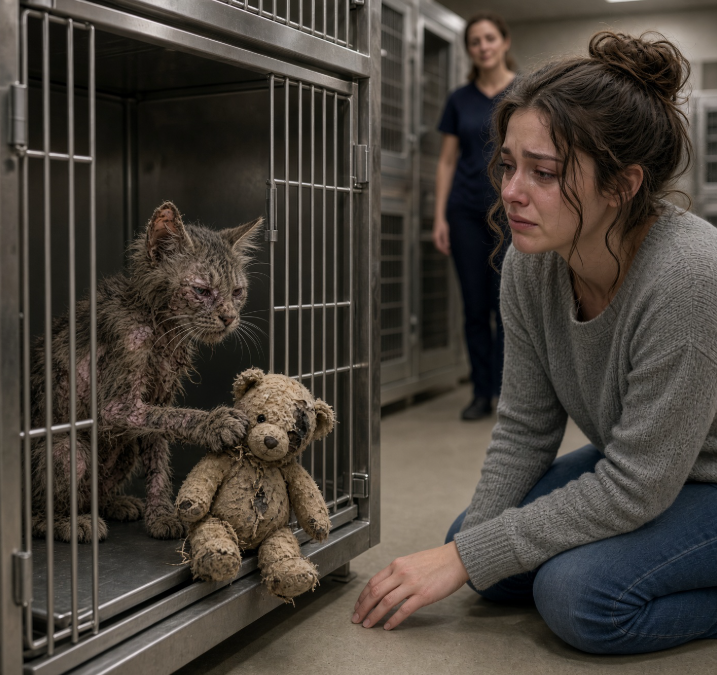
She sat very still with a ragged stuffed bear hanging from her mouth.
It was not a cute toy.
Not anymore.
Maybe it had been once.
One ear dangled by threads. The tan fabric had gone gray from years of being carried, slept on, worried over. Stuffing pushed against one ripped seam. One plastic eye remained. The other was gone, leaving a tiny dark crater that made the thing look wounded.
The cat did not cry.
She did not paw at the kennel door.
She did not roll onto her back or perform sweetness for strangers.
She just watched people walk by.
Then a teenage girl passed close to the kennel.
The cat stood.
Slowly.
She carried the bear to the front, lowered her head, and placed it against the bars.
The girl glanced down.
“Aww,” she said.
Then kept walking toward the kittens.
The cat waited.
Her ears lifted.
Her eyes followed.
When the girl did not come back, the cat picked up the bear and retreated to the rear corner.
I stopped completely.
Patricia noticed.
She turned and followed my gaze.
Her face changed in a way that told me she already knew exactly where this was going to hurt.
“That’s Mabel,” she said.
“Mabel?”
“She came in with that bear.”
I looked at the toy.
“It belongs to her?”
Patricia nodded.
“Very much.”
Mabel sat in the back corner now with the bear under one paw.
“She always does that?” I asked.
“With almost everybody.”
“Why?”
I hated that I asked.
I hated that I wanted the answer.
I had walked into that shelter wanting clean joy, and already I could feel the story reaching for me with dirty little hands.
Patricia leaned against the wall.
Her voice softened.
“Her last family moved out of their rental and left her behind.”
I looked at Mabel.
“She was in the house?”
“Maintenance found her. We don’t know exactly how long she was alone. She had water from a dripping faucet, from what we could tell. Food was gone. The bear was with her in a closet.”
My throat tightened.
“Did the family come back for her?”
“No.”
Mabel looked toward the front again.
Someone else was passing.
A man with his little boy.
Mabel rose.
Picked up the bear.
Brought it forward.
Set it down.
The little boy pointed.
“Dad, that cat has a teddy.”
The father smiled quickly.
“That’s sweet. Come on, buddy. Let’s look at the kittens.”
Mabel waited.
The boy looked back once.
Then disappeared around the corner.
Mabel’s head lowered.
Patricia said, “After she came here, she was very attached to the bear. Wouldn’t eat unless it was nearby. Then she started bringing it forward whenever visitors passed.”
“Like she’s showing it?”
Patricia hesitated.
Then said the sentence that ruined my entire plan.
“It’s like she thinks if she gives up the best thing she has, somebody might take her home.”
I laughed once.
A small, wrong sound.
Not because it was funny.
Because my chest did not know what else to do with the pain that had just entered it.
Mabel picked up the bear again and backed into the corner.
As if the laugh had meant she offered too soon.
That nearly broke me.
I looked away.
Toward the kitten room.
That was what I came for.
A kitten.
A simple choice.
A happy one.
A creature without a sad toy and a history hiding in a closet.
I took three steps.
Then stopped.
Because another person walked past Mabel’s kennel without slowing down.
An older woman in a denim jacket.
Mabel rose again.
Bear in her mouth.
She hurried to the bars with that careful little hope animals have when they have been disappointed so many times they should have learned better, but something in them refuses.
She laid the bear down.
The woman never looked.
Mabel waited a few seconds longer.
Then picked the bear back up.
That did something to me.
Not the rejection by itself.
Life is full of beings walking past other beings.
People do it constantly.
At grocery stores.
At office doors.
At hospital waiting rooms.
At family dinners.
We pass each other with our private disasters tucked under one arm and call it normal because stopping would cost too much.
It was not the rejection.
It was the hope.
The ridiculous, stubborn, embarrassing hope.
That cat had clearly been disappointed before.
Maybe dozens of times.
Maybe all day.
Maybe all week.
And still she kept dragging her one precious thing to the front like:
Here.
You can have this too.
Just please do not leave me here.
I stood there thinking about how many of us do that in one way or another.
We offer usefulness.
We offer silence.
We offer patience.
We offer the agreeable version of ourselves.
We offer whatever hurts to give, hoping it will make somebody stay.
Suddenly my whole fresh-start idea felt thin and childish.
I did not need perfect.
I did not need untouched.
I needed something real.
I turned back.
Patricia did not smile.
Good volunteers do not celebrate too early.
They know hope can scare people off.
I knelt in front of Mabel’s kennel.
She watched me.
The bear hung from her mouth again.
“Hi,” I said.
My voice came out strange.
Too soft.
Mabel came forward slowly.
One paw.
Then another.
Not rushing.
Not trusting.
Just trying.
She set the bear between us and looked up.
I did not reach for the toy.
That felt important.
I put my hand near the kennel door instead.
Palm down.
Still.
“You don’t have to buy your way in,” I whispered.
Of course, I was speaking to the cat.
Also, I was not.
Mabel’s whiskers twitched.
She sniffed my fingers through the bars.
Then she picked up the bear and placed it closer.
As if I had misunderstood the offer.
I swallowed hard.
“No,” I whispered. “You keep that.”
She blinked.
Slowly.
I looked up at Patricia.
“I want this one.”
Patricia’s eyes filled before her smile reached them.
“I was hoping you’d say that.”
“I came for a kitten.”
“Most people do.”
“Does she like apartments?”
“She likes quiet.”
“I have a lot of that.”
Patricia nodded.
“Then maybe she can help you fill it.”
I almost changed my mind.
Not because I did not want Mabel.
Because that sentence came too close to the truth.
Adoption paperwork is strangely ordinary considering what it can change.
Name.
Address.
Employment.
Housing.
Veterinarian.
Pet policy.
Emergency contact.
Questions about scratching posts and windows and whether I understood that a cat could live fifteen to twenty years.
I remember staring at that part.
Fifteen to twenty years.
Mabel already had years behind her.
No one could promise how many remained.
A kitten offered the illusion of more time.
An older cat offered only the truth.
Nothing is guaranteed.
Patricia gave me a folder with food instructions, medical records, adjustment tips, and a list of behaviors that might show stress.
Hiding.
Not eating.
Overgrooming.
Excessive vocalization.
Startling.
Guarding objects.
I looked toward Mabel’s bear.
Guarding objects.
I signed anyway.
While staff prepared the carrier, I walked through the tiny shelter shop and bought things I had not planned to buy.
A soft bed.
Two ceramic bowls.
A litter mat.
A scratching pad.
Three toys.
One little fish that crinkled.
A jingly ball.
A mouse with feathers so dramatic it looked dressed for theater.
At checkout, Patricia glanced at the toys.
“She may not play right away.”
“I know.”
“She may hide for a while.”
“I know.”
“She may carry the bear around.”
“I know.”
Patricia’s face softened.
“Some people think love should look grateful right away.”
I looked at Mabel, who had retreated to the corner while a staff member opened the kennel.
“She doesn’t owe me a performance.”
“No,” Patricia said. “She doesn’t.”
When they placed Mabel into the carrier, she cried once.
A low, terrible sound.
Not loud.
Not a protest exactly.
More like the sound of one more door closing in a life that had already had too many.
The bear went in with her.
Patricia buckled the carrier into my passenger seat while I stood there feeling like I had accidentally taken responsibility for a world too delicate to hold.
“She’ll be okay,” Patricia said.
“How do you know?”
“I don’t.”
I looked at her.
She smiled sadly.
“But she has a chance now.”
On the drive home, Mabel did not make a sound.
I talked because silence felt cruel.
“My apartment is small,” I told her. “But the windows face east, and there’s a tree outside the bedroom. Squirrels use it like they own stock in the building.”
No response.
“There’s a heater vent near the couch. The landlord is useless, but the heat works.”
Nothing.
“I don’t cook much, so you may have to lower your expectations.”
Still nothing.
At a red light, I looked into the carrier.
Mabel’s eyes were wide.
The bear was tucked beneath her chin.
“I don’t know what I’m doing either,” I admitted.
Her ears moved.
That was all.
At home, I prepared the bathroom the way the shelter instructions said.
Small room first.
Food.
Water.
Litter box.
Soft bed.
Towel under the door.
I opened the carrier.
Mabel did not move.
I sat on the floor beside the tub for twenty minutes.
My hips hurt.
My phone buzzed twice.
I ignored it.
Finally, Mabel stepped out.
Low to the ground.
Bear in mouth.
She did not look at me.
She crossed the tile, entered the space between the toilet and the wall, and disappeared as much as a grown cat can disappear in a one-bedroom apartment bathroom.
I placed the bear closer to her.
Then stopped myself.
No.
She had carried it there.
That was where she wanted it.
So I stood and left.
For the first three days, Mabel barely left that bathroom.
She ate at night.
Used the litter box when I was not there.
Moved the bear between corners like the placement mattered deeply.
Each morning I found it somewhere else.
Beside the sink.
Behind the toilet.
In the dry tub.
Once inside her food bowl, which seemed impractical but emotionally significant.
I started talking to her while pretending not to.
“Good morning,” I said while brushing my teeth.
No answer.
“You ate more last night. That’s good.”
Silence.
“I have to go to work. I’ll be back around six.”
Her eyes watched from under the sink.
“I know everybody says that.”
Still nothing.
“I’ll prove it.”
That first day back at work after adopting her, I thought about Mabel all day.
During staff meeting.
While answering emails.
While my supervisor praised me in front of three people for “always being willing to jump in,” which usually meant someone had already planned to push something onto my desk.
While eating half a sandwich at 2:13.
I wondered if she thought I had left forever.
When I unlocked my apartment door that evening, I found the bathroom door open.
Mabel was sitting in the hallway.
Not at the door.
Not exactly waiting.
But positioned where she could see the entrance.
The bear sat between her paws.
When she saw me, she picked it up and retreated to the bathroom.
That should not have made me cry.
It did.
“Hi,” I said, taking off my shoes. “I came back.”
She watched.
“I told you I would.”
The next evening, she sat a few inches farther from the bathroom.
The third evening, halfway down the hall.
The fourth, beside the kitchen entrance.
Each time, the bear came with her.
Each time, she placed it between us.
Not close enough to be touched.
Just close enough to be noticed.
An offering.
A negotiation.
A little heartbreaking contract she kept trying to sign.
Thank you for coming back.
Here is the best thing I have.
Please keep coming back.
On the fifth night, she jumped onto the couch.
Not my lap.
That would have been too much.
Just the far cushion.
The bear hung from her mouth.
I froze with the remote in my hand.
Mabel stepped carefully across the blanket, laid the bear down between us, and stared straight ahead like a person pretending not to hold hands first.
I did not move.
The television played some home renovation show where a couple with suspiciously young faces debated whether six bedrooms were enough for two people.
Mabel remained upright for a full minute.
Then she lowered herself onto the cushion.
After another minute, she rested one paw on the bear.
And after a long time, without looking at me, she leaned until one narrow strip of warm fur touched my leg.
That tiny weight broke something open in me.
Not loudly.
Not in a movie way.
No sobbing into her fur.
No speech about destiny.
Just enough to let in air.
People think rescue is dramatic.
They imagine the adoption photo.
The ride home.
The before and after.
But most rescue is repetitive.
It is showing up the next morning.
And the morning after that.
It is making coffee while a scared creature learns the sound of your footsteps means breakfast, not danger.
It is leaving and coming back.
Leaving and coming back.
Leaving and coming back.
It is answering the same question without words until the body believes you.
Are you still here?
For the first few months, Mabel asked that question constantly.
If I went into the bathroom and closed the door, she sat outside it.
If I showered, she waited on the bath mat.
If I left for work, I came home to find her planted near the entrance like a very anxious landlord.
If I moved furniture, she hid for an hour.
If I dropped a pan, she vanished into the closet so completely I panicked and opened every cabinet before finding two shining eyes behind my winter boots.
And every night, without fail, the bear came to bed.
Always the bear.
Never the new fish toy.
Never the jingly ball.
Never the expensive feather mouse I had foolishly purchased with optimism.
That bear looked worse every week.
The remaining ear loosened.
The seams split.
The stuffing shifted around inside like old bones.
If you saw it on the floor, you would think it belonged in the trash.
I never threw it away.
Some things are ugly because they carried somebody through.
You do not confuse worn out with worthless unless your whole life has been easy.
Mabel taught me that first.
Then she taught me it again.
The first time I took her to the vet, I apologized six times before we reached the exam room.
“I’m sorry,” I told the receptionist when Mabel cried.
“I’m sorry,” I told a man in the waiting area whose golden retriever looked offended by her voice.
“I’m sorry,” I told the technician when Mabel refused to leave the carrier.
The technician finally smiled and said, “You know you don’t have to apologize for her being scared.”
I almost answered automatically:
I know.
But I didn’t.
Because I did not know.
Not really.
I had spent most of my adult life apologizing for anything in me that required adjustment from other people.
My confusion.
My sadness.
My preferences.
My tiredness.
My need for reassurance.
My desire to leave early.
My hunger.
My anger.
My softness.
Mabel crouched in the back of the carrier with the bear beneath her chest, trembling.
I reached through the little door and touched one finger to her paw.
“You don’t have to be sorry,” I whispered.
The technician looked at me.
I pretended not to notice.
Some sentences are meant for whoever needs them most.
Sometimes that is the cat.
Sometimes that is you.
Months passed.
Mabel became less invisible.
She discovered the eastern window.
The tree outside my bedroom.
The squirrels, which she watched with the intensity of a retired detective reviewing cold cases.
She developed strong opinions about canned food.
She learned the sound of the cabinet where treats lived.
She stopped hiding when I sneezed.
She began sleeping on my bed like she paid the mortgage.
At 6:40 every morning, she walked across my ribs.
Not beside me.
Across me.
No apology.
No negotiation.
Just paws.
For a creature who had once acted like every inch of space had to be earned, she became wonderfully entitled.
I loved that about her.
The first time she knocked a pen off my desk and looked at me with calm satisfaction, I laughed so hard she ran from the room.
“Sorry,” I called after her. “I was admiring your confidence.”
But even as Mabel grew safer, the bear remained.
At first, she still offered it constantly.
When I came home.
When I sat on the couch.
When I cried during a movie I did not even like.
When thunder shook the windows.
When I had guests.
After about six months, something changed.
She still carried it, but not always toward me.
Sometimes she carried it to the bed and tucked it under her chin.
Sometimes she dropped it in a sunbeam.
Sometimes she brought it halfway down the hall and then seemed to forget why.
It stopped looking like rent.
It became ritual.
A memory transformed.
A thing that once belonged to fear, now living inside safety.
That mattered more than I knew how to explain.
The first person who made me try was my friend Allison.
I had known Allison since college.
She was sharp, busy, funny, and proud of saying hard things quickly.
She considered bluntness a moral achievement.
Sometimes it is.
Sometimes it is laziness wearing honesty’s clothes.
She came over for Thai food on a Thursday night about a year after I adopted Mabel.
Mabel sat in the hallway, watching us eat.
The bear was at her feet.
Allison glanced down.
“Oh no. She still has that disgusting thing?”
I looked up from my noodles.
“What?”
“The toy.” She pointed with her fork. “You should probably get rid of it.”
I laughed because I thought she was joking.
She wasn’t.
“I’m serious,” she said. “She might bond better if you stop letting her cling to the past.”
I stared at her.
“She is bonded.”
“She’s a cat.”
“And?”
“You’re turning it into some tragic symbol.”
Mabel looked at me.
Then gently placed one paw over the bear.
I do not know why that annoyed me as much as it did.
Maybe because people only call something projection when it reveals more truth than they are comfortable with.
Maybe because the world is so eager to strip meaning from anything soft.
Especially if that softness exposes us.
“Or maybe,” I said, “she’s attached to the one thing that stayed with her when people didn’t.”
Allison rolled her eyes.
“You don’t know that.”
No.
I did not know it in a way that could be entered as evidence in court.
I did not have signed testimony from the cat.
I did not have a lab report.
But I had eyes.
I had patterns.
I had the strange, deep education that comes from living beside another being long enough to see how grief repeats itself.
We hide behind the demand for proof whenever compassion might require too much of us.
If suffering cannot be measured neatly, some people decide it must not be real.
That is convenient.
It is also brutal.
I changed the subject.
That was what I usually did when something stung.
But the comment stayed with me.
Not because I thought Allison was right.
Because I knew a lot of people thought the same way.
We are living in a time that worships efficiency.
Even in love.
Especially in love.
People want clean narratives.
A new pet.
A fresh start.
A happy ending.
They do not want the weird, messy middle where trust comes in inches and old damage keeps showing up at bedtime with its stuffing coming out.
They do not want the creature that flinches.
The person who apologizes too much.
The child who hoards snacks.
The spouse who goes silent during arguments because silence once kept them safe.
The old dog with medical bills.
The cat who still sleeps with proof of her worst years tucked under one paw.
Everybody says they want something real until real starts looking inconvenient.
That sounds harsh.
Maybe it is.
But after Mabel, I started noticing how often love gets confused with preference.
How often we call comfort compatibility.
How often we walk past anything that might need patience and then say we are protecting our peace.
I know that phrase is popular.
I know sometimes it is true.
Sometimes protecting your peace is wisdom.
Sometimes it is survival.
And sometimes, if we are honest, it is just a prettier way of saying:
I do not want to be bothered by anybody else’s scars.
That is the part people get mad about.
I understand why.
Nobody likes feeling accused by a cat story.
But that is what happened.
A cat story accused me first.
Not in words.
In contrast.
I was standing in that shelter thinking I wanted something simple.
What I really wanted was something that did not remind me of myself.
Then Mabel lifted that broken bear to the door like rent for love, and suddenly I had no place left to hide.
Because I knew that move.
Maybe not with a toy.
But in spirit.
I knew what it was to think:
Let me be useful first.
Let me be undemanding first.
Let me give you something so you will not leave.
Let me earn what other people seem to receive for free.
That is not a cat problem.
That is half the adults I know.
Maybe more.
I had been one of them for so long I had mistaken it for personality.
At work, I was the dependable one.
That sounds nice until you understand how often dependable means exploitable.
I said yes before I checked my capacity.
I stayed late because someone said, “You’re just so good at handling clients.”
I volunteered for messy projects because I knew if I was useful enough, nobody would look too closely at whether I was lonely or scared or quietly furious.
I made myself easy to have around.
With family, I kept conversations smooth.
In relationships, I acted low-maintenance while privately starving.
I told myself I was easy to love.
What I really was was easy to overlook.
Mabel did not fix that overnight.
I wish I could say she did.
I wish I could tell you adopting one sad shelter cat turned me into a boundary-setting, emotionally healthy adult by spring.
That would play well online.
But no.
The truth was slower.
And more embarrassing.
The first real change happened at work on a Friday afternoon.
My supervisor, Diane, came to my desk at 4:38 p.m. holding a stack of folders.
The sight of them made my whole body tired.
“Could you do me a huge favor?” she asked.
That sentence is rarely a question.
Diane was excellent at praise.
Public praise, especially.
She would say things like, “Nobody handles difficult accounts like you,” while quietly handing me the difficult accounts no one else wanted.
She called me a lifesaver so often I stopped noticing I was drowning.
That Friday, she placed the folders on my desk and gave me a bright fake smile.
“We really need these summaries done before Monday.”
I looked at the stack.
Then at the clock.
Normally, I would have done it.
Resented it quietly.
Canceled my evening.
Gone home late.
Fed Mabel with an apology in my throat.
Then sat on the couch feeling noble and empty.
Instead, I looked at those folders and heard the strangest thought in my mind:
The cat would not offer the bear anymore.
That sounds absurd.
I know.
But once you see a pattern, it starts showing up everywhere.
I had spent years leaving my own metaphorical bear at door after door.
Here.
Take this too.
My time.
My calm.
My extra effort.
My weekend.
My body.
My silence.
Just please do not punish me for existing with needs.
I put one hand on the folders and slid them back an inch.
“I can finish these on Monday,” I said.
Diane blinked.
“We really need them tonight.”
“I understand. I can finish them on Monday.”
That was all.
A normal sentence.
A small one.
My heart pounded so hard I thought I might pass out.
That is how deeply the training runs.
For some of us, declining one unreasonable request feels like committing a crime.
Diane stared at me another second.
Then her smile tightened.
“Okay. I’ll see who else can help.”
“Thank you.”
She walked away.
I sat there shaking.
Not because I thought one boundary had transformed my life.
Because I had just acted like a person with dignity after years of moving like someone grateful to be tolerated.
When I got home, Mabel was waiting by the door.
Bear in mouth.
She dropped it at my feet.
For a second, I almost cried.
Not because I thought she knew what had happened.
Because I did.
I knelt down and said, “Not tonight. We’re keeping what’s ours.”
That became a private joke between us.
Whenever I noticed myself slipping into old habits, I would think it.
Keep what’s ours.
Not selfishly.
Sanely.
Keep the rest I need.
Keep the no that protects me.
Keep the hour that belongs to my own nervous system.
Keep the truth.
Keep the self-respect.
Keep the thing I was taught to hand over too cheaply.
The next change happened with a man named Aaron.
Calling it dating may be generous.
We had been seeing each other for four months, which meant we had eaten enough dinners together for me to know how he took coffee but not enough for him to have earned the right to disappoint me as often as he did.
Aaron was charming.
Funny.
Good at talking about emotions in the language people use now.
He said things like “holding space” and “processing” and “capacity,” but somehow his capacity always seemed to vanish right when I needed him to keep a promise.
He liked me best when I was accommodating.
Easy.
Available.
Understanding.
He liked that I never made scenes.
Never asked for much.
Never complicated the mood with inconvenient feelings.
Then one Saturday, he canceled plans at the last minute for the third weekend in a row.
Sorry, he texted. Week got away from me. Rain check?
Normally, I would have swallowed it.
Told myself not to be dramatic.
Typed something breezy.
No worries!
I understood!
Rest up!
Somewhere inside, I would have quietly set down the bear.
Instead, I stared at the message.
Mabel slept beside me with one paw on the toy.
I typed:
I don’t think this works for me anymore.
My finger hovered over send so long Mabel changed positions twice.
Then I sent it.
The response came back almost instantly.
You’re overreacting.
There it was.
The oldest magic trick in the book.
Make the hurt person feel irrational for noticing the hurt.
Something unexpected happened.
I did not spiral.
I did not explain myself into exhaustion.
I did not write three paragraphs of gentle clarification to make my boundary easier to digest.
I looked at Mabel.
Even safe, she still slept touching the thing she once tried to trade.
Healing does not erase memory.
It changes the meaning of it.
I wrote back:
I wish you well.
Then I put the phone down.
That was that.
A small breakup.
Barely worth mentioning in the grand order of human events.
Except to me, it mattered.
Because it was one more door where I did not set down the bear.
You may think this is too much meaning to load onto one cat.
Maybe it is.
But I think people say that whenever they feel threatened by the idea that change can come through humble channels.
We respect revelation more if it costs money.
If it comes from a stage.
If it wears credentials.
But a lot of my real growth came from watching a seven-pound animal relearn safety in my hallway.
That is not less profound because it is ordinary.
It is more.
Two years after Mabel came home, somebody told me I was projecting.
That was when the story got bigger than my apartment.
It began on a Thursday night with the dirty stuffed bear in my hand and my phone buzzing on the kitchen counter.
The moments that change your life rarely arrive with music.
They arrive while you are rinsing a coffee cup.
While the cat winds around your ankles.
While you are tired enough to believe the day is over.
I had been repairing the bear.
Again.
One seam had opened near the remaining ear, and stuffing had begun escaping in tiny white tufts. Mabel sat beside me on the floor like a skeptical contractor supervising shoddy work.
“I am doing my best,” I told her.
She stared.
“You have unrealistic expectations.”
She blinked.
My phone buzzed.
A message from Allison.
I had not seen her since the Thai food conversation.
We had cooled after that.
Not dramatically.
Adult friendships often fade by inches rather than explosions.
Her message read:
Saw this and thought of you.
Beneath it was a post from some pet account with a caption about people projecting abandonment issues onto rescue animals. The tone was smug in the specific way people get when they think cynicism is intelligence.
I stared.
Then laughed.
Not kindly.
Mabel reached one paw toward the bear.
Something in me hardened.
Not against Allison exactly.
Against the old habit of letting other people make me feel foolish for tenderness.
I opened my photos.
Found one from earlier that week.
Mabel asleep on my bed, curled around the bear, face peaceful, one paw resting over the ruined little body like she was keeping it from falling out of the world.
I posted it.
Just that.
A photo and a short caption.
Two years ago I went to a shelter for a kitten and came home with a grown cat who used to leave this bear at the kennel door like payment. She still sleeps with it every night. Some things stop being a trade once they’re finally safe.
That was it.
No sermon.
No grand point.
No dramatic music.
I posted it.
Set the phone down.
Made tea.
Mended the bear.
Changed into pajamas.
When I picked up my phone again, there were already more notifications than I usually received in a month.
At first, they were from people I knew.
Hearts.
Crying faces.
“Oh my God.”
“She’s precious.”
“I’m not okay.”
Then friends of friends.
Then shelter people.
Then strangers.
By midnight, the post had traveled beyond anything I understood.
People were sharing it.
Commenting.
Tagging each other.
Sending long messages I did not yet have the emotional stamina to read.
By morning, the internet had done what the internet always does.
It took one soft human story and turned it into a public argument.
Some people were kind in ways that nearly leveled me.
They told me about old dogs who still carried baby blankets.
Cats who slept inside laundry baskets because that was where they hid before rescue.
Children who still kept hospital bracelets in drawers.
Adults who still apologized before asking for water.
The comments filled with people recognizing themselves.
Not just in the cat.
In the offering.
In the bargaining.
In the quiet, humiliating instinct to make themselves lovable by being useful.
One woman wrote:
I spent twelve years cooking, cleaning, staying calm, and calling it love. It was really rent.
I stared at that comment for a long time.
Another person wrote:
My son carries his backpack into every room, even at home. Reading this made me realize he still doesn’t feel settled.
A man wrote:
I’m forty-six years old and still show up to my mother’s house with groceries every time I need to ask her for anything.
And then the other side arrived.
Because of course it did.
The internet sees a wound and immediately starts debating whether the wound has the right to hurt.
It’s a cat. Calm down.
You people project human emotions onto animals and then wonder why you’re unhappy.
This is why shelters guilt people instead of being honest.
Older pets come with baggage. That’s just reality.
Not everybody wants a fixer-upper.
That last one got under my skin.
Not because it was unusual.
Because it was common.
Common enough to reveal something ugly.
Not just about animals.
About how we rank worthiness.
How fast we sort living beings into categories.
Easy.
Cute.
New.
Damaged.
Complicated.
Too much.
Then we pretend the categories are neutral.
They are not.
They shape who gets chosen.
Who gets helped.
Who gets patience.
Who gets to arrive with history and still be welcomed.
I kept reading.
That was probably unhealthy.
But there is a point where you stop looking at comments for validation and start reading because they form a rough map of the country you live in.
According to that map, a lot of people believed love should feel easy right away or it was not worth doing.
A lot of people believed visible scars lowered value.
A lot of people believed need itself was suspicious.
Yes, some of them were only talking about pets.
But only if you are determined to miss the larger point.
We reveal ourselves in the way we talk about the vulnerable.
Always.
How we talk about old animals.
How we talk about struggling kids.
How we talk about sick relatives.
How we talk about the friend who is a lot.
How we talk about people who ask for a second chance after life has knocked half the polish off them.
That is the real confession.
Not what we say we believe.
What irritates us.
What we call inconvenient.
What we keep walking past.
The post kept spreading.
A local shelter asked permission to share it.
Then another.
Then another.
My inbox filled with people telling me they had adopted older pets because of Mabel.
I want to be honest.
That part felt good.
Of course it did.
Any human being who says they do not enjoy seeing proof that something tender mattered is either lying or trying too hard to look detached.
It felt good.
But it also felt strange.
Because mixed into the sweet messages were ones that carried accusation even when they meant kindness.
Thank you for saving her.
I understood the sentiment.
Still, that word sat wrong in me.
Saved.
As if love only moved one way.
As if I had been the stable one offering rescue from above.
As if Mabel had arrived empty and left improved.
That is not what happened.
I gave her a home.
She gave me a mirror I could not avoid.
She forced me to see the humiliating little performances I had built my life around.
The constant proving.
The self-erasure disguised as kindness.
The way I treated my own needs like embarrassing extra luggage.
That is not a small gift.
That is restructuring.
So when people called me Mabel’s rescuer, I started replying with some version of:
She rescued me from thinking love had to be earned by usefulness.
A few people understood immediately.
A few mocked it.
One man commented:
Imagine letting a housecat become your life coach.
I almost ignored that one.
Then I laughed.
Because maybe that was the problem.
Not that I had learned from a housecat.
That too many people have decided wisdom only counts when it comes packaged in status.
We will listen to a man in a suit tell us we deserve rest.
We will repost a quote over a beach background about self-worth.
We will buy books on boundaries and healing.
But let one shelter cat drag a busted toy to a kennel door, and suddenly everybody gets embarrassed.
Why?
Because then the lesson is too plain to ignore.
You do not need a seminar to understand it.
You need only the willingness to be implicated by something small.
Mabel did not use big language.
Mabel said, with her body:
I have learned to barter because I do not believe I am enough by myself.
And something in me answered:
Same.
The post changed my life in ways I did not expect.
Not dramatically.
At first, it only made me uncomfortable.
My phone buzzed for days.
People I had not heard from in years sent messages.
My cousin Lauren wrote:
This made me cry. Also, are you okay?
I stared at those words.
Are you okay?
A simple question I would have answered falsely before Mabel.
I started typing:
Yes! Totally fine! Hope you’re good!
Then stopped.
Mabel sat on the arm of the couch, washing one paw.
The bear rested by her tail.
I deleted my response.
Typed:
Not always. But better than I was.
Lauren replied:
Me too.
That was the whole conversation for two days.
Me too.
Sometimes truth does not need a paragraph.
Sometimes it needs one small crack in the polite wall.
A week later, Lauren called.
Not texted.
Called.
I almost did not answer because phone calls feel like emergencies now.
But I did.
We talked for an hour.
At first about Mabel.
Then about work.
Then about her marriage.
Then about the strange loneliness of being surrounded by people who need you but do not necessarily know you.
At the end she said, “I think I’ve been offering the bear too.”
I sat on my couch in the dark with Mabel asleep against my hip.
“Yeah,” I said. “A lot of us have.”
The next family dinner confirmed that.
My cousin hosted one of those crowded meals where everyone acts casual while quietly auditing each other’s lives.
I almost canceled.
I was tired.
Work had been bad.
Money felt thin.
The apartment needed repairs.
There is a particular kind of fatigue that makes even being perceived feel expensive.
But I went.
Mostly because saying no would have led to follow-up questions, and I had no energy for those either.
I got there late.
People were already eating.
Children in socks ran across the living room.
Two conversations happened over each other.
Someone had brought three kinds of salad, all of which contained ingredients trying too hard.
I had barely sat down when my aunt asked if I was still living alone.
Still.
That word landed like something dropped on tile.
I smiled and said, “Unless you count Mabel.”
“Who’s Mabel?”
“My cat.”
A few polite laughs.
Then somebody asked to see a picture.
So I pulled out my phone and showed one from the week before.
Mabel asleep on my bed with the bear under her chin, looking so peaceful it almost hurt to see.
Just like that, the table split into the two camps that always emerge when an animal becomes more than decoration.
One person softened immediately.
Another smiled.
Then my uncle Carl, who had never met a vulnerable moment he could not flatten into a joke, said, “You let a cat sleep in your bed with that filthy little thing? That animal really manipulated you.”
A few people laughed.
Not cruelly.
That almost made it worse.
Casual dismissal hurts differently because it tells you the world thinks your tenderness is silly.
That your attachment is unserious.
That caring deeply is a personality flaw to outgrow.
“She’s not manipulating me,” I said.
He shrugged.
“Come on. Animals know how to work people.”
There it was again.
That need to reduce love to leverage.
To turn connection into strategy.
To frame need as manipulation because then nobody has to respond with mercy.
I looked around the table.
People were waiting to see if I would laugh it off.
I usually would have.
Keep it light.
Make it easy.
Do not make the room uncomfortable.
But I was tired.
Not ordinary tired.
Deep tired.
The kind that makes you stop performing.
“Maybe she does know how to work people,” I said. “Maybe she learned she had to.”
The room went quieter than I expected.
I kept going.
“Sometimes when something gets left behind enough times, it starts offering whatever it has. Not because it’s clever. Because it’s scared.”
Nobody spoke.
I could hear silverware.
A child laughing somewhere in the other room.
My uncle looked annoyed.
“Now you’re turning a pet into a therapy session.”
Maybe I was.
Or maybe the line between the two is thinner than people think.
“No,” I said. “I’m saying a lot of us do the exact same thing, and we call it being nice.”
That landed.
Not with everyone.
But with enough.
Lauren looked down at her plate so fast I knew I had hit something true.
An older aunt across the table had tears in her eyes for reasons nobody named.
My uncle scoffed and reached for bread.
The subject changed one minute later.
That is how families survive.
By changing the subject one minute after truth enters the room.
But I carried that moment home with me.
Not because I had delivered some grand speech.
Because I realized how quickly people defend themselves against the idea that love might ask more of them than convenience.
A month after the post took off, a local rescue group invited me to an adoption event.
They had a cheerful name like Paws & Porchlight.
Something designed by a committee that believed hope required paw prints in the logo.
They asked if I would stop by.
Maybe bring Mabel.
Maybe bring the bear.
Maybe take photos.
I nearly declined.
Public things are not my strength.
Neither are folding tables in parking lots.
But they mentioned older cats needed attention because people kept walking straight to the kittens.
So I went.
Of course I did.
Mabel did not come.
She would have hated it, and I respect her boundaries more than most humans respect each other’s.
I brought a photo.
And because I had apparently become this kind of person, I brought the bear.
It sat on the table beside Mabel’s picture so people could see how small and ordinary it really was.
Not magical.
Not cinematic.
Just worn.
A little ugly.
Still surviving.
You would not believe how people reacted to that bear.
Some touched their chests as if struck.
Some laughed nervously and said, “Oh no.”
One older man stood there for a long time and finally told me his late wife had slept with the same pillow for thirty years after her first husband died, even after the fabric turned thin as paper.
“I used to tease her about it,” he said. “Now I think maybe that was the wrong instinct.”
A teenage girl stared at the bear and started crying so suddenly her mother pulled her aside.
Later the mother came back alone and said, “Her father moved out last year. She keeps giving away her favorite things whenever she thinks people are upset with her.”
That stayed with me.
Because once you see this pattern, you see it everywhere.
Children doing chores nobody asked for after divorce.
Partners becoming impossibly agreeable after betrayal.
Friends always picking up the check because they are terrified of being a burden.
Employees answering emails at midnight to prove they deserve to remain employed.
Old animals bringing their only toy to the bars.
The forms differ.
The ache is the same.
At the event, a little boy asked why the cat gave away the bear if she loved it.
He had serious eyes and chocolate on his shirt.
I told him, “Sometimes when somebody is scared of losing everything, they offer the most important thing they have.”
He thought about that with the face children get when they are building a new shelf inside themselves.
Then he said, “That’s sad.”
Yes.
It is sad.
It is also common enough that we should be more ashamed of the world than surprised by the cat.
Before I left, I walked past the kennels set up for the day.
Kittens climbed and pawed and performed adorable chaos with the ruthless efficiency of youth.
People gathered around them, phones out, voices high.
Then, in a lower crate near the end, there was an older gray cat with cloudy eyes and a calm face.
Not sick.
Just old.
Just unfashionable by the standards of people who shop for hope in small fluffy bodies.
A young couple stopped in front of the crate.
The woman smiled at the cat.
The man glanced at the sign and said, “Nine years old? No way. We want more time than that.”
Then they moved on.
I stood there thinking about all the ways people speak as if love is a bad investment unless the return window is long enough.
As if something only counts if you get maximum years.
As if the point is quantity, not encounter.
I understand the fear.
I do.
Loss is expensive.
Grief rearranges furniture inside your chest.
Of course people want to postpone it.
But if fear becomes the thing steering every choice, what you are really saying is:
I will only love where the odds flatter me.
That is not how the best parts of life work.
Nobody gets guaranteed time.
Not with pets.
Not with people.
Not with parents, spouses, friends, children, or your own body.
Nothing is promised.
And still, we love.
Or we are supposed to.
That older gray cat was adopted that afternoon by a retired school custodian named Walter.
I happened to be standing near the table when he filled out the paperwork.
He wore a brown jacket with frayed cuffs and held the pen like he was signing something solemn.
The volunteer asked, “Are you sure? She’s nine.”
Walter nodded.
“I’m seventy-four.”
The volunteer smiled.
He continued, “We can be each other’s short-term plan.”
I had to walk away for a minute.
There.
That.
The world is still terrible in many ways.
Sharp.
Cruel.
Full of people who measure worth by convenience.
But then one tired older man looks at one tired older cat and says, basically:
I do not need forever to know this matters.
And suddenly the whole day becomes easier to bear.
When I got home, Mabel was in the window.
She always waited there if I had been gone longer than usual.
Not dramatically.
Just sitting.
As if she had decided to hold the place steady until I returned.
I unlocked the door.
She trotted over.
And yes, she had the bear.
She laid it down on the rug between us.
Not as payment anymore.
Not even exactly as comfort.
More like ritual.
Memory transformed.
A thing that once belonged to fear now living inside safety.
I picked it up carefully.
The stitching was loosening again.
At some point, I knew it would fall apart for good.
That thought scared me more than it should have.
Because the bear had become more than a toy.
It was evidence.
Of where she had been.
Of what she had believed.
Of what changed.
And maybe I needed that evidence too.
Maybe I was afraid that if the object vanished, the lesson would soften.
That night, I sat on the floor with my sewing kit, trying to reinforce one side seam while Mabel supervised.
Halfway through, my phone buzzed.
Against my better judgment, I opened it.
A stranger had commented:
Cute story, but let’s be honest. Some things are broken for a reason. Not everybody wants the burden.
I stared at that sentence.
Not because it was original.
Because it was not.
That is the sentence under half the cruelty in this country.
Different wording.
Same belief.
Some things are broken for a reason.
Translation:
Their pain must mean something about their worth.
Their hardship must be their category.
Their visible damage should disqualify them from tenderness.
Not everybody wants the burden.
Translation:
I see need as contamination.
I see care as a downgrade.
I see history and think defect.
And maybe the worst part is that many of us absorb those messages long before we can argue with them.
That is how people end up apologizing for normal needs.
That is how children grow into adults who arrive carrying gifts they cannot afford.
That is how love turns transactional before it even begins.
I did not respond to the stranger.
There was no point.
The internet is full of people rehearsing the worldview that best protects them from obligation.
Arguing one comment at a time is like trying to empty a lake with a spoon.
Instead, I put the phone down and finished mending the bear.
Then I looked at Mabel.
“You know what? Let them tell on themselves.”
That became another phrase in my house.
Let them tell on themselves.
Because that is what people do when they talk about the vulnerable.
They reveal whether they believe wounds reduce worth.
They reveal whether they understand visible damage is not moral failure.
They reveal whether they think care should be reserved for the easy.
You do not always have to argue.
Sometimes you only have to listen long enough to hear what a person worships.
Comfort.
Control.
Convenience.
Clean narratives.
Or something better.
Months went by.
The internet moved on, because it always does.
Outrage rotates.
Tenderness too.
New arguments.
New scandals.
New distractions.
Mabel’s post stopped collecting hundreds of comments a day and settled into the slower rhythm of occasional messages from strangers who had found it late, usually at night, usually when they were already hurting.
But the story did not leave me.
It kept working in private.
I started calling my mother more.
Really calling.
Not the efficient kind of call adult children make when they are afraid of intimacy.
You know the one.
Weather.
Appointments.
Groceries.
Anything breaking?
Need anything?
Okay, talk later.
My mother is from a generation that believes love should be practical and rarely named.
She is not cold.
Just careful.
A person shaped by years when survival got first pick over softness.
For most of my life, our relationship had been built around usefulness.
I helped with errands.
She sent leftovers.
We discussed appointments, weather, family logistics.
We did not discuss loneliness.
Regret.
Fear.
The fact that both of us had spent decades trying to deserve each other in small serviceable ways.
One Sunday afternoon, I was at her house fixing a loose cabinet hinge.
She sat at the kitchen table sorting coupons she would probably never use.
Mabel’s story had traveled farther than either of us expected, and my mother, who claimed not to care about the internet while somehow knowing everything that circulated on it, said without looking at me, “Your aunt showed me that cat post.”
I tightened a screw.
“Oh.”
She was quiet.
Then said, “That thing you wrote. About some people offering things so others will stay.”
I waited.
My mother does not approach tenderness head-on.
She circles it like a cautious animal.
Finally she said, “Your father used to bring home little presents every time he thought I was mad.”
There it was.
A doorway.
Not wide.
But open.
I sat back on my heels.
She kept talking, still not looking at me.
“Nothing expensive. Gum. A magazine. Those little orange cakes I liked.” She swallowed once. “He thought if he came home empty-handed, it meant trouble.”
My father had been gone for years by then.
I knew pieces of him.
Not enough.
The ordinary tragedy of adulthood is realizing your parents were once young, frightened people improvising their way through damage nobody translated for them.
“Maybe that’s where I learned it,” I said.
That made her laugh softly.
Sadly.
“Probably.”
We sat in that for a while.
Then because life has a sense of humor, she asked, “How is the cat?”
I smiled.
“She still sleeps with the bear.”
My mother nodded like that made perfect sense.
Maybe it did.
Maybe every family has its own version.
The object.
The ritual.
The little behavior that looks strange from outside but is actually a scar translated into habit.
I think that was the day I stopped feeling embarrassed by the depth of this story.
Because I could see the line running through generations.
Not just one shelter cat.
Not just me.
A thousand little barters passed hand to hand like heirlooms nobody wanted but everyone inherited.
Be useful.
Be easy.
Bring something.
Do not arrive empty.
Do not ask for love without compensation.
Then one day, if you are lucky, life places a creature in your path who exposes the whole arrangement by making it visible.
By dragging the old bargain into the center of the room where nobody can pretend it is normal anymore.
That is what Mabel did.
Maybe that is why people reacted so strongly.
Not because it was just a cat story.
Because it was not.
It was a story about the humiliating economy too many of us live inside.
The one where affection gets confused with reward.
Where care gets rationed according to performance.
Where we praise people for being low-maintenance when what we really mean is that they learned not to bother us with the full weight of their humanity.
I am not interested in pretending every hard thing deserves access to your life.
That is not wisdom either.
Boundaries matter.
Safety matters.
Discernment matters.
But we have swung so far toward self-protection that sometimes I think we are in danger of calling numbness maturity.
We confuse detachment with standards.
We confuse avoidance with peace.
We confuse emotional minimalism with health.
Then we wonder why so many people feel unseen even in crowded rooms.
This is the controversial part, I suppose.
So here it is plain.
I do not think the biggest crisis around us is that people care too much.
I think it is that too many people have learned to treat inconvenience as injustice.
If love requires adaptation, patience, sacrifice, or contact with somebody else’s history, we increasingly act like something unfair has happened to us.
Not every time.
But often enough to matter.
And yes, sometimes protecting yourself is necessary.
Sometimes walking away is correct.
Sometimes the kindest thing you can do is not sign up for a responsibility you cannot carry well.
But a lot of the time, people are not protecting themselves from harm.
They are protecting themselves from tenderness that might demand they become less selfish.
There.
I said it.
You can disagree.
A lot of people did.
That is fine.
But I have watched enough humans pass the older cat kennel without slowing down to know there is truth in it.
We like the version of love that makes us feel good about ourselves.
We like being chosen.
We like being adored.
We like the cute beginning.
We do not always like being needed by something that has seen too much and still dares to hope.
But that may be the holiest part.
Not the polished affection that arrives easy.
The risky, trembling trust of a being that has reason not to believe in you and chooses to try anyway.
That changes a person.
Or it should.
Mabel grew older beside me.
Not ancient.
But older.
Her face softened.
The gray around her muzzle deepened.
She gained weight, then lost a little as cats do when time begins making quieter claims.
She still startled when the door buzzer sounded.
Still hated cardboard boxes if they were too large.
Still hid during thunderstorms.
Still carried the bear to bed every single night.
The bear was almost more thread than fabric now.
One ear gone for good.
The shape of it making less and less sense.
But she loved it.
Or maybe love is not even the right word.
Maybe it was simply woven into the story of how she survived long enough to learn safety.
I understood that better because I had my versions too.
The habits.
The phrases.
The overexplaining.
The instant apology when I asked for anything.
The urge to bring some invisible offering into rooms where I wanted to be welcomed.
I was better than I had been.
Not cured.
Better.
That matters.
One evening, my neighbor’s little girl came by to return a package that had been dropped at her apartment by mistake.
Her name was Sophie.
Maybe eight.
Serious eyes.
Missing front tooth.
She stood in the hallway holding the box with both arms.
“This is yours,” she said.
“Thank you.”
Mabel appeared behind me.
Sophie’s eyes widened.
“Can I say hi?”
“If she wants.”
Sophie sat on the floor without being told.
Smart kid.
People who know cats understand that ground level is more polite.
Mabel walked over.
To my surprise, she carried the bear.
She dropped it in front of Sophie.
The girl looked up at me and whispered, “Is this for me?”
I smiled.
“No. That’s her special one.”
Sophie nodded solemnly and placed her hands in her lap instead of grabbing for it.
Mabel sniffed her fingers.
Then sat.
Then, after a long moment, laid one paw on the bear and leaned against Sophie’s knee.
Sophie looked at me again.
“I think she likes me.”
“I think so too.”
She was quiet another second.
Then said, “My brother gives me his crackers when he thinks I’m sad.”
I do not know why that almost broke me.
Maybe because the pattern keeps reappearing.
Generation after generation.
House after house.
All these small offerings.
All these private little bribes against abandonment.
“Do you give him things too?” I asked.
She nodded.
“My blue blanket when he gets scared.”
There it was.
The whole human story.
Again.
Not in theory.
In a child.
In crackers and a blanket.
In the ancient instinct to share what soothes you with someone you cannot bear to lose.
After she left, I sat on the couch and cried harder than I had in months.
Not out of sadness exactly.
Out of recognition.
Out of the terrible tenderness of realizing how much of life is just creatures trying to reassure each other that the night will not swallow them whole.
Maybe that is why Mabel’s story spread.
Maybe people are starved for language plain enough to hold what they already know.
That love should not have to be bought.
That a scar is not a moral defect.
That old hurt does not make somebody less worthy of being chosen.
That sometimes the ones who look too much are only the ones who had to carry too much alone.
That the world keeps teaching us to rate value by ease.
And the soul, when it is still alive, keeps resisting.
The winter after Sophie returned my package, Mabel got sick.
Not dramatically at first.
That is how fear likes to enter.
Small.
Easy to explain.
She ate less on Monday.
Slept more Tuesday.
Skipped the window Wednesday.
On Thursday morning, the bear was still in the hallway.
Not beside the bed.
That scared me.
Mabel always brought it to bed.
Always.
I found her curled in the bathroom, eyes half closed, breathing shallow.
The old panic rose in me.
Not just about her.
About every creature I had ever loved.
Every person who had seemed fine until they weren’t.
Every ending that started with one detail out of place.
I called the vet with shaking hands.
They got us in that afternoon.
I placed Mabel in the carrier.
The bear went with her.
In the waiting room, a little boy asked why my cat had a teddy bear.
His mother hushed him.
I answered anyway.
“Because she loves it.”
He nodded.
“That’s okay.”
I looked at his mother.
“Apparently.”
The vet was kind.
Kidney numbers.
Hydration.
Age.
Manageable, he said.
For now.
Those words held both mercy and warning.
Manageable.
For now.
We started fluids.
Medication.
Food changes.
Appointments.
I learned how to give injections under loose skin while Mabel stared at me with deep betrayal.
“I am saving your life,” I told her.
She disagreed.
The bear stayed near her food bowl for three days.
Then one night, as I washed a spoon at the sink, I heard the soft thump of paws.
Mabel came into the kitchen.
Slow.
Determined.
Bear in mouth.
She dropped it at my feet.
Not at the door.
Not between us.
At my feet.
Then she sat.
I sank to the floor.
“Oh,” I whispered.
She leaned into my knee.
For years, I had told her she did not need to pay to stay.
That night, I finally understood another part.
Sometimes an offering is not payment.
Sometimes it is participation.
Sometimes the thing you carry is not a bribe.
It is language.
Mabel had no speech for fear.
No sentence for gratitude.
No way to say, I still want to be here.
So she brought what she had always brought.
Not because she thought I would leave.
Because she trusted me enough to show me the old ritual without shame.
I picked up the bear and placed it beside both of us.
“We’re keeping what’s ours,” I said.
Mabel pressed her forehead against my hand.
She stabilized.
Not forever.
Nothing is forever.
But for a while.
A good while.
Long enough for spring to come back.
Long enough for the tree outside my bedroom to fill with leaves again.
Long enough for the squirrels to resume their criminal activity.
Long enough for Mabel to teach me that loving something vulnerable does not mean pretending endings are not coming.
It means refusing to let endings steal the whole middle.
That spring, Paws & Porchlight asked if I would speak at another adoption event.
I said no to a speech.
Then yes to a table.
This time I brought a printed sign.
No dramatic font.
No crying cat photo blown up like a charity poster.
Just one sentence:
Ask about the ones who already know how to love.
People stopped.
Not everyone.
Some still went straight to the kittens.
That was okay.
Kittens need homes too.
New beginnings are not crimes.
But a few people slowed.
Asked.
Listened.
One woman adopted a twelve-year-old tuxedo cat named Henry because, as she said, “My husband’s name was Henry. Maybe that’s a sign.”
Maybe it was.
Maybe it wasn’t.
The cat got a home either way.
A college student adopted a shy calico after sitting on the floor for forty minutes.
A father with two daughters asked about bonded pairs.
The youngest daughter said, “We shouldn’t split sisters.”
Good girl.
At the end of the day, Patricia showed up.
The shelter volunteer from my first visit.
She had aged a little.
So had I.
She recognized the bear immediately.
“Oh my goodness.”
“I know.”
“It’s still alive?”
“Barely.”
She touched the table near it, not the toy.
Respect.
“How’s Mabel?”
“Bossy.”
Patricia smiled.
“That means good.”
“She sleeps on my bed like she owns the lease.”
“Better.”
I hesitated.
Then said, “I’m glad you let me stop that day.”
Patricia looked confused.
“You stopped yourself.”
“No,” I said. “I almost kept walking.”
“We all almost keep walking.”
That sentence followed me home.
We all almost keep walking.
Past kennels.
Past neighbors.
Past family members.
Past ourselves.
The difference between one life and another can be a hesitation honored instead of ignored.
That evening, I came home exhausted.
Mabel waited in the window.
Bear beside her.
Not in her mouth.
Beside her.
She had stopped carrying it to greet me every time.
That, too, was progress.
I sat on the floor near the door.
She walked over, climbed into my lap—something she almost never did without formal negotiation—and curled there.
No offering.
No distance.
No bargain.
Just weight.
Warm.
Ordinary.
Chosen.
I thought of all the comments.
All the people debating whether the story meant too much.
Not enough.
Whether the cat was projecting.
Whether I was.
Whether older animals were worth adopting.
Whether need was manipulation.
Whether love should be easy.
Mabel slept.
The answer was not in the comments.
It never had been.
The answer was breathing in my lap.
Years continued.
That is what years do.
They carry sweetness and fear in the same bag.
My mother died when I was forty-three.
A stroke.
Not sudden enough to avoid goodbyes.
Not slow enough to feel prepared.
For three weeks, I sat beside her hospital bed while machines made small sounds and nurses came in with soft feet.
One evening, she opened her eyes and asked about Mabel.
“She’s good,” I said.
“Still has that ugly bear?”
“Yes.”
My mother smiled.
“Good.”
Then she said, “Your father brought me orange cakes the night before you were born.”
I laughed through tears.
“Was he scared?”
“Terrified.”
“Of me?”
“Of being needed.”
I held her hand.
“Did he get over it?”
She looked toward the window.
“Some days.”
That was the last real conversation we had.
After she died, I cleaned out her house.
There is no task quite like dismantling the evidence of a life.
Pots.
Receipts.
Photos.
Half-used thread.
Batteries in drawers.
A purse with peppermint candies.
I found, in the back of her nightstand, a small box full of things my father had brought her.
A gum wrapper.
A faded magazine clipping.
A tiny orange-cake package flattened and saved.
I sat on the floor and cried.
Not because the objects were valuable.
Because suddenly I could see him.
A young man standing at the door with something in his hand because arriving empty felt dangerous.
My mother had saved the offerings.
Not because she demanded payment.
Because she understood fear when it showed up dressed as a snack cake.
I took the box home.
Placed it on a shelf above my desk.
Not a shrine.
A witness.
Mabel sniffed it once and ignored it.
Cats are helpful that way.
They refuse to be impressed by your symbolic breakthroughs.
After my mother’s death, I almost fell back into old habits.
Grief makes bargains tempting.
Let me be useful and nobody will notice I am drowning.
I volunteered for too much.
Answered messages too quickly.
Told everyone I was fine.
Then one night, Mabel dropped the bear directly onto my laptop keyboard.
I stared.
She stared back.
“Rude,” I said.
She did not move.
I closed the computer.
We went to bed.
Some interventions come with whiskers.
I began therapy three months later.
Yes, a real therapist.
Not just a housecat life coach.
Her name was Dr. Elaine Porter, and she wore cardigans that looked soft enough to make people confess things.
The first appointment, she asked what brought me in.
I almost said:
My mother died.
Instead, I said:
“I think I keep trying to pay rent in relationships where I already live.”
Dr. Porter looked at me for a long time.
Then said, “That sounds exhausting.”
I cried immediately.
It turns out being understood can be very inconvenient.
Therapy did not replace what Mabel taught me.
It translated it.
We talked about attachment.
Family systems.
Emotional labor.
How overfunctioning can become a plea.
How people who learned love as inconsistency often become experts at earning what should be freely given.
I told Dr. Porter about the bear.
She did not laugh.
That alone helped.
She said, “Objects can hold memory when bodies are not ready to.”
I thought of Mabel.
My father’s orange cakes.
My mother’s saved wrappers.
All the small things that carried what people could not say.
The bear continued aging.
So did Mabel.
Her kidney disease advanced slowly.
She had good days.
Bad days.
Days when she ate like a queen.
Days when I begged her to accept prescription food that cost more than my first phone bill.
Days when she ignored me until I sprinkled something forbidden on top.
The vet said, “Quality of life.”
I hated that phrase.
Not because it was wrong.
Because it was right.
It required me to look honestly.
To love Mabel, I had to watch her instead of my fear.
Was she eating?
Was she hiding?
Was she grooming?
Was she seeking me?
Was she still herself?
Love is not only holding on.
Sometimes love is refusing to make another creature pay for your terror of goodbye.
I knew that.
Knowing did not make it easy.
One night, near the end of winter, Mabel did not bring the bear to bed.
I found her in the hallway, standing over it.
She looked confused.
As if she had forgotten where she meant to go.
I lifted her gently.
She was lighter than she had once been.
I carried her to the bed.
Then went back for the bear.
When I placed it beside her, she rested one paw on it.
Her eyes closed.
I lay beside her and cried silently.
In the morning, she ate.
Not much.
Enough.
For three more months, we lived inside enough.
Enough food.
Enough comfort.
Enough window time.
Enough purring.
Enough mornings.
Enough is not nothing.
Do not let fear of the final day steal the value of enough.
During those months, messages still arrived from strangers.
Slower now.
One from a man who had adopted a thirteen-year-old cat after reading Mabel’s story.
She died eight months later, he wrote. I thought I’d regret not getting more time. I don’t. I regret only that nobody chose her sooner.
I read that one aloud to Mabel.
She was unimpressed.
Another came from a woman who wrote:
I stopped bringing gifts every time I visited my daughter. Last week I came empty-handed, and she still hugged me.
I read that twice.
Then sent back:
I’m glad you kept the bear.
She understood.
Eventually, Mabel stopped climbing onto the bed by herself.
I bought little pet stairs.
She ignored them for a week because she had principles.
Then used them in secret.
I pretended not to know.
Dignity matters.
Even for cats.
Especially for cats.
The final morning came quietly.
I wish it had announced itself.
I wish some part of me could say I knew for certain.
But certainty is rare at the end.
Mostly you get signs.
She did not eat.
She did not drink.
She did not watch the tree.
She lay beside the bear, and when I touched her back, she purred without lifting her head.
A weak purr.
Not pleasure exactly.
Trust.
That is what it felt like.
I called the vet.
My voice broke when I asked for an appointment.
They had an opening late afternoon.
I spent the day on the floor.
Mabel beside me.
Bear between us.
I told her things I had said before because love repeats itself when language fails.
“You don’t have to buy your way in.”
“You don’t have to be sorry.”
“We’re keeping what’s ours.”
“You can keep that.”
“You don’t have to pay to stay.”
By three o’clock, I wrapped the bear in a soft towel.
Then Mabel.
She did not protest when I placed her in the carrier.
That broke me more than fighting would have.
At the vet, the technician remembered us.
She led us into a quiet room.
There was a couch.
A soft blanket.
A lamp instead of overhead lights.
Someone had placed tissues on a table, as if grief could be handled by paper squares.
The vet came in.
Spoke gently.
Explained everything.
Gave me time.
Time is mercy when it cannot fix anything else.
Mabel lay on my lap with her head beside the bear.
I placed one hand on her side.
Felt her breathe.
In.
Out.
In.
Out.
For years, people had told me I saved her.
But in that room, I knew she had saved something in me I might never have found otherwise.
Not because she fixed my loneliness.
She did not.
Not because she made life simple.
She made it more complicated.
More expensive.
More covered in fur.
More tender.
More alive.
She saved me from a life of choosing only what seemed easy.
She saved me from the polished emptiness of low-risk affection.
She saved me from thinking my own needs made me less lovable.
And maybe most importantly, she saved me from walking past myself.
When the medicine came, I whispered into her fur.
“You can keep it.”
Her paw rested on the bear.
“You don’t have to pay to stay.”
She exhaled.
Softly.
The room changed.
Not silent exactly.
Rooms after death are never empty.
They are full of what just left.
I held her a long time.
Nobody rushed me.
The bear came home with me.
That decision surprised some people.
Allison, who had come back into my life more carefully by then, asked gently, “Was that hard?”
“Yes.”
“Why keep it?”
I looked at the bear.
Because grief needs somewhere to sit.
Because memory can be held without becoming a chain.
Because throwing away the thing that carried Mabel through her fear would not prove I had healed.
Because love leaves objects behind and asks us to learn the difference between shrine and witness.
But I only said, “Because it’s hers.”
Allison nodded.
That time, she did not argue.
For a while, the apartment became terrible.
People who say a pet is just a pet have never heard the silence after food bowls stop being used.
The first morning without Mabel, I woke at 6:40 anyway.
No paws crossed my ribs.
No offended meow.
No anxious landlord near the door.
I lay there staring at the ceiling, waiting for a weight that would not come.
That is the awful thing about routine.
It keeps reaching after the body is gone.
I almost removed everything immediately.
Bowls.
Litter box.
Stairs.
Bed.
Then I did not.
I let the apartment remain awkward with absence.
For three days.
Then a week.
Then I washed the bowls.
Put the stairs in the closet.
Folded the blanket.
The bear stayed on my nightstand.
Not forever, I told myself.
Just for now.
Enough for now.
Messages continued to come from people who did not know she was gone.
I could not answer most.
Then one night, a woman wrote:
I adopted a ten-year-old cat because of your post. She brought me a sock today. I think she’s trying.
I sat in bed with the bear beside the lamp and cried.
Then I replied:
She is trying. Let her keep the sock.
That was the first time grief made room for something other than itself.
Six months after Mabel died, Patricia called me.
I had not expected to hear from her.
“Don’t panic,” she said immediately.
“That is a terrible opening.”
“I know.”
“What happened?”
“There’s a cat here.”
“No.”
“You don’t know what I’m going to say.”
“I do.”
Patricia laughed softly.
“She’s not Mabel.”
“I know that.”
“And this is not pressure.”
“You are pressuring in a very professional voice.”
“She’s ten. Black. Very shy. Came in after her owner went into hospice. She hides under blankets. No toy. But she has a sock.”
I closed my eyes.
“No.”
“That’s okay.”
Silence.
Patricia said, “I just thought of you.”
I looked at the bear on my nightstand.
“I’m not ready.”
“I know.”
After we hung up, I walked around my apartment.
It had become clean.
Too clean.
Quiet again.
Not the same silence as before Mabel.
Different.
But still silence.
I waited three more weeks.
Then drove to the shelter.
Not because I wanted to replace Mabel.
Replacement is a stupid word people use when they do not understand love.
Nothing living is a vacancy filled by something else.
I went because Mabel had taught me that love can expand without betraying what came before.
The black cat was named Tilly.
She hid under a blanket.
Patricia lifted one corner.
Two yellow eyes glared at me.
A gray sock was tucked under her chin.
I laughed.
Not at her.
At life.
At the ridiculous persistence of tiny objects.
At the way grief keeps finding shapes.
“Hi, Tilly,” I said.
She did not move.
Good.
I understood not moving.
I sat on the floor outside the kennel.
This time, I had not come for a kitten.
This time, I had not come for easy.
This time, I knew enough to wait.
Tilly did not come home that day.
Or the next.
I visited four times.
On the fifth visit, she pushed the sock toward the front of the kennel with one paw, then immediately pulled it back as if regretting the risk.
I smiled.
“You can keep that.”
Patricia wiped her eyes behind me.
“I know,” I said.
“What?”
“Paperwork.”
Tilly came home one month after I first met her.
The bear stayed on my nightstand.
The sock came with Tilly.
Different cat.
Different object.
Different grief.
Same rule.
No one has to pay to stay.
Tilly never became Mabel.
She became Tilly.
That was the gift.
She hid for two weeks.
Bit me once.
Then decided my office chair belonged to her.
She never carried the sock to me.
She slept on it.
Guarded it.
Kicked it under the couch.
Retrieved it.
Lived.
The apartment filled again.
Not the way it had with Mabel.
No two loves sound the same in a house.
But the silence loosened.
One evening, Sophie—the neighbor girl—came by again.
Older now.
Braces.
Still serious.
She asked if Tilly liked visitors.
“Sometimes.”
“Can I sit?”
“If she wants.”
Sophie sat on the floor.
Tilly watched from the hallway.
After a long time, she approached, sniffed Sophie’s shoe, then sat six feet away.
Sophie whispered, “That’s okay. I can wait.”
I smiled.
Safe girl.
Mabel would have approved.
Years later, people still know me as the woman with the shelter cat and the bear.
Sometimes I resent that.
Sometimes I don’t.
The internet preserved one version of my life and kept passing it around like a smooth stone.
It is not the full story.
It never was.
The full story includes bad work boundaries, awkward family dinners, a breakup text, my mother’s orange-cake wrappers, a kidney diagnosis, grief on a clinic couch, a black cat with a sock, and a child in the hallway learning that special things do not have to be grabbed to matter.
The full story includes the fact that Mabel died.
People hate that part.
They want rescue stories to end with forever.
But forever is not a time period available to living things.
A love story that ends in death is still a love story.
Maybe the truest kind.
Because all love ends in some kind of loss if it lasts long enough.
That does not make it a bad investment.
That makes it honest.
Mabel’s bear sits now inside a small shadow box above my desk.
Not because I worship it.
Because I remember.
Beside it is one of my father’s saved orange-cake wrappers.
My mother’s handwriting on a recipe card.
A photo of Tilly asleep on her sock.
Objects, yes.
Small ones.
Ugly to anyone else.
But they are not clutter.
They are evidence of the ways frightened beings tried to love before they knew they could simply stay.
I still receive messages.
Not many.
Enough.
People write when they adopt the older cat.
When they apologize to their daughter.
When they stop overexplaining.
When they let their dog keep the disgusting blanket.
When they realize they have been calling their own needs baggage.
I do not always answer.
That is another boundary Mabel gave me.
Love does not require immediate access.
But sometimes I reply.
Usually with some version of the same thing:
You can keep that.
Come inside.
That is the whole sermon, if there has to be one.
And yes, I know life is more complicated.
I know not everyone has room, money, time, or emotional bandwidth to take in every wounded thing.
Of course not.
This story does not ask you to save everyone.
It asks something more uncomfortable.
When you do have the chance to choose, what are you choosing by instinct?
The shiny beginning?
The easy option?
The thing that flatters your idea of yourself?
Or are you willing, at least sometimes, to stop at the lower kennel and look hard at the face waiting there with the ragged little proof of what it survived?
Because one choice builds a life of preference.
The other can build a life of meaning.
And those are not always the same.
Two years ago, I thought I was going to the shelter for a kitten because I wanted something uncomplicated.
Now I think I was going there to meet the truth in a form small enough not to scare me off.
It just happened to have whiskers.
And one ruined bear.
Tonight, when I go to bed, Tilly will already be sleeping in the office chair she stole from me with absolutely no remorse.
Mabel will not come down the hallway.
The bear will not appear in the doorway.
That part of the story is finished.
But not gone.
That is the strange mercy of love.
What leaves can still teach.
What ends can still shape.
What was once offered in fear can become evidence of safety long after the body that carried it has stopped needing proof.
There are people in this world who will tell you visible damage lowers value.
That need is manipulation.
That old hurt is baggage.
That love is best reserved for the easy, the new, the low-risk.
Let them tell on themselves.
Then go be the kind of person who opens the door anyway.
Because a lot of us are only alive in the shape we are now because somewhere, at some point, someone looked at the strange thing we kept trying to hand over and said:
No.
You keep that.
You do not have to pay to stay.








