I Went to the Shelter for a Kitten—Then a Grown Cat Laid Her Only Worn-Out Toy at My Feet Like She Was Trying to Pay for a Home
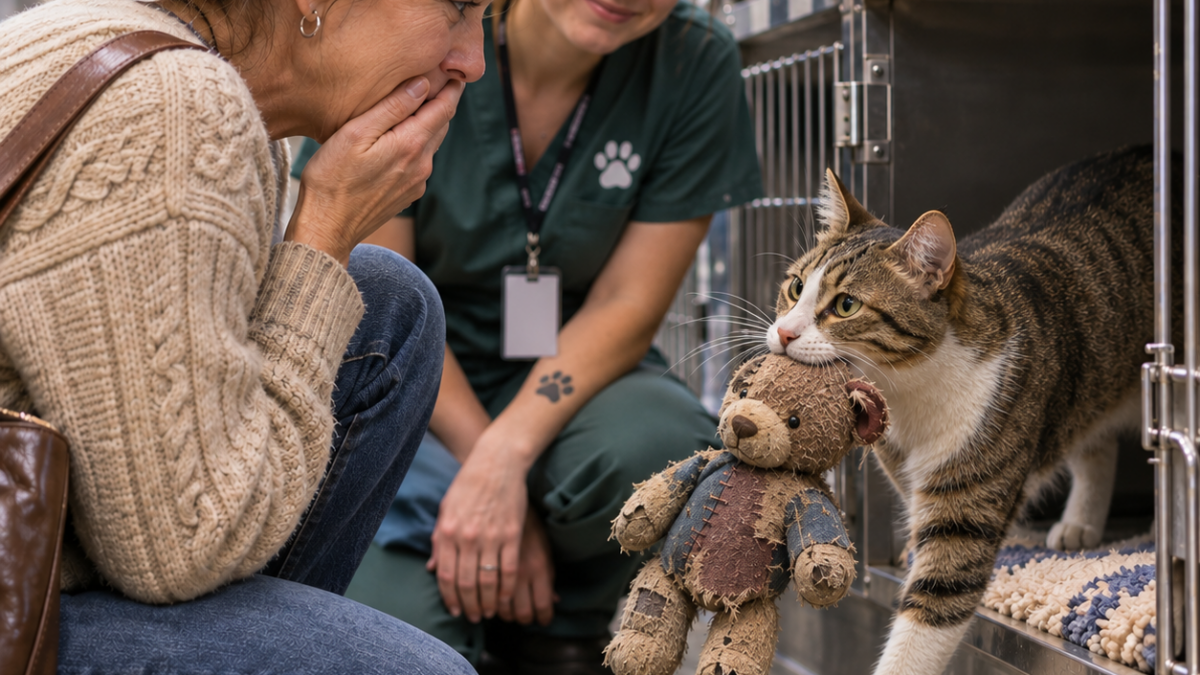
I Went to the Shelter for a Kitten—Then a Grown Cat Laid Her Only Worn-Out Toy at My Feet Like She Was Trying to Pay for a Home.
I walked into the shelter looking for something young, easy, and untouched by loss, then watched a grown cat place the only toy she owned at my feet as if she had learned that love was something she had to pay for.
Two years later, after I posted a photograph of her sleeping with that same ragged bear, a stranger accused me of “projecting”—and less than an hour after that, another woman sent me a message that began, I know that bear, and I know that cat.
What I eventually learned was that Mabel had never been abandoned by an owner who stopped loving her; she had been surrendered by a son who lied to his elderly mother, sold the home out from under her, and made one small cat carry the last piece of a family he was trying to erase.
I had my mind made up before I even opened the shelter door.
I wanted a kitten.
Not because I disliked older cats.
That was the explanation I gave myself.
A kitten felt practical.
Cleaner somehow.
A beginning.
No old routines I would accidentally disrupt.
No mysterious fears.
No medications.
No history written into the way an animal reacted to footsteps, doors, certain voices, or hands reaching too quickly.
No one else’s mistakes for me to inherit.
That last thought should have embarrassed me more than it did.
But I was tired.
Not sleepy.
Life tired.
The kind of tired that makes every additional responsibility look heavier than it probably is.
I was forty-nine years old, divorced for five years, and working as an accounts-payable supervisor for a manufacturing company outside Harrisburg, Pennsylvania.
My life was stable.
That word followed me everywhere.
Stable job.
Stable mortgage.
Stable health.
Stable income.
Stable.
It is a word people use when they mean nothing is technically on fire.
My daughter, Claire, had moved to Boston after graduate school.
My ex-husband lived in Maryland with a woman named Rebecca and a goldendoodle they dressed for holidays.
I had no desire to get him back.
I need to be clear about that.
There is a version of every middle-aged divorced woman’s story where people assume everything afterward is about the man who left.
Mine wasn’t.
At least not entirely.
The marriage had been exhausting long before it ended.
Tom liked being taken care of.
I liked being useful.
That combination can impersonate love for a surprisingly long time.
I remembered birthdays.
Scheduled dental appointments.
Bought gifts for his parents.
Handled insurance.
Paid bills.
Packed lunches.
Apologized first.
Kept the peace.
PART2:
If Tom came home angry, I softened myself.
If he was tired, I became quieter.
If I was hurt, I waited until a better time.
There was always a better time coming.
It rarely arrived.
When he finally left, he said something I would spend years pretending hadn’t mattered.
“You make everything feel like an obligation.”
I stared at him.
I had spent twenty-one years making sure he had almost none.
But that was long over by the time I walked into Franklin County Animal Services.
What wasn’t over was the habit.
I still tried to earn my place in rooms.
At work, I took the extra task.
With friends, I offered to drive.
With Claire, I edited myself so she would never feel responsible for my loneliness.
I brought food to people who invited me to dinner.
I cleaned before the cleaning woman came.
I said:
“No problem.”
“It’s fine.”
“Whatever’s easiest.”
so often that eventually I stopped knowing what was easiest for me.
I did not think about any of that when I went to the shelter.
I thought:
Kitten.
Small.
New.
Simple.
The building smelled like bleach, laundry detergent, litter, and warm animal fur.
A volunteer named Kayla met me near reception.
PART3:
She was maybe twenty-six, with a ponytail, green scrub top, and a tattoo of a paw print on her wrist.
“What are you looking for?”
“A kitten.”
She smiled.
“We can definitely help with that.”
“How many?”
“Today?”
“That sounds dangerous.”
“Six.”
“One.”
“That’s what they all say.”
“I mean it.”
She laughed.
Then started toward the kitten room.
We passed a lower row of kennels.
I barely looked.
Adult cats.
A tuxedo.
A tabby.
A black cat sleeping with his face against the wall.
Then I slowed.
One cat sat in the front of her kennel with something in her mouth.
She was a medium-sized brown-and-white domestic shorthair.
Maybe six or seven.
Soft brown tabby pattern along her back.
White chest.
White front paws.
A pale pink nose.
One eye had a slight golden fleck near the iris.
She held a stuffed bear.
Or what had once been a bear.
The thing was brownish-blue.
One ear nearly detached.
Fur rubbed away around the face.
A seam along the belly had been repaired with dark thread.
The cat did not meow.
She watched us.
Kayla kept walking.
I didn’t.
The cat stood.
Carried the bear forward.
Lowered it carefully at the front of the kennel.
Then stepped back.
I looked at Kayla.
She looked at me.
Then at the cat.
Her face softened.
“That’s Mabel.”
“Why did she do that?”
Kayla leaned against the kennel bank.
“She does it when people stop.”
“What?”
“Brings the bear.”
“Why?”
She shrugged first.
The kind of shrug people use when they know an answer but don’t want to pretend they know an animal’s mind.
“Could just be a displacement behavior.”
I appreciated that.
“Could be comfort.”
“Okay.”
“Could be that she learned people pay attention when she carries it.”
“That sounds sadder.”
“Probably.”
Mabel waited.
Bear between us.
“How long has she been here?”
“Four months.”
“Why?”
“Adult cat. Shy. Doesn’t show well.”
“She looks friendly.”
“She is once she trusts you.”
I looked at the bear.
“That came with her?”
“Yes.”
“From the last home?”
“Apparently.”
Kayla glanced at the intake card.
“She was surrendered after being left behind in a house.”
“Abandoned?”
“That’s what the paperwork says.”
Mabel picked up the bear again.
Carried it backward.
Sat.
She held it in her mouth while looking at me.
There are moments when your brain understands something and your body understands something else.
My brain said:
You came for a kitten.
My body stayed in front of Mabel.
Kayla asked:
“Want to meet her?”
“No.”
The answer came too quickly.
I felt embarrassed.
“I mean—not yet.”
“That’s fine.”
We walked toward the kitten room.
Six kittens.
Exactly as promised.
Orange.
Gray.
Tortoiseshell.
Two black siblings.
A little white male with one gray ear.
They were perfect.
Of course they were.
Kittens are professionally designed to dismantle judgment.
The white one climbed my jeans.
I laughed.
The orange kitten fell asleep in my lap.
I could imagine him at home.
Running through the hallway.
Sleeping on my pillow.
No history.
No baggage.
Fresh start.
I filled out the beginning of an adoption interest form.
Then a family came into the room.
Mother.
Father.
Two little girls.
The girls immediately sat near the kittens.
The orange kitten left me.
Climbed into one child’s lap.
She squealed.
I smiled.
Then, through the glass door, I saw Mabel.
Not clearly.
Just her kennel.
A woman stopped in front of it.
Mabel stood.
Bear in mouth.
The woman bent.
Read the card.
Mabel brought the bear forward.
The woman smiled.
Then walked away.
Mabel remained at the gate for three seconds.
Picked the bear up.
Went back.
I looked down at my form.
KITTEN PREFERENCE.
I put the pen down.
Kayla noticed.
“You okay?”
“I want to see Mabel.”
She smiled slightly.
“Okay.”
“Don’t do that.”
“What?”
“That smile.”
“What smile?”
“The I-knew-this-would-happen smile.”
“I have no idea what you mean.”
Liar.
We went back.
Kayla unlocked the kennel.
Mabel retreated immediately.
Not panic.
Caution.
The bear stayed in front.
I crouched.
“Hi.”
Her ears moved.
I extended one hand.
Not inside.
Just near the opening.
Mabel stared.
A full minute passed.
Then she came forward.
One step.
Two.
She sniffed my fingers.
Backed away.
Kayla said:
“That’s pretty good.”
“That’s good?”
“For her.”
I sat on the floor.
“Okay.”
Ten minutes.
Mabel sniffed again.
Fifteen.
She came out.
Not all the way.
Front paws.
Then shoulders.
Her body remained ready to retreat.
I did not touch her.
She sniffed my knee.
Then turned.
Went back into the kennel.
Picked up the bear.
Walked toward me.
Dropped it between my shoes.
I froze.
Kayla did too.
“Does she always do this?”
“With people, yes.”
“Outside the kennel?”
“Not usually.”
Mabel looked up.
I heard myself laugh.
Not because it was funny.
Because sometimes something hurts in a place you thought had already scarred over.
“You don’t have to pay me.”
Kayla glanced at me.
I reached toward the floor.
Not the bear.
My hand.
Mabel sniffed.
Then pressed one side of her face against my fingers.
Once.
That was all.
I adopted her.
The kitten form remained unfinished.
I signed Mabel’s paperwork instead.
Age estimated at seven.
Spayed.
Vaccinated.
Microchipped at intake.
No known chronic disease.
Mild dental tartar.
Fearful during transition.
Recommended quiet home.
Her adoption fee was forty dollars.
The bear came free.
Kayla placed it inside the carrier.
Mabel climbed in after it.
On the drive home, I talked.
“I’m not promising perfection.”
Silence.
“I’ve never had an adult rescue cat.”
Nothing.
“I had cats growing up, but that’s different.”
Mabel stayed in the carrier.
“You may discover I am deeply disappointing.”
A soft rustle.
“Good talk.”
At home, I opened the carrier in my bedroom.
Mabel stayed inside for two hours.
I left.
Later, she moved under the bed.
The bear moved with her.
For three days, I mostly saw eyes.
Food disappeared at night.
Litter used.
Water lowered.
Bear remained beneath the bed.
Day four, I came home from work and found the bear in the hallway.
Mabel was under the dining table.
She watched me.
I took off my shoes.
Walked past the bear.
Made tea.
Sat on the couch.
Ten minutes later, Mabel approached the toy.
Picked it up.
Brought it to me.
Placed it beside my foot.
Then backed away.
I did not pick it up.
“You can keep it.”
Her head tilted.
“I have enough stuff.”
She sat.
“Seriously.”
Nothing.
I moved my hand toward the couch cushion.
Mabel watched.
Then climbed halfway onto the sofa.
One paw.
Two.
Stopped.
Jumped down.
Progress.
The bear stayed beside my foot until bedtime.
Mabel carried it back under the bed.
That became a pattern.
When I came home, sometimes the bear was by the door.
Sometimes near my shoes.
Sometimes on the couch.
For the first month, Mabel rarely climbed into my lap.
But the bear arrived constantly.
If I vacuumed, bear.
If someone visited, bear.
If I came home late, bear.
If I raised my voice on the phone, bear.
I began wondering whether Kayla was right.
Maybe it was comfort.
Maybe arousal.
Maybe learned behavior.
I did not need an explanation.
Still, I called it rent.
Not publicly.
Just to myself.
One evening Mabel put the bear beside my laptop while I worked late.
“You’re paying rent again.”
She blinked.
“Overachiever.”
Two months passed.
Mabel became affectionate.
Not clingy.
Specific.
She liked the left side of the couch.
Preferred cheek scratches.
Hated belly touch.
Slept at the foot of my bed.
Never scratched furniture except one kitchen chair she despised for reasons known only to her.
She learned the sound of my car.
By the time I reached the front door, she was often waiting.
The bear stayed near her.
I bought toys.
Balls.
Mice.
Feathers.
A tunnel.
A ridiculously expensive battery-operated bug that moved randomly across the floor.
Mabel looked at all of them like a woman receiving kitchen appliances for her anniversary.
She wanted the bear.
Only the bear.
I repaired its ear.
Badly.
She watched every second.
I used brown thread.
When I finished, I handed it back.
She sniffed the seam.
Then carried it away.
I had passed inspection.
Claire visited at Christmas.
She sat on the floor.
Mabel hid twenty minutes.
Then emerged.
Bear in mouth.
Claire’s face changed.
“Oh.”
“Yep.”
“Is that the famous bear?”
“I haven’t made it famous.”
“You talk about it constantly.”
“I have told you twice.”
“Five times.”
Mabel dropped the bear beside Claire.
My daughter looked at me.
“What do I do?”
“Nothing.”
“Can I touch it?”
“You can.”
Claire reached.
Mabel did not retreat.
She stroked the toy.
Then held out her hand.
Mabel sniffed.
Claire cried.
I rolled my eyes.
“Do not be dramatic.”
“You adopted a cat because she gave you a teddy bear.”
“I adopted a cat because I am emotionally mature.”
“Sure.”
Mabel climbed into her lap.
Traitor.
The first year changed my house.
That sounds sentimental.
It is also practical.
There was litter on the floor.
Cat hair on clothes.
A water fountain humming in the kitchen.
A cardboard scratcher in the living room.
Food deliveries.
Veterinary appointments.
Mabel’s body crossing rooms.
The silence changed.
I did not become less capable of being alone.
I became less afraid of quiet.
There is a difference.
I started taking myself to dinner occasionally.
Joined a pottery class.
Stopped saying yes to every request at work.
When my manager tried handing me another monthly report because “you’re the organized one,” I said:
“I don’t have capacity.”
The sentence felt illegal.
No one died.
Tom called one afternoon because a tax document had gone to my address.
We talked.
He asked:
“How are you?”
“Good.”
“Claire said you got a cat.”
“I did.”
“Wasn’t really your thing.”
I almost defended myself.
Then didn’t.
“Apparently it is now.”
He laughed.
“Still taking care of everybody.”
There it was.
Old button.
My chest tightened.
I said:
“She takes care of herself.”
“So why get one?”
I looked at Mabel.
Bear beneath one paw.
“Because I wanted one.”
That sentence surprised me.
Not:
Because she needed me.
Because the shelter was sad.
Because I was lonely.
Because I could help.
I wanted one.
Permission without justification.
Tom said:
“Good for you.”
He meant it neutrally.
Still, something inside me shifted.
Mabel turned eight.
Then nine.
Two years after adoption, the bear looked worse.
One repaired ear.
Flattened stuffing.
A new tear near the belly.
I could have replaced it.
I tried.
I found a similar toy online.
Bought it.
Mabel sniffed.
Walked away.
The replacement remained untouched for six months before I donated it.
The original stayed.
One Thursday evening, I washed dishes.
Mabel carried the bear into the kitchen.
Dropped it near the rug.
Then sat.
I took a photograph.
Nothing dramatic.
Mabel.
Bear.
Kitchen light.
One front paw resting across the toy.
I posted it to my personal Facebook page with a caption.
Two years ago I went to the shelter for a kitten and came home with this grown girl because she kept offering visitors the only toy she had.
For months I joked that she was paying rent for love.
She doesn’t do it as often anymore.
Now she mostly carries the bear to bed.
I like to think she finally figured out she can keep the things she loves and still be loved too.
Maybe fifteen people usually reacted to my posts.
This one traveled.
Claire shared it.
Then one of her friends.
Then an animal-rescue page asked permission.
By dinner the next day, thousands of shares.
Comments.
Most kind.
Some people told stories.
Dogs carrying blankets.
Cats sleeping with old collars.
Senior animals surrendering toys.
Children who packed belongings during foster placements.
One woman wrote:
I spent thirty years trying to be useful enough that nobody would leave. I know this cat.
That comment sat with me.
Then came another.
Cute story, but you’re projecting.
Cats don’t understand “rent” or trade objects for affection.
It’s a toy.
Anthropomorphizing shelter animals may make humans feel good, but it doesn’t tell us what the animal actually thinks.
The commenter was named Dr. Lucas Harmon.
His profile listed animal-behavior research.
My first reaction was embarrassment.
Not anger.
Embarrassment.
Like I had been caught believing in something childish.
I reread my own caption.
I had written:
I like to think.
Not:
Scientific fact.
Still, the word hit me.
Projecting.
Tom had used that word.
Often.
“You’re projecting.”
If I thought he was angry.
If I said he seemed distant.
If I noticed he liked another woman’s attention.
If I said I felt taken for granted.
Projecting.
My mother used another version.
“Don’t make everything about your feelings.”
At work:
“Try not to take it personally.”
Different phrases.
Same lesson.
Your interpretation is the problem.
Maybe it was.
Sometimes.
But seeing patterns is not always pathology.
I typed a response.
Deleted it.
Typed another.
Deleted.
Finally:
You’re probably right that I can’t know why she carries it, and I don’t pretend I can. “Paying rent” is my shorthand, not a scientific claim. I only know she arrived with the toy, offered it frequently during stressful interactions, and still treasures it two years later.
I posted.
Lucas replied:
Fair enough. She’s beautiful.
That should have ended it.
Then my phone buzzed.
Messenger.
A woman named Emily Grant.
No mutual friends.
Her message contained only four lines.
I know that bear.
Please don’t throw this away as a weird internet message.
Check the underside of its right foot.
There should be three blue stitches shaped like an X.
My hands went cold.
Mabel was in the bedroom.
Bear on the blanket.
I picked it up.
Turned it over.
The fur was worn.
Thread everywhere.
I almost missed it.
Under the right foot were three faded blue stitches.
Not part of the manufacturing seam.
An X.
I sat down.
Another message arrived.
If those stitches are there, I think your cat used to belong to my grandmother.
I stared at the screen.
I called Claire.
No answer.
Called again.
“Mom?”
“Something weird happened.”
“What?”
I explained.
Claire went quiet.
“Did you answer?”
“No.”
“Answer.”
“What if it’s a scam?”
“What kind of scam starts with teddy bear stitches?”
“People are creative.”
“Mom.”
I replied:
They’re there.
Emily immediately asked:
What is the cat’s name now?
Mabel.
A pause.
Then:
That was always her name.
I stopped breathing.
I had never renamed her.
The shelter intake card said Mabel.
I assumed the name came with surrender paperwork.
Emily sent a photograph.
An elderly woman sat in a floral recliner.
White hair.
Glasses.
A younger Mabel curled across her legs.
And under one paw was the bear.
No doubt.
Same torn left ear before it tore.
Same blue-gray fur.
Same stitched foot.
I zoomed in.
Mabel.
Younger.
Rounder.
Home.
My eyes filled.
I typed:
Who is your grandmother?
Her name is Joan Whitaker.
She’s alive.
That was the moment the story became larger than my house.
I had assumed Mabel’s former owner had left.
Moved.
Abandoned her.
Maybe died.
Something finished.
Joan was alive.
Emily asked if we could talk by phone.
I agreed.
Her voice shook.
“I’ve been looking for that cat for almost three years.”
I sat at the kitchen table.
Mabel entered.
Jumped onto the chair beside me.
Bear still in my hand.
“Why?”
“My grandmother thinks Mabel ran away.”
Silence.
“What?”
“She didn’t.”
Emily started crying.
I waited.
“My dad lied.”
Her father was Grant Whitaker.
Joan’s only son.
Emily’s father.
The family history came out in pieces.
Joan had lived in a small house outside York for thirty-four years.
Widowed.
Independent.
She adopted Mabel as a young adult cat after Joan’s husband died.
The bear belonged to Emily originally.
She had left it at her grandmother’s house when she was twelve.
Mabel claimed it.
Joan repaired it repeatedly.
Including the blue X.
Two and a half years earlier, Joan fell in her kitchen.
Broke her hip.
Hospital.
Rehabilitation.
During that time Grant received temporary financial power of attorney so he could pay bills.
That part had been agreed.
Joan intended to return home.
Grant did not think she should.
“He said the house was too much.”
Emily’s voice became bitter.
“Maybe he was right about that part.”
“What happened to Mabel?”
“Grandma kept asking.”
Grant told her Mabel was being cared for at his house.
Then later told her the cat escaped.
“Escaped?”
“Yes.”
“Why?”
“I didn’t know he surrendered her.”
“How do you know now?”
“The picture.”
Emily had not seen Mabel in over a year before Joan’s fall.
She lived in Pittsburgh.
Her relationship with her father was strained.
Grant controlled communication with Joan during rehab.
Joan eventually moved into assisted living.
Emily believed it was temporary.
Then the house sold.
Fast.
Furniture dispersed.
Personal belongings donated.
Some placed in storage.
Others disappeared.
Joan was furious.
But by then Grant had expanded his role over her finances.
Emily suspected abuse.
Could not prove it.
Then she saw my post.
The bear.
The cat.
The date.
She called the shelter.
They would not release previous surrender information to her.
Privacy policy.
But they confirmed Mabel had entered roughly two weeks after Joan’s fall.
I felt sick.
“You think your father surrendered her?”
“I know he did.”
“How?”
“Because I called him after I saw your post.”
I waited.
“What did he say?”
“At first he denied it.”
Then:
“He told me Grandma couldn’t take care of a cat anymore and someone had to be practical.”
Practical.
I hated that word suddenly.
Emily continued.
“He said Mabel was making the house harder to clean before listing it.”
I closed my eyes.
“He surrendered her so he could sell the house?”
“That’s what it sounds like.”
“Did your grandmother agree?”
“No.”
“How do you know?”
“Because she spent two years blaming herself for leaving a door open.”
That sentence hurt.
Mabel jumped from the chair.
Walked toward her bowl.
Completely unaware that two women were reconstructing the betrayal that had put her behind shelter bars.
I asked:
“Does Joan know you found her?”
“No.”
“Why not?”
“I wanted to talk to you first.”
I understood what she was really asking.
Would I give Mabel back?
The thought hit me hard.
Immediate.
Ugly.
She’s mine.
Then guilt.
Joan had loved her first.
She had not surrendered her.
She had been lied to.
I looked at Mabel.
Two years.
My bed.
My window.
My routines.
My cat.
I asked:
“Where does your grandmother live?”
“Silver Oaks in Mechanicsburg.”
Twenty-eight minutes from my house.
Close.
Emily said:
“They allow pets.”
I went completely still.
“What?”
“Cats under twenty pounds.”
“Was that true when she moved in?”
“Yes.”
My stomach turned.
“So she could have kept Mabel.”
“Maybe not immediately. She was recovering. But yes.”
“Did Grant know?”
“I assume so.”
We ended the call after nearly an hour.
I did not promise anything.
Emily didn’t ask.
That made it worse.
I called the shelter the next morning.
Kayla no longer worked there.
The director, Hannah Ruiz, pulled archived records.
She could not release identifying information.
I told her I had direct contact with the prior owner’s granddaughter.
That changed the conversation.
With Emily’s written permission and later Joan’s, records could be reviewed.
The surrender form listed:
CAT FOUND ABANDONED IN RESIDENCE AFTER OWNER RELOCATED TO CARE FACILITY.
SURRENDERING PARTY:
PROPERTY REPRESENTATIVE.
Signature.
G. WHITAKER.
Grant.
Reason:
OWNER UNABLE/UNWILLING TO RECLAIM.
I nearly threw up.
“Unwilling?”
Hannah sounded uncomfortable.
“That is what the surrendering party represented.”
“Did anyone contact Joan?”
“The phone number given was his.”
“So no.”
“We had no reason to suspect fraud.”
I wasn’t angry at the shelter.
Not really.
They had been lied to.
Still, the language cut.
Unwilling.
Mabel’s owner had been sitting in rehabilitation asking where her cat was.
The shelter had recorded:
Unwilling.
I thought of all the labels humans create after the person with the least power has disappeared from the room.
Noncompliant.
Difficult.
Abandoned.
Unwilling.
Sometimes a single word is just the winner’s version of what happened.
Emily called adult protective services.
She had already raised concerns once about Joan’s finances.
The new information mattered.
A pet surrender alone was not financial exploitation.
But Grant’s timing overlapped with the house sale.
Bank transfers.
Storage-unit closure.
Disposition of property.
Emily began gathering records.
I wanted no part of a family legal war.
Then I remembered the bear.
Mabel offering it.
Again.
Again.
Again.
People passing.
And Joan thinking a door had been left open.
I agreed to provide adoption records if legally requested.
Three days later, Emily asked if I would bring Mabel to meet Joan.
I didn’t answer immediately.
“What does she expect?”
“She doesn’t know.”
“Emily.”
“I haven’t told her.”
“Good.”
“I don’t want to hurt her if Mabel doesn’t react.”
That surprised me.
Not:
I don’t want to hurt her if you refuse.
She understood animals.
Or grief.
Maybe both.
“What if she wants her back?”
Emily was quiet.
“That would be between you and Grandma.”
No.
Legally, it wasn’t.
Mabel had been lawfully transferred to me through the shelter based on apparently valid surrender.
I had adoption ownership.
But morality is not always satisfied by paperwork.
I asked:
“What do you want?”
“My grandmother to know she didn’t lose that cat because she failed.”
That decided it.
Saturday.
Silver Oaks.
I brought Mabel in her carrier.
The bear inside.
My hands shook during the entire drive.
I felt disloyal.
To whom, I didn’t know.
Mabel hated car rides.
She complained.
I kept saying:
“I’m not giving you away.”
Then wondered whether I was reassuring her or myself.
Emily met me in the lobby.
Thirty-four.
Dark hair.
Tired face.
She hugged me.
I stiffened.
Then hugged back.
“Thank you.”
“Don’t thank me yet.”
“Fair.”
Joan’s room was on the second floor.
Emily went ahead.
I waited.
Mabel in carrier.
Bear under her front paws.
Then Emily returned.
“She knows we’re bringing someone.”
“Someone?”
“I said a visitor.”
“You’re terrible.”
“I panicked.”
We entered.
Joan Whitaker was eighty-one.
Small.
White hair cut short.
Blue cardigan.
Walker beside the chair.
Photographs covered one wall.
Emily.
A man who must have been Joan’s husband.
Grant younger.
And Mabel.
At least six photographs.
My throat tightened.
Joan looked toward me.
Then carrier.
Her face changed before I opened it.
“What is that?”
Emily crouched.
“Grandma.”
Joan stared.
“No.”
Her hands began shaking.
“Grandma—”
“No.”
I put the carrier on the floor.
Joan covered her mouth.
I opened the door.
Mabel did not come out.
Of course.
New place.
New smells.
I sat.
“Take your time.”
Joan cried without sound.
“Mabel?”
The cat’s ears moved.
That was all.
Joan made a sound I will never forget.
Not quite a laugh.
Not quite a sob.
She whispered:
“Mabel, sweetheart.”
Mabel moved to the carrier opening.
Stopped.
Sniffed.
I did not breathe.
Neither did Emily.
Joan held out one hand.
Not reaching.
Palm down.
“It’s me.”
Mabel stepped out.
Slow.
She sniffed the room.
Then Joan’s shoe.
Walker.
Blanket.
Chair.
Her body changed.
I don’t mean magically.
No dramatic recognition music.
Her tail rose halfway.
She sniffed Joan’s pant leg longer than anything else.
Then the hand.
Joan whispered:
“Oh, baby.”
Mabel rubbed her cheek against Joan’s fingers.
Once.
Joan broke.
She bent forward as much as her body allowed.
Mabel jumped onto the footrest.
Then the chair.
Then Joan’s lap.
I looked away.
I couldn’t watch and remain intact.
Emily cried.
Joan buried her face against Mabel’s back.
“I didn’t leave you.”
There it was.
The sentence.
“I didn’t leave you.”
Again.
Again.
“I didn’t leave you.”
Mabel stayed.
Her purr filled the room.
Joan looked at me.
Tears everywhere.
“How?”
I could barely speak.
“She was at Franklin County.”
Joan’s face became confused.
“The shelter?”
“Yes.”
“My son said…”
Emily took her hand.
“Dad surrendered her.”
Joan went very still.
Mabel kept purring.
“No.”
“Grandma.”
“No.”
“He lied.”
Joan’s expression changed.
Grief first.
Then rage.
Age does not erase rage.
Illness does not erase it.
She looked down at Mabel.
“He told me you ran.”
Her voice cracked.
“He told me I left the back door open.”
Emily said:
“You didn’t.”
Joan stared at her granddaughter.
“I cried every night.”
“I know.”
“He let me think…”
“I know.”
Mabel shifted.
Joan’s hand moved automatically along her back.
Old muscle memory.
I sat quietly.
This was not my moment.
After ten minutes, Joan noticed the bear.
“Mr. Buttons.”
I laughed through tears.
“That has a name?”
Joan looked offended.
“Of course.”
Emily smiled.
“I forgot that.”
Joan reached.
Mabel immediately placed one paw over the bear.
We all laughed.
First laugh in the room.
Joan touched the repaired ear.
“You fixed him.”
“Badly.”
“Looks like I did it.”
“Thank you.”
That made her laugh harder.
Then she looked at me.
Really looked.
“You took her?”
“Yes.”
“How long?”
“Two years.”
“Is she happy?”
My throat tightened.
“I think so.”
“Does she sleep with you?”
“Yes.”
“On your legs?”
“Usually left side.”
“She always liked left.”
Joan smiled.
“Does she still bring the bear when she’s nervous?”
I froze.
“What?”
“She does that?”
“She used to.”
“When?”
Joan looked toward the window.
“After Frank died.”
Her husband.
Mabel had been five when Frank died suddenly from an aneurysm.
For weeks Joan cried constantly.
Mabel began bringing the bear.
Not giving it away.
Bringing it to Joan.
Dropping it beside her.
At night.
On the couch.
Near the bathroom.
Joan told me:
“I used to say she was checking on me.”
My chest tightened.
“So it wasn’t…”
“What?”
“Nothing.”
I thought about my story.
Paying rent.
Trading the best thing she had.
Maybe Lucas Harmon really had been right.
Maybe I had projected.
But not completely.
The bear did have history.
Mabel had learned that carrying it happened around distress.
Maybe it comforted her.
Maybe Joan.
Maybe both.
Meaning did not need to be literal to be real.
Joan asked:
“Do you have other pets?”
“No.”
“Kids?”
“Adult daughter.”
“Good vet?”
“Yes.”
“Kidney issues?”
“None.”
“Teeth?”
“Cleaning last year.”
She interviewed me like a foster applicant.
I answered everything.
Then the question came.
“Are you keeping her?”
I swallowed.
“I…”
Joan touched Mabel’s face.
“She looks at you.”
I didn’t understand.
Joan smiled sadly.
“She keeps checking where you are.”
I looked.
Mabel was in Joan’s lap.
But her eyes were on me.
Then Joan said the sentence that freed me.
“You’re her home now.”
I cried.
“No.”
“Yes.”
“She was yours.”
“She was.”
“You didn’t give her up.”
“No.”
“You could—”
Joan shook her head.
“I am not taking her through another move because my son already took her through one.”
She looked down.
“I wanted to know she was alive.”
Her voice broke.
“I wanted to know she didn’t think I threw her away.”
I thought of the shelter.
Mabel at the kennel.
Bear at the door.
My caption.
You don’t have to buy your way in.
Maybe I had been speaking to the wrong wound.
Or maybe wounds overlap.
Joan asked one thing.
“Can I see her sometimes?”
“Yes.”
Immediately.
“Yes.”
So Mabel gained two homes without moving from mine.
Every other Saturday for six months, I brought her to Silver Oaks.
She learned the route.
Or maybe she simply learned the carrier led somewhere safe.
Joan kept treats.
A blanket.
One brush.
Mabel sat in her lap.
Sometimes slept.
Sometimes ignored her and stared out the window.
Real love is less cinematic after reunion.
Thank God.
Meanwhile, the investigation into Grant expanded.
Emily discovered Joan’s house had sold for $286,000.
The proceeds entered an account Grant controlled under power of attorney.
Large payments followed.
Credit cards.
A truck down payment.
A transfer into his business.
Joan had been told the money was being held for her care.
Some was.
Not all.
The power of attorney authorized Grant to manage finances for Joan’s benefit.
Not his.
Adult Protective Services referred the matter.
An attorney became involved.
Then law enforcement.
Grant called Emily furious.
She recorded nothing.
She didn’t need to.
Documents spoke.
He called me once.
I don’t know how he got my number.
Probably the shelter paperwork passed during legal discovery.
“Are you Rachel Bennett?”
“Yes.”
“You have my mother’s cat.”
My entire body stiffened.
“Mabel lives with me.”
“She belongs to my mother.”
“Your mother disagrees.”
Silence.
“You’ve been talking to her.”
“Yes.”
“You don’t understand our family.”
“I’m sure I don’t.”
“My mother couldn’t live alone.”
“That may be true.”
“She couldn’t care for that animal.”
“Maybe.”
“So I surrendered it.”
“You told her Mabel ran away.”
Another silence.
“Emily is filling your head.”
“No.”
I looked at Mabel sleeping beside the bear.
“Your paperwork filled my head.”
He became angry.
“You people turn everything into abuse.”
“You people?”
“Strangers on the internet.”
“I didn’t accuse you publicly of anything.”
“You made that stupid cat story viral.”
I almost laughed.
“That happened before I knew who you were.”
“Take it down.”
“Why?”
“Because this is private.”
I thought about Joan spending two years believing she had lost Mabel through negligence.
“You made a private decision for someone else and then lied about it.”
“You have no idea what I had to deal with.”
Maybe he was right.
Caregiving is difficult.
Aging parents are difficult.
Money is difficult.
Fear makes people impatient.
Grant may have believed assisted living was necessary.
That did not explain the lie.
It did not explain Mabel.
It did not explain the money.
“You might have been overwhelmed,” I said.
He went quiet.
“But overwhelmed people can still do cruel things.”
He hung up.
I never heard from him directly again.
The legal process lasted nearly a year.
There was no dramatic courtroom reveal.
No handcuffs outside Silver Oaks.
Life is often less satisfying than movies.
Grant entered a civil settlement requiring repayment of a substantial portion of money.
His power of attorney was revoked.
A court-appointed fiduciary handled Joan’s remaining assets.
The district attorney pursued charges related to financial exploitation and fraudulent use of funds.
Grant eventually pleaded guilty to a reduced felony count and received probation, restitution obligations, and restrictions on serving in fiduciary roles.
Some people online wanted prison.
Joan didn’t.
When Emily asked why, Joan said:
“I want my money back more than I want my son in a cell.”
Then:
“And I don’t want to spend what time I have left thinking about him.”
That was justice enough for her.
Not forgiveness.
Not reconciliation.
Consequence.
Choice returned.
Her choice.
The story did become public.
Not all details.
The local newspaper connected the viral cat post with an elder financial-abuse investigation.
I hated the headline.
VIRAL CAT HELPS UNCOVER ELDER EXPLOITATION.
Mabel had done no investigation.
She carried a bear.
Humans connected records.
I told the reporter that.
She included the correction.
Still, people preferred the simpler version.
Hero cat.
Evil son.
Saved grandmother.
Reality was messier.
Grant had helped Joan for years before he betrayed her trust.
He had driven her to appointments.
Fixed gutters.
Managed medications.
Then control became entitlement.
Maybe slowly.
Maybe not.
Good acts do not immunize people against later cruelty.
Cruel acts do not require someone to have been evil from birth.
That mattered to me.
Because I had spent years simplifying Tom.
He was not Grant.
Not remotely.
But I had turned my ex-husband into a clean villain after divorce because it made leaving easier to understand.
Then into a clean victim of “marital incompatibility” because anger exhausted me.
Neither was true.
People are rarely clean.
Mabel certainly wasn’t.
She vomited on a white rug the week the newspaper article ran.
Twice.
She also became famous enough that strangers mailed her stuffed bears.
Dozens.
I donated most to the shelter.
Mabel did not want them.
Mr. Buttons remained sovereign.
Dr. Lucas Harmon—the projecting commenter—messaged me again after the larger story surfaced.
I expected an apology.
Instead:
Well, this became more complicated than I expected.
I laughed.
I wrote:
Same.
He replied:
For what it’s worth, I still don’t think she was consciously bartering the toy.
I answered:
For what it’s worth, neither do I anymore.
Then:
But Joan says she started carrying it after her husband died.
Lucas responded several minutes later.
That makes sense. Object-carrying can become associated with arousal, comfort, social interaction, routine, all kinds of things. We have to be careful not to overstate what animals understand, but “we can’t know exactly” isn’t the same as “nothing meaningful is happening.”
I stared at that.
That became more useful than being right.
I posted a follow-up.
I wrote that I had been wrong to describe Mabel’s behavior too literally.
I couldn’t know she believed she was trading the bear for love.
What I knew now was better.
The bear had been part of her home with Joan.
She had carried it during Joan’s grief.
Then when Joan disappeared, it went to the shelter with Mabel.
At the shelter, she carried it during stressful encounters.
At my house, she carried it during new routines.
Years later, she still slept with it.
Maybe it was comfort.
Maybe memory.
Maybe a behavior reinforced over time.
Maybe all three.
People accused me of ruining my own inspirational story.
I didn’t care.
Truth did not make Mabel less moving.
It made her more real.
Something else happened.
People began contacting me about elder abuse.
Not cats.
Parents.
Grandparents.
Aunties.
Neighbors.
Financial control.
Power of attorney.
Family members making decisions “for their own good.”
Pets removed during hospitalization.
Homes sold.
Possessions discarded.
One woman wrote:
My brother gave away my mom’s dog while she was in rehab because he said taking care of it was inconvenient. She still asks where he is.
I cried reading that.
Another:
My father stayed in an unsafe house two years longer than he should have because assisted living wouldn’t take his cat.
Another:
I work in senior housing. We need better pet transition plans.
That became the real second life of the story.
The shelter partnered with a local senior-services nonprofit.
Nothing enormous.
No national foundation.
They created a simple emergency foster list for pets whose owners entered hospitals, rehabilitation centers, or temporary care.
Thirty volunteers.
Then sixty.
If an older resident was hospitalized unexpectedly, a pet could enter temporary foster without surrendering ownership.
Written agreements.
Veterinary authorization.
Contact plan.
Return procedure.
Not perfect.
But real.
Joan cried when Emily showed her the first brochure.
SAFE PAWS TEMPORARY FOSTER PROGRAM.
Joan said:
“Should’ve had that before.”
Emily replied:
“Now somebody else does.”
Mabel appeared in none of the official materials.
My request.
I did not want her turned into a logo.
Joan disagreed.
“She has a good face.”
“She has a judgmental face.”
“Exactly.”
We compromised.
One small photograph inside the volunteer training packet.
Mabel sleeping with Mr. Buttons.
Caption:
Assume separation is temporary until the owner or lawful representative says otherwise.
That sentence mattered.
The shelter changed intake procedure too.
If a third party attempted to surrender an animal belonging to someone hospitalized or in care, staff had to verify authority.
No more:
Property representative.
No questions.
Mabel’s surrender had been legally accepted under old procedures because Grant presented himself as authorized.
He was authorized to manage many of Joan’s affairs.
Whether he had authority to permanently dispose of a companion animal against her wishes was much less clear.
The shelter’s attorney recommended caution thereafter.
No villains.
Forms improved.
Sometimes justice is a checkbox added because one bad story finally made the missing question visible.
Two years after my original adoption became three.
Then four.
Mabel aged.
Nine.
Ten.
She gained weight.
Lost some.
Dental cleaning.
Mild arthritis.
Nothing dramatic.
Joan declined faster.
Mobility.
Then memory.
Not dementia exactly at first.
Small losses.
Names.
Dates.
Repeating questions.
Emily worried.
Mabel visits continued.
Sometimes Joan called her Mabel immediately.
Other times:
“Where’s my girl?”
Sometimes she called her Lucy, the name of a cat she’d owned decades earlier.
Mabel didn’t care.
She climbed into the lap.
The bear came too.
One afternoon Joan held Mr. Buttons.
“Did I make this?”
Emily said:
“You repaired it.”
Joan examined the blue X.
“I did that?”
“Yes.”
“Terrible work.”
I laughed.
“So I’m not the only one.”
Joan looked at me.
“Who are you?”
The room went still.
First time.
Emily answered gently.
“Rachel.”
Joan smiled politely.
“Nice to meet you.”
I swallowed.
“We’ve met.”
“Oh.”
She looked embarrassed.
I sat beside her.
“It’s okay.”
Mabel jumped from Joan’s lap into mine.
Joan watched.
Then smiled.
“She likes you.”
“Yes.”
“You should keep her.”
That broke me.
She did not remember giving permission years earlier.
She gave it again anyway.
“Thank you.”
Joan touched Mabel’s head.
“Animals know where they’re safe.”
I did not correct the science.
Sometimes a sentence is not a claim.
It is a blessing.
Joan died the following spring.
Peacefully.
Emily called me before sunrise.
I knew from her voice.
“Mom—I mean Rachel.”
Grief confused her.
“It’s okay.”
“Grandma died.”
I sat on the bed.
Mabel was asleep near my legs.
“I’m sorry.”
“She had Mabel’s picture on the table.”
That got me.
Not because Joan needed to choose between people and cat.
Because somebody had made sure the story ended differently than Grant intended.
Joan’s funeral was small.
I attended.
Mabel did not.
Mr. Buttons stayed home.
Grant came.
That surprised me.
He stood in the back.
Older than I expected.
He looked at Emily.
She did not approach.
He did not force it.
Afterward he came toward me.
I almost walked away.
He said:
“Is Mabel okay?”
“Yes.”
He nodded.
“Good.”
That could have been it.
Then:
“My mother hated me.”
I looked at him.
“I don’t know.”
“She did.”
“You’d know better than I would.”
He laughed bitterly.
“I thought I was doing what had to be done.”
“Some of it?”
He looked at me.
“What?”
“Some of it may have had to be done.”
That surprised him.
“She probably did need more care.”
“Yes.”
“The house may have been unsafe.”
“Yes.”
I continued.
“But lying about Mabel didn’t have to be done.”
His face closed.
“I know.”
“Using her money didn’t.”
“I know.”
“You don’t get to turn necessary decisions into permission for everything around them.”
He looked toward the cemetery.
“No.”
I waited.
He said:
“Did she ask about the cat?”
“For years.”
His eyes filled.
Not enough to undo anything.
But real.
“I couldn’t fix it after.”
“You could have told her the truth.”
“I was ashamed.”
There it was.
The oldest excuse.
Also sometimes the truest.
Shame does not make people confess.
Often it makes them build another lie around the first.
Grant said:
“I’m glad she found her.”
I thought about correcting him.
Mabel did not find Joan.
The internet did.
A photograph did.
Emily did.
Paperwork.
Memory.
Blue stitches.
Then I decided it didn’t matter.
“She did.”
He walked away.
No reconciliation.
No cinematic forgiveness.
Just a man standing near his mother’s grave realizing that practical cruelty leaves impractical grief behind.
After Joan died, Mabel stopped going to Silver Oaks.
For several Saturdays, she became restless around the time we usually left.
Maybe routine.
Probably routine.
I sat with her.
Eventually the pattern faded.
Mr. Buttons remained.
One night, I woke around two.
Mabel was beside me.
Bear under her paw.
I thought about my original caption.
Back then, it was something to trade for love.
Now it’s just something old she can hold while sleeping in a home where love no longer has to be earned.
I still loved the sentence.
But I understood it differently.
Maybe Mabel had never thought love had to be earned.
Maybe that was my part.
My projection.
I had looked at a cat offering a toy and recognized myself.
Not because she was me.
Because I was primed to see the shape.
All my life, I had carried my own bears.
Competence.
Helpfulness.
Patience.
Silence.
I had laid them at people’s feet.
Here.
I can do this.
Here.
I won’t ask for much.
Here.
I can solve your problem.
Here.
Please think I am worth keeping.
Tom had not taught me that.
My family hadn’t entirely taught me.
Some things grow from a thousand small lessons.
Girls praised for being easy.
Employees praised for never saying no.
Mothers praised for selflessness.
Wives praised for keeping peace.
Eventually you forget where generosity ends and self-erasure begins.
A cat did not explain that to me.
A comment did.
You’re projecting.
At first, I heard it as:
You’re wrong.
Later I understood another possibility.
Yes.
I was projecting.
So what was the projection trying to show me?
That became the useful question.
I started therapy at fifty-two.
Not because of Mabel.
Not because of Tom.
Not because one internet stranger challenged my cat story.
Because I was tired of making usefulness my personality.
My therapist, Dana, asked:
“What happens if you disappoint someone?”
“They’re disappointed.”
“And?”
I laughed.
“You’re going to make me say something embarrassing.”
“Probably.”
“They leave.”
There it was.
Dana waited.
“Who taught you that?”
“I don’t know.”
“Then maybe we find out.”
Therapy was less cinematic than people advertise.
No single breakthrough.
Mostly noticing.
I volunteered to stay late at work.
Why?
I apologized when someone bumped into me.
Why?
Claire canceled a visit.
I said:
“No problem.”
Was it?
Actually, I was disappointed.
Could I say that without making her responsible for fixing it?
I tried.
“I understand, but I’m sad. I was looking forward to seeing you.”
Claire replied:
“Me too. Let’s reschedule.”
No catastrophe.
Nobody left.
I began practicing not paying rent.
With friends.
With work.
With my daughter.
With myself.
Mabel continued paying none whatsoever.
She screamed for breakfast.
Rejected food after I opened the expensive can.
Slept across my pillow.
Brought Mr. Buttons into the bathroom while I showered.
Once deposited him directly into the water bowl.
I panicked.
Washed him carefully.
Dried him with towels.
Then the hair dryer on low while Mabel watched from three feet away like an anxious parent in an emergency room.
Mr. Buttons survived.
His stuffing did not improve.
At eleven, Mabel developed kidney disease.
Early.
Manageable.
Priya, our veterinarian, recommended diet changes.
Fluids later.
Monitoring.
The usual senior-cat path.
I felt fear.
Not because death had arrived.
Because once you know an animal has a finite chapter, every number begins trying to become a countdown.
I refused that.
Mostly.
Mabel still played occasionally.
Not with Mr. Buttons.
He was never a play toy.
More object than toy.
She carried him.
Slept with him.
Licked his worn face.
At thirteen, she stopped jumping onto the bed.
I bought steps.
She ignored them.
I bought different steps.
Ignored.
I finally built a ramp from a board wrapped in carpet.
She used it immediately.
Apparently aesthetics mattered.
Claire came home one weekend.
Mabel slept on her lap.
Claire stroked the shortened fur around one ear.
“She’s getting old.”
“Rude.”
“Mom.”
“I know.”
“Are you okay?”
“No.”
“Good.”
I looked at her.
She smiled.
“You always say ‘fine.’”
Therapy had apparently created a monster.
“No, I’m not okay with her getting old.”
“That makes sense.”
“I’ll survive.”
“I know.”
“I hate that phrase.”
“Still true.”
Mabel turned fourteen.
Then fifteen.
Kidneys worsened.
Subcutaneous fluids.
I knew how to give them.
Warm bag.
Needle.
Treat.
Mabel tolerated medical indignity with the patience of someone planning revenge.
Her revenge was usually refusing food afterward.
At fifteen and a half, she became less interested in carrying Mr. Buttons.
He stayed on the bed.
I noticed.
Of course I noticed.
One evening she walked into the bedroom.
Looked at him.
Walked away.
My heart tightened.
I carried the bear to the living room.
Placed it beside her.
She sniffed.
Then rested one paw on it.
Maybe enough.
By then, the original viral post still resurfaced occasionally.
People tagged me.
“Is she still alive?”
Yes.
“Does she still have the bear?”
Yes.
“Did she remember Joan?”
I always answered carefully.
She responded strongly to Joan.
I cannot tell you exactly what she understood.
“Did the bear really save an old woman?”
No.
People did.
Facts matter.
Especially when sentiment grows faster than accuracy.
The Safe Paws program expanded to two counties.
Over six years, more than four hundred pets entered temporary foster while owners were hospitalized, in rehabilitation, or moving into senior care.
Most returned.
Some could not.
But permanent surrender became a final option rather than the first administrative convenience.
Emily served on the advisory committee.
I helped with paperwork occasionally.
I was good at paperwork.
The difference now was I said yes because I wanted to.
Not because usefulness purchased belonging.
One December evening, Emily sent me a photograph.
An eighty-six-year-old man reuniting with his black cat after eleven weeks in rehabilitation.
The cat stood on his walker tray.
The man’s face was buried in its neck.
Emily wrote:
Grandma would have loved this.
I replied:
She would’ve complained about the cat on the walker.
Emily sent:
Also true.
Mabel was asleep beside me.
Mr. Buttons near her back.
I touched his blue X.
Small thread.
Three stitches.
An entire hidden history.
If I had adopted the kitten that day, none of this would have happened.
That thought tempted me toward destiny.
I resisted.
Life is not always arranged.
Thousands of random choices produce consequences.
I stopped because a cat carried a bear.
I adopted her.
I posted a picture.
Emily happened to see it.
She remembered blue stitches.
That was enough.
Meaning doesn’t require fate.
Chance can still matter.
Mabel’s final decline began in March.
She stopped eating enough.
Nausea medication helped briefly.
Fluids.
Appetite stimulant.
Bloodwork.
Kidneys.
Anemia.
Weight loss.
One Tuesday, Priya sat beside me in the exam room.
Mabel weighed six pounds, eight ounces.
She had been ten.
“How many good days?”
“More than bad.”
“Still?”
I hesitated.
That was the answer.
Priya did not push.
“Take her home.”
“For how long?”
She looked at me.
“We stop measuring it that way.”
I cried.
“That’s an infuriating veterinarian thing to say.”
“I know.”
Mabel came home.
Claire flew in the following weekend.
Not because death was scheduled.
Because she wanted time before crisis.
That mattered.
We sat on the bed.
Mabel between us.
Claire held Mr. Buttons.
“Do you think she remembers Grandma Joan?”
I knew which grandmother she meant emotionally, though Joan had never been family by blood.
“I don’t know.”
“Do you think she misses her?”
“I don’t know.”
“Do you think she loves us?”
I looked at my daughter.
“Probably.”
She laughed.
“Very scientific.”
“I’ve been corrected online.”
Mabel purred.
Claire said:
“I think she does.”
“So do I.”
That was enough.
A week later, Mabel stopped carrying the bear entirely.
Then stopped climbing the ramp.
I moved her bed to the floor.
Mr. Buttons beside her.
She slept most of the day.
On the final morning, she woke me at 4:38.
Not meowing.
She stood beside the bed.
Weak.
I lifted her.
She hated being lifted when healthy.
That morning she allowed it.
I placed her beside me.
Mr. Buttons between us.
Mabel put one paw over him.
The exact pose from the photograph years earlier.
I knew.
Not because I am mystical.
Because by then I knew every ordinary version of Mabel.
This was different.
I called Priya.
Home visit.
Claire joined by video.
Emily too, after I asked.
I wasn’t sure why.
Then realized.
Joan should be represented somehow.
Emily held the old photograph of Joan and Mabel on her screen.
Younger Mabel.
Mr. Buttons.
Same cat.
Different homes.
Priya arrived around nine.
Mabel was awake.
Tired.
I read nothing dramatic.
No speech.
I told her what I knew.
“You were loved before me.”
Her ear moved.
“Joan did not leave you.”
My voice broke.
“You didn’t have to earn this house.”
Mabel blinked.
“And I know you probably don’t understand any of this.”
Claire laughed through tears on the phone.
“Mom.”
“I’m being accurate.”
Priya smiled.
I placed my hand on Mabel’s side.
“You can keep the bear.”
The first medication relaxed her.
Her breathing slowed.
I cried into her fur.
The second came when I nodded.
Mabel died with one paw resting on Mr. Buttons.
I left the bear there for an hour.
Then took it back.
That surprised some people.
When I later wrote about her death, strangers asked whether I cremated it with her.
No.
Mabel had carried it through Joan’s home.
The shelter.
Mine.
It was not only an object she owned.
It was evidence.
I kept it.
Mr. Buttons now sits inside a small glass-fronted box in my bedroom.
Not as a shrine exactly.
I don’t light candles.
I don’t talk to it.
Mostly.
The blue X faces outward.
Beside it is a photograph of Joan with Mabel.
Another of me with Mabel.
No quote.
No inspirational plaque.
I don’t need one.
The Safe Paws program uses a different image now.
A dog.
Temporary foster.
No connection to Mabel obvious to anyone who doesn’t know.
That feels right.
Her story became larger than her.
Then life returned her to being what she always was.
A cat.
Not a lesson.
Not an activist.
Not a symbol of elder justice.
Not a therapist.
Not a saint.
A cat who liked warm blankets.
Hated salmon.
Had one favorite object.
Loved certain laps.
Disliked closed doors.
And lived long enough for several humans to become better at asking questions before deciding what another living being could do without.
Years later, people still occasionally message me about the original post.
One asked:
“Do you still believe she was offering the bear as rent for love?”
I thought for a long time before answering.
No.
Not literally.
I don’t think Mabel understood rent.
I don’t think she formulated a bargain.
I don’t think she stood inside that shelter cage thinking:
If I surrender this toy, a human will adopt me.
That was my language.
My wound.
My projection.
But I also don’t think that makes the moment meaningless.
She carried an object connected to home.
She brought it forward during uncertain interactions.
She carried it after Joan disappeared.
She carried it when strangers passed.
She carried it into my house.
She slept with it after she no longer needed to impress anyone.
Behavior does not need a human sentence inside an animal’s head to matter.
And projection is not always useless.
Sometimes you look at another creature and see yourself.
The responsible thing is not to insist the creature is your mirror.
It is to turn around and examine the person staring back.
Mabel did not need to learn that love wasn’t rent.
I did.
I had been making payments for years.
Extra work.
Silence.
Flexibility.
Competence.
Patience.
Never needing too much.
Never asking too loudly.
Never letting anyone see how afraid I was of being difficult enough to leave.
A ragged stuffed bear did not cure that.
But it gave the pattern a shape I could finally see.
Here is the part I wish someone had told me at thirty.
You can be generous without auditioning.
Useful without disappearing.
Patient without accepting neglect.
Loving without making yourself cheap.
And if somebody only stays while you keep laying pieces of yourself at their feet, that is not security.
That is a lease.
I don’t live that way anymore.
At least not most days.
Claire calls me out when I do.
Emily became a friend.
Lucas Harmon—the commenter who started the whole second half—still occasionally sends me animal-behavior articles.
We joke that he ruined a perfectly good sentimental cat story by introducing nuance.
He says:
“You’re welcome.”
I say:
“Still annoying.”
Both true.
Franklin County Animal Services still has adult cats that people walk past.
No viral story fixed that.
Some wait months.
Some longer.
I volunteer twice a month.
Not every weekend.
Boundaries.
Kayla returned once for a visit after moving out of state.
She asked:
“Remember when you wanted a kitten?”
“I deny it.”
We walked past an adult tabby.
He came forward carrying a green mouse.
Kayla looked at me.
I pointed at her.
“No.”
“I didn’t say anything.”
“I have one house.”
“No cat currently.”
“Still no.”
The tabby dropped the mouse.
I stared.
Kayla laughed so hard she had to lean against the wall.
I did not adopt him.
A family did two days later.
Progress.
Sometimes love is saying yes.
Sometimes it is knowing you are not the only person who can.
That may be the biggest change Mabel left in me.
I no longer believe I have to rescue every sad thing to prove I am good.
I no longer believe I have to be necessary to be loved.
Those are cousins.
Dangerous ones.
The last photograph I have of Mabel alive is not the famous one.
No bear offering.
No dramatic eyes.
No shelter bars.
She’s asleep on my bed.
Old.
Thin.
Sun across her back.
Mr. Buttons behind her.
Not under a paw.
Not in her mouth.
Just nearby.
She isn’t guarding it.
Trading it.
Presenting it.
She has nothing to prove.
Neither do I.
That is the photograph I keep on my desk.
Because I went to the shelter wanting something new.
Something easy.
Something untouched.
I thought love would feel safer if it arrived without history.
Instead I brought home a grown cat carrying an old stuffed bear full of other people’s stitches.
And eventually I learned that a fresh start does not mean nothing came before.
Sometimes the best beginnings arrive carrying proof that they have already survived an ending.
Mabel carried hers in her mouth.
I carried mine in ways nobody could see.
For a while, I thought I had rescued her because I was the person who finally stopped when she offered the bear.
Then Joan entered the story.
Emily.
The blue stitches.
The truth.
And I understood that nobody had rescued anybody alone.
Joan loved Mabel first.
Mabel stayed with Joan through grief.
Emily remembered.
A shelter kept her safe.
I happened to stop.
The internet happened to connect two people.
A law required records.
A granddaughter refused to let her grandmother’s story disappear.
A veterinarian kept an old cat comfortable.
A social-service program grew out of one family’s failure.
Love was never one heroic act.
It was a chain of people deciding not to look away.
The bear is still here.
One ear hanging slightly despite my repair.
Belly seam crooked.
Blue X faded almost gray.
Occasionally I take it from the box.
The fabric no longer smells like Mabel.
At least not to me.
Maybe nothing material remains except thread, stuffing, cloth, and memory.
That is enough.
I hold it.
Then put it back.
No trade.
No payment.
Nothing owed.
Just something old that survived long enough to mean more than one thing.
Which, I suppose, is what happened to both of us.








