I Went to the Shelter Carrying Seven Years of Regret—Then an Old Golden Retriever Saw Me, Reached Through the Bars, and Made My Forgotten Promise Come Rushing Back
PART3:
I posted quietly in community groups, then deleted the posts because the replies made me feel like I was stripping my own failure in public.
Finally, I called the shelter.
I still remember the woman’s voice.
“We can take him,” she said gently. “We’ll evaluate him and place him through adoption.”
“Will he be okay?”
The question was unfair.
She answered anyway.
“We’ll do everything we can.”
On the morning I surrendered him, I put on the nicest sweater that still fit me and brushed Sunny until his coat shone. I packed his food, his favorite stuffed duck, his vaccination records, and a handwritten note for whoever adopted him.
Please tell whoever adopts him that he sleeps better if he can see you. He is afraid of thunderstorms. He likes apple slices but not bananas. He will pretend he doesn’t know “stay” if food is involved. Please don’t think I stopped loving him. I am very sick and I cannot give him what he needs. Please tell him I’m sorry.
At the shelter, Sunny walked in cheerfully.
That was the cruelest part.
He thought we were visiting.
He sniffed the floor, wagged at the front desk worker, leaned against my leg while I filled out the paperwork.
The form asked for a reason.
I stared at the blank line for a long time.
Illness.
Financial hardship.
Unable to provide care.
All true.
None true enough.
When it was time, I knelt beside him on the floor.
He wore his red collar.
I buried my face in the thick fur around his neck.
“I’m not leaving because I stopped loving you,” I whispered. “I’m trying to save you because I can’t take care of you right now.”
Sunny licked the tears from my cheek.
That almost broke me.
“I’ll come back,” I told him.
I should not have said it.
I know that now.
Maybe I knew it then.
But grief makes liars of people who mean every word.
“I promise,” I whispered.
Then I stood.
Sunny tried to follow me.
A staff member gently held his leash.
I walked out while his nails scraped against the tile behind me.
I did not make it to my car before I vomited beside the curb.
For months after that, I called the shelter.
At first, they told me he was doing well.
Then they told me he had been transferred into an adoption program.
Then, eventually, they could not tell me anything.
Records moved.
Staff changed.
Shelter systems were imperfect, and I had relinquished ownership. There were privacy rules. Procedures. Limitations.
By the time I was healthy enough to search properly, Sunny was gone from the system.
I checked every listing I could find.
I emailed shelters.
I called rescues.
I joined lost-and-found pet groups even though he was not lost.
Nothing.
Friends tried to comfort me.
“He was probably adopted by a nice family.”
“You did what you had to do.”
“He wouldn’t want you to punish yourself forever.”
People say things like that because they are kind and helpless.
Sometimes I believed them.
Most nights, I did not.
Recovery took years.
My health improved slowly, then more steadily. I found remote work first, then a full-time position with a nonprofit health organization. I rebuilt my savings a dollar at a time. I moved from the apartment where every room remembered Sunny into a small house with a fenced backyard and an old maple tree shading the porch.
The house was perfect for a dog.
That was the first thing I noticed when the real estate agent opened the back door.
The yard was not large, but it was safe. The fence was sturdy. The porch caught afternoon sun. There was a corner in the living room where a dog bed would fit perfectly.
I almost did not buy it because of that.
Then I bought it because of that.
For the first year, I did not adopt.
I told myself I was waiting until work settled.
Then until the fence was repaired.
Then until after the holidays.
Then until spring.
The truth was simpler.
I was afraid.
Afraid that adopting another dog would feel like replacing Sunny.
Afraid I would compare every dog to him.
Afraid I did not deserve a second chance with any animal after failing the first one I had loved that deeply.
But guilt is not devotion.
I had begun to understand that.
Sometimes guilt is just fear wearing a familiar coat.
So on a Friday evening in late September, I drove to the pet store and bought a blue leash.
The next morning, I walked into the shelter.
Not the same shelter where I had surrendered Sunny seven years earlier. That building had closed during a county merger. This shelter was newer, larger, brighter. The lobby smelled faintly of disinfectant, wet dog, and coffee from a volunteer station near the wall.
The woman who greeted me introduced herself as Rachel.
She was in her early thirties, with a messy ponytail, a shelter T-shirt, and the kind of calm warmth people develop after years of handling frightened animals and emotional humans.
“We’re always grateful when someone asks about seniors,” she said, leading me through a door marked ADOPTION KENNELS. “They get overlooked more than people realize.”
“I know,” I said.
My voice must have sounded strange, because she glanced at me.
But she did not ask.
That made me like her.
We started with the first row.
A gray-muzzled shepherd mix pressed his nose against my fingers. His name was Otis, and he leaned so heavily into the kennel gate that Rachel laughed and said, “He believes gravity is optional if love is involved.”
A twelve-year-old terrier named Peanut rolled over dramatically the moment I looked at him.
A sleepy black Lab barely lifted his head from his blanket, but his tail thumped once when I said hello.
I could have loved any of them.
That was the terrible, beautiful part.
Every old face carried a story.
Every cloudy eye.
Every stiff joint.
Every hopeful tail wag from a dog who had already given years to someone else and still had enough courage left to lift their head when a stranger walked by.
I moved slowly.
I spoke softly to each one.
But something kept me walking.
By the second row, Rachel had relaxed into friendly narration.
“This is Daisy. She likes cats but judges men in hats.”
“This one is Arnold. Very sweet. Zero respect for sandwiches.”
“Mabel here is technically fourteen, but don’t say that in front of her. She identifies as six.”
I smiled.
For the first time in weeks, maybe months, the ache in my chest loosened.
Then we turned into the last row.
Before I saw him, I heard him.
Bang.
Metal thundered down the corridor.
Every dog in the row erupted.
Bang.
A desperate whimper followed.
Rachel stopped mid-sentence.
I looked toward the end.
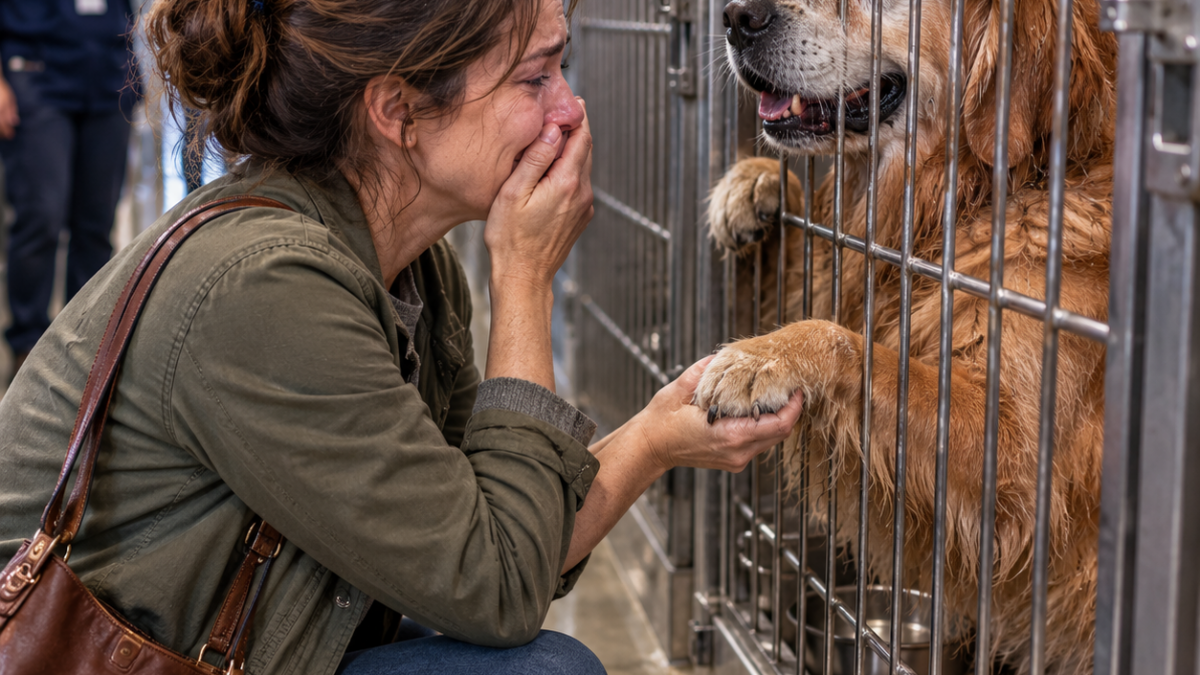
An elderly Golden Retriever stood behind the last kennel door.
His coat was duller than it should have been, more cream than gold now, with patches of white spreading across his muzzle and around his eyes. His body was thinner than a Golden’s body should be. His back legs trembled slightly with age or excitement or both.
The moment our eyes met, he froze.
Everything else in the shelter seemed to fall away.
Then he exploded forward.
He struck the metal gate with both front paws, crying, scrambling, pushing his nose between the bars as if the metal itself were keeping him from breathing.
Bang.
Bang.
Bang.
Rachel inhaled sharply behind me.
“He’s never done that before.”
I barely heard her.
The dog was crying.
Not barking.
Crying.
The sound went through me with such force that I had to place one hand against the wall.
“Hey,” I whispered.
The Golden shoved one paw through the bars.
His right front paw.
There was a white patch above the toes.
Small.
Irregular.
Like a little sock.
My knees weakened.
No.
No, that was impossible.
Seven years.
Different shelter.
Different county.
Hundreds of dogs had white markings.
The Golden pressed harder against the gate. His muzzle squeezed between the bars. His eyes locked onto mine with frantic, unbearable recognition.
I took one step closer.
Then I saw his left ear.
The edge folded slightly near the tip.
A tiny crease.
The exact place my thumb remembered before my mind could argue.
I covered my mouth.
The shelter corridor tilted.
Suddenly, I was no longer forty-two years old in a clean, bright adoption wing.
I was thirty-five again, kneeling on a shelter floor, promising a dog I would come back because I could not survive the truth that I might not.
Rachel moved beside me carefully.
“What do you mean?” I asked, though I barely knew what question I was asking.
She stared at the old Golden.
“He’s been here almost two months,” she said. “He’s friendly, but mostly quiet. Especially lately. He’ll come to the gate for treats, but I’ve never seen him act like this.”
The dog struck the kennel door again.
Bang.
Then he pushed his muzzle between the bars and made a broken, breathless sound.
My hands began shaking.
I stepped closer.
“Sunny?”
Everything stopped.
The dog froze.
His ears lifted.
For half a second, neither of us moved.
Then his entire body began trembling.
His tail swept once.
Twice.
Then faster.
“Sunny?”
He cried.
Not barked.
Cried.
I had heard that sound before.
Years earlier, whenever I returned home after being gone longer than usual, Sunny would greet me with a strange little whine that seemed almost too emotional for his body to contain.
This was the same sound.
Older.
Rougher.
But the same.
I grabbed the metal bars.
“Oh my God.”
Rachel looked from me to the dog.
“You know him?”
“I think…”
My voice failed.
Sunny shoved one paw through the bars again.
I touched it.
The small white patch was exactly where I remembered.
There are details you forget after seven years.
The sound of an old neighbor’s voice.
The exact shape of a room.
Which sweater you wore on a particular morning.
But there are other details grief preserves so perfectly they become almost painful.
The white patch above Sunny’s toes.
The crease in his left ear.
The way his eyes closed when my fingers found that crease.
My hand moved up through the bars, trembling, searching for that spot.
When I touched it, Sunny’s eyes closed.
The old habit.
The same one.
“Open it,” I said.
Rachel hesitated.
“Please.”
“I need to get another staff member. We have procedures.”
“Please.”
She saw my face.
“I’ll be right back.”
The second she walked away, I dropped to my knees.
Sunny pressed himself against the door.
I pushed both hands through as far as they would go and touched his face.
He licked my fingers.
“Sunny.”
His eyes closed again.
That was when I lost control.
For seven years, I had imagined finding him.
In some versions, he was still young.
In others, he was gray.
Sometimes I imagined seeing him across a park, calling his name, watching him run.
Sometimes I imagined spotting him asleep beside another family on a front porch, happy and loved, and having to walk away without disturbing the life he had built.
But never—not once—had I imagined finding him behind another shelter door.
“I came back,” I whispered.
Sunny pushed harder against the bars.
“I’m sorry it took me so long.”
My tears fell onto the concrete.
“I tried, baby. I tried.”
Rachel returned with a man wearing a shelter supervisor badge.
He introduced himself later, but in that moment, he was just the person with the keys.
Rachel spoke quietly to him. He glanced at Sunny, then at me, and something in his expression softened.
“We’re going to open the kennel,” he said, “but I need you to stand back for a second. He’s excited.”
I almost laughed.
Excited was not the word.
Sunny looked like seven years had crashed into his chest all at once.
I moved back.
The latch lifted.
The door opened six inches.
That was all Sunny needed.
He pushed through.
I barely had time to kneel before sixty pounds of old Golden Retriever slammed into me.
I fell backward onto the floor.
Sunny climbed halfway into my lap, whining, licking my cheeks, pushing his head beneath my chin. His body trembled against mine, all ribs and age and desperate joy.
I wrapped both arms around him.
And I screamed his name.
“Sunny!”
He pressed harder against me.
I buried my face in his fur.
It smelled different.
Shelter shampoo.
Disinfectant.
Dust.
Age.
But beneath all of it, somehow, he was still there.
His heart hammered against my chest.
“You remember me,” I sobbed.
Sunny licked my face.
“You remember me.”
I do not know how long I sat on that concrete floor.
Maybe five minutes.
Maybe twenty.
People gathered at the far end of the corridor, but no one interrupted us. Even the barking quieted eventually, as if the dogs around us understood something had happened that belonged more to grief than excitement.
Sunny kept checking me.
That is the only way I can describe it.
He would press his body against mine, then pull back just enough to stare directly into my face, as if verifying I was still there.
Then he would press against me again.
Every time I touched his left ear, his eyes closed.
Rachel crouched several feet away.
“What was his name when you had him?”
“Sunny.”
She looked at the kennel card.
“He came in as Sunny.”
I stopped breathing.
“What?”
“That’s his name in our system.”
I tightened my arms around him.
The supervisor knelt beside us.
“My name is David.”
I nodded, wiping my face with the sleeve of my sweater.
“I’m Claire.”
“Claire, can we go somewhere quieter? I think we should pull his intake record.”
Sunny tried to follow before I had even stood.
I took one step.
He stayed against my leg.
Second step.
Still there.
For seven years, I had dreamed about hearing that soft tapping beside my feet again.
I had forgotten how much that sound could hurt.
We went into a consultation room.
Sunny refused the blanket Rachel brought. Instead, he lay directly against my chair with his head across my shoes, as if my feet might vanish if he did not hold them down.
David opened a computer.
“When did you last have him?”
“Seven years ago.”
His eyebrows lifted.
“Seven?”
“Yes.”
“How old was he then?”
“About five.”
David looked at the screen.
“Our vet estimated him at around twelve.”
I laughed once, but it came out as a sob.
“That’s him.”
“Do you have old veterinary records? Microchip information? Photos?”
“My old phone probably has hundreds of photos. I can get veterinary records. He was microchipped.”
David typed.
A number appeared on the screen.
Sunny’s chip number.
David read the last four digits aloud.
I knew them.
I had memorized that number after Sunny once escaped through a damaged fence when he was two.
I finished reciting the rest.
David stopped typing.
Rachel covered her mouth.
I reached down and touched Sunny’s head.
“There you are.”
For one bright moment, happiness filled the room so completely that I could not feel anything else.
Then fear stepped in beside it.
Because happiness, when it arrives after years of punishment, often brings terror with it.
I looked at David.
“How did he get here?”
David’s expression changed.
“He was surrendered.”
“By who?”
“Family members of his previous owner.”
Previous owner.
The words stung more than they should have.
I reminded myself that someone else had cared for Sunny because I could not.
That person deserved gratitude.
Not jealousy.
“What happened?”
David looked at the notes.
“An elderly gentleman named Henry Wallace had been caring for Sunny for approximately five years. According to the intake information, Mr. Wallace passed away.”
I closed my eyes.
Sunny’s head remained on my foot.
“And his family?”
“They didn’t want to keep the dog.”
Something hard formed beneath my ribs.
“So they brought him here.”
“Yes.”
“How long ago?”
“Almost two months.”
I looked down at Sunny.
He had lost someone else.
That realization destroyed the simple reunion story I had been building in my head.
He had not spent seven years frozen in time, waiting in one place for me.
He had lived.
He had loved another person.
Probably deeply.
Someone named Henry had fed him, walked him, cared for him when he was sick, maybe slept in the same room with him, maybe learned the same little habits I had once known by heart.
Then Henry disappeared.
Sunny could not understand death.
All he knew was that another person he loved had vanished.
And afterward, strangers had driven him to a shelter.
Again.
I stroked his head.
“Oh, Sunny.”
David continued gently.
“He had difficulty adjusting when he arrived. For the first couple of weeks, he waited near the front of the kennel every time someone came down the hall. Then he mostly stopped.”
The sentence cut through me.
“He stopped waiting?”
David looked uncomfortable.
“In a way.”
Seven years earlier, I had watched Sunny stare through a shelter door as I left.
Now I imagined him doing it again after Henry’s family walked away.
Something inside me cracked.
Rachel handed me a tissue.
“I’m taking him home,” I said.
David nodded slowly.
“I suspected you might say that.”
“Today.”
“There are procedures.”
“I understand.”
“There’s also something else.”
My stomach tightened.
“What?”
“Sunny isn’t technically cleared for immediate adoption.”
I stared at him.
“Why not?”
“His surrender paperwork has an administrative note attached to it.”
“What kind of note?”
David turned the monitor slightly away, which terrified me more than if he had simply explained.
“I need to speak with our director.”
“You just confirmed I’m his original owner.”
“I understand.”
“I have his microchip number.”
“I understand.”
“He recognizes me.”
“No one is questioning that.”
“Then what is stopping me from taking him?”
David looked at Rachel.
Then back at me.
“One member of Mr. Wallace’s family called yesterday. He said he may want Sunny back.”
The words did not feel real at first.
“No.”
“Claire—”
“They left him here for two months.”
“I know.”
“They surrendered him.”
“I know.”
“And now they want him?”
“He hasn’t filed anything formal yet.”
I looked down at Sunny.
His eyes were closed.
His muzzle rested across my shoe.
He had no idea three adults were quietly discussing whether he would be abandoned for a third time.
“No,” I repeated.
David’s voice remained calm.
“We’re not handing him over today. That’s exactly why the note exists. Our director put a temporary hold on any transfer until we review the surrender.”
I stood.
Sunny stood instantly.
“I promised him seven years ago I was coming back.”
My voice shook.
“I failed that promise for seven years. I am not failing it again because somebody suddenly changed his mind after leaving this dog in a kennel for eight weeks.”
David nodded.
“Then help us document everything.”
So I did.
But not fast enough to bring him home that day.
I drove home without Sunny that afternoon.
It was one of the hardest things I had ever done.
Before leaving, I spent another forty minutes inside his kennel. Sunny sensed something was wrong the moment I stood. He positioned himself between me and the door.
“Sunny.”
His tail stopped.
I crouched.
“I’m coming back tomorrow.”
He stared at me.
The irony was unbearable.
Seven years earlier, I had said almost the same thing.
I’ll come back.
Now I was asking him to trust those words again.
“I know I haven’t earned this,” I whispered.
His ears lowered.
“But I’m coming back.”
I touched the crease in his ear.
“Tomorrow.”
When I stepped through the kennel door, he followed.
Rachel gently blocked him.
Sunny began whining.
I almost turned around.
Almost told them I would sit on the floor all night if necessary.
But emotion would not solve the legal problem.
Records might.
Evidence might.
So I walked away while Sunny struck the metal door behind me.
Bang.
Bang.
Bang.
I cried all the way home.
Then I opened every box I owned.
For the next six hours, my living room looked like the aftermath of a burglary. Old paperwork covered the floor. Tax returns. Medical bills. Lease agreements. Photographs. Receipts. Empty folders. Dusty shoeboxes. My old laptop. Two dead phones I had never thrown away because some part of me knew they still held proof of a life I had not been ready to revisit.
I found Sunny’s vaccination record in a folder marked 2018.
I found the microchip registration.
I found adoption papers from when I had first brought him home as a puppy.
I found receipts for toys he had destroyed in under ten minutes.
And then I found something I had not seen in years.
His old red collar.
I held it in both hands.
There were still a few golden hairs caught beneath the buckle.
I sat on the floor and cried again.
At midnight, I found the photograph that changed everything.
It had been taken the morning I surrendered Sunny.
I was kneeling beside him outside the shelter.
My face looked sick.
Not sad.
Sick.
My cheeks were hollow. My jacket hung from my shoulders. Sunny sat against me wearing the red collar, bright-eyed and trusting, completely unaware that I was about to hand him to strangers because my body and bank account had both betrayed us.
On the back, I had written the date.
I remembered exactly why.
I wanted proof that he had existed in that part of my life.
I had been terrified illness would erase everything.
By two in the morning, I had built a binder.
Photos.
Veterinary records.
The chip registration.
A copy of my old lease that matched the address in his original records.
Licensing documents.
His first adoption papers.
The surrender photo.
The red collar.
I slept for ninety minutes on the couch, if what I did could be called sleeping.
The next morning, I arrived before the shelter opened.
Rachel laughed softly when she saw the binder.
“You weren’t kidding.”
“Birthdays, vaccinations, microchip, photographs, veterinary bills, licensing records.”
I held up the collar.
“And this.”
Her smile softened.
“I think someone is waiting for you.”
The shelter doors opened.
Sunny was brought into the consultation room.
The moment he saw me, he pulled so hard that the staff member holding the leash nearly lost her balance.
“Sunny!”
He reached me and pressed his entire body against my legs.
I showed him the collar.
He sniffed it.
Then something extraordinary happened.
He took the old red collar gently between his teeth.
He carried it to the corner.
Lay down.
Placed it between his paws.
And rested his chin on it.
Rachel turned away.
I heard her whisper, “I’m going to cry.”
I already was.
The shelter director arrived at nine.
Her name was Monica Chen, and she had the composed expression of someone who had spent years balancing compassion against policy. She reviewed my documents carefully while Sunny slept at my feet with the red collar tucked against his chest.
“This proves your history with Sunny,” she said.
“Good.”
“But I need to be clear about something. When you surrendered him seven years ago, you relinquished legal ownership.”
“I know.”
“Sunny was later adopted.”
“By Henry.”
“Yes.”
“So I’m not claiming I legally owned him during those years,” I said. “I’m asking to adopt him now.”
Monica nodded.
“That distinction matters.”
“The question,” she continued, “is whether the Wallace family member has any valid legal claim.”
“After they surrendered him?”
“Usually, no.”
Usually.
I hated that word.
“What exactly is he claiming?”
“His name is Robert Wallace. He’s Henry Wallace’s nephew. He says he signed the surrender while overwhelmed after his uncle’s death and now regrets the decision.”
“Did Sunny live with him?”
“According to the file, no.”
“Did he care for Sunny?”
“Not that we know.”
“Did he visit him during these two months?”
Monica paused.
“No.”
“Bring food?”
“No.”
“Call to check?”
“There was one call three days after intake.”
“And after that?”
“Nothing until yesterday.”
I stared at her.
“Why yesterday?”
Monica did not answer.
But Rachel, standing near the doorway, did.
“There was a post.”
Monica turned.
“Rachel.”
“What post?” I asked.
Rachel hesitated.
“One of our volunteers posted Sunny on the shelter’s senior dog page two days ago. It got shared a lot.”
My stomach tightened.
“Was his story included?”
“Just that his owner passed away and family couldn’t keep him.”
“And Robert called the next day.”
Rachel nodded.
Suddenly, I understood.
This was not grief arriving late.
This was attention.
Someone had seen Sunny becoming visible.
Maybe people were criticizing the family.
Maybe Robert did not like strangers asking why a twelve-year-old Golden Retriever had been surrendered.
Maybe there was something else.
I did not know.
But the timing felt wrong.
“When does he come in?” I asked.
Monica looked at the clock.
“Ten.”
“I want to stay.”
“That could become confrontational.”
“I won’t cause a scene.”
She studied me.
“I mean it.”
Sunny raised his head.
“I’m staying.”
At 10:07, Robert Wallace walked into the lobby.
He was around fifty, tall, with an expensive watch, a pressed polo shirt, and the impatient expression of a man who expected inconvenience to rearrange itself around him.
He carried no leash.
No dog bed.
No food.
Nothing.
That detail made me angry immediately, although I knew it was not evidence of anything.
He saw Sunny beside me.
His face changed.
“That’s him.”
Sunny stood.
For one terrifying second, I wondered if he would recognize Robert.
Sunny looked at him.
Then moved behind my legs.
Robert frowned.
“What’s she doing with him?”
Monica stepped forward.
“Mr. Wallace, this is Claire Bennett. She was Sunny’s original owner before your uncle adopted him.”
Robert stared at me.
“Original owner?”
“Yes,” I said.
He looked at Sunny again.
“So?”
“I’m applying to adopt him.”
“No.”
The word came fast.
Too fast.
Monica intervened.
“We’re here to determine whether you have any basis to withdraw the surrender.”
“I made a mistake.”
“You signed the surrender voluntarily.”
“I was dealing with my uncle’s funeral.”
“I understand.”
“I want the dog.”
Sunny pressed closer to my knee.
Robert noticed.
“He’s nervous because he’s been in here.”
“No,” I said before I could stop myself.
Monica looked at me warningly.
I kept my voice controlled.
“He was calm until you walked in.”
Robert scoffed.
“You had this dog seven years ago and dumped him.”
The sentence hit exactly where he aimed it.
I went silent.
He saw it.
And pushed harder.
“You’re acting like I’m the bad guy? You gave him away first.”
For a second, all my carefully rebuilt strength disappeared.
I was back in that first shelter.
Sick.
Broke.
Terrified.
Sunny watching me leave.
Robert had found the wound I had spent seven years trying to close, and he had pressed his thumb directly into it.
Then Sunny moved.
He stepped from behind my legs.
Not toward Robert.
Toward me.
He pressed his shoulder against my shin.
I rested my hand on his head.
“You’re right about one thing,” I said.
Robert waited.
“I surrendered him.”
My voice was steady now.
“I made the worst decision of my life because I was too sick to care for myself and too broke to guarantee he would have food and medical care. I have regretted it every day since.”
Robert folded his arms.
“So you understand.”
“No.”
He frowned.
“I understand what it feels like to surrender a dog because you believe you have no other safe option.”
I looked around the shelter.
“But you had options.”
“You don’t know anything about my family.”
“You could have found him a home.”
“I had a funeral to handle.”
“You could have called Henry’s veterinarian.”
“I didn’t have time.”
“A Golden Retriever rescue.”
Silence.
“A foster network.”
Nothing.
“Someone who knew your uncle.”
Robert’s face reddened.
“You have no right—”
“I know exactly what having no options looks like,” I said. “It does not look like disappearing for two months and returning the day strangers start asking questions.”
“Claire,” Monica warned softly.
I stopped.
Robert stared at me.
Then at Sunny.
“Uncle Henry wanted me to handle everything.”
“Then why didn’t he leave Sunny to you?”
The room went quiet.
Robert’s expression changed.
Very slightly.
But I saw it.
So did Monica.
“What do you mean?” she asked.
Robert looked annoyed.
“Nothing.”
Monica leaned forward.
“Was there a will?”
Robert did not answer.
I felt something shift.
“Mr. Wallace?” Monica said.
“Of course there was a will.”
“Did it mention Sunny?”
“No.”
Too fast.
Monica noticed.
“I’d like documentation.”
“This is ridiculous.”
“You are asking us to reverse a legally executed animal surrender. We need to verify your authority and your uncle’s wishes.”
Robert laughed once.
“You people really think this is some courtroom drama?”
“No,” Monica said calmly. “I think you signed a dog over to this shelter and now want him back. We need a reason.”
Robert grabbed his phone.
“I’ll have my attorney call.”
He walked out.
Sunny never followed him with his eyes.
Not once.
That afternoon, Monica called the shelter’s attorney.
I went home again without Sunny.
The second departure hurt less because something had changed.
Before I reached the end of the hallway, I turned.
Sunny stood at the kennel door.
I touched my chest.
“Tomorrow.”
He watched me.
But he did not bang on the door.
Maybe I imagined it.
Maybe I wanted to believe too badly.
But I thought he understood.
The next day produced the first real surprise.
Henry Wallace’s attorney called the shelter.
Not Robert’s attorney.
Henry’s.
He was an older man named Samuel Price, and Monica put him on speakerphone while I sat beside Sunny in the consultation room.
“I represented Henry for seventeen years,” Samuel said.
His voice was soft but precise, the kind of voice that made every word feel weighed before spoken.
“Did Henry’s will mention the dog?” Monica asked.
A pause.
“Yes.”
I looked at Sunny.
Robert had lied.
“What does it say?”
Samuel cleared his throat.
“Henry had a provision regarding Sunny’s care. It wasn’t a trust exactly, but he left written instructions requesting that Sunny remain in his home if possible. If no relative was willing to keep him, Henry requested that Sunny be placed through Golden Hearts Senior Rescue.”
My skin went cold.
“Not a municipal shelter?” Monica asked.
“No.”
“Was Robert aware?”
“Yes. He was one of the people provided copies after Henry’s death.”
Anger burned through me.
Robert had not been overwhelmed and unaware.
He had known.
He simply had not bothered.
Samuel continued.
“There’s more.”
I looked at the phone.
“Henry kept a file on Sunny.”
“What kind of file?” I asked.
“Veterinary records, photographs, and information from the shelter where he originally adopted him.”
My throat tightened.
“Information about me?”
“I don’t know,” Samuel said. “But Henry wrote a note about Sunny’s previous owner.”
My hand flew to my mouth.
“What note?”
“I’ll need permission from the estate administrator before releasing the entire file, but I can read a portion.”
Paper rustled.
Then Samuel spoke.
“Sunny came from someone who clearly loved him. I don’t know the circumstances that separated them, but this dog never behaved like an animal who had been discarded without love. He watches women with dark hair more closely than anyone else. Sometimes I think he is still looking for somebody.”
I broke.
There was no warning.
One second, I was sitting upright.
The next, my face was in both hands.
Sunny stood and pushed his head beneath my arm.
Samuel stopped reading.
Monica whispered, “Claire?”
“I’m okay.”
I wasn’t.
I was hearing the voice of a dead man I had never met describing the dog we had both loved.
Not competed over.
Loved.
Five years.
Henry had given Sunny five years I could not.
Five winters.
Five birthdays.
Five summers.
He had noticed Sunny watching women who looked like me.
Instead of resenting that, he had understood.
I leaned down and held Sunny.
“Thank you, Henry,” I whispered.
Robert’s claim collapsed quickly after that.
His own signature was on the surrender.
Henry’s written instructions showed Robert had failed to follow his uncle’s preferred placement plan.
The shelter attorney determined there was no legal basis to return Sunny to him.
Two days later, Monica called me.
“Come get your dog.”
I do not remember hanging up.
I barely remember driving.
I only remember entering the shelter with the old red collar in my hand.
Sunny heard my voice before he saw me.
I heard one bark from the back.
Then another.
Rachel came around the corner smiling.
“He knows.”
I signed every paper Monica placed in front of me.
I paid the adoption fee.
I paid for an orthopedic bed from the shelter shop even though I had already bought two at home.
I bought a ridiculous stuffed duck because Rachel said Sunny carried one around during enrichment time.
Then Monica slid one final document across the desk.
ADOPTION COMPLETE.
I stared at it.
“You can take him.”
My hand shook as I picked up the pen.
Seven years earlier, I had signed paperwork surrendering Sunny.
Now I signed paperwork bringing him back.
The symmetry was almost unbearable.
When Rachel brought him out, I knelt.
“Sunny.”
He came directly into my arms.
No metal door.
No bars.
No employee holding him back.
Just Sunny.
I removed the shelter collar.
Then I fastened his old red collar around his neck.
It barely fit because the leather had stiffened with age, so I loosened it to the last hole.
Sunny shook his head.
The tag jingled.
That sound transported me seven years backward so violently I started crying again.
Rachel laughed through her own tears.
“You cry a lot.”
“You have no idea.”
Sunny licked my chin.
“I think he agrees.”
I stood.
Sunny stood beside me.
And this time, when we walked down the shelter corridor, we walked toward the exit together.
Outside, he stopped.
The afternoon sun touched his face.
He lifted his nose.
For a moment, he simply breathed.
Then he looked at me.
“Ready?”
His tail moved.
We walked to my car.
The moment I opened the back door, Sunny hesitated.
I understood.
Cars had taken him away from homes before.
I sat sideways on the seat.
“I’m going too.”
He looked at me.
“See?”
I climbed in.
Sunny followed.
Then I moved to the driver’s seat.
He immediately tried to climb between the seats after me.
I laughed.
“Okay. Okay.”
I spread an old blanket across the passenger seat.
Sunny climbed up and lay with his head against my thigh.
I started the engine.
His eyes opened.
“I’m not leaving.”
I drove one-handed for almost half the trip because my other hand remained buried in the fur behind his ear.
At every traffic light, Sunny looked up.
“I’m still here,” I told him.
By the third time, I realized I was saying it for both of us.
I’m still here.
I’m still here.
I’m still here.
When we reached my house, I turned off the engine.
Sunny did not move.
I opened my door.
His head came up.
I walked around to his side and opened his door.
He stared at the unfamiliar yard.
For a moment, I wondered whether bringing him somewhere new after everything he had endured would frighten him.
Then Sunny stepped down.
He sniffed the driveway.
The grass.
The porch.
The maple tree.
I unlocked the front door.
“Come on.”
Sunny entered.
He stopped in the hallway.
His nose moved rapidly.
Kitchen.
Living room.
Stairs.
Windows.
Every scent was new.
He took three steps.
Then turned to make sure I was behind him.
“I’m here.”
He continued.
That became our first ritual.
Sunny explored.
I followed.
Living room.
Look back.
“I’m here.”
Kitchen.
Look back.
“I’m here.”
Bedroom.
Look back.
“I’m here.”
Backyard.
Look back.
“I’m here.”
By sunset, he had inspected every corner of the house.
I had placed his orthopedic bed beside mine.
Another one was in the living room.
A third rested beside the back window.
Apparently, I had believed one elderly Golden Retriever required more furniture than I did.
That night, I tried to guide him toward the bed.
Sunny looked at it.
Looked at me.
Then lay directly beside my bed on the hardwood floor.
“No,” I said.
I patted the mattress.
He lifted his head.
“Seven years, Sunny. I think we’ve earned one broken rule.”
He stood.
I helped him climb onto the bed. His back legs were weaker than I remembered. Once he was beside me, he circled twice, lay down, and placed his head on the pillow.
Exactly as he used to.
I stared at him in disbelief.
“You remember this too?”
His eyes closed.
I did not sleep much that first night.
Sunny did.
For hours, I watched his chest rise and fall.
Sometimes my hand reached toward him just to make sure he was real.
At 2:13 a.m., he woke suddenly.
He lifted his head.
Looked toward the bedroom door.
Then jumped from the bed.
“Sunny?”
He hurried downstairs.
By the time I reached him, he was standing at the front door.
Staring.
Waiting.
I knew immediately.
Henry.
He was waiting for Henry.
My happiness collided with something I had not prepared for.
I was not the only person Sunny had lost.
For five years, Henry Wallace had been his home.
Now I was asking Sunny to begin again without him.
I sat on the floor.
Sunny continued staring at the door.
“He loved you, didn’t he?”
Sunny’s ears moved.
“I think he did.”
I touched his back.
“And you loved him.”
Sunny leaned against me.
My tears came quietly.
“That’s okay.”
I meant it.
I had once been afraid that if Sunny loved another person, it would somehow prove he had forgotten me.
Now I understood how selfish that fear had been.
Dogs do not replace love.
They add to it.
Sunny had room for me.
He had room for Henry.
He had room for every safe hand that had ever touched him.
We sat at the door until almost dawn.
When Sunny finally followed me upstairs, I understood that bringing him home was not the end of the story.
It was the beginning of healing.
The first week was harder than I expected.
Sunny ate very little unless I remained near the bowl.
He woke at night.
Certain sounds made him rush to the front window.
An older man’s voice from the sidewalk once made him stand so quickly his legs slipped beneath him.
Every morning at approximately seven, Sunny waited in the hallway.
I did not understand why until Samuel Price came to the house.
He had received permission from Henry’s estate administrator to give me Sunny’s personal file.
When Samuel arrived, Sunny approached him slowly.
Samuel crouched.
“Hello, old friend.”
Sunny froze.
Then his tail moved.
I stared.
“You know him?”
Samuel smiled sadly.
“I visited Henry often.”
Sunny pressed his nose against Samuel’s hand.
Samuel rubbed behind his ears.
“Henry spoiled you terribly.”
I almost laughed.
“Good.”
We sat at my kitchen table.
Samuel placed a thick brown envelope between us.
“This belonged to Henry.”
Inside were photographs.
Sunny sleeping beside a fireplace.
Sunny wearing a ridiculous Christmas bow.
Sunny sitting beside Henry on a wooden porch.
Sunny swimming.
Sunny asleep with his head across Henry’s shoe.
My eyes filled.
“He looks happy.”
“He was,” Samuel said.
“Thank God.”
Samuel looked at me.
“Henry loved him enormously.”
I touched one photograph.
Henry was thin, white-haired, and smiling. Sunny leaned against his leg with the relaxed trust of a dog who knew exactly where he belonged.
“Tell me about him,” I said.
So Samuel did.
Henry had been seventy-three when he adopted Sunny. His wife, Margaret, had died two years earlier. His adult children lived in other states. His house had become quiet in the way houses become quiet when grief has too much room.
A neighbor suggested he adopt a dog.
Henry originally went looking for a small dog.
He came home with a sixty-pound Golden Retriever.
“That sounds right,” I said.
Samuel smiled.
“Henry said Sunny chose him.”
I swallowed.
“Did Henry know his history?”
“Only that he had been surrendered by a woman who was ill.”
“He knew?”
“Yes.”
“Did he know my name?”
“No.”
Relief and disappointment arrived together.
Samuel continued.
“Henry said whoever surrendered Sunny had left a note.”
I straightened.
“What note?”
Samuel searched the file.
Then removed a folded photocopy.
My handwriting.
I recognized it before he opened it.
I had written the note the night before surrendering Sunny.
Please tell whoever adopts him that he sleeps better if he can see you. He is afraid of thunderstorms. He likes apple slices but not bananas. He will pretend he doesn’t know “stay” if food is involved. Please don’t think I stopped loving him. I am very sick and I cannot give him what he needs. Please tell him I’m sorry.
I could not finish reading.
My vision blurred.
“Henry kept this?”
“For five years.”
I pressed the paper to my chest.
“Why?”
“Because he wanted to understand Sunny.”
I cried.
Not from guilt this time.
From gratitude.
Somewhere during the darkest period of my life, when I had imagined Sunny confused and believing I had thrown him away, a stranger had read my words and understood that I had loved him.
Samuel slid another piece of paper toward me.
It was handwritten by Henry.
If anyone ever finds the woman who wrote Sunny’s surrender note, tell her he was loved every day.
I made a sound somewhere between a laugh and a sob.
Sunny came to me.
I slid from the chair and knelt beside him.
For several minutes, nobody spoke.
Finally, I looked at Samuel.
“Why didn’t Robert follow Henry’s instructions?”
Samuel sighed.
“There was conflict in the family.”
“About what?”
“Mostly the estate.”
There it was.
The explanation I had sensed but never understood.
Henry’s house was being sold. Several relatives disagreed over furniture, vehicles, and money. Sunny had become one more responsibility in the middle of an argument.
“Robert said no one could keep him,” Samuel explained.
“But Henry specifically named a rescue.”
“Yes.”
“So why bring him to the municipal shelter?”
“Convenience.”
One word.
Convenience.
I looked at Sunny.
Five years of loyalty.
Reduced to convenience.
“Did Henry leave money for Sunny?”
Samuel hesitated.
“A modest amount.”
That explained something else.
“How modest?”
“Five thousand dollars intended to cover veterinary and care expenses.”
My stomach turned.
“Who controlled it?”
“Robert initially handled several estate expenses.”
“And if Sunny was surrendered?”
“The unused portion reverted to the estate.”
I understood.
Robert had called after the shelter post became public.
Maybe not only because of embarrassment.
Maybe because questions about Sunny threatened to expose that Henry’s instructions had not been followed.
“Did he keep the money?”
Samuel’s expression hardened.
“That matter is being reviewed.”
I sat very still.
There was the conflict.
Not Hollywood evil.
Not someone chaining Sunny in a basement.
Something more ordinary.
A dog had been loved deeply by an old man.
Then the old man died.
And the people sorting his possessions treated the dog’s future like another inconvenient line on a spreadsheet.
I did not scream at Robert.
I did not threaten him.
I did something that ultimately bothered him much more.
I cooperated.
Samuel requested records.
Monica provided surrender documentation.
The shelter confirmed Robert had represented himself as authorized to surrender Sunny permanently.
Henry’s estate attorney reviewed the care provision.
The executor, who was not Robert, ordered an accounting of the pet-care money.
A month later, Samuel called.
“Robert has been ordered to reimburse the estate for funds he cannot document.”
“How much?”
“Most of it.”
I sat on my back porch while Sunny slept in the grass.
“And Sunny?”
“The remaining care fund belongs to his care.”
“So Sunny gets it?”
“Yes.”
I laughed.
It was not the revenge fantasy anger had briefly given me.
It was better.
Robert had treated Sunny as a burden.
Now the money Henry had specifically intended for the dog would actually be used for the dog.
I spent the first portion on a complete senior examination.
Blood work.
Dental care.
Joint imaging.
Medication for arthritis.
A soft ramp for the car.
I sent Samuel copies of every receipt.
He laughed.
“You know you don’t have to document every bag of treats.”
“I’m documenting everything.”
“Henry would approve.”
Sunny’s medical results were better than I feared.
His kidneys were good.
His heart was strong for his age.
He had arthritis, mild hearing loss, and several teeth that needed extraction.
But Dr. Patel looked at me after the examination and smiled.
“I wouldn’t make long-term promises with a twelve-year-old Golden.”
“I know.”
“But I would buy next year’s calendar.”
That sentence became precious to me.
Buy next year’s calendar.
I did.
I hung it in the kitchen.
Then I began filling it.
Not with dramatic things.
Walk by the lake.
Vet appointment.
Visit Samuel.
Groomer.
Park.
Birthday.
Sunny’s first weeks became months.
His coat improved.
His ribs disappeared beneath healthy weight.
His eyes brightened.
He learned the new house.
More importantly, he learned that I always came back.
The first time I went grocery shopping, he panicked.
I watched through a small indoor camera as he paced from the front door to the window, back to the door, back to the window.
I abandoned my cart and drove home.
When I entered, he ran to me so hard his hips nearly gave out.
I sat on the floor.
“I’m sorry.”
Then I realized I was doing something dangerous.
If I never left because Sunny feared abandonment, he would never learn leaving was temporary.
So we practiced.
Thirty seconds.
I walked outside, closed the door, returned.
Sunny waited.
“See?”
One minute.
Then three.
Then five.
Every return ended the same way.
Calm voice.
Gentle touch.
No dramatic goodbye.
No dramatic reunion.
I wanted him to understand a boring truth.
People can leave rooms without leaving lives.
It took weeks.
Then one afternoon, I went to the mailbox.
Sunny remained asleep.
I stood outside holding two envelopes and cried.
My neighbor thought something terrible had happened.
“Are you okay?”
“Yes.”
“You’re crying.”
“My dog didn’t follow me.”
She stared.
“That’s… good?”
“It’s wonderful.”
Eventually, I returned to work in person three days a week. A retired neighbor named Ellen stayed with Sunny during the first few afternoons. Sunny adored her because she carried cheese.
Within a month, he could spend several hours at home without anxiety.
I still checked the camera too often.
One afternoon, I saw him asleep on the couch, legs in the air, mouth hanging open.
I took a screenshot.
That picture is still one of my favorites.
Because truly secure dogs sleep ugly.
Sunny began remembering old routines too.
The first time I took an apple from the refrigerator, he appeared before I had touched the knife.
I stared.
“No.”
His tail moved.
“You remember apples?”
He sat.
“You absolutely remember.”
I sliced one.
He took the piece gently.
Then waited.
“What else do you remember?”
A great deal, apparently.
The word “walk.”
The sound of my keys.
The hand signal for “stay.”
And yes, exactly as I had written seven years earlier, he still pretended not to understand “stay” when food was involved.
But the moment that broke me happened at the park.
It was a place we had visited constantly when Sunny was young.
I had not been there in years.
Part of me avoided it because every trail contained a memory.
One cool October afternoon, I finally drove there.
Sunny climbed down the ramp.
He sniffed.
His whole body changed.
His head lifted.
His tail began moving.
“Do you know this?”
He pulled gently.
We walked down the old path.
Past the pond.
Past the benches.
Then Sunny turned left.
I stopped.
There was no reason for him to turn there unless he remembered.
Fifty yards away stood a large sycamore tree.
We had sat beneath it hundreds of times. When I was sick but not yet sick enough to understand how bad things would become, I used to bring a blanket and lie beneath that tree while Sunny watched squirrels.
He walked directly to it.
Stopped beneath the branches.
Looked at me.
My legs gave out.
I knelt in the grass.
“You remember.”
Sunny came toward me.
“You remember our tree.”
He licked my cheek.
Seven years disappeared.
I wrapped both arms around him.
People walked past us.
A child laughed somewhere near the pond.
Leaves moved above our heads.
And for the first time, I stopped thinking only about the years we had lost.
I thought about what had survived them.
Memory.
Recognition.
Attachment.
Love.
Not untouched.
Not frozen perfectly in time.
But alive.
Later that month, Samuel invited Sunny and me to Henry’s old house before it was sold.
I almost refused.
I worried it would confuse him.
Dr. Patel told me something simple.
“Let Sunny tell you.”
So we went.
The house stood on a quiet street lined with oak trees.
The moment we turned onto the block, Sunny stood in the back seat.
His breathing changed.
“Oh.”
I pulled over for a moment.
“You know.”
His tail began moving.
When we reached the driveway, Samuel was waiting.
I opened the car door.
Sunny climbed down.
He did not hesitate.
He walked straight to the porch.
Then stopped.
The door was closed.
Sunny looked back at me.
Samuel unlocked it.
Sunny entered.
He moved from room to room.
Living room.
Kitchen.
Hallway.
Bedroom.
Not frantic.
Not confused.
Remembering.
In the living room, he stopped beside an empty space near the fireplace.
Samuel whispered, “Henry’s chair was there.”
Sunny sat.
I covered my mouth.
We let him remain.
Minutes passed.
Eventually, Sunny lay down.
His head rested on his paws.
I sat beside him.
“He loved you.”
Sunny’s eyes remained on the empty place.
“He really loved you.”
I stroked his back.
“You didn’t lose him because he stopped loving you.”
Those words came out before I realized they were also meant for me.
“You didn’t lose me because I stopped loving you either.”
Sunny turned his head.
I cried.
“Sometimes people disappear because life makes choices for them.”
I thought about illness.
Death.
Fear.
Money.
All the things dogs cannot understand.
“But you were loved before me.”
I touched the floor.
“You were loved here.”
Then my chest.
“And you are loved now.”
Sunny leaned against my knee.
Samuel went upstairs and returned carrying a wooden box.
“Henry wanted this to stay with Sunny.”
Inside was a blue tennis ball.
A worn leather leash.
Sunny’s old veterinary tag.
And a photograph.
Henry sat in the backyard.
Sunny lay at his feet.
On the back, Henry had written:
Best decision I made after Margaret died.
I pressed the photograph against my heart.
“Can I keep this?”
Samuel smiled.
“It belongs to Sunny.”
When we left the house, Sunny stopped at the porch.
He looked back once.
Only once.
Then followed me to the car.
That became another lesson he gave me.
Moving forward does not require pretending the past never existed.
Sunny did not have to choose between Henry and me.
Neither did I.
I could be grateful to the man who had loved my dog when I could not.
I started visiting Henry’s grave.
The first time, I felt ridiculous.
I stood with Sunny beside a simple stone.
HENRY WALLACE
Beloved husband, father, friend.
“I never met you,” I said.
Sunny sniffed the grass.
“But thank you.”
My voice broke.
“Thank you for reading my note.”
Sunny sat beside me.
“Thank you for understanding that surrendering him wasn’t easy.”
Wind moved across the cemetery.
“And thank you for loving him enough that I got him back as this dog.”
I touched Sunny’s head.
“Not broken.”
Sunny leaned into my palm.
“Still able to trust.”
I smiled through tears.
“You saved a piece of me without ever knowing my name.”
After that, I visited a few times a year.
Not because Sunny needed it.
Because I did.
Robert disappeared from our lives.
The estate accounting was resolved. The money Henry intended for Sunny remained protected for his veterinary care. Robert never contacted the shelter again.
Months later, I learned indirectly that he had complained about being “humiliated” by the situation.
I felt something close to satisfaction.
Not because I wanted him destroyed.
I wanted him to remember.
The next time an old animal became inconvenient, I wanted him to remember that convenience does not erase responsibility.
If that discomfort stayed with him, good.
That was enough revenge for me.
My real victory was sleeping beside me every night.
Winter came.
Sunny loved snow when he was young.
At twelve, his enthusiasm remained stronger than his joints.
The first snowfall covered the yard in three inches of powder.
I opened the door.
Sunny stared.
His ears lifted.
“Oh no.”
He launched himself outside.
For approximately twelve glorious seconds, he became five years old again.
He ran.
Not fast.
Not gracefully.
But he ran.
He pushed his nose through the snow.
Rolled once.
Immediately regretted rolling because standing up was difficult.
I hurried over.
“You are twelve!”
Sunny shook snow into my face.
“You have arthritis!”
His tail wagged.
“You are supposed to behave responsibly!”
He sneezed.
I laughed so hard my stomach hurt.
That evening, I wrapped him in a blanket beside the fireplace and massaged his hips.
He slept with one paw touching my foot.
Spring arrived.
Then summer.
The anniversary of our reunion approached.
I was afraid of it.
Not because anything was wrong.
Because Sunny was thirteen now.
Time had become visible.
He slept more.
Walked slower.
Sometimes he stood at the bottom of the stairs until I helped him.
His muzzle became almost completely white.
Every beautiful day carried a shadow.
How many more?
I hated myself for counting.
Sunny did not count.
That was another thing he taught me.
Dogs do not ruin Tuesday because Friday might hurt.
Sunny enjoyed Tuesday.
Breakfast existed now.
Sunlight existed now.
My hand existed now.
That was enough.
So I tried to learn.
On the exact anniversary of the day I found him, we returned to the shelter.
Rachel still worked there.
The moment Sunny entered the lobby, she screamed.
“Sunny!”
He wagged.
She dropped to her knees.
“Look at you!”
Sunny accepted the affection as if he owned the building.
Monica came from her office.
“You brought our celebrity.”
“His ego needed maintenance.”
We walked toward the last kennel row.
I almost stopped.
Memories came rushing back.
The banging.
The crying.
The paw reaching through the bars.
Sunny walked slowly beside me.
When we reached his old kennel, it was empty.
The metal door stood open.
Sunny sniffed the threshold.
Then walked away.
Just like that.
I stood staring after him.
For me, that cage carried enormous meaning.
For Sunny, apparently, it was simply somewhere he no longer needed to stay.
Rachel touched my shoulder.
“That’s probably healthy.”
I laughed.
“I think he’s smarter than me.”
“Most dogs are.”
Before leaving, I asked about the senior dogs.
There were eleven.
That number stayed in my mind.
That night, Sunny slept beside me while I looked at the shelter website.
I kept seeing gray faces.
Old dogs.
Dogs whose stories had already begun somewhere else.
I thought about the day I had entered that building hoping to adopt one senior dog.
I had found mine.
But ten others had remained.
I could not adopt them all.
So I started small.
I created a fund in Henry’s name.
The Henry & Sunny Senior Dog Fund.
The first donation was mine.
The second came from Samuel.
The third came from Rachel.
Within months, enough money had been raised to cover adoption fees and initial veterinary exams for several senior dogs.
I kept a photograph of Henry and Sunny on the donation page.
Under it, I wrote one sentence:
Old dogs are not the end of a story.
They are the part that deserves someone who will stay.
The program grew.
A local veterinary practice joined.
Then a pet store offered food vouchers.
Then foster families volunteered.
By Sunny’s fourteenth birthday, thirty-one senior dogs had been placed through the program.
Thirty-one.
Sometimes I looked at him sleeping in the sun and wondered whether he had any idea what his life had caused.
Probably not.
He cared more about cheese.
That was fine.
Then came the winter I had feared.
Sunny began coughing.
At first, it was occasional.
Dr. Patel listened to his chest.
Tests followed.
The diagnosis was heart disease.
Not catastrophic yet.
Manageable.
Medication.
Monitoring.
Shorter walks.
I nodded through every instruction.
Then cried in my car for forty minutes.
When I got home, Sunny wanted dinner.
That irritated me for some reason.
“How can you want dinner right now?”
He stared.
“You have heart disease.”
Tail wag.
“I am having an emotional crisis.”
Tail wag.
“You want chicken.”
Tail wag harder.
I laughed while crying.
“Fine.”
That night, I remembered what I had promised myself.
Do not ruin Tuesday because Friday might hurt.
So Sunny got chicken.
Months passed.
Medication helped.
He remained happy.
Slower.
But happy.
We still visited the park.
We still sat beneath our tree.
I began bringing a folding wagon for long outings.
Sunny initially considered this insulting.
He refused to get in.
Then I placed treats inside.
His principles collapsed immediately.
We would walk until he tired.
Then I lifted him into the wagon.
People smiled when we passed.
An old Golden Retriever riding like royalty.
Sunny looked deeply satisfied with himself.
One afternoon beneath the sycamore, I told him everything I had never said.
“I forgive myself.”
The words surprised me.
Sunny looked at me.
“I think I finally do.”
For years, I had believed loving Sunny required punishing myself forever for surrendering him.
But if I had kept him while I was seriously ill and financially collapsing, what would that love have looked like?
Maybe missed medication for him.
Maybe missed rent.
Maybe an emergency I couldn’t pay for.
Maybe both of us becoming less safe because I refused to admit I needed help.
I had not surrendered Sunny because he was inconvenient.
I had surrendered him because I believed someone else could give him what I could not.
And someone had.
Henry.
The truth was painful.
But it was not shameful.
I touched Sunny’s white muzzle.
“You had a whole life I didn’t know about.”
He closed his eyes.
“And it was a good life.”
A breeze moved through the tree.
“I wish I had found you sooner.”
Sunny rested his head on my leg.
“But I’m grateful somebody loved you until I could come back.”
For the first time in seven years, the memory of that original shelter did not make me hate myself.
It still hurt.
But pain and guilt are not the same thing.
Sunny gave me that distinction.
His fifteenth birthday came quietly.
Chicken.
A new stuffed duck.
A short walk.
Samuel visited.
So did Rachel.
We took a photograph in the backyard.
Sunny in the middle.
Me on one side.
Samuel on the other.
The old dog connected three people whose lives might never otherwise have touched.
That photograph stayed on my refrigerator.
In October, Sunny’s heart worsened.
Dr. Patel changed his medication.
“Watch his breathing.”
I watched everything.
Too much.
Every sigh woke me.
Every slower meal terrified me.
Every time he slept longer than usual, I touched his side.
Sunny began looking irritated.
“I know.”
I kissed his head.
“I’m annoying.”
He sighed.
“You’re allowed to complain.”
Then came one clear November morning.
Sunny did not finish breakfast.
That had never happened.
Not even during his shelter recovery.
I sat beside him.
“Hey.”
He looked at me.
His eyes were tired.
Not frightened.
Tired.
I called Dr. Patel.
We went in.
X-rays.
Examination.
Long silence.
Then the sentence I knew would eventually arrive.
“We’re reaching the point where treatment is buying less comfort.”
I stared at the floor.
“How long?”
“No one can answer exactly.”
“Days?”
“Possibly.”
“Weeks?”
“Possibly.”
“Months?”
Dr. Patel hesitated.
“Claire.”
I stopped.
Sunny rested beside my chair.
I knew.
The ride home was quiet.
Sunny placed his head on my thigh.
Exactly as he had the day I adopted him back.
I drove with one hand and touched him with the other.
“I’m still here.”
His eyes closed.
At home, I opened the back door.
Sunny walked outside slowly.
He stopped beneath the maple tree.
The afternoon sun warmed his fur.
I sat beside him.
For a while, neither of us moved.
Then I said the thing I had spent years afraid to say.
“You don’t have to wait for me this time.”
Sunny looked at me.
I cried.
“You waited enough.”
His head lowered onto my leg.
“I came back.”
My hand moved over the crease in his left ear.
“I kept that promise eventually.”
He breathed slowly.
“And you kept every promise you ever made to me.”
I bent over him.
“So when you’re tired, it’s okay.”
That evening, he ate chicken from my hand.
We slept downstairs because he could no longer manage the bedroom safely. I put a mattress beside his bed.
At three in the morning, I woke.
Sunny was watching me.
“Hey.”
His tail moved once.
I reached over.
He pushed his paw into my hand.
The white patch.
The same paw that had reached through the shelter bars.
I held it.
“I’ve got you.”
We stayed that way until morning.
Sunny had two more good days.
On the third, he struggled to breathe.
I called Dr. Patel.
She came to the house.
That was my final promise.
No cage.
No frightening clinic.
No goodbye beneath fluorescent lights.
Sunny lay beneath the maple tree on his favorite blanket.
The air was cool.
Birds moved above us.
I held his face.
“I love you.”
Sunny’s eyes remained on mine.
“I loved you when I left.”
My tears fell into his fur.
“I loved you every day we were apart.”
His breathing slowed.
“I loved you when Henry loved you.”
I kissed the crease in his ear.
“And I love you now.”
Dr. Patel touched my shoulder.
I nodded.
Sunny’s paw rested in my hand.
His breathing became soft.
Then softer.
Then still.
For one terrible second, the world contained no sound.
I put my face against his neck.
“I came back.”
That was the last thing I whispered.
“I came back, Sunny.”
He died at home.
Not alone.
Not wondering whether someone would return.
Not behind a shelter door.
Home.
I thought that would destroy me.
In some ways, it did.
The house became impossibly quiet.
No nails on the floor.
No sigh beside my bed.
No nose appearing whenever I opened the refrigerator.
For three days, I kept expecting him around corners.
On the fourth morning, I found one of his golden hairs on my black sweater and sat on the kitchen floor crying.
Grief does not care whether you had one year or fifteen.
Enough time never exists.
But underneath the pain was something I had not experienced after losing Sunny the first time.
Peace.
The first loss had been uncertainty.
Where was he?
Was he safe?
Did he think I had abandoned him?
The final loss had answers.
He had been safe.
He had been loved.
He had found Henry.
He had found me again.
And when his life ended, my hand was holding the paw that first made me recognize him.
Samuel attended the small memorial I held beneath the maple tree.
So did Rachel.
Monica came.
Dr. Patel came.
We buried Sunny’s old red collar inside a wooden memory box with copies of photographs from every chapter of his life.
Not his ashes.
Those stayed with me.
I put Henry’s photograph in the box too.
Samuel smiled when he saw it.
“He had two homes.”
I shook my head.
“More than that.”
Samuel looked at me.
“He had everyone who chose him.”
The Henry & Sunny Senior Dog Fund continued.
I expected to stop volunteering for a while.
Instead, grief pushed me back toward the shelter.
Three months after Sunny died, I walked through the same corridor.
For the first time since his adoption, his old kennel held another dog.
A thirteen-year-old black Lab named Murphy.
He did not bang on the door.
He did not cry.
He simply lay on his blanket and watched people pass.
I sat outside his kennel.
“Hey, Murphy.”
His tail tapped once.
I smiled.
“I knew someone like you.”
Murphy lifted his head.
“He was old too.”
Another tail tap.
“And he completely rearranged my life.”
I sat there for twenty minutes.
Then a couple entered the corridor.
They were in their sixties.
They stopped beside me.
“Is that Murphy?”
I stood.
“Yes.”
“We saw him online.”
The woman crouched.
Murphy approached.
I watched his nose touch her fingers.
Something opened in my chest.
Not replacement.
Never replacement.
Continuation.
I stepped aside.
Six hours later, Murphy went home with them.
I cried in the parking lot.
Rachel found me.
“You know Sunny would think you’re ridiculous.”
I laughed through my tears.
“He would want chicken.”
“He always wanted chicken.”
We stood quietly.
Then Rachel said, “Thirty-eight.”
“What?”
“Senior dogs adopted through the fund.”
I looked at her.
“Thirty-eight?”
“As of Murphy.”
I smiled.
Sunny had been gone three months.
His life was still moving through the world.
Years have passed now.
His photograph remains beside my bed.
Not the shelter photograph.
Not the picture from his final day.
The one beneath the sycamore.
Sunny is sitting beside me. His face is gray. My arm is around him. Both of us are looking slightly away from the camera because a squirrel had chosen that exact moment to run across the grass.
Every morning, I see that picture.
And I remember something people often misunderstand about reunion stories.
Finding someone again does not erase the years apart.
It does not magically refund lost birthdays, lost walks, or nights spent wondering.
Sunny and I never received those seven years back.
They belonged to time.
But they were not empty years.
Henry filled five of them with kindness.
Sunny filled all seven with a life that continued even when I was not there to witness it.
And when our paths crossed again, neither of us was the same person—or dog—we had been when we separated.
Maybe that is why our second chance mattered so much.
I had once believed the greatest act of love was never letting go.
Sunny taught me something harder.
Sometimes love means letting go because holding on would hurt the one you love.
Sometimes love means caring for something another person had to surrender.
Sometimes love means forgiving yourself.
Sometimes love means coming back.
And eventually, love means knowing when someone has waited long enough and giving them permission to leave.
I kept the promise I made on that shelter floor.
Not on the schedule I wanted.
Not in the way I imagined.
But I came back.
Seven years late.
Sunny was still there.
Older.
Grayer.
Carrying memories of another good man in his heart.
But when he saw me, he knew me.
When he heard his name, he remembered.
When I touched that fold in his ear, seven years collapsed into one breath.
And when he pushed that white-marked paw through the bars, I finally understood something I had been too ashamed to believe.
Sunny had never needed me to spend the rest of my life punishing myself.
He needed me to be there when life gave us another chance.
So I was.
Every morning.
Every difficult night.
Every medication.
Every slow walk.
Every trip to our tree.
Every moment beneath the maple.
Until the last breath.
People sometimes ask whether I believe Sunny really remembered me after seven years.
I never argue with them.
I do not need to.
I remember the way he struck that cage door before I said his name.
I remember the sound he made when I touched him.
I remember the old red collar between his paws.
I remember him finding our tree without direction.
Maybe science has explanations for recognition, scent memory, and canine attachment.
Those explanations do not make the moment less extraordinary.
They make it more extraordinary.
A dog’s world is built from scent, routine, safety, and relationships.
Somewhere inside Sunny, after another home, another person, thousands of meals, hundreds of walks, and seven changing seasons, something about me remained.
And somewhere inside me, the same was true.
I had rebuilt my life.
Changed homes.
Changed jobs.
Recovered.
Aged.
Learned to live without hearing his feet beside mine.
But the moment I saw that white patch on his paw, some part of me recognized home.
That is how I remember Sunny now.
Not as the dog I lost.
Not as the dog who died.
As the dog who came home twice.
Once when Henry chose him after I could no longer keep him.
And once when I entered the last row of a shelter seven years later and heard an old Golden Retriever pounding desperately against a metal door.
I thought I was going there to rescue a forgotten senior dog.
Instead, I found the promise I had spent seven years believing I had broken beyond repair.
And in the end, Sunny gave me something even greater than forgiveness.
He gave me proof that a terrible chapter does not have to become the ending.
The last photograph I keep on my phone was taken four days before he died.
Sunny is beneath the maple tree.
His body is old.
His muzzle is white.
His eyes are half closed in the afternoon sun.
There is no dramatic expression.
No perfect pose.
He is simply resting.
Safe.
Loved.
Home.
Whenever guilt tries to rewrite our story, I look at that photograph.
I remember the sick thirty-five-year-old woman crying on a shelter floor.
I remember Henry opening his home to a dog who needed another chance.
I remember a twelve-year-old Golden Retriever reaching one paw through a metal gate.
And I remember the final morning beneath the maple tree, when that same paw rested quietly inside my hand.
Seven years earlier, I had whispered, “I’ll come back.”
When Sunny finally left this world, I was able to whisper something different.
“You don’t have to wait anymore.”
Because this time, I was already there.








