**I Went to Bury the Cat I Found Frozen in My Barn—Then His Eyes Opened**
PART3:
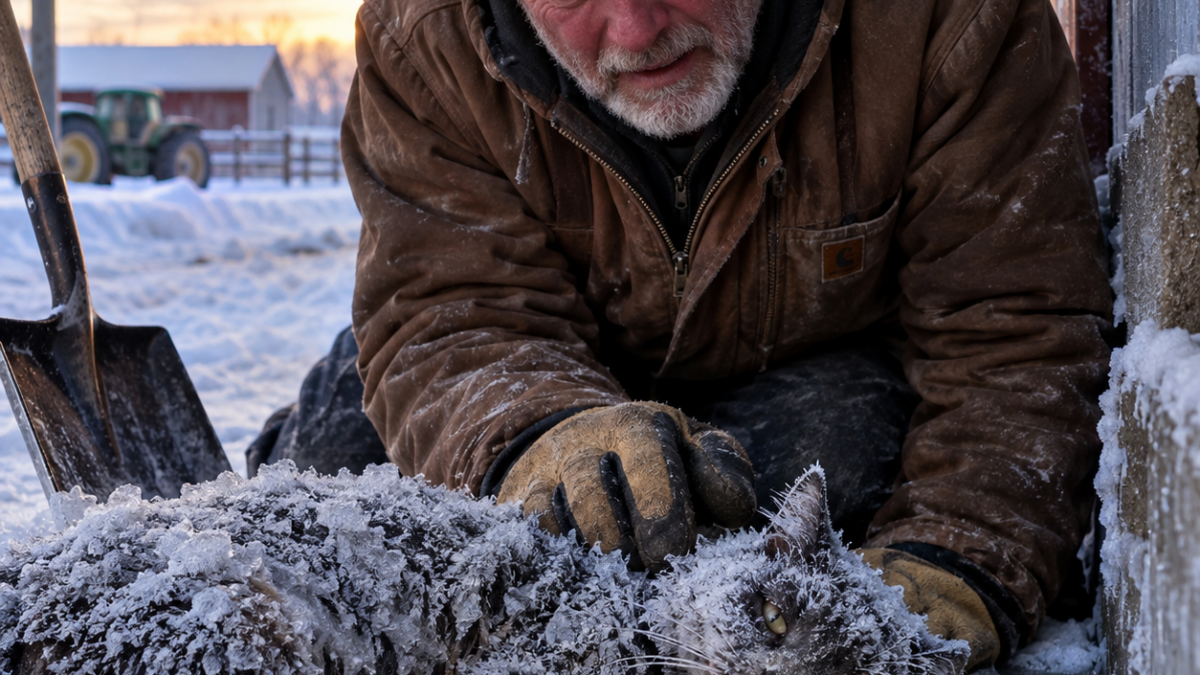
Inside the shed, the cat lay exactly where I had left him.
Ruth stopped a few feet away.
“Oh, Harold.”
“I told you.”
She did not answer.
She only moved closer, slowly.
I knelt beside him.
My knees cracked. The concrete was cold through my overalls. I leaned down toward his face, more to satisfy Ruth than from any expectation.
His eyes were closed.
Or almost closed.
There was frost along the lashes, if cats can be said to have lashes. Tiny crystals at the edges of his lids. I reached out one bare finger and brushed a bit of frost away from the fur near his cheek.
That was when I saw it.
A thin amber slit opened between his eyelids.
Not wide.
Not blinking.
Barely more than a line of color.
But open.
And looking at me.
I stopped breathing.
The eye moved.
Just enough to follow my face.
The shovel fell from my hand and hit the concrete with a clang that made Ruth jump.
“He’s alive,” I said.
Ruth was already beside me.
“What?”
“He’s alive.”
The cat did not move.
Could not move.
But that narrow amber line stayed fixed on us.
I have no proper way to explain what that felt like.
It was not like finding something wounded and crying.
It was worse.
Because he was silent.
So silent.
His body had already surrendered every motion except that one tiny act.
His eyes.
He had kept his eyes open.
Ruth dropped to her knees.
“We need to get him out of the ice.”
“Not pull,” I said quickly. “His skin could tear.”
“I know.”
I grabbed a flathead screwdriver from the tool bench. Ruth pulled off her gloves and tucked them under her arms, then cursed because the metal was too cold for bare fingers. We worked carefully around the frozen puddle, chipping at the ice without touching him more than necessary.
It took fifteen minutes.
Fifteen minutes of tiny cracks, scraping, pausing, listening, checking those eyes.
He never made a sound.
Not once.
No meow.
No hiss.
No cry.
But his eyes followed us the whole time.
Sometimes both opened a fraction.
Sometimes one.
Sometimes they faded so much I thought we were losing him.
“Stay,” Ruth whispered, as if he were a child fighting sleep. “You stay with us.”
The ice finally released around his body with a faint snap.
I slid both hands beneath him, expecting resistance or limpness or something.
He gave neither.
He was stiff with cold, light as a bundle of sticks, fur crusted so hard it crackled against my coat.
Ruth ran ahead to the house.
“Near the stove,” I called. “But not too close.”
“I know!”
We laid him on towels on the kitchen floor, several feet from the wood stove. Ruth called the veterinarian while I knelt beside him, feeling useless.
Dr. Elaine Porter answered the emergency line. She had been our vet for nearly twelve years, mostly cattle, dogs, barn cats when they allowed themselves to be caught.
Ruth put her on speaker.
“Do not use hot water,” Dr. Porter said immediately after hearing the situation. “Do not put him on a heating pad. Do not warm him too fast.”
“He’s frozen solid,” I said.
“He’s severely hypothermic. Fast external heat can shock his system and make things worse. Warm towels, body heat, room warmth. Slow. If he’s breathing, keep him still. I’m getting dressed now.”
“How long?”
“Forty minutes if the roads are passable.”
I looked at the cat.
“I don’t know if he has forty minutes.”
“Then give him the next one,” she said.
That sentence stayed with me.
Give him the next one.
Not save him.
Not promise.
Just give him the next minute.
Then the next.
So we did.
Ruth warmed towels near the stove, not hot, just warm. I swapped them gently as they cooled. She sat on the floor with one hand near his head, not petting exactly, just present. I lay beside him with my palm near his nose, trying to feel breath.
Once, I thought there was nothing.
Then a faint whisper of air touched my skin.
“He’s breathing,” I said.
Ruth closed her eyes.
For four hours, he did not move.
Dr. Porter arrived after seven, examined him where he lay, and looked more grim than I wanted.
“Core temperature is too low to read accurately on my field thermometer,” she said. “But based on response and stiffness, he may be around thirty-one Celsius. Maybe lower.”
“What does that mean?”
“It means he should not be alive.”
Ruth’s hand covered her mouth.
Dr. Porter checked his heart.
Slow.
Weak.
But there.
His paws were rigid. His tail was frozen stiff. The fur along one hip had been pressed deep into the ice. The ears looked bad. Very bad. But she kept working, kept listening, kept telling us what to do.
“Slow warming. Keep him dry. Keep him quiet. If he starts to move, don’t let him panic. He may be disoriented. He’ll need a full exam at the clinic once he’s stable enough to transport.”
“Will he live?” Ruth asked.
Dr. Porter looked at the cat for a long time.
“I don’t know.”
Farm people are used to honest answers.
That one still hurt.
After Dr. Porter left, the house changed around him.
Chores still had to happen. Cows do not stop needing milked because a cat is freezing in your kitchen. Pipes do not thaw themselves. Feed does not move from one place to another because your heart is occupied elsewhere.
I went out because I had to.
Ruth stayed in.
Every half hour, I came back to check.
Nothing.
Then nothing.
Then nothing.
At nearly ten, Ruth called from the kitchen.
“Harold!”
I came in with snow still on my boots.
“What?”
“His ear moved.”
I knelt beside him.
“Are you sure?”
“I saw it.”
We waited.
Nothing.
Then, five minutes later, the tip of one ear twitched.
So small.
So ordinary.
Ruth started crying.
Not loudly.
Just one hand over her mouth, tears slipping down her face.
“That’s it,” she whispered. “That’s it, sweetheart.”
Another hour passed.
Then one front paw flexed.
Barely.
At noon, he blinked.
An actual blink.
Slow.
Uneven.
But real.
At nearly one, he tried to lift his head and failed.
At two, he tried again.
At three, he pushed one paw beneath himself.
His body trembled so violently I thought he might break apart.
“Easy,” I said. “Easy.”
He got one front leg under him.
Then the other.
His back legs slid.
He collapsed.
Ruth reached for him, but I stopped her.
“Wait.”
The cat lay there, breathing hard.
Then he tried again.
He rose.
Wobbled.
Fell.
Rose again.
By the time he managed to stand for three full seconds, Ruth and I were sitting on the floor like fools, cheering quietly so we wouldn’t frighten him.
He took one step.
Fell.
Took another.
Fell.
Then, as if offended by the entire situation, he dragged himself toward the stove and collapsed closer to the warmth.
Ruth laughed through tears.
“Well,” she said, “he knows what he wants.”
That was January from the beginning.
The next day, we took him to Dr. Porter’s clinic.
He rode in a laundry basket lined with towels because we did not own a cat carrier. Ruth sat in the passenger seat with one hand resting near him the whole way. Every few minutes she said, “Still with us,” as if reporting to the universe.
Dr. Porter’s full exam confirmed what the cold had done.
Severe hypothermia.
Frostbite.
Dehydration.
Low body temperature consistent with being found near thirty-one Celsius.
No microchip.
No collar.
Unneutered male.
Probably four to six years old.
A stray, most likely.
His tail was the first thing she warned us about.
“It may not survive.”
“How much?” I asked.
“We won’t know for several days. Frostbite declares itself slowly.”
That was a phrase I had never heard before.
Declares itself.
As if damage has to finish speaking.
Over the next week, it did.
The last three-quarters of his tail turned black and cold, then leathery. It had to be amputated.
The tips of both ears lost tissue too. Not enough to take the whole ear, but enough that when they healed, they became shorter, rounded at the top, soft-edged like someone had carefully reshaped them.
Two toes on his right front paw could not be saved.
The pads on three paws cracked open during the thawing process, deep painful fissures that took five weeks to heal.
A patch on his right hip, where the ice had held him most deeply, never regrew fur.
Every day brought a new cost of the night he survived.
And yet, every day, he remained alive.
That was the thing.
He ate.
Not at first with enthusiasm, but with determination. He drank. He slept. He watched. He tolerated bandage changes with a low rumble that might have been a warning or might simply have been his opinion of humanity.
Ruth named him before I admitted we were keeping him.
“January,” she said one evening.
He was lying in a box near the stove, wrapped in a towel, tail bandaged after surgery.
I looked up from my coffee.
“What?”
“His name.”
“He’s not ours.”
She gave me the look.
Every married man knows the look.
It contains history, evidence, prophecy, and the complete foolishness of pretending the conversation is undecided.
“We don’t know where he came from,” I said.
“No chip. No collar. No one has answered the posts. No one nearby recognizes him.”
“He could belong to someone.”
“Then they should have kept him inside at minus thirty-five.”
That ended that part.
I looked at the cat.
He opened one amber eye, then closed it again.
“January,” I said.
His shortened ear twitched.
Ruth smiled.
“He knows.”
“He does not know.”
“He does.”
I did not argue.
January recovered like winter leaving a field.
Not all at once.
Slowly.
Messily.
With setbacks.
His paws hurt for weeks. We had to change dressings and apply ointment while he glared at us with the solemn disgust of a king betrayed by servants. He walked badly at first, especially after losing the two toes. A little uneven hitch remained even after he healed.
His tail, shortened after amputation, curved slightly left when he walked.
His ears healed into smooth rounded shapes that made him look permanently windblown.
The fur returned everywhere except that small patch on his hip.
His body filled out.
By spring, he weighed nearly thirteen pounds—close to six kilos—and looked less like a ghost found in the shed and more like a cat who had opinions about everything.
He had many opinions.
He disliked closed doors.
He disliked being picked up unless it was his idea.
He disliked the vacuum, the barn radio, wet boots, and a particular rooster that had never done anything to him but exist too loudly.
He loved the wood stove.
He loved the radiator.
He loved sun patches.
He loved Ruth’s lap but pretended he didn’t.
He loved warmth with a devotion that was almost painful to watch.
Every night, he slept on the radiator in the mudroom, stretched as close as physically possible without melting into it. We placed a folded blanket on top after the first week because he refused every softer bed we bought.
In summer, he moved from one patch of sunlight to another across the kitchen floor, sleeping until the light shifted, then rising with great seriousness to relocate eight inches.
“He’s solar-powered,” Ruth said.
“He’s heat-powered,” I said.
“He’s alive-powered.”
That was Ruth.
She could say things that would sound foolish from anyone else.
From her, they usually turned out to be true.
People came by to see him after the story spread locally.
The vet mentioned him to one person, who told another, and soon half the county knew about “the frozen cat at Bennett’s place.” A reporter from the small-town paper called. I said no. Ruth said yes. We compromised, which means Ruth won.
The reporter took a photo of January on the radiator, shortened tail curled left, rounded ears forward, amber eyes half closed in heat-drunk satisfaction.
She asked Ruth what it felt like to see him alive after thinking he was dead.
Ruth answered before I could.
“I’ve lived on this farm for forty years,” she said. “I’ve seen a lot of animals freeze to death. But I have never seen one decide not to die.”
The reporter used that line as the headline.
I teased Ruth about it later.
“Getting poetic in your old age.”
She shrugged.
“You saw his eyes.”
I had.
That was the problem.
I could never unsee them.
For months afterward, I replayed the moment I dropped the shovel.
The sound of metal on concrete.
The thin amber line opening.
The way his eyes followed me when nothing else in his body could move.
He had not fought his way out of the ice.
He couldn’t.
He had not cried for help.
He couldn’t.
He had not run, clawed, broken free, or done any of the things people usually imagine survival requires.
He had simply stayed.
Stayed alive.
Stayed present.
Stayed with eyes open long enough for someone to notice.
That did not feel small to me.
At first, I felt guilty for almost burying him.
Ruth told me guilt was useless unless it taught you something.
“What is it teaching you?” she asked one night as January slept near the stove.
“That I should listen to you.”
“You already knew that.”
I smiled despite myself.
Then I said, “That I was too sure.”
Ruth nodded.
“That’s closer.”
“I thought I knew what I was looking at.”
“We all do sometimes.”
“I had the shovel in my hand.”
“But you went back.”
“Because you made me.”
“Because you listened.”
That was generous.
But marriage is partly choosing generous versions of the truth.
January became part of the farm in quiet ways.
He never became a barn cat.
Not truly.
We tried letting him choose. When the weather warmed, I opened the mudroom door and let him step outside. He took three careful steps onto the porch, sniffed the air, looked at the yard, the barn, the shed where I had found him, the open sky, the dirt, the lingering memory of cold only he could know.
Then he turned around and went back to the radiator.
That was his vote.
We respected it.
He watched the farm from windows after that.
Cows moving across pasture.
Snow falling.
Swallows under the eaves.
Me carrying feed buckets.
Ruth hanging laundry.
He showed no desire to return to outdoor life. Whatever freedom had meant to him before, warmth meant more now.
Some people did not understand that.
“He’d probably like to roam,” one neighbor said.
“He nearly died roaming,” Ruth replied.
The neighbor did not bring it up again.
January did have one outdoor habit.
On warm summer evenings, he liked the screened porch. He would lie in the last strip of sun by the door and watch moths thump against the mesh. Sometimes he raised one paw as if considering violence, then decided against the effort.
The missing toes made that paw look slightly unfinished.
I found it beautiful.
Not in a cute way.
In a true way.
A body keeping record.
Farmers understand that. Every old cow, every working dog, every hand that has fixed machinery in winter carries a map of what happened and what healed. Scars are not failures. They are notes written by survival.
January was full of notes.
Rounded ears: the cold took this.
Short tail: the cold took this.
Missing toes: the cold took this.
Bare patch on hip: the ice held here.
Amber eyes: I stayed.
That last one mattered most.
The following winter, I dreaded the first deep freeze more than I admitted.
So did Ruth.
We made preparations we had always made: heat lamps checked, barn doors sealed, water lines insulated, extra bedding laid down. But now, every temperature drop carried the memory of January locked in ice.
The first night it fell below zero, January paced.
Not frantically.
But enough that Ruth noticed.
“He knows.”
“He smells it maybe.”
“He remembers.”
He climbed onto the radiator but did not settle. He stared toward the mudroom door, ears angled slightly back.
I sat on the floor beside him.
“Not going out there,” I told him.
He looked at me.
“Not tonight. Not ever if you don’t want.”
After a minute, he stepped down from the radiator and climbed awkwardly into my lap.
He was not a lap cat by nature.
Ruth looked over from her chair.
“Well, look at that.”
“Don’t make it a thing,” I said.
She smiled and returned to her knitting.
January stayed for seventeen minutes.
I counted because I did not know if it would happen again.
It did.
Only in deep cold.
Only when the wind pressed against the house and the windows frosted white.
On those nights, he would leave the radiator, come to my chair, and wait. I would lift him because jumping had become harder with his missing toes and shortened balance. He would settle heavily against me, face toward the stove, body warm and alive under my hand.
I came to understand that survival does not end when the danger passes.
The body keeps listening for the weather that almost took it.
Some nights, I think people do too.
I had my own winters.
Not as literal as his.
A brother lost young. A season when milk prices nearly sank us. Ruth’s cancer scare fifteen years earlier. My father’s decline. The year I wondered if the farm would outlast me or take me down with it.
I had survived those things the way men of my generation often survive: quietly, stubbornly, with very little discussion and too much coffee.
January survived differently.
He did not pretend the cold had not happened.
He sought warmth without shame.
That taught me something.
A living thing that almost froze does not apologize for needing heat.
Maybe people shouldn’t either.
One afternoon, Ruth found me standing in the equipment shed near the place where I had found him. It was spring again. The air smelled of thawed mud and diesel. The concrete floor was dry now. Ordinary. A shovel leaned against the wall.
“You all right?” she asked.
“Yeah.”
She stood beside me.
For a while, neither of us spoke.
Then I pointed to the floor.
“Right there.”
“I know.”
“I was going to bury him.”
“But you didn’t.”
“I would have.”
“But you didn’t.”
I looked at her.
“You keep saying that.”
“Because you keep standing here like the almost is stronger than the after.”
That woman.
Forty years married, and she could still put a sentence exactly where it hurt.
“The almost was close,” I said.
“Yes.”
“The after is closer now.”
I looked toward the house.
Through the kitchen window, January was visible on the sill, watching us with narrowed eyes.
“He’s still here,” Ruth said.
I nodded.
“He’s still here.”
After the newspaper story, people sent messages.
Some were kind.
Some told us about animals they had found frozen and could not save.
Some said January gave them hope.
One letter came from a woman in Iowa whose son had survived an overdose. She wrote that when she read Ruth’s line—never seen one decide not to die—she cried for an hour. She said her son had not fought dramatically either. He had simply opened his eyes in the hospital when everyone feared he would not.
Ruth kept that letter in her Bible.
January, unaware of his influence, tried to chew the corner once.
We stopped him before he damaged anyone’s healing.
Another message came from a man who said he had been depressed for months and kept thinking about the cat who couldn’t move but kept his eyes open.
I did not know what to do with messages like that.
I am a dairy farmer, not a preacher.
But I started to understand that January’s story belonged to more than us.
Not because it was sentimental.
Because it was plain.
He was almost gone.
Someone almost gave up on him.
He did not give up on himself.
That is a story many people recognize in their bones.
Even if they have never been frozen to a shed floor.
Years later, January is heavier, slower, and more demanding than ever.
He wakes Ruth before the alarm if the radiator blanket has shifted. He sits directly on the newspaper if I am reading. He swats at my pencil when I do farm accounts. He has learned that visitors praise him, which he accepts as overdue recognition.
His shortened tail still curves left.
His gait is still slightly uneven.
His ears are still rounded and soft where the tips used to be.
When strangers ask what happened, Ruth usually says, “Winter tried to keep him.”
Then she scratches under his chin.
“But it didn’t.”
Every January, on the coldest morning we can bear, Ruth and I light the wood stove early and give him a little saucer of warm goat milk, which Dr. Porter says is unnecessary and probably indulgent.
It is absolutely indulgent.
We do it anyway.
The first time, I said, “To January.”
Ruth raised her coffee mug.
“To keeping your eyes open.”
That became the tradition.
This past winter, our granddaughter Ellie was visiting when we did it. She is nine and has the serious tenderness children sometimes have before the world teaches them to hide it.
She sat cross-legged on the kitchen floor watching January drink his milk.
“Grandpa,” she said, “was he scared when he was frozen?”
I looked at Ruth.
Then at January.
“I think so.”
“But he couldn’t move?”
“No.”
“Could he meow?”
“No.”
“Then what did he do?”
I thought about those eyes.
“He waited.”
Ellie frowned.
“That’s all?”
“That was enough.”
She considered that.
Then she reached out one small hand, and January, who generally did not tolerate unnecessary affection from children, allowed her to touch the top of his head.
“Good waiting,” she whispered.
Ruth turned quickly toward the sink.
I pretended not to see her wipe her eyes.
There are many kinds of bravery.
I know that now.
There is the bravery that runs into fire.
The bravery that crosses a battlefield.
The bravery that speaks a hard truth in a room where silence would be easier.
But there is another kind too.
The kind that does not look like movement.
The kind that cannot lift its head.
The kind that lies frozen to a shed floor with organs slowing, limbs locked, frost on its whiskers, and a shovel coming.
The kind that keeps one thin line of amber open.
The kind that says, without sound, I am still here.
January had that kind.
And because he did, Ruth made me check.
Because Ruth made me check, I saw his eyes.
Because I saw his eyes, the shovel fell.
Because the shovel fell, we chipped him out.
Because we chipped him out, he warmed.
Because he warmed, he stood.
Because he stood, he lived.
And because he lived, our house learned something about survival that forty years of farming had not taught us clearly enough.
Life does not always announce itself loudly.
Sometimes it barely opens one eye.
Sometimes hope is not a cry for help.
Sometimes it is only the refusal to disappear before someone looks closely enough.
I still keep that shovel in the shed.
I use it for ordinary things now. Gravel. Snow. Manure. Work.
But sometimes, when I reach for it, I remember the sound it made hitting the concrete after I saw his eyes.
That sound was the beginning of January’s second life.
It was also the end of a certain kind of certainty in me.
I am less quick now.
Less sure that stillness means absence.
Less willing to decide what cannot be saved before checking twice.
Ruth says that is a good change.
I suppose it is.
January is asleep on the radiator as I tell this.
The house is warm. The wind outside has picked up, rattling snow against the kitchen windows. His body is curled tight, shortened tail tucked along his side, rounded ears relaxed. One paw hangs over the edge of the blanket, the paw missing two toes.
He is not the cat he was before the cold.
We will never know that cat.
But he is not only what the cold did to him either.
He is the cat who wakes us too early.
The cat who steals Ruth’s chair.
The cat who limps toward every square of sunlight like it owes him rent.
The cat who survived impossible cold by doing the only thing he still could.
Keeping his eyes open.
For all the living creatures who have survived something they should not have survived, I think of him.
For all the people who could not move, could not speak, could not explain, could not fight in any visible way, but stayed alive one more minute anyway.
For every soul someone nearly gave up on too soon.
Check anyway.
Kneel down.
Look closely.
Sometimes the eyes are still open.
And sometimes that is enough to bring the shovel down, call someone you love, wrap a frozen body in towels, and begin again.








