I Went to a Garage Sale for an Old Toolbox—Then I Saw a 17-Year-Old Cat Marked “FREE” Beside His Dead Owner’s Belongings
I Went to a Garage Sale for an Old Toolbox—Then I Saw a 17-Year-Old Cat Marked “FREE” Beside His Dead Owner’s Belongings
I went to a neighborhood garage sale outside Indianapolis looking for an old toolbox, but at the end of one driveway I found a seventeen-year-old cat sitting in a wire carrier beside a cardboard sign that said “FREE,” watching strangers buy the possessions of the woman he had slept beside for almost his entire life.
Thirty people walked past Arthur before I finally knelt down, and when his late owner’s daughter handed me the carrier with tears in her eyes, she quietly admitted that her brother had given her until sunset to “get rid of the cat” so they could finish clearing their mother’s estate.
Then, hidden behind the framed photograph she sent home with me, I found a letter written by Arthur’s dead owner—and one sentence inside it revealed that the old cat had never been meant to be given away at all.
I was not looking for a cat.
That part matters.
People hear what happened later and assume I must have been one of those people who visited shelters on weekends, volunteered with rescues, carried bags of cat food in my trunk, and had been waiting for the right animal to appear.
I wasn’t.
My name is Mark Dalton.
At the time, I was forty-six years old, divorced, living alone in a small ranch house outside Indianapolis, and the closest thing I had to a pet was a spider that had occupied the corner of my garage for three months because neither of us had enough motivation to do anything about the arrangement.
I liked animals.
I just did not organize my life around them.
That Saturday morning, I had one goal.
A toolbox.
Not even a good toolbox.
An old steel one.
The kind made before everything became plastic.
My father had owned one when I was a kid—a red Kennedy box with scratches down the lid and a drawer that stuck if you pulled it too fast.
He died five years earlier.
My younger brother inherited the tools.
I told him I didn’t care.
That was mostly true.
But lately I had been restoring an old workbench in my garage, and I had started thinking about that toolbox.
So when I saw a neighborhood sign reading MULTI-FAMILY GARAGE SALE — SATURDAY 8–3, I turned onto the cul-de-sac.
It was one of those neighborhoods built in the late seventies.
Maple trees.
Wide driveways.
Brick ranches with low roofs.
Mailboxes leaning slightly after decades of snowplows and teenagers.
People had folding tables everywhere.
Baby clothes.
Fishing gear.
Kitchen appliances.
Christmas decorations.
A man was selling four nearly identical drills.
A woman had arranged paperback mysteries in perfect rows by author.
Two children were running a lemonade stand that appeared to be operating without any understanding of food safety.
I parked near the entrance and started walking.
I found tools almost immediately.
Wrong tools.
Cheap socket sets.
Broken levels.
Rusty saw blades.
One table had a bright-blue plastic toolbox with SPIDER-MAN on the lid.
A six-year-old boy told me it was “vintage.”
I respected the salesmanship.
Then I reached the last house.
The atmosphere changed before I understood why.
Most garage sales look like people clearing out clutter.
This one looked like a life being dismantled.
There were no children’s toys.
PART2:
No exercise equipment someone regretted buying.
No box labeled RANDOM CORDS.
The tables were covered with things that had clearly been used by the same person for decades.
Fine china.
Lace tablecloths.
Old Pyrex dishes.
A walker.
A small wooden jewelry box.
Two winter coats that looked older than I was.
Hardcover novels with handwritten notes in the margins.
A sewing basket.
A collection of teacups.
Beside them sat a pair of reading glasses folded neatly on top of a crossword puzzle book.
Family photographs had been stacked face down in a cardboard box marked FREE FRAMES.
You did not have to ask.
Someone had died.
A woman in her early fifties sat in a folding chair near the garage.
She had tired eyes and the posture of someone who had been making decisions all week.
People picked up objects.
Asked prices.
Haggled.
Walked away carrying parts of somebody’s life in grocery bags.
I slowed.
Not because I was sentimental.
Because it felt strange bargaining there.
I found a metal toolbox beneath one table.
Old.
Green.
Heavy.
PART3:
Not the one I had imagined, but close enough.
I opened it.
Two drawers.
Rust along one corner.
Ten dollars written on masking tape.
I carried it toward the woman.
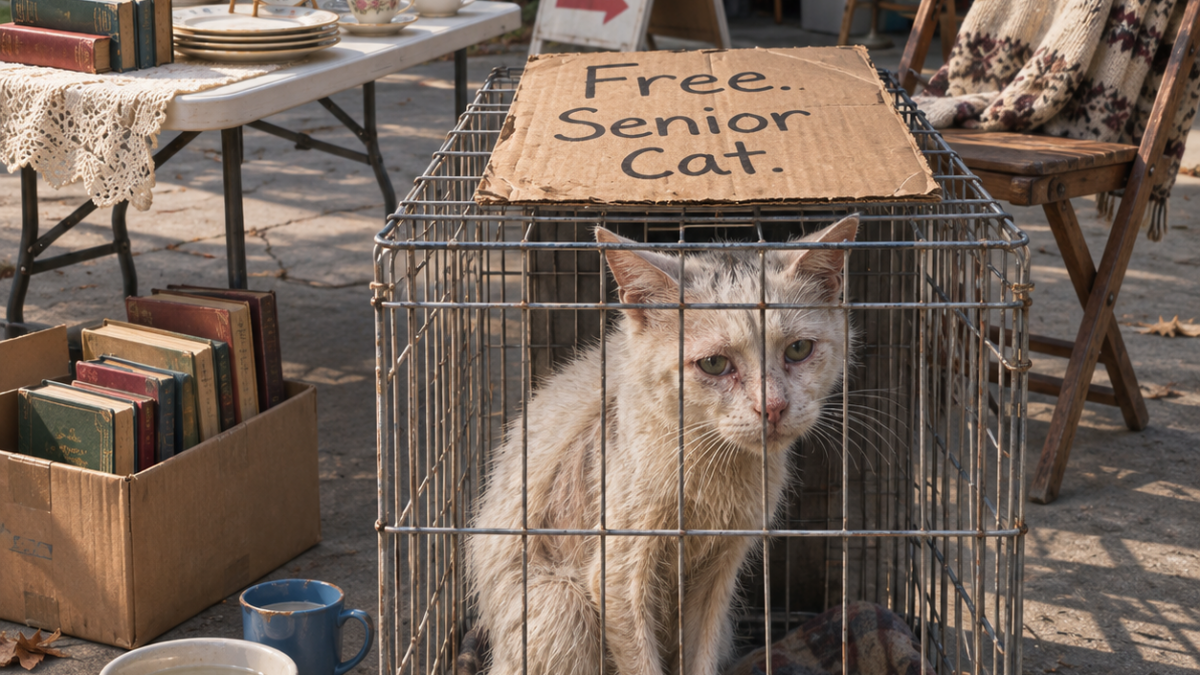
That was when I saw the carrier.
Large wire pet carrier.
Sitting beside the last folding table.
Inside was a cat.
White and gray.
Big once, probably.
Now thin through the shoulders.
His face had the narrow, dignified look of very old cats.
His whiskers were entirely white.
The fur around his muzzle had faded.
He had green eyes.
Not bright green.
Cloudy green.
One eye had a slight blue-gray cast.
He was lying on an old floral blanket.
He did not meow.
Did not paw the bars.
Did not move when people passed.
A piece of cardboard leaned against the carrier.
Thick black marker.
FREE.
SENIOR CAT.
17 YEARS OLD.
OWNER DIED.
HE JUST NEEDS SOMEONE.
I read it.
Then looked at the cat.
He looked back.
That should have been the moment.
It wasn’t.
I paid ten dollars for the toolbox.
Carried it three houses down.
Bought a socket set for six more.
Looked through a box of screwdrivers.
Talked to a retired electrician about how modern tools were “all garbage now,” a position I only partly agreed with but did not feel strongly enough to challenge.
Then I headed toward my truck.
And stopped.
From halfway down the street, I could still see the carrier.
The cat had not moved.
People kept walking past.
An older couple stopped.
Read the sign.
The woman crouched slightly.
The man shook his head.
They continued.
A mother with two little girls approached.
One child pointed.
“Kitty!”
The mother read the sign.
Her expression changed.
“Come on, sweetie.”
They walked away.
A young guy in a Colts sweatshirt glanced at the carrier and said to his girlfriend:
“Seventeen? That thing’s ancient.”
They left.
I stood beside my truck.
I should have loaded the toolbox.
I should have gone home.
Instead I watched.
I do not know why I started counting.
Maybe because numbers turn uncomfortable things into something measurable.
Twenty-two.
Twenty-three.
Twenty-four.
A teenage girl stopped.
Read the sign.
Looked at the cat.
For a second I thought she might kneel.
Her father called her from another driveway.
She left.
Twenty-five.
A man carrying a lamp.
Twenty-six.
Two women with shopping bags.
Twenty-seven.
A couple pushing a stroller.
Twenty-eight.
An elderly man.
He looked longest.
Nearly a minute.
Then shook his head and moved on.
Twenty-nine.
A woman with sunglasses.
Thirty.
Thirty people.
Not one opened the carrier.
Not one touched him.
Not one asked the woman in the folding chair a question.
I told myself that was reasonable.
He was seventeen.
An old cat comes with bills.
Medication.
Kidney disease.
Arthritis.
Possible accidents outside the litter box.
Possibly months instead of years.
Everybody passing him probably had a perfectly respectable reason.
So did I.
I traveled occasionally for work.
I had no pet supplies.
No idea what seventeen-year-old cats needed.
I liked sleeping past six on weekends.
My furniture had survived my divorce and deserved peace.
All excellent reasons.
I opened my truck door.
Then looked back one more time.
Most of the tables were empty now.
The china was gone.
The walker was gone.
The old winter coats had disappeared.
Somebody carried away a lamp.
The woman hosting the sale looked across the almost-empty driveway.
Then down at the carrier.
Her shoulders dropped.
It was a tiny movement.
But I understood it.
She had been hoping somebody else would solve the problem.
The solution had not arrived.
I closed my truck door.
“Damn it.”
I walked back.
The woman looked up.
“Forget something?”
I pointed toward the carrier.
“Tell me about him.”
Her whole face changed.
Not relief yet.
Too early.
But hope.
“His name is Arthur.”
I crouched.
Up close, he looked older.
Thin around the spine.
One ear nicked near the edge.
Long gray-white eyebrows.
I placed two fingers near the wire.
Arthur raised his head.
That took effort.
He stood.
His hind legs were stiff.
He walked to the front.
Sniffed once.
Then pressed his nose against the wire until it touched my fingers.
I felt ridiculous for how hard that hit me.
No hesitation.
No defensive hiss.
Just contact.
The woman whispered:
“He hasn’t done that with anybody today.”
“Probably smells the toolbox.”
She almost laughed.
“My mother used to say he liked men because they had warmer hands.”
“Your mother?”
She nodded.
“That was her house.”
I looked toward the brick ranch behind us.
Curtains open.
Empty rooms visible through the front window.
“My mom was Eleanor.”
Her voice changed when she said the name.
“She died three weeks ago.”
“I’m sorry.”
“Thank you.”
She looked at Arthur.
“She got him when he was a kitten.”
“Seventeen years?”
“Seventeen years and four months.”
“You know exactly?”
“She knew exactly.”
A faint smile.
“He was her retirement present to herself.”
“What did she retire from?”
“Third-grade teacher.”
“That tracks.”
“What?”
“Seventeen years with one cat sounds like a teacher.”
She laughed properly then.
“My name’s Susan.”
“Mark.”
We shook hands awkwardly over the carrier.
Susan sat back down.
“My mother found him through a rescue when he was maybe ten weeks old.”
“He slept in her bed from the first night.”
“Wouldn’t use the cat bed.”
“She bought six.”
“He rejected every one.”
“Seems principled.”
“He is.”
Arthur sat near my fingers.
Susan continued.
“When Mom got sick last year, he started staying in her room.”
“What kind of sick?”
“Heart failure.”
Her voice became flatter.
Protective.
“She was in and out of the hospital.”
“Then hospice came to the house.”
“Arthur barely left her bed.”
“Wouldn’t even come down for food some days.”
“We had to carry his bowl upstairs.”
I looked at him.
He blinked slowly.
“When she died…”
Susan stopped.
I waited.
“When she died, he stayed on the bed.”
“For two days.”
“We tried moving him.”
“He went right back.”
“The funeral home came.”
“He hid under the bed.”
“After they took her, he climbed onto her pillow.”
Susan wiped her cheek quickly.
“I’m sorry.”
“No.”
I said it softly.
“You don’t have to apologize.”
She looked away.
“I tried taking him home.”
“The sign says he needs someone.”
She nodded.
“I have two dogs.”
“Big dogs.”
“Both rescues.”
“One is fine with cats.”
“The other…”
She shook her head.
“Not safe.”
“I kept Arthur in a spare room.”
“He stayed under the bed for a week.”
“Barely ate.”
“My husband slept on the floor in there two nights.”
“We tried gates.”
“Slow introductions.”
“Everything.”
“But the dogs knew he was there.”
“He knew they were there.”
“So I brought him back here while we finished the house.”
“How long?”
“Ten days.”
“You’ve been coming every day?”
“Twice a day.”
“Food.”
“Medication.”
“Company.”
“Medication?”
“Arthritis.”
“And thyroid pills.”
There it was.
The practical list beginning.
I glanced at the sign.
“Why not a shelter?”
Susan’s face tightened.
“I called.”
“Two said they were full.”
“One said they’d take him, but…”
She looked at Arthur.
“I couldn’t do it.”
“Why?”
“He’s never been in a cage.”
I looked at the wire carrier.
She saw the irony.
“I know.”
“This is temporary.”
“I thought if people could meet him…”
Her voice broke.
“I thought somebody would see him.”
I looked down the street.
Thirty people.
Susan followed my eyes.
“Four hours.”
“No one?”
She shook her head.
“One woman asked if he was free because he was sick.”
“What did you say?”
“I said he’s free because I need him to have a home.”
“What did she say?”
“She wanted a kitten.”
Arthur sat.
Waiting.
I asked:
“What happens if nobody takes him today?”
Susan did not answer.
That was answer enough.
“What?”
She rubbed her hands together.
“My brother is coming at four.”
“For what?”
“To finish clearing the house.”
“And Arthur?”
Susan swallowed.
“He thinks we should surrender him Monday.”
“To the shelter?”
“Yes.”
“And if they won’t take him?”
She looked down.
“He says seventeen is old.”
My chest tightened.
“What does that mean?”
“He keeps saying…”
She stopped.
“Say it.”
“He says sometimes the kind thing is not putting an old animal through more transitions.”
That could be true.
Sometimes.
But Susan did not believe that was what her brother meant.
I could see it.
“Does Arthur have something terminal?”
“No.”
“Pain uncontrolled?”
“No.”
“Eating?”
“Yes.”
“Using litter?”
“Yes.”
“Enjoying things?”
“He still watches birds.”
“He still sleeps in the sun.”
“He purrs.”
She looked at me.
“He’s old.”
“That’s all.”
I stood.
Then immediately wished I hadn’t because Arthur followed the movement with his eyes.
I looked at the toolbox in my truck.
Then at the carrier.
“This is stupid.”
Susan blinked.
“What?”
“I came here for tools.”
She almost smiled.
“I can tell.”
“I don’t know anything about cats.”
“That can be learned.”
“I travel.”
“How often?”
“Couple days every two months.”
“There are pet sitters.”
“You’re really selling this.”
Her face changed.
“I’m sorry.”
“No.”
I looked at Arthur.
“Open it.”
Susan froze.
“What?”
“The carrier.”
“Why?”
“I want to see what he does.”
Her hands shook slightly as she unlatched the door.
Arthur did not bolt.
He stepped forward.
Slow.
Stiff.
Front paws onto the driveway.
Then back paws.
He sniffed my shoe.
Circled once.
Then sat directly against my ankle.
Not dramatic.
No leap.
No miracle.
Just leaned.
Susan covered her mouth.
I looked down.
“That’s dirty pool.”
She laughed and cried at the same time.
Arthur rested his side against my boot.
I crouched.
Scratched behind his ear.
He closed his eyes.
Purr.
Quiet.
Old motor.
Still running.
I heard myself say:
“I’ll take him.”
Susan did not speak.
“I said I’ll take him.”
She stared.
“Are you sure?”
“No.”
That made her laugh harder.
“I don’t think anyone adopting a seventeen-year-old cat from a garage sale should be sure.”
Tears rolled down her face.
“You have no idea what this means.”
“I have some idea.”
She reached for the carrier handle.
Then stopped.
Her fingers tightened around it.
For a moment she looked like she might change her mind.
I understood.
Arthur was not just a cat.
He was evidence her mother had existed in that house.
Breathed there.
Slept there.
Loved something there.
Everything else was being sold by price tag.
Arthur was the last living part.
Susan whispered:
“My mom would have worried about him.”
“I’m sure.”
“She asked about him in hospice.”
“What did she say?”
“Mostly whether he’d eaten.”
I laughed.
“Very motherly.”
“She’d be half asleep and ask, ‘Did Arthur get dinner?’”
“Even after he’d eaten twice.”
“He learned that part fast.”
“Smart cat.”
Susan looked at me.
“Please don’t let him get fat.”
“I’ll do my best.”
She began gathering things.
A litter box.
Food.
Medications.
Medical records.
Two ceramic bowls.
A brush.
A scratching pad.
A blue fleece blanket.
Then she reached beneath the table.
Pulled out a framed photograph.
Old.
Silver frame.
Eleanor, maybe sixty-five in the picture.
Sitting on the porch.
Laughing.
Holding a tiny white-and-gray kitten against her chest.
Arthur.
I looked at the photograph.
Same eyes.
Younger face.
Huge ears.
“You should have this.”
“No.”
“Yes.”
“That belongs to your family.”
Susan shook her head.
“He belongs in the photo.”
“You should know how loved he was.”
That sentence stayed with me.
Not:
So you’ll know what he looked like.
So you’ll know who owned him.
So you’ll remember my mother.
So you’ll know how loved he was.
I took the frame.
“Okay.”
Arthur rode home in the passenger seat.
Carrier buckled with the seat belt because I had suddenly become the kind of man who worried about cat-carrier safety.
He did not cry.
Did not scratch.
He simply lay on Eleanor’s blanket and watched me.
I kept glancing over.
“This is weird.”
Blink.
“I have never owned a cat.”
Blink.
“I hope you know that.”
Arthur closed his eyes.
“Excellent confidence.”
My house had never seemed particularly empty until I carried a living thing into it.
Then every room looked unfinished.
No cat food station.
No litter area.
No toys.
No idea where a cat was supposed to sleep.
I put the carrier in the living room.
Opened the door.
Arthur stayed inside.
I sat on the couch.
“Your call.”
Ten minutes.
Nothing.
Twenty.
Arthur stepped out.
He sniffed the rug.
Moved slowly.
Living room.
Hallway.
Kitchen.
He stopped at the sliding glass door.
Looked outside.
Bird feeder.
Two sparrows.
Arthur sat.
Watched.
Susan had said he still watched birds.
I felt absurdly relieved.
He ate every bite of dinner.
Used the litter box.
At nine thirty, I found him on the couch.
One paw resting on Eleanor’s blanket.
The framed photograph sat on my bookshelf.
I looked from young Arthur to old Arthur.
“Long day?”
Purr.
At eleven, I went to bed.
Arthur did not follow.
I told myself that was good.
He needed space.
At 1:14 a.m., I woke because something landed on the mattress.
Arthur.
He stood near my feet.
One eye on me.
I lifted the blanket.
“I assume boundaries are negotiable.”
He walked toward the pillow.
Circled twice.
Lay beside my shoulder.
Purr.
I stared at the ceiling.
“Of course.”
For seventeen years, Arthur had slept next to Eleanor.
I realized he was not asking whether he could sleep in my bed.
He was trying to find the place he already understood.
I touched his head.
“Okay.”
His purr grew louder.
That first week, I learned several things.
Arthur woke at 5:38 a.m.
Not approximately.
5:38.
If breakfast had not appeared by 5:41, he sat beside the bed and stared.
No meow.
Just judgment.
He drank from the left side of his water bowl.
Refused tuna.
Loved chicken.
Hated closed bathroom doors.
Would not sit on my lap during the day.
Would sleep against my ribs every night.
He could not jump onto the kitchen counter.
Could absolutely jump onto the couch when motivated.
He had arthritis.
Hyperthyroidism.
Early kidney disease.
A heart murmur graded two out of six.
In other words, he was seventeen.
I took him to my veterinarian because Susan’s records were current but I wanted a baseline.
Dr. Nora Callahan examined him.
“Where’d you get him?”
“Garage sale.”
She stopped.
“What?”
“Garage sale.”
“You bought a cat?”
“He was free.”
Nora stared at me.
“That does not improve the sentence.”
I explained.
Her expression softened.
“Seventeen?”
“Yes.”
“Let’s see.”
Arthur tolerated everything.
Blood draw.
Blood pressure.
Teeth.
Joint exam.
Then he bit Nora during the thyroid pill discussion.
Not hard.
A warning.
She laughed.
“Good.”
“Good?”
“Very old cats who still object to nonsense are usually doing something right.”
Blood work showed stable early kidney disease.
Thyroid controlled.
No immediate crisis.
Nora looked at me.
“He could have six months.”
“Could have three years.”
“Maybe more.”
“You don’t know.”
“No.”
“How will I know when…”
I stopped.
Nora waited.
“When it’s time?”
“Yes.”
“You’ll learn him first.”
“That wasn’t an answer.”
“It’s the only useful answer.”
I left annoyed.
Later, I understood.
Two days after the appointment, Susan called.
“How is he?”
“Judgmental.”
She laughed.
“Eating?”
“Yes.”
“Pills?”
“If I put them in chicken.”
“He has trained you already.”
“Apparently.”
She went quiet.
“Thank you again.”
“You’ve said that.”
“I know.”
“Stop.”
“I’ll try.”
Then:
“Did you look at the photo?”
“It’s on the shelf.”
Pause.
“There’s something behind it.”
“What?”
“I forgot.”
“What?”
“Mom used to tuck notes into frames.”
“I saw an envelope when I was packing, but…”
She stopped.
“I thought it was just one of her grocery lists.”
I looked toward the bookshelf.
The silver frame sat beside Arthur’s food container.
“What envelope?”
“Behind the backing.”
“Can I open it?”
Susan hesitated.
“If it has your name, no.”
“Fair.”
“But if it’s about Arthur…”
She swallowed.
“Yes.”
I took the frame down.
Turned it over.
The backing was secured with four small metal tabs.
Behind it, folded flat, was a cream-colored envelope.
On the front:
FOR WHOMEVER HAS ARTHUR AFTER ME.
My stomach tightened.
“Susan.”
“What?”
“It’s about him.”
Silence.
“Open it.”
Inside was a handwritten letter.
Blue ink.
Shaky in places.
I read aloud.
If you are reading this, then I suppose I did not get my wish to outlive Arthur.
Susan made a sound between a laugh and a sob.
I continued.
He has slept beside me since 2009. He is not brave about storms, he hates salmon despite what the expensive food company claims, and he will tell you he has not been fed even when he has.
Susan laughed through tears.
Then the letter changed.
Please do not surrender him to a shelter unless there is truly no other safe option.
He has never lived in a kennel and I am afraid the noise and stress will frighten him.
I have spoken with Thomas about this and set aside money for Arthur’s care in my estate instructions.
Susan went silent.
I stopped reading.
“What?”
“Keep going.”
The next line:
Thomas has the paperwork. There should be $12,000 reserved for veterinary bills, medication, food, and reasonable boarding or pet-sitting expenses for the rest of Arthur’s life. If a family member cannot keep him, the money is to follow Arthur to whoever provides him a permanent home.
I stared.
“Susan.”
“Read the rest.”
I did.
Please do not fight over the money. It is not an inheritance. It belongs to his care.
If someone kind takes him, give them the photograph from the porch. I like that one because he was so small and I still had brown hair.
Tell them he likes the right side of the bed.
And please, if possible, let him live his last years in a home.
He gave me seventeen good years.
I would like the world to give him a few good days back.
Love,
Eleanor
Neither of us spoke.
Arthur slept on the couch.
One paw on Eleanor’s blanket.
Finally Susan whispered:
“Twelve thousand dollars?”
“Yes.”
“I never knew.”
“Your mother says Thomas did.”
Silence.
Thomas.
Her brother.
The one coming at four.
The one saying surrender was reasonable.
The one telling Susan the estate needed to be closed.
“What did he tell you about the estate?”
“That everything was divided.”
“And Arthur?”
“He said Mom left no instructions.”
My hand tightened around the letter.
“Did you ask?”
“Yes.”
“More than once?”
“Yes.”
“What did he say?”
“That she mentioned Arthur informally but never put anything in writing.”
I stared at Eleanor’s handwriting.
“Well.”
Susan started crying.
Not soft crying.
Angry crying.
“I asked him.”
“I know.”
“I told him I couldn’t keep Arthur.”
“I said we needed money for boarding while we figured something out.”
“He told me there was no money.”
Arthur lifted his head at her voice through the phone.
I went to him.
Put my hand on his side.
“Susan.”
“Why would he do that?”
I knew.
So did she.
Money.
But the answer was too ugly to say immediately.
She whispered:
“I’m calling him.”
“Wait.”
“Why?”
“Because we have a letter, not the legal document.”
“What if he lies?”
“He already did.”
“Then we verify first.”
I had no legal training.
But I had been divorced.
Close enough to know documents mattered.
Susan contacted her mother’s attorney the next morning.
Her name was Patricia Hayes.
Probate and estate planning.
Seventy.
Direct voice.
She remembered Eleanor.
“Yes, there is a pet-care provision.”
Susan put the call on speaker with me listening.
“How much?”
“Twelve thousand dollars.”
My chest tightened.
“And who administers it?”
“Your brother as executor initially.”
Susan closed her eyes.
“What happens if Arthur goes to another home?”
“Funds follow approved caretaker reimbursements.”
“Thomas told me none of this existed.”
Silence.
Patricia’s voice changed.
“Excuse me?”
“He said Mom left no written instructions.”
“That is false.”
“What has happened to the money?”
“I would need to review estate accounting.”
“When?”
“I’m doing that now.”
Thomas arrived at Susan’s house that afternoon.
I was not there.
I wish I had been.
Later she told me every word she remembered.
He walked in carrying two storage bins.
Saw the letter on the dining table.
Stopped.
“What is that?”
“Mom’s.”
He read one line.
His face changed.
Susan asked:
“Where is Arthur’s money?”
Thomas became defensive immediately.
“What are you talking about?”
“Twelve thousand dollars.”
“That isn’t ‘Arthur’s money.’”
“Mom says it is.”
“It is part of a discretionary pet provision.”
“You told me there was nothing.”
“I told you there was nothing practical.”
Susan stared.
“What does that mean?”
“He’s seventeen.”
“There was no point reserving twelve thousand dollars for a cat that could die next month.”
“You don’t get to decide that.”
“As executor, I make practical distributions.”
“No.”
Susan’s voice shook.
“Patricia says you do not.”
Thomas realized she had called the lawyer.
That was when he got angry.
“You’re turning this into a legal fight over a cat?”
“No.”
“You did that when you lied.”
He told her she was being emotional.
That word did not help.
He said he had been trying to preserve the estate for “actual family.”
Susan asked:
“What was Arthur for seventeen years?”
Thomas said:
“An animal.”
The conversation ended there.
Not because Susan had nothing else to say.
Because sometimes one sentence tells you enough.
Patricia’s accounting review found the problem.
Thomas had not stolen twelve thousand dollars outright.
That would have been simpler.
He had treated the unused pet-care allocation as if it would revert to the residual estate after a “reasonable disposition” of Arthur.
Reasonable disposition, in Thomas’s interpretation, included shelter surrender or humane euthanasia if no family member took him quickly.
The faster Arthur was gone, the sooner the unused money flowed back into the estate.
Half to Thomas.
Half to Susan.
Susan had never known.
If I had not taken Arthur that Saturday, and if Thomas had surrendered him Monday, the money could potentially have been released back once Arthur was no longer considered an ongoing care obligation.
“Jesus.”
I said it when Susan explained.
“Yeah.”
She sounded sick.
“He was worth more dead.”
“Not exactly.”
She snapped:
“Don’t lawyer it.”
I stopped.
She was right emotionally, even if not legally.
Thomas had created an incentive he did not want to admit.
Arthur’s continued life meant the money remained tied up for Arthur.
Arthur’s disappearance from the problem meant the money returned to people.
That did not prove Thomas wanted him dead.
It proved he had preferred the cheapest ending.
I looked at Arthur.
He was sleeping in a patch of sunlight.
Seventeen years old.
No awareness that his life had briefly become an accounting category.
Susan said:
“I want none of it.”
“What?”
“My half.”
“If anything reverts.”
“I don’t want it.”
“Okay.”
“I mean it.”
“I know.”
“I want Mom’s instructions followed.”
They filed an objection in probate court.
That was when Thomas made the worst possible decision.
He came to my house.
Sunday afternoon.
No warning.
I opened the door.
A man in his late fifties stood there.
Tall.
Expensive jacket.
Face already angry.
“Mark Dalton?”
“Yes.”
“I’m Thomas Keller.”
I knew.
“What do you want?”
“My mother’s cat.”
Arthur was asleep on the couch.
Thomas looked past me.
“There.”
I stepped into the doorway.
“No.”
“You are in possession of estate property.”
“He was legally transferred by Susan.”
“Susan had no authority.”
“Talk to Patricia.”
“I’m talking to you.”
“You can stop.”
His jaw tightened.
“This has gotten ridiculous.”
“I agree.”
“You found a free cat at a garage sale.”
“Yes.”
“You don’t get to insert yourself into my family’s estate.”
“I didn’t.”
“You took the cat.”
“You put him on a driveway with a FREE sign.”
“I did not.”
“Your sister did because you gave her a deadline.”
Thomas’s face changed.
“She told you that?”
“Yes.”
He lowered his voice.
“Do you have any idea what my mother’s final year was like?”
“No.”
“You know nothing.”
“Probably.”
“You know nothing about the hospital bills.”
“The house.”
“The cleanup.”
“The arguments.”
“The accusations.”
“Mom stopped being reasonable.”
I heard Diane’s story from Bean in another life, though not literally. Here similar: aging parent tensions. Need distinguish. Thomas continues.
“Arthur became one more problem.”
I said:
“He wasn’t a problem to her.”
Thomas laughed without humor.
“Of course not.”
“She didn’t have to deal with what came after.”
That sentence was cruel.
Also honest.
I looked at him.
“Did you hide the provision?”
“No.”
“You told Susan there was nothing.”
“I told her there was no sensible reason to spend twelve thousand dollars keeping a seventeen-year-old cat alive indefinitely.”
Arthur opened his eyes.
Thomas noticed.
“Look at him.”
“He’s ancient.”
“Kidneys failing.”
“Thyroid problem.”
“Arthritis.”
“He could die next week.”
I said:
“Then he gets a good week.”
Thomas stared.
“That’s sentimental nonsense.”
“Maybe.”
“He’s comfortable?”
“Yes.”
“He eats?”
“Yes.”
“He sleeps on my bed.”
Thomas looked away.
“That doesn’t change the fact that Mom’s money could help her children.”
“She decided what she wanted.”
“She was old.”
“Was she incompetent when she signed it?”
Silence.
I knew then.
No.
Eleanor had been competent.
Maybe stubborn.
Maybe difficult.
Maybe dying.
But competent.
Thomas said:
“You’re getting reimbursed.”
“What?”
“You think I don’t understand this?”
“You get a cat and twelve thousand dollars.”
There it was.
The accusation.
“You think that’s why I took him?”
“I think people get very noble when somebody else pays.”
I almost hit him.
Not proud.
Didn’t.
Instead I opened the door wider.
“Get out.”
“This is not over.”
“For you, maybe.”
He left.
Arthur looked at me.
I sat beside him.
“Your family is exhausting.”
Purr.
“Your mother warned us not to fight over money.”
Purr.
“You people failed immediately.”
The probate hearing happened six weeks later.
I did not want to attend.
Patricia said I should because I was Arthur’s current caretaker.
So I wore a suit.
Arthur stayed home with a pet sitter.
The courtroom was small.
Susan sat beside Patricia.
Thomas had his own attorney.
Nobody looked like a villain.
That is important.
Thomas looked tired.
Susan looked hurt.
The judge reviewed the estate documents.
Eleanor’s pet-care clause was valid.
Clear.
The $12,000 had been specifically earmarked.
Thomas’s attorney argued his interpretation had been reasonable because the provision allowed discretion when continued care was medically inappropriate.
Patricia asked:
“Was there any veterinary opinion that Arthur’s continued life was medically inappropriate?”
“No.”
“Any terminal diagnosis?”
“No.”
“Any recommendation for euthanasia?”
“No.”
“Any proof he was suffering unmanageably?”
“No.”
“So why was shelter surrender being treated as the preferred solution?”
Thomas’s attorney objected to phrasing.
The judge rephrased.
Thomas answered:
“Because nobody in the family could keep him.”
Patricia looked at me.
“Someone could.”
Thomas turned.
“After Susan gave him away.”
The judge asked:
“Did you disclose the care fund before that transfer?”
Thomas paused.
“No.”
“Why?”
Another pause.
“I did not believe it would materially affect the decision.”
The judge stared over reading glasses.
“Twelve thousand dollars for pet care would not materially affect whether someone could care for the pet?”
Thomas looked down.
That was the moment.
Not dramatic.
No shouting.
No confession.
Just a man hearing his own reasoning spoken aloud.
The court removed Thomas as administrator of the pet-care provision.
Not executor of the entire estate.
Just that provision.
Patricia was appointed independent administrator for Arthur’s funds.
Expenses could be reimbursed directly to veterinary providers, pharmacy, pet sitter, and food costs.
I refused personal reimbursement for anything I could afford.
Patricia told me that was unnecessary.
I said:
“Use it for vet care.”
She agreed.
Susan waived any claim to reverted funds in favor of a local senior-animal rescue if Arthur died before the account was exhausted.
Thomas objected.
The judge said Eleanor’s provision permitted residual charitable designation.
It stood.
Thomas did not lose his inheritance.
Did not go to jail.
Was not dragged away.
Life is less satisfying than viral videos.
What he lost was control over Arthur’s money.
And, more painfully, some part of his relationship with Susan.
They barely spoke for months.
I did not celebrate that.
Family fractures are not justice.
Sometimes they are just another cost.
Arthur knew none of it.
He had bigger problems.
A squirrel had begun visiting my bird feeder.
Arthur took this personally.
Every morning he sat at the sliding door.
Tail twitching.
Old joints forgotten.
The squirrel would climb.
Arthur would chatter.
Then look at me like I had failed to secure the perimeter.
“You’re seventeen.”
I reminded him.
“You are not catching that squirrel.”
He ignored me.
His life became a collection of small routines.
Breakfast at 5:38.
Thyroid pill hidden in chicken.
Sunlight at 9:15 in the dining room.
Nap on Eleanor’s blanket.
Second nap on my work shirt if I foolishly left one on the bed.
Bird patrol.
Dinner.
Then at 10:00, Arthur would stand in the hallway and look at me.
The first few times, I did not understand.
Then Susan explained.
“My mom went to bed at ten.”
Exactly.
Arthur had been waiting for me to follow the schedule.
I started going to bed earlier.
At forty-six, I had become managed by an elderly cat.
My coworkers found this deeply entertaining.
I worked for a commercial building supplier.
A guy named Kevin saw cat hair on my jacket.
“You have a cat?”
“Apparently.”
“Since when?”
“Garage sale.”
“What?”
The story spread through the office.
Within a week someone put a sign over my desk:
ASK MARK ABOUT HIS VINTAGE CAT.
I removed it.
It returned.
Arthur became known as Antique.
I objected.
Nobody cared.
The strange thing was how quickly my house stopped feeling like mine alone.
He did not occupy much space physically.
Maybe eleven pounds after he gained some weight.
But absence had size.
Before Arthur, I came home to quiet.
After Arthur, quiet meant I listened for him.
Where is he?
Couch?
Bed?
Kitchen?
One afternoon I returned from work and did not see him.
“Arthur?”
Nothing.
Bedroom.
Nothing.
Kitchen.
Nothing.
My heart started pounding.
Then I found him asleep inside the green toolbox I had originally gone to buy.
I had left it open on the workbench while cleaning it.
Arthur had climbed in.
Curled around the socket tray.
I stared.
“You have got to be kidding me.”
He opened one eye.
“Do you understand the irony?”
Purr.
I took a picture.
Sent it to Susan.
She replied:
Mom would love this.
Then, thirty seconds later:
Actually Mom would yell because he’s on tools.
The framed photograph became more important than I expected.
Eleanor on the porch.
Arthur tiny.
Sometimes I caught myself looking at her.
She had a broad smile.
Round glasses.
Brown hair cut to her chin.
I knew almost nothing about her.
Yet every day I lived with seventeen years of her choices.
Arthur’s routines.
His food preferences.
The way he slept on the right side.
The way he waited at ten.
Even how he responded to phrases.
One night I said:
“Okay, bedtime.”
Arthur looked at me but did not move.
Then I remembered Susan saying Eleanor used to tell him:
“Come on, old man.”
I tried it.
“Come on, old man.”
Arthur stood immediately.
I laughed so hard I had to sit down.
“Unbelievable.”
He walked toward the bedroom.
I followed.
Susan visited after three weeks.
Arthur heard her voice in the entryway.
He came down the hall.
Stopped.
Susan crouched.
“Hi, baby.”
Arthur walked to her.
Sniffed.
Then rubbed against her knee.
Susan dissolved.
Not metaphorically.
She sat on my floor and cried into both hands.
Arthur looked mildly alarmed.
I brought tissues.
She apologized.
I told her to stop apologizing.
She said:
“My mom would be so relieved.”
I sat across from her.
“You think?”
“I know.”
She looked around.
“This is the kind of house she would have picked.”
“That sounds like an insult.”
“No.”
“Quiet.”
“You’re quiet.”
“I’m divorced.”
“Same thing apparently.”
We both laughed.
Susan became part of Arthur’s new life.
Not constantly.
Once every few weeks.
She brought old things.
A ceramic food dish painted with blue flowers.
A wool throw from Eleanor’s bedroom.
One Christmas ornament shaped like a cat.
And stories.
Arthur used to hide under the Christmas tree.
Arthur once got locked in a pantry for six hours because Eleanor thought he had escaped.
Arthur hated the vacuum.
Arthur loved rotisserie chicken.
Arthur once bit a priest.
I stopped her.
“What?”
“He bit Father Michael.”
“Why?”
“Father Michael touched his tail.”
“Reasonable.”
“That’s what Mom said.”
Over time, I knew Eleanor through Arthur.
And Susan knew her differently too.
That part surprised her.
“I spent the last two years remembering Mom sick.”
She sat at my kitchen table.
Arthur slept between us.
“Hospital.”
“Medication.”
“Arguments.”
“Her refusing help.”
“I forgot she was funny.”
“Arthur remembers the funny version.”
I said it without thinking.
Susan looked at me.
Then at the cat.
“Maybe.”
I did not mean literally.
Cats do not preserve biographies.
But Arthur’s habits belonged to years before hospice.
Before heart failure.
Before family arguments.
He was a living record of ordinary days.
That was valuable.
Thomas did not visit.
For nearly six months, I heard nothing.
Then one evening Susan called.
“He wants to see Arthur.”
I looked at the cat.
“Why?”
“He didn’t say.”
“You want him to?”
“I don’t know.”
“What does Arthur want?”
Susan laughed.
“Chicken.”
“Then we have clarity.”
Eventually, Thomas came.
Not to demand anything.
He stood in my living room awkwardly.
Arthur was asleep.
Thomas looked older than he had at court.
“You don’t have to let me in.”
“I know.”
“Then why?”
“Because Susan asked.”
He nodded.
Arthur opened his eyes.
Saw Thomas.
No reaction.
Thomas crouched.
“Hey, Artie.”
Arthur’s ear moved.
Artie.
That was new.
Thomas sat on the floor.
“When I was in college, Mom used to send me pictures of him.”
I stayed quiet.
“He was ugly as a kitten.”
“Photographic evidence disagrees.”
Thomas almost smiled.
“He had giant ears.”
Arthur remained still.
Thomas reached one hand.
Stopped before touching.
“Do you remember me?”
No one could answer.
Arthur stood.
Walked slowly.
Sniffed Thomas.
Then moved past him toward the kitchen.
Thomas laughed once.
“Fair.”
He stood.
Then said:
“I was wrong.”
I looked at him.
“About?”
“Most of it.”
“That’s broad.”
“I thought Mom’s pet provision was stupid.”
“She was spending twelve thousand dollars on a seventeen-year-old cat while leaving us to sort bills.”
“I was angry.”
“Was the estate insolvent?”
“No.”
“So it wasn’t taking food from anyone.”
“No.”
He looked down.
“I still thought it was ridiculous.”
“Do you now?”
Thomas watched Arthur drink water.
“Less.”
Not a movie answer.
More believable.
He continued.
“I told myself surrender was practical.”
“Maybe part of it was.”
“Maybe.”
“But I also wanted the account closed.”
There it was.
I said nothing.
Thomas looked at me.
“I did not want him dead.”
“I know.”
“You believe me?”
“Yes.”
He looked surprised.
“I think you wanted him to stop being your responsibility.”
His eyes dropped.
“That’s worse in some ways.”
“Different.”
Thomas sat again.
“My mother spent her whole life giving animals names.”
“What?”
“Stray cats.”
“Birds.”
“Squirrels.”
“Every squirrel in her yard had a name.”
Arthur returned.
Thomas whispered:
“She would hate me.”
“No.”
I said it before thinking.
He looked up.
“How do you know?”
“I don’t.”
I glanced at Eleanor’s photo.
“But she wrote ‘please do not fight over the money.’”
Thomas laughed.
Then started crying.
Quietly.
“I didn’t even do that right.”
Arthur walked to him.
Sniffed his shoe.
Then sat beside his leg.
Thomas did not touch him.
For almost a minute.
Then Arthur leaned.
Just slightly.
Thomas placed one hand on his back.
That was their reconciliation.
Not forgiveness from a cat.
Cats do not conduct probate mediation.
Just an old animal allowing a familiar human to touch him.
Enough.
Thomas repaired things with Susan more slowly.
Arthur helped without knowing.
Shared visits.
Stories about Eleanor.
Old photographs.
Not everything healed.
Some wounds stay visible.
But family became possible again.
Arthur turned eighteen.
We had a party.
I did not want a party.
Susan did.
She brought a small plain chicken breast instead of cake.
Thomas came.
My daughter Emily flew in from Denver.
She had never met Arthur in person and immediately accused me of loving the cat more than her.
“You call him every day.”
“I call you.”
“Twice a week.”
“Arthur lives here.”
“Exactly.”
Arthur slept through most of his birthday.
At one point Emily took a photograph of all of us.
Me on the couch.
Susan.
Thomas.
Arthur in my lap.
Behind us on the bookshelf:
Eleanor’s framed picture.
Two versions of the same cat.
Seventeen years apart.
Later, Emily looked at the photo.
“This is weird.”
“What?”
“You got a whole family with a garage-sale cat.”
I laughed.
Then realized she was right.
Not a replacement family.
Something stranger.
A chain of people attached by one old animal.
Arthur’s kidneys worsened slowly.
At eighteen and a half, he needed fluids twice a week.
I learned.
Nora taught me.
Arthur hated needles.
Still forgave chicken.
His arthritis progressed.
I built a ramp to the bed.
He refused to use it for three days.
Then decided it had always been his idea.
I bought stairs for the couch.
He preferred the ramp.
I adjusted furniture.
Added rugs because hardwood was slippery.
Moved water closer.
Changed litter boxes to lower sides.
My house changed around his aging body.
That taught me something I had not expected.
Love often looks less like grand sacrifice and more like removing small obstacles.
A lower step.
A warmer blanket.
A pill hidden in food.
A light left on.
A person moving their routines slightly so another living thing can keep theirs.
Eleanor had done that for seventeen years.
I got the final stretch.
At nineteen, Arthur’s hearing faded.
He stopped meeting me at the kitchen door if I entered quietly.
But he could feel footsteps.
Sometimes I watched his head rise as vibrations traveled through the floor.
He still knew 5:38.
No hearing required.
One morning I overslept until 6:10.
Arthur stood directly on my chest.
Nineteen years old.
Kidney disease.
Arthritis.
Still capable of attempted murder over breakfast.
“Good.”
I told him.
“You remain terrible.”
Purr.
The garage sale anniversary became something Susan remembered every year.
At year one, she texted:
One year since you stopped.
I replied:
One year since I failed to buy only tools.
At year two:
Thirty-one.
That was all she wrote.
I knew.
Thirty people walked past.
I was thirty-one.
The number embarrassed me.
Because it sounded heroic when people repeated it.
I had walked past too.
That part disappeared from the story.
People said:
“Thirty people passed him until Mark stopped.”
Not true.
Thirty people passed him.
Then I passed him.
Bought a toolbox.
Went to my truck.
I only came back because something bothered me enough.
I was not better immediately.
I simply reconsidered.
That distinction mattered.
Because if kindness belongs only to people who react perfectly the first time, most of us are disqualified.
Sometimes the decent thing happens on the second thought.
Arthur’s final winter arrived quietly.
No dramatic diagnosis.
Just numbers worsening.
Creatinine.
Weight.
Blood pressure.
Appetite.
His body narrowed.
Sleep increased.
The green eyes still found me.
At twenty, almost impossibly, Arthur became the oldest patient at Nora’s clinic.
She printed him a certificate.
I told her it was humiliating.
Susan framed it.
Arthur turned twenty in Eleanor’s blue blanket.
Twenty.
A cat who had once been marked FREE because nobody expected much time left had lived nearly three more years.
Thomas stared at him.
“Mom would be unbearable about this.”
Susan laughed.
“She’d call everyone.”
“She’d contact local news.”
“She absolutely would.”
Arthur ate chicken.
Ignored the celebration.
Two months later, he stopped eating breakfast.
That was the beginning.
Not because he had never skipped before.
Because of the way he looked at the bowl.
No interest.
I tried chicken.
Nothing.
Tuna even though he hated tuna.
Nothing.
He drank.
Walked away.
Nora ran blood work.
Kidney failure advanced significantly.
Anemia.
Dehydration.
Weight loss.
She looked at me.
“You know.”
I hated her for saying it that way.
“Yes.”
“What can we do?”
“Fluids.”
“Anti-nausea.”
“Appetite stimulant.”
“Maybe days.”
“Maybe a couple weeks.”
“Will he feel good?”
“Some of it.”
That was the question.
Not:
Can we keep him alive?
Can we make him feel good?
I called Susan.
Then Thomas.
Then Emily.
Not because Arthur needed an audience.
Because they needed a chance.
He rallied for six days.
Chicken on day two.
Sunlight on day three.
Slept with me every night.
On day four, he walked to Eleanor’s photograph and sat beneath the shelf.
Probably coincidence.
I took it down anyway.
Placed it on the floor.
Arthur sniffed the frame.
Then lay beside it.
I cried.
No dignity.
Full adult crying.
“Your timing is awful.”
He closed his eyes.
Susan came Saturday.
Arthur was on the couch.
She sat beside him.
Placed Eleanor’s blue blanket across her lap.
Arthur moved slowly.
Climbed half onto it.
Susan helped the rest.
She touched his head.
“Mom loved you so much.”
Arthur purred.
She laughed through tears.
“More than us sometimes.”
Thomas sat across the room.
“Definitely more than me.”
Susan smiled.
Arthur slept.
We talked about Eleanor.
Not dying Eleanor.
Teacher Eleanor.
Young Eleanor.
The woman who once convinced a principal to allow a classroom hamster after swearing she would take it home every weekend.
The woman who hated mushrooms.
Collected teacups.
Cheated at Scrabble according to Thomas.
“Used obsolete words.”
“They were in the dictionary.”
“From 1954.”
“Still legal.”
Arthur slept through it all.
Maybe that was why pets matter at the end of people’s lives.
They give families a reason to remember years that have nothing to do with hospitals.
The next morning Arthur could not get onto his feet without slipping.
I lifted him.
He did not protest.
That was when I knew.
Arthur always protested being lifted.
Even at nineteen.
Even weak.
That morning he simply rested against my chest.
I called Nora.
“Today.”
She was quiet.
“I can come at noon.”
“Okay.”
I carried Arthur to the bedroom.
Placed him on Eleanor’s blanket on the right side of the bed.
His side.
I found the old porch photograph.
Set it on the nightstand.
Susan came.
Thomas too.
Emily joined by video because flights were impossible that day.
I almost canceled the call.
Then decided Arthur had spent enough of life connecting people.
He could do it once more.
Nora arrived with a small bag.
No white coat.
No clinic smell except what she carried with her.
She examined him gently.
Heart.
Breathing.
Gums.
Then looked at me.
“You’re making the right decision.”
I hated that phrase.
“Doesn’t feel right.”
“Usually doesn’t.”
Susan sat on the bed.
Arthur’s head rested against her leg.
She whispered:
“You know what Mom wrote?”
I nodded.
She had memorized it too.
“He gave me seventeen good years.”
Her voice broke.
“I would like the world to give him a few good days back.”
Thomas covered his face.
Susan smiled through tears.
“He got more than a few.”
“Almost three years.”
I said:
“One thousand and forty-eight days.”
Susan looked at me.
“You counted?”
“Apparently.”
Thirty people walked past.
437 days in other stories, but Arthur wasn’t shelter. Here exact 1,048 days home matters.
Arthur opened his eyes.
I placed my hand on him.
“You did good, old man.”
Ear movement.
“Very good.”
Emily’s voice came through the phone.
“Bye, Arthur.”
He did not hear.
Or maybe felt the voices.
No one needed certainty.
Thomas leaned closer.
“I’m sorry.”
That was his goodbye.
Not to Eleanor.
Not to Susan.
To Arthur.
“I treated you like paperwork.”
Susan looked at him.
Thomas cried.
“I’m sorry.”
Arthur breathed.
No judgment.
No absolution.
Just breath.
Nora gave the sedative.
Arthur relaxed.
His head grew heavy in my hand.
Purr.
Faint.
I leaned down.
“Come on, old man.”
The old bedtime phrase.
His ear twitched.
I laughed and cried.
“Yeah.”
Susan whispered:
“Go find Mom.”
I did not know what I believed about that.
It did not matter.
Nora gave the final medication.
Arthur breathed once.
Again.
Then stopped.
Twenty years.
Gone quietly on a blue blanket.
I kept my hand on his side long after there was nothing left to feel.
The house was unbearable that night.
No sound at 5:38 the next morning.
That was worse.
I woke anyway.
Stared at the clock.
5:38.
Automatic.
I lay there.
Waited for judgment that did not come.
Eventually I got up.
Walked to the kitchen.
There was no cat at the door.
I had known grief before.
My father.
My marriage ending.
People.
Arthur’s absence was smaller.
Also strangely physical.
The empty right side of the bed.
The untouched water bowl.
No white hair on my black sweater.
The toolbox open without an old cat inside.
Susan came two days later.
We packed his things slowly.
Not everything.
I kept Eleanor’s blanket.
The blue bowl.
The photograph.
Susan took his collar.
Thomas asked for nothing.
Then changed his mind.
“The birthday certificate.”
I laughed.
“The clinic one?”
“Yes.”
“You mocked it.”
“I know.”
I gave it to him.
Arthur’s ashes were divided.
Most stayed with me.
Susan asked to bury a small amount beside Eleanor.
Of course.
We drove to Crown Hill Cemetery on a cold March morning.
Eleanor’s grave had her name.
Dates.
BELOVED MOTHER & TEACHER.
Susan knelt.
Placed a small container beneath the soil near the marker.
Then set a tiny stone beside it.
ARTHUR
2006–2027
HOME AGAIN
Thomas stood behind her.
He cried.
I did too.
No one made a speech.
On the drive home, Susan asked:
“Do you regret taking him?”
“No.”
“Not even a little?”
“No.”
“He cost you sleep.”
“Yes.”
“Money.”
“Some.”
“Your couch.”
“Significant damage.”
She smiled.
“You only got three years.”
“Almost.”
“Would you do it again?”
I looked out the windshield.
“Ask me when there’s another garage sale.”
She laughed.
Six months later, Patricia Hayes closed Arthur’s care account.
There was $7,843 left.
Per Eleanor’s provision and Susan’s request, the balance went to a local rescue’s senior-animal medical fund.
Thomas added five thousand dollars of his own money.
Anonymous.
Susan told me anyway.
I never mentioned it to him.
That money paid for:
Dental surgery on a fifteen-year-old cat named Norman.
Kidney treatment for an elderly tabby named Pearl.
A year of medication for a diabetic Siamese.
And hospice foster care for a nineteen-year-old orange cat whose owner had entered memory care.
Arthur’s money kept moving.
Not because he needed a legacy.
He was a cat.
He needed chicken.
But Eleanor had understood something practical.
Old animals are expensive precisely when people are least likely to choose them.
A few thousand dollars can be the difference between:
I wish I could.
And:
Yes.
The rescue later created a permanent program.
THE ARTHUR FUND.
I objected.
Nobody asked me.
Their brochure used no sad cage photo.
I insisted on that.
Instead:
Arthur asleep in the old green toolbox.
One paw hanging over the edge.
Caption:
OLD DOESN’T MEAN FINISHED.
I liked that.
Susan did too.
Thomas pretended not to.
Then donated every year.
The original toolbox still sits in my garage.
I restored it.
Sanded rust.
Repainted the exterior dark green.
Kept one scratch on the lid because Arthur made it jumping in.
My father’s old toolbox had been the reason I turned into that neighborhood.
I never found one exactly like his.
For a while, that bothered me.
Then it didn’t.
The green toolbox became its own thing.
Like Arthur.
You go looking for one version of your life.
You come home carrying another.
People sometimes tell Arthur’s story wrong.
They say:
I went to a garage sale and immediately saw an old cat nobody wanted and rescued him.
No.
I saw him.
Read the sign.
Then walked away.
That part matters.
I bought tools.
Talked to strangers.
Went back to my truck.
I had every intention of leaving.
Thirty people passed Arthur.
Then I did too.
I was number thirty-one only because I changed my mind before I drove away.
That makes the story more hopeful to me.
Not less.
Because perfect people are useless as examples.
Most of us are distracted.
Busy.
Practical.
Tired.
We notice suffering and immediately invent reasons it belongs to someone else.
Somebody younger should adopt him.
Somebody with fewer pets.
Somebody with more money.
Somebody who knows cats.
Somebody who needs companionship.
Somebody.
That word can become a very comfortable hiding place.
Eleanor’s letter said:
He just needs someone.
Susan copied those words onto the cardboard sign without realizing her mother had written almost the same thing behind the photograph.
Maybe that was why the sign bothered me.
It did not say:
FREE CAT.
URGENT.
SAVE HIM.
It said:
He just needs someone.
Not everyone.
One.
One person with a spare room.
One person willing to learn thyroid pills.
One person willing to adjust the side of the bed.
One person who can accept that seventeen is not a guarantee.
Neither is seven.
Neither is two.
Life does not hand contracts to people or animals when we love them.
Arthur’s age did not make choosing him foolish.
It made time visible.
That was different.
When people adopt kittens, they imagine years.
When I looked at Arthur, I imagined endings.
Vet visits.
Loss.
An empty bed.
All of it happened.
But I had made a mistake.
I had assumed knowing the ending would somehow make the middle smaller.
It did not.
Breakfast at 5:38 mattered.
Sunlight mattered.
The squirrel mattered.
The toolbox mattered.
Eleanor’s blanket mattered.
The way he waited at ten for bedtime mattered.
The way he leaned against Thomas after months of anger mattered.
The way Susan remembered her mother laughing instead of dying mattered.
The way my house stopped feeling empty mattered.
A life can be brief from the point where you enter it and still become enormous.
Years later, I still have Eleanor’s photograph.
It sits on the bookshelf where she told Susan it should go.
A young Arthur in her arms.
Eleanor laughing.
Sometimes visitors ask:
“Who is that?”
I say:
“A woman I never met.”
Then they look confused.
I explain.
She loved a cat for seventeen years.
I loved him for almost three.
We never met each other.
But the same animal slept beside both of us.
That is enough of a connection to keep a picture.
On the back of the frame, I keep the letter.
Original.
Folded.
The line I return to most is not the money.
Not the shelter instruction.
Not even the right side of the bed.
It is:
He gave me seventeen good years. I would like the world to give him a few good days back.
The world gave him 1,048.
Not all perfect.
Some with needles.
Some with bad kidneys.
Some with stiff joints.
But home.
That seems fair.
And I think about that garage sale more often than I expected.
The empty tables.
The dishes being wrapped in newspaper.
The books carried away.
The walker disappearing into a stranger’s trunk.
The reading glasses.
Teacups.
Coats.
Photographs.
A woman’s life converted into five-dollar bills and empty rooms.
There was something brutal about it.
Everything Eleanor owned became an object once she was gone.
Except Arthur.
Arthur remembered routines.
Smells.
Rooms.
Voices.
The ten o’clock bedtime.
The right side of the mattress.
He was the only thing in that driveway that had loved her back.
And somehow he had a cardboard sign leaning against his cage.
FREE.
That used to make me angry.
It doesn’t anymore.
Free was not his value.
It was his price.
Those are not the same thing.
Arthur was not worthless because nobody paid for him.
He was not more valuable because a trust account existed.
He was not valuable because I adopted him.
He had value when Eleanor held him as a kitten.
When he slept at her feet through hospice.
When thirty people passed.
When I passed.
When he was sitting alone in the carrier.
Before anyone chose him.
That is the part people get backward.
Being chosen does not create worth.
It recognizes it.
At the garage sale, I did not turn Arthur into something worth saving.
I finally looked long enough to understand he already was.
Thirty people passed him.
Then I did too.
I came back.
And for almost three years, every morning at 5:38, the oldest thing I ever brought home reminded me that second thoughts can change an entire life.
His.
Mine.
Susan’s.
Even Thomas’s.
I went looking for an old toolbox.
I found one.
It cost ten dollars.
The cat was free.
Arthur turned out to be the expensive part.
Medication.
Food.
Vet visits.
Ramps.
Ruined furniture.
Lost sleep.
Grief.
Every bit of it.
And if that same garage sale happened tomorrow, if I saw that same carrier beside an empty driveway, if I knew exactly how the story would end—
the kidney disease,
the last morning,
the silent kitchen,
the ashes,
the empty right side of the bed—
I would still walk back.
I would still kneel.
I would still put my fingers against the wire.
And when that old white-and-gray cat pressed his nose against my hand, I would make the same terrible financial decision and the same perfect mistake.
I would say:
“Tell me about him.”
And then I would take Arthur home.








