I Went Looking for Old Tools at a Garage Sale—And Came Home With a 17-Year-Old Cat Nobody Else Would Choose
PART2:
From where I sat, I could not read the words.
But I could see people reading them.
That was what made me pause.
A woman pushing a stroller slowed, bent slightly, looked at the sign, then straightened and kept walking.
A man carrying golf clubs glanced down and shook his head before turning away.
Two teenagers pointed, whispered, and laughed uncomfortably, not cruelly exactly, but with the awkwardness of people too young to understand what they were seeing.
An older couple stopped for half a minute. The woman crouched, said something to the cat inside, then touched her husband’s arm and stood. They walked away slowly.
The carrier remained.
The table beside it emptied.
The sale began to end around it.
I turned off my truck.
I do not know why.
That is not true.
I know why.
I just did not admit it yet.
Something about that little carrier at the edge of a dead woman’s belongings looked too much like a question no one wanted to answer.
I got out and walked back.
As I got closer, I could read the sign.
Free. 17-year-old cat. Owner passed away. Needs a home.
Underneath, in smaller writing:
His name is Walter.
I stopped.
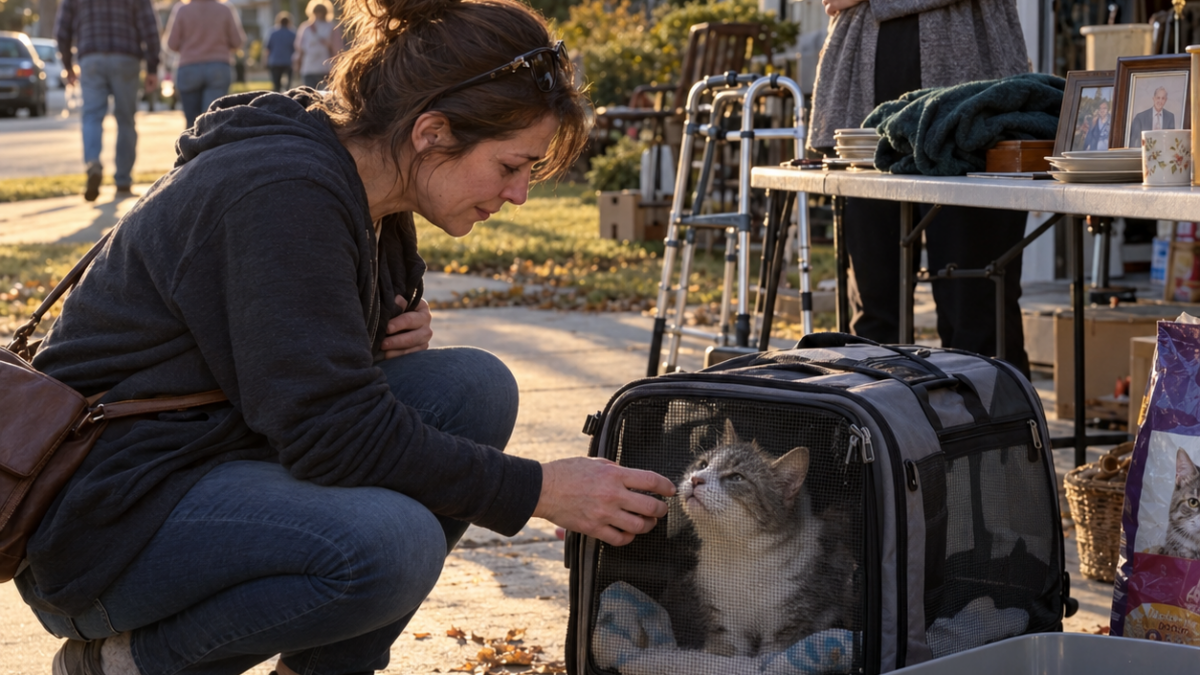
The carrier sat in the shade of the table, but the afternoon had warmed. Inside, a gray tabby lay curled on an old towel. His fur was faded around the face, silver and brown mixed together. One ear had a tiny notch. His body looked thin in the way very old cats do, as if time had slowly lifted pieces from him while leaving his dignity intact.
His eyes were open.
Yellow-green.
Cloudy at the edges.
He looked at me.
Not hopefully.
Not dramatically.
Just looked.
I crouched.
“Hey, Walter.”
At the sound of his name, one paw shifted.
Slowly, as if every movement had to be negotiated with old bones, he lifted his head. He blinked once, then pressed his nose against the metal door.
That small gesture hit me harder than it should have.
Behind me, Melissa said, “He’s friendly.”
I looked up.
She was holding a half-empty roll of price stickers in one hand.
“He doesn’t look like trouble,” I said.
“He isn’t.” Her voice changed. “He’s just old.”
There are sentences that carry more grief than their words.
That was one.
I looked back at the sign.
“Seventeen?”
“Seventeen and three months, according to Mom. She celebrated his birthday every March with tuna and a candle he hated.”
Despite myself, I smiled.
Melissa did too, but hers broke quickly.
“He was hers his whole life,” she said. “She found him under the porch when he was tiny. Bottle-fed him. Slept with him every night. Talked to him like he was a rude little roommate.”
Walter’s nose remained pressed to the metal.
“What happened?”
“My mother died three weeks ago.”
“I’m sorry.”
“Thank you.”
She folded the price stickers around her finger, then unfolded them.
“She had a stroke in her sleep. Fast. That’s what everyone keeps telling me like fast makes it less of a hole.”
I did not know what to say.
There are no good sentences for a stranger’s mother dying.
So I stayed quiet.
Melissa looked at Walter.
“He stayed on her bed for days after. Wouldn’t leave the pillow. Wouldn’t eat unless I carried the bowl upstairs. The funeral home took her, and he kept waiting in the same spot.”
Her voice tightened.
“I tried to keep him. I really did. I have two dogs. Big dogs. Not bad dogs, but loud. He was terrified. He stopped eating again. Hid behind the washing machine. My husband is allergic, my kids are scared to touch him because he looks so fragile, and I—”
She stopped.
Swallowed.
“I can’t send him to a shelter. I called one, and they were kind, but he’s seventeen. I know what that means. I just thought maybe someone…”
She did not finish.
She did not need to.
Maybe someone would care enough to take him.
That was what the sign meant.
Not free.
Not even needs a home.
The real sign said:
Please let this last piece of my mother’s life matter to someone.
I looked at Walter.
He looked back.
I had never owned a cat.
Not as an adult.
My ex-wife had wanted a dog once, but we had never managed to agree on timing, breed, responsibility, or anything else by then. Growing up, my family had one orange barn cat that came and went as he pleased and accepted food as tribute but affection only during thunderstorms.
I did not know anything about senior cats.
I did not know what Walter ate, what his vet bills might look like, whether my rental allowed pets, whether I could manage medication if he needed it, whether he would hide for months, whether I was the right person for a fragile animal near the end of his life.
But I knew this.
He had spent the day watching strangers decide he was too old to choose.
And I could not be one more person who walked away after reading the sign.
“When does the sale end?” I asked.
Melissa looked toward the tables.
“Now, basically. I have to clear everything by tonight. The realtor’s coming Monday.”
“What happens to him if no one takes him?”
Her face changed.
She looked away.
“I don’t know.”
That was an honest answer.
It frightened both of us.
Walter made a tiny sound then.
Not a full meow.
More like a rough question from a throat that had not used hope much that day.
I placed my fingers through the carrier door.
He sniffed them.
Then, carefully, he rubbed his cheek against one knuckle.
I closed my eyes.
That was it.
That was the moment.
Not lightning.
Not destiny.
Just an old cat’s cheek against my finger and the quiet shame of realizing I had almost driven away.
“I’ll take him,” I said.
Melissa stared at me.
“What?”
“I’ll take Walter.”
Her mouth opened slightly.
“You don’t have to say that because you feel bad.”
“I know.”
“He’s old.”
“I see that.”
“He may not have a lot of time.”
“Then he shouldn’t spend it in a carrier at a garage sale.”
Her hand went to her mouth.
For a second, I thought she might argue.
Instead, she turned away and pressed her fist to her lips, trying not to cry in front of a stranger.
I stood awkwardly because men like me are useless around sudden tears unless given a practical task.
“What does he need?” I asked.
That helped.
Melissa wiped her eyes quickly.
“Everything. I have his food, litter box, blanket, vet records, his brush, his dishes. He eats wet food mostly. He’s missing some teeth. He gets a supplement in the morning. He likes the blanket because it smells like Mom.”
“Okay.”
“He hates car rides.”
“Noted.”
“He likes windows. He doesn’t jump high anymore, so Mom had little steps by the bed.”
“I can make steps.”
Of all the things I said that afternoon, that was the one that made Melissa cry for real.
“I’m sorry,” she said, turning away. “I’m sorry. It’s just—she would have liked that.”
Then she went inside.
I stayed crouched beside Walter.
“Well,” I said quietly, “I came for tools.”
Walter blinked.
“Apparently I needed them for you.”
Melissa returned with boxes.
So many boxes.
A half bag of food.
Cans of senior cat wet food.
A low-sided litter box.
Two ceramic bowls.
A bottle of joint supplement.
Vet records in a folder labeled Walter in careful handwriting that must have belonged to her mother.
A brush.
A small towel.
A fleece blanket, faded green, covered in gray hair.
A toy mouse with one ear missing.
And the framed photograph I had noticed earlier.
The silver-haired woman holding Walter as a kitten.
Melissa held it for a long moment before giving it to me.
“This was Mom’s favorite picture of him.”
“I can send you updates,” I said.
The offer came before I thought about whether it was strange.
Her eyes filled again.
“Would you?”
“Of course.”
She nodded, then looked embarrassed by her own relief.
“Her name was Elaine. My mom.”
I took the frame carefully.
“Elaine.”
“She used to say Walter was the only man who never disappointed her.”
I smiled.
“High bar.”
“She had standards.”
Melissa knelt by the carrier.
Walter watched her.
“Oh, old man,” she whispered.
He pressed his nose to the door again.
“I’m sorry I couldn’t be your next person.”
Her voice broke on the last word.
I looked away because that felt private.
She reached through the door and touched his forehead.
“He’s a good cat,” she said to me. “He’s grumpy sometimes. He’ll yell if he wants something. He may act like he doesn’t need you, but he does.”
“Sounds familiar,” I said.
She gave a weak laugh.
Then helped me load everything into my truck.
Before I put the carrier inside, she touched the top of it with both hands.
“My mother would have been relieved,” she said.
Not happy.
Relieved.
There is a difference when the person you love has died and left someone helpless behind.
“I’ll take care of him,” I said.
I meant it more seriously than I had meant almost anything in a long time.
On the drive home, Walter complained twice.
Not loudly.
Just two cracked, indignant meows from the passenger seat.
“I agree,” I told him. “This is poor planning.”
He was silent for another mile.
“I don’t have a cat tree. Or whatever cats use.”
Silence.
“I do have a couch.”
Nothing.
“And tuna, maybe.”
At that, he meowed.
“Oh, so you understand English selectively.”
He turned his face away from me inside the carrier.
I laughed.
A real laugh.
That surprised me.
The house I rented sat on a quiet street with old maples and uneven sidewalks. It had one bedroom, a small living room, a kitchen with yellow cabinets, and the kind of back steps that had started this whole day. I had lived there eight months, long enough to receive mail, not long enough for it to feel like a life.
When I carried Walter inside, the house suddenly felt unprepared in a way I had not expected.
Like bringing home an old soul revealed how empty the rooms were.
I set him up in the bedroom first because the internet, which I checked frantically in the driveway before going in, said old cats should start in one quiet room. I put his litter box in the corner, food and water away from it, blanket on the floor beside the bed, carrier door open.
Then I sat down and waited.
Walter did not come out.
For thirty minutes, nothing happened.
I lay on the floor so he could see me.
“Take your time,” I said.
He stared from the back of the carrier.
His pupils were wide.
His body remained tucked low.
I wondered if I had made a terrible mistake.
Not because I regretted taking him.
Because love, even new love, immediately opens the door to fear.
What if he stopped eating here too?
What if he died in a stranger’s house?
What if I had taken him from the smell of his old home only to fail him differently?
The vet records said Elaine had used Maple Street Animal Clinic. I called them from the bedroom floor.
A receptionist named Carla answered.
When I said Walter’s name, her voice softened.
“Elaine’s Walter?”
“Yes.”
A pause.
“Oh. We heard Elaine passed.”
“I adopted him today. From her daughter.”
Another pause.
Then, gently, “Thank you for taking him.”
“I don’t really know what I’m doing.”
“That puts you ahead of some people who think they do.”
I almost laughed.
She scheduled him for Monday morning and told me what to watch for: not eating, not drinking, hiding too long, labored breathing, vomiting, weakness. She explained that transitions were hard on senior cats. She told me to keep his routine as close as possible and not force affection.
“He lost his person,” she said. “Give him time to understand you are not replacing her. You’re just staying.”
That sentence stayed with me.
You are not replacing her.
You’re just staying.
Around dusk, Walter stepped out of the carrier.
One paw.
Then another.
Slowly, stiffly, with all the ceremony of an elderly man entering a room where the chairs are suspicious.
He sniffed the blanket.
The bowls.
The leg of my bed.
Then he walked to the framed photograph of Elaine, which I had set on the dresser, and stared up at it.
I do not know whether cats understand photographs.
I know what I saw.
Walter sat beneath that dresser and looked up at Elaine’s face for almost a full minute.
Then he made that rough little sound again.
It broke me in a quiet place.
“I know,” I said.
He turned to look at me.
“I miss people too.”
He approached the food bowl and took three bites.
Three.
I texted Melissa immediately.
He ate a little.
She replied within seconds.
Thank God.
Then:
Can I tell you something weird?
Sure.
I’ve been holding my breath all day.
I looked at Walter, who had returned to the blanket and lowered himself carefully onto it.
Me too, I typed.
That first night, I did not sleep much.
Walter hid under the bed for two hours, then came out and yelled at 1:13 a.m. like a tiny ghost with a complaint. I turned on the lamp. He stood in the middle of the room, looking offended by time, death, relocation, and possibly my bedding.
“What?”
He yelled again.
I offered food.
No.
Water.
No.
Blanket adjustment.
No.
I finally sat on the floor.
He walked over slowly, sniffed my knee, and leaned against it.
Just once.
Then he went back to bed.
Apparently the emergency had been loneliness.
I understood that one too well.
Monday morning, I took him to the vet.
Walter hated the car with the full strength of a seventeen-year-old cat who had seen enough and did not appreciate new chapters. He complained in a raspy voice the whole way while I apologized at red lights.
At the clinic, every person seemed to know him.
“Walter!” Carla said from the desk.
His ears went back.
“I know,” she said. “You hate us. We missed you too.”
Dr. Singh came in wearing purple scrubs and the expression of a man who had delivered both terrible news and tiny miracles in the same room too many times to be careless with either.
He examined Walter gently.
“Still handsome,” he said.
Walter looked unconvinced.
Dr. Singh reviewed his records with me.
Early kidney disease.
Arthritis.
Mild dental issues.
Weight loss since Elaine’s death.
Nothing unexpected.
Nothing easy.
“He’s very old,” Dr. Singh said.
“I know.”
“That doesn’t mean he’s done.”
I held onto that.
We made a plan.
Senior food.
Hydration.
A small dose for arthritis pain.
A heating pad made for pets.
Steps to the couch and bed.
Watch appetite closely.
No aggressive treatment unless it would truly give comfort.
“Quality of life matters most now,” Dr. Singh said.
I nodded.
The phrase frightened me.
Quality of life sounded like a door at the end of a hallway.
But Walter, from the exam table, headbutted my wrist with surprising force.
Dr. Singh smiled.
“He has opinions.”
“So I’m learning.”
At the front desk, Carla updated his file.
“Owner name?”
I hesitated.
The word felt too big.
Too soon.
Then Walter meowed from inside the carrier, impatient and ancient and alive.
“Daniel Turner,” I said.
Carla typed it in.
Something shifted inside me.
Not ownership.
Responsibility.
On the way home, I stopped at a pet store and bought things I had never expected to buy on purpose.
A soft bed.
Low bowls.
A scratching pad.
Senior cat treats.
A ramp that cost too much.
Two toys Walter would later ignore completely.
At checkout, the cashier asked, “New kitten?”
I looked at the pile of elderly-cat accommodations in front of her.
“Very old kitten.”
She laughed.
I did too.
When we got home, Walter inspected every item with grave disappointment and chose the cardboard box the ramp came in.
That was when I sent Melissa the first picture.
Walter sitting in the box, glaring.
Her reply came a minute later.
Mom would be laughing so hard.
Then:
Thank you.
I looked at the message for a long time.
“You hear that?” I said to Walter. “We’re doing okay.”
He began washing one paw.
Clearly, he had never doubted himself.
The days that followed were small and strangely full.
I learned Walter liked his wet food warmed for seven seconds, not eight.
I learned he preferred water from a wide ceramic bowl but would still attempt to drink from my glass if I became careless.
I learned his arthritis was worse in the mornings, so I placed rugs on the hardwood to help him walk without slipping.
I learned he liked the couch best if Elaine’s blanket was on it, but he liked my lap only if I had a book open and absolutely needed to move soon.
I learned he snored.
Softly.
Like a tiny engine deciding whether to start.
I learned he could still jump onto the couch if sufficiently motivated by roast chicken, though I tried to discourage it because his hips were not as ambitious as his spirit.
Every night, before bed, I placed Elaine’s photograph on the nightstand.
Not because I thought Walter needed it.
Maybe because I did.
Her face reminded me that I was not the beginning of his story.
That mattered.
When you adopt an elderly animal, especially one loved well before you, you do not become the hero of the whole book. You become the person trusted with the final chapters.
That is a different kind of honor.
Melissa and I began texting almost daily.
At first, just updates.
He ate half a can.
He used the litter box.
He yelled at the microwave.
He slept in the box again instead of the expensive bed because he is apparently a financial critic.
Then stories came.
Melissa told me Elaine had been a school librarian for thirty-four years. That she had read mysteries, hated cilantro, loved cardinals, and believed every house needed at least one animal who looked unimpressed. Walter had been her companion after her husband died. He sat on the bathroom mat while she brushed her teeth. He slept on the left side of the bed because her husband used to sleep on the right and she could not bear to disturb that space.
I told Melissa about my divorce.
Not everything.
Enough.
How the house had grown too quiet afterward. How I had stopped cooking real meals because leftovers for one felt accusatory. How I had gone to the garage sale because I needed tools, but maybe also because wandering through other people’s discarded objects felt less lonely than sitting in my own half-furnished living room.
She replied:
Maybe Walter needed someone who understood empty rooms.
I looked at him curled on my couch beneath Elaine’s blanket.
Maybe.
After two weeks, Walter began meeting me at the door.
Slowly.
Not every time.
Sometimes I came home and found him still asleep, one eye opening just enough to confirm I was not food. But sometimes he was there in the hallway, thin tail lifted halfway, raspy voice scolding me for leaving the house as if bills and employment were personal betrayals.
The first time it happened, I stood frozen with my keys in my hand.
“Well,” I said, “hello to you too.”
He yelled.
I crouched, and he pressed his forehead against my knee.
That became our greeting.
I did not realize how badly I had needed something to come toward me when I opened the door.
It is embarrassing, maybe, to admit that a seventeen-year-old cat changed the weight of my evenings.
But he did.
Before Walter, I came home to silence and called it peace because peace sounded healthier than loneliness.
After Walter, I came home to complaints.
To medication schedules.
To food bowls.
To the small responsibility of keeping another living thing warm.
I started cooking again because roast chicken made sense if I could share one plain bite with him.
I fixed the back steps because Walter liked sitting near the screen door in the afternoon, and I did not want anything unsafe beneath him.
The tools I bought at Elaine’s estate sale ended up building his ramp first.
Not the steps.
His ramp.
An ugly little plywood thing covered with carpet scraps, leading from the floor to the couch. I measured wrong twice, swore once, and spent an entire Sunday making something that looked like it had been designed by a committee of raccoons.
Walter used it once.
Then ignored it for three days.
Then, at 2 a.m. on Thursday, I woke to the sound of slow claws on carpet and watched him walk up the ramp like he had invented it.
He settled beside me on the couch, tucked his paws under his chest, and purred.
I texted Melissa a picture in the morning.
Ramp accepted.
She replied:
Mom would say he was waiting until you stopped looking.
That sounded exactly right.
One month after I brought him home, Melissa asked if she could visit.
She wrote the message carefully.
No pressure. I don’t want to confuse him. I just miss him.
I understood.
Missing is not always a request.
Sometimes it is simply a fact looking for a safe place to stand.
I told her she could come Saturday.
I cleaned the house like a nervous man expecting judgment from a cat’s extended family. I vacuumed. Hid laundry. Bought decent coffee. Put Elaine’s photograph on the shelf near Walter’s favorite couch spot.
When Melissa arrived, she stood on the porch holding a paper bag.
“I brought his old brush,” she said. “Found it in Mom’s bathroom drawer.”
Her voice trembled.
Inside, Walter was asleep on the couch.
Melissa stopped when she saw him.
He looked smaller than grief, older than memory, and very much alive.
“Oh, Walter,” she whispered.
His ears moved.
He opened his eyes.
For a moment, nobody breathed.
Then he lifted his head and gave one rough meow.
Melissa covered her mouth.
I stepped back, giving them space.
She sat beside the couch, not reaching too quickly.
“Hi, old man.”
Walter sniffed her fingers.
Then pressed his face into her palm.
She cried silently.
He did not climb into her lap. He did not perform recognition the way humans want animals to perform it. But he stayed. He let her brush him with Elaine’s old brush. He purred, low and uneven, while she told him he looked good and apologized for the dogs and said her mother would be so happy.
I stood in the kitchen pretending to make coffee that did not need ten minutes of attention.
When Melissa left, she hugged me.
A sudden, fierce hug.
“Thank you for not making me feel worse,” she said.
I thought about that.
“You were trying to save him from the shelter.”
“I still gave him away at a garage sale.”
“You asked someone to choose him.”
Her eyes filled.
“And you did.”
“Yes.”
We stood on the porch a moment, both looking toward the living room window where Walter had already gone back to sleep.
“Do you ever feel like you took on too much?” she asked.
I answered honestly.
“Sometimes.”
Her face fell.
“But not too much of him,” I said. “Too much fear that I won’t do it right.”
She nodded.
“I think that means you care.”
Maybe it did.
Winter came early that year.
Cold rain first, then frost, then a thin snow that made the neighborhood look kinder than it was. Walter loved the heating pad. He loved it with a devotion I found almost religious. I placed it under one side of his blanket so he could move away if he got too warm. He did not move away. He melted into it like butter and looked personally offended whenever I checked the temperature.
His health had good days and bad days.
Good days meant he ate well, yelled loudly, and followed sunbeams from room to room.
Bad days meant he slept more, moved stiffly, and looked at food as if it had disappointed him politically.
Dr. Singh adjusted medication.
I learned to give subcutaneous fluids, which sounded impossible until love made it routine. The first time, my hands shook so badly that Walter looked up at me with visible disgust.
“I know,” I said. “I’m embarrassing us both.”
He tolerated it.
Barely.
I sent Melissa updates, but not every hard detail. Some parts of caregiving are too tender to turn into messages unless necessary. Still, I told her when he had a bad week. She came over with soup for me and sat with Walter while I took a shower long enough to feel human again.
That was something I had not expected.
Walter brought more than himself into my life.
He brought Melissa.
Not romantically.
People always want that twist.
No.
He brought friendship, the kind built from shared responsibility and grief that did not need explaining. Melissa and I became two people connected by an old cat and a dead woman’s love. Sometimes she told stories about Elaine. Sometimes I told stories about my father. Sometimes we sat in the living room while Walter slept and said nothing at all.
Silence is different when someone else is holding it with you.
On Christmas Eve, Melissa brought a small ornament.
A photograph of Elaine and Walter.
The same picture as the frame, copied smaller and sealed behind glass.
“I made one for you,” she said.
I hung it on the tree I had bought impulsively after deciding Walter deserved lights to judge.
He sat beneath it, unimpressed.
“You’re welcome,” I told him.
That night, I sat on the couch with Walter asleep against my leg, the tree glowing in the corner, and realized my house no longer felt like a place I was waiting to leave.
It felt inhabited.
Not full.
Not fixed.
Inhabited.
There is a difference.
In January, Walter scared me.
He stopped eating for a full day.
Not even warmed food.
Not even tuna.
Not even roast chicken.
He hid under the bed, eyes dull, body tight. I called Dr. Singh, then Melissa. We went to the clinic together, both of us quiet in the waiting room while Walter sat in his carrier looking smaller than usual.
His kidney values had worsened.
Not catastrophically.
But enough.
Dr. Singh spoke gently about comfort, monitoring, options, and the truth that old age is not a problem medicine can solve forever.
I nodded like I understood.
I did understand.
I hated it.
That night, I lay on the floor beside Walter the way I had on his first night with me.
“You don’t have to stay for me,” I whispered.
The sentence hurt coming out.
“But if you want more time, I’ll help you have it.”
He blinked slowly.
Then, with visible effort, stretched one paw out and rested it against my sleeve.
He ate breakfast the next morning.
Half a portion.
I cried into the sink where he could not see.
After that, I stopped measuring his life in months.
I measured it in comforts.
Did he eat?
Did he purr?
Did he seek sun?
Did he still yell when I was late?
Did he enjoy the brush?
Did his body relax when I touched him?
Did he look more tired than content, or more content than tired?
This is the math of loving something old.
It is brutal.
It is sacred.
It forces honesty because comfort cannot be faked for long.
Spring arrived in slow pieces.
Wet sidewalks.
Soft air.
Birds outside the window making Walter’s tail twitch with memories of violence his body could no longer carry out.
On the first warm day, I opened the back door and let him sit near the screen. The steps were repaired by then, solid and level. The yard beyond was nothing special—patchy grass, fence, a stubborn dandelion, one leaning birdbath left by the previous tenant.
Walter sniffed the air.
Closed his eyes.
For a moment, he looked almost young.
I took a picture and sent it to Melissa.
She replied:
Mom used to say he looked like a king inspecting land he refused to pay taxes on.
I laughed so hard Walter opened one eye in annoyance.
By then, almost six months had passed since the garage sale.
Six months no one had expected him to have, maybe.
Six months of warm blankets, soft food, vet visits, bad ramps, good sun, and tiny stubborn routines.
I still had Elaine’s photograph on the shelf.
Sometimes people who came over asked if she was my grandmother.
I said, “No. She was Walter’s first person.”
Most people smiled politely, unsure what to do with that answer.
That was fine.
Not everything needs to be explained to everyone.
One afternoon in May, I drove past the old neighborhood where the garage sale had been. I had no reason to. I told myself I was avoiding traffic. Maybe I was. Maybe I wanted to see the house.
It had sold.
The lawn was trimmed. The curtains were different. A child’s bicycle lay near the porch. No tables. No dishes. No cardboard sign. No carrier.
A life cleared out.
Another moved in.
For a moment, I sat parked across the street and thought about how close Walter had come to disappearing into the aftermath. How easy it would have been for the carrier to be loaded into a car and driven somewhere final. How many people had read the sign and decided not me.
I had been one of them at first.
I had walked past.
That truth keeps me humble.
I did not choose Walter immediately because I was better than everyone else.
I chose him because I came back.
Sometimes that is all goodness is.
Not never failing to notice.
Not never being selfish or afraid or unsure.
Just turning around before it is too late.
That evening, when I got home, Walter was waiting in the hallway.
Very annoyed.
Very alive.
I crouched.
“I came back,” I told him.
He pressed his forehead to mine.
“I know,” I whispered. “I’m learning.”
People sometimes ask why I took in a seventeen-year-old cat when I knew the ending would hurt.
I never know how to answer briefly.
The practical answer is that he needed a home.
The emotional answer is that I did too.
The honest answer is that endings hurt whether we choose love or not. Avoiding love does not spare you grief. It only makes sure grief has nothing warm to remember.
Walter did not need twenty more years from me.
He needed safety now.
Food now.
A couch now.
A hand now.
A person willing to say, however much time is left, you will not spend it unwanted.
That is not a small thing.
For animals.
For people.
For anyone.
I still have the tools from that garage sale. The hammer hangs in my shed. The level sits on a shelf. The socket set is still missing two pieces. I used them to fix the back steps, build Walter’s ramp, tighten the loose hinge on the front door, and repair a little wooden box Melissa found in Elaine’s closet.
Inside that box now are Walter’s vet records, Elaine’s note about his birthday, the ornament with their photograph, and the cardboard sign from the sale.
Melissa saved it.
She gave it to me later, folded carefully.
Free. 17-year-old cat. Owner passed away. Needs a home.
I do not like the word free on it.
Walter was never free.
He came with a whole life attached.
A woman’s love.
A daughter’s grief.
A bed where he waited for someone who would not return.
A blanket that smelled like home.
A toy mouse with one ear.
Medication.
Vet bills.
Fear.
Trust.
Time.
He was not free.
He was priceless in the inconvenient way that living things are priceless. They cost effort. They cost sleep. They cost money. They cost tears you think you have already used up. They cost the comfortable illusion that your life belongs only to you.
And then they give you back a reason to open the door gently.
Walter is asleep on my couch now as I write this.
Wrapped in Elaine’s green blanket.
The same one Melissa handed me with shaking hands on a driveway full of folding tables and grief.
His body is slower than it was even a few months ago. His face is thinner. His purr is softer. Sometimes he wakes confused and calls out until I answer. Sometimes he walks into a room and forgets why, which makes two of us more often than I care to admit.
But he is warm.
He has eaten.
His medicine is done.
His water bowl is full.
Elaine’s photograph sits where he can ignore it with dignity.
And he no longer has to wait for someone to choose him.
I do not know how much time we have.
That used to terrify me so badly I tried not to think about it.
Now I think of time differently.
Walter’s whole life before me was not erased because I came at the end. I am not the main character in his story. Elaine was his first home. Her bed was his country. Her voice was the sound that shaped his days. I do not compete with that.
I honor it by keeping him safe now.
That is all love can ever do with what came before.
Care for what remains.
Sometimes, when he is sleeping deeply, I touch the worn edge of his blanket and imagine Elaine as she was in that photograph, smiling with a gray tabby kitten in her arms, not knowing that seventeen years later a stranger would carry the same cat into a little rental house and promise to stay.
I hope she would be relieved.
Melissa says she would.
I hold onto that.
Because the truth is, I did not just bring home an old cat from a garage sale.
I brought home proof that a life does not stop mattering when its first witness is gone.
I brought home the last warm thread of a woman named Elaine, who loved a kitten into old age and left behind a daughter brave enough to ask strangers for mercy instead of surrendering him quietly.
I brought home responsibility at a time when I had mistaken emptiness for peace.
I brought home an old, fragile, opinionated soul who taught me that love near the end is still love, maybe even more urgently.
And I think about all the people who walked by Walter that day.
I do not hate them.
They were afraid of the cost.
The grief.
The inconvenience.
The shortness of the road.
I understand.
I almost kept walking too.
But I turned around.
That one choice changed the shape of my house.
It changed my evenings.
It changed the way I understand rescue.
Rescue is not always dramatic. It is not always pulling something from a fire or arriving just in time. Sometimes rescue is reading a cardboard sign, crouching beside a carrier, and letting an old cat press his nose against the door while the rest of the sale is packed away.
Sometimes rescue is saying yes to a life that will break your heart sooner than you want.
Sometimes rescue is realizing that “not much time left” is exactly why someone should be loved carefully, not passed over.
Walter is dreaming now.
His paws twitch beneath the blanket.
Maybe he is young in the dream.
Maybe Elaine is calling him from a room full of sunlight.
Maybe he is chasing the toy mouse that lost its ear before I ever knew him.
I hope so.
When he wakes, I will warm his food for seven seconds.
I will give him his medicine.
I will complain when he tries to drink from my glass.
I will sit on the couch with a book I may not read because he has decided my lap is needed.
I will be here.
For however long he has.
That is the promise I made without fully understanding it on the day I went looking for tools and found Walter.
A seventeen-year-old cat.
A dead woman’s companion.
A daughter’s last worry.
The last piece of someone else’s life.
And somehow, impossibly, the beginning of a new part of mine.








