I Went Back Into a Burning Building for a Screaming Cat—Eighteen Seconds Later, the Walls Came Down
PART3:
Monk came up from below, eyes wide behind his facepiece.
“What the hell are you doing?”
“There’s something alive in that wall.”
“The building is coming down.”
“I know.”
“That means leave.”
I knew the protocol.
Of course I knew it.
No animal life is worth a firefighter’s life. That is what the manuals say, and the manuals are written in blood for a reason. We do not ignore collapse warnings. We do not go cowboy. We do not turn emotion into another casualty.
I knew all of that.
I still heard the screaming.
I still saw the residents outside, safe because someone had gone in for them when there was still time.
And I thought, There is still one living thing in here that knows no one is coming.
Alvarez stepped in front of me.
“Evan, I swear to God.”
Behind him, flames rolled across the ceiling farther down the hallway. The plaster was beginning to blister and sag. The heat at head level was savage, pressing down even through the gear. We were low, breathing through masks, every second spending air and luck.
“Move,” I said.
“No.”
The cat screamed again.
I do not know how to explain what that sound did to me.
It was not reasonable.
It was not tactical.
It reached something older than reason.
Something human before training, before rank, before policy.
A creature was trapped in a wall and begging the world not to leave.
I keyed my radio.
“There’s something alive in this wall, and I’m not leaving it there.”
Captain Reeves shouted my name through the radio.
I pulled free from Alvarez and went back in.
The hallway was worse than it had been seconds earlier.
Fire changes fast. People think eighteen seconds is nothing until they see what fire can do in eighteen seconds. A room can flash. A stairwell can disappear. A ceiling can come down. A doorway can become a furnace. An exit can vanish in the time it takes to take three bad breaths.
I dropped lower, beneath the thermal layer, where the air was still barely survivable through my gear. The floor was wet and gritty under my gloves. Water from the hose line ran black with soot along the boards. Steam crawled over the walls. My mask fogged at the edges. The heads-up display inside my facepiece blinked my remaining air.
The scream came again.
Closer now.
I followed it.
The wall between two apartments was bulging from heat. Old plaster, wood lath underneath, probably a narrow void where pipes or wiring ran. The cat was somewhere inside it. How she got there, we never knew for certain. Maybe she had hidden in the wall during renovations and gotten trapped. Maybe there was a break behind a cabinet. Maybe fire and smoke drove her into a space she could not escape.
All I knew was that she was there.
I slammed my boot into the plaster.
Once.
Twice.
The wall cracked but did not open enough.
The cat screamed again, weaker this time.
“Hold on,” I shouted, as if she could understand.
I drove my boot in harder.
The plaster gave.
Smoke pushed out of the opening.
I punched through with my gloved hand, tearing away hot lath and chunks of wall. Heat rolled against my wrist. I could barely see. I reached in blind.
Nothing.
I shifted lower.
My glove brushed something soft.
Fur.
The cat shrieked when I touched her, not in anger but in terror and pain.
“I’ve got you,” I said.
I worked my hand around her carefully. She was wedged in a narrow pocket inside the wall, body twisted, claws dug into wood. Even through my gloves, I could feel how hot she was. Her fur felt singed. Her body trembled violently.
I pulled gently at first.
She would not come free.
A crash sounded above me.
Not nearby.
Too nearby.
My radio erupted.
“Hale, get out now! Get out now!”
I pulled again, firmer, using my other hand to break away more plaster.
The cat came loose all at once.
A small gray body, coated in soot, fur burned at the edges, eyes swollen shut from smoke.
She was still screaming.
Still alive.
I had no carrier.
No bag.
No safe way to hold a terrified, injured cat while crawling through fire.
So I did the only thing I could think of.
I took off my helmet.
Every firefighter knows how wrong that feels inside a burning structure. Your helmet is part of you. It is protection from falling debris, heat, impact, everything raining down inside a failing building. Taking it off in that hallway felt like removing part of my own skull.
But the cat needed a basket.
I placed her inside the helmet.
She was so small she fit curled against the inner liner, shaking and panting. I pressed the helmet against my chest with both arms, bent over it as much as I could, and ran.
Not a clean run.
A firefighter’s run through smoke and debris is ugly. I stumbled. Hit the wall. Caught myself with one shoulder because both hands held the helmet. My knees slammed into the floor once when something gave under my boot. The hallway flashed orange to my right. A sheet of burning material fell behind me. Someone was shouting my name, maybe in my radio, maybe at the door, maybe both.
I saw the front entrance through smoke and light.
A rectangle of night.
Rain.
Flashing red.
Figures moving.
Alvarez appeared at the threshold, reaching for me.
“Move! Move!”
I crossed the doorway with the helmet locked against my chest.
Hands grabbed my coat.
Alvarez and Monk pulled me forward so hard I almost fell onto the sidewalk.
“Back! Back!” someone yelled.
I staggered into the street.
The cat was still in the helmet.
I had barely turned when the second-floor windows exploded outward.
Glass burst into the night.
The roof folded inward with a deep, final roar.
Then the front wall leaned.
For one terrible second, it seemed to pause there, a whole building deciding whether to remain a building.
Then it came down.
Brick, wood, fire, dust, sparks, and smoke collapsed into the street with a force that punched the air from everyone watching.
I stood there frozen, helmet in my arms, while the place I had just left became rubble.
Eighteen seconds.
That was what the body camera showed later.
Eighteen seconds between my boots hitting the sidewalk and the building giving up completely.
Not twenty.
Not thirty.
Eighteen.
I did not know the number then.
All I knew was that my captain was in front of me, furious and pale, shouting words I could not fully process because my ears were ringing and the cat in my helmet had gone quiet.
That silence scared me more than the collapse.
I looked down.
The cat was conscious.
Barely.
Her mouth was open. She was panting. Her fur was wet with steam and soot. The edges of her ears were singed. Her eyes were swollen shut, lashes clumped from smoke and ash. She looked less like an animal than a tiny burned piece of the building that had somehow still held life.
“She’s alive,” I said.
No one answered at first.
Then Alvarez swore under his breath, and I realized his hand was shaking where it gripped my sleeve.
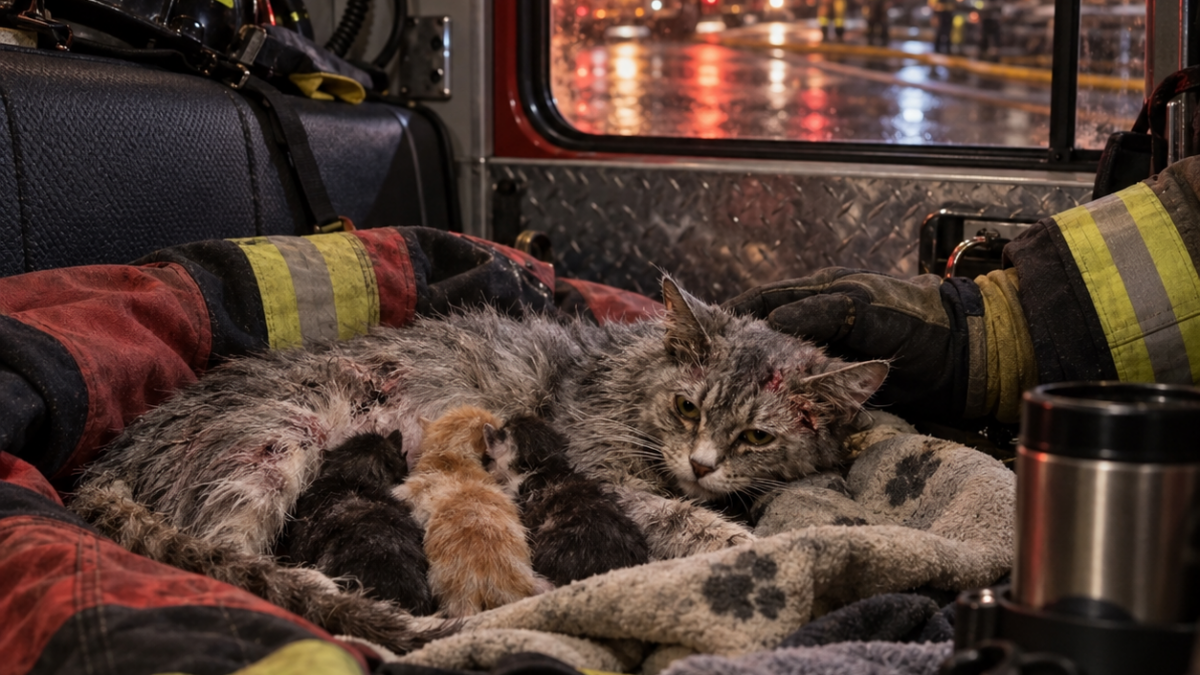
We moved her into the fire truck.
The inside of an engine is not a delivery room. It is not an animal clinic. It is cramped, bright, full of gear, radios, medical bags, water bottles, gloves, spare hoods, and the smell of smoke that follows firefighters everywhere. But compared to the building, it was heaven.
White overhead lights.
Warmth.
Air.
I placed the helmet carefully on the bench seat and opened my coat around it.
The cat lifted her head once, then dropped it.
“Get the oxygen,” I said.
Monk brought a small animal oxygen mask from the kit. We kept them because someone in the department had pushed for it years ago after losing a family dog in a house fire. At the time, people joked about it. Nobody was joking now.
We placed the mask near her face.
She breathed.
Fast.
Shallow.
But she breathed.
That was when I noticed her belly.
At first, I thought it was swelling from injury.
Then it moved.
Not with breath.
With life.
I stared.
“No way,” Alvarez whispered.
The cat’s abdomen tightened.
Her body curled around itself.
Another contraction passed through her.
Before I became a firefighter, I had been a volunteer EMT in a rural county where help was always far away and people expected you to know how to handle whatever arrived. I had assisted with childbirth twice. Human childbirth. Messy, panicked, unforgettable. I had also grown up around barn cats, farm dogs, and enough animals to know when a body was getting ready to deliver whether the patient had two legs or four.
“She’s pregnant,” I said.
Captain Reeves stood in the open truck doorway, still breathing hard, soot streaked across one cheek.
“She’s what?”
“She’s in labor.”
For a second, nobody moved.
Then the whole crew seemed to understand at once that the night was not done with us.
We cleared space.
Someone spread a clean turnout coat across the bench seat. Someone else grabbed towels from the EMS bag. Monk found gloves. Alvarez called dispatch to request animal control and the nearest emergency vet contact. Captain Reeves stood in the doorway, jaw tight, watching the cat as if she had personally ruined every operational rule he had ever trusted.
The mother cat panted inside my helmet.
Then tried weakly to climb out.
I gently lifted her onto the turnout coat.
She was hot even through my gloves. Her gray fur was darkened with soot. Patches along her back and ears were singed. But beneath all that pain, her body was doing what bodies do when life refuses to wait for better circumstances.
“She’s crowning,” I said.
Alvarez stared at me.
“You know cat delivery now?”
“No,” I said. “But I know delivery.”
“That is not comforting.”
“Then hand me another towel.”
The first kitten was born on a firefighter’s coat in the back of Engine 7 while the building that had nearly become its grave burned behind us.
Tiny.
Wet.
Gray.
Silent for one awful second.
Then moving.
The mother twisted toward it, instinct cutting through smoke inhalation, burns, terror, and exhaustion. We helped clear the kitten’s face as gently as we could. The mother began licking weakly.
“Come on,” Monk whispered. “Come on, little guy.”
The kitten squeaked.
Every firefighter in that truck exhaled at once.
I do not know who cried first.
I only know it was not me.
Probably.
The second kitten came twelve minutes later.
Also gray.
Louder.
Angrier.
A fighter from the first breath.
The third arrived black as coal except for one pale toe. Alvarez saw that and laughed once, short and wet-eyed.
“Of course,” he said. “Little smoke detector.”
The fourth took longer.
Too long.
The mother was fading. Her contractions weakened. Her head dropped against the coat. I placed my hand beside her face and spoke softly, the way I had in the hallway, though I still did not know if she understood anything but tone.
“You got one more, mama. Come on. You got one more.”
Outside, crews kept working. Water hit flame. Radios crackled. The collapsed building steamed and groaned. People watched from behind the safety line, wrapped in blankets, unaware that inside the truck, another emergency was unfolding in miniature.
The fourth kitten finally came after forty minutes.
Gray.
Smallest of all.
For one brutal moment, I thought it was gone.
The mother did not lift her head.
The kitten did not move.
Monk took it carefully in a towel and rubbed it with two fingers, gentle but firm.
“Come on,” he said.
Alvarez leaned close.
“Breathe, kid.”
Captain Reeves, who had spent the last half hour saying almost nothing, removed his helmet and lowered his head.
The kitten twitched.
Then opened its tiny mouth and made a sound so small it barely qualified as sound.
Alive.
All four were alive.
The mother was alive.
Five lives, born or saved within an hour of a building falling into itself.
I sat back against the wall of the truck and realized my hands were shaking so badly I could barely flex them.
That was when the adrenaline began to leave.
That is always the dangerous part emotionally.
During the event, your body gives you what you need. Focus. Speed. Tunnel vision. Afterward, it returns the bill.
Mine arrived all at once.
The hallway.
The scream.
My captain yelling no.
The wall opening.
The helmet in my hands.
The collapse.
Eighteen seconds, though I still did not know the number.
I looked at the mother cat lying on the turnout coat with four newborns tucked against her belly. She was exhausted beyond anything I had seen in an animal. Her eyes were swollen shut. Her breathing was rough. Her ears were burned at the tips. But when one kitten squirmed away, she dragged her head toward it and pulled it close with her chin.
That was when I named her in my mind, though I would not say it out loud until later.
Eighteen.
The vet met us at the station just after dawn.
By then, the fire had been knocked down. The residents had been placed with relatives, shelters, or neighbors. The building was a black, steaming pile under winter rain. My gear smelled like smoke so deeply I felt it in my skin.
The mother cat and kittens rode to the emergency clinic in a warm crate wrapped in towels, and I followed in my own truck because I could not make myself go home.
The vet examined the mother first.
Moderate smoke inhalation.
Superficial burns along her back and ears.
Mild dehydration.
No deep burns.
No broken bones.
The kittens were full term, strong, and somehow untouched by the smoke. The vet explained that inside her body, protected by the uterus and amniotic fluid, they had been shielded from the worst of the heat and toxins long enough to survive.
Long enough.
That phrase became another one I could not shake.
Everything about that night had been long enough or almost not.
The residents got out in time.
The building held long enough.
I reached the wall fast enough.
She delivered after we got out.
Eighteen seconds.
The vet let me see them after the exam.
The mother lay in a clean, warm enclosure, eyes treated, fur carefully cleaned. Her kittens were tucked against her in a pile of tiny moving bodies. Three gray. One black. Their little mouths searched blindly. Their paws kneaded air.
The mother lifted her head when I spoke.
“Hey, mama.”
One swollen eye opened just a slit.
She could not see well yet, but she turned toward my voice.
The vet tech smiled.
“She knows you.”
I did not answer.
My throat did not trust itself.
For two days, everyone at the department called her Helmet Cat.
Then the body camera footage was reviewed for the report.
I was in Captain Reeves’s office when he paused the video.
There I was, coming out the front door with my helmet in my arms.
The timestamp ran in the corner.
Behind me, the windows blew.
Then the roof.
Then the wall.
Reeves watched silently.
He rewound.
Played it again.
Then again.
Finally, he said, “Eighteen seconds.”
I stared at the screen.
“That’s how long?”
“From your exit to collapse. Eighteen seconds.”
The number settled into the room.
I had known it was close.
I had felt the collapse at my back.
But seeing the number made my knees feel weak.
Eighteen seconds was not a story number.
It was not dramatic enough to seem invented.
It was specific.
Merciless.
Eighteen seconds was the difference between a rescue and five small bodies buried under brick.
Captain Reeves leaned back in his chair.
“You understand how bad this is on paper.”
“Yes, sir.”
“You disobeyed a direct order.”
“Yes, sir.”
“You re-entered a collapse-risk structure after evacuation.”
“Yes, sir.”
“You could have died.”
“I know.”
He looked at me for a long time.
His anger had burned down into something heavier.
Fear, maybe.
The kind commanders carry after almost losing one of their own.
“Don’t mistake the outcome for permission,” he said.
“I won’t.”
“You were lucky.”
“Yes, sir.”
He turned the monitor slightly toward me. On the frozen image, I was halfway through the door, bent over the helmet. A blur of motion. A firefighter doing something he should not have done and surviving because the math came out merciful by eighteen seconds.
Captain Reeves tapped the screen.
“What’s her name?”
I looked at the image.
“Eighteen.”
He nodded once.
“That tracks.”
The department’s official position remained complicated.
No one wanted to endorse what I had done.
No one wanted to condemn it too loudly either, not after seeing the kittens.
Firefighters are strange people. We live by rules because rules keep us alive. We also carry stories of impossible calls where someone broke the clean line between protocol and instinct and came back with a life in their hands.
Both things can be true.
I was reprimanded.
Quietly.
Formally.
Correctly.
Then Alvarez brought a bag of kitten formula to the station and pretended he had found it lying around.
Monk built a small wooden box for the foster setup and said he was only using scrap.
Captain Reeves asked for daily updates and claimed it was for documentation.
Nobody believed him.
For weeks, my crew gave me grief.
“You were stupid,” Alvarez said one morning while we checked gear.
“Yes.”
“Reckless.”
“Yes.”
“Selfish, too. You know what finding you in that rubble would have done to us?”
I stopped checking the nozzle.
“I know.”
His voice changed.
“Do you?”
I looked at him then.
Really looked.
Alvarez had been the one at the doorway. He had seen me go back. He had grabbed for me and missed. For eighteen seconds, maybe longer in his mind, he had believed he was watching a friend make himself impossible to save.
“I’m sorry,” I said.
He looked away.
“Yeah.”
Then, after a moment, “How are the kittens?”
That was how most of the arguments ended.
With anger unable to hold its shape around four newborn cats and a burned mother who had screamed through a wall until someone heard.
Eighteen went to a foster home first.
A good one.
A woman named Callie who had raised bottle babies, burn cases, feral mothers, orphaned litters, and cats that hated everyone except her. She took one look at Eighteen and said, “This girl has been through hell, but she has fight left.”
The kittens grew fast.
That is what kittens do.
They began as helpless little commas, all closed eyes and tiny mouths. Then ears unfolded. Eyes opened. Legs strengthened. Personalities appeared like weather.
The first gray kitten was calm and observant, always tucked against Eighteen’s front legs. I named him Ash.
The second gray kitten screamed about everything, including being warm, fed, or mildly inconvenienced. Monk named her Siren.
The third gray kitten climbed before walking properly. Alvarez named him Ladder, and no one was able to stop him.
The black kitten with one pale toe became Coal.
Every name was terrible.
Every name stayed.
Eighteen healed more slowly.
Her burns scabbed and peeled. The fur along her back grew in unevenly at first. The edges of her ears stayed slightly ragged. Her eyes cleared after treatment, though smoke left them irritated for weeks. She hated medication, tolerated Callie, and accepted my visits with a quiet intensity that made me feel both honored and judged.
I visited whenever I could.
After shifts.
Before shifts.
Once in dress uniform after a school safety event because I did not want to miss a day.
I told myself I was checking on the animals for closure.
That was a lie.
I was attached before the building hit the ground.
Eighteen did not become affectionate all at once. She was not a magical rescue cat who instantly forgot fire because a human held her. Her body remembered. Loud cracking sounds made her flatten. Smoke smell made her hide. Once, when Callie burned toast, Eighteen grabbed one kitten by the scruff and tried to move all four under a cabinet.
Healing was not a straight line.
It never is.
But she watched me.
Every time I entered the foster room, she lifted her head.
Every time I spoke, she blinked slowly.
After a month, she let me touch the unburned place between her shoulders.
After six weeks, she pressed her face against my hand.
After eight, she climbed into my lap, turned once, and lay down like she had finally finished deciding.
Callie stood in the doorway and smiled.
“Well,” she said. “That answers that.”
“What?”
“You’re adopting her.”
I looked down at Eighteen.
Four kittens were wrestling nearby with all the grace of drunken cotton balls. Coal bit Ladder’s tail. Siren yelled about an injustice nobody understood. Ash watched from a blanket, too dignified for nonsense until nonsense came within range.
“All of them,” I said.
Callie stared.
“Excuse me?”
“All five.”
She laughed because she thought I was overwhelmed and emotional.
Then she saw my face.
“Oh,” she said. “You mean it.”
I did.
My house had never been a cat house.
It became one quickly.
I bought beds they ignored, toys they destroyed, scratching posts they used selectively, and a cat tree so large the delivery man asked if I had ordered furniture for a raccoon family.
Eighteen chose my bed.
Not near it.
Not beside it.
On it.
Specifically on my side.
Sometimes on my fire jacket if I left it anywhere reachable.
I washed that jacket again and again, but turnout gear carries memory. Smoke gets into fibers. It hides in seams. Even after cleaning, there is a ghost of fire that never entirely leaves. Eighteen seemed to know. She would curl on it with her kittens tumbling around her, eyes half closed, as if sleeping on the thing that carried her out helped prove the fire was over.
The kittens became enormous.
That is not an exaggeration.
They grew into loud, shameless, beautiful chaos.
Ash became a quiet thief who stole socks and placed them in the hallway like offerings.
Siren remained convinced the world needed constant commentary.
Ladder climbed curtains, shelves, doorframes, and once my back when I bent over to tie my boots.
Coal became a lap cat with the density of a sandbag and the timing of an alarm clock.
They knocked things off counters.
Shredded furniture.
Invaded laundry baskets.
Chased each other at three in the morning like a herd of small horses.
Destroyed two houseplants and looked offended when the third was moved out of reach.
They were alive in that magnificent, exasperating way living creatures are when they were not supposed to survive.
Sometimes I would come home after a hard shift, exhausted, smelling faintly of smoke no matter how well I showered, and find Eighteen waiting in the hallway. She walked toward me with calm authority, her four impossible children orbiting around her like unruly planets.
I would kneel.
She would press her forehead to mine.
And for a moment, the worst parts of the job loosened their grip.
People asked why I named her Eighteen.
I told them the truth.
“That’s how many seconds we had.”
Some understood immediately.
Some asked if it was morbid.
Maybe it was.
But to me, Eighteen was not a name about almost dying.
It was a name about time.
About the kind of time people waste without noticing and the kind that contains entire lives.
Eighteen seconds can be nothing.
A red light.
A microwave countdown.
The time it takes to tie a boot.
The time it takes to check a phone.
The time it takes to hesitate.
That night, eighteen seconds was everything.
A mother.
Four kittens.
A helmet.
A doorway.
A building turning into dust.
People like clean morals from stories like this.
They want to say, Always go back.
Or never go back.
The truth is harder.
I do not tell young firefighters to do what I did. I do not stand in training rooms and pretend courage is the same thing as disobeying orders. My captain was right. My crew was right. The building was too dangerous. The call to go defensive was the right call.
And still, when I close my eyes, I hear her.
Through the fire.
Through the wall.
Through my mask.
Screaming.
Not because she understood collapse zones or operational modes or risk assessments.
Because she was alive.
Because she was trapped.
Because her body was preparing to bring four more lives into a wall that was about to become their grave.
Nobody else was coming.
I had two legs.
There was a door in front of me.
So I used them.
That is not a defense.
It is only the truth.
Months later, after Eighteen and the kittens had settled fully into my house, Captain Reeves came over with his wife to “inspect the chaos,” as he put it.
He stood in my living room while Siren screamed from the top of the cat tree, Ladder batted at his shoelace, Coal attempted to climb into his wife’s purse, and Ash quietly stole a glove from his coat pocket.
Eighteen watched from the back of the couch.
Captain Reeves looked at her for a long time.
Then he removed his cap.
Not dramatically.
Just quietly.
“Ma’am,” he said to the cat, “you caused a lot of paperwork.”
Eighteen blinked.
His wife laughed.
Later, on the porch, Reeves stood beside me with a cup of coffee.
“You still think about it?” he asked.
“Every day.”
“The eighteen seconds?”
“Every day.”
He nodded.
“Me too.”
I looked at him.
He stared out toward the street.
“I was mad because you scared the hell out of me,” he said. “Still am, some days.”
“I know.”
“But I heard the audio again last week.”
I waited.
“That scream,” he said quietly. “I don’t know if I could’ve left it either.”
He did not say more.
He did not need to.
That was the closest thing to forgiveness the job allowed.
The building lot stayed empty for a long time.
Insurance.
Investigation.
Permits.
Arguments.
Weather.
For months, I drove past it on calls or errands and saw only a fenced-off rectangle of blackened brick and broken memory. Eventually, the debris was cleared. Then the land sat bare. Then grass began growing where the front door had been.
People forgot quickly.
Not because they were cruel.
Because life moves.
Residents found new apartments. The local news stopped mentioning it. The department filed the reports. The body camera footage became training material in a restricted, uncomfortable way. The street returned to normal traffic. Dogs were walked past the lot. Kids rode bikes nearby. Spring came.
But I knew exactly where the doorway had been.
I knew where I crossed it.
I knew where the wall came down.
I knew where eighteen seconds started counting.
Sometimes, when I passed the lot, I could feel my arms tighten around a helmet that was not there.
Eighteen changed too.
Her fur grew back, though not perfectly. A faint roughness remained along her ears. Her back held a slightly different texture where burns had healed. Her eyes were clear, bright, and far too intelligent for anyone’s comfort.
She became calm, but never careless.
She did not like closed closets.
She did not like the smell of smoke.
If the smoke alarm chirped for a battery change, she gathered the kittens, even when they were nearly grown and far too large to be gathered, and tried to herd them under my bed.
The first time she did it, I sat on the floor beside her hiding place and apologized.
Not because I had caused the fire.
Because I understood that safety has echoes.
Eventually, she learned the house was safe.
Mostly.
Healing does not always mean fear disappears.
Sometimes healing means fear comes, and safety answers every time.
Smoke alarm chirps.
I change the battery.
Eighteen hides.
I sit nearby.
Nothing burns.
Again and again, her body learns.
Nothing burns.
The kittens, meanwhile, had no trauma that anyone could see. They were born into crisis but not memory, protected inside her body until the world opened into lights, towels, firefighters, and warmth. They knew nothing of walls or fire except what lived in their mother’s instincts.
That felt like a gift.
A strange one.
Eighteen carried the fear so they did not have to.
Maybe every mother understands that in some way.
One night, almost a year after the fire, I came home from a shift that had gone badly.
No dramatic rescue.
No headlines.
Just an old man we could not bring back, a family standing in a driveway, and the particular silence that follows when every machine stops and everyone knows effort was not enough.
I sat on the edge of my bed without turning on the light.
For a while, I just listened to the house.
The hum of the refrigerator.
A car passing outside.
The faint thump of one of the cats knocking something over and choosing crime over accountability.
Then Eighteen jumped onto the bed.
She walked slowly toward me, placed one paw on my thigh, and looked into my face.
Cats do not comfort like dogs.
They do not rush in with obvious concern.
They arrive like they had already planned to sit there and your sorrow is simply where they intended to be.
Eighteen climbed into my lap.
She was heavier now.
Healthy.
Warm.
Her kittens, nearly grown, appeared one by one. Coal first. Then Ash. Siren complaining. Ladder from somewhere he should not have been.
Soon I was surrounded.
Five lives that existed because eighteen seconds had gone one way instead of another.
I put one hand on Eighteen’s back.
She purred.
Low.
Steady.
Like an engine that had finally found idle after a hard run.
That was when I understood something I had not before.
I had thought I saved her once.
But she kept saving me in smaller ways.
Not from buildings.
Not from collapse.
From the quiet after.
From the weight firefighters bring home when the gear comes off and the calls remain somewhere under the skin.
From the lie that if you could not save everyone, the ones you did save mattered less.
Eighteen never let me believe that for long.
She was evidence.
Breathing, shedding, scratching furniture, stealing my pillow evidence.
A living argument against despair.
On the anniversary of the fire, the crew came to my house.
Not officially.
No ceremony.
No speeches.
Just pizza, coffee, and firefighters pretending they had not all come to see the cats.
Alvarez brought toys.
Monk brought a scratching post he built himself.
Captain Reeves brought nothing and claimed dignity prevented gifts for cats.
Then he slipped a packet of treats onto the counter when he thought nobody was looking.
Eighteen ignored all of them for the first hour.
Then, as if making a royal decision, she climbed onto Reeves’s lap.
The room went silent.
Reeves looked terrified.
“Do I move?” he whispered.
“No,” Alvarez said. “This is command now.”
Eighteen tucked her paws beneath her and closed her eyes.
Captain Reeves sat perfectly still for twenty-three minutes.
No one let him forget it.
Near the end of the evening, Monk asked the question that always comes back eventually.
“Would you really do it again?”
The room quieted.
I looked at Eighteen.
At Ash sleeping upside down.
At Siren chewing a cardboard corner.
At Ladder on a shelf he had absolutely been told not to climb.
At Coal pressed against Alvarez’s boot.
“I don’t know,” I said first.
That was the honest answer.
The responsible answer.
Then I said the other honest thing.
“I know what I hope I’d do. I hope I’d be smarter. Faster. Better. I hope I’d find a way without putting the crew through that.”
Alvarez watched me.
“But if you mean, do I regret that she’s here?”
I shook my head.
“Not for one second.”
Nobody argued.
The fire did not become less dangerous because the ending was beautiful.
The risk did not become wise because five lives survived.
But neither did the lives become less real because the risk was wrong.
That is the hard place where the story lives.
Between protocol and instinct.
Between fear and mercy.
Between eighteen seconds and nothing.
Years from now, people may remember it differently.
Stories change as they travel. Maybe someone will say I ran through a wall of fire carrying five cats already born. Maybe someone will say the building collapsed as I jumped out the window. Maybe someone will say Eighteen was a kitten herself, or that the babies were born in my helmet, or that I never got in trouble because everyone loves a happy ending.
The truth is enough.
A gray pregnant cat was trapped inside a wall of a burning building.
She screamed until someone heard.
My crew begged me not to go back.
My captain ordered me not to.
I went anyway.
I kicked open the wall.
I pulled her out.
I carried her in my helmet.
Eighteen seconds later, the building collapsed.
In the back of a fire truck, on a turnout coat under harsh white lights, she gave birth to four kittens while a crew of exhausted firefighters watched in silence.
All four lived.
So did she.
I adopted them all.
That is the truth.
Simple.
Impossible.
Mine.
Tonight, Eighteen is sleeping on my bed.
She has one paw over her face and the deeply peaceful expression of a creature who has survived hell and now finds my pillow acceptable compensation. Ash is in the laundry basket. Siren is yelling at a closed bathroom door. Ladder is somewhere too quiet, which means property damage is likely. Coal is on my jacket.
My fire jacket.
Washed more times than I can count.
Still carrying, deep in the fibers, the faint ghost of smoke from a January night when time became a blade.
Sometimes Eighteen sleeps on that jacket.
Sometimes she kneads it.
Sometimes she presses her face into the fabric and purrs.
I do not know what she remembers.
Maybe nothing clearly.
Maybe everything in the way animals remember: heat, noise, fear, then hands, air, breath, warmth.
I only know that when she looks at me, I still hear the scream.
Not as a nightmare anymore.
As a reminder.
There was something alive in that wall.
And it was not ready to die.
People have asked me why I stopped listening to everyone outside that door.
My answer has never changed much.
I could hear her.
Through the fire.
Through the walls.
Through my mask.
She was screaming because four tiny lives were about to be born in a place that was about to disappear.
Nobody else was coming.
I had two legs.
I had a door.
And I had eighteen seconds, though I did not know it yet.
So I went.
And when people ask what eighteen seconds are worth, I tell them to come to my house at three in the morning when five cats are tearing down the hallway like thunder.
I tell them to watch Eighteen curl up on my jacket.
I tell them to see Ash, Siren, Ladder, and Coal alive in all their wonderful, annoying, furniture-destroying glory.
That is what eighteen seconds are worth.
A mother.
Four kittens.
Five heartbeats.
One helmet.
One choice.
The difference between life and nothing.
And yes.
I would do it again for nine.








