I Watched Six Bikers Drag a Screaming Nurse Out of the ICU—Then the Charge Nurse Told Me Why Nobody Stopped Them
PART3;
The cup dropped crookedly. Half the coffee splashed down the side.
She did not seem to notice.
“She’s been inside this building for eleven straight days,” she said.
“What do you mean, inside?”
“She hasn’t gone home. Hasn’t stepped outside. She’s been sleeping in empty rooms, staff bathrooms, supply closets—wherever nobody could find her.”
“That’s allowed?”
“No.”
“Then why didn’t anyone send her home?”
“We tried.”
“Not very hard.”
The words came out sharper than I intended.
Denise looked at me.
“No,” she said. “Not hard enough.”
She handed me the untouched coffee.
“Maria hasn’t eaten a real meal in five days. She hasn’t slept more than twenty minutes at a time in almost seventy-two hours. This morning, a nursing assistant found her unconscious between two boxes of surgical gauze.”
“Why wasn’t she admitted?”
“We called Employee Health. They said she denied being suicidal and refused evaluation. Administration told us we couldn’t force her off the unit without formal documentation of impairment.”
“She was unconscious in a closet.”
“We documented it.”
“And?”
“They asked whether patient care had been affected.”
“Had it?”
Denise looked down.
“Three nights ago, she drew medication for a patient and stood in the med room holding the syringe for twenty minutes. She forgot why she was there.”
My stomach tightened.
“Did she give it to anyone?”
“No. I found her first.”
“Then she could have hurt somebody.”
“She knew that.”
“Why did she keep working?”
“Because six weeks ago, her seventeen-year-old son died in Room Four.”
The vending machine hummed between us.
Denise stared at the dark coffee in her own cup.
“His name was Caleb.”
The elevator doors opened down the hall, and another group of visitors stepped out, laughing softly.
They did not know they had entered a place that had just split open.
Denise continued.
“Caleb was a junior in high school. Played baseball. Wanted to become a paramedic like his mother. He had already started volunteering with the county rescue squad.”
“What happened?”
“He was riding his dirt bike on County Road Twelve. A pickup blew through a stop sign and hit him at almost fifty miles an hour.”
I closed my eyes.
“A helicopter brought him here.”
“Straight to his mother’s unit.”
Maria had been on duty when the trauma call came over.
She headed toward the elevators the way she had a thousand times before, ready for whichever stranger needed her.
The gurney rolled through the doors.
The stranger was her son.
“They tried to pull her back,” Denise said. “She shoved through everybody.”
Maria saw Caleb’s shoes first.
Dusty black sneakers with a strip of white tape near the heel where he had repaired a tear.
Then she saw his face.
Blood covered one side of his hair. His chest did not rise correctly. One arm hung at an angle beneath the emergency blanket.
Maria became his nurse before she allowed herself to become his mother.
She read the monitor, checked the airway, and began shouting orders. She knew his allergies. She knew his blood type. She knew the scar beneath his ribs came from an appendectomy when he was nine.
The attending physician told her to leave.
She refused.
Another nurse tried to guide her away.
Maria threatened to break the woman’s hand.
“For forty minutes, she worked on her own child,” Denise said. “She pushed medication. She helped with compressions. She held pressure while the surgeon tried to control the bleeding.”
Caleb’s heart stopped twice.
They brought him back once.
The second time, nothing worked.
“At 5:47 p.m., Dr. Patel called the time of death.”
Denise’s voice broke.
“Maria looked at him and said, ‘No. He’s seventeen.’ As if his age changed what the monitor was telling us.”
Nobody moved.
“She started compressions again.”
The physician tried to stop her.
Maria shoved him away.
She continued pressing on Caleb’s chest until Marco arrived and wrapped his arms around her from behind.
“Caleb died on her floor, in her unit, with his mother begging him not to go.”
Maria left St. Mary’s shortly before midnight.
She returned at six the next morning.
“At first we thought she needed to be here,” Denise said. “People grieve differently. Work gave her structure.”
Maria refused bereavement leave.
She said staying home meant sitting across from Caleb’s empty chair.
She requested the hardest patients—the young ones, the unidentified ones, the ones with almost no chance of survival.
She sat beside them after her shifts ended.
She called families nobody could reach.
She washed blood from strangers’ hair because she could not forget the blood in Caleb’s.
Every patient who survived became evidence that the unit did not always take children from their mothers.
Every patient who died became another accusation.
“She started calling some of them Caleb,” Denise said. “Not loudly. Just under her breath.”
Maria lost twenty pounds in six weeks.
Her hands began trembling.
She forgot conversations.
She developed heart palpitations and nosebleeds. She lived on coffee, electrolyte drinks, and whatever crackers she could hide in her scrub pockets.
Marco came every day.
He brought food she refused to eat. Clean clothes she left folded in a locker. A pillow from home she would not use.
Whenever he asked her to leave, she said Caleb needed her.
“We called administration,” Denise said. “We begged them to place her on emergency leave.”
“What did they say?”
“That we were short-staffed.”
The administrator responsible was Dr. Everett Sloan, St. Mary’s chief operating officer.
He had never treated a patient at the bedside.
He wore tailored suits, quoted employee-wellness slogans at staff meetings, and sent emails thanking nurses for their sacrifice whenever the hospital needed them to accept another double shift.
According to Denise, Sloan knew Maria was unraveling.
He also knew the ICU had lost nine nurses in eight months.
Replacing Maria during a staffing crisis would cost the hospital thousands in agency fees.
“So he let her keep working?” I asked.
“He praised her dedication.”
Denise’s mouth twisted.
“He called her resilience inspiring.”
A grieving mother worked until she collapsed, and the man overseeing her called it inspiration.
Three days before the bikers arrived, Denise had found Maria asleep on the supply-closet floor.
Her pulse was irregular.
Her blood sugar was dangerously low.
When Maria woke, she insisted she had only rested for a minute.
Security footage showed she had been there for six hours.
“That was when we called Marco again,” Denise said. “We told him if he couldn’t get her out, we would admit her on an emergency psychiatric hold.”
“On this floor?”
“The assessment unit is two levels down, but she would still be inside St. Mary’s. Same elevators. Same smells. Same trauma team.”
“Same Room Four.”
Denise nodded.
“Marco said he would handle it.”
Through the lobby windows, I could see a dark pickup truck beneath the entrance lights.
Maria sat in the passenger seat.
Marco held her against his chest while she cried into his shirt.
The other bikers stood around the truck with their backs turned outward, creating a wall between her and the phones pressed against the hospital glass.
My wife woke twenty minutes later.
When I entered her recovery room, she looked at me through the fog of anesthesia.
“Did they fix my knee?”
“Yes.”
“Did you cry?”
“No.”
“You look like you cried.”
“Something happened outside.”
She reached weakly for my hand.
“Is somebody dead?”
I thought of Maria fighting six men who loved her because she could not say her son was gone.
“No,” I said. “I think somebody was trying to make sure there wasn’t.”
By the next morning, the video was everywhere.
It began after Maria had already been lifted from the floor.
The clip showed six bikers carrying a screaming nurse through the hallway while hospital staff refused to intervene.
The title read:
BIKERS ABDUCT NURSE FROM ST. MARY’S AS SECURITY WATCHES.
Within six hours, it had been viewed nearly three million times.
People demanded arrests.
Commenters called the Lanterns a criminal gang. They accused hospital security of cowardice. Some claimed Maria had uncovered illegal activity and was being silenced.
St. Mary’s released a statement before noon.
“An unauthorized group entered a restricted patient-care area and removed an employee during a personal dispute. Hospital leadership is cooperating fully with law enforcement.”
The statement did not mention that staff had called Marco.
It did not mention Maria’s collapse.
It did not mention Dr. Sloan refusing repeated requests to remove her from duty.
By afternoon, police were outside Marco and Maria’s home.
Marco walked onto the porch with his hands visible.
He was not arrested, but officers questioned him for nearly four hours.
The hospital placed Maria on unpaid administrative leave.
Not medical leave.
Not emergency bereavement leave.
Unpaid leave pending investigation of “workplace conduct and patient-safety concerns.”
Dr. Sloan appeared on television that evening.
He called Maria a valued employee.
Then he said, “St. Mary’s cannot comment on whether personal choices may have impaired her ability to perform her duties.”
He turned six weeks of documented collapse into Maria’s personal failure.
I watched the interview from Ellen’s hospital room.
“That man is lying,” I said.
Ellen adjusted the ice machine around her knee.
“How do you know?”
“The charge nurse told me they asked administration for help.”
“Then tell someone.”
“I’m not involved.”
“You almost called the police on the people who were involved.”
“That’s different.”
“Is it?”
I looked at her.
Ellen had spent thirty-two years teaching middle school. She possessed a terrifying ability to reduce excuses to their smallest form.
“What am I supposed to do?”
“Start by not pretending you saw nothing.”
Before retiring, I had worked as a reporter for the Flagstaff Sentinel.
I had left journalism five years earlier after newspapers began shrinking, editors began counting clicks, and every complicated human story was forced into whatever headline made strangers angriest.
The hospital video reminded me why I quit.
It also reminded me why I had started.
I called Denise.
She refused to speak on the record.
Then I told her about Sloan’s television interview.
She was quiet for a long time.
Finally, she said, “Come to the diner on Ash Street at nine.”
Eleven nurses met me there.
They brought scheduling records, emails, and copies of incident reports.
Denise had emailed Sloan four times.
Maria Reyes is not medically safe to continue working.
Maria experienced a syncopal episode during shift.
Maria displayed memory impairment while handling medication.
Immediate intervention is required.
Sloan’s replies were brief.
Can coverage be managed internally?
Please avoid diagnostic language unless Employee Health has completed evaluation.
We must respect the employee’s autonomy.
After the supply-closet collapse, Denise sent one final message.
If Maria harms herself or a patient, I will testify that you were warned.
Sloan never responded in writing.
He called her instead.
“He told me not to create discoverable panic,” Denise said.
“Those exact words?”
“Yes.”
A nurse named Keisha unlocked her phone.
She had recorded part of the call.
Sloan’s voice was unmistakable.
“We are discussing a grieving employee, not a catastrophe. Remove her from narcotics access if necessary, but do not take an ICU nurse off the schedule three days before the audit.”
The room fell silent.
“What audit?” I asked.
“State staffing review,” Denise said. “If Maria came off the schedule, the ICU would fall below required coverage.”
“So he kept a medically impaired nurse working to hide a staffing violation.”
“Yes.”
“And after she was removed, he blamed her.”
“Yes.”
“Why didn’t you go public immediately?”
Keisha looked around the table.
“We need our jobs.”
That answer mattered.
People often ask why employees do not expose cruelty the moment they see it.
They imagine truth is free.
It is not.
Truth can cost health insurance, rent, child care, professional licenses, and the references required to work anywhere else.
Courage does not erase those costs.
It only decides when paying them becomes unavoidable.
The next person I contacted was Marco.
He agreed to meet me two days later at a diner near the interstate.
His motorcycle stood outside beneath a gray sky.
He chose a booth facing the entrance.
I introduced myself as the man who almost called 911.
Marco gave a tired laugh.
“Can’t say I blame you. Six bikers hauling a screaming woman out of a hospital? I’d have called it in myself.”
He wrapped both hands around his coffee.
“When Denise called that night, I was sitting in Caleb’s bedroom.”
His voice changed when he said the name.
“I hadn’t touched anything. Sheets still rumpled. Glove still on the shelf. Homework half-finished on the desk.”
“Maria had not been home in eleven days?”
“She had barely been home in six weeks.”
“Why didn’t you force her sooner?”
The question came out more accusingly than I intended.
Marco accepted it.
“Because the first time I tried, she told me taking her away from the hospital would be killing Caleb a second time.”
“And you believed her?”
“I knew it wasn’t true. That doesn’t mean I could survive hearing my wife say it.”
He stared into his coffee.
“Everybody thinks carrying her out was the hard part. It wasn’t. The hard part was driving home alone every night for six weeks because I was afraid she would hate me if I made her leave.”
He had visited the hospital daily.
He brought homemade soup, sandwiches, clean scrubs, and photographs from Caleb’s childhood.
Maria refused all of them.
When Marco sat near her, she found another patient.
When he touched her arm, she flinched.
When he spoke Caleb’s name, she accused him of trying to make her quit.
“I started sleeping in my truck outside,” he said. “Just so I’d be there if she finally walked out.”
The final call from Denise came shortly after five on Thursday.
“She told me Maria’s kidneys were starting to show stress. She had an abnormal rhythm on the monitor after collapsing. Denise said, ‘If you love her, stop asking permission.’”
Marco called Danny Alvarez.
Inside an hour, five Lanterns stood in his driveway.
“I warned them she’d fight,” Marco said. “I told them she might bite, kick, say things none of us could forget.”
“What did Danny say?”
“He said, ‘Brother, we’ve carried wounded men off roads while they begged us to leave them beside their bikes. You don’t abandon somebody because pain made them confused about where safety is.’”
The club rode to St. Mary’s together.
The security guard recognized Marco.
Hospital staff had already been warned.
Maria was in Room Four.
Caleb’s room.
She had begun taking her breaks there after the bed was emptied. Sometimes she sat beside the blank monitor for hours.
When Marco entered, she knew immediately.
“She said, ‘Don’t you dare take me away from him.’”
“What did you say?”
“I told her Caleb wasn’t there.”
Marco’s eyes filled.
“She looked at me like I’d murdered him.”
Maria struck him.
Then she grabbed the bed rail with both hands.
Hammer and Brick each took one arm. Bear supported her legs. Doc stayed close in case she had another cardiac episode.
They lifted her only after she tried to lock herself inside the patient bathroom.
“She screamed all the way down that hallway,” Marco said. “Every nurse cried. One doctor pressed himself against the wall and whispered, ‘I’m sorry.’”
When they reached the truck, Maria fought for another ten minutes.
Then something inside her broke.
“She fell against me and started screaming. No words. Just sound. Six weeks of it coming out at once.”
Marco’s hands tightened around the coffee mug.
“She kept saying Caleb’s name. Over and over. Like he might answer if she said it enough times.”
They drove to a private crisis center outside the city.
Danny followed on his motorcycle.
Hammer sat in the truck bed because Maria refused to let go of Marco and there was no room inside.
Halfway there, Maria became quiet.
Marco thought she had lost consciousness.
Then she raised her head.
“She said, ‘He’s really gone, isn’t he?’”
Marco pressed his fists against his eyes.
“Six weeks. She hadn’t said those words once. Not to the counselor. Not to me. Not to anyone.”
“What did you tell her?”
“I said, ‘Yeah, baby. He’s gone. But I’m still here.’”
Maria spent nine days in inpatient treatment.
Doctors diagnosed severe dehydration, malnutrition, complicated grief, sleep deprivation, depression, and a cardiac rhythm disturbance triggered by exhaustion.
The physician told Marco that another forty-eight hours without intervention could have caused permanent kidney damage, a fatal arrhythmia, or a medication error that destroyed both Maria and a patient’s family.
“The bikers saved her life,” I said.
Marco looked out the diner window.
“They did what I should have done sooner.”
“You were grieving too.”
“So was she.”
“That doesn’t make you responsible for controlling another adult.”
“No. But marriage means sometimes you notice the person you love has stopped being able to choose between pain and danger.”
He paused.
“I kept calling my fear respect. I said I was respecting her wishes. Truth was, I was afraid she’d hate me.”
“Does she?”
“Some days.”
He gave a tired smile.
“She’s allowed.”
Maria’s hospitalization should have shifted public understanding.
Instead, St. Mary’s escalated.
The hospital’s attorney sent Marco a letter accusing him and the Lanterns of trespassing, assault, and interfering with hospital operations.
Maria received notice that the hospital intended to terminate her nursing privileges.
Dr. Sloan claimed the administration had not known the severity of her condition because her colleagues failed to follow reporting procedures.
He blamed Denise.
Then the hospital released a second edited security video.
It showed Maria striking Marco and being lifted from Room Four.
There was no audio.
The caption described an “unauthorized physical removal.”
That was when I wrote the first article.
I included the staffing emails.
I included the recorded call.
I included the medical finding that Maria was dangerously dehydrated when she left St. Mary’s.
I did not identify the nurses who had requested anonymity.
The Sentinel published the piece on Sunday morning beneath the headline:
ST. MARY’S PRAISED A GRIEVING NURSE’S “RESILIENCE” UNTIL SHE COLLAPSED—THEN BLAMED THE MEN WHO CARRIED HER OUT.
By noon, the hospital’s board announced an independent review.
By evening, Dr. Sloan called my reporting reckless.
The following morning, someone leaked Maria’s personnel file.
Her counseling referrals, medication history, performance evaluations, and the initial account of her collapse appeared on an anonymous website.
The leak was illegal.
It was also effective.
Commenters stopped discussing the hospital’s staffing decisions and began debating whether Maria had ever been fit to work as a nurse.
Strangers called her unstable.
One wrote that Caleb might have survived if his mother had not interfered with the trauma team.
Maria read that sentence inside the treatment center.
She stopped speaking for the rest of the day.
Marco called me that evening.
His voice shook with rage.
“If I find out who posted it—”
“You call the investigator.”
“They said she killed her own boy.”
“I know.”
“She worked until her hands bled trying to save him.”
“I know.”
“I can’t keep reading this.”
“Then stop.”
“What?”
“Stop reading strangers who know nothing about your wife.”
“It’s everywhere.”
“Your job is not to correct every cruel person. Your job is to stand between Maria and the lie until she can stand there herself.”
The words sounded stronger than I felt.
Marco became quiet.
“That sounds like something Danny would say.”
“I’ll take that as a compliment.”
The state health department opened an investigation into St. Mary’s staffing practices and the privacy breach.
A forensic review traced the leaked personnel file to an administrative account assigned to Sloan’s executive assistant.
The assistant admitted Sloan ordered her to download it.
He claimed he needed the records for legal review.
She had also forwarded them to a public-relations consultant.
The consultant’s company created the anonymous website.
The cruelty was no longer an accident.
Sloan had used a grieving mother’s medical history to protect himself.
The hospital placed him on leave.
He resigned two days later.
But Maria still faced the nursing board.
The hospital had reported her medication-room lapse and accused her of abandoning assigned patients when the bikers removed her.
Maria’s attorney requested a closed hearing.
Maria refused.
“If they are going to discuss the worst six weeks of my life,” she said, “I want them to use my name where people can hear it.”
I met her for the first time the morning of the hearing.
She looked nothing like the woman being carried down the hallway.
She wore a gray sweater and black pants. Her hair was tied loosely behind her head. She had regained some weight, though her face remained thin.
Marco walked beside her.
The six Lanterns followed several paces back.
Not surrounding her.
Not controlling her.
Simply there.
Maria recognized me.
“You’re the man from the waiting room.”
“Yes.”
“You almost called the police.”
“Yes.”
“You should have.”
I did not know how to answer.
Then she smiled faintly.
“At least until somebody explained.”
Inside the hearing room, St. Mary’s attorney described Maria as a danger to patients.
He listed the hours she worked, the conversations she forgot, and the medication she prepared but never administered.
Each fact was true.
Truth can still become dishonest when stripped of the person who caused it, warned about it, or profited from ignoring it.
Maria listened without interrupting.
When her turn came, she walked to the witness table.
“Did you know you were impaired?” the board investigator asked.
“Not at first.”
“When did you know?”
“The night I forgot why I was holding a syringe.”
“Why didn’t you leave?”
Maria looked toward Marco.
“Because leaving meant admitting Caleb would never come through those doors again.”
“Did hospital leadership force you to work?”
“No.”
St. Mary’s attorney leaned back, satisfied.
Maria continued.
“They did something more confusing. They rewarded me for it.”
The room quieted.
“Every time I accepted another shift, someone called me dedicated. Every time I refused leave, they called me strong. When my coworkers said I was falling apart, administration told them to respect my choices.”
Her voice trembled.
“I wanted to believe work was keeping me alive. They needed to believe it too because they needed a nurse.”
“Are you blaming the hospital for your actions?”
“No.”
Maria’s answer came immediately.
“I am responsible for staying. They are responsible for knowing I was sick and deciding my labor mattered more than my life.”
The investigator displayed Denise’s emails.
Then Sloan’s recorded phone call played.
Do not take an ICU nurse off the schedule three days before the audit.
Several board members exchanged looks.
Maria folded her hands.
“I could have harmed someone. That knowledge will stay with me forever. My coworkers protected my patients when I could not. My husband protected me when I hated him for it.”
She looked back at the six bikers.
“They did not kidnap me. They carried me out of a place I had turned into my son’s grave.”
Marco lowered his head.
The board suspended Maria’s license for six months but stayed the suspension on the condition that she complete treatment, medical monitoring, and a gradual return-to-work program.
It was not punishment.
It was accountability with a path home.
The board also referred St. Mary’s conduct to the state labor department.
Sloan was charged with unlawful disclosure of medical information. He later pleaded guilty and lost his position in hospital administration permanently.
St. Mary’s paid a substantial fine for staffing violations and retaliation.
The hospital settled Maria’s employment claim, restored her health coverage, and funded an independent mental-health program for clinical staff.
Denise became the program’s first director.
The policy was simple.
A nurse could be removed from duty for acute psychological or physical impairment without losing pay while evaluation occurred.
No administrator could override the decision for staffing reasons.
They called it the Caleb Protocol.
Maria cried when she saw the name.
“Caleb wanted to be a paramedic,” she said. “He would have liked knowing people were being sent home before they became patients.”
The other investigation concerned Caleb’s crash.
The pickup driver was nineteen-year-old Tyler Grant.
His father owned three construction companies and had hired a well-connected attorney before Caleb’s helicopter reached St. Mary’s.
Tyler claimed the stop sign had been obscured by a tree.
He said Caleb entered the intersection too quickly.
The initial report called the collision unavoidable.
Marco never believed it.
Neither did Danny.
Two Lanterns returned to the road the morning after Caleb died. They measured skid marks, photographed the intersection, and spoke to nearby property owners.
One house had a doorbell camera pointed toward the county road.
The owner told them police had already collected the footage.
The official report did not mention it.
When state investigators reopened the case, the video could not be found in the county evidence system.
The homeowner still had a cloud backup.
It showed Tyler’s pickup traveling far above the speed limit.
The stop sign was fully visible.
A phone glowed in his hand.
He never braked before entering the intersection.
A second camera from a gas station showed him deleting messages moments after the crash.
Phone records proved he had been recording a video for social media while driving.
The county prosecutor charged Tyler with vehicular manslaughter and evidence tampering.
His father publicly accused the Lanterns of threatening witnesses.
Danny responded with five words.
“Release the video, then.”
The video was released.
Tyler pleaded guilty before trial.
At sentencing, Maria stood in front of him.
The courtroom expected anger.
She carried Caleb’s baseball glove.
“My son wanted to save people,” she said. “You killed him because looking at your phone mattered more than looking at the road.”
Tyler began crying.
Maria did not stop.
“I have imagined your suffering every night. I thought if you hurt enough, it might balance what happened.”
She placed the glove on the table.
“It won’t.”
Tyler looked up.
“I do not forgive what you did. I may never forgive it. But I will not build the rest of my life around hating you. I already lost six weeks trying to live beside my son’s death. I will not lose the years he wanted me to have.”
The judge sentenced Tyler to prison, probation after release, and a permanent speaking requirement in distracted-driving programs.
Outside the courthouse, reporters surrounded Maria.
Marco and the Lanterns formed a loose circle around her.
This time, nobody mistook what they were doing.
Six months after the night she was carried from St. Mary’s, Maria returned to the hospital.
I happened to be there with Ellen for her final orthopedic follow-up.
The lobby looked exactly the same.
Same white lights.
Same vending machines.
Same row of chairs where I had reached for my phone.
Then Maria walked through the entrance.
She wore street clothes rather than scrubs. Her hair had grown longer, and color had returned to her face.
Marco walked beside her but did not touch her.
She carried a cardboard box.
When the elevator opened on the third floor, Denise was waiting.
The two women stared at each other.
Then Denise crossed the corridor and wrapped Maria in a hug so fierce they nearly fell.
The other nurses came from the station.
Keisha.
The resident who had stepped against the wall.
The security guard who had sat back down when Marco said it was time.
Even Dr. Patel, who had called Caleb’s time of death, emerged from a patient room.
Maria opened the box.
Inside were small parcels wrapped in blue tissue paper.
One for every nurse on the floor.
Each contained a bracelet she had made during treatment. Blue beads. White beads. Silver letters.
CALEB.
THANK YOU FOR TRYING.
Maria gave the first bracelet to Denise.
“I’m sorry,” she said.
Denise shook her head.
“No.”
“I frightened you.”
“You were sick.”
“I refused to hear you.”
“We should have made them listen sooner.”
Maria closed Denise’s fingers around the bracelet.
“You tried.”
She went to every nurse individually.
She apologized to the medication nurse who found her holding the syringe.
She apologized to the nursing assistant who found her unconscious.
She apologized to Dr. Patel for shoving him away from Caleb.
He began crying before she finished.
“I was his mother,” she said.
“I know.”
“I thought if I stopped compressions, I was agreeing to let him die.”
“You weren’t.”
“I understand that now.”
Dr. Patel looked at the bracelet in his hand.
“We did try.”
“I know.”
Maria entered Room Four last.
The room was empty.
A fresh sheet covered the bed. The monitor was dark. Sunlight fell across the floor where Marco had lifted her six months earlier.
She stood in the doorway for several minutes.
Marco waited behind her.
“Do you want me to come in?” he asked.
“No.”
He did not move.
Maria glanced back.
“But don’t leave.”
“I won’t.”
She walked to the chair beside the bed and sat.
From the hallway, I saw her place Caleb’s baseball glove on her knees.
She remained there for almost an hour.
When she came out, she was crying.
But she walked under her own power.
The six Lanterns waited near the elevators.
Hammer’s forearm still carried pale marks where Maria’s nails had broken his skin.
She approached him first.
“I owe you an apology.”
“No, ma’am.”
“I hurt you.”
“I’ve had worse.”
“You should have let go.”
“No.”
Maria almost smiled.
“Still stubborn?”
“Occupational requirement.”
She handed him an envelope.
Inside was a letter thanking him for holding on.
She gave one to each biker.
Danny read his and folded it carefully into his vest.
Bear hugged her only after asking permission.
Brick turned away to hide his tears.
Doc checked her pulse as a joke, then checked it again seriously.
Finally, Maria stood in front of Marco.
The hallway went quiet.
“I said I hated you,” she whispered.
“I know.”
“I meant it.”
“I know.”
“I wanted you to feel what I felt.”
“I did.”
Her face crumpled.
“What if you had listened to me?”
Marco looked toward Room Four.
“I would have buried you too.”
Maria pressed both hands against his chest.
“I’m sorry.”
He folded his arms around her.
“So am I.”
They remained there while nurses, doctors, bikers, and one former reporter pretended not to watch.
Maria did not return to the ICU immediately.
She spent three months in outpatient rehabilitation and grief therapy. When her license was fully restored, she accepted a position with St. Mary’s new trauma-family support team.
Her job was to meet families during the first hours after catastrophic injury.
She sat with parents outside operating rooms.
She explained monitors, procedures, and the unbearable gaps between updates.
She also watched the staff.
When a nurse’s hands began shaking, Maria noticed.
When a doctor stopped sleeping, she asked questions.
When an employee tried to turn self-destruction into dedication, she refused to applaud.
The first nurse she removed from duty was a twenty-six-year-old named Ashley, who had worked four consecutive doubles after losing a patient.
Ashley became angry.
She accused Maria of humiliating her.
Maria sat beside her and listened.
Then she said, “You are allowed to hate me while you rest.”
Ashley went home.
Two days later, she called to say thank you.
One year after Caleb’s death, the Lanterns organized a memorial ride.
More than three hundred motorcycles gathered outside St. Mary’s.
They did not rev their engines near the hospital.
Maria had asked them not to.
Patients needed rest.
The riders rolled out quietly and followed the county road to the intersection where Caleb died.
A new stop sign stood there, larger and brighter than the old one. Beneath it, the county installed a warning:
PUT THE PHONE DOWN.
A baseball field near Caleb’s high school was renamed in his honor.
Maria threw the first pitch.
It landed five feet short of home plate.
Marco called it perfect.
The Lanterns presented a scholarship to a graduating student entering paramedic training.
Maria chose the recipient herself.
At the ceremony, she spoke about Caleb for twelve minutes without once saying how he died.
She talked about how he hated onions, how he cheated at card games, how he sang badly in the shower, and how he carried granola bars in his backpack for homeless people but pretended he had bought too many.
Grief had stopped reducing him to his final forty minutes.
That may have been Maria’s greatest recovery.
She could remember her son alive.
Two years after that Thursday night, I met Marco again at the same diner.
His beard had grown grayer.
Maria was working part-time and training hospitals across the state on grief, impairment, and staff intervention.
Ellen’s knee had healed. She had returned to gardening and criticizing my driving.
Marco stirred his coffee.
“People still ask whether Maria forgave us.”
“Did she?”
“She says forgiveness is the wrong word.”
“What word does she use?”
“Understanding.”
He looked through the window at his motorcycle.
“She understands why we did it. That doesn’t mean the memory stopped hurting.”
“Would you do it again?”
He answered without hesitation.
“Yes.”
“Even knowing she might have hated you forever?”
His eyes moved toward the road.
“People think bikers are tough because we ride hard and look mean.”
He paused.
“The hardest thing I’ve ever done was carrying my wife out of that hospital while she screamed that she hated me. Knowing she meant every word right then. Knowing she might never forgive me.”
He wrapped both hands around his mug.
“And doing it anyway because the other option was burying her too.”
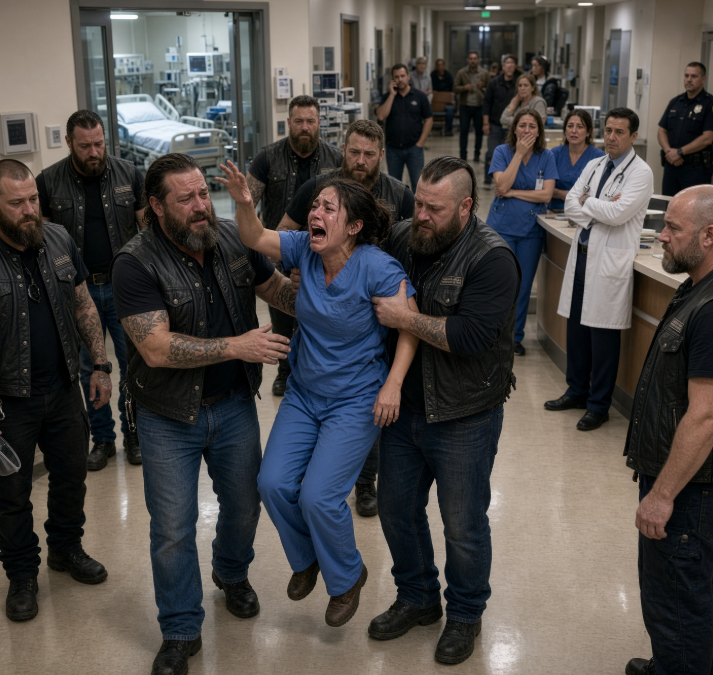
I thought about the first image I had seen.
Six huge men in leather.
One screaming woman.
Doctors stepping aside.
Security refusing to intervene.
Every visible detail had been true.
I had simply misunderstood what those details meant.
The bikers had taken Maria against her wishes.
They had ignored her demands.
They had used their strength to remove her physically from the place where she wanted to remain.
From a distance, love and cruelty can sometimes wear the same outline.
The difference lies in what the stronger person is trying to protect.
Control says, “Your pain belongs to me.”
Love says, “You can hate me, but I will not stand here and watch your pain kill you.”
Nobody stopped those bikers that night.
Not because nobody cared.
Not because the hospital feared them.
Not because Maria’s screams did not matter.
Nobody stopped them because every nurse on that floor had already tried gentleness.
They had offered food.
Rest.
Counseling.
Leave.
Medication.
Compassion.
They had begged.
They had waited.
They had watched Maria disappear one shift at a time.
By the time those six men arrived, love had run out of soft ways to keep her alive.
Sometimes saving someone is a beautiful thing.
A hand extended over dark water.
A firefighter carrying a child from smoke.
A doctor announcing that the tumor is gone.
Other times, saving someone is ugly.
It is paperwork, anger, restraint, slammed doors, broken trust, and a promise you are not sure will ever be forgiven.
Sometimes it looks like six bikers carrying a screaming nurse through a crowded hospital while everyone moves aside.
Sometimes love has to use its hands.
And sometimes the bravest words one grieving person can say to another are the words Marco gave Maria after she finally stopped fighting him.
“He’s gone.”
Then, before that truth could destroy her, he gave her the second half.
“But I’m still here.”








