I Watched an Old Shepherd Give Every Frightened Puppy the Same Gray Teddy Bear for Six Years—Then I Read the Second Page of His Surrender File
PART3:
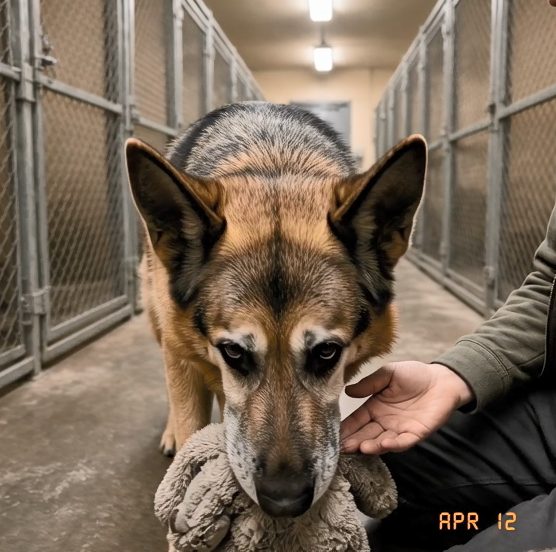
Sometimes he stood politely when someone stopped.
If they spoke softly, his ears would lift.
If they baby-talked too loudly, he would look away.
If they reached through the gate without asking, he stepped back.
Not aggressively.
Never aggressively.
Just enough to say, no.
People misread him.
They said he looked sad.
They said he looked aloof.
They said he did not seem interested.
They said things like, “He’s beautiful, but I don’t feel a connection.”
Then they chose a puppy.
Or a smaller dog.
Or a dog who jumped and licked and made them laugh.
Gunner stayed.
Months became a year.
A year became two.
Two became three.
The gray around his muzzle spread.
Kennel nine became his address.
And the bear stayed in the back corner.
Then one night, everything changed.
Not dramatically.
Not in a way any of us understood at the time.
We had taken in a litter of abandoned puppies from a roadside ditch. Six of them, maybe seven weeks old, soaked in mud and fleas, bellies round with worms, crying for a mother who was not coming. We cleaned them, treated them, fed them, and placed them in the puppy row.
The smallest one cried hardest.
She was a little brindle female with a white stripe on her nose and a voice that sounded too big for her body. She would not settle. Every time the lights dimmed and staff moved away from the kennels, she started again.
High.
Panicked.
Relentless.
The kind of crying that crawls under your skin because you know exactly what it means.
Where is everyone?
Where is warm?
Where is the body I slept against?
Why am I alone?
I was finishing medication logs when I heard kennel nine open.
At first, I thought one of the night volunteers had gone in to walk Gunner.
Then I looked down the hall and saw him.
Gunner stood at his gate with the gray teddy bear in his mouth.
The volunteer, Marcy, stood beside him holding the kennel door half open, looking confused.
“He picked it up,” she said. “I thought maybe he needed to go out.”
Gunner walked past her.
Not running.
Not excited.
Purposeful.
He moved down the concrete hallway, the gray bear hanging gently from his mouth, while the puppy cried at the far end.
Every other dog watched him pass.
I watched too.
He stopped at the brindle puppy’s kennel.
Lowered his head.
Pushed the bear under the gate as far as his nose could reach.
The puppy stopped crying mid-sound.
She stumbled toward it, sniffed, then climbed on top of the bear with all four paws and collapsed against it.
Gunner stood there for a few seconds.
Then he turned around, walked back to kennel nine, entered, and lay down in the back corner.
Alone.
With nothing.
Marcy covered her mouth.
I felt something twist in my chest.
“Well,” she whispered, “that just broke me.”
I walked to Gunner’s kennel.
He looked up at me.
“Did you just give her your bear?”
His tail moved once.
Barely.
I crouched there for a long time.
The brindle puppy did not cry again that night.
By morning, she was curled around the bear like it was a living thing.
We all talked about it.
Of course we did.
Shelter workers survive on stories like that. Tiny moments of grace. Proof that even in a building built for unwanted animals, love still found ways to move.
We called Gunner “the uncle.”
It started as a joke.
Then it became his title.
Whenever a new puppy arrived scared and alone, we would say, “Wait until Uncle Gunner hears.”
And he always heard.
Not immediately.
That was the part I still think about.
He did not rush the first cries.
He let a new puppy be new for a few hours. He let us do our work: vaccines, dewormer, warm bedding, food, water, intake photos, notes. He watched from kennel nine with those serious eyes.
Then, in the evening, when the building quieted and the puppy row began to feel too big and too cold, Gunner would stand.
He would pick up the gray bear.
If his kennel was closed, he would wait at the gate until one of us noticed.
If we did not notice quickly enough, he would make one low sound.
Not a bark.
A request.
We learned.
Someone would open kennel nine, and Gunner would walk down the hallway carrying the bear.
He always chose the puppy who needed it most.
Not always the youngest.
Not always the loudest.
Sometimes the silent one.
The one pressed into a corner.
The one trembling behind the water bowl.
The one who had stopped crying because it had already learned no one was answering.
Gunner knew.
He would push the bear under the gate.
Wait.
Then return to his empty kennel.
The puppies almost always settled.
A soft thing that smelled like another dog can do what human hands sometimes cannot. It gives a frightened puppy evidence that it is not completely alone.
Over six years, that bear comforted more puppies than I can count.
We took pictures.
Gunner carrying the bear past the laundry cart.
Gunner standing outside kennel two while a brown puppy sniffed through the bars.
Gunner pushing the bear beneath the gate with his nose.
Gunner walking back empty-mouthed, head low, not sad exactly, just finished.
Some of those puppies were adopted within days.
Some within weeks.
One became a therapy dog for a retired schoolteacher.
One went to a family with three little boys and a fenced yard.
One went to a woman in Chattanooga who sent Christmas cards every year.
One tiny hound mix kept the bear for two days and screamed when we tried to return it to Gunner, so Gunner gave it back again.
That was the first time I saw him do something I can only describe as a decision.
I brought the bear to kennel nine, washed and dried, and placed it inside.
Gunner sniffed it.
Then picked it up, walked straight back to the hound puppy, and pushed it under the gate again.
He did not take it back until the puppy was adopted.
After that, we kept extra soft toys in storage.
But Gunner rarely used them.
It had to be that bear.
The gray one.
The worn one.
The one he kept, not like a toy, but like a piece of history.
And still, somehow, none of us asked where it came from.
That is the shame I carry.
We loved the sweetness of the act so much that we never investigated the grief underneath it.
We thought we understood.
Old shelter dog comforts puppies.
Beautiful.
Simple.
Shareable.
We made the mistake people make all the time with animals and with each other.
We assumed kindness had to be uncomplicated because it looked gentle from the outside.
Gunner grew old in kennel nine.
Not quickly.
Shelter time ages animals differently.
There are dogs who come in young and seem old after six months because their hope burns too hot and too fast. There are others who adapt, who build routines around disappointment and survive longer than your heart can comfortably watch.
Gunner was the second kind.
He knew breakfast time.
He knew which volunteer dropped treats and which one sang off-key during evening cleaning.
He knew when storms were coming before the first thunder.
He hated fireworks.
Loved scrambled eggs.
Tolerated baths with the exhausted dignity of a widowed judge.
He allowed children to read to him through the gate if they sat quietly.
He did not like men in baseball caps unless they turned sideways and spoke low.
He never once destroyed the bear.
Not even when bored.
Not even when anxious.
Not even when storms shook the roof.
He kept it in the same back corner of kennel nine.
When he slept, one paw often rested near it.
When we washed it, he watched the dryer until it came back.
Adopters passed him over.
Year after year.
We posted him online.
We wrote beautiful captions.
Meet Gunner, our gentle old soul.
Meet Gunner, the shelter uncle.
Meet Gunner, the dog who comforts puppies.
People loved the posts.
They commented heart emojis.
They shared them.
They said, “Someone adopt this angel.”
They said, “I would if I could.”
They said, “He deserves the world.”
And then they adopted younger dogs.
I do not say that bitterly.
Not entirely.
People know what they can take on. Senior dogs can be expensive. Big dogs can be difficult for renters. Shepherd mixes need experienced homes. I understand all of that.
But understanding does not make it painless to watch a dog become beloved by thousands and chosen by no one.
By his fifth year with us, Gunner’s hips started to trouble him.
He rose more slowly.
He still carried the bear, but sometimes he needed a rest halfway down the hallway. We started helping him. Not by taking the bear. Never that. We simply opened doors, cleared the aisle, and walked near him in case he slipped.
One winter night, a litter of three puppies came in after animal control found them under a porch. They were cold, thin, and terrified. One cried so hard she made herself cough.
Gunner stood with the bear.
His back legs trembled.
I crouched beside him.
“Let me do it, old man.”
I reached for the bear.
He turned his head away.
Not growling.
Not snapping.
Just no.
So I stood up.
“All right,” I whispered. “You do it.”
He walked slower than usual.
Step.
Pause.
Step.
Pause.
The puppy cried.
Gunner kept going.
At the gate, he lowered his head and pushed the bear through.
The puppy crawled onto it, still hiccuping.
Gunner leaned against the gate for a moment, breathing hard.
I wanted to carry him back.
He would not have liked that.
So I walked beside him while he returned to kennel nine.
He lay down and closed his eyes.
I sat outside his gate until midnight.
That was the first time I thought, He will die here.
Not because he was actively dying.
Because he had become so much a part of the shelter that some terrible part of me had stopped imagining him anywhere else.
That is another thing shelter work does to you.
You fight so hard for animals to leave that, when one stays too long, your mind begins building excuses around the staying.
He knows us.
He is comfortable.
This is his home now.
It is a mercy we tell ourselves because the alternative is admitting a dog can be loved by everyone and still belong to no one.
Gunner’s last spring was soft.
That feels important.
The dogwoods bloomed early. The rain came warm. We started taking him outside in the staff yard for longer afternoons because sun helped his joints. He would lie under the maple tree with the bear beside him while puppies tumbled in the next play yard.
Sometimes, if a puppy came to the fence, Gunner would lift his head.
Not jealous.
Not playful.
Watchful.
Like a grandfather at a family picnic.
One afternoon, a woman named April came to meet him.
She was in her sixties, recently widowed, with a small house outside Maryville and a fenced yard. She had seen Gunner’s video online and cried, she said, because her late husband had been a quiet man who always gave away the best part of what he had.
I tried not to hope.
Hope is dangerous in shelters.
It makes you hear adoption bells before the paperwork exists.
But Gunner liked her.
I saw it.
He stood and went to the front of the kennel. Not fast, but willingly. He sniffed her hand. Let her stroke the scarred place behind his ear. When we brought him to the meet room, he lay down near her chair and sighed.
April cried.
“I think he’s tired,” she said.
“He is,” I answered honestly.
“Would he hate leaving?”
That question undid me.
Most people ask if a dog will adjust.
If he is housebroken.
If he likes cats.
If he can handle stairs.
April asked whether leaving would hurt him.
“I don’t know,” I said.
Gunner looked at me.
Then at April.
Then at the door.
April stayed an hour.
She came back the next day.
And the next.
On the fourth visit, she brought a soft orthopedic bed and asked if she could place it in the meet room, just to see if he liked it.
He did.
On the fifth visit, we began adoption paperwork.
On the sixth, Gunner had a mild seizure.
The adoption paused.
The vet found a mass.
Spleen.
Advanced.
Quiet until it was not.
The kind of diagnosis that arrives like a thief and then claims it was there all along.
April came anyway.
She sat with him in the yard.
She asked about hospice adoption.
She said she did not care if it was weeks.
She said no dog should die in a kennel.
I loved her for that.
I still do.
But Gunner made the decision before we could.
Two nights later, a storm rolled over Knoxville.
Not a dramatic storm.
Just steady rain, low thunder, the kind that made anxious dogs pace.
A new puppy had arrived that afternoon.
A little black lab mix, maybe ten weeks old, found beside a dumpster behind a gas station. He had cried through intake, cried through dinner, cried when the lights dimmed.
Gunner had been weak all day.
He had eaten half his breakfast and none of his dinner.
He lay on his bed in kennel nine with the bear tucked under his chin.
I told Marcy, “Do not let him get up tonight.”
As if love ever listened to instructions.
At 8:40 p.m., Gunner stood.
The security camera caught it.
I watched the footage later because I needed to know.
He stood slowly, bracing himself against the wall.
He picked up the gray bear.
He waited at the gate.
No one noticed at first.
The puppy cried.
Gunner made one low sound.
Marcy turned.
“Oh, Gunner,” she said on the recording.
She did not open the gate.
He made the sound again.
I was in the med room drawing up medication when Marcy called me over the radio.
“Renata, he wants to take the bear.”
I closed my eyes.
“Don’t let him.”
Silence.
Then Marcy said, “You need to come.”
I went.
Gunner stood at the gate, bear in his mouth, body shaking with effort.
I crouched.
“Buddy, not tonight.”
His eyes met mine.
I have worked with animals long enough to avoid turning every look into a human sentence.
But some looks do not need translation.
Move.
I opened the gate.
We walked with him.
Marcy on one side.
Me on the other.
Gunner carried the bear down the concrete hallway for the last time.
It took nearly five minutes.
The puppy cried until he saw him.
Gunner reached the gate.
Lowered his head.
Pushed the bear underneath.
The puppy grabbed it, climbed over it, and stopped crying.
Gunner stood there for a moment, swaying slightly.
Then he turned back toward kennel nine.
He made it halfway.
His legs folded.
We caught him before he hit the concrete.
I do not remember what I said.
Probably his name.
Probably no.
People say no to death as if it is a command that might work if spoken with enough love.
We carried Gunner to the treatment room and called the vet.
April came because I called her too.
She arrived in the rain wearing slippers and a coat over her pajamas. She sat on the floor with us while Gunner lay on blankets, his breathing shallow.
“He did the bear?” she asked.
I nodded.
April touched his head.
“Of course he did.”
The vet confirmed what we already knew.
Internal bleeding.
The mass had ruptured.
There are decisions in shelter work that feel like failures even when they are mercy.
This was one.
Gunner was surrounded by people who loved him.
Marcy.
Me.
April.
Dr. Singh.
Two volunteers who had driven back when they heard.
And, because I could not bear the thought of him leaving without it, I went to the puppy kennel and took the gray bear.
The puppy was asleep by then, curled around the blanket we had replaced it with.
I carried the bear back to the treatment room and placed it beside Gunner’s face.
His nose moved.
Once.
He knew.
April whispered, “Good boy.”
I held his paw when Dr. Singh gave the injection.
Gunner’s breathing slowed.
Stopped.
The shelter went quiet in the way it never does unless something sacred has left it.
Afterward, I sat on the floor beside him long after everyone else had gone to do the necessary things.
Paperwork.
Cleaning.
Calls.
Cremation arrangements.
Life after loss is full of administration.
I stroked the worn gray bear and felt something hard inside my chest.
Six years.
He had been with us six years.
We had told his story a hundred times.
The uncle.
The gentle shepherd.
The dog who gave his teddy bear away.
But I still did not know where the bear had come from.
That thought came like an accusation.
So I went to the file room.
Gunner’s surrender file was in the older cabinet, because six years earlier we still used paper for everything. His folder was thick with medical records, behavior notes, adoption promotions, volunteer observations, dental estimates, arthritis medications, yearly vaccinations, and printed photos from events where no one chose him.
The first page was the intake form I had read years ago.
The second page was stuck to the back of it, folded slightly at the corner.
I had never noticed.
Or maybe I had and never cared enough.
There was a handwritten note across the bottom in blue ink.
The writing belonged to the woman who surrendered him.
I sat down before I read it fully.
Please let Gunner keep the gray bear. It belonged to the last puppy from his litter. He carried that puppy for two days after the fire, but the puppy did not survive. Since then, he gives the bear to any crying baby animal he hears. I think he still believes he can save this one.
I read it once.
Then again.
Then I covered my mouth with my hand because a sound came out of me I did not want the dogs to hear.
The last puppy from his litter.
His litter.
Gunner had been a father.
Or at least, in the way dogs understand family, he had belonged to puppies once.
The surrender file had more.
Not much.
Just enough.
The woman who surrendered him had lived on a rural property outside Sevierville. A fire had destroyed a shed where a mother dog and her litter had been sheltering. Gunner had been found dragging puppies out one by one. The mother dog died in the fire. Most of the puppies did too.
One lived for two days.
The last puppy.
The one with the gray bear.
Gunner had carried that puppy in his mouth, then beside him, then would not leave the body after it passed.
Afterward, he kept the bear.
Not like a toy.
Like evidence.
Like a promise.
The woman surrendered him months later when she lost her housing. She wrote that Gunner had begun carrying the bear to crying kittens, crying puppies, even a baby goat once on a neighboring farm.
I think he still believes he can save this one.
For six years, every time Gunner heard a frightened puppy cry, he was not doing a cute shelter trick.
He was answering an old grief.
He was going back to the fire.
Back to the puppy he could not save.
Back to the one small body that had carried the smell of smoke and milk and loss.
And every time he pushed that bear under a gate, maybe he was trying again.
Not because he was confused.
Because love does not always accept the final version of a story.
Sometimes it repeats the only good thing it knows how to do.
I took the file to the break room.
Marcy read the note and started crying before she finished.
Dr. Singh sat down hard.
April asked for a copy.
We gave her one.
Then we made a decision.
The gray bear would not be cremated with Gunner.
That was my first instinct, and it was wrong.
The bear had been his, yes.
But Gunner had spent six years teaching us that love is not ownership.
Love is passing warmth through the gate.
So we washed the bear one last time.
Gently.
By hand.
We dried it in the staff room, not the machine, because the stitching was too fragile.
Then we placed it in a small shadow box in the shelter lobby.
Beside it, we hung Gunner’s photograph.
Not the polished adoption photo.
Not the one where we tried to make him look younger or more adoptable.
We chose a picture Marcy had taken at 9:00 p.m. three years earlier.
Gunner walking down the concrete hallway with the gray bear in his mouth.
Serious.
Gray-faced.
Purposeful.
Underneath, we printed the sentence from the note.
I think he still believes he can save this one.
People cried when they read it.
Not social-media crying.
Not performative.
Real tears.
The kind that change the way someone looks at the kennel doors.
The story spread after that.
A local reporter came.
Then a Knoxville station.
Then national animal pages.
People who had ignored six years of adoption posts shared Gunner’s story in numbers I could not comprehend.
For a while, I was angry about that.
Where were you when he was alive?
Where were you when he slept in kennel nine?
Where were you when we posted his face again and again and asked someone to give him a couch before his hips gave out?
But anger, like grief, has to be used carefully or it spoils what love leaves behind.
So we used the attention for senior dogs.
We started Gunner’s Bear Fund.
The fund paid adoption fees for senior shelter animals and provided starter kits: orthopedic beds, medication support, food, toys, and veterinary vouchers for people willing to adopt older dogs.
April made the first donation.
Then she adopted the black lab puppy Gunner had comforted on his last night.
She named him Teddy.
Of course she did.
Teddy grew into a ridiculous, joyful dog with no sense of personal space and a deep suspicion of vacuum cleaners. April sent us pictures every month. In every one, Teddy had a gray stuffed bear of his own.
Not Gunner’s bear.
That one stayed in the lobby.
But a new one.
Soft.
Whole.
Ready to belong to a dog without grief attached to it.
The strangest part was what happened to kennel nine.
For weeks after Gunner died, I could barely walk past it.
It had been cleaned, of course. New blankets. New bowls. Another dog eventually moved in, because shelters do not have the luxury of leaving spaces empty for grief.
But to me, it was still his.
Then one morning, I came in and found a volunteer standing outside kennel nine with a frightened senior beagle who had arrived overnight.
The beagle was trembling.
Not crying.
Too scared for sound.
On the floor just inside his gate was a small brown stuffed dog.
Not Gunner’s bear.
A volunteer had placed it there without thinking.
The beagle had curled around it.
I stood there and felt the grief shift.
Not disappear.
Never that.
Shift.
Gunner had not left an empty kennel.
He had left instructions.
Give them something soft.
Give them time.
Do not assume quiet means okay.
Do not mistake scars for distance.
Ask where the bear came from.
That last one became a rule for me.
Not literally always.
But in practice.
When an animal does something beautiful, I try not to stop at beautiful anymore.
I ask what pain taught them that kindness.
I ask what history might be hiding under the behavior that makes us say aww.
I ask what we missed because the sweetness was easier to look at than the loss.
Animals carry stories.
Not in words.
In objects.
In routines.
In the way they freeze at certain sounds.
In the corner of a kennel they refuse to leave.
In the toy they protect.
In the toy they give away.
Six years after Gunner arrived, we finally understood that the gray bear was not a toy.
It was the last thing he had from a puppy he loved and lost.
And he gave it away again and again.
That is the part I still cannot say without my throat closing.
He had so little.
A concrete kennel.
A staff that loved him but could not be a family in the way he deserved.
A body growing old.
A bear that smelled like memory.
And whenever a puppy cried, he gave away the one thing that was truly his.
Not because it stopped hurting.
Because someone else was hurting.
I keep a copy of Gunner’s note taped inside my desk drawer.
On hard days, I read it.
Days when three dogs are surrendered before noon.
Days when adopters cancel.
Days when medical bills stack higher than donations.
Days when someone says, “How can you work there? I would take them all home,” and I have to smile instead of saying, We cannot take them all home either, and that is the wound we work inside every day.
I read the note and remember Gunner.
Not as a tragedy.
As a teacher.
He taught me that love can become ritual.
That grief can become service.
That an old dog in a shelter kennel can understand something many humans never do: the fact that you could not save one life does not mean you stop answering the next cry.
The gray bear is still in the lobby.
Children ask about it.
Adults read the plaque.
Some cry.
Some donate.
Some turn around and ask to meet the oldest dog we have.
Those are my favorite people.
Sometimes, late in the evening, after the building quiets and the puppy row settles, I find myself looking down the hallway toward kennel nine.
For just a second, I expect to see him.
Big dark face.
Gray muzzle.
Slow steps.
That bear held gently in his mouth.
Walking toward the sound of someone small and scared who thinks nobody is coming.
But Gunner is gone.
So now we go.
We carry blankets.
Soft toys.
Warm towels.
Patience.
We push comfort under gates as far as our hands can reach.
And when a puppy finally stops crying and curls around something soft, I always whisper the same thing.
“Good job, Gunner.”
Because even now, in the quietest hours at Ridgeline Animal Shelter, he is still saving this one.








