I Watched a Biker Destroy 48 Gallons Meant for Hungry Children—Then a Little Boy Said, “It Burns”
PART3:
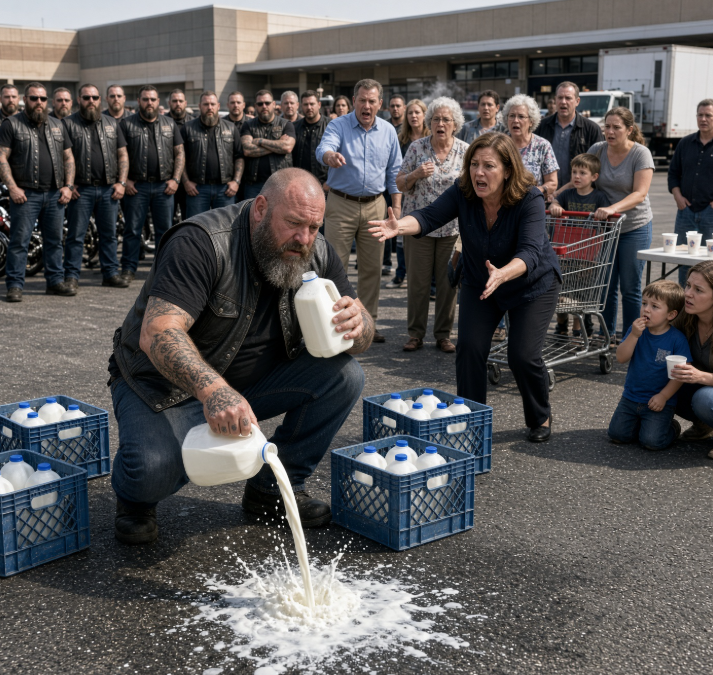
Two Springfield officers approached the bikers instead of the loading dock. From their angle, they saw a huge tattooed man surrounded by ruined milk and angry families.
“Step away from the merchandise,” the first officer ordered.
Ray looked at the gallon in his hand.
Then he opened it.
Milk struck the pavement.
The officer reached for his wrist.
I stepped between them and said the sentence that still embarrasses me.
“He bought it for the children, and then he snapped. I don’t know why.”
Ray looked at me.
He did not appear angry.
He looked tired.
“You know enough,” he said. “You smelled it.”
Behind us, the supermarket’s automatic doors opened.
A teenage cashier ran outside holding a paper cup from the children’s sample table.
“A little boy says the milk tastes like pennies.”
Ray dropped the empty jug.
The plastic bounced once.
His reaction was heavier.
He ran toward the store.
Mack shouted for someone to call poison control. The officers followed. Parents abandoned their carts and rushed toward the entrance until the second officer ordered them back.
Near the customer-service desk, a five-year-old boy stood beside a folding sample table.
His name was Noah Griggs.
Milk glistened on his lower lip. His mother knelt in front of him, wiping his mouth with a napkin and asking how much he had swallowed.
“It burns,” Noah whispered.
Ray stopped three feet away.
He did not touch the child.
Instead, he removed an old plastic card from inside his vest and handed it to the approaching paramedic.
The card listed the chemical name, emergency rinsing instructions, and an incident number from a dairy plant north of Springfield.
The paramedic turned it over.
A young woman’s photograph had been taped to the back.
She had Ray’s eyes.
Beneath her picture were six handwritten words.
DAD, BELIEVE THE SMELL BEFORE THE LABEL.
Then the loading-dock alarm began ringing.
White vapor rolled beneath the trailer door.
The store manager’s face lost its color.
Ray looked at him.
Brent whispered the name he had been avoiding.
“Lena.”
Ray’s daughter had worked at the dairy plant named on the card.
Brent had been standing beside her on the day she was exposed.
I first met Ray Dawson four years before the milk spread across that parking lot.
Someone had stolen the catalytic converter from our delivery van. The theft occurred two days before Thanksgiving and left us without a vehicle large enough to collect donated turkeys.
At seven on Monday morning, I found a pair of heavy boots extending from beneath the van.
A black Harley idled near our dumpster.
I locked the center doors and called police.
Ray rolled from beneath the vehicle, wiped his hands on a rag, and said, “Morning.”
The responding officer recognized him.
Ray owned Dawson Motor & Tow on West Chestnut Expressway. He had recovered our converter from a scrap-metal buyer who disliked answering questions from a 285-pound biker.
Ray welded it back into place before I arrived.
“What do we owe you?” I asked.
He pointed toward six children waiting near our locked front door.
“Open up.”
“That’s your price?”
“They’re cold.”
The children arrived early because their parents began work before our breakfast service. Ray noticed which ones came without coats, which boy wrapped half a biscuit inside a napkin, and which sisters took turns drinking from the same carton.
He said nothing about any of it.
The following week, the Lanterns delivered three boxes of winter gloves. Every store tag had been removed so no one could return them for cash, and every size matched a child Ray had quietly measured by comparing their hands to his.
He did not stay for a photograph.
That became his pattern.
When our walk-in freezer failed during a July heat wave, Ray arrived after dark with Mack and two other Lanterns. They replaced the compressor, cleaned the coils, and left before sunrise.
No invoice appeared.
When our oldest van lost its transmission, I found a rebuilt one beside the loading door with a note taped to the housing.
FOUND THIS.
Ray refused our donor dinners. He avoided award ceremonies. If a reporter entered the building, Ray discovered an urgent reason to check his motorcycle.
The children loved him because he repaired things without turning the repairs into lessons about gratitude.
Parents were slower to trust him.
His past did not fit his good deeds neatly.
Ray grew up outside Tulsa with a father who repaired farm equipment while sober and smashed furniture when he was not. At sixteen, Ray left school and slept inside a tire-storage shed.
At nineteen, he joined a motorcycle club that gave him food, work, and enough anger to keep moving.
The club did not save him.
It gave his damage a uniform.
Ray spent fourteen months in county jail after nearly killing a man during a bar fight. He lost jobs and friendships. His wife, Joanne, left twice and returned once.
Their daughter, Lena, learned to identify the sound of her father’s Harley before she learned multiplication.
Ray loved Lena badly at first.
He missed school plays but repaired every bicycle in her neighborhood. He forgot birthdays and remembered the exact cereal she liked. He promised to stop drinking so many times that the promises became another kind of lie.
Joanne ended the marriage when Lena was thirteen.
For eight months, Lena refused to sit on Ray’s motorcycle.
The moment that changed him came three years later.
Lena called from a gas station shortly before midnight. Joanne’s car had broken down, and Lena needed a ride.
Ray had been drinking.
He arrived anyway.
Lena took one look at him, stepped away from the motorcycle, and gave the car keys to a stranger who had offered to help.
“You called me,” Ray said.
Lena looked directly at him.
“You came, but you still weren’t here.”
Those seven words hurt him more than jail.
Ray attended his first recovery meeting the following morning. He sold two motorcycles, closed his account at the neighborhood bar, and gave Mack permission to break both his hands if Mack ever saw him riding drunk.
Mack declined the hand-breaking arrangement.
He kept Ray’s spare keys instead.
Sobriety did not repair everything.
Joanne never returned.
Lena did, but slowly.
Ray attended every meeting she invited him to, even when she refused to call him Dad. He sat in the back row at her graduation and left before the photographs because Joanne’s new husband was standing beside her.
Lena followed him into the parking lot.
“You’re supposed to be in the picture,” she said.
“Already saw you walk.”
“That’s not the same.”
“It’s enough.”
“No,” Lena told him. “You don’t get to disappear just because staying is uncomfortable.”
Ray returned.
The photograph from that afternoon was the one taped to his chemical-response card.
Lena studied industrial safety at Ozarks Technical Community College and accepted a quality-control position at Ridgeway Dairy Processing, twenty-two miles north of Springfield.
Ray joked that she had chosen a career based on telling grown men not to touch things.
“Somebody had to raise you,” she answered.
At Ridgeway, employees worked around concentrated cleaning compounds used to sanitize tanks, fillers, pipes, and bottling lines.
One of those chemicals was peracetic acid.
Lena believed workers relied too heavily on printed labels.
Labels peeled.
Drums were reused.
Shipping papers were copied incorrectly.
People ignored faint odors because reporting them stopped production and made supervisors angry.
While helping the Lanterns prepare a charity warehouse, Lena taught the bikers basic chemical-response procedures. She made the card Ray carried inside his vest.
Move upwind.
Protect drains.
Avoid direct contact.
Call emergency services.
Identify the container.
Do not induce vomiting.
Believe the smell before the label.
Ray carried the card because Lena asked him to.
Then came the Ridgeway accident.
Eleven years before the supermarket incident, a sanitation line ruptured during the night shift. Concentrated cleaner sprayed across a narrow service corridor while an evacuation alarm failed to sound in one section of the plant.
Lena smelled the chemical before she saw it.
She pulled two workers through a side exit. Then she returned for a third employee who had fallen near the control panel.
By the time firefighters reached her, her lungs had been badly damaged.
Lena lived for six days.
Ray sat beside her hospital bed in the same leather vest he wore in Harlan’s parking lot. After the second day, Lena could no longer speak. She communicated by writing on a dry-erase board.
Her last clear instruction to her father was not sentimental.
CHECK THE MANIFEST.
Ray did.
The document showed that a replacement chemical drum had been stored on the wrong rack. The plant supervisor who signed the receiving sheet had noticed a discrepancy but delayed reporting it because production was already behind schedule.
The supervisor’s name was Brent Colson.
Brent had not caused the corroded fitting to rupture.
He had not ordered Lena back into the corridor.
But he had recognized a warning and decided reporting it could wait.
That delay mattered.
It became part of a civil settlement that paid medical claims and forced Ridgeway to adopt stricter handling procedures. Brent lost his position but faced no criminal charge.
Ray never attacked him.
That surprised everyone who remembered his younger years.
He attended the hearings, listened to every word, then returned to his garage and welded until his hands shook too badly to hold the torch.
The Lanterns feared he would drink.
Instead, he began counting children.
Seven waiting at our locked door.
Twenty-one eating winter breakfast.
Seventy-three enrolled in summer meals.
Four lactose-intolerant.
Eleven with documented food allergies.
One child named Ava Bennett who needed a blue cup because red plastic reminded her of medicine.
Ray never explained the arithmetic.
Mack understood.
Every child accounted for was one person somebody had refused to treat as an acceptable risk.
That was why Ray purchased the milk.
It was also why one faint chemical smell beneath a plastic cap stopped him cold.
The contaminated shipment reached Harlan’s Market at 4:42 that Saturday morning.
I learned the details later through security footage, shipping records, and testimony from the receiving clerk.
The refrigerated trailer carried dairy products, bottled juice, and four containers of cleaning supplies intended for the store’s deli department.
The chemicals should have been isolated behind a rigid barrier.
They were not.
A steel retaining bar had loosened somewhere between Tulsa and Springfield. One five-gallon container of concentrated sanitizer slid against a stack of milk crates.
The container’s closure collar cracked without fully releasing the cap.
The leak was slow.
That made it easier to ignore.
Liquid traveled beneath the pallet wrap, soaked into cardboard trays, and collected around the necks of milk jugs stacked beside it. The cold trailer suppressed the odor until the doors opened.
A receiving clerk noticed the damp cardboard.
He assumed it was condensation.
The driver smelled something sharp.
He blamed the deli sanitizer.
Brent Colson signed the delivery.
Saturday was the worst morning to reject a dairy shipment. Families bought milk before church events, youth baseball games, and weekend meal programs. Refusing the trailer meant empty shelves, customer complaints, and an angry regional supervisor.
Brent separated the visibly damaged chemical container and placed it beside the loading dock.
Then he ordered the milk stocked.
He did not test the caps.
By 7:15, seventeen gallons had been sold.
Ray and the Lanterns arrived twenty minutes later.
The regional dairy that normally supported our program had canceled its donation. I called Ray the previous evening because I needed someone with a truck.
He arrived on motorcycles instead.
Mack suggested splitting the milk cost among club members. Ray placed a folded stack of bills on the checkout belt.
“You bought the freezer compressor,” Mack reminded him.
“Bought a part.”
“You rebuilt Carmen’s transmission.”
“Had another one.”
“You cannot keep paying for everything Lena might have cared about.”
Ray looked at him.
Mack stopped.
That was the brotherhood’s recurring wound.
The Lanterns wanted to help Ray carry his grief. Ray treated grief like a debt no one else was permitted to pay.
The riders began loading milk crates into our van.
Ray noticed moisture on his glove.
He smelled the cap.
The odor pulled him eleven years backward before he could resist it.
Vinegar.
Hospital disinfectant.
Burned plastic.
Lena trying to form words around a breathing tube.
He placed the jug on the pavement.
“Where was this stored?”
The teenage stock clerk pointed toward the loading dock.
Ray and Mack walked behind the store.
They found the damaged sanitizer container beside the trailer. Part of its label had dissolved, but the oxidizer symbol remained visible.
A pale trail ran beneath the pallet toward a storm drain.
Ray removed Lena’s card from his vest.
The product name matched.
He called the Springfield Fire Department’s nonemergency dispatch, identified the chemical, and requested hazardous-material guidance. The dispatcher told him to avoid direct contact, move people upwind, protect nearby drains, and keep the shipment isolated until a unit arrived.
Ray returned to the front.
Brent was pushing the crates toward our van.
“Pull every gallon with this lot code,” Ray said.
Brent looked at the biker and then at the customers watching.
“You don’t work here.”
“That chemical traveled beside the milk.”
“The jugs are sealed.”
“This one isn’t.”
Ray showed him the damp cap.
Brent wiped it with a paper towel and smelled it.
His eyes changed for half a second.
Ray saw the recognition.
“You know that smell.”
“I know what our deli sanitizer smells like.”
“Then pull the shipment.”
Brent lowered his voice.
“Do you understand what a full dairy recall costs?”
Ray stared at him.
“Less than one kid.”
Brent refused.
He accused Ray of frightening employees and interfering with business. He said the milk had passed visual inspection and ordered the clerk to finish loading it.
Then he told a cashier to call security if the bikers continued causing trouble.
Mack wanted to wait for firefighters.
Ray watched families leaving with gallon jugs.
“By the time the fire department arrives, those are gone.”
“We can ask customers to return them.”
“Not all of them.”
Ray took the receipt.
The forty-eight gallons in our crates belonged to him.
He moved them to the highest corner of the parking lot, away from cars and storm drains.
Then he opened the first jug.
Mack caught his wrist.
“Think, brother.”
“I am.”
“If you dump this, they’ll say you contaminated it.”
“Film the seals.”
“You hate cameras.”
“Today I don’t.”
Mack released him.
The decision divided the Lanterns.
Four riders agreed immediately. Three wanted to block the parking-lot exits. Others argued that physically stopping families would turn a safety warning into a confrontation the police would misunderstand.
Ray settled the argument with five words.
“No hands on any family.”
The riders could warn shoppers, offer replacement money, record lot numbers, and ask people not to open the milk.
They would touch no vehicle.
They would block no person.
Ray would destroy the forty-eight gallons purchased for our center.
His reasoning was brutal and simple.
Once every jug was opened and emptied, no employee could return them to a shelf. No volunteer could donate them elsewhere. No manager could reassure me that the outside of the packaging had merely been exposed.
Ray knew seventy-three hungry children were waiting.
He also knew I was under pressure.
If Brent had offered a confident explanation, I might have accepted it.
Ray removed that choice.
When I arrived, I saw only milk spreading across black pavement.
A parent shoved Mack after he tried to inspect her gallon. One Lantern pushed the man back.
Every phone recorded the second shove.
None captured the first.
Brent told customers the bikers were staging a protest.
Someone started the rumor that Ray was drunk.
Then came the accusation that he was destroying milk because immigrant children would drink it.
“You know who those children are,” I shouted.
Ray opened another jug.
“I do.”
“Then why are you doing this?”
“Because you’d serve it.”
The words felt cruel.
They were true.
We had forty minutes before lunch, no backup delivery, and children already seated inside our center.
“You think I’d poison them?”
“I think you’d believe him.”
Ray pointed toward Brent.
I wanted to deny it.
Then Ray made me smell the cap.
When police arrived, Officer Daniel Price ordered the Lanterns away from the crates.
Everyone complied except Ray, who still held an open gallon.
“Put it down,” Price ordered.
Ray tilted it.
Milk struck the asphalt.
Price seized his wrist.
The wet glove compressed between their hands, releasing the chemical smell.
The officer released him.
A red blister had formed along Ray’s palm.
Mack shouted for everyone to move upwind.
Then the cashier ran outside with the sample cup.
Ray did not hesitate.
He ran toward Noah.
Inside the store, Noah’s mother tried to wipe the milk from his mouth.
Ray knelt out of reach.
“Water only,” he told her. “Don’t make him throw up.”
“How do you know?”
He gave Officer Price the exposure card.
The officer read the product name to dispatch. Poison control advised immediate mouth rinsing and medical evaluation.
Ray offered a sealed water bottle, but he let Noah’s mother take it from him. Afterward, he placed both hands behind his back so no one mistook help for permission to touch the child.
Then the loading-dock alarm sounded.
Sunlight had warmed the leaking sanitizer, and vapor began escaping beneath the trailer door.
Firefighters evacuated the store.
The chemical was real.
The milk was quarantined.
Noah had swallowed only a small amount.
For one brief moment, I believed the danger had ended.
Then Mack returned from the parking lanes.
The Lanterns had traced sixteen of the seventeen gallons purchased by customers.
One was missing.
The missing jug belonged to Ruth Bennett, Ava’s grandmother.
Ava’s blue cup was already waiting on our lunch table.
Ruth was sixty-eight and had no cell phone. She paid cash, used no loyalty card, and had no reason to know the store was being evacuated.
I called her house.
No answer.
Ray was already moving.
“Address.”
I gave it to him.
Mack started toward his motorcycle, but Officer Price stopped the Lanterns from leaving while police investigated the confrontation.
Ray took Lena’s card from the officer’s hand.
“A child has that milk.”
“You can’t leave an active scene.”
“Then arrest me later.”
Ray walked toward his Road King.
Price grabbed the back of his leather vest.
Fourteen Lanterns turned at once.
The parking lot became silent.
Ray looked over one shoulder.
“Nobody moves.”
Every biker obeyed.
Ray removed his cut and placed it in Mack’s hands. Without the leather, he looked less like the man everyone had been filming and more like a tired mechanic with a chemical burn spreading across his palm.
“You’re injured,” Price said.
“Still know the address.”
“I’ll send a unit.”
“You’ll send it after the request enters a queue.”
Ray pointed toward the cruiser.
“You lead, or I go.”
Price hesitated.
Then he climbed into his patrol vehicle.
Ray mounted the Road King. Its engine struck the parking lot with a heavy pulse, but he did not race.
He waited for the cruiser.
Then he followed exactly two car lengths behind.
I rode in Noah’s ambulance because the paramedics needed information about the shipment. From the rear window, I could see Ray’s motorcycle behind the police car.
He did not look reckless.
He looked precise.
Ruth’s front door was open when we arrived.
Her car was gone.
A neighbor told Officer Price she had driven Ava to the Ozarks Family Center twenty minutes earlier.
The milk had beaten us there.
Ray turned around before anyone instructed him.
Price radioed our center, but no one answered. Volunteers were setting up lunch in the multipurpose room, where the music and aging ventilation system drowned out the office telephone.
The trip back took nine minutes.
It felt like forty.
When we reached the center, children were seated at long folding tables.
Volunteers had served sandwiches and apple slices. Blue plastic cups waited beside every plate because Ava disliked being the only child with a different color.
Ruth stood near the refrigerator.
The missing gallon was open.
Ava’s cup was full.
Ray entered through the side door with Officer Price behind him.
Several parents recognized him from livestreams already spreading online.
One father stepped into his path.
“Get out.”
Ray pointed toward Ava’s cup.
“Same shipment.”
The father did not understand.
Ruth did.
She looked at the gallon and covered her mouth.
Ava lifted the blue cup.
Ray crossed the room.
He did not strike it from her hand. The impact could have splashed liquid into her eyes.
Instead, he dropped to both knees and extended his uninjured hand.
“Give me the cup, sweetheart.”
Ava pulled it closer.
“It’s mine.”
“I know.”
“You remembered the blue one.”
“Always.”
“Then why can’t I drink it?”
Ray looked at the children surrounding her.
“Because I need to be wrong first.”
Ava studied his face.
Children often noticed what adults ignored.
She saw the red skin beneath his torn glove.
She gave him the cup.
Ray placed it inside a metal sink and smelled the open gallon.
The sharp odor was stronger than before.
Officer Price evacuated the room. Firefighters isolated the refrigerator and sealed the jug in an evidence container.
Every child was examined.
No one had swallowed the milk.
We thought Ray had recovered the final gallon.
He had not.
Ruth told investigators that the supermarket display contained two full layers of milk when she shopped.
Brent’s paperwork listed one pallet of forty-eight gallons plus seventeen individual jugs stocked in the cooler.
The cashier remembered a larger shipment.
The numbers did not match.
There should have been eighty gallons.
Sixteen more were missing.
Police returned Brent to the center while firefighters searched the supermarket warehouse.
He insisted the difference was a clerical mistake.
Ray asked him one question.
“Why is the count short exactly one sixteen-gallon layer?”
Brent said nothing.
Officer Price found a photograph on the receiving clerk’s phone. The employee had taken it during unloading because the mixed trailer looked unusually crowded.
The image showed three complete milk layers beneath the pallet wrap.
Brent had removed the bottom layer after noticing wet caps.
He had not destroyed it.
He placed the sixteen gallons inside the store’s donation cooler.
Those gallons had been collected at 6:30 that morning by a church pantry serving three rural communities.
The pantry van was already forty miles away.
I stared at Brent.
“You donated milk you suspected was contaminated?”
“I didn’t suspect contamination.”
“You removed the entire wet layer.”
“It was a precaution.”
“Then why didn’t you destroy it?”
His face tightened.
“Do you know what food waste does to our quarterly numbers?”
That answer stripped away his last excuse.
Brent had not saved the milk because he believed it was safe.
He moved it off his inventory sheet and sent it to families he assumed would never complain.
Ray stepped toward him.
Officer Price placed one hand near his holster.
Fourteen bikers waited outside the center under police supervision.
Brent saw them through the window.
For the first time, he looked afraid of Ray.
Ray stopped three feet away.
He could have threatened Brent.
He could have spoken Lena’s name like a weapon.
Instead, he turned toward Mack.
“Routes.”
Mack understood.
The Lanterns divided the pantry’s delivery list. Police could contact official addresses, but many recipients lived in trailers, weekly motels, and farmworker housing without reliable phones.
The bikers knew those roads because they had delivered food, fuel, and medicine during storms.
Officer Price warned them not to speed or enter anyone’s home.
Ray tightened a clean bandage around his burned palm.
“We knock. We warn. We replace.”
Fourteen motorcycles started almost simultaneously.
Their engines shook the center’s windows. Several parents pulled children away from the noise.
One mother asked me whether those men were safe.
I watched Ray check the lot number written on Lena’s card.
“They’re the reason the milk isn’t here,” I said.
The sentence sounded accusatory until I finished it.
“They’re also the reason it won’t reach anyone else.”
The Lanterns spent the next two hours tracing sixteen gallons across Greene and Christian Counties.
They found seven unopened at the church pantry.
Three were inside family refrigerators.
Two had reached a church kitchen.
One sat in the bed of a pickup beneath melting ice.
Three had been delivered to a roadside motel where six families rented rooms by the week.
Ray found two in Room 18.
The woman in Room 23 said her teenage son had taken the final gallon to work.
He worked at a daycare.
For the second time that morning, Ray faced a locked door with children behind it and a chemical warning no one wanted to believe.
He struck the steel frame with his scarred knuckles.
Three hard blows.
“Open up.”
The daycare director saw the motorcycles and refused.
Ray stepped back from the glass. He did not threaten to enter.
Officer Price confirmed the recall by telephone. Only then did the director unlock the door.
The final gallon sat unopened inside the staff refrigerator.
Ray leaned against the brick wall while a firefighter sealed it inside an evidence container. The chemical burn had spread across two fingers, and vapor exposure made his voice rough.
Mack urged him to accept medical treatment.
Ray refused until the complete count was confirmed.
“All eighty.”
It took another hour.
Forty-eight gallons purchased by Ray had been emptied.
Sixteen gallons sold to customers had been recovered or accounted for, including the sample-table jug.
Sixteen donation gallons had been traced by the Lanterns.
No milk remained missing.
Noah stayed in the emergency department for observation. He developed irritation around his lips and throat, but tests showed no internal burns.
Doctors expected a complete recovery.
Nobody else drank the contaminated milk.
The story should have ended there.
Instead, investigators searched Brent’s office.
They found emails showing that Harlan’s regional warehouse had repeatedly warned stores about chemical containers arriving without secondary containment.
Brent complained about the delivery contractor but continued accepting mixed shipments.
Rejecting a trailer meant losing grocery inventory, paying additional transport fees, and risking his performance bonus.
Saturday’s leak was not the first warning.
Three weeks earlier, an employee had reported a chemical odor on yogurt cases. Brent removed the visibly wet packages and wrote “refrigeration condensation” on the disposal form.
His motive was not dramatic hatred.
It was smaller.
Deadlines.
Numbers.
Fear of losing money.
The belief that nothing terrible had happened yet, so nothing terrible would happen today.
Ray understood that kind of failure.
So did I.
I had been prepared to serve the milk because children were hungry.
Mack initially wanted to wait for official confirmation.
The receiving clerk mistook damp cardboard for condensation.
The driver blamed a familiar warehouse smell.
Nobody woke that morning planning to hurt a child.
Danger entered through every place where an ordinary person decided uncertainty was inconvenient.
When investigators interviewed Ray, he gave them Lena’s exposure card.
A fire captain recognized the incident number and requested the original Ridgeway report.
That report revealed one final connection.
After Lena’s death, her family’s settlement funded a training program for regional food warehouses. She had designed much of the material during her last semester in college.
One procedure required food shipments to be rejected whenever oxidizing sanitizers leaked inside the same cargo space.
Harlan’s delivery contractor had received the program.
The driver’s company possessed Lena’s warning sheet in its digital safety manual.
No one had opened it.
Ray learned this while doctors treated the burns on his hand.
He sat on the edge of the examination table while Mack read the investigator’s email.
For a long time, he said nothing.
Then he asked, “Her name still on it?”
Mack checked.
“Yes.”
Ray nodded.
“Good.”
That was all.
I visited him that evening.
I brought a printed list of the seventy-three children who had eaten safely at the center after volunteers purchased replacement food.
I believed their names would comfort him.
Ray refused to take it.
“They’re children, not a scoreboard.”
I folded the paper.
“You saved them.”
“We stopped milk.”
“You recognized what no one else did.”
“Lena taught me.”
“Why did you pour out every gallon before firefighters arrived? You could have blocked the crates with motorcycles or waited for police.”
Ray looked at his bandaged hand.
“You would’ve asked me again.”
“Asked you what?”
“Whether I was sure.”
I did not answer.
“If Brent told you the smell came from the outside of the seals, what would you have done?”
“I don’t know.”
“You had hungry kids and forty minutes.”
“That was pressure.”
“So I took the decision away.”
I should have been offended.
Instead, my throat tightened.
Ray had allowed an entire parking lot to hate him because hatred was reversible.
A burned throat was not.
He did not need us to trust him quickly enough.
He needed to make our disbelief harmless.
Mack later showed me the broken safety rings. They appeared closed, but several contained hairline fractures. The sanitizer had traveled beneath the caps and weakened the plastic bridges.
As the cold jugs warmed, pressure forced contaminated liquid around the damaged threads.
Most of the chemical remained outside the packaging.
Testing suggested that only a few gallons suffered probable intrusion, including the sample jug and Ruth’s.
No one could prove every gallon was dangerous.
Ray did not care about every gallon.
One was enough.
The spilled milk became evidence. Firefighters collected samples from the clean edge of the puddle, away from oil and vehicle runoff. Laboratory testing confirmed the same oxidizer found around the caps.
Even the place Ray chose to empty the jugs mattered.
He selected the highest corner of the parking lot, thirty feet from the nearest storm drain. Mack positioned absorbent barriers along the slope while the crowd accused the bikers of creating a spectacle.
What looked like chaos had contained a rough plan.
Ray’s damaged glove mattered too.
He had handled the first contaminated gallon before recognizing the odor. When his palm began burning, he removed the glove so police and parents could see the reaction.
The card inside his vest was not a shrine.
He carried it during every food delivery because chemical shipping accidents had not stopped after Lena’s death.
Lena taught him that familiarity created carelessness.
Ray treated her warning like a tool.
Then Mack showed me the inside of Ray’s leather vest.
Behind the left chest pocket, Lena had sewn a white label years earlier. The stitching was uneven, and one corner had loosened.
HAMMER—EMERGENCY CONTACT: LENA DAWSON.
Her telephone number had been disconnected for eleven years.
“Why does he keep an emergency contact who can’t answer?” I asked.
Mack ran one finger across the loose thread.
“That label isn’t for calling her.”
“What is it for?”
“So he remembers who taught him to answer.”
One week after the incident, Harlan’s insurance company offered Ray reimbursement for the milk, his medical expenses, his gloves, and what they called emotional inconvenience.
He accepted $187.36.
Not one cent more.
He used the money to purchase forty-eight replacement gallons from another store.
Before loading them, he checked every lot code and smelled every cap.
Then he made me smell them.
Ava stood beside us holding her blue cup.
“Does milk always cause this much trouble?” she asked.
Ray lifted the final gallon.
“Only when grown-ups hurry.”
The public version of the story continued spreading.
A six-second video showed Ray pouring milk while parents screamed that it belonged to hungry children. The caption described him as a drunken biker destroying donated food.
By noon, it had been watched hundreds of thousands of times.
The correction appeared later.
It showed Ray’s blistered hand, the hazmat team sealing the trailer, and the Lanterns recovering gallons from family refrigerators.
Far fewer people watched that part.
Ray expected nothing else.
“The lie had a better opening,” he told Mack.
Harlan’s Market closed for four days.
Brent lost his job and was charged with falsifying receiving records and obstructing a product-safety investigation. He eventually pleaded guilty to reduced charges, paid restitution, and lost his management certification.
Ray did not attend the hearings.
Months later, Brent asked to speak with him.
Ray agreed under one condition.
They would meet at our family center, not in a courtroom or television studio.
Brent arrived without an attorney.
He looked older, thinner, and smaller than he had in the parking lot.
“I’m sorry about Lena,” he began.
Ray stopped him.
“You didn’t break that pipe.”
“I delayed reporting the manifest problem.”
“You did.”
“I told myself the container was probably right.”
“You did.”
“I did it again with the milk.”
“Yes.”
Brent’s hands trembled.
“What do you want me to say?”
“Nothing.”
Ray led him into our storage room.
Forty-eight cleaned milk jugs had been stacked along the wall. The children washed them for a science project before anyone told Ray.
Each jug contained a small battery-powered paper light.
Ava had written a name on every handle, one for each meal-program family that might have taken contaminated milk home.
Ray switched off the overhead fixture.
Forty-eight soft lights filled the room.
“No speech,” he said. “Count.”
Brent began.
His voice remained steady through the first twelve.
At twenty-three, it weakened.
At thirty-one, he stopped.
Ray waited.
He did not help.
Brent started again.
At forty-eight, he lowered his head.
Ray turned on the overhead light and switched off the paper ones.
That was their entire meeting.
The supermarket later offered our center a large donation if we placed its logo on our delivery van.
I declined.
Instead, the company funded independent chemical-separation inspections across nine regional stores without attaching Ray’s name or photograph to the program.
He preferred that.
The Lanterns changed their own delivery procedures.
Before accepting food, one rider checked the temperature and lot codes. Another inspected cargo areas for chemicals, damaged seals, and unusual odors.
Mack printed Lena’s warning on small cards.
Ray objected.
“It belongs to her.”
“That’s why we’re using it,” Mack said.
“Don’t turn my daughter into a club patch.”
“We won’t.”
The cards carried no photograph, club emblem, or dramatic slogan.
They listed practical response steps and one sentence.
BELIEVE THE SMELL BEFORE THE LABEL.
Cards appeared in saddlebags, food-pantries, church vans, and our kitchen.
Noah recovered completely.
His mother sent Ray a photograph from his first day of kindergarten. Ray kept it inside a garage drawer instead of his vest.
“Why hide it?” I asked.
“I’m not hiding it.”
“Then why not carry it?”
“Children should grow without becoming symbols of the worst morning their parents remember.”
Ava was less willing to let Ray disappear.
For our autumn fundraiser, she drew a picture of him kneeling beside a blue cup.
In the drawing, Ray was larger than the lunch tables. His beard reached the floor. Every tattoo resembled a crooked black snake, and forty-eight milk jugs floated above his head.
Ray studied it.
“You made me ugly.”
“You already were,” Ava said.
He nodded.
“Fair.”
She taped the picture inside his toolbox.
The Lanterns continued bringing food.
Parents who once pulled their children away from the motorcycles gradually learned which rider carried allergy-safe snacks, which one could repair wheelchairs, and which always brought extra paper cups.
Ray remained difficult.
He refused photographs.
He argued with volunteers who placed cleaning products on shelves above food.
He discarded cans with swollen lids even when the dates appeared current.
Once, after he rejected an entire box of donated juice because the seals looked uneven, I accused him of seeing danger everywhere.
Ray looked across the dining room.
Children were laughing over grilled-cheese sandwiches. Ava drank from her blue cup. Two brothers divided an apple into perfectly equal pieces.
“Not everywhere,” he said.
“Then where?”
“Where somebody stopped looking.”
The stain in Harlan’s parking lot remained visible for months. Summer rain faded its edges. Tires crossed it. New asphalt eventually covered part of the shape.
Ray still parked near that corner whenever he shopped.
One July morning, I found him standing there with two unopened gallons.
His Road King idled beside the cart return.
A woman recognized him from the original video.
“You’re the man who wasted all that milk.”
Ray inspected the first safety ring.
“Yes, ma’am.”
She waited for an explanation.
He did not offer one.
Her daughter, perhaps six years old, pointed toward his scarred knuckles.
“Did the milk hurt you?”
Ray crouched so she would not have to look up.
“A little.”
“Did you save the children?”
He shook his head.
“I smelled something.”
The girl leaned toward the gallon.
“Does this one smell okay?”
Ray checked the seal and gave it to her mother.
“You check.”
The woman smelled the cap.
Her expression softened.
“It smells like milk.”
“Good.”
Ray placed the other gallon inside his saddlebag and rode to our center.
At lunch, he set it beside Ava’s blue cup and leaned against the wall while she drank.
She emptied the cup, raised it toward him, and smiled.
Ray touched two scarred fingers to his vest, directly above Lena’s card.
Outside, fourteen Harley engines started one after another.
Ray looked across the tables.
He counted all seventy-three children.
Then he counted them again.
Only when every child had been accounted for did Hammer Dawson walk outside and ride.








