I Was Told a Dying Stray Cat Needed Help—But When I Finally Saw Him, I Had No Idea That Saving His Life Would Quietly Change Mine Forever
PART3:
Inside, the cat had curled himself into the farthest corner, making his already small body even smaller. He did not hiss. He did not growl. He did not strike at the bars.
That almost made it worse.
Fear with energy looks different.
This was fear that had run out of strength.
“Hi, sweetheart,” I whispered.
His eyes opened a fraction.
I reached one finger toward the carrier door, not touching him, just letting him smell that I was there.
He lowered his head.
Not in trust.
In surrender.
Something inside me ached.
I loaded the carrier into my car carefully, securing it so it would not shift on the drive. Michael stood in the driveway, rubbing his hands together.
“Do you think he has a chance?”
I looked at the carrier.
The honest answer was maybe.
The answer Michael needed was hope.
“We’re going to give him one,” I said.
On the drive to the veterinarian, I kept glancing at the carrier on the passenger seat.
He made no sound.
Not one.
No crying.
No scratching.
No complaint.
That silence felt heavy.
At a red light, I looked over and said, “You need a name.”
He did not move.
Names matter to me.
Not because animals understand them immediately, though many eventually do, but because naming is the first step away from being “the stray,” “the case,” “the sick one,” “the cat found near the garage.”
A name says you are someone now.
A name says there is a future in which people will call for you and expect you to answer.
“Jasper,” I said suddenly.
I do not know where it came from.
It simply arrived.
The cat in the carrier blinked once.
“Jasper,” I repeated softly. “That’s your name.”
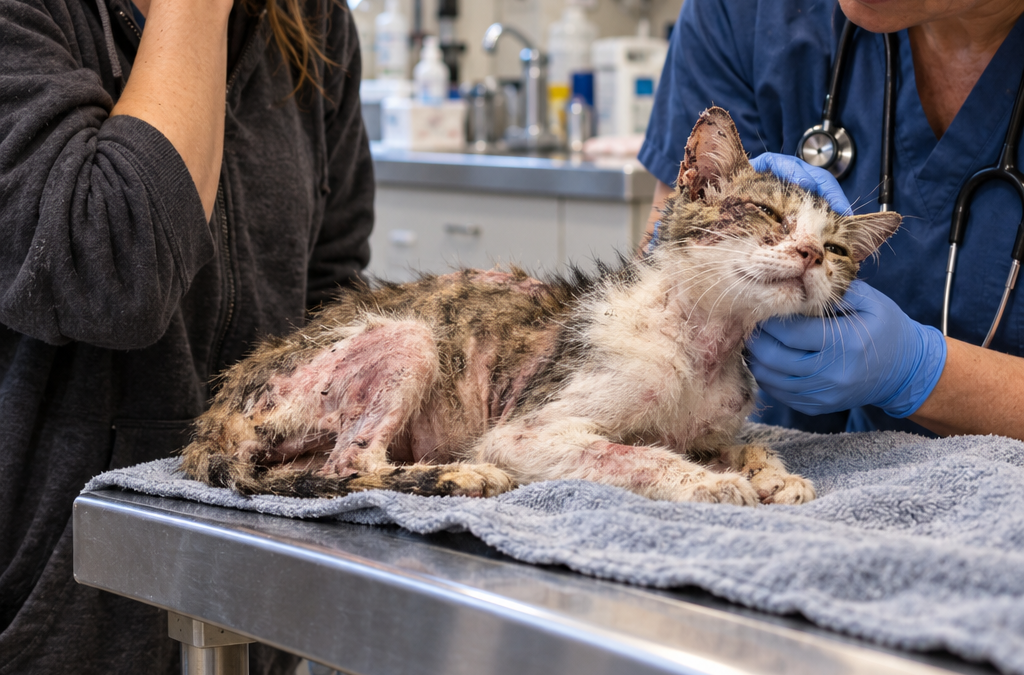
At the clinic, the veterinary team moved with the kind of gentle urgency I have come to recognize. Nobody gasped. Nobody said the awful things people sometimes say when they see an animal in terrible condition. They simply prepared the exam room, warmed a towel, and let me open the carrier slowly.
Jasper did not come out on his own.
I reached in with both hands, moving as carefully as I could.
His body weighed almost nothing.
That is what I remember most from that first moment holding him.
Not the skin.
Not the crusts.
The weight.
Or rather, the absence of it.
A cat should have substance. Warmth. Resistance. A shape that pushes back against your hands.
Jasper felt like something made of bones, fragile breath, and exhaustion.
I placed him on the exam table. He crouched immediately, trying to make himself invisible against the towel.
The veterinarian, Dr. Ellis, examined him with slow hands.
Severely underweight.
Dehydrated.
Skin infection.
Inflamed eyes.
Ear crusting.
Possible mange.
Secondary infections.
Poor muscle condition.
Evidence of prolonged neglect or prolonged life outdoors without care.
Every word was clinical.
Every word had weight.
Nobody could tell me exactly how long he had been living that way.
Weeks.
Months.
Long enough.
I kept thinking about all the roads he might have crossed. All the porches he might have hidden under. All the people who might have seen a flash of his damaged body and looked away because looking closer would have required action.
That thought is dangerous.
If you let yourself think too long about everyone who did not stop, anger can swallow the energy you need for the one who finally did.
So I tried to focus on the now.
Michael had stopped.
I had come.
Dr. Ellis was here.
Jasper was on a warm towel instead of cold dirt.
That had to count for something.
Then, during the exam, Jasper did something none of us expected.
He purred.
At first, I thought I imagined it.
The sound was so small it seemed impossible that it could come from a body so tired. A fragile vibration under Dr. Ellis’s fingers as she gently stroked the top of his head.
She froze.
“Is he purring?”
I leaned closer.
There it was.
Soft.
Uneven.
Real.
This tiny, wounded, half-starved cat, who had every reason in the world to fear human hands, was purring while someone touched him gently.
I had to turn away.
There are moments in rescue that are harder than the suffering itself.
Not because they are ugly.
Because they are beautiful in a way you are not ready for.
I could handle his thin body.
I could handle the medications.
I could handle the baths, the cleaning, the vet bills, the long instructions, the careful feeding schedule.
But that purr nearly broke me.
How can an animal who has received so little kindness still have so much trust left to offer?
How can a creature treated as disposable still recognize gentleness when it finally arrives?
I did not know.
I still do not.
Dr. Ellis looked at me.
“He’s very sick,” she said.
“I know.”
“But he’s responsive. He’s eating. That matters.”
“What are his chances?”
She took a breath.
“With care? Better than they looked in the photos.”
That was enough.
Better was enough.
I brought Jasper home that evening with medication, special food, eye ointment, skin treatment, and a long list of instructions that covered nearly the entire kitchen counter when I spread everything out.
My spare bathroom became his recovery room.
I chose it because it was quiet, warm, and easy to clean. I placed soft blankets on the floor and made a bed in the corner. I kept his food and water only a few steps away because, in the beginning, even crossing the room seemed exhausting for him.
When I opened the carrier, he did not come out.
I sat on the floor a few feet away and waited.
That became the first rule of Jasper.
Wait.
Do not rush the cat who has only known urgency, fear, and hunger.
Do not force trust from an animal who has had so many reasons to distrust.
Do not make your need to comfort him more important than his need to feel safe.
So I waited.
After nearly twenty minutes, he placed one paw outside the carrier.
Then another.
His legs trembled.
He sniffed the blanket.
Looked at the food bowl.
Looked at me.
I looked away, pretending not to watch.
That mattered too.
Sometimes the kindest thing you can do for a frightened animal is not stare.
He took one step.
Then another.
Then he reached the food bowl and began to eat.
Not normally.
Not hungrily in the ordinary sense.
Desperately.
As if the bowl might vanish between bites.
As if a hand might come down and take it away.
As if food were not nourishment but a race against loss.
I sat on the bathroom floor and cried silently while he ate.
For several days, our whole world became very small.
Jasper and me.
Medicine.
Food.
Fresh blankets.
Quiet words.
Warm water.
Vet updates.
Soft towels.
Waiting.
Every few hours, I offered another small meal. Too much too fast would be hard on his system, so I had to feed him carefully, even though every part of me wanted to give him all the food in the world at once.
He hated the eye ointment.
He tolerated the skin treatments.
He accepted the medication with the weary dignity of a tiny old man who disapproved of everyone but lacked the energy to file a formal complaint.
At first, he did not seek comfort.
He allowed care.
There is a difference.
He watched me with those painful, narrowed eyes, tracking every movement. If I stood too quickly, he flinched. If the door opened too fast, he pressed himself into the corner. If I reached over him instead of beside him, his whole body stiffened.
So I learned his rules.
Approach low.
Move slowly.
Speak before touching.
Let him smell the spoon.
Let him see the towel.
No sudden sounds.
No surprise hands.
No taking the bowl away while he watched.
I narrated everything.
“Medicine time, Jasper.”
“Fresh blanket.”
“Just cleaning your eyes.”
“I know, sweetheart. I know.”
“You’re safe.”
At first, I said it for him.
Eventually, I realized I was saying it for myself too.
You’re safe.
You’re safe.
You’re safe.
There are some promises you make before you know whether the body can keep them.
One afternoon, something tiny happened that probably would not mean much to anyone else.
Jasper left food in his bowl.
Not a lot.
Just a little crescent of wet food pressed against the edge.
I saw it when I came in to check on him, and I stopped in the doorway.
For days, he had eaten every molecule I gave him. Licked the ceramic clean. Checked it again. Sat beside it afterward with that same heartbreaking vigilance Michael had photographed.
But that day, he had left some.
I stared at the bowl.
Then at him.
He was curled on his blanket, watching me.
I smiled so hard my face hurt.
“Look at you,” I whispered. “You believe me.”
It was not about fullness.
It was about trust.
For the first time in who knew how long, Jasper was beginning to understand that food was not a one-time event. There would be more later. He did not have to finish everything. He did not have to panic. Hunger was no longer in charge.
That little bit of food left behind felt like a miracle.
Not the loud kind.
The real kind.
The kind built out of repeated safety.
A few days later came another victory.
I opened the bathroom door in the morning and found two eyes looking back at me.
Open.
Not completely healed.
Still irritated.
Still fragile.
But open.
Jasper was sitting upright on his blanket, paws tucked under his thin chest, looking directly at me.
For a moment, I could not speak.
Then I whispered, “Good morning, beautiful.”
He blinked slowly.
A slow blink from a cat is not a small thing.
It is a door cracked open.
I sat down beside him and cried.
Jasper watched me with what I can only describe as mild concern, as if he had survived starvation and skin disease only to discover his caretaker was emotionally unstable.
Fair enough.
Days became weeks.
His skin slowly began to heal.
The crusts softened and disappeared.
The raw patches calmed.
Soft fur started to grow where there had once been irritated skin. At first, it came in like peach fuzz, uneven and delicate. Then thicker. Warmer. His body began to fill out. His spine softened under my hand. His hips became less sharp. His steps grew steadier.
He began exploring the bathroom.
This was a major expedition in Jasper’s mind.
The bath mat was inspected.
The cabinet was suspicious.
The toilet was ignored with the disdain it deserved.
The laundry basket became, for reasons known only to him, an object of deep study.
Then one morning, he batted at the drawstring of my sweatpants.
It was the first time I saw him play.
Barely.
One weak little paw tap.
Then another.
Then he looked shocked at himself, as if some kitten hidden deep inside him had made an unauthorized appearance.
I laughed.
He froze.
I stopped immediately.
“Sorry,” I whispered. “You’re just very cute.”
He considered this.
Then tapped the string again.
That was the beginning of Jasper returning to himself.
Or maybe becoming himself for the first time in a life safe enough to allow personality.
He was not the broken little animal I first carried through my door.
He was curious.
Stubborn.
Affectionate on his own schedule.
Suspicious of closed doors.
Deeply offended by late breakfast.
He developed opinions.
Strong ones.
He liked the blue blanket but not the gray one.
He preferred chicken flavor unless turkey was offered, in which case he suddenly became a starving Victorian orphan.
He did not appreciate being told no, even when “no” involved climbing into the bathroom sink while the faucet was running.
Eventually, I opened the bathroom door and let him explore the hallway.
He stepped out like a tiny king entering disputed territory.
Every few feet, he stopped and looked back at me.
Not asking permission.
Checking that I was still there.
“I’m here,” I said each time.
He discovered the living room that day.
Then the couch.
The couch changed everything.
Jasper climbed onto it with great effort, turned in a slow circle, and lowered himself onto a pillow with the expression of a cat who had just discovered that civilization had been keeping secrets from him.
From that moment on, the couch belonged to Jasper.
Then my bed.
Then the windowsill.
Then every blanket, pillow, folded towel, and warm patch of sunlight in the house.
I had intended to keep him contained until he was stronger.
Jasper had apparently intended to claim all available territory and establish legal ownership through aggressive napping.
He won.
I happily allowed it.
As the weeks passed, people began asking when he would be ready for adoption.
That was always the plan.
I fostered.
I helped animals recover.
Then I found them permanent homes.
That was the agreement I had made with myself.
It is a necessary agreement.
If you keep everyone, you eventually cannot help anyone new.
I knew this.
I believed this.
I repeated it often.
“Jasper is temporary.”
“He just needs to heal.”
“When he’s ready, we’ll find him the perfect family.”
I said these things while preparing his medication.
While washing his blankets.
While buying him a soft bed he did not use because he preferred my laundry.
While waking at 6:00 a.m. because he had discovered breakfast could be demanded through a combination of staring, chirping, and stepping directly onto my ribcage.
Temporary.
Of course.
One evening, I sat on the floor looking through the photographs from the day he had been found.
I do not know why I did it.
Maybe because when an animal heals slowly in front of you, memory becomes unreliable. You begin to forget how bad it was. The mind softens the edges. The healthy cat purring beside you makes the sick cat in the photos feel impossible.
But there he was on my phone.
Thin.
Raw.
Crusted.
Eyes nearly closed.
Sitting beside that empty food bowl.
Waiting.
As I stared at the picture, Jasper walked over from the couch.
He was stronger by then, fur growing in soft patches across his body, tail held with cautious dignity.
Without hesitation, he climbed into my lap.
Not beside me.
Into my lap.
He curled himself against my chest and began to purr.
A deep, steady purr now.
Not the fragile thread from the exam room.
A sound that filled the space between us.
I looked at the photograph.
Then down at him.
In that picture was an animal who looked as though the world had forgotten he existed.
In my arms was a cat sleeping so deeply he did not even flinch when I shifted.
He finally felt safe enough to sleep without fear.
I pressed my face into his growing fur and cried.
Jasper, by then accustomed to my emotional limitations, continued sleeping.
The adoption post remained unwritten.
I opened my laptop several times.
“Meet Jasper…”
Delete.
“Jasper is looking for his forever home…”
Delete.
“After an incredible recovery, this sweet boy is ready…”
Delete.
Each attempt felt wrong in my body before my mind would admit why.
One night, I sat at the kitchen table with the laptop open while Jasper slept beside me, one paw stretched across my leg like he had anchored himself there.
The cursor blinked.
Meet Jasper.
I looked at him.
He was on his back, belly exposed, mouth slightly open, one ear twitching in a dream.
A cat does not sleep like that in a place he considers temporary.
A cat does not give you the softest part of himself unless some deep instinct has decided you are safe.
I closed the laptop.
The truth felt embarrassingly obvious.
I was not looking for Jasper’s forever home.
He was already in it.
Somewhere between the medications and the small meals, the fresh blankets and the vet visits, the bathroom floor and the slow blinks, something had changed.
Jasper was no longer a cat I was helping.
He was family.
Maybe I had rescued him.
But somewhere along the way, he had quietly claimed a piece of my heart and settled there like he had always intended to stay.
The first time I said it out loud, I was at the vet for a follow-up appointment.
The technician smiled at him.
“He looks amazing. Has he got any adoption interest yet?”
I opened my mouth.
The old answer waited.
Not yet.
Soon.
We’re working on it.
Instead, I said, “He’s staying with me.”
The words came out simple.
Final.
The technician grinned.
“Foster fail?”
I looked at Jasper, who was glaring at a jar of cotton balls as though it had personally insulted him.
“Something like that.”
But it did not feel like failure.
It felt like recognition.
Today, Jasper stretches across my bed like a cat who has never known an uncomfortable day in his life.
He complains when breakfast is late.
He steals my spot on the couch.
He follows me from room to room with the firm belief that privacy is unnecessary and closed doors are a violation of his rights.
He has grown soft and warm.
His eyes are clear.
His fur, though still a little patchy in places, has filled in enough that strangers would never know what he looked like when he first arrived.
Sometimes, when he sleeps beside me, I look at the old photographs.
It is difficult to believe they are real.
That broken creature beside the empty bowl.
That fragile body curled in the corner of the carrier.
That tiny purr in the exam room.
And then I look at Jasper now, draped across my blanket, whiskers twitching, paws relaxed, completely certain that tomorrow will bring breakfast, warmth, and someone who comes when he calls.
People sometimes ask me, “How did you save him?”
I never know how to answer.
Because there was no single magical moment.
No miracle cure.
No instant transformation.
There was only one person who stopped.
One bowl of food.
One carrier.
One veterinarian.
One safe room.
One meal after another.
One dose of medicine after another.
One clean blanket after another.
One gentle touch after another.
One frightened animal slowly learning that tomorrow was not something he needed to fear.
That is the part of rescue people do not always see.
They see the before and after photos.
They see the dramatic contrast.
They see the cat who once looked dying now curled on a velvet blanket, bright-eyed and adored.
But healing lives in the middle.
In the messy, repetitive, unglamorous middle.
The alarms set for medication.
The laundry.
The vet bills.
The worry when they do not eat enough.
The victory when they do.
The first time they play.
The first time they sleep.
The first time they leave food in the bowl because hunger is no longer the ruler of their world.
Jasper did not need someone to change the entire world.
He needed someone to change his.
And maybe that is what I will remember forever.
The night I first heard about Jasper, I thought I was going to help a dying stray cat.
I thought I was giving him a second chance.
I had no idea that months later, he would be sleeping beside me as if that had always been exactly where he belonged.
I thought I was saving Jasper.
But in the end, we simply found each other.








