I Was the Homeless Kid Hiding Beneath the Bridge When the Sheriff Threw a Stranger Into the River—By Nightfall, 200 Bikers Were Looking for Me
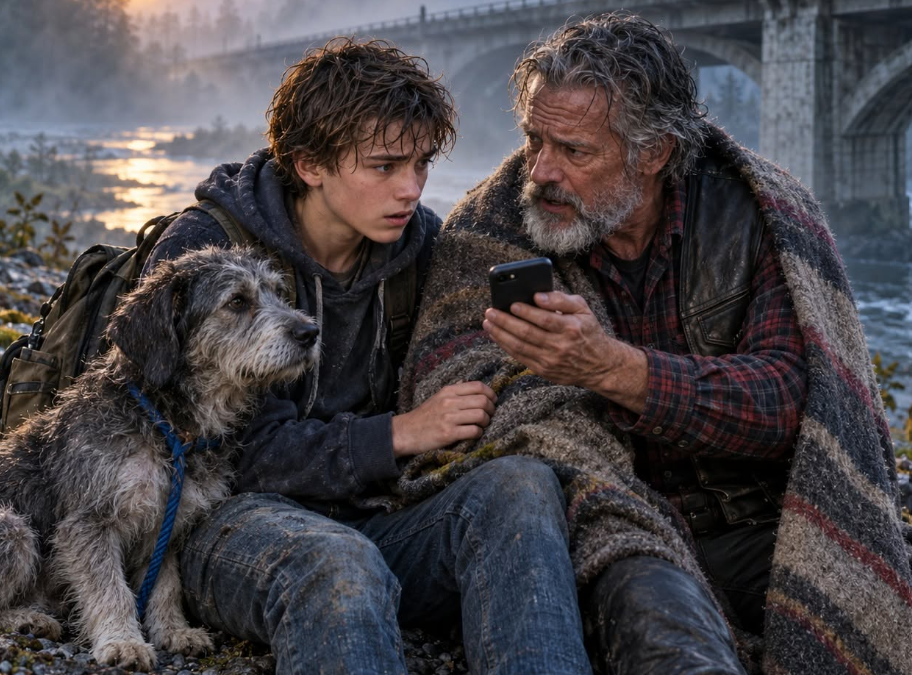
I Was the Homeless Kid Hiding Beneath the Bridge When the Sheriff Threw a Stranger Into the River—By Nightfall, 200 Bikers Were Looking for Me
I watched the sheriff shove a gray-bearded stranger into a swollen Oregon river, and for three terrible seconds, I decided to stay hidden and let the current take him.
I was sixteen, homeless, carrying thirty-two dollars to my name, and sleeping beneath Mercer Bridge with a limping dog nobody else wanted.
Then the stranger disappeared beneath the water, and I remembered exactly how it felt when adults saw something wrong happening to me and chose to look away.
My name is Caleb Turner.
That October, I was living beneath a bridge outside Alder Falls, Oregon.
Six weeks earlier, I had walked out of a foster home with one backpack and a split lip.
I had tried telling a teacher about that house once.
She called someone.
A man came.
My foster father smiled through the entire interview.
Afterward, I learned what happened when you embarrassed him.
So I stopped telling.
Under Mercer Bridge, I found a dry concrete ledge.
Three nights later, a gray dog found me.
His back leg dragged when he walked.
A frayed blue rope hung around his neck.
No collar.
No owner.
I shared half a convenience-store sandwich with him.
After that, he slept against my ribs every night.
I called him Blue.
We survived on returned cans and leftovers from a diner where a waitress named Marlene quietly left food near the back door.
She pretended it was for stray cats.
She never asked why her stray cat needed a plastic fork.
Sheriff Warren Pike noticed me during my second week.
“You need to keep moving.”
I nodded.
His eyes shifted toward Blue.
“Dog disappears, don’t come crying to me.”
After that, I learned Pike’s schedule.
Then one wet morning, tires crunched across the gravel above my sleeping place.
I covered Blue’s muzzle before he could bark.
Two voices.
One hard.
One quiet.
I crawled toward the blackberry bushes.
Pike stood beside an older biker.
Gray beard.
Leather vest.
One arm held stiff against his body.
“You should’ve left it alone,” Pike said.
Then the biker went over the embankment.
Pike watched him fall.
Then drove away.
The stranger surfaced once.
Went under.
And I froze.
Nobody knew I was there.
I could grab my backpack.
Take Blue.
Disappear.
Then I remembered all the people who had done exactly that when I needed help.
So I tied Blue to the railing and ran downstream.
The river was freezing.
The current hit harder than I expected.
When I finally reached the man, he grabbed my sleeve in panic.
I got behind him.
Held his face above water.
Kicked toward a gravel shelf.
By the time we reached it, my legs were numb.
He coughed until he could speak.
“Did he see you?”
PART2:
I shook my head.
“Good.”
He pulled a phone from a waterproof pouch.
One favorite contact appeared at the top.
BEAR.
“Call him. Tell him Jonah’s alive.”
Bear answered on the second ring.
When I explained what happened, his voice changed.
“Stay with him, son. Help’s coming.”
Twenty minutes later, an ambulance arrived.
At the hospital, nurses wrapped me in heated blankets while Jonah disappeared behind a curtain.
Marlene promised she had Blue.
For the first time that day, I thought maybe I was safe.
Then I heard boots in the hallway.
A voice I knew.
“Where’s the runaway who called this in?”
Pike.
I slid off the hospital bed.
Reached for my wet shoes.
Too late.
The curtain opened.
Sheriff Pike stood there smiling.
Handcuffs hanging from one hand.
“Your foster father says you’re a liar, Caleb.”
My stomach dropped.
He stepped inside.
“Now tell me what you think you saw.”
What Pike didn’t know was that Bear had already made one phone call of his own.
And across western Oregon, two hundred motorcycles were beginning to move.








