I Was Sent to Break Up 40 Bikers Outside a Dying Girl’s Home—Then I Saw Every One of Them Pushing Their Harleys Uphill in Silence
I Was Sent to Break Up 40 Bikers Outside a Dying Girl’s Home—Then I Saw Every One of Them Pushing Their Harleys Uphill in Silence
I Was Sent to Break Up 40 Bikers Outside a Dying Girl’s Home—Then I Saw Every One of Them Pushing Their Harleys Uphill in Silence
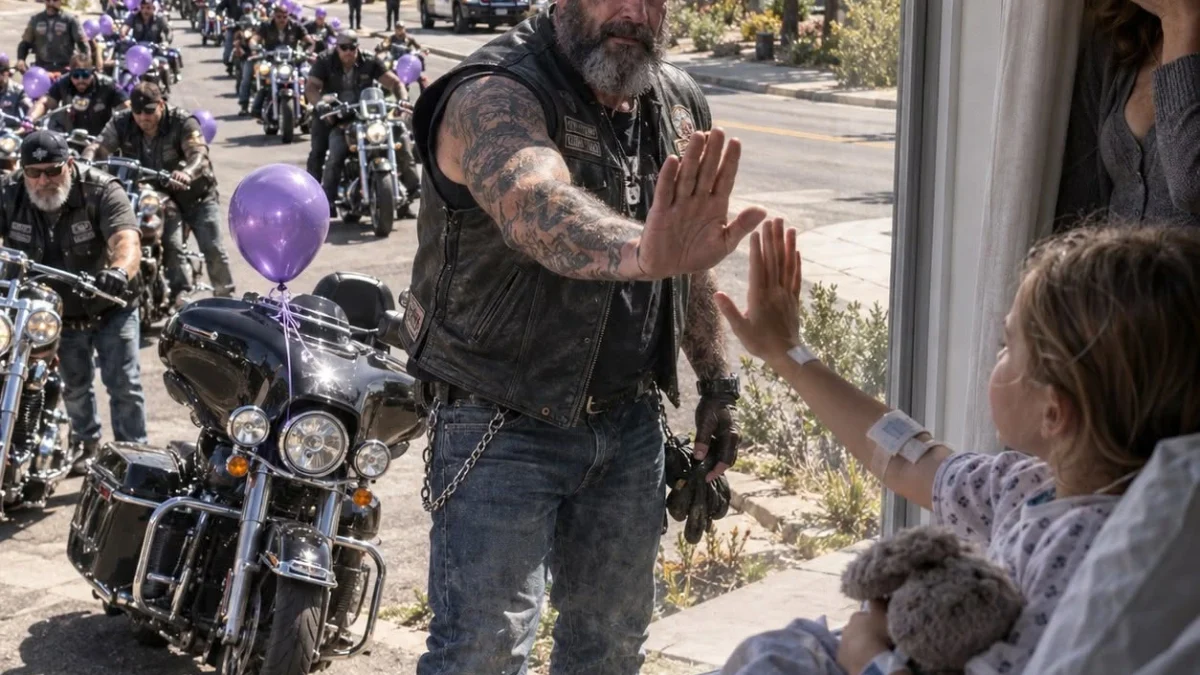
The complaint said forty bikers were terrorizing a quiet Arizona neighborhood, but when I arrived, every engine was off and every rider was pushing his Harley uphill by hand.
They looked exactly like the kind of men people judged from a distance—tattoos, leather cuts, scarred hands, heavy boots—but not one of them made a sound near the window of a terminally ill nine-year-old girl.
I thought I had been dispatched to stop a disturbance, until I discovered the only thing those bikers had come to do was fulfill a child’s final wish without hurting her head.
My name is Marcus Bell.
I was forty-eight and a patrol sergeant with the Flagstaff Police Department.
That morning, dispatch called about a “large motorcycle gang” entering Willow Ridge.
Forty riders.
Possible blocked access.
Residents frightened.
Neighborhood association president demanding immediate removal.
I expected engines.
Revving.
Arguments.
Maybe forty men standing around motorcycles while homeowners filmed from porches.
Instead, I turned into Willow Ridge and almost stopped my cruiser in the middle of the road.
Forty motorcycles were moving uphill.
Silently.
Not riding.
Being pushed.
Every engine was off.
At the front was Ray “Hammer” Dawson, president of the Iron Saints Motorcycle Club.
Six-foot-four.
Nearly 285 pounds.
Shaved head.
Gray-black beard.
Tattooed arms.
A man who looked capable of moving a wall if he got angry enough.
That morning, he was bent over the handlebars of a loaded touring Harley, pushing nearly a thousand pounds of steel uphill one painful step at a time.
Behind him, older bikers struggled on bad knees.
Younger riders walked beside them in case a bike tipped.
Each motorcycle carried one small balloon.
Purple.
Blue.
Yellow.
White.
Pink.
No banners.
No music.
No yelling.
Just forty men pushing forty motorcycles uphill.
Then a woman in a cream coat hurried toward me.
“Sergeant, you need to remove them.”
She introduced herself as Cynthia Hale, president of the Willow Ridge Neighborhood Association.
“Are they threatening anyone?” I asked.
“They were told not to come.”
“Are they blocking emergency access?”
“They’re creating an image.”
I looked at the silent procession.
Not a hazard.
Not violence.
An image.
That was when I remembered who lived at the top of the hill.
Emma Quinn.
Nine years old.
Pediatric hospice.
Our department had already been instructed to avoid sirens near her house whenever possible.
That detail hit harder than most people would understand.
My own daughter had survived chemotherapy six years earlier.
Once you’ve slept in a plastic hospital chair beside your child, the words sick kid never sound ordinary again.
I walked toward Hammer.
He raised one fist.
Forty bikers immediately stopped.
No one argued.
No one surrounded me.
Every hand remained visible.
“You in charge?” I asked.
“Supposedly.”
“You have permission from Emma’s family?”
PART2:
Hammer reached into a saddlebag.
What he handed me wasn’t some improvised biker plan.
There was hospice approval.
Emergency-access paperwork.
Insurance.
A route map.
Contact numbers.
Then a folded letter written in purple marker.
It was from Emma.
Dear Mr. Hammer,
My dad says you know motorcycles.
I have been sick for forty weeks. I counted.
I want to see forty motorcycles go past my window because motorcycles sound like storms that know where they are going.
But if my head hurts, please make them quiet.
I still want to see them being strong.
At the bottom, Emma had drawn forty motorcycles.
Most looked like potatoes with wheels.
I had to look away for a second.
Then I noticed Cynthia staring at the letter.
She wasn’t moved.
She looked angry.
“You still have to stop this,” she said.
I folded Emma’s letter carefully.
“Why?”
Cynthia glanced toward the little girl’s house.
Then toward the bikers.
And the answer she gave me finally explained why forty grown men had shut off their engines three blocks away—
and why someone had been fighting so hard to keep Emma from seeing them at all.








