I Was Minutes From Euthanizing the Cat Who Saved Me After My Wife Died—Then He Heard Me Scream From the ICU
PART3:
Come sit in my kitchen because the clock sounds too loud?
Tell me why a man should plant another crop when the only person who cared how it turned out is buried six miles away?
So I didn’t call.
I stopped going to church.
Stopped going into town unless necessary.
Stopped shaving every day.
Some mornings, I sat on the side of my bed for forty minutes because getting dressed felt like agreeing to another whole day.
Buster changed that.
Not in some beautiful, inspirational way.
He annoyed me into functioning.
At 5:17 every morning, he stood on my chest.
Twenty-two pounds of cat.
No respect for grief.
No patience for existential despair.
If I didn’t move, he put one paw on my mouth.
The first time he did it, I shoved him off the bed.
“You trying to kill me?”
He hit the floor, turned, and yelled.
Buster had a terrible voice.
Deep.
Ragged.
Like a rusty barn hinge arguing with a chainsaw.
“Food?”
Another yell.
“Fine.”
That became our routine.
Feed Buster.
Make coffee.
Walk to the barn.
Check the weather.
Check equipment.
Do one thing.
Then another.
Grief makes the future impossible.
Animals reduce life to the next necessary task.
Fill the bowl.
Open the door.
Clean the litter box.
Let him back inside.
Move because something depends on you.
By the first anniversary of Ellen’s death, Buster had become my shadow.
He rode in the passenger seat of the farm truck.
Slept on feed sacks.
Hunted mice with the enthusiasm of a much smaller animal.
Followed me along fence lines.
Sat in Ellen’s old garden while I pulled weeds I barely cared about.
And every evening, he climbed onto the porch swing.
Her side.
Always her side.
I took mine.
Sometimes I talked to him.
“Your mother would hate how fat you’re getting.”
Buster licked himself.
“She would’ve made me take you to a vet the first week.”
Nothing.
“She would’ve said your ear needs cleaning.”
He looked at me.
“Don’t look at me like that. I’m not touching it.”
I touched it eventually.
Five years went by.
I never stopped missing Ellen.
That’s not how loss works.
You don’t move on from a marriage that long.
You build around the hole.
Buster became part of what I built.
Then came that Tuesday.
Harvest season.
October.
Clear morning.
Cold enough to see my breath before sunrise.
I’d been awake since four.
The south field needed finishing before rain arrived Wednesday night.
One of my hired hands had called in sick.
The grain elevator was backing up.
Everything felt late.
Everything felt urgent.
And my truck brakes had been soft for weeks.
I knew it.
I had even mentioned it to Ray Collins at the feed store.
Ray said, “Get those brakes looked at.”
I said, “After harvest.”
He said, “That’s what idiots say before funerals.”
I told him to mind his own business.
That sentence came back to me later.
The truck was an old Ford F-250.
Blue originally, although rust had taken enough of the body that color was becoming theoretical.
It had nearly three hundred thousand miles on it.
Ellen hated the thing.
“You’re going to die in that truck,” she used to say.
She was almost right.
Just not the way either of us imagined.
That morning, I loaded tools behind the seat.
Buster had been following me around the yard.
I remember seeing him near the barn.
Then I forgot about him.
That’s the part I replay.
The forgetting.
He was always there.
So familiar my brain stopped registering him as something I could lose.
I climbed into the truck.
Started the engine.
Put it in reverse.
The brake pedal felt soft.
I knew.
I knew.
I still backed up.
The truck rolled.
I tapped the brake.
Nothing much.
Pressed harder.
The pedal sank.
I panicked and hit the gas by mistake for half a second.
Then came the thud.
Not loud.
That’s what surprised me.
The sound that destroyed everything wasn’t dramatic.
A dull bump underneath the rear wheel.
I stopped.
My stomach knew before my mind did.
“No.”
I threw the door open.
Buster lay behind the truck.
The world became silent.
I could see his front legs.
His head.
His back half lay wrong.
He wasn’t screaming.
God, I wish he had screamed.
He looked at me.
Green eyes enormous.
Confused.
Terrified.
I dropped beside him.
“Buster.”
His mouth opened.
No sound.
“No, no, no.”
I touched his head.
He tried to pull forward with his front legs.
His back legs didn’t move.
Something inside me broke.
“I’m sorry.”
I kept saying it.
“I’m sorry. I’m sorry.”
He stared at me.
And I knew exactly what I’d done.
My stubbornness.
My cheapness.
My stupid belief that every repair could wait until convenient.
I had run over the animal that trusted me enough to sleep underneath my truck.
I slid my coat beneath him.
Lifted.
He cried then.
One short sound.
I nearly dropped him.
“I’m sorry, buddy.”
I put him on the passenger seat.
Ellen’s old quilt was behind it.
I wrapped him.
Then I drove.
The local vet took one look and sent me to the state university emergency clinic ninety minutes away.
I made it in sixty-eight.
I don’t remember most of that drive.
I remember Buster breathing.
That’s all.
I kept one hand on him whenever the road was straight.
“Stay.”
I said it again and again.
“Stay with me.”
At one point I realized those were almost the exact words I’d said to Ellen during her final night.
Stay.
As if love gives orders death must obey.
At the university clinic, people moved fast.
Gurney.
Questions.
Forms.
“Trauma?”
“Truck.”
“How long ago?”
“Maybe twenty-five minutes.”
“Conscious?”
“He was.”
“Owner?”
“Me.”
They took him away.
A young technician guided me into a waiting room.
I had blood on my sleeve.
Buster’s blood.
I stared at it until the pattern stopped looking real.
Two hours later, a veterinarian named Dr. Rachel Patel sat across from me.
She couldn’t have been much older than forty.
Small woman.
Dark hair pulled back.
Eyes that had delivered bad news too many times.
“Mr. Hensley.”
“Walter.”
“Walter.”
She placed scans on a screen.
I understood almost none of what I saw.
“This is Buster’s lower spine.”
I leaned forward.
“There are multiple fractures.”
“Fix them.”
She paused.
“There’s significant compression and trauma to the spinal cord.”
“Then operate.”
“We also have concerns about head trauma.”
“He didn’t hit his head.”
“We can’t be sure.”
She pointed at another image.
“His neurological responses are very poor.”
My mouth went dry.
“How poor?”
“Severe.”
“Is he dying?”
“He’s unstable.”
“That’s not what I asked.”
Dr. Patel sat back.
“Walter, I need to be very honest with you.”
I hated her before she spoke.
Not personally.
Because I knew what honesty meant in rooms like this.
“We may not be able to restore meaningful neurological function.”
“May not.”
“Correct.”
“So you don’t know.”
“We don’t know with certainty.”
“Then treat him.”
She took a breath.
“Treatment would be extensive.”
“Treat him.”
“Potential surgery. Intensive care. Assisted ventilation if his respiratory function worsens. Feeding support.”
“Do it.”
“Costs could be considerable.”
“Do it.”
“And even with aggressive treatment, he could remain paralyzed.”
“I said do it.”
Her expression changed slightly.
Not annoyance.
Concern.
“For him?”
“For what?”
“Are you doing this for him?”
That made me angry.
“You think I’m trying to torture my cat?”
“No.”
“Then what are you asking?”
“I’m asking whether you understand that keeping an animal alive medically and preserving a life he can experience are not always the same thing.”
I stood.
“I understand I ran him over.”
“Walter—”
“I understand he trusted me.”
“I know.”
“No, you don’t.”
My voice shook.
“He showed up the day after I buried my wife.”
Dr. Patel didn’t interrupt.
“He kept me alive.”
I pointed toward the ICU doors.
“So if there’s one chance in a thousand he comes back, you take it.”
She studied me.
“One chance in a thousand may not be an accurate number.”
“I don’t care.”
“Walter.”
“I don’t care what it costs.”
“Your consent isn’t the only issue. We have to consider suffering.”
“Is he suffering now?”
“He’s heavily sedated.”
“Then treat him.”
She was quiet.
Finally:
“We can stabilize and reassess.”
“Good.”
I drove directly from the clinic to my bank.
The branch manager knew me.
Small town.
Everyone knows everyone until you wish they didn’t.
“Walter, is everything okay?”
“No.”
I withdrew money from an account Ellen and I had built for retirement.
Not all of it.
At first.
Enough to cover the initial estimate.
Then came another estimate.
Surgery.
ICU.
Ventilator.
Specialists.
I signed.
Every time.
At the feed store, word spread.
Ray confronted me near the seed counter.
“Thirty thousand?”
“Who told you?”
“Nobody needs to tell me. Everybody knows.”
“Then everybody needs a hobby.”
He lowered his voice.
“Walt, that’s a cat.”
I turned.
“Don’t.”
“I’m your friend.”
“Then act like one.”
“I’m trying.”
“No. You’re trying to tell me what my money should mean.”
Ray’s jaw tightened.
“You spent your whole life working that farm.”
“And?”
“Ellen would skin you alive.”
That stopped me.
“Don’t use my wife.”
“I’m saying she wouldn’t want you bankrupting yourself.”
“You don’t know what she’d want.”
“I knew her forty years.”
“Not like I did.”
Silence.
Ray looked away.
He was a large man with hands like fence posts.
We’d been friends since high school.
He’d helped carry Ellen’s casket.
That should have made me gentler.
It didn’t.
“You farmers love talking about responsibility,” I said.
“Yeah.”
“Well, this is mine.”
Ray’s eyes returned to mine.
“It was an accident.”
“It was negligence.”
“Same truck you been driving twenty years?”
“I knew the brakes were bad.”
He said nothing.
“I knew.”
That landed.
I left.
Week one passed.
Buster survived the surgery.
Barely.
His spine was stabilized.
The damage to the spinal cord remained.
Then his breathing worsened.
Ventilator.
Feeding tube.
Neurological tests.
Minimal responses.
I visited every day.
The drive took ninety minutes each way.
I didn’t care.
Harvest stopped mattering.
Ray and two other farmers quietly finished my south field.
I found out afterward.
Nobody asked permission.
I intended to yell.
Didn’t.
Every morning at the clinic, I sat beside Buster’s cage.
He looked enormous even sick.
Golden fur shaved in patches.
Tubes.
Bandages.
Machines.
I read him the agricultural newspaper.
Corn prices.
Weather.
Equipment auctions.
County fair results.
Anything.
“Bunch of nonsense today.”
No response.
“Soybeans are down.”
Nothing.
“Ray says he finished the south field crooked.”
Nothing.
“I told him you could drive straighter.”
Nothing.
Day ten.
Day fifteen.
Day twenty-one.
No meaningful neurological improvement.
Dr. Patel began sitting with me longer.
She never pressured.
That was somehow worse.
“Walter, we need to keep evaluating whether continued treatment is in Buster’s interest.”
“He’s stable.”
“Medically.”
“That’s good.”
“Not necessarily enough.”
I hated that sentence.
By week four, the nurses knew me.
Megan brought coffee.
Luis found an old chair with better back support.
A veterinary student named Chloe started leaving the agricultural newspaper in Buster’s room before I arrived.
People were kind.
Kindness can be unbearable when you know what they’re preparing you for.
At night, I returned to the farmhouse.
Empty.
More empty than after Ellen died.
Because now I had learned the rooms could lose again.
Buster’s dish remained beside the refrigerator.
His hair remained on the couch.
His toy mouse lay under the table.
I slept badly.
Sometimes I heard him jump off the windowsill.
I’d sit up.
Nothing.
On day thirty-one, Dr. Patel showed me his latest brain activity results.
“Very limited.”
“But not zero.”
“No.”
“So he’s there.”
“We don’t know what he’s experiencing.”
“But he’s there.”
“Possibly.”
“Then we wait.”
On day thirty-five, Ray came to the hospital.
I saw him through the ICU window and almost asked security to remove him.
He held two coffees.
“Peace offering.”
“I don’t want coffee.”
“Then hold it until you’re less mean.”
I took it.
We sat.
Buster lay behind glass.
Ray watched.
“He’s big.”
“Always has been.”
“He looks smaller.”
I hated him for saying it.
Then realized it was true.
Muscle wasting.
His body disappearing while machines preserved time.
Ray rubbed his hands over his jeans.
“I was wrong.”
I looked at him.
“About what?”
“Telling you what Ellen would’ve wanted.”
I said nothing.
“I don’t know.”
“No.”
“She probably would’ve yelled at both of us.”
That almost made me smile.
“Probably.”
Ray stared through the glass.
“But Walt.”
I knew.
“Don’t.”
“You look awful.”
“I said don’t.”
“You’re killing yourself.”
“I can spare the weight.”
“This isn’t a joke.”
“No.”
He leaned closer.
“How long?”
“As long as he needs.”
“What if he needs forever?”
I looked at Buster.
“I don’t know.”
That was the first time I admitted it.
Ray didn’t push.
He sat beside me for an hour.
Before leaving, he touched my shoulder.
“If you need me, call.”
I almost told him people always say that.
Instead:
“Thanks.”
By day forty, hope had changed shape.
At first it was bright.
Aggressive.
He’s coming back.
Then it became defensive.
You don’t know he won’t.
Then desperate.
One more day.
Then shameful.
What if I’m the one making him stay?
Day forty-one, Dr. Patel asked me into a consultation room.
No scans this time.
Just two chairs.
I knew.
“Walter, his body is weakening.”
I stared at the floor.
“He has developed another infection.”
“Antibiotics.”
“We’re giving them.”
“So give stronger ones.”
“It’s not that simple.”
“It never is with you people.”
She let that pass.
“His neurological status has not improved in six weeks.”
“He reacted last Tuesday.”
“A reflex.”
“You don’t know.”
“We can’t say it was conscious.”
“Then don’t say it wasn’t.”
She folded her hands.
“What would Ellen tell you?”
I snapped my head up.
“Don’t.”
“I’m not Ray.”
“How do you know about Ray?”
“You talk.”
I looked away.
“You’ve told Buster a lot.”
Embarrassing.
“Well?”
“I don’t know what Ellen would say.”
“Try.”
I hated her.
Because I knew the answer.
Ellen would look at Buster.
Not me.
She would ask whether I was keeping him alive because he needed the time.
Or because I needed forgiveness.
That night, I sat beside his cage until visiting hours ended.
I touched the fur between his ears.
“I don’t know what I’m doing.”
The ventilator breathed.
“I thought if I spent enough, prayed enough, sat here enough, I could make this fair.”
Nothing.
“You saved me.”
Machine hiss.
“I don’t know if you know that.”
His eyelids didn’t move.
“I was done after Ellen.”
My voice broke.
“Nobody knew.”
I had never said it out loud.
Not even to him.
“I had her pills.”
That confession came from somewhere dark.
The final month of Ellen’s illness, our bathroom cabinet was full of medication.
After she died, I had gathered bottles.
Morphine.
Pain medication.
Other things.
For two nights, I kept them on the kitchen table.
I had not made a plan exactly.
But I had sat there.
Thinking.
Then Buster showed up.
Needed food.
Then water.
Then a place inside.
Then tomorrow.
“I would’ve gone where she went.”
Tears fell onto his fur.
“You didn’t know.”
My hand shook.
“You were just hungry.”
The ventilator continued.
“But you made me get up.”
I bent over him.
“So how am I supposed to be the one who stops fighting for you?”
No answer.
That was the problem.
On day forty-two, I drove to the clinic knowing.
Not certain.
Knowing.
The sky was colorless.
Cold rain.
I parked badly.
Walked inside.
Megan at reception smiled, then saw my face.
“I need Dr. Patel.”
“She’s in rounds.”
“I need the form.”
Megan didn’t pretend not to understand.
Her expression softened.
“Walter.”
“The form.”
She came around the desk.
“Do you want someone with you?”
“No.”
“I can call Ray.”
“No.”
“You shouldn’t have to—”
“I said no.”
That was the last piece of stubbornness I had.
I wanted to do it alone.
Maybe because I believed I deserved to.
They gave me a clipboard.
EUTHANASIA AUTHORIZATION.
Clinical language.
Release.
Consent.
Disposition of remains.
Private cremation.
Communal cremation.
Return of ashes.
All those neat little boxes waiting to organize the destruction of my world.
I held the pen.
My hand shook.
I wrote W.
The pen tore the paper.
The receptionist looked at me.
I tried again.
Walter Hensley.
I made it to the signature line.
Then I saw a question.
Reason for euthanasia.
A blank space.
What was I supposed to write?
I ran him over.
I waited too long.
I spent too much.
I love him.
I failed him.
He saved me and I couldn’t save him.
Something came apart.
I threw the pen.
It bounced off the counter.
“Goddamn it!”
The lobby froze.
A woman holding a terrier turned.
A man with a carrier looked up.
Megan stood.
“Walter.”
“No.”
I hit the counter.
The sound cracked through the lobby.
“It’s not fair!”
“Walter, come with me.”
“I’ll sell the farm!”
My voice became a roar.
“I don’t care!”
People stared.
“I’ll sell every acre!”
Two security guards appeared from the hallway.
“Sir, you need to lower your voice.”
I turned on them.
“You tell them to wake him up!”
“Sir.”
“You tell those doctors I have money!”
One guard raised his hands.
“Nobody’s talking about money.”
“I don’t care what it costs!”
My face was wet.
I wasn’t aware I was crying until I tasted salt.
“I know I did it!”
The words echoed.
“I know it was my fault!”
Megan came toward me.
“Please.”
“I knew those brakes were bad!”
I slammed both hands on the counter.
“I knew!”
One guard stepped closer.
“Sir, if you can’t calm down—”
“Throw me out!”
“Walter!”
Dr. Patel’s voice?
No.
A nurse came running through the ICU doors.
Chloe.
She was pale.
“Dr. Patel!”
The doctor appeared behind her.
“What?”
“You need to come now.”
“What happened?”
“Buster.”
My body stopped.
“What?”
Chloe looked toward me.
Then back to Patel.
“His heart rate.”
Dr. Patel began moving.
“Arrhythmia?”
“No.”
“Pressure?”
“No, his EEG changed.”
Patel stopped.
“What?”
“Spiked.”
“When?”
“Just now.”
The nurse pointed toward the lobby.
“When he started yelling.”
Everybody looked at me.
I didn’t ask permission.
I pushed past the security guards.
One grabbed my arm.
Dr. Patel said, “Let him go.”
We ran.
I was seventy-two.
Had arthritis in both knees.
I ran anyway.
The ICU door felt too heavy.
Inside, monitors sounded different.
Fast.
Alive.
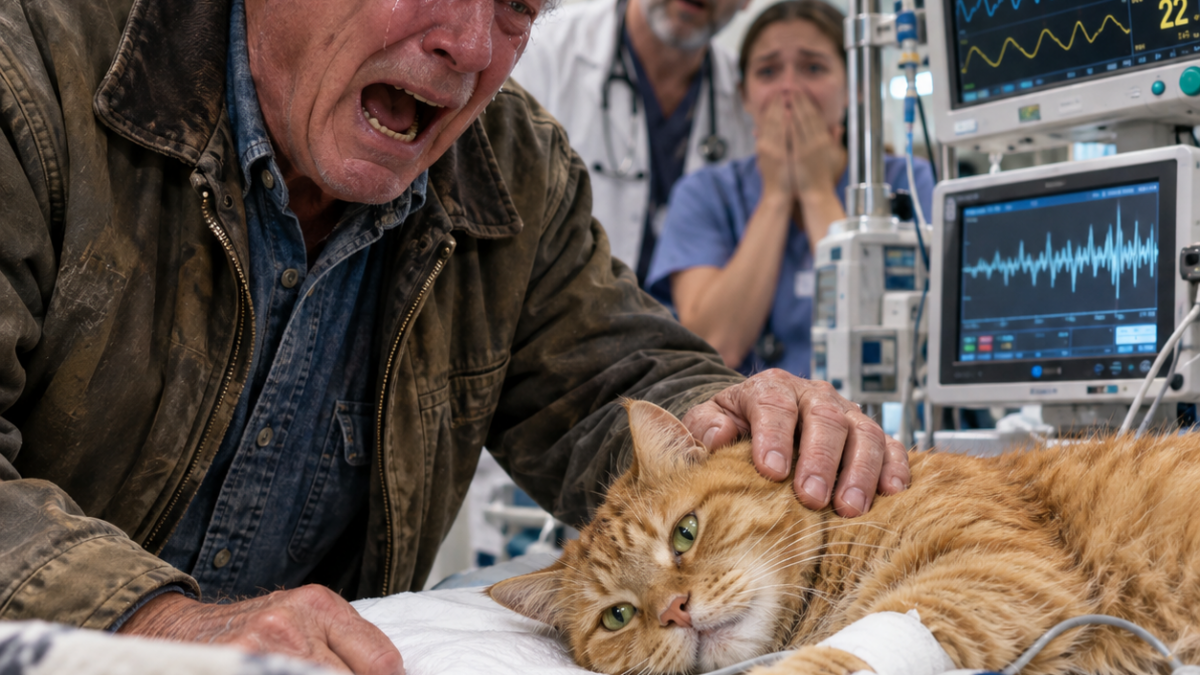
Buster lay there.
Same body.
Same tubes.
But the screen above him showed jagged movement.
Dr. Patel stared.
“Again.”
“What?”
She looked at me.
“Were you yelling?”
“What kind of question—”
“Talk to him.”
I approached the cage.
My legs nearly failed.
“Buster.”
Nothing obvious.
“Use the same voice.”
“What voice?”
“The voice you use outside.”
I understood.
The one Ellen called my bullhorn voice.
I put my hand on Buster’s head.
“HEY!”
The monitor jumped.
Everyone froze.
I stared.
“Buster!”
Another spike.
Dr. Patel moved closer to the screen.
“Again.”
My mouth went dry.
I bent toward him.
“You lazy son of a gun!”
Spike.
Megan covered her mouth.
I started crying.
“Barn’s full of mice!”
Spike.
“You hear me?”
His heart rate climbed.
Not dangerously.
Responsively.
“I’ve got Ray doing your job!”
Spike.
“He’s terrible at it!”
Somebody laughed behind me.
I barely heard.
“Buster.”
My voice broke.
“Come on.”
The lines moved.
Not reflex.
Not random enough.
Something.
Something was there.
I lowered my face to his.
“I need my partner back.”
The biggest change yet appeared on the monitor.
Dr. Patel whispered something I couldn’t hear.
“What does that mean?”
She didn’t answer immediately.
“What does it mean?”
“It means we wait.”
Three words.
For forty-two days, I’d hated that answer.
Now they felt like mercy.
I did not sign the form.
They increased neurological monitoring.
Reduced sedation further.
Repeated tests.
The clinic became careful about the word miracle.
Doctors are like that.
They prefer “unexpected response.”
“Significant neurological change.”
“Evidence of auditory processing.”
Fine.
Call it Tuesday.
I called it Buster hearing me.
The next twenty-four hours were torture.
His numbers improved.
Then flattened.
His eyelids fluttered once.
Nurse said maybe reflex.
I refused to fight her.
Day forty-three.
No eyes.
Day forty-four.
His front paw moved when I shouted.
Maybe reflex.
I didn’t care.
Day forty-five, at 6:12 in the morning, I had fallen asleep in the chair.
Megan touched my shoulder.
“Walter.”
I woke.
“What?”
She was crying.
I stood too fast.
“Buster?”
She pointed.
His eyes were open.
Both.
Cloudy.
Unfocused.
Open.
I stumbled toward the cage.
“Buster.”
His gaze wandered.
Stopped.
Maybe on me.
Maybe not.
I put my hand through.
He blinked.
Once.
Then again.
“Buster.”
His mouth moved around the tube.
No sound.
I sobbed.
Full ugly sobbing.
Dr. Patel came in.
Checked reflexes.
Light response.
Movement.
Brain activity.
She smiled.
First real smile I’d seen from her.
“He’s awake.”
I looked at her.
“Say it again.”
“He’s awake.”
I laughed.
Then cried harder.
The miracle was not complete.
That matters.
People like miracles clean.
Animal wakes.
Walks.
Music.
Credits.
Real miracles are messy.
Buster woke with permanent damage.
His hind legs didn’t move.
Not then.
Not later.
The spinal cord injury had been catastrophic.
His right front leg was weak at first.
He had trouble swallowing.
His balance was poor.
His brain injury caused confusion.
The first time they removed the breathing tube, he panicked.
I stood nearby.
“Buster.”
His eye found me.
“Easy.”
He calmed.
Dr. Patel saw it.
Afterward:
“You’re an effective sedative.”
“Put that on the bill.”
She laughed.
Buster spent another eleven days hospitalized.
Rehabilitation began.
Occupational therapy for cats, which I didn’t know existed.
Range-of-motion exercises.
Support sling.
Bladder management.
Medication.
I learned things no corn farmer expects to learn at seventy-two.
How to express a cat’s bladder.
How to prevent pressure sores.
How to watch skin around paralyzed legs.
How to inspect urine color.
How to lift without twisting the spine.
The rehabilitation specialist sat with me.
“This will be a major commitment.”
“I know.”
“Possibly years.”
“Good.”
She hesitated.
“Good?”
“Means he’ll be here years.”
She smiled.
“Buster won’t be able to live exactly as before.”
“Neither do I.”
“He may need assistance several times a day.”
“So do tractors.”
“Animals aren’t tractors.”
“Thank God. Tractors are meaner.”
She laughed.
Then became serious.
“You need to consider your age.”
There it was.
I stared.
“Say what you’re saying.”
“If you become injured or ill, who helps?”
I didn’t know.
That embarrassed me.
“You live alone.”
“Yes.”
“You need a plan.”
I hated that she was right.
That evening, I called Ray.
“Need something.”
He didn’t tease.
“Name it.”
“If I die.”
Silence.
“You’re not dying.”
“If I do.”
“Walt.”
“Buster.”
Ray understood.
“He’s mine.”
Just like that.
I closed my eyes.
“Thanks.”
“But you’re not dying.”
“Eventually.”
“Not before me. I already called dibs.”
“You don’t get dibs on death.”
“Tell that to my cholesterol.”
For the first time in nearly two months, I laughed hard enough my stomach hurt.
Bringing Buster home should have felt triumphant.
It didn’t.
The farmhouse that had once fit him perfectly had become hostile.
Three porch steps.
Too steep.
The bed.
Too high.
Windowsill.
Impossible.
Kitchen tile.
Too slick.
Even the doorway lips caught his back legs.
I placed him on a blanket in the living room.
He immediately tried to stand.
His front legs pushed.
His back half remained.
He dragged forward.
Stopped.
Looked behind himself.
Tried again.
Nothing.
The sound he made broke me.
Low.
Guttural.
Angry.
He bit at one back paw.
Not hard.
Confused.
“Buster.”
He looked at me.
“I’m sorry.”
Wrong thing to say.
I had been saying it for two months.
He didn’t need apologies.
He needed a floor he could move across.
I laid rugs everywhere.
Old carpet remnants.
Feed sacks.
Bath mats.
Anything his front claws could grip.
He learned to pull himself.
At first inches.
Then feet.
His shoulders became powerful.
His chest broadened.
His rear legs dragged behind.
I used padded wraps to prevent skin injuries.
Still, he hated it.
The porch was worst.
He would sit at the door.
Look out.
Then at the steps.
He couldn’t descend safely.
I’d carry him.
Buster hated being carried.
Always had.
Now he tolerated it with an expression that made me feel incompetent.
The windowsill destroyed me.
It had been his favorite place.
Wide old farmhouse window facing west.
Afternoon sunlight.
He would spend hours there watching birds, combines, pickup trucks, weather.
The first afternoon home, he dragged himself beneath it.
Looked up.
Tried to jump.
Nothing.
Again.
His front half lifted.
Back half anchored him.
He fell.
“Stop.”
He tried again.
“Buster.”
Third time.
I picked him up.
Set him on the sill.
He immediately jumped—fell—off.
I caught him.
He didn’t understand that getting somewhere wasn’t enough if he couldn’t leave safely.
For the next week, he stopped trying.
That was worse.
He became quiet.
A cat who had once screamed at closed doors stopped asking.
He ate.
Took medication.
Allowed therapy.
But the fight went out.
I recognized it.
I’d seen the same thing in myself after Ellen.
The difference between being alive and participating.
I called Dr. Patel.
“He’s depressed.”
“Cats can experience behavioral changes after trauma.”
“Don’t give me clinic language.”
She sighed.
“Yes. He may be frustrated.”
“What do I do?”
“Adapt his environment.”
“How?”
“Make important places accessible.”
“I carry him.”
“Not accessible to you. To him.”
That night, I measured the windowsill.
Then the bed.
Then the porch.
I found plywood in the barn.
Started building a ramp.
It was terrible.
Too steep.
Buster tried it once.
Slid backward.
Glared at me.
“Fine.”
I rebuilt.
Worse.
Ray stopped by Saturday morning.
He looked at the ramp.
Then at me.
“What is that?”
“Ramp.”
“No, it’s a lawsuit.”
“Get out.”
He walked around it.
“Did you measure anything?”
“Yes.”
“With what? Prayer?”
“I said get out.”
He looked toward Buster.
Buster was under the table.
Ray crouched.
“Hey, farmhand.”
Buster looked away.
Ray stood.
“Be right back.”
“Where are you going?”
No answer.
An hour later, I heard engines.
Three pickups.
Ray.
Mack Holloway.
Dennis Boone.
Men I’d known most of my life.
Men who had all told me in one form or another that spending retirement money on a barn cat was insanity.
They climbed out carrying tools.
Circular saw.
Drill.
Levels.
Carpet.
Plywood.
“What are you doing?”
Ray walked past me.
“Fixing your engineering crime.”
“I didn’t ask.”
“Nope.”
Mack carried lumber toward the house.
Dennis looked at my ramp.
“Burn it.”
“I can still hear you.”
“Good.”
For two days, those men took over my farmhouse.
Sawing.
Measuring.
Arguing.
Tracking sawdust.
Drinking my coffee.
Criticizing my tools.
They built a gentle ramp from floor to bed.
Side rails.
Carpet grip.
They built another to the porch.
Then the ridiculous masterpiece.
A winding series of platforms along the living room wall leading gradually upward to the western windowsill.
It curved around furniture.
Used two support posts.
Had rest platforms.
Ray checked every angle.
“Too steep.”
Mack changed it.
Dennis added carpet.
I stood there watching.
“Thought this was stupid.”
Ray didn’t look up.
“What?”
“The money.”
He drove a screw.
“Still think you’re stupid.”
“Thank you.”
“Doesn’t mean the cat should suffer for it.”
That shut me up.
Later, while Mack cut a carpet strip, he said, “My wife said I was a jackass.”
“For what?”
“Telling everybody you were crazy.”
“You were.”
“She said if something kept me alive after she died, she’d expect me to spend every penny too.”
He cleared his throat.
“Then she told me to get over here.”
Dennis snorted.
“Same.”
I stared at them.
Men my age don’t apologize well.
We repair fences.
Show up with tools.
Bring parts we claim were lying around.
That’s how we say things.
On Sunday afternoon, Ray nailed a small piece of stained wood to the final windowsill platform.
I couldn’t see the writing until he moved.
FOR BUSTER
THE TOUGHEST FARMHAND IN THE COUNTY
I looked at him.
“That’s sentimental.”
“Shut up.”
They packed.
Mack stole two cookies from my kitchen.
Dennis said my coffee was terrible.
Ray stopped at the door.
“Try him.”
“I will.”
He looked toward Buster.
Then me.
“If he doesn’t use it today, give him time.”
“I know.”
“No, you don’t.”
He put on his hat.
“You think everything’s a test you pass or fail right away.”
That sounded like Ellen.
I hated him for it.
Then they left.
The farmhouse went silent.
Saw dust floated in afternoon light.
Carpeted ramps everywhere.
My living room looked like an amusement park designed by old carpenters with bad knees.
Buster lay on his blanket.
I sat beside him.
“Your uncles have lost their minds.”
He blinked.
I rubbed his head.
“There’s something I never told you.”
His ear moved.
“Day forty-two.”
My throat tightened.
“I signed.”
Not completely.
But close enough.
“I was going to let them put you down.”
Buster stared at me.
“I gave up.”
Those words mattered.
“I told myself it was for you.”
I looked at my hands.
“Maybe part of it was.”
My voice broke.
“Maybe I was just too tired to watch you disappear.”
He shifted.
“I did to you what I almost did after Ellen.”
Buster’s eyes remained on me.
“I decided because I couldn’t see the way forward, there wasn’t one.”
He looked toward the ramp.
“I am sorry.”
I almost laughed.
“Again.”
Buster pulled himself upright.
Front legs.
Shoulders.
Rear legs trailing.
He moved toward the first ramp.
I held my breath.
He sniffed.
Put one paw on the carpet.
Then the other.
Pulled.
His back legs dragged.
He stopped.
I wanted to help.
Ray’s voice in my head.
Give him time.
Buster dug his claws deeper.
Pulled again.
Six inches.
Stopped.
Breathing harder.
“Buster.”
He looked back.
“Take your time.”
Another pull.
Then another.
His shoulders flexed beneath golden fur.
He reached the first platform.
Rested.
I sat on the floor.
Didn’t touch him.
“That’s it.”
He resumed.
Up.
Turn.
Across.
Up again.
Every foot looked impossible.
He made it anyway.
Halfway, one paw slipped.
His body slid several inches.
I lunged.
Stopped myself.
He caught the carpet.
Hung there.
Then hauled himself back.
“Good boy.”
My voice cracked.
He continued.
When he reached the final incline, sunlight covered the upper platform.
His old place.
Buster paused.
Then climbed.
One pull.
Another.
One last effort.
He reached the windowsill.
Settled his body in the patch of afternoon light.
His back legs lay useless behind him.
His chest heaved.
He looked down at me.
I was crying before I realized it.
“Show-off.”
One slow blink.
Then Buster purred.
Loud.
Deep.
That rusty tractor purr.
The first real purr since the accident.
I sat beneath the window and cried like I had in the hospital lobby.
Only this time there was no rage.
For months afterward, life reorganized itself.
5:17 a.m.
Still breakfast.
Except now I helped Buster from bed.
Medication.
Bladder routine.
Physical therapy.
He learned the ramps.
The porch became his kingdom again.
I built a small fenced area outside so he could drag himself safely through grass.
At first, his hind legs left tracks.
Then I bought a mobility cart designed for cats.
Two little wheels.
The first time I put him in it, he froze.
Looked left.
Right.
Then took off so fast he hit a flower pot.
“Buster!”
He kept going.
Across the porch.
Down the ramp.
Into the yard.
Twenty-two pounds of furious golden cat on wheels.
I laughed so hard I nearly fell.
Ray came around the barn.
“What the hell?”
Buster rolled past him.
Ray jumped aside.
“You gave him machinery?”
“Apparently.”
“This is irresponsible.”
“You finished my south field crooked.”
“It was straighter than yours.”
For the first time since Ellen died, there were afternoons when I didn’t think about being alone.
Not because she mattered less.
Because grief had changed from a locked room into part of the house.
You can live with a room you don’t enter every day.
Buster changed too.
His frustration softened.
He learned which surfaces worked.
How to turn.
How to back up in the cart.
How to climb the ramps.
He became stronger than before in his front half.
The vet called him exceptionally adaptive.
I called him stubborn.
Dr. Patel visited the farm six months later.
She said she was attending a conference nearby.
I accused her of wanting free eggs.
She denied it badly.
Buster was on the windowsill.
She stood underneath.
“He looks good.”
“He’s fat.”
“That too.”
She watched him for a moment.
“Walter.”
“Hmm?”
“There’s something I never told you.”
I looked over.
“That day in the lobby.”
I stiffened.
“We almost missed the change.”
“What?”
“His monitor alarm thresholds weren’t set to flag that specific pattern.”
I didn’t understand.
“If Chloe hadn’t been physically in the ICU looking at the screen when you shouted, she might not have noticed immediately.”
My stomach tightened.
“So if she had been somewhere else…”
“We might have seen it later.”
“Too late?”
“I don’t know.”
I stared at Buster.
Dr. Patel continued.
“And if you’d signed five minutes earlier…”
She stopped.
Didn’t need to finish.
I sat.
The porch chair creaked.
“So it was luck.”
“Partly.”
“Miracle?”
She smiled.
“I’m a doctor.”
“That’s not an answer.”
“Neurology is complicated.”
“Still not an answer.”
She looked at Buster.
“I think sometimes the line between medicine and miracle is just whether we understand the mechanism yet.”
I considered that.
“What mechanism?”
“Voice recognition. Emotional salience. Auditory pathways functioning despite limited cortical response. Maybe memory networks responding to a familiar stimulus.”
“English.”
She laughed.
“He knew you.”
That was enough.
A year after the accident, the university clinic asked permission to present Buster’s case at a veterinary neurology conference.
I said no at first.
Then Dr. Patel explained that his response might help clinicians think differently about auditory stimulation in severe neurological cases.
“You mean yelling at cats?”
“No.”
“Shame. I could teach that.”
“Walter.”
I agreed.
They anonymized most details.
But the local paper found out anyway.
OLD FARMER’S VOICE HELPS WAKE COMATOSE CAT.
I hated the headline.
Ray loved it.
He bought six copies.
Pinned one at the feed store.
People started recognizing me.
A woman in the grocery store said, “You’re the cat man.”
I said, “I’m a corn farmer.”
She said, “Sure.”
The story spread enough that people mailed things.
Cat treats.
Letters.
A tiny wheelchair somebody knitted.
Don’t ask how you knit a wheelchair.
It was decorative.
One letter came from a widower in Nebraska.
His wife had died the previous year.
He wrote:
I haven’t wanted to get out of bed since March. Your story made me go to the shelter. I came home with the ugliest old dog they had.
Underneath:
He snores like farm equipment. I think we’re going to be okay.
I read that letter on the porch.
Then again.
I folded it carefully.
Put it in Ellen’s old recipe box.
More came.
People who had lost spouses.
Pets.
Children.
Mobility.
Farms.
Versions of themselves.
They saw Buster and me as something hopeful.
That made me uncomfortable.
Because hope looks cleaner from far away.
Nobody saw me at 3 a.m. cleaning urine off a blanket.
Nobody saw the days Buster refused therapy.
Nobody saw me shouting because I was exhausted, then apologizing to a cat.
Nobody saw the bills.
The fear.
The first time Buster developed a urinary infection and I was sure I was losing him again.
Recovery is not a straight line.
Neither is grief.
I wrote back to the Nebraska man.
Only one sentence.
Take care of the dog and let the dog take care of tomorrow.
Maybe that’s all Buster ever did for me.
He took care of tomorrow.
Ellen had taken care of forty-eight years.
Buster gave me mornings.
Individual ones.
Wake up.
Feed him.
Move.
There is dignity in surviving one day without demanding it explain the rest of your life.
Two years after the accident, Ray had a heart attack.
Minor, though he called it “an electrical misunderstanding.”
I visited him in the hospital.
He looked terrible.
“Don’t say it.”
“You look beautiful.”
“Go to hell.”
“Doctors say you’ll live.”
“Unfortunate.”
I sat.
Ray became quiet.
“Who’ll take care of Buster if something happens to you?”
Still practical.
“Thought we settled this.”
“We did.”
“You.”
“Yeah.”
“You trying to get out of it?”
“No.”
He looked toward the window.
“My wife says if you go first, Buster gets the guest room.”
“He’s not sleeping in a guest room.”
“She says he is.”
“Your wife runs that house.”
“Exactly.”
We sat.
Then Ray said, “I’m glad you didn’t listen to me.”
“About the money?”
“Yeah.”
I looked at him.
“Me too.”
He rubbed his chest.
“I thought practical always meant cheapest.”
“Ellen cured me of that years ago.”
“Didn’t stick.”
“No.”
“Maybe practical means knowing what you’re trying to save.”
That sounded far too intelligent for Ray.
“Hospital drugs?”
“Probably.”
Three years after the accident, I finally replaced the old truck.
Not fixed.
Replaced.
Ray stood beside the new one.
“Never thought I’d see the day.”
“Don’t make it emotional.”
“What’d you do with the Ford?”
“Scrapped it.”
“Good.”
I kept the license plate.
Not as punishment.
As reminder.
Stubbornness is not automatically strength.
Sometimes stubbornness is refusing to repair brakes.
Sometimes stubbornness is sitting beside a hospital cage for forty-two days.
Wisdom is knowing which version you’re practicing.
I’m still learning.
Buster is older now.
Gray around his muzzle.
Still paralyzed.
Still uses the ramps.
Still sits on Ellen’s side of the porch swing when I lift him onto it.
The first time I noticed that I laughed.
“You remember her?”
He blinked.
Maybe he did.
Maybe Ellen left a scent in wood long after science would say she couldn’t.
Maybe I just needed to believe he did.
Either way, evening sunlight reaches that porch the same way it always has.
Some days I tell Buster stories about Ellen.
“You would’ve liked her biscuits.”
Purr.
“She wouldn’t have liked your hair on the couch.”
Purr.
“She would’ve made you lose three pounds.”
He stops purring.
“Exactly.”
The sign Ray nailed above the windowsill remains.
FOR BUSTER.
THE TOUGHEST FARMHAND IN THE COUNTY.
The carpet has worn thin.
We’ve replaced it twice.
The ramps are scratched.
One corner has tooth marks I refuse to explain.
They aren’t beautiful.
Visitors sometimes laugh.
My farmhouse looks like a lumberyard married a children’s playground.
I don’t care.
Every piece of wood means Buster can reach a place someone once thought was gone forever.
That matters to me more as I age.
The world gets smaller if you’re not careful.
First you stop climbing ladders.
Then driving at night.
Then walking far.
Then attending things because your knees hurt.
Then calling people because you don’t want to bother them.
One barrier at a time.
Buster taught me something about that.
When a body changes, don’t immediately shrink the life to fit the disability.
Change the environment.
Build the ramp.
Move the bowl.
Ask for help.
Make another way.
I wish I had understood that while Ellen was sick.
I spent so much time mourning what she could no longer do.
Travel.
Garden.
Cook.
Walk to the barn.
She would say, “Walter, stop looking at me like I’ve already gone.”
I didn’t understand.
Now I do.
I had been measuring her against the woman she used to be instead of meeting the woman still in front of me.
That regret is heavier than Buster.
You can’t fix everything once the lesson arrives.
Sometimes the person who needed your understanding is already gone.
All you can do is use the lesson on whoever remains.
A few months ago, the veterinary school invited me back.
Fifth anniversary of Buster’s case.
I almost refused.
Too much attention.
Dr. Patel called.
“Please.”
“Why?”
“Students.”
“What about them?”
“They know the case clinically.”
“So?”
“They need to hear the part that isn’t in the chart.”
I went.
Buster came too.
In his mobility cart.
The lecture hall was full of veterinary students.
Young faces.
Laptops.
Coffee.
People who could pronounce every part of Buster’s spine that I’d once pointed at and demanded they fix.
Dr. Patel presented scans.
Numbers.
Timelines.
Then she introduced me.
I stood behind a podium.
Hated every second.
Buster sat beside me.
I looked at the students.
“I don’t know anything about veterinary medicine.”
A few smiled.
“I know corn.”
More smiles.
“And I know this animal.”
I told them about the brakes.
My mistake.
The coma.
Forty-two days.
The consent form.
The lobby.
My yelling.
Buster’s monitor changing.
I didn’t make myself look noble.
That mattered.
“I nearly killed him because I was too stubborn to spend money fixing my truck.”
The room became silent.
“Then I nearly spent everything I had because guilt convinced me money could force a different ending.”
I looked at Dr. Patel.
“These people kept asking me a question I hated.”
I turned back.
“Are you doing this for him, or for you?”
Nobody typed now.
“The answer was both.”
I swallowed.
“And that’s dangerous.”
Buster shifted.
His wheels clicked.
“I think people like me want love to make every decision obvious.”
Pause.
“It doesn’t.”
I told them the truth.
There had been a point when euthanasia might have been mercy.
Maybe day forty-two was that point.
Maybe I was minutes from doing something compassionate.
I still don’t know.
“And then he heard me.”
I looked down.
Buster’s green eyes watched the room.
“Or his brain recognized me. Or whatever scientific words you use.”
A few students smiled.
“But he responded.”
I rested a hand on his head.
“After that, the question changed.”
I could feel my throat tightening.
“It stopped being, Can I make him the cat he was?”
Silence.
“It became, Can I help him build a life with what he still has?”
Dr. Patel looked down.
I continued.
“That is the best question anybody asked me.”
Afterward, students came to meet him.
Buster tolerated the first six.
Then growled at the seventh.
“He’s done,” I said.
The student backed away.
“Sorry.”
“Don’t apologize. He charges extra after six.”
On our drive home, I thought about the first trip to the clinic.
Buster broken on the passenger seat.
Me begging him to stay.
Five years later, he sat beside me in a padded carrier, yelling because the radio was too loud.
Life does not always return what was taken.
That’s another truth miracle stories leave out.
Buster never walked again.
Ellen never came back.
My guilt never disappeared.
I still dream about the thud sometimes.
In the dream, I step out of the truck.
But Buster isn’t there.
Ellen is.
Dreams are cruel.
I wake sweating.
Then hear claws.
Scrape.
Pull.
Scrape.
Buster coming up the bedside ramp.
He reaches the mattress.
Hauls himself next to me.
Settles against my ribs.
I put my hand on him.
Warm.
Alive.
Not the same.
Still enough.
Last fall, harvest ended early.
Good yield.
Better prices than expected.
I drove home before sunset.
Ray and the others were at my place.
Their trucks lined the driveway.
“What now?”
Ray pointed toward the porch.
“We upgraded.”
The original outside ramp had been replaced.
Wider.
Gentler.
Covered against rain.
“What did you do?”
“Building code.”
“There is no building code for cat ramps.”
“There is now.”
Mack held up a clipboard.
“We formed a committee.”
“You people have too much time.”
They laughed.
At the top of the ramp, another wooden sign.
The old one had been copied.
FOR BUSTER.
STILL THE TOUGHEST FARMHAND IN THE COUNTY.
Below, someone had added:
AND WALTER’S NOT BAD EITHER.
I stared.
“Who wrote that?”
Nobody answered.
“Which one of you got sentimental?”
Ray walked away.
Cowards.
That evening, we sat on the porch.
Four old men.
One disabled cat.
Sun going down over harvested corn.
Ray drank coffee.
Mack complained about his hip.
Dennis said the Bears were hopeless.
Buster slept between us.
I looked across the fields.
For years after Ellen died, sunsets hurt.
Every beautiful thing felt insulting because she wasn’t there to see it.
That evening, the light turned the cut corn gold.
I thought of her.
And it didn’t hurt the same way.
Still hurt.
But there was gratitude mixed inside.
Forty-eight years.
That’s more than many people get.
Five years with Buster before the accident.
Years after.
More time I almost threw away because I couldn’t imagine a changed life could still be worth living.
I reached down.
Buster opened one eye.
“You did all right.”
He closed it.
Ray heard me.
“Talking to yourself?”
“Cat.”
“Same intelligence.”
“Go home.”
The others laughed.
After they left, I carried Buster inside.
Set him on the floor.
He pulled himself toward the living room ramp.
Slow now.
Age.
Front shoulders not as strong as they once were.
I watched.
Didn’t help.
He prefers dignity over speed.
First platform.
Rest.
Second.
Turn.
Final incline.
The same route he’d taken the first Sunday after my friends built it.
He reached the windowsill.
Settled into the last rectangle of afternoon light.
I stood beneath him.
For a moment, I saw every version at once.
The stray on Ellen’s porch.
The barn cat chasing mice.
The broken body behind my truck.
The coma.
The monitor spiking while I screamed.
The paralyzed animal staring at useless legs.
The stubborn cat dragging himself up a ramp.
The old friend in front of me now.
I thought about day forty-two.
That form.
My hand shaking.
How close I came.
I no longer say I gave up on Buster that day.
For a long time I did.
I carried shame about it.
But Dr. Patel eventually corrected me.
“You weren’t giving up.”
“What do you call signing euthanasia papers?”
“Accepting that love sometimes means ending suffering.”
“But I was wrong.”
“You didn’t know that.”
“He woke up.”
“After new information.”
I stared.
She continued.
“Don’t turn mercy into another reason to punish yourself.”
That took me years to understand.
I had spent my entire life believing responsibility meant blame.
If something went wrong, find who caused it.
Usually me.
Fix it.
Pay.
Carry it forever.
But responsibility can mean something else.
Respond.
To what is true now.
The truck accident was my fault.
That remains true.
Buster’s injury was my fault.
True.
The brakes should have been repaired.
True.
I cannot change those facts by hating myself harder.
What I could do was respond.
Pay for treatment while treatment offered hope.
Consider letting go when suffering seemed to outweigh it.
Listen when new evidence appeared.
Bring him home.
Learn his new body.
Build ramps.
Accept help.
Repair what could be repaired.
Live with what could not.
That’s responsibility too.
Maybe the better version.
That night, Buster gave me one slow blink.
Then purred.
I reached up and scratched beneath his chin.
“Bed?”
He remained on the window.
“Fine.”
I made coffee even though it was too late.
Sat in my chair.
The farmhouse was quiet.
But not empty.
There is a difference.
I know that now.
On the wall near the window is a photograph of Ellen.
She’s fifty-six in it.
Standing beside a ridiculous giant pumpkin she grew and refused to admit was mostly water weight.
She’s laughing.
I sometimes look from her to Buster.
Two lives that kept me here in different ways.
Ellen gave me nearly half a century of reasons.
Buster gave me one morning at a time when I had forgotten what reasons felt like.
Then I nearly took his mornings away.
By accident.
Negligence.
Whatever word is honest enough.
And somehow, when I finally believed there was no road forward, he heard my voice through two doors, a hallway, medication, injury, darkness, and six weeks of silence.
People ask me whether I believe he consciously chose to wake up because I yelled.
I don’t know.
Dr. Patel doesn’t know.
Nobody knows exactly what Buster experienced during those weeks.
Maybe some part of his brain recognized the frequency of my voice.
Maybe anger carried differently than gentle speech.
Maybe coincidence placed a neurological change in the same second I lost control.
Science gets to remain honest about uncertainty.
So do I.
But I know what happened next.
I shouted.
His brain activity changed.
I shouted again.
It changed again.
I told him the barn needed him.
His heart rate rose.
Three days later, he opened his eyes.
That’s enough mystery for me.
I don’t need to improve it.
The real miracle wasn’t that he woke up anyway.
It was what came after.
It was discovering that a life does not have to return to its old shape to remain a life worth fighting for.
It was three stubborn farmers who once called me crazy building ramps through my house.
It was learning to accept help without feeling weak.
It was watching a paralyzed cat reach a window everyone assumed he had lost forever.
It was understanding that Ellen’s death had paralyzed part of me too, and that I had been dragging it around for years while pretending I was walking normally.
Buster didn’t cure that.
Neither of us got cured.
We adapted.
Maybe that’s what survival usually is.
Not restoration.
Adaptation.
A ramp where stairs used to be.
Wheels where legs failed.
Friends where pride once stood.
New reasons where old ones disappeared.
Tomorrow morning, if the Lord and Buster cooperate, I will wake around five.
I don’t need an alarm anymore.
Buster scratches the side of the bed.
I’ll help him down.
He’ll complain.
I’ll feed him.
He’ll act like he hasn’t eaten since Eisenhower.
I’ll make coffee.
We’ll go to the porch.
The cornfield will still be there.
Ellen won’t.
That will hurt.
Buster will.
That will help.
Both truths can live in the same morning.
It took me seventy-two years, one dead wife, one broken cat, a ruined truck, tens of thousands of dollars, forty-two days beside an ICU cage, and three old farmers with circular saws to understand that.
Sometimes love cannot put things back the way they were.
Sometimes it can only build a different way up.
And every afternoon, when Buster digs his claws into those worn strips of carpet and drags himself toward the sunlight, I remember the moment I stood in that veterinary lobby believing the story was over.
I remember the torn consent form.
The security guards.
My fist against the counter.
My voice echoing down the hall.
I remember running into the ICU.
The monitor jumping.
The doctor telling me to speak.
And I remember putting my hand on Buster’s head and using the same voice I’d once used to call him in from the barn.
“Get up, partner.”
He couldn’t.
Not then.
Not the way I meant.
But somehow, from wherever he had been, he heard me.
Years later, I finally understand that maybe I was the one those words were meant for too.








