I Was Counting Roof Leaks From My Wheelchair When 40 Bikers Rolled In—Then Their Leader Said, “We Brought a Week, Not a Bill”
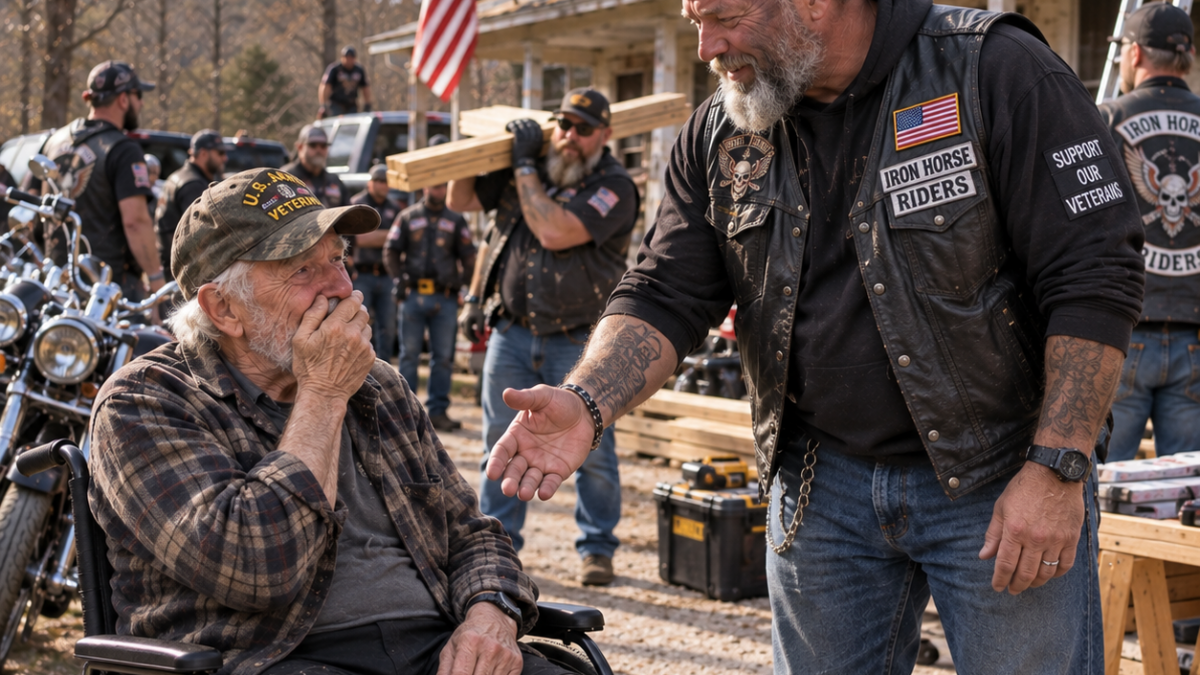
PART2:
Emily leaned forward and said, “Danny, right now you are broken. Half your body has been blown apart, you’re drugged to your eyebrows, and you haven’t eaten solid food in nine days.”
I stared at her.
“But broken isn’t the same thing as finished.”
I laughed.
Then screamed because laughing pulled at things that hurt.
Emily spent the next three years forcing me to learn that difference.
Broken isn’t finished.
I hated physical therapy.
She drove me.
I hated prosthetics.
She learned everything about them.
I hated strangers holding doors.
She taught me how to say thank you without sounding like I was accepting defeat.
When I came home to Arkansas, our little house outside Pine Hollow suddenly felt like an obstacle course.
It had belonged to my grandparents.
Built in the 1950s.
Wood siding.
Narrow doorways.
High thresholds.
Small bathroom.
Three porch steps.
Nothing about it understood wheelchairs.
At first, I used prosthetics more.
I was younger.
Angrier.
Stubborn enough to fall fourteen times and call each one a learning experience.
Emily wanted modifications.
A proper ramp.
Wider bathroom door.
Roll-in shower.
Lower cabinets.
I refused half of it.
“We don’t need to turn the house into a hospital.”
“It’s not a hospital.”
“It’ll look like one.”
“It’ll look like a place where you can reach your own sink.”
“I can reach the sink.”
“By twisting sideways like a trapped raccoon.”
“I manage.”
That word.
Manage.
I used it constantly.
Emily hated it.
“You don’t have to manage everything,” she’d say.
“What do you want me to do? Quit?”
PART3:
“No. I want you to stop acting like needing a better doorway is a moral failure.”
Eventually she won the ramp.
Sort of.
I built it myself with two friends.
Too steep.
Emily knew.
I knew.
Everybody knew.
But I could use it.
Mostly.
The bathroom remained narrow.
The kitchen stayed the same.
We told ourselves we’d fix more later.
Later is one of the most dangerous words human beings invented.
Emily had a stroke at thirty-eight.
No warning.
One Saturday morning she was complaining that I had left coffee grounds all over the counter.
By evening I was sitting in an ICU being told half her brain had been deprived of oxygen.
She lived three more days.
I signed papers I don’t remember signing.
People spoke to me with voices designed for bad news.
Then somebody handed me her wedding ring in a little plastic bag.
That was four years before the bikers came.
I wish I could say I honored Emily by living well.
I didn’t.
I survived badly.
There is a difference.
The first year, people were everywhere.
Her sister came from Tennessee.
Church ladies brought food.
My old Army buddies called.
Neighbors mowed.
Martha Ellis from next door brought coffee almost every morning.
Then life did what life does.
It kept moving.
People went back to jobs.
Children.
Illnesses.
Bills.
And I stayed in the same house.
Emily’s mug still in the cabinet.
Her shoes still under the bed for eleven months because I couldn’t make myself touch them.
Her shampoo still in the shower until it smelled like nothing.
I stopped wearing my prosthetic legs unless I had to leave the property.
My stumps hurt more as I got older.
The wheelchair became easier.
That word again.
Easier.
The house became harder.
The ramp warped.
Arkansas rain did what Arkansas rain does to wood nobody maintains.
One board split near the bottom.
I replaced it.
Then another.
I added screws.
Scrap lumber.
A metal brace.
Anything except admitting the whole thing needed rebuilding.
The porch dropped on the left side.
One support rotted.
The roof began leaking above the kitchen.
At first, one drip.
I put down a bowl.
Then two leaks.
Bucket.
Then three.
By the time the motorcycles arrived, I had a system.
Storm starts.
Bucket near refrigerator.
Old stock pot by back doorway.
Red plastic pail underneath the hallway stain.
The pail was my favorite because it was exactly tall enough to slide under the fastest leak.
You learn absurd things when dysfunction becomes routine.
I knew which floorboard flexed.
Which doorway would scrape my knuckles.
How hard to hit the bad threshold with my right wheel.
How to lean backward on the ramp when it was wet.
How to wrap my palm around the railing before the chair started sliding.
I knew all of it.
And I called that independence.
Martha Ellis knew better.
Martha was sixty-seven.
Silver hair.
Brown eyes.
Widow.
Five grandchildren.
The kind of woman who could make a pie, change a tire, organize a funeral dinner, and tell a grown man he was being an idiot without once raising her voice.
She had lived next door six years.
We had rules.
She didn’t ask whether I needed food.
She said, “I made too much chili.”
I didn’t ask whether she needed her gutters cleaned.
I sent her grandson up a ladder with my tools and called it character building.
We allowed each other dignity through lies.
Then came the storm.
Hardest rain we’d had that spring.
It started just before midnight.
By two in the morning, I woke to dripping.
Not one.
Three.
I transferred from bed to chair.
Rolled to the kitchen.
The biggest stain had spread.
Water came through beside the light fixture.
That scared me.
I shut off the circuit.
Moved a bucket.
Then water began running down the hallway wall.
I got a towel.
My right wheel hit a wet patch.
Slid.
I caught the doorframe.
Knuckles scraped.
“Perfect.”
I shoved the towel under the baseboard.
Then the kitchen bucket filled faster than expected.
I tried to carry it while rolling.
Bad idea.
Water spilled across my lap.
Across the floor.
By four-thirty, I was soaked.
Angry.
Exhausted.
The house smelled like wet wood.
When dawn came, the hallway looked like I’d lost a fight with a river.
At 6:15, Martha knocked.
I ignored her.
She knocked again.
“I know you’re awake.”
“Go home.”
“I brought coffee.”
That was dirty tactics.
I opened the door.
She looked at me.
Then the hallway.
Then my shirt.
Then the muddy tracks from my wheels where I’d rolled across the soft patch near the back door.
Her face changed.
“Don’t.”
“Danny.”
“I said don’t.”
“This house is hurting you.”
“No, ma’am. It’s old.”
“So are you.”
“I’m forty-two.”
“You complain like eighty.”
I almost smiled.
She didn’t.
She wheeled—well, not wheeled, marched—past me.
Looked at the ceiling.
Touched the wall.
Saw the brown water line.
“Danny.”
“I’m handling it.”
“With cookware?”
“Buckets are effective technology.”
“This is not funny.”
“I didn’t laugh.”
She turned.
“Your ramp shook yesterday when the mailman stepped on it.”
“He’s heavy.”
“He’s nineteen.”
“Big-boned.”
“Danny.”
“What do you want me to say?”
“The truth.”
I stared.
She pointed toward the ceiling.
“The roof is failing.”
“I know.”
“Ramp is dangerous.”
“I know.”
“The bathroom isn’t accessible.”
“I manage.”
Her eyes flashed.
“I swear if you say manage one more time, I will throw that coffee at you.”
I looked at the cup.
“Seems wasteful.”
She set it down.
“Emily would be furious.”
That did it.
“Don’t.”
“Danny—”
“Do not use my wife to win an argument.”
Her face softened.
“I’m sorry.”
“Leave her out of it.”
She nodded.
Then said quietly, “Fine. I’ll use me.”
I looked at her.
“I’m scared you’re going to get hurt.”
That disarmed me more than Emily’s name.
Martha wasn’t dramatic.
She was scared.
I looked away.
“I’ve been hurt before.”
“That doesn’t mean you owe the world another injury.”
I didn’t answer.
She stayed another hour.
Mopped water.
I protested.
She ignored me.
By noon, the rain stopped.
I fell asleep in the recliner.
That’s when she took the photograph.
I didn’t know until later.
She stood at the edge of my yard.
No face.
No wheelchair close-up.
No wounded-veteran spectacle.
Just house.
Sagging porch.
Rotten ramp.
Water stain above the door.
Mud.
One wheelchair track leading where a sidewalk should’ve been.
She posted:
This is where a man who gave both legs in service to this country is living. He says he is fine. He is not fine.
I hated that caption when I saw it.
Still do a little.
Not because it was false.
Because it was true.
The post moved farther than anybody expected.
Pine Hollow.
Little Rock.
Memphis.
Then north.
By midnight it reached Ohio.
Caleb Hayes was in a garage outside Cleveland when somebody sent it to him.
I learned that later.
Everybody called Caleb “Preacher.”
Not because he was clergy.
Because, according to his friends, he could turn changing a tire into a forty-minute sermon about responsibility.
Fifty-eight years old.
Black man.
Gray beard.
Tattooed hands.
Former Army mechanic.
Owned a small repair shop.
Rode with a motorcycle club called the Iron Hollow Riders.
The name sounded menacing enough that people made assumptions.
That amused Caleb.
The club included veterans, roofers, nurses, truck drivers, electricians, teachers, welders, firefighters, plumbers, contractors.
People who liked motorcycles.
People who had lived long enough to stop worrying whether strangers understood leather vests.
Caleb looked at Martha’s photo for several minutes.
Then sent it to the club group message.
He typed:
How far?
Somebody answered:
About 800 miles.
Caleb typed:
Pack tools.
What happened next was not spontaneous.
That’s important.
Kindness becomes dangerous when people confuse enthusiasm with competence.
Caleb’s first rule:
“We are not riding eight hundred miles to tear apart a disabled man’s house and feel good about ourselves.”
Marlene Torres—everybody called her Switch—was a licensed contractor.
Forty-nine.
Latina.
Dark hair.
Tattooed forearms.
The kind of woman who could look at a wall and somehow make it confess structural defects.
She studied the photograph.
“Roof.”
“Ramp.”
“Porch.”
“Probably flooring.”
Caleb said, “Bathroom?”
“House that age? Almost certainly.”
Ben Park, electrician, packed testing equipment.
Marcus Bell, retired firefighter and Army veteran, contacted a veterans’ nonprofit for accessibility guidelines.
Hank Porter called lumber suppliers and apparently threatened one salesman with such aggressive negotiation that the company donated half a trailer of plywood.
Denise Carter, known universally as Mama D, organized lodging, food, first aid, medications, water, and a work schedule.
Nobody filmed recruitment videos.
Nobody printed sponsor banners.
Caleb called Martha.
She thought it was a scam.
“You’re who?”
“Iron Hollow Riders.”
“That sounds like a gang.”
Caleb laughed.
“We get that.”
“Why are you calling me?”
“About Danny.”
Silence.
Then Martha cried.
Not delicate crying.
Big relieved sobs.
When she got herself together, she warned them.
“He will hate this.”
Caleb said, “I figured.”
“He will say no.”
“Maybe.”
“He hates charity.”
“Good.”
“Good?”
“We aren’t coming to make him grateful.”
She became quiet.
“What are you coming for?”
“To fix a house.”
Martha told him about me.
Military.
Explosion.
Emily.
Stroke.
Pride.
The ramp.
The county waiting list.
Contractor estimates.
Disability check.
Caleb listened.
Then asked, “Who owns the house?”
“Danny.”
“Good.”
“Why good?”
“Because then he’s the boss.”
That became their rule.
Nobody would treat me like a project.
Nobody would move anything without permission.
No hidden cameras.
No livestream.
No dramatic surprise demolition.
Work requiring permits would get permits.
Electrical work done by qualified people.
Structural work inspected.
My choices.
My home.
They left Ohio Friday before sunrise.
Forty motorcycles.
Two pickups.
Three trailers.
Eight hundred miles.
I knew none of this.
Saturday morning, I was at my kitchen table fixing the brake on my wheelchair.
I heard engines.
At first I thought highway traffic.
Then louder.
Steady.
Many.
The sound rolled over the ridge like thunder had found gears.
I wheeled to the window.
One headlight appeared on the gravel road.
Then another.
Then ten.
Twenty.
More.
Behind them came trucks loaded with lumber.
Ladders.
Roofing bundles.
Toolboxes.
Sawhorses.
Generators.
I thought Martha had joined a cult.
She came onto her porch.
Hands over her mouth.
I opened my front door.
By then motorcycles were lining my driveway.
Men and women in leather.
Boots.
Bandanas.
Patches.
I gripped my wheels.
Every instinct I had went defensive.
A tall man climbed off the first motorcycle.
Removed helmet.
Gray beard.
Deep brown skin.
He walked toward my ramp.
Then stopped.
At the bottom.
That mattered.
He didn’t climb into my space.
“Mr. Whitaker?”
“Who’s asking?”
“Caleb Hayes.”
“What do you want?”
“Folks call me Preacher.”
“That wasn’t my question.”
He smiled slightly.
Fair.
Behind him, riders began unloading nothing.
They waited.
“We saw a picture of your house.”
My eyes found Martha.
She looked guilty enough to confess to murder.
I turned back.
“You can turn around.”
Caleb nodded.
“We can.”
That surprised me.
People offering help rarely accept no calmly.
They’re usually offended you didn’t cooperate with their generosity.
I said, “Good.”
He remained.
“But we drove here to offer something first.”
“I don’t need anything.”
His eyes traveled to the ramp.
One board had warped upward.
“That ramp says otherwise.”
“Ramp isn’t talking.”
“Pretty loud from here.”
A couple riders almost smiled.
I didn’t.
“I don’t take charity.”
Caleb glanced behind him.
“Anybody bring charity?”
Hank called, “Nope.”
Mama D said, “Left it in Ohio.”
Caleb looked back at me.
“We brought a week.”
“What?”
“Seven days.”
He pointed toward the trailers.
“Roofers. Carpenter. Electrician. Plumber. Contractor. People who know accessibility work.”
“I can’t pay forty people.”
“We didn’t bring a bill.”
“I said I don’t take charity.”
“Then call it a trade.”
“For what?”
Caleb looked at me for a long second.
Then his voice grew heavier.
“You gave this country two legs.”
My jaw tightened immediately.
“I didn’t do that for you.”
“I know.”
“I didn’t lose them so people could show up and feel patriotic.”
“I know that too.”
“Then don’t use them.”
He nodded.
“Fair.”
That response cooled my anger by one degree.
He looked at the house.
Then me.
“Forget your service.”
I stared.
“Forget?”
“For this conversation.”
Nobody spoke.
“You’re a homeowner with a dangerous ramp and leaking roof. We’re people who know how to fix those things. We have materials. We have seven days. You have the right to say no.”
That was different.
No obligation.
No flag.
No pity.
Still, pride is creative.
“I don’t want strangers tearing apart my house.”
A woman stepped forward.
Clipboard.
Tan skin.
Bandana.
“I’m Marlene Torres.”
I said nothing.
“Licensed contractor in Ohio. Spoke to your county permitting office yesterday.”
That got my attention.
“You what?”
“Didn’t pull anything without your authorization.”
Good answer.
“I’d like permission to inspect the porch, ramp, roof interior, and bathroom.”
“No.”
“Okay.”
She closed the clipboard.
Also surprising.
Martha called from her yard.
“Danny.”
I looked at her.
She wasn’t pleading.
Just waiting.
Caleb said, “We’ll have breakfast at the diner. Give you an hour.”
“You’ll leave if I say leave?”
“Yes.”
“All of you?”
“Eventually. Forty breakfasts take time.”
I almost laughed.
Didn’t.
They turned away.
Started walking toward bikes.
That was when the kitchen ceiling dripped into the bucket behind me.
Plink.
Everyone heard it.
I closed my eyes.
Marlene didn’t turn around.
Respectful woman.
I hated her.
“Wait.”
The riders stopped.
Marlene faced me.
“You can inspect.”
“Thank you.”
“Inspect.”
“Understood.”
“No demolition.”
“Without approval.”
“Don’t move my wife’s photographs.”
Caleb looked at the frames visible through the doorway.
“First rule.”
“No news.”
“You heard the homeowner,” he called.
Forty people nodded.
I backed away from the door.
That was how it started.
Not with gratitude.
With suspicion.
Marlene inspected the porch first.
She crawled underneath.
Came back out covered in dirt.
She said a word Martha would have objected to.
Then looked at me.
“Good news.”
“What good news?”
“This ramp has apparently been trying to kill you for at least six months and you’ve refused to cooperate.”
I stared.
Hank laughed.
I didn’t want to.
My mouth betrayed me.
Tiny smile.
Marlene saw.
Didn’t comment.
She examined the roof.
Floor.
Bathroom.
Kitchen.
Electrical panel with Ben.
Plumbing.
By noon, they had a list.
It was longer than I expected.
“Roof repair.”
“Ramp replacement.”
“Porch support.”
“Bathroom doorway.”
“Roll-in shower?”
“No.”
Marlene looked up.
“No.”
“Why?”
“I manage.”
She stared.
I stared.
Caleb, standing behind her, quietly walked outside.
Coward.
Marlene said, “Managing is not the same as safe.”
“I’ve used that bathroom twelve years.”
“Congratulations on surviving your bathroom.”
“I don’t need—”
“You scrape your knuckles?”
I stopped.
She had noticed.
“Sometimes.”
“Transfer from chair to shower bench?”
“Yes.”
“How many times have you fallen?”
“None.”
Lie.
Her face said she knew.
“Mr. Whitaker.”
“Danny.”
“Danny. I don’t care whether you impress me.”
“I wasn’t trying.”
“Good. Because I’ve met stubborn veterans before.”
“Then you know when to stop talking.”
She smiled.
“I know when not to.”
I disliked her immediately.
Which meant she reminded me of Emily.
Work began Monday.
The first thing they did was build a temporary safe entrance before touching the old ramp.
That detail mattered.
They didn’t leave me trapped inside.
Then demolition.
Rotten boards came out.
Every hammer strike got under my skin.
I sat in the doorway watching.
My house.
My failures.
One by one exposed.
“Rot here.”
“Joist needs sistering.”
“Water damage.”
“Soft section.”
Every comment sounded like accusation even when it wasn’t.
A man named Hank pulled a board.
It crumbled at one end.
He whistled.
I turned my chair away.
That’s when shame arrived.
Not because they judged me.
Because they didn’t.
Judgment would’ve been easier.
These people simply worked.
No one said, “How did you let it get this bad?”
That question was already in my head.
Emily had wanted repairs.
I delayed.
After she died, I stopped caring.
Then the house became harder.
Harder made repairs harder.
A cycle.
Poverty isn’t always about having no money.
Sometimes it is not having enough money at the exact moment a small problem would still be cheap.
Then small becomes large.
Large becomes impossible.
Around ten, Hank found a bent hinge on the side gate.
Materials couldn’t pass through.
He examined it.
Then looked at me.
“You got a vise grip?”
I frowned.
“Of course.”
“Where?”
“Shed. Second shelf. Red handle.”
He retrieved it.
Then held it up.
“Want to talk me through this?”
“You don’t know how to bend a hinge?”
“I know.”
“Then why—”
“It’s your gate.”
That shut me up.
I wheeled down the temporary ramp.
Caleb stood nearby.
Didn’t touch my chair.
Good man.
I positioned beside the gate.
“Put the block behind it.”
Hank obeyed.
“Lower.”
He lowered.
“Now pressure.”
The metal shifted.
“Too much.”
He stopped.
“Again.”
Five minutes later, gate swung clean.
Hank looked at me.
“Foreman approved?”
I rolled my eyes.
“Barely.”
By lunch, everybody called me Foreman.
At first I hated it.
Then I started giving orders.
Not because I needed control.
That’s what I told myself anyway.
“Those cabinets stay.”
“Yes, Foreman.”
“Don’t throw that oak trim away.”
“Yes, Foreman.”
“Emily’s quilt doesn’t go in a trash bag.”
Mama D looked offended.
“I have clean storage tubs.”
“Fine.”
“Say thank you.”
“Don’t push your luck.”
She grinned.
By afternoon, I knew names.
Switch.
Preacher.
Mama D.
Hank.
Marcus.
Ben.
A nurse named Sheila.
Two brothers, Cole and Jason, who argued about measurements so constantly I wondered how they had survived adulthood.
These people worked.
No posing.
No dramatic speeches.
Sweat.
Dust.
Stripped screws.
Wrong measurements.
A wasp nest under the siding caused five bikers to scatter faster than enemy fire.
I laughed so hard my ribs hurt.
Hank pointed at me.
“You weren’t laughing when your ramp tried to kill you.”
“Wasn’t funny then.”
“Wasn’t?”
“No.”
“Is now.”
By Wednesday, my house looked worse than before.
Blue tarps.
Exposed framing.
Bathroom door removed.
Flooring pulled.
Furniture covered.
I sat under a canopy outside.
Martha brought lemonade.
“I suppose you’re proud of yourself.”
She smiled.
“A little.”
“You posted my house.”
“I did.”
“Without asking.”
“I did.”
“That’s an invasion of privacy.”
“I didn’t show your face.”
“Still.”
Her smile disappeared.
“I know.”
That stopped me.
She looked down.
“I’ve felt guilty ever since.”
“Why’d you do it?”
She met my eyes.
“Because asking permission would’ve given you another chance to say no.”
I became angry.
“So you decided for me.”
“I decided to tell the truth about a house.”
“Same difference.”
“No.”
Her voice trembled.
“I didn’t tell anyone you couldn’t care for yourself.”
“Looked like it.”
“I told them the house was failing.”
“And a disabled veteran lives in it.”
“Yes.”
I wheeled closer.
“You know what people see when they read that?”
“What?”
“Pity.”
Martha shook her head.
“Maybe some.”
“Most.”
“Then they don’t know you.”
“Exactly.”
She took a breath.
“Danny, do you know what I saw the night of the storm?”
I stayed silent.
“I saw a man with wet clothes and bleeding knuckles sitting under a ceiling that could’ve shorted electrical wiring.”
I looked away.
“I saw someone I care about calling danger independence.”
That hurt.
“I didn’t post because you’re helpless.”
Her eyes filled.
“I posted because I was helpless.”
My anger softened.
Barely.
She continued.
“I couldn’t fix your roof.”
Silence.
“I couldn’t rebuild a ramp.”
She gestured toward the riders.
“But I could tell somebody.”
I rubbed my forehead.
“You still should’ve asked.”
“I know.”
“Don’t do it again.”
“I won’t.”
“Thank you.”
She smiled slightly.
“You’re welcome.”
That afternoon, Marlene brought up the bathroom again.
“No.”
“Danny.”
“Still no.”
“It’s demolished anyway.”
“I noticed.”
“We widened the door.”
“Fine.”
“We can improve the shower.”
“I have a bench.”
“Your bench is older than some of our riders.”
“It works.”
She crossed her arms.
“What are you afraid of?”
That irritated me.
“Nothing.”
“Then why does a safer shower bother you?”
“Because I don’t need my house redesigned around everything I can’t do.”
Her expression changed.
There.
Truth.
I looked away.
Marlene sat on an overturned bucket.
For once, she stopped being contractor.
“My brother used a chair.”
I looked at her.
“Car accident.”
She tapped the clipboard against her knee.
“He refused hand controls in his first car because he said it made him feel disabled.”
I knew immediately where this was going.
“Two months later, he got them.”
“Why?”
“Because he realized he was already disabled. The controls made him independent.”
I hated the logic.
“Emily said something like that.”
“Smart woman?”
“Annoyingly.”
“Best kind.”
I looked toward the gutted bathroom.
“Nothing that looks like a hospital.”
“Agreed.”
“No stainless-steel institutional nightmare.”
“Agreed.”
“Keep the blue tile if you can.”
“Ugly blue tile?”
“Emily picked it.”
“Beautiful blue tile.”
I pointed at her.
“You’re learning.”
That bathroom became the room that broke me.
They widened it.
Created roll-in entry.
Grab bars that looked like part of the design instead of medical equipment.
Lowered sink clearance.
Moved storage.
Better light.
Kept enough blue tile to preserve Emily.
When it was finished, Marlene called me in.
I rolled through the doorway.
No scraped knuckles.
That alone nearly did it.
Then I saw the shower.
No dangerous transfer.
No twisting.
No fighting.
I could enter.
Turn.
Reach.
Use my own bathroom without negotiating with architecture.
I backed out.
Went to my bedroom.
Closed the door.
Cried.
Not because the bathroom was beautiful.
Because Emily had asked me to do it.
Years before.
“Danny, someday you might need the chair more than you do now.”
“I won’t.”
“How do you know?”
“I’ll keep using prosthetics.”
“You don’t know what your body will do.”
“I know myself.”
“No. You know your pride.”
She had been right.
I sat beside the bed and covered my face.
A knock came.
“Go away.”
No answer.
Good.
I stayed alone twenty minutes.
When I came out, Marcus stood in the hallway wrapping one of Emily’s pictures.
He didn’t look at my red eyes.
“Bathroom’s good work,” I said.
He nodded.
“Switch doesn’t miss.”
“Emily wanted that.”
Marcus carefully placed the photograph.
“Then we’re late.”
I looked at him.
He continued.
“Late isn’t the same as unwelcome.”
I started crying again.
Damn him.
Outside, Hank suddenly started a circular saw.
Loud.
Obnoxious.
Perfect.
Nobody had to hear me.
By Thursday, Pine Hollow had noticed.
People started showing up.
At first to stare.
Forty motorcycles create curiosity.
Mama D cured that quickly.
“You here to watch or work?”
A man from town said, “I was just—”
“Gloves are there.”
She handed him a pair.
A church group brought food.
Hardware store donated paint.
A retired nurse checked supplies.
Teenagers hauled debris.
Martha commanded the food table.
The county inspector arrived.
I expected trouble.
Instead, he looked over Marlene’s plans.
“Who did these?”
“I did.”
He raised eyebrows.
“You’re licensed in Ohio?”
“Yes.”
They discussed code.
Slope.
Landings.
Rail heights.
I sat nearby.
For years, government assistance had meant forms.
Waiting lists.
Letters saying funding had been exhausted.
Calls transferred.
People explaining they cared while nothing changed.
Now I watched a contractor and inspector argue six minutes over handrail clearance.
Six minutes later, decision made.
Actual work resumed.
I remember thinking:
This is what help looks like when everybody knows exactly what the next action is.
Not “We’re looking into it.”
Not “We’ll keep your application on file.”
Measure.
Cut.
Install.
Specific.
Friday morning, rain came.
My stomach tightened automatically.
Buckets.
Then I remembered.
Roof.
I rolled to the kitchen.
Waited.
Rain struck shingles.
No drip.
I sat under the old stain.
Nothing.
Five minutes.
Ten.
Nothing.
Caleb came inside.
“You all right?”
“Shh.”
He stopped.
We listened.
Rain.
Only rain.
No bucket.
No plink.
I laughed.
Couldn’t help it.
“First dry rain in three years.”
Caleb looked up.
“You kept buckets?”
“Three.”
“Where?”
“Closet.”
“Throw them out.”
“No.”
“Why?”
“Good buckets.”
He smiled.
“Farmer mentality.”
“Army.”
“Same disease.”
Saturday morning, work slowed.
Finishing.
Paint.
Trim.
Cleanup.
Photos returned exactly where I wanted.
Emily’s quilt, washed and folded.
Porch rebuilt.
Ramp broad.
Proper slope.
Textured surface.
I rolled from living room to porch.
Then down.
No leaning backward.
No gripping railing.
No fear.
At the bottom, I stopped.
Turned.
Looked up.
It’s hard to explain what a ramp means if you’ve always trusted stairs.
A front door isn’t just an opening.
It’s choice.
I had gradually stopped leaving unless necessary because each exit carried risk.
Wet boards.
Bad angle.
Chair catching.
Neighbors watching.
Now I could roll from my home to the yard like it was ordinary.
Caleb stood nearby with a notebook.
“What did we miss?”
I looked around.
Roof.
Porch.
Ramp.
Doorways.
Bathroom.
Kitchen.
Floor.
“Nothing important.”
He closed notebook.
“That means something’s missing.”
“What?”
He pointed toward the porch post.
My flag bracket had been broken for two years.
Emily bought it after my retirement.
I’d never replaced it.
An hour later, a new bracket was installed.
The flag went up.
I rolled beneath it.
That’s where the photograph everyone eventually saw came from.
Not during construction.
After.
Me on the porch.
Hands on wheels.
Flag moving overhead.
I cried.
Nobody tried to hide it.
Nobody made a speech.
That evening we ate together.
Forty riders.
Neighbors.
Volunteers.
Folding tables in my yard.
Barbecue.
Corn.
Beans.
Mama D’s potato salad, which she announced was superior to every potato salad in Arkansas.
Martha disagreed.
An interstate potato-salad conflict nearly started.
I laughed more that night than I had in four years.
That scared me afterward.
When everybody left except the riders sleeping at a campground and cheap motel, the house became quiet.
I wheeled into the bedroom.
Emily’s photograph sat on the dresser.
I picked it up.
“You would’ve loved these lunatics.”
She smiled from fifteen years ago.
I sat there a long time.
Then said something I hadn’t said aloud since she died.
“I miss you.”
Not “I still love you.”
Not “I’m sorry.”
Just:
“I miss you.”
Grief changed slightly.
Maybe because my house no longer looked abandoned by the future.
Sunday was goodbye.
I woke early.
Made coffee.
Rolled through the bathroom.
Because I could.
Down the ramp.
Because I could.
Forty motorcycles lined up.
Tools packed.
Trailers loaded.
Leftover lumber stacked neatly.
Nobody left trash.
Of course.
I had prepared something.
An envelope.
I had sold my rifle.
Not my service weapon.
Nothing sentimental from deployment.
An old hunting rifle my father had given me.
Worth enough to matter.
Not enough to cover anything.
But something.
Caleb stood by his bike.
I wheeled toward him.
Held out envelope.
“Take it.”
He looked.
“No.”
“There’s cash.”
“I guessed.”
“Not enough.”
“I guessed that too.”
“Then take it.”
“No.”
My face hardened.
“Don’t insult me.”
His changed too.
Not angry.
Serious.
“I would never.”
“Then don’t make me your charity case.”
“Danny—”
“I watched forty people spend a week rebuilding my house.”
“Yes.”
“You drove eight hundred miles.”
“Yes.”
“Materials.”
“Donations.”
“Fuel.”
“Covered.”
“Food.”
“Mama D threatened three businesses until they helped.”
“Still money.”
Caleb nodded.
“Yes.”
I pushed the envelope farther.
“Take it.”
He didn’t.
“Caleb.”
“Danny.”
The driveway went quiet.
Everybody knew.
Proud man reaching for a ledger.
Trying to turn love into debt because debt can be repaid.
My voice cracked.
“I can’t let you leave with nothing.”
Caleb looked behind him.
At his riders.
Then at my house.
“We aren’t.”
“You know what I mean.”
“I do.”
He crouched slightly so we were nearer eye level.
“You think payment is the only way to keep your dignity.”
I became angry.
“Careful.”
“I’m not taking it.”
“Why?”
He looked at my legs.
Not the chair.
Not pity.
Just reality.
“Because there isn’t a number.”
I swallowed.
“You gave this country both legs.”
“Stop.”
“No.”
My jaw tightened.
“I didn’t give them.”
Silence.
“They were taken.”
Caleb nodded.
“You’re right.”
That mattered.
People say sacrifice because sacrifice sounds voluntary.
My legs weren’t a donation.
I didn’t hand them over.
An explosion took them.
“Don’t make that into something noble.”
“I won’t.”
He stood.
“But after they were taken, you still carried the cost.”
I looked away.
“Pain.”
He continued.
“Surgeries. Nights. Marriage. Work. Pride. Everything people applaud for thirty seconds on Veterans Day and forget the next morning.”
Martha was crying on her porch.
I hated her for that.
My own eyes burned.
Caleb pointed toward the house.
“We brought seven days.”
I said nothing.
“Seven.”
His voice broke.
“You lived twelve years with a body that changed in one second. Four years without your wife. Years in a house working against you because systems moved too slowly and you were too proud to keep asking.”
He swallowed.
“We brought one week.”
Nobody moved.
“That’s not payment.”
The envelope dropped slightly.
“It’s not even close.”
I whispered, “I never asked anybody to owe me.”
“I know.”
“I didn’t serve so people would owe me.”
“I know.”
“Then why?”
Caleb looked at the ramp.
“The roof.”
The widened doorway.
The flag.
Then back at me.
“Because a country isn’t speeches.”
His voice was rough.
“It isn’t a discount at a restaurant one day a year.”
Nobody breathed.
“Sometimes it’s forty tired people with tools showing up late and trying to fix something that should’ve been fixed sooner.”
My hand started shaking.
“I don’t deserve forty people.”
Caleb’s eyes sharpened.
“That’s not your decision.”
“What?”
“Kindness isn’t a medal.”
He stepped closer.
“You don’t earn it.”
My throat closed.
“You need it. Somebody can give it. That’s enough.”
I covered my face.
For years I’d believed accepting help required proving worth.
Military service.
Disability.
Loss.
Something.
But Caleb wasn’t saying I deserved the repair because I was a veteran.
He was saying people sometimes help because they can.
That was harder to accept.
No transaction.
No debt.
I lowered my hand.
“You stubborn bastard.”
He smiled.
“So I’ve been told.”
I held out my hand.
He took it.
Then I pulled him closer.
Awkward hug.
Wheelchair.
Leather vest.
Helmet in his hand.
Didn’t matter.
I cried against the shoulder of a man I’d known seven days.
Caleb held me.
No back-patting performance.
No “It’s okay.”
Just held.
When we separated, I couldn’t speak.
Mama D rescued me.
“Foreman.”
I looked at her.
“You have our numbers.”
I nodded.
“If that sink leaks, you call.”
“It won’t.”
“If anything leaks.”
“Fine.”
“You call.”
“Yes, ma’am.”
Marlene pointed.
“And don’t touch the roof.”
“I know roofing.”
“No.”
“I grew up—”
“If I find out you rolled onto that roof, I will ride eight hundred miles and personally throw you off it.”
Everyone laughed.
I laughed too.
Full chest.
No embarrassment.
The motorcycles left one by one.
Slow.
Not a performance.
Engines down the gravel road.
I stayed at the top of my new ramp until the last taillight disappeared.
Martha came over.
We stood—well, she stood, I sat—without speaking.
The house behind us looked different.
Not new.
Still small.
Still old siding.
Still Emily’s flower beds half-dead.
But it no longer looked like something I was surviving inside.
It looked like a home.
A week later, I found the envelope.
On my kitchen table.
Unopened.
Note on top:
USE IT FOR GROCERIES, FOREMAN. THAT’S AN ORDER.
I called Caleb.
“You son of a—”
He laughed.
“Good morning.”
“I sold a rifle for that.”
“Buy soup.”
“I don’t need soup.”
“Then steak.”
“I’m mailing it.”
“I’ll mail it back.”
“I’ll send certified.”
“I won’t sign.”
“You’re childish.”
“So I’ve been told.”
We argued twelve minutes.
I kept the money.
Mostly because I realized the rifle hadn’t been used in eight years anyway.
I bought groceries.
Then something else.
A proper paved path from the ramp to the driveway.
Not charity.
Not pride.
Just infrastructure.
Martha cried when she saw it.
“Stop doing that.”
“I’m old.”
“You’re sixty-seven.”
“Old enough.”
Life changed after the bikers.
Not magically.
I still woke from nightmares sometimes.
Still hated prosthetics.
Still missed Emily.
Still had bills.
The house still needed maintenance.
But I started calling before emergencies.
That’s harder than it sounds.
A month later, the kitchen faucet began dripping.
I stared at it for two days.
Old Danny would’ve waited.
Then I photographed it.
Texted Caleb.
Your people broke my faucet.
He responded:
WE DIDN’T TOUCH THAT FAUCET.
I wrote:
Sounds like denial.
Ten minutes later:
CALL A PLUMBER, FOREMAN.
I did.
That felt ridiculous.
Also revolutionary.
Pine Hollow changed too.
The bikers embarrassed us.
Not intentionally.
Their specificity exposed our vagueness.
Everybody had known about me.
The hardware-store owner knew.
Church knew.
County knew.
Neighbors knew.
People cared.
But caring had lived in sentences.
“Somebody ought to help Danny.”
“He really needs a roof.”
“It’s a shame.”
“Let us know if you need anything.”
The Iron Hollow Riders showed up saying:
Ramp crew Monday.
Roof Tuesday.
Bathroom Wednesday.
Specific kindness builds.
Vague kindness comforts the person offering it.
That difference bothered people enough that things started moving.
A church created a home-accessibility fund.
The hardware store donated materials quarterly.
A local contractor agreed to take two reduced-cost veteran or disability jobs each year.
Teenagers began doing yard maintenance for elderly residents.
Martha formed something called the Pine Hollow Neighbors Network.
I told her the name sounded like a cable company.
She told me to shut up.
They kept a list.
Rides.
Small repairs.
Meals.
Wheelchair-access issues.
No inspirational slogans.
Tasks.
That mattered.
One afternoon, the county veterans’ coordinator visited.
A man named Lewis.
He had been the person calling me every six months for years asking whether anything had changed.
I always said no.
He sat on my porch.
“This is embarrassing.”
“What?”
“We had you on the list.”
“I know.”
“We still do, technically.”
I laughed.
He didn’t.
“Funding ran out twice.”
“I know.”
“Your application rolled.”
“I know.”
He looked at the ramp.
“Forty bikers did in seven days what we hadn’t done in three years.”
“Pretty much.”
He rubbed his face.
“I’m sorry.”
I wanted to tell him apology wasn’t a roof.
Then I looked at him.
He meant it.
“What are you going to do?”
He looked up.
“What?”
“Being sorry isn’t useful unless it changes something.”
He stared.
Then nodded slowly.
“You’re right.”
That conversation eventually led to an accelerated emergency-review process for accessibility hazards.
Not because of me alone.
Not because bureaucracy suddenly grew a heart.
Because Lewis pushed.
Because the riders made the failure visible.
Because Martha documented.
Because several local veterans testified.
Change is usually less cinematic than arrival.
No forty motorcycles.
Just meetings.
Forms.
Arguments.
Policy language.
But it mattered.
A year later, an older veteran three towns over got a dangerous ramp replaced in twelve days instead of joining the long general queue.
Lewis sent me a photo.
I forwarded it to Caleb.
He replied:
NOW THAT’S PAYMENT.
I stared at those words a long time.
Caleb and I started talking twice a month.
Sometimes about nothing.
Weather.
Bikes.
Army.
Food.
He called me Foreman.
I called him Preacher.
Marlene visited once and inspected everything without being asked.
“This handrail moved.”
“It does not.”
She shook it.
Moved.
“Damn.”
“Foreman approval revoked.”
“Get out.”
She tightened it.
Mama D mailed Christmas cookies.
Half were labeled DO NOT SHARE WITH HANK.
Hank called to complain I had received preferential cookie distribution.
The Iron Hollow Riders became family in that strange adult way where people enter your life too late to know your childhood but somehow learn where all your emotional weak spots are anyway.
Two years after the build, Caleb rode down alone.
Emily’s death anniversary.
I hadn’t told him the date.
Martha had.
Traitor.
He brought no tools.
We sat on the porch.
Coffee.
Quiet.
After a while, he asked, “What was she like?”
I looked toward the field.
“Mean.”
He smiled.
“That’s what everybody says about somebody they adored.”
“Bossy.”
“Uh-huh.”
“Always right.”
“Worse.”
“Terrible cook except three things.”
“What three?”
“Biscuits, chicken and dumplings, peach pie.”
“That’s enough.”
“No, because everything else was dangerous.”
We laughed.
Then silence.
“She would’ve liked you,” I said.
Caleb looked surprised.
“Why?”
“You don’t take no personally.”
He nodded.
“Learned that from people who needed help.”
I looked at him.
He continued.
“My younger brother came back from Iraq with a traumatic brain injury.”
I hadn’t known.
“Marcus?”
“No. Different guy. Damon.”
Caleb rubbed his hands.
“He needed help with everything at first.”
“What happened?”
“He hated everybody.”
“Understandable.”
“He hated me most.”
“Also understandable.”
Caleb smiled.
“I kept trying to do things for him.”
I waited.
“Finally he told me, ‘Stop helping me like I’m dead.'”
That sentence hit.
“What did he mean?”
“Same thing you meant when we arrived.”
Caleb looked at the ramp.
“People start taking over because they’re scared for you.”
I knew.
“And every thing they do without asking becomes one more thing you didn’t choose.”
I stared toward Emily’s empty flower bed.
“That’s why you stopped at the bottom of the ramp.”
“Yes.”
“Why Marlene asked permission.”
“Yes.”
“Why Hank asked about the hinge.”
“Yes.”
I swallowed.
“You planned that?”
“Not the hinge.”
He smiled.
“But the principle.”
Respect before rescue.
No wonder it worked.
Three years after the build, I began volunteering with Martha’s network.
At first by accident.
A younger veteran named Chris needed help designing an accessible workbench.
Martha said, “Danny knows tools.”
I went.
Chris had lost one arm and part of one leg.
Thirty-one.
Angry.
Reminded me of me.
He said, “I don’t want somebody building it for me.”
I heard myself answer:
“Good. Then you’re foreman.”
Caleb would’ve been unbearable if he heard.
We built the bench.
Well, Chris built it.
I talked.
Then an elderly woman needed advice on doorway width.
Another man needed ramp-angle measurements.
I learned accessibility codes.
Not as professional.
As user.
Every modification I had resisted became knowledge I could pass forward.
That changed how I saw my body.
For years, disability had been something that happened to me.
Then it became expertise.
Not inspiration.
Expertise.
There is dignity in knowing things because you survived needing to know them.
I started speaking at county meetings occasionally.
Hated microphones.
Still do.
I would say:
“Accessibility is not special treatment. It’s the difference between a house someone occupies and a house someone can live in.”
People listened more when the man in the chair said it.
I wished they didn’t need the chair to make the sentence true.
But I used what I had.
On the fifth anniversary of the riders’ visit, forty didn’t come.
Only twelve.
People got older.
Schedules.
Health.
Life.
But Caleb came.
Marlene.
Mama D.
Hank.
Marcus.
Ben.
They rode into the driveway and I pretended not to be emotional.
They inspected their work.
Hank found one loose screw and behaved like he’d uncovered government corruption.
Marlene checked ramp slope.
“Still legal.”
“Thank God.”
Caleb stood at the top.
“How many times you fall?”
“None.”
“Lie.”
“Once.”
“When?”
“Winter.”
“Call anybody?”
“No.”
He stared.
I sighed.
“Martha was there.”
“Better.”
We had barbecue.
Neighbors came.
Chris came.
Lewis from county.
Several veterans whose homes had been repaired through the new program.
Nobody made a ceremony.
That would’ve ruined it.
At sunset, we sat on the porch.
Martha looked around.
“You know what this all started with?”
I pointed at her.
“Illegal photography.”
She laughed.
“A picture.”
“Still mad.”
“No, you’re not.”
“No.”
I wasn’t.
Caleb said, “Picture didn’t do it.”
Martha looked.
“What did?”
He pointed at me.
“He said yes.”
I laughed.
“Barely.”
“Still counts.”
That made me think.
Everybody celebrates the helpers.
As they should.
But receiving help takes courage too.
Especially when your identity has been built around never needing it.
I had mistaken independence for isolation.
Emily tried to teach me.
Martha tried.
The riders finally got through.
Independence isn’t doing everything alone.
It’s having choices.
The ramp gave me choices.
The bathroom gave me choices.
Asking a plumber before the floor rotted gave me choices.
Calling people before crisis gave me choices.
Help, when offered correctly, expands independence instead of shrinking it.
That’s something I wish every person who has ever grabbed a wheelchair without asking understood.
Do not move us through our lives.
Make room so we can move ourselves.
The riders understood that before I did.
Emily’s photos are still on the wall.
Exactly where they were.
The blue bathroom tile remains.
Some of it.
The new roof is holding.
Ramp has been resurfaced once.
Porch rail replaced after a storm.
I paid for that.
Proudly.
There are days I sit outside beneath the flag and hear a motorcycle in the distance.
For a second I expect forty.
Usually it’s one kid on a dirt bike.
Still, I remember.
Engines rolling over the ridge.
My anger.
Caleb at the bottom of the ramp.
“I didn’t ask for charity.”
His face.
“No, sir.”
Then:
“We brought a week.”
Seven days.
That’s what they said.
But they gave me more than a week.
They gave me my front door back.
That’s what I tell people.
They expect me to say roof.
Bathroom.
Ramp.
Floor.
Those things matter.
God, they matter.
A roof sounds boring until water falls beside your refrigerator.
A bathroom sounds ordinary until using it feels dangerous.
A ramp looks like lumber until the alternative is staying inside.
A doorway means nothing until your hands bleed trying to fit through it.
But the front door?
That was everything.
Before them, every trip out of my house required calculation.
Weather.
Ramp condition.
Upper body strength.
Whether anybody was watching.
I had gradually become a prisoner who insisted the unlocked door proved I was free.
The riders changed the geometry of my life.
The first morning after they left, I woke early.
No alarms.
Rolled into the hallway.
No bucket.
Kitchen.
Dry.
Bathroom.
Easy turn.
Front door.
I opened it.
Sunrise.
I went down the ramp.
Slowly.
Reached bottom.
No wobble.
No fear.
I rolled all the way to the mailbox.
First time in nearly a year.
Got the mail.
Rolled back.
That’s it.
No audience.
No applause.
But halfway up, I stopped.
Looked toward Martha’s house.
She stood at her window.
Coffee.
She raised the mug.
I raised the mail.
Then I went inside.
That simple trip was more emotional than the goodbye.
Because dignity isn’t usually dramatic.
It’s mundane.
Taking out trash without waiting for darkness.
Getting your own mail.
Entering your own bathroom.
Choosing when to leave.
Choosing when to return.
Years later, Caleb asked me what I remembered most from that week.
I told him the hinge.
He thought I was joking.
“The gate hinge?”
“Yeah.”
“Why?”
“Because Hank knew how to fix it.”
“He fixes everything.”
“But he asked me.”
Caleb understood.
That moment gave me a role.
Not recipient.
Homeowner.
Foreman.
Person with knowledge.
They didn’t show up and erase me from my own rescue.
That is why I let them stay.
That’s why I eventually loved them.
There is an ugly kind of kindness that needs the person receiving it to become small.
These people refused that.
Even when I cried.
Especially then.
They never treated vulnerability as proof I had become less of a man.
That was something the Army never taught me.
Army teaches you how to carry weight.
Not always how to let somebody take one side of it.
Emily knew.
She’d say, “Danny, if two people carry the couch, nobody calls the couch weak.”
I would reply, “I’m not a couch.”
She’d say, “You’re not as useful either.”
God, I miss her.
Still.
The grief never vanished.
But the repaired house gave memories safer places to live.
For years, every broken thing reminded me she wasn’t there to help.
Now the blue bathroom reminded me she had been right.
The porch reminded me of coffee.
The widened doorway made me imagine her saying, “Finally.”
Her quilt remained on the couch.
Sometimes I pressed my hand against it.
No shame.
A man can miss his wife and still laugh with new friends.
That took me years to learn.
Love for the dead doesn’t require loyalty to misery.
The first Thanksgiving after the build, Martha came over.
Then her family.
Then Ray from town.
Then somehow eight people were in my house.
My old house would’ve been impossible.
Wheelchair wedged between chairs.
Narrow doorway.
No room.
The modified living space worked.
People moved around me instead of around the chair.
At dinner, Martha raised a glass.
“To the bikers.”
I said, “Don’t encourage them.”
Everybody laughed.
Then I raised mine.
“To Emily.”
Silence.
Warm silence.
“She wanted this house fixed before any of us had enough sense to listen.”
Martha wiped her eyes.
I continued.
“And to people who show up with plans.”
That became my definition.
People who show up with plans.
If someone says, “Let me know if you need anything,” they’re usually kind.
I no longer resent it.
But if you really want to help somebody, make it easier to say yes.
“I’m free Tuesday. Can I take you to the appointment?”
“I made extra dinner. Can I leave it at six?”
“I know your ramp rail is loose. May I fix it Saturday?”
Specific.
Concrete.
No emotional labor required from the person already drowning.
The riders taught Pine Hollow that.
They taught me too.
A few years later, Martha got sick.
Breast cancer.
Early stage.
Good prognosis.
She hated accepting help.
I enjoyed that immensely.
“I can drive myself.”
“Doctor says no after treatment.”
“I’ll be fine.”
I looked at her.
She narrowed her eyes.
“Don’t.”
I smiled.
“What?”
“Don’t use my own words.”
“I manage.”
“Danny.”
I laughed.
Then I drove her.
Well, she drove us there and I drove us back using hand controls.
She complained the entire time.
That’s love too.
Not dramatic.
Just refusing to let somebody else’s pride become an injury.
Caleb once asked if I had forgiven Martha for the post.
“Yes.”
“Immediately?”
“No.”
“How long?”
“About three months.”
“Why?”
“Because she was right.”
He laughed.
“Hardest kind of forgiveness.”
Exactly.
She crossed a line.
She also saved me from a worse one.
Both truths can exist.
We talked about it.
She apologized properly.
Not “sorry you were upset.”
Not “I did it because I care.”
She said:
“I should have asked. I was afraid you’d say no. I chose the result over your consent. I’m sorry.”
That’s why I forgave her.
Good intentions do not erase boundaries.
But accountability can rebuild trust.
She never posted my life without asking again.
When the local newspaper eventually wanted the story, I said yes.
With rules.
No pity headline.
No “wheelchair-bound veteran.”
I hate that phrase.
I’m not bound to anything.
Wheelchair is the thing that lets me move.
No photograph of me looking sadly out a window.
They agreed.
The article focused on home accessibility and volunteer coordination.
Caleb said it was boring.
“Good.”
“Boring doesn’t get clicks.”
“Roof leaks didn’t ask for clicks.”
He smiled.
“Foreman still cranky.”
Always.
The Iron Hollow Riders still do projects.
Not forty every time.
Sometimes five.
Sometimes fifteen.
A roof here.
Ramp there.
Veteran.
Widow.
Disabled teacher.
Family after a fire.
They built rules partly from what happened at my place.
Ask first.
Use qualified labor.
No filming without explicit consent.
Finish what you start.
Treat the resident as decision-maker.
Never confuse gratitude with payment.
Mama D added another rule.
“Feed everybody.”
Apparently that one is nonnegotiable.
Once a year, I donate to their repair fund.
Small amount.
Caleb objected at first.
I told him this was not repayment.
“What is it?”
“Fuel.”
“For what?”
“The next week.”
He stopped arguing.
That’s how I finally understood the envelope.
I couldn’t pay them back.
But I could pass forward.
Different thing.
Better thing.
I still have the note.
USE IT FOR GROCERIES, FOREMAN. THAT’S AN ORDER.
It’s framed in my kitchen.
Caleb thinks that’s ridiculous.
He’s wrong.
The old rifle money lasted months.
Groceries.
A new cushion for my wheelchair.
Part of the walkway.
Something Emily would have called practical.
She loved that word when she used it correctly.
I am fifty now.
My shoulders ache more.
Transfers take longer.
I use prosthetics less.
For years, that would’ve felt like losing.
Now I adapt sooner.
New cushion.
Better chair.
Reach tools.
Home modifications.
I no longer wait for pain to become catastrophe before acknowledging change.
That’s another gift from the riders.
Not the repair itself.
Permission to redesign instead of endure.
Men are trained strangely.
Especially men from military backgrounds.
Pain becomes proof.
If it hurts and you continue, you’re strong.
Sometimes.
Other times, pain is information.
The roof is leaking.
The ramp is unsafe.
Your shoulder needs rest.
Your heart is lonely.
Something needs attention.
Ignoring information isn’t courage.
I learned late.
Still learned.
Last summer, a young veteran named Michael visited.
He had lost one leg.
Used prosthetic.
Wouldn’t touch a wheelchair.
He looked at mine like it was surrender.
I recognized the expression.
He said, “I’m not ready for that.”
I said, “Good.”
He looked surprised.
“Good?”
“Use whatever gives you the most life.”
“What if people think I’m giving up?”
“People don’t have to get you to the bathroom at three in the morning.”
He laughed.
Then became serious.
“I just don’t want to become dependent.”
I wheeled toward my ramp.
“Come here.”
He followed.
I showed him the porch.
Door.
Bathroom.
Kitchen.
“This house used to make me dependent.”
He frowned.
“How?”
“Because I needed strength and risk for ordinary things.”
I tapped the ramp rail.
“This gave me independence.”
He looked.
“Tools aren’t defeat.”
I told him.
“Your chair, prosthetic, ramp, grab bar—none of them define your worth.”
He stayed quiet.
I added:
“Neither does doing something the hard way.”
That was Emily speaking through me.
He later got a lightweight chair for bad pain days.
Sent me a photo.
Caption:
NOT SURRENDERING. JUST TAKING THE GOOD PARKING SPACES.
I laughed for ten minutes.
That is how lessons move.
Emily to me.
Me too stubborn to listen.
Bikers to me.
Me to Michael.
Nobody teaches anything alone.
One autumn evening, Caleb and I sat on the porch again.
The ramp was wet from rain.
Textured surface gripped perfectly.
He said, “You ever think what would’ve happened if you said no?”
“Sometimes.”
“What do you think?”
“Roof would’ve gotten worse.”
“Probably.”
“Ramp might’ve failed.”
“Probably.”
“Bathroom would’ve stayed terrible.”
“Definitely.”
I looked over.
“But that’s not the worst part.”
“What is?”
“I would’ve kept thinking isolation was dignity.”
Caleb nodded slowly.
“That’s a hard habit.”
“Yeah.”
He looked out at the yard.
“Damon died last year.”
His brother.
The one with the brain injury.
I hadn’t known.
“I’m sorry.”
“Thanks.”
We sat.
“He hated asking for help until the end.”
I understood.
Caleb rubbed his beard.
“Last week he was alive, he let me shave him.”
His voice cracked.
“I think that was the closest he ever came to saying he trusted me.”
I didn’t know what to say.
So I didn’t.
After a while, he said, “You know why I came eight hundred miles?”
I looked.
“The post?”
“Partly.”
He stared toward the flag.
“I saw Damon.”
That hit me.
“The ramp. House. Pride. All of it.”
He swallowed.
“I couldn’t fix everything for my brother.”
“So you fixed my ramp.”
He smiled sadly.
“Maybe.”
I thought about that.
Help is rarely pure.
We bring our own grief into it.
Our regrets.
People we’d couldn’t save.
Things we wish we’d done sooner.
That doesn’t make kindness selfish.
It makes it human.
I reached over.
Put a hand on his shoulder.
“You did right by him.”
Caleb’s eyes filled.
“How do you know?”
“I don’t.”
He laughed through tears.
“But I’m Foreman.”
That got him.
We sat until dark.
The house lights glowed behind us.
Dry ceiling.
Safe entrance.
Blue bathroom tile.
Emily everywhere and nowhere.
Life.
That’s what the riders gave me.
Not because they rescued a helpless man.
I wasn’t helpless.
Not because I was a hero.
I wasn’t.
Not because America owed me some perfect debt.
No country can make every loss fair.
They gave me something because they had it to give.
Time.
Skill.
Labor.
Attention.
Seven days.
And because they offered it in a way that left me standing—figuratively—in my own life.
When people ask what those forty bikers gave me, I still don’t say roof.
Or ramp.
Or bathroom.
Or floor.
I say:
“They gave me my front door back.”
Some people don’t understand.
That’s okay.
A front door sounds simple until leaving your own house becomes dangerous.
A dry ceiling sounds ordinary until storms mean sleep deprivation.
A bathroom sounds boring until you’re bleeding against the doorway because it was designed for somebody else’s body.
Dignity often hides inside ordinary design.
The world notices heroic sacrifice.
It is less good at noticing daily friction.
One inch too narrow.
One step too high.
One form too complicated.
One call nobody returns.
Those things accumulate.
Then people disappear into houses while everybody says, “He likes his privacy.”
Maybe.
Sometimes privacy is just what isolation looks like from the sidewalk.
I still like privacy.
Don’t misunderstand.
If forty motorcycles appeared unexpectedly tomorrow, I might call the sheriff.
But I no longer wait until midnight to take out trash.
I don’t care who watches me use the ramp.
I don’t pretend a dangerous task becomes dignified because I do it alone.
And when somebody says, “Can I help?” I don’t automatically hear, “You are incapable.”
Sometimes I hear what they meant.
“We can carry this together.”
The riders taught me that.
Emily tried first.
She deserves credit.
Martha gets some too, against my better judgment.
Last month, a storm came through.
Hard rain.
Wind.
The kind that once would’ve put three buckets in my kitchen.
I woke at two.
Old habits.
Transferred to the chair.
Rolled down the hall.
Kitchen.
Dry.
I sat there listening.
Rain on roof.
No leaks.
I thought about that first storm.
Wet shirt.
Muddy wheels.
Martha saying, “This house is hurting you.”
I had answered:
“I’ve been in worse fights.”
True.
I’d survived war.
Surgery.
Grief.
But surviving worse doesn’t make a lesser danger acceptable.
That’s another strange pride.
People who’ve lived through hell start believing they’re obligated to tolerate purgatory.
We’re not.
I wheeled to the front room.
Emily’s photograph caught the light.
I smiled.
“You were right.”
The photograph, predictably, didn’t gloat.
Real Emily would’ve.
I made coffee.
Too early.
Sat by the window while the storm moved east.
At sunrise, I went outside.
Down the ramp.
Smooth.
No wobble.
Flag wet but moving.
Martha’s house quiet.
Road shining.
I rolled to the mailbox even though mail wouldn’t come for hours.
Just because I could.
At the bottom of the driveway, I heard a motorcycle.
One.
It came around the bend.
Black bike.
Gray beard.
Caleb.
I laughed.
He pulled in.
Shut off the engine.
“What are you doing here?”
“Passing through.”
“Eight hundred miles?”
“Long pass.”
“Liar.”
He climbed off.
Looked at the roof.
“Still there.”
“Barely.”
“The ramp?”
“Terrible.”
“Bathroom?”
“Collapsed.”
He smiled.
“Coffee?”
“That’s why you’re here.”
“Probably.”
I led him up the ramp.
Halfway, he stopped.
“Remember when you tried to pay us?”
“I still think you should’ve taken it.”
“No.”
“Could’ve bought a better motorcycle.”
“Mine is fine.”
“Manageable?”
He pointed.
“Don’t start.”
We sat on the porch.
Coffee.
Rain smell.
Quiet road.
After a while, Caleb said, “You know what I tell people now when they ask why we did it?”
“I assume you give a long speech.”
“Usually.”
“Of course.”
He smiled.
“Then I tell them one sentence.”
“What?”
He looked at me.
“‘He gave more than he should’ve had to. We gave what we had.'”
I shook my head.
“Still sounds dramatic.”
“You’re impossible.”
“So I’ve been told.”
The morning warmed.
Sun broke through.
Water lifted from the road as mist.
I thought about the man I had been when Caleb first arrived.
Hands locked around wheels.
Face hard.
Ready to defend myself against kindness.
Not because I was ungrateful.
Because I was afraid.
Afraid accepting help would confirm every private fear I had about disability.
That I was a burden.
A project.
A man whose best years belonged to a photograph in uniform.
The riders never asked me to become any of those things.
They handed me a clipboard.
Asked where I wanted the cabinets.
Called me Foreman.
Put my wife’s photographs back exactly where they belonged.
Then left.
No bill.
No demand.
No ownership of my story.
Just a week.
Maybe that is why the miracle wasn’t forty motorcycles.
It wasn’t the roof.
It wasn’t the ramp.
The miracle was that forty strangers arrived at a man’s worst point and somehow knew not to take his dignity while carrying the weight.
That is rare.
That is what I remember.
And when Caleb finally stood to leave that morning, he put on his helmet.
I said, “Preacher.”
He turned.
“Yeah, Foreman?”
“Thank you.”
No joke.
No deflection.
Just those words.
His face softened.
“You’re welcome.”
He started the bike.
I watched him roll down the driveway.
The same driveway where forty headlights had once appeared while I sat behind a rotten ramp pretending I needed nothing.
At the road, he raised one hand.
I raised mine.
Then he disappeared around the bend.
I stayed there a while.
On my porch.
Under a roof that didn’t leak.
Beside a ramp that didn’t shake.
In front of a door I could use whenever I wanted.
Emily’s house.
My house.
Home.
And for the first time in a very long time, needing people no longer felt like something I had survived.
It felt like proof that I was still part of the world.








