“I WANT THIS MAN ARRESTED!” The HOA President Screamed—Then the 911 Dispatcher Identified the Driver
PART2:
PINEHAVEN ESTATES — PRIVATE ACCESS — RESIDENTS AND AUTHORIZED GUESTS ONLY
Avery included photographs.
He also included something else.
A copy of what Pinehaven called its legal authorization.
Across the top:
COUNTY EMERGENCY ACCESS RESTRICTION AUTHORIZATION
At the bottom:
Duncan Ashford, Sheriff, Cedar Bluff County
And underneath that—
my signature.
Or something close to it.
I had never signed the document.
I didn’t call Blythe.
Didn’t alert the HOA.
Didn’t send deputies marching in.
Because the minute somebody uses your name on something questionable, you have two choices.
React.
Or document.
I chose document.
So Friday morning, I drove out alone.
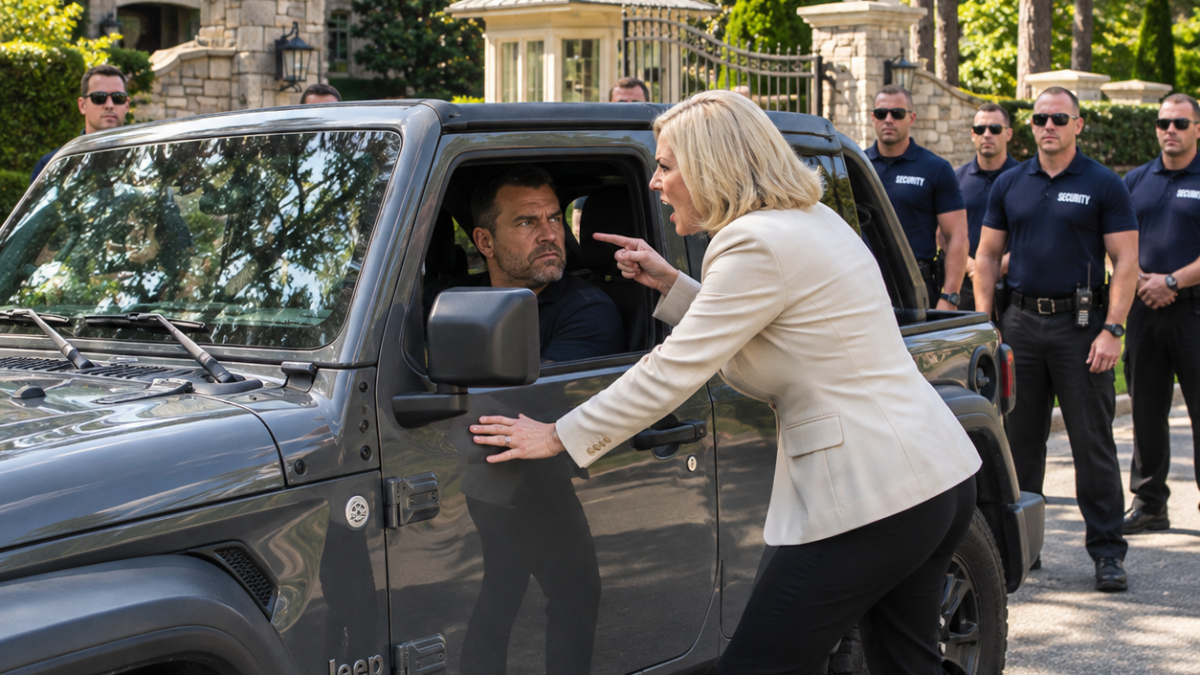
I hadn’t even shut off the Jeep when a security guard walked toward my window.
“This is private property. Turn around.”
I lowered the glass.
“Good morning.”
He looked about thirty.
Black polo.
Utility belt.
Radio.
No law-enforcement insignia.
“Who manages this gate?”
“That’s none of your business.”
“I have a question about the road.”
He frowned.
Then reached for his radio.
“Ma’am, we’ve got someone refusing to leave the east entrance.”
I looked around.
My Jeep was on the shoulder.
Not blocking the barrier.
Not touching Pinehaven property.
Not even inside the development.
Within two minutes, five additional guards appeared.
Six men around my Jeep.
Then Blythe arrived.
White blazer.
Oversized sunglasses.
Perfect hair.
Fifty-two years old and carrying herself with the calm entitlement of someone accustomed to having discomfort removed before it reached her.
She looked at my Jeep.
Then me.
“We don’t allow people like you at our entrance.”
I glanced at the guards.
“People like me?”
“Uninvited strangers.”
She pointed toward the road.
“Especially strangers blocking our private gate.”
I looked behind me.
Empty pavement.
“I’m legally parked on the shoulder.”
“You have thirty seconds.”
“I’d like to discuss the authorization for the gate.”
Something flickered behind her sunglasses.
Then she laughed.
“You don’t get to question our permits.”
“I think you’ll find that I do.”
That was when her composure disappeared.
She slammed her palm against my hood.
Hard.
“WHO THE HELL DO YOU THINK YOU ARE?”
One guard visibly flinched.
I kept my hands on the steering wheel.
“Please don’t hit my vehicle again.”
Blythe pulled out her phone.
“Oh, you’re going to regret this.”
She dialed 911.
Switched to speaker.
The dispatcher answered.
“Emergency services. What’s your emergency?”
Blythe’s voice transformed instantly.
Panic.
Breathless.
Almost trembling.
“HELP! There’s a dangerous man at our private entrance. He’s threatening my guards and refusing to leave!”
I stared at her.
The dispatcher asked:
“Is anyone injured?”
“Not yet! He’s acting aggressively.”
I leaned slightly toward my window.
“Please tell her what actually happened.”
Blythe’s face reddened.
Then she escalated.
“HE JUST TRIED TO RAM OUR GATE WITH HIS JEEP!”
One guard looked at another.
My dashboard camera’s red light continued blinking.
Good.
The dispatcher asked for the license plate.
Blythe walked around the Jeep.
Read it loudly.
Slowly.
Triumphantly.
Then:
Silence.
Five seconds.
Maybe ten.
The dispatcher returned.
“Ma’am?”
“Yes?”
“Ma’am, that’s the sheriff.”
Nobody moved.
Blythe stared at the phone.
“What?”
“The plate is registered to the Cedar Bluff County Sheriff’s Office.”
I stepped out.
Removed my credentials.
“Sheriff Duncan Ashford.”
The youngest guard stepped backward.
Another whispered:
“Oh, hell.”
Blythe went bright red.
Then did something I still remember because it told me exactly what kind of person I was dealing with.
She doubled down.
“I DON’T CARE IF YOU’RE THE SHERIFF! HOA RULES STILL APPLY TO YOU!”
I nodded.
“Only where your HOA has legal authority.”
“I’ll call your superiors.”
“You’re welcome to contact the appropriate oversight office.”
Then I reached into the Jeep.
Removed the folder.
Placed the authorization on my hood.
“Before you do, Mrs. Fenwick, I’d appreciate an explanation.”
Her eyes went to the document.
Her expression changed immediately.
“Where did you get that?”
“From a citizen complaint.”
“That’s an official authorization.”
“It’s certainly designed to look like one.”
I pointed at the bottom.
“Did Pinehaven use this document to justify closing Lakeside Access Road?”
“Our attorney handled the process.”
“What’s your attorney’s name?”
“I don’t have to tell you.”
“Who authorized use of my signature?”
Nothing.
“Because I didn’t.”
That was when Deputy Owen Fletcher arrived.
Marked cruiser.
Uniform.
Blythe ran toward him.
“OFFICER! Your sheriff has been threatening us!”
Owen looked at me.
Then six guards.
Then the document.
I said:
“Deputy, take independent witness statements. Preserve relevant evidence through normal procedure. Treat me as a witness, not the investigating officer.”
Blythe immediately shouted:
“Our cameras are private property!”
“Then any evidence request will go through proper process.”
The youngest guard raised his hand.
“Sir?”
Blythe spun around.
“DON’T SAY ANYTHING!”
He swallowed.
Then looked at Owen.
“The Jeep never touched the gate.”
Silence.
Blythe snapped:
“YOU’RE NOT BEING PAID TO CONTRADICT ME!”
My dashboard camera captured that too.
Then she pulled out a citation book.
Wrote furiously.
Slapped a paper against my windshield.
“Unauthorized vehicle obstruction. Twenty-five hundred dollars.”
I stared at it.
“Are you issuing me an HOA fine?”
“Yes.”
“While I’m parked on a county road?”
“This is my community.”
I put the citation into my folder.
“Thank you.”
That confused her.
What Blythe didn’t understand was that every new piece of paper helped establish what Pinehaven claimed to control.
I was preparing to leave when I saw her whisper to one guard.
He nodded.
Walked quickly toward the gatehouse.
Opened a camera housing.
Removed a small memory card.
I did nothing.
Didn’t seize it.
Didn’t approach.
Just noted the time.
8:51 a.m.
If an investigation followed, I wanted every action clean.
That evening, an edited video appeared online.
It showed me surrounded by guards.
Showing my sheriff’s credentials.
Blythe gesturing dramatically.
Headline:
COUNTY SHERIFF THREATENS PRIVATE HOA OVER SECURITY GATE
Conveniently missing:
Her striking my Jeep.
False 911 accusation.
Claim that I’d rammed the barrier.
The dispatcher’s identification.
I watched it.
Then watched my complete dash recording.
Everything was preserved.
I could have uploaded it publicly.
Destroyed the story in an hour.
I didn’t.
Because this had stopped being about reputation.
Someone had forged my signature.
Someone had erected a gate.
Someone appeared worried enough about camera footage to remove storage immediately after a deputy arrived.
And I was the victim named in the document.
If I personally ran the case, a defense attorney would someday argue I used the sheriff’s office to punish someone who embarrassed me.
I called my chief deputy.
“Refer the document investigation outside the department.”
“State bureau?”
“Yes.”
“You sure?”
“I’m the complaining party.”
Pause.
“What about Fenwick?”
“We preserve everything.”
“Okay.”
“And don’t release my dash video yet.”
He sounded surprised.
“Why?”
“Because I want to know what they do when they think we don’t have it.”
That was when Owen’s message arrived.
The young guard wanted to speak again.
Away from Pinehaven.
I met him the following morning at a diner.
Not in an interview room.
Not as sheriff.
The state investigator hadn’t arrived yet, and I wasn’t going to interrogate him.
His name was Caleb Mason.
Twenty-four.
Worked Pinehaven security fourteen months.
He looked exhausted.
“I can lose my job for talking to you.”
“You may.”
That answer surprised him.
“I won’t lie to you.”
He nodded.
“I don’t know anything about the document.”
“Okay.”
“But the road…”
He looked around.
Nobody nearby.
“They don’t want people seeing what happens down there at night.”
“What happens?”
“Trucks.”
“What kind?”
“Dump trucks. Concrete trucks sometimes. Flatbeds.”
“When?”
“Usually after eleven.”
“How often?”
“Three, four nights a week for the last five months.”
“What are they carrying?”
“I don’t know.”
“Where do they go?”
“Past the old public boat ramp.”
I knew the location.
County maps showed a narrow public recreation strip running along the northeastern edge of Lake Addison.
“What happens after they go in?”
“Gate closes.”
“You log the vehicles?”
“We used to.”
“Used to?”
“Mrs. Fenwick changed the procedure.”
“When?”
“October.”
“What procedure?”
“She said construction vehicles for Project Evergreen weren’t supposed to go in the normal log.”
Project Evergreen.
“What’s that?”
“I don’t know.”
“Who told you not to ask?”
He looked at his coffee.
“Blythe.”
“What else?”
“The cameras.”
I waited.
“The east-road cameras record the trucks.”
“Then why remove the memory card yesterday?”
Caleb looked directly at me.
“Because she told Ben to.”
“Ben?”
“Shift supervisor.”
“Did he delete it?”
“I don’t know.”
“What do you know?”
Caleb swallowed.
“The system backs up online.”
That was useful.
“Does Blythe know?”
“I don’t think so.”
“Why?”
“She thinks the DVR is local.”
I sat back.
“Anything else?”
“Yes.”
He looked nervous now.
“Public people used to drive down to the lake.”
“Before the gate.”
“Yes.”
“Fishermen.”
“Kayaks.”
“Families.”
“Then one day we were told anyone without a Pinehaven sticker had to be turned around.”
“Reason?”
“Safety.”
“Whose order?”
“Blythe.”
“County order?”
“We were shown a paper.”
“The one with my signature?”
“I think so.”
“How long ago?”
“September.”
The forged document wasn’t created after complaints.
It had been used operationally for months.
The state bureau took over Monday.
Special Agent Dana Crowell.
Professional.
Methodical.
She interviewed me.
Took my original signature samples.
Obtained the questioned document.
Collected the dash recording.
Then asked the one question I appreciated most.
“Sheriff, what outcome do you want?”
“The truth.”
“No.”
She looked at me.
“What outcome?”
I understood.
“I want the road status resolved legally.”
“And Blythe?”
“If she committed a crime, handle it like anyone else.”
“Even if that means nothing criminal happened?”
“Yes.”
“Good.”
That was the end of our personal involvement.
Mostly.
But Cedar Bluff is not a large county.
Information travels.
Within three days, county planning staff discovered there were no approved permits for major construction at the Pinehaven lakefront.
No commercial marina.
No dredging.
No concrete retaining walls.
No major shoreline alteration.
Yet aerial imagery from a routine county GIS flight showed something new.
Docks.
A lot of docks.
Twenty-eight slips extending into a cove below Pinehaven.
Large floating structures.
A widened access road.
A freshly graded parking area.
The planning director called me.
“This wasn’t here last year.”
“Who owns the shoreline?”
“That’s complicated.”
It always is.
The upper bank belonged to Pinehaven’s HOA.
But the lower recreation strip along the eastern shore remained subject to a public-access reservation created when the county sold adjacent surplus land in 1987.
The access road connected directly to it.
Pinehaven could maintain its land.
It could not simply extinguish the public reservation.
And it definitely couldn’t build a private marina across it without permits.
Then environmental staff visited.
They found fresh fill along protected shoreline.
Concrete poured below the approved elevation line.
Trees cleared.
Bank material pushed toward the water.
No erosion-control plan.
No state shoreline permit.
No county grading permit.
No Army Corps review where required.
And no marina authorization.
The trucks Caleb had seen suddenly made sense.
They were building something.
At night.
Behind a gate erected using a forged county authorization.
Agent Crowell obtained warrants.
Not from me.
From a judge in the neighboring judicial district.
Clean separation.
The cloud camera system was preserved before Pinehaven could alter it.
Five months of video.
Dump trucks entering at midnight.
Excavators working under temporary lights.
Concrete trucks.
Flatbeds carrying dock sections.
Blythe entering repeatedly.
A man named Gordon Fenwick, her younger brother, supervising crews.
His company:
Fenwick Lakeside Services LLC.
That name mattered.
Because Pinehaven’s financial records showed payments.
Lots of them.
$46,000.
$73,500.
$118,000.
Then another $96,000.
More than $330,000 transferred to Gordon’s company over two years.
Descriptions:
shoreline beautification
stormwater stabilization
resident amenity improvements
emergency access restoration
Very little corresponding documentation.
The HOA board claimed ignorance.
Blythe said everything was authorized.
The permits said otherwise.
Then investigators found a second account.
Not an HOA operating account.
Pinehaven Premier Lake Club
That was where the case changed.
Thirty-one Pinehaven homeowners had paid deposits.
$22,500 each.
For guaranteed private boat slips.
Exclusive lake access.
Private launch privileges.
Secure storage.
Founding membership.
Thirty-one times $22,500.
$697,500.
Nearly seven hundred thousand dollars.
The promotional packet called it:
A private marina experience reserved exclusively for Pinehaven residents.
One page promised:
Public road access has been permanently restricted by county authorization, guaranteeing privacy and controlled shoreline use.
County authorization.
My forged signature.
Now we knew exactly why it existed.
Blythe wasn’t only trying to keep strangers out.
The gate was part of what she was selling.
Exclusivity.
Private lake access.
No fishermen.
No kayakers.
No families launching boats from the old public ramp.
Thirty-one wealthy homeowners had paid premiums because they were told ordinary people could no longer reach that side of the lake.
And if somebody questioned the gate?
Blythe could produce a county document.
Signed by the sheriff.
Except it wasn’t.
I asked Agent Crowell one afternoon:
“Does this count as motive?”
She smiled slightly.
“It counts as something I’m interested in.”
Financial investigators went through the Lake Club account.
Money came in.
Then moved.
Some paid contractors.
Some bought docks.
Some paid engineering work that never received county approval.
Then:
$185,000 transferred to Fenwick Community Management LLC.
Registered owner:
Blythe Fenwick.
She described it as “project administration.”
Another $94,000 transferred to Gordon’s company without itemized invoices.
Then a $48,000 payment toward a condominium in South Carolina held through a company Blythe controlled.
That was harder to call shoreline beautification.
Pinehaven homeowners started asking questions.
The board called an emergency meeting.
Blythe arrived with a lawyer.
Not the “HOA attorney” she’d mentioned at the gate.
A criminal-defense attorney.
That told everyone enough.
The board treasurer, Helen Shaw, stood in front of eighty residents.
“I never authorized a Lake Club account.”
Blythe interrupted.
“The board approved the marina concept.”
Helen shook her head.
“We approved feasibility review.”
“Same project.”
“No.”
She held up minutes.
“We approved $25,000 for feasibility.”
People started shouting.
Blythe pointed toward Helen.
“You signed checks.”
“Routine HOA checks.”
“Exactly.”
“Not this account.”
Blythe called the meeting hostile.
A resident named Scott Melton stood.
He had paid for two slips.
$45,000.
“You told me construction was county approved.”
“It is.”
“No, it isn’t.”
“Technical permits are being finalized.”
“They issued a stop-work order yesterday.”
“Politics.”
Then someone shouted:
“What about the sheriff’s authorization?”
Silence.
Blythe looked toward the door.
The room changed.
Someone else:
“Is it real?”
She didn’t answer.
That meeting lasted four hours.
By the end, the board suspended her authority.
Four votes to one.
Blythe voted for herself.
She tried to argue the vote violated bylaws.
The HOA’s actual attorney—who had not drafted the road authorization—said it did not.
Forensic examination of the forged document came next.
The signature wasn’t handwritten.
It had been copied from a public document.
My signature appeared on a county emergency-management memorandum from two years earlier.
Same curve.
Same pen lift.
Same microscopic imperfections.
Digital image extracted.
Placed onto the new authorization.
The document metadata showed it was created on a laptop assigned to Pinehaven’s management office.
User account:
B. Fenwick.
That wasn’t enough by itself.
But then investigators recovered draft versions.
Draft 1:
No sheriff signature.
Draft 2:
Signature image inserted.
Draft 3:
County seal added.
Draft 4:
Final PDF.
A notes file sat in the same folder.
Need official-looking emergency closure language.
Agent Crowell didn’t tell me that immediately.
I learned during discovery months later.
Probably for the best.
Because if she’d told me that week, staying professionally detached would have been harder.
The camera-card incident became another problem.
Ben, the security supervisor, admitted Blythe ordered him to remove the storage card immediately after Deputy Fletcher arrived.
“What did she say?” investigators asked.
Ben answered:
“She said county officials were not entitled to private surveillance.”
“What did she tell you to do with the card?”
“Bring it to her office.”
“What happened next?”
“She snapped it.”
That became evidence-tampering territory.
Except the cloud backup had everything.
Including Blythe ordering Ben toward the camera housing.
Including her returning to the gatehouse later.
Including nighttime work.
The attempted deletion preserved nothing except intent.
The edited social-media video came from another employee.
He told investigators Blythe personally selected the clips.
“Remove the dispatcher part.”
“Why?”
“She said it was irrelevant.”
“Remove her striking the Jeep?”
“Yes.”
“Why?”
“She said it looked bad.”
Honest, at least.
County public-works officials then dug into the road history.
Lakeside Access Road was not Pinehaven property.
The first 0.8 mile was county right-of-way.
The final section crossed an old transportation easement reserved specifically for public lake access.
Pinehaven had maintenance obligations on a landscaped strip beside it.
Nothing more.
The gate itself sat six feet inside county right-of-way.
That meant Pinehaven had built a permanent private gate partly on public land.
No permit.
No franchise agreement.
No county approval.
Public works issued a removal order.
Blythe’s attorney appealed.
Lost.
At 9:00 on a Wednesday morning, the wrought-iron gate came down.
I didn’t attend.
Didn’t need to.
Owen sent me a photo.
Road open.
Two fishermen waiting in pickups.
A family with kayaks.
No guards.
I looked at it for a long time.
Not because I had won anything.
The road belonged to the public before I ever became sheriff.
All we’d done was stop someone from pretending otherwise.
Pinehaven residents were divided.
Some hated Blythe.
Some defended her.
One man wrote a letter to the editor saying she’d increased property values and “created the kind of exclusivity residents paid for.”
That sentence revealed the entire dispute better than any legal filing.
Exclusivity.
Some people believed paying more for a home gave them the right to make nearby public things private.
The law usually disagrees.
The Pinehaven board hired an independent accountant.
The report took three months.
It was ugly.
Over four years:
$1.26 million in “amenity enhancement” assessments.
$697,500 Lake Club deposits.
$412,000 paid to companies controlled by Blythe or Gordon.
$185,000 in management fees to Blythe’s LLC.
$94,000 to Gordon without adequate invoices.
$71,000 in travel, hospitality, and “community development” reimbursements.
Some expenses were legitimate.
Many were not well documented.
The South Carolina condo payment became especially difficult to explain.
Blythe claimed it had been a temporary investment connected to HOA conferences.
Nobody found an HOA ownership interest in the condo.
Title was held by her LLC.
Her defense evolved.
First:
Everything was authorized.
Then:
Board members knew.
Then:
The treasurer approved.
Then:
The Lake Club was separate from the HOA.
Then:
The forged sheriff authorization had been prepared by a consultant.
Investigators asked which consultant.
She couldn’t identify one.
Gordon hired his own attorney.
Two weeks later, he began cooperating.
That was when the case moved quickly.
According to Gordon, Blythe had conceived the private marina almost three years earlier.
Pinehaven homes with lake privileges sold for substantially more than inland homes.
But public access at the east road undermined what she called the “exclusive lakefront identity.”
She wanted the road closed.
County staff initially told her no.
So she reframed it as emergency-security control.
That also failed.
Then she produced the authorization.
Gordon said he asked:
“Did the sheriff really sign that?”
Blythe answered:
“He will never know.”
I did.
Gordon also explained why construction happened at night.
Not just to avoid public attention.
The contractor knew permit approvals were incomplete.
Heavy work during business hours risked county inspectors seeing it from the lake.
Night construction reduced visibility.
“What about the public boat ramp?” investigators asked.
Gordon said:
“Blythe wanted it gone.”
“How?”
“Eventually landscaped over.”
“Before permits?”
“She said once the marina was operating, nobody would force residents to tear it out.”
There was her strategy.
Do first.
Argue later.
Make reversal expensive enough that authorities compromise.
It works more often than people like to admit.
Until somebody documents the first step.
The state environmental agency ordered shoreline restoration.
Unauthorized fill removed.
Bank stabilized.
Vegetation replanted.
Several docks removed completely.
A smaller set of lawful slips could remain only after new permitting and public-access protections.
The Lake Club members were furious.
Not at me.
At least most weren’t.
They had been sold something Pinehaven had no authority to promise.
Refund litigation followed.
The HOA’s insurance carrier denied portions of coverage tied to intentional misrepresentation.
Homeowners faced assessments.
That created another wave of anger.
One resident confronted Blythe outside court.
“You made us pay for a private lake you didn’t own.”
She replied:
“I was protecting your investment.”
He said:
“My investment was my house.”
That line stuck with me.
Blythe had confused the neighborhood with an empire.
Its entrance.
Its road.
Its lake.
Its guards.
Its cameras.
Its residents.
Her authority.
But an HOA is not a government.
A president is not a mayor.
And a gated entrance does not transform public land into private land because somebody buys a nicer sign.
The grand jury returned indictments nine months after I first drove to Pinehaven.
The counts included forgery-related charges tied to the county authorization.
Fraud-related charges involving Lake Club representations.
Misuse of association funds.
Evidence tampering.
And conspiracy counts involving Gordon and two contractors.
Not everyone was convicted of everything.
One contractor showed he had repeatedly asked for permits and had been given fake assurances.
Charges against him were dropped.
Gordon reached a cooperation agreement.
Ben, the guard who removed the memory card, was not prosecuted after investigators determined he acted under employer instruction and surrendered evidence voluntarily once questioned.
Caleb Mason never returned to Pinehaven security.
He became a county dispatcher.
Not because of me.
He applied.
Passed.
Good employee.
The first time he saw me after training, he smiled.
“Sheriff.”
“Caleb.”
“You still drive that Jeep?”
“Yes.”
“Still dangerous?”
“Extremely.”
He laughed.
Blythe fought the case for almost a year.
Then pleaded.
The evidence was overwhelming.
Digital drafts.
Bank transfers.
Gordon’s testimony.
Camera footage.
HOA records.
County correspondence.
The fake signature.
She accepted responsibility on several major counts.
Other counts were dismissed.
At sentencing, the prosecutor didn’t spend much time on the morning at the gate.
That surprised reporters.
They expected the dramatic story.
HOA president calls 911 on sheriff.
Dispatcher identifies him.
Six guards.
$2,500 citation.
Funny.
Viral.
But that was not the serious part.
The prosecutor focused on the homeowners.
Thirty-one families paid nearly $700,000 based on representations about access and permits.
The public was denied a road it legally possessed.
County authority was forged to make the closure look official.
Construction altered protected shoreline.
Association money moved into companies controlled by people directing the project.
The prosecutor said:
“This case is not fundamentally about a confrontation at a gate. It is about manufacturing authority where none existed and monetizing that false authority.”
Exactly.
Blythe addressed the court.
She said she believed Pinehaven needed stronger control over its lakefront.
She said the neighborhood had suffered from trespassing, litter, and unauthorized parking.
Some of that was true.
Public access creates problems.
Public spaces require management.
Then she said:
“I was trying to protect seventy-eight families.”
The judge asked:
“Did protecting those families require forging the sheriff’s signature?”
Silence.
“No.”
“Did it require telling customers the marina was fully approved?”
“No.”
“Did it require taking public access for private sale?”
Blythe hesitated.
“No.”
That was the first time I ever heard her say it plainly.
She received a combination of incarceration, suspended time, probation, restitution, and financial restrictions.
She was barred from serving as an HOA officer or handling association funds during the probationary period.
Her companies were dissolved or placed into settlement administration.
The condo was sold.
Proceeds went toward restitution.
Gordon received a lesser sentence under his cooperation agreement.
Pinehaven’s board changed almost completely.
New president:
Helen Shaw.
The former treasurer.
First week, she called my office.
Not me personally.
My office.
Correct channel.
She requested a meeting about road safety.
I attended with public works.
Helen brought three residents.
No lawyers.
No private guards.
No white blazer.
She said:
“We still have problems with cars parking near the entrance.”
Public works said:
“We can stripe the shoulder and install no-parking zones where sight distance is poor.”
“Can we put cameras?”
“On HOA property, yes.”
“Can we restrict road access?”
“No.”
She nodded.
“Okay.”
That was it.
Twenty minutes.
Government does not have to be dramatic when people accept where authority ends.
Pinehaven funded cleanup at the public boat ramp.
Not because we forced them.
The residents voted to.
They installed trash cans on HOA land.
Paid for weekend litter pickup.
Worked with the county on lighting.
The lake stayed public.
The neighborhood stayed gated where its private roads actually began.
Clear boundary.
Everybody survived.
My $2,500 HOA ticket remained on the bulletin board in my office.
Chief Deputy Ramirez framed it.
I told him not to.
He did anyway.
Underneath he added a brass label:
MOST EXPENSIVE PARKING WARNING NEVER PAID
I should have removed it.
I didn’t.
The dash video eventually became public evidence after the case resolved.
By then it was no longer useful to release it for reputation management.
The complete version spread online anyway.
Blythe hitting the hood.
False 911 report.
Dispatcher pause.
“Ma’am, that’s the sheriff.”
Her issuing the fine.
Ordering the guard not to contradict her.
People treated it like comedy.
I understood why.
It was absurd.
But I never found the 911 part very funny.
False emergency reports are dangerous.
Blythe told dispatch I’d tried to ram a gate.
Said I was aggressive.
Imagine I had not been the sheriff.
Imagine an ordinary man sitting in an unmarked vehicle.
Imagine responding deputies arriving on information that he had attempted vehicular violence against six guards.
That is how bad information turns into bad outcomes.
My title protected me that morning.
The dispatcher recognized the plate.
An ordinary citizen might not have had that advantage.
That mattered more to me than the forged signature.
So we changed county procedure.
Not because of Pinehaven specifically.
Any high-risk call based primarily on a private-security report now required dispatchers, when feasible, to capture specific observable facts.
Weapon seen?
Vehicle contact observed?
Actual threats quoted?
Injury?
Direction of travel?
Not:
“Caller says aggressive male.”
Facts.
It didn’t eliminate false reports.
Nothing does.
But it improved the information deputies received.
Caleb helped write some of the dispatch training after he joined.
Full circle.
A year after Blythe’s sentencing, I drove Lakeside Access Road again.
Same Jeep.
This time marked by dust from a search-and-rescue training exercise.
No guards stopped me.
No gate.
Near the lake, a father was unloading two kayaks.
An older man sat on a folding chair fishing from the bank.
Kids threw rocks into the shallows.
The repaired shoreline looked rough in places.
Young grass.
New erosion matting.
Smaller legal dock.
Nothing like Blythe’s promised private marina.
Better.
I parked.
Walked toward the water.
The older fisherman looked up.
“You Ashford?”
“Yes.”
He pointed at the road.
“Thanks.”
“Wasn’t mine to give back.”
“Still.”
He went back to fishing.
That was enough.
I walked past the old gate location.
Two concrete footing scars remained beside the shoulder.
Public works had removed the rest.
For months, that gate represented Blythe’s entire strategy.
Make something physically real.
Then tell everyone the law had already approved it.
A gate exists.
Therefore authority exists.
Guards stand there.
Therefore they can order you away.
A document has a seal.
Therefore somebody official signed it.
A marina is under construction.
Therefore permits must exist.
Residents paid for slips.
Therefore exclusive access must be legitimate.
Most scams don’t depend on people believing something impossible.
They depend on people assuming somebody else already checked.
That was Blythe’s greatest weapon.
Assumption.
The guards assumed the gate was legal.
Contractors assumed permits existed.
Residents assumed the Lake Club had rights.
Homebuyers assumed the private-road claim had been verified.
County employees seeing the sheriff’s name might have assumed another department approved it.
Until Thomas Avery didn’t.
He asked for a copy.
Then sent it to my office.
One citizen looked at one document and asked one question.
Did you really sign this?
No.
Everything came from that.
I met Avery later.
Retired science teacher.
Seventy-one.
He apologized for “causing trouble.”
I told him:
“You caused paperwork.”
He laughed.
“Worse.”
“Much.”
Then I thanked him.
Blythe had spent years constructing authority.
Avery defeated the first layer by reading.
That is less exciting than people want these stories to be.
No secret federal agent.
No billionaire.
No hacker.
A retiree requested records.
A sheriff recognized his own forged signature.
A guard told the truth.
A cloud camera preserved footage somebody thought had been destroyed.
An accountant followed money.
A planning officer checked permits.
The system worked because individual people did ordinary jobs carefully.
It also failed for years because others didn’t.
Both things can be true.
Pinehaven still exists.
Homes still expensive.
Lake views still beautiful.
Property values did not collapse because fishermen returned.
The residents survived seeing kayaks.
Nobody’s civilization ended.
Helen Shaw invited county officials to the association’s annual meeting two years later.
I declined.
Sent a lieutenant.
She mailed me a holiday card anyway.
Front:
Snow-covered Pinehaven entrance.
No illegal gate.
Inside:
We promise not to fine county vehicles this year.
I laughed.
Ramirez put that beside the framed ticket.
My office was becoming a museum of bad HOA decisions.
Caleb stopped by one afternoon.
He looked at the citation.
Then the card.
“Do you ever think about that morning?”
“Sometimes.”
“What part?”
I thought about it.
“Your face.”
He looked confused.
“When?”
“When the dispatcher said who I was.”
He laughed.
“I thought I was getting fired.”
“You were.”
His smile vanished.
“I was?”
“I assume Blythe fired you.”
“Oh.”
Then he laughed harder.
“Yes. About twenty minutes after you left.”
“I didn’t know that.”
“Best thing she ever did for me.”
He pointed toward his dispatch badge.
Probably true.
Then he became serious.
“I should have spoken sooner.”
“About the trucks?”
“Yes.”
“Maybe.”
“I knew something felt wrong.”
“Feeling isn’t always enough.”
“I could’ve asked.”
“Yes.”
He nodded.
I didn’t tell him it wasn’t his fault.
Sometimes people say that too quickly.
There had been choices.
He had followed bad instructions for months.
Then he made a better choice.
That mattered.
“What made you talk?” I asked.
Caleb thought.
“When she told me not to contradict her.”
“At the gate?”
“Yes.”
He looked down.
“I suddenly realized she wasn’t asking us to protect residents.”
“What was she asking?”
“To protect her version of things.”
Exactly.
That was Blythe’s entire operation.
Protect the version.
The version where Lakeside Road was private.
The version where the marina was legal.
The version where public access was a security problem.
The version where seven hundred thousand dollars represented legitimate private privileges.
The version where companies she controlled were just vendors.
The version where a man sitting calmly in a Jeep was dangerous.
The version where a forged signature became official because enough people saw it on letterhead.
Versions collapse when records survive.
That’s why I never regretted not confronting the guard who removed the camera card.
If I’d grabbed him, shouted, seized evidence without process, Blythe would’ve gained exactly what she needed.
A story about an angry sheriff abusing authority.
Instead, I wrote down:
8:51 a.m.
Male security employee removed media card from east gate camera after conversation with Blythe Fenwick.
Then I left.
The state bureau did the rest.
Restraint is not weakness.
Sometimes restraint is how you keep the truth admissible.
Three years later, a new deputy asked me about the case during orientation.
“Sheriff, is it true she actually called 911 on you?”
“Yes.”
“And didn’t know who you were?”
“Yes.”
“And fined you?”
“Yes.”
“Twenty-five hundred?”
“Yes.”
He smiled.
“That’s insane.”
“Maybe.”
He waited for the funny part.
I gave him the important one.
“Don’t ever decide a caller is right because they sound confident.”
His smile disappeared.
“Okay.”
“Don’t decide they’re wrong because they sound ridiculous either.”
He nodded.
“Then what do I decide?”
“Nothing until you have facts.”
That was the lesson.
Not:
Don’t mess with the sheriff.
I hated that version.
People online framed it that way.
HOA Karen picks wrong man.
Sheriff destroys her empire.
No.
Blythe shouldn’t have been able to do it to anyone.
The problem wasn’t that she falsely accused a sheriff.
The problem was that she had become comfortable falsely accusing people at all.
She had six guards.
Money.
Lawyers.
A gate.
An HOA title.
Professional-looking documents.
And years of people stepping aside because challenging her was inconvenient.
Then she crossed a line where the person on the other side happened to understand exactly how evidence should be preserved.
That accelerated things.
But it shouldn’t require a sheriff.
That’s why the public road mattered.
That’s why Thomas Avery mattered.
That’s why Caleb mattered.
The lake belonged to everybody who legally had access to it.
Not because they were wealthy enough to live behind Pinehaven’s gates.
Not because they bought a $22,500 slip package.
Not because Blythe approved them.
Because the public-access reservation existed before Pinehaven built its first house.
You cannot buy exclusivity to something you don’t own by installing a gate in front of it.
Blythe tried.
For a while, it worked.
Then one Friday morning at 8:14, she slapped the hood of a dusty Jeep and called 911.
She thought the dangerous man at her gate was the problem.
She had no idea the real danger was sitting on my hood in a folder.
A document with my name.
My forged signature.
And enough lies beneath it to bring down everything she had built around the lake.








