I Trusted My Sister With the Cat Who Had Been Beside Me for Thirteen Years—When I Came Back, One Empty Carrier Told Me Something I Wasn’t Ready to Face
PART3:
Those words have teeth.
They still do.
Because Jasper had a home.
A small one-bedroom apartment with an old blue sofa, two sunny windows, a scratched wooden bookshelf, and a woman who knew exactly how he liked his food warmed for eight seconds in the microwave so the gravy loosened but did not steam.
He had a home where his blanket was not folded for decoration, where his medication was not optional, where his yowling at night meant fear and not inconvenience.
He had me.
For thirteen years, he had me.
And I had him.
I drove to the rescue so fast I do not remember half the trip.
I remember Lauren following me outside, saying my name in that sharp, whisper-yell people use when they are afraid the neighbors will hear truth.
I remember her saying, “You’re overreacting.”
I remember turning back so suddenly she stopped walking.
“I swear to God, Lauren,” I said, “do not follow me.”
Then I got in my car and left her standing in the rain beside Jasper’s empty carrier.
My hands shook so hard on the steering wheel that I missed the first turn.
The rescue was eleven minutes away, according to my phone. It felt like a different country. I kept seeing Jasper in my mind, but not as he was now—old, bony at the hips, offended by most things, still handsome in the stubborn way elderly cats become handsome because they have survived long enough to stop caring what anyone thinks.
I saw him as a kitten.
Tiny and furious.
Mostly white, with dark brown patches too big for his little body and a black smudge under his nose that made him look like a disapproving landlord. I had found him outside the back door of the bookstore where I worked when I was twenty-two. He had been wedged beneath a rusted metal shelf, screaming at the rain like it had personally wronged him.
I was broke then.
Lonely in a way I would not have admitted because twenty-two-year-olds think loneliness means failure.
My first apartment smelled like paint and secondhand carpet. I owned two plates, three mugs, and a mattress on the floor. I told myself I would take the kitten to a shelter the next morning.
Instead, he fell asleep inside the hood of my sweatshirt while I sat cross-legged on the kitchen floor feeding him tuna from a spoon.
By sunrise, I had named him Jasper.
By the end of the week, he had claimed my pillow.
By the end of the month, I was talking to him like he was a roommate with opinions.
By the end of the year, I could not remember what the apartment had felt like before him.
He was there when I got married too young to a man who loved the version of me who agreed with him.
He was there when that marriage became quiet in all the wrong ways.
He was there the night I packed two suitcases while my husband slept, my heart beating so hard I thought it would wake him. Jasper had watched from the bed, tail wrapped around his paws, solemn as a judge. When I picked up his carrier, he walked into it without a fight for the first and only time in his life.
As if he already knew.
He was there through the divorce, through the apartment I could barely afford, through the evenings when I ate cereal over the sink because cooking for one felt too much like proof.
He was there when our mother got sick.
That last year with Mom hollowed me out in slow, precise ways.
Lauren visited on weekends when she could. She brought flowers, handled insurance calls, posted smiling pictures with captions about cherishing family. I did not judge her for that. We all cope differently. That is what I told myself then.
I was the one who went every Tuesday and Thursday after work.
I was the one who learned which nurses were gentle and which ones rushed.
I was the one who knew Mom liked ice chips in the blue cup but not the clear one, who knew she got scared if she woke up and nobody was touching her hand.
And every night, after hospice, I came home to Jasper.
He would be waiting by the door.
Not because he was affectionate in a soft, movie way. Jasper was not that kind of cat. He would not rush into my arms. He would not lick away tears like some golden retriever in a commercial.
He would sit two feet away and stare at me until I sat down.
Then he would climb onto my lap with the weary authority of a nurse clocking in for another shift.
When Mom died, the silence in my apartment changed shape.
Grief does that.
It does not simply make a place quiet. It makes the quiet active. It waits in rooms. It sits in chairs. It turns ordinary objects cruel.
Her last cardigan was on my kitchen chair for three weeks because I could not touch it.
The sympathy cards stood on the counter like tiny gravestones.
My phone stopped ringing at 7:15 every evening because there was no mother left to call and ask whether I had eaten.
Jasper carried me through that.
Not dramatically.
Not magically.
He carried me by needing breakfast.
By yelling at the bathroom door.
By stepping on my chest at six in the morning with one cold paw because, apparently, mourning did not change feeding time.
He kept me attached to the day.
That is what people like Lauren never understood.
Sometimes survival does not look heroic.
Sometimes it looks like scooping a litter box because one small creature still depends on you.
By the time I pulled into the rescue parking lot, I could barely breathe.
The sign said HARBOR PAWS RESCUE in cheerful blue letters, with a cartoon dog and cat curled around a heart. Cheerful signs outside sad buildings always feel like a lie.
I ran through the front door.
A woman behind the desk looked up, startled.
“I’m looking for my cat,” I said. “His name is Jasper. My sister brought him here yesterday. She had no right to do that. He’s mine. He’s thirteen. He needs medication. Please.”
The words came out tangled.
The woman’s face changed immediately.
Not annoyed.
Concerned.
“What’s your name?”
“Nora Whitaker.”
“Cat’s name is Jasper?”
“Yes. Mostly white. Brown patches. Black mark under his nose. He’s old. He has kidney disease. He needs medication twice a day. Please, I need to see him.”
She turned to the computer, typed quickly, and her mouth tightened.
A second woman came from the hallway holding a clipboard.
The first woman said, low, “Can you get Marisol?”
That scared me more than anything.
“Is he here?” I asked. “Is he alive? Is he okay?”
The woman stood.
“He’s here,” she said gently. “Let’s go back.”
The intake area smelled like disinfectant, wet towels, and fear.
If you have ever walked through a rescue kennel, you know that sound. Not one sound. Many sounds layered together. Dogs barking in uneven waves. Metal bowls clanging. A dryer thumping somewhere. A cat crying behind a closed door. Human voices trying to stay calm.
She led me into a quieter room with stainless-steel cages along one wall.
I saw him before she pointed.
Jasper was in the bottom kennel at the far end.
He was sitting at the very back with his face turned toward the wall.
His body looked smaller than it had two days earlier. That is impossible, I know. A body does not shrink from heartbreak in twenty-four hours. But he looked diminished somehow, folded inward, as if every year of his age had risen to the surface at once.
His food bowl was untouched.
His blanket was not with him.
Of course it was not.
His blanket was folded on my sister’s armchair.
“Jasper,” I whispered.
He did not move.
The worker unlocked the kennel.
“He’s been very shut down,” she said softly. “He hasn’t eaten for us yet.”
I knelt so quickly my knees hit the floor.
“Jasper.”
His ears moved.
Just barely.
I said his name the way I always did at home, low and familiar, with the little softness at the end I never noticed until that moment.
“Jas.”
He turned his head.
And I will never forget his face.
People who do not love animals will tell you not to put human feelings onto them. They say it like they are being wise. Like love is only valid if it can be measured in the right vocabulary.
But Jasper’s face changed.
His eyes widened.
His whole body froze.
For one second, he looked afraid to believe me.
Then he stood.
Slowly.
Stiffly.
One front paw, then the other.
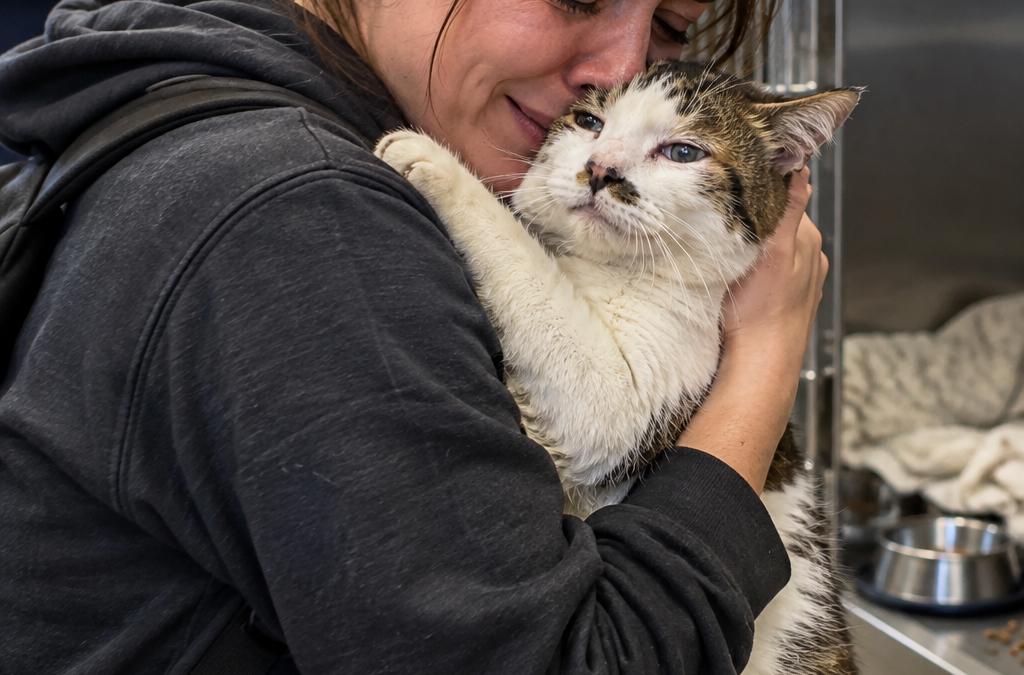
He stepped toward the open kennel door like the floor might vanish beneath him. He stopped halfway, staring. I reached in, palm open, and he leaned forward to smell my fingers.
That broke me.
Thirteen years, and he still needed proof.
“I came back,” I said, and my voice shattered. “Baby, I came back.”
Then he came forward all at once.
Not gracefully.
Jasper had never done anything gracefully when emotion was involved. He stumbled out of the kennel, climbed up my coat, and planted both front paws on my chest. His claws caught in the fabric. His body shook so violently I thought he might fall.
I wrapped both arms around him.
He was trembling.
I pressed my face into the fur behind his ear and cried so hard I could not apologize to the rescue worker, though I wanted to. Jasper did not meow. He did not purr at first. He just held on, claws dug into my coat, face pushed beneath my chin.
Then, after a long minute, I felt it.
A faint vibration.
Rusty.
Uneven.
Barely there.
His purr.
That tiny broken sound nearly put me on the floor.
“I’m so sorry,” I whispered. “I’m so sorry. I didn’t know. I would have come. I would have come right away.”
A woman with silver hair and kind, tired eyes stepped into the room.
“I’m Marisol,” she said. “I manage intake.”
I could only nod.
Her gaze moved from my face to Jasper’s paws gripping me like I was the last solid thing in the world.
“I think we need to talk,” she said.
I thought the hard part was finding him.
I was wrong.
The hard part was sitting in a small office ten minutes later with Jasper inside my coat like a trembling secret while Marisol placed photocopied papers on the desk between us.
“Your sister signed these yesterday at 4:18 p.m.,” she said.
I stared at the top page.
Owner surrender form.
The words blurred.
“She’s not his owner.”
“I understand that now.”
“She knew that. She knew he was mine.”
Marisol’s face tightened with the practiced restraint of someone who has seen too many versions of human cowardice to be surprised by a new one.
“She listed herself as temporary caregiver.”
“Temporary because my apartment building had an electrical issue,” I said. “My landlord made everyone leave for two nights. Lauren offered. I asked her three times if she was sure.”
“She indicated the cat had been left with her indefinitely.”
I looked up.
“What?”
Marisol turned the form toward me and tapped one section with her pen.
Reason for surrender: Owner left animal in my care and has not returned. Unable to manage behavioral issues.
My mouth went dry.
“She wrote that?”
“Yes.”
“I was coming back Sunday. She knew I was coming back Sunday. I texted her Saturday night asking how he was.”
Marisol’s expression changed.
“Do you have that message?”
I pulled my phone out with shaking hands and opened the thread.
Saturday, 8:42 p.m.
Me: How’s my cranky old man doing? Did he eat the wet food? Remember meds after dinner.
Lauren: He’s hiding but fine. Don’t worry. Get your apartment handled.
Me: I can come early if it’s too much.
Lauren: No, stay there. We’re managing.
I turned the phone toward Marisol.
She read it.
Her jaw tightened.
Not dramatically. Just enough.
“May I take a photo of these messages for our file, with your permission?”
“Yes. Please. Take anything you need.”
She took photos with a shelter tablet, then continued through the paperwork.
Lauren had signed a statement declaring that she had authority to surrender Jasper.
Lauren had checked “no known medical conditions.”
Lauren had checked “no medication.”
Lauren had written, under temperament: anxious, hides, vocal at night, unsuitable for current home.
Current home.
As if my apartment, where Jasper had slept every night for thirteen years, had vanished because Lauren found him inconvenient for one weekend.
There was a line at the bottom where she had signed her name.
Lauren Whitaker Pierce.
I stared at that signature.
My sister’s handwriting had always been prettier than mine. She used to write our Christmas gift tags because Mom said her letters looked like they belonged in a magazine. Even there, on a form built out of betrayal, the L looped elegantly.
It made me hate the page more.
“She didn’t tell you he had kidney disease,” I said.
“No.”
“She didn’t give you his medication.”
“No.”
“She had it. I packed it. She left it at her house.”
Marisol leaned back slowly.
“I’m very sorry.”
That is such a small sentence for a large wound.
But I could tell she meant it.
Jasper shifted in my coat and pressed his head harder against me.
“What would have happened if I hadn’t come today?” I asked.
Marisol was quiet.
“Because he’s older and shut down, he would have stayed in intake while our vet evaluated him. We would not have made him available immediately. But without medical history…” She paused. “We would have had an incomplete picture.”
An incomplete picture.
My sister had turned Jasper into an incomplete picture.
A frightened senior cat in a kennel.
No home.
No medication.
No person.
No story.
Just a problem someone wanted gone.
I signed the paperwork to reclaim him with hands that still would not steady.
Marisol waived every fee before I could ask.
A younger staff member brought in the small bag of items Lauren had left. Not Jasper’s blanket. Not his medication. Not his prescription food.
Just one half-used bag of cheap dry cat food that did not belong to him and a towel with a bleach stain.
“That’s not his,” I said.
The staff member looked horrified.
“She brought this with him.”
I almost laughed again, but there was no humor in me.
Lauren had not even surrendered him with his own things.
She had packed him like a mistake.
On the drive home, Jasper cried twice.
Each time, I said his name, and each time he stopped.
At my apartment, the hallway still smelled faintly of electrical dust from the repairs. My door had a yellow notice taped to it saying tenants were cleared to return. Ordinary paper. Ordinary tape. Ordinary life waiting behind a lock.
The moment I opened the carrier, Jasper did not come out.
He sat inside, eyes wide, body low.
So I sat on the floor and waited.
I did not reach for him.
I did not coax.
I did not make promises too loudly.
After twenty minutes, he stepped out.
He sniffed the rug.
The leg of the coffee table.
The corner of the sofa.
His water bowl.
Then he walked to the bedroom and stared at the place where his fleece blanket should have been.
I had forgotten it at Lauren’s.
The realization hit me with such force that I nearly called her right then.
But I couldn’t.
Not yet.
So I took the old sweatshirt I had worn to the rescue, the one covered in his fur and my tears, and folded it at the foot of the bed.
Jasper smelled it.
Kneaded it twice.
Then curled on top of it and closed his eyes without sleeping.
That first night, he woke every time I moved.
If I shifted my foot beneath the blanket, his head snapped up.
If I went to the bathroom, he followed.
If I stood in the kitchen to get water, he stood in the doorway watching me with haunted eyes.
At 3:12 a.m., I broke.
I sat on the floor beside the bed and whispered, “I didn’t leave you.”
Jasper climbed into my lap, old bones and all, and tucked his head under my arm.
That was how we slept for the rest of the night.
Or tried to.
Morning came gray and quiet.
My phone had sixteen missed calls.
Four from Lauren.
Three from my aunt Denise.
Two from Lauren’s husband, Kevin.
The rest from cousins who apparently believed family emergencies were group projects as long as nobody asked the person who had actually been harmed.
There were texts too.
Lauren: Please call me. You scared the girls.
Lauren: I know you’re upset but you can’t just cut me off.
Lauren: I said I’m sorry.
She had not said she was sorry.
Not really.
She had said please don’t get mad.
Then Aunt Denise: Honey, your sister thought she was helping. Jasper is safe now. Don’t tear the family apart over a mistake.
A mistake.
I looked at Jasper, who was sitting two feet away from his food bowl, staring at me instead of eating because apparently I might vanish if he looked down too long.
A mistake is forgetting to pick up milk.
A mistake is missing a turn.
A mistake is washing a red sock with white towels.
Forging authority to surrender someone else’s elderly cat is not a mistake.
It is a decision.
I typed one text to Lauren.
Bring Jasper’s blanket, prescription food, medication, carrier liner, and crinkle ball to my apartment door by noon. Do not knock. Leave everything outside.
She responded immediately.
Can we talk like adults?
I stared at that message until my vision blurred.
Then I wrote back:
Adults do not give away animals that do not belong to them.
At 11:46, my doorbell camera recorded Lauren placing Jasper’s things outside my apartment.
She looked angry.
Not ashamed.
Angry.
She set the bag down too hard, glanced at the camera, and said, “This is ridiculous,” before walking away.
I saved the video.
I did not know yet why I would need it.
I only knew that something in me had stopped assuming the best.
That is what betrayal does.
It turns evidence into comfort.
Jasper’s blanket changed him.
When I brought it inside and laid it on the sofa, he approached it cautiously, as if even familiar things had become suspicious. He smelled one corner. Then another. Then he stepped onto it, crouched low, and began kneading.
His paws moved slowly at first.
Then faster.
He pressed his face into the fleece and made a sound I had not heard since before the weekend.
A small, breathy chirp.
I sat beside the sofa and cried into my sleeve because I did not want to make noise.
For the next few days, Jasper lived like a creature waiting for the second blow.
He ate only if I sat beside him.
He followed me into the bathroom.
He slept pressed against my legs with his claws lightly hooked into the blanket, as if he could anchor himself to me by force.
When I had to go to work, I set up a camera in the living room.
I watched him from my desk.
He sat facing the front door for almost two hours the first day.
Not sleeping.
Not grooming.
Just watching.
My coworker Maya found me crying in the break room with my phone in my hand.
When I told her what happened, she covered her mouth.
“She gave him away?”
I nodded.
“Your sister?”
I nodded again.
Maya had met Jasper once during a video call when he walked across my keyboard and sent half an email to accounting. She had called him “the little CEO” ever since.
“What kind of person does that?” she whispered.
That question stayed with me.
Because the terrible answer was not that Lauren was a monster.
Monsters are easy.
Lauren was worse in the ordinary way.
She was a person who believed her discomfort mattered more than another being’s fear.
She was a person who could call cruelty practicality if she was tired enough.
She was a person who had always been able to explain herself so smoothly that people apologized for bleeding on her carpet.
Growing up, Lauren was the golden one, though nobody ever used that phrase.
She was organized.
Polished.
Pretty in a clean, effortless way that made adults trust her.
I was the sensitive one.
That was the family word for me.
Sensitive.
It meant I cried too easily when Dad forgot my school play.
It meant I got upset when Lauren “borrowed” my clothes and returned them stained.
It meant I ruined Thanksgiving at sixteen by asking why Uncle Ray was allowed to make jokes about Mom’s weight until she went quiet.
Lauren was never sensitive.
Lauren was reasonable.
If she hurt you, she had a reason.
If you reacted, you were dramatic.
I had spent thirty-five years trying to become the kind of woman my family could not dismiss with one word.
Then my sister gave away my cat, and suddenly I was twelve again, being told not to make a scene.
On Wednesday, Marisol called.
“I wanted to check on Jasper,” she said.
“He’s home,” I said. “He’s eating a little. Not enough.”
“Has he seen his vet?”
“We’re going tomorrow.”
“Good.”
There was a pause.
Then she said, “Nora, I also need to tell you something. We reviewed the intake file in more detail.”
My stomach tightened.
“What else is there?”
“When your sister brought Jasper in, our volunteer asked whether there was another owner we should contact. Your sister said no.”
I closed my eyes.
“She said he had been living with her?”
“She said he had been left with her weeks earlier.”
“Weeks?”
“Yes.”
I pressed the heel of my hand against my forehead.
The lie had not been panic.
That was what settled over me in that moment.
Lauren had not stumbled into one bad choice because she was overwhelmed and sleepless.
She had built a story.
She had walked into that rescue with my cat and constructed a version of reality where I was the neglectful one and she was the exhausted rescuer.
“She also asked,” Marisol continued carefully, “whether senior cats who don’t adjust are ever humanely euthanized.”
I stopped breathing.
“She asked what?”
“I want to be clear. She did not request that. But she asked generally.”
My hand began to shake so badly I had to sit down.
Jasper was on the windowsill in a patch of weak sunlight. He turned when he heard my breath change.
“She asked if you kill old cats who are scared?” I said.
Marisol’s voice softened.
“She asked what outcomes were common for elderly anxious cats.”
There are professional ways to say ugly things.
Lauren had always been good at finding them.
I thanked Marisol for telling me, hung up, and walked to the window.
Jasper blinked up at me.
His black nose mark made him look offended, as always, but his eyes were still too watchful.
I touched his head with two fingers.
“You were not disposable,” I said.
He closed his eyes.
The vet appointment was the next morning.
Dr. Patel had been Jasper’s vet for nine years. She knew his entire history. His kidney numbers, his arthritis, his dental surgery, the time he ate half a pothos leaf and cost me $600 just to prove he was dramatic rather than dying.
When she entered the exam room, she greeted him first.
“Mr. Jasper,” she said. “I hear you’ve had an unacceptable adventure.”
Jasper glared at her from the carrier.
I burst into tears.
I had held myself together through the drive, through check-in, through the waiting room full of healthy puppies and people making casual conversation. But kindness undid me.
Dr. Patel handed me tissues without looking startled.
That is one thing I love about good veterinarians. They know tears are part of the appointment sometimes.
I told her everything.
She examined Jasper slowly, gently, narrating each touch in a soft voice.
He had lost eight ounces since his last visit.
His hydration was borderline.
His kidney values had worsened slightly, likely from stress and missed medication.
“Will he recover?” I asked.
Dr. Patel looked at me over her glasses.
“I think he can stabilize,” she said. “But emotionally, this was significant. Senior cats do not always bounce back quickly from displacement. Especially bonded cats.”
Bonded.
That word hurt and healed at the same time.
Because it made our love sound real in a room where science lived.
Not silly.
Not dramatic.
Bonded.
“I need documentation,” I said.
Dr. Patel nodded as if she had expected that.
“I’ll write a medical summary. I’ll include his need for continuity, medication, prescription diet, and the risks associated with stress and surrender at his age.”
I wiped my face.
“Thank you.”
She looked at Jasper, then back at me.
“Nora, may I ask something?”
“Of course.”
“Do you want to pursue this legally?”
I had not known how badly I needed someone to say that until she did.
Because up to that point, everyone in my family had treated the situation like a fight between sisters. An emotional misunderstanding. A feud. A dramatic overreaction.
But Dr. Patel’s question placed it somewhere else.
Not in family gossip.
In reality.
“I don’t know,” I admitted.
“What do you want?”
I looked at Jasper on the exam table, crouched on the towel, pretending to hate everyone while leaning subtly toward my hand.
“I want her to understand what she did.”
Dr. Patel sighed.
“People like that often understand. They just object to consequences.”
That sentence became a match in my chest.
By Friday, the family had chosen sides without calling it that.
Aunt Denise wanted me to forgive Lauren before Thanksgiving.
My cousin Amanda sent a long message about how motherhood was stressful and Lauren had “probably panicked.”
Kevin texted, Lauren feels terrible. The girls miss you.
I responded: Did Lauren tell you she signed a form saying Jasper had been left with her for weeks?
No answer.
Then, thirty minutes later, Lauren called.
I let it ring.
She called again.
I let it ring.
Then she sent a voice message.
Her tone was tight, furious under a layer of fake calm.
“Nora, this has gone far enough. You’re making me sound like some horrible person. I did what I thought was best in a bad situation. You know Jasper was distressed. You know my house was chaotic. I found a reputable rescue. I didn’t dump him on the street. I’m sorry you’re upset, but you are punishing me over a cat, and it’s cruel. Mom would be heartbroken seeing us like this.”
Mom.
There it was.
The emergency weapon.
I played the message twice, not because I wanted to hear it again, but because I wanted the pain to turn into something clean.
It did.
Anger, when it finally arrives after heartbreak, can be a form of self-respect.
I texted back:
Do not use Mom to make yourself look kind. Mom knew exactly what Jasper meant to me. She also knew the difference between helping and lying.
Lauren replied:
You’re impossible.
I wrote:
No. I am done being easy to hurt.
Then I blocked her for the night.
That evening, I did something I had never done before.
I made a folder on my laptop.
I titled it JASPER.
Inside, I saved everything.
Screenshots of my texts with Lauren.
Photos of the rescue paperwork.
Marisol’s email confirming the intake details.
Dr. Patel’s medical summary.
The doorbell camera clip.
Photos of Jasper before the weekend and after.
A record of his missed medication.
Not because I had decided what to do.
Because my family’s version of events was already shifting.
I could feel it.
By Sunday, the story had become: Lauren took Jasper to a rescue because she thought Nora had abandoned him during apartment repairs.
By Monday, it had become: Jasper was sick and Lauren panicked.
By Tuesday, it had become: Nora cares more about a cat than her nieces.
People who do wrong often count on time to soften the edges.
They count on everyone getting tired.
They count on the victim becoming embarrassed by the size of their own hurt.
They count on the truth being too much work to carry.
So I carried it carefully.
On Wednesday, Aunt Denise called from a number I had not blocked.
“I’m not calling to fight,” she began, which meant she absolutely was.
I stayed quiet.
“Honey, I know you’re hurt.”
“Hurt is not the word I’d use.”
“Well, betrayed, then. But Lauren really thought the rescue could help.”
“She lied on the intake forms.”
Aunt Denise sighed.
“She was overwhelmed.”
“She checked no medical conditions.”
“She probably forgot.”
“She asked about outcomes for senior cats that don’t adjust.”
Silence.
For the first time, Aunt Denise had no immediate soft place to lay Lauren’s behavior.
I waited.
Finally, she said, “Where did you hear that?”
“The rescue manager.”
Another silence.
Then, quieter, “That doesn’t sound good.”
“No,” I said. “It doesn’t.”
“But she wouldn’t have wanted him hurt.”
“Intent does not erase impact.”
“I know, honey, but family—”
“Jasper is my family.”
Aunt Denise made a small sound.
Not mocking exactly.
Worse.
Pitying.
And there it was.
The wall.
Some people can love you and still refuse to understand the shape of your life because it does not match theirs.
Aunt Denise had children, grandchildren, a husband who watched crime shows too loudly, a dining table that filled on holidays.
I had Jasper.
And to her, that would always seem smaller.
“Nora,” she said gently, “I know he means a lot to you.”
“No. You don’t.”
She inhaled.
I kept going.
“You know I’m attached. You know I love him. But you do not know what it means to come home from hospice every night and have one living being waiting. You do not know what it means to rebuild your life around the creature who stayed when everything else fell apart. You do not know what it means because if you did, you would not be asking me to make this easier for Lauren.”
Aunt Denise did not speak.
My hands were shaking, but my voice held.
“I’m not tearing this family apart,” I said. “I’m refusing to pretend Lauren didn’t.”
Then I hung up.
Jasper was sitting in the hallway, watching me.
He had started doing that.
Positioning himself where he could see me in every room.
“I know,” I told him. “I was loud.”
He blinked slowly.
It felt like forgiveness.
Thanksgiving was nine days later.
I was not going to go.
That had been my plan.
Stay home. Roast a chicken too small for the occasion. Let Jasper sit on the kitchen mat and judge me. Watch old movies. Survive the day.
Then Kevin showed up at my apartment.
It was the Saturday before Thanksgiving, late afternoon. Rain again. November had become a long wet bruise.
I saw him through the peephole holding a paper bag.
I opened the door only as far as the chain allowed.
“Nora,” he said.
“What do you want?”
He looked exhausted.
Kevin was not a bad man. That was the inconvenient truth. He was passive in the way people become passive when they marry someone who turns every disagreement into a trial. He worked in logistics, coached their older daughter’s soccer team, and avoided conflict the way cats avoid baths.
“I brought Jasper something,” he said.
My expression must have been something terrible because he quickly added, “Not from Lauren. From me.”
He lifted the bag.
Inside were three cans of Jasper’s prescription food and a catnip banana toy still in its packaging.
“I know it doesn’t fix anything,” he said.
“No,” I replied. “It doesn’t.”
He nodded.
“I didn’t know she was taking him to the rescue.”
I said nothing.
“I was at work. She texted me that Jasper had been yowling all night and she couldn’t do another night. I told her to call you.”
My hand tightened on the door.
“She told me she had.”
“She didn’t.”
“I know that now.”
He looked past me, not trying to see inside, just struggling for words.
“When I got home, Jasper was gone. She said you had agreed it was better.”
I laughed bitterly.
“She told you I agreed?”
“Yes.”
I leaned my forehead against the door for half a second.
A new lie.
Or an old one wearing different clothes.
Kevin’s voice dropped.
“I believed her.”
“That must be comfortable.”
He flinched.
I almost apologized.
Then I didn’t.
He deserved discomfort. Maybe not as much as Lauren, but enough.
“I found out about the forms,” he said. “Marisol called Lauren yesterday because the rescue is filing an incident report. Lauren lost it. That’s when I realized there was more.”
Good.
The word rose in me before I could make it polite.
Good.
Let there be more.
Let the truth become inconvenient for someone else for once.
“What incident report?”
“The rescue board is reviewing it because she misrepresented ownership and medical information. They said they may ban her from surrendering animals there in the future.”
I had not known that.
Something in my chest loosened slightly.
Not joy.
Not revenge.
Just the relief of a system, somewhere, saying this was real.
Kevin shifted the paper bag from one hand to the other.
“I’m sorry,” he said.
I looked at him.
He seemed to mean it.
But apologies are strange after harm. Sometimes they arrive like cups of water after the house has burned down.
“I need you to understand something,” I said. “Jasper could have died.”
His face went pale.
“He missed medication. He stopped eating. He is thirteen. Stress affects his kidneys. If I had trusted Lauren and waited another day, if the rescue had been crowded, if someone had adopted him without knowing his medical needs—”
My voice broke.
Kevin closed his eyes.
“I know.”
“No,” I said. “You don’t get to know quietly. You need to say it to her. To your family. To mine. Because she is telling people she helped.”
He nodded slowly.
“I will.”
I almost believed him.
Then he said, “Will you come Thursday?”
I stared.
“Absolutely not.”
“Not for Lauren,” he said quickly. “For everyone else. Your aunt is worried. The girls keep asking. And I think…” He swallowed. “I think if you’re not there, Lauren controls the story.”
I hated him a little for being right.
All week, I thought about it.
Jasper slowly improved.
He began eating without me sitting directly beside him, though he still checked over his shoulder between bites. He slept more deeply. Once, on Tuesday morning, he carried his crinkle ball into the hallway at 5:30 a.m. and announced his victory over it in a muffled howl.
I cried into my coffee.
Not because it was sad.
Because it was Jasper.
My Jasper.
Returning in fragments.
On Wednesday night, I took out the dress I had planned to wear to Thanksgiving and hung it on the closet door. Jasper sat on the bed watching me.
“I may do something stupid,” I told him.
He licked one paw and dragged it over his ear.
“Thank you for your support.”
The next afternoon, I drove to Aunt Denise’s house with a folder on the passenger seat.
Not the laptop folder.
A real one.
Printed copies.
Receipts.
Forms.
Texts.
Medical summary.
Doorbell stills.
I wore black, not because I wanted drama, but because I did not trust myself in softer colors.
Aunt Denise lived in a colonial at the end of a cul-de-sac where every lawn looked personally anxious about leaves. Her house smelled like turkey, butter, cinnamon, and the kind of family history people edit while setting the table.
Cars lined the street.
I sat in my parked car for almost five minutes.
Then I looked at the folder and thought of Jasper sitting in that kennel with his face to the wall.
I went inside.
The noise hit first.
Children running.
Football on TV.
Silverware clattering.
Cousins laughing too loudly in the kitchen.
For one disorienting second, nothing had changed. Same house. Same family. Same framed photos. Mom’s picture on the mantel, smiling in a blue sweater from five years before she got sick.
Then Lauren saw me.
She was standing near the dining room holding a glass of white wine.
Her face tightened.
“Nora,” she said, as if I had arrived uninvited to a wedding.
Aunt Denise rushed over.
“Oh, honey, you came.”
She hugged me too tightly.
I did not hug back much.
Kevin was near the fireplace. He met my eyes, then looked away. That told me everything I needed to know about how brave he had been.
Not enough.
Dinner began with everyone trying very hard to be normal.
Normal is such a fragile performance.
Pass the potatoes.
How’s work?
The girls are getting so tall.
Did you see the storm warning?
Nobody mentioned Jasper.
Not one person.
His absence sat beside me like an extra chair.
Lauren laughed too brightly at a cousin’s joke. She wore pearl earrings and a cream sweater and the face of a woman confident that public settings protect people like her. She believed I would not ruin Thanksgiving. She believed I would sit there, wounded but quiet, because that was what the family expected from the sensitive one once enough people were watching.
For a while, I almost did.
Then Aunt Denise raised her glass.
“I just want to say how grateful I am that we’re all here together,” she said, eyes shining. “Family has disagreements. We hurt each other sometimes. But at the end of the day, love is what matters. Forgiveness is what keeps us together.”
Several people murmured agreement.
Lauren lowered her eyes in a performance of humility so polished it nearly sparkled.
And something in me went still.
Not hot.
Not shaking.
Still.
I set down my fork.
“Aunt Denise,” I said, “before we toast forgiveness, I think everyone should know what they’re asking me to forgive.”
The room changed temperature.
Lauren’s head snapped up.
“Nora,” she warned.
I looked at her.
“No.”
One word.
Small.
Clean.
Final.
I opened the folder.
“I trusted Lauren with Jasper for one weekend because my building had electrical repairs. I packed his prescription food, his medication, his blanket, his carrier, and his toys. I texted her Saturday night and offered to come early if he was too much. She told me not to worry. The next day, she took him to Harbor Paws Rescue and signed paperwork saying he had been left with her for weeks.”
Lauren stood.
“That is not fair.”
I slid the first paper onto the table.
“It is literally what you wrote.”
Nobody moved.
Aunt Denise’s mouth opened, then closed.
My cousin Amanda leaned forward slightly.
I placed the text screenshots beside the form.
“She also told the rescue he had no medical conditions and no medication. Jasper has kidney disease. Missing medication and not eating put him at risk. Here is Dr. Patel’s summary.”
Another paper.
My hands were steady now.
I looked around the table.
“He was found in the back of a kennel with his face to the wall. He had not eaten. He was shaking when I got there.”
Lauren’s face flushed deep red.
“How dare you do this here?”
I turned to her.
“You did it in private because you thought that would protect you.”
“That’s not why—”
“You lied to the rescue. You lied to Kevin. You lied to our family. And now you want everyone to pressure me into forgiving you because the truth sounds ugly out loud.”
Her wineglass trembled in her hand.
“You care more about that cat than your own sister.”
There it was.
The sentence she had wanted to say from the beginning.
The room went silent.
I felt it land.
Not as an insult.
As a confession.
“You’re right about one thing,” I said quietly. “I care more about Jasper’s safety than your comfort.”
Lauren laughed bitterly.
“He’s a cat, Nora.”
I stood then.
Slowly.
The chair scraped against the hardwood.
Everyone flinched at the sound.
“He is a living creature who trusted me. He is thirteen years of my life. He was there when my marriage ended. He was there when Mom died. He has never once betrayed me, lied about me, or decided I was disposable because I became inconvenient.”
Lauren’s eyes flashed.
“Oh, don’t make this about Mom.”
“You made it about Mom when you used her in a voice message to shame me.”
Aunt Denise looked at Lauren.
“You did what?”
Lauren’s face changed.
For the first time that day, real panic cracked through.
“I was upset.”
I pulled out the transcript I had typed from her voice message. Maybe that was petty. Maybe it was too much. I do not care.
I had learned that people like Lauren survive by making pain vague.
So I made it specific.
“She said Mom would be heartbroken seeing us like this,” I said. “And she was right. Mom would be heartbroken that one daughter gave away the other daughter’s elderly cat and then tried to use a dead woman as cover.”
Aunt Denise sat back like I had slapped the air from her.
Kevin finally spoke.
“Lauren, I told you to call Nora.”
Lauren turned on him.
“Not now.”
“Yes, now,” he said, surprising all of us, maybe himself most. “You told me Nora agreed Jasper should go to the rescue.”
A cousin whispered, “What?”
Lauren’s eyes filled with tears.
Weapon tears.
I knew the difference by then.
“I was exhausted,” she said. “None of you were there. He screamed all night. The girls were scared. Kevin had work. Nora wasn’t answering fast enough. I made a decision.”
“I replied to your text within six minutes,” I said.
She glared at me.
“It felt longer.”
That sentence did something strange to the room.
It stripped the last respectable cloth from her excuse.
It felt longer.
Not truth.
Feeling.
Convenience.
Panic turned into permission.
My aunt put one hand over her mouth.
Amanda looked down at the paperwork, then at Lauren with something like disgust.
Lauren saw it.
Her voice sharpened.
“Oh, so now I’m the villain? Fine. I’m the villain because I didn’t want an old sick cat traumatizing my kids all weekend.”
“He was traumatized,” I said. “By you.”
She recoiled.
For one second, I saw the cruelty fully exposed on her face. Not because she had surrendered Jasper. I already knew that. But because even now, surrounded by proof, she was more humiliated by being seen than sorry for what she had done.
That realization hurt in a clean way.
Some relationships die not because of the original wound, but because the person holding the knife complains about the blood.
I gathered the papers.
“I’m not asking anyone to choose between us,” I said. “I’m telling you what happened so you can stop asking me to pretend it didn’t.”
Aunt Denise was crying quietly.
“Nora…”
I looked at her.
“I love this family. But I am done making myself smaller so everyone else can stay comfortable.”
Then I turned to Lauren.
“You are not welcome in my apartment. You are not allowed near Jasper. And until you can admit what you did without blaming me, my cat, your children, your sleep, or the weather, you are not part of my life.”
Lauren’s face crumpled.
“You would cut off your own sister over this?”
“No,” I said. “You cut yourself off when you gave away a living being I trusted you to protect.”
I left before dessert.
Outside, the air was cold enough to sting.
I made it to my car before I started shaking.
Not from fear.
From release.
For years, I had imagined strength as something loud and fearless. But that night, sitting in my car with cranberry sauce still on the cuff of my sleeve, I learned strength can be ugly and trembling. It can cry in the driver’s seat. It can drive home with mascara under its eyes and still be strength.
When I opened my apartment door, Jasper was waiting.
He had been asleep on the sofa camera when I checked before leaving. But now he sat in the hallway like a grumpy little statue, his black nose mark tilted upward in judgment.
“I know,” I said, dropping my bag. “I smell like turkey and conflict.”
He meowed.
Not a scared meow.
A complaint.
A normal Jasper complaint.
It was the best sound I had heard in weeks.
I sat on the floor, and he climbed into my lap with the slow, careful effort of old age. I buried my face in his fur.
“I told them,” I whispered.
He purred.
Louder than before.
The rescue incident report did not become a lawsuit.
People may find that disappointing.
Real justice is not always dramatic in the way stories teach us to expect. There was no courtroom scene where Lauren broke down under cross-examination. No judge slamming a gavel. No viral news segment with her hiding behind sunglasses.
What happened was quieter.
And in some ways, more permanent.
Harbor Paws banned Lauren from surrendering or adopting animals through their organization. They also changed their intake procedure so any person surrendering an animal they had not owned for at least six months had to provide additional verification and emergency contact information.
Marisol emailed me the policy update.
At the bottom, she wrote: Jasper changed how we ask questions.
I printed that email and put it in the folder.
Dr. Patel stabilized Jasper’s kidney numbers over the next month. He regained four ounces. Then six. He began eating breakfast with his usual air of disappointment, as if I had personally failed the culinary arts.
He stopped following me into the bathroom every single time, which felt like progress and also, weirdly, rejection.
The first night he slept through me getting up for water, I stood in the kitchen crying with relief while he snored faintly from the bedroom.
Healing is not one grand arrival.
It is tiny permissions returning.
The permission to sleep.
To eat.
To let someone leave the room.
To believe the door will open again.
My family changed too.
Not all at once.
Aunt Denise called two days after Thanksgiving and apologized.
Not perfectly.
People rarely apologize perfectly the first time.
She began with too much explanation, too many mentions of peace, too much fear about the family breaking apart. I almost hung up. Then she stopped herself mid-sentence and said, “I didn’t understand because I didn’t want to. It was easier to make you the emotional one than admit Lauren did something cruel.”
That apology, I accepted.
Amanda sent flowers with a card addressed to me and Jasper.
Kevin brought the girls by once, without Lauren, and they slid drawings under my door because I was not ready to see them yet. One drawing showed Jasper wearing a crown. The other showed him inside a castle labeled “SAFE HOME.”
I kept both on the fridge.
Lauren did not apologize.
Not then.
For six weeks, she sent nothing.
No calls.
No texts.
No emails.
I heard from others that she was humiliated. That she had cried after I left Thanksgiving. That she told people I ambushed her. That she could not believe I had “made private family business public.”
Private family business.
That phrase always seems to appear when truth threatens someone’s reputation.
I did not chase her.
I had spent enough of my life trying to drag remorse out of people who preferred excuses.
Instead, I built new routines.
Jasper got a heated bed near the window for Christmas.
He ignored it for nine days.
Then, on the tenth, he climbed into it with the smug expression of a landlord inspecting property he had owned all along.
I started volunteering twice a month at Harbor Paws, mostly with senior cats. Marisol said I had “the right kind of sadness” for them, which sounds strange unless you understand rescue people. They mean things like that kindly.
There was Agnes, a fourteen-year-old tortoiseshell whose owner had died.
Murray, a deaf orange cat who screamed when he could not see you.
Petunia, a tiny black cat with arthritis and a face like a disappointed school principal.
I learned that older animals often arrive with invisible luggage.
Favorite beds.
Missed voices.
Medication schedules.
Words they know.
Songs their people used to hum.
Grief does not vanish because the grieving creature cannot explain it.
I began writing little notes for their kennel cards.
Not just medical facts.
Human facts.
Murray likes to see your hand before you touch him.
Agnes eats better if you sit nearby.
Petunia prefers her blanket folded twice.
Small things.
Tiny instructions for gentleness.
Because I knew what it meant when those things were missing.
In January, Jasper had a bad week.
He stopped eating breakfast again.
My whole body went back to the rescue room in an instant.
Dr. Patel adjusted his medication and told me kidney disease had moods like weather. Some weeks would be harder.
Still, I panicked.
For three nights, I slept badly, waking to check if he was breathing.
On the fourth morning, I found him in the kitchen dragging the crinkle ball by one corner, yowling like he had captured a dangerous beast.
I stood there in my robe and cried.
He dropped the toy at my feet and looked offended by my lack of discipline.
“Sorry,” I said. “Very terrifying. Well done.”
He accepted this tribute and demanded breakfast.
Life came back like that.
Not untouched.
Not innocent.
But real.
Then, in late February, Lauren came to my apartment.
I saw her on the doorbell camera first.
She looked different.
No cream sweater.
No polished anger.
Just jeans, a dark coat, no makeup, and a white envelope held in both hands.
My first instinct was not softness.
It was alarm.
Jasper was asleep on the sofa. I checked the lock twice before speaking through the doorbell speaker.
“What do you want?”
Lauren looked up at the camera.
Her face twisted at the sound of my voice.
“I know you don’t want to see me.”
“That’s correct.”
She nodded.
“I’m not asking to come in.”
“Good.”
She swallowed.
“I brought something.”
I waited.
She looked down at the envelope.
“I wrote it because… because whenever I try to talk, I start defending myself. And I know that’s part of the problem.”
That was the first sentence from her that sounded like it had cost something.
Still, I said nothing.
“I’m going to leave it here,” she continued. “You don’t have to read it. You don’t have to forgive me. I just… I need to say I understand more now.”
More now.
Not enough, maybe.
But more.
She placed the envelope against my door.
Then she stepped back.
“I’m sorry, Nora,” she said.
I stood frozen inside the apartment.
Jasper lifted his head from the sofa, ears angled toward her voice.
Lauren saw movement through the narrow side window. Her face changed.
Not dramatically.
Not in a way anyone else would have noticed.
But I knew my sister’s face.
For the first time since it happened, she looked at Jasper and did not look annoyed, defensive, or embarrassed.
She looked ashamed.
“He looks better,” she whispered.
I almost did not answer.
Then I said through the speaker, “He is better.”
Lauren nodded, tears running down her face now.
“I’m glad.”
She left without another word.
I waited until her car pulled away before opening the door.
The envelope had my name on it in Lauren’s beautiful handwriting.
Nora.
I put it on the kitchen table and did not touch it for two hours.
Jasper, who had ignored many expensive toys and at least one heated bed, became intensely interested in the envelope. He sniffed it, stepped on it, and eventually sat directly on top of it as if claiming legal ownership.
“Move,” I told him.
He did not.
So I read the letter around him.
Nora,
I have started this letter five times, and every version sounded like an excuse. I am trying not to do that.
I gave Jasper away because I was angry and overwhelmed, but that is not the full truth. The full truth is uglier.
I thought your attachment to him was excessive. I thought you used him as a wall between yourself and other people. I thought if he was somewhere else, maybe you would be forced to need us more. I did not say that to myself clearly at the time because it sounds cruel. But it was there.
I also resented you.
When Mom was sick, everyone praised you for showing up. They should have. You did show up. But I felt judged, even when you were not judging me. I felt like you and Mom had something at the end that I was outside of. After she died, Jasper became part of that in my mind. He was there with you through all of it. I looked at him and saw proof of a closeness I didn’t have.
None of that is Jasper’s fault. None of it is yours.
When he cried at my house, I did not hear fear. I heard accusation. I heard inconvenience. I heard a problem I wanted gone.
So I made him gone.
Then I lied because I knew, even while doing it, that I was wrong.
I told myself the rescue was safe. I told myself he might find a quieter home. I told myself you were too attached. I told myself a lot of things because the truth was that I had betrayed you and abandoned him.
I am sorry.
I am sorry I lied on the forms.
I am sorry I did not give them his medication.
I am sorry I made Jasper suffer.
I am sorry I used Mom’s memory against you.
I am sorry I made you defend a love that should not have needed defending.
I do not expect you to forgive me now. I do not expect you to trust me with him or with your home. I only want you to know I am not going to keep telling people I was helping. I wasn’t.
I was wrong.
Lauren.
I read it once.
Then again.
Then a third time.
Jasper began chewing the corner.
“Absolutely not,” I said, pulling it away.
Then I cried.
Not because the letter fixed everything.
It did not.
An apology does not erase an empty carrier.
It does not unmake a kennel.
It does not give back the nights Jasper spent waking every time I moved.
But a true apology does something excuses never can.
It places the weight where it belongs.
For the first time, Lauren had picked up her part of the story and stopped trying to hand it to me.
I did not call her that night.
I was not ready.
Forgiveness, real forgiveness, is not a door people get to kick open because they finally found the key of apology. Sometimes it is a window you look through for a long time before deciding whether the air outside is safe.
But I did unblock her.
That was all.
A week later, she sent one text.
Thank you for reading the letter. I am going to counseling. I know that doesn’t repair it. I wanted you to know.
I wrote back:
I’m glad.
Then, after a long pause, I added:
Jasper is eating well today.
Three dots appeared.
Disappeared.
Appeared again.
Finally, she wrote:
I’m really glad.
That was how rebuilding began.
Not with hugs.
Not with holidays.
Not with pretending.
With four words that did not ask anything from me.
I’m really glad.
Spring arrived slowly.
Jasper loved spring in the way old cats love anything warm enough to make their bones less rude. He took possession of the windowsill again. He watched birds with the bitter fascination of a retired hunter who believed the world had declined in quality. His fur grew shinier. His purr returned fully, though he still reserved it for moments he considered worthy.
One Saturday in April, Harbor Paws held a fundraiser for senior animals.
Marisol asked if I would speak.
I said no immediately.
Then I said maybe.
Then I said yes because apparently healing makes people reckless.
I wrote my speech the night before with Jasper asleep beside the laptop, one paw on the delete key. It was not a long speech. It was not polished. It was mostly about asking better questions before deciding an animal has no one.
The event was held in a community center gym with folding chairs, donated cupcakes, and posters of gray-muzzled dogs and cloudy-eyed cats who needed homes. Nothing glamorous. Nothing viral. Just ordinary people trying to make neglect less easy.
I brought Jasper in his carrier.
He hated everyone.
This was expected.
Dr. Patel came. Maya came. Aunt Denise came and sat in the back. Kevin brought the girls. To my surprise, Lauren came too.
She stood near the exit.
Alone.
No dramatic entrance. No attempt to sit with me. No performance.
Just present.
When my turn came, I carried Jasper to the front wrapped in his fleece blanket. He allowed this because he was old, tired, and possibly aware that public relations were beneath him.
I looked out at the room and almost forgot every word.
Then Jasper shifted in my arms and pressed one paw against my wrist.
So I told the truth.
I told them about trusting someone.
About the empty carrier.
About the kennel.
About the way Jasper looked over his shoulder when he heard his name.
I did not name Lauren.
I did not need to.
I talked about senior animals and the violence of assuming their bonds are replaceable. I talked about paperwork and how a checkbox can become a wound if nobody asks who is missing from the story. I talked about the difference between rescue and removal.
Then I said the sentence that had been sitting in my chest for months.
“An animal does not become disposable because loving them becomes inconvenient.”
The room was quiet.
Not polite quiet.
Feeling quiet.
I looked at Jasper, who was glaring at the microphone.
“This cat was never just my pet,” I said. “He was my witness. My routine. My reason to come home when home hurt. And when he was frightened, he did not need a calmer home. He needed his home. He needed me to come back.”
My voice broke then.
I let it.
“He needed me,” I said again. “And I did.”
People stood after.
I did not expect that.
I did not want it, exactly.
But I understood what they were clapping for.
Not me.
Not even Jasper.
They were clapping for the part of themselves that had loved something others dismissed.
Afterward, Lauren approached slowly.
She stopped several feet away.
“May I say hello to him?” she asked.
My body tightened.
Jasper was in his carrier by then, door open, blanket tucked around him.
I looked at him.
Then at her.
“No touching,” I said.
She nodded immediately.
“Of course.”
She crouched at a distance.
For a moment, she did not speak.
Then she said, very softly, “Hi, Jasper.”
Jasper opened one eye.
His expression suggested he remembered her and found the universe poorly managed.
Lauren gave a small, wet laugh.
“You’re right,” she whispered. “I deserve that.”
He closed his eye again.
That was enough.
Lauren looked up at me.
“Thank you.”
“I didn’t do it for you.”
“I know.”
And I believed that she did.
That summer, Jasper turned fourteen.
I threw him a birthday party.
Before anyone judges me, let me be clear: it was a very dignified event attended by three humans, one cat, and a salmon pâté shaped badly into the number fourteen.
Maya came with a tiny paper crown. Jasper refused the crown with such moral clarity that we placed it beside him instead.
Aunt Denise brought a soft blanket.
Kevin’s girls made a card that said, “Happy Birthday King Jasper, Protector of Aunt Nora.”
Lauren did not come.
She mailed a card.
Inside was a donation receipt from Harbor Paws for their senior cat medical fund.
No long note.
Just: In Jasper’s honor. I’m still sorry.
I placed the card in the folder.
Not because I wanted to keep score.
Because some things are part of the record too.
Repair matters.
Jasper lived two more years.
I want to say they were easy years.
They were not.
Old age is not easy just because love is present.
There were fluids under the skin twice a week. There were pills hidden in treats he eventually learned to detect with the skill of a criminal investigator. There were vet visits, blood panels, appetite scares, and one terrifying night when he stumbled jumping off the sofa and I drove to the emergency clinic in pajama pants and one slipper.
But there was joy too.
So much joy.
Quiet joy.
The kind people miss if they are looking only for big happiness.
Jasper sleeping in a sunbeam with his belly exposed like a trust fall.
Jasper yelling at birds through a closed window.
Jasper discovering that heated laundry fresh from the dryer was the highest form of civilization.
Jasper sitting beside me while I worked, occasionally placing one paw on my wrist as if to remind me my productivity was not his priority.
He stopped waking every time I stood.
He stopped watching the door with fear.
He began, eventually, to trust that leaving was not the same as abandonment.
So did I.
Lauren and I rebuilt slowly.
Carefully.
With boundaries that would have offended the old version of our family.
She never came to my apartment while Jasper was alive. She offered once, about a year later, and I said no. She accepted it without argument. That acceptance mattered more than the offer.
We met for coffee sometimes.
We talked about Mom.
Really talked.
Not in the polished way families talk around grief, but honestly. Lauren admitted she had stayed away from hospice more than she wanted to because she was terrified of seeing Mom disappear. I admitted I had judged her sometimes and pretended I hadn’t. We both cried. We both apologized for different things.
But Jasper was not used as a bridge.
He was not a lesson for Lauren’s redemption.
He was himself.
That was important to me.
Too many stories make the harmed one responsible for healing everyone else.
Jasper had already carried enough.
When the end came, it came on a rainy morning in September.
He had stopped eating the night before.
Not in the picky way.
In the tired way.
I knew.
Dr. Patel came to my apartment because she is the kind of vet people should write thank-you letters to forever. Jasper was on his fleece blanket by the window. The same one Lauren had once folded like decoration. The same one he had kneaded when he came home.
I sat beside him with one hand on his back.
He was very thin by then.
Still Jasper.
Still offended.
Still mine.
I told him everything.
That he was the best thing I found in the rain.
That he had saved me more times than any person knew.
That I was sorry for the weekend he thought I had left him.
That I came back.
That I would always come back in every way a person can, even if one day coming back meant carrying him only in memory.
His breathing slowed under my hand.
Dr. Patel cried too.
When he was gone, the apartment became impossibly quiet.
The first night without him was worse than I had imagined.
No medication alarm.
No food bowl.
No paws in the hallway.
No irritated yell from the bathroom door.
Grief returned like an old weather system, familiar and cruel.
But this time, it did not find me empty.
Jasper had left too much behind for that.
He left routines that had become strength.
He left proof that I could protect what I loved.
He left a family changed by the truth of him.
He left a folder full of papers that began as evidence and ended as testimony.
Most of all, he left me with the final, unshakable knowledge that love does not need anyone else’s permission to be real.
Three weeks after he died, Lauren came over.
For the first time in almost three years, I let her into my apartment.
She stood in the doorway and looked around like she was entering a church after a fire.
Her eyes went to the empty windowsill.
“I’m sorry,” she whispered.
This time, the words did not ask me for anything.
I nodded.
“I know.”
She handed me a small box.
Inside was a framed drawing.
Her youngest daughter had made it from a photo of Jasper: white body, brown patches, black mark under his nose, crown crooked on his head. Beneath it, in careful child handwriting, were the words:
Jasper came home.
I sat down on the sofa and cried until I could not see.
Lauren sat beside me.
She did not touch me at first.
Then, slowly, she reached for my hand.
I let her hold it.
That was not the same as forgetting.
It was not the same as saying the wound had never happened.
It was something quieter and more honest.
A hand, offered without defense.
A hand, accepted without surrender.
The picture hangs by my front door now.
People ask about it sometimes.
When they do, I tell them Jasper’s story.
Not all of it. Not always. Some days I only say, “He was my cat for sixteen years, and he was wonderful.”
Other days, when the person asking seems like they might understand, I tell them more.
I tell them about the weekend.
The empty carrier.
The rescue papers.
The kennel.
The way he put both paws on my chest when he realized I had come back.
And I tell them what I learned.
That betrayal does not always arrive looking like hatred.
Sometimes it arrives looking like inconvenience.
Sometimes it speaks in reasonable tones.
Sometimes it says, “I thought I was helping,” when what it means is, “Your love became too much trouble for me to respect.”
But I also tell them this.
Love can be defended.
Truth can be documented.
Families can be forced to stop calling cruelty a misunderstanding.
And an old cat who once sat shaking in the back of a rescue kennel can still come home, sleep in the sun, grow old in safety, and leave this world in the arms of the person who never stopped choosing him.
Jasper did not need a calmer home.
He did not need a different family.
He did not need strangers deciding his fear made him unwanted.
He needed time.
He needed medicine.
He needed his blanket.
He needed his name spoken by the person who had said it every day for thirteen years.
He needed me to come back for him.
And I did.








