I Trusted My Mother With My Senior Cat—Then I Found Him Behind Shelter Glass
PART3:
I wrote instructions on two pages because Henry’s care was not complicated, but it was specific. He ate small amounts more often now. He sometimes threw up if he ate too fast. He cried at night in new places if he could not find me. The best thing to do was leave a lamp on, speak softly, and not force him out from under furniture.
My mother looked at the instructions and laughed.
“You make him sound like a baby.”
“He’s old, Mom.”
“He’s a cat.”
“He’s my cat.”
“I know, honey. I know.”
But she said it in a way that made me feel childish for caring.
I should have listened to that feeling.
When I brought Henry over, he cried the whole car ride. Not loudly. Just a low, worried sound from the carrier, every few seconds. I kept one hand near the door and talked to him the entire way.
“I know, buddy. I’m sorry. Just a few days. Grandma’s house. You’ll be okay.”
Grandma.
I hate that I said that now.
My mother opened the door before I knocked.
“Oh, poor thing,” she said, peering into the carrier. “He looks scared.”
“He is scared.”
I carried him into the guest room and set everything up myself. Litter box in the corner. Food and water on a towel. Blanket on the bed. Medication on the dresser beside the instructions. I opened the carrier and let him come out on his own.
He did not.
He stayed in the back, eyes wide, body low.
“That’s normal,” I said. “Just give him time.”
My mother stood in the doorway.
“You really think he’ll be fine?”
“If you keep the door closed and give him his meds, yes. If there’s a problem, call me. I can come get him. I don’t care what time it is.”
“I know.”
“Seriously, Mom. Anything. If he won’t eat, if he throws up more than once, if he seems sick, if you feel overwhelmed, call me.”
She gave me a look.
“I raised you. I can handle a cat for a few days.”
That should have comforted me.
It did not.
I knelt by the carrier.
“Henry,” I whispered. “I’ll be back soon.”
He blinked slowly once.
I touched his paw through the carrier door.
Then I left him there.
For the next two days, my mother texted brief updates.
He’s hiding but fine.
Ate a little.
Took pill.
Still crying some at night.
I asked for pictures. She sent one blurry photo of Henry half under the bed, eyes reflecting from the flash. I hated how frightened he looked, but I told myself this was temporary. My apartment repairs were moving. The mold treatment would be done by Friday. I could bring him home.
On the third night, I called.
She did not answer.
I called again.
No answer.
An hour later, she texted:
Busy. He’s fine.
I stared at the message longer than I should have.
Something about it felt wrong.
Not because “he’s fine” was alarming by itself. Because my mother used “fine” the way some people use a locked door. It meant stop asking.
The next morning, I texted asking whether he had eaten breakfast.
No reply.
At lunch, I called.
No answer.
At four, she texted:
We’ll talk when you come.
My stomach went cold.
I called immediately.
She declined it.
I left work early.
The drive to her house felt longer than forty minutes. Every red light seemed personal. Every worst possibility entered my head and then multiplied. Maybe he had gotten sick. Maybe he had slipped outside. Maybe he had stopped eating. Maybe she had taken him to the emergency vet and did not want to scare me until she knew more.
I pulled into her driveway and saw no guest room light in the window.
That was the first thing.
The second was that Henry’s carrier was not by the door where I had left it.
My mother opened the front door before I knocked.
She looked tired.
Annoyed.
And guilty.
I knew guilt on her face. I had seen it when she forgot my school concert in seventh grade and blamed traffic. I had seen it when she threw away Dad’s old flannel shirts without asking me and then told me keeping them would have been unhealthy. My mother did not handle guilt by apologizing. She handled it by becoming irritated at the person who made her feel it.
“Please don’t get upset before you hear me out,” she said.
The world narrowed.
“Where is Henry?”
She crossed her arms.
“Honey—”
“Where is my cat?”
“He was too stressed here.”
My hand tightened around my keys.
“What does that mean?”
“He cried all night. He scratched at the guest room door. He threw up on the rug.”
“Did you call me?”
“I didn’t want to bother you at work.”
“Did you call the vet?”
“It wasn’t a medical emergency.”
“Where is he?”
She looked away.
That was when I knew.
Not the details.
But enough.
“I took him somewhere safe,” she said.
For a second, I could not breathe.
“What did you do?”
“The shelter on Pine Ridge has a senior cat room. I called first. They said they could take him.”
My ears rang.
“You took my cat to a shelter?”
“He was miserable here.”
“You took Henry to a shelter?”
“Don’t say it like that. I explained the situation. I told them he had medication.”
I stepped back.
The porch seemed to tilt.
“You surrendered my cat?”
“I did not surrender him like he was unwanted. I told them he belonged to you.”
“Then why is he there?”
“Because I couldn’t do it anymore.”
She said that last part sharply, like she had been waiting to become the injured one.
“I couldn’t sleep. He was crying and scratching and then he vomited. I’m not equipped for that kind of stress. You should have boarded him somewhere professional.”
“I asked you to call me if there was a problem.”
“You were dealing with your apartment.”
“I would have come.”
“Well, I made a decision.”
“My cat is fourteen years old. He needs medication. He gets scared in unfamiliar places.”
“And that is exactly why I took him somewhere with staff.”
I stared at her.
It was the kind of logic that sounds almost reasonable if you do not love the living creature being discussed.
“What shelter?”
She sighed.
“Don’t be dramatic.”
“What shelter?”
“Pine Ridge Animal Services.”
I turned and walked back to my car.
She followed me onto the porch.
“He’s fine! They said he was fine. You can just pick him up.”
I opened the car door.
My hands shook so badly I dropped the keys.
My mother’s voice sharpened.
“This is exactly why I didn’t tell you right away. You overreact to everything.”
I picked up the keys and looked at her.
“No. I react when someone I trusted hurts someone I love.”
Then I got in the car and drove.
I do not remember most of that drive.
I remember calling the shelter from the road. I remember stumbling over my own words.
“My cat is there. Henry. Senior gray tabby. Fourteen. Medication. My mother brought him in. She didn’t have permission. Please don’t—please don’t adopt him out. Please don’t—”
The woman on the phone became very gentle.
“Ma’am, slow down. What is your name?”
I told her.
“And the cat’s name is Henry?”
“Yes.”
“Can you describe him?”
I described his white chin. His striped tail. The small notch in his left ear from a fight he lost with a window screen ten years earlier. The way he had one toe on his back foot that stayed slightly crooked.
She paused.
“I see him in our system. He is here.”
My throat closed.
“Is he okay?”
“He’s safe.”
That was not the same as okay.
I knew it.
So did she.
“We’ll note that you’re coming,” she said. “Bring your ID and any vet records if you have them.”
“I have everything.”
Of course I had everything.
Medication logs.
Microchip paperwork.
Vet invoices.
Photos from fourteen years of my life.
Proof that Henry had never been disposable for one second.
The shelter sat behind a county building, low and beige, with a parking lot full of tired cars and a faded sign featuring a cartoon dog that made the place look kinder than it felt when I pulled in. I ran inside with my folder clutched to my chest.
The woman at the front desk recognized my voice.
“You’re Henry’s person?”
His person.
I almost broke right there.
“Yes.”
“I’m Maria. Come with me.”
There are sounds in shelters that people do not forget.
Dogs barking from far away.
Metal doors closing.
A phone ringing.
A printer.
A cat crying once, then stopping.
The smell of disinfectant trying and failing to erase fear.
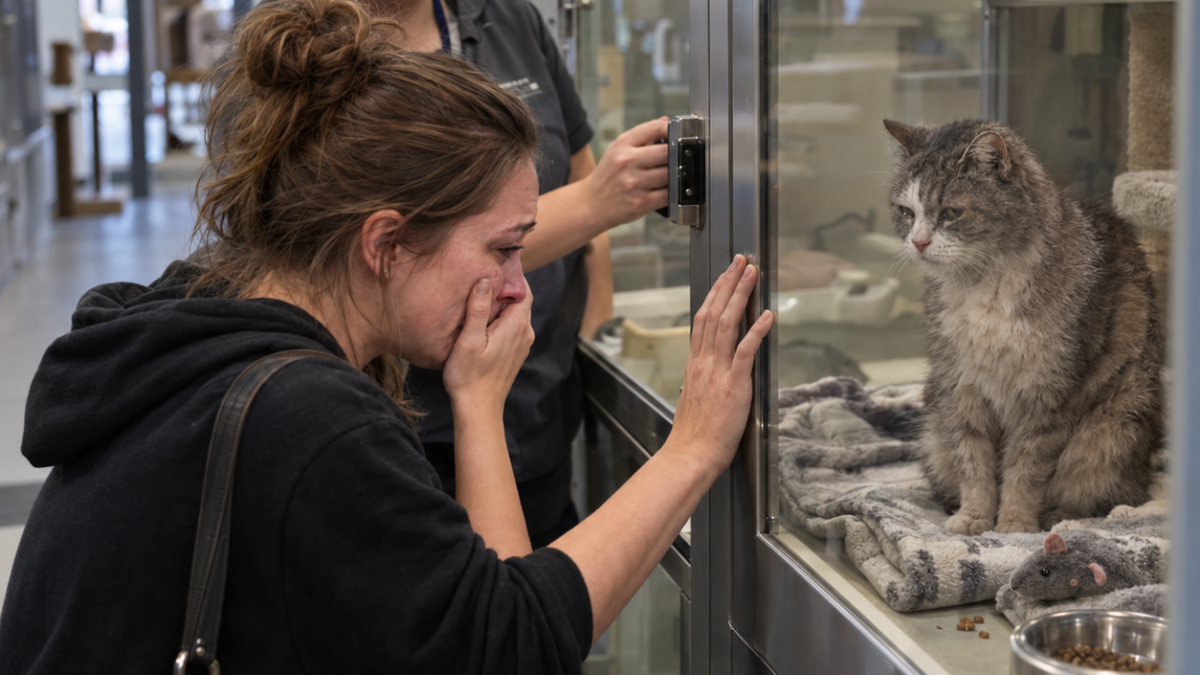
Maria led me through a side door into the cat room. Rows of glass-front enclosures lined the wall. Some cats came forward when we entered. Some hid. Some slept curled tightly as if making themselves smaller might help.
Henry was in the third enclosure on the left.
He was sitting in the back corner on a towel that was not his blanket.
Silent.
Not sleeping.
Not grooming.
Not crying.
Just sitting.
His body was tucked tight, paws under him, tail wrapped close. His eyes were open. When I stepped closer, he looked at me.
That was all.
He did not meow.
He did not run to the glass.
He only stared.
As if he could not understand why the person he trusted most had disappeared and then returned on the wrong side of a wall.
“Henry,” I whispered.
His ears moved.
One tiny flick.
My hand went to the glass.
“I’m here, buddy. I’m here. I’m so sorry.”
Maria stood quietly beside me.
“He hasn’t been doing great,” she said softly. “He’s been very withdrawn. Barely eating. We got the medication note, but he resisted this morning. We were going to call the number on the form again.”
“What number?”
She hesitated.
“The number your mother gave us.”
I closed my eyes.
Of course.
My mother had given her own number.
Not mine.
“She didn’t give you mine?”
“No.”
Something hot and ugly rose in me.
Not rage exactly.
Worse.
Confirmation.
Maria unlocked the enclosure.
“He may be slow to come out.”
The door opened.
For a second, Henry did not move.
Then I reached in with both hands, carefully, because his hips hurt and because he had always hated being grabbed. I touched the side of his face.
He leaned into my palm.
Just leaned.
His whole body seemed to soften by one degree.
Then he started purring.
A tiny, shaky sound.
Not happy.
Relieved.
That distinction shattered me.
“Oh, Henry.”
I lifted him gently. He felt lighter than he should have. His fur was dry, slightly rough, and he tucked his head beneath my chin the way he had not done since he was young. I pressed my face into his neck and cried right there in the cat room, surrounded by glass, towels, disinfectant, and strangers who had seen worse things but were kind enough to act like this mattered exactly as much as it did.
Maria gave me tissues.
“He knew you,” she said.
I nodded because I could not speak.
“He really knew you.”
“I should have come sooner.”
“You came as soon as you knew.”
That sentence helped.
Not enough.
But some.
The paperwork was humiliating in a way I had not expected. Not because the shelter staff were unkind. They were careful. They had rules, and I was grateful for rules because rules were the only reason Henry had not vanished into a system before I found him.
But I still had to prove he was mine.
Microchip records.
Vet bills.
Photos.
Medication history.
I showed them a picture of Henry asleep on my laptop during grad school. Henry sitting beside Dad’s recliner during chemo. Henry wearing a Christmas ribbon he hated. Henry curled on the blue blanket with his dead little mouse tucked under one paw.
Maria looked through the photos and said, “That’s family.”
“Yes,” I said. “He is.”
She did not correct me.
When they brought out the form my mother had signed, I saw the word relinquishment.
My vision blurred.
Relinquishment.
Such a clean word for betrayal.
Reason for surrender: Owner unable to manage medical/emotional needs.
Owner.
She had written herself into a role she did not have.
I stared at the line until Maria gently turned the paper over.
“She may not have understood the legal meaning.”
“She understood enough not to call me.”
Maria did not argue.
That was another kindness.
I brought Henry home that night, but not to my apartment. The repairs were still unfinished, and I would not risk him around mold or strangers or the roar of industrial fans. I called my friend Claire, the one with the dogs, and sobbed into the phone until she said, “Bring him here. I’ll take the dogs to my brother’s for two nights. Don’t argue.”
So Henry and I spent the night in Claire’s guest room.
I set out his own blanket.
His real food.
His medication.
His mouse.
For the first hour, he stayed in the carrier with the door open.
I lay on the floor beside him.
Not on the bed.
Not in a chair.
On the floor, where he could smell me and decide for himself when the world was safe enough to enter.
Around midnight, he stepped out.
Slowly.
One paw.
Then another.
He walked to my shoulder, pressed his head against me, and began purring again.
Still shaky.
Still small.
I did not sleep much.
Every time he shifted, I woke. Every time he stopped purring, I checked his breathing. Around three, he ate two bites of wet food from my fingers. Around four, he used the litter box. Around five, he climbed onto the mattress and slept against my stomach.
That was when I finally let myself cry properly.
Quietly, so I would not scare him.
I cried for Henry behind glass.
For the hours he spent thinking I had left him.
For the fact that he had barely eaten.
For the medication missed or forced by strangers.
For the blue blanket sitting unused at my mother’s house while he crouched on a shelter towel.
For all the years he had been there for me, and the one time I had trusted someone else to be there for him.
My mother started calling at 7:30.
I did not answer.
She texted:
Did you get him?
Then:
You’re really not going to answer me?
Then:
I said I was sorry you got upset.
I stared at that one for a long time.
Not I’m sorry I did it.
I’m sorry you got upset.
The difference was the whole wound.
By noon, she sent:
This is ridiculous. He is home now. Stop punishing me.
I turned off my phone.
The next day, I took Henry to his vet.
Dr. Kaplan had known Henry since he was a kitten. She was one of those vets who spoke to animals first and humans second, which is exactly how it should be. When she entered the exam room and saw him tucked in his carrier, her face softened.
“Hi, old man.”
Henry blinked.
Then looked away like he had not missed her at all.
She examined him carefully. He had lost almost half a pound in a short time, which mattered at his age. He was dehydrated. His kidney values needed checking. His blood pressure was elevated, likely stress-related. His throat was irritated from vomiting or crying. Nothing catastrophic, thank God, but enough that her mouth tightened when I explained what happened.
“She surrendered him without your consent?”
“Yes.”
“Did the shelter scan his microchip?”
“Yes. It had my old number, but my email was current. They said they would have contacted me before any adoption process. But he should never have been there.”
“No,” Dr. Kaplan said. “He should not have.”
Hearing a professional say that did something important.
Because by then my mother’s voice had started creeping into my head.
Dramatic.
Overreacting.
He’s fine now.
It’s just a cat.
Dr. Kaplan put one hand on Henry’s back.
“At fourteen, stress can be medically significant. Especially with kidney disease. You are not overreacting.”
I cried again.
I was getting tired of crying in public rooms.
Dr. Kaplan pretended to check Henry’s chart while giving me time to pull myself together.
We made a plan.
Fluids.
Appetite stimulant if needed.
A calmer medication routine.
Microchip update.
Emergency contacts removed and replaced.
My mother’s number gone from every form connected to Henry.
That felt like locking a door.
When I finally went back to my mother’s house, I did not take Henry.
I went alone.
I went because his food bag, litter, carrier, blanket, and toy mouse were still there. I went because avoiding her would not make the wound cleaner. I went because I wanted to see whether remorse had entered the room.
It had not.
My mother opened the door and immediately said, “Are you done being mad?”
Something inside me settled.
Not healed.
Settled.
Like a glass breaking and every piece finally stopping on the floor.
“I’m here for Henry’s things.”
She stepped aside.
The guest room had been cleaned.
Too cleaned.
No litter box.
No food bowls.
No signs that a frightened old cat had spent nights crying behind the door.
His blue blanket was folded on the bed.
His mouse sat on top of it.
I picked them up.
My mother stood in the doorway.
“You have to understand how stressful it was.”
“I do understand stress.”
“I’m not like you. I can’t handle animals crying all night.”
“I told you to call me.”
“You would have been upset.”
“I am upset because you did not call me.”
She crossed her arms.
“You always make me the villain.”
“No, Mom. You made a decision. I’m naming it.”
Her face tightened.
“I did what I thought was best.”
“For whom?”
“For everyone.”
“No. For yourself.”
She looked offended.
But she did not look surprised.
That was when I knew she had always understood the shape of what she did. She had simply hoped I would be polite enough not to draw the outline.
“He was safe,” she said.
“He stopped eating.”
“You don’t know that was because of me.”
“He was at a shelter because of you.”
“Don’t twist things.”
“I’m not twisting anything. You took my fourteen-year-old medicated cat to a shelter instead of calling me.”
“He cried constantly.”
“Because he was scared.”
“I couldn’t sleep!”
“So you made sure he was the one who suffered.”
Her mouth opened.
Closed.
Then she said the sentence that changed everything.
“I knew you would choose the cat over me.”
The room went very quiet.
There it was.
Not inconvenience.
Not stress.
Not confusion.
Jealousy, old and ugly, dressed up as exhaustion.
I stared at her.
“This was not a choice between you and Henry.”
“It always is with you.”
“No. You made it one.”
She looked away, jaw tight.
I thought of every little comment over the years.
You spend more on that cat than people spend on children.
You didn’t visit because Henry needed medicine?
You act like he’s your whole family.
Maybe if you had a husband, you wouldn’t be so attached.
I had brushed those comments aside because they were irritating, not dangerous.
I would never make that mistake again.
“He depended on you,” I said. “I depended on you.”
My voice shook, but I did not stop.
“You could have called me at any hour. I would have come. You chose not to. Then you signed paperwork saying you were his owner and gave them your number instead of mine.”
She flinched then.
Finally.
“You saw that?”
“Yes.”
“They asked for a number.”
“You gave them yours because you did not want me contacted.”
“That’s not—”
“Do not lie to me.”
The words came out sharper than I expected.
She froze.
I had never spoken to her that way.
Not because she had never deserved it.
Because I had been trained, like many daughters, to soften truth until it could be swallowed by the person who caused the wound.
Not that day.
“I am taking his things,” I said. “You will not be alone with Henry again. You will not be listed as an emergency contact. You will not have a key to my apartment. If I need help, I will ask someone else.”
Her face hardened because anger was easier than shame.
“So you’re cutting me off over a cat.”
“No. I am changing what access you have because you broke my trust.”
“Same thing.”
“No. It isn’t.”
I picked up the blanket and the mouse.
At the door, she said, “You’ll regret treating your mother this way.”
I turned back.
“I already regret trusting her.”
That landed.
I left before she could answer.
For the next few weeks, Henry recovered slowly.
Very slowly.
Senior cats do not bounce back like kittens. Stress lingers in their bodies. For days, he startled at small sounds. If I left the room, he followed me, crying in that hoarse little voice that made my chest ache. He slept pressed against me so tightly that I woke with one arm numb.
I gave him fluids under Dr. Kaplan’s guidance.
I mixed his food with warm water.
I crushed pills into tiny portions and praised him like he had won a war every time he swallowed.
The apartment repairs finished, and I brought him home only after cleaning every surface and running air purifiers for two days. When I opened the carrier in our living room, he stepped out cautiously.
He sniffed the couch.
The rug.
The corner where his scratcher lived.
Then he walked to the window, jumped awkwardly onto the low bench I had placed there for his hips, and sat in the afternoon sun.
For the first time since the shelter, he looked like himself.
Old.
Grumpy.
Royal.
I sat on the floor and watched him until the light changed.
My mother kept texting.
At first angry.
Then wounded.
Then weirdly casual, as if pretending nothing happened might reset the room.
Hope Henry is doing better.
Saw a cute cat mug today.
Are you really not coming for Thanksgiving?
My aunt called.
Then my cousin.
Then my brother, who lived three states away and had not once offered to help with Henry, my apartment, or Dad when he was sick, but had apparently found time to have opinions.
“Mom says you’re not speaking to her because she took your cat somewhere safe when he was sick.”
I laughed once.
It sounded awful.
“She surrendered him to a shelter without telling me.”
“She said temporary.”
“The form said relinquishment.”
Silence.
“She said he was too much.”
“He is fourteen and on medication.”
“I get that, but Mom’s getting older too.”
“Then she should have said no when I asked. Or called me when it became too much.”
He sighed.
“You know how she is.”
There it was.
The family motto of every person tired of holding someone accountable.
You know how she is.
“Yes,” I said. “I do. That’s why she’s not watching Henry again.”
“You’re really going to blow up the family over this?”
“No. I’m going to protect the family member who can’t protect himself.”
“He’s a cat.”
“He is my cat.”
He went quiet.
I softened my voice because he was not the main wound, only another person trying to step around it.
“I’m not asking you to understand it the way I do. I’m asking you not to minimize it.”
He did not apologize.
But he stopped arguing.
That was enough for that day.
Thanksgiving came.
I did not go.
I cooked a small meal for myself, which is to say I roasted a chicken badly and ate mashed potatoes from a container because grief had not made me ambitious. Henry sat in his window seat wearing the expression of a cat who had survived betrayal and found the holiday menu lacking.
I gave him a little plain turkey from a deli pack.
He sniffed it.
Licked it once.
Then looked at me like I had insulted his ancestors.
“Fine,” I said. “More for me.”
That was the first time I laughed without feeling guilty afterward.
In December, I started therapy again.
I told myself it was because of Henry, but of course it was not only because of Henry. It was because the shelter had revealed something larger. My mother had always treated my boundaries as suggestions, my attachments as phases, my grief as an inconvenience if it lasted longer than she found comfortable.
When Dad was dying, she had leaned on me until I nearly collapsed, then criticized me for being “too emotional.”
When I stayed late at the hospital, she told relatives I was dramatic.
When I cried at the funeral, she whispered that I needed to pull myself together.
Afterward, when I spent nights with Henry on my chest because I could not sleep alone in a world without my father, she said, “At least the cat gives you something to do.”
Something to do.
As if love were a hobby.
My therapist listened carefully and then said, “It sounds like Henry became a place where your love was allowed to be uncomplicated.”
I sat with that for a long time.
“Yes,” I said.
Henry did not tell me I was too much.
Henry did not ask me to grieve on a better schedule.
Henry did not roll his eyes when I needed comfort.
He simply stayed.
That was why finding him behind glass felt like more than a pet emergency.
It felt like my mother had taken the safest part of my life and treated it as clutter.
I did not go no-contact immediately.
People love clean endings.
Life rarely gives them.
I spoke to my mother eventually, but only by phone, and only after I knew what I needed to say.
“I’m willing to have a relationship,” I told her, “but not the same one.”
She hated that.
“What does that mean?”
“It means you do not get keys to my home. You do not make decisions for me. You do not make decisions about Henry. If I tell you something matters to me, you do not get to decide it should matter less.”
She was quiet.
Then: “I already apologized.”
“You apologized that I was upset.”
“I’m sorry I took him there.”
The words came flat.
Forced.
Maybe that should have satisfied me.
It did not.
“Why did you give them your number instead of mine?”
Silence.
“Mom.”
“I didn’t want them calling you and making me look bad before I explained.”
There it was.
The truth.
Not pretty.
But true.
“You cared more about looking bad than about Henry getting back to me.”
“I panicked.”
“You protected yourself.”
She started crying then.
My old training rose up immediately. Comfort her. Soften. Take less space. End the conflict. Tell her it’s okay.
I did none of that.
“I hope you think about that,” I said. “I have to go.”
Then I hung up and shook for ten minutes.
Henry, who had been asleep on the couch, opened one eye, judged my emotional management, and came over anyway.
He climbed into my lap.
Slowly.
Carefully.
Old bones.
Stubborn heart.
I put my face in his fur.
“I’m trying,” I whispered.
He purred.
Months passed.
Henry stabilized.
His kidney numbers improved slightly. His weight came back. His fur softened. He resumed his hobbies: sunbathing, ignoring expensive toys, yelling at 5:42 a.m., and placing himself on whatever document I needed most urgently.
He also changed.
Or maybe I noticed changes I would have missed before.
He became more anxious when I took out his carrier. So I trained with it slowly, leaving it open with treats inside, letting it become furniture instead of a warning.
He disliked closed doors even more than before. So I stopped closing them unless necessary.
He followed me more. I let him.
Some people would say I spoiled him.
Good.
He is fourteen.
He has earned softness.
In the spring, I adopted a new emergency plan.
My friend Claire became Henry’s primary backup. Dr. Kaplan’s office had written authorization to treat him if I could not be reached. A professional pet sitter came twice while I was home so Henry could meet her without crisis. I updated the microchip again. I placed printed instructions in a folder by the door.
I built a safety net that did not include my mother.
That was painful.
It was also peaceful.
My mother and I now speak once every couple of weeks.
Weather.
Work.
My brother’s kids.
Her garden.
Sometimes she asks about Henry.
I say, “He’s fine.”
Not because he is only fine.
Because she no longer gets access to the soft details.
She does not get to know that he has started sleeping with one paw on my wrist again. She does not get the picture of him sprawled in a sunbeam with his belly exposed like trust made visible. She does not get to hear how he chirps when I warm his food.
Those details belong to people who understand that love is not measured by species.
Recently, she said, “I miss when you told me things.”
I looked at Henry asleep beside me.
Then I said, “Me too.”
That was honest.
I do miss it.
I miss the mother I wanted.
The one I thought would protect what I loved because she loved me.
The one who would call and say, “He’s crying too much, come get him,” instead of making a secret decision and hoping I would be too polite to name it.
I miss what should have been.
But missing something does not mean rebuilding it from the same broken pieces and pretending the cracks are decoration.
Henry is asleep beside me as I write this.
His breathing is soft and slightly wheezy. His paw twitches sometimes. His little mouse is tucked near his back feet, though he has not actually played with it in years. The blue blanket is beneath him, washed, safe, home.
Sometimes I think about the shelter glass.
I wish I did not.
I think about him sitting silently behind it. Not crying. Not fighting. Just waiting in a way that looked too much like giving up.
I think about the moment he leaned into my hand.
The shaky purr.
The relief.
The trust he gave back before I had forgiven myself.
Animals do that sometimes.
They offer grace we have not earned yet.
My mother says I am being dramatic because Henry is home now.
She is wrong.
Home is not a magic eraser.
Bringing him back did not remove the fear from his body immediately. It did not undo the missed meals. It did not erase the paperwork where someone else claimed the right to give him away. It did not return the version of me who believed my mother could be trusted with the most vulnerable thing in my life.
Henry is safe now.
That matters.
But safety after betrayal is not the same as no betrayal.
People who minimize harm often want the ending to cancel the event.
He’s fine now.
You got him back.
No real damage was done.
But real damage is not always measured in permanent loss.
Sometimes damage is the moment you understand someone had the power to protect what you loved and chose convenience instead.
Sometimes it is watching your elderly cat press himself into the back of a shelter enclosure because the world became strange and the person who promised to keep him safe did not.
Sometimes it is realizing that trust can be broken without anyone raising a voice.
I do not know exactly what my relationship with my mother will become.
I know what it will not become.
It will not become access without accountability.
It will not become me laughing off cruelty because admitting pain makes dinner awkward.
It will not become Henry in her guest room again.
Ever.
I can love my mother and still know she is not safe for every part of me.
I can accept that she may never understand the depth of what she did and still refuse to make that misunderstanding my responsibility to absorb.
I can grieve the relationship I wanted while protecting the life that depends on me.
That is what Henry taught me long before this happened.
Love is not always loud.
Sometimes it is a pill given on time.
A blanket packed carefully.
A door left open.
A phone call made before a decision.
A name on a microchip.
A drive across town with your hands shaking.
A promise whispered through shelter glass.
I’m here.
I’m sorry.
You’re coming home.
And he did.
Henry came home.
Not because my mother understood.
Because I found out in time.
Because a shelter worker was careful.
Because my old cat, frightened and silent and betrayed by circumstances he could not understand, still leaned into my hand when I reached for him.
He is family.
Not almost family.
Not practice family.
Not “just a cat.”
Family.
And family is not disposable because caring for them becomes inconvenient.
If there is one thing I know now, it is this:
I will never again hand someone my trust just because they share my blood.
Trust is not inherited.
It is proven.
Henry proved his love for fourteen years by staying.
My mother broke my trust in one afternoon by choosing not to call.
And me?
I am proving mine now.
Every day.
Every meal.
Every pill.
Every soft place I make for him to rest.
Every boundary I hold, even when people call it dramatic.
Henry is old.
He is slower now.
He will not be with me forever, and that truth sits in my chest like a stone I try not to touch too often.
But for however much time he has left, he will know this: I came back. I chose him. I will protect him.
And no one who sees him as disposable will ever be trusted with his little life again.








