I Took My Neighbor to a Barn Dance—Then She Led Me Into the Hills, Held Out Her Hand, and Said, “I’d Rather Dance With You Somewhere Private.”
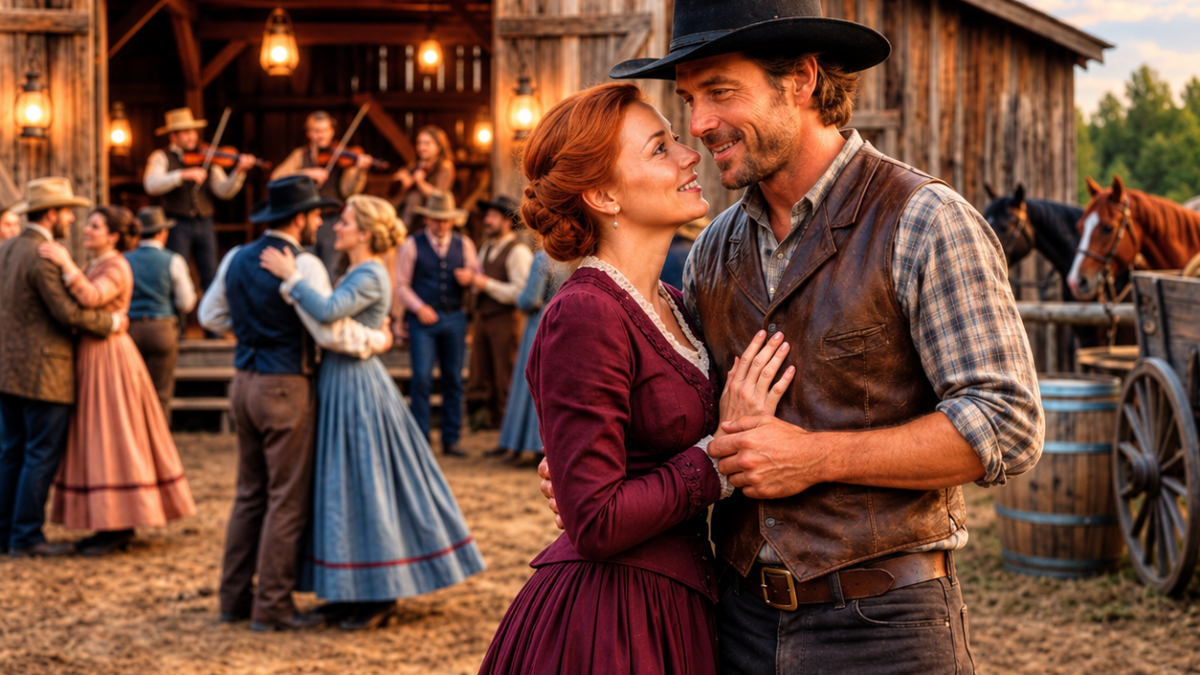
I Took My Neighbor to a Barn Dance—Then She Led Me Into the Hills, Held Out Her Hand, and Said, “I’d Rather Dance With You Somewhere Private.”
I had spent two years pretending the red-haired woman next door was only a neighbor, right up until she pulled me away from a crowded barn dance and led me to the one place in the valley she had never shown anyone else.
Under the moonlight, with music drifting faintly from four miles away, Mave Flynn finally asked what I had been too afraid to say—and I realized she had been waiting almost as long as I had.
But before that night was over, three days of rain would turn a harmless creek into something strong enough to drag me off my feet, and the woman I had been trying so hard not to lose would have to decide whether I was worth pulling back.
My name is Jesse Callum, and until the spring of 1887, I had convinced myself that patience and cowardice were close enough to be confused for one another.
I was twenty-four years old then.
I owned eighty acres in Oregon’s Willamette Valley, a narrow horse ranch bordered on one side by timber and on the other by Patrick Flynn’s much larger property.
Eighty acres was not much compared with Patrick’s four hundred.
I didn’t care.
I had never wanted land simply so other men could count it.
I wanted enough pasture to raise good horses, enough timber to heat a house through winter, enough creek water to last a dry summer, and enough distance from town that a man could make a mistake without three neighbors discussing it before supper.
The Callum place had all of that.
It also had a barn that leaned slightly east, a house that needed new shingles, a lower pasture that became a shallow lake whenever rain lasted more than two days, and a boundary fence along the Flynn property that had apparently been maintained by men who believed livestock respected suggestions.
I bought it in the spring of 1885.
On my second day there, I was standing outside the barn wondering which repair to regret first when a young woman rode through the broken boundary fence carrying a loaf of soda bread wrapped in a white cloth.
She had red hair.
Not brown that looked red in sunlight.
Red.
The kind you could see from across a field.
Freckles crossed her nose and cheeks, and she sat her mare as naturally as if the horse had grown beneath her.
I stopped hammering.
She rode right up to me.
“My father says welcome.”
I took the bread.
“Tell him thank you.”
“I will.”
She looked past me.
Not at the house.
Not at the barn.
At the fence.
“That corner post is rotten.”
I followed her eyes.
“It is.”
“The third brace from the creek is loose too.”
I looked farther down.
“I hadn’t noticed.”
“You will.”
Then she turned her mare around and rode home.
No introduction.
No polite conversation.
Nothing.
I stood in the yard holding bread and wondering whether every Flynn greeted neighbors by inspecting their property.
I repaired the third brace the following morning.
She was right.
That should have been the end of it.
It wasn’t.
Three days later I was replacing shingles on the barn roof when she came riding through again.
There was an upper trail that crossed a narrow corner of my land before circling back onto Flynn property, and she used it often.
I was halfway through hammering when a red-tailed hawk called from the fir trees beyond the pasture.
I stopped.
The bird called again.
The woman stopped her horse below me.
“You know birds?”
I looked down.
“No.”
“You stopped hammering.”
“I heard it.”
“Most people hear birds and keep hammering.”
I looked toward the trees.
“Seemed rude.”
She laughed.
PART2:
That was the first time I heard Mave Flynn laugh.
Two years later, I could recognize that sound from half a field away.
“My name’s Mave,” she said.
“Jesse.”
“I know.”
Of course she did.
Apparently my arrival had already become local knowledge.
She rode away.
After that, we became neighbors in the way rural neighbors often do.
Not through any one large event.
Through dozens of small ones.
She lent me a book about exploration after I mentioned reading one as a boy.
I returned it with two scraps of paper marking passages where I thought the author was exaggerating.
Three days later, Mave appeared at my fence holding the book.
“You’re wrong on page one hundred twelve.”
“Good afternoon to you too.”
“He clearly means the second route.”
“He clearly says the northern route.”
“You read it badly.”
“I read exactly what he wrote.”
“Then he wrote badly.”
That argument lasted thirty minutes.
Neither of us noticed.
Another afternoon she found me trying to rehang a gate by myself.
I had one shoulder under the weight while attempting to fit the hinge pin with my free hand.
Mave watched from horseback.
“You know,” she said, “there are probably ways to make that harder, but you seem close to exhausting them.”
“Helpful.”
“I could hold the gate.”
“You could have started with that.”
“I wanted to see how long pride would keep you underneath it.”
I stared at her.
She dismounted.
Together we rehung the gate in five minutes.
I had been struggling for twenty.
PART3:
Late that summer, we stood beside the upper pasture fence watching two hawks circle on a thermal above the timber.
Neither of us planned to stay.
Neither of us mentioned that we had stood there for nearly twenty minutes afterward.
By winter I knew Mave read almost every book that came through the small lending shelf in town.
By spring I knew she kept a notebook of bird sightings.
She had dates.
Locations.
Migration patterns.
Little drawings.
She also kept a county map with corrections penciled into the margins because, according to Mave, “maps are written by men who apparently never walk anywhere.”
I learned one other thing by accident.
She played the fiddle terribly.
I was riding past the Flynn house one evening when a noise came through an open window.
It sounded like either a fiddle tune being murdered or furniture dragged across a floor.
The noise stopped.
Mave appeared at the doorway.
“You heard nothing.”
“I heard something.”
“No.”
“Was that supposed to be ‘Arkansas Traveler’?”
The door closed.
The next morning a loaf of soda bread appeared on my fence post.
I never mentioned the fiddle for several weeks.
By 1887, I knew Mave better than I knew most people.
Which made it embarrassing that I had still done absolutely nothing about the fact that I was in love with her.
I told myself I was being sensible.
There was a five-hundred-acre rancher six miles west who owned more land than I ever would.
There were merchant sons in town with cleaner coats and larger houses.
Mave was twenty-two, intelligent, capable, and the only child of Patrick Flynn.
She would inherit land.
She deserved choices.
I told myself that staying silent allowed her to have them.
That reasoning sounded noble until you looked at it closely enough to realize it was mostly fear wearing a respectable coat.
Patrick Flynn certainly knew.
Patrick noticed everything.
He had come from Cork as a young man and crossed the country with his wife, Mary, eventually settling in Oregon in 1872.
They built the Flynn ranch from almost nothing.
Cattle first.
Then orchard.
Then more land.
Then a larger barn.
Mary died in 1881 when Mave was sixteen.
Patrick never remarried.
He raised his daughter without treating her as something fragile.
Mave could saddle horses.
Keep accounts.
Mend tack.
Read legal notices.
Set a splint.
Argue livestock prices.
And apparently determine whether tea had steeped twelve seconds too long from across a room.
Patrick and I respected each other.
We discussed weather.
Horses.
Fence lines.
Drainage.
We did not discuss his daughter.
That arrangement might have continued until we both died of old age if the Cooper barn dance had not arrived in May.
The Cooper dance happened every spring.
Half the valley attended.
I had gone twice before.
Both times I stood against the barn wall with cider in one hand while other men danced with women I might have considered asking if I had been born with the ability to act before thinking every possible outcome to death.
Mave knew this.
On the Tuesday before the dance, I was resetting a post near the boundary when she rode up.
“The Cooper dance is Saturday.”
“I heard.”
“Papa’s horse has a stone bruise.”
“That’s unfortunate.”
“He’s riding with the Gades.”
“All right.”
Mave waited.
I kept tamping dirt.
“I was thinking of walking.”
I stopped.
“To the Cooper place?”
“Yes.”
“That’s four miles.”
“That is generally how far four miles remains, regardless of who measures it.”
I leaned on the tamping bar.
Mave looked at me.
I looked at the post.
I could actually feel her waiting.
Finally I said, “I’ve got room in the wagon.”
“I imagine you do.”
“I could take you.”
She studied my post.
“That one’s two inches off plumb.”
I stepped back.
It was not two inches.
At worst, one.
I adjusted it anyway.
“Saturday at six.”
One corner of her mouth lifted.
“Saturday at six.”
She rode away.
I watched her until she passed the orchard.
Then I looked at the post.
“You’re fine.”
The post did not answer.
Saturday arrived after three days of rain.
Nothing violent.
Just persistent Oregon rain.
Fields darkened.
Ditches filled.
Creeks ran fuller.
By late afternoon the clouds broke enough to show patches of blue, and the whole valley smelled freshly washed.
I drove to the Flynn place at six precisely.
Mave came out wearing a green dress with cream trim.
A small comb held part of her red hair back.
For the first time in two years, I forgot what to say around her entirely.
Patrick appeared behind her.
He looked at me.
Then at the wagon.
Then at me again.
“Road’s wet.”
“Yes, sir.”
“Creek’s high.”
“I know.”
“You’ll use sense.”
“Yes.”
Mave came down the steps.
“Papa, he is taking me to a dance, not migrating west.”
Patrick ignored her.
“Home before?”
He looked at Mave.
Not me.
She smiled.
“Before you become unbearable.”
“I am already unbearable.”
“I’ve noticed.”
She climbed into the wagon.
Patrick looked at me one more time.
No threat.
No speech.
He simply said, “Evening, Jesse.”
“Evening.”
Then we went.
I had rehearsed conversation during the four-mile drive over.
Mave ruined all of it immediately.
“You’re holding the reins too tightly.”
“I’m driving.”
“You drive daily.”
“Not with commentary.”
“That seems unlikely.”
I looked at her.
She looked ahead as if she had said nothing.
We talked about a book she had finished.
Patrick’s horse.
The rain.
A pair of hawks nesting near the north pasture.
“The male is the same one you stopped hammering for when you first moved in,” she said.
I looked at her.
“You remember that?”
“Of course.”
“That was two years ago.”
“It still happened.”
I thought about that sentence for most of the remaining drive.
The Cooper barn glowed with lantern light when we arrived.
Wagons lined the yard.
Music drifted through open doors.
Inside, people who had known one another for years crowded the floor with the comfortable lack of dignity that comes from living around people who have already watched you fall off horses, lose cattle, argue with machinery, and accidentally attend church with mud on your trousers.
Martha Cooper hugged Mave.
Then she looked at me.
Not normally.
Knowingly.
I disliked that immediately.
For the first forty minutes, I did exactly what I had done the previous two years.
I stood near the wall.
Cider in hand.
Mave danced once with a cousin.
Talked to Martha.
Spoke with two girls near the food table.
Then suddenly she appeared beside me.
“You’ve been standing here forty minutes.”
“I’ve moved.”
“You changed walls.”
“Still counts.”
The fiddler began another tune.
Mave extended one hand.
“Dance with me.”
I stared at it.
“I don’t dance well.”
“Neither does Tom Gity.”
She nodded toward him.
Tom was currently stepping directly on Martha Cooper’s skirt.
“If you don’t dance with me, I’ll ask him.”
I looked at Tom.
“That sounds like a threat.”
“It is.”
So I danced.
I was not good.
But I was not Tom Gity.
That seemed enough.
Mave’s hand rested in mine.
My other hand settled carefully at her waist.
We moved through one song.
Three minutes.
Possibly the shortest three minutes of my life.
When the tune ended, people shifted into another set.
I expected Mave to step away.
She didn’t.
Her cheeks were flushed.
One loose strand of red hair had escaped near her temple.
She looked up at me.
“I’d rather dance with you somewhere private.”
Every sensible sentence left my head.
“How private?”
“Enough that Tom cannot follow.”
“That is persuasive.”
“I thought so.”
“Where?”
She nodded toward the open barn doors.
“There’s a place above the valley.”
“What place?”
“Nobody goes there but me.”
“You’re asking me to leave the dance?”
“I’m asking whether you have enough nerve to come with me.”
I put down my cider.
“I’ve got enough.”
Her smile widened.
“Good.”
We left the wagon at the Coopers’ place and took our horses.
Mave led.
The air was cold enough after sunset that our breath showed faintly.
Clouds moved over the ridge, but moonlight broke through often enough to silver the wet fields.
We climbed through oak and fir.
“How far?” I asked.
“Ten minutes.”
“Actual ten minutes?”
Mave looked back.
“You count minutes?”
“I count when people give me numbers.”
“That sounds exhausting.”
“It is.”
Eleven minutes later the trees opened.
I almost pointed that out.
Then I saw the clearing.
It was small.
Irregular.
Grass bordered by tall Douglas firs.
A rocky shelf extended along the western edge.
Below us lay the entire valley.
Dark fields.
Scattered barn lights.
Farmhouses.
Farther west, the river reflected moonlight like a pale ribbon.
The Cooper barn was only a distant golden square.
Mave dismounted.
“I found this when I was fourteen.”
I tied my gelding near her mare.
“How?”
“I was angry with Papa.”
“What did he do?”
“I don’t remember.”
“Serious offense.”
“Extremely serious for at least an hour.”
I smiled.
Mave walked toward the western shelf.
“Nobody knows?”
“Papa knows I come up somewhere around here.”
“But not here.”
“No.”
“And you brought me.”
She looked at me.
“Yes.”
The faintest trace of music reached us when the wind shifted.
Just fiddle and rhythm, so distant it barely sounded real.
Mave turned.
“Well?”
“Well what?”
Her eyebrows rose.
“I said I wanted to dance somewhere private.”
I looked around.
“You meant literally?”
“I usually do.”
“There is no music.”
“There is.”
She pointed toward the valley.
“It is simply four miles away.”
I laughed.
She held out her hand.
“Mr. Callum.”
I took it.
Mave hummed the tune.
Not especially well.
I did not mention that.
We started moving over the uneven grass.
“This ground is worse than the barn.”
“Less competition.”
“Tom isn’t here.”
“Exactly.”
Mave stepped on my boot.
She looked down.
“I didn’t do that.”
“You did.”
“Prove it.”
We kept dancing.
The awkwardness lasted perhaps thirty seconds.
Then it disappeared.
There was moonlight.
The smell of wet grass.
Distant music.
Mave humming slightly out of tune.
And for once in my life, I stopped planning my next sentence long enough to understand I was already inside the moment I had spent two years waiting for.
Mave looked at me.
“Do you know why I brought you here?”
“No.”
“At the barn, you were watching me again.”
“I was watching everyone.”
“No.”
She smiled.
“You watch people like you’re trying to learn something.”
“That sounds normal.”
“You watch me like you’re waiting for something.”
My hand tightened slightly around hers.
“I got tired of wondering what.”
We stopped.
The distant fiddle carried a thin phrase across the valley.
Mave stood close enough that I could see every freckle across her nose.
“I’ve been trying to find the right time,” I said.
“For two years?”
“Not all two.”
“How many?”
“Enough.”
She waited.
And something changed in me.
I had prepared speeches.
None mattered.
So I told the truth badly.
“I like roads better when you’re riding on them.”
Mave did not laugh.
“I have started work near the upper fence because I thought you might pass.”
Her eyes brightened.
“I’ve read books faster because I knew you’d ask what I thought.”
A smile began.
“And sometimes when I hear a hawk, I think of you before I think about the bird.”
She looked down for one second.
“That is a very inconvenient way to say you care about me.”
“I was building toward it.”
“I know.”
I took a breath.
“I care about you.”
Mave looked back at me.
“I know that too.”
“How?”
She gave me a very serious expression.
“Jesse.”
“What?”
“The fence is excellent.”
I laughed.
So did she.
Then she stepped closer and rested her forehead against my shoulder.
Nothing exploded.
No dramatic music swelled.
No lightning crossed the sky.
I simply stood there with the woman I had loved in silence for two years leaning against me.
That was enough.
When she lifted her head, a raindrop landed on my cheek.
Then another.
Mave looked upward.
Her expression changed.
“We should go.”
I did not argue.
The rain was not violent.
That made what happened later easier to underestimate.
The valley had already absorbed three days of water.
The soil was saturated.
Ditches were full.
Streams were high.
This new rain did not need to be extraordinary.
It only needed to arrive.
We mounted.
The descent became slippery almost immediately.
Mave knew the trail better than I did.
She took the lead.
“You all right?” I called.
“Yes.”
A lantern hung from her saddle.
“Lantern still lit?”
“Yes.”
A minute later it went dark.
Mave laughed.
“I withdraw that answer.”
We slowed.
The horses chose each step.
Rain thickened.
Branches shook overhead.
I kept my gelding close enough that if Mave’s mare slipped, I could react.
Not because she needed guiding.
She knew the trail.
That was one of the things I admired most about her.
She was capable without needing anyone to pretend otherwise.
At a lower stand of oaks, rain eased.
We stopped.
Mave pushed wet hair away from her face.
“You meant what you said?”
I knew immediately.
“Yes.”
“Good.”
I waited.
“That’s all?”
“Do you require a certificate?”
“I expected something more.”
Mave thought.
Then she said, “I brought you to the only place in this valley that belongs only to me.”
That silenced me.
“I have never shown it to anybody.”
“You said that.”
“I meant it.”
I nodded.
“Good.”
She laughed.
“Now you understand how irritating that answer is.”
“I do.”
We continued.
By the time we reached the valley floor, water covered sections of the road.
The shortest route home crossed a creek.
Usually the word creek gave the water more dignity than it deserved.
Most days it ran ankle-deep over gravel.
That night we heard it before we saw it.
Mave slowed.
“That’s higher.”
“Yes.”
We reached the ford.
Brown water had spread into grass on either side.
Branches drifted past.
Small ones.
Enough.
I dismounted.
Mave stayed mounted.
“Don’t.”
“I haven’t done anything.”
“You were about to.”
She knew me too well.
“I’m checking the bank.”
“The bank.”
“Not the middle.”
“Good.”
I found a long branch and tested the mud.
It collapsed easily.
I moved downstream.
“No horses through.”
Mave nodded.
“Upper road.”
“Adds an hour.”
“An hour is cheaper than a horse.”
I smiled.
“That sounds nearly wise.”
“Careful. I’ll expect you to remember it.”
We should have turned immediately.
We nearly did.
Then we heard a calf.
A young animal stood downstream on slightly higher ground, trapped between the swollen creek and a flooded ditch.
Even through the rain, Mave recognized the brand.
“Flynn.”
A gate must have washed loose.
The calf called again.
I moved along the bank.
“Leave it,” Mave said.
“If the water rises—”
“I know.”
I kept moving.
“Jesse.”
“I’m not crossing.”
“Good.”
There was a shallow route across flooded grass that avoided the main current.
I tested each step with the branch.
Mave dismounted but stayed back with the horses.
I reached the calf.
“Easy.”
The animal was terrified.
I moved carefully, trying to turn it toward higher ground.
It spun.
Then lunged past me.
I stepped sideways.
My right boot landed where solid earth should have been.
The bank collapsed.
I dropped hard.
My knee struck mud.
Then half my body slid into the ditch.
The current caught my legs.
Suddenly I was sideways.
Cold water slammed against me.
I grabbed a willow root.
“Jesse!”
“I’m all right.”
It was a lie.
Not because I was drowning.
The water was not that deep.
Because every time I tried standing, the current pulled my legs farther away from the bank.
Mave moved immediately.
But she did not run into the water.
That decision probably saved us both.
She pulled a rope from her saddle.
Looped one end around the base of a cottonwood.
Braced.
“Hold on.”
“Working on it.”
She threw the rope.
It landed short.
“Again.”
She gathered it.
Second throw.
I caught it.
“Wrap it around your forearm,” she shouted.
“Not your waist. Don’t tie yourself.”
I did.
Mave leaned back.
The rope tightened.
“Don’t fight the current.”
“Easy advice from shore.”
“Jesse!”
“I’m listening.”
“Move with it. Diagonal toward me when pressure eases.”
I waited.
Water pushed hard against my legs.
Then for half a second the force changed.
I moved.
My boot found gravel.
Lost it.
Found it again.
Mave pulled.
I shifted one knee beneath me.
Mud collapsed.
I slid another foot.
Mave never screamed.
Her voice stayed steady.
“Again.”
I moved.
One hand on the willow root.
One arm through the rope.
Then suddenly my knee reached solid bank.
I crawled.
Two feet.
One.
Then I was out.
I stayed on hands and knees.
Rain fell off my hair.
My chest heaved.
Mave dropped beside me.
For several seconds neither of us said anything.
Then we both looked up.
The calf had apparently solved its own problem and was twenty yards away eating grass.
I stared at it.
Mave stared at it.
I started laughing.
She looked at me as if I had lost my mind.
Then she laughed too.
Relief does strange things.
One minute you think you might be swept into a flooded creek.
The next you are sitting in mud laughing at a cow.
Mave put one hand against my cheek.
The laughter stopped.
“Don’t do that again.”
“I won’t.”
“I mean it.”
“So do I.”
I covered her hand.
Her eyes were wet.
Not entirely from rain.
“Mave.”
“Yes?”
“When we get home, I’m not going back to being your quiet neighbor.”
Her smile came slowly.
“I should hope not.”
We took the upper road.
It added almost an hour.
My trousers were soaked from the thigh down.
My knee hurt.
One glove had disappeared somewhere downstream.
Mave was significantly less miserable than I was.
She mentioned this more than once.
“You look terrible.”
“Thank you.”
“My dress is wet, but at least I stayed upright.”
“Thank you again.”
“And I still have two gloves.”
“I regret telling you I care about you.”
“No, you don’t.”
She was right.
Rain eased as we climbed higher.
Clouds broke.
Stars appeared in small patches.
Frogs called from flooded fields.
For a while we rode side by side without speaking.
Then Mave said, “You really worked near the fence hoping I would pass?”
I considered lying.
“Yes.”
“How often?”
“Often.”
“That’s ridiculous.”
“Probably.”
“You could have ridden to my house.”
“I did.”
“For what?”
“Fence questions.”
Mave turned in the saddle.
“Fence questions?”
“Yes.”
“My father thinks you are obsessed with drainage.”
“I am interested in drainage.”
“You asked him about the same culvert three times.”
“It is a complicated culvert.”
Mave laughed hard enough that her mare turned an ear backward.
I looked at her.
This.
This was what I had nearly lost by waiting.
Not some grand dramatic romance.
This road.
Her laugh.
Being understood well enough that a drainage culvert could become evidence against me.
After a while, Mave became quieter.
“My mother used to say Papa courted her for six months before she realized it.”
“That sounds like Patrick.”
“He kept coming to repair things that were not broken.”
I looked ahead.
Mave smiled.
“I always thought that story was funny.”
“Until now?”
“Until now.”
We reached the ridge above the Flynn house.
A lamp burned in the kitchen.
Mave exhaled.
“Papa’s awake.”
“Of course.”
“He’ll ask questions.”
“He should.”
“He may ask them in a very Irish order.”
“What order is that?”
“The order that makes every answer increasingly uncomfortable.”
“I respect structure.”
Mave stopped her mare.
“Jesse.”
“Yes?”
“What you said in the clearing.”
I waited.
“I care about you too.”
There it was.
Simple.
No storm required.
No rescue required.
No danger turning emotion into obligation.
Just truth.
I felt something settle inside me.
“How long?”
Mave looked toward the house.
“The hawk.”
I frowned.
“The first week?”
“Yes.”
“Two years?”
“Yes.”
“You could have said something.”
She stared at me.
“So could you.”
I had no defense.
She nudged her mare forward.
“Come on.”
“Where?”
“Home.”
Then she smiled.
“Let’s go disappoint my father by being alive.”
Patrick Flynn was waiting in the doorway.
Trousers.
Shirt.
Suspenders.
Lamp in one hand.
Mave dismounted first.
Patrick looked at her.
Then me.
Then my soaked trousers.
Then the rope on her saddle.
Then both horses.
I realized he was checking whether they still had the correct number of legs.
Finally he sighed.
“Come in.”
Inside, Patrick put water on for tea.
Mave changed clothes.
I sat near the stove with a blanket over my legs, feeling simultaneously twenty-four and twelve.
Patrick said nothing.
Silence was worse.
Mave returned with her hair loosely braided.
Patrick poured tea.
“Now.”
That was all.
I told him.
The barn dance.
The ride.
The rain.
The ford.
The calf.
My fall.
The rope.
I did not describe the private dance in detail.
There are limits to a father’s need for information.
Patrick listened.
When I finished, he looked at Mave.
“You entered the water?”
“No.”
“You stayed on the bank.”
“Yes.”
“Anchored the rope?”
“To the cottonwood.”
Patrick nodded.
“Good.”
Mave looked at me like this was exactly what she expected.
Patrick turned to me.
“You.”
“Yes, sir.”
“You stepped where?”
“Edge of the flooded ditch.”
“Why?”
“The calf.”
Patrick closed his eyes briefly.
“Was the calf worth your leg?”
“No.”
“Your life?”
“No.”
“Good.”
He drank tea.
“We have established the value of one calf.”
Mave lowered her face toward her cup to hide a smile.
Patrick saw it.
“Do not encourage him.”
“I wasn’t.”
“You were.”
He waited another minute.
Then looked at Mave.
“Bed.”
She frowned.
“I’m twenty-two.”
“You are wet, tired, and arguing with a man who has not finished tea.”
Mave stood.
At the hallway, she looked back at me.
I looked at her.
Patrick saw that too.
Of course he did.
She disappeared.
The bedroom door closed.
Patrick sat opposite me.
“How long?”
I did not pretend confusion.
“Two years.”
He rubbed his face.
“Two years?”
“Yes, sir.”
“And tonight?”
“I told her.”
Patrick looked genuinely surprised.
“You told her?”
“Yes.”
“With words?”
I nearly laughed.
“Yes, sir.”
He nodded.
“Progress.”
I smiled.
Patrick’s face softened slightly.
“My wife died when Mave was sixteen.”
“I know.”
“For a long time, I worried I would hold on too tightly.”
He looked toward the hallway.
“Then I worried I would let go too quickly.”
I listened.
“Turns out she made both worries fairly useless.”
He looked at me again.
“She is her own woman.”
“I know.”
“I know what you are, Jesse.”
I waited.
“I know how you work.”
He pointed toward the window.
“I’ve seen how you treat horses when you believe nobody is watching.”
He continued.
“I know you pay hired men what you promise, even if the job costs more than expected.”
I nodded.
“And I know the fence between our places is absurdly well maintained.”
I looked into my tea.
“I appreciate good fences.”
Patrick allowed the silence to sit.
Then he said, “Come for breakfast.”
I looked up.
“Tomorrow?”
“Sunday.”
“Yes, sir.”
“Mave makes bread.”
I understood.
“Thank you.”
Patrick stood.
“Don’t thank me.”
He lifted the kettle.
“You’re asking the wrong Flynn.”
The next morning was bright and clear.
Water still stood in low fields.
The hills looked greener than seemed reasonable.
I arrived after eight carrying coffee.
Mave opened the door.
“What’s that?”
“Coffee.”
“We have coffee.”
“Better coffee.”
“You nearly floated into the next county last night and today you arrive insulting our kitchen.”
“I recover quickly.”
She let me in.
Patrick was in the barn.
Bread baked in the oven.
Mave looked at the coffee bundle.
“You bought that yesterday?”
“Last week.”
“So you planned to visit before Papa invited you.”
I hesitated.
Mave smiled.
“Interesting.”
“I hoped there might be a reason.”
“Fence question?”
“No.”
“Drainage?”
“Mave.”
She laughed.
We sat at the kitchen table.
When the bread came out, she cut it.
For several minutes neither of us said anything important.
Then I set down my cup.
“I want to ask something.”
“All right.”
“I thought I should ask your father first.”
Her expression changed.
I continued.
“He told me I was asking the wrong Flynn.”
Mave’s mouth curved.
“That sounds like Papa.”
“I’d like to court you.”
“Properly?”
“Yes.”
“What does properly mean?”
“Saturday rides.”
“All right.”
“Sunday breakfast.”
“Dangerous.”
“Your father knowing where we are.”
“My father knows where everyone is.”
“Probably true.”
She leaned forward.
“And if I say no?”
My face must have fallen.
Mave’s expression softened.
She reached across the table and put her hand over mine.
“I’m not saying no.”
I breathed again.
“I’ve been waiting two years for you to ask a question I couldn’t answer with a fence measurement.”
“So?”
“Yes.”
Patrick entered carrying a bucket.
He stopped.
Looked at our hands.
Then at me.
Then at the untouched half of my bread.
“You’re wasting good bread.”
Mave withdrew her hand.
“We were talking.”
“I could see that.”
I stood.
“Mr. Flynn.”
Patrick raised one hand.
“Did you ask her?”
“Yes.”
He looked at Mave.
“Did you answer?”
“Yes.”
Patrick looked back at me.
“Then why are you standing?”
I sat.
Patrick cut himself bread.
That was his entire ceremony of approval.
It was perfect.
Courtship taught me that knowing a person as a neighbor and knowing them as the person you love are two very different things.
As a neighbor, I knew Mave liked books.
While courting her, I discovered she read final pages early because suspense irritated her.
Then she went back and read properly.
As a neighbor, I knew she liked birds.
While courting her, I discovered her notebook contained arguments in the margins against published field guides.
“This author has never watched nesting behavior before dawn,” she said.
“How do you know?”
“He claims females always return from the east.”
“And?”
“They don’t.”
“Strong evidence.”
“It is if you wake up early.”
As a neighbor, I knew she played fiddle badly.
During courtship, she finally played for me deliberately.
That happened one evening in July.
Patrick had gone to help move hay.
Mave brought the fiddle onto the porch.
“You are not allowed to laugh.”
“I made no such agreement.”
“Then leave.”
“I’ll stay.”
She lifted the instrument.
The first note was respectable.
The second ambitious.
The third abandoned music altogether and began exploring other possibilities.
I smiled.
Mave stopped.
“You’re smiling.”
“I’m listening.”
“You’re smiling while listening.”
“They are not mutually exclusive.”
“You may go home.”
“I like it.”
“That makes it worse.”
“No.”
I thought.
“I like that you’re bad.”
Mave stared.
I immediately realized the danger.
“You are good at almost everything.”
Silence.
“This is reassuring.”
For one second I thought she might hit me with the bow.
Then she laughed.
“That may be the worst compliment anybody has ever given me.”
“I meant it kindly.”
“You often do.”
She started again.
This time when I smiled, she kept playing.
By late summer, our courtship had its own rhythm.
Saturday rides.
Sunday breakfasts.
Books crossing the fence.
I repaired Patrick’s barn door and refused payment.
Patrick announced that the Callum economy had apparently become dependent on receiving bread instead of currency.
Mave helped me with a weak foal.
I learned she could stay awake half the night with a sick animal without complaint and then become violently irritated if breakfast tea was over-steeped.
We returned to the clearing twice.
In daylight I saw things I had missed.
Foxglove along one edge.
A fir split years earlier by lightning.
A flat grass patch near the rocks where Mave read.
On the second visit, she brought her bird notebook.
She opened one page.
Red-tailed hawk, north fir. New neighbor stopped hammering to listen.
I looked at it twice.
“You wrote that?”
“I write things I don’t want to forget.”
I handed it back.
She closed the notebook.
“You’re in more pages now.”
I did not ask how many.
Some answers were better left growing.
By September, I knew I wanted to marry her.
The old version of me would have waited.
Winter coming.
Maybe spring better.
Need more savings.
Need a larger barn.
Need certainty.
The new version of me had begun recognizing how often thoughtfulness became a hiding place for fear.
So near the end of September, I asked Mave to ride.
She knew where before we reached the hill.
“The clearing?”
“The clearing.”
“Are we dancing?”
“Possibly.”
“You’re becoming reckless.”
“I’ve heard that.”
The valley below was changing toward autumn.
Gold fields.
Dark orchards.
Long evening shadows.
I had no ring.
I had looked.
Every ring in town seemed meant for a different woman.
Mave sat on the flat western rock.
I stood.
“You look worried,” she said.
“I’m not.”
“You’re rubbing your thumb against your palm.”
I stopped.
She smiled.
“I notice things too.”
“I know.”
I sat beside her.
For a while we just watched the valley.
Then I said, “I spent two years waiting for the right moment to tell you I cared.”
Mave turned.
“I remember.”
“I don’t want to spend another two waiting for the right moment to tell you what comes next.”
Her expression softened.
“I want mornings with you.”
She listened.
“I want your books on my table.”
A smile.
“Your horse in my pasture.”
She squeezed my hand.
“I want you correcting my fence posts even when they’re straight.”
“They are rarely straight.”
“They are always straight.”
“Continue.”
I laughed.
Then I looked at her.
“I want a life where I never need to invent another reason to stand near that upper fence.”
Her eyes lowered.
I did not wait long enough to lose courage.
“Mave Flynn, will you marry me?”
She looked back at me.
“I showed you this clearing.”
“I know.”
“I had never shown anyone.”
“I know.”
She took my hand.
“That was my answer before you learned how to ask the question.”
I smiled.
“I’d still like an actual answer.”
Mave leaned closer.
“Yes.”
One word.
Certain.
Then she added, “Provided you stop trying to rescue livestock from flooded ditches.”
“I promised.”
“Good.”
“Anything else?”
“Your barn still leans east.”
“It does not.”
“It does.”
We argued about my barn until sunset.
Neither of us minded.
I told Patrick the following morning.
Not asking permission.
Telling him.
That distinction mattered.
He was repairing a harness.
“Mave said yes.”
Patrick kept working.
“To what?”
I waited.
His mouth twitched.
“Marriage.”
“Ah.”
“You knew?”
“I suspected.”
“She told you?”
“No.”
He tested the strap.
“She was humming before breakfast.”
“She hums.”
“Not before breakfast.”
Patrick set the harness aside.
Then looked at me fully.
“Mary would have liked this.”
I knew not to fill the silence.
He continued.
“When Mave was sixteen, after her mother died, I thought keeping her safe meant stopping things from changing.”
His eyes shifted toward the house.
“Then she grew while I was busy trying to prevent it.”
He looked back.
“Parents make that mistake.”
I listened.
“Don’t make it as a husband.”
“I won’t.”
“She does not need somebody deciding what is best for her.”
“I know.”
“She needs somebody who hears her before she has to shout.”
I smiled.
“I’m good at listening.”
“Yes.”
Patrick nodded.
“Now you’ve learned speaking.”
He held out his hand.
I took it.
No blessing.
No grand speech.
He had already told me the important thing months earlier.
Ask the right Flynn.
We married in October.
In the clearing.
Not in church.
Not beside the boundary fence.
Mave chose the place that had once belonged only to her.
A small group made the climb.
Patrick.
Martha and Henry Cooper.
Several neighboring families.
The reverend.
Even Tom Gity.
I questioned that.
“Why Tom?”
“So he understands threats work.”
I laughed.
The morning was clear.
No storm.
The valley lay green and gold under blue sky.
Mave wore a deep blue dress with small leaves stitched at the cuffs.
Patrick walked beside her.
But he did not give her away as though ownership were passing from one man to another.
He simply walked with his daughter until she reached the clearing.
Then she stepped toward me on her own.
That mattered.
The ceremony was short.
Patrick shook my hand.
Martha cried and denied it.
Tom Gity began eating cake before anybody gave permission.
Afterward, Mave and I stood near the western edge.
The same valley below.
The same fir trees.
Different life.
I looked toward the grass.
“Would you like to dance?”
Mave followed my gaze.
“Here?”
“You said you prefer somewhere private.”
She looked behind us.
Twenty people.
“This is less private.”
“I could ask them to leave.”
“You will not make Papa walk down before cake.”
“Fair.”
She smiled.
“I’ll allow it.”
There was no proper band.
One Cooper boy knew three fiddle tunes.
Two of them well.
He played the better one.
I took Mave’s hand.
We began on the uneven grass where months earlier she had forced me to stop hiding behind patience.
This time I did not count my steps.
Mave did not step on my boot.
“You’ve improved,” I said.
“So have you.”
“At dancing?”
“At not standing against walls.”
I smiled.
We turned.
Everyone else became background.
Then a red-tailed hawk called somewhere over the timber.
We both stopped.
Listened.
It called again.
Mave smiled.
“Still rude to hammer through that.”
“Very.”
Then we kept dancing.
Years later, people occasionally asked me when I knew I loved my wife.
They expected a dramatic answer.
The creek.
The rope.
The night she saved me.
That would make a good story.
It would also be wrong.
I knew long before the creek.
I knew in pieces.
When she noticed a loose fence brace I had missed.
When she remembered a hawk call two years later.
When she argued over books.
When she left bread after I insulted her fiddle.
When she stood beside a gate and let me fail just long enough to learn to accept help.
When she showed me the clearing.
The creek did not teach me love.
It taught me urgency.
There is a difference.
A person can care deeply and still waste years waiting for certainty.
I had.
I thought the right moment would arrive clearly marked.
It never did.
The moments that mattered came disguised as ordinary things.
A fence.
A road.
A book.
A barn dance.
A bad fiddle tune.
A wet evening.
A woman saying she would rather dance somewhere private.
And almost losing my footing beside a creek finally made something plain.
You do not get endless chances simply because you wish you did.
Care deserves patience.
But truth deserves courage.
And sometimes waiting, once it has taught you everything it can, becomes nothing more than another way of refusing to live.
Mave understood that before I did.
Fortunately, she waited long enough for me to learn.
Not forever.
Just long enough.
The clearing remained ours for the rest of our lives.
We returned often.
Sometimes to talk.
Sometimes to argue where no neighbor could hear.
Sometimes because Mave wanted to record birds.
Sometimes because I wanted to remember the exact place where a woman with red hair looked at me and finally grew tired of waiting for me to become brave.
When our first child was old enough to ride, Mave brought her there.
Years later, we brought our son.
The place was no longer secret by then.
It had become something better.
Shared.
Patrick grew older.
Slower.
Still observant.
He never stopped noticing crooked work.
My barn, according to him, leaned east until the day he died.
It did not.
Mave insists it did.
Our boundary fence stayed excellent.
Mostly because I kept repairing sections that did not require repair whenever I wanted an excuse to see her before we married.
After marriage, she discovered this had become habit.
One spring she found me replacing a perfectly good brace.
“Jesse.”
“Yes?”
“That board is fine.”
“Preventative maintenance.”
“It was installed four years ago.”
“Exactly.”
She folded her arms.
“You just wanted to come over here.”
“We live in the same house.”
“I know.”
I looked at her.
She looked at me.
Then we both laughed.
That was marriage, more often than people admit.
Not constant declarations.
Not rescues.
Not moonlit dances.
A thousand private jokes built from things only two people remember.
And whenever a storm filled the creek, I stayed well away from flooded ditches.
Mave made certain of it.
One year, I started toward a stranded sheep.
She shouted my name once.
I stopped.
Some lessons do not need repeating.
The old Cooper barn eventually came down after a winter storm damaged the roof.
By then the dances were held in a newer building.
People still told the story of the night Mave Flynn threatened to dance with Tom Gity if I did not move away from the wall.
Tom denied being part of it.
Martha Cooper remembered everything.
She said she knew exactly what Mave was doing.
I asked why nobody warned me.
Martha laughed.
“Would you have listened?”
Probably not.
Years later, after our children were grown and my hair had started showing gray at the temples, Mave found the old bird notebook in a trunk.
We sat on the porch.
She handed it to me.
The pages had yellowed.
There it was.
Red-tailed hawk. North fir. Neighbor stopped hammering to listen.
I looked at her.
“You kept this.”
“I told you.”
“You write things you don’t want to forget.”
“Yes.”
I turned pages.
My name appeared more often.
Jesse repaired fence again.
Jesse says mapmaker is wrong.
Jesse pretended not to hear fiddle.
Jesse asked about hawk nest.
Jesse returned book with absurd argument.
I looked up.
“How early did you know?”
Mave leaned back.
“That depends.”
“On what?”
“Know what?”
“That you cared.”
She smiled.
“The hawk.”
“I thought you were joking.”
“I rarely joke about birds.”
“Two years.”
“You have mentioned that.”
“You waited two years.”
“No.”
I frowned.
Mave took the notebook from me.
“I lived two years.”
“That sounds like something you practiced.”
“It is.”
She looked toward the fields.
“I did not spend every day waiting for you to speak.”
I nodded.
“You were part of my life.”
Her fingers found mine.
“Not the whole of it.”
That answer stayed with me.
It was one of the many reasons I loved her.
Love did not require standing still until another person finally became courageous.
Mave had books.
Birds.
Her father.
The ranch.
Maps.
Work.
Friends.
The clearing.
A whole self before me.
I did not complete her.
She did not complete me.
We chose to bring two already living lives together.
Maybe that was why it lasted.
On our fortieth anniversary, we rode to the clearing again.
Slowly.
Our horses were gentler than the animals we had ridden young.
So were we.
Mave’s hair had more silver than red.
My right knee still ached in wet weather from the creek.
She claimed that was useful punishment.
We reached the clearing before sunset.
The fir trees were taller.
The rocky shelf unchanged.
Below us, the valley held more houses than it had in 1887.
New roads.
New roofs.
Different barns.
Mave stood near the place where we had danced.
“You remember the tune?”
“No.”
“You don’t?”
“I remember you humming badly.”
She stared.
“After forty years, you remain unpleasant.”
“I married you anyway.”
She held out her hand.
“Dance.”
“There’s no music.”
“There wasn’t much last time.”
I took her hand.
We moved slowly.
Very slowly.
Uneven ground had become less forgiving.
I said, “Careful.”
Mave looked at me.
“I pulled you out of a creek once.”
“That was forty years ago.”
“I remain qualified.”
We kept moving.
A hawk called over the trees.
Both of us stopped automatically.
We listened.
When it called again, Mave smiled.
And for one moment I saw her exactly as she had been.
Twenty-two.
Red hair catching moonlight.
Freckles.
Green dress.
Hand held out.
Tired of waiting.
I had once thought the great danger in love was moving too quickly.
Sometimes it is.
But sometimes the greater danger is telling yourself you are being careful when you are actually hiding.
There are moments when patience protects something valuable.
And there are moments when the moment itself is asking you to answer.
Mave knew the difference.
I learned it because she refused to let me remain against the wall forever.
All those years later, I was still grateful she had looked at a barn full of people, found the man too afraid to cross the floor on his own, and decided to make the first move herself.
I took my neighbor to a barn dance believing I was finally doing something brave.
Mave knew better.
The brave part came later.
It came when we left the crowd behind.
When she led me to the place she trusted no one else with.
When I stopped rehearsing and spoke.
When she answered.
When danger came and we chose sense instead of pride.
When I nearly failed at that lesson once and she pulled me back.
When we returned home and said aloud what had already been true for years.
The private dance was never really about dancing.
It was Mave opening a door.
I had spent two years standing outside it.
That night, finally, I walked through.
And I never regretted where it led.








