I Took My 8-Year-Old Daughter to Choose a Kitten—She Walked Past Every One and Put Her Hand on the Cage Nobody Else Stopped For
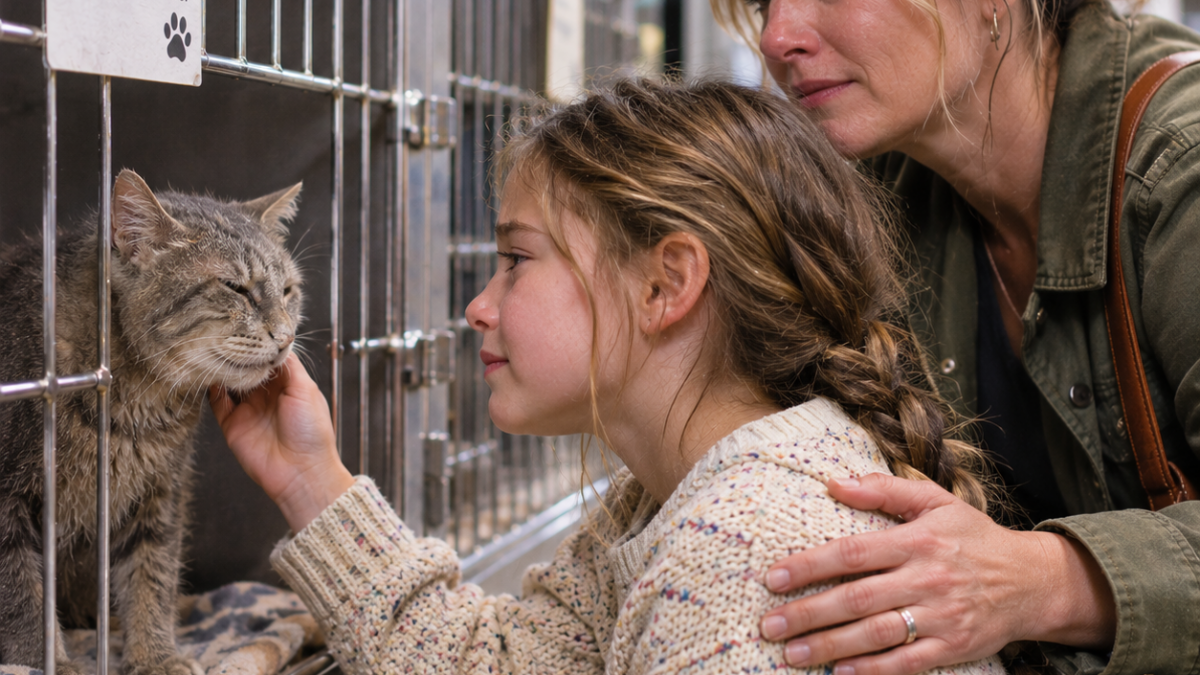
I Took My 8-Year-Old Daughter to Choose a Kitten—She Walked Past Every One and Put Her Hand on the Cage Nobody Else Stopped For
My eight-year-old daughter passed every kitten in the shelter and chose the old gray cat nobody else wanted because, in her words, “maybe nobody comes back for her.”
Three weeks later, that same cat stopped eating, and a veterinarian placed a $2,846 estimate in my shaking hands while I tried to decide whether keeping my promise to my daughter meant missing rent.
Then the clinic scanned the cat’s old microchip, made one phone call, and uncovered the truth about why she had been surrendered—a truth that made my daughter look at me and whisper, “Mom, somebody lied about her.”
My name is Megan Carter.
At the time, I was thirty-seven years old, divorced, tired, and far more proud of the fact that I could keep everything functioning than I had any right to be.
Functioning was not the same as living.
I know that now.
Back then, functioning meant rent paid by the fifth.
Usually.
Electricity on.
Groceries in the refrigerator.
Enough gasoline to get to work.
Ellie’s school lunch account never negative.
Laundry done before somebody ran out of underwear.
And if there were twenty-seven dollars left in my checking account the night before payday, I considered that a successful week.
Ellie and I lived in a second-floor apartment outside Dayton, Ohio.
Two bedrooms.
One bathroom.
Beige carpet.
Walls thin enough that I knew when the couple next door argued and when the man below us watched football.
The place was not beautiful.
But it was ours.
That mattered after her father left.
His name was Ryan.
I do not tell this story to make him a villain because life rarely gives you villains as cleanly as stories do.
Ryan did not hit me.
He did not drink away our savings.
He did not disappear one night without warning.
He simply became less present over time.
First emotionally.
Then physically.
Then practically.
There were late shifts that were not always shifts.
Phone calls taken outside.
Apologies.
Promises.
Counseling.
Another chance.
Then another.
Eventually he said he did not think he was “built for this version of life.”
I remember standing in our old kitchen with Ellie asleep upstairs and asking:
“What version?”
He looked at me as if the answer should have been obvious.
“This.”
Marriage.
Bills.
Parenthood.
Routine.
Me.
Maybe all of it.
PART2:
Ellie was five when he moved out.
For the first year he called regularly.
Then every other week.
Then randomly.
Birthdays became money transfers.
Christmas became a package from Amazon.
Visits were often canceled because something “came up.”
The last time Ellie waited for him at the window, she was seven.
He had promised to take her to the zoo.
She wore her sneakers from eight in the morning until almost three.
At 2:47, he texted me.
Can’t make it. Tell her I’m sorry.
I did not tell her immediately.
I sat beside her.
We watched cars enter the parking lot.
At three, she looked at me.
“He forgot again?”
I hated the word again.
“He had to work.”
Kids know when adults are lying for them.
She turned back toward the window.
“He always has to work when it’s me.”
PART2:
After that, she stopped waiting where I could see.
That may be why the shelter affected her the way it did.
We had gone for a kitten.
I had researched kittens.
I knew adoption fees.
Food cost.
Litter cost.
Vaccinations.
Spay procedures.
Pet deposits.
Our landlord required two hundred dollars upfront and an extra twenty-five a month.
I had calculated everything.
That is what I did when scared.
Numbers made fear look manageable.
A kitten was the plan.
Young.
Healthy.
Adaptable.
Years ahead of us.
Then Ellie walked straight past them.
At first I assumed she had not understood.
“Kitten room is over here.”
“I know.”
She kept walking.
“Ellie?”
She stopped at the last cage.
Bottom row.
Old gray cat.
The card said:
PENELOPE.
FEMALE.
11 YEARS.
SPAYED.
OWNER SURRENDER.
QUIET HOME PREFERRED.
I remember looking at the age first.
Eleven.
No.
That was my immediate reaction.
Absolutely not.
I was struggling to keep one child healthy.
I did not need geriatric veterinary bills.
Penny had thin gray fur around her ears and cloudy green eyes.
A white patch ran beneath her chin.
She was small.
Maybe seven pounds.
She did not stand when we approached.
Did not rub against the bars.
Did not meow.
She simply looked at us.
Ellie placed her palm against the cage.
“This one.”
I laughed.
Not cruelly.
Reflexively.
“We came for a kitten.”
“I know.”
“A kitten, honey.”
“I want her.”
I crouched.
“An older cat can have health problems.”
Ellie said nothing.
“They might need medicine.”
Nothing.
“They may not adjust as easily.”
Still nothing.
I tried the practical angle.
“A kitten will have more time with us.”
That made her look at me.
Exactly at me.
“More time before what?”
I wished I could take the sentence back.
“Nothing.”
“No.”
“Before what?”
I sighed.
“Older animals don’t usually live as long.”
Ellie looked at Penny.
Then:
“So?”
I almost smiled.
“So that matters.”
“Why?”
“Because losing something hurts.”
Ellie looked up.
There are moments children accidentally hold a mirror in front of you.
You do not always enjoy the view.
She said:
“You can still love it before.”
I had no response.
A shelter employee named Carla approached.
“Interested in Penny?”
Ellie immediately said:
“Yes.”
I said:
“We’re looking.”
Carla smiled.
Penny had been there twelve days.
Owner surrender.
Good litter habits.
No known aggression.
Lived with one woman most of her life.
Did not like loud dogs.
Preferred sleeping near people but did not enjoy being carried much.
“Why was she surrendered?” I asked.
Carla checked the notes.
“Family change.”
“What does that mean?”
“That’s all intake says.”
I hated vague phrases.
Family change could mean anything.
Death.
Divorce.
Moving.
A baby.
Somebody simply deciding they no longer wanted her.
Ellie was still touching the cage.
“She looks sad.”
Carla nodded.
“She’s having a hard time.”
“Does anyone ask about her?”
“A few.”
“Then?”
Carla hesitated.
“People usually choose younger.”
Ellie looked at me.
“That’s why nobody wants her.”
“I didn’t say nobody.”
“But nobody picked her.”
I lowered my voice.
“Sweetheart, I’m being practical.”
That was my favorite adult word.
Practical.
It can mean wise.
It can also mean scared.
Ellie turned toward Penny.
“If we don’t take one of the kittens, somebody else will.”
I said nothing.
“But if we leave her…”
She swallowed.
“Maybe nobody comes back.”
Then she said it.
The sentence I would remember long after everything else.
“She looks like she knows what it feels like to be left.”
Three years since Ryan left.
Three years of me telling myself Ellie had adjusted.
Three years of thinking children only carry the pain they show you.
I looked at my daughter.
Then at the cat.
Carla opened the kennel.
“Want to meet her?”
Ellie sat on the floor.
Penny did not move at first.
Ellie reached one finger.
Penny smelled it.
Then slowly leaned her cheek into Ellie’s hand.
Barely.
One inch.
Maybe less.
That tiny movement destroyed every spreadsheet in my head.
We adopted her.
The first night was bad.
Penny disappeared beneath our couch and stayed there.
No food.
No water.
No litter.
Nothing.
By eight in the evening I was pacing.
“This is exactly what I was worried about.”
Ellie sat on the rug.
“She’s scared.”
“She has to drink.”
“She will.”
“You don’t know that.”
Ellie looked at me.
“She was there twelve days.”
“So?”
“So maybe she thinks this is another place she has to leave.”
I hated how often my eight-year-old made me feel emotionally undereducated.
At ten, I sent her to bed.
At eleven-thirty, I found her asleep on the rug beside the couch.
Blue blanket to her chin.
I crouched.
“Ellie.”
Her eyes stayed closed.
Then she whispered:
“You don’t have to come out tonight.”
I froze.
“I just don’t want you to be alone.”
She was talking to Penny.
I sat on the floor.
Eventually I fell asleep against the couch.
When morning came, Penny was outside.
Curled against Ellie’s side.
My daughter opened her eyes.
Did not move.
“She picked us.”
That became the phrase.
Not we adopted Penny.
Penny picked us.
Three weeks later, I woke at 5:58 a.m. to crying.
Not cat crying.
Ellie.
I ran into the kitchen.
She was sitting on the floor in pajamas.
Penny stood beside the food bowl.
Staring at the wall.
“She won’t eat.”
My brain immediately went somewhere terrible.
Penny was dead.
Except she was standing.
I crouched.
“Penny?”
She turned.
That was when I saw it.
Her mouth opened slightly.
Then closed.
She approached the bowl.
Tried to take food.
Stopped.
Swallowed.
Backed away.
Pain.
I knew almost nothing about veterinary medicine.
But I knew pain.
“Get dressed.”
Ellie looked terrified.
“Is she dying?”
“No.”
Too fast.
“How do you know?”
“I don’t.”
Wrong answer.
Her face crumpled.
I softened.
“We’re taking her to the doctor.”
Our regular clinic opened at eight.
I called from the parking lot at 7:49.
They fit us in.
Dr. Rebecca Sloan examined Penny.
Early forties.
Gentle voice.
The kind of veterinarian who spoke to the animal before the person.
“Hi, sweetheart.”
Penny flattened against the table.
Dr. Sloan touched her jaw.
Penny jerked.
“There.”
“What?”
“Her mouth.”
She used a small light.
Then looked at me.
“She has significant dental disease.”
“How significant?”
“I can see at least two badly infected teeth.”
“Can you pull them?”
“Yes.”
Relief.
Then:
“But I’m concerned there’s more underneath the gumline.”
X-rays.
Blood work.
Possible extraction of multiple teeth.
Treatment for infection.
Anesthesia.
IV fluids because Penny was older.
Monitoring.
I watched numbers build on the estimate.
$1,980.
Then $2,340.
Then:
$2,846.17.
I stared.
The clinic employee placed the paper in front of me.
I remember every digit because fear turns numbers into tattoos.
My checking account contained $412.
Rent was due in six days.
My credit card had $603 available.
Another card had been closed after the divorce.
Savings:
$780.
That was our emergency fund.
Car brakes had started squeaking.
Ellie needed new winter boots.
And now:
$2,846.17.
Dr. Sloan said:
“We don’t necessarily need every procedure today.”
I looked at Penny.
“What does she need today?”
“Pain control.”
“Antibiotics.”
“Fluids if she’s dehydrated.”
“And then?”
“Dental surgery.”
“What happens if we wait?”
Dr. Sloan was careful.
“She’s already not eating normally.”
“That’s dangerous in cats.”
“How long can I wait?”
She understood the real question.
Not medical.
Financial.
“I’d prefer days, not weeks.”
Ellie was sitting in a chair.
Quiet.
Too quiet.
I asked:
“Do you have payment plans?”
“We use CareCredit.”
I had already been denied years earlier.
“Anything else?”
“We can take a deposit and split some portions, but surgery has to be paid before discharge.”
“How much deposit?”
“Usually half.”
Half.
$1,423.
More than my checking account.
More than my available credit.
More than anything I could produce without making another part of our life unstable.
I looked at my daughter.
She was watching me.
Children know that adult face too.
The one where numbers are bad.
I folded the estimate.
“Can we take her home today with medicine?”
“Yes.”
“We’ll schedule surgery.”
Dr. Sloan nodded.
No judgment.
That almost made it worse.
At reception I paid $287 for the exam, blood draw, pain medication, and antibiotics.
My bank balance dropped to $125.
In the car, Ellie said:
“Are we getting her teeth fixed?”
“Yes.”
“When?”
“Soon.”
“Are you sure?”
I started the engine.
“Ellie.”
“How much is it?”
“Adult problem.”
“That means a lot.”
I gripped the steering wheel.
“Don’t worry about it.”
Kids do not stop worrying because you issue instructions.
They simply worry privately.
At home, Penny ate softened wet food after medication.
A little.
Ellie sat beside her.
I went into my bedroom and closed the door.
Then opened my banking app.
Again.
As if numbers might change if sufficiently disappointed.
$125.43.
Savings:
$780.10.
Available credit:
$603.
Total accessible money if I emptied everything:
$1,508.53.
Not enough.
And rent:
$1,146.
I could miss rent.
We had never missed rent.
Late fee after the fifth.
Eviction did not happen instantly, I knew that.
But once you have lived through financial instability, even a late payment feels like the first crack in a dam.
I called Ryan.
We had spoken only twice that month.
He answered after four rings.
“Hey.”
“I need help.”
Silence.
Then:
“With what?”
Not:
Are you okay?
“What?”
I explained Penny.
The surgery.
The amount.
Ryan sighed.
Actually sighed.
“Megan.”
I closed my eyes.
“What?”
“You adopted an eleven-year-old cat?”
“Yes.”
“Why?”
I looked toward the bedroom door.
“Because Ellie wanted her.”
“That doesn’t mean you say yes.”
“I’m aware.”
“You know money’s tight.”
“Yes.”
“So why would you take on a senior animal?”
My face burned.
“I’m not asking for commentary.”
“How much do you need?”
“At least twelve hundred.”
He laughed once.
Not humor.
Disbelief.
“I don’t have twelve hundred dollars for a cat.”
“It’s not for me.”
“It’s still a cat.”
Something in me went cold.
“It’s Ellie’s cat.”
“It’s been three weeks.”
“She loves her.”
“She’ll get over it.”
I stopped breathing for a second.
Not because of Penny.
Because I had heard that philosophy before.
Children get over things.
Wives get over things.
People adapt.
If you leave often enough, eventually everyone learns not to expect you.
I said:
“Forget it.”
“Megan, be reasonable.”
“Goodbye.”
I hung up.
I cried for exactly four minutes.
Then I got angry.
Anger was useful.
I called the clinic.
Asked if surgery could be delayed five days.
Dr. Sloan came to the phone.
“If she keeps eating with pain medication.”
“I can have the money in five days.”
I had no idea whether that was true.
“Bring her in immediately if she stops eating completely, vomits repeatedly, becomes very lethargic, or you see swelling.”
“Okay.”
I volunteered for two extra weekend shifts at the medical billing office.
I listed a television we rarely used online.
Sold an unused stand mixer my sister had given me.
Canceled a subscription.
Returned two sweaters I had purchased for myself and never worn.
By Saturday I had added $386.
Still short.
Ellie noticed things disappearing.
“Where’s the TV?”
“I sold it.”
“Why?”
“We never use it.”
“We did.”
“Not enough.”
She looked at Penny.
Then at me.
“Is it for her doctor?”
I wanted to lie.
I didn’t.
“Partly.”
Ellie became very quiet.
That afternoon she disappeared into her bedroom.
An hour later I found her sitting with a jar.
Her piggy bank had been emptied.
Crushed dollar bills.
Coins.
Birthday money.
Christmas money.
She pushed it toward me.
$84.17.
“No.”
“Take it.”
“No.”
“It’s mine.”
“That’s exactly why.”
“I want to.”
I sat beside her.
“You saved this for a bicycle.”
“I don’t need one.”
“Yes, you do.”
“No.”
“Ellie.”
She looked at me.
“Penny needs teeth more than I need a bike.”
I laughed despite the lump in my throat.
“Cats don’t need teeth more than kids need bikes.”
“She can’t eat.”
“You are eight.”
“So?”
“So I’m supposed to take care of this.”
“You’re trying.”
I hated that sentence.
Not because it was wrong.
Because it contained mercy I had not given myself.
She pushed the jar again.
“Please.”
I took twenty dollars.
Not because we needed twenty.
Because refusing everything would have told her love only counted when adults performed it.
“We’re partners.”
She nodded.
“Okay.”
I returned the rest.
Monday morning Penny stopped eating again.
Completely.
I called the clinic.
“Bring her.”
Dr. Sloan took one look and said:
“We can’t wait.”
My stomach dropped.
“I don’t have all the money yet.”
“I know.”
That surprised me.
The receptionist came in carrying a tablet.
“We found something.”
“What?”
“When we scanned Penny today, we got a second microchip response.”
I frowned.
“Second?”
“The first scan at the shelter may have missed it or the chip had migrated.”
“Is that normal?”
“Not common, but possible.”
“Who is it registered to?”
Dr. Sloan looked at the tablet.
“Margaret Holloway.”
Ellie looked at me.
“Her old mom?”
“Maybe.”
I asked:
“Can you call her?”
“We did.”
My pulse changed.
“And?”
“The number belongs to someone else now.”
Of course.
Dr. Sloan continued.
“But the chip registry also listed an alternate contact.”
“Who?”
“A veterinary clinic.”
Not ours.
Maple Grove Animal Hospital in Springfield.
Forty minutes away.
“They sent us Penny’s old records.”
Dr. Sloan’s voice had changed.
Not excitement.
Concern.
“She was treated there for nine years.”
“That’s good, right?”
“Yes.”
“Then why do you look like that?”
Dr. Sloan pulled up the file.
“Because Penny was never supposed to be surrendered.”
I stared.
“What?”
“According to these records, Margaret Holloway died last year.”
Ellie’s hand found mine.
“Penny lived with Margaret from kittenhood.”
“Okay.”
“After Margaret died, her adult son, Dennis Holloway, took responsibility for Penny.”
“Then he surrendered her.”
“That’s what the shelter paperwork says.”
“But?”
Dr. Sloan turned the screen.
There was a scanned document.
A handwritten note.
Then a legal letter.
Margaret had created a small pet-care trust.
$12,000.
Specifically for Penny.
Veterinary care.
Food.
Boarding if necessary.
Permanent placement with a family member or approved adopter.
The funds were supposed to follow the cat.
I looked at Dr. Sloan.
“Where is the money?”
“We don’t know.”
My first thought was:
That could pay for surgery.
My second:
Somebody had already paid for Penny.
Years before I met her.
Somebody had loved her enough to prepare for this exact kind of problem.
And somehow she had ended up in a shelter anyway.
Ellie whispered:
“Somebody lied about her.”
I looked at my daughter.
“Yes.”
Dr. Sloan explained what they knew.
Margaret Holloway had been seventy-six when she died.
Widow.
Retired librarian.
No daughters.
One son.
Dennis.
Her attorney handled the estate.
The pet trust had been established two years before her death after Penny developed thyroid problems that later resolved with treatment.
The trust named Dennis as initial caregiver.
If Dennis could not keep Penny, he was required to arrange a permanent home through Margaret’s veterinarian or a designated cat rescue.
He could not simply surrender Penny anonymously and retain the fund.
But the shelter intake form listed:
OWNER SURRENDER.
Reason:
MOVING / UNABLE TO KEEP.
The person signing:
Dennis Holloway.
Dr. Sloan said:
“We contacted Maple Grove.”
“They’re contacting Margaret’s attorney.”
I felt like I had stumbled into someone else’s family dispute.
“What happens to Penny?”
“For now?”
Dr. Sloan looked at her.
“We treat Penny.”
“I can’t pay the full amount.”
“We know.”
“What does that mean?”
“It means Maple Grove has agreed to guarantee the surgery while the trust issue is investigated.”
I stared.
“Seriously?”
“Yes.”
I began crying.
Immediately.
Embarrassingly.
I covered my face.
“I’m sorry.”
Dr. Sloan handed me tissues.
Ellie squeezed my hand.
Penny sat in her carrier looking annoyed at the universe.
I laughed through tears.
“Can you fix her?”
Dr. Sloan smiled.
“Yes.”
“We can fix her mouth.”
Penny had surgery that afternoon.
Six extractions.
Not two.
Six.
One molar root had developed an abscess deep beneath the gumline.
Another tooth had fractured.
The infection explained why she had stopped eating.
The dental x-rays also revealed bone loss.
Dr. Sloan called at 4:37.
“She’s awake.”
I sat down at my desk at work.
“Is she okay?”
“She did beautifully.”
I closed my eyes.
“Can we see her?”
“Tomorrow morning.”
Ellie slept in my bed that night.
She had not done that in almost a year.
At 1:00 a.m., she whispered:
“Mom?”
“I thought you were asleep.”
“Did her first owner love her?”
“Yes.”
“How do you know?”
“She saved money for her.”
“That’s money.”
I smiled in the dark.
“Fair.”
“She took her to the vet for nine years.”
Nothing.
“She made a plan for after she died.”
Ellie thought.
“Then why did the man take her to the shelter?”
“I don’t know.”
“Maybe he needed the money.”
There are moments children say something so bluntly you want to protect them from their own accuracy.
“Maybe.”
“Can people steal cat money?”
I laughed.
“Apparently.”
“That’s stupid.”
“Yes.”
“Will he go to jail?”
“I don’t know.”
“Should he?”
I thought carefully.
“We don’t know everything yet.”
Ellie hated that answer.
“So you can do bad things if people don’t know everything?”
“No.”
“But you shouldn’t decide somebody is completely bad from one thing either.”
She was quiet.
Then:
“Dad leaves a lot.”
My chest tightened.
“But he’s not completely bad.”
There it was.
Not Penny.
Never only Penny.
I rolled toward her.
“No.”
“He’s not.”
“Sometimes I’m mad at him.”
“You’re allowed.”
“Do you hate him?”
I thought about lying.
“No.”
“Why?”
“Because hating him would take a lot of work.”
She giggled.
Then I said:
“I’m angry at choices he’s made.”
“Is that different?”
“Yes.”
“How?”
“You can love someone and still know they hurt you.”
Ellie stared at the ceiling.
“Like Penny’s old person?”
“Maybe.”
We found out later.
Dennis Holloway was fifty-two.
Divorced.
Two teenage sons.
Financial problems.
His mother’s house had been heavily mortgaged.
Her estate was far smaller than he expected.
The $12,000 pet trust irritated him.
That came from emails eventually reviewed by the attorney.
To Dennis, it was money his mother had “wasted on a cat.”
He kept Penny for seven months.
Not cruelly.
He fed her.
Provided litter.
But she hid constantly in his house because he had two large dogs.
When Dennis received a job offer in Indianapolis, his new apartment prohibited cats.
He could have contacted Maple Grove.
Could have contacted the designated rescue.
Could have transferred the trust.
Instead he surrendered Penny to our local shelter ninety miles away.
Why so far?
Because he did not want Margaret’s veterinarian finding out.
On the intake form, he listed himself as owner.
Did not disclose the trust.
Did not disclose her medical history beyond “healthy senior.”
Then he submitted receipts to the trust for expenses that had never occurred.
Boarding.
Prescription food.
Veterinary treatment.
Almost $4,300.
His mother’s attorney had approved reimbursements based on falsified receipts.
When Maple Grove called, the deception unraveled.
The story might have stayed private if Dennis had cooperated.
He did not.
He claimed Penny had run away.
The shelter had his signature.
He claimed the signature was not his.
Our security camera had him surrendering her.
Then he accused the shelter of “stealing his mother’s cat.”
That was when I got pulled in.
Not because I wanted to.
Because Penny was legally still connected to the trust, and suddenly someone was questioning whether our adoption was valid.
Three days after Penny’s surgery, I got a call from the shelter director.
“Megan, we need to talk.”
No sentence starting that way has ever improved a person’s morning.
“About what?”
“Penny.”
My stomach dropped.
“What happened?”
“Dennis Holloway has contacted an attorney.”
I sat down.
“He wants her back?”
“He says the adoption should be void because he did not understand what he was signing.”
“That’s ridiculous.”
“I know.”
“He surrendered her.”
“I know.”
“He left her there for twelve days.”
“I know.”
“He lied about her records.”
“Megan.”
“What?”
“Breathe.”
I stood.
“I am breathing.”
I was not.
“Can he take her?”
“We don’t believe so.”
“Believe?”
“Our counsel is reviewing it.”
That word destroyed me.
Reviewing.
For adults with money, reviewing is administrative.
For people without it, reviewing can mean your whole life is suspended while somebody else decides what you are allowed to keep.
I looked toward the living room.
Penny was sleeping beside Ellie.
Fresh shaved patch from the IV.
Mouth healing.
My daughter’s hand resting near her back.
“No.”
The shelter director said:
“What?”
“He’s not taking her.”
“Megan—”
“No.”
I lowered my voice.
“He threw her away because he wanted money.”
“We don’t know exactly—”
“I know enough.”
“We’ll fight it.”
“I don’t have money for a lawyer.”
“You shouldn’t need one.”
Again:
Shouldn’t.
I had built my whole adult life around things that shouldn’t happen.
Husbands shouldn’t leave.
Fathers shouldn’t cancel on daughters.
Rent shouldn’t rise faster than wages.
Kids shouldn’t learn to recognize overdraft alerts.
Old cats shouldn’t be abandoned after somebody saved twelve thousand dollars to protect them.
Shouldn’t was not protection.
Documentation was.
Money was.
Power was.
I had very little of any.
That evening I did something I regret.
I told Ellie nothing.
Then she heard me on the phone.
I was in the kitchen talking to Carla from the shelter.
“Could he actually win?”
Ellie appeared in the doorway.
I stopped.
Too late.
“Win what?”
“Nothing.”
“Mom.”
I closed my eyes.
She looked at Penny.
Then at me.
“Is somebody taking her?”
“No.”
My voice was sharp.
“Who?”
“Nobody.”
“Then why are you crying?”
I had not realized I was.
I sat.
She came closer.
I told her the simplified version.
Penny’s previous caregiver wanted to challenge the adoption.
Ellie’s face transformed.
“No.”
“We don’t think he can.”
“No.”
“Ellie.”
“He left her.”
“Yes.”
“She got sick.”
“Yes.”
“He didn’t come.”
“I know.”
“We came.”
I swallowed.
“Yes.”
“She picked us.”
“Yes.”
“Then he can’t.”
Her entire body was shaking.
I pulled her against me.
“He’s not taking Penny tonight.”
“What about tomorrow?”
I could not promise.
So I said:
“We are going to do everything we can.”
Ellie cried against my shoulder.
Penny woke.
Walked over.
Rubbed against Ellie’s leg.
My daughter picked her up carefully.
Penny was not a cat who liked being carried.
She tolerated it for almost a full minute.
That night Ellie asked if Penny could sleep in her bed.
“She chooses.”
Penny chose.
The legal fight lasted six weeks.
Long enough to ruin sleep.
Long enough for me to learn phrases I never wanted to know.
Pet trust.
Beneficiary property.
Custodial intent.
Fraudulent reimbursement.
Surrender waiver.
Relinquishment of ownership.
The shelter’s attorney argued that Dennis had knowingly surrendered Penny.
Margaret’s estate attorney argued that he had violated the trust and therefore had no authority to reclaim her.
Dennis’s lawyer argued that his client had surrendered Penny only because he was “temporarily unable to house her” and that the trust should remain under his control.
That last part exposed everything.
Control the trust.
Not Penny.
The county probate court scheduled a hearing.
I was asked to attend.
So was Ellie.
I refused to bring her.
She was eight.
She did not need to sit in a courtroom while adults debated whether love had paperwork.
My sister watched her.
I wore the only blazer I owned.
Bought during my divorce proceedings.
Apparently it was my bad-news jacket.
Dennis sat across the aisle.
I recognized him from shelter footage.
Tall.
Heavyset.
Expensive watch.
He looked exhausted rather than evil.
That complicated my anger.
He had his own life.
His own failures.
His own explanations.
Then he testified.
And complicated became harder to maintain.
His lawyer asked:
“Why did you surrender Penelope?”
“My housing changed.”
“Did you intend permanent abandonment?”
“No.”
I stared.
The shelter form literally said permanent surrender.
“Why did you select that shelter?”
“It was convenient.”
Ninety miles away.
Convenient.
“Did you understand your mother had established funds for the cat’s care?”
“Yes.”
“Were you trying to retain those funds personally?”
“No.”
Then the estate attorney questioned him.
“Mr. Holloway, did your mother’s trust permit you to keep unused funds after Penelope’s death?”
Dennis shifted.
“Eventually they become part of the estate.”
“To whom?”
“Myself and my sons.”
“So money not spent on Penelope could ultimately benefit you.”
“That wasn’t why.”
The attorney held up a document.
“Did you submit a $1,180 veterinary reimbursement two months after surrendering Penelope?”
Dennis looked down.
“I don’t remember.”
“It is your signature.”
“I submitted a lot of paperwork.”
“The veterinary clinic listed on this receipt says it never treated Penelope on that date.”
Silence.
“Did you create the receipt?”
“No.”
“Who did?”
“I don’t know.”
Then another.
Prescription food.
Never purchased.
Boarding.
Facility had never seen Penny.
I stopped feeling sorry for him.
The judge did not look impressed.
Then came the part I had not expected.
A video deposition from Margaret Holloway.
Recorded two years earlier when she created the trust.
Her attorney had recommended it because Margaret feared Dennis would resent the arrangement.
An old woman appeared on a screen.
Silver hair.
Blue cardigan.
Penny sitting in her lap.
Younger Penny.
Fuller.
Bright-eyed.
I covered my mouth.
The judge listened.
Margaret said:
“Dennis thinks I’m ridiculous.”
“He thinks twelve thousand dollars is too much.”
“Maybe it is.”
“But I am not leaving twelve thousand dollars to a cat.”
“I am leaving money to the human being who agrees to care for her when I cannot.”
She stroked Penny.
“I know my son.”
“He is not cruel.”
“But he is practical when practical benefits him.”
Dennis looked at the floor.
Margaret continued.
“If he loves her enough to keep her, he should use the money.”
“If he cannot keep her, that is all right.”
“I do not expect people to rearrange their whole lives because I died.”
“But then he is to find someone who wants her, and the money is to help that person.”
Then she said:
“What I do not want is for Penny to become an inconvenience that gets dropped somewhere because she is old.”
My eyes filled.
Across the aisle, Dennis wiped his face.
For one second, I saw a son listening to his dead mother describe him accurately.
There was no triumph in that.
Only humiliation.
The kind created when the truth arrives in someone else’s voice.
The judge ruled the same afternoon.
Dennis had permanently relinquished ownership.
Our adoption stood.
He was removed as trustee.
He was ordered to repay misused funds.
The remaining trust—just over $8,000 after legal and medical expenses—would be transferred to a professional trustee and used exclusively for Penny’s care.
I should have felt victorious.
Instead I felt tired.
Outside the courtroom Dennis approached me.
My first instinct was to move away.
He stopped several feet from me.
“I’m not going to bother you.”
I said nothing.
He looked at the parking lot.
Then:
“How is she?”
I almost laughed.
Not kindly.
“You’re asking now?”
“I deserve that.”
“Yes.”
He nodded.
“How is she?”
I could have punished him.
Could have walked away.
Instead:
“She had six teeth removed.”
His face changed.
“Six?”
“Yes.”
“I didn’t know.”
“You didn’t take her to the vet.”
“No.”
“She almost stopped eating completely.”
He looked sick.
“I thought she was just old.”
I said:
“She is old.”
“That doesn’t mean pain is normal.”
He nodded.
“I know that now.”
“No.”
I could feel my anger returning.
“You know because somebody else noticed.”
He accepted that.
Then he reached into his coat.
I stiffened.
He brought out an envelope.
“I found this in Mom’s things.”
I did not take it.
“What?”
“Pictures.”
He held it toward me.
“Penny.”
I took the envelope.
Photographs.
Margaret holding Penny as a kitten.
Penny on a Christmas blanket.
Penny inside a cardboard box.
Penny sitting beside an open book.
On one photograph Margaret had written:
My favorite reading partner.
I looked at Dennis.
“Why didn’t you give these to the attorney?”
“I almost threw them away.”
“Why?”
He looked embarrassed.
“Because looking at her reminded me of Mom.”
Everything shifted slightly.
Not enough to excuse him.
Enough to understand.
Penny had not only been an expense.
She had been a living piece of grief Dennis did not want.
He had removed the animal partly because she made loss visible.
I knew something about avoiding visible loss.
“Your mom loved her.”
“Yes.”
“Did you?”
Dennis took a long time.
“When I was a kid, my mother chose animals over everything.”
I frowned.
“She always had strays.”
“Dogs.”
“Cats.”
“Injured birds.”
“Sometimes we didn’t have money and she’d still spend fifty dollars on a sick cat.”
He gave a bitter little laugh.
“When she made that trust, it felt like one more time the animals mattered more than me.”
There it was.
Not greed alone.
Old resentment.
Childhood carried into middle age.
I said:
“That cat didn’t take anything from you.”
“I know.”
“You took it out on her anyway.”
His eyes filled.
“Yes.”
He did not ask me to forgive him.
Good.
I was not ready.
He asked:
“Can I send my mother’s things?”
“What things?”
“Penny’s blanket.”
“Some toys.”
“Her ceramic bowl.”
I thought about Ellie.
“Yes.”
“Send them through the attorney.”
He nodded.
Then left.
Justice rarely feels like music swelling.
Sometimes it is simply someone walking away after finally being made to look directly at what they did.
When I picked Ellie up, she ran to me.
“Did we win?”
I crouched.
“Penny stays.”
She screamed.
Actually screamed.
Then hugged me.
My sister cried.
I cried.
Ellie pulled back.
“What happens to the man?”
“He has to pay money back.”
“Does he go to jail?”
“No.”
She looked disappointed.
“Why?”
“Because not every bad choice means jail.”
“He lied.”
“Yes.”
“He hurt Penny.”
“Yes.”
“He should have consequences.”
“He does.”
“That doesn’t feel like enough.”
I smiled sadly.
“Welcome to being an adult.”
She frowned.
“I don’t want it.”
“Smart.”
That evening I showed her Margaret’s photographs.
Ellie held one of Margaret reading with Penny.
“She had another mom.”
“Yes.”
“Did Penny love her?”
“I think so.”
“Then does she love us less?”
I stopped.
“No.”
“How do you know?”
Because I had spent years believing love was a finite amount people could withdraw.
Ryan leaves, love decreases.
Marriage ends, love fails.
Family shrinks.
But Penny had known Margaret.
Then shelter.
Then us.
The first did not erase the last.
The last did not insult the first.
I said:
“Because love isn’t a cup.”
Ellie looked confused.
“You don’t run out just because someone drank from it first.”
“That is a weird example.”
“I’m tired.”
She laughed.
We hung one photograph beside Ellie’s bed.
Margaret holding young Penny.
My daughter insisted.
“So she knows we know.”
“Who?”
“Penny.”
“She cannot understand photographs like that.”
“You don’t know.”
I stopped arguing.
The pet trust changed our finances more than I wanted to admit.
Not because we used it irresponsibly.
We didn’t.
Every expense required receipts.
Veterinary care.
Medication.
Prescription food.
Nothing else.
But knowing Penny’s medical needs would not threaten our rent removed a pressure I had been carrying like a stone.
Her dental surgery healed.
She ate.
Really ate.
Within two weeks she gained almost half a pound.
Her coat improved.
She began grooming again.
Then personality appeared.
Penny was not quiet.
Penny had simply been miserable.
She yelled for breakfast.
Knocked pens from tables.
Hated closed bathroom doors.
Had a specific problem with one decorative pillow.
If I put it on the couch, she knocked it down.
Every time.
Ellie said:
“Margaret probably taught her.”
“I doubt Margaret spent her retirement training a cat to hate pillows.”
“You don’t know.”
That became Ellie’s answer to everything.
Penny also developed a ritual.
At 6:15 every morning she walked into Ellie’s room.
Jumped onto the bed.
Sat on her chest.
Ellie would complain:
“Penny.”
The cat stared.
“Five more minutes.”
Stare.
Then one paw to Ellie’s cheek.
Breakfast.
I began waking to laughter.
That sound had been missing from our apartment for longer than I understood.
Ryan visited three months later.
Unexpectedly.
He had texted the night before.
Can I see Ellie Saturday?
I almost said no.
Then asked her.
She shrugged too casually.
“Okay.”
He arrived carrying a gift bag.
Inside was a tablet.
Too expensive.
Exactly the kind of gift divorced parents buy when they want an object to perform emotional labor.
Ellie thanked him.
Penny watched from the hallway.
Ryan noticed.
“So that’s the famous cat.”
Ellie immediately became protective.
“Her name is Penny.”
“I know.”
He reached.
Penny backed away.
Ryan laughed.
“She hates me.”
“She doesn’t know you.”
The sentence landed harder than Ellie intended.
Ryan’s smile disappeared.
He looked at me.
I looked away.
They spent four hours together.
Lunch.
Park.
Ice cream.
He brought her home before six.
No cancellation.
No emergency.
A full visit.
Afterward Ellie sat beside Penny.
“Dad says he might come next month.”
I kept my face neutral.
“That would be nice.”
“Do you think he will?”
“I don’t know.”
She nodded.
Not devastated.
Not hopeful.
Prepared.
That broke my heart in a different way.
Penny climbed into her lap.
Ellie whispered:
“You stay.”
The cat did.
Ryan began showing up more after that.
Not perfectly.
Once a month.
Then twice.
He still failed sometimes.
But he stopped making promises unless he meant them.
One evening after returning Ellie, he stood outside my apartment.
“I’m sorry about what I said.”
“Which thing?”
“The cat.”
I waited.
“When you called for money.”
“Oh.”
“I was a jerk.”
“Yes.”
“I thought you were making another emotional decision I’d have to fix.”
My jaw tightened.
“You haven’t been fixing much here for three years.”
“I know.”
He looked toward the floor.
“That’s the point.”
I said nothing.
Ryan continued.
“I got used to thinking because you handled everything, you didn’t need anything.”
“That was convenient.”
“Yes.”
At least honest.
He transferred six hundred dollars the next day.
Not for Penny.
For Ellie’s expenses he had missed.
Then began paying support on a regular schedule without me chasing him.
Did Penny cause that?
No.
Life is not a movie.
But being confronted with one small example of my struggle had apparently forced Ryan to see a larger pattern.
He did not become a perfect father.
He became a more accountable one.
That was enough to begin.
A year passed.
Penny turned twelve.
We celebrated the estimated birthday from Margaret’s records.
Ellie made a paper crown.
Penny destroyed it.
At thirteen, early kidney disease appeared.
This time I did not panic over the estimate.
The trust covered labs.
Prescription food.
Medication.
I still worried.
But health worry is different when it is not tangled with financial terror.
I thought often about Margaret.
A woman I never met had understood something important.
Money cannot guarantee an animal will be loved.
But it can prevent love from being destroyed by a bill.
When Penny was fourteen, we moved.
Not because we were forced.
Because I got promoted.
Medical coding supervisor.
Better salary.
Benefits.
Small townhouse.
Three bedrooms.
Tiny fenced patio.
Ellie finally got the bicycle.
She was eleven then.
First ride, she crashed into a hedge.
Penny watched from the window with what I considered inappropriate satisfaction.
The old apartment had been where we survived.
The townhouse became where we began expecting things.
Friends over.
Decorations.
Birthday dinners.
A desk for me that was not the kitchen table.
A bedroom wall Ellie painted pale blue.
Penny took three days to adjust.
Then claimed the sunniest window.
At fifteen, she developed arthritis.
Steps appeared.
Couch steps.
Bed steps.
Window platform.
Our house began looking like an accessibility project for a six-pound dictator.
Ellie was thirteen.
Middle school.
Hard age.
Friends became complicated.
Bodies changed.
Social media arrived despite my resistance.
One afternoon she came home crying.
A group of girls had excluded her from a birthday party.
No obvious reason.
Just cruelty packaged as social hierarchy.
Ellie went to her room.
Penny followed.
I stood outside.
Did not enter.
An hour later Ellie emerged carrying the cat.
Her eyes were swollen.
“She doesn’t care if I’m weird.”
“Penny is extremely weird.”
“Exactly.”
At sixteen, Penny’s eyesight worsened.
Ellie was fourteen.
Ryan had become more present.
Not living with us.
Never that.
Our marriage was finished.
But fatherhood had returned enough to have shape.
He came to school events.
Learned teachers’ names.
Showed up for orthodontist appointments.
He once drove two hours back from Cincinnati because Ellie had a panic attack before a debate competition.
That mattered.
Forgiveness came slowly.
Not reunion.
Forgiveness.
They are not the same.
Penny helped me understand that too.
An animal can remember fear and still accept a hand again.
Not blindly.
Not without caution.
But sometimes.
When Penny was seventeen, Margaret’s trust held only $1,900.
Years of care had used most of it.
The professional trustee called.
“We need to discuss what happens after funds are exhausted.”
I laughed.
“What happens?”
“I keep paying for my cat.”
He paused.
“Correct.”
The question would have terrified the woman I was when Penny was eleven.
It did not now.
I had savings.
Real savings.
Not enormous.
Enough.
Ellie had a part-time job.
College applications beginning.
Ryan contributed reliably.
Life remained expensive.
Always would.
But we were no longer balancing on a single bad vet bill.
I sometimes wondered whether I would have become more financially stable without Penny.
Maybe.
Pets cost money.
That is reality.
But I also knew the version of me before Penny avoided risks so completely that she had begun avoiding life.
I chose the safest route.
The cheapest.
The least emotionally dangerous.
Penny had been none of those.
She was old.
Medically complicated.
Grieving.
And somehow she became one of the best decisions I ever made.
At eighteen, Penny became very frail.
Ellie was fifteen.
The reversal hit me one morning.
My daughter was sitting at the kitchen table studying chemistry.
Penny tried to jump onto the chair.
Failed.
Ellie lifted her.
“Careful, Grandma.”
I stood at the sink.
For a second, I saw eight-year-old Ellie at the shelter again.
Hand against a cage.
This one.
All those years.
Years I had nearly rejected because I had looked at an eleven-year-old cat and thought there was not enough time.
Seven years had passed.
Seven.
Longer than some marriages.
Longer than entire stages of childhood.
Enough time for an old cat to become part of every version of us.
The end began on a Monday.
Penny stopped coming downstairs.
She still ate.
A little.
Drank.
Used the litter box.
But something was different.
Dr. Sloan had retired by then.
Her replacement, Dr. Marcus Lee, examined Penny.
Kidney disease advanced.
Arthritis significant.
Weight down.
Possible intestinal cancer.
We could test.
Ultrasound.
Biopsy.
More blood work.
Ellie was seventeen then.
Old enough to understand.
She asked the question before I could.
“Would treatment make her feel good?”
Dr. Lee looked at her.
“Maybe for a little while.”
“What does a little mean?”
“Weeks.”
“Months if we’re lucky.”
“Would she hate the tests?”
Dr. Lee answered honestly.
“She would probably find them stressful.”
Ellie looked at Penny.
Then at me.
I saw the eight-year-old again.
The child who had chosen need over ease.
Only now choosing love meant something different.
“Can we take her home?”
Dr. Lee nodded.
“Yes.”
Palliative care.
Pain medication.
Appetite support.
Fluids.
Warm blankets.
Favorite foods.
No heroics.
For eleven days Penny stayed with us.
Ryan visited.
He sat on the floor.
Penny surprised all of us by walking toward him.
He smiled.
“Finally.”
Ellie said:
“She needed seventeen years to decide.”
Ryan touched her head.
“Fair.”
Then he started crying.
That startled Ellie.
Maybe because children assume parental tears are caused by larger things.
Divorce.
Death.
Disaster.
Sometimes an old cat is large enough.
Dennis Holloway contacted me once during those final days.
We had not spoken in years.
He emailed through the trustee.
Subject:
Penny.
I almost deleted it.
Then opened.
He wrote:
I know I have no right to ask anything from you.
The attorney told me the trust is almost exhausted and that Penny is still alive.
I am glad.
My mother would be glad.
I have spent a lot of years being ashamed of what I did.
I do not expect forgiveness.
If Penny is still comfortable and if it would not distress her or your family, I would like to send one thing.
If not, I understand.
I showed Ellie.
She was seventeen.
Old enough to choose too.
“What thing?”
“He doesn’t say.”
“Ask.”
A package arrived three days later.
Small.
Inside was a cloth book sleeve.
Gray fabric.
Embroidered flowers.
It smelled like storage.
There was a note:
Mom kept this on her reading chair.
Penny slept on it every day.
I could never throw it away.
I think it belongs with her.
Ellie put the fabric near Penny.
The cat was almost blind.
Hearing weak.
Sense of smell still there.
She lifted her head.
Sniffed.
Then moved.
Very slowly.
Onto the cloth.
Circled once.
Lay down.
Ellie looked at me.
“She remembers.”
Maybe.
Probably.
I did not argue.
We sent Dennis one photograph.
Penny sleeping on Margaret’s old book sleeve.
No words.
He replied:
Thank you.
That was enough.
On Penny’s final morning, the sun came through the living-room window.
Warm.
She loved warmth.
Ellie had slept beside her on the floor.
Just like the first night.
Full circle has become a cliché because life keeps doing it anyway.
I came downstairs at 6:08.
My daughter was awake.
Penny between her arms.
Ellie looked at me.
“It’s today.”
I knew.
We called Dr. Lee.
He came to the house at ten.
Ryan came too.
Nobody asked him.
He simply arrived.
For once, coming without being asked felt right.
Penny lay on Margaret’s cloth.
Ellie sat on one side.
Me on the other.
Ryan near her feet.
Dr. Lee explained everything.
Sedative first.
Then the final medication.
Ellie nodded.
Her face was wet.
She stroked Penny’s head.
“I picked you.”
Penny breathed.
“You were supposed to be my cat.”
Another breath.
“But you were Mom’s too.”
I laughed through tears.
“Definitely.”
Ellie kissed her forehead.
“You fixed her.”
I shook my head.
“No.”
“You did.”
“How?”
“She used to be scared of everything.”
That hit.
I looked at my daughter.
Penny had not fixed me.
Not exactly.
But she had forced me to discover that practical and frightened were not synonyms.
That risk and mistake were not synonyms.
That loving something temporary was not foolish.
Everything is temporary.
We just hide that fact better when something is young.
Dr. Lee gave the sedative.
Penny relaxed.
Her breathing slowed.
Ellie’s hand rested over her side.
I put my palm beside my daughter’s.
Ryan placed his hand on Ellie’s shoulder.
A strange little family.
Broken.
Rebuilt differently.
Not the original plan.
Still real.
Before the final injection, I whispered:
“You were never the cat nobody wanted.”
Because that had bothered me for years.
People described senior animals that way.
Nobody wanted her.
But Margaret had wanted her.
Ellie wanted her.
I wanted her.
Eventually even Dennis had learned to regret failing her.
Penny had been loved before the shelter.
Loved after it.
The cage was not the whole story.
Neither was surrender.
Neither was age.
Dr. Lee administered the medication.
Penny took three slow breaths.
Then stopped.
Ellie lowered her head against Penny’s side.
I held her.
For a long time, nobody moved.
Ryan quietly went into the kitchen.
I heard him crying.
I stayed with my daughter.
Eventually Ellie whispered:
“She picked us.”
Same words.
Nine years earlier.
I said:
“Yes.”
“She really did.”
We had Penny cremated.
Ellie chose a simple wooden box.
No dramatic inscription.
Just:
PENNY
Loved Before Us.
Loved With Us.
Loved Always.
When Ellie graduated high school the following spring, she carried one of Penny’s old collar tags inside her purse.
I did not know until afterward.
We took photographs outside the school.
Ryan stood on one side.
I stood on the other.
Neither of us pretended our family history had been prettier than it was.
We were just there.
Ellie graduated with honors.
Accepted into Ohio State.
She did not become a veterinarian.
People always assume that part.
No.
She studied social work.
When I asked why, she said:
“I like the ones people walk past.”
Of course she did.
During her second year of college, she volunteered with a program that helped elderly people keep their pets during temporary hospital stays.
The first time she told me, I laughed.
“What?”
She shrugged.
“Seems useful.”
I thought about Margaret.
The trust.
Penny.
Dennis.
All the small places where one person choosing differently could have prevented pain.
“You know what you’re doing?”
“Not really.”
“Excellent.”
“Very encouraging, Mom.”
Years later, Ellie would work with families facing eviction, illness, and elder care.
Some of her cases involved pets.
Often the animal looked like the least important part of a crisis.
Until you understood that sometimes the dog was the reason an elderly man agreed to come home after rehab.
The cat was the only constant a child had during a divorce.
A rabbit was the one living thing a woman leaving an abusive partner refused to abandon.
Practical systems tend to separate needs into boxes.
Housing.
Health.
Finances.
Animals.
Humans rarely live that neatly.
Ellie knew that before I did.
She knew it at eight.
I had walked into that shelter with a plan.
A kitten.
Healthy.
Young.
Easy.
The safest possible version of love.
My daughter walked past every safe choice.
She found an eleven-year-old gray cat sitting silently in the last cage.
She placed her hand against the door.
And said:
“This one.”
I thought she was choosing a cat.
She was choosing a philosophy I had spent years avoiding.
Love where it is needed.
Even if it costs something.
Even if it may hurt.
Even if you cannot guarantee how long you get.
Especially then.
Three weeks later, when the veterinarian placed that $2,846 estimate in my hands, I almost thought my fear had been proven right.
See?
This is why you choose the easy one.
This is why adults think ahead.
This is why you do not let feelings make decisions.
But that bill was not proof we had made a mistake.
It was simply proof that love sometimes comes with responsibility.
The mistake had happened before us.
A son who let resentment become neglect.
A woman’s carefully planned protection ignored because an old cat looked like an inconvenience.
A shelter left without the information it needed.
Pain dismissed as age.
Those things were mistakes.
Choosing Penny was not.
The trust eventually ran out.
Penny eventually died.
Ellie eventually grew up.
Ryan never became the husband I once wanted him to be.
I never became the woman who could control every bad thing by planning hard enough.
None of us got the safe version.
We got something better.
Something honest.
Today, I am fifty-two.
Almost the age I once considered impossibly old.
Funny how that works.
My house is quieter again.
Ellie lives in Cincinnati now.
Ryan remarried.
We are friendly in the strange way people sometimes become after enough years have sanded down what used to cut.
I still work too much.
Still drop ice cubes when I make coffee.
Still check my banking app more than necessary.
Some things stay.
On my bookshelf is Margaret’s photograph.
The one of her holding Penny beside an open book.
Next to it is another photograph.
Eight-year-old Ellie asleep on our apartment rug.
Penny curled against her side.
The morning after we brought her home.
Two women who never met.
One cat between them.
Two homes.
Two different kinds of love.
Sometimes people see the photographs and ask:
“Was she a rescue?”
I never know how to answer.
Technically yes.
But rescue makes the story sound one-directional.
Like we entered a shelter, found something damaged, and fixed it.
That is not what happened.
Penny arrived carrying Margaret’s love.
She arrived carrying Dennis’s failure.
She arrived carrying fear.
Age.
Pain.
History.
Then Ellie added herself.
Then me.
Then even Ryan, eventually, in his imperfect way.
Love did not erase anything that came before.
It layered over it.
That is what I learned.
And if I could go back to that rainy Saturday and stand beside the woman I was—the one calculating vet bills before she had even touched the cat—I would not tell her to stop being practical.
Practical matters.
Food costs money.
Veterinary medicine costs money.
Rent is real.
Good intentions do not pay bills.
I would simply tell her something else too.
Do not confuse the possibility of pain with evidence that love is a bad investment.
Do not assume old means almost finished.
Do not assume difficult means wrong.
Do not assume the safest choice is the one you will be most grateful you made.
Then I would point toward the far wall.
Toward the bottom cage.
Toward a thin gray cat with cloudy eyes who has stopped trying to impress anyone.
And I would tell her:
Watch your daughter.
She sees something you don’t yet.
Ellie will walk past the kittens.
She will put one hand against the metal door.
She will choose the animal everybody else thinks has too little time left.
And years from now, when that same little girl is grown, you will understand what she knew before you did.
Love is not measured by how much time is left.
It is measured by what you do with the time that is given.
Penny gave us nine years.
Nine.
I had almost walked away because eleven sounded too old.
Nine Christmas mornings.
Nine years of school pictures.
Nine years of breakfast yelling.
Nine years of vet visits, couch naps, scratched furniture, hair on black clothing, and a gray cat occupying whatever piece of paper I was trying to read.
Nine years of watching my daughter become someone kind without becoming naïve.
Nine years of learning that being left does not have to be the last thing that defines you.
All because an eight-year-old girl looked at an old cat in a shelter cage and refused to choose the easy one.
“She picked us,” Ellie said that first morning.
For years I thought she was talking about Penny.
Now I think she was talking about love itself.
It found the two of us when we were tired, careful, and still carrying the shape of someone who had left.
It did not arrive young.
It did not arrive easy.
It did not arrive inexpensive.
It arrived gray around the ears, hurting badly, and too proud to ask for anything.
And somehow that was exactly what our home needed.








