I Told My Wife I Didn’t Want the Stray Kitten She Found—Then One Day She Looked Out the Window and Said a Word No Cat Should Know
I Told My Wife I Didn’t Want the Stray Kitten She Found—Then One Day She Looked Out the Window and Said a Word No Cat Should Know
I told my wife I absolutely did not want the tiny stray kitten she had found near an abandoned park, and during the first few days I was not even convinced the wild little creature attacking my hands, climbing my clothes and screaming at invisible enemies had any intention of becoming a normal house cat.
Then one afternoon she stared through the living-room window and made a sound so unmistakably close to “coyote” that I laughed—until I looked outside and saw an actual coyote standing beyond the fence exactly where she had been staring.
By the time Merv began answering me, crawling onto my chest, stealing food from my plate and making sounds that somehow seemed to fit entire conversations, the man who had once begged his wife not to bring home a cat had become completely obsessed with earning the love of the strangest little animal he had ever met.
Merv is my partner in crime.
That is the easiest way I know how to explain her.
Not my pet.
Not exactly.
Not merely my cat.
Partner in crime.
If I decide, at forty years old, that the kitchen floor needs to become the site of an unnecessary cardboard-box construction project at eleven at night, Merv is there.
If I decide to dump every throw pillow off the couch because I am looking for the television remote and then get distracted halfway through, Merv immediately assumes this is a game designed specifically for her.
If I am stressed and feel like tearing the house apart in the harmless, immature way grown men sometimes do when life has been too serious for too long, there is one creature in my home who understands exactly what I am trying to accomplish.
Merv.
She does not ask questions.
She does not remind me that I will eventually have to clean it.
She does not suggest meditation.
She launches herself directly into whatever bad idea is happening.
That is why I love her.
It is also why my wife sometimes looks at both of us and says:
“No.”
Usually in the exact tone you would use with two children standing beside a broken lamp.
“Merv.”
Merv answers.
“Merv, no.”
Another answer.
“Merv, I love you.”
She gives me a long, nasal Siamese sound that seems to contain insult, complaint and acknowledgment all at once.
“Merv.”
Another sound.
“I know.”
Sound.
“You did it.”
Sound.
“No, it was absolutely you.”
Sound.
“That is not an excuse.”
Sometimes my wife walks through while these conversations are happening and asks:
“Do you realize she’s a cat?”
I say:
“Do you realize she started it?”
This is my life now.
Which is funny because when Merv entered my life, I wanted absolutely nothing to do with cats.
I was not one of those people who hated them.
Hate takes effort.
Cats simply existed outside my emotional jurisdiction.
Dogs made sense.
Dogs ran toward you.
PART2:
Dogs looked pleased when you came home.
Dogs had body language I understood.
A dog might destroy your couch, but at least while doing it he generally looked guilty.
Cats always seemed like tiny landlords who had decided humans were behind on rent.
I had friends with cats.
I respected their choices.
I just never thought:
I need that.
I certainly never thought I would someday become the sort of man who could identify one specific cat’s emotional state based on whether her scream contained two syllables or three.
Then my wife found Merv.
It happened in an old park area that had mostly been abandoned.
The grass had gone wild in places.
There were cracked concrete picnic pads and a few rusting metal fixtures where playground equipment had once stood.
My wife had gone through there for reasons I no longer remember.
What I remember is my phone buzzing.
Her message:
Hey.
Then:
There’s a kitten.
I should have known.
I called her.
“What do you mean there’s a kitten?”
“I found a little kitty.”
“No.”
“I haven’t even asked anything yet.”
“You don’t have to.”
“She’s alone.”
“No.”
“She’s tiny.”
“That makes the no smaller, not different.”
“I need you to bring a blanket.”
“No.”
“And a box.”
“Please don’t make me do this.”
There was silence.
Then my wife said the one sentence she knew would make the argument unfair.
“She needs help.”
I closed my eyes.
There are moments in marriage where you know you have already lost before the other person has finished speaking.
I found a cardboard box.
I grabbed an old blanket.
And I drove to meet her.
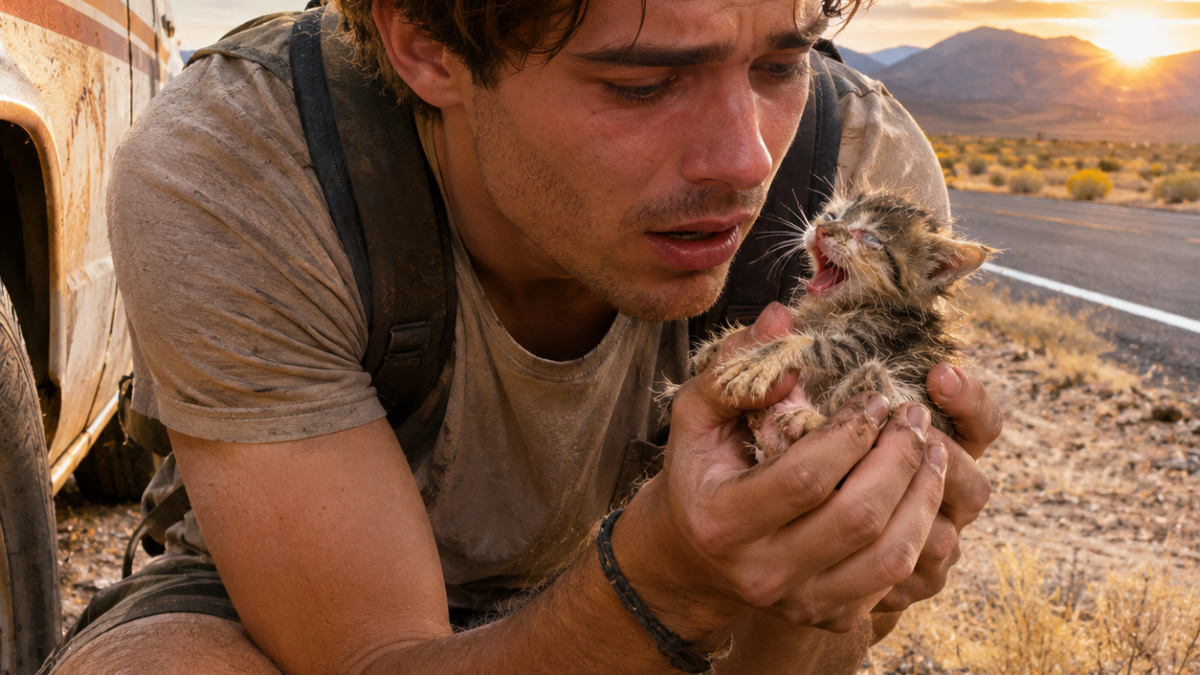
The first time I saw Merv, I thought she looked less like a kitten and more like an animal that had recently escaped some tiny war.
She was all angles.
Too-big ears.
Sharp little face.
Long limbs.
Eyes that seemed permanently alert.
She was small, but there was nothing fragile about the way she looked at me.
She looked prepared to fight a much larger mammal.
That mammal happened to be me.
I crouched.
“Hi.”
Merv flattened slightly.
My wife said:
“Be careful.”
“That’s reassuring.”
“She’s scared.”
“So am I.”
Merv made a noise.
“What was that?”
“She’s talking.”
“No. She’s threatening litigation.”
We got her into the box.
That part deserves a more dignified sentence than it gets.
We persuaded her into the box.
There were hands.
Blanket.
Tiny claws.
A sound I had not known could come out of something weighing only a few pounds.
I drove home convinced we were temporary custodians.
That was the mental agreement I made with myself.
Temporary.
Feed her.
Get her checked.
Find out if she belonged to someone.
If not, find her a home.
That home would not be ours.
I repeated that to my wife.
She said:
“Okay.”
Her tone meant:
You poor idiot.
I did not recognize it yet.
The first few days were chaos.
Merv did not walk through the house.
She exploded through it.
She hid under furniture, then appeared six feet away as if she had discovered teleportation.
She climbed fabric.
She attacked socks.
She attacked hands.
She attacked things that were not moving and then appeared offended when they remained still.
I would sit on the couch, and suddenly a blur came from somewhere beside me.
Claws.
Teeth.
Tail.
Gone.
“Merv!”
She would stare from beneath the coffee table.
“What is wrong with you?”
My wife said:
“She’s a kitten.”
“Are kittens normally attempted murder?”
“Sometimes.”
I looked at Merv.
“Do you hear that? You’re getting away with this because of your age.”
Merv launched herself at my ankle.
I spent the first week telling people I did not know if she was actually a cat.
She reminded me of a wild dog that had somehow been reduced in size.
Maybe with a little human mixed in.
Not because she behaved like a person.
Because she seemed to possess the self-confidence of someone paying taxes.
She had opinions.
Rooms.
Doors.
People.
Food.
Timing.
The house itself.
The first time I closed a door between us, she yelled.
Not meowed.
Yelled.
I opened it.
Merv walked through without acknowledging me.
That was when I first understood the hierarchy.
It would take me months to accept it.
My wife began calling her Merv.
The name stuck.
I do not remember why that specific name won.
Merv simply looked like a Merv.
Some animals arrive carrying names invisibly.
Once spoken, nothing else fits.
We took her to the veterinarian.
No microchip.
No owner found.
Healthy enough.
Young.
Full of energy.
Potential Siamese ancestry.
The veterinarian warned us:
“They can be vocal.”
I laughed.
“You mean this gets worse?”
The veterinarian smiled.
“That depends on whether you enjoy conversation.”
At the time I assumed she meant loud meowing.
I had no idea.
Merv’s voice developed along with her confidence.
At first she produced ordinary kitten noises.
Meow.
Yowl.
Chirp.
Trill.
Then the sounds diversified.
Some were higher.
Some lower.
Some sounded like complaints.
Some sounded like questions.
And some, through coincidence or repetition or whatever complicated interaction happens between animal vocalization and human pattern recognition, sounded disturbingly like words.
I know how that sounds.
I am not claiming Merv sat down one afternoon and learned English grammar.
She does not file taxes.
She has not asked for voting rights.
But when you live closely with an animal, you stop hearing “meow” as one category.
You hear intent.
The same way a parent hears different cries from a baby.
Hungry.
Angry.
Lonely.
Pain.
Attention.
Merv had categories.
Lots of them.
I began responding.
Not deliberately.
It just happened.
Merv vocalized.
I answered.
She answered my answer.
Then I answered that.
Soon we had entire exchanges.
My wife would hear us from another room.
“What are you doing?”
“Talking to Merv.”
“About what?”
“I don’t know. She brought it up.”
The first event that made me question everything I thought I understood about her happened at the window.
It was afternoon.
Merv was watching outside.
She did that often.
Birds.
People.
Cars.
Leaves.
Nothing unusual.
Then her body changed.
Every cat owner knows the change.
Stillness.
Focused eyes.
Muscles alert.
She made a sound.
I was in the room.
It sounded like:
“Coyote.”
I looked over.
“What?”
Again.
“Coyote.”
Not perfectly.
Not like a human child.
But close enough that my brain assembled it immediately.
I laughed.
“No.”
Merv stared outside.
“Coyote.”
I remember actually saying:
“There’s not going to be a coyote outside just because you made a weird noise.”
I walked over anyway.
There was a coyote.
Standing outside.
I froze.
Looked down at Merv.
She looked up.
I have never seen an animal look more smug.
My wife walked in.
“What?”
I pointed.
“Coyote.”
She looked outside.
Then at Merv.
“What did she do?”
“She said coyote.”
My wife laughed.
“No, she didn’t.”
“She absolutely did.”
“She made a noise that sounded like it.”
“That is what saying things is.”
“No, it is not.”
“Tell that to Merv.”
Merv vocalized again.
For the next several days I told everybody.
This was the beginning of my decline into full cat-person behavior.
Friends would come over.
I would say:
“Ask me what Merv said.”
Nobody asked.
I told them anyway.
“She saw a coyote and said coyote.”
They smiled the way people smile when they realize their friend has become strange but is not currently dangerous.
Then Merv started making other sounds.
Some seemed like:
“I love you.”
That one destroyed me.
You can tell yourself all day that it is pattern recognition.
Then your cat crawls onto you, looks directly into your face and makes a two- or three-part sound that your brain hears as “I love you.”
Good luck remaining emotionally rational.
I answered every time.
“I love you too.”
Merv often replied.
I began trying to reproduce her noises.
She tried to reproduce mine.
This probably made both of us look insane.
My wife filmed some of it.
On video, you could hear what we heard.
Maybe not perfectly.
But enough.
Then came Bagua.
To this day, I cannot explain Bagua.
Merv would sometimes scream a sound that resembled:
“Bagua!”
“Baaag-waa!”
Who is Bagua?
No idea.
I have asked.
“Merv, who’s Bagua?”
She answers.
Not helpfully.
“Is Bagua here?”
Sound.
“Do we know Bagua?”
Sound.
“Do you owe Bagua money?”
Long sound.
We developed theories.
Imaginary friend.
Ancient enemy.
Secret cat deity.
A word Merv invented for something obvious to cats and invisible to humans.
Maybe it means cupboard.
Maybe it means bird.
Maybe it means:
This conversation has gone on too long.
Nobody knows.
Merv knows.
She is not sharing.
The voice was funny.
But what changed me was not the talking.
It was the closeness.
During the first weeks, Merv had interacted with me primarily through violence.
Then she began approaching without attacking.
She sat near me.
Then against me.
Then on me.
The first time she crawled onto my chest willingly, I stayed absolutely still.
I did not want to ruin it.
I looked toward my wife.
“She’s on me.”
“I can see.”
“She came by herself.”
“Yes.”
“Do I move?”
“You can breathe.”
“I don’t know.”
Merv circled once.
Then settled.
Her body warm against mine.
Tiny vibration of purring.
I remember thinking something embarrassingly vulnerable.
I want this cat to love me.
Not tolerate me.
Not accept food from me.
Love me.
That feeling surprised me more than anything Merv did.
Because I had approached the whole relationship as a reluctant participant.
My wife wanted the kitten.
The kitten needed help.
Fine.
I would assist.
Then suddenly I was the one looking for approval.
If Merv chose my lap instead of my wife’s, I noticed.
If she followed me into another room, I felt pleased.
If she ignored me all afternoon, I became offended.
“What did I do?”
My wife said:
“She’s sleeping.”
“She’s been sleeping six hours.”
“She is a cat.”
“That cannot be healthy.”
“It is exactly healthy.”
“What if she’s avoiding me?”
My wife stared.
“You’ve lost your mind.”
She was right.
Merv changed the way I moved through the house.
I began checking where she was before closing doors.
Leaving space on the couch.
Moving certain objects because I knew she would knock them down.
Buying food based on what she liked.
Learning her routines.
Morning stretch.
Window time.
Mad sprint.
Nap.
Dinner demand.
Evening conversation.
Second mad sprint.
Somewhere in that process, she became part of the architecture of home.
A house with Merv in it felt one way.
A house without Merv, even when she was at the veterinarian for an hour, felt wrong.
Too still.
Too easy.
That is one of the strange things animals do.
They inconvenience you until the inconvenience becomes comfort.
Merv was terrible at allowing food to remain exclusively mine.
If I ate, she needed inspection rights.
At first I pushed her away.
“No.”
Merv returned.
“No.”
Returned.
“Merv.”
Returned.
Eventually we developed rules.
Some foods absolutely not.
Some foods tiny safe tastes if appropriate.
Some meals involved Merv sitting at a polite distance staring with such intensity that I felt legally obligated to provide representation.
She would crawl onto me.
Sniff.
Attempt negotiations.
I would say:
“You have food.”
Merv would answer.
“You ate.”
Answer.
“You cannot possibly be hungry.”
Answer.
“You are seven pounds of extortion.”
Answer.
I loved every second.
Her behavior and mine began to mirror one another.
I am not the calmest person.
I have energy.
Restlessness.
A tendency to turn stress into jokes.
Sometimes mess.
Sometimes chaos.
Merv fit that frequency.
If my brain felt like a carnival ride moving at warp speed, hers seemed to be operating in the same park.
That is why “partner in crime” became the phrase.
We did not calm each other down.
We made each other more ourselves.
People sometimes assume the best relationships are balancing ones.
Quiet person meets energetic person.
Serious person meets funny person.
Maybe.
Merv and I were reinforcement.
Chaos recognizes chaos.
The more I loved her, the more ridiculous I became.
I created voices for her.
Not because her own voice was insufficient.
Because apparently I needed additional layers.
I told my wife what Merv was “thinking.”
Merv usually objected.
I gave her nicknames.
Songs.
She hated some.
Tolerated others.
I would pick her up and say:
“Merv loves Merv.”
She would complain.
“Merv, come in your room.”
Complaints.
“This is your room.”
Complaints.
I interpreted all complaints as evidence of affection.
Convenient.
Then came the moments when Merv was not funny.
Those are important too.
Animals who become comedy partners are still animals.
They get sick.
Scared.
Tired.
There was a night when Merv stopped eating normally.
Nothing dramatic at first.
She sniffed dinner and walked away.
I noticed immediately.
The old me would not have known how significant that was.
The new me knew exactly how many bites Merv usually took before pausing.
I followed her.
“Merv?”
No answer.
Not her usual answer anyway.
She hid.
My stomach tightened.
We called the veterinarian.
Monitored her.
Eventually brought her in.
Minor stomach issue.
Nothing serious.
But I sat in the waiting room feeling the specific terror pet owners eventually learn.
This creature who has no idea how much power she has over my emotional stability is currently inside another room.
When the vet returned and said she was fine, I felt my shoulders drop.
My wife looked at me.
“You okay?”
“Yeah.”
“You look pale.”
“I’m fine.”
The veterinarian returned Merv.
She immediately yelled at me.
I nearly cried from relief.
“Talk all you want.”
Merv yelled again.
“I missed that.”
My wife laughed.
That evening Merv slept against me.
I realized how complete the transformation had been.
I had once said:
Please don’t make me do this.
I don’t want a cat.
Now I could not imagine the house without that voice.
Time made Merv more Merv.
The kitten edges softened.
Her personality did not.
She became confident.
Opinionated.
Secure.
She knew our routines and manipulated them beautifully.
If I delayed something she expected, she reminded me.
If I left a room, she sometimes followed.
Other times she made it clear I was dismissed.
She still watched windows.
Still announced interesting things.
Still produced uncanny human-like sounds at moments that made people stare.
Visitors became experiments.
I would say:
“Talk to her.”
They would.
Merv often refused.
Of course.
Cats understand performance pressure better than anyone.
Someone would wait with a camera.
Silence.
Phone put away.
Merv gives a ten-second monologue.
I would shout:
“See!”
Too late.
My credibility suffered.
I did not care.
Then there were mornings when she crawled on me and stayed.
Those moments became more valuable as years passed.
Because the wild kitten who once treated affection like an ambush now chose closeness.
That choice meant something.
I think that is why cats get people the way they do.
Dogs often give love so freely that you feel lucky.
Cats can make affection feel like a treaty negotiated over months.
When Merv settled against me, it felt earned.
Not because I deserved love more.
Because trust had history.
She had started frightened.
Defensive.
Uncertain.
Then discovered us.
Routine.
Food.
Warmth.
Play.
Safety.
Our voices.
My ridiculous conversations.
Eventually she stopped merely surviving in the house and began owning it.
That is what rescue is supposed to look like.
Not gratitude.
Ownership.
A rescued animal does not owe you worship.
The best outcome is that one day they become so comfortable they inconvenience you with complete confidence.
Merv achieved that beautifully.
Sometimes I think back to the abandoned park.
What if my wife had not seen her?
What if I had won the argument?
What if I had said:
No, I’m busy.
Call someone else.
I do not like following those questions.
Not because I believe fate guaranteed Merv belonged with us.
Maybe someone else would have helped.
Maybe she would have survived.
Maybe.
But I know what happened in this version.
My wife found a kitten.
I brought a blanket and a box.
The kitten entered the house.
Then entered every part of our life.
And somehow the person most resistant to the idea became the one most fascinated by her.
That is the joke my wife never gets tired of.
“You didn’t want her.”
“I know.”
“You were very clear.”
“I remember.”
“You said, ‘I don’t want a cat.’”
“I have apologized.”
“Not enough.”
“I didn’t know it was Merv.”
That is my defense.
I did not want a cat.
I wanted Merv.
I just did not know Merv existed yet.
There is a difference.
Before her, “cat” was an idea.
After her, cats became individuals.
Voices.
Habits.
Preferences.
Relationships.
I began understanding why people grieve them like family.
Why someone rearranges travel plans because a cat needs medication.
Why grown adults spend twenty minutes discussing litter brands.
Why people show phone photographs to uninterested coworkers.
Merv had turned me into the cliché.
And I was happy.
I even began noticing other cats differently.
A cat in a window.
A stray near a parking lot.
A friend’s shy cat.
Before, background animal.
After Merv, personality waiting to be discovered.
My wife sometimes says Merv taught me empathy.
I disagree because I had empathy before.
Merv taught me specificity.
It is easy to say you like animals.
Harder to understand one.
Merv demanded attention.
If you wanted a relationship with her, you had to learn her.
What scared her.
What excited her.
What sound meant:
Leave me alone.
What sound meant:
Where are you?
What sound meant:
Food.
What sound meant something only Merv understood.
And then there was the almost-language.
People ask:
“Does she really talk?”
I never know how to answer.
If by talk you mean produce intentional English words in the way humans do, I cannot prove that.
If you mean communicate so specifically that two beings from different species can have repeatable exchanges that feel like conversations?
Absolutely.
She talks.
I talk back.
We understand enough.
Maybe that is all language ever was at the beginning anyway.
Sound.
Pattern.
Attention.
Meaning built together.
Merv knows her name.
Knows tones.
Knows routines.
Knows certain words.
I know her sounds.
We meet in the middle.
Sometimes that middle sounds like:
“I love you.”
Sometimes:
“Coyote.”
Sometimes:
“Bagua.”
One of those remains unsolved.
I am starting to accept that Bagua may outlive me.
There are nights when I sit on the couch with Merv nearby and remember the man who complained about bringing her home.
He feels like somebody else.
Not because Merv transformed every part of my personality.
I am still me.
That is the strange beauty.
She brought out something already there.
The part that wanted connection but had not looked for it in a cat.
The part that could be silly without embarrassment.
The part willing to spend ten minutes arguing with an animal over a chair.
Merv made that part louder.
Maybe that is why our personalities fit.
Her mind always seems to be moving.
Mine too.
She turns a quiet room into activity.
I turn ordinary life into commentary.
Together, apparently, we make messes.
My wife occasionally finds us in the middle of some nonsense and says:
“What are you two doing?”
There is never a good answer.
Merv looks at me.
I look at Merv.
Sometimes she vocalizes.
I say:
“She said it was her idea.”
Merv yells.
My wife says:
“She is literally denying it.”
“Exactly. Guilty behavior.”
That is home now.
Not the building.
The pattern.
My wife.
Me.
Merv yelling from another room.
The sound of paws running across the floor.
A conversation nobody outside the house would fully understand.
One of the most surprising things about loving an animal is how quickly their behavior becomes memory in advance.
You catch yourself thinking:
I am going to remember this someday.
Merv on the windowsill.
Merv yelling.
Merv climbing onto me.
Merv stealing my spot.
You want to preserve ordinary moments because you know ordinary does not last forever.
I try not to live inside that fear.
Merv is here.
That is enough.
She is alive.
Loud.
Sassy.
Funny.
Still occasionally wild.
Still capable of looking at me like I am the least intelligent member of the household.
Good.
I want all of it.
I want the inconvenient version.
The weird noises.
The cat hair.
The food negotiations.
The doors that cannot be closed without commentary.
The conversations about Bagua.
The moments when she says something that sounds so human both my wife and I stop moving.
The moments when she says nothing and simply curls against me.
Especially those.
Because the first time she did that, I asked myself:
Are we bonding?
Is this really happening?
I know the answer now.
Yes.
It happened.
Slowly.
Then completely.
The kitten I did not want became the animal I could not imagine losing.
The animal I thought would be a temporary problem became a permanent relationship.
And the man who said cats were not really his thing became the man who knows exactly when one particular cat is annoyed by the shape of his breathing.
I used to laugh at people who said:
“My cat chose me.”
Now I understand.
It does not always mean the animal literally walks through a crowd and points.
Sometimes choice is built.
One approach.
One shared couch.
One stolen bite.
One weird conversation.
One day the cat who once tried to kill your hand decides to sleep on your chest.
You hold still.
You realize you have been accepted.
Then you spend the rest of your life trying to deserve the promotion.
Merv is older now than the tiny creature we carried out of that park.
Her face has matured.
Her habits have settled.
Some things changed.
Some never did.
She is still Merv.
Still too much.
Still loud.
Still funny.
Still convinced every room belongs to her.
Still my partner in crime.
When life is heavy, I can look at her and find something ridiculous.
When I am restless, she matches me.
When I talk, she answers.
When I tell her:
“Merv, I love you.”
Sometimes she produces the sound.
That sound.
Close enough that my heart hears exactly what it wants to hear.
“I love you.”
Maybe she is saying it.
Maybe she is not.
At this point I do not care.
Love has never depended entirely on vocabulary.
She shows me.
I show her.
That is enough.
I once believed I was not a cat person.
I was wrong.
But not in the way people think.
Merv did not teach me to love cats as an abstract category.
She taught me that categories are useless once a living being becomes specific.
I did not fall in love with “a cat.”
I fell in love with a tiny abandoned lunatic named Merv.
Her voice.
Her attitude.
Her weirdness.
Her trust.
Her chaos.
And if I could go back to the moment my wife texted:
There’s a little kitty cat. Please bring a blanket and a box.
I know exactly what I would say now.
I would still complain.
Because apparently that is part of who I am.
I would probably still say:
“Do we really need a cat?”
My wife would roll her eyes.
Then I would grab the biggest box I could find.
The softest blanket.
And I would drive faster.
Because I know what is waiting.
Not a cat.
Merv.
The best bad decision I never made.
The little wild thing who learned our house, learned our voices, built a language with me and somehow turned a reluctant man into the kind of person who cannot hear a strange Siamese noise without wondering whether a coyote is outside.
She came into my life because my wife refused to leave her behind.
She stayed because none of us could imagine sending her anywhere else.
And somewhere between those two moments, without asking permission, Merv became family.
Not quietly.
Of course not.
Nothing Merv has ever done has been quiet.
She announced herself.
And she has been talking ever since.








