I Thought the Old Woman Knitting Sweaters for Shelter Cats Was Strange—Until Our Meanest Tomcat Chose Her Blue One
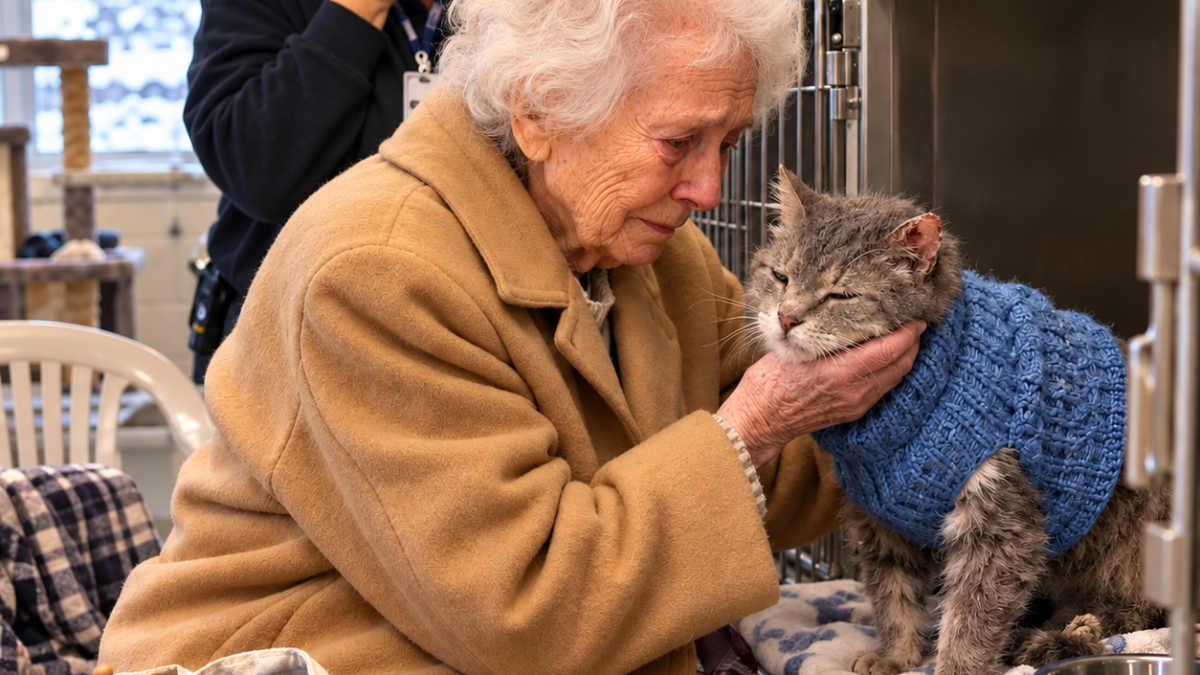
I Thought the Old Woman Knitting Sweaters for Shelter Cats Was Strange—Until Our Meanest Tomcat Chose Her Blue One.
The first time I saw the eighty-nine-year-old woman knitting a sweater for the meanest cat in our shelter, I thought grief had finally bent her mind somewhere the rest of us could not follow.
Then the cat nobody could touch dragged one of her tiny sweaters into the back of his kennel and slept on it like it was the only soft thing the world had ever given him.
But when Mabel disappeared one Tuesday and I found the note hidden in her yarn bag, I finally understood she had not been knitting clothes at all—she had been trying to keep broken hearts from shaking alone.
My name is Nora Bell, and by the winter Mabel Finch walked into our shelter with a canvas bag full of yarn, I had stopped believing every animal could be saved.
That sounds hard.
Maybe it is.
But I had worked at Bramble House Rescue for eleven years, and heartbreak has a way of making practical people out of you whether you want it to or not.
The shelter sat on the edge of town in a low brick building that used to be a hardware store.
You could still see the ghost of the old sign above the front door when the sun hit right.
Inside, the floors were scuffed, the walls were painted a tired shade of yellow, and the furnace had two moods: too hot in the office and useless everywhere else.
We had twenty-two cat kennels along the east wall, twelve dog runs in back, a laundry room that smelled permanently of bleach, and a volunteer break area where the coffee was always burnt because nobody had time to clean the pot properly.
People came in asking for kittens.
That was what I had learned.
They wanted bright eyes.
Soft fur.
Playful paws.
A pink nose pressed through the bars.
They wanted easy love.
They wanted the kind of animal that made a child squeal and a mother reach for adoption papers before anyone asked about medical history.
What they did not want were the old ones.
The ones who had already been failed.
The ones with cloudy eyes, bad teeth, missing tails, torn ears, stiff hips, strange smells, old scars, or fear that came out sideways as anger.
They did not want cats who hid in litter boxes.
They did not want cats who hissed before they purred.
They did not want cats who needed patience measured in months instead of minutes.
That was where Pickles came in.
Pickles was a gray tomcat with one torn ear, a stiff back leg, yellow eyes, and a face like life had personally insulted him.
Nobody named him Pickles because it suited him.
A five-year-old volunteer named Sophie had named him during a summer reading event when she saw him glare at a cucumber slice through the kennel door.
PART2:
PART3:
Pickles had not been born mean.
Mean is rarely born.
Mean is built.
One bad hand at a time.
By December, his infections were improving, his limp was manageable, and his bloodwork was better than expected.
But his attitude had not improved.
If anything, medical treatment had convinced him people were organized primarily to bother him.
We placed him in the seniors’ row, which was what we called the last seven kennels near the back window.
It was not an official term.
Officially, we had “special considerations.”
That meant old.
Scared.
Sick.
Slow to trust.
Hard to place.
The cats nobody wanted were not less lovable.
They were simply less marketable.
I hated knowing that.
I hated how easily I understood it.
Because if I were honest, there were mornings when even I walked past the seniors’ row faster.
Not because I did not care.
Because caring hurt more there.
Every animal in that row looked like a question we might not be able to answer.
Pickles was our hardest.
He stayed curled in the back of his kennel most of the day, one paw tucked under his chest, eyes half open, watching us like he had already testified against humanity and was waiting for sentencing.
“Good morning, sweetheart,” I would say.
He would hiss.
“Same to you.”
That was our relationship.
Then Mabel came.
It was a Tuesday morning in January, cold enough that the front door stuck when she pushed it open.
I remember the bell above the door jingling.
I remember looking up from the front desk.
I remember thinking she was lost.
She was tiny.
Not just short.
Tiny in the way very old people sometimes become, as if the years have folded them carefully inward.
She wore a tan wool coat buttoned all the way to her throat, brown shoes with sensible soles, and a faded green scarf tucked neatly beneath her chin.
Her white hair was pinned in a bun.
Her glasses were thick.
One lens had a scratch through the corner.
She carried a canvas bag against her side like it contained treasure or medicine.
“Good morning,” I said.
She smiled.
“Good morning, dear.”
Her voice was soft but steady.
“Looking to adopt?”
“No.”
“Donating?”
“In a manner of speaking.”
I waited.
She did not explain.
Instead, she walked past the kittens without even glancing at them.
That got my attention.
Everybody glanced at kittens.
Even people who claimed they were “just looking” and “definitely not taking home another cat” ended up making ridiculous noises at the kitten room.
Mabel went straight to the seniors’ row.
She stopped in front of Pickles.
He glared.
She looked back at him.
No baby talk.
No cooing.
No fingers through the bars.
She simply nodded once.
“Well,” she said. “You do look like you’ve had enough of everyone.”
Pickles did not hiss.
That alone was unusual.
Mabel set her canvas bag beside the old plastic chair near the kennels, lowered herself carefully, and pulled out two knitting needles.
Then yarn.
Cream-colored.
Soft.
She began knitting.
Right there.
In the shelter.
Beside the meanest cat we had.
I watched for ten minutes.
Maybe fifteen.
Finally I walked over with a clipboard in my hand so I could pretend I had a professional reason.
“Ma’am?”
“Yes, dear?”
“You know these are cats, right?”
She did not look up.
“I do.”
The needles clicked.
“But cold is still cold.”
I had no idea what to say to that.
So I said something stupid.
“We have blankets.”
“I’m glad.”
Click.
Click.
Click.
“And heated pads for some of the older ones.”
“Very good.”
Click.
Click.
Pickles watched her hands.
His eyes followed the movement of the needles.
Not relaxed.
Never relaxed.
But interested.
“What are you making?” I asked.
“A sweater.”
“For him?”
“If he wants it.”
“He won’t.”
Mabel smiled.
“Then I will make it anyway.”
I almost laughed.
Not kindly.
I am ashamed of that too.
In my defense, shelters attract well-meaning oddness.
People donate things animals cannot use.
Sequined dog costumes.
Ceramic bowls with cracks.
Essential oils.
Handmade hats.
One woman once brought us twelve tiny capes “for shy kittens to feel powerful.”
So when an eighty-nine-year-old woman sat down to knit sweaters for cats who hissed at kindness, I put her into the box my tired mind had ready.
Lonely.
Sweet.
A little strange.
Harmless.
Maybe grief.
Maybe dementia.
Maybe someone whose family did not visit enough.
I was wrong.
Mabel came back the next Tuesday.
Same tan coat.
Same canvas bag.
Same chair.
This time she asked me one question before she sat.
“Which one sleeps curled up the tightest?”
I looked down the row.
“What?”
“Which cat curls the tightest when sleeping?”
“Why?”
“The ones curled tightest are usually coldest. Or most afraid. Sometimes both.”
I looked toward Pickles.
He was in the back corner, curled so tightly he looked like one gray stone.
“Him,” I said.
Mabel nodded.
“I thought so.”
She pulled out pale green yarn.
Pickles opened one eye.
“I wouldn’t take it personally if he attacks the sweater,” I said.
“I won’t.”
“He attacks most expressions of care.”
“Some of us do.”
She said it so lightly I did not realize until later that she had included more than the cat.
That became her routine.
Every Tuesday at nine-thirty.
Never nine-twenty.
Never ten.
Nine-thirty exactly.
She came in, greeted whoever was working the desk, and went to the seniors’ row.
She never asked to hold kittens.
Never lingered by the puppy runs.
Never asked which animals were “most adoptable.”
She always asked:
“Who curls tightest this week?”
And then she knit.
No two sweaters looked alike.
Cream.
Green.
Faded red.
Pale yellow.
Soft blue.
Brown with a crooked white stripe.
Gray with tiny button loops.
Little armholes.
Open backs.
Soft seams.
Nothing tight around the neck.
Nothing that would restrict movement.
She asked questions without sounding like she was asking.
“Does Stella mind things over her head?”
“Does Jasper scratch at his collar?”
“Does the orange one pull at blankets?”
“What side does Pickles favor when he lies down?”
At first I answered like a person humoring an elderly volunteer.
Then I realized her questions were better than mine.
She watched each animal.
Really watched.
She noticed that Stella, our fifteen-year-old calico, hated anything touching her whiskers but would accept fabric over her shoulders.
She noticed Jasper, a black senior with kidney disease, dragged blankets into his water bowl and then cried because they were wet.
She noticed Miso, the orange tabby with thyroid trouble, only slept against hard corners.
“That one needs weight,” Mabel said.
“Weight?”
“Not heavy. Just enough to feel held.”
She made him a small quilted pad.
Miso stopped sleeping in his litter box.
Janine called it coincidence.
Then she cried in the supply closet.
We all pretended not to hear.
Shelter work teaches that kindness must often be practical.
Food.
Medication.
Clean bedding.
Safe kennels.
Sterilized equipment.
Records.
Vaccines.
Appointments.
Adoption screening.
Everything measurable.
Mabel brought something harder to measure.
Attention.
Not loud attention.
Not the kind that posts well online.
Quiet attention.
The kind that says:
I see how you fold yourself.
I see where the cold reaches you.
I see what you refuse before you accept.
Pickles refused everything.
Naturally.
The first time I tried putting one of Mabel’s sweaters on him, he reacted as if I had insulted generations of his ancestors.
He hissed.
Twisted.
Kicked.
Knocked over his water bowl.
Slapped my wrist.
Backed into the corner with one paw lifted.
Mabel watched from her chair.
“That’s all right,” she said.
I held the sweater and tried not to bleed on it.
“That’s all right?”
“He’ll decide when he’s ready.”
“Ready for what? A fashion show?”
Mabel smiled.
“No. Warmth.”
I laughed because I did not want to feel what she meant.
I folded the sweater and placed it on top of his kennel.
The next morning, it was gone.
I found it inside the kennel.
Back corner.
Folded under Pickles’s belly.
Not perfectly.
He had clearly dragged it there himself, then arranged himself on top of it with great irritation.
When he saw me noticing, he put one paw over the sweater as if I might steal it.
“Well,” I said.
He hissed.
“Your secret is safe.”
I did not tell Mabel that day.
I don’t know why.
Maybe because the moment felt private.
Pickles had accepted something only when nobody watched him accept it.
I understood that more than I wanted to.
My own life had narrowed by then.
I lived in a rented duplex with a leaky kitchen faucet, one tired houseplant, and a framed photo of my younger sister, Annie, on the bookshelf.
Annie had died nine years earlier.
Drunk driver.
Forty-four years old.
Two kids.
A laugh that made strangers turn around.
After she died, people brought casseroles until my freezer looked like a church basement.
They called.
Visited.
Said all the right things.
Then, slowly, their lives resumed.
Mine did too, on the outside.
Work.
Bills.
Laundry.
Grocery store.
Shelter.
But some part of me stayed at the hospital where a doctor with careful eyes said, “I’m so sorry,” and my mother made a sound I still hear in dreams.
Grief did not make me soft.
Not then.
It made me efficient.
I became good at doing what needed to be done.
Cleaning cages.
Answering phones.
Explaining euthanasia decisions.
Telling crying families that surrendering an animal did not always make them bad people.
Telling angry families that abandoning one in a parking lot did.
I learned to keep my voice level.
People mistake level for strong.
Sometimes it is only numbness with manners.
So when Mabel sat by the seniors’ row knitting tiny sweaters for animals most people passed over, some unpleasant part of me judged her.
I thought:
She has too much time.
I thought:
This is sweet but useless.
I thought:
Sweaters will not fix age, disease, fear, or death.
All true.
All incomplete.
One Tuesday, she arrived during intake chaos.
A man had left three cats in taped cardboard boxes outside before sunrise.
One was pregnant.
One had fleas so severe her gums were pale.
One was old, orange, and furious.
Our washing machine flooded.
A volunteer called in sick.
The phone would not stop ringing.
I looked up to find Mabel standing beside the front desk with her canvas bag.
“I can come back,” she said.
“No, no.”
I pushed hair out of my face.
“Sorry. It’s just one of those mornings.”
She looked at the boxes.
Then at me.
“Most mornings become those mornings if nobody has slept.”
I laughed once.
“You’re not wrong.”
“Have you eaten?”
“I had coffee.”
“That is not food.”
“It’s shelter food.”
She narrowed her eyes.
“Sit.”
I blinked.
“Excuse me?”
“Five minutes.”
“Ma’am, I work here.”
“And I am old enough to ignore that.”
She reached into her canvas bag and pulled out a wrapped biscuit.
Homemade.
Still faintly warm.
“I made too many.”
“You brought cat sweaters and biscuits?”
“I contain multitudes.”
That startled a real laugh out of me.
I took the biscuit because it was easier than arguing.
Mabel sat with Pickles.
He was pretending not to watch her.
The old orange intake cat growled from a temporary kennel.
Mabel looked at him.
“There’s another tight sleeper.”
“He might bite through steel.”
“Then perhaps red.”
“For blood?”
“For courage.”
She said such things with no irony.
I should have found that foolish.
Instead I found myself waiting for Tuesdays.
So did the cats.
Stella began waking when Mabel entered.
Jasper stopped hiding behind his litter box and moved to the front of his kennel.
Miso let her touch one paw through the bars.
Pickles did not move, but his ears tracked her voice.
Mabel never asked to pet him.
That was important.
Everyone wanted to win Pickles.
Volunteers tried treats.
Soft voices.
Slow blinks.
Toys.
Catnip.
Baby talk.
He refused all of it with the deep suspicion of a creature who knew human affection often came with a trapdoor.
Mabel simply sat.
Knitted.
Talked sometimes.
Not always to him.
Sometimes to me.
Sometimes to whatever cat had chosen to listen.
Sometimes to no one.
“My husband hated cats,” she said one morning.
I looked over.
“Really?”
“Terrified of them.”
“Your husband?”
“Marine Corps veteran. Could repair a roof in a thunderstorm. Once chased a raccoon out of our pantry with a broom. But a house cat looked at him sideways and he remembered urgent business elsewhere.”
I smiled.
“What was his name?”
“Walter.”
“Is he gone?”
“Fifteen years.”
“I’m sorry.”
“So am I, some days more politely than others.”
That was Mabel.
Gentle without being sentimental.
Warm without lying.
Another week, she told me she had worked as a school secretary for thirty-two years.
“I knew every child who came to school hungry,” she said.
“How?”
“They stand too close to the cafeteria doors and pretend they don’t.”
I thought of the animals at our kennel doors.
Pretending not to need.
Wanting and resisting at the same time.
Mabel knitted a brown sweater for a half-blind tortoiseshell named Queenie.
Queenie wore it three hours, then fell asleep with her head on her paws.
A couple adopted her that weekend.
The wife said, “She looks like somebody’s grandmother.”
Mabel said, “She probably is.”
The woman laughed.
Then signed papers.
After that, Janine let Mabel place a small basket of finished sweaters near the seniors’ row with a sign:
**For Cats Who Want Them**
Not **free sweaters**.
Not **please dress the old cats**.
Not **cute adoption accessories**.
For cats who want them.
Mabel insisted on those words.
“Choice matters,” she said.
“They’re cats.”
“Especially then.”
Pickles dragged three sweaters into his kennel over six weeks.
Cream.
Green.
Gray.
He never wore them.
He slept on them.
If any volunteer rearranged his bedding, he punished everyone for a full day.
He treated those sweaters like property.
Then one Tuesday in late January, Mabel did not come.
At first, I told myself nothing.
Old people have appointments.
Bad weather.
Family obligations.
Maybe she overslept.
But nine-thirty passed.
Then ten.
Then ten-thirty.
The shelter felt wrong without her.
Too bright.
Too loud.
The seniors’ row seemed unsettled.
Stella paced.
Jasper cried once, a thin little sound.
Pickles sat at the front of his kennel for the first time since I’d known him, staring at the empty chair.
“Don’t look at me like that,” I told him.
He stared harder.
“I don’t know where she is.”
His tail twitched.
“I agree. Very rude.”
Around noon, I noticed something beneath the plastic chair.
A canvas project bag.
Not her main bag.
Smaller.
Faded blue with a broken zipper.
It had slipped behind one chair leg.
I picked it up.
Inside was a half-finished blue sweater.
Deep blue.
Almost the color of winter twilight.
Two wooden needles still held the stitches.
A small ball of yarn sat tucked inside the body.
There was also a scrap of paper folded so many times it felt soft as cloth.
I should not have opened it.
I know that.
But fear has poor manners.
I unfolded it.
The handwriting was shaky.
Only one line.
**So nobody shakes alone again.**
I sat down in Mabel’s chair.
Just sat.
The shelter noise moved around me.
Dogs barking.
Washer thumping.
Phones ringing.
Somewhere a volunteer laughed.
Pickles watched from his kennel.
The blue sweater lay across my lap.
So nobody shakes alone again.
It was not the sort of sentence someone writes casually.
It belonged to a room with a closed door.
An old room.
A room I had no right entering.
I folded the note carefully and placed it back.
Then I called every number we had.
Mabel was not an official volunteer, so we had only what she had written on a donor card.
Home phone.
No answer.
Emergency contact.
A niece named Carol.
Carol answered on the fifth ring.
“Mabel Finch?”
“This is Nora Bell from Bramble House Rescue. I’m sorry to bother you. Your aunt usually comes on Tuesdays, and she left a bag here. I just wanted to make sure—”
“She’s all right.”
I exhaled.
“Thank God.”
“Her blood pressure dropped yesterday. Doctor kept her overnight. She’s home now but resting.”
“Can I bring her bag?”
There was a pause.
“She’ll like that.”
I should have waited.
But after work, I drove across town with the blue bag on the passenger seat.
Mabel lived in a small white house with green shutters and a front porch full of empty flowerpots waiting for spring.
Carol met me at the door.
Fifties.
Tired, kind face.
“She’s stubborn,” Carol warned.
“I work with cats.”
That made her smile.
Mabel sat in a recliner near the window, wrapped in a blanket.
Without her tan coat, she looked smaller.
Too small.
That frightened me.
Her eyes lit when she saw the bag.
“You found it.”
“Under your chair.”
“I wondered.”
Carol said, “You are not going anywhere next week.”
Mabel looked at me.
“Don’t listen to her.”
“She sounds reasonable.”
“Reasonable people miss too much.”
Carol rolled her eyes, but lovingly.
I handed over the bag.
Mabel touched the half-finished sweater.
Her fingers trembled more than usual.
“I read the note,” I said.
The words came out before I could dress them properly.
Mabel’s hand stilled.
I rushed.
“I’m sorry. I shouldn’t have. I was worried when you didn’t come, and I found it, and—”
“It’s all right.”
But her face had changed.
Not embarrassment.
Not anger.
Something like being caught standing in the doorway of an old room.
“That was for my grandson.”
Carol quietly left us.
Mabel looked at the blue yarn.
“His name was Daniel.”
I sat on the edge of the sofa.
“You don’t have to tell me.”
“I know.”
She smiled faintly.
“That is why I can.”
Daniel had been six when he got sick.
Leukemia.
Mabel did not use dramatic words.
She told it plainly, the way people do when grief has lived long enough to become part of the furniture.
He loved trains.
Peanut butter crackers.
The color blue.
He hated hospital socks because the seams bothered his toes.
He called Mabel “May-bell” because when he was little, he thought her name had something to do with ringing.
“He shook,” she said.
“When fever was high. When medicine made him cold. Sometimes from fear before procedures.”
Her fingers moved over the yarn.
“I could not fix much.”
I looked down.
“I knitted.”
Blankets.
Hats.
Tiny mitts.
Little soft tubes to hold when needles went in.
A blue sweater for a stuffed rabbit named Captain.
“Did it help?”
Mabel thought.
“Not enough.”
That answer went through me.
Not enough.
The truest answer to so much love.
“He died in February,” she said.
“How old?”
“Seven.”
I closed my eyes.
“I packed the yarn away afterward. Couldn’t bear the sound of needles.”
“How long?”
“Twenty-two years.”
I stared.
She nodded.
“Grief can be very patient.”
“What made you start again?”
She looked toward window.
“Your shelter.”
I frowned.
“I came to donate towels last fall. Carol had cleaned her linen closet and decided I should stop storing things like an old hotel.”
From the hallway, Carol called, “Still true.”
Mabel ignored her.
“I saw an old cat shivering in a metal kennel.”
“Pickles?”
“No. Before him. A black one.”
“Arthur.”
“Yes. Arthur.”
Arthur had died in November.
Quietly.
Kidney failure.
No adopter.
One volunteer holding him.
I still remembered his light body wrapped in a towel.
“He was curled so tightly,” Mabel said. “Like Daniel when he was afraid.”
My throat tightened.
“I went home and opened the yarn box.”
She looked at the blue sweater.
“I couldn’t help Daniel the way I wanted.”
Her voice softened.
“But my hands still worked.”
I had to look away.
There was a framed photo on the shelf beside me.
A little boy with big ears and a gap-toothed grin, wearing a blue sweater and holding a stuffed rabbit.
Daniel.
I busied myself with nothing.
Straightened my sleeve.
Studied the carpet.
Anything.
Mabel saw.
She was too kind to mention it.
“Pickles missed you today,” I said.
That made her smile.
“He did not.”
“He sat at front of kennel and glared at your chair.”
“That is practically a sonnet from a cat like him.”
I laughed.
When I left, she insisted on keeping the blue sweater.
“I’ll finish it.”
“You should rest.”
“I can rest and knit.”
“Mabel.”
“Nora.”
There it was.
Stubborn recognizes stubborn.
“Fine,” I said. “But slowly.”
She smiled.
“At my age, everything is slowly whether I agree or not.”
The next Tuesday, Mabel came back.
Carol drove her.
She moved carefully.
Her tan coat seemed heavier than usual.
But she walked straight to the seniors’ row.
Pickles was waiting.
Not visibly.
He sat in the back corner pretending not to notice her.
But his ears were forward.
Mabel lowered herself into chair.
“Well,” she said to him. “I heard you were rude in my absence.”
Pickles blinked.
She pulled out the blue sweater.
Finished.
Soft.
Small.
With tiny button loops and a slightly wider neck because Pickles hated feeling trapped.
I tried not to sound too eager.
“You missed a week.”
“I know. My body likes reminding me who’s in charge.”
I held up the note.
Not dramatically.
Just between two fingers.
Her face changed again.
“I’m sorry,” I said.
“I told you. It’s all right.”
“Did you write it for Daniel?”
“Yes.”
I sat on the floor beside the chair because all other seats were full of donated towels waiting to be folded.
“Why ‘nobody shakes alone’?”
Mabel looked at Pickles.
“Because that is the worst part.”
“Of being cold?”
“Of being afraid.”
I thought about that for a long time.
A few days later, Pickles took a turn.
It happened the way animal decline often happens.
Not with a crash.
A quiet slipping.
First he left breakfast untouched.
Pickles never admitted enjoyment, but he ate with the grim determination of a cat who believed food might be stolen.
That morning, his bowl stayed full.
By noon, he was curled tight.
Too tight.
His body trembled.
I opened the kennel.
He did not hiss.
That scared me more than any hiss would have.
“Pickles?”
His eyes opened halfway.
Dull.
Tired.
We took temperature.
Too low.
Called Dr. Ames.
Started warming measures.
Checked gums.
Heart.
Hydration.
He resisted nothing.
That was wrong.
Mean cats who stop being mean are often telling you something is terribly wrong.
Janine asked, “Should we call Mabel?”
I looked at Pickles.
He was shaking.
The note returned.
So nobody shakes alone again.
“Yes.”
Mabel answered on second ring.
“It’s Pickles,” I said.
I heard her inhale.
“I’m coming.”
“Mabel, you don’t have to—”
“I said I’m coming.”
Carol brought her twenty minutes later.
Mabel wore the tan coat, green scarf, and a blue knit hat I had never seen.
In her hands was the finished sweater.
She did not ask what happened.
She looked at Pickles.
Then at me.
“May I?”
I opened kennel.
Everyone held breath.
Normally Pickles turned into a storm of teeth and insult.
This time, he only looked at Mabel.
One tired breath.
That was all.
She placed one hand near him.
Not on him.
Near.
“Hello, old man.”
His whiskers moved.
“I brought blue.”
He blinked.
She slid the sweater over his head slowly.
I waited for the fight.
It never came.
Front legs.
Soft fabric.
Buttons.
Mabel’s thin hands worked carefully, though they shook.
Pickles let her do it.
Then, when she finished, he did something I had never seen.
He leaned into her palm.
Not accidentally.
Not because he was too weak to hold himself up.
He pushed his head against her hand as if he had been saving that touch for years.
I started crying before I knew tears had moved.
I turned away.
Too late.
Janine was crying too.
So was Marcus, our kennel tech, though he claimed later it was allergies.
Mabel stroked Pickles’s cheek.
“There now.”
Pickles closed his eyes.
His trembling eased.
Not stopped.
But eased.
We took him to Dr. Ames.
Respiratory infection.
Dehydration.
Early kidney trouble.
Old body reaching a bad corner.
But not the end.
Not yet.
With fluids, antibiotics, warming, and attention, he improved.
The blue sweater stayed on.
If anyone else adjusted it, he growled.
If Mabel adjusted it, he allowed the indignity.
Sometimes he even purred.
Very quietly.
Like he resented the sound.
That week, something shifted in the shelter.
The seniors’ row became less like a waiting room and more like a place where things still happened.
Visitors noticed.
A woman came in looking for a kitten and stopped at Jasper’s kennel.
“Is he wearing a sweater?”
“If he wants to.”
“What does that mean?”
I almost gave the practical answer.
Instead, I said, “It means he still gets to choose things.”
She stood there longer.
Did not adopt him.
But she stood there.
Sometimes standing there is a beginning.
Mabel began leaving small cards with each sweater.
Not sad cards.
Not manipulative.
No “please adopt me before I die.”
She hated that sort of thing.
Instead:
**Stella likes quiet mornings and warm windows.**
**Jasper prefers being talked to before being touched.**
**Miso wants a blanket with one corner folded. Nobody knows why.**
For Pickles, she wrote:
**Pickles has strong opinions and deserves to keep them.**
That card made me laugh for five minutes.
Then two weeks later, a man named Harold Mercer walked into Bramble House.
Retired widower.
Seventy-six.
Tall but stooped.
Wool cap in hand.
He stood near the front desk looking lost.
“Can I help you?” I asked.
“I’m looking for an older cat.”
That was rare enough that I thought I misheard.
“Older?”
“Yes.”
“How old?”
He shrugged.
“Old enough not to climb curtains.”
“We have several seniors.”
“I don’t need playful.”
His fingers twisted the cap.
“I need one that can sit quiet.”
There was a silence after that.
Not empty.
Full.
I said gently, “Do you have other pets?”
“No.”
“Children in home?”
“No.”
“Experience with cats?”
“My wife had two. They both hated me until she passed. Then one slept on my feet for three years.”
His mouth moved.
Almost smile.
“After he died, the house got loud.”
People think empty houses are silent.
They are not.
They make the loudest kind of quiet.
I brought Harold to seniors’ row.
Stella ignored him.
Jasper cried until he spoke softly, then listened.
Miso slept.
Pickles opened one eye.
Harold stopped.
“That one looks tired of nonsense.”
“He is.”
“What’s his name?”
“Pickles.”
Harold blinked.
“Of course it is.”
I warned him.
“He’s not cuddly.”
“Neither am I.”
“He bites.”
“I complain.”
“He hates being picked up.”
“So do I.”
“He may never become affectionate.”
Harold looked at Pickles in his blue sweater.
“Does he need me to be?”
I had no answer.
Mabel came in while Harold stood there.
She saw him.
Saw Pickles.
Asked nothing.
Harold looked at her.
“You make these?”
“Yes.”
“For cats?”
“For whoever needs them.”
He nodded as if that made complete sense.
“Good work.”
“Thank you.”
Pickles stood.
Slowly.
Stiff leg.
Blue sweater slightly crooked.
He walked to front of kennel.
Harold extended one finger.
I opened my mouth to warn him.
Mabel touched my sleeve.
Wait.
Pickles sniffed the finger.
Long pause.
Then he gave Harold one firm, controlled slap.
No claws.
Harold looked at his hand.
Then at the cat.
“Fair.”
Pickles sat.
Harold smiled.
“I’ll take him.”
I nearly dropped the clipboard.
“You don’t want to meet others?”
“I have.”
“No, you haven’t.”
“I have enough information.”
“Mr. Mercer—”
“Harold.”
“Harold, he is difficult.”
“So am I.”
“He’ll need medication.”
“I take seven pills before breakfast. We can make an event of it.”
“He might hide for weeks.”
“I have weeks.”
“He might not love you the way you want.”
Harold’s eyes moved to the sweater.
“My wife loved me more than I deserved for forty-nine years. I’m not asking a cat to fix that.”
My throat tightened.
“What are you asking?”
He looked at Pickles.
“To share the quiet.”
Pickles blinked slowly.
That was his first adoption interview.
It was also his last.
The paperwork took an hour because I kept explaining things Harold already understood.
At the end, Mabel placed one extra sweater into a paper bag.
Gray.
With blue buttons.
“For washing days.”
Harold accepted it solemnly.
Pickles went into the carrier with less violence than expected, which meant only one bandage for Marcus.
Before Harold left, he looked at Mabel.
“Would you mind if I called sometimes? If I need help with sweater buttons?”
Mabel smiled.
“I would not mind.”
Pickles left wearing blue.
The seniors’ row felt different without him.
Lighter and lonelier at once.
The next Tuesday, Mabel returned with more yarn.
I said, “You know you already worked your miracle.”
She sat in her chair.
Clicked needles once.
“At my age, you don’t wait around to do big things. You just keep small things from feeling cold.”
That sentence has followed me ever since.
But the story did not end with Pickles leaving.
Stories like this rarely end where they should.
Harold called three nights later.
I was closing the shelter.
The dogs had finally quieted.
The cats were eating.
Janine had gone home early with a migraine.
The phone rang.
“Bramble House.”
“This is Harold Mercer.”
My heart jumped.
“Is Pickles okay?”
A pause.
“That depends on your definition.”
“What happened?”
“He has taken the blue sweater off.”
“That’s normal.”
“And placed it in my recliner.”
I smiled.
“All right.”
“Then he sat on the floor and yelled until I moved.”
I pressed the phone against my ear.
“You moved?”
“Of course.”
“And?”
“He is now asleep in my recliner on the sweater.”
I laughed.
Harold’s voice softened.
“I think I have been adopted out of my own chair.”
“That sounds like progress.”
“He slapped me again.”
“Claws?”
“No.”
“Affection.”
“I suspected.”
He called every few days after that.
Pickles hid under bed for two nights.
Then moved to hallway.
Then kitchen doorway.
He ate best when Harold sat nearby reading the newspaper aloud.
He refused one medication flavor and accepted another.
He slept on Marian? no, that was previous story. Let’s avoid. He slept on Harold’s late wife’s old quilt.
The third week, Harold called and said, “He got on the sofa.”
“While you were there?”
“Yes.”
“Did he touch you?”
“No.”
“Progress.”
“He looked disappointed in me.”
“Also progress.”
Two months later, he sent a photo.
Pickles in blue sweater.
One paw resting against Harold’s slipper.
Caption written in shaky handwriting:
**We are sitting quiet.**
I printed it and pinned it behind front desk.
Mabel looked at it a long time.
Then touched the corner.
“That is enough.”
I thought she meant the photo.
Later I understood she meant something larger.
Winter deepened.
The furnace failed twice.
Mabel’s sweaters became more popular than our official adoption posters.
People came in asking, “Are these the cats with sweaters?”
Janine worried the whole thing might become gimmicky.
Mabel worried too.
“I don’t want costumes,” she said.
“They’re not.”
“Good. Costumes are for people. Comfort is for the wearer.”
She began teaching volunteers how to tell the difference.
If a cat froze, remove.
If a cat pawed, remove.
If a cat relaxed, leave.
If a cat used sweater as bedding, that was still acceptance.
If a sweater stressed the animal, kindness had missed its mark.
“Love that ignores response is only performance,” Mabel said.
Marcus wrote that on the staff whiteboard.
Then erased it because Janine said it made us sound like a philosophy department.
But it stuck.
Mabel’s health flickered through February.
Some Tuesdays she came.
Some she didn’t.
Carol called when she could not.
Pickles was gone by then, but the chair still belonged to Mabel.
No one sat there.
Not officially.
It simply happened.
One morning, I arrived to find a young volunteer named Tessa sitting in Mabel’s chair scrolling her phone.
Before I could say anything, Jasper hissed from his kennel.
Tessa looked up.
“What?”
“Wrong chair,” Marcus said.
She moved.
Jasper settled.
We all pretended that was not strange.
Animals know routines.
They also know absence.
Mabel did not like being treated fragile.
If I asked too carefully how she felt, she gave me a look.
“Nora, I am eighty-nine. Some days my body files complaints. That does not make every breath a tragedy.”
“Noted.”
“Good.”
But one Tuesday in March, she came in without yarn.
Just the tan coat and scarf.
She sat in the chair.
Hands empty.
I noticed immediately.
“Forgot your bag?”
“No.”
“Carol has it?”
“No.”
I waited.
Mabel looked at her hands.
“They are not cooperating today.”
The fingers were swollen at the joints.
A tremor moved through them.
My chest tightened.
“You can just sit.”
“I know.”
But she looked lost.
People think losing ability is one grief.
It is many.
First you lose the thing.
Then the rhythm of doing it.
Then the usefulness it gave you.
Then the version of yourself who never had to think about whether your hands would obey.
I went to the supply closet.
Found a finished sweater from the basket.
Pale yellow.
I placed it in her lap.
“You could hold this.”
She looked up.
I shrugged.
“For inspection.”
Her smile trembled.
“Very official.”
Queenie had been adopted, but an old black cat named Milton was in her kennel now.
Milton slept curled like a comma.
Mabel held the yellow sweater.
Did not knit.
Just sat.
After a while, Pickles’s old card fell from the side of the basket.
I picked it up.
**Pickles has strong opinions and deserves to keep them.**
Mabel laughed softly.
“I miss that awful cat.”
“Me too.”
“Have you heard from Harold?”
“Yesterday. Pickles has expanded to two rooms and one windowsill.”
“Generous of him.”
“And Harold says he no longer gets slapped unless he deserves it.”
Mabel nodded.
“That is a healthy boundary.”
We sat together.
No needles.
No clicking.
Still, the room felt warmer.
That was another lesson.
Sometimes the thing we give changes form before it stops mattering.
Mabel began teaching.
Not formally.
She hated formal.
But she brought patterns.
Measurements.
Notes.
She showed us how to make sweaters with wide necks and soft closures.
How to avoid seams beneath front legs.
How to sew button loops big enough for arthritic fingers.
How to choose yarn that washed well.
How to make small blankets for animals who refused clothing.
She labeled each pattern not by size alone, but by temperament.
**For cats who accept over-head handling.**
**For cats who need side closure.**
**For cats who prefer bedding.**
**For dogs with narrow chests.**
**For animals who shake after surgery.**
At the top of one page:
**Ask the animal.**
I stared at that.
“How?”
Mabel smiled.
“You watch the answer.”
By April, we had a small Tuesday group.
Not planned.
A retired nurse.
Two teenagers fulfilling service hours who stayed after their hours were complete.
A man whose wife had died and who said knitting was cheaper than therapy.
Carol sometimes came.
I learned.
Badly.
My first sweater looked like a potholder with ambition.
Mabel inspected it.
“Well.”
“That bad?”
“It is… sincere.”
“That’s worse than bad.”
“Yes.”
We laughed.
I kept trying.
My hands, used to leashes, pill syringes, mop handles, and kennel latches, were clumsy with needles.
Mabel never mocked.
She corrected.
There is a difference.
“Not so tight,” she said.
“I’m trying not to drop stitches.”
“If you pull everything tight because you’re afraid of losing it, the whole thing becomes hard.”
I looked at her.
She looked back mildly.
“Knitting, dear.”
“Of course.”
Mabel was dangerous that way.
She could hand you truth disguised as a craft instruction.
Spring brought kittens.
Too many.
Always.
Boxes left at door.
Litters from people who swore their cats had “never gotten out before.”
Families wanted kittens again.
The senior row quieted.
But something had changed.
People stopped walking past as quickly.
The sweaters helped, yes.
But not because they made old cats cute.
Because they made people pause.
A sweater said:
Someone has already cared for this one.
Not someday.
Not after adoption.
Now.
That mattered.
One Saturday, a mother with two children came in wanting a kitten.
The younger child stopped at seniors’ row.
“Why does that cat have a sweater?”
I explained.
The girl looked at a twelve-year-old tabby named Louise.
“She looks like Grandma.”
The mother laughed awkwardly.
They left with Louise.
Not a kitten.
Louise lived with them three years and reportedly slept in the grandmother’s lap every afternoon.
Another time, a young man came in after losing his first cat.
He said he wanted “one that nobody else is looking at.”
He adopted Jasper.
Jasper cried in the car, then slept on his pillow the first night.
Mabel collected these updates carefully.
She wrote them in a little notebook.
Name.
Sweater color.
Adopter.
First report.
Not because she wanted credit.
Because proof matters when you are working against despair.
In May, Pickles came back.
Not returned.
Visited.
Harold called first.
“I have a proposal.”
“That sounds ominous.”
“Pickles would like to express displeasure in person.”
“About what?”
“I washed his blue sweater.”
“Did you use unscented detergent?”
“Yes.”
“Air dry?”
“Yes.”
“Then what’s the problem?”
“He believes cleanliness has altered its legal status.”
I laughed so hard Janine asked if I was all right.
Harold brought him in a soft carrier.
Pickles emerged wearing the gray backup sweater and an expression of betrayal.
Mabel was there.
She stood slowly.
“Well, look at you.”
Pickles stared.
Then crossed the room.
Stiff leg.
Slow.
Everyone froze.
He reached Mabel’s shoes.
Sat.
Raised one paw.
And tapped her ankle.
No claws.
Mabel covered her mouth.
“Hello, old man.”
Harold handed over the blue sweater.
Freshly washed.
Pickles sniffed.
Then pushed his face into it.
Mabel knelt with help from me and Carol.
She placed the sweater against him.
He leaned into her hand.
The shelter went silent.
Not the fearful kind.
The holy kind.
I don’t use that word often.
But some silences feel like a church before anyone starts talking too much.
Harold watched.
His eyes wet.
“He’s better,” he said.
Mabel nodded.
“So are you.”
He gave a shaky laugh.
“Debatable.”
“No.”
She looked up.
“You came back to show us he lived.”
Harold swallowed.
“I suppose I did.”
Pickles stayed twenty minutes.
Then got irritated by attention and slapped Marcus.
Claws in.
Affection.
When Harold left, Mabel sat down heavily.
I touched her shoulder.
“You okay?”
She nodded.
“I am very happy.”
Her voice was tired.
“Sometimes happiness takes a great deal of strength.”
By summer, Mabel’s Tuesday group had become official enough that Janine made a sign.
**Warmth Circle**
Mabel hated it.
“Sounds like a cult.”
“It’s sweet,” Janine said.
“Cults often begin sweetly.”
We changed it to:
**Comfort Knitting — Tuesdays**
Mabel approved.
Barely.
We collected yarn donations.
Mabel inspected every skein.
No scratchy wool.
No loose fibers that could catch claws.
No unsafe buttons.
No decorative nonsense.
“Animals do not need pompoms,” she declared.
Tessa whispered, “I need that on a shirt.”
The work spread beyond cats.
Tiny sweaters for small dogs after surgery.
Soft pads for rabbits.
Little wraps for hairless guinea pigs surrendered by a college student who cried harder than expected.
Blankets for bottle kittens.
Nothing dramatic.
Small things.
Small warmth.
In August, Mabel turned ninety.
We tried to throw a party.
She resisted.
“You are not putting a hat on me.”
“Not even a sweater?” Marcus asked.
She pointed one needle at him.
“You are not too tall for me to injure.”
We compromised.
Cupcakes.
No candles because of smoke alarm.
Carol brought Daniel’s photograph.
The one with blue sweater and stuffed rabbit.
She placed it on the table beside a photo of Pickles in his blue sweater, Harold’s slipper in the corner.
Mabel looked at both.
For a moment, her face opened in a way I had never seen.
Pain and joy, side by side.
Not canceling each other.
Keeping company.
She touched Daniel’s photo.
Then Pickles’s.
“Nobody replaces anybody,” she said quietly.
Carol squeezed her hand.
I pretended to adjust the coffee filters.
Mabel saw anyway.
She always did.
That fall, my sister Annie’s daughter called.
Lily.
Twenty-three.
She had been twelve when her mother died.
We had stayed close for a while, then less close, then politely connected through holidays and social media.
Grief scatters families in ways nobody warns you about.
Lily asked if she could visit the shelter.
“Of course.”
She came on a rainy Thursday.
Same eyes as Annie.
That hurt.
She walked through the cat room and stopped at Mabel’s chair.
I told her the story.
Not all of it.
Enough.
Lily touched one of the sweaters.
“Aunt Nora?”
“Yeah?”
“Mom had your scarf.”
I frowned.
“What scarf?”
“The red one. From college? She kept it in her closet.”
I remembered.
Red wool scarf I had worn every day one winter when Annie and I shared an apartment.
“She kept that?”
“Yeah. She said you gave it to her after a fight.”
The memory returned slowly.
Annie stealing it.
Me yelling.
Then giving it because she was walking home in snow.
“She wore it when she missed you,” Lily said.
Something in me folded.
“I didn’t know.”
“She kept lots of things.”
After Lily left, I sat in Mabel’s chair though nobody else dared.
I thought about objects.
Sweaters.
Scarves.
Notes.
Photos.
Things that become containers because love needs somewhere to rest.
I had judged Mabel for knitting grief into fabric.
But I had kept Annie’s voicemail for nine years.
I never played it.
Still paid to keep old phone account active for three years because I couldn’t let the recording vanish.
We are all strange with grief.
Some of us simply hide it better.
That Tuesday, I told Mabel about Annie.
Not everything.
Enough.
She listened.
Needles clicking.
When I finished, she said, “Did people let you talk about her?”
“At first.”
“And then?”
“They wanted me to be better.”
“Ah.”
That small sound held more understanding than any speech.
“I became practical,” I said.
“That is useful.”
“I became cold.”
“That is different.”
I laughed because it hurt.
“Yes.”
Mabel looked toward seniors’ row.
“Cold is not always absence of feeling, Nora. Sometimes it is feeling with nowhere safe to go.”
I said nothing.
She placed a small ball of red yarn in my hand.
“For your sister.”
“I don’t knit well.”
“Then make something sincere.”
We both smiled.
My second attempt was better than the first.
Still uneven.
Mabel called it “honest.”
I made a small red blanket for a senior cat named Penny.
Penny was adopted two weeks later by a college student who wanted a study companion.
When the girl sent a photo of Penny sleeping on the red blanket beside textbooks, I cried in my car for ten minutes.
Not because of Penny alone.
Because something I made with grief had kept another life warm.
That is how Mabel’s miracle worked.
Not one grand rescue.
Contagion.
Quiet.
Practical.
Hand to hand.
Stitch to stitch.
Winter came again.
A full year since Mabel first walked in.
She was thinner.
Moved slower.
But Tuesdays remained hers.
Pickles and Harold visited before Christmas.
Pickles wore blue.
Harold wore a scarf Mabel had made him because “humans shake too, even if they pretend not to.”
He protested.
Wore it anyway.
Lucy, a teenage volunteer, took a photograph with permission.
Mabel in chair.
Pickles on Harold’s lap.
Sweaters stacked beside them.
The seniors’ row behind.
No caption online.
Mabel didn’t like turning private tenderness into public currency.
We printed one copy for shelter wall.
One for Harold.
One for Mabel.
In January, Mabel missed two Tuesdays.
Then three.
Carol called.
Hospital again.
Pneumonia.
Not severe, she said.
But at ninety, every illness enters room carrying questions.
I visited.
Mabel looked annoyed to be in bed.
Hospital blanket tucked under chin.
Oxygen tubing.
Hands resting on sheet.
“No needles,” I said.
“Confiscated by Carol.”
“Probably wise.”
“I could still take her.”
“I believe you.”
She smiled.
On bedside table was blue yarn.
“Pickles color,” I said.
“For whom?”
“Not sure yet.”
I sat.
The hospital sounds surrounded us.
Soft beeping.
Cart wheels.
Distant voices.
My stomach tightened.
I had hated hospitals since Annie.
Mabel noticed.
“Thank you for coming anyway.”
I looked at her.
“How do you always know?”
“People carry their fear in different places. Yours sits in your shoulders.”
I tried relaxing them.
Too late.
She asked, “How is the mean one?”
“Pickles? Still mean.”
“Good.”
“Harold says he let him touch his belly for three seconds.”
Mabel smiled.
“Scandalous.”
Then she turned serious.
“Nora, there is a box in my sewing room.”
“No.”
“You don’t know what I’m asking.”
“Yes, I do.”
Her eyes softened.
“Do you?”
I looked away.
She waited.
Never forced.
Finally:
“You’re asking me to take the yarn if—”
“If I don’t need it.”
I hated that phrase.
“Don’t.”
“Dear.”
“No.”
“The yarn should not sit in a dark closet for another twenty-two years.”
My eyes burned.
“You’re not done.”
“I may not be.”
“Then don’t talk like that.”
Mabel reached for my hand.
Her skin thin.
Warm.
“I am not trying to leave tonight. I am making sure warmth knows where to go.”
That undid me.
I cried.
Not prettily.
Mabel squeezed my fingers.
“So much leaking,” she murmured.
I laughed through it.
“You are a terrible patient.”
“I am an excellent patient. I make nurses feel needed.”
When she improved, Carol brought her home.
She returned to shelter in February, thinner but victorious.
Everyone pretended not to cheer.
Mabel glared.
Then smiled.
The blue yarn became a sweater for a three-legged black cat named Captain, because Daniel’s stuffed rabbit had been Captain and Mabel believed names deserved second lives.
Captain was adopted by a firefighter.
Of course he was.
Spring brought another adoption event.
We decorated modestly because Janine had learned from Mabel.
No pity posters.
No sad music.
No “last chance” language.
Instead, each senior cat had a card.
**What I Like**
**How to Help Me Feel Safe**
**What I Am Still Learning**
Pickles’s old card remained framed by the desk.
Mabel arrived early.
Tan coat lighter now.
Canvas bag patched twice.
She inspected the cards.
Approved.
Mostly.
She changed one that said:
**I’m shy but sweet.**
To:
**I am careful with trust.**
“Words matter,” she said.
They do.
A family came for kittens and adopted a twelve-year-old cat with one eye because their son said, “He looks like a pirate who wants naps.”
A woman adopted two bonded senior sisters nobody thought would leave.
An older man sponsored medical care for three cats because he could not adopt.
By closing, every cat in seniors’ row had either an application or sponsor.
Janine cried openly.
No supply closet.
Progress.
Mabel looked satisfied but exhausted.
I drove her home.
She fell asleep in passenger seat with yarn bag in lap.
At a red light, I looked at her and felt fear so sharp I nearly missed green.
I was going to lose her.
Not that day maybe.
Not that month maybe.
But soon enough.
Old age is honest that way.
It sits in passenger seat breathing softly and reminds you love has never come with guarantees.
I hated that.
I hated it like a child.
When we reached her house, she woke before I touched her arm.
“I know,” she said.
“What?”
“You’re angry.”
“I am not.”
“You are.”
“At what?”
“At endings.”
I laughed once.
Not kindly.
She looked at me with no offense.
“I am too.”
I carried her bag to porch.
She said, “Endings are rude.”
That made me smile despite myself.
“Yes.”
“But they are not always thieves.”
I didn’t answer.
She continued.
“Sometimes they are simply doors.”
“I hate doors.”
“I gathered.”
Carol opened before I could respond.
“Stop giving philosophical speeches on the porch and come inside before you both freeze.”
Mabel winked.
“I contain multitudes.”
That summer, Mabel came less often.
Every other Tuesday.
Then only first Tuesday of month.
Comfort Knitting continued.
People missed her, but the work no longer depended entirely on her hands.
That pleased her.
“Good work outgrows the worker,” she told me.
“I don’t like that.”
“You don’t have to like true things.”
Pickles visited in August.
Harold had started using a cane.
Pickles’s face had more white around muzzle.
He was still rude.
When Mabel sat, he surprised everyone by climbing from Harold’s lap onto hers.
Carefully.
Slowly.
As if dignity required pretending it had been his idea.
He settled against her.
Blue sweater.
Torn ear.
Cloudy eyes.
Mabel placed one hand on his back.
He purred.
Audibly.
Harold whispered, “Well, I’ll be damned.”
Mabel looked down.
“Language.”
Harold said, “Sorry.”
Pickles purred louder.
I took the photo.
With permission.
Mabel asked for a copy.
So did Harold.
So did I.
In September, Mabel gave me the blue canvas project bag.
The one with the note.
“I want you to keep this at the shelter.”
My throat tightened.
“Mabel.”
“Not now,” she said. “I am not dying this afternoon. I have soup planned.”
“Then why?”
“Because I am tired of seeing your face whenever I mention practical matters.”
I had to laugh.
She placed the bag in my hands.
Inside were patterns.
Finished sweaters.
Needles.
And the note.
**So nobody shakes alone again.**
“I can’t take this.”
“You can.”
“It’s Daniel’s.”
“It is.”
“Then—”
“And now it is theirs too.”
She nodded toward the kennels.
“And maybe yours.”
I held the bag carefully.
“What if I don’t do it right?”
“You won’t.”
I looked up.
She smiled.
“None of us do, at first.”
Mabel died in November.
Not in hospital.
At home.
Carol called me before sunrise.
I sat on the edge of my bed holding the phone, unable to move.
“She went peacefully,” Carol said.
I hated that phrase.
Not because it was false.
Because peaceful still meant gone.
The funeral was small.
Church with wooden pews.
Carol.
A few neighbors.
Former schoolchildren now gray-haired.
Harold came wearing Mabel’s scarf.
Pickles could not attend, though Harold claimed he tried to get into the carrier until he realized it involved leaving the heating vent.
We placed a small basket of folded sweaters near the guest book.
Not display.
Offering.
People touched them as they passed.
Carol spoke about Daniel.
Walter.
Mabel’s years at school.
I spoke about the shelter.
I did not make her sound like saint.
She would have hated that.
I said she was stubborn.
Particular.
Occasionally bossy.
Deeply suspicious of pompoms.
People laughed.
Then I said:
“She taught us that warmth is not always dramatic. Sometimes it is measured in stitches small enough to fit around a frightened animal’s shoulders.”
I got through that sentence.
Barely.
After funeral, Carol handed me a cardboard box.
“Yarn.”
I closed my eyes.
“She said you’d argue.”
“I will.”
“She also said to tell you cold is still cold.”
That ended argument.
The first Tuesday after Mabel died, I expected the shelter to feel empty.
It did.
But at nine-thirty, people arrived.
The retired nurse.
The teenagers.
The widower knitter.
Carol.
Janine.
Marcus.
Even Harold came without Pickles because the cat had “declined civic responsibility.”
We sat by seniors’ row.
No one spoke for a while.
Then I opened the blue bag.
Pulled out Mabel’s note.
Placed it in the center of the table.
So nobody shakes alone again.
Needles clicked.
Not as neatly as hers.
Not as confidently.
But they clicked.
Pickles died two years later.
Very old.
At home.
In Harold’s lap.
Wearing the blue sweater.
Harold called me afterward.
He could barely speak.
I went to his house.
Pickles lay on a folded towel, looking less angry than usual.
Harold sat beside him.
“I thought I was ready,” he said.
“No one is.”
“He let me hold him.”
I touched his shoulder.
“That was a gift.”
Harold nodded.
“He slapped me this morning.”
“Claws?”
“No.”
“Then he loved you to the end.”
Harold laughed and cried at once.
We buried Pickles beneath a maple in Harold’s backyard.
Not with the blue sweater.
Harold kept it.
“I know it’s foolish,” he said.
“It isn’t.”
He kept it folded on the arm of the recliner.
Six months later, he adopted another senior cat.
A tortoiseshell named Betty who hated everyone except him and a yellow blanket knitted by Tessa.
That is how love works when done right.
It does not close after loss.
It limps.
It complains.
It eventually opens a window.
Years have passed.
I am older now than Mabel was when I first judged her.
That sentence startles me every time I think it.
Bramble House moved to a bigger building.
Better furnace.
Separate intake room.
Real laundry system.
The seniors’ row has windowsills now.
Soft beds.
Heating pads.
And on the wall above them hangs a framed scrap of paper:
**So nobody shakes alone again.**
People ask about it.
We tell them.
Sometimes briefly.
Sometimes, when they need it, fully.
Comfort Knitting still meets Tuesdays at nine-thirty.
No one decided the time.
It remained.
The blue canvas bag stays in Mabel’s old chair.
We replaced the plastic chair eventually because one leg cracked.
The new chair is wooden, with a cushion.
No one calls it a memorial.
It is simply Mabel’s chair.
Cats know.
I do not understand how.
They do.
The tight sleepers still find their way near it.
We still ask:
“Who curls tightest this week?”
That question changed our shelter more than any fundraiser.
It changed how we watched.
Not just who looked adoptable.
Who looked cold.
Who looked afraid.
Who hid pain under teeth.
Who accepted warmth only when nobody was looking.
It changed me most.
I no longer think practical care and tenderness are opposites.
They are the same work when done honestly.
Medicine matters.
Food matters.
Clean kennels matter.
Adoption screening matters.
So do tiny sweaters, if the animal wants one.
So does a card written with respect.
So does sitting near a creature who cannot yet bear touch.
So does not rushing.
So does asking without words.
So does noticing who curls tightest.
Last winter, a gray tomcat arrived.
Torn ear.
Bad leg.
Terrible attitude.
For one absurd second, I thought Pickles had returned with a different face to file another complaint against humanity.
We named him Turnip.
Not my choice.
Children should not be allowed naming rights without supervision.
Turnip hissed at everyone.
Bit Marcus twice.
Knocked his water bowl over daily.
Slept curled tight in the back corner.
One Tuesday, a new volunteer asked, “Should we try a sweater?”
I almost said no.
Then I heard Mabel.
He’ll decide when he’s ready.
We placed a folded blue sweater inside.
Not on him.
Near.
The next morning, it was gone.
Turnip had dragged it beneath his belly.
One paw over it.
Guarding.
I stood there with tears in my eyes, laughing.
“Your secret is safe,” I told him.
He hissed.
Exactly right.
That afternoon, a little boy came in with his grandmother.
He had just finished cancer treatment.
I knew because his grandmother told Janine quietly at desk.
He wore a blue knit cap though the room was warm.
He walked down seniors’ row slowly.
Stopped by Turnip.
“That cat looks mad.”
“He is,” I said.
“Why?”
“Probably good reasons.”
The boy considered.
“I was mad too.”
I crouched beside him.
“Were you?”
“Yeah.”
He looked at Turnip’s folded sweater.
“Does he wear that?”
“Not yet.”
“Why?”
“He likes to sleep on it.”
The boy nodded as if this made perfect sense.
“Sometimes touching warm things is enough.”
I could not answer for a moment.
The grandmother wiped her eyes behind him.
Turnip opened one eye.
The boy did not reach into kennel.
Did not coo.
Did not demand anything.
He simply sat on the floor nearby.
After five minutes, Turnip uncurled slightly.
Not much.
Enough.
Mabel would have noticed.
Mabel would have approved.
Not everybody gets saved in some grand way.
I used to hate that.
It sounded like surrender.
Now I think it is simply true.
Grand rescues happen.
Sometimes.
A firefighter pulls a dog from a burning house.
A surgeon repairs what seemed impossible.
A stranger pays the bill.
A cat no one could touch leans into an old woman’s palm.
Those moments matter.
But most love is smaller.
Less visible.
A biscuit handed to an overworked shelter worker.
A sweater adjusted so it does not rub under the leg.
A chair left empty until someone who needs it sits down.
A photograph mailed back to a shelter.
A widower calling to report that the mean old cat stole his recliner.
A child sitting quietly beside another angry survivor.
A woman who lost her grandson deciding twenty-two years later that her hands still worked.
Mabel never saved Daniel.
That fact remained.
She did not pretend otherwise.
Her yarn did not undo leukemia.
Her sweaters did not defeat death.
They did something humbler.
They refused to let the love she had for him rot in a closed box.
They gave it work.
That is what saved the rest of us.
Pickles.
Harold.
Me.
Cats whose names blur now because there have been so many, though each mattered while they were here.
Mabel taught me that grief with work to do becomes tenderness.
Grief with nowhere to go becomes cold.
And cold is still cold.
I think about her every Tuesday.
Nine-thirty.
Needles clicking.
Cats shifting in kennels.
Volunteers talking softly.
Somebody always brings biscuits now.
The first time a new person laughs at the idea of cat sweaters, I do not judge them too harshly.
I remember myself.
I remember thinking grief had made Mabel strange.
Maybe it had.
Maybe grief makes all of us strange.
Maybe love does too.
Maybe the best people are the ones who let that strangeness become kindness instead of armor.
When I lock the shelter at night, I walk past the seniors’ row last.
Always.
I check food.
Water.
Blankets.
Heating pads.
Medication charts.
Then I look for the tight sleepers.
There is always at least one.
Some old body tucked against itself.
Some frightened creature trying to make itself small enough that the world forgets to hurt it.
I open the cabinet.
Take out something soft.
Place it near.
Not on.
Never forced.
Near.
An invitation.
A little warmth.
A small thing.
Sometimes by morning, it has been ignored.
Sometimes dragged into the litter box.
Sometimes shredded.
Sometimes claimed.
You cannot control what comfort someone is ready to accept.
You can only offer it honestly and leave room for choice.
Mabel knew that.
Pickles knew too.
Eventually.
And I am still learning.
So when people ask me why our rescue keeps an entire shelf of tiny hand-knit sweaters for old cats who may never wear them, I tell them the truth.
Because cold is still cold.
Because fear shakes.
Because grief needs somewhere gentle to go.
Because the animals nobody wants are still allowed to feel warm.
Because an eighty-nine-year-old woman once sat beside the meanest cat in our shelter and understood him better than the rest of us did.
Because he took the blue sweater when he was ready.
Because he lived long enough to share the quiet with a man who needed him.
Because love does not have to be large to be real.
Sometimes love looks like a tiny sweater folded in the back of a metal kennel.
Sometimes it looks like an old woman’s shaking hands.
Sometimes it looks like a gray tomcat who hates the world but sleeps, finally, with one paw over something soft.
Sometimes that is not everything.
But it is enough.








