I Thought I Was Taking One Gray Cat Home—Then She Ran Back to Another Cage and Refused to Leave the Frightened Orange Cat Behind
PART3:
He was curled beneath a faded towel with only his eyes showing.
Every few seconds, Ivy glanced toward him.
At first, I assumed she was nervous.
Shelters are overwhelming places.
Dogs bark somewhere in the back.
Doors slam.
People come in smelling like outside and perfume and other animals.
Stainless-steel bowls clatter.
Volunteers speak in bright voices because sadness is waiting in every cage and everyone is trying not to look directly at it.
I did not think much of Ivy’s attention until Ellen opened her cage.
“Come on, sweetheart,” I said, crouching with the cardboard carrier in front of me. “Let’s go home.”
Ivy stepped out slowly.
She looked at me.
She looked at the carrier.
She took two more steps.
Then she turned.
Not toward her own cage.
Toward Bean.
At first she walked.
Then trotted.
Ellen reached for her.
“Ivy—”
Too late.
Ivy ran past her.
Straight to Bean’s kennel.
The orange cat disappeared deeper beneath his towel.
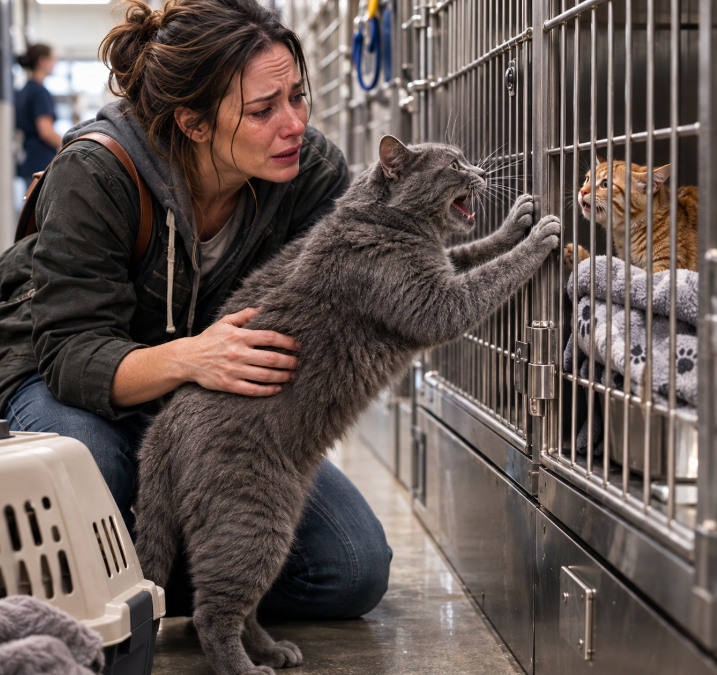
Ivy pushed her face against the bars.
Then she made a sound I had not heard from her once during the hour I had been there.
A scream.
Not a normal meow.
Not even a yowl.
It sounded torn out of her.
Bean’s eyes appeared from beneath the towel.
Ivy screamed again.
She shoved one paw through the bars.
Bean came forward.
Slowly.
His nose touched her paw.
I remember looking at Ellen.
“What is happening?”
She looked just as confused.
“I don’t know.”
Ivy began pawing at the kennel latch.
Not randomly.
Repeatedly.
Then she turned toward me and cried again.
Bean pressed himself against the bars.
Ellen crouched.
“Were they brought in together?”
“I thought you knew.”
“I don’t handle every intake.”
She looked over her shoulder.
“Hang on.”
She disappeared into the office.
Ivy refused to move.
I tried picking her up.
She twisted from my hands—not scratching, not biting, just fighting with everything in her body to stay near Bean.
The orange cat began making tiny chirping sounds.
Ivy answered every one.
I stopped trying.
“All right.”
I sat on the floor.
“You win.”
Five minutes later, Ellen returned carrying two intake sheets.
Her expression had changed.
“They weren’t listed as bonded.”
“What does that mean?”
“They didn’t come in under the same intake number.”
“Did they come in together?”
“Technically, no.”
She sat beside me.
“Ivy was surrendered on a Tuesday afternoon.”
“By her owner?”
“That’s what the form says.”
“And Bean?”
“Picked up as a stray early Wednesday morning.”
“Where?”
Ellen turned the paper toward me.
The address was less than two blocks from the shelter.
I looked at Bean.
Then Ivy.
“You think he followed her?”
“I have no idea.”
“Did they ever see each other here?”
“Apparently.”
“How?”
“The cat room has been rearranged a few times.”
She frowned.
“They may have been across from each other during cleaning.”
Ivy cried again.
Ellen looked at me.
“That doesn’t prove they lived together.”
“No.”
“But it proves something.”
I looked at Bean.
He had come completely out from under the towel now.
His entire body was pressed against the kennel door.
Ivy would not leave him.
“What happens to him?”
“He’s not ready for adoption.”
“Why?”
“He’s underweight. Skin infection. Fear response. He needs a little time.”
“How much?”
“Could be a couple weeks.”
“And Ivy?”
“You can take her today.”
I stared at her.
Ivy screamed.
Bean pushed a paw through the bars.
I said:
“Apparently I cannot.”
Ellen smiled despite herself.
“We can delay Ivy’s adoption.”
“No.”
She raised an eyebrow.
“No?”
I looked at Bean.
“What happens if I apply for him too?”
Ellen blinked.
“You came here for one cat.”
“I’m aware.”
“You haven’t touched him.”
“He hasn’t allowed anyone to touch him.”
“Exactly.”
“Ivy has.”
Ellen looked from me to the cats.
“I can’t promise they’re actually bonded.”
“I’m not asking you to.”
“You could end up with a terrified orange cat who hides under your bed for six months.”
“My social calendar can accommodate that.”
She laughed.
“Let me get the director.”
Twenty minutes later, I had signed foster-to-adopt paperwork for Bean.
Ivy came home that afternoon.
Bean stayed another nine days while the shelter treated his skin and tried to get weight on him.
Those nine days nearly killed Ivy.
She searched my house constantly.
Closets.
Bedrooms.
Behind shower curtain.
Under furniture.
She would sit at the front door and cry.
At night, she slept beside the carrier I had brought her home in.
She ate.
But not much.
She allowed me to pet her.
Sometimes.
But every time I moved toward the door, she followed as if she thought I might know where Bean was.
I called Ellen every day.
On day four, she finally said:
“You know we would call if something changed.”
“I know.”
“You’re still going to call tomorrow, aren’t you?”
“Yes.”
“Okay.”
On day nine, Bean came home.
The shelter staff warned me not to expect a reunion like television.
Cats can behave differently in new environments.
Stress changes scent.
A familiar animal can still hiss or hide after separation.
So I put Bean’s carrier in the spare bedroom.
Closed the door.
Opened the carrier.
He stayed inside.
I sat against the wall.
Ivy waited outside the room because the shelter behavior technician told me to introduce them carefully even though they appeared familiar.
Bean did not move for forty minutes.
Then Ivy cried outside.
Bean’s ears moved.
She cried again.
He stepped out.
One paw.
Then another.
His fur looked better already.
Still thin.
Still frightened.
He walked directly to the door.
I opened it two inches.
Ivy’s nose appeared.
Bean touched it.
Neither hissed.
Neither swatted.
I opened wider.
Ivy walked in.
Bean immediately shoved his entire face beneath her chin.
Ivy began licking the top of his head.
That was the first time I cried over them.
Not because it was cute.
Because suddenly I knew I had almost taken her away without him.
She knew something I didn’t.
I had nearly mistaken paperwork for the whole story.
Bean hid from me for twenty-three days.
I counted.
He lived under the spare bed.
He came out to eat only when I left the room.
If I entered too quickly, he flattened himself into the far corner.
I never reached under.
Never dragged him out.
I put food down.
Sat on the floor.
Read.
At first I read books.
Then bills.
Then junk mail.
One evening I read him an advertisement for gutter guards because I had run out of material within reach.
Ivy would lie beside me.
Sometimes she crawled under the bed with Bean.
Sometimes she slept against my leg.
On day eleven, Bean ate while I was still in the room.
Day sixteen, he came out while I read.
Day twenty-three, he crossed the carpet and sniffed my sock.
I did not move.
My heart was pounding so hard I thought he might hear it.
He sniffed again.
Then walked away.
I called Rachel.
“Bean touched my foot.”
There was a pause.
“I’m happy for you?”
“You don’t understand.”
“I definitely do not.”
“He came out by himself.”
“Congratulations.”
“I’m serious.”
“I know.”
She softened.
“I’m glad.”
I looked at Ivy sleeping on the windowsill.
“So am I.”
By the second month, my house no longer sounded empty.
There were bowls moving across kitchen tile.
Feet racing at three in the morning.
Ivy had discovered the top of the refrigerator.
Bean had discovered gravity and spent an unreasonable amount of time pushing pens from my desk.
He remained shy with strangers.
But with Ivy, he was ridiculous.
He followed her everywhere.
If she jumped onto the couch, he jumped onto the couch.
If she drank, he drank.
If she slept in a patch of sunlight, he squeezed into the same patch until half his body lay on top of hers.
I bought two beds.
They used one.
I bought separate scratching posts.
Bean scratched Ivy’s.
I bought an expensive cat tree.
They preferred the box.
Normal cat ownership, apparently.
I stopped eating cereal over the sink.
Not because cats care whether you sit at a table.
Because feeding them created a rhythm.
I came home.
They ate.
I ate.
I cleaned dishes.
I watched television with Bean gradually learning that my lap was not a trap.
Thursday stopped being the hardest day.
It became ordinary.
That was more important than happiness at first.
Ordinary was enough.
Six months after the adoption, Ellen called me at work.
I almost ignored it.
Then saw the shelter number.
“Is everything okay?”
“Are Ivy and Bean okay?”
“Yes.”
Her voice was strange.
“Can you come in?”
My stomach dropped.
“What happened?”
“Nothing happened to them.”
“Then what?”
There was a pause.
“A man came in this morning.”
“What man?”
“He says Ivy belongs to him.”
The room tilted.
I stood up from my desk.
“What?”
“He has photographs.”
“Of Ivy?”
“From when she was a kitten.”
I stopped breathing normally.
“He says she was stolen.”
That was how Harold Whitmore entered my life.
He was seventy-six years old.
Tall even with the slight stoop in his back.
White hair.
Brown jacket too large through the shoulders.
A cane in one hand.
A yellow photo envelope in the other.
When I reached the shelter, he was sitting in the same plastic chair where I had signed Ivy’s adoption forms six months earlier.
Ellen introduced us.
“This is Harold.”
He stood.
Slowly.
“I’m sorry.”
That was the first thing he said to me.
Not:
Give me my cat.
Not:
You took her.
Not:
She’s mine.
I’m sorry.
I sat across from him.
“For what?”
“For this.”
He put the envelope between us.
His hands shook.
“I know you didn’t do anything wrong.”
I looked at Ellen.
She looked miserable.
Harold opened the envelope.
The first photograph nearly broke me.
Ivy.
Tiny.
Maybe ten weeks old.
Sitting inside a blue ceramic bowl.
Same gray coat.
Same yellow-green eyes.
No scar yet.
Behind her was an older woman laughing.
Thin face.
Silver hair.
One hand reaching toward the kitten.
“My wife,” Harold said.
“Her name was Margaret.”
He turned the picture over.
MARGARET + IVY
APRIL 2022.
Next photograph.
Ivy climbing curtains.
Next.
Sleeping beside Margaret’s neck.
Next.
Christmas tree.
Next.
Ivy stretched across Harold’s lap.
Then another.
The scar.
I pointed.
“What happened?”
Harold touched the same place near his own ear instinctively.
“She tried jumping through a window screen after a moth.”
Despite everything, I laughed.
“So that’s where it came from.”
“Four stitches.”
“I thought it looked old.”
“It is.”
He showed me a veterinary invoice.
Microchip number.
Vaccination record.
The number matched the one on Ivy’s shelter file.
There was no question.
She had belonged to Harold and Margaret.
I felt physically sick.
“What happened?”
Harold looked at his hands.
“My wife died nineteen months ago.”
“I’m sorry.”
“Thank you.”
He nodded toward the photographs.
“Ivy was hers.”
He corrected himself.
“Ours. But mostly hers.”
Margaret had pancreatic cancer.
Eleven months from diagnosis to death.
Ivy had slept beside her through most of it.
Near the end, when Margaret spent more time in bed than out, Ivy rarely left the room.
“She used to put one paw on Margaret’s wrist,” Harold said.
“Just leave it there.”
He smiled faintly.
“Margaret said Ivy was checking whether she was still here.”
He looked down.
“After Margaret died, the cat started doing it to me.”
I had to look away.
Because Ivy did that.
Every morning.
One paw against my forearm before breakfast.
I had thought it was just Ivy.
Maybe it was.
Maybe cats repeat behaviors because they work.
Maybe the meaning belonged to us.
Either way, it hurt.
“What about Bean?”
Harold looked confused.
“The orange one?”
“Yes.”
His expression changed immediately.
“He’s alive?”
Ellen leaned forward.
“You know Bean?”
Harold closed his eyes.
“Oh, thank God.”
The story got worse.
Bean had appeared under Harold’s porch about four months after Margaret died.
Tiny.
Half-starved.
Orange.
Ivy discovered him before Harold did.
“She sat at the back door all night,” he said.
“Wouldn’t come to bed.”
The next morning, Harold found the kitten beneath the porch.
He started feeding him outside.
Ivy spent hours watching through the glass.
Eventually Bean came inside.
Harold named him Bean because, as he put it, “he was no bigger than one.”
By the time Harold was hospitalized, Bean had lived with Ivy for nearly nine months.
That explained everything.
The shelter records.
The terror.
The way Ivy had screamed at his cage.
They were not strangers who met at the shelter.
They had been family.
“What happened when you went to the hospital?”
Harold’s face hardened for the first time.
“I fell.”
December.
Ice on porch step.
Broken hip.
Complications after surgery.
Pneumonia.
Then heart rhythm problems.
A hospital stay expected to last four days became nearly three weeks.
Then rehabilitation.
Harold had no children.
His younger brother lived in Oregon and was dealing with Parkinson’s.
Neighbors helped at first.
Then a hospital case coordinator gave Harold a list of private senior-transition services.
One company was called Gentle Hands Home Transition.
Owner:
Denise Avery.
Denise visited Harold at the rehabilitation center.
Professional.
Kind.
Soft voice.
She offered pet care.
Mail collection.
Basic home checks.
Help arranging cleaning if rehabilitation lasted longer than expected.
Harold signed a limited service agreement.
Not power of attorney.
Not permission to sell.
Not permission to surrender animals.
“Feed the cats,” he said.
“That was the important part.”
Denise told him she would.
Three weeks later, Harold developed another infection.
More treatment.
He was not strong enough to go home.
Denise began telling him the house required “stabilization.”
He did not understand what she meant.
She said neighbors had complained about odors.
That there might be damage.
That Ivy was becoming aggressive.
That Bean had escaped.
Harold demanded to speak with the neighbor.
Denise said she would handle it.
Then one afternoon she came to rehab and told him:
“The cats have been placed.”
Harold said he thought he had misheard her.
“Placed where?”
“Safe homes.”
“What safe homes?”
“Through rescue contacts.”
“I didn’t tell you to give them away.”
She said:
“You weren’t coming home anytime soon.”
Harold tried to stand.
A nurse stopped him.
He called police.
Denise produced the service contract and claimed Harold had verbally authorized emergency rehoming.
The situation looked messy.
Civil.
A sick elderly man.
A private caregiver.
No immediate evidence where the animals had gone.
Harold said officers were polite.
But nothing happened quickly.
When he finally returned home nearly two months later, the cats were gone.
So were other things.
Margaret’s sewing machine.
A walnut side table.
Two lamps.
A box of silverware.
Several pieces of costume jewelry.
A set of old kitchen canisters Margaret had collected.
Nothing worth a fortune.
Everything worth something.
Denise said those items had been removed during “home safety cleanup.”
Harold asked where.
She said donated.
He asked for receipts.
None.
Then a bill arrived.
$1,860.
PET RELOCATION AND HOME STABILIZATION SERVICES.
Harold refused to pay.
Denise sent it to collections.
I stared at him.
“She charged you for getting rid of your cats?”
Harold gave a small bitter laugh.
“That’s one way to say it.”
“How did you find Ivy?”
“Facebook.”
Ellen looked at me.
My chest tightened.
Three weeks earlier, I had sent the shelter a photograph for their “Happy Tails” page.
Ivy and Bean asleep together on my couch.
The shelter posted:
IVY & BEAN — SIX MONTHS HOME.
Harold’s neighbor saw it.
Called him.
He enlarged photograph until pixels blurred.
The scar near Ivy’s ear was visible.
Bean’s pale orange face.
Harold called the shelter the next morning.
Then came in with proof.
“What do you want?” I asked.
The question sounded cruel when it left my mouth.
Harold’s face collapsed slightly.
I corrected myself.
“I’m sorry. I mean…”
“I know what you mean.”
He touched the photographs.
“I came to get Ivy.”
The words hit exactly as hard as I expected.
Maybe harder.
“And Bean?”
Harold closed his eyes.
“I didn’t know he was here.”
I swallowed.
“They can’t be separated.”
“I know.”
“You haven’t seen them yet.”
“I know.”
“I’m not telling you what to do.”
“I know.”
Everything was I know because neither of us knew what else to say.
I had spent six months making them part of my life.
Harold had spent months believing they had been stolen from his.
Neither of us had done anything wrong.
That did not make it hurt less.
I asked Ellen:
“What happens now?”
She looked exhausted.
“We’re contacting the shelter’s attorney and animal control.”
“I legally adopted them.”
“Yes.”
“He has proof they were surrendered without permission.”
“Yes.”
“So whose cats are they?”
“That is not something I’m going to answer at this table.”
Fair.
Harold said quietly:
“I don’t want to sue anybody.”
I looked at him.
“I don’t want you to have to.”
“I just want my cat.”
That was worse than anger.
I went home.
Ivy met me at the door.
Bean appeared behind her.
I sat on the kitchen floor and started crying.
Ivy walked onto my lap.
Bean stopped three feet away.
Watched.
Then came closer.
I kept thinking:
They are not mine.
Then:
They are.
Then:
They were his first.
Then:
He lost his wife.
Then:
I lost my mother.
Then I hated myself for turning grief into arithmetic.
As if one dead woman could be weighed against another.
As if loneliness could establish ownership.
As if loving an animal longer or harder made a person more deserving.
That night Ivy slept against my ribs.
Bean curled behind my knees.
I did not sleep.
The next morning I called Ellen.
“If Harold legally owns them, I’m not going to fight him.”
Silence.
“Are you sure?”
“No.”
That was the truth.
“I’m not sure about anything.”
I looked at Ivy.
“But I’m not going to make an old man go to court to prove he deserves the cat someone stole while he was sick.”
Ellen’s voice softened.
“That isn’t necessarily where this is going.”
“I know.”
“Ivy and Bean’s welfare matters too.”
“I know.”
“Six months matters.”
“I know.”
“Their current stability matters.”
“I know.”
I started crying again.
“I wish everyone would stop telling me things matter.”
Ellen was quiet.
Then:
“I’m sorry.”
“So am I.”
The investigation began because the shelter had something Harold never had.
The original surrender paperwork.
Denise Avery’s signature.
She had listed herself as Ivy’s owner.
Relationship:
OWNER.
Length of ownership:
THREE YEARS.
That was demonstrably false.
Ivy’s microchip registration had been in Margaret Whitmore’s name, later Harold’s.
Denise had signed a statement affirming she possessed legal authority to surrender.
She had also listed an address that was not hers.
Harold’s address.
Animal control investigator Carla Mendes took over.
She interviewed Harold.
Ellen.
The intake technician.
Then she searched shelter records for Denise Avery.
That changed everything.
Ivy was not the first animal Denise had surrendered.
Not even close.
Seven dogs.
Four cats.
Over approximately two years.
Different addresses.
Different explanations.
Sometimes “owner surrender.”
Sometimes “family emergency.”
Sometimes “moving.”
Several of the names on those surrender forms belonged to people who were elderly.
Carla began calling.
Two were dead.
One family confirmed their father had entered assisted living and believed his dog had gone to a “private foster home.”
It had been surrendered to a shelter forty miles away.
Another woman said her mother’s Persian cat disappeared during a hospitalization.
Denise told the family the cat had escaped.
Shelter records showed the cat had been surrendered the same week and later adopted.
Then investigators found online listings.
Not every animal went to shelters.
Younger dogs.
Small breeds.
One purebred Yorkie.
A miniature poodle.
Denise had advertised them on local rehoming groups with fees ranging from $250 to $800.
The older animals, sick animals, and less marketable cats went to shelters.
The pattern was simple enough to be ugly.
Denise gained access to homes while owners were hospitalized or entering rehabilitation.
She charged for pet care.
Then in several cases she removed animals without clear authorization.
Some she sold.
Some she surrendered.
Then billed “placement” or “transition” fees.
In at least three homes, personal property had also disappeared or been sold through consignment.
Sickness had become inventory.
That was how Carla described it later.
Not dramatically.
Just accurately.
Denise denied stealing anything.
She said clients were confused.
Families were disorganized.
Verbal permission had been given.
Pet placements were necessary for safety.
Some allegations would be difficult to prove.
Others weren’t.
Ivy’s surrender form was one of the strongest.
Harold had contemporaneous text messages.
The day before Denise surrendered Ivy, Harold had written:
PLEASE DO NOT MOVE IVY OR BEAN. MY NEIGHBOR BILL CAN HELP FEED THEM IF NEEDED.
Denise replied:
I HAVE IT HANDLED. FOCUS ON GETTING STRONGER.
The next day, Ivy entered the shelter.
Bean had apparently escaped during transport.
A shelter parking-lot camera provided the final strange piece.
An orange cat bolting beneath a parked car as Denise carried Ivy’s carrier inside.
The timestamp was 2:14 p.m.
Bean was found at 6:40 the next morning behind a convenience store less than two blocks away.
Ivy had seen him again in the shelter several days later.
No wonder she refused to leave.
She had already watched him disappear once.
That realization hurt more than anything.
The shelter’s attorney advised everyone not to make sudden changes while ownership and welfare were being sorted out.
Harold was offered supervised time with Ivy and Bean.
The first meeting happened at my house.
That was my choice.
I wanted him to see them where they felt safe.
I also wanted to see him with them.
Maybe that sounds selfish.
It was.
I needed to know what I was about to lose.
Harold arrived with Ellen and Carla.
He had changed since the first shelter meeting.
Cleaner shirt.
Hair combed.
Still the cane.
Still the yellow envelope.
I made coffee nobody drank.
Ivy was upstairs.
Bean beneath the dining table.
Harold sat on the couch.
His hands trembled.
“Should I call her?”
“Yes.”
He swallowed.
“Ivy?”
Nothing.
Again.
“Ivy-girl?”
Her head appeared at the top of the stairs.
I felt my heart stop.
Ivy stared.
Harold did not move.
“Hey, sweetheart.”
Her body lowered.
Not fear.
Attention.
She came down three stairs.
Stopped.
Harold began crying silently.
Ivy came another three.
Then the rest.
She approached within four feet.
Sniffed.
Walked around his cane.
Sniffed his shoes.
Then sat.
Harold whispered:
“It’s me.”
Ivy rubbed once against the cane.
Then his pant leg.
He covered his mouth.
I had to leave the room for a minute.
I stood in the kitchen gripping the counter.
This was what I had promised myself I would do.
If she knew him.
If she wanted him.
I would let her go.
Knowing something is right does not make it feel noble.
Sometimes it just feels like losing.
When I returned, Ivy was beside Harold.
Not on his lap.
Beside him.
Bean had emerged.
Harold looked down.
“Bean.”
The orange cat froze.
Harold laughed through tears.
“You still look terrible.”
Bean blinked.
Then retreated beneath the chair.
I laughed too.
That was Bean.
Recognition or no recognition, he maintained standards.
Harold spent ninety minutes with them.
He had brought Margaret’s old knitted lap blanket.
Blue and cream.
Ivy sniffed it for a long time.
Then kneaded it.
Harold cried again.
When he left, he folded the blanket.
I stopped him.
“Leave it.”
He looked at me.
“Are you sure?”
“Yes.”
Ivy was already lying on it.
Harold nodded.
“Okay.”
At the door, he said:
“I’m getting my apartment ready.”
My stomach tightened.
“What apartment?”
“I sold the house.”
I had not known.
“It was too much.”
He had moved into a small senior apartment complex.
Independent living.
Pets allowed.
He had already paid the deposit.
Bought litter boxes.
Food bowls.
Scratching post.
He could take them.
That mattered.
This was not a convenient sacrifice because he had nowhere for them.
He was preparing to bring them home.
I went upstairs after he left and cried into a towel so hard my face hurt.
Three days later, I called him.
“When do you want them?”
Silence.
“Harold?”
“You’re willing?”
“No.”
I laughed once because otherwise I was going to break.
“I mean yes.”
He was quiet.
I continued:
“I don’t want to.”
“I know.”
“But if you want Ivy back, she was yours before she was mine.”
“And Bean?”
“They stay together.”
“Yes.”
“That part isn’t negotiable.”
“I agree.”
I closed my eyes.
“What day?”
“Saturday?”
“Okay.”
Saturday came.
I packed food.
Medications.
Toys.
Records.
The stupid cardboard fish Bean loved.
Ivy’s brush.
Margaret’s blanket.
My entire house seemed to understand what was happening.
Ivy kept climbing into boxes.
Bean hid because boxes meant change.
Rachel came over.
She did not say:
Maybe Harold will change his mind.
She knew better.
She just helped.
At eleven, Harold arrived.
He had brought two carriers.
New.
Tags attached.
IVY.
BEAN.
Seeing their names on his carriers nearly destroyed me.
He stood in my living room.
Looked around.
Ivy was sleeping on the windowsill.
Bean beside her.
Harold watched them for a long time.
Then he said:
“Can I see where they sleep?”
I took him upstairs.
My bedroom.
Two beds they rarely used.
Window perch.
Bean’s hiding box.
Harold smiled.
“Margaret used to complain Ivy had more furniture than we did.”
We went downstairs.
He looked at their bowls.
The scratching posts.
Photographs on my phone.
Videos.
Ivy chasing a bottle cap.
Bean falling off the couch.
Both sleeping against me while I had the flu.
Harold asked:
“Does Ivy still put her paw on you?”
I swallowed.
“Every morning.”
He looked away.
Then:
“Bean sleep under blankets?”
“Yes.”
“Only his head out?”
“Yes.”
Harold smiled.
“He did that with me.”
The room went quiet.
I reached for Ivy’s carrier.
Harold said:
“Don’t.”
I stopped.
“What?”
“Don’t put her in.”
I stared.
“Why?”
He sat down.
His cane between his knees.
For a moment, he looked older than seventy-six.
“I thought I wanted my cat back.”
My throat closed.
“You do.”
“Yes.”
He looked at Ivy.
“That’s the problem.”
“I don’t understand.”
“I’ve spent six months angry because somebody decided what was best for me without asking.”
He looked toward Bean.
“Denise took them because she thought I was old and sick and wouldn’t come home.”
His voice hardened briefly.
“She made my decision for me.”
Then softened.
“I’m not going to do the same thing to them.”
I sat.
“Harold…”
He raised one hand.
“Let me finish or I won’t.”
So I stayed quiet.
“When Margaret died, Ivy was the last living thing in that house that had belonged to both of us.”
He smiled faintly.
“Not belonged. You know what I mean.”
I did.
“She slept beside Margaret.”
His eyes filled.
“She knew the sound of her oxygen machine. She knew which chair Margaret sat in. She knew the blue blanket.”
He looked at Ivy.
“For months after Margaret died, I think I kept that cat too close because losing her felt like losing Margaret again.”
I could barely breathe.
“Then Bean came.”
He laughed.
“That ridiculous orange thing gave Ivy something else to think about.”
Bean was washing himself under the table, unaware he was central to an emotional crisis.
Harold continued:
“When they disappeared, I told myself getting Ivy back would put one part of my life where it belonged.”
He looked at me.
“But I came here and realized it already is.”
I started crying.
“No.”
“Yes.”
“You don’t have to do this.”
“I know.”
“You have a place for them.”
“I know.”
“They remember you.”
“I know.”
“Then take them.”
My voice cracked.
Because part of me meant it.
Another part wanted him to refuse.
That is the cruel thing about trying to do right.
Sometimes your heart argues both sides.
Harold reached across and took my hand.
“You love them.”
“So do you.”
“Yes.”
His fingers tightened.
“And that’s why this hurts.”
That sentence stayed with me.
He looked toward Ivy.
“She has lost Margaret.”
Pause.
“Then me.”
Another.
“Then Bean.”
“She found Bean.”
“Because you brought him home.”
I shook my head.
“She brought me to him.”
Harold smiled.
“Exactly.”
He wiped his eyes.
“She fought to keep what she had left.”
Ivy jumped down from the window.
Walked across the room.
Climbed onto the couch beside me.
Then Bean followed.
Harold watched.
“I don’t want to make her start over again so I can feel less lonely.”
That broke something in me.
Because I knew exactly what loneliness could convince you to do.
I had adopted a cat because I wanted something alive to notice when I came home.
Harold wanted his cat because she was the last creature who had shared a home with his dead wife.
Neither desire was selfish enough to condemn.
Both were selfish enough to hurt.
I said:
“You can visit.”
He nodded.
“If they tolerate me.”
“They will.”
“Send pictures?”
“Too many.”
He laughed.
“Good.”
Then he reached into his jacket.
Pulled out the yellow envelope.
The baby pictures.
He put it in my lap.
“No.”
“They’re yours.”
“No, they’re not.”
He shook his head.
“I have copies.”
“You’re lying.”
He smiled.
“I had copies made yesterday.”
I held the envelope to my chest.
“Harold.”
He stood.
Slowly.
Ivy watched.
He bent as far as his hip allowed.
Touched two fingers to her head.
“Be good.”
Ivy rubbed against his hand.
Then he walked to the door.
Without the carriers.
I followed.
On the porch, I said:
“I’m sorry.”
He turned.
“For what?”
“I don’t know.”
He nodded as if that made sense.
“I’m sorry too.”
“For what?”
“I don’t know.”
Then we both laughed while crying.
Harold left.
I stood in the doorway until his car disappeared.
When I went back inside, Bean had climbed into one of the new carriers he had brought.
Of course.
I sat on the floor.
Ivy climbed into my lap.
Then, exactly as she had every morning, she placed one paw against my wrist.
I cried so hard I had to lie down.
The investigation into Denise Avery continued for almost a year.
She was not a criminal mastermind.
That was important.
There was no secret warehouse full of stolen pets.
No dramatic interstate ring.
What investigators found was sadder because it was smaller and more ordinary.
Denise had discovered a type of person who was easy to override.
Elderly.
Sick.
Hospitalized.
Families far away.
Homes temporarily empty.
People overwhelmed enough to sign forms without imagining someone would stretch a narrow permission into control.
She charged legitimate fees for legitimate work too.
That complicated the case.
Some clients liked her.
Some said she had helped enormously.
Some pets were genuinely rehomed with permission.
Some furniture really was donated.
Predatory people are not required to be predatory every minute of every day.
That is part of why they survive.
But records showed a pattern.
Unauthorized pet removals.
False surrender statements.
Questionable resale fees.
Property sold without adequate written consent.
Invoices for services clients disputed.
Payments routed through a small consignment business owned by Denise’s sister.
Harold’s case was one of the clearest because of his text messages.
Do not move Ivy or Bean.
And her response.
I have it handled.
She had handled it.
Just not the way he meant.
Denise eventually pleaded guilty to several fraud and theft-related counts arising from multiple clients.
Some allegations were resolved civilly.
Some were not charged.
Restitution was ordered for proven losses.
Her transition business closed.
The collections account against Harold disappeared.
A few of Margaret’s items were recovered from a consignment warehouse.
The walnut table.
One lamp.
The kitchen canisters.
Not the jewelry.
Not the sewing machine.
Harold told me:
“Margaret would care more about the canisters.”
I asked why.
“She hated that sewing machine.”
I laughed.
Harold became part of my life slowly.
Not because we made a formal arrangement.
He simply began coming over every other Sunday.
At first, for Ivy.
Then for coffee.
Then because he liked arguing with Rachel about baseball.
Ivy always greeted him.
Not dramatically.
She sniffed his shoes.
Rubbed his cane.
Sometimes sat beside him.
Bean took four visits before he came within arm’s reach.
On the fifth, Harold brought roast chicken.
That improved diplomatic relations considerably.
“You cheated,” I said.
Harold whispered:
“Experience.”
Eventually Bean sat on his lap.
Harold did not move for forty minutes.
His leg went numb.
I knew because his face turned strange.
“Are you okay?”
“Yes.”
“You don’t look okay.”
“Quiet.”
“Your foot is purple.”
“Worth it.”
That was when I realized Harold had not given Ivy up and disappeared.
He had done something harder.
He had accepted that love did not always require possession.
He could still know her.
She could still know him.
Their history did not have to be erased because her home had changed.
And I did not have to pretend I was Ivy’s entire story.
That was important too.
People like simple adoption stories.
Cat abandoned.
Good person arrives.
Cat finally home.
Before Harold, I had told myself that story.
Ivy and Bean had been abandoned.
I rescued them.
Then the truth arrived carrying baby pictures.
I had not saved Ivy from a person who stopped loving her.
I had unknowingly received a cat who had been stolen from someone who was fighting to get home to her.
That changed the way I thought about rescue.
Shelters see the moment in front of them.
Sometimes that is all anyone can see.
An animal arrives.
A form has a signature.
A person says owner surrender.
Staff must make decisions.
Most of the time, the paperwork is truthful.
Sometimes it isn’t.
Harold did not blame Ellen.
Neither did I.
But Cedar Valley changed several procedures anyway.
If an animal was surrendered by someone claiming authority on behalf of an elderly, hospitalized, or institutionalized owner, staff asked for clearer proof.
Microchip records were checked more aggressively.
Third-party surrender forms required documentation.
Emergency exceptions still existed.
Animals still needed safety.
But “I’m handling this for the owner” was no longer enough by itself.
Ellen called it the Ivy Rule once.
Harold hated that.
“Don’t name bureaucracy after my cat.”
So they didn’t.
Bean became fat.
Not obese.
I need that distinction in the record.
He reached a healthy weight.
His fur grew thick and bright.
He still hid from visitors.
Except Harold.
And Rachel, eventually.
And one plumber who apparently possessed some mysterious quality Bean found trustworthy.
Ivy remained Ivy.
Judgmental.
Precise.
She hated closed doors.
Loved laundry.
Could open one kitchen cabinet with her paw.
She never stopped checking Bean.
If he cried from another room, she went.
If he disappeared beneath a bed during thunderstorms, she found him.
If I put him in a carrier for veterinary appointments, Ivy sat outside and complained until he returned.
The shelter behaviorist once told me:
“They may have a strong affiliative bond.”
Harold said:
“They’re married.”
I said:
“They’re both fixed.”
He replied:
“That has not stopped many marriages from becoming less interesting.”
I almost choked on coffee.
Three years passed.
Harold’s health worsened gradually.
Nothing dramatic at first.
More cane.
Then walker.
Then oxygen at night.
His apartment became harder to manage.
He moved into assisted living.
No cats allowed in his particular care unit.
By then the decision he had made years earlier carried even more weight.
One Sunday, I brought him photographs instead of the cats.
Travel had become stressful for Bean.
Ivy tolerated car rides but complained with professional persistence.
Harold said:
“Don’t bring them anymore.”
“You sure?”
“I’m not asking them to make a forty-minute round trip for an old man.”
“You’re twenty minutes away.”
“Feels like forty when Ivy is yelling.”
Fair.
I showed him a video instead.
Bean had climbed into the laundry basket and gotten stuck under a towel.
Harold laughed until he coughed.
Then needed several minutes to catch his breath.
That scared me.
He noticed.
“Don’t do that.”
“Do what?”
“Look at me like I’m already dead.”
I looked down.
“Sorry.”
“Margaret did that near the end too.”
“What?”
“Looked at me like she was apologizing for leaving before she had.”
He adjusted the oxygen tube.
“Terrible habit.”
I smiled.
“Did she stop?”
“No.”
“Then maybe it runs in the family.”
Harold looked at me.
“You’re not family.”
I pretended to be offended.
He smiled.
“Not biologically.”
Then took my hand.
“You know what I mean.”
I did.
Six months later, Harold called me at 2:13 in the morning.
I answered immediately.
Nobody calls at 2:13 with good news.
“I need a favor.”
His voice was weak.
“What?”
“I’m in the hospital.”
I sat up.
“What happened?”
“Breathing.”
“I’m coming.”
“No.”
“Yes.”
“Listen.”
I froze.
He continued:
“Bring the envelope.”
“What envelope?”
“The yellow one.”
I knew.
Ivy’s baby pictures.
“Why?”
“I want to see Margaret.”
My throat closed.
There were pictures of Margaret with Ivy.
But I knew that was not really what he meant.
“I’ll come.”
“Morning.”
“No.”
“You need sleep.”
“I’m already dressed.”
I wasn’t.
I became dressed.
At the hospital, Harold looked very small beneath white blankets.
I sat beside him.
Opened the envelope.
We went through every photograph.
Margaret holding baby Ivy.
Ivy in bowl.
Ivy attacking curtains.
Margaret laughing.
Harold younger.
Their house.
Christmas.
Bean later.
My photographs had been added too.
That surprised me.
Harold had printed them.
Ivy and Bean on my couch.
Bean under Christmas tree.
Ivy touching my wrist.
He had mixed the lives together.
No dividing line.
Before theft.
After adoption.
Margaret.
Harold.
Me.
One story.
He tapped a photograph of me asleep on the couch with both cats.
Rachel had taken it.
“You look terrible.”
“Thank you.”
“You look happy.”
I stared.
“I was.”
“You are.”
I nodded.
He closed the envelope.
Then handed it to me.
“You keep these.”
“I already do.”
“I mean after.”
“Harold.”
“Don’t.”
I looked away.
He continued:
“I thought Ivy was the last thing Margaret left me.”
His breathing was shallow.
“She wasn’t.”
I looked at him.
“What was?”
He smiled.
“Love, apparently.”
I rolled my eyes because if I did not, I would cry.
“That is disgustingly sentimental.”
“I’m dying. I’m allowed one.”
“You don’t know that.”
“I do.”
He took my hand.
“Listen.”
I did.
“I gave up Ivy because I thought she belonged where she was safe.”
He paused for breath.
“But for a long time I also thought I lost something when I did it.”
Another breath.
“I didn’t.”
“What do you mean?”
“She gave me you.”
That did it.
I bent forward and cried against his hand.
He patted my hair like I was twelve.
“Your mother would hate that.”
I looked up.
“What?”
“You crying this hard.”
“You never met my mother.”
“You talk about her enough.”
Fair.
Harold died two days later.
Peacefully.
His brother came from Oregon.
Rachel sat with me at the funeral.
I brought no cats.
Obviously.
People asked whether Harold had family.
His brother said yes.
Then pointed at me.
I cried again.
After the service, his brother handed me one small box.
Inside was Margaret’s blue-and-cream blanket.
Harold had apparently asked the assisted-living staff to store it after he could no longer keep Ivy.
I took it home.
Placed it on the couch.
Ivy sniffed.
Kneaded.
Lay down.
Bean climbed on top of her.
I sat beside them.
For the first time in years, I played my mother’s old voicemail.
All of it.
Her voice filled the living room.
Ordinary.
She was asking whether I had remembered to make the dentist appointment.
Then complaining about the neighbor’s tree.
Nothing profound.
No last words.
No hidden wisdom.
Just my mother being alive for forty-three seconds.
Ivy slept through it.
Bean rolled onto his back.
I laughed while crying.
That was grief now.
Less sharp.
More crowded.
My mother.
Margaret.
Harold.
All the people and animals whose lives had crossed mine because I walked into a shelter on a Thursday wanting something alive to notice when I came home.
Five years after the adoption, Bean finally stopped hiding from the vacuum cleaner.
I consider that one of the great achievements of modern civilization.
Ivy became more affectionate with age.
Or I became easier to manipulate.
Possibly both.
She developed kidney disease at nine.
Early.
Manageable.
Special food.
Fluids later.
More veterinary appointments.
Bean remained healthy.
The first time Ivy stayed overnight at the animal hospital, Bean searched the house exactly the way she had searched for him years earlier.
Bedroom.
Closets.
Front door.
Carrier.
He cried.
I sat on the floor with him.
“I know.”
That night I understood something Ivy had known before I did.
Absence has a shape.
Animals may not understand our explanations, but they notice the shape.
A missing smell.
A missing sound.
An empty bed.
A routine with one body gone.
The next morning, when I brought Ivy home, Bean shoved his face against the carrier door before I could open it.
I laughed.
“Apparently none of us learns dignity.”
Ivy came out.
Bean followed her for six hours.
At eleven, Ivy’s kidneys worsened.
Good months.
Then difficult ones.
She became thinner.
Slept more.
Still touched my wrist each morning.
Sometimes I wondered whether Margaret had really taught her that somehow.
Then corrected myself.
No.
Margaret probably rewarded a behavior accidentally.
Ivy repeated it.
Then it became routine.
Meaning came from repetition.
That did not make it less meaningful.
Bean was eight by then.
Still orange.
Still dramatic.
Still glued to her.
My veterinarian, Dr. Santos, helped me track Ivy’s quality of life.
I had learned from Harold that loving something does not mean keeping it at any cost.
That lesson is beautiful when theoretical.
Awful when practical.
Ivy stopped eating enough.
Then stopped grooming.
One morning, she tried jumping onto the couch and missed.
Bean immediately went down to her.
I picked her up.
She felt too light.
I called Dr. Santos.
The appointment was scheduled for Friday.
Thursday night—of course it was Thursday—I slept on the couch with Ivy against my chest and Bean pressed against her back.
I thought about the first Thursday.
Shelter.
Metal bars.
Her forehead against my fingers.
I thought I was choosing one gray cat.
She had other plans.
In the morning, Ivy placed her paw on my wrist.
Weakly.
I held it.
“I’m still here.”
Maybe that was for her.
Maybe for me.
At the clinic, Bean came too.
Dr. Santos agreed.
They had lived bonded for years.
He should have the chance to understand the change in whatever way cats understand it.
Ivy died with my hand on her shoulder.
Quiet.
No struggle.
Bean stayed in his carrier until afterward.
Then I opened it.
He came out.
Sniffed Ivy.
Sat.
Waited.
Sniffed again.
Then walked back into his carrier.
No cinematic howl.
No collapse.
Just information received.
At home, he searched anyway.
For days.
That hurt almost worse.
Eventually he began sleeping on Margaret’s blanket alone.
I let him.
I kept Ivy’s ashes beside Harold’s yellow envelope for a while.
Then decided she did not need to become another object I was afraid to move.
I scattered some beneath the maple tree in my yard.
Kept some.
Harold would probably have teased me for indecision.
Bean lived to sixteen.
Old orange cat.
Thick fur.
Arthritis.
Extremely opinionated.
By then I was fifty-seven.
Rachel’s children were adults.
My house was no longer quiet in the same way.
Not because it was always occupied.
Because I had stopped treating solitude like proof that nobody needed me.
I had friends.
Rachel.
Neighbors.
A shelter where I volunteered twice a month.
And Bean.
When Bean died, it was peaceful.
Another Thursday.
Apparently my life had a sense of humor.
I returned to Cedar Valley three weeks later carrying his unopened prescription food.
Ellen had retired.
The director was younger.
She knew me because Ivy and Bean’s story still circulated among staff.
I hated that and loved it.
She asked:
“Are you ready for another cat?”
“No.”
That answer was immediate.
She nodded.
“Okay.”
I donated the food.
Turned to leave.
Then heard screaming from cat room.
I stopped.
Not Ivy’s voice.
Different.
Still enough to make every muscle remember.
The director laughed.
“Don’t.”
“I didn’t say anything.”
“You looked.”
“I’m leaving.”
“Good.”
I made it halfway to the door.
Then turned.
“There isn’t another cat involved, is there?”
She smiled.
“Go home.”
I did.
For six months.
Then I adopted a twelve-year-old black cat named Walter who hated everyone except me.
No bonded companion.
No stolen history.
No old man with photographs.
Just Walter.
That was enough.
Ivy taught me that adoption is not ownership of a story.
We enter animals’ lives somewhere in the middle.
Sometimes we know what came before.
Sometimes a shelter card gives us three lines.
Sometimes six months later an old man opens a yellow envelope and reveals that the animal sleeping on your pillow once slept beside a dying woman you never met.
The past does not make the present less real.
That took me years to understand.
Harold loved Ivy.
Margaret loved Ivy.
I loved Ivy.
None of us cancelled the others.
Bean belonged with Harold once.
Then with me.
His fear at the shelter was not proof nobody had loved him.
It was partly proof that someone had.
He had lost a house.
A man.
A familiar cat.
Then found the familiar cat again two cages away.
And Ivy refused to leave without him.
That is the moment everyone remembers.
The gray cat screaming at the cage.
The orange face appearing from beneath the towel.
Me changing one adoption form into two.
But sometimes I think the more important moment happened six months later.
Harold arrived prepared to take Ivy home.
He had every emotional reason to.
A pet-friendly apartment.
Food bowls.
Carriers.
The last animal who had known Margaret.
And then he looked at Ivy asleep beside Bean in my house.
He understood something that cost him more than any court fight would have.
Love does not always ask:
Who has the strongest claim?
Sometimes it asks:
Where can I do the least damage?
Harold had already been robbed of choice once.
He could have reclaimed it by taking Ivy.
Instead, he used that choice to leave her.
Not because he loved her less.
Because he loved her enough to let her life keep moving after his had changed.
Years later, when I looked through the yellow envelope, one photograph became my favorite.
Not the beautiful ones.
Not Margaret holding kitten Ivy.
Not Christmas.
Not Ivy asleep on Harold.
It was blurry.
Ivy was maybe four months old.
She was running toward the camera.
Margaret’s hand entered from one side.
Harold’s shoe was visible at the bottom.
Nothing composed.
Nothing perfect.
Just a small gray cat moving toward people who loved her.
On the back, Margaret had written:
SHE ALWAYS COMES BACK FOR WHOEVER SHE THINKS SHE LEFT BEHIND.
I do not know whether that was really true.
Cats are cats.
People create stories around them because we need stories.
But I know what I saw at Cedar Valley.
Ivy had a carrier waiting.
A home waiting.
A woman already signing papers for her.
And she turned around.
She went back to the frightened orange cat hiding beneath a towel.
She screamed until somebody understood.
So when people ask whether I rescued Ivy, I tell them no.
She rescued Bean.
Harold rescued her from becoming only a memory.
And somehow, between them, they rescued the quiet parts of me I had mistaken for peace.
I walked into that shelter because I wanted something alive to notice when I came home.
I left with two cats who taught me that being noticed and being needed were not the same thing.
Then an old man taught me something harder.
Being loved and being kept were not the same thing either.
Sometimes the most painful form of love is opening your hands.
Harold did that.
I eventually had to do it for Ivy.
Then Bean.
And every time, it felt a little like destruction.
Maybe that is what love does when it has nowhere else to go.
It breaks the person holding it.
Then leaves something larger in the space.
The first day, I thought I was taking one gray cat home.
I was wrong.
I was taking home an orange cat too.
A dead woman’s memory.
An old man’s last piece of family.
A crime nobody had uncovered yet.
And a lesson I would spend the rest of my life learning:
Sometimes the one who loves you most is the one who refuses to leave someone else behind.








