I Thought a Biker Was Luring a 10-Year-Old With Cash—Then I Saw What the Boy Was Hiding in His Hands
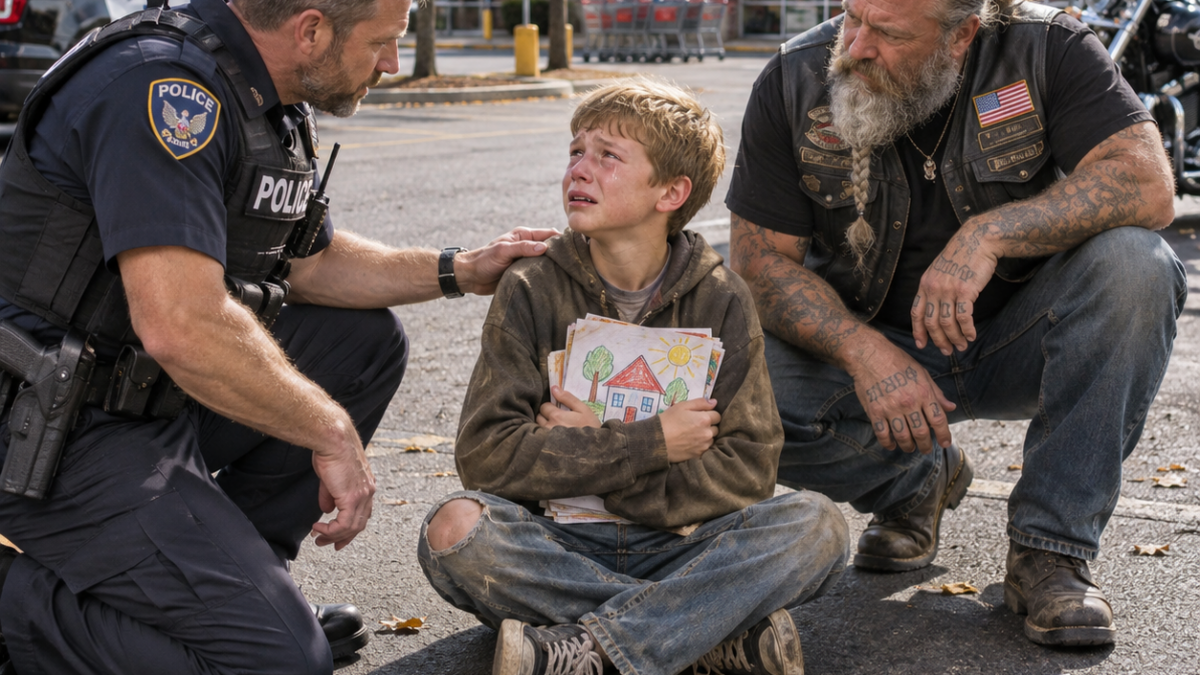
I Thought a Biker Was Luring a 10-Year-Old With Cash—Then I Saw What the Boy Was Hiding in His Hands
I was the officer who came into that supermarket parking lot convinced I was interrupting something predatory—a 250-pound biker, a frightened ten-year-old boy, a thick wad of cash changing hands—and I had my hand near my belt before my cruiser door had fully closed.
Then I knelt in front of the boy and saw what he was hiding behind his back: a stack of crayon drawings he had made himself, because his mother was sick, they could not afford her medicine, and a ten-year-old had somehow decided the only way to save her was to sell the one thing in the world that belonged entirely to him.
The biker had bought every drawing for ten times what Marcus was asking, but what stayed with me was what he did next—because instead of handing the child money and riding away, Diesel looked at me, the same cop who had nearly treated him like a predator, and said, “Officer, can you please take that boy home and make sure his mama gets real help?”
I have been a police officer long enough to know how dangerous certainty can be.
Not confidence.
Certainty.
They are different things.
Confidence says you have training, experience, and a responsibility to act when the facts in front of you point toward danger.
Certainty says you already know the whole story before anyone has opened their mouth.
The first can save a life.
The second can ruin one.
I learned that in a supermarket parking lot because of a ten-year-old boy named Marcus and a biker everybody called Diesel.
His real name was Ray.
I did not learn that until later.
To almost everyone who knew him, he had been Diesel for thirty years.
Long-haul mechanic.
Motorcycle rider.
Big enough that people moved slightly when he walked past.
Heavy beard.
Tattooed arms.
Leather vest.
Hands like wrenches.
If you saw him from fifty feet away and knew nothing else, your brain made decisions.
Mine did.
That is why I am telling this honestly.
I am not going to pretend that because the truth eventually became beautiful, I behaved as though I knew it from the beginning.
I did not.
I thought I was responding to a possible child predator.
The call came in a little after noon.
I was two streets over, finishing a traffic warning.
Dispatch said there was a suspicious adult male giving cash to a child in the supermarket parking lot.
Young boy.
Possibly alone.
Caller believed the adult might be trying to lure him.
Those are the kinds of words that erase whatever tiredness you were carrying five seconds earlier.
Child.
Alone.
Cash.
Luring.
I acknowledged the call and started moving.
There are things police officers can respond to calmly.
Loose dog.
Minor property damage.
Noise complaint.
Fender bender with nobody hurt.
Then there are words that change your pulse immediately.
Child in danger is one.
Anybody who has worked patrol knows that feeling.
You can tell yourself to slow your breathing.
You can remind yourself that dispatch information is incomplete.
You can say:
Observe first.
Assess.
Do not jump.
But your body is already preparing for the worst thing.
I pulled into the lot faster than I normally would.
Not recklessly.
Urgently.
PART2:
The supermarket sat in a shopping center outside Oklahoma City, the kind of place with a wide parking lot, two cart corrals, a pharmacy sign glowing red near one entrance, and more asphalt than shade.
Midday.
Bright.
A handful of people loading groceries.
Cars moving slowly.
I spotted them almost immediately.
The biker was impossible to miss.
Large man.
Black leather.
Jeans.
Boots.
Gray-black beard.
Motorcycle parked maybe forty yards away.
The boy stood in front of him.
Small.
Thin.
Ten, I would learn.
Maybe I would have guessed nine or eleven.
He held something behind one leg.
The biker had cash in his hand.
Then I saw him put money toward the boy.
The boy took it.
Immediately tried to hide it.
That was the moment every alarm in my head lit up.
A frightened child hiding money handed to him by a large adult stranger.
You do not need a vivid imagination.
I stopped the cruiser.
Got out quickly.
“Sir.”
The biker turned.
“Step back from the child.”
He did.
Immediately.
That mattered later.
At the time, I was too focused to appreciate it.
No argument.
No:
What did I do?
No hands raised in outrage.
No movement toward me.
He simply stepped back.
Hands open.
The boy looked at me.
His face changed.
Panic.
Real panic.
That seemed to confirm everything.
“It’s okay,” I told the boy.
The biker said:
“Officer—”
“I need you to stay where you are.”
He stopped talking.
Again.
No escalation.
I moved between them.
My first concern was the boy.
“Hey, buddy.”
His eyes dropped.
“What’s your name?”
No answer.
I crouched.
Police uniforms look different from a child’s height.
Adults forget that.
We think crouching is enough to become less intimidating.
It helps.
The badge is still there.
Radio.
Belt.
Gun.
Everything telling a kid:
Authority.
He clutched something against his stomach.
“I’m not mad at you.”
That made it worse.
His eyes filled.
“I didn’t steal it.”
That was the first thing Marcus said to me.
Not:
That man scared me.
Not:
Help.
Not:
He tried to take me somewhere.
“I didn’t steal it.”
I remember that sentence because it was the first crack in the story I had already written.
I softened my voice.
“Okay.”
“What didn’t you steal?”
“The money.”
I looked at the biker.
He stayed where I had put him.
Maybe ten feet away.
Hands visible.
Watching Marcus.
Not me.
The boy tried to push the cash deeper into his pocket.
There were too many bills for the small pocket.
Several folded out.
I asked:
“Did he give you that?”
Marcus nodded.
Then immediately said:
“He bought them.”
“Bought what?”
That was when he showed me the drawings.
A stack.
Maybe fifteen.
Maybe more.
Cheap printer paper.
Notebook paper.
One sheet looked torn from a school pad.
Crayon.
Markers.
Pencil.
Kid art.
A dog with legs of different lengths.
A bright red truck.
A house with blue windows.
A motorcycle.
A sunset made almost entirely orange.
A woman with yellow hair standing beside a little boy.
A tree.
A superhero.
A picture of what I think was supposed to be a horse.
Some were folded at the corners.
Some wrinkled.
Every one hand-drawn.
Marcus held them like evidence.
“He bought all of them.”
I looked over my shoulder.
Diesel nodded once.
I looked back at Marcus.
“You’re selling drawings?”
Another nod.
“Why?”
That was when fear finally became tears.
Marcus looked toward the store.
Then at my uniform.
“I can leave.”
I was confused.
“What?”
“I can leave.”
His voice broke.
“Please don’t call the manager.”
Something in my chest shifted.
“I’m not calling the manager.”
“I wasn’t inside.”
“Okay.”
“I didn’t make a table.”
“Okay.”
“I know I’m not supposed to sell stuff.”
There it was.
The fear.
Not Diesel.
Me.
Marcus had not been terrified because a biker was handing him cash.
He was terrified because a police officer had arrived and he thought his little business had been discovered.
I glanced toward the adults watching.
A woman stood beside an open SUV trunk.
Another person had stopped pushing a cart.
Somebody had called us.
From their angle, they saw what I saw.
Large biker.
Small child.
Money.
Fear.
We were all wrong.
At least partly.
I asked Marcus:
“How long have you been out here?”
He shrugged.
“Since after breakfast.”
“By yourself?”
Nod.
“Does your mom know?”
Silence.
That concerned me.
“Marcus?”
He wiped his nose on his sleeve.
“She’s sleeping.”
“Where?”
“At home.”
“Is she okay?”
That was the wrong question.
He immediately started crying harder.
Not loud.
He was trying to stop it.
Children trying not to cry can be harder to watch than children screaming.
“She’s sick.”
I lowered myself fully onto one knee.
“What kind of sick?”
“I don’t know.”
“Is she awake when you leave?”
“Sometimes.”
“Does she have medicine?”
His face collapsed.
“No.”
The word came out tiny.
I looked at the biker again.
Diesel’s jaw was tight.
He knew what was coming.
He had already heard it.
I turned back to Marcus.
“Why doesn’t she have medicine?”
“It’s too much.”
“Too expensive?”
Nod.
“So you’re selling your pictures?”
Another nod.
“For her medicine?”
“Yes.”
That was the moment the call transformed.
Not gradually.
Completely.
One second, I was investigating possible luring.
The next, I was kneeling in front of a ten-year-old child who had been trying to solve American health care with crayons.
There are scenes police academy training does not prepare you for.
You learn procedure.
Law.
Officer safety.
Reports.
Use of force.
Traffic.
Domestic calls.
Interviewing.
You do not learn what to say when a child tells you:
My mother needs medicine and I thought I could draw enough pictures to buy it.
I asked:
“How much are you selling them for?”
Marcus looked embarrassed.
“Two dollars.”
“Each?”
“Yes.”
“Have you sold any?”
He looked at the ground.
“Three.”
Before Diesel.
Three drawings.
Six dollars.
A morning in a parking lot.
Approaching strangers.
Getting waved away.
Trying again.
Six dollars.
I wanted to ask why no adult had noticed earlier.
Then I remembered an adult had noticed.
He was standing ten feet away in a leather vest.
I stood.
“Sir.”
Diesel looked at me.
“You bought these?”
“All of them.”
“For how much?”
He shrugged.
Marcus answered.
“He gave me a lot.”
Diesel looked at the boy.
“Kid.”
Marcus stopped.
The biker’s voice was deep but not harsh.
“That’s your money.”
Then to me:
“I paid for the pictures.”
“How much?”
He looked uncomfortable.
I waited.
Finally:
“Couple hundred.”
Marcus had been asking two dollars a drawing.
Diesel had paid roughly ten times what the stack would have brought at asking price.
Maybe more.
I asked:
“Why?”
Diesel gave me a look that suggested he did not consider that a useful question.
“Because I wanted the drawings.”
“You wanted fifteen crayon drawings?”
“However many there are.”
“How many?”
Marcus whispered:
“Eighteen.”
Diesel nodded.
“Eighteen.”
I should say something here about police instinct.
Even after the explanation changed, part of my brain remained cautious.
That is supposed to happen.
A kind story is not evidence by itself.
Children can be coached.
Adults can invent explanations.
So I asked Marcus separately:
“Do you know this man?”
“No.”
“Did he ask you to go anywhere?”
“No.”
“Did he touch you?”
“No.”
“Did he ask for your address?”
“No.”
“Phone number?”
“No.”
“Did he tell you to keep anything secret?”
“No.”
“What did he say?”
Marcus looked at Diesel.
Then at me.
“He asked how much my pictures were.”
“And?”
“I said two dollars.”
“And then?”
“He asked why I was selling them.”
“What did you tell him?”
“About Mom.”
“And then?”
“He said he wanted all of them.”
“Anything else?”
Marcus thought.
“He said don’t stop drawing.”
That was it.
No grooming.
No invitation.
No secret.
No inappropriate contact.
No luring.
Just an adult buying art.
Generously.
I walked toward Diesel.
“Can I talk to you over here?”
He followed.
A few yards away.
Marcus remained where I could see him.
I said:
“You understand why this looked bad.”
“Yep.”
That answer caught me.
No anger.
“You’re not upset?”
“At you?”
“At anybody.”
He glanced around the parking lot.
“Big guy like me handing cash to a nervous kid.”
He shrugged.
“I get it.”
That should have embarrassed me more than anger would have.
I asked for identification.
He handed it over.
Raymond something.
But the card confirmed what mattered.
No immediate issue.
He said:
“Everybody calls me Diesel.”
“Why?”
“Mechanic.”
Long-haul truck work.
Motorcycles.
Thirty years.
I ran his information.
Nothing came back that changed the situation.
While we waited, I asked:
“You always spend a couple hundred dollars on children’s drawings in parking lots?”
“No.”
“Then why today?”
He looked at Marcus.
Long pause.
Then:
“Because I used to be that kid.”
I did not understand yet.
“What do you mean?”
Diesel rubbed his thumb along the edge of one of the drawings he had kept in his hand.
It was the motorcycle drawing.
Thick black circles for wheels.
Orange flame-looking lines near the tank.
A rider with arms sticking straight out.
Diesel looked at it like it was worth examining.
“When I was little, I made stuff.”
“Drawings?”
“Drawings. Little things out of scrap. Whatever.”
He looked at his boots.
“Wasn’t good.”
“That doesn’t explain—”
“My old man used to tell me it was garbage.”
The sentence changed the air.
Diesel continued.
“Anything I made.”
He laughed once.
No humor.
“Waste of paper. Waste of time. Waste of everything.”
I waited.
“I believed him.”
“How long?”
He looked at me.
“Too long.”
That was the first time I saw past the leather.
Not because leather meant anything.
Because pain does.
Once you recognize pain, appearance becomes less relevant.
Diesel looked toward Marcus again.
“He’s out here showing people what he made.”
“Trying to help his mom.”
“Yeah.”
“And people were turning him down.”
“Most.”
That bothered him.
I could hear it.
Diesel said:
“You know what happens when you’re a kid and enough people tell you something you made is worthless?”
I did.
But I let him answer.
“You stop thinking they’re talking about the thing.”
He tapped the paper.
“You start thinking they’re talking about you.”
That sentence has stayed with me longer than many things I heard in uniform.
He continued:
“I wasn’t going to watch that happen to him.”
“So you bought everything.”
“Yep.”
“For ten times the price.”
“He priced it wrong.”
I almost smiled.
Diesel did not.
To him, this was not charity.
That mattered.
He was not saying:
Poor kid. Here’s money.
He was saying:
Your work has value.
Maybe not market value.
Something more important for a ten-year-old.
Proof that someone could look at what he created and choose it.
I asked:
“Did you tell him that?”
Diesel shrugged.
“Told him to keep drawing.”
“That’s it?”
“Kid doesn’t need my life story.”
I disagreed.
Maybe Marcus did not need it then.
I did.
Because my initial assumptions were still sitting uncomfortably inside me.
I had arrived expecting to save Marcus from Diesel.
Instead, Diesel had protected something in Marcus I had not even noticed was at risk.
Not his body.
His dignity.
Then Diesel said:
“Officer.”
“Yes?”
“Can you do me a favor?”
Here it comes, I thought.
Maybe ride.
Maybe confirmation he was clear.
Instead:
“Take him home.”
I looked toward Marcus.
“You know where he lives?”
“No.”
“Then why—”
“Because he’s ten.”
Simple.
Diesel continued:
“He shouldn’t be walking around with that much cash.”
Fair.
“And his mom’s sick.”
Also fair.
“He says she doesn’t have medicine.”
“Yes.”
“Cash is going to last what?”
He gestured.
“A week? Two? I don’t know what she needs.”
Neither did I.
Diesel lowered his voice.
“I don’t want to just give him money and leave him thinking he has to do this again next month.”
That was when kindness became responsibility.
Buying the drawings had been generous.
This was smarter.
Diesel understood the obvious thing I had not gotten to yet.
Marcus’s problem was not art sales.
It was a household crisis.
A sick parent.
A child carrying adult responsibility.
No medication.
No support reaching them.
The money might buy a prescription.
Then what?
Next refill?
Next bill?
Food?
Utilities?
What if his mother’s condition worsened?
What if Marcus was alone with her?
A ten-year-old had already decided he was responsible for fixing everything.
That had to stop.
Diesel said:
“Can you make sure somebody checks on her?”
“Yes.”
“And don’t take the money from him.”
“I wasn’t planning to.”
“He earned it.”
The way he emphasized earned made me understand how seriously he was protecting Marcus’s pride.
I nodded.
“I’ll take him home.”
Diesel looked relieved.
Not triumphant.
Relieved.
Then he held up the stack.
“I’m taking these.”
I smiled.
“You paid.”
“Exactly.”
I walked back to Marcus.
He looked between us.
“Am I in trouble?”
“No.”
His shoulders dropped slightly.
“Are you going to tell the store?”
“No.”
More relief.
“But I need to take you home.”
Immediate worry.
“My mom’s sleeping.”
“I know.”
“You’ll wake her.”
“Probably.”
“She’ll be mad.”
“She might.”
“I don’t want her to know.”
That sentence told me something else.
Marcus had not been sent out to sell drawings.
His mother had not turned her child into a fundraiser.
This had been his idea.
He was protecting her too.
“Marcus, I have to make sure she’s okay.”
“She is.”
“You said she’s sick.”
He looked trapped by his own honesty.
I softened.
“You’re not in trouble.”
“Neither is she.”
“But you’re ten.”
“You can’t be responsible for her medicine by yourself.”
His eyes dropped.
“I can help.”
“I know.”
That was important.
I did not say:
You’re just a kid.
Adults often say that when children are trying to contribute.
It can sound like:
You are useless.
Marcus had already been proving the opposite.
He could help.
He had helped.
But help and responsibility are not the same thing.
I said:
“You did help.”
He looked up.
“You made these.”
I pointed toward Diesel.
“He bought them.”
“You earned money.”
“But there are other adults whose job is to help too.”
Marcus considered that.
Children hear fairness even when they do not understand bureaucracy.
“What adults?”
“Me, for one.”
Then Diesel stepped closer.
Carefully.
He did not approach until I nodded.
Marcus looked at him.
Diesel held up one drawing.
The motorcycle.
“This one goes in my garage.”
Marcus blinked.
“Really?”
“Yep.”
“You don’t have to.”
“I paid two dollars.”
Marcus looked confused.
“You paid more.”
Diesel shrugged.
“Tip.”
That finally got a tiny smile out of Marcus.
I wish I could tell you everybody in the parking lot applauded.
They did not.
Real life is rarely organized enough for applause.
Some people went back to loading groceries.
The woman who had called remained nearby.
She looked embarrassed.
She eventually approached me.
“Officer?”
I turned.
“I was the one who called.”
“Okay.”
“I thought—”
“I understand.”
She looked at Diesel.
“I thought he was—”
“I understand.”
Diesel heard.
He nodded at her.
No resentment.
She looked near tears.
“I’m sorry.”
He answered:
“You called because you were worried about the boy.”
“Yes.”
“Then don’t be sorry.”
That made two people he had forgiven within twenty minutes for assuming the worst.
Me included, though I had not apologized yet.
I said:
“Diesel.”
He looked at me.
“I came in hard.”
“You’re a cop.”
“That isn’t an excuse for everything.”
“No.”
“I was wrong about you.”
He shrugged.
“Looked bad.”
“That doesn’t make me less wrong.”
This time, he actually smiled.
A little.
“Then we’re good.”
That was the entire reconciliation.
No speech.
No demand.
He had no interest in making anybody suffer for misunderstanding him.
Maybe because he had spent a lifetime being misunderstood.
Maybe because he did not care.
Probably both.
I put Marcus in the rear seat of my cruiser.
Not because he was detained.
Because I was driving him home.
He kept the money in his pocket.
I gave him the drawings back first without thinking.
Diesel immediately said:
“Hold on.”
I looked.
He reached for them.
Marcus laughed.
“You bought them.”
“Exactly.”
Diesel tucked all eighteen under his arm.
I asked:
“You have somewhere to put those?”
“Garage walls.”
“You’re serious.”
He looked offended.
“Officer.”
Apparently this was obvious.
Marcus stood beside the cruiser.
“Can I make you another one?”
Diesel froze.
That was the first moment I saw emotion hit him hard.
He recovered quickly.
“Sure.”
“What do you want?”
Diesel looked at his motorcycle.
Then at Marcus.
“Draw whatever you want.”
Marcus thought.
“Okay.”
Diesel nodded.
“That’s the rule.”
I did not understand what he meant until later.
Draw whatever you want.
Not:
Draw something worth money.
Not:
Make something people like.
Whatever you want.
It was exactly what nobody had given Diesel as a child.
Before leaving, I asked for his number for the report.
He gave it reluctantly.
I asked if I could contact him about the family.
He said:
“If there’s something they need and you’re allowed to tell me.”
Then immediately:
“But don’t tell the kid I’m paying for stuff.”
I laughed.
“You just handed him two hundred dollars.”
“Bought art.”
“Right.”
“Different.”
To Diesel, it truly was.
Charity could make Marcus feel small.
Commerce, even wildly generous commerce, let him feel capable.
That distinction mattered more than I realized.
Marcus gave me directions.
They lived less than two miles away.
Small rental duplex.
Older neighborhood.
Patchy lawns.
Cars parked along curbs.
The kind of block where nobody has much privacy because windows and porches sit close.
Marcus became increasingly nervous as we approached.
“She’s going to be mad.”
“Maybe.”
“Can you not tell her I went to the store?”
“I have to tell her where I found you.”
He groaned.
Ten-year-old.
Heroic enough to sell art for medicine.
Still worried about being grounded.
That normality almost broke me.
He was not some miniature saint.
He was a kid.
A kid who should have been playing video games, complaining about homework, or asking for snacks.
Instead he had spent a morning negotiating art sales.
We pulled up.
Marcus’s front door was unlocked.
He called:
“Mom?”
No answer.
Then louder.
“Mom?”
I felt my body shift again.
Officer mode.
I told Marcus to stay behind me.
He did not want to.
“That’s my mom.”
“I know.”
“Stay here.”
He listened.
Inside was quiet.
Small living room.
Blanket on couch.
Prescription bottles on a table.
Some empty.
Utility mail.
A school backpack.
Nothing that immediately suggested neglect.
It suggested exhaustion.
We found Marcus’s mother in the bedroom.
Alive.
Breathing.
Very weak.
She woke when I called her name.
Disoriented at first.
Then saw uniform.
Then Marcus.
Panic.
“Marcus?”
He ran past me.
I let him.
She tried to sit up.
“What happened?”
“Nothing.”
Marcus climbed beside her.
“I’m okay.”
She looked at me.
“What happened?”
I explained slowly.
Parking lot.
Drawings.
Biker.
Money.
Her face moved through confusion, horror, humiliation, anger, grief.
She looked at Marcus.
“You went out there alone?”
He started crying.
“I needed your medicine.”
She covered her face.
That moment is private enough that I will not describe every part.
I will say this.
His mother did not thank him at first.
She apologized.
Again and again.
To Marcus.
For him feeling like he had to solve it.
That mattered.
She had not asked her son to become responsible for her medical care.
She had been trying to protect him from how bad things had become.
Adults often believe children do not know because adults do not explain.
Children know.
Maybe not details.
They know something is wrong.
Marcus knew the medication bottle was empty.
He knew his mother was worse without it.
He knew money was the reason.
That was enough.
He formed a plan.
Crayons.
The arithmetic of childhood.
Medicine costs money.
Pictures can be sold.
Therefore pictures equal medicine.
He had no idea how heartbreaking that logic was.
His mother did.
She held him and cried.
I called EMS because her condition concerned me.
I will not name her diagnosis.
The source family kept parts of that private, and rightly so.
What mattered was that she had an ongoing illness requiring regular medication and medical follow-up.
They had fallen into a gap.
Too much instability.
Not enough money.
Care interrupted.
Refills delayed.
Transportation problems.
Paperwork.
All the things that sound solvable individually until a sick person has to solve them simultaneously.
EMS evaluated her.
She needed medical attention.
Not because Marcus had left her alone for a few hours.
Because the underlying illness had been inadequately managed.
While paramedics worked, I contacted our department’s community-resource officer.
Then a hospital social worker became involved.
That began the chain Diesel had asked for.
Real help.
Not perfect help.
I do not want to make systems sound magical.
They are not.
There were forms.
Eligibility questions.
Calls.
Follow-ups.
Transportation assistance.
Prescription support.
Benefits review.
Medical appointments.
Community programs.
It took work.
But wheels started turning.
That was the difference.
Marcus had been pushing alone.
Now adults were pushing.
His mother kept asking about the money.
Marcus pulled the folded bills from his pocket.
Her eyes widened.
“Where did this come from?”
“I sold my pictures.”
“All of them?”
“Yes.”
“To who?”
“The biker.”
She looked at me.
I nodded.
“He paid well.”
She began crying again.
“He can’t—”
“He already did.”
“I need to give it back.”
“No.”
“Officer, I can’t take—”
“He didn’t give you money.”
That sounded absurd even as I said it.
“He bought eighteen drawings.”
“For two hundred dollars?”
“Apparently he values art.”
Marcus almost smiled.
His mother did not.
She understood what had happened.
Pity was the thing she feared.
People who have struggled financially often develop complicated pride because charity can feel like a spotlight pointed at everything going wrong.
I told her:
“He asked me to make sure your family got connected with support.”
That made her close her eyes.
“Why?”
“Because he met your son.”
That was the simplest truth.
Diesel did not know her.
Marcus was enough.
Later that afternoon, after the initial medical situation stabilized, I called Diesel.
He answered over engine noise.
“Yeah?”
“It’s me.”
“Cop?”
I laughed.
“Officer Bennett.”
Let’s call me Bennett here; my specific name isn’t important to the point.
“Right.”
“You riding?”
“Stopped for fuel.”
“Marcus’s mom is getting care.”
Silence.
Then:
“Good.”
“We’re connecting them with support.”
“Good.”
“The boy’s safe.”
“Good.”
Three goods.
That was apparently the emotional range he intended to provide.
I said:
“She wants to thank you.”
“No.”
“I figured.”
“Tell her kid draws good motorcycles.”
“You know that isn’t true.”
Pause.
Then Diesel laughed.
First real laugh.
“Don’t tell him.”
I asked:
“Can I ask you something?”
“You already have.”
“Why exactly ten times?”
“I didn’t calculate.”
“You gave him about ten times what he asked.”
Diesel was quiet.
Then:
“He was asking too little.”
There was the line again.
Not generosity.
Valuation.
“He needs to know his work matters.”
I said:
“You really believe that.”
Diesel’s voice changed.
“Officer.”
“Yeah?”
“When you’re little, you don’t know the difference between somebody saying your drawing is trash and saying you are.”
I did not answer.
He continued:
“You’re the adult.”
“You know they’re talking about paper.”
“The kid doesn’t.”
That was probably the most important thing Diesel told me.
Adults underestimate how literal children make our judgments.
We say:
That’s stupid.
They hear:
I’m stupid.
We say:
Your drawing is bad.
They hear:
Something I made from inside myself deserves ridicule.
Diesel had carried that for decades.
He told me more later.
Not all at once.
A father who had no patience for creative things.
A household where usefulness was measured narrowly.
Work with your hands if it produced money.
Do not waste time drawing.
Do not make silly things.
He learned mechanical work.
Got good at it.
Very good.
Built engines.
Welded.
Repaired rigs.
Worked long-haul maintenance.
Ironically, those were creative skills too.
You cannot solve mechanical problems without imagination.
But nobody had called it creativity when he was young.
He believed for years that the things he wanted to make for no practical reason were worthless.
Somewhere along the way, he stopped drawing.
He still remembered.
That was why Marcus mattered.
A ten-year-old had done something Diesel had once been trained not to do.
He had put his work in front of strangers.
Not confidently.
Terrified.
But he did it.
Diesel was not going to be another adult who waved him away.
That was personal.
The woman who had made the original call eventually found Marcus’s family through proper channels and apologized for her assumption.
She also bought one of Marcus’s later drawings.
Paid normal price.
Marcus apparently charged five dollars by then.
Inflation.
Diesel had permanently damaged his pricing model.
The story moved around locally.
Then online.
A witness posted about it.
I was careful with what I said publicly because Marcus was a child and his mother’s health was private.
Diesel wanted nothing to do with attention.
When someone asked him for a photo, he declined.
When a local page called him a hero, he complained.
Not performatively.
Actually annoyed.
He said:
“Marcus is the hero.”
People say that kind of thing all the time.
In Diesel’s case, I think he meant it.
He thought spending a few hundred dollars was easy.
Marcus walking into that parking lot with drawings was hard.
That distinction mattered to him.
He kept saying:
“Tell it about the kid.”
So I do.
Marcus was ten.
He loved his mother enough to notice what adults were trying to hide.
He did not understand insurance.
Prescription-assistance programs.
Income eligibility.
Transportation systems.
He understood crayons.
So he used crayons.
That should never have been necessary.
But bravery often appears where systems failed first.
I do not romanticize that.
A ten-year-old should not have to rescue his sick parent financially.
The beautiful part is not that Marcus had to try.
The beautiful part is that when he did, somebody saw him clearly.
And then made sure he no longer had to carry it alone.
The support network eventually stabilized the immediate crisis.
His mother got the treatment and medication she needed.
They were connected with ongoing assistance.
Things did not become rich and easy overnight.
That is not how poverty works.
But emergency became management.
There is a massive difference.
Marcus went back to school without needing to spend mornings approaching strangers.
That was the outcome I cared about most.
Childhood returned.
Not perfectly.
Enough.
Then something happened I did not expect.
Diesel stayed.
Not physically.
He lived outside town and traveled for work.
But he checked in.
Sometimes through me initially.
Then eventually through the family, after Marcus’s mother became comfortable with it.
He did not become some controlling benefactor.
He did not throw money at every problem.
He asked about school.
Drawings.
He encouraged Marcus to keep making art.
That mattered more than money after the crisis.
A few months after the parking-lot call, I saw Diesel again.
He was at a community event.
Same bike.
Same vest.
Marcus ran toward him carrying a folder.
Diesel looked alarmed.
Not because Marcus was running.
Because of the folder.
More drawings.
Marcus had made one specifically for him.
A semi-truck.
Black.
Huge exhaust pipes.
Driver with an impossible beard.
At the top Marcus had written:
DIESEL’S TRUCK.
Diesel stared.
“How much?”
Marcus grinned.
“Free.”
Diesel shook his head.
“No.”
“It’s a gift.”
“Nope.”
“Why?”
Diesel looked around as if asking adults for help.
Nobody helped.
Finally:
“Artists get paid.”
Marcus crossed his arms.
“Friends get gifts.”
Diesel was trapped.
I enjoyed watching.
He eventually accepted it.
No money.
A rare defeat.
Later I learned he framed it.
That was not the only one.
Every drawing from that first day ended up framed.
Not expensive gallery frames.
Some simple black frames.
Some cheap ones.
Several in Diesel’s garage.
Some in his house.
He treated them like collection pieces.
Motorcycle.
Dog.
House.
Superhero.
Orange sunset.
The woman and boy.
He never threw them into a drawer.
That is significant because children notice whether adults mean praise.
You can say:
That’s beautiful.
Then throw the paper away.
The trash can tells the truth.
Diesel kept the evidence.
Marcus saw photographs of the garage.
His drawings on the wall between motorcycle parts, metal signs, tools, and old racing photos.
You could see his face change.
Someone had not only paid for his art.
Someone displayed it.
That is a different kind of validation.
One drawing never made the wall.
The first one.
The motorcycle.
Diesel carried that one.
Inside his vest.
Pocket over his chest.
I learned about it months later.
We were talking outside a diner after an event.
He reached into the inner pocket for something.
The paper came out partly.
I recognized the crayon wheels.
“You carry that?”
He looked annoyed that I noticed.
“Sometimes.”
“Every day?”
“Most.”
“Why?”
He pushed it back.
“None of your business.”
I knew him well enough by then to wait.
Silence can do more than questions.
Eventually he said:
“It’s not really his.”
“What?”
“The picture.”
“Marcus drew it.”
“I know.”
“Then whose is it?”
Diesel looked away.
“The one nobody kept for me.”
That stopped me.
He did not elaborate.
He did not need to.
He carried Marcus’s drawing for Marcus.
And for the boy he had once been.
The kid whose art had gone into trash.
The kid who learned not to show people.
The kid who became a mechanic instead of whatever else he might have become.
Not because mechanics are lesser.
Diesel loved his work.
But part of him had been shut down unnecessarily.
Marcus reopened it.
That is what people missed when they reduced the story to:
Biker buys drawings.
He was not only helping Marcus.
He was revisiting his own childhood and making a different choice at the point where Marcus’s path crossed his.
That is one of the few forms of healing available to adults.
You cannot go backward and give your younger self a better parent.
You can become a better adult for the child standing in front of you.
Diesel did.
I thought about that in my own work.
How many kids had I encountered in uniform while assuming what they needed?
How many frightened children did I ask questions too quickly?
How many times had I focused on compliance before context?
Police work requires control sometimes.
It also requires listening.
Marcus made me better at the second.
Since that day, when I see a child hiding something, I remember that hidden does not automatically mean guilty.
Sometimes the thing behind the back is eighteen crayon drawings and a plan to save Mom.
You ask.
Then listen.
I also think about Diesel whenever I find myself reading a person from appearance.
Do I still notice tattoos?
Yes.
Size?
Yes.
Behavior?
Of course.
Officer safety does not mean pretending visual information does not exist.
The lesson is not:
Never be suspicious of a biker.
The lesson is:
Suspicion is the beginning of investigation, not the conclusion.
I approached Diesel correctly in one sense.
Potentially vulnerable child.
Separate adult.
Check.
Ask.
Verify.
Where I was wrong was internal.
I felt too sure too fast.
That matters because internal certainty leaks into tone.
Body language.
Respect.
Diesel did nothing to punish me for it.
He could have.
He had every reason to say:
You saw beard and leather and decided monster.
He mostly shrugged.
He had lived with that.
That itself was sad.
When the story circulated more widely, comments focused heavily on people judging Diesel.
Some were fair.
Others turned him into another stereotype in reverse.
Scary biker actually angel.
Diesel hated that too.
He said:
“I’m neither.”
That may be the healthiest interpretation.
He was a man.
Big.
Tattooed.
Rough-looking.
Capable of kindness.
Capable of irritation.
Past mistakes.
Good decisions.
Like everyone else.
The goal should not be to replace one stereotype with another.
Just stop assuming a costume tells the whole person.
Marcus eventually learned the full story of why Diesel bought the drawings.
At first, nobody told him all of it.
He was ten.
He needed support, not another adult’s childhood burden.
As he got older, Diesel explained pieces.
Marcus asked:
“Did your dad really say your drawings were bad?”
Diesel answered:
“Yep.”
“Were they bad?”
“Probably.”
Marcus looked shocked.
Then Diesel said:
“Didn’t matter.”
That was perfect.
Art does not need to be good to deserve encouragement from a child.
Children create to discover themselves.
If quality is the only gate, most will stop before they improve.
Marcus understood.
He started drawing more.
Not because Diesel told him he was a prodigy.
He did not.
He told him:
“You’re an artist because you make art.”
That’s all.
Marcus drew after school.
Cars.
Motorcycles.
People.
Animals.
Comics.
Some better than others.
Diesel bought pieces occasionally.
Not every one.
That mattered too.
If he bought everything forever, it would become charity disguised as commerce.
Instead he treated Marcus like a developing artist.
“What are you charging?”
“Ten.”
“For this?”
“Yes.”
“Too much.”
Marcus would argue.
Diesel would laugh.
Other times:
“Too cheap.”
Negotiation.
Worth.
Normality.
That gave Marcus something beyond rescue.
A craft.
A relationship with his own work.
I saw him one afternoon maybe a year later with a folding table.
That got me.
The first day, he had been too scared to set up a table because he thought somebody would chase him off.
Now he had one.
Not in the supermarket lot.
At a community fundraiser with permission.
A small sign:
MARCUS’S ART — $5-$15.
His handwriting.
Drawings clipped to poster board.
Diesel arrived late.
Looked at the table.
Then looked at me.
“Problem.”
“What?”
“He has prices now.”
“You started this.”
“Bad idea.”
Marcus saw him.
“Diesel!”
There was no fear.
That was the transformation.
The first parking lot:
Boy small.
Trying not to be seen.
Money hidden.
Authority terrifying.
Now:
Table.
Sign.
Prices.
Voice.
He waved at people.
Explained drawings.
Sold some.
Kept drawing while sitting there.
His mother sat nearby.
Healthy enough to attend.
That mattered most.
She was still managing illness.
But she was there.
Not a crisis behind a bedroom door.
She thanked Diesel again that day.
He still struggled with thanks.
She had learned how to handle him.
Instead of:
You saved us.
She said:
“Marcus sold twelve drawings today.”
Diesel brightened.
“How much?”
She told him.
“Good.”
That was thanks he could accept.
Results.
The money from Marcus’s art eventually stopped being about medicine.
That was important.
He started saving for art supplies.
A better marker set.
Sketchbooks.
One year he saved toward a tablet.
His mother insisted he keep the money.
Children should be allowed to have goals that are not household survival.
The first time Marcus used his art money to buy something purely for himself, he felt guilty.
His mother told me that.
He had spent years, even if only one dramatic period was visible to outsiders, watching money as a family emergency.
Buying something fun felt wrong.
Diesel talked to him.
I do not know the exact words.
Marcus later summarized:
“He said helping people doesn’t mean you have to disappear.”
That sounds like Diesel.
Maybe someone should have told him the same when he was young.
The relationship between him and Marcus became guardian-like, though Diesel rejected that word publicly.
He was not replacing anybody.
He was a steady adult.
That is enough.
Marcus’s mother made the boundaries.
Diesel respected them.
No secret communication.
No taking Marcus places without permission.
No grand gestures that made the family dependent.
That matters in any story involving a child and unrelated adult.
Kindness is safest when it welcomes accountability.
Diesel never objected.
In fact, he preferred structure.
Maybe because of how the first call began.
He understood how things could look.
He also understood Marcus had a mother.
Her authority mattered.
Over time, I stopped being the cop in their story and became someone who occasionally saw the edges.
That’s healthier.
Police should not remain central after a family has resources.
The goal is not to become indispensable.
It is to help stabilize and leave people with more options.
Diesel understood that too.
He did not want to be the one-time hero.
But he also did not want to be the center.
His help pointed outward.
Social services.
Medical care.
Community.
School.
Art.
Not:
Depend on Diesel.
I respect that.
The first money eventually ran out.
Of course.
But by then it had done what emergency money does best.
It bought time.
Medication.
Immediate breathing room.
Then systems and people had to do the rest.
The story online sometimes simplified it to:
Biker saved sick mother.
That is not accurate enough.
He helped trigger a chain of support.
Doctors treated her.
Social workers navigated assistance.
Community programs helped.
Marcus’s mother did the exhausting work of continuing care.
Marcus went back to being a kid.
Diesel started the motion.
He did not single-handedly fix a family’s life.
Real life is collaborative.
That makes the story better, not worse.
Because Diesel’s wisest decision was recognizing that.
He could have handed over money and congratulated himself.
Instead he asked:
What happens after the money?
That question is the difference between charity and care.
I started asking it more often on calls.
Homeless person gets a meal.
Then what?
Family gets emergency hotel.
Then what?
Domestic survivor gets transportation.
Then what?
Not every police officer can solve the “then what.”
Often we cannot.
But asking reveals whether the problem has actually changed.
Diesel, a mechanic in a parking lot, reminded me of that.
Marcus is older now.
Still draws.
Better, obviously.
Kids improve when they keep going.
Diesel still has the originals.
The contrast is hilarious.
Early Marcus:
Giant heads.
Tiny hands.
Cars with transparent wheels.
Current Marcus:
Perspective.
Shading.
Details.
Diesel refuses to rank them.
Marcus asked:
“Which is your favorite?”
Diesel pulled the first motorcycle drawing from his vest.
“This one.”
Marcus groaned.
“That’s terrible.”
Diesel said:
“Watch your mouth.”
Marcus laughed.
“It’s mine.”
“Exactly.”
I love that.
The artist now criticizing his early work.
The man who once believed bad art meant bad child protecting the bad drawing as sacred.
Full circle without anybody needing to say it.
One day Marcus may become a professional artist.
Maybe not.
That is not the point.
Diesel did not help him so he would produce a career.
He helped him so creativity remained available.
Marcus could become a mechanic.
Teacher.
Accountant.
Doctor.
Whatever.
And still draw.
The victory is not:
Boy becomes famous artist because biker believed in him.
The victory is:
Boy never learned to be ashamed of making things.
That is enough.
The parking lot woman who originally called once told me:
“I still feel horrible.”
I said:
“Don’t.”
“Diesel said the same.”
“He’s right.”
She had seen a potentially dangerous situation involving a child and called.
That was reasonable.
The problem would have been refusing new information after it arrived.
She did not.
She apologized.
Then supported Marcus.
That is how we correct assumptions.
Not by pretending we never make them.
Everybody does.
Correct quickly.
That is integrity.
I told her:
“If you hadn’t called, I wouldn’t have met Marcus.”
“And his mom?”
“Maybe somebody else would have.”
“Maybe not.”
The misunderstanding itself helped bring resources.
Strange.
Not fate.
Just consequence.
A suspicious call became a welfare check.
A welfare check became medical connection.
That does not make the assumption good.
It makes the response useful.
Life often works through imperfect beginnings.
Diesel joked once that he got “profiled into social work.”
I laughed harder than he expected.
He said:
“Don’t put that in any article.”
I am putting it here.
Sorry, Diesel.
He also hates when people call him “heart of gold.”
He says gold is too soft for mechanical use.
Mechanic answer.
Somebody called him “heart the size of a truck.”
He tolerated that slightly more.
But the truth is his kindness is not soft in the sentimental sense.
It is practical.
Buy drawings.
Protect dignity.
Get officer.
Send kid home safely.
Connect mother to care.
Follow up.
Frame art.
That is working-man compassion.
Concrete steps.
I think that is why it was effective.
Marcus did not need pity.
He needed adults who did something.
There is a photograph from about a year after the incident.
Marcus standing beside Diesel’s Harley.
Not sitting on it.
Standing.
Holding a sketchpad.
Diesel has one arm crossed, the other hand pointing at something on the page.
If you did not know them, you might see what I saw the first day.
Large tattooed biker.
Small boy.
And maybe concern would rise again.
Context changes images.
That is the entire lesson.
Same visual.
Different truth.
The first day I thought:
Danger.
Now I think:
Mentor.
Neither can be known from appearance alone.
You need behavior.
That is what I teach younger officers now.
Observe behavior, not costume.
A polo shirt does not make a man safe.
Leather does not make him dangerous.
Uniform does not make me correct.
Behavior.
Facts.
Listen.
Marcus taught me that.
Diesel reinforced it.
The source story eventually spread far beyond Oklahoma.
People wrote comments about childhood poverty.
Artists wrote about parents throwing away drawings.
Adults remembered lemonade stands.
School projects.
Songs nobody encouraged.
One comment stuck with me:
“Tell kids their work matters before they decide they don’t.”
That captures something.
Children are always deciding what parts of themselves are safe to keep.
Adults influence that.
One laugh.
One insult.
One framed drawing.
You can alter a trajectory.
Not always dramatically.
Sometimes enough.
Diesel knew because he carried the negative version for decades.
Marcus got the positive one.
That is why the drawing in the vest matters.
It is not only Marcus’s first sale.
It is Diesel keeping something his younger self needed somebody to keep.
I asked him once whether he ever started drawing again.
He looked disgusted.
“No.”
“Why not?”
“Can’t draw.”
“That’s the whole point.”
He stared at me.
I had him.
Eventually, Marcus gave him a sketchbook.
Blank.
On the front, Marcus wrote:
BAD DRAWINGS ALLOWED.
Diesel pretended to hate it.
Marlena—his wife, who had heard the story enough times to become part of its extended circle—later told me he drew a motorcycle in it.
One motorcycle.
Terrible.
Marcus framed it.
That is justice.
Not courtroom justice.
Better.
The child returned the lesson.
Your bad drawing matters too.
Diesel complained for weeks.
He also kept the frame.
Of course.
I have thought about that first call on almost every shift since.
Not every minute.
That would be dramatic.
But certain scenes trigger it.
Kid selling candy.
Adult handing cash to teenager.
Biker outside convenience store.
Child looking nervous around police.
I remember Marcus.
I slow down mentally.
Not physically if danger requires speed.
Mentally.
What do I actually know?
What am I assuming?
What question changes the picture?
That habit has helped.
Once, I responded to a teenager sleeping in a parked car behind a strip mall.
Caller suspected drugs.
Turned out the kid worked an overnight bakery shift and was sleeping before school.
Different story.
Same lesson.
Ask.
Another call:
Man arguing with child near bus station.
Looked terrible.
Father trying to convince autistic son to leave after sensory overload.
Ask.
Police work gets better when uncertainty is tolerated long enough to gather facts.
Again, not hesitation when immediate action is necessary.
Just humility.
Diesel gave me that.
Funny considering I almost arrested him.
He likes reminding me.
“Remember when you thought I was stealing a kid?”
“Luring.”
“Worse.”
“You looked suspicious.”
“I was buying fine art.”
“Your taste is questionable.”
We are friendly now.
Not close friends.
I see him around.
He still rides.
Still works with engines more than retirement age probably recommends.
Marcus still calls him Diesel.
His mother calls him Ray.
I call him whatever annoys him.
One thing has never changed.
He refuses credit for the part of the story everyone loves.
Ask why he bought the drawings.
He gives the same answer.
“Because I used to be that kid.”
Then if you push:
“I wasn’t letting him think his stuff was worthless.”
Ask why he got the police involved.
“Kid needed adults.”
Ask why he stayed involved.
“Because he kept drawing.”
Ask about the picture in his vest.
Conversation over.
Some things remain private.
I respect that now.
Mostly.
Marcus’s mother is doing better.
I use those words carefully.
Chronic illness does not become fairy-tale health because strangers care.
She still has medical needs.
Still has hard days.
But the crisis that sent Marcus to the parking lot was addressed.
She has access to care.
Medication.
Support.
A network.
Most importantly, Marcus no longer believes her health rests on his ability to earn money.
That burden has been moved back where it belongs.
Adults.
Systems.
Community.
He helps his mother like children help parents.
Brings water.
Does chores.
Checks on her.
Normal love.
Not financial rescue.
There is a difference.
She once told me the hardest part was realizing Marcus had been watching her count pills.
She thought she had hidden the problem.
He had noticed.
Children always notice patterns.
She would skip a dose.
He saw.
She said she wasn’t hungry so he could eat.
He saw.
A bill got pushed under another paper.
He saw.
He did not understand the adult explanation.
He understood scarcity.
That realization changed how she talked to him.
Age-appropriate honesty.
Not burdening.
Not pretending.
There is evidence that children often imagine worse when adults hide everything.
Marcus’s plan had been born partly inside silence.
Now they talked.
She would say:
“The adults are handling the medicine.”
Marcus could ask.
Then go draw because he wanted to.
That is healthier.
He still sells art sometimes.
But now the money is his.
That feels like the true ending.
Same action.
Different meaning.
Parking lot version:
Survival.
Later version:
Creation.
One day at a fundraiser I watched Marcus sell a drawing to a woman for ten dollars.
He handed her change.
Professional.
Diesel stood twenty feet away.
I said:
“You buying anything?”
“No.”
“Why?”
“He knows I’ll buy.”
“So?”
“Needs real customers.”
That impressed me.
Support is not making yourself the only audience.
It is helping someone reach a wider world.
Diesel knew when to step back.
Marcus sold five pieces before Diesel finally bought one.
Full price.
No ten-times premium.
Marcus complained.
“You used to pay more.”
Diesel:
“Market correction.”
The boy laughed.
Their relationship had become safe enough for normal teasing.
That is another good sign.
No one trapped forever in rescuer and rescued roles.
Marcus was not “the poor boy.”
Diesel not “the hero biker.”
They became people.
That is healthier.
I think the internet struggles with that.
Stories freeze people at their most emotional moment.
Marcus forever ten with crayons.
Diesel forever emptying wallet.
Mother forever sick.
Officer forever mistaken.
Life continues.
Marcus grows.
His mother stabilizes.
Diesel ages.
I learn.
That continuation matters.
If you tell only the viral moment, you risk turning humans into props.
I want to resist that.
Marcus is not a symbol of poverty.
He is funny.
He hates mushrooms.
Likes motorcycles more because Diesel does.
Draws hands badly and knows it.
Gets impatient.
Sometimes does not clean his room.
He once tried to charge Diesel thirty dollars for a drawing because “inflation.”
Good kid.
Normal kid.
His mother is not only “sick mom.”
She has humor.
Pride.
Opinions.
She worked before illness disrupted things.
She loves her son enough to be horrified that he thought he needed to save her.
She fought hard to regain stability.
Diesel is not simply “scary-looking man with secret heart.”
He is sarcastic.
Stubborn.
Bad at accepting gifts.
Good with engines.
Carries childhood wounds.
Can be impatient with bureaucracy.
He also did a profoundly kind thing.
I am not simply “cop learns lesson.”
I still make mistakes.
I still have instincts.
I still sometimes assume.
I just have Marcus in my head now.
That helps.
The image I return to most is not the cash.
Not my approach.
Not even the drawings.
It is Diesel asking me to escort Marcus home.
That was when I understood the depth of his kindness.
He could have bought the drawings and left feeling good.
Instead, he recognized the danger of becoming the hero in his own head.
He knew:
This isn’t solved.
That instinct is rare.
People like gestures because gestures end.
Systems are exhausting.
Follow-up is boring.
Diesel chose boring help.
Make sure the kid gets home.
Check the mother.
Get resources.
That changed the family.
The cash bought time.
The follow-up built a bridge.
Whenever someone asks what they should do if they want to help struggling families, I think of that.
Do not assume the dramatic gift is enough.
Ask what happens next.
Sometimes the answer is not more money.
Information.
Transportation.
Advocacy.
Connection.
Consistency.
Dignity.
Those can matter as much.
I also think about Marcus’s fear of setting up a table.
That detail breaks me every time.
He knew visibility could bring authority.
So he made himself small.
No sign.
No table.
Approach quietly.
Retreat quickly.
Trying to help his mother without attracting the wrong adult.
Then the wrong adult arrived.
Me.
At least in his mind.
He saw my uniform and thought:
Now it’s over.
I wish children did not associate authority with being chased away for trying to survive.
That is something worth examining.
My job that day became proving the uniform could mean help.
Not punishment.
Marcus gave me the chance.
I am grateful.
When I told him he was not in trouble, his face relaxed by degrees.
Not instantly.
Trust does not switch.
Then I drove him home.
Then brought adults.
Then followed through.
That is what made my words real.
Children evaluate action.
So do adults.
Diesel did too.
The next time he saw me, he asked first:
“Family okay?”
Not:
Did you tell anybody what I did?
Family.
That was his measure.
I said:
“They’re getting support.”
He nodded.
“Good.”
Then walked away.
That man has a very limited vocabulary for emotion.
But his garage walls say the rest.
Eighteen original drawings.
Framed.
Imagine that.
A ten-year-old entered a supermarket lot believing his art might be worth two dollars if he was lucky.
A year later, the entire first collection was framed in a grown man’s home.
You cannot measure what that does to a kid.
Maybe nothing dramatic.
Maybe everything.
Marcus does not remember every person who ignored him that morning.
He remembers Diesel.
That balance matters.
One person cannot erase every rejection.
One person can stop rejection from becoming the only evidence.
That is a useful idea beyond art.
Children collect evidence about themselves.
Smart.
Stupid.
Wanted.
Annoying.
Capable.
Worthless.
Adults contribute exhibits.
We should be careful what we submit.
Diesel submitted:
Worth something.
Actually, more than you think.
That became part of Marcus’s file on himself.
I hope it stays.
Maybe someday Marcus will have a child who draws something terrible.
All children’s drawings are terrible for a while.
Beautifully terrible.
Maybe Marcus will put it on the refrigerator.
Maybe he will remember a biker in a parking lot.
Maybe not consciously.
Lessons can survive without explicit memory.
You become the adult someone once was for you.
That is how good things propagate.
Diesel could not change his father.
He changed himself.
Then affected Marcus.
Marcus may affect someone else.
That is what healing can look like across generations.
Not forgetting harm.
Refusing to repeat it.
I told Diesel that once.
He said:
“You’ve been talking to social workers too much.”
Probably.
Still true.
The story has been shared online with dramatic captions.
Some accurate.
Some exaggerated.
That happens.
I prefer the simple version.
A ten-year-old was selling drawings to buy medicine for his mother.
A biker bought them all.
A cop misunderstood.
Then listened.
The biker asked the cop to take the child home.
The family got help.
The drawings got framed.
Everything else is detail.
But details are where humanity lives.
Marcus hiding money because he feared trouble.
Diesel saying “He earned it.”
The mother apologizing to her son.
The biker keeping the first drawing over his heart.
Those details matter.
The first time I saw that drawing partly sticking from Diesel’s vest, I thought it would eventually disintegrate.
Paper folded.
Sweat.
Movement.
I told him:
“You should laminate that.”
He looked horrified.
“No.”
“Why?”
“Changes it.”
I did not understand.
He explained badly:
“It’s supposed to be paper.”
Maybe he meant he wanted the vulnerability of it.
Maybe he just hates laminators.
Could be either.
Eventually he put it in a thin protective sleeve.
Compromise.
Marcus approved.
That drawing has traveled thousands of miles now.
Truck stops.
Motorcycle rides.
Garages.
Parking lots.
The thing Marcus thought might earn him two dollars became an object a man carries like a photograph.
Worth is strange.
Market says paper and crayon.
Human says memory.
You cannot price that.
Maybe that is what Diesel understood when he “overpaid.”
He was not paying for technical skill.
He was paying attention.
Those are different currencies.
Sometimes attention is the greater one.
Marcus needed to know someone saw what he was doing.
Not only why.
The art itself.
I think adults often destroy dignity by helping only the need.
Poor child.
Sick mother.
Here’s charity.
Diesel helped the capacity.
You draw.
I buy.
That preserved something.
Then he handled the need separately through adults.
Very smart.
I did not see it until later.
First, honor the work.
Then address the crisis.
Marcus got to remain a person who contributed rather than only a recipient.
That matters.
His mother once said:
“Ray gave Marcus back something I didn’t know he was losing.”
“What?”
“Pride without responsibility.”
That is perfectly said.
Marcus could be proud of helping.
But no longer responsible for saving her.
Every child deserves that balance.
I wish more families had the resources to maintain it.
Poverty blurs the line.
Kids become translators.
Caregivers.
Workers.
Budget watchers.
Not because parents want that.
Because necessity recruits everyone.
Marcus’s story should make people compassionate, not judgmental.
His mother did not fail because her child noticed poverty.
The larger situation had failed both of them.
Then community helped.
That is the honest framing.
Diesel never blamed her.
Not once.
When someone online asked:
“What kind of mother lets her kid sell drawings alone?”
Diesel responded publicly exactly one time.
He wrote:
“The kind who’s sick enough not to know he left. Leave her alone.”
Then disappeared from comments.
That was his entire social-media career.
I respected it.
People love to place moral blame where structural failure is easier to ignore.
Diesel would not let them.
He had grown up poor enough to know.
He told me once:
“Everybody thinks poor people are one good decision away from not being poor.”
Then:
“Sometimes they’re fifty bucks away from disaster.”
He was right.
Marcus’s mother needed medicine.
That should not have become a child’s business problem.
But it did.
Then people responded.
I keep coming back to response.
We cannot rewrite the moment before.
We choose the moment after.
I arrived with suspicion.
Then listened.
Diesel arrived for groceries.
Then noticed.
Marcus arrived afraid.
Then showed his work.
His mother woke to crisis.
Then accepted help.
A woman called police because she feared danger.
Then apologized when wrong.
Nobody entered the story perfectly.
That makes it worth telling.
Perfect people teach nothing.
Corrected people do.
Today, if I saw the exact same visual—large man, small child, cash, fear—I would still stop.
Absolutely.
A child deserves verification.
But I would hold the narrative more loosely.
Sir, step back.
Check child.
Ask.
Listen.
Same procedure.
Less certainty.
That is growth.
Diesel would probably make fun of me for calling it growth.
Fine.
He can.
He still owes me better coffee.
I sometimes visit the garage.
There they are.
Marcus’s originals.
One wall.
Not arranged professionally.
Some crooked.
Frames mismatched.
Diesel claims that makes them better.
The motorcycle drawing is absent because it lives in his vest.
In the center is a newer drawing Marcus made of Diesel working on an engine.
Much better technique.
Shadowing.
Detail.
Hands still slightly weird.
Artists hate hands.
Diesel likes that one too.
But first collection remains.
History.
On one frame, Diesel has written the date.
Parking lot day.
No inspirational quote.
No label.
Just date.
That is enough.
Marcus knows.
I know.
Diesel knows.
Sometimes people ask which drawing is worth the most.
Wrong question.
But Diesel’s answer:
“All of them.”
Of course.
The first time he said that, I joked:
“Even the horse?”
He looked at the horse drawing.
We still do not know if it is a horse.
“Especially that one.”
Why?
“Kid tried.”
That may be the entire philosophy.
Effort deserves room.
Not every effort deserves ten times asking price.
But children deserve encouragement before skill.
That is what Diesel means.
Marcus’s current art is better because early art survived.
That is how development works.
You cannot shame stage one and expect stage ten.
Somebody has to tolerate awkward beginnings.
Diesel wishes someone had done that for him.
Now he does it for Marcus.
I think about beginnings in my own career.
Young cop.
Too certain.
Too eager to look decisive.
Experienced officers gave me room to make nonfatal mistakes and learn.
Maybe I should extend that same grace.
Marcus did not know business.
Diesel did not know art.
I did not know the situation.
We all learned something.
That parking lot remains ordinary.
No plaque.
No marker.
People push carts.
Park crooked.
Argue over spaces.
Kids ask for snacks.
Nobody knows one corner was once a ten-year-old art gallery with no table.
I prefer that.
Meaning does not need monuments.
Sometimes it lives in people.
Marcus’s art table at community events is better monument anyway.
Every time he sets it up openly, that frightened morning is answered.
Look at me.
I am allowed to be here.
That is powerful.
The first time he asked a store manager for permission to sell drawings outside a fundraiser, he was nervous.
Manager said yes.
Marcus set table.
No hiding.
No fear of police.
I stopped by in uniform intentionally.
He saw me.
Grinned.
“Officer Bennett.”
“License for this operation?”
His face changed for half a second.
I immediately smiled.
“Kidding.”
He threw a marker cap at me.
Fair.
Diesel later said:
“Don’t traumatize the artist.”
Also fair.
We bought something.
Full price.
No police discount.
Marcus insisted.
Good.
That is what I mean about life continuing.
A story born from desperation becomes a joke years later because safety changed the meaning.
Those are the endings I like.
Not grand.
Normal.
Medicine gets filled.
Kid returns to school.
Art becomes hobby.
Biker becomes friend.
Officer becomes customer.
Normal.
There is dignity in normal.
If I could speak to the version of myself pulling into that parking lot, I would not tell him:
You’re wrong.
That would interfere with safety.
I would tell him:
You don’t know yet.
That is all.
You don’t know yet.
Approach.
Protect.
Ask.
Listen.
Do not let appearance complete the report before the facts arrive.
That sentence would help.
Maybe all of us need it beyond police work.
You don’t know yet.
The bearded biker may be buying art.
The frightened boy may be afraid of authority, not the adult beside him.
The sick mother may not be neglectful.
The caller may not be malicious.
You don’t know yet.
Curiosity before condemnation.
Not always possible.
Worth trying.
The first day Diesel and I met, I saw a possible predator.
Marcus saw a customer.
Diesel saw a kid trying.
Different perspectives.
The truth required all three.
By the end of the afternoon, I was driving home thinking about eighteen crayon drawings.
That is not something I expected from the shift.
I told my wife that night.
She cried.
Then asked:
“Did you buy one?”
“No.”
“You’re a terrible person.”
Fair.
Next time I saw Marcus, I bought a drawing.
It was a police car.
Blue lights.
Enormous wheels.
The officer had no neck.
Five dollars.
I paid ten.
Marcus said:
“Diesel says not to overpay anymore.”
I gave him five back.
The boy had learned business.
My drawing is in my locker.
Not framed at home.
Locker.
Every shift I open the door and see it.
People think I keep it because Marcus is brave.
Yes.
Also because it reminds me:
Look again.
That is what the picture means to me.
Police car drawn by the boy I almost misunderstood.
Look again.
Useful.
Diesel’s vest carries a different lesson.
Value.
My locker carries humility.
Marcus probably thinks they’re just drawings.
Maybe that’s best.
Children should not have to carry all the meaning adults assign to their work.
He gets to draw.
We get to learn.
His mother once told me Marcus barely remembers the exact terror of seeing my cruiser anymore.
Good.
I do.
He shouldn’t have to.
We adults can carry some memories for children so children can move forward.
Diesel carries the first drawing.
I carry the police car.
Marcus carries new sketchbooks.
That distribution feels right.
The last time I saw Diesel, he was sitting outside a service station drinking terrible coffee.
I asked how Marcus was.
He said:
“Kid’s drawing faces now.”
“Good?”
“Creepy.”
“Why?”
“Eyes follow you.”
Maybe Marcus is improving too much.
I asked:
“You still got the original?”
Diesel tapped his chest.
Of course.
“Ever going to stop carrying it?”
He looked at me.
“Why?”
No answer needed.
The paper has become part of his own story.
Maybe one day it falls apart.
Maybe Marcus replaces it.
Maybe not.
Objects are temporary.
The lesson already transferred.
Diesel knows now, at sixty-something, that something he made as a child could have mattered if somebody had treated it that way.
Marcus knows at ten, eleven, twelve that his work matters because somebody did.
That is enough.
If this story has any message, it is not:
Pay children ridiculous amounts for drawings.
Though Marcus would endorse that.
It is:
Notice what a child is offering.
Sometimes they are offering much more than paper.
They are offering a piece of identity and waiting to see how the adult reacts.
Handle it carefully.
And if you see a child carrying a burden that belongs to adults, do not praise them so much for being strong that you forget to remove the burden.
That is what Diesel understood.
He praised the drawings.
Then called in adults.
Both.
Encouragement without rescue leaves Marcus selling again next month.
Rescue without encouragement risks teaching him he was helpless.
Diesel gave him dignity and relief.
That is why the story stayed with me.
The most frightening-looking man in the parking lot understood a child better than the rest of us did.
Not because bikers are secretly better people.
Not because tattoos mean kindness.
Because Diesel had once been a child who felt worthless.
Pain gave him recognition.
He could have turned that pain outward.
Instead, he used it as radar.
He saw Marcus.
That is what healed something.
Maybe in both of them.
I still remember the first question Marcus asked after I told him he wasn’t in trouble.
“Can I keep the money?”
“Yes.”
All fear.
Then Diesel:
“He earned it.”
That was the line.
Not:
I gave it to him.
He earned it.
The boy’s shoulders changed.
Tiny.
But I saw it.
He had not been caught begging.
He had made a sale.
That mattered.
Marcus put the money back in his pocket.
Held his head slightly higher.
Then let me take him home.
Sometimes a child’s dignity hangs on one word.
Diesel chose the right one.
Earned.
Years later, when Marcus’s mother tells the story, she always pauses there.
I understand why.
No parent wants a child to believe love must become labor.
But she is also proud.
Marcus tried.
His plan was impossible.
His heart was not.
She keeps one photograph of that first community art table.
Marcus behind the sign.
Diesel off to one side.
Me in uniform.
She says it is her favorite because nobody in the photograph looks rescued.
They just look like people at a fundraiser.
Exactly.
That is the best possible outcome.
Not frozen forever at the worst moment.
Just people.
That is where the story stands.
Marcus is still drawing.
His mother has ongoing care.
Diesel still checks in.
The original drawings remain framed.
The first one stays in the vest pocket over Diesel’s heart.
I still work patrol.
And every time I feel that dangerous certainty rising before the facts are complete, I remember a frightened ten-year-old hiding money behind his back.
I remember getting down to his level.
I remember paper.
Crayon.
Eighteen drawings.
I remember thinking I had come to save him from the biker.
Then realizing the biker had already done something far harder.
He had looked at a child the rest of the parking lot barely noticed and told him, with cash, attention, and action:
What you made matters.
What you are matters.
And you do not have to save your mother by yourself.
That is the whole story.
A ten-year-old boy thought crayons were the only thing standing between his sick mother and another night without medicine.
A biker bought every drawing.
A cop almost misunderstood the man doing it.
Then we listened.
The boy went home.
His mother got help.
The drawings went onto walls.
One went over a biker’s heart.
And the kid who had been too afraid to set up a table eventually learned to put his own name on a sign and let the whole world see what he made.








