I Thought a Biker Had Cornered My 12-Year-Old Son After School—Then I Learned What He Had Seen in That Alley and Why He Refused to Walk Away
PART3:
The officers took his information. He gave it calmly. Name. Phone number. Address. No attitude. No complaint. No remark about how quickly I had assumed the worst. When they told him he was free to go, he nodded once and walked toward his bike.
I looked at Marcus.
His cheek was swelling. His hands were scraped. His lower lip had split. He held himself stiffly, one arm wrapped around his ribs.
All year, he had told me things were getting worse.
All year, the school had told me they had it under control.
I walked after the biker before he could start the engine.
“Wait.”
He turned.
“I’m sorry,” I said. My voice shook. “I thought—”
“I know what you thought.”
There was no cruelty in it.
That somehow made it worse.
“I assumed the worst.”
“You’re his mother. You saw a big guy standing over him. I get it.”
“Thank you,” I said. “For stopping.”
“Don’t worry about it. I’m just glad he’s okay.”
He swung one leg over the motorcycle.
“Wait,” I said again. “Those kids. Did you get a look at them?”
Something changed in his face.
The tiredness stayed, but something darker came underneath it.
“Yeah,” he said. “I got a good look.”
He reached into his vest and pulled out his phone.
At first, I thought he was going to show me a photo.
Instead, he tapped the screen, turned it toward me, and played a video.
The image was sharp.
Too sharp.
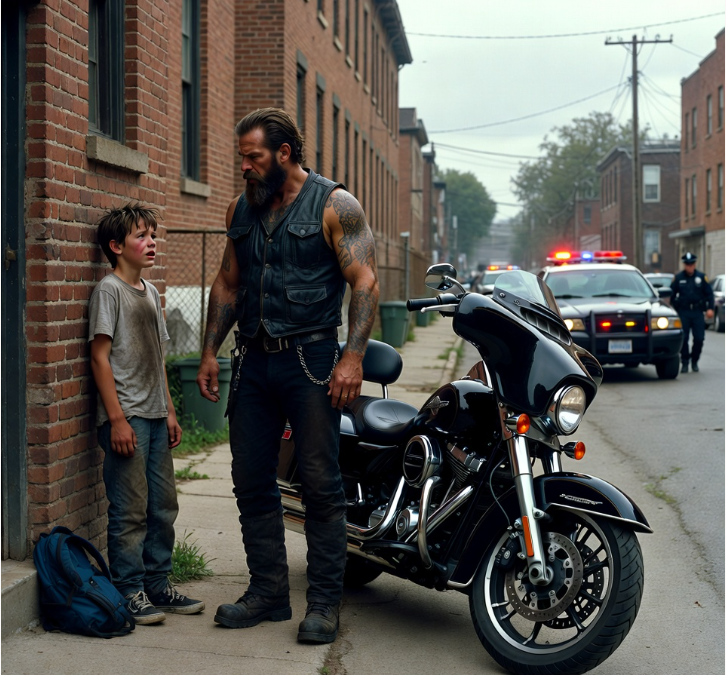
The angle came from the front of his motorcycle, parked near the alley entrance before he had dismounted. I saw Marcus on the ground. Three older boys stood over him. One kicked his backpack away. Another stomped on his phone until the screen shattered. The third bent down and said something I could not hear but could understand from Marcus’s face.
Then the kicking started.
One to the leg.
One to the ribs.
A shove when Marcus tried to crawl away.
Laughter.
That was the part that got me.
Not the violence, though that was bad enough. It was the laughter. The pleasure. The casual, easy cruelty of boys old enough to know pain and young enough to believe consequences were for other people.
I covered my mouth.
The biker did not stop the video.
He let me see all of it.
Then, suddenly, his engine roared in the footage. His bike rolled forward, blocking the alley. He jumped off and moved toward them like thunder given human shape. The boys scattered.
The screen went dark.
“Got a dashcam on the bike,” he said. “Caught the whole thing.”
My hands were trembling.
“Can you send that to me?”
He gave me a small smile, but there was no warmth in it.
“I’ve got a better idea.”
His name was Ray Dawson.
He was fifty-two years old, a retired firefighter, and he had been riding motorcycles for thirty years. That was what he told me ten minutes later, after Marcus had been checked by paramedics, after officers had taken our statements, after I finally managed to breathe without feeling like my lungs had broken.
Ray had pulled over because he heard shouting.
He had seen enough in the first two seconds to know exactly what was happening.
“Let me ask you something,” he said, still standing beside his bike while the police finished up. “First time those kids came after him?”
I looked toward Marcus.
He was sitting on the bumper of the ambulance, shoulders hunched, a paramedic pressing a cold pack to his cheek. He looked smaller than twelve. Younger than twelve. Like some part of him had retreated to an age when he still believed I could fix everything.
“No,” I said.
Ray’s jaw tightened.
“It’s been going on all year. Names. Pushing. Taking his lunch money. Tripping him in the hallway. Hiding his gym clothes. I went to the school three times.”
“And?”
I laughed once, bitterly.
“And they said boys will be boys. They said Marcus needed to toughen up. They said unless I had proof of serious physical harm, their hands were tied.”
Ray looked down the alley, then back at me.
“Well,” he said, “you’ve got proof now.”
He walked over to Marcus and crouched in front of him so they were eye level.
I followed because some part of me still could not let any adult man get close to my son without standing nearby.
Ray seemed to understand that too.
He kept his hands visible.
“Hey, buddy,” he said. “Those kids. You know their names?”
Marcus looked at me.
I nodded.
“Tyler Bennett,” he whispered. “Chase Morrison. Jake Chen. They’re eighth graders.”
Ray took out a small notepad from inside his vest and wrote the names down.
“This been going on all year?”
“Yes, sir.”
“Teachers know?”
Marcus swallowed.
“Yes, sir.”
“Principal?”
“Dr. Hendricks knows,” I said. “I met with her twice.”
Ray looked at Marcus.
“And they did nothing?”
Marcus’s eyes filled again.
“They said if I ignored them, they’d get bored.”
Ray went very still.
I saw it then.
The anger.
Not wild anger. Not reckless anger. Worse. The kind that had lived in a man for years, waiting for a purpose.
“What time does school get out tomorrow?” he asked.
“Three,” I said. “Why?”
“Because tomorrow at three, you and I are going to have a chat with Dr. Hendricks. And those three boys. And every one of their parents.”
“I don’t—”
“You have a lawyer?”
“No.”
“I do. Brother-in-law. Civil rights attorney. He owes me. He’s coming.”
I stared at this man who had appeared out of nowhere, stopped my son from being beaten, and was now organizing a legal offensive in an alley like this was the most normal thing in the world.
“Why?” I asked.
Ray looked at Marcus.
Then back at me.
“You don’t even know us.”
His expression changed.
The anger dimmed, and grief stepped forward.
“I had a son,” he said quietly. “Had. Billy. He’d be twenty-four now.”
The past tense hit me like a blow.
Marcus looked up.
Ray kept his voice steady, but I could hear what it cost him.
“Billy got bullied all through middle school. Kids picked on him for being small. For liking books more than sports. For not fitting in. We went to the school. My wife went. I went. We got the same lines you got. Boys will be boys. He needs to toughen up. Where’s the proof? We can’t punish kids based on accusations.”
He paused.
The alley seemed to go quiet around us.
“Billy killed himself at fourteen.”
I put my hand over my mouth.
Ray’s eyes stayed on Marcus.
“He left a note. Said he couldn’t do it anymore. Said nobody was going to help him. Said he was tired of being scared.”
Marcus started crying again.
Not loud. Just a terrible silent collapse, like his body understood something his mind could not yet hold.
Ray put one hand lightly on Marcus’s shoulder.
“I can’t help Billy,” he said. “But I can help you.”
Marcus nodded, tears dropping onto his jeans.
Ray looked at me.
“So when I pull up on three kids beating another kid in an alley, and I hear the school has been ignoring it? Yeah. I’m doing something.”
I did not know what to say.
Thank you was too small.
I’m sorry was too late.
Ray squeezed Marcus’s shoulder once.
“Those boys don’t touch you again. I promise you that.”
Marcus looked at him like he wanted to believe but did not know how.
Ray seemed to understand that too.
“Your mom’s number is in my phone,” he said. “I’ll call tonight. We’ll work out tomorrow.”
Then he got on the bike, started it, and met my eyes one more time.
“They come after your kid,” he said, “they come after all of us. That’s how it works.”
Then he was gone.
That night, Marcus barely spoke.
At urgent care, they confirmed bruised ribs, a split lip, swelling along his cheek, and scrapes on his hands and knees. Nothing broken. That was supposed to be good news. I signed paperwork with a pen that shook between my fingers and wanted to scream at every form that said “minor injuries” because there was nothing minor about watching your child flinch when a nurse raised her hand too quickly.
At home, Marcus sat on the couch beneath a blanket, staring at the television without seeing it.
I made soup.
He did not eat.
I sat beside him.
“Why didn’t you tell me they were hitting you like that?”
His eyes stayed on the blank screen.
“I did tell you.”
The answer pierced me.
I swallowed.
“You told me they pushed you.”
“They did.”
“You told me they called you names.”
“They did.”
“You didn’t say they were beating you.”
He looked down at his hands.
“I thought if I made it sound too bad, you’d go to the school again.”
“I did go to the school.”
“And it got worse.”
I closed my eyes.
There it was.
The thing every bullied child learns too soon.
Sometimes telling adults does not stop the cruelty.
Sometimes it teaches the cruel that the adults are harmless.
“I’m sorry,” I whispered.
Marcus’s mouth trembled.
“I didn’t want you to feel bad.”
I turned toward him.
“Baby, protecting my feelings is not your job.”
He nodded, but I could tell the idea did not land.
Children who spend too long surviving learn to manage the adults around them.
It is one of the ways the world steals childhood without leaving fingerprints.
Ray called at seven.
I put him on speaker so Marcus could hear.
“Talked to my brother-in-law,” Ray said. “Mike Chen. Civil rights lawyer. He says what those kids did is assault and battery. The school ignoring repeated reports may constitute failure to address a hostile educational environment, especially if they knew and did nothing. We can sue if they don’t take it seriously.”
“I can’t afford a lawsuit.”
“Won’t need one. Threat is usually enough when the evidence is ugly. Mike’s coming tomorrow. Free.”
“Why?”
“Because he’s a good man. And I asked him.”
The plan was simple.
Three o’clock.
The school.
Me, Marcus, Ray, and Mike.
A meeting with Dr. Patricia Hendricks, the three boys, and their parents.
Show the video.
Make it stop.
After the call, Marcus looked at me.
“Do I have to go?”
I wanted to say no.
Everything in me wanted to wrap him in blankets, keep him home, cook him food, and never make him see those boys again.
But Ray’s voice echoed in my head.
The school had hidden behind no proof.
Now proof existed.
And Marcus deserved to see adults use it.
“You don’t have to speak if you don’t want to,” I said. “But I think you should be there.”
“What if they lie?”
“They will.”
“What if nobody believes me?”
I touched his hair.
“This time, they don’t have to believe. They have to watch.”
The next day, I parked at the school at 2:45 with Marcus beside me.
He wore his hood up even though it was not raining. His shoulders had been tight all morning. He asked twice if we could turn around. Both times I told him yes, if he truly wanted to. Both times he said no after a moment.
Ray was already there.
Leather vest. Jeans. Boots. Motorcycle parked near the curb, not blocking anything, but somehow still making a statement. Beside him stood a man in a navy suit with a briefcase, glasses, and an expression that suggested he had made much wealthier people regret wasting his time.
“Sarah,” Ray said, “Marcus. This is my brother-in-law, Mike Chen.”
Mike shook my hand.
“Ray filled me in. I reviewed the video and your notes from prior school meetings. Let’s put an end to this.”
Marcus stared at Mike.
“Your last name is Chen?”
Mike smiled faintly.
“Yes.”
“One of the boys is Jake Chen.”
“I know. No relation. And even if he were, I’d still be standing here.”
That seemed to matter to Marcus.
The four of us walked into Westbridge Middle together.
Me.
My bruised son.
A biker.
A lawyer.
The receptionist looked up, saw Ray first, then Mike’s briefcase, then Marcus’s swollen face, and slowly lost her greeting smile.
“Can I help you?”
Mike stepped forward.
“Dr. Hendricks. Now.”
“Do you have an appointment?”
“No. But she’ll want to see us. Now, or a lawsuit by Friday. Her choice.”
The receptionist blinked.
“One moment.”
Dr. Hendricks appeared inside a minute.
She was a woman in her fifties with carefully styled hair, a soft cardigan, and the practiced concerned expression of someone who had spent years saying difficult things in a soothing voice. I had seen that face twice before while sitting across from her, trying to explain that my son was afraid to go to school.
“Mrs. Mitchell,” she said. “Marcus. What happened to your face?”
The question nearly made me laugh.
Not because it was funny.
Because rage sometimes comes so fast the body looks for another exit.
Mike answered.
“That is what we’re here to discuss.”
She led us into her office.
The walls were covered in posters about kindness, inclusion, empathy, and safe learning environments. One said, SEE SOMETHING, SAY SOMETHING. I stared at it until my vision blurred.
I had said something.
Marcus had said something.
Nothing had happened until a stranger on a motorcycle had said it louder with video.
Mike did not waste time.
He laid out the assault, the three boys’ names, my three prior reports, Marcus’s injuries, the neighbor’s statement, and the police report number.
Dr. Hendricks folded her hands.
“We take all bullying allegations seriously.”
Ray made a sound low in his throat.
Mike glanced at him.
Ray went silent.
Dr. Hendricks continued.
“However, as I explained to Mrs. Mitchell previously, we cannot take disciplinary action without sufficient evidence. Children often have interpersonal conflicts, and our goal is always to mediate—”
Ray placed his phone on her desk and hit play.
The office went white.
Marcus on the ground.
Tyler Bennett kicking his backpack away.
Chase Morrison stomping the phone.
Jake Chen laughing.
A foot driving into Marcus’s side.
Another shove.
The laughter.
Always the laughter.
Dr. Hendricks stopped talking.
The video ended.
Mike said, “There’s your evidence.”
For once, Dr. Hendricks had no soothing phrase ready.
She looked sick.
“What are you asking for?”
“Those boys in this office with their parents today,” Mike said. “You show them the video. You enforce the zero-tolerance policy in your handbook.”
“Expulsion is a serious measure.”
“So is assault.”
“The incident occurred off school grounds.”
“Immediately after school, behind the school, involving three enrolled students targeting another enrolled student after a year of documented reports. If your defense is jurisdictional wordplay, I’d advise against using it in front of a judge.”
Her mouth tightened.
“The parents will fight it.”
“Let them,” Mike said. “We have the video, police report, urgent care records, witness statement, and Mrs. Mitchell’s prior reports. If the school fails to act, we sue the district, request records of prior complaints involving the same boys, and subpoena staff communications. I imagine the local press will find the kindness posters especially compelling.”
Dr. Hendricks looked at Marcus.
Really looked.
For the first time, I saw the moment she understood he was not a file, not a parent complaint, not an inconvenience between budget meetings.
He was a child.
A child with a swollen face sitting beneath a poster about safety.
She picked up her phone.
“Please ask Tyler Bennett, Chase Morrison, Jake Chen, and their parents to come to my office immediately.”
It took an hour.
The longest hour I have ever spent in a school office.
Marcus sat between me and Ray. He did not speak. Ray said nothing either, but his presence filled the room like a locked gate. At one point, Marcus’s hand drifted toward his bruised ribs, and Ray quietly pushed a bottle of water across the table.
Marcus took it.
That tiny exchange nearly broke me.
One by one, the families arrived.
Tyler Bennett came first with his father, a tall man in an expensive coat who entered already irritated.
“I left a client meeting for this.”
Chase Morrison arrived with his mother, who looked anxious before she even knew why.
Jake Chen came last with both parents. His mother clutched her purse strap. His father wore a hospital badge, still in scrubs, face drawn from a long shift.
The boys saw Marcus and looked away.
That told me enough.
Dr. Hendricks closed the door.
“Thank you for coming on short notice. We are here regarding a serious incident that occurred yesterday after school.”
Tyler’s father folded his arms.
“If this is about some fight, I’ll remind everyone boys shove each other around. Let’s not ruin futures over playground nonsense.”
Ray’s chair scraped back an inch.
Mike touched his arm lightly.
Not yet.
Dr. Hendricks played the video.
The room changed.
Chase’s mother went white before the first kick landed.
Jake’s mother began crying almost immediately.
Jake stared at the floor.
Tyler’s father lasted the longest.
He watched his son kick my child and then leaned back with a sneer.
“How was this obtained?”
Ray spoke for the first time.
“My motorcycle dashcam.”
“Were you filming minors without permission?”
Mike answered before Ray could.
“Public alley. No expectation of privacy. Legal.”
Tyler’s father pointed at Marcus.
“What did he do before the recording started?”
My entire body went cold.
There it was.
The instinct to search for what the victim did to deserve cruelty.
Marcus shrank beside me.
Ray stood.
Slowly.
Not threateningly.
But the air changed anyway.
“He was on the ground,” Ray said. “Curled up. Three on one. That’s what I saw when I turned into the alley.”
Tyler’s father looked him over.
“And who are you?”
Ray held his gaze.
“The man who stopped your son from putting another boot into that kid’s ribs.”
“Are you threatening my child?”
“No,” Ray said. “I saved your child from being worse than he already was on camera.”
The room went silent.
Chase’s mother started crying harder.
“Chase,” she whispered. “How could you?”
Chase stared at his hands.
Jake’s father looked like someone had punched him in the chest.
“Jake,” he said quietly. “Look at me.”
Jake did not.
“Look at me.”
Slowly, Jake raised his eyes.
His father’s voice was not loud.
That made it more devastating.
“Is that you laughing?”
Jake’s chin trembled.
“Yes.”
His mother covered her face.
Tyler’s father slammed a hand on the desk.
“This is outrageous. You can’t expel for something off school grounds.”
Mike opened the handbook he had brought printed and tabbed.
“Westbridge Middle School Code of Conduct, page seventeen. Violence, assault, harassment, intimidation, or retaliatory behavior occurring on school property, during school activities, traveling to or from school, or in circumstances materially affecting the school environment may result in suspension or expulsion.”
He slid it across the desk.
“This qualifies.”
Tyler’s father glared at him.
“You think you can intimidate us with paperwork?”
Mike smiled.
“I rarely need more.”
Then Ray stood fully.
He did not raise his voice.
He did not curse.
He did not threaten violence.
He simply looked at the three boys.
“I had a son named Billy.”
The room quieted in a different way.
“He was small for his age. Loved fantasy books. Drew maps of worlds he made up in his head. He got bullied in middle school. Kids called him names. Knocked books out of his hands. Shoved him into lockers. Once they put his backpack in a toilet.”
The boys stared at the floor.
“The school said boys will be boys. Said they needed proof. Said Billy needed to learn resilience.”
Ray’s mouth tightened.
“Billy killed himself when he was fourteen.”
Chase’s mother made a small sound.
Ray kept going.
“He left a note saying he was tired of being scared and tired of waiting for adults to help.”
Marcus’s breathing changed beside me.
Ray looked at the three boys.
“You think this is a game right now. You think you got caught and that’s the bad part. Getting caught is the best thing that happened to you. Because the road you are on does not just hurt him.”
He pointed at Marcus.
“It hollows you out too. Every time you laugh at another person’s pain, you become less human. Every time adults excuse you, they help you become worse.”
Tyler tried to look bored, but his face had gone pale.
Ray stepped closer to the desk.
“You three stay away from Marcus. You don’t speak to him. You don’t look at him. You don’t send friends after him. You don’t post about him. You don’t whisper his name in a hallway. If I hear you have, I will be back with Mr. Chen, and next time this video won’t stay in this office.”
Tyler’s father began, “You can’t—”
Ray turned to him.
“I am not talking to you.”
The father shut his mouth.
Ray looked back at the boys.
“Understood?”
Chase whispered, “Yes.”
“Louder.”
“Yes, sir.”
Jake said it next, voice broken.
“Yes, sir.”
Tyler stared at the desk.
Ray waited.
Everyone waited.
Finally Tyler muttered, “Yes.”
Ray leaned forward slightly.
“Try again.”
Tyler looked up, eyes full of hatred and fear.
“Yes, sir.”
Dr. Hendricks suspended them immediately pending expulsion proceedings.
By the next week, all three were expelled.
Two transferred to other schools.
Jake’s parents pulled him out to homeschool and later wrote me a letter. Not a perfect letter. Not enough to fix anything. But an honest one. His mother said he had started counseling. His father said they had failed to see who their son was becoming because his grades were good and his teachers called him polite.
Polite.
That word bothered me for weeks.
People think cruelty always looks like a snarl.
Sometimes it looks like a polite boy with good grades laughing while someone smaller curls up on pavement.
Tyler’s father threatened legal action for three days.
Then the school district’s attorney showed him the video again and asked whether he wanted discovery to include his son’s disciplinary history.
He disappeared quietly after that.
Marcus went back to school a week later.
I offered to homeschool him.
Transfer him.
Move.
Anything.
He thought about it, then said, “I want to go back.”
“Are you sure?”
“No.”
That was the bravest answer I had ever heard.
The first morning back, Ray showed up at our house at seven-thirty.
I opened the door to find him standing on the porch holding two coffees and wearing the same leather vest.
“What are you doing here?”
“Walking him in.”
Marcus appeared behind me, backpack on both shoulders.
“You don’t have to,” he said.
“I know.”
Ray handed me a coffee.
Then he looked at Marcus.
“But I’m here.”
We drove separately. Ray rode ahead on his motorcycle, not blocking traffic, not making a show, just present. When Marcus got out of my car, whispers started. Kids looked. Teachers looked. By then, everyone had heard some version of what happened.
Ray walked on one side of Marcus.
I walked on the other.
At the entrance, Marcus stopped.
His face had gone pale.
“I can’t.”
Ray crouched in front of him, just like he had in the alley.
“Yes, you can. But you don’t have to do it all at once. Just walk to the office. That’s all. After that, walk to first period. After that, second. You don’t have to survive the whole day right now. Just the next hallway.”
Marcus nodded slowly.
“The next hallway.”
“That’s it.”
He walked in.
That first week was hard.
He came home exhausted. Angry. Quiet. Sometimes he snapped at me for asking normal questions. Sometimes he cried in the shower because he thought I could not hear. Twice, he woke from nightmares. Once, he asked if I thought Billy was mad that Ray had helped him when no one helped Billy.
I called Ray for that one.
He came over within twenty minutes.
Marcus sat on the porch steps, wrapped in a blanket.
Ray sat beside him.
“Billy wouldn’t be mad,” Ray said.
“How do you know?”
“Because Billy was kind. He would be glad somebody got help.”
Marcus stared at the street.
“Do you think he knows?”
Ray took a long breath.
“I hope so.”
Marcus nodded.
Then he whispered, “I’m sorry nobody helped him.”
Ray closed his eyes.
“So am I.”
They sat together for a long time.
After that, Ray checked in regularly.
At first, every day.
Then a few times a week.
Then weekly.
Texts mostly.
How’s school?
Any trouble?
Need me to scare a principal?
That one made Marcus laugh for the first time in days.
Ray never made himself a hero. That was one of the things I came to respect most. He did not show up demanding gratitude. He did not use Marcus to heal himself loudly. He simply appeared, again and again, in small practical ways.
He took Marcus to a bookstore and bought him the first book in the fantasy series Billy had loved.
He came to one of Marcus’s counseling appointments and sat in the waiting room because Marcus asked.
He taught Marcus how to check tire pressure on my aging sedan.
He came by with soup when I got the flu and Marcus panicked at the idea of me being sick.
Three months after the alley, I invited Ray over for dinner.
I told myself it was a thank-you.
That was partly true.
It was also because I had started looking forward to his texts too.
That realization frightened me.
I had been divorced for four years. Marcus’s father lived in another state and called when guilt or holidays reminded him he had a son. I had built a life around work, bills, school meetings, and trying to be both soft place and shield for my child. I did not have time to wonder whether a retired firefighter with a motorcycle and sad eyes might enjoy my terrible lasagna.
Ray arrived with flowers for me and a wrapped book for Marcus.
“Billy’s favorite,” he said, handing it over.
Marcus touched the cover carefully.
“Thank you.”
“Fair warning. The second one is better.”
Marcus looked up.
“There’s more than one?”
“Kid, there are nine. You’re doomed.”
Dinner was awkward for exactly eight minutes.
Then Ray told a story about a kitchen fire caused by a man trying to deep-fry a turkey indoors, and Marcus laughed so hard milk came out his nose.
After dinner, Marcus went to his room with the book, pretending not to be excited and failing.
Ray and I sat on the porch with coffee.
The air was cold enough to see our breath.
“You saved him,” I said.
Ray looked down at his cup.
“No.”
“Yes.”
“I stopped a fight.”
“You did more than that. You showed him adults could fight for him and win.”
Ray was quiet.
Then he said, “I didn’t fight hard enough for Billy.”
There it was.
The wound beneath everything.
I waited.
He rubbed a hand over his beard.
“My wife told me. Over and over. She said we needed to pull him out, transfer him, sue, do something. I kept saying we had to work with the school. Follow the process. Be reasonable.”
His mouth twisted.
“Reasonable. God, I hate that word now.”
“Ray.”
“She left a year after he died. Said she couldn’t look at me without seeing all the times I told Billy to hang in there.”
His voice broke slightly.
“She was right.”
“No,” I said.
He looked at me.
“She was grieving. And so were you. But the boys who hurt Billy, the adults who dismissed him, the system that taught him no one was coming—those carry blame too.”
Ray stared toward the street.
“I was his father.”
“Yes.”
“I should have made someone listen.”
I thought of Marcus telling me he had tried.
I thought of Dr. Hendricks’ kindness posters.
I thought of how quickly I had assumed Ray was the threat because he looked dangerous, while the real danger wore backpacks and school uniforms.
“Then make them listen now,” I said.
He looked at me.
“You already started.”
Eight months after the alley, Marcus turned thirteen.
He was doing better, which did not mean everything was easy. He still had hard days. He still looked over his shoulder when older boys laughed too loudly. He still sometimes asked if Ray had texted, as if confirmation of that presence helped steady him.
But he was growing back into himself.
Not the same self.
Something stronger, maybe.
But I wish he had never needed that kind of strength.
For his birthday, Ray took him to a bike show with my permission. He let Marcus sit on a 1947 Harley and sent me a picture of my son grinning so wide his face looked unrecognizable in the best possible way.
Under it, Ray wrote:
Told him I’d teach him to ride at sixteen.
I replied:
I said maybe.
Ray wrote:
He says that means yes.
I looked at Marcus’s smile for a long time before writing back.
It probably does.
Two weeks later, Ray called me in the evening.
His voice sounded different.
“Can I ask something?”
“Of course.”
“Every year on the anniversary, I visit Billy’s grave. I bring flowers. Sometimes I read him a letter. This year… I wondered if Marcus might want to come. No pressure. I just thought maybe—”
“Yes,” I said.
Then stopped myself.
“I’ll ask him.”
Marcus was quiet when I told him.
He looked down at the book Ray had given him, now worn at the edges from being carried everywhere.
“Do you think Ray wants me there?”
“Yes.”
“Why?”
“Because you matter to him.”
Marcus swallowed.
“I want to go.”
Riverside Cemetery was gray and still that Saturday morning in November. The trees had lost most of their leaves. The sky hung low. Ray stood beside a simple headstone holding a bouquet of white flowers.
William “Billy” Dawson.
1995–2009.
Beloved Son.
Forever Our Brave Boy.
Marcus stood beside me, hands in his coat pockets.
Ray placed the flowers carefully.
For a while, no one spoke.
Then Marcus pulled a folded piece of paper from his pocket.
Ray looked at him.
“What’s that?”
“A letter,” Marcus said.
His voice shook, but he did not stop.
“To Billy.”
Ray’s face changed.
Marcus stepped forward and placed the letter beside the flowers.
“I wrote that I’m sorry,” he said. “And thank you. Because your dad saved me. And because I think maybe you helped him know what to do.”
Ray covered his mouth.
Marcus turned to him.
“I’m going to be okay,” he said. “Not every day. But mostly. And I wanted him to know.”
Ray pulled Marcus into a hug so suddenly I nearly stepped forward. But Marcus hugged him back.
Not politely.
Not carefully.
Like he needed it too.
I stood in the cold cemetery and cried quietly while two wounded boys, one grown old enough to have gray in his beard and one still young enough to carry fear in his shoulders, held each other over a grave that had changed both their lives.
I think about that first alley sometimes.
I think about how fast I judged Ray Dawson.
How I saw leather, tattoos, a motorcycle blocking the exit, and decided I knew the story.
I was wrong.
The boys in clean school clothes were the threat.
The biker was the rescue.
That mistake humbles me still.
It also taught Marcus something I could not have taught him alone.
Heroes do not always look the way people expect.
Sometimes they wear uniforms.
Sometimes they wear suits and carry briefcases.
Sometimes they are retired firefighters with grief in their eyes.
Sometimes they are neighbors who look out windows and call the police.
Sometimes they are mothers who keep showing up at schools even when no one listens.
And sometimes they are bikers who see three boys beating a child in an alley and decide that riding past is not an option.
A year after the attack, Westbridge Middle changed its bullying policy.
Not because the district suddenly grew a conscience on its own.
Because Mike filed formal notices. Because Ray spoke at a school board meeting. Because I stood at a microphone with my son’s permission and described what it felt like to watch a video of children laughing while they kicked my child. Because Jake Chen’s father, to his credit, stood up too and said parents needed to stop mistaking good grades for good character.
Dr. Hendricks resigned before the school year ended.
The district called it early retirement.
No one believed that.
A new principal came in, a younger man named Mr. Alvarez, no relation to my neighbor. At orientation, he said something that made Marcus squeeze my hand under the table.
“Bullying is not conflict. Harassment is not drama. Violence is not a misunderstanding. And silence is not neutrality. It is permission.”
Marcus looked at Ray across the auditorium.
Ray nodded once.
That was enough.
Marcus is fourteen now.
Taller than me.
Still quiet, but not in the same way.
He joined the robotics club. He made two friends who come over every Friday and eat everything in my refrigerator. He still has hard days. We both do. But he knows people care. He knows standing up can work. He knows proof matters, but so does persistence. He knows being kind does not mean accepting cruelty.
Ray is part of our life now.
I say that simply because pretending otherwise would be ridiculous. He comes for dinner on Sundays more often than not. He fixes things I did not ask him to fix. He and Marcus argue about whether old bikes have more soul than new ones. He still visits Billy every November, and now we go with him.
Last month, he taught Marcus how to start a motorcycle safely.
Not ride.
Start.
I stood in the driveway with my arms crossed, trying to look stern while my son’s face lit up at the sound of the engine.
Ray looked at me.
“Sixteen,” he said.
“Sixteen,” I agreed.
Marcus shouted over the engine, “That’s only two years!”
“Long two years,” I shouted back.
Ray grinned.
Sometimes, when he thinks no one is watching, I see grief move across his face. A shadow. A memory. Billy’s absence sitting beside Marcus’s presence.
I do not try to erase it.
Some losses are not meant to be healed by replacement. Marcus is not Billy. Ray knows that. I know that. Marcus knows that too. But love does not have to replace what was lost in order to matter. Sometimes it honors the lost by protecting the living.
One evening, Ray and I sat on the porch after Marcus had gone inside.
The same porch where he first told me about his wife leaving.
He looked toward the street.
“You know what Billy wrote in that last note?” he asked.
I waited.
Ray swallowed.
“He wrote, ‘I wish one person would make them stop.’”
My chest tightened.
Ray’s eyes shone.
“When I saw Marcus in that alley, I heard that sentence. Clear as if Billy said it right beside me.”
I reached for his hand.
He let me take it.
“You made them stop,” I said.
His fingers tightened around mine.
“Too late for him.”
“Yes,” I whispered. “But not too late for Marcus.”
Ray closed his eyes.
“No,” he said. “Not too late for Marcus.”
That is the part I carry now.
Not only the fear.
Not only the video.
Not only the anger at a school that chose comfort over courage until a biker’s dashcam forced the truth into their office.
I carry the moment Ray stopped.
He could have ridden on.
He could have told himself it was not his business. That someone else would handle it. That three boys beating a child in an alley was a school matter, a parent matter, a police matter, anything but his matter.
Instead, he turned his motorcycle sideways and made himself a barrier.
He stayed.
He recorded.
He testified.
He called a lawyer.
He faced the school.
He made the boys say out loud that they understood.
He checked in after the drama ended, when most people would have disappeared.
He kept showing up.
That is what saved my son from believing no one would.
People love to say one person cannot change a system.
Maybe that is true.
One person may not change the whole system in a day.
But one person can interrupt cruelty.
One person can create evidence.
One person can force a meeting.
One person can stand beside a child who thinks he is alone.
One person can make three bullies understand that the next time they choose a victim, someone might be watching.
One person can become the reason another child does not write a note like Billy did.
That matters.
It matters more than the world admits.
I was wrong about Ray Dawson the first time I saw him.
I thought the man in the leather vest was the danger.
But danger does not always look frightening.
Sometimes it looks like adults smiling gently while doing nothing.
Sometimes it looks like policies no one enforces.
Sometimes it looks like boys laughing in school uniforms.
Sometimes it looks like a principal saying her hands are tied while a child learns that telling the truth changes nothing.
And sometimes help arrives loud, tattooed, gray-bearded, and riding a motorcycle with a dashcam that sees exactly what everyone else tried not to see.
My son is safe now.
Not because the world became kind overnight.
Because enough people finally decided cruelty would cost something.
Marcus still has the book Ray gave him. The one Billy loved. It sits on his shelf with a bookmark halfway through the fourth volume now. On difficult days, he reads. On better days, he tells me what is happening in the story with more detail than I can follow.
Inside the front cover, Ray wrote one sentence.
For Marcus—keep going. Billy would have liked you.
Marcus reads that inscription more often than he admits.
I pretend not to notice.
Some things are allowed to be private.
But I know what it means to him.
It means a boy he never met mattered.
It means his pain did not vanish into silence.
It means someone else’s tragedy became the reason someone showed up in time for him.
And maybe that is how healing works sometimes.
Not by undoing what happened.
Not by making the world fair.
But by taking the love that had nowhere left to go and placing it between harm and another child.
Ray did that.
For Billy.
For Marcus.
For me.
For every parent who has ever sat across from a school official and been told to wait until the damage becomes undeniable.
I hope they never forget what happened in that office.
I hope Dr. Hendricks remembers the sound of those boys laughing on video.
I hope Tyler, Chase, and Jake remember Ray Dawson’s voice telling them that cruelty hollows out the person who commits it too.
I hope their parents remember the moment they saw their sons clearly.
I hope Marcus remembers that he was believed.
Most of all, I hope he remembers this.
He was never weak.
He was a child carrying pain adults should have stopped sooner.
There is a difference.
And the day one man finally stopped it, everything changed.
Even if that man was just a biker who saw trouble in an alley and decided to give a damn.








