I Stopped to Rescue Two Starving Cats Clinging to Each Other Beside the Road—Then the Vet Told Me I Hadn’t Rescued Just Two Lives
PART3:
Another sigh.
“Twenty minutes.”
“I’ll try.”
“Twenty, Claire.”
She hung up.
I grabbed an old sweatshirt from the back seat, got out, and immediately regretted not wearing gloves.
The cold bit through my fingers.
The orange cat watched me.
He didn’t run.
That surprised me.
Most frightened strays either flee or freeze.
He did neither.
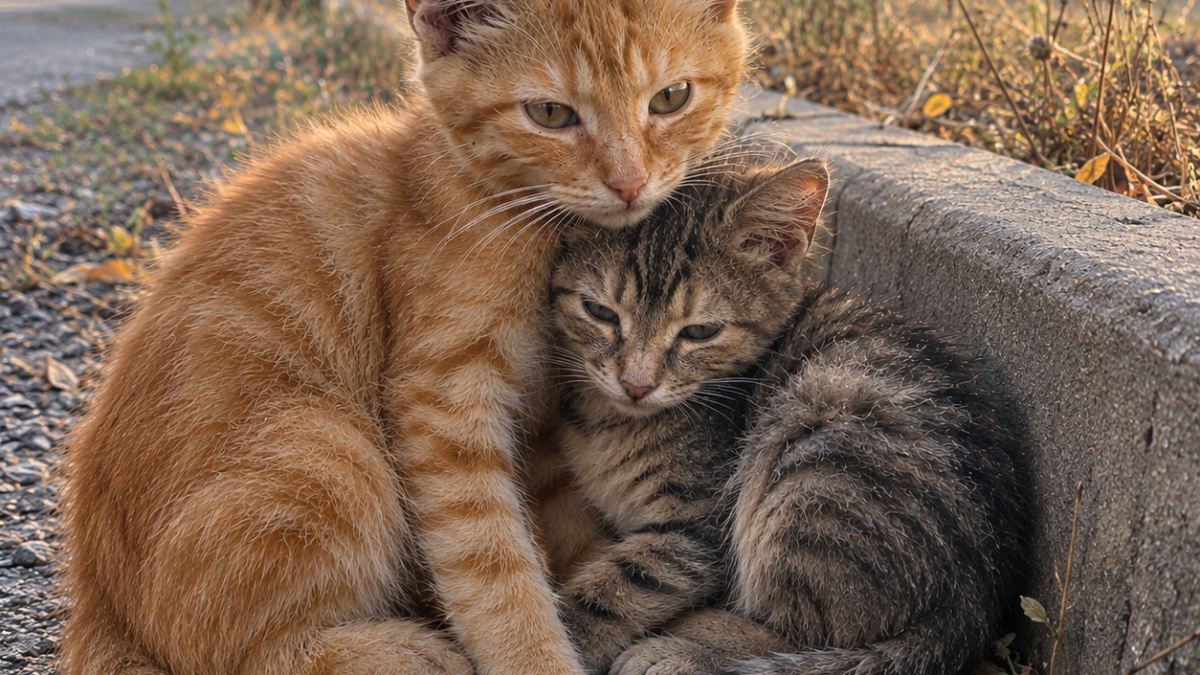
He moved in front of the gray cat.
One step.
That was all.
One tiny, trembling step.
But it put his body between hers and mine.
“Hey, buddy.”
His ears flattened.
The gray cat peeked around him.
She looked younger than I’d first thought.
Maybe a year old.
Her fur was a smoky blue-gray beneath the dirt, and her face was delicate, almost kittenish.
But her eyes looked old.
That is the only way I know to describe them.
Exhausted.
Watchful.
Resigned.
The orange cat was bigger.
Maybe eighteen months.
He had white around his muzzle and a narrow white stripe running down his chest.
His left ear had a small notch in it.
His paws were filthy.
One front paw looked slightly swollen.
I crouched.
“It’s okay.”
They stared at me.
“I don’t have anything good.”
I checked my purse.
One granola bar.
Peppermints.
A package of crackers.
No cat food.
Then I remembered the tuna sandwich I’d packed for lunch.
“Well,” I said, “there goes lunch.”
I tore off small pieces of tuna and set them on the pavement.
The orange cat waited.
He looked at me.
Then at the food.
Then at the gray cat.
He did something I didn’t expect.
He stepped backward.
He nudged her forward.
She ate first.
That was the moment.
That was when whatever sensible part of my brain still remembered rent, gasoline, deadlines, and veterinary costs lost the argument.
He was starving.
And he let her eat first.
I placed more tuna down.
She swallowed it almost without chewing.
The orange cat kept looking around while she ate.
Only after she’d taken several bites did he lower his head.
I opened my back door.
“Come on.”
Neither moved.
“I don’t know what I’m doing either.”
The orange cat stared into the car.
Then at me.
Then at the gray cat.
He jumped inside.
Just like that.
The gray cat made a sound.
Not a normal meow.
A short, sharp cry.
She leaped after him so fast her back feet slipped on the pavement.
She landed on the floorboard beside him and immediately pressed against his side.
I closed the door.
For several seconds, I just stood there.
Two stray cats.
In my car.
At 7:51 in the morning.
“Great decision-making, Claire.”
I called Denise again.
“I’m not making twenty minutes.”
“You have got to be kidding.”
“I have them in my car.”
“Take them to animal control.”
“I can’t.”
“Why?”
I looked through the window.
The gray cat had curled against the orange one.
He was licking her forehead.
“Because I can’t.”
Denise was quiet.
Then she said, “You owe me.”
“I know.”
“A lot.”
“I know.”
“And if the regional manager asks, you had car trouble.”
Technically, I did have car trouble.
The trouble was that my car now contained two cats.
I drove home.
My apartment was on the second floor of a tired brick building outside Dayton, the kind of place where the hallway always smelled faintly of someone’s dinner and the laundry machines accepted quarters even though no one under sixty carried quarters anymore.
I lived alone.
I had lived alone for four years.
The quiet had once felt peaceful.
After my mother died, it started feeling different.
Empty, maybe.
I didn’t talk about that much.
People tend to expect grief to expire after a respectful amount of time.
Mine hadn’t.
I carried both cats upstairs in a cardboard box I’d found in the trunk.
The orange cat could have escaped twice.
He didn’t.
The gray cat never tried.
The moment I put them in my bathroom, she climbed out and pressed herself against him.
I found two old towels.
A mixing bowl for water.
A shallow plastic container with torn newspaper because I didn’t own a litter box.
Then I remembered I still had three cans of cat food from when my sister’s tabby, Winston, had stayed with me during her move.
I opened one.
Both cats froze at the sound.
The orange cat’s pupils widened.
The gray cat stood up so fast she nearly knocked over the water.
I divided the food between two plates.
They ate shoulder to shoulder.
Not near each other.
Touching.
If the orange cat moved an inch, the gray one moved too.
Afterward they drank from the same bowl.
Then the orange cat walked around the bathroom, sniffing everything.
The gray cat followed.
He looked behind the toilet.
She looked behind the toilet.
He sniffed the shower curtain.
She sniffed the shower curtain.
He climbed onto the bath mat.
She climbed onto the bath mat.
He finally curled on one of the towels.
She climbed directly against his chest, tucked her head beneath his chin, and fell asleep almost immediately.
I stood in the doorway.
My bathroom was six feet by eight feet.
The tile was cracked near the sink.
The faucet dripped if I didn’t twist it hard enough.
There was nothing special about that room.
But watching those two exhausted animals sleep against each other, I had the strangest feeling that something important had just entered my life.
I took a picture.
Then I went to work.
I was forty-three minutes late.
Denise pointed at the clock as I entered the office.
“Don’t.”
“I’m not saying anything.”
“You’re pointing.”
“That’s different.”
I worked customer service for a regional insurance company.
Nothing glamorous.
Eight hours a day explaining deductibles, replacing ID cards, listening to people yell about premiums I had no power to change.
By noon, I had already checked my phone twelve times.
At 12:14, I posted the cats’ photo on three local lost-pet groups.
FOUND: TWO YOUNG CATS NEAR BENTON SERVICE ROAD, CLOSE TO OLD WILLOW STORAGE. ORANGE MALE AND GRAY FEMALE. VERY BONDED. PLEASE MESSAGE WITH PROOF OF OWNERSHIP.
Within an hour, the post had thirty-two shares.
People commented.
“So sad.”
“Boost.”
“Hope their owner finds them.”
“Check for microchips.”
“Please don’t give them to anyone without proof.”
One woman wrote:
I saw two cats matching this description around there last week. Thought they belonged to the houses behind the industrial park.
That got my attention.
I messaged her.
Her name was Linda.
She said she’d seen them four days earlier behind a closed gas station approximately two miles north of where I found them.
“Were they together?” I asked.
She replied immediately.
Yes. Orange one was bringing food to gray one from trash.
I stared at that sentence.
Bringing food.
I didn’t know if cats actually did that.
Maybe she’d misunderstood what she saw.
But somehow I believed her.
That evening I bought cat litter, two cheap bowls, and a bag of food.
Thirty-eight dollars.
I stood at the register mentally subtracting it from my grocery budget.
The cashier, a woman with pink glasses, noticed the canned kitten food.
“New kitten?”
“Two strays.”
She smiled.
“Congratulations.”
“No. Not congratulations.”
She laughed.
“That’s how it starts.”
At home, both cats were exactly where I’d left them.
Together.
The orange one greeted me.
He rubbed against my shin.
The gray one stayed behind him.
Over the next two days, I learned their differences.
The orange cat was friendly.
Almost absurdly friendly.
Once he decided I wasn’t going to hurt him, he followed me everywhere.
He climbed onto my lap.
Head-butted my elbow.
Chirped when I opened the refrigerator.
Tried to steal bread.
The gray cat was more cautious.
She watched.
She seemed to study every movement before deciding whether it was safe.
If I approached too quickly, she lowered herself to the floor.
If I raised my arm, even just to grab a towel, she flinched.
The orange cat always noticed.
He would walk to her.
Touch noses.
Sit nearby.
Then she would relax.
I named him Milo.
I named her Ivy.
Not because I intended to keep them.
That is what I told myself.
Names were just easier than “the orange one” and “the gray one.”
I searched for owners every night.
No one came.
No one messaged with photographs.
No frantic family posted about missing pets.
No child begged for their cats back.
Nothing.
On Friday afternoon, I took them to a low-cost veterinary clinic.
The receptionist, Marcy, looked into the carrier.
“They always sit like that?”
Milo was pressed against one side.
Ivy was practically underneath him.
“Always.”
“Bonded pair.”
“I guess.”
“How long have you had them?”
“Three days.”
Marcy smiled.
“That’s usually how people get cats.”
“I didn’t get cats.”
“Sure.”
Dr. Patel examined Milo first.
Milo tolerated everything with mild outrage.
Heart.
Eyes.
Teeth.
Paws.
Temperature.
Then came the scanner.
“No chip,” Dr. Patel said.
I felt disappointed.
Then guilty for feeling disappointed.
Because if there was no chip, that made my situation harder.
Milo had fleas.
Intestinal parasites.
A small infected puncture wound in his paw.
He was significantly underweight.
“But otherwise,” Dr. Patel said, “he’s young and fairly healthy.”
“How young?”
“Maybe fourteen to eighteen months.”
“Neutered?”
Dr. Patel gave me a look.
“No.”
“Right.”
Then Ivy.
She hated being separated.
The second Dr. Patel lifted her from the carrier without Milo, she twisted around.
Her eyes widened.
She cried.
Milo answered from inside the carrier.
Ivy struggled harder.
“Hold on,” Dr. Patel said.
He moved the carrier closer to the examination table.
Milo stuck his face against the mesh.
Ivy immediately calmed.
Dr. Patel glanced at me.
“That’s intense.”
“I told you.”
He examined her more slowly.
Her weight bothered him.
So did her gums.
He pressed gently along her abdomen.
Then stopped.
He pressed again.
I watched his expression change.
“What?”
He didn’t answer immediately.
He reached for the ultrasound machine.
My stomach dropped.
“Is something wrong?”
“Let’s check.”
Ivy whimpered.
Milo answered.
Dr. Patel shaved a small patch of fur.
The screen flickered.
Gray shadows.
Shapes I couldn’t understand.
Then Dr. Patel smiled.
“Well.”
“What?”
He pointed.
“That’s one.”
I stared.
“One what?”
“Kitten.”
I stopped breathing.
He moved the probe.
“That’s two.”
My hand went to my forehead.
“Oh my God.”
“Three.”
“No.”
He looked at another area.
“And possibly four.”
I sat down.
Marcy, standing beside the door, tried not to smile.
“You okay?”
“No.”
Dr. Patel laughed softly.
“I take it this wasn’t expected.”
“I found two cats.”
“Apparently you found more than two.”
I looked at Ivy.
She lay perfectly still.
Milo’s nose remained pressed against the carrier door.
“How far along?”
“Hard to be exact. Maybe five or six weeks.”
“She’s so thin.”
“That’s what concerns me.”
The humor left his voice.
“She’s underweight, mildly anemic, and probably hasn’t had adequate nutrition for a while. Pregnancy puts extra stress on her.”
“Will she be okay?”
“If she gets good nutrition and no complications, she has a decent chance.”
“And the kittens?”
“Same answer.”
I swallowed.
Then came the question I didn’t want to ask.
“Could Milo be the father?”
Dr. Patel shrugged.
“Certainly possible.”
Milo meowed.
Marcy laughed.
“He’s not denying it.”
But Dr. Patel’s expression became thoughtful.
“They’re unusually bonded.”
“You noticed.”
“Have they ever been apart since you found them?”
“No.”
“Try not to separate them unnecessarily. Some animals form very strong attachment bonds after trauma.”
“Trauma?”
“Could be abandonment. Could be something else.”
I looked at Ivy.
She had scars I hadn’t noticed before.
Thin lines beneath the fur near her hind legs.
One small bald patch around her neck.
“Do those mean anything?”
Dr. Patel examined them.
“Hard to say.”
He paused near her neck.
“Interesting.”
“What?”
“This looks like friction.”
“From what?”
“Possibly a collar that was too tight.”
The words bothered me.
I didn’t know why.
Before I left, the bill came to $287.
I stared at the total.
Marcy noticed.
“We can split it.”
“Into how many payments?”
“Three.”
“Do that.”
I put ninety-six dollars on my credit card.
In the parking lot, I sat inside my car for several minutes.
Pregnant.
Four kittens.
Maybe.
I laughed once.
Then cried.
Then laughed because I was crying.
Milo climbed into the passenger seat.
Ivy stayed in the carrier.
He sat beside it.
Of course he did.
“You two are destroying my budget.”
Milo blinked.
“I hope you understand that.”
He yawned.
At home, I turned the corner of my bedroom into a nesting area.
A cardboard box.
Two towels.
A fleece blanket from the thrift store.
The following week, something changed.
Milo started sitting by my front door.
Not constantly.
Only around sunset.
He would sit.
Listen.
Wait.
Sometimes he pawed at the bottom.
The first time I assumed he wanted outside.
Then one evening, someone dropped a package in the hallway.
Milo bolted.
Not toward the door.
Away from it.
He ran to Ivy.
Pressed against her.
She lowered herself instantly.
Both stared at the door.
That wasn’t curiosity.
It was fear.
I began wondering what had happened before I found them.
On Sunday I drove back to the service road.
The weather was warmer.
I parked near the same guardrail.
I walked along the shoulder.
Nothing.
No carrier.
No food bowls.
No blanket.
Then I noticed tire tracks leading into a narrow gravel turnoff behind an abandoned warehouse.
I followed them.
A hundred yards back was an old storage complex.
WILLOW CREEK STORAGE.
The sign had lost three letters.
Several units were boarded.
One exterior security camera hung crookedly above the office.
A man was sweeping leaves near the gate.
“Can I help you?”
He looked about seventy.
Green jacket.
White beard.
His name patch said EARL.
“I’m looking for someone who might have seen two cats.”
“Which cats?”
“Orange male. Gray female.”
His broom stopped.
I noticed.
“You’ve seen them?”
He looked toward the office.
“Where’d you find them?”
“Along the service road.”
“They alive?”
The question sent a chill through me.
“Yes.”
He nodded.
“Good.”
“Why?”
Earl leaned on the broom.
“You didn’t get them from here.”
“I didn’t say I did.”
“They weren’t ours.”
“I didn’t say they were.”
He looked uncomfortable.
“Somebody dumped them?”
He hesitated.
“I don’t know.”
“Earl.”
He looked at my face.
Maybe he saw something there.
Maybe he was tired of carrying whatever he knew.
“There was a woman.”
“When?”
“Week and a half ago.”
My heart started pounding.
“What woman?”
“Black SUV. Nice one. Cadillac maybe.”
“What did she do?”
“Pulled around the back.”
“And?”
“I was fixing the lock on twenty-seven. Didn’t think anything of it.”
He looked embarrassed.
“Then I heard cats screaming.”
My stomach tightened.
“What do you mean screaming?”
“Just scared. Not hurt. I don’t think.”
“What happened?”
“She had a pet carrier.”
“One carrier?”
“Large plastic crate.”
“Both cats were inside?”
He nodded.
“What did she do?”
Earl looked toward the road.
“Opened it.”
“And let them go?”
“More like shook them out.”
I stared at him.
“Shook them out?”
“The gray one wouldn’t come.”
“What do you mean?”
“She was clinging to the back. The orange one was outside already, circling the carrier.”
I felt something hot climb into my chest.
“What did the woman do?”
“Pulled the top apart.”
“Then?”
“Gray cat fell out.”
I couldn’t speak.
Earl continued.
“The orange one ran straight to her.”
“Did the woman leave?”
“Pretty much.”
“Did she say anything?”
He looked ashamed.
“I confronted her.”
“What did she say?”
He swallowed.
“She told me they weren’t her problem anymore.”
I closed my eyes.
“What else?”
“She said she was moving.”
“Description?”
“Forties maybe. Blond. Expensive coat.”
“License plate?”
He shook his head.
“Didn’t see it.”
“Security camera?”
He glanced at the office.
“Hasn’t worked in two years.”
Of course.
“Why didn’t you call animal control?”
“I did.”
That surprised me.
“What happened?”
“They said someone would come.”
“Did they?”
“Not while I was here.”
“Did you feed them?”
Earl looked down.
“I left tuna.”
That explained something.
“I saw them the next morning.”
“Together?”
“Always.”
He paused.
“The gray one wouldn’t go more than a few feet from the orange one.”
“Did you see them before that night?”
“No.”
Then Earl remembered something.
“Wait.”
He walked inside the office and returned with a small black object.
A collar.
My chest tightened.
Thin black nylon.
A small metal ring.
No tag.
“I found that where the woman parked.”
I took it.
The inside was stiff with dirt.
Near the buckle, someone had written something in faded silver marker.
Two letters.
M.S.
“Can I keep this?”
Earl nodded.
“What are you going to do?”
“I don’t know yet.”
That was true.
But for the first time, I knew something else.
Milo and Ivy hadn’t simply wandered away.
Someone had driven them out there.
Together.
And abandoned them.
I posted an update online.
FOUND CATS WERE LIKELY ABANDONED FROM A BLACK SUV NEAR WILLOW CREEK STORAGE. SEEKING INFORMATION. POSSIBLE OWNER INITIALS M.S.
The post spread.
Hundreds of shares.
Then came messages.
Most were useless.
People accusing neighbors.
People telling stories about similar cats.
People asking if the kittens would be available.
One woman offered me $50 for the gray cat before she’d even given birth.
I blocked her.
Then, Wednesday night, I received a message from someone named Hannah Reed.
I think I know these cats.
My heart jumped.
She sent a photograph.
I opened it.
And stopped breathing.
Milo.
Ivy.
No question.
They were sitting on a white sofa.
Healthy.
Well-fed.
Milo wore a blue collar.
Ivy wore the black collar in my hand.
The photo had been taken months earlier.
Together.
I wrote:
Are they yours?
Three dots appeared.
No.
They belonged to my neighbor.
What was her name?
Hannah didn’t answer for six minutes.
Then:
Melissa Shaw.
M.S.
I sat on my couch.
Milo was asleep against my thigh.
Ivy lay curled beside him, visibly pregnant now.
Melissa Shaw.
I searched the name.
There were several.
Hannah sent me a Facebook profile.
The woman in the picture was blond.
Forties.
Standing beside a black Cadillac Escalade.
My pulse quickened.
I asked Hannah to call me.
She did.
Her voice was nervous.
“I don’t want trouble.”
“I understand.”
“Melissa is… difficult.”
“Did she own them?”
“She had them.”
“That’s not exactly what I asked.”
Silence.
“What does that mean?”
Hannah sighed.
“The gray cat belonged to her daughter.”
“Where’s her daughter?”
“College.”
“And the orange cat?”
“Found him as a kitten.”
“So Melissa owned both.”
“Basically.”
“Why would she dump them?”
Another silence.
“I think because of the pregnancy.”
I looked at Ivy.
“What?”
“Melissa was furious when she realized the gray one was pregnant.”
“Why?”
“Because she wanted to move.”
“Move where?”
“Florida.”
“She abandoned two cats because one was pregnant?”
“There’s more.”
I waited.
Hannah lowered her voice.
“She used to breed cats.”
“What breed?”
“She said Russian Blue mixes. Designer kittens. I don’t know.”
Ivy looked vaguely Russian Blue.
“Was Ivy part of that?”
“I don’t think she was supposed to be.”
“What does that mean?”
“Melissa had a male she used for breeding. Expensive cat. She kept him upstairs.”
“And Milo?”
“Just a stray.”
The realization came slowly.
“She thought Milo got Ivy pregnant.”
“Yes.”
I looked at him.
He woke as though he could feel my eyes.
“Did Melissa hurt them?”
“I never saw her hit them.”
Not the answer I wanted.
“But?”
“She wasn’t kind.”
“How unkind?”
Hannah exhaled.
“She’d leave them outside when she got angry.”
“In winter?”
“Sometimes.”
My grip tightened around the phone.
“Why didn’t anyone report her?”
“I did.”
That stopped me.
“What happened?”
“Nothing.”
“Why?”
“They came once. She brought the cats inside. Said everything was fine.”
“And that was it?”
“Pretty much.”
Hannah sounded ashamed.
“I should have done more.”
“Did you know she abandoned them?”
“No.”
“I saw her moving boxes.”
“Did she move?”
“Three weeks ago.”
“To Florida?”
“No.”
“Where?”
“New house in Beavercreek.”
I sat straighter.
“So she didn’t move out of state.”
“No.”
“Then why dump them?”
“I don’t know.”
That bothered me more.
People do cruel things for stupid reasons.
But something about this felt unfinished.
I asked Hannah for the address.
She refused.
“I don’t want her knowing I told you.”
“I understand.”
“Please don’t use my name.”
“I won’t.”
She hung up.
The next morning I called animal control.
They listened.
They took notes.
Then they explained something I would come to hate.
Unless there was evidence proving Melissa intentionally abandoned the cats—and proving they were hers—there wasn’t much they could do immediately.
“I have a witness.”
“We can speak to him.”
“I have photographs.”
“That helps.”
“I have the collar.”
“That helps.”
“I have another witness saying she owned them.”
“That helps.”
“But?”
“But we need to investigate.”
“How long?”
“I can’t promise.”
I wanted action.
They offered procedure.
I understood why.
That didn’t make it easier.
Meanwhile, Ivy grew larger.
Milo became more attentive.
He slept beside the nesting box.
He groomed her face.
When she ate, he sat nearby.
When she used the litter box, he sometimes waited outside like a ridiculous orange security guard.
One night she woke from sleep crying.
I rushed over.
Milo reached her first.
She pressed her forehead against his chest.
Her breathing slowed.
I sat beside them.
“What happened to you?”
I whispered.
Ivy looked at me.
Milo began grooming her ear.
I didn’t know the answer.
But I was becoming sure of one thing.
Their bond had not been created on the roadside.
It had been forged long before I found them.
Two weeks later, Ivy went into labor.
At 1:17 in the morning.
Of course she did.
I was asleep when the scratching woke me.
I turned on the lamp.
Milo stood beside my bed.
Meowing.
Once.
Twice.
Then he ran toward the bedroom corner.
Ivy was inside the nesting box.
Panting.
“Oh.”
I sat up.
“Oh no.”
I called the emergency veterinary line.
The technician gave me instructions.
Keep things quiet.
Don’t interfere unless necessary.
Watch for complications.
Time contractions.
I spread towels.
Filled water.
Turned off the overhead light.
Milo remained outside the box.
At 2:04, the first kitten arrived.
Orange.
Tiny.
Wet.
Ivy cleaned him.
I cried immediately.
I am not proud of that.
Actually, I am a little proud.
At 2:41, another kitten.
Orange and white.
At 3:22, gray.
At 4:06, another orange.
Four.
All alive.
All nursing.
Ivy was exhausted.
Milo sat less than a foot away.
He didn’t enter the box.
He simply watched.
The first kitten squeaked.
His ears lifted.
Ivy looked at him.
Then, slowly, she stretched one paw over the edge of the box.
Milo leaned forward.
Their paws touched.
I will never forget that.
Not because it proved anything scientific.
Not because I suddenly knew he was the father.
But because after everything humans had done to them, their first instinct in safety was still to reach for each other.
I took a picture.
Around sunrise, I texted it to Dr. Patel.
Four healthy babies.
He replied:
Mom okay?
Ivy was eating.
Drinking.
Alert.
I typed:
Yes.
Then he wrote:
And Dad?
I looked at Milo.
He was asleep beside the box.
I smiled.
Standing guard.
The next few weeks were some of the happiest and most exhausting of my life.
My apartment changed.
My schedule changed.
My bank account definitely changed.
I worked overtime.
Stopped buying coffee.
Canceled streaming services.
Learned how much kitten food a nursing mother could consume.
Milo was neutered after Dr. Patel cleared him medically.
Ivy would be spayed once the kittens were weaned.
I told myself I would find homes for everyone.
I told myself that frequently.
Almost no one believed me.
Especially Denise.
“You have six cats.”
“I temporarily have six cats.”
“You named the kittens.”
“For identification.”
“What are their names?”
“Pumpkin, Rusty, Juniper, and Bean.”
Denise stared at me.
“Those are not identification numbers.”
“Be quiet.”
Then something happened that changed everything.
I took Ivy for a postpartum exam.
Marcy was holding Bean while Dr. Patel checked Ivy.
Milo was at home with the other kittens.
For once, Ivy was separated from him without panicking.
She had improved that much.
Dr. Patel finished the exam.
“She’s doing great.”
“Really?”
“Weight is up. Anemia improved. Kittens look good.”
I let out a breath.
Then a man standing near reception spoke.
“Excuse me.”
I turned.
He was maybe sixty-five.
Tall.
Thin.
Gray hair.
He held a pet carrier.
His face had gone pale.
“What?”
He stared at Ivy.
“Where did you get that cat?”
My body tensed.
The protective part of me appeared immediately.
“Why?”
“Please.”
He stepped closer.
“Where did you get her?”
Marcy stood.
“Sir—”
The man pulled out his phone.
His hands shook.
He scrolled.
Then held it toward me.
A photograph.
Ivy.
Smaller.
Maybe six months old.
Sitting beside a white-haired woman.
The woman was smiling.
The man said, “Her name isn’t Ivy.”
I looked at him.
“What?”
“Her name is Sophie.”
My stomach dropped.
He swiped to another photograph.
Sophie—Ivy—sleeping on the woman’s lap.
Another.
Sitting in a window.
Another.
Wearing the black collar.
The same collar.
“Who are you?”
The man’s eyes filled.
“My name is Daniel Shaw.”
Shaw.
My heart began pounding.
“Do you know Melissa Shaw?”
His expression changed.
“She’s my daughter.”
For several seconds, none of us spoke.
Then Daniel sat down.
He looked like his legs had stopped working.
“Where is my wife’s cat?”
I stared at him.
“Your wife’s?”
He nodded.
“Carol.”
He showed me the photograph again.
The white-haired woman.
“My wife died nine months ago.”
Ivy moved toward him.
Slowly.
Daniel lowered his hand.
She sniffed his fingers.
Then something happened that silenced the entire waiting room.
Ivy pressed her forehead into his palm.
Daniel broke.
Not loudly.
He simply covered his mouth with his other hand, bent forward, and began crying.
“Oh, Sophie.”
I didn’t know what to do.
I knelt.
“Tell me.”
It took several minutes.
Daniel and Carol had been married thirty-eight years.
Carol had cancer.
During her final year, Sophie rarely left her side.
Melissa, their daughter, helped care for her mother.
After Carol died, Daniel fell apart.
He admitted it without embarrassment.
He stopped eating.
Stopped sleeping.
Stopped opening mail.
Melissa convinced him to sell the family home.
She said he needed a smaller place.
She handled paperwork.
She took furniture.
She took Carol’s clothes to charity.
She also took Sophie.
“She said Sophie ran away.”
Daniel’s voice shook.
“When?”
“Three months after Carol died.”
I looked at Ivy.
“Did you believe her?”
“I wanted to.”
He stared at the floor.
“I searched for weeks.”
“Did you post online?”
“I don’t use Facebook.”
“Did Melissa help?”
“She said she did.”
I felt sick.
“Did Sophie know Milo?”
Daniel nodded.
“Oliver.”
“What?”
“The orange cat.”
My breath caught.
“His name was Oliver?”
“He showed up behind our house when he was a kitten.”
Daniel smiled through tears.
“Carol started feeding him.”
“And Sophie?”
“They became inseparable.”
I looked at Ivy.
Everything inside me went still.
Daniel continued.
“Oliver slept on the porch at first. Then one winter night Carol heard him crying and brought him in.”
“Did Melissa own him?”
“No.”
“But Hannah said—”
I stopped.
Daniel looked confused.
I explained what I’d learned.
His jaw tightened.
“Melissa hated Oliver.”
“Why?”
“Because Carol loved him.”
That didn’t make sense.
Then Daniel said something I will never forget.
“Melissa was jealous of anything her mother loved that wasn’t her.”
The sentence was simple.
But it explained a family.
Daniel described years of tension.
Melissa was his only child.
Bright.
Charming.
Successful.
And deeply controlling.
She could be generous when people were watching.
Cruel when they weren’t.
She had spent years resenting her mother’s attention to animals, neighbors, friends, even Daniel.
After Carol became sick, Melissa suddenly became the devoted daughter.
She organized appointments.
Controlled medication schedules.
Handled finances.
People praised her constantly.
Daniel had praised her too.
“She helped us,” he said.
Then he looked at me.
“At least I thought she did.”
“What changed?”
“After Carol died, Melissa began asking about the house.”
“Money?”
“Everything became money.”
Daniel’s voice hardened.
“She said I couldn’t manage alone. Said I was confused. Said I should let her handle things.”
“Did you?”
“Too much.”
I looked at Ivy.
“Why would she tell you Sophie ran away?”
Daniel’s face tightened.
“Because my wife left instructions.”
“What instructions?”
He pulled out his phone.
He showed me a scanned page from a handwritten letter.
One paragraph mentioned Sophie and Oliver.
Please keep them together if possible. Sophie feels safe with Oliver. If Daniel cannot care for them, please find them one home. Do not separate them.
My eyes blurred.
There it was.
The entire story.
Written by a dying woman.
Daniel whispered, “Carol knew.”
“Knew what?”
“That Sophie depended on him.”
I looked at Ivy.
“No wonder.”
Daniel nodded.
“When Carol was getting chemotherapy, Sophie developed terrible separation anxiety. Oliver was the only thing that calmed her.”
My skin prickled.
So every time Ivy panicked when Milo disappeared—
Every time she pressed herself against him—
Every time he stepped between her and danger—
It wasn’t random.
It wasn’t new.
He had been her anchor before Carol died.
He had been her anchor when Daniel disappeared from her life.
He had been her anchor when Melissa took them.
And when someone dumped them beside a storage facility in freezing weather, he became the only familiar thing she had left.
I sat beside Daniel for almost an hour.
Then I told him the hardest part.
“She’s pregnant.”
His eyes widened.
“She already had kittens.”
“What?”
“Four.”
Daniel covered his mouth.
“Oliver?”
“Probably.”
Then, unexpectedly, he laughed.
A real laugh.
The first one I’d heard from him.
“Carol would have lost her mind.”
“Good or bad?”
“She would’ve kept every single one.”
I smiled.
“So that’s where I get it.”
He looked at me.
“You kept them alive.”
“I just stopped the car.”
“No.”
Daniel shook his head.
“You didn’t just stop.”
He reached for Ivy.
She leaned into him again.
“You stopped when everyone else kept going.”
That sentence stayed with me.
Then we began asking questions.
Why did Melissa take Sophie and Oliver?
Why lie to Daniel?
Why keep them for months?
Why abandon them only after Sophie became pregnant?
And why tell neighbors she was moving to Florida when she wasn’t?
Daniel knew the answer to the first question.
Money.
Carol’s will included a small trust.
Not for the cats exactly.
For animal care.
Twenty-five thousand dollars.
The money was to be held by Daniel, but if Daniel became unable to manage his affairs, Melissa would become trustee.
I stared at him.
“Twenty-five thousand?”
“For veterinary care, food, emergencies, donations after they died.”
“Did Melissa have access?”
“I don’t know.”
“Check.”
We did.
That opened the door.
Daniel called his bank.
Then his attorney.
Then me.
The account was almost empty.
$2,840 remained.
More than $22,000 had been spent in six months.
“On what?”
“I don’t know.”
The trust card showed charges at veterinary clinics.
Pet supply stores.
Boarding facilities.
Some looked legitimate.
Others didn’t.
One repeated business appeared again and again.
Silver Pines Feline Care.
I searched it.
Breeding.
Boarding.
Designer kittens.
Owner: Melissa Shaw.
My stomach turned.
“Your daughter owns this?”
Daniel whispered, “She started it after Carol died.”
I remembered Hannah.
Russian Blue mixes.
Designer kittens.
I looked at Ivy.
“She wasn’t just keeping Sophie.”
Daniel understood at the same moment.
“No.”
The next day I called animal control again.
This time I had names.
Documents.
Photographs.
A trust.
A previous owner.
A breeding business.
And a witness placing Melissa at the dumping site.
Things moved faster.
Not instantly.
But faster.
An investigator named Teresa Monroe met us at Dr. Patel’s clinic.
Teresa was a compact woman in her fifties with a practical haircut and the unnerving ability to ask questions without changing her facial expression.
She photographed Ivy.
Milo.
The collar.
Medical records.
Scars.
Then she asked Daniel to describe everything.
He did.
When he finished, Teresa leaned back.
“Do you have proof these cats were ever in Melissa’s custody?”
Daniel showed photographs.
Hannah had provided screenshots too.
Teresa asked, “Would your neighbor speak formally?”
“I don’t know.”
I called Hannah.
She was terrified.
“I can’t.”
“Why?”
“Melissa will know.”
“She dumped them.”
“I know.”
“She may have used Sophie for breeding.”
Silence.
“I know.”
“Then help us.”
Hannah started crying.
“You don’t understand.”
“Then tell me.”
Her answer surprised me.
Melissa had done this before.
Not the dumping.
The retaliation.
A neighbor once complained about barking dogs at a property Melissa rented.
The neighbor’s employer suddenly received anonymous accusations.
Another woman posted a negative review of Melissa’s breeding business.
Her car was vandalized three nights later.
Nothing was ever proven.
“She scares people,” Hannah whispered.
Teresa took my phone.
“This is Investigator Monroe with county animal services.”
Hannah went silent.
Teresa said, “I’m not asking you to confront anyone. I’m asking if you will tell the truth.”
A long pause.
Then Hannah said, “Yes.”
The investigation expanded.
And Melissa noticed.
She called Daniel first.
He called me immediately afterward.
“She’s furious.”
“What did she say?”
“She wants to know why I’m asking questions about the trust.”
“Did you tell her about Sophie?”
“No.”
“Good.”
Then Melissa called me.
I didn’t know how she got my number.
I answered because I was expecting the clinic.
“Claire Bennett?”
“Yes?”
“This is Melissa Shaw.”
My body went cold.
I sat down.
“Okay.”
“I understand you have property belonging to my family.”
Property.
Not cats.
“Which property?”
“Two animals.”
“Interesting.”
“What?”
“I thought one ran away.”
Silence.
Then, “You’ve been speaking to my father.”
“Yes.”
“He’s confused.”
“He seems pretty clear.”
“You don’t know him.”
“I know he recognized Sophie.”
Another silence.
Her voice changed.
Softer.
Controlled.
“Claire, I think you’ve gotten involved in a family situation you don’t understand.”
“I found two starving cats on a highway.”
“That wasn’t a highway.”
I froze.
She had just told me she knew the location.
I didn’t respond.
She realized it too.
“Wherever you found them,” she added.
“How do you know they were yours?”
“My father told me.”
“Oliver wasn’t yours.”
“Legally, he was under my care.”
“Sophie belonged to your father.”
“Not exactly.”
“And the twenty-five-thousand-dollar trust?”
Silence.
Then the mask came off.
“That is none of your business.”
“You made it my business when you left her pregnant beside a road.”
“I did no such thing.”
“We have a witness.”
She laughed.
“Then your witness is lying.”
“Two witnesses.”
Not technically.
But I wanted her reaction.
She went silent.
Then she said, “You should be very careful accusing people of crimes.”
“Is that a threat?”
“It’s advice.”
“Here’s mine.”
I was shaking.
But my voice wasn’t.
“Don’t contact me again unless it’s through an investigator.”
She hung up.
Five minutes later, I received a text from an unknown number.
You have no idea what you’re getting involved in.
I screenshotted it.
Sent it to Teresa.
Then blocked the number.
The next morning, someone had left a note under my windshield wiper.
RETURN WHAT ISN’T YOURS.
I called the police.
They made a report.
No fingerprints.
No camera footage.
Nothing.
Denise found me crying in the break room.
Not dramatic crying.
Angry crying.
The kind where you’re embarrassed by your own tears.
She sat beside me.
“What’s wrong?”
I told her.
Everything.
When I finished, she stared at me.
“You’ve been dealing with all of this?”
“Apparently.”
“And you didn’t tell me?”
“You think being late is a felony.”
“It is in customer service.”
I laughed despite myself.
She took my hand.
“Are you scared?”
“Yes.”
“Then don’t do this alone.”
That became important.
Because bullies thrive on isolation.
Melissa had spent years making people feel alone.
Hannah.
Daniel.
Neighbors.
Employees.
Maybe even her mother.
But now there were too many of us.
Daniel hired an attorney.
Hannah gave a formal statement.
Earl gave one too.
Animal services obtained veterinary records connected to Silver Pines Feline Care.
The records raised questions.
Many questions.
Sophie had been listed as a breeding female.
Under a different name.
“Silver Mist.”
I stared at the paperwork when Teresa showed me.
Two litters were recorded.
The first before Carol’s death.
The second listed after.
But Daniel swore Sophie had never been bred while Carol was alive.
“She was spayed,” he said.
Everyone looked at him.
“What?”
Daniel frowned.
“Carol told me she had Sophie spayed.”
Dr. Patel checked again.
She wasn’t.
Daniel’s face collapsed.
“My wife believed she was.”
That led to another invoice.
A veterinary procedure.
Paid from Carol and Daniel’s account.
Supposedly a spay.
But the clinic named on the invoice had no record of performing it.
The receipt was fake.
Melissa had created it.
Why?
Because she had already decided Sophie’s value wasn’t emotional.
It was reproductive.
And suddenly the story became uglier.
Melissa hadn’t simply inherited responsibility for two cats.
She had manipulated her sick mother.
She had lied about Sophie’s medical care.
She had secretly bred her.
Then after Carol died, she took Sophie and Oliver from Daniel under the pretense that she would care for them.
When Daniel asked for Sophie back, Melissa claimed she had escaped.
In reality, Sophie had been placed into Melissa’s breeding operation.
Oliver had been kept because Sophie panicked without him.
Then Sophie became pregnant unexpectedly.
Possibly by Oliver.
That ruined Melissa’s breeding plans.
The kittens couldn’t be marketed as planned.
Worse, Sophie had begun losing weight.
A veterinary visit would raise questions.
So Melissa solved the problem the way she solved anything that stopped being useful.
She threw it away.
Both cats.
Because separating Sophie from Oliver made her scream.
Earl later confirmed that detail.
He said Melissa first tried putting only Sophie outside.
Oliver remained in the carrier.
Sophie screamed.
Threw herself against the plastic crate.
Oliver clawed at the door.
So Melissa released him too.
Not from mercy.
From annoyance.
When Teresa told me that, I had to leave the room.
I went outside.
I sat on the curb behind the animal services building.
And I cried.
Not because Sophie had suffered.
I already knew that.
I cried because even in the worst moment of her life, she had fought harder to stay with Oliver than the human responsible for her had fought to protect either of them.
A week later, Melissa confronted me publicly.
That was her mistake.
I was leaving a pet supply store.
I’d bought six cans of kitten food and a ridiculous feather toy Pumpkin had become obsessed with.
Someone called my name.
“Claire.”
I turned.
Melissa stood beside a black Escalade.
The same vehicle Earl had described.
She was exactly as Hannah had said.
Blond.
Expensive coat.
Perfect makeup.
The kind of polished appearance that made cruelty seem impossible until she opened her mouth.
“You’ve caused enough damage.”
I put my bag in the cart.
“I’m not speaking to you.”
“You stole my animals.”
“They were abandoned.”
“According to a confused old man.”
“Earl isn’t confused.”
“I meant my father.”
That made me angry.
“Your father knows exactly who Sophie is.”
Melissa stepped closer.
“You’ve manipulated him.”
“No.”
“You’re exploiting a grieving widower.”
“Interesting accusation.”
“What is that supposed to mean?”
“You stole his wife’s cat.”
“I did not steal anything.”
People were watching now.
A woman loading dog food paused.
A young man near the entrance took out his phone.
Melissa noticed.
Her face changed.
Public image mattered.
She softened her voice.
“Claire, this is a misunderstanding.”
“No.”
“I had arranged placement for those animals.”
“On the side of a service road?”
Her eyes flashed.
“Be careful.”
“That’s the second time you’ve told me that.”
“You don’t know what you’re talking about.”
“I know about Silver Mist.”
Her face went white.
Just slightly.
But I saw it.
“I know about the false spay invoice.”
She looked around.
“Keep your voice down.”
“I know about the trust.”
“Stop.”
“I know you told your father Sophie escaped.”
“Stop.”
“She didn’t escape.”
Melissa grabbed my wrist.
That was another mistake.
I didn’t pull away.
I looked directly at her hand.
Then at the phones around us.
“Let go of me.”
She did.
Immediately.
But too late.
The young man near the entrance said, “I got that.”
Melissa spun toward him.
“Delete it.”
He laughed.
“No.”
She snapped.
“Mind your own business.”
He pointed at me.
“Looks like you made it everyone’s business.”
The woman with dog food approached.
“You okay?”
“I’m fine.”
Melissa looked at the growing audience.
Then at me.
“You think you’re some kind of hero?”
“No.”
I meant it.
“I think I stopped my car.”
“You’re pathetic.”
“Maybe.”
She smiled cruelly.
“You can’t even afford those animals.”
That landed.
Because it was true.
I was struggling.
And she knew.
I later discovered she had searched my social media.
Found my workplace.
Found my apartment complex.
She knew enough to choose the wound.
“You live in a rented box,” she continued.
“You work in a call center.”
“Melissa.”
“You have no idea what responsible animal care costs.”
I looked at her Escalade.
Her coat.
The diamond bracelet.
Then I thought about Sophie eating tuna from asphalt.
“Apparently neither do you.”
The woman beside me laughed.
Melissa’s face twisted.
“Those kittens are mine.”
Every person around us became quiet.
I stared at her.
“What?”
“If Sophie delivered while under your possession, they’re legally connected to my breeding program.”
I almost smiled.
Not because it was funny.
Because arrogance had finally made her stupid.
“Say that again.”
She realized.
Too late.
The phones were recording.
“You heard me.”
“You’re claiming Sophie was part of your breeding program?”
Her face changed again.
She had walked directly into it.
I said nothing else.
I pushed my cart away.
Melissa shouted behind me.
“You’ll regret this.”
I turned once.
“No.”
I said it calmly.
“I think you already do.”
The video went online that evening.
I did not post it.
The young man did.
Someone recognized Melissa.
Someone found Silver Pines Feline Care.
Former customers began commenting.
Then former employees.
Then people who had purchased kittens from her.
One woman claimed her kitten arrived sick.
Another said Melissa refused to provide veterinary records.
Another said she had been pressured to pay cash.
Another said her kitten’s age had been misrepresented.
Animal services received more complaints in three days than they had received about Melissa in the previous three years.
That is how these things often work.
One person speaks.
Then someone else realizes they weren’t imagining it.
Then another.
Cruelty survives by convincing each victim they are the only one.
Once they start talking to one another, the structure collapses.
A search warrant was eventually executed at Silver Pines.
I wasn’t there.
Daniel wasn’t either.
Teresa told us afterward.
Seventeen cats were removed.
Four had respiratory infections.
Two were underweight.
Several lacked proper records.
One nursing mother was housed in a laundry room.
They found paperwork.
Receipts.
Medication.
Breeding charts.
And photographs.
Hundreds of photographs.
Among them were multiple images of Sophie.
One showed Melissa holding her beside a litter of kittens.
The date was five months after Carol died.
The date Melissa had told Daniel Sophie was missing.
That image broke him.
He stared at it for a long time.
“I searched every night.”
He finally whispered.
“I drove until two in the morning.”
No one answered.
“I put food behind the house.”
His voice cracked.
“I slept with the porch light on.”
I moved closer.
Daniel looked at me.
“She knew.”
I nodded.
“She knew I was searching.”
There are betrayals involving money.
Property.
Lies.
Then there are betrayals that weaponize love.
Melissa had watched her father grieve a cat who wasn’t missing.
She had listened to him blame himself.
She had watched him search.
And she had kept Sophie less than six miles away.
That was the cruelty Daniel struggled with most.
Not the trust money.
Not the forged invoice.
Not even the abandonment.
The lie.
He had already lost his wife.
Melissa made him lose one of the last living connections to her too.
Months passed before court.
Meanwhile, life happened.
The kittens grew.
Pumpkin developed an obsession with shoelaces.
Rusty climbed curtains.
Juniper learned to open cabinet doors.
Bean was the smallest and boldest.
Milo adored them.
Whether he was biologically their father, I never learned.
I didn’t need to.
He groomed them.
Played with them.
Let them tackle his tail.
Slept beside the nesting box.
When they started exploring, he followed them like a tired babysitter.
Sophie changed too.
Yes.
I started calling her Sophie.
It was her name.
The name Carol had given her.
At first I worried that changing from Ivy would confuse her.
It didn’t seem to.
Daniel visited almost every weekend.
The first time he called, “Sophie,” she ran to him.
That settled it.
Milo remained Milo to me most of the time.
Daniel called him Oliver.
Eventually he became Milo Oliver.
Which suited him.
He had enough personality for two names.
Sophie gained weight.
Her coat became glossy.
She stopped flinching when I reached over her.
She began sleeping alone sometimes.
Not because she loved Milo less.
Because she was no longer terrified that separation meant permanent loss.
That felt like healing.
The first time I found her asleep in the bedroom while Milo was in the kitchen, I nearly cried.
I texted Dr. Patel.
SHE IS SLEEPING IN A DIFFERENT ROOM.
He replied:
Normal people would not understand this text.
I wrote:
I DON’T CARE.
He replied with a laughing emoji.
The kittens were adopted in pairs.
That was my rule.
I could not stand the thought of separating them one by one after everything their mother had endured.
Pumpkin and Rusty went to a retired couple named George and Evelyn.
They sent me photographs almost daily for the first month.
Juniper and Bean went to a pediatric nurse named Michelle and her wife, Tara.
They bought an eight-foot cat tree before the kittens even arrived.
I approved.
Then came the question everyone kept asking.
“What about Sophie and Milo?”
I pretended not to understand.
Denise asked.
Dr. Patel asked.
Marcy asked.
Daniel asked.
My sister asked.
My landlord definitely asked after discovering I had exceeded the pet limit by approximately five cats.
“I’ll figure it out,” I kept saying.
The truth was, I already had.
I couldn’t separate them.
Not after Carol’s letter.
Not after the service road.
Not after watching Sophie sleep beneath Milo’s chin for months.
But keeping them created another problem.
Money.
I didn’t want to become the kind of person who confused love with capability.
Love mattered.
Food mattered too.
Veterinary care mattered.
Housing mattered.
So I picked up extra shifts.
I sold a guitar I hadn’t played in six years.
Denise helped me apply for a better position in claims support.
I got it.
It paid four dollars more an hour.
Daniel offered money.
I refused.
He offered again.
I refused again.
Then he got clever.
He started buying enormous bags of food and claiming they were “from Sophie.”
“You can’t reject gifts from a cat,” he said.
“That’s manipulative.”
“She learned from Melissa.”
We both froze.
Then Daniel laughed.
Eventually, so did I.
Court came in April.
Melissa faced multiple animal neglect charges, abandonment charges, and separate civil claims related to the trust.
Some accusations resulted in charges.
Others became civil matters.
Legal systems are rarely as dramatic as stories make them.
There was no single judge slamming a gavel and delivering a speech that healed everything.
There were hearings.
Continuances.
Documents.
Attorneys.
Negotiations.
Evidence.
Frustration.
But justice arrived piece by piece.
Melissa was prohibited from operating her breeding business.
The remaining animals were surrendered.
Financial records connected her to unauthorized trust withdrawals.
She was ordered to repay money.
She received probation, fines, community service, mandatory animal-care restrictions, and monitoring.
Daniel pursued a civil case concerning the trust and forged documentation.
He won a judgment.
Hannah testified.
So did Earl.
So did I.
Melissa never apologized.
That mattered to me at first.
I wanted one.
For Daniel.
For Sophie.
For Milo.
For Carol.
I wanted her to stand up and admit exactly what she had done.
She didn’t.
Instead, outside the courthouse, she looked at me and said, “You ruined my life over cats.”
I stopped.
Daniel was beside me.
Teresa was a few feet away.
I could have kept walking.
I didn’t.
“Your mother trusted you.”
Melissa’s face tightened.
“Don’t talk about my mother.”
“Your father trusted you.”
“Stop.”
“Sophie trusted you.”
“They’re animals.”
There it was.
Not screamed.
Not dramatic.
Just three words.
They’re animals.
As if that erased pain.
As if trust mattered less because it came from something small.
As if helplessness reduced moral responsibility instead of increasing it.
Daniel stepped forward.
I thought he would shout.
He didn’t.
He looked at his daughter with devastating calm.
“Your mother knew who you were.”
Melissa went still.
Daniel continued.
“That is why she wrote the letter.”
“What letter?”
He had never shown her.
The one asking that Sophie and Oliver stay together.
Daniel took out a copy.
Melissa read.
Her face changed.
The final line said:
If someone ever tells you their bond is silly because they are only cats, remember that love does not become smaller because the ones carrying it cannot speak.
Melissa handed the paper back.
She looked angry.
Then wounded.
Then empty.
For one second, I wondered if she might cry.
She didn’t.
She walked away.
Daniel watched her go.
I touched his arm.
“You okay?”
“No.”
He smiled sadly.
“But I will be.”
That was the most truthful answer anyone gave that day.
Healing didn’t happen because Melissa lost.
Healing happened slowly afterward.
Daniel began volunteering at a rescue.
At first, only two hours a week.
Then four.
He was especially good with older cats.
The frightened ones.
The ones no one chose.
He said Carol would have liked that.
He also moved into a small house with a sunroom.
He asked if Sophie could visit.
I laughed.
“Visit?”
“I’m not stealing her.”
“Bad family history.”
He winced.
“Fair.”
Sophie did visit.
So did Milo.
The first time I brought them over, Sophie walked directly into the sunroom.
She jumped onto the wide windowsill.
Daniel stopped in the doorway.
“Carol always wanted one like that.”
“A sunroom?”
“She called it a cat room.”
Sophie curled in the sunlight.
Milo joined her.
Their shoulders touched.
Not because they were frightened.
Not because one needed to physically anchor the other.
Just because they wanted to be close.
Daniel sat beside me.
For a while, neither of us spoke.
Then he said, “I used to think I failed her.”
“Carol?”
“Sophie.”
“You didn’t.”
“I believed Melissa.”
“You were grieving.”
“I should’ve known.”
“Daniel.”
He looked at me.
“Grief isn’t stupidity.”
He stared ahead.
“It feels like it sometimes.”
“I know.”
That surprised him.
I had rarely spoken about my mother.
But something about Daniel made it easier.
“My mom died four years ago.”
“I’m sorry.”
“I kept one voicemail.”
He waited.
“I backed it up in three places because I was afraid I’d accidentally delete it.”
Daniel nodded.
“I still have Carol’s grocery lists.”
I laughed.
“Grocery lists?”
“Her handwriting.”
That made perfect sense.
We sat there with the cats in the sun.
Two people holding onto ridiculous little pieces of people we missed.
A voicemail.
A grocery list.
A gray cat.
Maybe grief is like that.
Everyone wants it to be philosophical.
Clean.
Meaningful.
But half the time it’s just refusing to throw away something because someone’s hand touched it.
That summer, something strange happened.
I drove past the service road.
I had avoided it for months.
Not intentionally.
At least that’s what I told myself.
One Saturday I decided to go back.
I parked near the guardrail.
The grass was green now.
Wildflowers grew where frost had covered the shoulder.
Cars rushed past.
Nothing about the place looked important.
I got out.
I stood where I’d first seen them.
I tried to reconstruct the image.
Milo in front.
Sophie behind him.
Both starving.
Both terrified.
Both carrying lives I couldn’t see.
I thought about how close I had come to continuing down the road.
Five seconds.
Maybe less.
There are moments that don’t announce themselves.
No music.
No warning.
No voice telling you that your life is about to split into before and after.
You simply see something.
And choose.
Stop.
Or don’t.
I used to think the story was about saving them.
People online called me their rescuer.
Daniel called me that sometimes too.
But it never felt accurate.
Because the more I knew about Sophie and Milo, the more I understood they had already been saving each other long before I arrived.
When Sophie lost Carol, Milo stayed.
When Daniel disappeared from her life, Milo stayed.
When Melissa moved them into an unfamiliar breeding house, Milo stayed.
When Sophie became pregnant, Milo stayed.
When she was pushed from a carrier into freezing dirt, Milo stayed.
When she was too frightened to move, Milo stood in front of her.
When she was hungry, witnesses saw him searching for food.
When she screamed because Melissa tried to abandon her alone, Milo fought to reach her.
All I did was become the next person who stayed.
That matters.
But it wasn’t where the love started.
I was walking back toward my car when I noticed something beside the weeds.
A small piece of blue plastic.
Probably trash.
I picked it up anyway.
It was part of an old pet tag.
No writing remained.
I don’t know if it belonged to Milo.
Probably not.
But I carried it home.
It sits in a drawer with Sophie’s old black collar.
Not because I enjoy remembering what happened.
Because I don’t want to forget what almost happened.
There is a difference.
A few months later, Daniel called me on a Thursday evening.
“I have something for you.”
“What?”
“Come over.”
“Is this another forty-pound bag of cat food?”
“No.”
“Because my apartment has limits.”
“Come over.”
I brought Sophie and Milo.
Daniel had dinner waiting.
Pasta.
Garlic bread.
The kind of meal a widowed man learns after surviving too long on sandwiches.
After we ate, he handed me an envelope.
Inside was Carol’s original letter.
Not the copy.
The real one.
I looked at him.
“No.”
“Read the back.”
I turned it over.
There was handwriting I hadn’t seen.
Another paragraph.
Daniel explained that Carol had written it two days before entering hospice.
It said:
Daniel worries he won’t know what to do when I’m gone. Tell him there isn’t a correct way to survive losing someone. Feed the cats. Open the curtains. Answer the phone sometimes. Keep living badly until you learn how to live well again.
I stopped reading.
Daniel looked away.
I continued.
And if Sophie keeps sleeping beside Oliver, leave them alone. She has always known something we forget—that sometimes being near someone you love is enough to make a terrible day survivable.
My throat closed.
Below that, Carol had written:
If Daniel cannot keep them, I hope whoever finds them understands this.
I looked at Daniel.
He was crying.
So was I.
“Why are you giving this to me?”
“Because you found them.”
“This belongs to you.”
“I have copies.”
“No.”
“Claire.”
“No.”
He smiled.
“You’re as stubborn as Carol.”
“That’s not an argument.”
“It was a compliment.”
He folded the letter.
Then placed it in a small wooden frame.
“Then don’t keep it.”
“What?”
“Hang it in the rescue someday.”
“What rescue?”
He looked suspiciously innocent.
I narrowed my eyes.
“Daniel.”
He pulled out another folder.
“Oh no.”
He had made a donation.
Not to me.
To a nonprofit rescue program in Carol’s name.
The Carol Shaw Bonded Animal Fund.
Its purpose was simple.
Help shelters provide veterinary care for bonded animals so they wouldn’t be separated merely because keeping two together cost more.
I stared at the paperwork.
“Daniel.”
“The trust money that was recovered.”
I looked at him.
“I didn’t need it.”
“You absolutely could have used it.”
“I have enough.”
He looked toward Sophie.
“Carol wanted the cats cared for.”
“She’d love this.”
“I think so.”
Milo jumped onto the couch.
Sophie followed.
Of course.
Daniel smiled.
“There they go.”
The fund began small.
One county shelter.
Then two.
Then three.
People donated.
Some had followed Sophie’s story after the parking lot video circulated.
Others simply understood what bonded animals meant.
A pair of sixteen-year-old cats named Walter and June were adopted together after the fund covered their dental work.
Two surrendered dogs who had lived together eight years avoided separation.
A blind kitten and the adult cat who guided him received medical care.
Each time Daniel sent me a photo, he wrote the same sentence.
Carol would’ve loved this.
I believed him.
By the following winter, one year after I found them, my life looked different.
Same apartment.
Better job.
Same unreliable Honda.
Still too many bills.
But there were two heated cat beds near the window.
A giant scratching post I had sworn I would never buy.
Food bowls labeled SOPHIE and MILO.
And a framed photograph of four kittens with their mother and the orange cat who had guarded them like they were treasure.
On the anniversary of the rescue, I made the mistake of buying both cats expensive salmon treats.
Milo inhaled his.
Sophie took one bite and walked away.
“Do you know what those cost?”
She stared at me.
Milo stole hers.
Some things don’t become profound just because you’ve survived trauma.
Sometimes cats are simply cats.
That night it snowed.
I sat near the window with a blanket over my legs.
Sophie slept on one side.
Milo on the other.
For once, they weren’t touching.
Then a snowplow scraped loudly down the street.
Sophie woke.
Her body tensed.
Milo lifted his head.
For a moment, I saw the old fear.
That frightened gray cat beside the highway.
Then Milo stretched one paw.
He touched Sophie’s back.
She looked at him.
Relaxed.
Went back to sleep.
I looked down at them.
And I understood something I had missed at the beginning.
Their bond wasn’t proof that they were damaged.
It was proof that even after everything, they were still capable of trust.
There is a temptation to admire independence above everything else.
We praise people for needing no one.
We call toughness strength.
We treat vulnerability like failure.
But Milo and Sophie survived because they refused to accept that idea.
They needed each other.
Openly.
Completely.
Without embarrassment.
And eventually they learned to need other people too.
Daniel.
Me.
Dr. Patel.
Marcy.
Hannah.
Earl.
Teresa.
Even Denise, who still complained when I showed her too many cat photos.
A life was rebuilt around that trust.
Not perfectly.
Not magically.
But piece by piece.
Several months later, Daniel and I attended the opening of a new bonded-cat room at the county shelter.
They named it Carol’s Room.
The wall displayed a photograph of Sophie and Milo.
Below it was one sentence from Carol’s letter:
Sometimes being near someone you love is enough to make a terrible day survivable.
I stood staring at it longer than I expected.
Daniel came beside me.
“Too sentimental?”
“Absolutely.”
“Want me to have them take it down?”
“I’ll fight you.”
He laughed.
A shelter employee approached.
“Claire?”
“Yes?”
She carried a small carrier.
Inside were two cats.
One black.
One white.
Senior.
Terrified.
Pressing against each other.
I looked at Daniel.
“No.”
He laughed.
“I didn’t say anything.”
The employee smiled.
“They were surrendered this morning. Fourteen years together.”
“No.”
“They need foster placement.”
“Absolutely not.”
Daniel was already opening the carrier door.
I pointed at him.
“Don’t.”
The black cat leaned into the white one.
I closed my eyes.
“This is emotional manipulation.”
Daniel nodded.
“Very effective emotional manipulation.”
I crouched.
The white cat sniffed my hand.
The black one remained hidden behind her.
I sighed.
“Temporary.”
Daniel laughed.
“Sure.”
I took them home.
Not forever.
I mean that.
Mostly.
Sophie was suspicious.
Milo welcomed them in approximately seven minutes.
And while I was arranging a second litter box in the bathroom, I remembered the first morning.
The broken heater.
The cold coffee.
The bills.
The fear of being late.
All the reasons I almost kept driving.
I had thought stopping would complicate my life.
I was right.
It cost money.
Time.
Sleep.
Tears.
It pulled me into an investigation.
Put me in court.
Got me threatened.
Filled my apartment with fur.
Forced me to confront grief I’d spent years avoiding.
Introduced me to a widower who became family.
Connected me to strangers who became friends.
Helped expose a woman who had mistaken control for love and animals for inventory.
And somewhere along the way, it taught me something I wish I had understood earlier.
A good life isn’t necessarily the life with the fewest burdens.
Sometimes it is the life containing the burdens you chose because something vulnerable needed you.
Years have passed now.
Milo’s face has more white around the muzzle.
Sophie moves a little slower.
They still sleep together.
Not every night.
But most.
Daniel visits on Sundays.
He always brings too much food.
The bonded-animal fund has helped hundreds of animals.
Hannah eventually moved away from Melissa’s old neighborhood.
Earl retired.
Dr. Patel claims Milo still remembers him only as “the man responsible for several indignities.”
Denise is now one of my closest friends.
And I still drive the same service road occasionally.
I never pass that guardrail without looking.
Not because I expect another miracle.
Not because I think every roadside contains a hidden story.
But because once you learn how easily suffering can disappear into the background, you start paying attention differently.
You notice the dog tied behind the house.
The elderly neighbor carrying groceries alone.
The coworker who always says she’s fine too quickly.
The abandoned cat beneath the dumpster.
The person sitting in their car crying before walking into work.
Most lives do not announce when they need help.
They simply wait to see whether anyone notices.
That morning, I noticed two cats.
What I did not see was the dying woman’s promise attached to them.
I did not see Daniel searching dark streets for a cat he believed he’d lost.
I did not see a daughter turning grief into profit.
I did not see four kittens waiting to be born.
I did not see an investigation.
A courtroom.
A rescue fund.
A room named after Carol.
I only saw an orange cat standing in front of a frightened gray one.
And maybe that was enough.
Maybe we aren’t supposed to see the whole story before we choose kindness.
Maybe if we did, kindness would become calculation.
We help because something in front of us needs help.
Then life reveals the rest later.
Sophie is asleep beside me as I write this.
Milo is curled around her.
His chin rests on the top of her head exactly the way it did on the bathroom floor the first day they came home.
They don’t cling out of panic anymore.
They don’t follow each other from room to room every second.
They know food will appear tomorrow.
They know doors opening do not always mean abandonment.
They know hands can reach toward them without causing pain.
They know when one leaves for a veterinary appointment, the other comes back.
They learned safety.
But they never stopped choosing each other.
Sometimes Daniel watches them and says Carol got her wish.
I think she got something bigger.
She wanted two animals she loved to remain together.
Instead, their bond became the reason strangers paid attention.
The reason hidden cruelty came into the light.
The reason frightened witnesses spoke.
The reason other bonded animals stayed together.
The reason Daniel found a way to carry grief instead of letting grief carry him.
And, in a quieter way, the reason I stopped believing my own life was too small to matter to anyone else.
I used to think rescue meant pulling someone from danger.
Now I think sometimes rescue simply means refusing to leave.
Milo refused to leave Sophie.
Sophie refused to stop reaching for him.
Daniel refused to let his daughter’s lies become the final version of Carol’s story.
Hannah refused to remain silent.
Earl refused to forget what he’d witnessed.
And one freezing November morning, for reasons I still cannot completely explain, I refused to keep driving.
I had been worried about being late.
I was.
I had been worried about money.
I spent more than I could afford.
I had been worried about space.
My apartment became crowded.
Every concern I had was real.
And none of them mattered as much as I thought they did.
Because sometimes the most important decision of your life looks, in the moment, like an inconvenience.
A missed appointment.
A phone call you almost don’t answer.
A stranger you almost ignore.
A frightened animal beside a road.
You do not hear music.
You do not know the ending.
You simply choose whether to stop.
I stopped because I saw one starving orange cat standing between danger and the gray cat he loved.
I stayed because I learned she had already lost too much.
And eventually I understood that I had never rescued two helpless animals who couldn’t survive without me.
I had found two survivors who had already been keeping each other alive.
They simply needed someone else to join them.
So I did.
And all these years later, whenever Sophie wakes from a bad dream and reaches one paw toward Milo, he still reaches back.
Every single time.








